Understanding Chinese Middle Names Before You Choose One
When you search for a Chinese middle name, you're actually looking at two very different things depending on your situation. The term carries distinct meanings, and getting clear on which one applies to you shapes every decision that follows.
What Counts as a Chinese Middle Name
Traditional Chinese names don't include a middle name the way Western names do. The structure is straightforward: a family name (surname) comes first, followed by a given name of one or two characters. So do Chinese people have middle names in the Western sense? Not within the native naming system itself.
However, the phrase "Chinese middle name" refers to two real practices:
The first is the generational name (字辈), a character shared among siblings and cousins of the same generation within a family lineage. This character sits inside the given name and signals which generation someone belongs to. It functions like a built-in family marker, not a separate middle slot. As documented in traditional generation name customs, these characters follow a sequence prescribed by a family poem that can span dozens of generations.
The second meaning is a Chinese name placed in the middle name position of a Western naming structure. Think: [Western first name] [Chinese name] [Surname]. This is the format many multicultural families use on birth certificates and passports, and it's the focus of this guide.
People often ask, "do Asians have middle names?" The answer depends entirely on context. Within Chinese naming conventions, no. But within Western legal frameworks, a middle name for Chinese heritage is both common and meaningful.
Who This Guide Is For
Choosing Chinese names for a middle name position involves cultural knowledge, phonetic awareness, and an understanding of taboos that most English-language resources skip entirely. This guide walks you through a complete methodology, step by step. It's built for three groups:
- Parents naming a child — you want a middle name in Chinese that honors heritage while fitting naturally alongside a Western first name and surname.
- Adults reclaiming cultural identity — you're reconnecting with Chinese roots and want a name that feels authentic to your family history.
- Non-Chinese individuals choosing a name — you need a Chinese middle name for professional, academic, or personal reasons and want to do it respectfully.
Each of these paths involves different priorities. A parent might lean toward generational naming traditions. Someone reclaiming heritage might prioritize family dialect and ancestral characters. A professional choosing a name for cross-cultural work might focus on how the characters romanize and sound in both languages.
Regardless of where you start, the process follows the same core steps: define your purpose, understand structure, select characters with intention, and validate against cultural pitfalls. The choices you make in the first step ripple through everything else.
Step 1 Define Your Purpose and Cultural Context
Why do you want a Chinese middle name? This isn't a throwaway question. Your answer determines whether you'll spend time researching generational poems, browsing character dictionaries for poetic meaning, or testing how a name sounds in a boardroom introduction. Every naming decision downstream flows from this single point of clarity.
Identify Your Naming Motivation
People arrive at this process from very different starting points. You might be wondering "what is my Chinese name" as you reconnect with family heritage. Or you might be choosing chinese baby names for a newborn who will grow up navigating two cultures. Here are the most common motivations:
- Honoring family heritage — preserving a generational character (字辈) or selecting characters that echo ancestral names passed down through your lineage.
- Creating cross-cultural identity for a child — giving a name that carries real weight in Chinese while pairing smoothly with a Western first name on legal documents.
- Professional or academic disambiguation — establishing a distinct identity in Chinese-speaking contexts where romanized Western names often blur together.
- Personal cultural connection — choosing a name that reflects values, personality, or aspirations through the richness of Chinese characters.
Each motivation pulls you toward different resources and different people to consult. A heritage-driven name might require a phone call to grandparents or a look at family genealogy records. A professionally motivated name might require testing how the pinyin spelling reads on a conference badge.
How Purpose Shapes Character Selection
The name in chinese meaning is inseparable from the characters chosen. But here's what most guides miss: meaning isn't the only axis of selection. Sound, visual form, and family convention all compete for priority, and your purpose decides which one wins.
Your naming purpose determines whether you prioritize meaning, sound, or family tradition. Get this wrong, and you'll second-guess every character choice that follows.
If you're following a generational naming tradition, one character is already decided for you. Your creative freedom applies only to the remaining character. If you're choosing chinese names and meanings from scratch for personal or professional reasons, you have full flexibility but also full responsibility to verify your choice with native speakers.
A parent selecting a name for cultural identity will likely prioritize beautiful meaning and tonal harmony. Someone choosing a name for professional use in China might care more about distinctiveness in romanized form, since many common characters share identical pinyin spellings. Imagine two colleagues both named "Wei" on a company directory. The characters might be completely different, but in email signatures and English-language contexts, they look the same.
Your purpose also shapes who you involve in the process. Heritage names benefit from family input. Professional names benefit from feedback by native-speaking colleagues. Personal names benefit from honest reactions by people who understand both the cultural weight and the practical realities of living with a chosen name.
With your motivation defined, the structural rules of Chinese naming become much easier to navigate. You'll know exactly which constraints apply to your situation and which traditions you can adapt rather than follow rigidly.
Step 2 Learn How Chinese Name Structure Works
Chinese naming follows a logic that runs opposite to Western conventions. Understanding how do chinese names work at a structural level prevents you from accidentally breaking rules you didn't know existed, and it clarifies exactly which piece of a Chinese name belongs in your middle name slot.
Surname and Given Name Structure
A standard Chinese name has two parts: the surname (姓, xing) followed by the given name (名, ming). The surname in chinese culture always comes first, reflecting the priority of family lineage over individual identity. In the name Wang Xiuying (王秀英), "Wang" is the chinese surname and "Xiuying" is the given name. This is the reverse of English order, where you'd say "Sarah Johnson."
Most chinese last names are a single character. A small number of compound surnames exist, like Ouyang (欧阳) or Sima (司马), but these are relatively rare. The given name, on the other hand, can be either one or two characters. Both formats are legitimate, but they carry different weight and serve different purposes when placed into a Western naming structure.
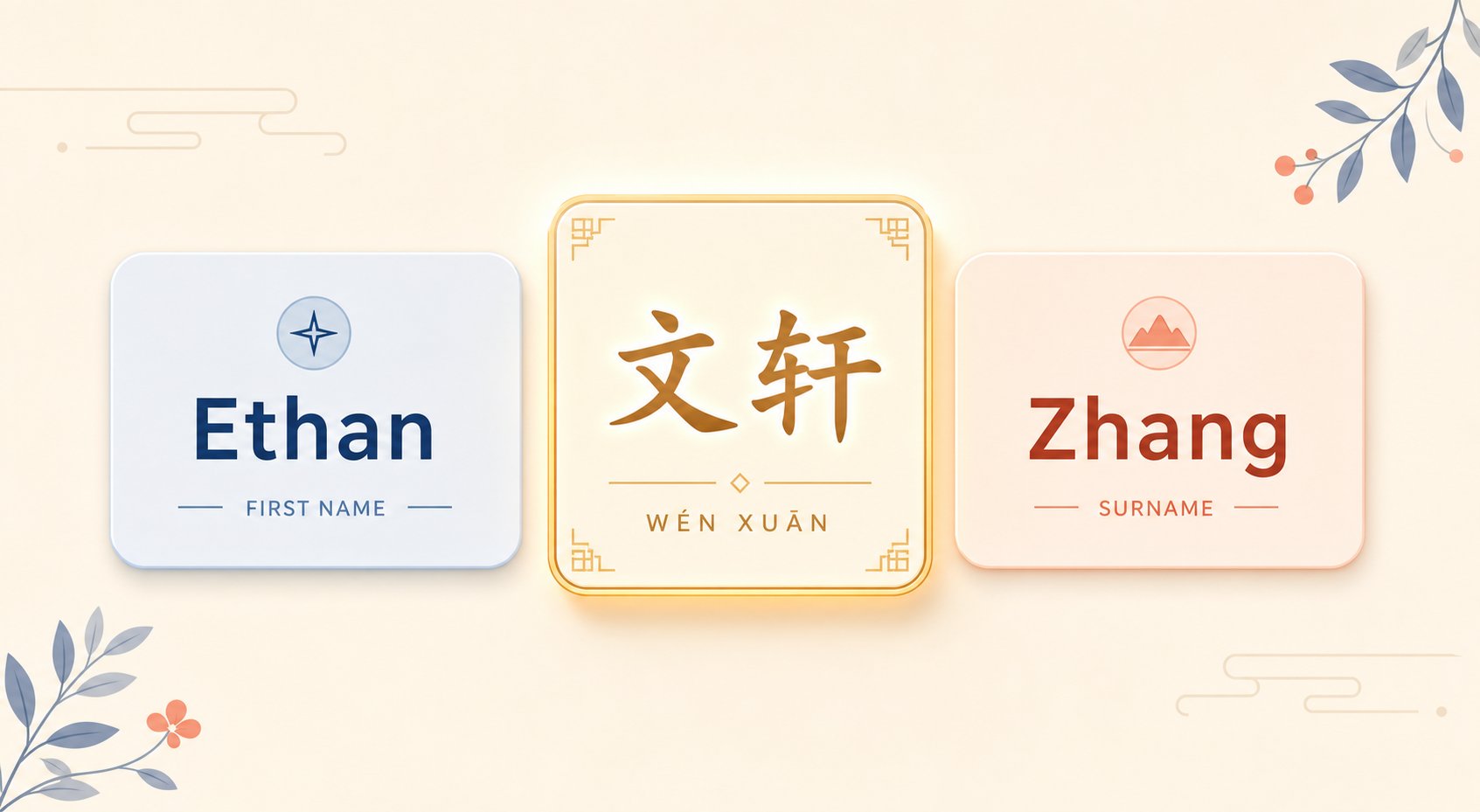
Here's where it matters for your decision: when you use a Chinese name as a middle name in a Western format, you're typically using only the given name portion, not the surname. Your structure becomes [Western first name] + [Chinese given name] + [Family surname]. For example: Emily Mingzhu Chen. The chinese first names portion (Mingzhu) sits in the middle position, while the family surname anchors the end.
| Structure | Example | Common Usage | Best as Middle Name When... |
|---|---|---|---|
| Single-character given name | Wei (伟) | More common in older generations and formal contexts | You want brevity, or your Western first name is already multi-syllabic |
| Two-character given name | Mingzhu (明珠) | Most common in modern naming; allows richer meaning | You want layered meaning and don't mind a longer full name |
A single-character given name keeps your full legal name compact. A two-character given name gives you more room to balance meaning, tone, and visual form. Neither is inherently better. The right choice depends on how the name sounds alongside your other names and how much meaning you want packed into that middle position.
Generational Names and Family Traditions
Within two-character given names, one character sometimes isn't a personal choice at all. The generational name tradition (字辈, zibei) assigns a shared character to everyone in the same generation of a family. Siblings, cousins, and even distant relatives connected through the paternal line all carry this same character in their given name.
Imagine a family where all children of one generation share the character "Zhen" (振). You'd see names like Jia Zhenni, Jia Zhenhai, and Jia Zhenhua among siblings and cousins. The "Zhen" signals their generational position, while the second character distinguishes each individual. These generational characters often come from a generation poem composed decades or even centuries in advance. The poem selected in 1737 for Mao Zedong's family, for instance, prescribed characters spanning sixteen or more generations.
Not every family still follows this practice. Many lineages lost their generational poems over time, and the tradition declined significantly after 1949. But if your family does maintain one, that character is typically non-negotiable. It becomes the fixed element in your middle name, and your creative choice applies only to the remaining character.
For historical context, classical Chinese culture also included the chinese courtesy name (字, zi), a formal name received upon reaching adulthood. The courtesy name reflected maturity and scholarly character, and peers used it instead of the given name as a sign of respect. While the courtesy name tradition has largely faded from daily life, understanding it helps you appreciate why names and characters carry such weight in Chinese culture. A name was never just a label. It was a marker of identity, stage of life, and social relationship.
With this structural map in hand, you know exactly what you're selecting: one or two characters for the given-name portion, potentially constrained by a generational character, destined to sit between a Western first name and your family surname. The next question becomes which characters deserve that position, and that's where meaning, connotation, and gender associations enter the picture.
Step 3 Select Characters by Meaning and Connotation
Every Chinese character carries layers: a core definition, cultural connotations, visual weight on the page, and associations that shift depending on who reads it. Two characters might both translate to "beautiful" in English, yet one evokes delicate flowers while the other suggests grand landscapes. Understanding chinese name meaning at this depth is what separates a thoughtful choice from a random pick.
Search Characters by Meaning Category
Rather than scrolling through endless lists, start by identifying the category of meaning you want your name to express. Think of it as choosing a theme before writing a story. Chinese dictionaries and naming resources organize characters into clusters that share conceptual territory, making it far easier to compare options side by side.
Here are the most common meaning categories people draw from when exploring chinese name meanings:
- Nature — characters evoking the natural world. Examples: 林 (lin, forest), 海 (hai, ocean), 雪 (xue, snow), 岚 (lan, mountain mist), 松 (song, pine tree).
- Virtues and character — qualities you aspire to embody. Examples: 诚 (cheng, sincerity), 仁 (ren, benevolence), 信 (xin, trustworthiness), 德 (de, virtue).
- Strength and resilience — characters suggesting power or endurance. Examples: 刚 (gang, steel-strong), 毅 (yi, perseverance), 伟 (wei, greatness), 志 (zhi, ambition).
- Beauty and grace — aesthetic qualities and elegance. Examples: 婷 (ting, graceful), 秀 (xiu, elegant), 美 (mei, beautiful), 瑶 (yao, precious jade).
- Wisdom and learning — intellectual aspirations. Examples: 慧 (hui, wisdom), 思 (si, thought), 博 (bo, broad knowledge), 明 (ming, bright/clear).
A practical approach: open a Chinese dictionary or a resource like EChineseLearning's naming guide, search by your chosen theme, and list five to ten candidate characters. Then compare them not just by definition, but by how they feel when written, how they sound, and what associations a native speaker would bring to them.
Evaluate Connotation and Gender Associations
Here's where meaning chinese names gets nuanced. Many characters carry gendered weight, even though no formal rule prevents anyone from using them. Recognizing these patterns helps you make an intentional choice rather than an accidental one.
Chinese feminine names tend to feature characters with the female radical 女 (like 妤, 娜, or 婉), characters related to flowers and plants (莉, 兰, 荷), or words suggesting grace and softness. The Chairman's Bao notes that repeated characters, like in the celebrity names 高圆圆 and 范冰冰, also signal femininity in Chinese naming culture. If you're exploring chinese first names female options, these patterns give you a starting framework.
Chinese masculine names lean toward characters conveying strength, ambition, or natural grandeur. The radicals 木 (wood/tree) and 钅 (metal) appear frequently in male names. Characters like 刚, 伟, 峰 (peak), and 龙 (dragon) carry strong masculine associations. For chinese first names male, think characters that suggest solidity, aspiration, or expansiveness.
That said, many names and characters sit comfortably in gender-neutral territory. Characters like 明 (bright), 思 (thought), and 安 (peace) work across genders without raising eyebrows. If you prefer a name that doesn't lean in either direction, these versatile characters give you room to move.
When evaluating connotation, also consider stroke count as a visual factor. A character with three strokes looks spare and modern when written. A character with fifteen strokes looks dense and classical. Neither is better, but pairing two visually mismatched characters can feel unbalanced on paper. Write your candidates by hand or view them in a standard font to check whether they sit well together.
Simplified vs Traditional Character Choice
Your family background determines which character set to use. Simplified Chinese is standard in mainland China and Singapore. Traditional Chinese is used in Hong Kong, Taiwan, and many overseas Chinese communities established before the 1950s simplification reforms.
Why does this matter for a middle name? Because the same character can look dramatically different across the two systems. The character for "dragon" is 龙 in simplified form and 龍 in traditional. The meaning is identical, but the visual identity, stroke count, and even the aesthetic impression shift significantly. If your family writes in traditional characters, choosing the simplified version may feel disconnected from the heritage you're trying to honor.
A practical rule: match the character set your family uses. If your grandparents write in traditional characters, use traditional. If your family is from mainland China and uses simplified, go with simplified. If you have no family connection and are choosing a name for professional or personal reasons, simplified is the more widely recognized system globally, but traditional carries a classical elegance that some people prefer.
Keep in mind that some characters are identical in both systems. Simple, low-stroke characters like 明, 安, or 林 didn't change during simplification. Choosing one of these sidesteps the question entirely.
With your characters narrowed by meaning, connotation, gender fit, and script form, the next layer of refinement is sonic. How these characters sound together, and how they translate into romanized spelling, can make or break a name that looks perfect on paper.
Step 4 Test Phonetic Harmony and Romanization
A name can carry beautiful meaning and still sound clunky when spoken aloud. Chinese is a tonal language, which means the pitch pattern of each syllable isn't decorative — it changes the word entirely. When you pair characters together, their tones interact. Some combinations flow like music. Others stumble. And once those characters get converted into pinyin and then into English spelling, another layer of information disappears. Testing for phonetic harmony and romanization quality is where your chinese name translation moves from a concept on paper to something that actually works in daily life.
Tonal Patterns That Sound Natural Together
Mandarin has four main tones plus a neutral tone: first tone (high and flat), second tone (rising), third tone (dipping then rising), fourth tone (sharp falling), and fifth tone (light and unstressed). When two characters sit next to each other, their tonal combination creates a rhythm. Some pairings feel effortless to say. Others force the speaker into awkward vocal gymnastics.
The most common pitfall? Placing two third-tone characters back to back. As Yoyo Chinese explains, Mandarin has a built-in rule for this: when two third tones appear consecutively, the first shifts to a second tone in natural speech. So "ni hao" (你好) is actually pronounced "ni hao" with a rising tone on "ni." This isn't wrong — it's how native speakers talk. But if your chosen name forces multiple tone changes, it can feel unnatural or confusing to people unfamiliar with the rule.
Generally, varied tonal patterns sound more pleasing. A combination like second tone followed by fourth tone (rising then falling) creates a natural arc. Two fourth tones in a row can sound abrupt. A first tone followed by a second tone feels smooth and open. Say your candidate name aloud several times, paying attention to whether the tones create a comfortable rhythm or whether your voice has to work against itself.
Stroke Count and Visual Balance
Phonetics matter when the name is spoken. Stroke count matters when it's written. Traditional naming practices consider the visual weight of characters sitting side by side. A character with four strokes next to one with twenty strokes looks lopsided — like pairing a haiku with a paragraph.
According to ThoughtCo's guide on stroke-based naming, Chinese characters are classified as Yin (even stroke count) or Yang (odd stroke count), and traditional practice seeks balanced Yin-Yang patterns across the full name. The total stroke count of a name ideally falls within specific auspicious numbers, and the characters should follow patterns like Yang-Yang-Yin or Yin-Yang-Yang.
Even if you don't follow numerological traditions strictly, visual balance still matters aesthetically. Write your candidate characters together by hand or display them in a standard font like SimSun. Do they look like they belong together? A name that appears harmonious when written carries a subtle sense of intentionality that native readers notice, even subconsciously.
Choosing Characters That Romanize Well
Here's the problem most guides ignore: every step from Chinese character to pinyin to English spelling loses information. The character 诗 becomes "shi" in pinyin, which could also represent 十, 石, 时, or 师 — all completely different characters with different meanings. When someone sees "Shi" on a business card or passport, the richness of your chosen character vanishes. This is the core challenge of any chinese translation for names that must function across languages.
When converting chinese names into english, some pinyin spellings fare better than others. "Xiu" is relatively distinctive. "Li" is not — it maps to dozens of characters and is also a common surname. If your name needs to work in English-language contexts where people will only ever see the romanized form, prioritize characters whose pinyin spelling is less ambiguous.
The process of going from english to chinese name (or the reverse) always involves compromise. But you can minimize confusion by choosing characters whose romanized form is pronounceable for English speakers, doesn't accidentally spell an unfortunate English word, and retains some distinctiveness among common pinyin syllables. A chinese name from english name conversion faces the same challenge in reverse — phonetic approximation always sacrifices something.
Use this checklist to test your candidates before committing:
- Say the full name aloud (Western first name + Chinese middle name + surname) five times quickly. Does it flow, or do you trip over certain syllable transitions?
- Check the tone combination between your chosen characters. Avoid pairing two third tones unless you're comfortable with the automatic tone-change rule.
- Write the pinyin spelling and show it to someone unfamiliar with Chinese. Can they pronounce it reasonably close to correct on the first try?
- Search the pinyin online. How many other common characters share that exact spelling? If the answer is many, consider whether distinctiveness matters for your context.
- Verify the romanized spelling doesn't form an unintended word or abbreviation in English when combined with your other names.
A chinese translation for names that will live on legal documents, email signatures, and introductions deserves this level of testing. The characters you've selected might be perfect in meaning and visual form, but phonetic harmony and romanization quality determine whether the name feels natural in the bilingual life it's about to enter.
Sound and spelling, though, aren't the only traditional frameworks that shape character selection. Some families layer an additional system on top of meaning and phonetics — one rooted in elemental balance and the cosmological relationship between a person's birth time and the natural world.
Step 5 Consider Five Elements and Traditional Naming Practices
Some families don't stop at meaning and sound. They add another layer: elemental balance. The Five Elements framework (五行, Wu Xing) is one of the oldest systems of chinese name interpretation, and it still shapes how traditional families and professional namers select characters. You don't have to follow it. But if a Chinese-speaking relative or naming consultant brings it up, understanding the basics keeps you in the conversation rather than lost outside it.
The Five Elements Framework Explained
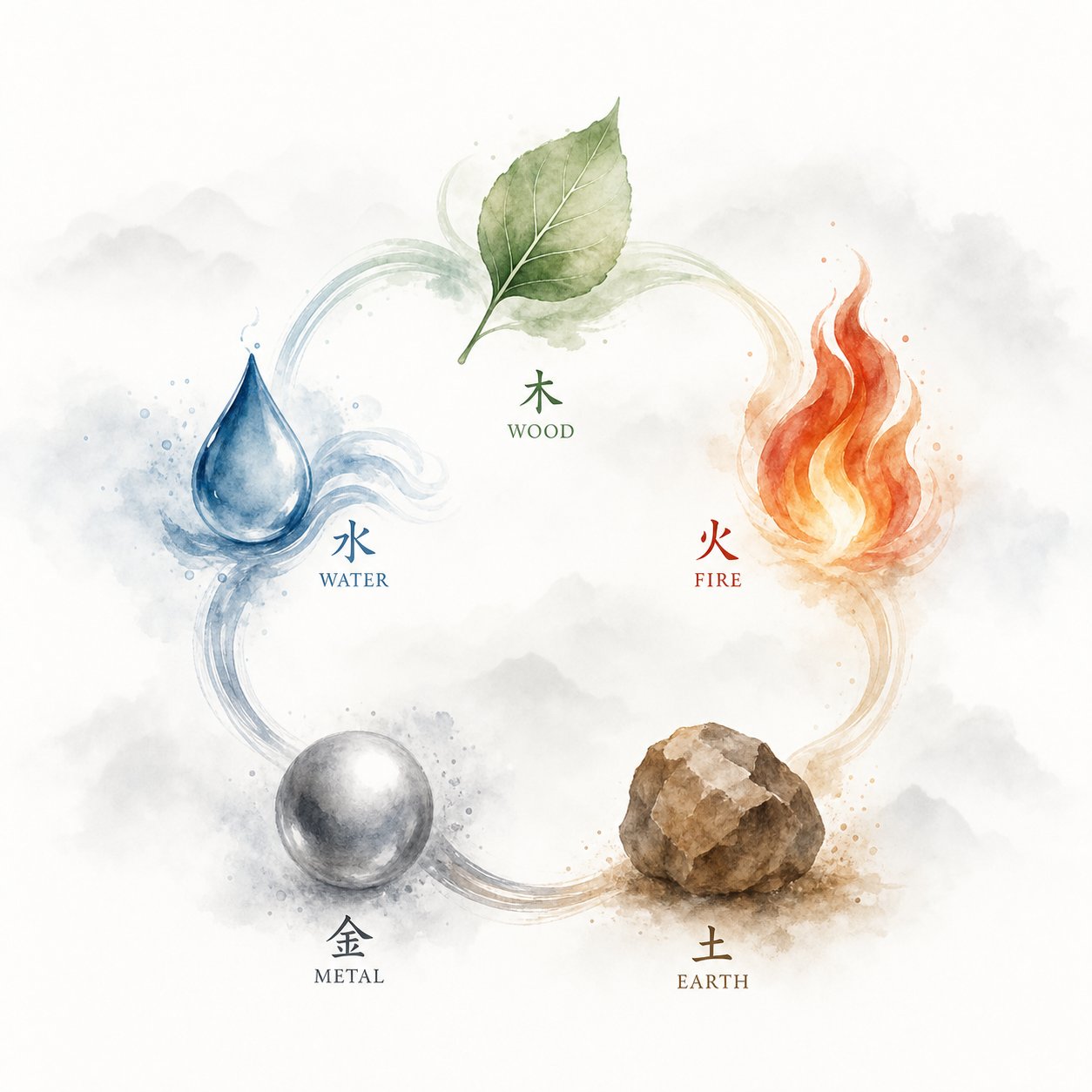
Wu Xing translates more accurately as "Five Phases" or "Five Movements" rather than "Five Elements." The character 行 (xing) means "to move," suggesting dynamic energy patterns rather than static substances. First documented in the Book of Documents around 1000 BCE, this system describes five phases of energy — Wood, Fire, Earth, Metal, and Water — that cycle through creation and control relationships.
In naming, the idea works like this: your birth date and time (calculated through a system called BaZi, or Four Pillars of Destiny) reveal which elements are strong, weak, or missing in your personal chart. A name then compensates for imbalances by introducing characters associated with the element you lack. If your chart shows a Water deficiency, for example, a namer might suggest characters containing the water radical (氵) to restore equilibrium.
This practice is rooted in the same cosmological thinking behind ancient chinese names, where naming was considered an act of aligning a person with natural forces. The generating cycle (Wood feeds Fire, Fire creates Earth, Earth bears Metal, Metal collects Water, Water nourishes Wood) and the controlling cycle (Water quenches Fire, Fire melts Metal, etc.) both factor into which elements support or conflict with your existing chart.
Is this required? No. Many modern families skip it entirely. But in traditional households — particularly those consulting a naming master — elemental balance carries real weight in the final decision.
Matching Elements to Characters
Each element connects to specific radicals, the structural building blocks of Chinese characters. This is what makes the system practical rather than purely abstract. When you know which element you need, you can filter your character search by radical and immediately narrow your options to characters carrying that elemental energy.
Here's how the five elements map to radicals, example characters, and the qualities they represent:
| Element | Associated Radicals | Example Characters | Personality Traits |
|---|---|---|---|
| Wood (木, mu) | 木 (wood), 艹 (grass) | 林 (lin, forest), 芳 (fang, fragrant), 桐 (tong, paulownia) | Creative, ambitious, flexible, growth-oriented |
| Fire (火, huo) | 火 (fire), 灬 (fire dots) | 炎 (yan, flame), 煜 (yu, radiant), 照 (zhao, illuminate) | Passionate, charismatic, expressive, warm |
| Earth (土, tu) | 土 (earth), 山 (mountain) | 坤 (kun, earth/feminine), 岳 (yue, peak), 城 (cheng, city) | Nurturing, reliable, stable, grounded |
| Metal (金, jin) | 金 (metal), 钅 (metal variant) | 鑫 (xin, prosperity), 铭 (ming, inscription), 锐 (rui, sharp) | Disciplined, precise, principled, decisive |
| Water (水, shui) | 氵 (water), 雨 (rain) | 涵 (han, contain), 泽 (ze, marsh/grace), 润 (run, moist) | Wise, adaptable, introspective, fluid |
Notice how the mandarin name meaning of each character connects to its element's energy. 泽 (ze) doesn't just contain the water radical — its meaning of "marsh" or "beneficence" evokes water's quality of nourishing everything it touches. 铭 (ming), meaning "to engrave" or "inscription," reflects Metal's nature of permanence and precision. The best elemental naming choices align radical, meaning, and energetic quality all at once.
A practical tip: if you're not working with a BaZi specialist, you can still use this table as a filtering tool. Decide which personality qualities you want the name to carry, find the matching element, and then explore characters within that radical family. You'll end up with options that satisfy both the meaning-based approach from Step 3 and the elemental logic that traditional families value.
Whether you embrace the Five Elements fully or simply use it as one more lens for evaluating candidates, this framework highlights something important: in Chinese naming tradition, characters aren't chosen in isolation. They exist in relationship — to each other, to the person's birth chart, and to the cultural forces that give them weight. That relational thinking also applies to what you avoid, because certain character choices carry risks that no amount of elemental balance can offset.
Step 6 Avoid Cultural Taboos and Common Mistakes
A name can score perfectly on meaning, tone, and elemental balance — and still be unusable because it triggers a cultural taboo invisible to non-native speakers. Chinese naming carries centuries of accumulated social rules about what you don't say, and these rules aren't written in any dictionary. They live in the reactions of native speakers who hear your name and wince.
This is where many people stumble. Even typical chinese names that seem safe on paper can hide pitfalls when spoken aloud or read in a different regional context. The mistakes below are the ones that matter most.
Homophone Pitfalls to Check
Chinese is dense with homophones — characters that sound identical or nearly identical but carry wildly different meanings. A character you chose for its beauty might, when combined with another character, produce a sound that evokes something unfortunate.
The classic example: 思 (si, to think) paired with 旺 (wang, prosperous) seems like a positive combination. But say "Siwang" aloud and you're essentially saying 死亡 (death). The tones differ slightly, but the resemblance is close enough to make every native speaker uncomfortable.
Here are the most common naming mistakes driven by sound:
- Characters sounding like 死 (si, death) — Any combination where syllables approximate "si" in the third tone next to certain other characters risks evoking mortality. The number 4 (四, si) carries the same stigma.
- Characters sounding like vulgar language — 日 (ri) means "sun" but doubles as a profanity in colloquial speech. 草 (cao, grass) carries a similar vulgar meaning in some regions. Both are risky in name combinations.
- Accidental insults through number associations — The number 250 (二百五) is a well-known insult meaning "fool" in northern China. Characters whose tonal pattern echoes "er bai wu" should be avoided.
- Overly literal translations that backfire — Direct transliterations of Western names can produce unfortunate sounds. "Charlotte" rendered as "Xialuote" resembles the phrase "sha le ta" (kill him/her) in Mandarin.
- Characters that are fine alone but problematic paired — Each character in isolation might be beautiful. Together, their combined pronunciation creates an unintended word. Always test the full name as a spoken unit, not just individual characters.
The fix is straightforward but non-negotiable: say your candidate name aloud to a native Mandarin speaker and ask what it sounds like. Don't explain the characters first. Just let them hear it cold.
Historical and Cultural Name Taboos
Chinese culture maintains a deep taboo against using names that belong to revered figures. This isn't about copyright — it's about hierarchy and respect. During imperial dynasties, using a character from the emperor's name could result in punishment. That extreme enforcement is gone, but the underlying principle persists in social expectations.
Avoid using the full names of famous chinese names in politics, particularly modern leaders like 毛泽东 (Mao Zedong), 周恩来 (Zhou Enlai), or 邓小平 (Deng Xiaoping). Using a single character from their given names with a different surname is generally acceptable, but adopting their full given name reads as presumptuous or politically tone-deaf.
The same logic applies to common chinese names associated with historical villains, traitors, or figures with damaged reputations. A name that evokes a negative historical figure carries that baggage whether you intend it or not.
Another critical rule: never repeat a character from a living elder's name within your own family. In traditional families, this applies to grandparents, parents, uncles, and aunts. Even using a different character with the same pronunciation can be perceived as disrespectful. This taboo is rooted in Confucian hierarchy — repeating an elder's name implies you're placing yourself at their level.
One more pitfall: overly grandiose names. Characters like 帝 (emperor), 圣 (sage/saint), or 天 (heaven) used without subtlety can come across as arrogant. Typical chinese names express aspiration through indirection — suggesting greatness rather than claiming it outright.
Dialect Variations That Change Meaning
If your family speaks Cantonese, Hokkien, Teochew, or another Chinese dialect, your name needs to pass muster in that language too — not just Mandarin. The same character can sound completely different across dialects, and a name that's perfectly fine in Mandarin might produce an unfortunate homophone in your family's spoken language.
Consider how dramatically pronunciation shifts: the character 王 is "Wang" in Mandarin, "Wong" in Cantonese, "Ong" in Hokkien, and "Heng" in Teochew. Cantonese names follow different tonal rules (six tones instead of four), which means an entirely different set of homophones to watch for. A character that avoids all Mandarin pitfalls might land on a Cantonese homophone for something embarrassing.
The Asia Media Centre notes that in diaspora communities across Singapore and Malaysia, the way a name is spelled and pronounced signals ancestral regional origin. Your name doesn't just identify you — it places you within a linguistic community. If your family heritage is Cantonese, test your name with Cantonese speakers specifically. If it's Hokkien, find a Hokkien speaker to listen for problems.
A practical approach: once you've narrowed your character choices, run them through three checks. First, say the name in Mandarin and listen for unfortunate homophones. Second, say it in your family's dialect (if different) and do the same. Third, ask someone from an older generation in your family — they'll catch references and associations that younger speakers might miss.
These taboos aren't meant to paralyze your choice. They're guardrails. Most characters are perfectly safe. The goal is simply to eliminate the small number of options that would cause real social friction — so the name you commit to works smoothly across every context it enters, including the cross-linguistic reality of pairing it with Western names on legal documents.
Step 7 Pair Your Chinese Middle Name with Western Names
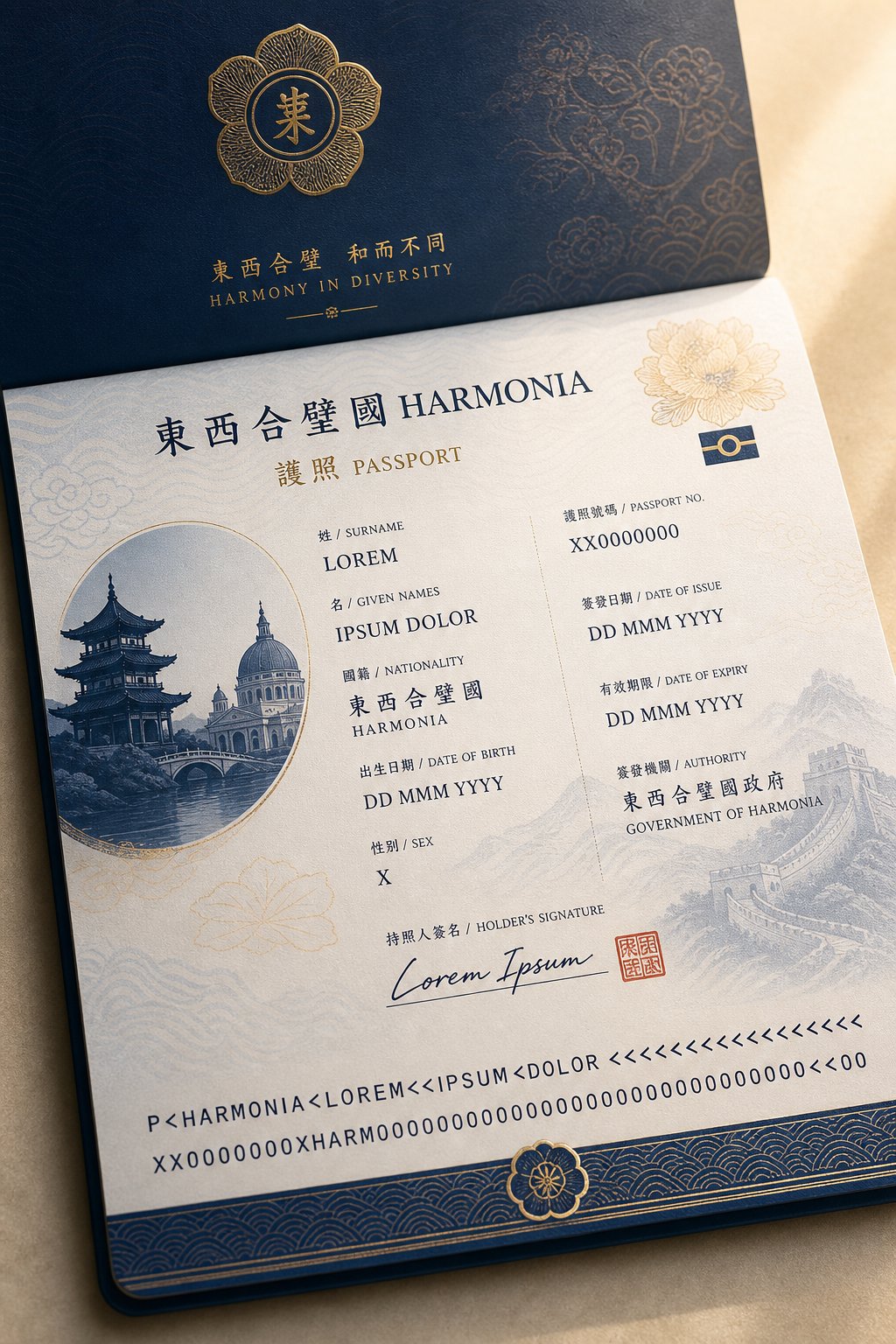
You've selected characters with strong meaning, tested their tonal harmony, and cleared them against cultural taboos. The name works beautifully in Chinese. But here's the reality: this name won't exist in isolation. It's going to sit between a Western first name and a surname on birth certificates, school enrollment forms, email signatures, and passport pages. The pairing needs to sound coherent when spoken aloud in English, look balanced on paper, and survive the formatting constraints of official documents without losing its identity.
This is where many people choosing asian middle names run into unexpected friction. A Chinese name that flows perfectly in Mandarin can create awkward syllable collisions when sandwiched between English names. And the bureaucratic reality of how names appear on legal documents introduces its own set of rules you need to anticipate.
Balancing Syllables Across Languages
Rhythm matters more than most people realize. When you say a full name aloud — first, middle, and last — your ear naturally expects a certain cadence. Three monosyllabic names in a row (like "John Wei Smith") sound clipped and staccato. Four syllables followed by one followed by three (like "Alexander Wei Patterson") creates an uneven weight distribution where the middle name almost disappears.
A practical guideline: vary your syllable counts across the three name positions. If your Western first name is short (one syllable), a two-character Chinese middle name adds welcome length and rhythm. Think "Grace Mingzhu Chen" — the syllable pattern moves 1-2-1, creating a natural rise and fall. If your first name is already long, one syllable middle names keep the full name from becoming unwieldy. "Evangeline Wei Torres" flows more easily than "Evangeline Mingzhu Torres."
For parents considering two syllable girl names or two-character options for any gender, test the full combination by saying it as if you're introducing yourself at a meeting. Does it feel like one continuous name, or does the Chinese portion stick out as a foreign insert? The goal is integration, not camouflage — you want the name to sound like it belongs together while still clearly carrying its Chinese identity.
Watch for these specific sound collisions across languages:
- Ending and beginning consonant clusters — If your first name ends in a hard consonant (like the "k" in Mark) and your Chinese middle name starts with a similar sound (like "Kai"), the transition can feel abrupt. "Mark Kai" forces a glottal stop that "Mark Lian" avoids.
- Repeated vowel sounds — "Maya Mei" creates an echoey quality that some people love and others find sing-songy. Decide intentionally whether you want that repetition.
- Unintended English words — Say the last syllable of your first name and the first syllable of your Chinese name together quickly. Do they accidentally form an English word? "Anna Ning" is fine. "Donna Li" spoken fast can blur into something else.
The simplest test: say the full name ten times at conversational speed. If you stumble, others will too.
Legal Documents and Passport Formatting
How your Chinese middle name appears on official documents depends on the issuing country's conventions and the specific form you're filling out. This is a practical concern with real consequences — inconsistent formatting across documents can trigger identity verification issues down the line.
The core question is whether to use pinyin (the standard romanization of Mandarin), an anglicized spelling, or names with a hyphen connecting two-character given names. Each approach has tradeoffs.
Pinyin uses the official romanization system: "Mingzhu" stays as one word, "Xiu" keeps its "X" spelling even though English speakers may struggle with it. This is the most linguistically accurate option and matches how chinese names for english names appear on Chinese passports.
Anglicized spelling adapts the pronunciation for English readers: "Mingzhu" might become "Ming-Ju" or "Ming Chu." This sacrifices standardization for accessibility but can create discrepancies if you later need documents that match a Chinese passport.
Hyphenated format connects two-character names: "Ming-Zhu" signals that both syllables form a single name unit rather than two separate middle names. This is common in Taiwanese passport conventions and helps prevent systems from splitting your name incorrectly.
According to SEVP's name standards for official U.S. documents, the Machine-Readable Zone (MRZ) of passports follows strict rules: no hyphens (replaced by filler characters), no special characters, and names limited to 39 characters on the first line. This means your carefully hyphenated "Ming-Zhu" becomes "MING Here's how a Chinese middle name typically appears on different document types: A critical practical point: whatever format you choose for the birth certificate becomes your baseline. Every subsequent document — passport, driver's license, Social Security card — needs to match or be reconcilable with that original record. Name discrepancies across documents are one of the most common sources of bureaucratic headaches for multicultural families, triggering identity verification delays and requests for additional evidence. Decide your formatting once, document it clearly, and maintain consistency. If you're using a two-character Chinese name as a middle name, decide upfront: is it one middle name ("Mingzhu") or two ("Ming Zhu")? This distinction matters because some government systems treat spaces as name separators. "Emily Ming Zhu Chen" might be read as having two middle names. "Emily Mingzhu Chen" keeps it unambiguous. The hyphenated form "Emily Ming-Zhu Chen" splits the difference but introduces the hyphen-stripping problem on machine-readable documents. The safest approach for most families: write the two-character Chinese name as a single unhyphenated word in pinyin on the birth certificate. This creates the least friction across systems while preserving the name's unity. You can always add hyphens or characters in informal contexts without affecting your legal documents. With your name paired, formatted, and tested across both languages, one final step remains: validating the complete choice against real-world feedback before making it permanent. You've done the research. You've selected characters with intention, tested their sound, checked for taboos, and formatted the name for legal documents. But before you sign a birth certificate or file paperwork, one more step separates a good name from a name you'll feel confident about for decades: real-world validation. No chinese name converter tool or online generator can replace the judgment of people who grew up speaking the language. As Hacking Chinese emphasizes, checking your name with several native speakers is "absolutely crucial" because connotations and emotional associations are nearly impossible for non-native speakers to fully grasp on their own. A name in chinese carries cultural weight that dictionaries don't capture. Run through each of these steps before committing. Skip none of them. That waiting period matters more than people expect. A chinese name convert process that moves from research to final decision in a single afternoon often produces regret. Names settle into identity slowly. Give yours time to prove it belongs. For multicultural families and diaspora communities, a Chinese middle name exists at the intersection of heritage and lived experience. Maybe you grew up hearing Cantonese at home but never learned to write characters. Maybe you're a non-Chinese parent honoring your partner's culture for your child. Maybe you're reclaiming something your family set aside generations ago to assimilate. None of these paths is more or less valid than another. What matters is that the name feels authentic to the person carrying it — not performative, not borrowed without care, but genuinely chosen with understanding. Your name doesn't need to be perfect by some abstract standard. It needs to be yours — researched with respect, tested with honesty, and carried with confidence. That's what transforms characters on a page into identity. Traditional Chinese names don't include a middle name in the Western sense. A Chinese name consists of a surname followed by a one- or two-character given name. However, the generational name (字辈) functions similarly by placing a shared family character within the given name. In Western countries, many multicultural families place a Chinese given name in the middle name position of a legal name, creating a hybrid format like Emily Mingzhu Chen. Yes, non-Chinese individuals can choose a Chinese middle name for professional, academic, or personal reasons. The key is approaching the process respectfully: research character meanings thoroughly, consult native speakers to avoid unintended connotations or taboos, and select characters that reflect genuine values rather than superficial aesthetics. Working with a native-speaking friend or professional namer helps ensure the result feels authentic rather than appropriative. Match the character set your family uses. If your heritage connects to mainland China or Singapore, simplified characters are standard. If your family roots are in Hong Kong, Taiwan, or older overseas communities, traditional characters are appropriate. For those without a family connection, simplified is more widely recognized globally, though traditional carries classical elegance. Some simple characters like 明, 安, and 林 are identical in both systems, avoiding the choice entirely. For most families, writing a two-character Chinese name as a single unhyphenated pinyin word on the birth certificate creates the least friction across systems. For example, 'Emily Mingzhu Chen' rather than 'Emily Ming Zhu Chen' or 'Emily Ming-Zhu Chen.' Passport machine-readable zones strip hyphens and special characters automatically. Whatever format you choose on the birth certificate becomes your baseline for all subsequent documents, so consistency from the start prevents identity verification issues later. The most critical mistakes involve homophones that sound like negative words (especially those resembling 死/death or vulgar terms), using characters from a living elder's name within your family, choosing overly grandiose characters like 帝 (emperor) that seem presumptuous, and failing to test the name in your family's specific dialect. Direct transliterations of Western names can also produce unfortunate sounds in Mandarin. Always say the full name aloud to native speakers before committing.
Step 8 Validate Your Choice and Make It Official
Your Final Validation Checklist
Making the Name Yours
A Chinese middle name is a living connection to culture, not just a label. It grows with you, carries meaning forward across generations, and becomes part of how you move through the world.
Frequently Asked Questions About Choosing a Chinese Middle Name
1. Do Chinese people have middle names?
2. Can a non-Chinese person choose a Chinese middle name?
3. Should I use simplified or traditional Chinese characters for my middle name?
4. How do I format a Chinese middle name on legal documents?
5. What are common mistakes to avoid when choosing a Chinese name?