Understanding Chinese Genealogy Records Before You Begin
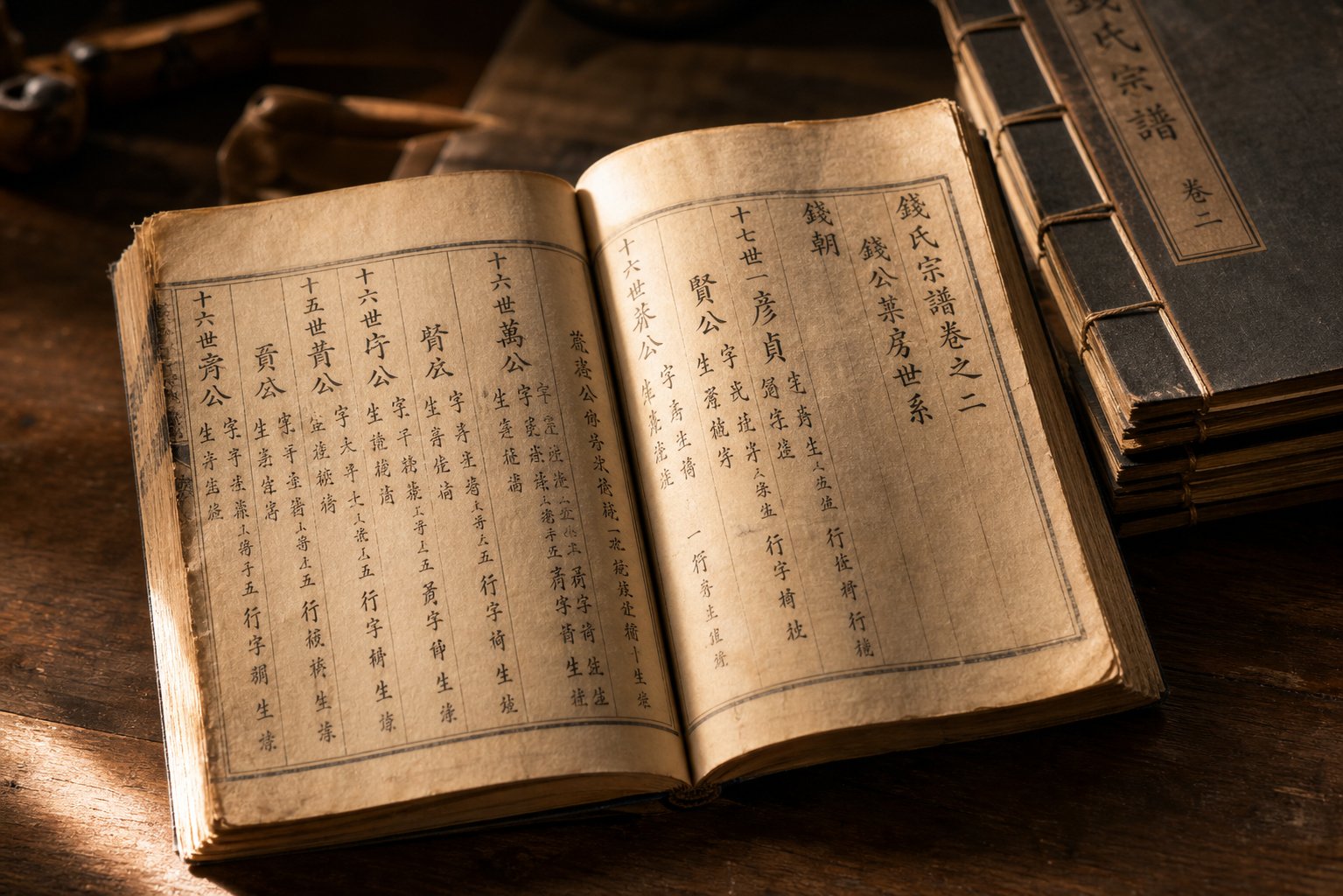
Imagine holding a handwritten book that traces your family back 500 years or more, generation by generation, with names, birth dates, marriages, and migration routes all recorded in ink. For millions of families of Chinese descent, that book exists. It is called a jiapu or zupu, and it may be the single most detailed genealogical document your family has ever produced. The challenge? It is written entirely in classical Chinese, reads from right to left, and follows conventions that look nothing like a Western family tree.
This guide teaches you how to read Chinese genealogy records using a systematic, step-by-step decoding process. You do not need fluency. You need pattern recognition, a reference vocabulary, and a clear workflow. By the end, you will know how to identify record types, orient yourself on a page, decode key characters for names and dates, extract relationship data, and record your findings in a usable format.
What Are Chinese Genealogy Records
A jiapu (家谱) or zupu (族谱) is a clan or family genealogy book. These records document lineage from a common ancestor downward through every generation of male descendants, often including wives' surnames, birth and death dates, burial locations, and biographical details. Unlike Western genealogies that typically trace lineage from an individual upward through both parental lines, Chinese genealogies start with a founding ancestor and document all descendants downward. Some jiapu span more than 500 years of continuous family documentation, with lineages periodically updating and reprinting their records across centuries.
These records gained widespread use during the Ming (1368-1644) and Qing (1636-1912) dynasties, when lineage membership carried real socioeconomic weight. Clans used them to manage collective property, organize villages, establish business networks, and support education. The tradition of keeping a jiapu served as a way to preserve and uphold a family's identity and honor across generations.
Who This Guide Is For
This guide serves two audiences: researchers with some Chinese literacy who need help navigating classical text conventions, and those with little or no ability to read Chinese who rely on character-matching strategies and digital tools. Both groups follow the same workflow:
- Identify your record type
- Orient yourself on the page
- Decode key characters using reference charts
- Extract names, dates, and relationships
- Record findings in your own research notes
You are not translating literature. You are extracting structured data from a document that follows predictable patterns. That distinction makes this achievable even without reading fluency.
Chinese genealogy records begin with a common ancestor and document all descendants downward, the opposite of Western genealogies that trace lineage upward from an individual. This means you read these records from the past forward, not from yourself backward.
With that foundational understanding in place, the real work begins with identifying exactly what type of record you are looking at and how its physical format shapes your reading strategy.
Step 1 Identify Your Record Type and Orient Yourself
The format of the document in your hands determines everything about how you extract information from it. A multi-volume clan genealogy requires a completely different reading strategy than a single-sheet lineage chart. Before decoding any characters, you need to identify what you are working with and understand how the page is physically organized.
Recognizing Different Record Formats
Chinese genealogy records come in several distinct formats, and the terminology on the cover or title page tells you the scope of what you are holding. The two most common types are the jiapu (家谱) and zupu (族谱), referring to a family genealogy and clan genealogy respectively. While these terms originally indicated different scopes, with zupu covering a broader clan network, they are now used interchangeably in many contexts.
Beyond these two, you will encounter more specific formats:
- Zhipu (支谱) - A branch genealogy documenting one specific branch of a larger clan. Smaller in scope, often a single volume.
- Fangpu (房谱) - Similar to a zhipu, recording one "room" or sub-branch of the family.
- Tongpu (统谱) or Huipu (会谱) - A unified genealogy combining multiple branches or even multiple clans sharing the same surname across a region.
- Shipu (世谱) - A generational record, often focused on the direct line of descent.
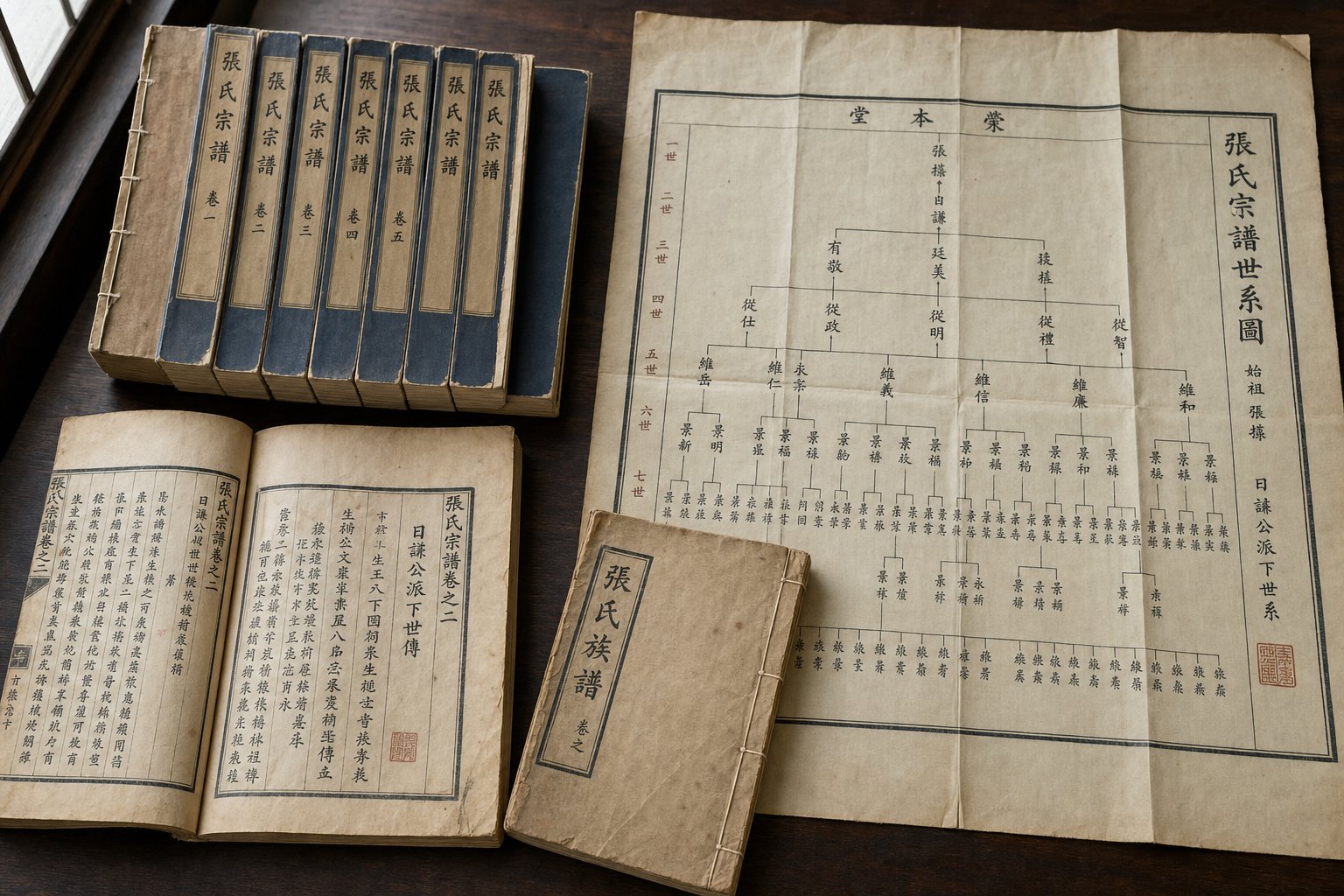
Visually, a comprehensive jiapu is easy to distinguish from a branch record. Comprehensive clan genealogies typically span multiple bound volumes, sometimes a dozen or more, with distinct sections covering everything from prefaces to lineage charts to biographies. A zhipu or fangpu, by contrast, is usually a single volume or a few thin booklets focused narrowly on one family line. Single-sheet lineage charts, sometimes called hanging charts, display an entire family tree on one large page in a visual tree or pagoda format.
The FamilySearch Jiapu Guide identifies five common layout styles you may encounter: Su Style (蘇式), which uses a hanging-pearl arrangement; Ou Yang Style (歐陽式), a horizontal format; Imperial Style (牒記式); Pagoda Style (寶塔式); and Document Style (文檔式), which reads more like continuous prose. Recognizing which style your record uses helps you predict where names, dates, and relationships will appear on the page.
Orienting Yourself on the Page
Here is where many researchers get stuck. Traditional Chinese text reads from right to left and top to bottom. When you open a traditional jiapu, the "first" page is what feels like the back cover to someone accustomed to Western books. Columns run vertically, and you read each column from top to bottom before moving to the next column on the left.
A few practical orientation tips:
- Find the binding edge. The spine of a traditional thread-bound book is on the right side when the text faces you correctly. If the binding is on your left, you are holding the book backward.
- Locate the title page. It appears on the first leaf when you open from the right. The title typically includes the surname, place of origin, and the word pu (谱).
- Identify the table of contents (mulu, 目录). Not all jiapu include one, but when present, it appears in the opening pages and lists section names with volume numbers, giving you a roadmap of the entire document.
- Look for prefaces (xu, 序). These appear at the very beginning and contain compilation dates, the names of editors, and often a brief clan origin story or migration history. If you see a date and a signature at the end of the opening text, you are reading a preface.
Section breaks in a jiapu are usually marked by a new heading written in slightly larger characters or set apart at the top of a new column. The shift from prose-style preface text to the structured, repetitive format of lineage entries is visually obvious once you know to look for it: prefaces flow as continuous text, while lineage sections use consistent spacing and indentation patterns that repeat for every individual.
One more factor affects your reading experience: whether the record is printed or handwritten. Woodblock-printed jiapu from the Qing dynasty feature uniform, clearly defined characters that are easier to match against reference charts. Handwritten records, especially those from the Republican era (1912-1949) or later manuscript copies, vary dramatically in legibility depending on the calligrapher's skill. If you are working with a handwritten record, expect to encounter characters that require cross-referencing with other entries in the same document to confirm your reading.
With your record type identified and the page orientation clear, the next step is understanding what lives inside each section of the document and where to find the specific genealogical data you need.
Step 2 Navigate the Physical Structure of a Jiapu
Every jiapu follows a recognizable internal logic. The sections of a Chinese jiapu are arranged in a deliberate sequence, moving from historical context at the front to detailed individual records in the middle and supplementary materials at the back. Think of it like a reference book: the introduction tells you why the book exists, the body gives you the data, and the appendices fill in the gaps. Knowing this structure lets you skip directly to the section that holds the information you need.
Navigating Prefaces and Clan Rules
The opening pages of most jiapu contain one or more prefaces (序, xu). These are not filler. Prefaces record the date the genealogy was compiled or revised, the names of the editors who organized the project, and often a narrative of the clan's origin and migration history. If your family moved from one province to another at some point in the past, the preface is likely where that story lives. When a jiapu has been revised multiple times over centuries, you may find several prefaces stacked in chronological order, each one written during a different compilation effort.
Following the prefaces, many jiapu include a clan rules section (家规, jiagui, or 家训, jiaxun). These passages outline behavioral expectations for clan members: how to treat elders, how to manage property disputes, how to conduct ancestral rites. While the rules themselves may seem less relevant to genealogical research, they frequently reference prominent ancestors by name and title. A clan rule that says "follow the example of our ancestor [Name] who served as magistrate in [Place]" gives you both a name and a career detail worth recording.
Reading Lineage Charts Versus Biographical Sections
The core genealogical data lives in two distinct section types, and understanding the difference between them saves significant time.
Lineage charts (世系图, shixi tu) are visual representations of family relationships. They display names arranged in a branching structure that shows parent-child connections at a glance. Reading these charts follows a specific order: the eldest son appears first (rightmost position in traditional layout), with younger sons branching to the left. Each generation occupies its own horizontal level. These charts give you the big picture, showing who belongs to which generation and how branches split, but they typically contain only names and generational positions.
Biographical entries (传, zhuan, or 世略, shilue) are where the rich detail lives. These prose sections provide individual records containing birth dates, death dates, marriage information, official titles, burial locations, and sometimes personality descriptions or notable achievements. When you are finding ancestors in jiapu biographical entries, you are extracting the specific data points that bring a name on a chart to life.
The practical workflow looks like this: use the lineage chart to locate your ancestor's position in the family structure, then cross-reference that person's name in the biographical section to pull detailed life information. Many jiapu number each individual or use generational markers that link a chart entry to its corresponding biography.
| Chinese Name | Romanization | English Meaning | Data to Extract |
|---|---|---|---|
| 序 | Xu | Preface | Compilation dates, editor names, clan origin story, migration routes |
| 家规 / 家训 | Jiagui / Jiaxun | Clan Rules / Family Teachings | Names of prominent ancestors, social context, location references |
| 世系图 | Shixi Tu | Lineage Chart | Names, generational positions, parent-child relationships, branch structure |
| 传 / 世略 | Zhuan / Shilue | Biographies | Birth and death dates, marriages, children, official titles, burial sites |
| 班次 / 字辈 | Banci / Zibei | Generation Poem | Generational naming characters, generation sequence, clan identity markers |
| 墓图 | Mutu | Cemetery Maps | Burial locations, geographic references, family land boundaries |
| 跋 | Ba | Postscript | Final compilation notes, additional editor names, printing details |
Not every jiapu contains all of these sections, and the order can vary. Some include ancestral portraits, property records, or maps of the ancestral village. But the structure above represents the standard framework you will encounter in most comprehensive clan genealogy books compiled during the Ming and Qing dynasties.
The structure of a Chinese clan genealogy book becomes predictable once you have seen a few examples. The real complexity begins when you start reading the characters within these sections, particularly the classical vocabulary used to record births, deaths, marriages, and official titles that appear throughout the biographical entries.
Step 3 Decode Classical Chinese Characters and Common Phrases
You do not need to learn thousands of characters to extract meaningful data from a jiapu. Genealogy records rely on a surprisingly small vocabulary of recurring terms. The same characters for "born," "died," "married," and "buried" appear hundreds of times within a single document. Once you can recognize these core terms, the repetitive structure of biographical entries does most of the work for you.
Before diving into the character reference chart, you need to understand one critical distinction: the difference between traditional and simplified Chinese characters. The FamilySearch Chinese Genealogical Word List notes that simplified characters have only had official sanction since 1954, meaning the vast majority of historical genealogy records use traditional characters. If your jiapu was compiled before the mid-twentieth century, you are almost certainly looking at traditional forms. Records compiled after 1954 in mainland China may use simplified characters, while those from Taiwan, Hong Kong, and overseas Chinese communities continued using traditional forms.
The other factor that affects interpretation is the style of written Chinese used. Older records, particularly those from the Ming and Qing dynasties, are written in classical Chinese (wenyanwen, 文言文), a highly condensed literary language where a single character often carries the meaning of an entire phrase in modern Chinese. A Qing-era entry might use the single character 卒 (zu) to mean "died," while a twentieth-century compilation might write the more vernacular 去世 (qushi, "passed away"). Both mean the same thing, but the classical form is far more compact. This compression actually works in your favor: fewer characters per entry means fewer characters you need to learn.
Essential Characters for Birth, Death, and Marriage
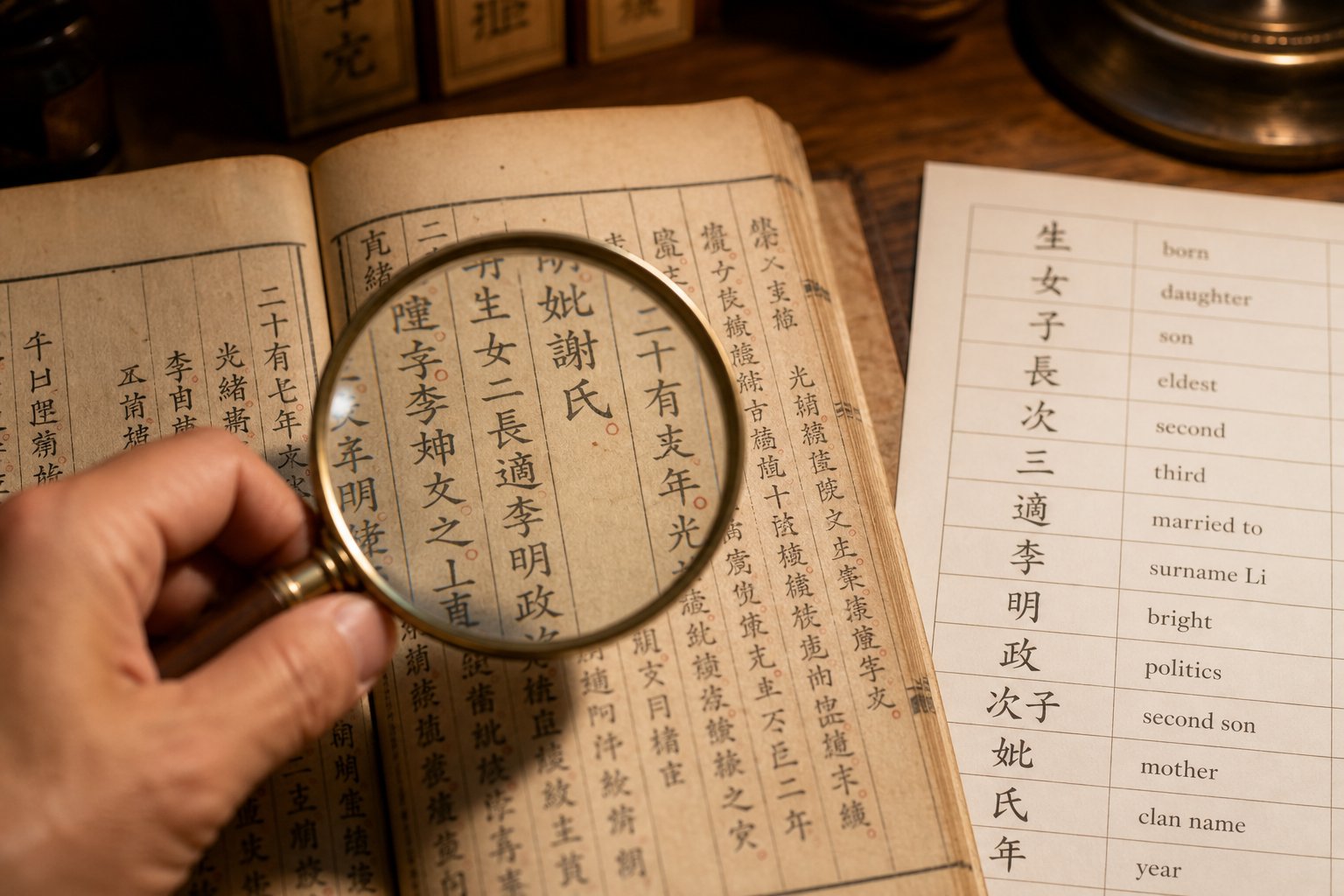
The following table is your core reference for the common Chinese characters in genealogy records. These are the terms you will encounter most frequently in biographical entries. Keep this Chinese genealogy character reference chart accessible while working through any jiapu.
| Traditional Character | Simplified Character | Pinyin | Meaning in Genealogy Context |
|---|---|---|---|
| 生 | 生 | sheng | Born / gave birth to |
| 卒 | 卒 | zu | Died (formal, used for officials) |
| 殁 | 殁 | mo | Died (general usage) |
| 亡 | 亡 | wang | Died / deceased |
| 配 | 配 | pei | Married to / spouse (formal) |
| 娶 | 娶 | qu | Married (took a wife, male subject) |
| 適 | 适 | shi | Married into (used for women marrying out) |
| 元配 | 元配 | yuanpei | First wife / primary wife |
| 繼配 | 继配 | jipei | Second wife (after first wife's death) |
| 妾 | 妾 | qie | Concubine |
| 側室 | 侧室 | ceshi | Concubine (literally "side room") |
| 嗣 | 嗣 | si | Heir / adopted heir (to continue the line) |
| 繼 | 继 | ji | Succeeded / adopted to continue lineage |
| 無嗣 | 无嗣 | wusi | No descendants / line ended |
| 葬 | 葬 | zang | Buried at |
| 墓 | 墓 | mu | Grave / tomb |
| 子 | 子 | zi | Son |
| 女 | 女 | nu | Daughter |
| 長子 | 长子 | zhangzi | Eldest son |
| 次子 | 次子 | cizi | Second son |
| 氏 | 氏 | shi | Clan / maiden surname marker (for women) |
| 諱 | 讳 | hui | Taboo name (formal given name of deceased) |
A few notes on usage: when you see 氏 (shi) following a single character, you are looking at a woman identified only by her maiden surname. For example, 陳氏 (Chen shi) means "woman of the Chen clan." The character 諱 (hui) signals that the formal given name follows, a convention used to show respect for the deceased. You will often see entries structured as [Surname] + 諱 + [Given name].
Recognizing Official Titles and Examination Degrees
Many biographical entries include titles or examination degrees before or after a person's name. These indicate social status and can help you distinguish between individuals with similar names. China's imperial examination system, which ran from 1646 through 1904 in its final form, produced records that include given names, family names, generation names, birthplace, and father/grandfather/great-grandfather names. When these degree holders appear in a jiapu, their titles are prominently noted.
Here are the most common examination degrees and official titles you will encounter:
- 進士 (jinshi) - The highest regular examination degree. Holders of this title passed the palace examination and were eligible for top government positions.
- 舉人 (juren) - Provincial-level degree holder. Passed the provincial examination and qualified for mid-level official posts.
- 秀才 (xiucai) - Entry-level degree. Passed the county-level examination, indicating basic scholarly achievement.
- 貢生 (gongsheng) - A student recommended to the national academy, a step between xiucai and juren.
- 官 (guan) - Official. Often followed by a specific position title.
- 知縣 (zhixian) - County magistrate.
- 知府 (zhifu) - Prefectural magistrate.
How do you tell a title from a name? Position on the page is your strongest clue. Titles appear immediately before the given name or in a separate notation line above or beside the main entry. They also tend to use characters that are never used as personal names. If you see 進士 or 舉人 adjacent to a name, those two characters are the title, not part of the name itself. Another giveaway: titles often appear in a slightly smaller font or are set off by specific formatting conventions within the entry.
Pattern Matching for Non-Readers
What if you cannot read Chinese at all? You can still extract data by treating the record as a pattern-recognition exercise rather than a reading task. Here is how to recognize Chinese characters without reading Chinese, using structural cues and repetition as your guide.
Genealogy entries follow rigid formatting. Every entry for every person in the same jiapu uses the same sequence of information in the same order. Once you decode one entry with help from a translator or reference tool, you have the template for every other entry in that section.
Practical strategies for non-readers:
- Use position as meaning. In a standard biographical entry, the first characters are always the name. Characters appearing after a consistent marker (like 生 for birth) are always a date. Characters after 配 or 娶 are always a wife's surname. The position within the entry tells you what category of information you are looking at.
- Identify repeating characters. Scan a full page of entries and look for characters that appear in the same position across multiple entries. A character that shows up at the start of every third line is likely a structural marker like 子 (son) or 配 (spouse).
- Match against the reference table. Print or save the character table above. Visually compare characters in the record against your reference, paying attention to stroke patterns rather than trying to "read" them. Even partial matches help narrow possibilities.
- Use digital tools for character lookup. If you have a digital image, tools like Google Translate's camera feature or handwriting-input dictionaries let you draw or photograph a character to identify it. For radical-based lookup, the FamilySearch word list explains that Chinese characters are structured around 214 radicals organized by stroke count, giving you a systematic way to look up unfamiliar characters.
- Track the surname character. Your family surname appears repeatedly throughout the record. Once you can recognize that single character, you can quickly scan pages to find entries relevant to your direct line.
The classical Chinese genealogy vocabulary list above covers roughly 80% of the functional terms you will encounter in biographical entries. The remaining 20% tends to be location names, descriptive phrases about character or achievements, and clan-specific terminology that varies between records. For those, context and cross-referencing with other entries in the same document will fill most gaps.
Characters and vocabulary give you the building blocks. But genealogy records also contain dates, and Chinese dates use systems entirely different from the Western calendar, requiring their own decoding approach.
Step 4 Read and Convert Chinese Dates to Western Calendar
Dates in Chinese genealogy records look nothing like what you are used to seeing. There is no "1847" or "March 15" waiting for you on the page. Instead, you will encounter phrases like "the twenty-seventh year of Qianlong, eighth month, fourteenth day" or a pair of obscure cyclical characters that designate a year within a repeating sixty-year loop. Reading dates in Chinese genealogy records requires understanding three overlapping systems: reign year dating, the sexagenary cycle, and the lunar calendar. Once you know how each system works, converting them to Western calendar equivalents becomes a straightforward mechanical process.
Reading Reign Year Dates
The most common dating method in jiapu from the imperial period is reign year dating (nianhao, 年号). During imperial times, the common method of designating years was to regard the reign of each emperor as constituting an era by itself, numbering the years as the first, second, third, and so on of that reign. The format follows a consistent pattern:
Era name + year number + month + day
For example, if an entry reads 光緒二年三月十四日, that breaks down as: Guangxu (光緒) + second year (二年) + third month (三月) + fourteenth day (十四日). Since the Guangxu Emperor ascended the throne in 1875, the second year of Guangxu corresponds to 1876.
Here are the reign periods you will encounter most frequently in genealogy records from the Qing dynasty (1644-1912), since this era produced the majority of surviving jiapu:
| Era Name (Traditional) | Pinyin | Start Year | End Year | Duration |
|---|---|---|---|---|
| 順治 | Shunzhi | 1644 | 1661 | 18 years |
| 康熙 | Kangxi | 1662 | 1722 | 61 years |
| 雍正 | Yongzheng | 1723 | 1735 | 13 years |
| 乾隆 | Qianlong | 1736 | 1795 | 60 years |
| 嘉慶 | Jiaqing | 1796 | 1820 | 25 years |
| 道光 | Daoguang | 1821 | 1850 | 30 years |
| 咸豐 | Xianfeng | 1851 | 1861 | 11 years |
| 同治 | Tongzhi | 1862 | 1874 | 13 years |
| 光緒 | Guangxu | 1875 | 1908 | 34 years |
| 宣統 | Xuantong | 1909 | 1911 | 3 years |
To convert a reign year date to the Western calendar, take the start year of the era and add the reign year number minus one. So "Qianlong 45th year" becomes 1736 + 44 = 1780. The subtraction of one accounts for the fact that the first year of a reign is year one, not year zero.
After the fall of the Qing dynasty, records compiled during the Republican period (1912-1949) use 民國 (Minguo, "Republic") as the era name. The new era became known as the Chinese Republic, starting in 1911, so Minguo year 37 corresponds to 1948. If you encounter 民國 followed by a number, simply add that number to 1911.
Understanding the Sexagenary Cycle
Alongside or sometimes instead of reign year dates, you will find years expressed using the Chinese sexagenary cycle, a system of sixty character pairs that repeat in an endless loop. This is where many researchers hit a wall, but the underlying logic is manageable once you see the pattern.
The cycle combines two sets of characters: ten Heavenly Stems (天干, tiangan) and twelve Earthly Branches (地支, dizhi). Each year is designated by a pair consisting of one stem and one branch. The ten Heavenly Stems in order are:
甲 (jia), 乙 (yi), 丙 (bing), 丁 (ding), 戊 (wu), 己 (ji), 庚 (geng), 辛 (xin), 壬 (ren), 癸 (gui)
The twelve Earthly Branches are:
子 (zi), 丑 (chou), 寅 (yin), 卯 (mao), 辰 (chen), 巳 (si), 午 (wu), 未 (wei), 申 (shen), 酉 (you), 戌 (xu), 亥 (hai)
You will recognize these Earthly Branches as the characters associated with the twelve Chinese zodiac animals. In genealogy records, when a sexagenary year appears, it is typically preceded by the expression 歲次 (suici, meaning "the year being") or followed by the character 歲 (sui, "year"). Spotting these marker characters helps you identify that the adjacent pair is a cyclical date rather than a name or place.
How do you convert a sexagenary pair to a Western year? Year 1 of the cycle (甲子, jiazi) began early in 1984, 1924, 1864, 1804, and so on, repeating every sixty years. If you can identify the pair's position in the sixty-year sequence and you know the approximate time period from context, you can pin down the exact Gregorian year. For example, if a record compiled during the Guangxu reign (1875-1908) mentions the year 丁未 (dingwei, pair number 44), and you know the cycle restarted in 1864, then 1864 + 43 = 1907.
Converting Lunar Calendar to Western Dates
Even after you have determined the correct year, the month and day in a Chinese genealogy record still do not map directly to the Gregorian calendar. Lunar calendar dates in Chinese family records follow a system where months are based on lunar cycles of approximately 29.5 days, meaning months are either 29 or 30 days long, and the year contains roughly 354 days. To keep the calendar aligned with the solar year, an intercalary month (閏月, runyue) is inserted approximately every three years.
This means that "third month, fourteenth day" in a Chinese record does not correspond to March 14. Depending on the year, the third lunar month might fall anywhere from late March to late April on the Gregorian calendar. For precise conversions, you need a dedicated conversion tool. The conversion calendar used by immigration officials, available through Harvard's library system, provides historical date correspondences. Online tools and published conversion tables for Chinese-Western date matching are also widely available for researchers who need exact Gregorian equivalents.
A practical tip: for most genealogical purposes, knowing the year accurately matters far more than pinpointing the exact day. If you can determine the reign year and convert it correctly, you have the most critical piece of chronological data. Exact day conversions become important primarily when cross-referencing with other dated documents like immigration records or civil registrations.
The same sexagenary cycle pair repeats every 60 years, so a date expressed only in cyclical characters without an accompanying reign year could refer to any of several possible years. Always use context from reign names, known generational spans, or surrounding entries to confirm which 60-year cycle applies.
Dates anchor individuals in time, but names anchor them in family structure. Chinese genealogy records assign multiple names to a single person, and a generational naming system embedded in the jiapu itself reveals exactly where each individual sits in the family hierarchy.
Step 5 Understand Naming Conventions and Generational Poems
A single ancestor in your jiapu might appear under three, four, or even five different names depending on the section you are reading. This is not an error or a sign of multiple people. In traditional Chinese society, men received a variety of first or given names at different stages of their life: a milk name at birth, a formal name, a courtesy name upon reaching maturity, a pen name, and sometimes a posthumous name. Understanding how Chinese naming conventions work in genealogy is essential for avoiding the mistake of treating one person as several, or merging several people into one.
Types of Names in Genealogy Records
When you encounter multiple names in Chinese family records, each one serves a distinct social function and appears in a predictable location within the entry. Here are the name types you will see most often:
- Ming (名) - Given name: The formal personal name assigned at birth or shortly after. This is the name most commonly recorded in lineage charts and biographical entries. In older records, it appears after the character 諱 (hui), which signals "the taboo name of the deceased is..."
- Zi (字) - Courtesy name: A name bestowed at the age of maturity (traditionally around 20 for men). This was the name used in daily social interactions, since calling someone by their ming was considered disrespectful. In jiapu entries, the zi typically appears after the marker character 字, making it easy to spot.
- Hao (號) - Pen name or style name: A self-chosen literary or artistic name. Scholars, poets, and officials often adopted one or more hao. These appear after the character 號 in biographical entries and are less consistently recorded than ming or zi.
- Shi (謚) - Posthumous name: An honorific name given after death, usually reserved for individuals of high status or particular virtue. These appear rarely and only in entries for prominent ancestors.
- Ru ming (乳名) - Milk name: A childhood nickname, sometimes recorded in parentheses or as a secondary notation. These informal names occasionally appear in immigration records when migrants gave officials their familiar name rather than their formal one.
How do you determine that all these names refer to the same person? Position within the entry is your strongest clue. A typical biographical entry presents names in sequence: surname + 諱 + ming + 字 + zi + 號 + hao. When you see this chain of marker characters followed by different names, you are reading one person's full identity, not a list of relatives.
Decoding Generational Poems and Naming Patterns
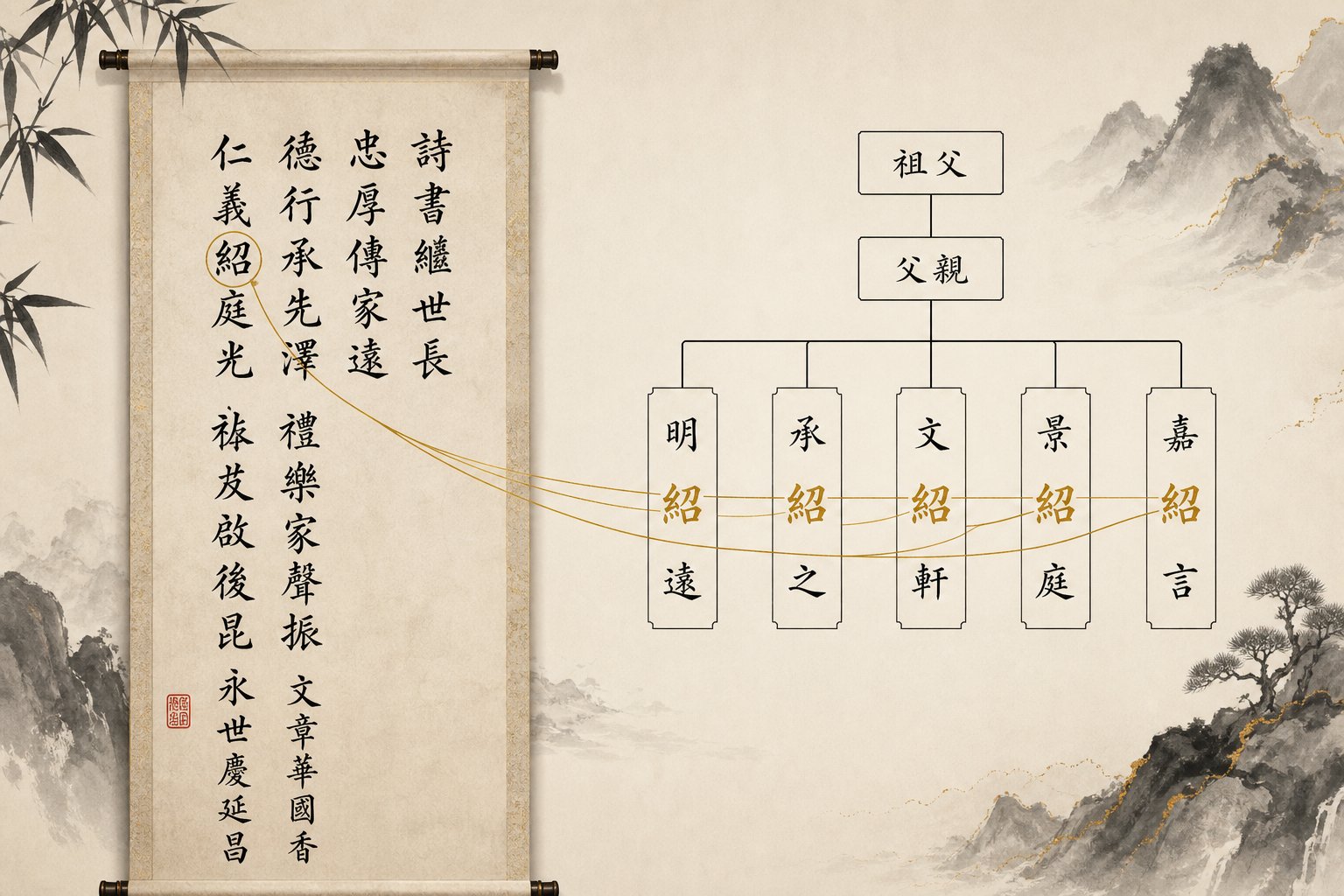
Here is where Chinese genealogy records offer something no Western record can match: a built-in system that instantly tells you which generation any individual belongs to. The generation poem (字辈, zibei, also called 班次, banci, or 排行, paihang) is a pre-composed sequence of characters, one assigned to each generation in order. Every male member of the same generation shares that character in his given name.
Imagine a poem with twenty characters. The founding ancestor's generation uses the first character. His sons' generation uses the second. His grandsons use the third. And so on, cycling through the poem across centuries of descendants. Because each clan's poem is unique, even a handful of generation characters can act like a fingerprint for identifying your family's records.
A concrete example from a real generation poem illustrates how this works in practice:
The generation poem assigns one character per generation in sequence. If the poem reads "立显荣朝士, 文方运际祥" (Li Xian Rong Chao Shi, Wen Fang Yun Ji Xiang), then the first ancestor's generation uses 立, his son's generation uses 显, his grandson's uses 荣, and so on through the poem.
So if you encounter three men named 李荣德 (Li Rongde), 李荣才 (Li Rongcai), and 李荣华 (Li Ronghua), the shared character 荣 (Rong) tells you immediately that all three belong to the same generation. They are brothers or cousins, not father and son. Their children's names would all share the next character in the poem: 朝 (Chao).
The placement of the generational character varies by clan. The generation character is most often the first given character, though in some families it comes second. In the example above, 荣 is the first character of the two-character given name. But in another clan, the generational character might be the second character instead, so you would see names like 李德荣, 李才荣, 李华荣. Knowing which position your clan uses is critical for correctly identifying generational groupings.
To locate the generation poem in a jiapu, look for the section labeled 字辈 (zibei) or 班次 (banci) in the front matter, often near the clan rules. It typically appears as a short verse arranged in lines of five or seven characters each. Some jiapu print the poem with annotations showing which generation has been reached at the time of compilation. If no formal poem section exists, you can often reconstruct the pattern by scanning names across consecutive generations in the lineage chart and noting which character repeats among siblings and cousins.
This pattern-recognition technique is powerful even for researchers who cannot read Chinese fluently. You do not need to understand the meaning of the generational character. You only need to recognize that the same character appears in the same position across names within one generational level. Once you identify the generational character for your ancestor's generation, you can scan the entire jiapu for anyone sharing that character in the same name position, instantly finding siblings, cousins, and other same-generation relatives you might otherwise miss.
One important caveat: generation poems were primarily created for male descendants. Women in the same generation might share a different generational character, or they might not follow the poem at all. Additionally, the practice declined significantly in mainland China during the mid-twentieth century, so records from that period onward may not follow generational naming patterns consistently.
Names tell you who someone is and where they sit in the generational hierarchy. But a name alone does not tell you who that person married, how many children they had, or which branch they belonged to. Those details live in the structured biographical entries, where names, dates, and relationships all come together in a standardized format waiting to be parsed.
Step 6 Extract Relationships and Biographical Details
You have the vocabulary. You can decode dates. You understand naming patterns. The real test is putting all of that together when you are staring at an actual biographical entry in a zupu, trying to figure out where one piece of data ends and the next begins. Parsing relationship data in jiapu records becomes manageable once you recognize that every entry follows the same internal sequence, person after person, page after page.
Reading a Standard Biographical Entry
A biographical entry in a Chinese genealogy is not free-form prose. It is a structured data record compressed into classical Chinese. The maximum amount of information recorded for individuals in these tables follows a predictable order, and once you internalize that order, you can extract data from any entry in the same jiapu without re-learning the format.
Here is the standard reading order for a male entry:
- Name and generational position - The entry opens with the surname, the formal given name (often preceded by 諱), and sometimes the courtesy name (字) and literary name (號). The generation number or branch designation may appear here as well.
- Relationship to father - A notation indicating whether this person is a natural son or adopted, and his birth order among siblings (長子 for eldest son, 次子 for second son, 三子 for third son).
- Education and official titles - If the individual held an examination degree or government post, it appears here. Characters like 進士, 舉人, or specific office titles signal this section.
- Birth date - Introduced by 生 (born) or 生於 (born on), followed by the reign year, month, day, and sometimes the hour.
- Marriage information - Introduced by 配 (spouse) or 娶 (married), followed by the wife's surname, sometimes her given name, her native place, and occasionally her father's name.
- Children - Sons listed by birth order with their names. Daughters may be listed separately, sometimes only by number.
- Death date - Introduced by 卒 (died) or 殁, followed by the date in the same format as the birth date.
- Burial location - Introduced by 葬 (buried at), followed by a place name and sometimes a directional description of the grave's exact position.
Not every entry contains all eight elements. Individuals who died young might have only a name and a death notation. Prominent ancestors might have lengthy biographical narratives inserted between the standard data points. But the sequence remains consistent: name first, death and burial last, with life events arranged chronologically in between.
Entries for women look fundamentally different. In traditional jiapu, women do not receive independent entries. Instead, a wife's information is embedded within her husband's entry, appearing after the marriage marker character. As the Cambridge Group for the History of Population notes, traditional genealogies listed female lineage members under their fathers' or husbands' names rather than giving them individual entries. You will typically find a woman's maiden surname followed by 氏 (shi), her birth and death dates if recorded, and sometimes her father's name and native village. Her own given name may or may not appear, depending on the era and region of compilation.
Interpreting Marriage and Children Records
Marriage notation in a zupu uses specific characters that tell you not just who someone married, but the status of that marriage within the family structure. Extracting marriage records from a Chinese zupu requires recognizing these distinctions:
- 元配 (yuanpei) - First wife, the primary marriage. This is the most common marriage notation you will encounter.
- 繼配 (jipei) or 繼娶 (jiqu) - A subsequent wife married after the first wife's death. This is not a concubine but a full-status replacement spouse.
- 側室 (ceshi) or 妾 (qie) - A concubine. Her entry appears after the primary wife's information and typically contains less detail.
Children are listed after the marriage information, and the notation system reveals birth order and maternal lineage simultaneously. Sons appear first, listed as 長子 (eldest son), 次子 (second son), 三子 (third), and so on. When a man had children by multiple wives or concubines, the sons are sometimes grouped by mother, with a notation like 側室出 (born of the concubine) or 繼配出 (born of the second wife) distinguishing maternal lines. Daughters, when recorded at all, may appear as a simple count (女二, meaning "two daughters") or individually with the surname of their husband noted if they married.
Chinese genealogy adoption and concubine notation follows specific conventions that are easy to miss if you are not looking for them. Adoption in a jiapu is not what modern readers might assume. It typically refers to a practice called 過繼 (guoji), where a son from one branch of the clan is formally transferred to another branch that lacks a male heir. The purpose is to continue the ancestral line, not to raise an orphan. You will recognize adoption entries by these markers:
- 嗣子 (sizi) - Adopted heir. The character 嗣 signals that this son was brought in to continue the line.
- 出繼 (chuji) - Adopted out. This notation in a son's entry means he was transferred to another branch. His full record will appear under his adoptive father's entry elsewhere in the jiapu.
- 入繼 (ruji) - Adopted in. The reverse notation, indicating this son came from another branch.
- 本生父 (bensheng fu) - Biological father. When an adopted son's entry names his birth father, this phrase introduces that information.
If you see 無嗣 (wusi, "no heir") in an entry, it means the line ended with that individual. No sons survived or were adopted to continue the branch. This is a dead end for that particular line of descent, though the individual's brothers' lines may continue on adjacent pages.
Tracing a woman's natal family when only her surname is recorded presents a common challenge. If an entry reads 配陳氏 (pei Chen shi, "married a woman of the Chen clan"), you know the wife's surname but nothing else. In some cases, additional detail follows: 配陳氏, followed by a place name indicating her home village, or the phrase 某某公之女 (daughter of a certain gentleman), naming her father. When this extra detail exists, it gives you a lead for cross-referencing with the Chen clan's own jiapu from that locality. When it does not, the surname alone still narrows your search to one clan in the local area, since marriages in traditional China typically occurred between families in neighboring villages.
A practical tip for working through biographical entries efficiently: process them in batches rather than one at a time. Read five or six consecutive entries in the same section, noting how the format repeats. The first entry takes the longest because you are learning the template. By the third or fourth, you will recognize the structural markers instantly and can move through entries much faster, pulling names, dates, and relationships almost mechanically.
These standardized entry formats hold true for the majority of jiapu you will encounter. But "majority" is not "all." Regional traditions, local terminology, and the physical condition of the document itself can introduce variations and obstacles that require a different set of strategies.
Step 7 Handle Regional Variations and Damaged Records
China is not one monolithic genealogical tradition. A jiapu compiled in a Hakka village in Guangdong province looks and reads differently from one produced by a scholar-official family in Shandong. The vocabulary shifts, the level of detail changes, and the sections emphasized reflect what mattered most to that particular community. Regional differences in Chinese genealogy records can trip up even experienced researchers who learned their decoding skills on one type of record and then encounter another from a different part of the country.
Regional Differences in Format and Terminology
Southern Chinese genealogies, particularly those from Guangdong, Fujian, and Hakka communities, tend to include significantly more detailed migration records than their northern counterparts. This makes sense historically: these are the regions that produced the largest waves of overseas emigration to Southeast Asia, the Americas, and beyond. When a clan had branches scattered across multiple countries, the jiapu became a tool for maintaining connections across vast distances. You will often find entire sections dedicated to recording which family members moved where, when they left, and what village or port they departed from.
Cantonese Hakka Fujianese genealogy format differences show up in several practical ways:
- Cantonese (Guangdong) records frequently include detailed property and land records alongside lineage data. Clan trusts (祖嘗, zuchang) managed collective assets, and the jiapu documented shares and entitlements. You may also encounter Cantonese romanizations of place names alongside or instead of standard Mandarin readings.
- Hakka records often emphasize migration narratives more heavily than any other regional tradition. Because Hakka communities moved repeatedly over centuries, from northern China southward and then overseas, their genealogies trace these movements in detail. Hakka jiapu may also use slightly different terminology for family relationships, reflecting dialectal differences.
- Fujianese (Hokkien) records from coastal Fujian frequently reference maritime trade connections and overseas branches in Southeast Asia. These genealogies sometimes include information about ancestral halls (祠堂, citang) in both the home village and overseas communities. Terminology for adoption and lineage continuation may differ from standard usage.
- Northern Chinese records (Shandong, Henan, Hebei, Shanxi) tend to place greater emphasis on official titles, examination degrees, and landholdings. Migration sections are typically shorter because northern families moved less frequently. These records often feature more elaborate biographical entries for degree-holders and officials, sometimes running to several pages for a single prominent ancestor.
Terminology variations between regions can cause confusion if you are not expecting them. For example, the character used for "wife" might be 配 (pei) in one region's records and 娶 (qu) in another, or a concubine might be called 妾 (qie) in one tradition and 副室 (fushi, "secondary room") in another. The underlying meaning is identical, but the specific character differs. When you encounter an unfamiliar term in a position where you expect a known one, check whether it might be a regional variant rather than an entirely different concept.
Strategies for Damaged or Illegible Records
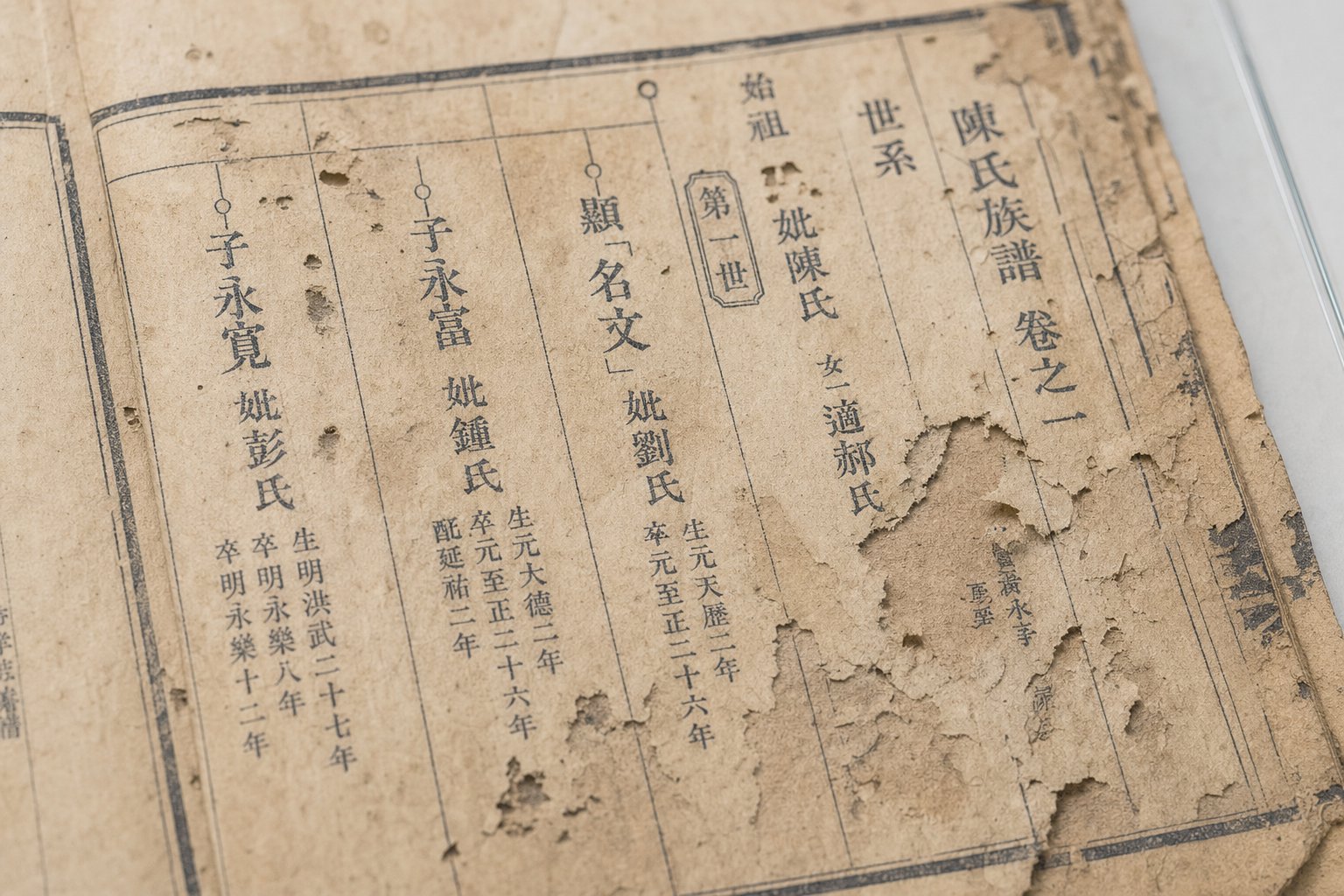
Reading damaged Chinese ancestry documents is a reality most researchers face at some point. Water damage, insect holes, torn pages, and faded ink are common in documents that may be 200 or 300 years old. Rather than treating a damaged section as a total loss, you can often recover significant information using the structural predictability of genealogy entries themselves.
Practical approaches for working with damaged records:
- Use context to infer missing characters. If you can read the characters before and after a damaged section, the entry's predictable structure tells you what category of information is missing. A gap between a birth date and a death date almost certainly contained marriage information. A gap after 葬 (buried) contained a place name.
- Cross-reference with other entries. If a wife's surname is illegible in one entry, check whether the same marriage is referenced in her natal family's section or in her children's entries. Jiapu often record the same relationship from multiple angles.
- Identify characters by radical. When only part of a character is visible, the remaining strokes may reveal the radical, which narrows possibilities dramatically. A visible water radical (氵) on the left side of a damaged character tells you the full character likely relates to water, rivers, or liquids, helping you match it against place names or descriptive terms.
- Exploit repetitive structure. If the same entry format repeats across a page and you can read three out of four entries clearly, the damaged fourth entry likely follows the identical pattern. Use the intact entries as a template to predict what belongs in each position of the damaged one.
- Compare across compilation editions. Many jiapu were revised and reprinted multiple times. If a later edition exists, it may reproduce the same information in better condition. Libraries and genealogical societies sometimes hold multiple editions of the same clan's records.
Common Mistakes and Misreadings to Avoid
Even with good source material and solid reference tools, certain errors come up repeatedly among researchers learning to decode these records. Being aware of these common mistakes reading Chinese family records helps you catch problems before they propagate through your research.
- Confusing visually similar characters. Classical Chinese contains many character pairs that differ by a single stroke. The characters 己 (ji, self), 已 (yi, already), and 巳 (si, the sixth Earthly Branch) look nearly identical in handwritten records. Similarly, 未 (wei) and 末 (mo) differ only in the relative length of their horizontal strokes. Always verify ambiguous characters against context.
- Misreading generational order. Assuming that entries on the same page belong to the same generation is a common trap. Lineage charts arrange generations vertically, but biographical sections may list individuals from different generations in sequence if they belong to the same branch. Check the generational character in each name to confirm placement.
- Applying modern meanings to classical characters. Some characters carried different meanings in classical Chinese than they do today. The character 卑 (bei) in a modern context suggests "lowly," but in genealogy records it can appear in place names or courtesy names without negative connotation. Do not impose modern interpretations on classical usage.
- Misidentifying which branch a person belongs to. Large jiapu document dozens of branches, and individuals with similar names may appear in different branches. Always trace the parent-child chain upward to confirm you are following the correct line rather than jumping to a same-name individual in a different branch.
- Confusing the generational character with the personal character. In a two-character given name, one character is the shared generational marker and the other is unique to the individual. If you misidentify which is which, you will incorrectly group people into the wrong generation. Cross-check against siblings and cousins to confirm which position holds the generational character in your clan's naming pattern.
- Overlooking intercalary months. When converting dates, forgetting that a 閏 (run, intercalary) month exists in certain years can throw off your calendar conversion by an entire month. If you see 閏 before a month number, it indicates an inserted leap month, not the regular month of that number.
Self-checking your accuracy is straightforward when you use the internal logic of the jiapu itself. Verify that birth dates make biological sense: a father should be at least 15 to 20 years older than his son, and siblings should be spaced at least a year apart. Confirm that generational characters align correctly across entries. Check that death dates fall after birth dates and that burial locations are geographically plausible given the family's known region. When something does not add up, you have likely misread a character or confused two individuals, and going back to re-examine the source will usually reveal the error.
These regional variations and practical challenges are real, but they are not roadblocks. They are simply additional layers of context that make your reading more accurate and your research more complete. Every jiapu you work through builds your pattern-recognition skills, and what felt like decoding on the first record starts to feel like reading by the fifth.
Frequently Asked Questions About Reading Chinese Genealogy Records
1. Can I read Chinese genealogy records without knowing Chinese?
Yes, you can extract meaningful data from Chinese genealogy records using pattern-recognition strategies rather than language fluency. Genealogy entries follow rigid, repetitive formats where the same characters for birth, death, marriage, and burial appear in predictable positions. By matching characters against a reference chart, tracking your family surname visually, and using the consistent entry structure as a template, you can identify names, dates, and relationships. Digital tools like handwriting-input dictionaries and camera-based translation apps also help identify individual characters when visual matching alone is not enough.
2. What is the difference between a jiapu and a zupu?
A jiapu (family genealogy) and zupu (clan genealogy) originally indicated different scopes of documentation. A zupu covered a broader clan network encompassing multiple branches and sometimes hundreds of families sharing a common ancestor, while a jiapu focused on a single family line. In modern usage, however, these terms are often used interchangeably. Both types typically contain prefaces, lineage charts, biographical entries, and generational poems. The practical difference for researchers lies in scope: a zupu may span dozens of volumes documenting thousands of individuals, while a jiapu tends to be more compact and focused on one direct line of descent.
3. How do I convert Chinese reign year dates to Western calendar dates?
To convert a reign year date, identify the era name (such as Qianlong or Guangxu), find the start year of that emperor's reign, then add the reign year number minus one. For example, Qianlong 45th year equals 1736 plus 44, giving you 1780. You subtract one because the first year of a reign is counted as year one, not year zero. For Republican-era dates using Minguo, add the year number to 1911. Keep in mind that months and days follow the lunar calendar and do not correspond directly to Gregorian dates, so a separate conversion tool is needed for precise month and day equivalents.
4. What are generational poems in Chinese genealogy and how do they help research?
Generational poems (zibei or banci) are pre-composed sequences of characters where each character is assigned to one generation in order. Every male member of the same generation shares that character in his given name, either as the first or second character depending on clan tradition. This system lets you instantly determine which generation any individual belongs to by identifying the shared character in their name. It also helps you find siblings and cousins across different sections of the record, since all same-generation relatives share that naming element regardless of which branch they belong to.
5. Where can I find Chinese genealogy records for my family?
Chinese genealogy records are held in several major repositories. FamilySearch maintains a large digitized collection accessible online for free. The Shanghai Library holds one of the world's largest collections of Chinese jiapu. University libraries in China, Taiwan, and the United States (particularly Columbia, Harvard, and the University of Wisconsin) also hold significant collections. For overseas Chinese families, local clan associations in Southeast Asia, North America, and Australia sometimes maintain copies of their lineage's jiapu. Start by identifying your ancestral surname and village of origin, then search these repositories using those details as keywords.