Understanding Pinyin as the Standard for Chinese Names
Imagine handing in a passport application only to have it rejected because your name is formatted incorrectly. Or picture a colleague's business card where their Chinese name looks different every time you see it printed. These aren't rare scenarios. Knowing how to write Chinese name in pinyin correctly is a practical skill with real consequences for travel, publishing, and professional life.
Pinyin is the official romanization system of Mandarin Chinese and the internationally recognized standard for writing Chinese names in Latin letters.
Why Pinyin Name Formatting Matters
Chinese names appear on passports, academic journals, international contracts, and visa applications. A single formatting error can cause mismatches between documents, delayed approvals, or confusion about identity. Whether you're figuring out how to write your name in Chinese for an official form or formatting a contact's name for a publication, consistency is everything. Pinyin provides that consistency by giving every Chinese character a standardized Latin-letter spelling.
Who This Guide Is For
This guide serves three groups of people:
- Native Chinese speakers who need to romanize their own name for international use (think: "my name is in Chinese, but how do I present it abroad?")
- Colleagues, HR professionals, or editors formatting someone else's Chinese names for documents or publications
- Translators and researchers learning how to write name in Chinese language contexts and render those names accurately in English
You'll find step-by-step rules, real examples, and context-specific guidance regardless of which group you fall into.
Official Standards Made Simple
Two standards govern pinyin name formatting. The Chinese national standard GB/T 28039-2011 specifies how personal names should be written in pinyin on official documents. The international standard ISO 7098 covers romanization of Chinese more broadly. These sound academic, but the rules they contain are straightforward. Think of them as the grammar book for Chinese for name formatting in Latin letters. This guide distills their key principles into clear, actionable steps so you never have to read the standards documents yourself.
The formatting choices you make depend heavily on understanding how Chinese names are actually structured, starting with the relationship between surname and given name.
Step 1 - Learn the Structure of Chinese Names
Before you can format a Chinese name in pinyin, you need to understand what you're working with. Chinese name structure follows a logic that's the reverse of most Western naming conventions, and that difference is exactly where formatting mistakes begin.
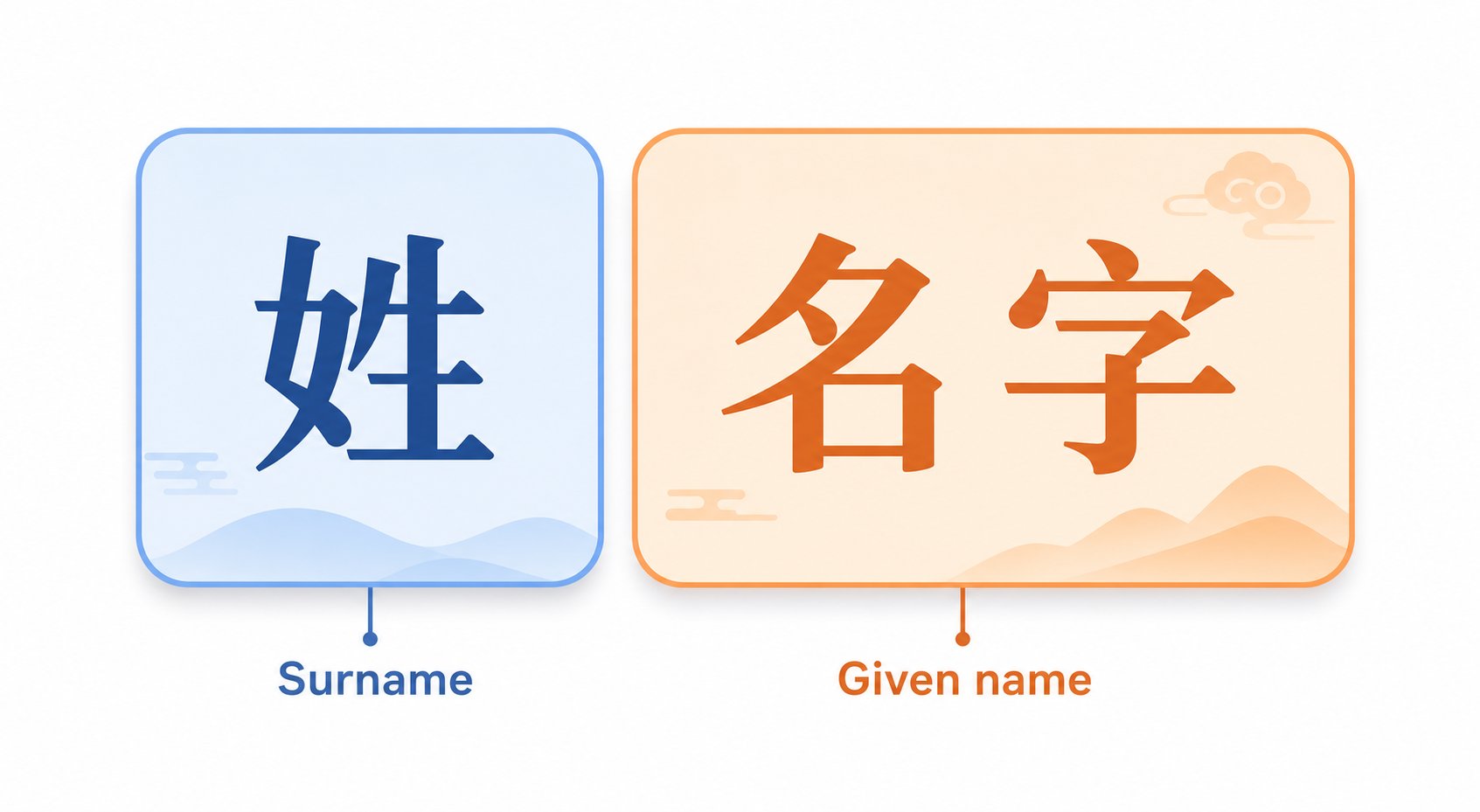
Surname Plus Given Name Order
In Chinese, the surname (姓, xìng) always comes first, followed by the given name (名, míng). Think of it as the family identity leading, with the individual identity following. So when you see 王小明, the first character 王 is the surname and 小明 is the given name. This order stays the same in pinyin: Wáng Xiǎomíng.
Most Chinese surnames are a single character. The three most common ones you'll encounter are 王 (Wáng), 李 (Lǐ), and 张 (Zhāng). Together, these three surnames alone cover hundreds of millions of people. Other frequently seen single-character surnames include 刘 (Liú), 陈 (Chén), and 赵 (Zhào). When writing Chinese names, the surname is always treated as its own unit, separated from the given name by a space.
Single vs Two-Character Given Names
Here's where things get interesting. A Chinese given name can be either one character or two characters long. That means a full Chinese name is typically two or three characters total:
- Two-character name (surname + one-character given name): 李华 → Lǐ Huá
- Three-character name (surname + two-character given name): 王小明 → Wáng Xiǎomíng
Two-character given names are more common in modern China. You'll notice them in both chinese names male and female chinese names alike. For example, 张伟 (Zhāng Wěi) is one of the most common male names, while 王芳 (Wáng Fāng) ranks among the most popular female names. Both happen to use single-character given names, but names like 陈美丽 (Chén Měilì) and 刘建国 (Liú Jiànguó) show the two-character given name pattern.
The key takeaway: regardless of whether the given name has one or two characters, it's written as a single unit in pinyin, separated from the surname by one space.
Character-to-Pinyin Mapping Examples
Each Chinese character maps to exactly one pinyin syllable. A three-character name produces three syllables, but those syllables are grouped into two visual units (surname and given name). Here's how the mapping works in practice:
| Full Name (Characters) | Surname | Given Name | Pinyin Output |
|---|---|---|---|
| 王小明 | 王 | 小明 | Wáng Xiǎomíng |
| 李华 | 李 | 华 | Lǐ Huá |
| 张伟 | 张 | 伟 | Zhāng Wěi |
| 陈美丽 | 陈 | 美丽 | Chén Měilì |
| 刘建国 | 刘 | 建国 | Liú Jiànguó |
| 赵雪 | 赵 | 雪 | Zhào Xuě |
Notice the pattern: the surname stands alone, and the given name characters merge into one continuous pinyin string. This chinese name structure is consistent whether you're dealing with a formal document or a casual introduction. The table above covers both male and female names to show that the formatting rule applies universally.
Getting the structure right is the foundation, but there's a critical next step: making sure each character maps to the correct pinyin syllable in the first place. A single character misidentified can change a name entirely.
Step 2 - Identify the Correct Pinyin for Each Character
Here's the tricky part about mandarin characters: many of them share the same pinyin syllable. The sound "li" alone can represent 李, 力, 丽, 立, 利, and dozens more. Each name chinese character carries a unique meaning, but when stripped down to its romanized spelling, it might look identical to completely different characters. That's why accuracy in identifying the correct pinyin for each character isn't optional. It's essential.
Finding the Correct Pinyin Spelling
Imagine you're formatting a colleague's name for a conference badge. You see the characters 张丽 and need the pinyin. Sounds simple, but is 丽 spelled "lì" or "lí"? (It's lì, fourth tone.) And what about less common characters that appear in names, like 翾 or 璟? Automated tools sometimes stumble on rare readings, especially when a character has multiple pronunciations depending on context.
The most reliable approach is layered verification. Don't rely on a single source. Here are the methods ranked from most to least reliable:
- Ask the person directly - the name's owner knows their own pronunciation, including any regional or family-specific readings
- Check existing official documents - a passport or national ID card already shows the approved pinyin spelling
- Consult authoritative dictionaries - the Xinhua Dictionary (新华字典) or the Contemporary Chinese Dictionary (现代汉语词典) provide standard readings
- Use verified online conversion tools - platforms like MandarinTools.com or Google Translate can convert characters to pinyin quickly
- Cross-reference multiple sources - if two tools give different results, dig deeper before committing
A word of caution about naming chinese characters with multiple readings (多音字). The character 乐 can be "lè" (happy) or "yuè" (music). In names, the intended reading depends entirely on the parents' choice. The character 单 is usually "dān," but as a surname it's pronounced "Shàn." No english to chinese converter or automated tool can reliably catch these edge cases without human confirmation.
Understanding Tones in Names
Mandarin uses four tones plus a neutral tone, marked with diacritics above vowels: ā (first, flat), á (second, rising), ǎ (third, dipping), and à (fourth, falling). These tone marks change meaning dramatically. "Wáng" (王, king/surname) and "wǎng" (网, net) are completely different words that would look identical without the marks.
So when are tone marks required? It depends on context:
- Linguistic texts and teaching materials - always include tone marks
- Formal pinyin transcription per GB/T 28039-2011 - tone marks are part of the standard
- Passports and official ID - tone marks are omitted (WANG XIAOMING, not WÁNG XIǍOMÍNG)
- Business cards and casual use - optional, though including them adds precision
For the purpose of getting the pinyin right in the first place, you'll want to identify the correct tone for each character even if you later drop the marks for a passport application. Knowing that 明 is "míng" (second tone) rather than "mìng" (fourth tone, which means fate/life) ensures you've matched the right character to the right sound.
Tools for Character-to-Pinyin Conversion
When you can't ask the person directly, a chinese name generator or conversion tool becomes your next best option. Several reliable platforms handle character-to-pinyin conversion, each with strengths and limitations. Google Translate provides real-time pinyin with audio pronunciation, which helps verify tones. MandarinTools.com supports bulk conversion with tone marks, tone numbers, or plain pinyin output. HanziCraft breaks down individual characters and shows their pinyin alongside structural analysis.
The key limitation across all these tools is the same: they process characters in isolation or by statistical context, not by personal intent. A mandarin chinese translator tool doesn't know that your colleague's 行 in their name is read "xíng" rather than "háng." It guesses based on surrounding text, and for standalone names, that guess can miss.
Your safest workflow combines automation with human verification. Run the name in characters through a conversion tool to get a starting point, then confirm with the person or their existing documents. This two-step process takes seconds but prevents errors that could follow someone across every official record they hold.
With the correct pinyin identified for each character, the next question becomes how to present it on the page. Capitalization rules might seem like a minor detail, but they're one of the most commonly botched aspects of pinyin name formatting.
Step 3 - Apply the Correct Capitalization Rules
Capitalization seems like it should be the easy part. You capitalize names in English, so you capitalize them in pinyin, right? Almost. The rules for chinese name writing in pinyin have a specific quirk that trips up nearly everyone: what happens with the second syllable of a two-character given name. Get this wrong, and your formatting looks amateur at best or creates document mismatches at worst.
Core Capitalization Rules
The GB/T 28039-2011 standard and ISO 7098 lay out four clean rules for capitalizing pinyin names:
- Rule 1: Capitalize the first letter of the surname. Write "Wang," not "wang."
- Rule 2: Capitalize the first letter of the given name. Write "Xiaoming," not "xiaoming."
- Rule 3: Do NOT capitalize the second syllable of a two-character given name. Write "Xiaoming," not "XiaoMing."
- Rule 4: When a name starts a sentence, standard sentence capitalization applies. No extra capitals are added beyond what the rules already require.
Rules 1 and 2 feel intuitive. Rule 3 is where confusion lives. If you write name in chinese pinyin and the given name has two characters, those two syllables merge into one word. Only the first letter of that merged word gets capitalized. The second syllable stays lowercase, just like the second syllable in any ordinary word.
The Two-Character Given Name Rule
Why does this rule exist? Think of it this way. When you write "Xiaoming" as a single unit, it functions as one word, not two separate words glued together. Capitalizing the second syllable ("XiaoMing") implies two distinct words, which contradicts the standard's spacing rule that treats the given name as a unified block.
This is the single most debated point in translator forums and name chinese writing discussions. People instinctively want to capitalize each syllable because each syllable corresponds to a separate character. But pinyin formatting follows its own logic. The character boundaries disappear once you're in Latin letters. You'll see this mistake constantly on business cards, conference badges, and even published papers. Knowing the rule puts you ahead of most people who handle Chinese names professionally.
How do you write names in chinese pinyin without second-guessing yourself? Treat the given name like a single English word. You wouldn't write "BasketBall." Same principle applies to "Xiaoming."
Correct vs Incorrect Capitalization Examples
A side-by-side comparison makes the pattern unmistakable:
| Correct ✓ | Incorrect ✗ |
|---|---|
| Wang Xiaoming | wang xiaoming |
| Zhang Dashi | Zhang Da-Shi |
| Li Meili | Li MeiLi |
| Chen Jianguo | chen JianGuo |
| Liu Xiaoyan | liu xiao yan |
| Zhao Mingze | ZHAO MingZe |
Notice the pattern in the incorrect column. The errors fall into predictable categories: all lowercase (no capitalization at all), mid-word capitals (treating each syllable as a separate word), hyphens with capitals after them, and random use of ALL CAPS for the surname only. Each of these breaks the standard in a different way, but the fix is always the same: one capital at the start of the surname, one capital at the start of the given name, everything else lowercase.
Capitalization gives your pinyin names their visual structure. But there's another formatting decision that causes even more heated debate: whether to use spaces, hyphens, or nothing at all between the syllables of a given name.
Step 4 - Handle Spacing and Hyphenation Correctly
Spacing and hyphenation spark more arguments in name pinyin formatting than any other single issue. You'll find conflicting advice across style guides, government websites, and academic publications. Some sources hyphenate given names. Others split them with a space. Others join them completely. So which format is actually correct when you need to know how to write name in chinese pinyin for official purposes?
The Official Spacing Standard
The answer is unambiguous once you look at the governing standard. GB/T 28039-2011, China's national standard for spelling Chinese personal names in pinyin, states the rule plainly:
According to the standard, syllables in a given name are written together without spaces or hyphens, with only the first letter capitalized.
That means a name like 张大石 becomes "Zhang Dashi" - not "Zhang Da Shi," not "Zhang Da-Shi," and not "Zhang Da-shi." The two syllables of the given name merge into a single continuous string. A space exists only between the surname and the given name. Nothing else breaks the given name apart.
Taiwan's Guidelines for Transliteration of Chinese reinforce this same principle, stating that letters in a given name are "all lower-cased and written without a space in between." The only exception noted is when the second character begins with a, o, or e, in which case an apostrophe separates the syllables for pronunciation clarity (e.g., 陈安 becomes "Chen'an" rather than "Chenan").
Why Hyphens Are No Longer Standard
If the rule is this clear, why do hyphens appear everywhere? The answer is historical. Before Hanyu Pinyin became the international standard in 1982, the Wade-Giles romanization system dominated English-language texts about China. Wade-Giles routinely hyphenated multi-syllable given names: "Hsiao-ming" instead of "Xiaoming." That convention stuck in people's habits long after the system itself fell out of official use.
Older passports, legacy databases, and publications from the 1980s and 1990s often show hyphenated formats. People who grew up seeing "Li Xiao-Long" on movie credits or "Deng Xiao-Ping" in newspapers naturally assumed the hyphen was correct. It wasn't wrong at the time under the older system, but it doesn't conform to current standards. If you're wondering how to spell name in chinese pinyin today, the hyphen has no place in the given name.
Some regions, notably Taiwan and Hong Kong, still permit hyphens in passport names as a legacy accommodation. But for mainland Chinese documents governed by GB/T 28039-2011 and for any context following ISO 7098, the hyphen is gone.
Resolving the Hyphenation Debate
Let's settle the debate with a direct comparison. Take the name 张大石 and look at the three formats you'll encounter in the wild:
- Zhang Dashi - syllables joined, only first letter capitalized. This is correct per GB/T 28039-2011.
- Zhang Da-shi - hyphenated, second syllable lowercase. Outdated; follows older conventions no longer standard.
- Zhang Da-Shi - hyphenated with both syllables capitalized. Incorrect under any current standard.
The logic behind the correct format is consistent with how pinyin treats all multi-syllable words. In standard pinyin orthography, compound words are written as single units. The given name functions as one word, so it's written as one word. How do you write name in chinese pinyin without errors? Join the given name syllables, capitalize only the first letter, and leave no hyphen or space between them.
One practical note: if someone's existing passport or legal documents already use a hyphenated format, changing it can create identity verification problems. China's National Immigration Administration acknowledges this reality by allowing applicants to maintain consistency with previously issued documents. So while the standard says no hyphens, real-world document continuity sometimes takes priority.
The spacing rule applies cleanly to standard single-character surnames paired with two-character given names. But what happens when the surname itself has two characters? Compound surnames introduce their own formatting layer that builds directly on the principles covered here.
Step 5 - Format Compound Surnames and Special Cases
Most Chinese surnames are a single character, but roughly 1.5 million people in China carry a compound surname (复姓) made of two characters. These names follow the same joining principle you've already learned for given names, but applied to the surname side. The rule is simple: write the compound surname as one unit with no space, no hyphen, and only the first letter capitalized.
Formatting Compound Surnames
Think of it this way. If a two-character given name merges into one pinyin word, a two-character surname does the same. 欧阳 becomes "Ouyang," not "Ou Yang" or "Ou-Yang" or "Ou-yang." Pinyin News emphasizes this point explicitly: Ouyang should never be split or hyphenated. The same logic applies to every compound surname in the list.
China currently has fewer than 100 compound surnames still in active use, down from over a thousand in ancient times. Their origins vary. Some came from official titles held by ancestors. Others derived from place names, like Ouyang (south of Ouyu Mountain) and Dongguo (east of the city wall). Still others trace back to ethnic minority tribes whose names were adapted into Chinese characters over centuries.
Complete Examples with Compound Surnames
Here's how the most common compound surnames look when formatted as complete names in pinyin. Notice that the spacing rule stays consistent: one space between surname and given name, everything else joined.
| Chinese Name (Characters) | Compound Surname | Given Name | Pinyin Output | People with This Surname |
|---|---|---|---|---|
| 欧阳娜娜 | 欧阳 | 娜娜 | Ouyang Nana | ~1,112,000 |
| 上官婉儿 | 上官 | 婉儿 | Shangguan Wan'er | ~88,000 |
| 皇甫嵩 | 皇甫 | 嵩 | Huangfu Song | ~64,000 |
| 令狐冲 | 令狐 | 冲 | Linghu Chong | ~55,000 |
| 诸葛亮 | 诸葛 | 亮 | Zhuge Liang | ~48,000 |
| 司徒雷登 | 司徒 | 雷登 | Situ Leideng | ~47,000 |
| 司马迁 | 司马 | 迁 | Sima Qian | ~23,000 |
The population figures come from China's 2020 National Name Report. You'll notice that Ouyang dominates, representing more than twelve times as many people as the next compound surname on the list. Whether you're looking at chinese given names male like Zhuge Liang or female names like Ouyang Nana, the formatting pattern stays identical.
Special Cases and Minority Name Conventions
Beyond compound surnames, a few other special scenarios affect how chinese name letters appear in pinyin:
Generation characters (字辈). Some families use a shared character across all siblings or cousins of the same generation. For example, three brothers might be named 王建国, 王建军, and 王建民, all sharing 建 as the generation marker. In pinyin, this changes nothing about formatting. Each name follows the standard rules: Wang Jianguo, Wang Jianjun, Wang Jianmin. The generation character simply becomes part of the joined given name.
Ethnic minority names. China's 55 officially recognized ethnic minorities often have naming conventions that don't follow the Han Chinese surname-plus-given-name structure. Tibetan, Uyghur, Mongolian, and Zhuang names may have three, four, or more syllables with no surname component at all. These names follow their own romanization conventions rather than standard pinyin rules. A Tibetan name like Tenzin Gyatso or a Uyghur name like Dilraba Dilmurat uses transliteration systems specific to those languages.
One edge case worth noting: the surname 邹 (Zou) sometimes prompts questions about whether it's a compound surname. It isn't. The zou meaning chinese name discussions often confuse this single-character surname with compound ones because "Zou" looks like it could be part of a longer unit. It stands alone as a standard one-character surname: 邹明 becomes "Zou Ming," following all the regular rules.
Compound surnames and special cases represent a small percentage of names you'll encounter, but handling them correctly shows attention to detail. The real test of your formatting skills, though, comes when you need to adapt any of these names for a specific document type, where passports, academic papers, and business cards each demand slightly different presentations.
Step 6 - How to Write Your Name in Mandarin for Passports and Official Documents
You've learned the standard rules. You know the capitalization, the spacing, the joined given name. But here's the reality: no single format works everywhere. A passport strips away tone marks. An academic journal wants a comma after the surname. An email signature might flip the name order entirely. Each context has its own conventions, and using the wrong one can range from mildly confusing to genuinely problematic.
So how do i write my name in chinese pinyin for a specific situation? The answer depends entirely on where that name will appear.
Passport and Official Document Format
Chinese passports follow a strict machine-readable format governed by the International Civil Aviation Organization (ICAO). The rules are non-negotiable:
- Surname appears in ALL CAPS on its own line or field
- Given name syllables are joined together with no space, no hyphen, and no tone marks
- All letters are uppercase in the machine-readable zone (MRZ)
- The visual data page typically shows: WANG XIAOMING (surname field: WANG, given name field: XIAOMING)
Notice what disappears in this format. Tone marks are gone. The elegant capitalization pattern you learned earlier (Wang Xiaoming) gets flattened into block capitals. The given name syllables still join together, but since everything is uppercase, the visual distinction between surname and given name relies entirely on the field labels or spacing conventions on the document itself.
If you're applying for a Chinese passport or renewing one, the pinyin on your ID card (身份证) should match what appears on the passport. Mismatches between documents create verification headaches at border control. When figuring out how to write your name in mandarin for travel documents, consistency across all your official IDs matters more than perfection in any single format.
Academic and Publication Conventions
Academic publishing introduces its own layer of formatting. Most international journals follow one of two patterns for Chinese author names:
- Surname, Given name - the most common format in reference lists and citations (Wang, Xiaoming)
- Given name Surname - sometimes used in author bylines to match Western reading expectations (Xiaoming Wang)
The specific style depends on the journal's guide. APA style, for instance, lists authors as "Wang, X." with the given name abbreviated to an initial. Chicago style might use the full given name. IEEE formats often show "X. Wang" in the byline but "Wang, Xiaoming" in the reference list.
One critical point for researchers: pick a format and stick with it across all publications. Citation databases like Google Scholar, Scopus, and Web of Science link your papers to your identity through name matching. If one paper lists you as "Wang, Xiao-Ming" (hyphenated) and another as "Wang, Xiaoming" (joined), the system may treat these as two different authors. Your publication record fragments, and your citation count suffers.
Business Cards and Email Signatures
Business cards occupy a unique space because they serve both Chinese-speaking and international audiences simultaneously. The standard professional approach places Chinese characters above the pinyin, with characters slightly larger to maintain visual hierarchy. The pinyin uses proper capitalization (Zhang Weiming, not ZHANG WEIMING), and a clean sans-serif font keeps it readable at small sizes.
How can i write my name in chinese for a business card that works globally? The most effective layout shows three elements:
- Chinese characters as the primary name (largest text)
- Pinyin directly below in standard format (Zhang Weiming)
- English name, if used, as a secondary element (e.g., David Zhang)
For email signatures targeting international colleagues, the convention shifts. Most professionals flip to Western order: given name first, surname last. "Xiaoming Wang" reads naturally for English-speaking recipients and avoids the confusion of someone addressing you as "Dear Xiaoming" when Xiaoming is actually your given name. If you want to learn how to write name in mandarin for professional correspondence, this Western-order adaptation is the practical standard for global communication.
One thing to avoid on business cards: using ALL CAPS for the pinyin name. As the formatting guide from Chinese Name Translator notes, all caps "can come across as overly aggressive and less refined in professional contexts." Save block capitals for passport fields where they're required.
International Forms and Applications
Filling out international forms, whether for visa applications, university admissions, or bank accounts, presents a recurring puzzle. The form asks for "First Name" and "Last Name," but Chinese names don't map neatly onto those boxes. Here's the practical guidance:
- Last Name / Surname / Family Name field: Enter your surname pinyin (Wang, Li, Zhang, Ouyang)
- First Name / Given Name field: Enter your given name pinyin as one joined word (Xiaoming, Meili, Jianguo)
- Middle Name field: Leave blank. Do not split your two-character given name across the "First Name" and "Middle Name" fields
This last point catches people off guard. When someone sees "Xiaoming" and a blank middle name field, they sometimes feel compelled to put "Xiao" in the first name box and "Ming" in the middle name box. Don't do this. It splits your given name into fragments that no official Chinese document recognizes, and it creates mismatches with your passport where the given name appears as one unit.
The table below pulls all five contexts together so you can see the differences at a glance:
| Context | Format Used | Name Order | Tone Marks | Example (for 王小明) |
|---|---|---|---|---|
| Passport / Official ID | All caps, joined given name | Surname first | No | WANG XIAOMING |
| Academic Papers (citation) | Surname comma given name | Surname first | No | Wang, Xiaoming |
| Business Cards | Standard pinyin with characters | Surname first | Optional | Wang Xiaoming (below 王小明) |
| Email Signatures | Western order, no characters | Given name first | No | Xiaoming Wang |
| International Forms | Split into surname/given name fields | Per field labels | No | Last: Wang / First: Xiaoming |
You'll notice a pattern: the underlying pinyin spelling never changes. "Wang" is always "Wang." "Xiaoming" is always "Xiaoming" (joined, no hyphen). What shifts is the order, the capitalization style, and whether tone marks appear. The name in chinese script stays constant. Only its presentation adapts to the context.
Knowing which format belongs where prevents the kind of inconsistencies that fragment your identity across systems. But even with the right format chosen, errors creep in. The most common mistakes aren't about choosing the wrong context. They're about confusing romanization systems, reversing name order without flagging it, or mixing conventions from different standards in a single document.
Step 7 - Avoid Common Mistakes and Compare Romanization Systems
Even after learning the rules, errors persist. Some come from habit. Others come from encountering a name that was romanized under a completely different system decades ago. If you've ever seen the same Chinese name spelled three different ways across three documents, you've already bumped into this problem. Understanding where mistakes originate is the fastest way to stop making them.
Common Formatting Mistakes to Avoid
These are the errors that show up most frequently when people attempt writing my name in chinese pinyin or formatting someone else's name for official use:
- Reversing name order without noting it. Flipping to "Xiaoming Wang" for a Western audience is fine in an email signature, but doing it on a form or publication without indicating which part is the surname creates confusion. If you reverse the order, add "(surname: Wang)" or use the convention of capitalizing the surname: "Xiaoming WANG."
- Inconsistent capitalization. Mixing formats like "Zhang WeiMing" or "zhang Weiming" within the same document signals carelessness. Pick the standard format (Zhang Weiming) and apply it uniformly.
- Adding unnecessary hyphens. Writing "Wei-Ming" instead of "Weiming" is a holdover from older systems. Unless you're maintaining consistency with an existing passport, drop the hyphen.
- Omitting or misplacing tone marks. When tone marks are required (linguistic texts, formal transcription), placing them on the wrong vowel changes the reading. The tone mark goes on the main vowel of the syllable: "liú" not "lúi."
- Confusing similar-sounding initials. The pairs zh/z, sh/s, and ch/c represent different sounds in Mandarin. Writing "Zang" when you mean "Zhang," or "Cen" when you mean "Chen," produces a completely different name. These aren't interchangeable.
- Splitting the given name into first and middle names. Putting "Xiao" in the first name field and "Ming" in the middle name field fractures the name in ways that don't match any official document.
Each of these mistakes traces back to applying English naming logic to a system that works differently. Chinese names in chinese letters follow their own structure, and pinyin formatting respects that structure rather than forcing it into Western patterns.
Pinyin vs Wade-Giles vs Other Systems
One major source of confusion: multiple romanization systems exist for Mandarin Chinese, and they spell the same sounds differently. When you see "Chou En-lai" in a history book but "Zhou Enlai" on a modern website, both refer to the same person. The difference is the system used.
Three systems appear most often:
- Hanyu Pinyin - the current international standard, adopted by the PRC in 1958 and recognized by the UN and ISO since 1982. This is what you should use.
- Wade-Giles - developed in the 19th century by British diplomats. Still appears in older academic texts and some Taiwanese contexts. Uses apostrophes to distinguish aspirated consonants (e.g., "ch'" vs "ch").
- Tongyong Pinyin - briefly used in Taiwan from 2002 to 2008 before Taiwan switched to Hanyu Pinyin for most purposes. You'll still see it on some Taiwanese road signs and older documents.
The differences aren't subtle. A name that looks completely unfamiliar in one system becomes instantly recognizable in another. Understanding chinese symbols and meanings requires knowing which romanization system produced the spelling you're looking at. Here's how the same names appear across all three systems, based on the cross-reference chart at Romanization.com:
| Chinese Name | Hanyu Pinyin | Wade-Giles | Tongyong Pinyin |
|---|---|---|---|
| 张伟 (Zhang Wei) | Zhang Wei | Chang Wei | Jhang Wei |
| 周恩来 (Zhou Enlai) | Zhou Enlai | Chou En-lai | Jhou Enlai |
| 徐志摩 (Xu Zhimo) | Xu Zhimo | Hsu Chih-mo | Syu Jhihmo |
| 蒋介石 (Jiang Jieshi) | Jiang Jieshi | Chiang Chieh-shih | Jiang Jieshih |
| 齐白石 (Qi Baishi) | Qi Baishi | Ch'i Pai-shih | Ci Baishih |
| 邓小平 (Deng Xiaoping) | Deng Xiaoping | Teng Hsiao-p'ing | Deng Siaoping |
Look at the Wade-Giles column. "Zhang" becomes "Chang." "Zhou" becomes "Chou." "Xu" becomes "Hsu." "Deng" becomes "Teng." If you're reading a historical text and the chinese letters name spelling looks unfamiliar, chances are you're looking at Wade-Giles rather than pinyin. The Tongyong system sits somewhere between the two, using "jh" for the zh- sound and "si" for the x- sound, which creates its own set of recognition challenges.
The practical takeaway: always use Hanyu Pinyin for new documents. If you encounter a name in an unfamiliar spelling, check whether it might be Wade-Giles or Tongyong before assuming it's misspelled. Names in chinese writing can look radically different depending on which system produced the romanization.
Quick Reference Checklist
Every time you format a Chinese name in pinyin, run through this sequence. It takes thirty seconds and catches the errors that cause document rejections, citation mismatches, and professional embarrassment:
- Verify the characters. Confirm you have the correct Chinese characters for the name. A wrong character means wrong pinyin from the start.
- Confirm the pinyin spelling. Look up each character's pinyin individually. Watch for multi-reading characters (多音字) and rare surname pronunciations.
- Apply capitalization. Capitalize the first letter of the surname and the first letter of the given name. Nothing else gets capitalized.
- Check spacing. One space between surname and given name. No space within the given name. No space within a compound surname.
- Remove hyphens. Unless maintaining consistency with an existing legal document, delete any hyphens in the given name.
- Adapt for context. Adjust tone marks, letter case, and name order based on where the name will appear (passport, journal, business card, form).
- Cross-check against existing documents. If the person has a passport or published papers, match their established spelling to avoid fragmenting their identity across systems.
This checklist works whether you're formatting your own chinese writing name for a visa application or handling a list of contributor names for a publication. The steps are the same regardless of the name's complexity. Run through them once, and you'll catch the mistakes that most people don't notice until a border agent or journal editor flags them.
Formatting Chinese names in pinyin isn't difficult once you internalize the pattern: identify the characters, map them to pinyin, join the given name, capitalize correctly, and adapt for your specific context. The rules exist to create consistency across billions of names and millions of documents. Follow them, and your names will match your passport, your publications, and every form you'll ever fill out.
Frequently Asked Questions About Writing Chinese Names in Pinyin
1. Do you put the surname or given name first when writing a Chinese name in pinyin?
In pinyin, the surname always comes first, followed by the given name, mirroring the original Chinese order. For example, 王小明 becomes Wang Xiaoming, where Wang is the surname and Xiaoming is the given name. This order is maintained on passports and official Chinese documents. However, in informal international contexts like email signatures, many people flip to Western order (Xiaoming Wang) for clarity with English-speaking audiences.
2. Should I use a hyphen between syllables in a Chinese given name written in pinyin?
No. According to the current national standard GB/T 28039-2011, syllables in a two-character given name are joined together without hyphens or spaces. Write Xiaoming, not Xiao-Ming or Xiao Ming. The hyphenated style comes from the older Wade-Giles romanization system and is no longer considered standard. The only exception is maintaining consistency with an existing passport that already uses a hyphenated format.
3. How do I write my Chinese name on a passport application?
For Chinese passports, your name appears in all capital letters without tone marks. The surname occupies its own field, and the given name syllables are joined into one continuous string. For example, 王小明 becomes WANG in the surname field and XIAOMING in the given name field. Make sure this matches your national ID card spelling to avoid verification issues at border control.
4. Do I need tone marks when writing a Chinese name in pinyin?
It depends on the context. Tone marks are required in linguistic texts and formal pinyin transcription per official standards. They are omitted on passports, most international forms, and in casual professional use like email signatures. Even when you plan to drop tone marks in the final output, identifying the correct tones during the conversion process helps ensure you have matched the right character to the right pinyin syllable.
5. How do I format a compound surname like Ouyang or Sima in pinyin?
Compound surnames follow the same joining principle as two-character given names. Write the two syllables together as one unit with only the first letter capitalized: Ouyang, Sima, Zhuge, Shangguan. A space separates the compound surname from the given name. For example, 欧阳娜娜 becomes Ouyang Nana. Never split a compound surname with a hyphen or space between its syllables.