The Chinese Character for King Explained
What Does 王 Mean in English
When you look up 王 meaning in english, the answer is refreshingly direct. This single character carries the weight of an entire concept of rulership.
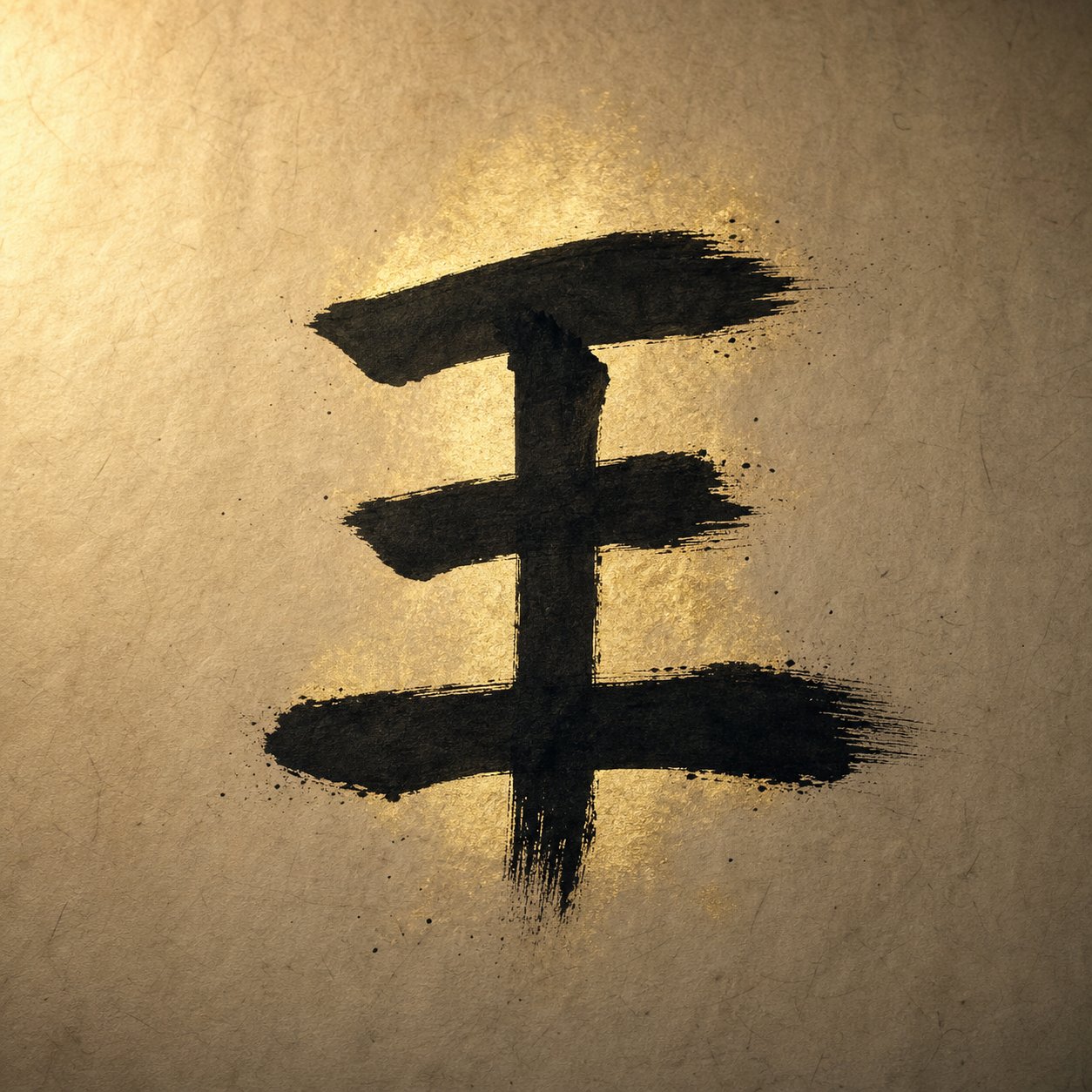
王 (wáng) is the Chinese character for king, meaning "king," "ruler," or "monarch." It consists of just three horizontal strokes connected by one vertical line and is one of the oldest and most frequently used characters in the Chinese writing system.
The character dates back thousands of years to the earliest known Chinese writing on oracle bones. As a standalone word, 王 refers to a king or sovereign. As a surname, it belongs to over 100 million people, making it the most common family name in China. And as a radical, it appears inside dozens of other characters, quietly shaping their meanings.
Why This Character Matters
Imagine a single character that works as a word, a name, a philosophical statement, and a building block for other characters all at once. That is 王. For language learners, the chinese character for king is an early milestone because it unlocks vocabulary across multiple levels. For anyone curious about Chinese culture, it opens a window into how ancient people thought about power, heaven, and the human world.
This article covers everything you need to know about this king chinese symbol: its ancient origins and competing etymological theories, the philosophy encoded in its strokes, how to write and pronounce it correctly, how it functions across Chinese, Japanese, and Korean, its role as a radical inside other characters, and its presence in modern life. Whether you are a beginner picking up your first characters or a culture enthusiast tracing the roots of king in chinese, you will find what you need here.
The story starts with a question scholars have debated for over a century: what did this character originally depict?
Etymology and Ancient Origins of 王
Two competing theories have shaped how scholars understand the wang chinese character. One is grounded in physical evidence from ancient inscriptions. The other draws on philosophical tradition. Both tell us something real about how the Chinese conceived of kingship, but they point in very different directions.
The Axe-Blade Theory of Origin
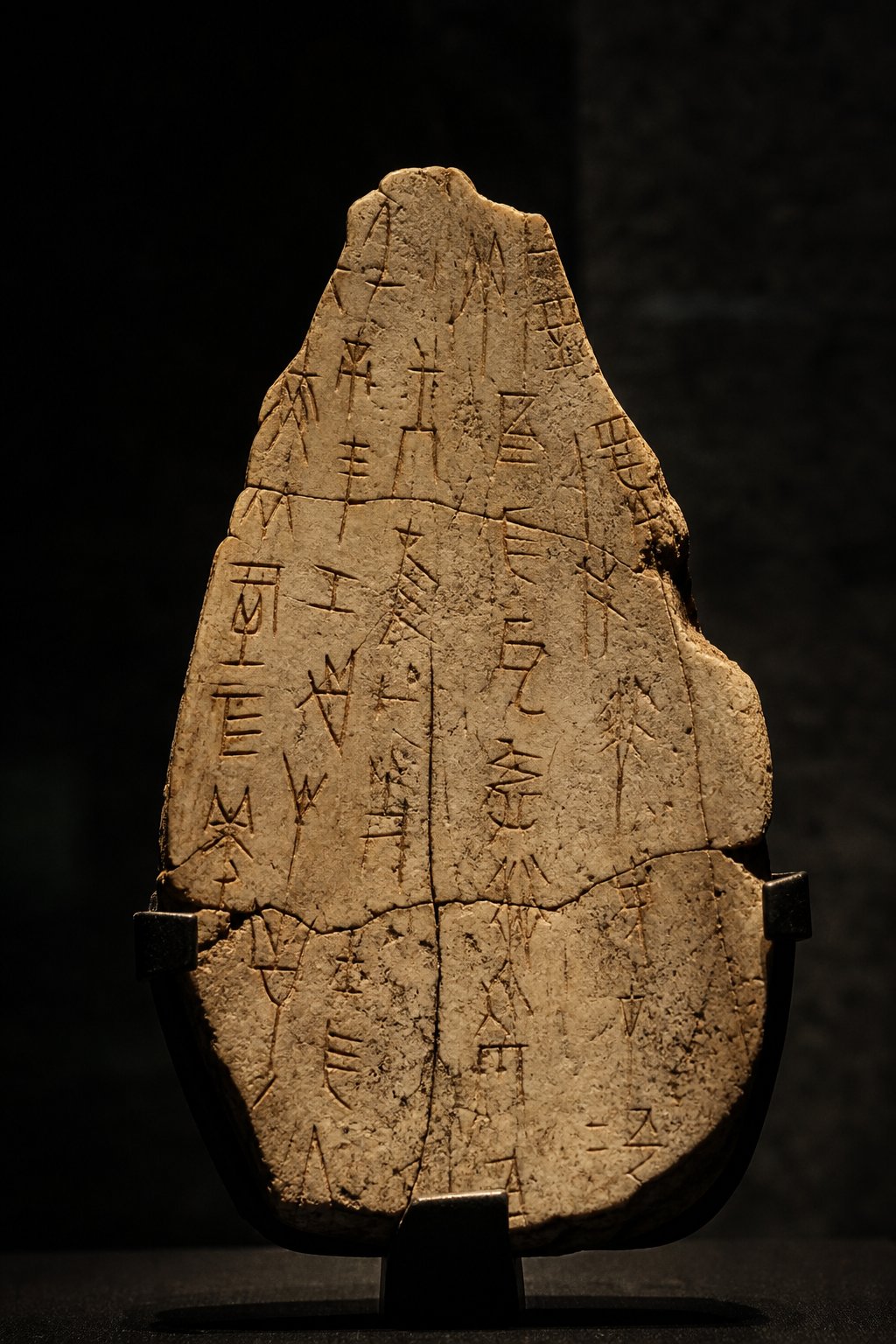
Look at the earliest known forms of 王 scratched into turtle shells and animal bones during the Shang dynasty (1600-1046 B.C.), and you will not see three neat horizontal lines. You will see something that looks like a broad, downward-facing axe blade. The bottom portion is wide and heavy, clearly representing the cutting edge of a ceremonial weapon.
Why an axe? In ancient China, a large ceremonial axe called a yue (鉞) was kept near the throne. It served as a symbol of the ruler's military authority and his ultimate power: the right to execute. The king in chinese character form was, at its origin, a picture of this weapon. Kingship was not an abstract idea. It was the physical capacity to command armies and enforce law through force.
This interpretation is supported by the character's visual evolution. The oracle bone forms from around 1250-1000 B.C. show a clearly recognizable axe shape. The top portion is narrow, representing the handle or socket, while the bottom flares outward into the blade. There is nothing philosophical about it. It is a weapon, plain and simple.
How Oracle Bone Script Reveals the Original Form
Oracle bone script (甲骨文) gives us the closest look at what 王 meant to the people who first wrote it. These inscriptions, carved during divination rituals, show the chinese character king in its rawest pictographic state. The shape is unmistakably an axe head, with the broad blade dominating the lower portion of the character.
Bronze inscriptions (金文) from the early Western Zhou dynasty (around the 11th century B.C.) preserve a similar form. A notable example comes from the 大盂鼎, a three-legged bronze vessel where 王 still retains the proportions of an axe blade. The distance between the top strokes and the bottom stroke is noticeably unequal, with the bottom line sitting farther away and rendered thicker to represent the blade's edge.
Here is an interesting connection that reinforces the axe theory: the character 金 (gold, metal) contains 王 as an iconic component. This relationship makes perfect sense if 王 originally depicted a metal axe blade. The link between king in chinese letters and the concept of metal is not coincidental. It is etymological evidence hiding in plain sight.
Evolution Through Bronze and Seal Script
As centuries passed, the axe shape gradually flattened into something more abstract. By the time of small seal script (小篆), standardized after 221 B.C. under the Qin dynasty's unification of writing, the character had lost most of its pictographic quality. The three horizontal strokes became more evenly spaced, and the vertical line straightened into a clean connector.
This visual shift created a problem. In seal script, 王 began to look almost identical to 玉 (jade). The only distinguishing feature was the spacing between strokes: in 王, the gap between the middle and bottom lines was slightly larger, preserving a faint echo of the original axe-blade proportions. Later, during the clerical script period (Eastern Han dynasty, 25-220 A.D.), scribes solved the confusion by adding a small dot to 玉, permanently separating the two characters.
The evolution from oracle bone to modern standard script took roughly 3,000 years:
- Oracle bone script (ca. 1250-1000 B.C.) - clear axe-blade pictograph
- Bronze script (ca. 1100-800 B.C.) - axe shape preserved with thick bottom stroke
- Seal script (ca. 221 B.C. onward) - strokes regularized, spacing still unequal
- Clerical script (25-220 A.D.) - fully linearized, three horizontal strokes plus vertical
- Standard script (modern) - the balanced, geometric form used today
By the time the king in chinese character reached its modern form, the axe had vanished entirely from its appearance. What remained was a clean geometric shape, three horizontal lines crossed by a single vertical stroke, that invited an entirely different kind of interpretation. Confucian scholars of the Han dynasty looked at this simplified form and saw not a weapon, but a cosmic diagram.
The Philosophy Hidden Inside Three Strokes
Confucian scholars looked at the simplified form of 王 and saw something far grander than a weapon. They saw a map of the universe. This philosophical reading, developed during the Han dynasty (206 B.C. - 220 A.D.), became the dominant definition of wang in Chinese intellectual tradition and shaped how generations understood the very nature of kingship.
Heaven, Humanity, and Earth United
Picture the character 王 in your mind. Three horizontal lines stacked evenly, one vertical stroke passing through all of them. The philosophical interpretation assigns each horizontal line a cosmic identity:
- The top stroke represents heaven (天, tian)
- The middle stroke represents humanity (人, ren)
- The bottom stroke represents earth (地, di)
The single vertical line that pierces all three? That is the king himself, the one figure who connects heaven above, the human world in the middle, and the earth below. A true king does not merely rule people. He serves as the living bridge between cosmic forces and everyday life.
In the chinese for king, the vertical stroke uniting heaven, humanity, and earth expresses the Confucian ideal that a ruler's legitimacy comes not from military force, but from his ability to harmonize the natural order with human society.
This reading transforms a simple four-stroke character into a political philosophy. The king is not a conqueror sitting on a throne. He is a conduit, responsible for maintaining balance between the forces above and the world below. When he governs well, heaven sends favorable weather and abundant harvests. When he fails, natural disasters signal that the cosmic connection has broken.
The Confucian Reading of Kingship
The scholar most responsible for cementing this interpretation was Dong Zhongshu (179-104 B.C.), a Han-dynasty Confucian thinker who formulated the doctrine of Interactions Between Heaven and Mankind (天人感应). Dong Zhongshu believed that heaven possessed its own consciousness and that a monarch was ordained by heaven as its representative. Auspicious signs honored a virtuous ruler, while calamities like earthquakes or droughts condemned his failures.
This was not merely abstract philosophy. It carried real political consequences. If a natural disaster struck, the emperor was obliged to issue an edict of self-criticism (罪己诏), admitting his lack of virtue, leaving the royal palace, and entering a period of fasting. The doctrine gave Confucian scholars a powerful check on imperial power: heaven itself could withdraw its approval.
The concept underlying this system is tianming, the Mandate of Heaven. A ruler held power only as long as heaven granted it. If his personal life became immoral or his rule tyrannical, Confucian teaching held that he had lost his right to govern and could legitimately be overthrown. The king in chinese language was never an absolute figure. He was always accountable to something above him.
You can see how perfectly the character 王 illustrates this idea. The vertical stroke does not float freely. It is constrained by the three horizontal lines it must connect. The king exists in relationship, bound by obligations to heaven and earth alike. Remove any one of the three realms, and the structure collapses.
This philosophical framework also clarifies the distinction between 王 (wang, king) and 皇 (huang, emperor). A 王 was originally a ruler who governed through moral authority and cosmic harmony. The title 皇, adopted by Qin Shi Huang in 221 B.C. when he unified China, carried connotations of supreme, almost divine power. While 王 implied a ruler who served as intermediary, 皇 suggested a ruler who stood above the system entirely. Over time, 王 became a lesser title, used for princes and regional kings beneath the emperor, while 皇 claimed the highest seat of power.
The philosophical reading of 王 may not reflect the character's original pictographic meaning, but it became far more influential in shaping Chinese political thought. For over two thousand years, this three-line cosmic diagram reminded rulers that their authority was conditional, their position earned through virtue rather than force alone.
Understanding the philosophy is one thing. Writing the character correctly is another skill entirely, and the stroke order carries its own logic.
How to Write 王 Step by Step
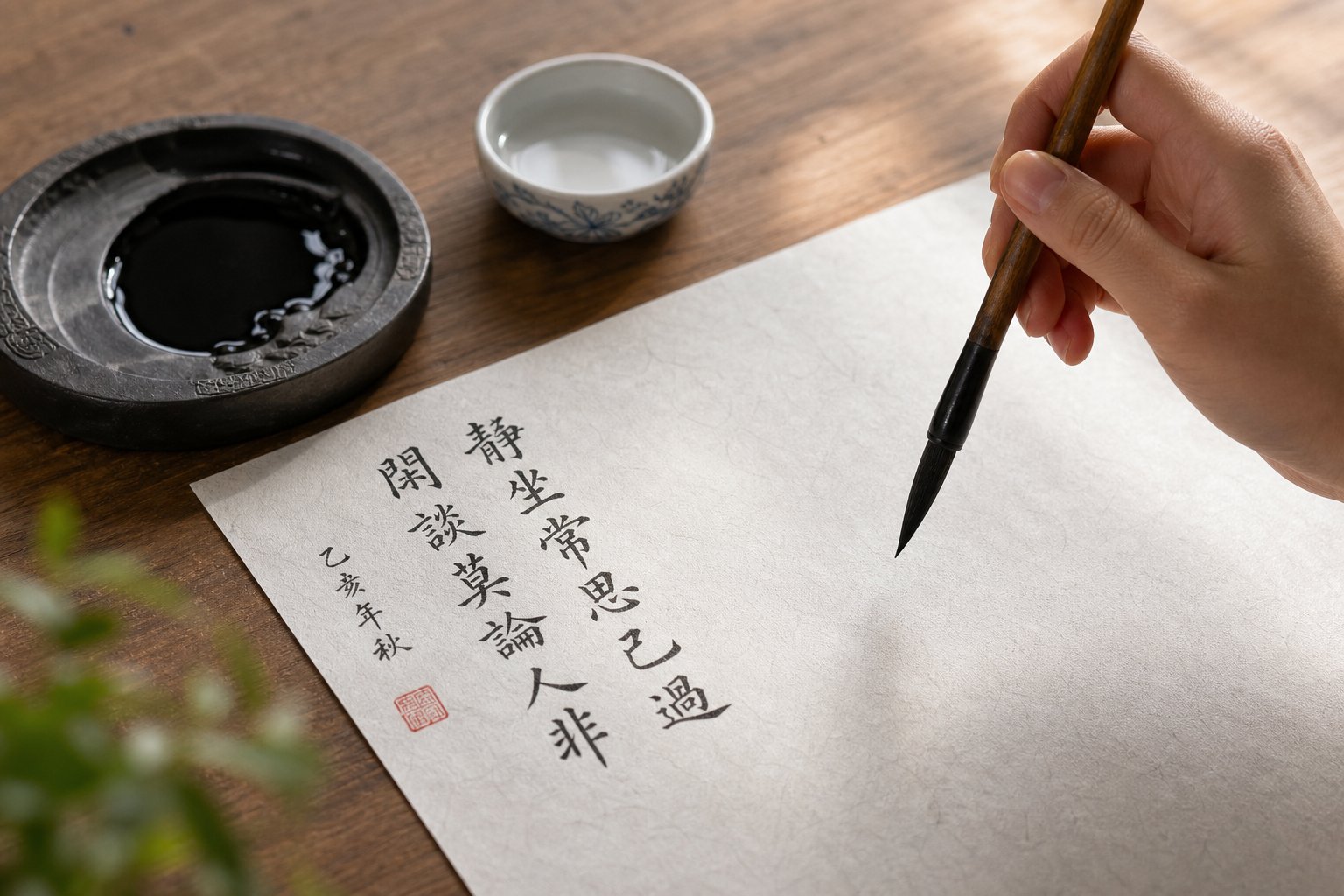
Knowing the philosophy behind a character is satisfying, but your hand still needs to know where to move. The king chinese character looks deceptively simple: four strokes, no curves, no hooks. Yet beginners routinely get the sequence wrong because the stroke order follows rules that are not always intuitive to English speakers.
Four Strokes in the Correct Order
When writing king in chinese writing, you follow the standard principle of "top to bottom, horizontal before vertical." The character 王 contains exactly four strokes, and each one must be written in a specific direction:
- First horizontal stroke (top) - Draw a short horizontal line from left to right. This represents the top boundary of the character and should be moderate in length.
- Second horizontal stroke (middle) - Draw another horizontal line from left to right, slightly shorter than the first. Position it at the vertical center of the character.
- Vertical stroke (center) - Draw a straight line from top to bottom, passing through the midpoint of both horizontal strokes. This is the spine of the character.
- Third horizontal stroke (bottom) - Draw the final horizontal line from left to right. Make this one slightly longer than the other two. It anchors the character and gives it visual stability.
Why does the vertical stroke come third instead of second? Chinese stroke order rules dictate that when a vertical stroke intersects multiple horizontals, you complete the upper horizontals first, then draw the vertical, then finish with the bottom horizontal. Think of it as building a frame: you lay the crossbars before inserting the post that holds them together.
Common mistakes beginners make include drawing the vertical stroke first, making all three horizontals the same length, or rushing through without pausing between strokes. The bottom stroke should be noticeably wider than the top two, giving the character a grounded, stable appearance, like a ruler standing firmly on the earth.
A helpful proportion tip: imagine the character fitting inside a square. The vertical stroke should land exactly at the horizontal center, and the three horizontal lines should divide the square into roughly equal vertical sections. Consistent spacing is what separates a well-written 王 from a sloppy one.
How to Tell 王 Apart from 玉
Here is where many learners stumble. The chinese character for wong (王, used in the Cantonese romanization of the surname) looks almost identical to 玉 (yu, meaning jade). The only visible difference? A single small dot.
| Feature | 王 (wang - king) | 玉 (yu - jade) |
|---|---|---|
| Stroke count | 4 strokes | 5 strokes |
| Distinguishing mark | No dot | Small dot (丶) at lower right |
| Meaning | King, ruler, surname | Jade, precious stone |
| As a radical | Indicates power or phonetic value | Indicates gems, beauty, or value |
The character 玉 adds a dot (丶) tucked into the lower-right area, written as the fifth and final stroke. Without that dot, you have 王. With it, you have 玉. This tiny mark completely changes the meaning, so pay close attention when reading handwritten Chinese, where the dot can sometimes be faint or positioned ambiguously.
Here is a practical way to remember: a king (王) stands alone and needs nothing extra. Jade (玉) is a precious stone with a small flaw or marking that makes it unique, represented by that added dot. When you encounter either character in the wild, check the lower-right corner first. That single dot is your key to telling them apart.
Once your hand is comfortable forming these four strokes in sequence, the next challenge is making them sound right. The character's pronunciation carries its own set of surprises, especially when you discover that "Wang" and "Wong" are actually the same character spoken in different dialects.
Pronunciation Guide for 王 in Mandarin and Cantonese
How do you pronounce wang correctly? The answer depends on which Chinese dialect you are speaking, and even within Mandarin, the tone you choose changes the word's meaning entirely. Getting this right matters, because in a tonal language, pitch is not decoration. It is grammar.
Pronouncing Wang with the Correct Tone
In Mandarin, 王 is wang pronounced with the second tone: wáng. The second tone is a rising pitch that starts at a mid-level and climbs sharply upward, similar to the natural intonation English speakers use when asking "What?" in surprise. Your voice lifts from the middle of your range to the top.
Break the syllable into two parts:
- Initial sound: w- This is a rounded lip sound, identical to the English "w" in "want" or "water." Your lips start rounded and then open.
- Final sound: -ang This rhymes with the English word "song" but with a broader, more open "ah" vowel at the start. The pinyin final "uang" combines a quick "oo" glide with the open "ang" ending, producing a full, resonant sound.
Put them together with a rising pitch, and you get wáng: the chinese wang that means "king."
Here is where tones get tricky. There is a second, less common pronunciation: wàng, spoken with the fourth tone (a sharp falling pitch, like giving a firm command). In classical Chinese, wàng functions as a verb meaning "to rule" or "to reign over." You will encounter this reading in ancient texts and literary Chinese, but in modern everyday speech, wáng (second tone) is the standard pronunciation for both the noun "king" and the surname.
Common mistakes English speakers make include pronouncing the vowel too short (saying "wang" to rhyme with "bang" instead of giving the "a" its full open quality) and flattening the tone into a monotone. Remember: Mandarin has four pitched tones plus a neutral tone, and getting the wrong one can change your meaning completely. A flat, toneless "wang" will sound unnatural and may confuse native listeners.
Why Wong and Wang Are the Same Character
If you have ever met someone surnamed Wong and someone surnamed Wang and wondered whether they share the same family name, the answer is yes. Both spellings represent 王, just romanized from different Chinese dialects.
The character 王 is pronounced Wang in Mandarin, Wong in Cantonese, Ong in Hokkien, and Heng in Teochew. In regions with large Chinese diaspora communities like Singapore, Malaysia, and Hong Kong, the spelling of a person's surname often signals their ancestral dialect group. A person named Wong likely has Cantonese-speaking roots, while someone named Ong probably traces their heritage to Hokkien-speaking regions of Fujian province.
| Dialect | Romanization | Tone | Approximate Sound |
|---|---|---|---|
| Mandarin (Putonghua) | wáng | Rising (Tone 2) | "wahng" with rising pitch |
| Cantonese | wong4 | Low falling (Tone 4) | "wawng" with a low drop |
| Hokkien (Min Nan) | ông | Rising | "ohng" with rising pitch |
| Teochew | hêng | Rising | "heng" with rising pitch |
Notice how dramatically the initial consonant shifts across dialects. Mandarin uses "w," Cantonese also uses "w" but changes the vowel, Hokkien drops the initial consonant entirely, and Teochew replaces it with "h." These are not different characters. They are the same 王 filtered through regional sound systems that diverged over centuries.
For English speakers learning Mandarin specifically, the key takeaway is simple: round your lips for the "w," open wide for the "ang," and let your pitch rise confidently from middle to high. Practice by saying "What?" in a surprised tone, then replace the word with "wáng." The pitch contour is nearly identical.
Pronunciation gives you the sound of a single character. But 王 rarely appears alone in real Chinese. It combines with other characters to form words, names, and idioms, and it also hides inside dozens of other characters as a radical, quietly shaping their meanings from within.

王 Across Chinese, Japanese, and Korean
Chinese characters did not stay within China's borders. Over centuries of cultural exchange, 王 traveled east to Japan and south to Korea, embedding itself in both writing systems. Each language absorbed the character, kept its core meaning of "king," and then adapted it to fit local political structures and pronunciation patterns. The result is a shared heritage with surprisingly distinct usage rules.
王 in Japanese — Readings and Compounds
In Japanese, the king kanji 王 carries the on'yomi (Chinese-derived) reading おう (o), and it has no native Japanese kun'yomi reading. This makes it somewhat unusual: most common kanji have both a Chinese-derived and a native Japanese pronunciation, but 王 relies entirely on its imported sound. The character is classified as JLPT N3 level and taught in first grade at Japanese schools, reflecting how fundamental it is to basic literacy.
When you encounter king in japanese language, you will almost always see 王 inside a compound word rather than standing alone. Here are the most common examples:
- 王様 (おうさま / osama) — king; the polite, everyday term for a king, often used in fairy tales and children's stories
- 王国 (おうこく / okoku) — kingdom; literally "king-country"
- 王子 (おうじ / oji) — prince; literally "king's child"
- 王女 (おうじょ / ojo) — princess; the female counterpart
- 女王 (じょおう / joo) — queen; notice the reversed character order compared to 王女
- 王冠 (おうかん / okan) — crown; the headwear of a king
- 王朝 (おうちょう / ocho) — dynasty; a period of rule by one royal family
- 竜王 (りゅうおう / ryuo) — Dragon King; a title in shogi (Japanese chess) and a figure in mythology
Here is a critical distinction that trips up learners: in Japanese, 王 specifically refers to a king who ranks below an emperor. The japanese for king is not the same as the Japanese for emperor. Japan's own monarch holds the title 天皇 (tenno, literally "heavenly sovereign"), a rank considered higher than 王. So when Japanese speakers use 王, they typically mean a foreign king, a historical ruler of lesser rank, or a figurative "king" of a domain like chess or sports. The character carries connotations of excellence and dominance beyond literal royalty, appearing in terms like 棋王 (kio, "king of chess") and 海王星 (kaiosei, the planet Neptune, literally "Sea King Star").
王 in Korean — From Historical Titles to Modern Use
The korean word for king is 왕 (wang), a direct phonetic borrowing from Middle Chinese that has remained remarkably stable over the centuries. In Korean, the character 王 belongs to the hanja system, the set of Chinese characters historically used in Korean writing before hangul became dominant.
During the Joseon dynasty (1392-1897), 왕 (王, wang) was the general title for the Korean monarch. The king was addressed with various formal titles like 주상 (主上, chusang) or 국왕 (國王, gugwang, literally "nation-king"), but 왕 remained the core term for the sovereign. This title carried specific political weight: Joseon rulers used 왕 rather than 皇帝 (hwangje, emperor) because the emperor title was reserved for the Chinese sovereign under the tributary system. Only when King Gojong declared the Korean Empire in 1897 did the Korean monarch adopt the higher title of emperor.
In modern Korean, 왕 appears in everyday vocabulary and popular culture:
- 왕 (wang) — king; also used colloquially as a prefix meaning "super" or "extra large" (e.g., 왕만두 = jumbo dumpling)
- 왕국 (wangguk) — kingdom
- 왕자 (wangja) — prince
- 왕비 (wangbi) — queen consort
- 대왕 (daewang) — great king, used in historical titles like 세종대왕 (Sejong Daewang, King Sejong the Great)
Korean historical dramas (사극, sageuk) have made these royal titles familiar to international audiences. If you have watched any Korean period drama, you have heard 왕 spoken dozens of times per episode.
Shared Heritage with Distinct Meanings
All three languages inherited 王 from classical Chinese, yet each carved out a unique semantic space for it. The table below captures these differences at a glance:
| Feature | Chinese | Japanese | Korean |
|---|---|---|---|
| Character | 王 | 王 | 王 |
| Reading | wang (second tone) | o (on'yomi) | wang |
| Script system | Hanzi | Kanji | Hanja |
| Rank implied | King (below emperor after Qin dynasty) | King (always below tenno) | King (highest title until 1897) |
| Modern frequency | Very high (surname + vocabulary) | High (compounds + cultural use) | Moderate (hanja declining, but common in speech) |
| Example compound | 国王 (guowang) — king of a country | 王国 (okoku) — kingdom | 왕국 (wangguk) — kingdom |
| Figurative use | Master of a domain (e.g., 歌王, song king) | Best in a field (e.g., 棋王, chess king) | Prefix for "extra large" (e.g., 왕새우, king prawn) |
A few patterns stand out. The pronunciation stayed closest to the original in Korean (wang) and shifted most in Japanese (o). The political rank of 王 dropped in China and Japan once higher imperial titles emerged, but in Korea it remained the top title for five centuries. And all three languages extended 王 beyond literal kingship into figurative territory, using it to mark supremacy in any domain.
One more shared trait connects these three traditions: in all of them, 王 does double duty as a standalone character and as a component inside other characters. When it appears on the left side of a more complex character, it takes on a completely different identity, one that has nothing to do with kings at all.
王 as a Building Block in Other Characters
That completely different identity? It is jade. When the wong chinese character appears tucked into the left side of a more complex character, it almost never signals kingship. Instead, it points toward precious stones, beauty, or value. This dual role makes 王 one of the most deceptive radicals in the entire Chinese writing system, and understanding it gives you a shortcut to decoding dozens of unfamiliar characters on sight.
Radical 96 and Its Dual Identity
In the traditional system of 214 radicals used to organize Chinese dictionaries, 王 is classified as Radical 96. Its official name is the "jade radical" (玉部), not the "king radical." Sounds confusing? Here is why.
The standalone character for jade is 玉 (yu), which has five strokes and includes a distinguishing dot in the lower right. But when 玉 appears as a radical on the left side of a character, it loses that dot and is written as ⺩, a four-stroke form that looks identical to 王. Centuries ago, the two characters had visually distinct forms, but as writing evolved, they converged in appearance until scribes added the dot to the standalone jade character just to tell them apart.
The practical result for learners: when you see 王 sitting on the left side of a character, your first instinct should be "jade or precious things," not "king." The radical is functioning as a compressed version of 玉, carrying meanings related to gemstones, beauty, purity, or value. This single insight unlocks the logic behind hundreds of characters in the Kangxi Dictionary, which lists 473 characters containing this radical.
Think of it this way: the chinese character wong (王) wears two hats. As a standalone character, it means king. As a radical embedded inside other characters, it whispers "something precious" to the reader. Recognizing which hat it is wearing depends entirely on position. Left side of a compound character? Jade. Standing alone or used as a surname? King.
Common Characters Built with the 王 Radical
Once you know the wong chinese symbol functions as a jade indicator inside compound characters, patterns emerge quickly. Here are some of the most frequently used characters that contain Radical 96, along with how the radical contributes to their meaning:
- 珠 (zhu) — pearl, bead: The 王 radical on the left signals "precious stone," while the right component 朱 (zhu) provides the pronunciation. A pearl is literally a precious round object, and the radical tells you that immediately.
- 珍 (zhen) — precious, rare: Again, the left-side radical flags something of great value. This character appears in common words like 珍珠 (zhenzhu, pearl) and 珍贵 (zhengui, precious).
- 玩 (wan) — to play: The connection to jade is less obvious here, but the original meaning related to handling and admiring jade objects for pleasure. Over time, it broadened to mean "play" or "have fun" in general.
- 现 (xian) — to appear, present: The radical hints at something coming into view like a gem being revealed. Used in everyday words like 现在 (xianzai, now) and 发现 (faxian, to discover).
- 理 (li) — reason, principle, to manage: Originally referred to the veins and patterns inside jade, the natural lines that a craftsman follows when carving. The meaning extended metaphorically to "the underlying pattern of things," hence "reason" or "principle."
- 环 (huan) — ring, circle: A jade ring or bracelet. The radical tells you it is a precious ornamental object, while the right side provides phonetic information.
- 球 (qiu) — ball, sphere: Originally a jade ball or orb. The meaning generalized to any spherical object, which is why 足球 (zuqiu, football) and 地球 (diqiu, Earth) both contain this character.
- 琴 (qin) — stringed instrument: Ancient Chinese instruments were considered objects of refinement and beauty, worthy of the jade radical's association with elegance and cultural value.
- 瑰 (gui) — magnificent, rose: Appears in 玫瑰 (meigui, rose) and 瑰宝 (guibao, treasure). The radical signals extraordinary beauty.
Notice the pattern? In nearly every case, the 王 radical on the left connects to something valuable, beautiful, or refined. It functions like a semantic tag, giving you a clue about the character's meaning before you even know the pronunciation.
This is exactly why radicals matter for language learners. When you encounter an unfamiliar character with ⺩ on its left side, you can immediately narrow down the meaning to the domain of precious materials, beauty, or value. You might not know the exact definition, but you know the neighborhood. That contextual awareness speeds up reading comprehension and makes vocabulary acquisition feel less random.
The radical also appears in several common surnames and personal names, particularly in female given names where parents choose characters associated with beauty and preciousness: 琳 (lin, beautiful jade), 瑶 (yao, precious jade), and 璐 (lu, fine jade) are all popular choices that carry the jade radical.
From ancient axe blade to cosmic diagram to jade indicator, 王 has proven itself one of the most versatile characters in the Chinese writing system. Its role as Radical 96 means it quietly shapes the meaning of hundreds of other characters, most of which have nothing to do with kings or rulers. Recognizing this dual identity is one of the most efficient shortcuts a learner can develop for building vocabulary systematically.
Beyond its structural role inside other characters, 王 also leads a busy life on its own in modern Chinese, where it functions as the world's most common surname and appears in dozens of everyday compounds and idioms.

王 in Modern Chinese Life and Vocabulary
So what is wang in the context of everyday Chinese life? Far more than an ancient symbol of kingship. This character is alive in modern China, appearing on ID cards, storefronts, movie posters, and dinner table conversations. Its most visible role today is not as a word meaning "king" but as a surname carried by more people than the entire population of most countries.
The World's Most Common Surname
According to the most recent national census data from the Chinese government, 王 (wang) is the number one most common surname in China, shared by over 101.8 million people. To put that in perspective, if everyone surnamed 王 formed their own country, it would be the 14th most populous nation on Earth, larger than Germany or the United Kingdom.
Why is this surname so widespread? Several historical factors contributed. During various dynasties, members of royal families who lost power adopted 王 as their surname, literally marking themselves as descendants of kings. Other families were granted the surname by emperors as an honor. Over millennia, these separate lineages merged into a single massive surname group. The character's meaning, "king," also made it an aspirational choice that families were proud to carry.
When Chinese people hear the surname 王, they do not think of royalty. It is too common for that. Instead, it carries a sense of familiarity and approachability. The phrase 老王 (lao wang, "Old Wang") is practically a generic placeholder name in Chinese storytelling and jokes, similar to how English speakers might say "John Smith." You will hear 王老师 (wang laoshi, "Teacher Wang") in schools, 王先生 (wang xiansheng, "Mr. Wang") in offices, and 小王 (xiao wang, "Young Wang") among colleagues.
Essential Vocabulary and Compounds with 王
Beyond its role as a surname, 王 forms the backbone of essential vocabulary related to royalty, power, and excellence. If you want to define wang comprehensively, you need to see it in combination with other characters, where its meaning expands and sharpens depending on context.
| Compound | Pinyin | Meaning | Literal Breakdown |
|---|---|---|---|
| 国王 | guowang | King (of a country) | country + king |
| 女王 | nuwang | Queen | woman + king |
| 王子 | wangzi | Prince | king + son |
| 王后 | wanghou | Queen (consort) | king + after/behind |
| 王国 | wangguo | Kingdom | king + country |
| 王冠 | wangguan | Crown | king + cap |
| 王朝 | wangchao | Dynasty | king + dynasty/morning |
| 大王 | dawang | Great king / overlord | great + king |
| 王牌 | wangpai | Trump card / ace | king + card |
| 王者 | wangzhe | Champion / the king | king + one who is |
| 霸王 | bawang | Overlord / tyrant | hegemon + king |
| 帝王 | diwang | Emperor | imperial + king |
A few of these deserve closer attention. The compound 女王 (nuwang) translates literally as "woman king" and is used for a queen who rules in her own right, like Queen Elizabeth II. This differs from 王后 (wanghou), which refers to a queen consort, the wife of a king. The distinction matters in Chinese: a 女王 holds power; a 王后 holds a title through marriage.
The 大王 meaning is equally layered. In historical contexts, 大王 (dawang) refers to a great king or supreme ruler. In folk tales and opera, it often describes a bandit chief or mountain lord. In modern slang, calling someone 大王 can be playful, like saying "the boss" or "the big cheese." The mobile game 王者荣耀 (wangzhe rongyao, Honor of Kings) uses 王者 to evoke championship-level dominance, and it has become one of the most downloaded games globally.
The compound 王牌 (wangpai) literally means "king card" and translates as "trump card" or "ace." You will hear it in card games, business strategy discussions, and sports commentary whenever someone pulls out their strongest asset.
王 in Idioms and Everyday Expressions
Chinese idioms (成语, chengyu) and colloquial expressions give 王 a life beyond formal vocabulary. Here are example sentences showing the character in natural contexts:
- 他姓王, 是我们的新同事。 (Ta xing wang, shi women de xin tongshi.) — His surname is Wang; he is our new colleague. [王 as a surname]
- 英国国王住在白金汉宫。 (Yingguo guowang zhu zai Baijinhan Gong.) — The King of England lives in Buckingham Palace. [王 in a royal title]
- 她是我们公司的销售王牌。 (Ta shi women gongsi de xiaoshou wangpai.) — She is our company's sales ace. [王 in a figurative compound]
- 山中无老虎, 猴子称大王。 (Shan zhong wu laohu, houzi cheng dawang.) — When there is no tiger in the mountain, the monkey calls himself king. [A proverb meaning lesser people rise when true leaders are absent]
- 王婆卖瓜, 自卖自夸。 (Wang po mai gua, zi mai zi kua.) — Old Lady Wang sells melons and praises her own goods. [An idiom for shameless self-promotion]
That last idiom is one of the most commonly quoted in daily Chinese. Whenever someone brags about their own work or product, a listener might quip "王婆卖瓜" and everyone understands the gentle criticism. The definition wang carries in this idiom is not "king" at all but simply a surname, yet the expression has become inseparable from the character's cultural presence.
Brand names also lean on 王 for its connotations of supremacy. 王老吉 (Wang Lao Ji) is one of China's best-selling herbal tea brands, using the surname in its name. The shampoo brand 霸王 (Bawang, literally "overlord") trades on the character's association with dominance and strength. In gaming, 王者荣耀 (Honor of Kings) has made 王者 a household term among younger Chinese speakers, extending the wang def from ancient ruler to modern champion.
From census data to card games, from proverbs about monkeys to billion-dollar beverage brands, 王 threads through Chinese life with a frequency that few characters can match. Its meaning has stretched far beyond the original axe-wielding sovereign. Today it marks family identity for over a hundred million people, structures essential vocabulary about power and excellence, and lends its authority to any context where someone or something claims to be the best. Three strokes, one vertical line, and an entire civilization's relationship with the concept of rulership, all packed into a character you can write in under two seconds.
Frequently Asked Questions About the King Chinese Character
1. What does the Chinese character 王 mean?
The character 王 (wáng) means king, ruler, or monarch in Chinese. It consists of three horizontal strokes connected by a single vertical line. Beyond its literal meaning, 王 is also the most common surname in China (shared by over 100 million people) and serves as Radical 96 in the Chinese writing system, where it indicates meanings related to jade and precious stones rather than kingship.
2. How do you write the Chinese character for king?
Writing 王 requires four strokes in a specific order: first, draw the top horizontal line left to right; second, draw the middle horizontal line (slightly shorter); third, draw the vertical stroke from top to bottom through both lines; fourth, draw the bottom horizontal line, making it slightly longer than the others for visual stability. The key rule is that the vertical stroke comes third, not second, because Chinese stroke order requires completing upper horizontals before inserting the connecting vertical.
3. Why are Wang and Wong spelled differently if they are the same character?
Wang and Wong are both romanizations of 王 from different Chinese dialects. Wang comes from Mandarin (wáng, second tone), while Wong reflects the Cantonese pronunciation (wong4). Other dialect spellings include Ong (Hokkien) and Heng (Teochew). The spelling of a person's surname often indicates their ancestral dialect group and regional heritage rather than a different character or meaning.
4. What is the difference between 王 (king) and 皇 (emperor) in Chinese?
In Chinese, 王 (wáng) originally referred to a ruler who governed through moral authority and cosmic harmony, serving as an intermediary between heaven and earth. The title 皇 (huáng) was adopted by Qin Shi Huang in 221 B.C. to claim supreme, almost divine power above the traditional king. After that point, 王 became a lesser title used for princes and regional rulers beneath the emperor, while 皇 held the highest political rank.
5. How is 王 used in Japanese and Korean?
In Japanese, 王 is read as おう (ō) and refers specifically to a king ranked below the emperor (天皇, tennō). It appears in compounds like 王国 (ōkoku, kingdom) and 王子 (ōji, prince). In Korean, 王 is read as 왕 (wang) and was the primary title for Korean monarchs throughout the Joseon dynasty. Modern Korean also uses 왕 as a colloquial prefix meaning 'super' or 'extra large,' as in 왕만두 (jumbo dumpling).