What Lao Gong Really Means in Chinese
Ever heard someone say "lao gong" in a Chinese drama or overheard it in conversation and wondered what it means? You're not alone. This two-syllable phrase is one of the first relationship terms most Mandarin learners encounter, and its simplicity hides a surprisingly rich backstory.
What Does Lao Gong Mean in Chinese
Lao gong (老公, pinyin: lǎo gōng) is the most common informal Chinese term for "husband." It is the everyday, affectionate way millions of Mandarin speakers refer to their male partner in casual conversation.
Think of it as the Chinese equivalent of calling someone "hubby" rather than "my husband." While formal alternatives exist for legal documents, news broadcasts, and polite introductions, laogong is what you'll actually hear between couples at the dinner table, in text messages, and across social media. It carries warmth, familiarity, and a sense of closeness that more formal terms simply don't convey.
What makes this term fascinating is how much depth sits beneath its casual surface. The two characters that form it each carry their own weight of meaning. The pronunciation involves specific tonal patterns that trip up many learners. And its history? That's where things get genuinely surprising, involving imperial courts, eunuchs, and a dramatic transformation in meaning over centuries.
Why This Term Matters for Language Learners
Understanding the lao gong meaning goes far beyond memorizing a vocabulary word. It opens a window into how Chinese culture approaches intimacy, respect, and the evolving dynamics between partners. You'll encounter it constantly in real-life Mandarin, from TV shows to everyday eavesdropping at a Shanghai cafe. Knowing when and how to use it, and when a more formal term fits better, signals genuine cultural fluency rather than textbook knowledge.
This guide covers everything in one place: a character-by-character breakdown, correct pronunciation with tone tips, the full historical journey of the term, comparisons with every other Chinese word for husband, regional differences, and how modern internet culture has given laogong entirely new dimensions. Whether you're a language student, someone in a cross-cultural relationship, or just curious about Chinese culture, you'll walk away with a complete picture.
The story starts with two simple characters, 老 and 公, and how they combine in a way that isn't quite as straightforward as it looks.
Character-by-Character Breakdown of 老公
Chinese builds meaning by combining characters, and laogong in Chinese is a perfect example of this logic at work. Each character contributes something specific, and together they produce a meaning that neither carries alone. Let's pull them apart.
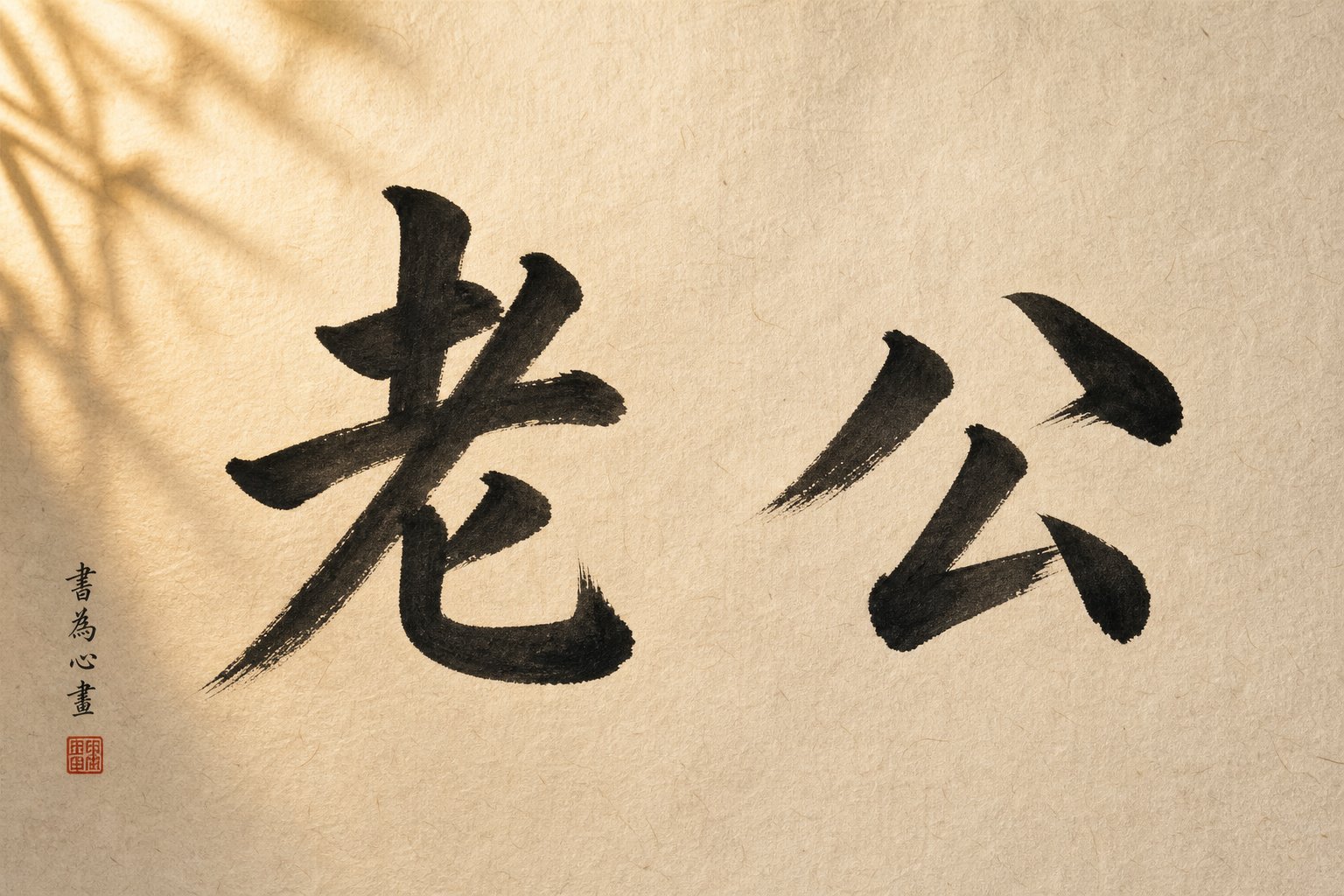
Breaking Down the Characters 老 and 公
The first character, 老 (lǎo), is one you'll see everywhere in Mandarin. Its core meaning is "old" or "aged," but don't take that too literally. In Chinese, 老 frequently functions as a prefix expressing familiarity, respect, or experience rather than physical age. You'll find it in 老师 (lǎo shī, teacher), 老板 (lǎo bǎn, boss), and 老朋友 (lǎo péngyou, old friend). In each case, 老 signals closeness or earned status, not wrinkles.
The second character, 公 (gōng), carries meanings like "male," "public," "lord," or "duke." It appears in words like 公司 (gōng sī, company), 公主 (gōng zhǔ, princess), and 公鸡 (gōng jī, rooster). The thread connecting these uses is authority, masculinity, or public standing.
| Character | Pinyin | Tone | Individual Meanings | Role in 老公 |
|---|---|---|---|---|
| 老 | lǎo | 3rd (dipping) | Old, experienced, familiar, venerable | Adds intimacy and affectionate familiarity |
| 公 | gōng | 1st (high flat) | Male, lord, public, duke | Identifies the masculine/husband figure |
| 老公 | lǎo gōng | 3rd + 1st | Husband (informal) | Casual, intimate term for one's male partner |
How Two Characters Combine to Mean Husband
Imagine combining "familiar/dear" with "man/lord" and you get something close to "my dear man" or "my guy." That's the emotional logic behind 老公. This mirrors how Chinese word formation works broadly: two characters with independent meanings merge to create a new concept that feels intuitive once you see the pieces.
This pattern repeats across relationship vocabulary. The reciprocal term 老婆 (lǎo pó, wife) uses the same 老 prefix paired with 婆 (pó, woman/grandmother). Similarly, 老爸 (lǎo bà) means "dad" with an affectionate tone, and 老妈 (lǎo mā) does the same for "mom." The 老 prefix consistently transforms a neutral label into something warmer and more personal.
Worth noting: the character order matters. Reversing gong lao doesn't produce a standard word. Chinese compound words are fixed in their sequence, and 老公 only works in this direction.
Understanding this construction gives you more than just one vocabulary word. It hands you a pattern you can recognize across dozens of Chinese terms for family, relationships, and social roles. But knowing what the characters mean on paper is only half the challenge. Getting the sounds right, especially those tones, is where many learners stumble.
How to Say Husband in Chinese with the Right Tones
Knowing the characters is one thing. Saying them so a native speaker actually recognizes the word? That's where tones come in. If you want to learn how to say husband in Chinese naturally, you'll need to nail two specific tones and understand how they interact in real speech.
Pinyin and Tones for Lao Gong
The pinyin for 老公 is lǎo gōng, combining a third tone with a first tone. Here's what each sounds like:
老 (lǎo) uses the third tone, often called the dipping tone. Your pitch drops low and then rises slightly, like the shape of a valley. 公 (gōng) uses the first tone, a steady high-level pitch you hold flat, like singing one sustained note.
Here's the catch: in natural connected speech, the third tone rarely gets its full dipping-rising shape. When 老 appears before 公 (a first-tone syllable), speakers typically produce only the low falling portion of the third tone, skipping the final rise. Linguists call this the "half third tone." The full dip-and-rise only surfaces when a third-tone syllable sits in isolation or at the end of a phrase. So in practice, 老公 sounds more like a low drop on 老 followed immediately by the high flat 公.
This is different from the well-known "3-3 sandhi rule" (where two consecutive third tones turn the first into a second tone, as in 你好 nǐ hǎo becoming ní hǎo). Since 公 is first tone, that rule doesn't apply here. Instead, you're dealing with the subtler half-third pattern.
Common Pronunciation Mistakes to Avoid
English speakers tend to hit the same pitfalls when pronouncing husband in Mandarin. Watch for these:
- Flattening the third tone into a monotone low note. English has no tonal system, so learners often produce a flat, lifeless low pitch instead of the characteristic dip. Even in its "half" form, the third tone should feel like your voice is sinking downward, not just sitting still.
- Confusing gōng (first tone) with gǒng (third tone). If you accidentally dip on the second syllable, you're producing a completely different sound. 公 needs to stay high and steady throughout.
- Adding English-style stress patterns. English speakers instinctively stress one syllable over another. In Mandarin, both syllables of 老公 carry roughly equal weight. The tones do the work, not volume or emphasis.
- Pronouncing the "o" in gōng like English "go." The vowel in gōng is closer to the "oo" in "goo" with a nasal ending, not the open "oh" sound.
A practical drill: say 老公 slowly, letting your voice drop low on 老, then jump cleanly to a high sustained pitch on 公. Exaggerate the contrast at first. Once the muscle memory sets in, speed up to a natural pace. Recording yourself and comparing to native audio is one of the fastest ways to close the gap.
Getting the pronunciation right matters because how do you say husband in Chinese if the tones are off? You might end up saying something unintended entirely. Tones aren't decoration in Mandarin; they're the difference between one word and another. With the sounds sorted, the real surprise lies in where this term actually came from, and its origins are far stranger than the casual modern usage suggests.

The Surprising Historical Origins of Lao Gong
Here's where the story takes a sharp turn. The term you hear Chinese couples whisper affectionately today once carried a meaning so different it borders on shocking. If you told someone in imperial China that 老公 would one day become a pet name for husbands, they might have stared at you in disbelief.
From Eunuchs to Endearment — The Surprising History
In ancient and imperial China, 老公 had nothing to do with romance. Its earliest documented uses fall into two categories. First, it served as a respectful form of address for elderly men, essentially meaning "old sir" or "venerable gentleman." The 老 carried its literal weight of age, and 公 retained its sense of a respected male figure. You might use it the way English speakers once said "old man" with deference rather than insult.
The second historical meaning is the one that surprises people. During the Ming and Qing dynasties, 老公 became a common way to refer to eunuchs serving in the imperial palace. Court eunuchs, who held significant behind-the-scenes power, were addressed or referenced as 老公 by those around them. The term carried a mix of respect for their authority and acknowledgment of their unique social position.
The same two characters that once identified castrated palace servants in imperial China now serve as the most intimate, affectionate word a Chinese wife uses for her husband.
That's a dramatic leap. So how did it happen?
How Chinese Marriage Culture Shaped the Term
The shift didn't occur overnight. Language evolves alongside the society that speaks it, and Chinese marriage culture underwent massive transformations between the imperial era and the modern period. Several forces drove the change:
As feudal court structures collapsed in the early twentieth century, the eunuch association faded from everyday consciousness. Simultaneously, spoken Chinese was diverging further from classical written forms. Colloquial terms gained legitimacy, and 老公 began circulating in regional dialects as a casual, familiar way for wives to reference their husbands. The 老 prefix shifted from signaling literal age to expressing the same warmth and closeness it carries in words like 老朋友 (old friend).
The broader cultural context matters too. Traditional Chinese relationship vocabulary was heavily formal. A wife might call her husband 夫君 or 相公 in earlier centuries, terms loaded with hierarchy and deference. As gender dynamics in Chinese society moved toward greater equality, especially after the mid-twentieth century, couples needed vocabulary that felt mutual and relaxed rather than one-sided. 老公 filled that gap perfectly. It was short, easy to say, and paired naturally with 老婆 (wife) to create a balanced, reciprocal set.
By the late twentieth century, the transformation was complete. Urban couples across China adopted 老公 as their default, and the eunuch meaning became little more than a historical footnote, occasionally surfacing as a joke or trivia. The term's journey mirrors how Chinese married life itself evolved from rigid formality to personal intimacy.
This evolution raises a practical question for anyone learning the language: if multiple terms for "husband" exist, each carrying different historical weight and formality, which one fits which situation?
Lao Gong vs Other Chinese Words for Husband
Chinese doesn't give you just one word for husband and call it a day. There are at least five commonly used terms, each carrying a distinct tone, context, and cultural flavor. Picking the right one depends on who you're talking to, how formal the situation is, and even which region of China you're in. Let's line them up side by side so you can see exactly where each one fits.
All Chinese Words for Husband Compared
Here's a breakdown of the five major terms you'll encounter when looking for the Chinese for husband:
| Term | Pinyin | Formality Level | Typical Context | Regional Preference |
|---|---|---|---|---|
| 老公 (lǎo gōng) | lǎo gōng | Very casual, intimate | Between couples in private or casual settings; texting, daily conversation | Dominant across Mainland China; widely used in Taiwan and Hong Kong |
| 丈夫 (zhàng fu) | zhàng fu | Neutral to formal | Written Chinese, news reports, official documents, third-person reference | Standard across all Chinese-speaking regions |
| 先生 (xiān shēng) | xiān shēng | Formal, polite | Formal introductions, business settings, addressing someone else's husband | Common in Taiwan; used broadly in formal Mainland contexts |
| 爱人 (ài rén) | ài rén | Neutral, slightly dated | Workplace introductions, older generation usage; can refer to either spouse | Mainland China (especially among older speakers); rare in Taiwan/Hong Kong |
| 夫君 (fū jūn) | fū jūn | Literary, archaic | Historical dramas, classical literature, playful or humorous modern usage | Not region-specific; understood everywhere but used almost exclusively in fiction |
A few things jump out from this comparison. The zhangfu meaning is closest to a neutral, all-purpose "husband" that works in writing and formal speech. It pairs naturally with 妻子 (qīzi, wife) in official or literary contexts. You'll see it in news articles, legal documents, and any situation where emotional warmth isn't the point.
先生 (xiān shēng) does double duty. It means "Mr." or "sir" in general use, but when a wife says 我先生 (wǒ xiān shēng), she's saying "my husband" in a polished, respectful way. This is the term you'd reach for at a business dinner or when introducing your spouse to someone you've just met. It signals courtesy without coldness.
爱人 (ài rén) is an interesting case. Literally "loved one," it became popular in Mainland China after 1949 as a gender-neutral term for one's spouse. Either a husband or wife could be called 爱人. It carries a slightly socialist-era flavor and remains common among older speakers, though younger generations tend to find it a bit stiff or old-fashioned.
The fujun meaning in Chinese points to classical literature and period dramas. If you've watched any ancient Chinese TV series, you've heard a wife address her husband as 夫君. It evokes deference, elegance, and a bygone era of formal marital hierarchy. In modern life, couples sometimes use it playfully or sarcastically, but never as a genuine everyday term.
Formality Spectrum from Casual to Formal
Imagine a sliding scale. On the far left sits 老公, the most intimate and relaxed option. It's what you whisper, text, or call across the apartment. Moving right, you hit 爱人 (neutral but slightly dated), then 丈夫 (standard written/formal), then 先生 (polished and public-facing). At the far right edge, 夫君 lives in its own literary world, more costume drama than real conversation.
- 老公 - Use with your partner in private or casual settings. Equivalent energy to "hubby."
- 爱人 - Use in workplace or semi-formal introductions, especially if you're in Mainland China and speaking with older colleagues.
- 丈夫 - Use in writing, formal speech, or when referring to someone's husband in the third person.
- 先生 - Use in polite introductions, business contexts, or when speaking to people you don't know well.
- 夫君 - Use for fun, in creative writing, or when quoting classical texts. Not for real-life introductions.
The key takeaway? Context drives the choice. A woman might call her partner 老公 at home, introduce him as 我先生 at a company event, and see him described as 丈夫 in a newspaper article, all referring to the same person. Chinese relationship vocabulary isn't about picking one term and sticking with it. It's about reading the room.
This flexibility also plays out geographically. The same couple might default to different terms depending on whether they're in Beijing, Taipei, or Hong Kong, where dialect, generation, and local culture all shape which word feels most natural.
Regional Differences Across Chinese-Speaking Communities
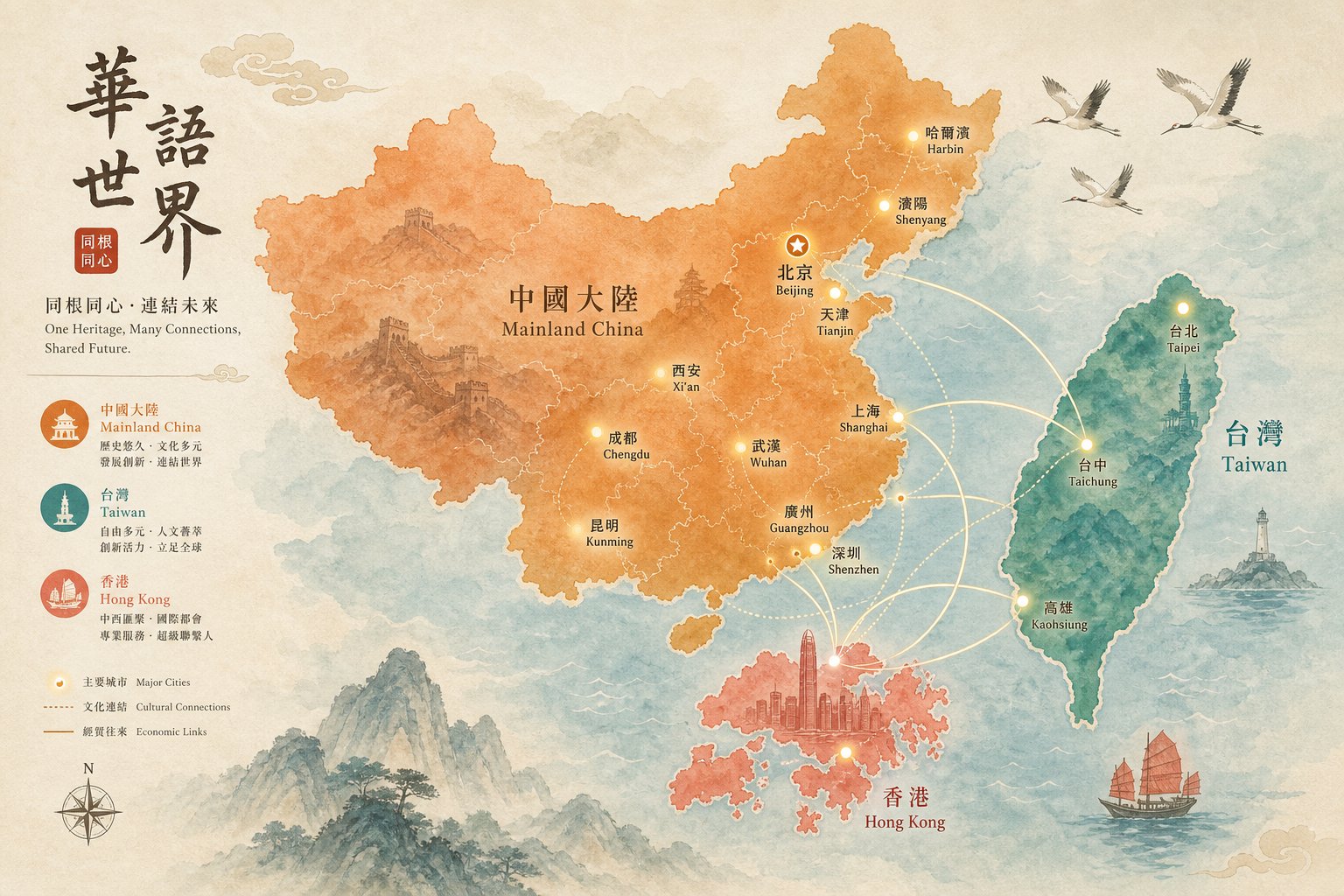
Geography changes everything. A couple in Shanghai, a couple in Taipei, and a couple in Hong Kong might all mean the same thing when they address their partner, but the word they reach for, and how it sounds, can differ in ways that catch learners off guard. The term for husband in different languages and dialects within the Chinese-speaking world reveals just how much local culture shapes everyday speech.
Mainland China and Taiwan Usage Differences
In Mainland China, 老公 reigns as the undisputed default among younger and middle-aged urban couples. Walk through any shopping mall in Beijing, Shenzhen, or Chengdu and you'll hear it constantly. The term dominates texting, social media, and face-to-face conversation between partners. Its rise tracks closely with urbanization and the influence of pop culture. TV dramas, variety shows, and online content all reinforced 老公 as the standard casual choice starting in the 1990s, and it hasn't loosened its grip since.
Taiwan tells a slightly different story. While 老公 is widely understood and used, it shares space with 老公's more formal cousin 先生 (xiān shēng) in everyday contexts where Mainland speakers would never bother with formality. Taiwanese couples, particularly those in their 40s and older, often default to 先生 even in relaxed settings. Younger Taiwanese speakers have increasingly adopted 老公 under the influence of Mainland Chinese media and internet culture, but the shift isn't universal. You'll also hear the Taiwanese Hokkien term 翁 (ang) in families that maintain strong local dialect traditions.
The generational split matters here. Older speakers in both regions tend toward more formal or dialect-specific terms, while anyone under 40 in an urban environment gravitates toward 老公 almost reflexively. Education level and media consumption play a role too. The more someone engages with Mandarin-language pop culture, the more likely they are to adopt the term regardless of where they live.
Hong Kong Cantonese and Overseas Communities
Hong Kong adds a whole new layer. Cantonese speakers use the same characters, 老公, but pronounce them as lou gung (lou5 gung1 in Jyutping romanization). The meaning is identical, the intimacy is the same, but the sound is distinctly Cantonese. For learners who only know the Mandarin pronunciation, hearing "lou gung" in a Hong Kong drama can be momentarily confusing until the characters appear in subtitles.
In Hong Kong, lou gung has been the dominant casual term for decades, arguably even longer than 老公 held that position in parts of the Mainland. Cantonese-speaking communities tend to be less formal in family address terms overall, and the lou gung/lou po pair feels deeply embedded in local culture.
Overseas Chinese communities present the most varied picture. Usage depends heavily on which generation immigrated, which dialect they brought with them, and how much contact they maintain with contemporary Chinese media:
- First-generation immigrants often preserve the dialect and vocabulary of their home region at the time they left. A family that emigrated from Guangdong in the 1970s might still use lou gung exclusively, while a family from northern China might default to 爱人 if they left during that term's peak popularity.
- Second-generation speakers frequently mix English and Chinese, sometimes using "husband" in English conversation and switching to 老公 only when speaking Mandarin or Cantonese with family.
- Third-generation and heritage learners may recognize 老公 from media but feel more comfortable with English terms in their own relationships, using the Chinese term playfully rather than as a genuine daily address.
Dialect background also creates pockets of variation. Hokkien speakers in Southeast Asia might use 翁 (ang), Teochew communities have their own equivalents, and Hakka speakers bring yet another set of terms. The word for husband in all languages within the Chinese family tree shares the same underlying concept but surfaces differently depending on which branch you're on.
What ties all these variations together is the underlying social function. Whether someone says lǎo gōng, lou gung, or a dialect equivalent, they're reaching for the same emotional register: casual, warm, and intimate. The specific sounds change with geography, but the relationship dynamic they express stays remarkably consistent.
This consistency extends to the other half of the equation too. Wherever 老公 appears, its partner term 老婆 is never far behind, and the way couples use these two words together reveals something deeper about how Chinese speakers signal intimacy and commitment.
Lao Po and the Language of Chinese Couples
Every 老公 needs a 老婆. These two terms exist as a matched pair in Chinese, and understanding one without the other leaves the picture incomplete. If lao gong meaning centers on "husband," then its mirror image, 老婆 (lǎo pó), is the casual, intimate word for "wife" that completes the couple in Chinese vocabulary.
Understanding Lao Po — The Wife Counterpart
The lao po meaning follows the same construction logic. The familiar prefix 老 (lǎo) carries warmth and closeness, just as it does in 老公. The second character, 婆 (pó), means "woman" or "grandmother" in other contexts. You'll recognize it in 婆婆 (pó po, mother-in-law) or 外婆 (wài pó, maternal grandmother). Combined with 老, it sheds any elderly connotation and becomes purely affectionate, the wife in China language that couples actually use day to day.
The tonal structure mirrors the pattern too. 老婆 is pronounced lǎo pó, a third tone followed by a second tone (rising). The same half-third-tone rule applies: in natural speech, the 老 drops low without fully rising before moving into the rising pitch of 婆.
What makes the 老公/老婆 pair special is its symmetry. Unlike older terms where the wife's title implied deference to the husband, this pair sits on equal footing. Neither word carries more weight or formality than the other. They're balanced, reciprocal, and interchangeable in emotional register. A husband calling his wife 老婆 and a wife calling her husband 老公 are performing the same act of casual intimacy from both directions.
This balance reflects something real about modern Chinese relationships. The pair replaced older, hierarchical vocabulary (like 夫君/娘子) precisely because couples wanted terms that felt mutual rather than one-sided. When you hear a couple in Chinese using 老公 and 老婆 with each other, you're hearing equality expressed through language.
Can Unmarried Couples Use Lao Gong and Lao Po
Here's where learners often get confused. If 老公 means "husband" and 老婆 means "wife," does using them imply marriage? In practice, no. And this is one of the most important cultural nuances to grasp.
In modern Chinese relationships, using 老公 and 老婆 signals emotional intimacy and commitment rather than legal marital status. Unmarried couples adopt these terms freely once the relationship feels serious.
Young couples in China frequently start calling each other 老公 and 老婆 well before any wedding, sometimes just months into dating. It functions like calling your boyfriend "hubby" or your girlfriend "wifey" in English, except the practice is far more widespread and socially normalized in Chinese culture. Nobody blinks at an unmarried 22-year-old referring to her boyfriend as 老公 in a WeChat message.
So when does the switch happen? There's no fixed rule, but the shift typically signals a few things:
- Exclusivity is established. Couples who've moved past the early dating phase and consider themselves committed often adopt the terms naturally.
- Emotional closeness has deepened. Using 老公/老婆 feels like a small declaration: "you're my person."
- The relationship is heading somewhere serious. While not a guarantee of marriage, the terms imply a future-oriented mindset.
That said, context still matters. A woman introducing her boyfriend to her parents as 老公 before any engagement might raise eyebrows in more traditional families. The terms work best in private conversation, texting, and among peers who understand the casual usage. For formal introductions, 男朋友 (nán péngyou, boyfriend) or 女朋友 (nǚ péngyou, girlfriend) remains the safer choice until the relationship is officially recognized.
This flexibility is part of what makes the 老公/老婆 pair so alive in modern Chinese. The terms have outgrown their dictionary definitions, becoming less about legal status and more about how two people feel toward each other. That emotional elasticity also explains why these words have stretched even further in recent years, showing up in contexts that have nothing to do with actual relationships at all.
Lao Gong in Pop Culture and Internet Slang
Scroll through Weibo or Douyin for five minutes and you'll notice something curious. Fans flood comment sections with 老公 directed at celebrities, anime characters, and fictional heroes they've never met, let alone married. This playful hijacking of the term has become one of the most visible features of Chinese internet culture, stretching the laogong meaning far beyond anything a dictionary would predict.
How Chinese Fans Use Lao Gong for Celebrity Crushes
In Chinese fan culture, calling a celebrity or fictional character 老公 is the equivalent of declaring "he's mine" in the most affectionate, half-joking way possible. When a handsome actor appears on screen or a K-pop idol posts a selfie, thousands of comments instantly fill with 老公! It's not a literal claim of partnership in Chinese. It's a shorthand for intense admiration, attraction, and emotional attachment compressed into two familiar characters.
This phenomenon connects directly to idol culture across East Asia. Fans build parasocial relationships with performers, and 老公 gives that one-sided devotion a playful vocabulary. The term works because everyone understands the context. Nobody mistakes a fan screaming 老公 at a concert for someone announcing their marriage. The word has simply expanded to cover a spectrum of affection that ranges from genuine romantic partnership all the way to "I find this person incredibly attractive."
A few patterns define how this plays out online:
- Celebrity crushes - Fans call actors, singers, and idols 老公 in comments, fan edits, and livestream chats. It signals devotion within fandom communities.
- Fictional characters - Anime, drama, and video game characters get the 老公 treatment constantly. A well-written male lead can accumulate millions of fans calling him 老公 across social platforms.
- Playful use among friends - Sometimes the term extends to anyone a person finds impressive or cool, used with obvious humor and no romantic implication at all.
What's interesting is how this usage coexists peacefully with the original meaning. A woman might call her actual partner 老公 in a text message and then comment 老公 on a celebrity's Douyin video ten minutes later. Context does all the heavy lifting. The word hasn't lost its intimate meaning between real couples. It's simply gained an additional layer in digital spaces, functioning almost like the English "husband" meme where fans jokingly claim fictional characters.
This evolution also touches the term's connection to authority and admiration. Remember that 公 originally carried meanings like "lord" or "duke." In fan usage, that older sense of elevating someone resurfaces. Calling an idol 老公 places them on a pedestal, not unlike how the chinese for boss (老板, lǎo bǎn) uses the same 老 prefix to signal someone worthy of respect and attention.
The Acupressure Point That Shares the Name
If you've searched for "lao gong" and landed on results about Traditional Chinese Medicine, you've encountered a completely different term that happens to share the same romanization. This is 劳宫 (láo gōng), not 老公 (lǎo gōng). Different characters, different tones on the first syllable, entirely different meaning.
劳宫 is the name of acupressure point PC8 (Pericardium 8), located in the center of the palm. Its name translates to "Palace of Toil," reflecting its role in Traditional Chinese Medicine for calming excess heat, easing stress, and restoring mental balance. To find it, make a loose fist and note where your middle fingertip touches your palm.
Here's how to keep these two apart:
- 老公 (lǎo gōng) - Third tone + first tone. Means "husband" (informal). Characters: 老 (old/familiar) + 公 (male/lord).
- 劳宫 (láo gōng) - Second tone + first tone. Means "Palace of Toil." Characters: 劳 (labor/toil) + 宫 (palace). An acupuncture point on the Pericardium meridian used for stress relief and clearing heat.
The tonal difference is the key. 老 uses a third tone (dipping), while 劳 uses a second tone (rising). Native speakers hear these as completely unrelated words. For searchers and learners, though, the identical romanization spelling creates genuine confusion, which is why it's worth flagging here.
Whether it's fans claiming idols online or an acupuncture point in your palm, the romanization "lao gong" clearly leads to more than one destination. Knowing which meaning applies comes down to context, characters, and tones. With all these layers covered, the practical question remains: when you're actually speaking Chinese, how do you use 老公 in a way that sounds natural rather than textbook?
Practical Tips for Using Lao Gong Naturally
Knowing what a word means and knowing when to actually say it are two different skills. You've got the full picture now: the characters, the tones, the history, the regional flavors, and the pop culture spin-offs. So how do you put 老公 to work in real conversation without sounding like you're reading from a phrasebook?
When to Use Lao Gong in Conversation
Think of 老公 as a term with a specific emotional temperature. It's warm, casual, and personal. That means it fits some situations perfectly and feels completely wrong in others. Here's a quick guide:
- Use it when speaking directly to your partner in private or casual settings: texting, phone calls, at home, or among close friends who know you as a couple.
- Use it when referring to your partner casually with close friends: "我老公说..." (My husband said...).
- Avoid it in formal introductions. Meeting your partner's boss? Say 我先生 (wǒ xiān shēng) instead.
- Avoid it in written or official contexts. Legal documents, workplace emails, and news articles call for 丈夫 (zhàng fu).
- Be mindful of your audience. Older or more traditional family members might prefer hearing 先生 or 爱人 depending on their generation and region.
The biggest mistake learners make isn't mispronouncing the word. It's using it in the wrong register. Imagine calling your spouse "hubby" during a formal toast at a business banquet. The word itself isn't wrong, but the setting makes it land awkwardly. Same principle applies to husband in Chinese language: match the term to the moment.
One more tip: if you're not Chinese but you're in a relationship with a Chinese speaker, using 老公 or 老婆 with your partner can feel surprisingly natural once you commit to it. Many cross-cultural couples adopt these terms as part of their shared vocabulary. Start simple, use it in texts first, and let it become part of your rhythm together.
Quick Reference Guide for Chinese Relationship Terms
Here's everything covered in this article distilled into one table. Bookmark it, screenshot it, or keep it handy for the next time you're unsure which term fits.
| Term | Meaning | When to Use |
|---|---|---|
| 老公 (lǎo gōng) | Husband (casual, intimate) | Private conversation, texting, daily life with your partner |
| 老婆 (lǎo pó) | Wife (casual, intimate) | Same as 老公 — the reciprocal term between couples |
| 丈夫 (zhàng fu) | Husband (neutral, formal) | Written Chinese, news, official documents, third-person reference |
| 先生 (xiān shēng) | Husband (polite, formal) | Formal introductions, business settings, speaking to strangers |
| 爱人 (ài rén) | Spouse (gender-neutral, slightly dated) | Workplace introductions in Mainland China, older generation usage |
| 夫君 (fū jūn) | Husband (literary, archaic) | Historical dramas, classical literature, playful or humorous use |
If someone asks what does furen mean in Chinese, point them to that last row. It's the elegant, old-world term that lives in period dramas and poetry rather than real kitchens and text threads.
Learning husband in Chinese isn't just about memorizing one word. It's about understanding a system where formality, intimacy, region, and context all determine which term you reach for. The vocabulary itself is simple. The cultural awareness behind it is what separates a textbook learner from someone who actually sounds like they belong in the conversation.
Practice the tones, pay attention to how native speakers switch between terms in different settings, and don't be afraid to use 老公 or 老婆 once the relationship and context feel right. Language learning works best when you treat words not as isolated definitions but as living tools shaped by the people who use them every day.
Frequently Asked Questions About Lao Gong Meaning
1. What does lao gong literally translate to in Chinese?
Lao gong (老公) combines two characters: 老 (lǎo), meaning old, familiar, or venerable, and 公 (gōng), meaning male, lord, or duke. Together they form the most common informal Chinese term for husband. The 老 prefix functions as an expression of closeness and affection rather than literal age, similar to how it works in 老师 (teacher) or 老朋友 (old friend). The emotional logic is roughly equivalent to saying 'my dear man' in English.
2. Can unmarried couples use lao gong and lao po in Chinese?
Yes, unmarried couples in China frequently use 老公 and 老婆 with each other. These terms signal emotional intimacy and commitment rather than legal marital status. Young couples often adopt them just months into a serious relationship, functioning much like 'hubby' or 'wifey' in English. The practice is socially normalized, especially in texting and private conversation, though more formal terms like 男朋友 (boyfriend) remain appropriate for introductions to family or colleagues.
3. What is the difference between lao gong and zhang fu?
老公 (lǎo gōng) and 丈夫 (zhàng fu) both mean husband but occupy different formality levels. 老公 is casual and intimate, used between couples in daily life, texting, and private settings — similar to saying 'hubby.' 丈夫 is neutral to formal, appearing in written Chinese, news reports, legal documents, and third-person references. Think of 丈夫 as the term you'd see in a newspaper article, while 老公 is what you'd hear whispered at the dinner table.
4. Why do Chinese fans call celebrities lao gong?
In Chinese internet and fan culture, calling a celebrity or fictional character 老公 is a playful way to express intense admiration and attraction. It functions like declaring 'he's mine' in an affectionate, half-joking manner on platforms like Weibo and Douyin. Everyone understands the context is parasocial rather than literal. The term has expanded beyond its marital definition to cover a spectrum of affection, from genuine romantic partnership to fandom devotion, without losing its original meaning between real couples.
5. Is lao gong the same as the acupressure point lao gong?
No, these are entirely different terms that share the same romanization spelling. 老公 (lǎo gōng, third tone + first tone) means husband and uses the characters for 'old/familiar' and 'male/lord.' 劳宫 (láo gōng, second tone + first tone) is acupressure point PC8 on the Pericardium meridian, located in the center of the palm, and translates to 'Palace of Toil.' The key difference is the tone on the first syllable: third tone (dipping) for husband versus second tone (rising) for the acupuncture point.