What Laobaixing Really Means in Chinese Culture
Imagine a single word that captures an entire civilization's relationship between identity, power, and belonging. In Chinese, that word is laobaixing. You hear it in political speeches, casual street conversations, and news broadcasts alike. It means "common people" or "ordinary folks," but its literal translation tells a far stranger story. Why would anyone call everyday citizens "the old hundred surnames"?
Breaking Down the Characters in Laobaixing
The term lao bai xing is built from three characters, each carrying its own cultural weight:
老百姓 (lao bai xing) — Literal: old/venerable + hundred + surnames. Colloquial meaning: the common people, ordinary citizens.
The first character, 老 (lao), does not simply mean "old" in the sense of aged or outdated. In Chinese, lao conveys respect, familiarity, and endurance. Think of how "old friend" in English suggests warmth rather than decay. When applied here, it gives the phrase a sense of deep-rooted permanence, something that has always existed and always will.
The second character, 百 (bai), means "hundred," but functions more like "all" or "every." It is a shorthand for totality, the way English speakers might say "a hundred different reasons" without counting to exactly one hundred.
The third character, 姓 (xing), is where things get interesting. The xing meaning in Chinese goes beyond a simple "surname" or "last name." Historically, xing in Chinese represented clan identity, bloodline, and social legitimacy. In ancient China, ordinary people had no surnames until relatively late in history. Only nobility carried a xing. To possess one was to belong, to be recognized within the social fabric of the empire.
Put these three morphemes together and you get something remarkable: a term that says "all the families, enduring through time" and yet means simply "regular people."
Why a Surname List Became a Word for the People
Here is the central puzzle this article explores: How did a reference to surnames transform into a word for ordinary citizens? The answer lives at the intersection of two things that share the same name but operate in completely different ways.
On one hand, there is the Baijiaxing (百家姓), a Song Dynasty text from around 960 CE that compiled 411 surnames into a rhyming poem used to teach children basic literacy. On the other hand, there is laobaixing as a living, breathing piece of modern Chinese identity language, a term people use daily to distinguish themselves from the rich and powerful.
The logic connecting these two is deceptively simple. If surnames once belonged only to the elite, then "the hundred surnames" eventually came to represent the moment when everyone had one. Having a name meant having a place. And "all the named families" became shorthand for "all of us, the people."
This dual nature, part historical artifact and part everyday vocabulary, is what makes laobaixing old hundred names such a rich subject. It is simultaneously a thousand-year-old literacy primer and a word you will hear in any Chinese taxi, teahouse, or television broadcast. The text tells us where the surnames came from. The living term tells us what they grew to mean.
The Baijiaxing Text and Its Origins as a Literacy Primer
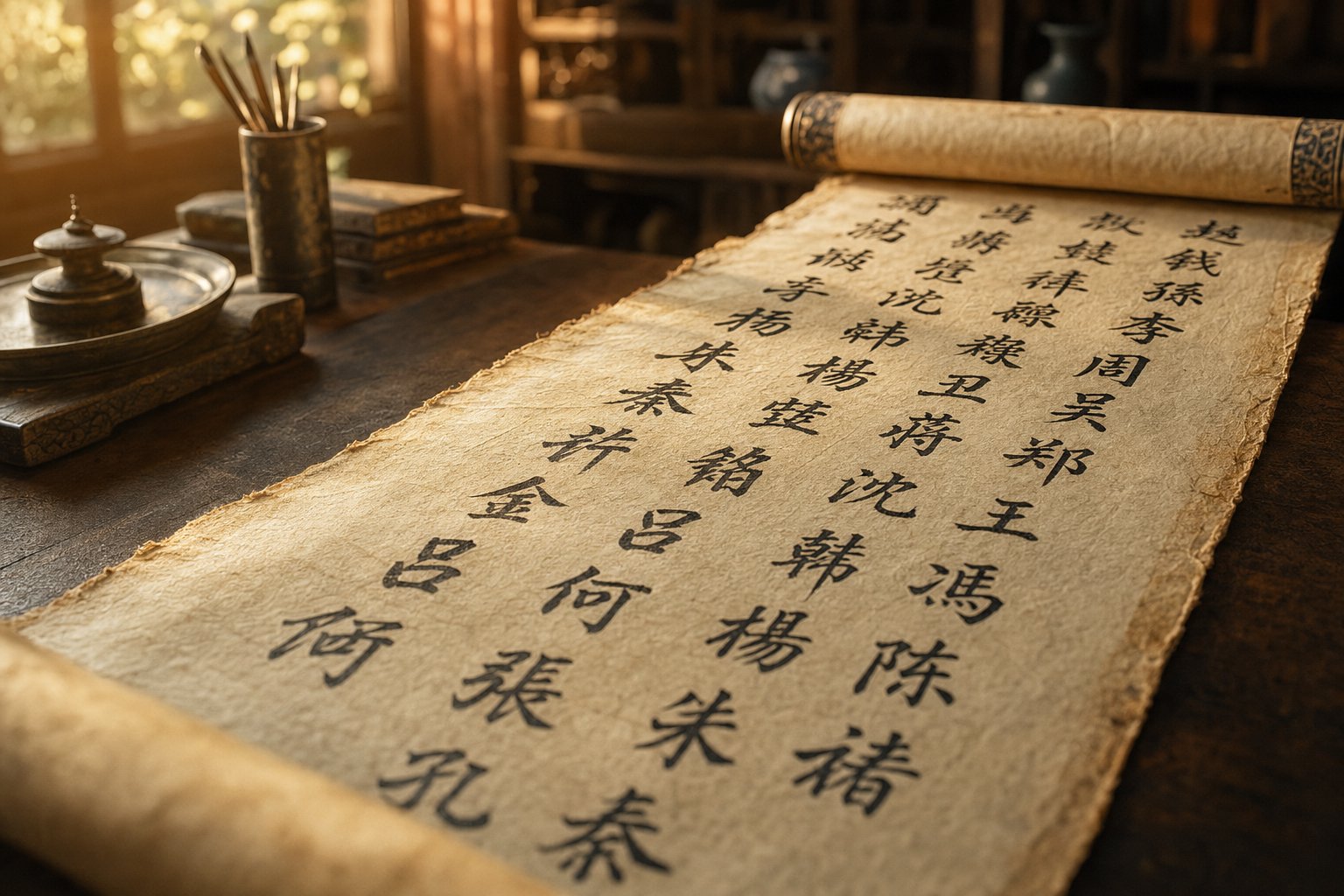
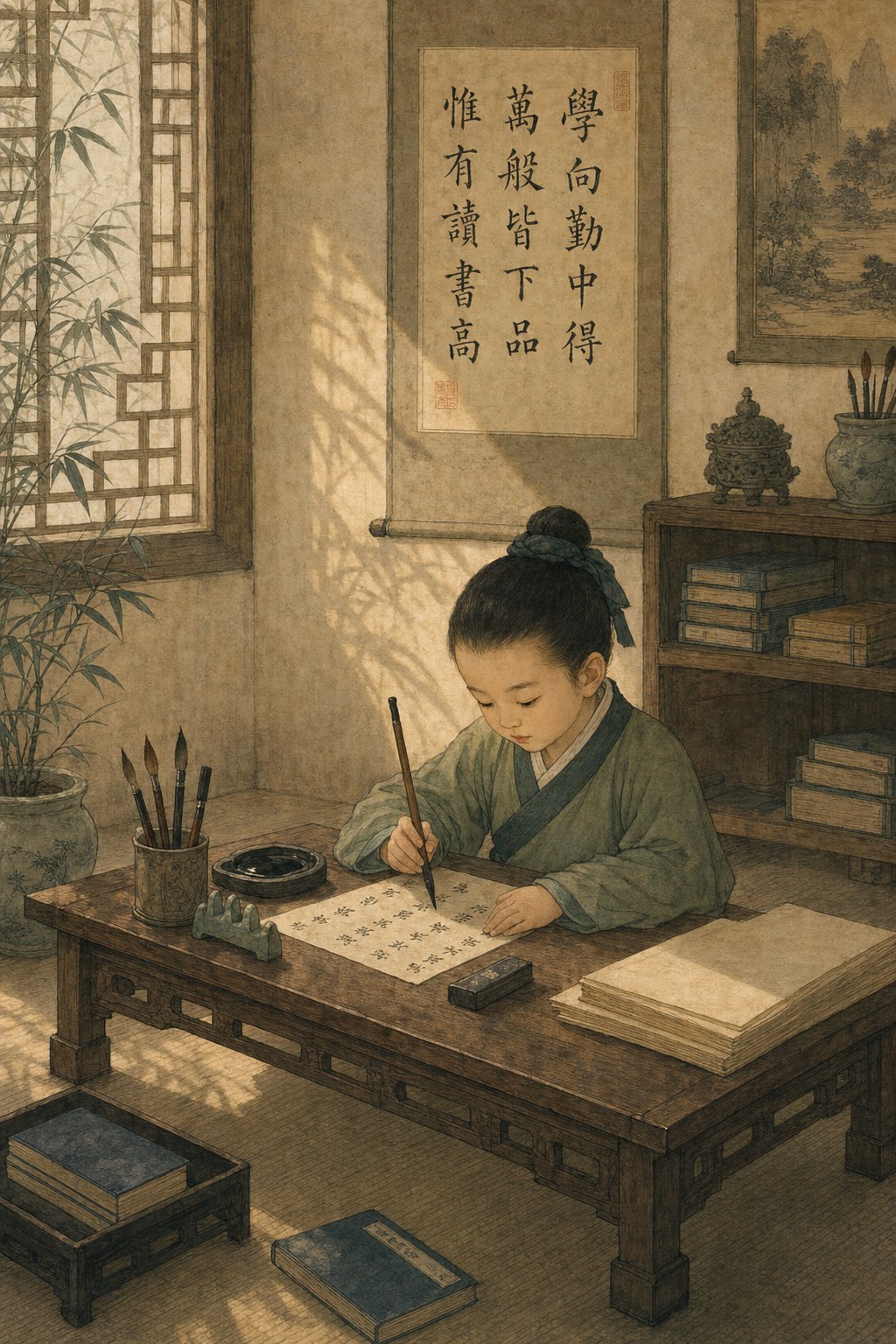
The literary text behind the phrase is a real, physical document that children once memorized the way English-speaking kids memorize the alphabet song. It is called the Baijiaxing (百家姓), and it was composed during the early Song Dynasty, around 960 CE. Its attributed author is a scholar from the Qiantang region (modern-day Hangzhou), though his exact identity remains debated. What is not debated is the text's purpose: it was a list of surnames arranged into a rhythmic, singable format designed to teach young children how to read Chinese characters.
The Song Dynasty Literacy Primer That Started It All
Imagine handing a child a poem that doubles as a vocabulary lesson. Each line contains exactly four characters, and the rhyming pattern makes the whole thing easy to chant aloud. For the first 32 lines, every second line ends with a syllable rhyming with "ang" in Mandarin pinyin. The result is a catchy, repetitive structure that sticks in memory, much like a nursery rhyme.
Here are the opening lines of this famous list of surnames:
赵钱孙李,周吴郑王 (Zhao Qian Sun Li, Zhou Wu Zheng Wang) — Zhao, Qian, Sun, Li, Zhou, Wu, Zheng, Wang
These eight surnames open what eventually became one of the most widely memorized texts in Chinese history. The full document originally contained 411 surnames and was later expanded to 504. Of those, 444 are single-character surnames and 60 are double-character compound surnames (fuxing).
Here are the key facts about the Baijiaxing at a glance:
- Compiled during the early Song Dynasty (circa 960 CE) in the Qiantang region
- Originally included 411 surnames, later expanded to 504 total
- Contains 444 single-character surnames and 60 double-character surnames
- Organized in four-character lines with a consistent rhyming pattern
- Served as a children's literacy primer, not a demographic record
- Paired with the Thousand Character Classic and Three Character Classic as foundational educational texts
The text was never meant to be a comprehensive census or a list of famous surnames ranked by popularity. It was a teaching tool, pure and simple. Children who memorized it gained exposure to hundreds of characters while also absorbing a sense of collective identity: all these families, all these names, all part of one civilization.
Why Zhao Comes First in the Hundred Family Surnames
If the ordering is not based on population size, what determines which surname appears first? The answer is political power. The surname Zhao (赵) leads the text because it was the imperial family name of the Song Dynasty rulers. Qian (钱) comes second because it belonged to the kings of Wuyue, the regional kingdom that controlled the area where the text was written. Sun (孙) follows as the surname of the Wuyue queen, and Li (李) appears fourth as the family name of the Southern Tang kings.
This ordering reveals something important: the Baijiaxing is a snapshot of political hierarchy frozen in time. It tells you who held power in 10th-century China as clearly as any history book. The compiler placed loyalty to the emperor first, deference to the local ruler second, and acknowledgment of neighboring powers third. Every child who chanted "Zhao Qian Sun Li" was unknowingly reciting a political map of early Song Dynasty China.
What the text does not tell you is how those surnames came to exist in the first place. The origins of Chinese family names stretch back thousands of years before the Song Dynasty, into legend, oracle bones, and the politics of ancient tribal confederations. That deeper history shaped the very system the Baijiaxing would later catalog, sometimes called 100 apellidos in Spanish-language discussions of Chinese culture.
Ancient Origins of Chinese Surnames Across Dynasties
The Baijiaxing cataloged surnames, but it did not invent them. These ancient surnames emerged from a layered history stretching back more than four thousand years, rooted in legend, tribal politics, and the slow expansion of identity from the elite to the masses. Tracing that history means moving through myth, archaeology, and imperial decree in a single narrative arc.
From the Yellow Emperor to the Shang Dynasty Bone Inscriptions
Chinese tradition places the origin of surnames with the Yellow Emperor (Huangdi), a semi-legendary figure said to have unified warring tribes around 2700 BCE. According to the FamilySearch Chinese Surnames resource, Huangdi was surnamed Gongsun and associated with the Xuanyuan clan, named after the hill where he was born. His descendants supposedly branched into 25 lineage groups, each receiving a distinct surname. Whether or not this account is historically precise, it reflects a core cultural belief: surnames began as markers of tribal confederation, assigned to distinguish allied groups within a larger political body.
Before these patrilineal surnames solidified, the earliest Chinese naming conventions traced through the mother's line. Many of the oldest historical surnames carry the "female" radical (女) in their written form, such as Ji (姬), Jiang (姜), and Si (姒). This linguistic fossil points back to a matriarchal clan society where identity passed through women. You will notice that these are not random characters. They encode a social structure in their very brushstrokes.
By the Shang Dynasty (circa 1600-1046 BCE), surnames appear inscribed on oracle bones, the earliest surviving Chinese written records. These bone inscriptions confirm that clan names were already functioning as administrative and ritual identifiers, used to track lineage for purposes of marriage regulation, ancestor worship, and political alliance. The rule was straightforward: people sharing the same surname (tongxing) could not intermarry, a genetic intuition encoded into social law thousands of years before modern genetics.
How Surnames Became Universal Across Social Classes
Here is the crucial detail that connects this history to the concept of laobaixing: for most of ancient China's early history, only the nobility possessed surnames. Commoners had personal names but no clan identifier. Having a surname (you xing) was itself a privilege, a marker of social belonging that separated the recognized from the anonymous.
This changed gradually. During the Zhou Dynasty (1046-256 BCE), the feudal system distributed land and titles, and with them, clan names proliferated among lower aristocracy. The pre-Qin era maintained a distinction between xing (the broad clan surname) and shi (a branch name indicating specific lineage), but after the Qin and Han dynasties unified China, these two concepts merged. By the Han Dynasty (206 BCE-220 CE), virtually everyone carried a surname. The old aristocratic privilege had become universal.
Compared to last names from the middle ages in Europe, where surnames often emerged from occupation or geography during the 11th-14th centuries, Chinese surnames crystallized far earlier and carried different social weight. European last names in medieval times typically indicated what a person did or where they lived. Chinese surnames indicated who you belonged to, which ancestor's blood ran in your veins, and which ritual obligations you inherited.
| Dynastic Period | Approximate Dates | Contribution to the Surname System |
|---|---|---|
| Legendary Period (Yellow Emperor) | c. 2700 BCE | Tribal surnames assigned to distinguish allied clans; matrilineal naming with female-radical characters |
| Shang Dynasty | c. 1600-1046 BCE | Surnames recorded on oracle bones; used for marriage regulation and ancestor worship |
| Zhou Dynasty | 1046-256 BCE | Feudal expansion spread surnames to lower aristocracy; xing and shi maintained as separate concepts |
| Qin and Han Dynasties | 221 BCE-220 CE | Xing and shi merged into a single surname; commoners universally adopted surnames |
| Tang Dynasty | 618-907 CE | Imperial naming taboos forced surname changes; official surname registries compiled |
| Song Dynasty | 960-1279 CE | Baijiaxing text compiled as literacy primer; surnames in medieval times codified into educational canon |
The Tang Dynasty added another layer of complexity. Emperors enforced naming taboos (bihui), forbidding subjects from using characters that appeared in the imperial name. Families whose surnames contained a taboo character were forced to adopt alternatives, sometimes permanently. This meant that political power could literally rewrite a family's identity overnight.
By the time the Song Dynasty scholar sat down to compile the Baijiaxing around 960 CE, he was not creating something new. He was organizing a system that had been building for millennia, one shaped by tribal legend, matriarchal inheritance, feudal politics, and imperial decree. The question that remained was how individual families navigated this system, and the pathways to acquiring a surname turned out to be far more varied than simple inheritance.
How Chinese Families Acquired Their Surnames Through History
Inheritance from father to child is the most obvious way a surname travels through time. But inheritance alone cannot explain how China ended up with thousands of distinct family names, including some of the most uncommon surnames still in use today. Families gained their names through at least five distinct historical pathways, each shaped by politics, geography, and cultural exchange.
Imperial Grants and Political Surname Changes
Picture a general returning from a victorious campaign. The emperor, pleased with his loyalty, bestows the imperial surname upon him as a reward. Overnight, the general's entire lineage carries a new identity. This was not rare. It happened repeatedly across dynasties, creating branches of families whose bloodlines had nothing in common with the ruling house but whose names suggested otherwise.
Equally common was the opposite scenario: emperors stripping surnames from disgraced officials and assigning humiliating replacements. Tang Dynasty naming taboos added yet another layer of forced change. When Emperor Li Shimin took the throne, any family whose surname contained the character "shi" (世) from his given name faced pressure to alter their name permanently. Some of these extinct last names vanished from records entirely, while others survived in modified form.
Here are the primary pathways through which Chinese families acquired their surnames:
- Imperial bestowal: The Tang emperor granted the surname Li to loyal non-Chinese generals, including Turkic military leaders who served the dynasty. This created entire lineages of "Li" families with no blood connection to the imperial house.
- Place names and fiefdoms: During the Zhou Dynasty, nobles took surnames from the territories they governed. The surname Zhao, for instance, derives from the Zhao city fief granted to an ancestor of the later Zhao state.
- Official titles and occupations: The surname Sima (司马) originated from the ancient military office of "Master of Horses." Situ (司徒) came from the title of Minister of Education. These compound surnames preserve job titles frozen in time.
- Avoidance of imperial taboos: Families surnamed Zhuang (庄) in some regions were originally surnamed Yan, forced to change during a dynasty whose emperor's name contained that character. The original surname sometimes reappeared after the dynasty fell, sometimes not.
- Transliteration of non-Han names: During the Northern Wei Dynasty (386-534 CE), Emperor Xiaowen ordered Xianbei families to adopt Chinese-style surnames. The Xianbei clan name Tuoba became Yuan (元), and Buliugu became Lu (陆).
Non-Han Names and the Sinicization of Surnames
The transliteration pathway deserves special attention because it produced some of the most uncommon last names still found in China. When Mongol rulers governed during the Yuan Dynasty (1271-1368), many Mongol and Central Asian families adopted Chinese surnames for administrative convenience. A Mongol name like Borjigin might become Bao (包) or Bo (博). Later, during the Qing Dynasty, Manchu banner families underwent similar transformations. The Manchu clan Aisin Gioro, the imperial family itself, saw many of its branches adopt the surname Jin (金, meaning "gold") after the dynasty's fall in 1912.
Any list of unusual last names in China today reflects these layered histories. Compound surnames like Ouyang, Sima, and Zhuge survived from ancient official titles, while others like Yelv trace back to Khitan royalty. Each uncommon surname is a fossil record of a specific historical moment when identity was negotiated, imposed, or reinvented.
These varied pathways meant that by the Song Dynasty, the surname landscape was far more complex than any single text could capture. The Baijiaxing recorded 504 names, but the actual number of surnames circulating across China's vast territory was much larger. What mattered culturally was not the exact count but the principle underneath it: every family had a name, and every name connected its bearers to a story. That principle, the idea that naming equals belonging, is precisely what transformed a surname catalog into a word for collective identity.
How Chinese Surnames Differ From Western Naming Systems
The pathways that created Chinese surnames are fascinating on their own, but the structural rules governing how those names are used set the system apart from nearly every other naming tradition on earth. If you have ever seen a Chinese name written in English and wondered which part is the family name, you have already bumped into the most visible difference.
Surname First Order and Single-Character Dominance
In Chinese, the surname always comes first. A person named Wang Xiaoming is Mr. Wang, not Mr. Xiaoming. This is not a quirk of formatting. It reflects a cultural priority: family identity precedes individual identity. You announce who you belong to before you announce who you are.
The structure is also remarkably compact. The vast majority of Chinese surnames consist of a single character, just one syllable. According to the Asia Media Centre, all of the top 100 Chinese family names have only one syllable, and these cover roughly 85 percent of the population. Compound surnames (fuxing 复姓) like Ouyang, Zhuge, or Shangguan do exist, but they are rare. Only about 81 compound surnames remain in active use across China.
Compare this to traditional english surnames, which often run two or three syllables and derive from patronymics (Johnson, Richardson), occupations (Smith, Baker), or geography (Hill, Brook). Common english family names in the UK follow similar patterns. Many uk surnames trace back to Norman French or Anglo-Saxon roots, and surnames in the united kingdom frequently changed spelling across generations as literacy was inconsistent. Chinese surnames, by contrast, have remained remarkably stable in written form for centuries because the character system anchors them visually regardless of pronunciation shifts across dialects.
Indian surnames operate on yet another structural logic. A surname of indian origin often signals caste, region, or religious community simultaneously. Sharma indicates Brahmin heritage, Patel points to a Gujarati landowning community, and Reddy identifies a Telugu-speaking lineage. Indian surnames function as social coordinates in a way that neither Chinese nor english surnames typically do.
Generational Naming vs. the Western Middle Name
Western naming conventions typically slot a middle name between the given name and surname, often honoring a relative or chosen for its sound. Chinese naming culture replaces this with something more systematic: the generational name (zibei or beifen).
In this tradition, all siblings and patrilineal cousins of the same generation share one character in their given name. As the Temple University Center for Chinese Language Instruction explains, siblings like Jia Zhenni and Jia Zhenhai share the element "zhen," and their cousins carry it too. These generational characters are sometimes determined decades in advance, written into family genealogies or encoded in a poem that maps out naming conventions for future generations.
This is not a middle name chosen for aesthetic reasons. It is a structural marker that lets any family member instantly identify which generation another person belongs to, even without knowing them personally. Common british family names carry no equivalent mechanism. You cannot look at two people surnamed Thompson and determine their generational relationship from the name alone.
| Category | Chinese Surnames | English Surnames | Indian Surnames |
|---|---|---|---|
| Position in full name | First (before given name) | Last (after given name) | Last (after given name) |
| Typical length | One character (one syllable) | One to three syllables | Two to four syllables |
| Primary origin type | Clan lineage and imperial grants | Patronymics, occupations, geography | Caste, region, religion, occupation |
| Cultural function | Signals ancestral lineage and collective belonging | Identifies family line | Indicates caste, community, and regional origin |
| Generational marker | Shared character in given name across same-generation relatives | No structural equivalent (middle name is individual) | No structural equivalent (gotra system serves a different function) |
| Change after marriage | Women retain birth surname | Traditionally wife adopts husband's surname | Varies by region and community |
These structural differences are not just trivia. They reveal fundamentally different answers to the question of what a name is for. English and indian surnames identify. Chinese surnames connect, binding individuals into a web of generational continuity that the laobaixing concept celebrates as universal. Everyone has a place in the chain. The deeper question is what happens when a surname list stops being a text and starts being an idea, when "the hundred families" becomes a way of talking about collective identity itself.
From a Surname Catalog to a Word Meaning Ordinary People
A literacy primer, a political hierarchy frozen in verse, a catalog of 504 surnames of people spanning centuries of tribal alliance, imperial decree, and cultural exchange. That is what the Baijiaxing was. Yet somewhere along the way, the phrase "hundred surnames" stopped referring to a text and started referring to human beings. How does a book title become a word for "us"?
The answer lies in a slow semantic drift that unfolded across dynasties, driven by a single powerful idea: if everyone has a surname, then "all the surnames" means "everyone." And "everyone" in the mouths of ordinary citizens eventually became shorthand for "people like me, not the emperor, not the officials, just regular folks trying to get by."
The Semantic Journey From Surname List to Common People
Think about how this shift works linguistically. In early usage, baixing (百姓) referred literally to "the hundred clans," meaning the collective body of named families within a kingdom. During the pre-Qin era, when only aristocrats carried surnames, baixing actually referred to the nobility, not the commoners. The Wikipedia entry on Baixing traces this origin to a confederation of roughly 100 tribes living along the Yellow River, the ancestors of what later became the Han ethnic group. These tribes formed an alliance, and their collective identity was "the hundred surnames."
The critical flip happened after the Qin and Han dynasties universalized surname use. Once commoners also carried family names, the phrase "hundred surnames" expanded to include them. And because commoners vastly outnumbered the elite, the term's center of gravity shifted downward. By the Tang and Song periods, baixing had become synonymous with "the common people" rather than "the noble clans." Adding the prefix lao (老) intensified this colloquial warmth, the way "old" in "old friend" signals affection rather than age.
This is not a case of a word losing its meaning. It is a case of social reality rewriting a word's boundaries. When surnames belonged to the few, "the hundred surnames" meant the privileged. When surnames belonged to all, the same phrase came to mean everybody, and eventually, specifically the non-privileged everybody. The old second names of aristocratic clans became the universal inheritance of an entire civilization.
By the time the Song Dynasty text was compiled around 960 CE, the colloquial meaning was already well established. The Baijiaxing primer did not create the term laobaixing. Rather, both the text and the term drew from the same deep well: the cultural conviction that 100 last names, taken together, represent the whole of society.
Laobaixing vs. Renmin vs. Gongmin in Chinese Discourse
Chinese has no shortage of words for "the people." But each one carries a different political charge, a different relationship between speaker and subject. Understanding where laobaixing fits requires seeing what it is not.
Renmin (人民) is the term you find in official state language. It appears in the country's formal name (People's Republic of China), on the currency (Renminbi, "the people's money"), and in state media. It carries ideological weight, implying a politically defined collective with revolutionary legitimacy. Qunzhong (群众) means "the masses" and belongs to Marxist-Leninist vocabulary, used in party documents and mobilization campaigns. Gongmin (公民) translates as "citizen" in the legal sense, emphasizing rights and duties within a constitutional framework. Shimin (市民) refers specifically to urban residents, a term that gained prominence as China urbanized.
Laobaixing sits apart from all of these. It is informal, warm, and deliberately non-ideological. When a taxi driver says "we laobaixing can't afford that," he is not making a legal claim about citizenship or invoking revolutionary theory. He is drawing a line between ordinary life and the world of power, wealth, and officialdom. The term carries humility without self-pity, solidarity without sloganeering.
| Term | Pinyin | Literal Meaning | Register | Typical Usage Context |
|---|---|---|---|---|
| 老百姓 | laobaixing | Old hundred surnames | Informal, colloquial | Everyday speech, media, political rhetoric signaling closeness to ordinary life |
| 人民 | renmin | The people (as a political body) | Formal, ideological | State documents, official names, propaganda, constitutional language |
| 群众 | qunzhong | The masses | Formal, Marxist-Leninist | Party documents, mass mobilization campaigns, cadre speeches |
| 公民 | gongmin | Public citizen | Formal, legal | Legal texts, rights discourse, civic education, constitutional law |
| 市民 | shimin | City resident | Neutral, administrative | Urban governance, municipal policy, local news reporting |
You will notice that only laobaixing carries the warmth of self-identification. People call themselves laobaixing. They rarely call themselves renmin in casual conversation, and almost never qunzhong. Those terms are applied from above, by institutions addressing their constituents. Laobaixing flows in the opposite direction: from the ground up, from kitchen tables and market stalls into the ears of officials who then borrow it to sound approachable.
This distinction matters because it reveals something about how collective identity works in Chinese culture. The surnames of people, taken as a whole, became a metaphor for shared ordinariness. Not shared ideology, not shared legal status, but shared humanity at its most basic level: we all have a family name, we all come from somewhere, we all face the same daily struggles. That emotional resonance is precisely what makes laobaixing so useful in political speech and so difficult to translate into any single English equivalent.
The question that follows naturally is scale. If laobaixing represents "all the families," how are those families actually distributed? The answer turns out to be surprisingly uneven, with a handful of surnames covering hundreds of millions of people while others teeter on the edge of disappearance.
The Most Common Chinese Surnames and Their Reach
A term celebrating collective belonging sounds egalitarian in theory. In practice, the distribution of Chinese surnames is anything but even. A small cluster of names dominates the population so thoroughly that stopping a random person on the street gives you a reasonable chance of guessing their surname correctly on the first try.
Wang Li and Zhang as China's Dominant Surnames
The five most common surnames in China, Wang, Li, Zhang, Liu, and Chen, are shared by more than 433 million people, roughly 30 percent of the entire population. Let that sink in. Five names cover nearly one in three Chinese citizens. Wang and Li alone each surpass 100 million bearers, making them individually larger than most countries on earth.
Zoom out slightly and the concentration becomes even more striking. China's Ministry of Public Security reports that only about 6,000 surnames are currently in use across the country. Of those, just 100 surnames account for almost 85 percent of the total population. Compare that to the United States, which recorded 6.3 million surnames in its 2010 census despite having less than a quarter of China's population. The majority of those American names appeared only once.
Why such a small pool? Several factors converge. China is less ethnically diverse than immigrant nations like the US, which limits surname variety at the source. The Chinese writing system also constrains invention: you cannot simply add a letter to create a new surname the way English speakers historically did. And the Galton-Watson process, a naturally occurring phenomenon in patrilineal societies, means that smaller surnames die out over generations while larger ones compound their dominance.
Here is how the top surnames rank by prevalence:
| Rank | Surname | Pinyin | Approximate Scale | Position in Baijiaxing Text |
|---|---|---|---|---|
| 1 | 王 | Wang | Over 100 million | 8th (in the opening line) |
| 2 | 李 | Li | Over 100 million | 4th (in the opening line) |
| 3 | 张 | Zhang | Tens of millions | Not in the first few lines |
| 4 | 刘 | Liu | Tens of millions | Not in the first few lines |
| 5 | 陈 | Chen | Tens of millions | Not in the first few lines |
| 6 | 杨 | Yang | Tens of millions | Not in the first few lines |
| 7 | 黄 | Huang | Tens of millions | Not in the first few lines |
| 8 | 赵 | Zhao | Tens of millions | 1st (opens the text) |
| 9 | 吴 | Wu | Tens of millions | 6th (in the opening line) |
| 10 | 周 | Zhou | Tens of millions | 5th (in the opening line) |
Twenty-three surnames each claim more than 10 million bearers. That is a last names list so concentrated that the entire demographic weight of a billion-person civilization rests on a remarkably narrow foundation.
How Modern Demographics Compare to the Historical Text
Look at the table above and you will notice something revealing. The Baijiaxing opens with "Zhao Qian Sun Li, Zhou Wu Zheng Wang," placing Zhao first because it was the Song imperial surname. In modern demographic reality, Zhao ranks only eighth. Wang and Li, which sit at positions eight and four in the historical text, now dominate the actual population. Zhang, Liu, and Chen, today's third through fifth most common names, do not appear in the opening lines at all.
This mismatch confirms what we already know: the Baijiaxing was organized by political prestige, not population size. A thousand years of migration, warfare, and natural demographic growth reshuffled the deck entirely. The Song Dynasty's ruling family name faded in relative prevalence while surnames associated with larger, more geographically dispersed clans rose to dominance.
Meanwhile, at the other end of the spectrum, the least common surnames face an existential threat. China has recorded more than 20,000 surnames throughout its history, yet only 6,000 remain in active use. Many of those surviving rare names belong to just a handful of families, sometimes concentrated in a single village. Digital ID systems that cannot process unusual characters have accelerated this decline, with up to 60 million citizens facing difficulties because their name characters were not coded into government databases.
The result is a list of last names that grows more concentrated with each generation. The dominant surnames expand while the rare ones vanish, squeezed out by demographic mathematics and technological standardization alike. This concentration gives the term laobaixing an ironic edge: "the hundred surnames" increasingly means "the same twenty surnames, repeated across a billion people." Yet the phrase retains its power precisely because it insists on collective identity regardless of which specific name you carry. What matters is not whether your surname is Wang or one of the least common surnames clinging to survival. What matters is that you have one at all, that you belong to the named community of ordinary people. And that sense of belonging is exactly what makes the term so potent when it enters the arena of politics and public discourse.
Laobaixing in Modern Politics Media and Everyday Life
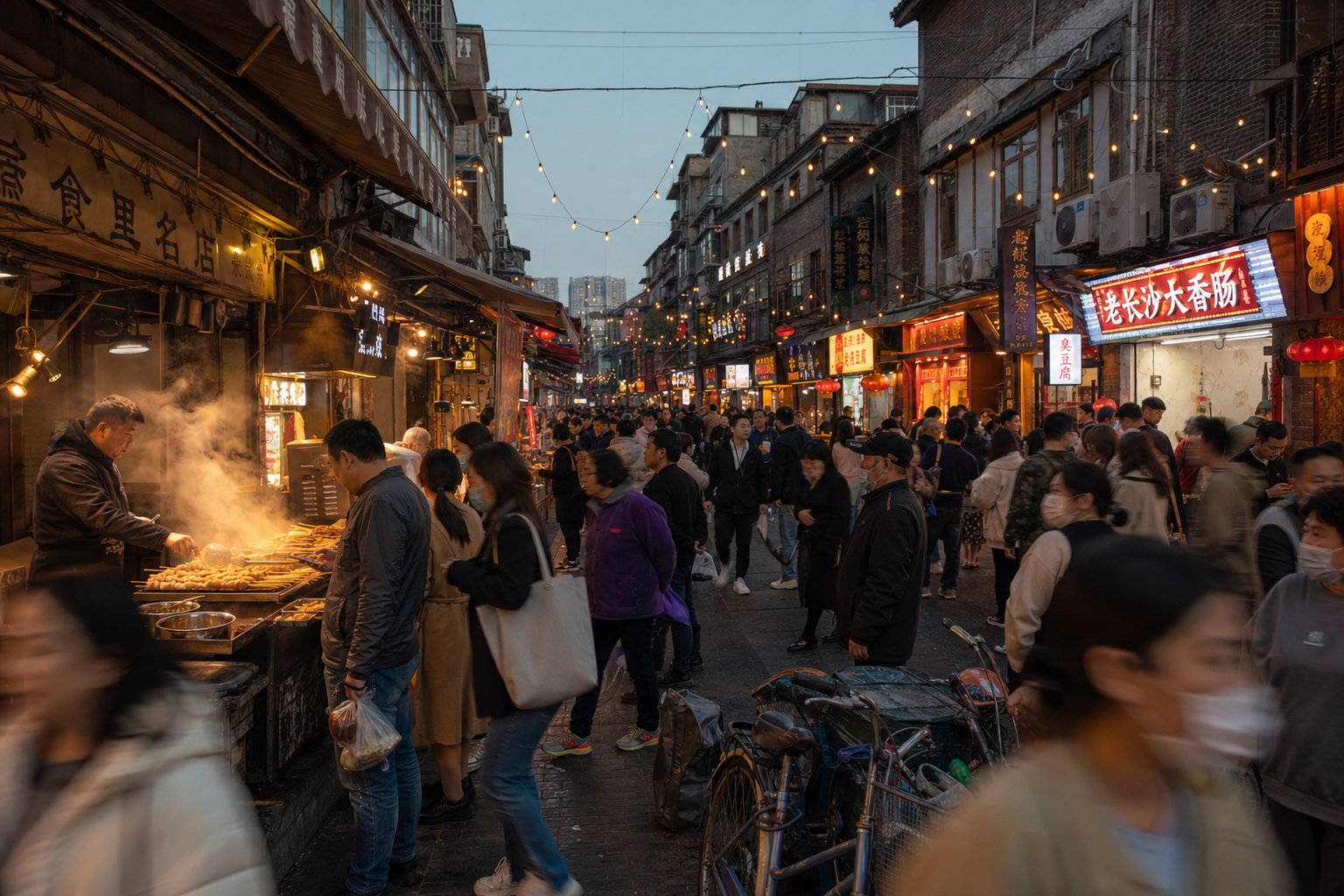
A word that belongs to the people does not stay out of the mouths of politicians for long. In modern China, laobaixing has become one of the most strategically deployed terms in public discourse. Officials reach for it when they want to sound grounded. Citizens wield it when they want to be heard. The same three characters carry entirely different weight depending on who speaks them and why.
How Politicians and Citizens Use Laobaixing Differently
When a government official says "we must serve the laobaixing," the message is deliberate: I am not above you, I remember where I come from, your concerns are my concerns. It is a rhetorical move that signals populism without requiring any specific policy commitment. The term appears in state media headlines, local government slogans, and televised addresses precisely because it carries an emotional warmth that bureaucratic alternatives like gongmin (citizen) or renmin (the people) cannot replicate. Those formal terms sound like documents. Laobaixing sounds like a neighbor.
Citizens use the same word in a completely different register. When a shopkeeper says "us laobaixing can't keep up with housing prices," she is drawing a boundary. On one side: ordinary people who work, struggle, and endure. On the other: officials, developers, and the wealthy who operate in a different reality. The term becomes a tool for collective grievance, a way of saying "people like us" without naming a specific enemy. It asserts solidarity through shared ordinariness.
This dual function creates a fascinating tension. Politicians borrow the term to close the gap between themselves and the public. Citizens use it to emphasize that the gap exists. Both uses depend on the same emotional core: laobaixing means belonging to the vast, unnamed majority whose lives are shaped by forces beyond their individual control.
Laobaixing is the only Chinese term for "the people" that flows upward from daily life into political language rather than being imposed downward from ideology onto the population.
That directional difference is everything. Renmin was defined by revolution. Qunzhong was assigned by party theory. Laobaixing emerged from kitchens, markets, and teahouses. Its authority comes not from any document but from centuries of ordinary people claiming it as their own.
Western Equivalents and Why They Fall Short
English offers several attempts at the same concept. "John Q. Public" refers to a generic American citizen. "The everyman" suggests an ordinary, representative person. "The man on the street" implies someone without specialized knowledge or elite status. In British English, you might hear "ordinary punters" or "the average Joe," phrases rooted in the same impulse to name the unnamed majority.
None of these carry the historical depth of laobaixing. "John Q. Public" is a 20th-century coinage with no ancestral weight. It does not connect its user to a thousand-year literary tradition or to the moment when common surnames in england, last names in the uk, or england family names first crystallized into hereditary identifiers. English equivalents are clever inventions. Laobaixing is an archaeological layer, a term whose meaning accumulated over dynasties rather than being coined in a single moment.
There is also a structural difference. Western equivalents tend to be singular: one hypothetical person standing in for many. Laobaixing is inherently plural. It refers to all the families, all the surnames, the entire collective. You cannot be a single laobaixing the way you can be a single "everyman." The term insists on community rather than representation. It does not ask one person to symbolize the rest. It names the rest directly.
This collective resonance explains why the term survives in an era of individualism and digital fragmentation. Even as Chinese society modernizes, urbanizes, and diversifies, laobaixing retains its grip on public language because it answers a question that never goes away: who are we, together, when we strip away titles and wealth and status? The answer the term offers is simple. We are the families. We are the names. We are the ones who endure. And that answer points toward something even larger: what the persistence of this concept reveals about Chinese cultural values at their deepest level.
Why Laobaixing Still Resonates as a Cultural Concept
Strip away the politics, the demographics, and the linguistic analysis, and what remains is a deceptively simple idea: your name tells you where you belong. The Baijiaxing text preserved that idea in verse. The living term laobaixing carries it forward in conversation. Together, they reveal a culture that treats lineage not as personal trivia but as the foundation of social existence.
Lineage and Collective Identity in Chinese Culture
Chinese culture has always prioritized the group over the individual, the family line over the single life. Ancestor worship, clan temples, generational naming poems, and detailed genealogies all point in the same direction: you are not just yourself. You are a link in a chain that stretches backward through centuries and forward through your descendants. The concept of laobaixing old hundred names encodes this worldview into everyday language. When someone identifies as laobaixing, they are not claiming uniqueness. They are claiming membership, insisting that their ordinariness is itself a form of dignity.
This stands in sharp contrast to Western individualism, where identity is often framed as something you build rather than something you inherit. The Chinese surname system says the opposite: identity is received, maintained, and passed along. It is a collective project, not a personal one. And the term laobaixing celebrates precisely this collectivity, the shared condition of being named, placed, and connected to something larger than any single person.
The Universal Appeal of Surname Origins
Interest in surname origins is not uniquely Chinese. Genealogy has become one of the fastest-growing hobbies worldwide, with millions of people researching old family names, tracing migration patterns, and reconstructing lost connections. Researchers exploring old family names in england discover Norman conquests and Anglo-Saxon settlements encoded in their heritage. Those investigating last names old english in origin find occupational markers and geographic roots preserved in spelling. Across the Atlantic, Americans searching for popular last names in 1800s records uncover immigration stories, name changes at port entries, and old american surnames that shifted spelling as families moved westward.
The impulse driving all of this is the same one that gave laobaixing its emotional power: the desire to know where you come from and who you belong to. A list of last names and meanings is never just a reference document. It is a map of human movement, adaptation, and survival. Whether you are tracing english surnames with meanings back to medieval villages or following a Chinese clan name to a specific province, the underlying question is identical. Who were my people?
What makes the Chinese case distinctive is how explicitly the culture answered that question at scale. The Baijiaxing did not just record surnames. It taught children that all families, taken together, form a single civilization. And laobaixing did not just name the common people. It told them that their commonness was the point, that belonging to the hundred surnames meant belonging to everyone and everything at once. In Chinese culture, to have a surname is to belong. And laobaixing, after a thousand years, still celebrates that belonging as something no amount of wealth or power can improve upon.
Frequently Asked Questions About Laobaixing and Chinese Surnames
1. What does laobaixing literally mean in Chinese?
Laobaixing (老百姓) combines three characters: lao (old/venerable), bai (hundred), and xing (surnames). The literal translation is 'old hundred surnames,' but in everyday Chinese it refers to common people or ordinary citizens. The prefix lao adds warmth and familiarity rather than indicating age, similar to how 'old friend' in English conveys affection. The term emerged because once all Chinese people carried surnames, 'all the surnames' became shorthand for 'everyone,' and eventually for non-elite citizens specifically.
2. What is the Baijiaxing (Hundred Family Surnames) text?
The Baijiaxing is a Song Dynasty literacy primer compiled around 960 CE in the Qiantang region near modern Hangzhou. It arranges 504 Chinese surnames (444 single-character and 60 compound surnames) into four-character rhyming lines that children memorized to learn reading. The text opens with 'Zhao Qian Sun Li, Zhou Wu Zheng Wang,' placing the Song imperial surname Zhao first as a political statement. It was never a demographic record but rather a teaching tool paired with the Thousand Character Classic and Three Character Classic in traditional Chinese education.
3. Why are there so few common surnames in China compared to Western countries?
China has only about 6,000 surnames in active use, with just 100 names covering roughly 85 percent of the population. Wang and Li alone each exceed 100 million bearers. This concentration results from several factors: limited ethnic diversity compared to immigrant nations, the Chinese writing system's constraints on inventing new characters, and the Galton-Watson effect in patrilineal societies where smaller surname lines naturally die out over generations while dominant ones compound. By contrast, the US 2010 census recorded 6.3 million surnames despite having far fewer people.
4. How is laobaixing different from other Chinese words for 'the people'?
Chinese has multiple terms for 'the people,' each carrying distinct political weight. Renmin (人民) is ideological, used in state documents and official names. Qunzhong (群众) means 'the masses' in Marxist-Leninist vocabulary. Gongmin (公民) is a legal term meaning 'citizen.' Shimin (市民) refers to urban residents. Laobaixing stands apart as the only informal, non-ideological term that flows upward from everyday speech into political language. People call themselves laobaixing voluntarily, while other terms are typically applied from above by institutions.
5. How did Chinese people originally get their surnames?
Chinese surnames emerged through at least five historical pathways: imperial bestowal (emperors granting their surname to loyal subjects), adoption of place names or fiefdom territories, conversion of official titles into hereditary names (like Sima from 'Master of Horses'), forced changes due to imperial naming taboos, and transliteration of non-Han ethnic names during periods of cultural assimilation. For example, the Xianbei clan Tuoba became Yuan during the Northern Wei Dynasty, and many Manchu clan names were sinicized to single-character Chinese surnames after the Qing Dynasty fell in 1912.