Left Handed Chinese Calligraphy Is More Achievable Than You Think
You have probably heard it before: Chinese calligraphy is designed for right-handed people, so left-handers should not bother. This belief is widespread, persistent, and largely wrong. Left handed chinese calligraphy is not a contradiction in terms. It is a practice with real historical precedent, proven techniques, and a growing community of practitioners who produce beautiful work with their dominant hand.
The misconception stems from a reasonable observation taken to an unreasonable conclusion. Yes, standard stroke order moves left to right. Yes, traditional instruction assumes a right-handed grip. But these are conventions, not physical laws. They can be adapted without destroying the art form.
What Left Handed Chinese Calligraphy Actually Involves
So what does calligraphy in chinese actually require? At its core, the chinese calligraphy definition centers on using a flexible hair brush, ink, and deliberate strokes to form characters that balance structure with expressive energy. The Metropolitan Museum of Art describes it as the visual art form prized above all others in traditional China, one where the brush becomes an extension of the writer's entire body. Each character follows an established stroke order, and each stroke demands control over pressure, speed, and direction.
For left-handers, the practice involves the same fundamental elements with specific adaptations to grip angle, paper positioning, and stroke execution. You are still learning the same characters, the same scripts, and the same principles of balance and proportion. The difference lies in how your hand approaches the brush and the paper, not in what you produce.
Why Left Handers Can Succeed at Chinese Brush Writing
History offers direct evidence. At least four notable calligraphers in Chinese history produced acclaimed work with their left hand. Zheng Yuanyou of the Yuan dynasty mastered regular script left-handed after a childhood injury. Qing dynasty artist Gao Fenghan switched hands after a stroke and later wrote that for swift, bold, and expressive strokes, his left hand actually surpassed his right. Fei Xinwo, a modern master, earned praise from Guo Moruo himself after transitioning to left-handed writing. These are not minor figures. Their work hangs in museums and fills scholarly catalogs.
Chinese calligraphy art rewards patience, body awareness, and consistent practice. None of these qualities belong exclusively to the right hand. A left-handed student working with adapted technique and proper guidance can develop the same brush control, the same sense of rhythm, and the same expressive range as any right-handed practitioner.
Calligraphy mastery is about adaptation, not limitation. The brush does not care which hand holds it. What matters is how you train that hand to move with intention, control, and feeling.
What most left-handers lack is not ability but instruction. The vast majority of calligraphy resources assume right-handedness without ever stating it explicitly. This article fills that gap with specific, actionable guidance on stroke mechanics, grip modifications, workspace setup, and a structured learning path built for the left-handed practitioner from the ground up.
Cultural History of Left Handedness and Chinese Writing
Ability alone does not explain why so few left-handed calligraphers appear in the historical record. Culture plays an enormous role. For centuries, left-handedness in China carried social stigma that discouraged millions from ever picking up a brush with their dominant hand. Understanding this context helps explain why dedicated left-handed instruction barely existed until recently, and why it matters so much now.
Historical Attitudes Toward Left Handedness in China
Surveys of Chinese students since the 1980s consistently report that less than 1% identify as left-handed. Compare that to the global baseline of 10 to 12%, and the gap is staggering. The numbers do not reflect biology. They reflect a deep cultural pattern of correction and concealment.
In ancient chinese calligraphy instruction, right-handedness was not merely preferred. It was assumed as a moral and practical default. Traditional Chinese values linked the right hand with correctness and propriety, while the left carried associations with deviance. Families routinely retrained left-handed children through physical restraints and social pressure. A 2013 study published in Endeavour documented how a combination of traditional values and practical considerations merged to reduce both the actual and reported prevalence of left-handedness across Chinese populations. As UCL researchers noted, cultural norms in China make this group more influenced to change their handedness to conform to social expectations.
This pressure extended directly into calligraphy in chinese art education. Chinese traditional calligraphy masters taught stroke mechanics, brush angles, and body posture exclusively for the right hand. A left-handed student entering a traditional chinese calligraphy classroom faced a simple choice: switch hands or leave. Most switched. Some left. Almost none received instruction adapted to their natural dominance.
How Cultural Context Shapes Modern Learning Strategies
That historical reality created a gap in pedagogical knowledge. Generations of potential left-handed technique development simply never happened. No teacher refined a left-handed grip method because no teacher accepted left-handed students as they were.
The landscape is shifting. Younger generations in China face less pressure to switch hands, and international interest in chinese ancient calligraphy brings learners from cultures where left-handedness carries no stigma at all. These practitioners are asking questions that traditional instruction never needed to answer. How should a left-handed writer angle the brush for a horizontal stroke? Where should the paper sit to prevent smudging? Which scripts feel most natural?
Dedicated left-handed instruction is emerging precisely because the cultural barrier is finally lowering. The knowledge gap is real, but it is a gap born from suppression, not impossibility. Filling it requires understanding exactly how standard stroke mechanics behave differently in the left hand, starting with the most fundamental challenge: the direction the brush moves across the page.
Understanding the Stroke Direction Challenge
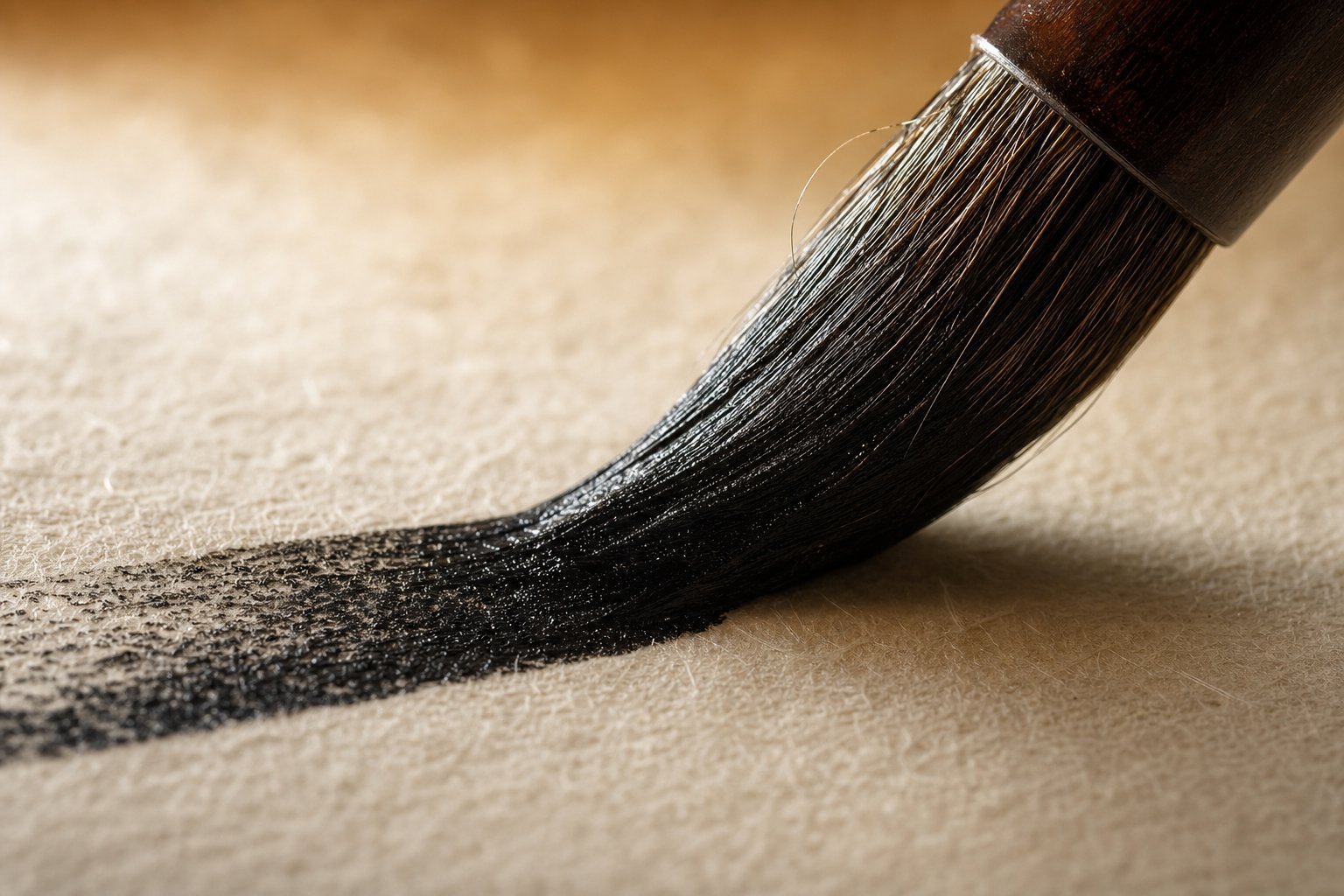
Every Chinese character is built from a set of eight fundamental strokes, and every one of those strokes assumes the brush is being pulled in a specific direction. Right-handers pull the chinese calligraphy brush naturally along these paths. Left-handers push it. That single mechanical difference, push versus pull, is the core challenge of left handed chinese calligraphy writing. It changes how the bristles behave, how ink transfers to paper, and how the finished stroke looks.
Pushing Versus Pulling Strokes and Brush Behavior
Imagine dragging a broom across a floor versus pushing it bristles-first into resistance. When you pull a brush, the bristles trail behind the tip in a smooth, unified bundle. Ink flows evenly from the loaded hairs onto the paper. The stroke tapers and thickens predictably based on pressure alone.
When you push a brush, the bristles splay outward. They resist the direction of travel, catching on paper fibers and spreading apart rather than staying compact. The result is often a rough, uneven edge where you intended a clean line. This is why many left-handers initially produce what looks like bad chinese calligraphy, not from lack of skill, but from fighting brush physics that nobody explained to them.
The key chinese calligraphy characteristics that define quality, such as crisp beginnings, controlled thickness variation, and tapered endings, all depend on predictable bristle behavior. Pushing disrupts that predictability. Understanding this is the first step toward compensating for it.
How Each Basic Stroke Changes for Left Handers
Not all strokes are equally affected. Some become significantly harder for left-handers, while others remain nearly identical. Here is how each basic stroke type behaves differently depending on which hand executes it:
| Stroke Type | Standard Direction | Right-Handed Mechanic | Left-Handed Mechanic | Difficulty Increase |
|---|---|---|---|---|
| Horizontal (横 heng) | Left to right | Pull stroke, smooth trailing bristles | Push stroke, bristles splay and resist | High |
| Vertical (竖 shu) | Top to bottom | Pull downward, natural gravity assist | Pull downward, nearly identical mechanic | Low |
| Dot (点 dian) | Quick press and release | Controlled dab with trailing lift | Slightly awkward angle but manageable | Low to Moderate |
| Left-falling (撇 pie) | Upper right to lower left | Pull stroke toward the body | Pull stroke away from the body, actually natural | Low |
| Right-falling (捺 na) | Upper left to lower right | Pull stroke away from the body | Push stroke, bristles catch and spread | High |
| Hook (钩 gou) | Sharp directional change | Flick at end of a pull stroke | Flick at end of a push stroke, less control | Moderate to High |
| Turning (折 zhe) | Direction change mid-stroke | Smooth transition between pulls | Transition between push and pull, inconsistent pressure | Moderate |
| Rising (提 ti) | Lower left to upper right | Push stroke with upward flick | Pull stroke, actually easier for left-handers | Low (easier) |
Notice the pattern. Vertical strokes and left-falling strokes feel almost the same for both hands. The horizontal stroke and right-falling stroke are where left-handers face the greatest resistance. The rising stroke is a rare case where brush chinese calligraphy actually becomes easier with the left hand, since the motion pulls naturally toward the left-handed writer's body.
Managing Ink Flow and Line Quality
Push strokes do not just affect shape. They change how ink leaves the brush. A pulled stroke deposits ink in a thin, even layer because the bristles compress uniformly against the paper. A pushed stroke forces ink out unevenly, sometimes flooding one side of the line while starving the other. You will notice thicker deposits where bristles bunch together and dry patches where they separate.
Left-handers who are unaware of this dynamic often blame themselves for producing bad chinese calligraphy when the real issue is unmanaged ink distribution. Two practical adjustments help immediately: loading slightly less ink on the brush to reduce flooding during push strokes, and slowing down through the highest-resistance strokes to give bristles time to resettle.
Speed control matters more for left-handers than for right-handers on horizontal and right-falling strokes. Where a right-handed writer can sweep through a horizontal stroke at a consistent pace, a left-handed writer benefits from a brief pause at the stroke's start to set the bristles, followed by steady, deliberate movement. This does not mean writing slowly overall. It means distributing your attention unevenly, spending more care on the strokes that fight your hand's natural motion and moving freely through those that cooperate.
The stroke direction challenge is real, but it is also specific and predictable. Once you know which strokes resist you and why, you can target your practice and adapt your grip to compensate. That adaptation starts with how you hold the brush itself.
Brush Grip Techniques Adapted for Left Handers
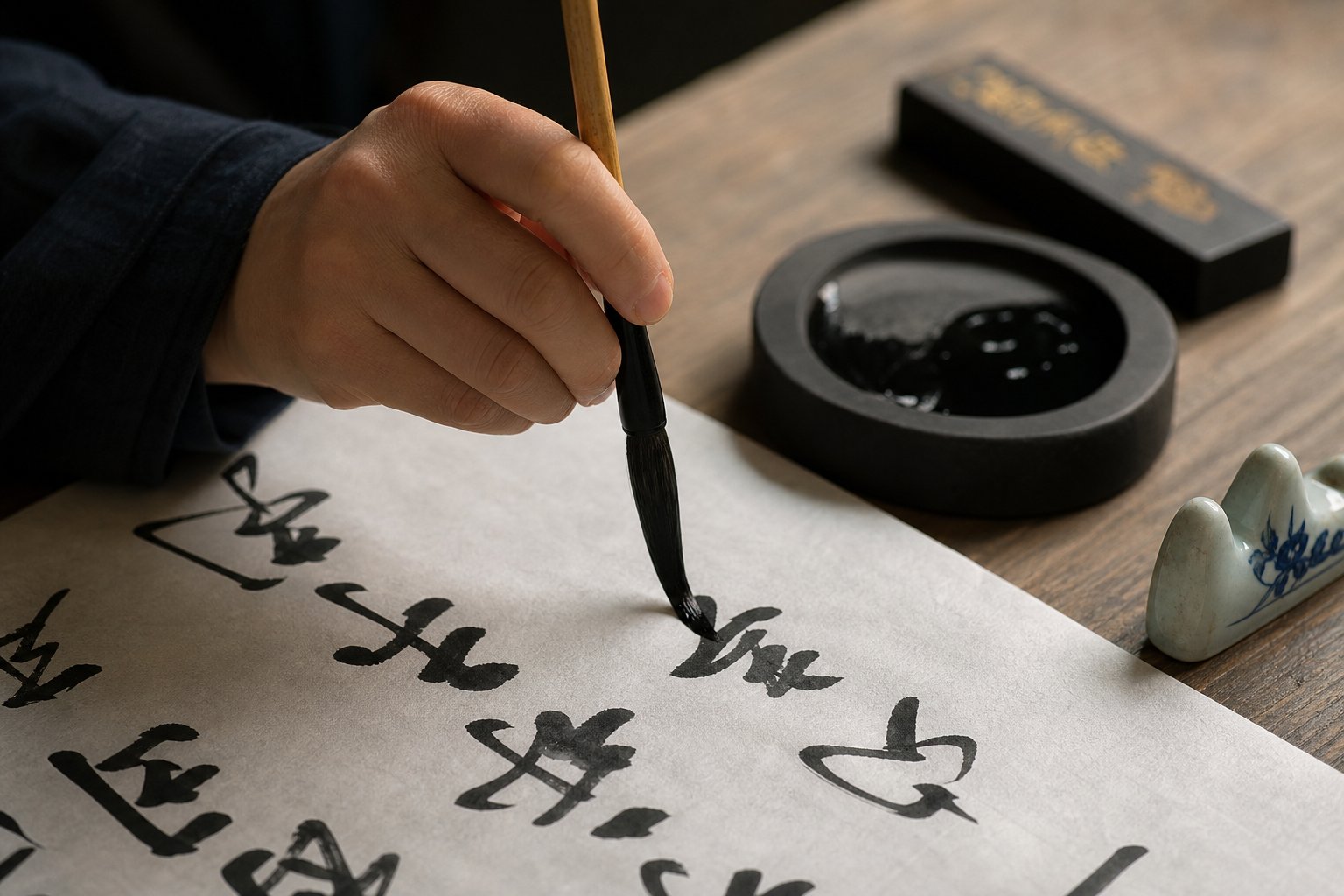
The calligraphy chinese brush is not a pen. It is flexible, responsive, and unforgiving of tension. A rigid grip produces rigid strokes. A balanced grip produces fluid ones. This principle applies equally to both hands, but the specific finger positions and angles that create balance differ for left-handed writers. The standard instruction, hold the brush upright with thumb and index finger stabilizing while middle, ring, and little fingers support, was developed entirely around right-handed anatomy. Left-handers need modified positions that achieve the same vertical control without forcing the wrist into uncomfortable angles.
Adapting the Traditional Vertical Brush Grip
The core principle of brush holding remains the same regardless of hand dominance: keep the brush upright. A vertical brush allows the tip to stay centered, creates balanced strokes, and gives full control over pressure. Left-handers can maintain this verticality, but the wrist angle required to achieve it differs. Where a right-handed writer's wrist naturally positions the brush perpendicular to a horizontal stroke, a left-handed writer's wrist tends to angle the brush slightly toward the body. Compensating for this means rotating the wrist outward by roughly 10 to 15 degrees, opening the hand so the brush shaft points straight up rather than tilting left.
Hold the brush slightly above the midpoint of the shaft, not close to the tip. This creates space between your fingers and the paper, encourages arm movement over finger movement, and improves overall stability. Many left-handers instinctively choke down on chinese calligraphy brushes for more control, but this actually restricts range of motion and increases fatigue.
Three Left Handed Grip Variations That Work
No single grip suits every left-handed writer. Hand size, finger length, and personal comfort all play a role. These three variations each solve different problems:
- The Mirrored Traditional Grip: Mirror the standard five-finger grip exactly. Thumb and index finger pinch the brush from opposite sides, middle finger presses from behind, ring and little fingers tuck underneath for support. This works best for writers who want maximum authenticity and are willing to spend extra time training wrist rotation. It produces the most traditional stroke quality but requires the most adaptation effort on horizontal strokes.
- The Angled Hook Grip: Curl the index and middle fingers slightly more than in the traditional hold, creating a hook shape that pulls the brush toward vertical even when the wrist sits in its natural left-handed position. The thumb presses firmly against the opposite side. This variation works best for practitioners who struggle with wrist fatigue from constant rotation. It sacrifices a small degree of fine pressure control but keeps the brush upright with less physical effort.
- The Elevated Pinch Grip: Hold the brush higher on the shaft, roughly two-thirds up, using primarily the thumb, index, and middle fingers in a relaxed tripod. The ring and little fingers float free or rest lightly against the shaft without gripping. This works best for running and cursive scripts where fluid arm movement matters more than precise fingertip control. It feels less secure initially but produces smoother, more expressive strokes once muscle memory develops. Many left-handers find this grip particularly effective with a chinese calligraphy brush pen for daily practice.
Pressure Control and Finger Placement Tips
Pressure in calligraphy comes from the arm and wrist, not from squeezing the fingers. Left-handers often over-grip to compensate for the instability they feel on push strokes. This creates a cycle: tighter grip leads to stiffer movement, which leads to worse strokes, which leads to gripping even tighter.
Break the cycle by checking tension every few characters. If your knuckles are white or your forearm feels tight, you are holding too hard. The brush should feel like it could be gently pulled from your fingers without a fight. When practicing with a chinese calligraphy pen or brush, try this test: write a vertical stroke, then immediately relax your hand completely. If the brush drops, your resting grip is too loose. If your fingers ache when you release, your working grip is too tight. The sweet spot sits between those extremes.
Finger placement also shifts depending on stroke type. For push strokes like the horizontal, increase thumb pressure slightly to prevent the brush from wobbling as bristles resist. For pull strokes like the left-falling, ease thumb pressure and let the middle finger guide. This dynamic adjustment, varying finger dominance stroke by stroke, is something right-handed writers do unconsciously. Left-handers benefit from making it deliberate until it becomes automatic.
Grip solves half the problem. The other half lives in how you position yourself relative to the paper, where even a small adjustment in angle can eliminate smudging entirely and turn a frustrating workspace into one that cooperates with your hand.
Paper Positioning and Workspace Setup for Left Handed Practice
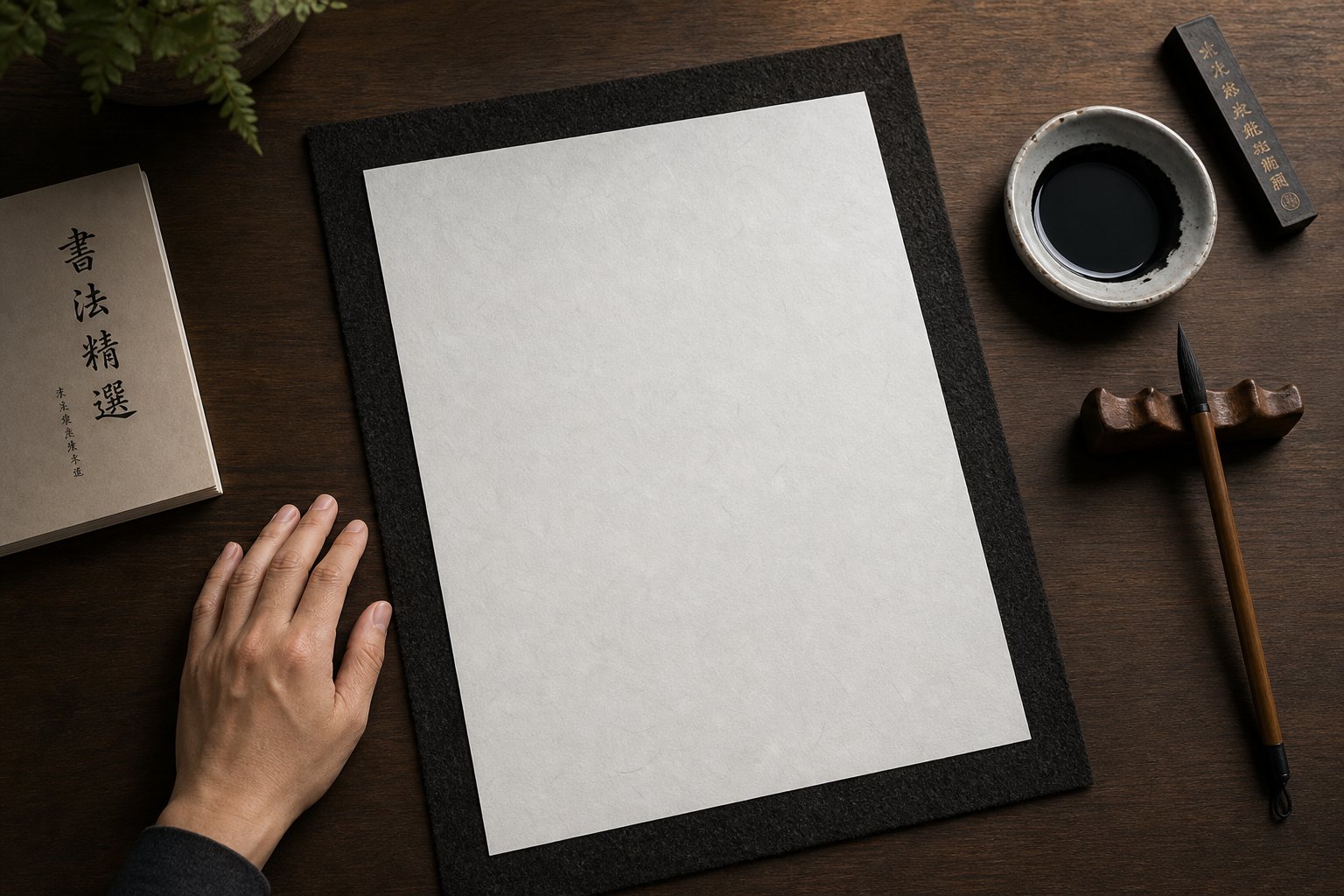
Your grip can be perfect and your brush angle ideal, but if the paper sits in the wrong position, you will still smudge wet ink, fight awkward wrist angles, and produce inconsistent strokes. Workspace setup is where many left-handed calligraphers find their biggest breakthrough. As calligraphy instructor Ellie Shopova-Smith notes from years of teaching workshops, adjusting the angle of your paper is often the single most important change a left-handed student can make.
Optimal Paper Angle and Rotation for Left Handers
Right-handed calligraphers typically keep their chinese calligraphy paper straight or rotated slightly counterclockwise. Left-handers need the opposite. Rotating the paper clockwise, anywhere from 15 to 90 degrees depending on your natural wrist position, aligns the brush with the stroke direction rather than fighting it. There is no universal correct angle. You find yours by experimenting.
Here is a step-by-step desk setup sequence that works as a reliable starting point:
- Sit centered at your desk with both feet flat on the floor. Position your chair so your forearm rests comfortably on the table surface without hunching your shoulders.
- Place the chinese calligraphy paper roll or practice sheet directly in front of your left hand, not centered on your body.
- Rotate the paper clockwise until the top edge angles toward the upper-right corner of your desk. Start with roughly 30 degrees and adjust from there.
- Position your ink stone or ink container to the right of the paper, where your non-writing hand can reach it without crossing over wet characters.
- Place a scrap sheet or felt pad beneath your writing paper to absorb excess ink and prevent bleed-through.
- Rest the heel of your left hand below the line you are currently writing, never beside or above it.
- Write a few test strokes. If your wrist feels strained or the brush tilts away from vertical, increase the clockwise rotation by 10 degrees and try again.
This process takes five minutes and saves hours of frustration. The Calligraphy Box recommends rotating until the nib or brush tip points toward the top-right corner of the paper, which prevents awkward wrist angles and reduces strain during extended practice sessions.
Why Vertical Column Writing Suits Left Handed Writers
Here is something most guides overlook: traditional Chinese writing moves top to bottom within each column, and columns progress from right to left across the page. This layout is actually friendlier to left-handers than modern horizontal writing.
Think about it. When you write horizontally from left to right, your left hand drags directly over everything you just wrote. Wet ink smears under your palm. But when you write in vertical columns moving rightward to leftward, your hand always moves away from completed columns. You never pass over fresh ink. This is why chinese calligraphy couplets, chinese calligraphy banners, and chinese scroll calligraphy, all traditionally written in vertical columns, present fewer smudging problems for left-handed practitioners than modern horizontal layouts.
If you are practicing on a chinese calligraphy paper roll, orient it vertically and work in columns. Start your first column on the far right side of the paper. As you complete each column and move leftward, your hand stays clear of wet strokes. The format that feels most traditional also happens to be the most practical for your dominant hand.
Preventing Smudging With Smart Positioning
Smudging is the most common complaint from left-handed brush writers, but it is almost entirely a positioning problem rather than a hand-dominance problem. Three adjustments eliminate most smudging:
- Keep your hand below the baseline. Whether writing horizontally or vertically, ensure the fleshy part of your palm never rests on or above the line you are actively writing. This single habit prevents the majority of smudges.
- Use a hand guard or barrier sheet. Place a small piece of clean chinese calligraphy red paper or scrap paper beneath your hand as a buffer. This protects finished characters below your current writing line without restricting movement.
- Work in the correct column direction. Always progress from right to left when writing vertical columns. If you are writing chinese calligraphy banners or couplets for display, this traditional direction keeps your hand clear of every completed stroke.
Body position matters too. Sit with your left shoulder slightly forward and your elbow close to your side rather than flared outward. This compact posture keeps your hand beneath the writing line naturally, without requiring constant conscious adjustment. Over time, the position becomes automatic.
With your workspace cooperating rather than fighting you, the next question becomes which style of calligraphy to practice first. Not all scripts present equal difficulty for left-handers, and choosing the right starting point can mean the difference between early frustration and steady progress.
Best Calligraphy Scripts for Left Handed Beginners
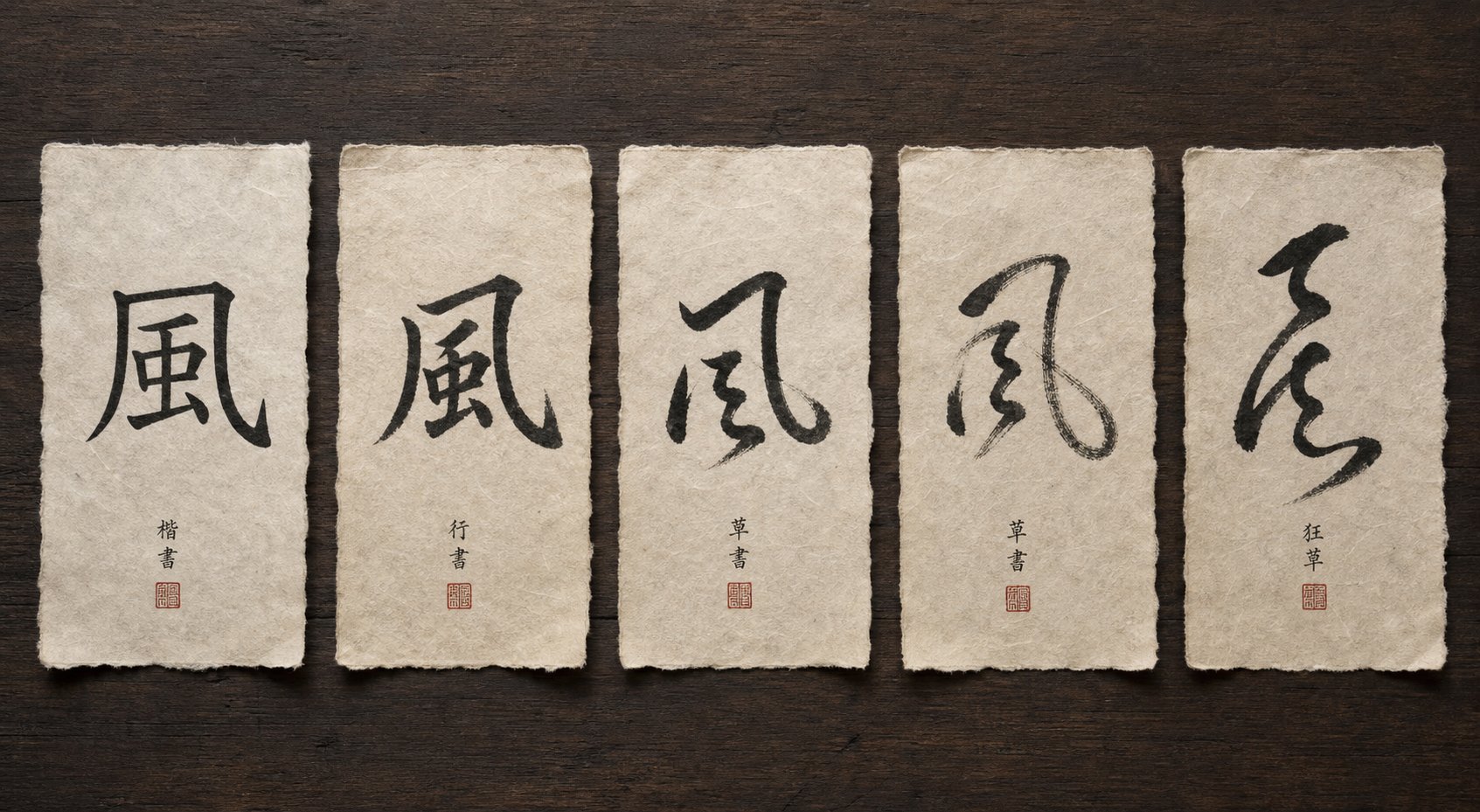
Chinese calligraphy styles span thousands of years of evolution, and each one demands different things from your hand. Some reward precision. Others reward flow. For left-handed practitioners, this distinction matters enormously because the scripts that emphasize flowing, connected movement tend to forgive the push-stroke challenges that rigid, structured scripts expose. Choosing the right starting point is not about picking the easiest option overall. It is about picking the style where your left hand encounters the fewest mechanical conflicts while still building foundational skills.
Ranking the Five Scripts by Left Handed Accessibility
There is no alphabet in chinese calligraphy. Instead, you work with thousands of individual calligraphy chinese characters, each assembled from the same basic strokes arranged in different combinations. The five major chinese calligraphy writing styles each treat those strokes differently, with varying speed, connection, and structural rigidity. Here is how they compare from a left-handed perspective:
| Script Style | Left-Handed Difficulty | Key Challenges for Left Handers | Recommended Practice Order |
|---|---|---|---|
| Kaishu (Regular Script) | Moderate | Requires precise, separate strokes with clear start and end points. Push strokes are exposed but predictable and repeatable. | 1st (Start here) |
| Xingshu (Running Script) | Moderate to Low | Partially connected strokes reduce the number of full push-stroke starts. Speed variation can mask minor inconsistencies. | 2nd |
| Caoshu (Cursive Script) | Moderate | Highly connected and fast. Simplified forms reduce stroke count, but abstraction requires deep character knowledge. | 4th |
| Lishu (Clerical Script) | Moderate to High | Wide horizontal strokes with dramatic flaring endings demand precise push-stroke control. Rhythm is slow and deliberate. | 3rd |
| Zhuanshu (Seal Script) | High | Even, consistent stroke thickness throughout. Slow speed and symmetrical structure leave no room to hide push-stroke irregularities. | 5th |
Notice something counterintuitive: cursive script, often considered the most advanced style, is not necessarily the hardest for left-handers. Its continuous, flowing movement actually reduces the number of times you must restart a push stroke from a dead stop, which is where left-handed inconsistencies are most visible.
Why Regular Script Is the Best Starting Point
Kaishu, or standard script, reached its peak during the Tang dynasty and remains the first script taught to calligraphy students worldwide. Its balanced, clearly legible chinese calligraphy characters combine distinct individual strokes in visually sophisticated forms. Eight fundamental stroke types, all contained within the single character yong (forever), provide the complete vocabulary of brush movements you will use across every other style.
For left-handers specifically, Kaishu works as a starting point because each stroke is isolated and repeatable. You can practice the horizontal push stroke dozens of times in a row without needing to connect it to anything else. Mistakes are obvious and diagnosable. When a stroke goes wrong, you know exactly which stroke it was and can target it. This clarity accelerates the adaptation process. You are not guessing where your technique broke down because the structure tells you.
The trade-off is that Kaishu exposes every imperfection. There is no flow to carry you past a rough horizontal stroke. But that exposure is precisely what builds the muscle memory you need before moving into faster, more connected scripts. Think of it as learning chinese calligraphy words one clean stroke at a time rather than trying to write full sentences before your hand knows the vocabulary.
A Recommended Learning Progression
Start with Kaishu to build stroke control and learn character structure. Spend enough time here that your eight basic strokes feel consistent, even the difficult horizontal and right-falling push strokes. Most practitioners need two to three months of regular practice before the foundation feels solid.
Move to Xingshu next. Running script combines the legibility of standard script with the expressivity of cursive, and its partially connected strokes let your hand flow rather than stopping and restarting at every character. Many left-handers report that Xingshu feels more natural than Kaishu because the continuous motion reduces the jarring push-stroke restarts that cause the most trouble. You still need character knowledge from your Kaishu practice, but the physical execution becomes smoother.
Lishu comes third because its wide, dramatic horizontal strokes with flaring endings demand the precise push-stroke control you have been building. By this point, your adapted grip and pressure management should be strong enough to handle its demands. Caoshu follows fourth, requiring deep familiarity with how chinese calligraphy characters simplify and connect. Zhuanshu comes last. Its demand for perfectly even, consistent strokes at slow speed is the ultimate test of left-handed brush control, and attempting it too early leads to frustration rather than growth.
There is no alphabet in chinese calligraphy to memorize in sequence, but there is a logical order for building skills. Each script trains a different aspect of brush control, and progressing through them in this order ensures that each new style builds on what the previous one taught your hand to do. The question that follows naturally is whether to pursue this progression with your left hand alone, or whether training your right hand for calligraphy specifically might offer advantages worth considering.
Three Learning Paths for Left Handed Calligraphers
Every left-handed person who decides to create chinese calligraphy eventually faces a fork in the road. Do you adapt your left hand to work within a system designed for the right? Do you train your right hand exclusively for brush work while staying left-handed for everything else? Or do you develop both hands and let each contribute its strengths? There is no single correct answer. Each path produces legitimate chinese calligraphy artwork, and each carries distinct trade-offs in comfort, learning speed, and long-term potential.
Here is how the three approaches compare across the factors that matter most:
| Factor | Path 1: Adapt Left Hand | Path 2: Train Right Hand | Path 3: Ambidextrous |
|---|---|---|---|
| Learning Curve | Moderate. Requires grip and angle adjustments but uses your dominant hand's existing coordination. | Steep initially. Building fine motor control from scratch takes months of dedicated practice. | Longest overall. You are training two separate skill sets simultaneously. |
| Authenticity of Results | High with adaptation. Strokes may carry subtle stylistic differences that some view as expressive rather than flawed. | Highest traditional alignment. Stroke mechanics match centuries of established technique exactly. | High for both hands independently. Offers creative flexibility for different scripts or styles. |
| Physical Comfort | Most comfortable. Your dominant hand has natural strength, endurance, and proprioception. | Uncomfortable at first. Fatigue and shakiness are common for weeks or months. | Variable. Comfort improves in both hands over time but neither reaches single-hand mastery as quickly. |
| Long-Term Mastery Potential | Excellent. Many accomplished calligraphers work exclusively left-handed with adapted technique. | Excellent. Removes all mechanical conflicts with traditional stroke direction. | Highest ceiling. Ability to switch hands opens unique creative possibilities for chinese calligraphy painting and large-format work. |
Path One Adapting Left Handed Technique
This is the most common choice among left-handers who want to start producing work quickly. You keep your dominant hand on the brush and modify your grip, paper angle, and stroke approach to compensate for reversed mechanics. The adaptations covered in earlier sections of this article, such as the mirrored grip, clockwise paper rotation, and deliberate speed control on push strokes, all belong to this path.
Pros
- Immediate access to your hand's existing fine motor skills and muscle memory
- Shorter time to producing recognizable, satisfying characters
- No identity conflict: you remain a left-handed calligrapher working authentically with your natural hand
Cons
- Certain strokes, particularly the horizontal and right-falling, will always require extra attention
- Some traditional teachers may not recognize or support adapted technique
- Finding left-handed-specific instruction remains harder than finding standard resources
This path suits practitioners who value comfort and natural expression. The chinese calligraphy art paintings produced by left-handed masters like Gao Fenghan demonstrate that adapted technique does not limit artistic quality. It simply routes you through different mechanical solutions to reach the same destination.
Path Two Training Your Right Hand for Calligraphy Only
Some left-handers choose to train their right hand exclusively for brush work while remaining left-handed for writing, eating, and everything else. This is not switching handedness. It is developing a specialized skill in a specific hand, similar to how a left-handed guitarist might play a right-handed instrument without becoming right-handed in daily life.
Pros
- Eliminates all push-stroke conflicts entirely since your right hand pulls naturally along standard stroke paths
- Full compatibility with any traditional instruction, textbook, or class without adaptation
- No need to find left-handed-specific resources or teachers
Cons
- Significant initial frustration as your non-dominant hand lacks coordination and endurance
- Longer time before producing satisfying results, often three to six months of basic stroke drills
- Some practitioners report that their right-hand work feels mechanical or disconnected from their natural expressiveness
The experience of calligraphy instructors who have trained their non-dominant hand shows that visible improvement happens within ten days of consistent practice, but true comfort takes much longer. If you choose this path, expect the first month to feel clumsy. Commit to short daily sessions of 15 to 20 minutes rather than occasional long ones, and focus exclusively on basic strokes before attempting full characters.
Path Three Developing Ambidextrous Skills
The third option is the most ambitious: train both hands and use each where it excels. Your left hand handles scripts and strokes where push mechanics are minimal or where flowing movement dominates. Your right hand takes over for scripts demanding precise, traditional stroke execution. Over time, you develop the ability to create chinese calligraphy artwork with either hand depending on the project.
Pros
- Maximum creative flexibility across all scripts and formats
- Unique artistic perspective that few calligraphers possess
- Practical advantages for large-format chinese calligraphy painting where switching hands reduces fatigue and improves reach
Cons
- Requires the most total practice time since you are building two separate skill sets
- Progress in each hand is slower than if you devoted all practice to one
- Risk of developing inconsistent style between hands if practice is not balanced
This path appeals to practitioners who view calligraphy as a long-term artistic pursuit rather than a skill to acquire quickly. It demands patience and structured practice scheduling, typically alternating hands by session or by script style rather than switching mid-practice.
No path is inherently superior. Your choice depends on your goals, your timeline, and how you want your relationship with the brush to feel. A practitioner focused on meditative daily practice may prefer the comfort of Path One. Someone pursuing formal study under a traditional master may find Path Two removes unnecessary friction. An artist creating large-scale work may find Path Three opens possibilities that neither single hand could achieve alone.
Whichever direction you choose, the tools you practice with shape your experience from the very first session. The right brush, paper, and ink make adaptation smoother, while poorly chosen supplies amplify every mechanical challenge your hand already faces.
Essential Supplies for Left Handed Calligraphy Practice
A well-chosen chinese calligraphy set removes friction from your early practice sessions. The wrong supplies amplify every push-stroke challenge your left hand already faces, while the right ones quietly compensate. You do not need to spend heavily, but you do need to choose deliberately. Here is what to look for from a left-handed perspective.
Choosing the Right Brush for Left Handed Strokes
Brush stiffness matters more for left-handers than for right-handers. When you push a brush, stiff bristles catch and resist. Softer bristles absorb that resistance, bending with the stroke rather than fighting it. A mixed bristle brush, combining soft goat hair on the outside with stiffer weasel or rabbit hair at the core, gives you the best of both worlds: enough structure to maintain a point, enough flexibility to forgive push-stroke pressure. This is the ideal starter brush for left-handed practitioners.
Avoid pure hard-bristle brushes at first. While they offer excellent control for right-handed pull strokes, they transmit every push-stroke wobble directly to the paper. A chinese calligraphy brush set marketed for beginners typically includes a mixed-bristle brush in the medium size range, suitable for characters measuring 6 to 8 centimeters. Start there.
Paper Ink and Practice Aids That Help
Your chinese calligraphy supplies beyond the brush shape your daily experience just as much. Paper choice affects how forgiving your practice feels. Chinese calligraphy ink behavior changes depending on what surface receives it. And practice aids can eliminate mess entirely while you build muscle memory.
For paper, look for partially treated alum rice paper (Xuan paper). It absorbs ink at a controlled rate, giving you a fraction of a second longer before strokes bleed, which helps left-handers who move slightly slower through push strokes. Untreated paper absorbs too fast and punishes hesitation.
For ink, bottled chinese calligraphy ink is the practical choice for beginners. A chinese calligraphy ink stick ground on a chinese calligraphy stone produces beautiful results, but controlling ink density adds complexity you do not need while simultaneously learning adapted grip mechanics. Save the traditional grinding ritual for later, once your strokes feel consistent.
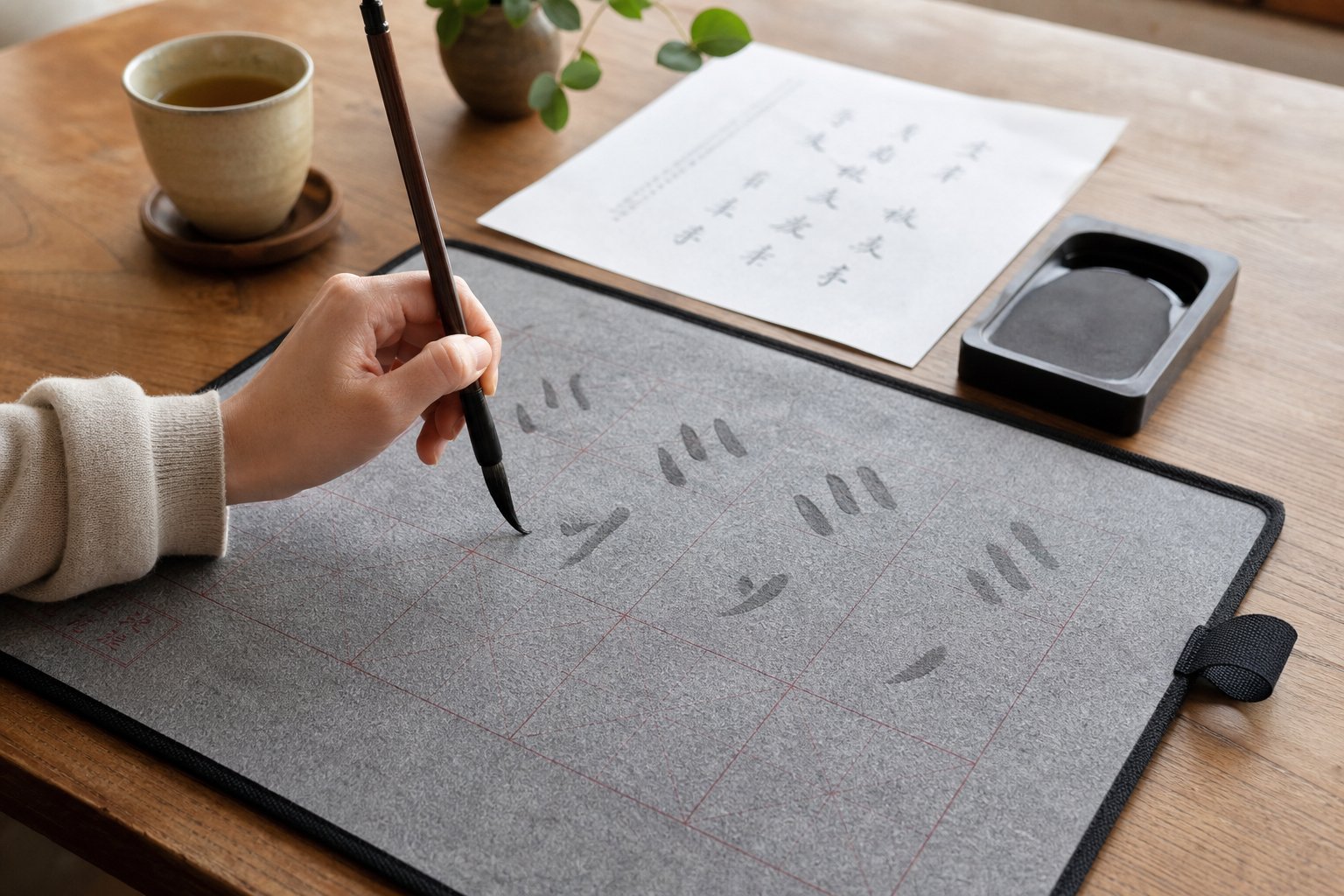
The single most useful practice aid for left-handers is water-writing cloth. This reusable fabric turns dark when touched with a wet brush and fades as it dries. No ink means no smudging, which eliminates the primary frustration left-handers face during early practice. You can repeat strokes endlessly without wasting paper or cleaning up. Look for versions with grid lines to guide character proportions.
Complete Starter Supply Checklist
Here is everything you need to begin practicing immediately, with left-handed-specific notes:
- Mixed-bristle brush (medium size): Forgiving on push strokes while maintaining enough structure for clean lines. One brush is sufficient to start.
- Bottled ink (100ml or larger): Easier to control than grinding your own. Pour small amounts into your inkstone to avoid waste.
- Ceramic or plastic inkstone: A shallow dish works fine with bottled ink. No need for a grinding stone until you switch to ink sticks.
- Partially treated Xuan paper: Affordable and forgiving. Buy a practice pack rather than premium sheets while learning.
- Water-writing cloth with grid lines: Your primary daily practice surface. Eliminates smudging concerns entirely.
- Felt desk pad: Protects your surface and provides slight cushion beneath the paper, improving brush response.
- Brush rest or wooden stand: Keeps bristles off the desk between strokes, preventing damage and ink pooling.
- Scrap paper hand guard: A small sheet to rest beneath your palm, protecting finished characters from accidental contact.
You may encounter a vintage chinese calligraphy set or antique chinese calligraphy set at estate sales or specialty shops. These can be beautiful objects, but aged brushes often have brittle or misshapen bristles that make learning harder. Appreciate them as art pieces. Practice with fresh chinese calligraphy supplies that respond predictably to your hand.
With your workspace arranged and your supplies ready, the only remaining question is how to structure your first weeks of practice into a progression that builds real skill rather than random repetition.
How to Start Practicing Left Handed Calligraphy Today
Supplies purchased. Workspace arranged. Grip chosen. The only thing left is to actually pick up the brush and begin. This is where many left-handed learners stall, not from lack of motivation but from lack of structure. Random practice produces random results. A clear weekly progression builds real skill, and it does so faster than you might expect.
Your First Month Practice Schedule
Muscle memory forms through frequent, short repetitions rather than occasional marathon sessions. Research on calligraphy muscle memory confirms that practicing the same movement repeatedly trains your hand to reproduce it without conscious effort. For left-handers adapting to reversed stroke mechanics, this principle matters even more. Fifteen to twenty minutes daily outperforms two hours on the weekend every time.
Here is a structured first-month plan designed specifically for left-handed practitioners:
- Week 1: Vertical and left-falling strokes only. These are the strokes that behave nearly identically for left-handers. Spend your first seven days building confidence with movements that cooperate with your hand. Practice the vertical stroke (shu) and left-falling stroke (pie) in sets of 20 repetitions each session. Focus on consistent pressure and clean endings. Use water-writing cloth so you can repeat without pause.
- Week 2: Add the horizontal stroke and dot. The horizontal stroke is your primary push-stroke challenge. Dedicate half of each session to it. Start each horizontal stroke with a brief pause to set the bristles, then move steadily left to right. Practice the dot (dian) as a warm-up since its quick press-and-release motion loosens your wrist. By the end of this week, aim for horizontal strokes that maintain even width across their length.
- Week 3: Introduce the right-falling stroke, hook, and turning stroke. These are the remaining difficult strokes for left-handers. Practice each in isolation first, then begin combining strokes into simple characters. Start with structurally basic characters like yi (one), shi (ten), da (big), and ren (person). These characters use only two to four strokes each and let you practice transitions between stroke types.
- Week 4: Write complete simple characters and short combinations. Practice characters with five to eight strokes such as yong (forever), which contains all eight basic stroke types in a single character. Write each character five to ten times per session. Compare your first attempt to your last and note which strokes still feel inconsistent. Target those specific strokes in your warm-up the following day.
Each session should follow a simple rhythm: two minutes of wrist circles and dry-brush air strokes to warm up, ten to fifteen minutes of focused practice on the week's target strokes or characters, and two minutes reviewing what felt strongest and what needs attention tomorrow. This structure keeps sessions short enough to maintain daily consistency without feeling like a burden.
Finding Instruction and Community
Self-study works, but guided instruction accelerates progress dramatically. A teacher can spot grip tension, paper angle problems, and stroke timing issues that you cannot see in your own work. The challenge for left-handers is finding instruction that accommodates rather than corrects your hand dominance.
Search for chinese calligraphy classes near me and contact instructors directly before enrolling. Ask whether they have experience teaching left-handed students and whether they require hand switching. Many modern chinese calligraphy classes welcome left-handed practitioners, but not all do. A brief conversation saves you from showing up to a class that insists you switch hands on day one.
If local options are limited, online instruction offers flexibility. Video-based chinese calligraphy class platforms let you mirror demonstrations and pause to match your adapted grip. Look for instructors who show stroke mechanics from multiple angles rather than only demonstrating finished characters. A good chinese calligraphy book also provides structured progression. Titles focused on stroke fundamentals rather than finished artwork give left-handers the clearest path since you can apply your adapted technique to each isolated stroke before combining them.
Digital tools can supplement physical practice. A chinese calligraphy generator or calligraphy generator chinese tool lets you input characters and see correct stroke order animated step by step. These tools help you visualize the target before attempting it with a brush. Some platforms let you generate chinese calligraphy models at various sizes, which you can print as reference sheets for your practice sessions. They are not substitutes for brush-in-hand work, but they clarify what you are aiming for.
Community matters too. Online forums and social media groups for left-handed calligraphers exist in both English and Chinese. Sharing your progress, asking questions about specific strokes, and seeing other left-handers produce beautiful work reinforces that your path is legitimate. You are not the only chinese calligraphy creator working with your left hand. You are part of a growing community that is building the instructional knowledge base that previous generations were denied.
Building Confidence as a Left Handed Calligrapher
Doubt will surface. You will produce strokes that look rough, characters that feel unbalanced, and sessions where nothing seems to click. This is normal for every calligraphy student regardless of hand dominance. The difference is that left-handers often blame their handedness rather than recognizing ordinary learning friction for what it is.
Remember the historical record. Gao Fenghan produced work with his left hand that critics praised as surpassing his earlier right-handed calligraphy. Fei Xinwo earned recognition from one of China's most prominent literary figures for left-handed work. These were not exceptions born of unusual talent. They were practitioners who committed to consistent practice with adapted technique, exactly what you are doing now.
Set realistic expectations. Your first month builds foundation, not mastery. Your second and third months refine consistency. Visible confidence in your strokes typically emerges around the three-month mark for practitioners who maintain daily short sessions. As experienced calligraphy instructors emphasize, you do not need perfect strokes or natural talent. You need consistency: one stroke, one character, one session at a time.
Left handed chinese calligraphy is not a workaround or a compromise. It is a legitimate practice with proven techniques, historical precedent, and a clear path from first stroke to accomplished work. Pick up the brush today. Your left hand is ready.
Frequently Asked Questions About Left Handed Chinese Calligraphy
1. Can left-handed people do Chinese calligraphy?
Yes. Left-handed practitioners can produce high-quality Chinese calligraphy by adapting their brush grip, rotating paper clockwise, and adjusting stroke speed on push-dominant strokes like the horizontal and right-falling. Historical figures such as Gao Fenghan and Fei Xinwo created acclaimed work with their left hand, proving that hand dominance does not limit artistic achievement in brush writing.
2. What is the biggest challenge for left-handed calligraphers writing Chinese characters?
The primary challenge is stroke direction. Standard Chinese strokes move left to right, meaning left-handers push the brush where right-handers pull it. Pushing causes bristles to splay and resist, producing uneven ink flow and rough edges. The horizontal stroke and right-falling stroke present the greatest difficulty, while vertical and left-falling strokes feel nearly identical regardless of hand dominance.
3. What brush is best for left-handed Chinese calligraphy beginners?
A mixed-bristle brush combining soft goat hair on the outside with stiffer weasel or rabbit hair at the core works best. Softer bristles absorb the resistance created by push strokes rather than fighting it, while the stiffer core maintains enough structure for clean lines. Avoid pure hard-bristle brushes initially since they transmit every push-stroke wobble directly to the paper.
4. Should left-handed people switch to their right hand for Chinese calligraphy?
Not necessarily. Three valid paths exist: adapting left-handed technique with modified grip and paper positioning, training the right hand specifically for calligraphy while staying left-handed otherwise, or developing ambidextrous skills. Each approach produces legitimate results. Adapting the left hand offers the fastest start and most physical comfort, while right-hand training eliminates all push-stroke conflicts but requires months of building coordination from scratch.
5. How should left-handed calligraphers position their paper to prevent smudging?
Rotate the paper clockwise between 15 and 90 degrees, write in traditional vertical columns progressing from right to left, and keep your palm below the current writing line at all times. Vertical column writing naturally moves your hand away from completed strokes, eliminating most smudging. A small scrap paper placed beneath your hand as a barrier provides additional protection during horizontal writing practice.