Why Asian Naming Conventions Deserve Your Attention
Imagine standing at a podium in front of international press and calling the leader of North Korea "Chairman Un." That is exactly what happened to U.S. Secretary of State Mike Pompeo in 2018. Because Korean names place the family name first, "Kim" is the surname and "Jong-un" is the given name. Pompeo essentially did the equivalent of addressing Donald Trump as "President Don." Meanwhile, China's President Xi Jinping is routinely called "Mr. Jinping" by Western commentators who assume the last word in a name must be the surname.
These are not trivial slip-ups. They signal a fundamental misunderstanding of how asian names and surnames actually work, and they happen every day in boardrooms, hospitals, immigration offices, and email inboxes around the world.
A simple name-order mistake can turn a diplomatic handshake into a professional embarrassment, because in much of Asia, the family name comes first and the given name comes last.
Why Getting Asian Names Right Matters
Surnames in Asia do not follow a single universal pattern. Some cultures place the family name before the given name. Others use no inherited surname at all. A few build names from the day of the week a child is born. When you encounter these systems without context, confusion is almost guaranteed. And that confusion carries real consequences: misidentified patients in healthcare records, botched airline tickets, or a colleague who quietly notices you have been addressing them incorrectly for months.
Whether you work alongside Asian colleagues, write about names of cultures you are still learning, or you are tracing your own family heritage, understanding these naming systems is a practical skill, not just a cultural nicety.
What This Comparison Covers
This article walks through 8 distinct naming traditions spanning East Asia (Chinese, Korean, Japanese), Southeast Asia (Vietnamese, Thai, Filipino, Indonesian, Burmese), and South Asia (Indian, Pakistani, Sikh, Sri Lankan). For each system, you will find how names are structured, where the surname sits, what traps outsiders commonly fall into, and how to address someone correctly in professional settings.
No single English-language resource currently compares all of these systems side by side with practical guidance attached. That is the gap this piece fills. By the end, you will have a clear mental map of how naming works across the continent and a set of actionable rules for getting it right the first time.
The starting point for any meaningful comparison is knowing what criteria to measure each system against, and which dimensions actually matter for real-world use.
How We Compared These Naming Systems
Comparing asian family names across eight distinct traditions requires more than listing name orders. Each system carries its own logic, its own history, and its own friction points when it collides with the rest of the world. To make this comparison useful rather than superficial, every naming convention in this guide is evaluated through four consistent dimensions.
Evaluation Criteria for Each Naming System
Think of these as lenses. Each one reveals something different about how a naming system works in practice:
- Structural complexity - How many components make up a full name? Is there a fixed number of elements, or does it vary? Does the system include generational markers, patronymics, or honorifics as built-in parts?
- Cultural significance - What philosophy drives naming choices? You will find that the asian name origin of each tradition reflects deep values, whether that is Confucian family continuity, Islamic devotion, astrological timing, or caste identity.
- Practical impact - How does the name function in legal documents, business cards, medical records, and everyday introductions? This is where naming systems either cooperate with or break global infrastructure.
- Global adaptability - How smoothly does the system interact with Western first-name/last-name conventions? Some traditions translate easily. Others, like Burmese single names or South Indian patronymic chains, resist the two-field form entirely.
These four dimensions surface the patterns that matter most when you are trying to address someone correctly, build an inclusive database, or simply understand why a colleague's name does not fit the boxes on your screen.
Sources and Research Methodology
A cross-linguistic study published in the Journal of Applied Linguistics and TESOL examined naming conventions across ten linguistically distinct communities, categorizing structures based on phonetic, syntactic, and semantic attributes. That research confirmed something intuitive: names function as both identity markers and social tools, and their structures reveal cultural hierarchies that a surface-level comparison would miss.
This guide also draws on practical journalism standards from the Asia Media Centre, which maintains a style reference for how named asians should be addressed in professional reporting. Combined with linguistic scholarship and real-world documentation challenges, these sources ground each section in verifiable detail rather than generalization.
With the framework in place, the clearest starting point is the naming system that influences more than a billion people and confuses Western databases more consistently than any other: Chinese names.
Chinese Naming System and Its Layers of Meaning
So how are Chinese names structured? At first glance, the system looks deceptively simple: surname first, given name second. But beneath that two- or three-character surface sits a naming tradition shaped by thousands of years of philosophy, family hierarchy, and linguistic precision.
Here is a quick-scan overview of the key facts:
- Name order: Family name (surname) always precedes the given name.
- Typical length: Two to three Chinese characters total. One character for the surname, one or two for the given name.
- Surname concentration: Roughly 100 surnames cover about 85% of China's population. The top three alone (Wang, Li, Zhang) account for over 270 million people.
- Middle names: There is no Western-style middle name. A two-character given name is a single unit, not a first-plus-middle split.
That last point trips up Western systems constantly. When someone named "Li Mingzhe" fills out a form with separate "first name" and "middle name" fields, the given name "Mingzhe" often gets split into "Ming" (first) and "Zhe" (middle). This is incorrect. The two characters form one given name, chosen together for their combined meaning.
Structure of Chinese Names
Imagine a name as a tiny sentence about family and identity. The surname anchors you to your lineage. The given name expresses your parents' hopes. In "Zhao Weiming," Zhao is the family name inherited from the father (traditionally), while Weiming, meaning "great and bright," is the personal name selected at birth.
Most Chinese surnames are a single character. A small number, like Ouyang or Sima, use two characters, but these compound surnames are rare. Given names, on the other hand, can be one or two characters. Single-character given names have grown more popular in recent decades, partly because they are simpler to use internationally, though two-character given names remain the traditional norm.
Why do so many asians have the same last name, particularly in China? The answer is historical consolidation. China's surname system dates back over 4,000 years, and unlike European surnames that diversified through occupations and locations, Chinese surnames remained a closed set tied to ancient clan lineages. Over millennia, dominant clans absorbed smaller ones, and migration patterns concentrated certain names in specific regions. The result: a population of 1.4 billion people drawing from a surname pool that is remarkably small by global standards.
Generational Characters and Auspicious Meanings
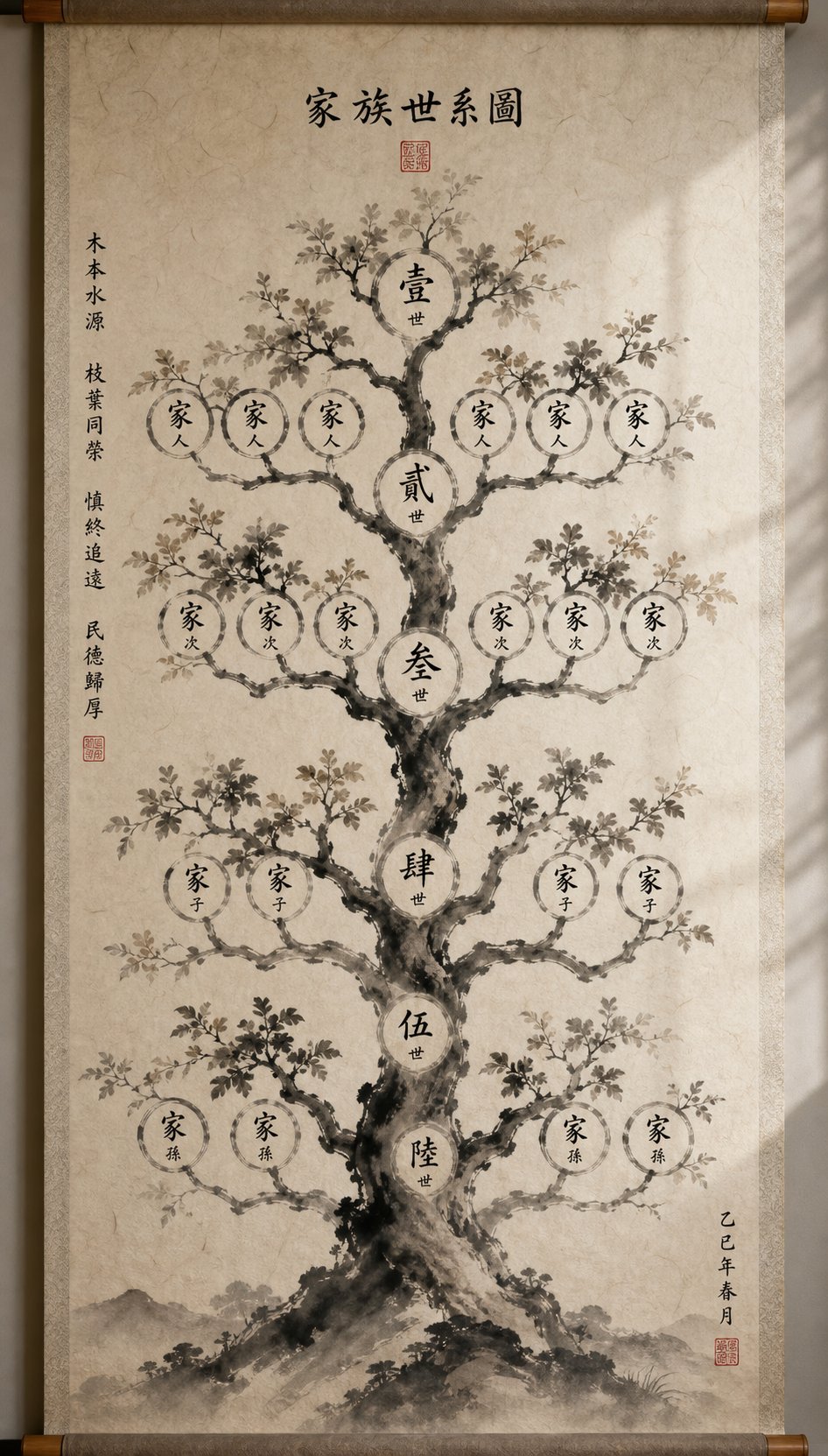
Chinese naming carries a layer that most Western systems lack entirely: generational characters, known as zibi (字辈). In this tradition, one character in the given name is shared among all siblings and sometimes all cousins of the same generation. If a family's generational character for a particular generation is "Wei," then brothers might be named Weiming, Weiguo, and Weijun. The shared syllable instantly signals their generational bond.
This practice is fading in urban China, especially under the one-child policy era when there were fewer siblings to link. But it remains alive in rural communities and among diaspora families who maintain genealogical records (族谱) stretching back dozens of generations.
Beyond generational markers, every character in a Chinese given name is chosen for its meaning, sound, and even its stroke count. Parents consult dictionaries, fortune tellers, and the five elements (wood, fire, earth, metal, water) to find characters that balance a child's birth chart. A name is not just a label. It is a deliberate act of wish-making, embedding aspirations for intelligence, strength, beauty, or prosperity directly into a person's identity.
Romanization Challenges With Pinyin and Wade-Giles
Here is where things get confusing for anyone reading Chinese names in English text. The same Chinese character can appear completely different depending on which romanization system was used to transcribe it.
Take the name of China's most famous revolutionary. In Pinyin, the modern standard, he is "Mao Zedong." In Wade-Giles, the older system developed in the 19th century, he is "Mao Tse-tung." Same person, same characters, two very different spellings. The Library of Congress identifies clear visual markers to distinguish the two systems: Wade-Giles uses hyphens between syllables of given names and apostrophe-like marks (ayns) to indicate aspiration, while Pinyin joins syllables together without hyphens and never uses ayns.
You will notice this split most often with older names and place names. "Peking" is Wade-Giles; "Beijing" is Pinyin. "Taipei" uses Wade-Giles conventions (still standard in Taiwan), while mainland China exclusively uses Pinyin. A person from Taiwan named "Tsai" and a person from mainland China named "Cai" may share the exact same surname character.
For anyone working with Chinese names professionally, the practical rule is straightforward: check the person's own preferred romanization. Do not assume Pinyin is universal, because Taiwan, older diaspora communities, and historical texts all use Wade-Giles or other regional systems. And never split a joined Pinyin given name into two separate fields on a form.
Do chinese people have middle names in the Western sense? No. But the two-character given name, the generational naming tradition, and the romanization split all conspire to make Western systems treat Chinese names as if they do. That structural mismatch between a three-character Chinese name and a three-field Western form is one of the most common sources of data errors in international record-keeping.
China's naming logic, with its surname-first order and compact structure, shares DNA with its closest cultural neighbors. Korean names follow the same broad pattern but layer on a clan system and surname concentration that creates an entirely different set of challenges.
Korean Naming Conventions and Clan Identity
Korean names follow the same surname-first order as Chinese names, and at three syllables total, they look structurally similar on the surface. But the korean name convention introduces a layer of complexity that catches outsiders off guard: an extraordinarily small pool of surnames shared by an extraordinarily large number of people, distinguished only by an invisible clan system that most forms and databases cannot capture.
Korean Clan Names and Why So Many Share Surnames
If you have spent any time around Korean colleagues, you have probably noticed the repetition. Kim, Lee, Park, Jeong, Choi. These five surnames alone cover more than half of South Korea's population. Kim is the single most common, belonging to roughly one in five Koreans. Add Lee and Park, and you are already past 45%.
So how does a society function when millions of unrelated people share the same family name? The answer is the bon-gwan (본관) system. Each Korean surname is subdivided into clans based on geographic origin. A 2015 census by Statistics Korea recorded 286 hanja-based surnames and around 858 distinct clans with more than a thousand members each. The two most common Kims, for example, are Gimhae Kim (originating from the city of Gimhae) and Gyeongju Kim (originating from Gyeongju). Despite sharing the identical surname, these are entirely separate lineages with different ancestors, different genealogical records, and historically, different marriage pools.
For Koreans, the bon-gwan is essential context. Saying "I'm a Kim" without specifying your clan is like saying "I'm from Europe" without naming a country. The clan tells you which Kim you are. But here is the problem: no international form, airline booking system, or HR database has a field for bon-gwan. Outside Korea, all Kims collapse into one undifferentiated mass, making east asian last names a persistent headache for record-keeping systems worldwide.
How Korean Names Are Formatted and Romanized
How are korean names formatted in their native script? A standard Korean name consists of a one-syllable surname written in hangul (한글), followed by a two-syllable given name. In Korean text, the full name is written without spaces: 김민수 (Kim Minsu). Each syllable block in hangul represents one character, making the visual structure clean and consistent.
Romanization is where things unravel. South Korea's official system is the Revised Romanization (RR), introduced in 2000. Under RR rules, the surname 김 becomes "Gim," 이 becomes "Yi," and 박 becomes "Bak." In practice, almost nobody uses these spellings. The overwhelming convention remains "Kim," "Lee," and "Park," holdovers from older romanization habits and personal preference.
This creates a situation where the same Korean name can appear in wildly different forms depending on who romanized it and when. The playwright 오영진 has been rendered as Oh Young-jin, O Yongjin, and Oh Young-Chin across different publications. A theatre director named 양정웅 appears as Yang Jung-woong, Yang Jeong-woong, Yang Jung-ung, and at least three other variations in English-language programs and reviews.
Hyphenation adds another variable. Some people write their given name as one word (Minsu), others hyphenate it (Min-su), and still others separate it entirely (Min Su). There is no enforced standard. The result is that a single person can appear under multiple spellings across different documents, making citation, database matching, and even basic identification unreliable.
In 2019, Japan's government formally requested that international media present Japanese names in surname-first order. This reignited a broader conversation across East Asia about whether Korean names should also be consistently presented surname-first in English contexts, rather than reversed to match Western conventions. The debate remains unresolved, and you will encounter both "Kim Minsu" and "Minsu Kim" depending on the publication, the individual's preference, and the country they reside in.
Generational Naming Traditions in Korean Families
Like Chinese generational characters, Korean families traditionally assign a shared syllable called dollimja (돌림자) to all children of the same generation. One syllable in the two-syllable given name is fixed for the entire generation, while the other syllable is unique to each child. If the generational syllable is "Jun," siblings might be named Junhyeok, Junwoo, and Junseo.
The generational syllable was historically chosen at the bon-gwan level, meaning cousins across different branches of the same clan would share it. This made it possible to determine someone's generational rank within the extended family simply by hearing their name. It functioned as a built-in seniority indicator, critical in a culture where age hierarchy shapes nearly every social interaction.
This tradition is declining. Asia Society Korea notes that younger parents increasingly drop the generational syllable, viewing it as an old-fashioned constraint that limits their naming options. The rise of pure Korean names (as opposed to hanja-based names) has also weakened the practice, since dollimja syllables are typically rooted in Chinese characters. Many younger Koreans may not even be aware of how traditional names were composed.
Still, if you notice that Korean siblings or cousins share a syllable in their given names, you are seeing this system at work.
Pros of the Korean Naming System
- Clear, consistent structure: one-syllable surname plus two-syllable given name makes names predictable in length and format.
- Strong family and clan identity embedded directly in the name through bon-gwan and generational syllables.
- Women retain their birth surname after marriage, avoiding the confusion of name changes.
- Hangul's phonetic nature makes pronunciation relatively accessible once you learn the script.
Cons of the Korean Naming System
- Extreme surname concentration causes constant confusion in international contexts. Multiple unrelated "Kim Jihyun" entries in a single database are common.
- Romanization inconsistency means the same person may appear under different spellings across documents, publications, and official records.
- The bon-gwan distinction that separates clans is invisible in romanized form, eliminating the one tool Koreans use to differentiate shared surnames.
- Name-order reversal in English contexts (given name first vs. surname first) creates ambiguity about which part of the name is which.
Korean diaspora communities navigate these friction points daily. Many adopt an English first name for professional use, becoming "David Kim" or "Sarah Park" while retaining their Korean given name for family contexts. Others hyphenate their given name to prevent it from being split into a first-and-middle-name pair. Some maintain surname-first order in all contexts as a matter of cultural identity. There is no single standard, which means anyone working with Korean names internationally needs to ask rather than assume.
The romanization challenges that plague Korean names take on a different character entirely in Japanese, where the writing system itself introduces a layer of ambiguity that even native speakers cannot always resolve.
Japanese Naming and the Kanji Reading Challenge
In Chinese and Korean, romanization creates ambiguity. In Japanese, the ambiguity starts before you even leave the native script. A single kanji character used in a name can have multiple valid pronunciations, and there is often no way to determine the correct one just by looking at it. This makes Japanese names uniquely unpredictable among east asian names, even for native Japanese speakers.
Here are the key characteristics of the Japanese naming system:
- Name order: Surname first, given name second in Japanese contexts. Often reversed to given-name-first in international settings.
- Typical structure: One to three kanji for the surname, one to three kanji for the given name. No middle name exists in the traditional system.
- Surname pool: Roughly 100,000 distinct surnames exist in Japan, far more diverse than Chinese or Korean pools.
- Legal restrictions: The government maintains an approved list of kanji (the jinmeiyou kanji) permitted for use in given names. Parents cannot use characters outside this list.
- Marriage requirement: Married couples must legally share one surname. In practice, over 95% of couples adopt the husband's surname.
Japanese Name Order and the International Reversal Debate
When you see "Haruki Murakami" on a book cover, you are looking at a reversed name. In Japanese, the author is Murakami Haruki, surname first. For decades, Japanese names in English-language media have been flipped to match Western conventions, placing the first name asian audiences would recognize as the given name at the front.
In 2019, Japan's government formally requested that international media and official documents present Japanese names in their native surname-first order. Then-Foreign Minister Taro Kono (or rather, Kono Taro) argued that other cultures' name orders are respected in English text, so Japanese names should receive the same treatment. The request prompted style guide updates at some outlets, but adoption remains inconsistent. You will still encounter both "Shinzo Abe" and "Abe Shinzo" depending on the publication.
This inconsistency means that when you encounter a Japanese name in English, you cannot always tell which part is the surname and which is the given name without additional context. Unlike Korean names, where the single-syllable surname is usually identifiable, Japanese surnames and given names can both be multi-syllable and multi-kanji, offering no structural clue about which is which.
Kanji Complexity and Multiple Name Readings
Here is where Japanese naming diverges sharply from every other system in this comparison. Each kanji character carries at least two categories of pronunciation: the on'yomi (derived from historical Chinese pronunciations) and the kun'yomi (the native Japanese reading). Many characters have multiple readings within each category, accumulated over centuries as different Chinese dynasties exported different pronunciations to Japan.
Sounds complex? Consider the kanji 生, meaning "life" or "birth." It has over ten recognized readings, including なま (nama), いきる (ikiru), うむ (umu), and はえる (haeru) for kun'yomi alone. When this character appears in a name, the correct pronunciation depends entirely on the family's chosen reading, which may not follow any predictable pattern.
This is not an edge case. Common name kanji like 大 can be read as "dai," "tai," "oo," or "masa" depending on the name. The character 美 might be "mi," "bi," or "yoshi." Parents can even assign readings to kanji that have no standard linguistic basis, a practice called kirakira names (glitter names) that has grown controversial in recent years.
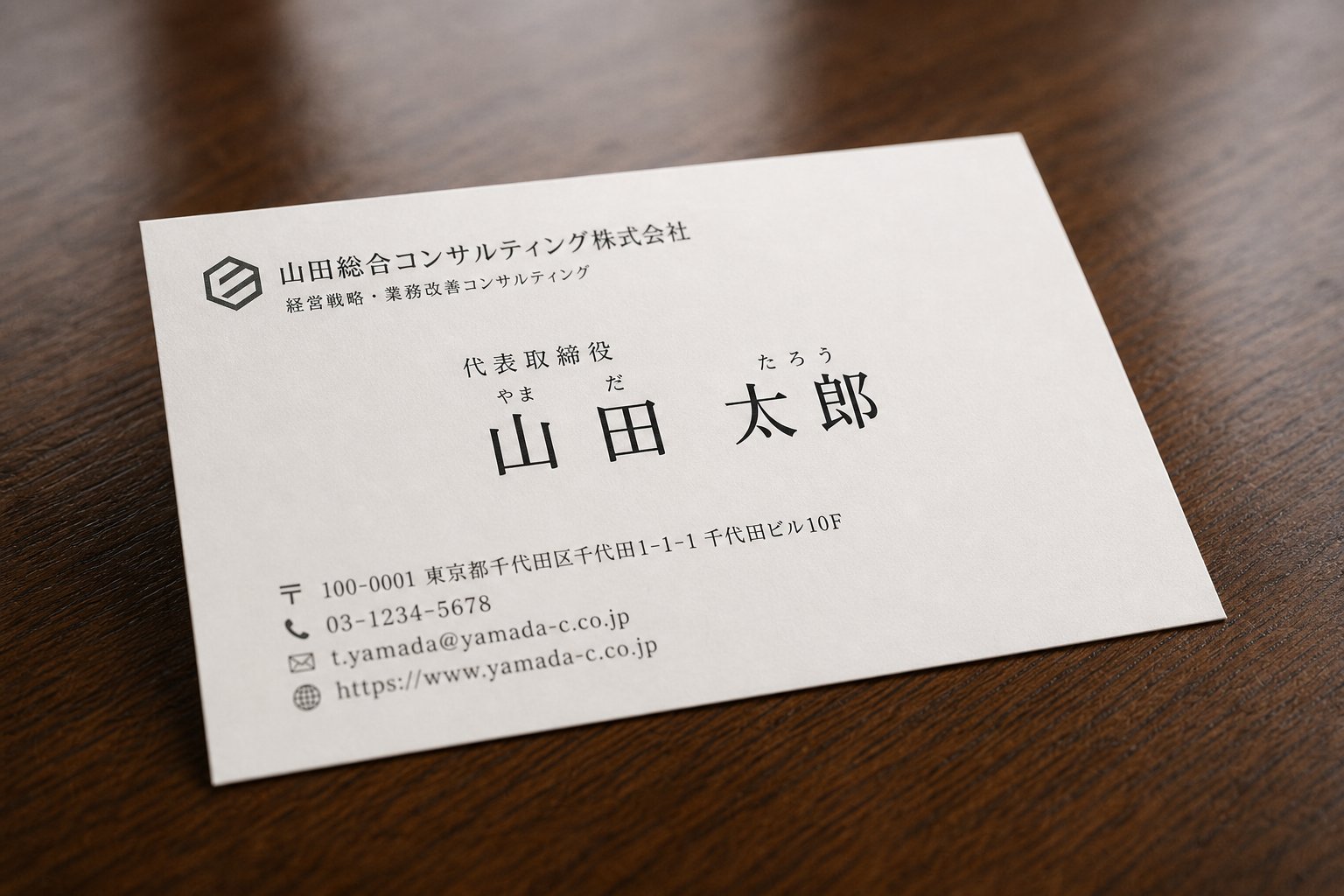
The practical result is striking: even Japanese people cannot reliably read an unfamiliar person's name from kanji alone. This is why business cards in Japan routinely include furigana, tiny phonetic characters printed above or beside the name kanji to indicate pronunciation. Without furigana, introductions in professional settings often begin with "How do you read your name?" It is a perfectly normal question in Japanese culture, not an admission of ignorance.
For anyone working with Japanese names internationally, this creates a challenge that no romanization system can fully solve. Two people with identical kanji in their names may pronounce them completely differently. And a romanized name like "Yuki" could correspond to dozens of different kanji combinations, each with its own meaning.
Marriage and Legal Name Requirements
Japanese civil law requires married couples to register under a single shared surname. There is no option for both spouses to retain their birth names legally, though one spouse may continue using their original name informally in professional contexts. This law, unchanged since 1896, means that marriage creates a hard break in one spouse's official name record.
The Supreme Court of Japan has upheld this requirement multiple times, though legal challenges continue. For international record-keeping, the practical impact is significant: a Japanese woman's passport name may change upon marriage, creating discontinuity in travel records, academic publications, and professional credentials. Some women publish under their maiden name while holding legal documents under their married name, producing yet another layer of asian second names that databases struggle to reconcile.
Combined with the kanji reading problem and the name-order reversal debate, Japanese names present a unique triple challenge: you may not know which part is the surname, you may not know how to pronounce it, and the name itself may have legally changed at some point due to marriage. No other naming system in this comparison bundles all three ambiguities into a single tradition.
Moving south from Japan's island chain, the naming systems of Southeast Asia introduce yet another dimension of complexity. Vietnam shares the surname-first structure of its East Asian neighbors, but the rest of the region breaks from that pattern in ways that few Western guides bother to document.
Southeast Asian Naming From Vietnam to Myanmar
Vietnam's naming system looks familiar if you have just studied Chinese and Korean conventions. Surname first, given name last, compact structure. But step beyond Vietnam into Thailand, the Philippines, Indonesia, and Myanmar, and the patterns shatter. Some of these systems have no inherited surname at all. Others borrow heavily from Spanish colonial traditions. A few assign names based on the day of the week a child is born. This is the region where the concept of "asian surnames" stops being a single category and becomes a spectrum.
Vietnamese Names and the Nguyen Phenomenon
A standard Vietnamese name has three parts: family name, middle name, and given name, written in that order. In "Nguyen Thi Minh," Nguyen is the surname, Thi is the middle name, and Minh is the given name. Unlike Chinese names, where the two-character given name is a single unit, Vietnamese middle names serve a distinct grammatical function. They often indicate gender (Thi for women, Van for men) or carry generational information linking siblings.
In daily life, Vietnamese people address each other by their given name, not their surname. You would call Nguyen Thi Minh simply "Minh," paired with an appropriate kinship term like "Chi" (older sister) or "Em" (younger person). The surname sits in the background, present on documents but rarely used in conversation.
This makes sense when you consider the concentration problem. Somewhere between 30 and 40 percent of Vietnam's population carries the surname Nguyen. The 14 most common last names asian communities use in Vietnam account for over 90 percent of the population. Compare that to the United States, where the 14 most popular surnames cover fewer than 6 percent.
How did one surname come to dominate so completely? The answer traces back to a cultural practice of adopting the ruling dynasty's name as a show of loyalty. Vietnamese families historically changed their surname when a new dynasty took power, a way to signal allegiance and avoid persecution. The last ruling family? The Nguyen Dynasty, which governed from 1802 to 1945. During those 143 years, the already-common name became ubiquitous.
The roots go even deeper. Vietnam's surname system itself was imposed by Chinese administrators during a thousand-year occupation beginning in 111 BC. Before that period, the Vietnamese likely did not use family names at all. Chinese bureaucrats assigned surnames from a limited pool, largely derived from Chinese names, to track populations for taxation. Nguyen comes from the Chinese surname Ruan. As one researcher at the University of Hawai'i at Manoa explains, senior Chinese administrators likely used their own personal names to designate people under their jurisdiction.
For Vietnamese-Americans and other diaspora communities, the surname Nguyen functions as a broad ethnic signifier rather than a meaningful genealogical marker. Tracing family history beyond a generation or two using the surname alone is essentially impossible. The name connects you to being Vietnamese, but with 40 percent of the population sharing it, that connection is cultural rather than familial.
Thai, Filipino, and Indonesian Naming Traditions
Step outside the Chinese-influenced naming sphere, and Southeast Asian conventions diverge dramatically.
Thai naming flips the script on surname length. While Chinese and Korean surnames are typically one syllable, Thai surnames can stretch to six or more syllables. A name like Chulalongkorn Rattanakosin is not unusual. Thai surnames were only mandated in 1913 under the Surname Act, and the law requires that each surname be unique to a single family. This uniqueness requirement, combined with the Thai preference for auspicious meanings, produces extraordinarily long compound surnames built from Pali and Sanskrit roots.
In daily life, Thais almost never use surnames. You address people by their given name or, more commonly, by a short nickname ("chue len") assigned at birth. A colleague named Siriporn Chaiyasombat would simply be called "Noi" or "Pla" by everyone from her boss to her bank teller. Business cards list the full legal name, but verbal address defaults to the given name or nickname. This means that surnames asian databases demand are, in Thai culture, essentially paperwork artifacts.
The Thai royal family historically granted surnames to distinguished families, and these royally bestowed names carry social prestige. Some families display their surname's origin as a mark of status, though the practice of daily surname use remains minimal regardless of the name's pedigree.
Filipino naming reflects over 300 years of Spanish colonial rule. The standard structure is: given name, middle name (mother's maiden surname), and surname (father's family name). In "Maria Santos Cruz," Maria is the given name, Santos is the mother's maiden name functioning as a middle name, and Cruz is the inherited paternal surname.
This Spanish-influenced middle name system is legally codified. Filipino passports and official documents include the mother's maiden surname as the middle name, a convention that confuses systems expecting a middle name to be a personal name rather than a family name. After marriage, Filipino women traditionally adopt their husband's surname while their maiden name shifts into the middle name position, creating a chain of maternal lineage embedded in the name structure.
The result is that Filipino names look superficially Western, with given-name-first order and familiar Spanish surnames like Garcia, Reyes, and Santos. But the middle name carries different information than a Western middle name, and misunderstanding this distinction leads to filing errors in international contexts.
Indonesian naming breaks from every pattern discussed so far. Many Indonesians, particularly Javanese, use a single name with no surname at all. The former president Suharto was simply Suharto. No family name, no patronymic, just one name. Other Indonesians may have two or three names, but these are not necessarily structured as given-name-plus-surname. Some are compound personal names, others reflect regional or ethnic conventions from Indonesia's hundreds of distinct cultural groups.
Javanese naming, which covers the largest ethnic group, traditionally uses a single name that may change throughout life to reflect status, spiritual development, or major life events. Balinese naming follows a birth-order system where the first child is named Wayan, the second Made, the third Nyoman, and the fourth Ketut, cycling back for subsequent children. Batak people from Sumatra, by contrast, use a clear clan surname system resembling East Asian conventions.
For international systems that require a surname field, single-named Indonesians face a recurring bureaucratic headache. Passports sometimes repeat the single name in both the given name and surname fields. Airlines, visa applications, and university enrollment forms each handle this differently, creating inconsistencies across a person's official documents.
Burmese Day-of-Week Naming Without Surnames
Myanmar's naming system is perhaps the most radical departure from Western assumptions in all of Asia. Burmese people have no inherited family name whatsoever. A child's name bears no structural relationship to either parent's name. There is no surname to pass down, no family name to share with siblings, and no clan marker embedded in the name.
Instead, Burmese naming traditionally follows a day-of-the-week system rooted in astrology. The day a child is born determines which letters their name should begin with. Monday births get names starting with certain consonants, Tuesday births get others, and so on through the week. The system links each day to a cardinal direction, an animal, and a planet, weaving cosmological significance into the name's very first sound.
Burmese names typically consist of one to four syllables, all functioning as a single personal name. "Aung San Suu Kyi" is not a given-name-plus-surname combination. It is one complete name, with "Aung San" honoring her father and "Suu" and "Kyi" drawn from her mother and grandmother. Honorific prefixes like "U" (Mr.), "Daw" (Mrs.), or "Ko" (young man) are added in address but are not part of the legal name.
When Burmese people encounter international forms demanding a "last name," there is no correct answer. Some enter their full name in the surname field and leave the given name blank. Others split their name arbitrarily. The lack of any inherited component means that parents, children, and siblings may share no name elements at all, making family relationships invisible in any database that relies on surname matching.
Here is how these four Southeast Asian systems compare at a glance:
| Feature | Thai | Filipino | Indonesian (Javanese) | Burmese |
|---|---|---|---|---|
| Name order | Given name + Surname | Given + Middle (mother's maiden) + Surname | Single name or variable | Single personal name (no fixed order) |
| Typical components | 2 (given + surname) | 3 (given + middle + surname) | 1 to 3 (no fixed structure) | 1 to 4 syllables as one unit |
| Surname inherited? | Yes, but unique to each family | Yes, paternal surname | Often no surname exists | No inherited family name |
| Daily-use name | Nickname or given name | Given name or nickname | Full name or shortened form | Full name with honorific prefix |
| Biggest challenge for outsiders | Surname length; rarely used in address | Middle name is a surname, not a personal name | Single-name individuals break form fields | No surname field possible; no family link visible |
What emerges from this comparison is a clear pattern: the further you move from Chinese cultural influence, the less the concept of an inherited, fixed surname applies. Vietnam inherited its surname system from China. Thailand created surnames only a century ago and barely uses them. Indonesia and Myanmar challenge the very premise that a person needs a family name at all.
These last names asian systems produce are not just linguistically diverse. They represent fundamentally different philosophies about whether identity flows from family lineage, personal destiny, or something else entirely. That philosophical divide grows even wider when you cross into South Asia, where religion, caste, region, and colonial history all compete to shape what a name contains and what it signals to the world.
South Asian Naming Diversity From India to Sri Lanka
South Asia is home to over 1.8 billion people spread across India, Pakistan, Bangladesh, Sri Lanka, and Nepal, speaking hundreds of languages and practicing half a dozen major religions. If East Asian naming felt like variations on a theme, surname first, given name second, South Asian naming is more like an entire orchestra playing different scores simultaneously. There is no single "Indian naming system." There are dozens, shaped by religion, region, caste, language, and family tradition, often layered on top of each other within the same community.
The result? A person named Sarvepalli Gopal is not structured the way a Western reader might assume. "Sarvepalli" is not a first name. It is a family or village name placed before the given name "Gopal," following a South Indian convention that reverses the Western expectation entirely. Meanwhile, someone named Rahul Sharma from North India follows a given-name-first, surname-last pattern that looks comfortably Western. Same country, same passport, completely different naming logic.
Hindu Naming Traditions Across Indian Regions
Hindu naming conventions vary so dramatically between North and South India that treating them as one system is misleading. Here are the key distinctions:
- North Indian pattern: Given name + family surname (e.g., Priya Sharma). The surname is inherited patrilineally and typically indicates caste, clan, or geographic origin. This structure maps relatively well onto Western first-name/last-name forms.
- South Indian pattern (Tamil Nadu, Karnataka, parts of Andhra Pradesh): Father's name or village name + given name (e.g., Ramasamy Venkatesh). There is often no inherited family surname at all. Instead, the father's personal name functions as an initial or prefix. A person might be officially recorded as "R. Venkatesh" where "R" stands for the father's name Ramasamy.
- Patronymic chains: In parts of South India, names historically followed a patronymic system where each generation's given name became the next generation's prefix. Your name identified your father, not your clan. This means siblings share a "surname" (their father's name), but cousins do not.
- Initial-based systems: Many South Indians compress their village name, father's name, and caste name into a string of initials placed before the given name. A name like "P.V.R. Krishnamurthy" might encode a village, a father's name, and a regional identifier, none of which function as a Western-style surname.
Imagine filling out an airline booking form when your legal name is "Venkataraman Subramanian Iyer" and the system asks for a "first name" and "last name." Which part goes where? Is Venkataraman the given name or the father's name? Is Iyer a surname or a caste title? The answer depends on the family, the region, and sometimes the generation. Western database systems that assume a fixed first-name/last-name structure routinely mangle South Indian names, splitting them at arbitrary points or forcing people to choose which component to sacrifice.
Asian male names and surnames in the North Indian tradition often carry caste markers. Sharma indicates Brahmin status. Yadav signals a pastoral community. Reddy, Naidu, and Nair are regionally specific caste surnames from Andhra Pradesh, Telugu-speaking regions, and Kerala respectively. These surnames function as social signals, immediately communicating community membership to anyone familiar with the system.
Islamic Naming Conventions in South Asia
Pakistan, Bangladesh, and India's Muslim communities follow naming conventions rooted in Arabic and Persian traditions, but adapted to South Asian contexts in ways that create their own distinct patterns.
The classical Islamic naming structure uses a nasab system: a chain of patronymics linked by "bin" (son of) or "bint" (daughter of). A full formal name might read "Ahmed bin Khalid bin Ibrahim," meaning Ahmed, son of Khalid, son of Ibrahim. Each generation's given name becomes the next generation's patronymic link. In this system, there is no fixed family surname that persists unchanged across generations.
In practice, South Asian Muslim naming has evolved considerably from this classical model. Many Pakistani and Bangladeshi families now use a fixed surname passed from father to children, functioning identically to a Western family name. Others use tribal or clan names (like Butt, Chaudhry, or Sheikh) that indicate geographic or social origin. Still others maintain the patronymic tradition, meaning a father named "Mohammad Tariq" might have a son named "Ali Tariq" where "Tariq" is the father's given name repurposed as the child's surname, not an inherited family name.
This inconsistency within a single community means you cannot assume how a Pakistani or Bangladeshi name is structured just by looking at it. "Khan" might be a family surname, a tribal identifier, or an honorific title depending on the individual. "Mohammad" or "Muhammad" appears so frequently as a first element that many systems treat it as a throwaway prefix, which is both culturally disrespectful and practically dangerous when it leads to patient or passenger misidentification.
Sikh, Buddhist, and Other Religious Naming Influences
Sikh naming introduces a deliberate philosophical intervention into the surname question. The tenth Sikh Guru, Guru Gobind Singh, established the practice of all Sikh men taking the surname "Singh" (lion) and all Sikh women taking "Kaur" (princess). The explicit purpose was to erase caste distinctions that Hindu surnames encoded. If everyone shares the same surname, the name can no longer function as a caste marker.
In practice, this means millions of Sikh men worldwide share the surname Singh, and millions of Sikh women share Kaur. Some families add a clan name (like Sidhu, Dhillon, or Gill) as an additional element, while others use only Singh or Kaur as their legal surname. The result is a naming system that intentionally prioritizes egalitarian values over genealogical specificity, but creates the same concentration problem that Korean names face internationally: databases full of people who appear to share a family connection but do not.
Sri Lankan naming adds yet another variation. Sinhalese names typically follow a structure of family name plus given name (surname first, similar to East Asian conventions), while Sri Lankan Tamil names follow the South Indian patronymic pattern. Sri Lankan Muslim names may follow Arabic conventions, Malay-influenced patterns, or hybrid systems depending on the community. A single country of 22 million people contains at least three fundamentally different naming logics operating in parallel.
Buddhist naming traditions across the region tend to be less prescriptive about surname structure but often incorporate religious or auspicious meanings. In some Buddhist communities, monks abandon their birth names entirely upon ordination, taking a new dharma name that severs the connection to family lineage. What do asians call their mom, their elders, their teachers? In South Asian Buddhist and Hindu traditions, kinship terms and honorifics often replace personal names entirely in daily address, making the "legal name" something that exists primarily on paper rather than in lived social interaction.
Across all of South Asia, a powerful modern tension runs through naming practices. Surnames that historically encoded caste identity are being challenged by anti-caste movements. Some families deliberately drop caste surnames, using only a given name or adopting a neutral alternative. The Indian state of Tamil Nadu has a long tradition of "initial-only" names partly rooted in the Dravidian movement's rejection of Brahminical naming conventions. Others reclaim caste names as markers of pride and community solidarity. The surname, in South Asia, is never just a label. It is a political statement, whether you keep it, change it, or refuse to carry one at all.
This political dimension of naming, combined with the sheer structural diversity across regions and religions, makes South Asian names arguably the most challenging category for any standardized system to handle. And it is precisely these standardized systems, passport forms, airline databases, hospital records, HR platforms, that billions of people must navigate every day, often discovering that their name simply does not fit.
Do Asians Have Middle Names? Practical Impact on Documents and Professional Life
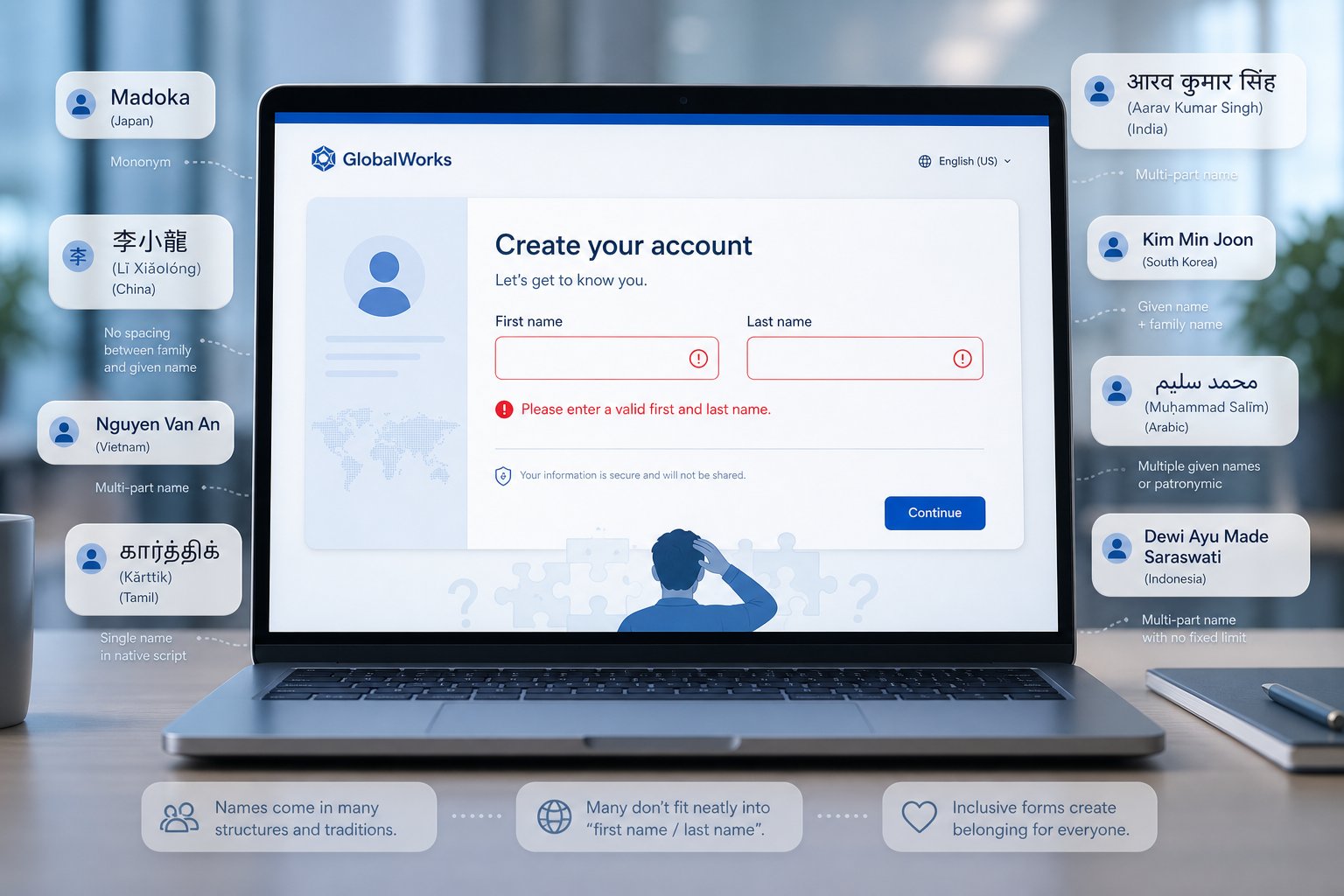
Every naming system covered so far carries its own internal logic. Chinese generational characters, Korean clan identifiers, Burmese day-of-week syllables: each makes perfect sense within its cultural context. The problems start when these systems collide with infrastructure built on a single assumption: that every human name consists of one given name, optionally one middle name, and one family name, in that order.
That assumption is baked into passport templates, airline reservation systems, hospital intake forms, HR platforms, and university enrollment databases worldwide. For the billions of people whose names do not fit this mold, the result is not just inconvenience. It is misidentification, denied boarding passes, lost medical records, and professional erasure.
Legal Documents and Database Challenges
Consider what happens when a Burmese citizen named Kyaw Zin Oo applies for an international flight. The booking system demands a "first name" and a "last name." Kyaw Zin Oo is a single personal name with no surname component. Does he enter "Kyaw" as the first name and "Oo" as the last? Or "Kyaw Zin" and "Oo"? Whatever he chooses, it must match his passport exactly, or he risks being denied boarding. And his passport itself may have handled the split differently from the airline's system, because there is no universal standard for how single-name individuals are processed across agencies.
The same friction hits Indonesian travelers with mononyms, South Indians whose "last name" is actually their father's given name, and Vietnamese passengers whose asian last name Nguyen appears on 40% of the flight manifest. When three passengers named "Nguyen Van Minh" check in for the same flight, the system has no reliable way to distinguish them beyond passport numbers.
Do asian people have middle names? The answer depends entirely on the culture. Vietnamese names include a true middle element that signals gender or generation. Filipino names use the mother's maiden surname in the middle position. Chinese and Korean names have no middle name at all, but Western forms routinely force a split that creates one. Japanese names lack any middle component in their traditional structure. The question itself reveals the Western bias embedded in the form design: it assumes a middle name is a universal category, when in reality it is a culturally specific one.
When software forces every name into a first-middle-last structure, it does not just create data errors. It creates bureaucratic harm: denied visas, mismatched medical records, and people who cannot prove they are themselves.
Library science professionals have documented these indexing challenges extensively. Cataloging systems like the Library of Congress Name Authority File must decide how to alphabetize names that do not follow Western surname conventions. Is "Aung San Suu Kyi" filed under A, S, or K? Different institutions answer differently, meaning the same person can be effectively invisible in one catalog while findable in another. Academic databases face identical problems when researchers publish under names that shift position depending on the publication's style guide.
Passport systems handle these edge cases with varying degrees of sophistication. Some countries repeat a mononym in both the given name and surname fields. Others leave one field blank, which then triggers errors in downstream systems that treat blank fields as incomplete records. The International Civil Aviation Organization (ICAO) provides guidelines for machine-readable travel documents, but implementation varies by country, and the fundamental two-field structure remains unchanged.
Professional Etiquette Across Business and Academia
Beyond documents, naming knowledge shapes everyday professional interactions. When you receive an email from "Park Jiyeon" and need to reply, what do you call her? If she is Korean and has presented her name surname-first, her given name is Jiyeon and the correct address is "Ms. Park." But if she has already reversed her name for Western convenience, "Park" might be in the given-name position and "Jiyeon" might be the surname she expects you to use. Without asking, you are guessing.
Business correspondence across Asia follows different rules depending on the culture:
- Chinese contexts: Use the surname plus a title (Director Li, Professor Wang). Using someone's given name without invitation signals inappropriate familiarity.
- Japanese contexts: Always use the surname plus "-san" (Tanaka-san) unless explicitly invited to use the given name. Even colleagues who have worked together for years may never switch to given-name address.
- Thai contexts: Use the given name or nickname, not the surname. Calling someone "Mr. Chaiyasombat" sounds stiff and overly formal in Thai professional culture.
- South Asian contexts: Varies enormously. "Mr. Singh" works for Sikh colleagues but tells you nothing about which Singh. North Indian colleagues typically expect surname-based address. South Indian colleagues may prefer their given name since their "surname" might be their father's name rather than a family identifier.
Academic citation creates its own minefield. Style guides like APA and Chicago assume that the last element of a name is the family name and should be used for alphabetization. This works for "Haruki Murakami" (alphabetize under M) but fails for "Aung San Suu Kyi" (no family name exists) or "Sarvepalli Gopal" (Sarvepalli is the family name, placed first). Researchers with Chinese names published in surname-first order get alphabetized correctly by accident, while those who reversed their name for Western journals end up filed under their given name.
Healthcare settings carry the highest stakes. Patient misidentification due to name confusion can lead to wrong medications, mixed-up test results, or procedures performed on the wrong person. Hospitals serving diverse Asian populations must contend with dozens of patients sharing the surname Kim, multiple unrelated Nguyens on the same ward, and South Asian patients whose name structure shifts between documents. Some healthcare systems have adopted additional identifiers like date of birth plus mother's name to disambiguate, but the underlying name fields remain a persistent source of near-miss errors.
How Diaspora Communities Adapt Their Names
Faced with systems that cannot accommodate their names, Asian diaspora communities have developed a range of adaptation strategies. None is universal, and each carries tradeoffs between convenience and cultural identity.
Adopting an English first name is the most common approach across East Asian diaspora communities. A person legally named "Zhang Wei" becomes "David Zhang" in professional contexts, with "David" appearing on business cards, email signatures, and LinkedIn profiles. This solves the immediate problem of pronunciation and name-order confusion, but it creates a split identity: one name for family and heritage contexts, another for the workplace. Some people choose their English name themselves; others are assigned one by teachers or employers who find their given name too difficult.
Hyphenation serves as a defensive strategy against form-field splitting. "Min-jun" signals to data entry systems that these two syllables belong together as one given name, not a first-plus-middle combination. Korean and Vietnamese diaspora communities use this approach frequently, though it introduces its own inconsistency since the same name might appear hyphenated in one document and unhyphenated in another.
Generational shifts represent the most permanent adaptation. Second- and third-generation diaspora families often give children names that work natively in both languages. A Korean-American child might be named "Juna" because it functions as both a Korean given name and an English one. Chinese-Australian parents might choose "Kai" for its dual legibility. These bridge names eliminate the friction entirely but represent a departure from traditional naming practices like generational characters or astrological selection.
Other strategies include placing the surname last regardless of native convention (making "Kim Jiyeon" into "Jiyeon Kim" permanently), using initials to compress problematic name elements, or legally changing one's name to a Western equivalent. Each choice reflects a personal negotiation between cultural preservation and practical survival in systems that were never designed to accommodate the full diversity of human naming.
The common thread across all these adaptations is that the burden falls entirely on the individual. The person with the non-conforming name must figure out how to make it fit, rather than the system expanding to accommodate the name as it actually exists. That asymmetry, where billions of people reshape their identities to match a form field designed for one cultural tradition, is the central practical failure that any serious comparison of naming systems must confront.
Understanding where each system breaks and why it breaks is useful. But the real value comes from putting all eight traditions side by side and extracting actionable guidance tailored to what you actually need to do with this knowledge.
Side-by-Side Comparison and Practical Recommendations for Asian Last Names
Eight naming systems. Eight different answers to the question of what a name should contain, how it should be ordered, and whether a surname even needs to exist. Seeing them individually is useful. Seeing them together reveals the patterns, the outliers, and the specific points where each system collides with global infrastructure.
Complete Comparison Table of Asian Naming Systems
This table consolidates the key structural features of every tradition covered in this guide. Use it as a quick reference when you encounter an unfamiliar name and need to determine which part is the surname, how many components to expect, and what mistake you are most likely to make.
| Naming System | Name Order | Typical Components | Surname Inherited? | Romanization System | Biggest Pitfall for Outsiders |
|---|---|---|---|---|---|
| Chinese | Surname + Given name | 2-3 characters (1 surname + 1-2 given) | Yes, patrilineal | Pinyin (mainland), Wade-Giles (Taiwan) | Splitting a two-character given name into first + middle |
| Korean | Surname + Given name | 3 syllables (1 surname + 2 given) | Yes, patrilineal with clan (bon-gwan) | Revised Romanization (official); personal preference varies widely | Assuming all Kims are related; inconsistent romanization across documents |
| Japanese | Surname + Given name (often reversed internationally) | 2-6 kanji (1-3 surname + 1-3 given) | Yes; married couples must share one surname | Hepburn romanization | Cannot determine pronunciation from kanji alone; name-order ambiguity in English |
| Vietnamese | Surname + Middle name + Given name | 3 parts (surname + middle + given) | Yes, patrilineal | Vietnamese alphabet (Latin-based with diacritics) | Addressing someone by surname (Nguyen) instead of given name |
| Thai | Given name + Surname | 2 (given + very long surname) | Yes, unique to each family | Royal Thai General System (inconsistently applied) | Using the surname in address; ignoring the nickname everyone actually uses |
| Filipino | Given + Middle (mother's maiden name) + Surname | 3 (given + maternal surname + paternal surname) | Yes, paternal surname | Standard Latin alphabet | Treating the middle name as a personal name when it is actually a maternal surname |
| Indonesian (Javanese) | Variable; often single name only | 1-3 (no fixed structure) | Often no surname exists | Standard Latin alphabet | Forcing a surname field when the person has only one name |
| Burmese | Single personal name (no fixed order) | 1-4 syllables as one unit | No inherited family name | Multiple systems; no single standard | Assuming any part of the name is a surname; expecting family members to share name elements |
| South Asian (Hindu, North India) | Given name + Surname | 2-3 (given + caste/clan surname) | Yes, patrilineal | Standard Latin transliteration (varies by language) | Misreading caste surnames as neutral family names; assuming uniform structure across regions |
| South Asian (Tamil/South India) | Father's name initial + Given name (or reversed) | 2-4 (initials + given name, sometimes caste title) | Patronymic, not fixed surname | Standard Latin transliteration | Treating the father's name as a family surname; splitting initials incorrectly |
| South Asian (Islamic/Pakistan) | Given name + Patronymic or clan name | 2-4 (variable) | Sometimes fixed, sometimes patronymic | Urdu transliteration (no single standard) | Assuming "Mohammad" is a throwaway prefix; confusing tribal names with family surnames |
| Sikh | Given name + Singh/Kaur | 2-3 (given + Singh/Kaur, optionally clan name) | Singh/Kaur is shared; clan name may or may not be used | Punjabi transliteration | Treating Singh as a unique family identifier when millions share it |
A few patterns jump out immediately. East Asian systems (Chinese, Korean, Japanese, Vietnamese) all place the surname first and use compact structures. Southeast Asian systems outside Vietnam diverge sharply, with Thai and Filipino names following given-name-first order and Indonesian and Burmese names challenging the concept of a surname entirely. South Asian systems are the most internally diverse, with no single structural rule applying across the entire region.
The "biggest pitfall" column is where this comparison earns its practical value. Each system breaks Western assumptions in a different way. Knowing which specific mistake to avoid for each tradition is more useful than memorizing every structural detail.
Recommendations Based on Your Use Case
Different readers need different things from this information. Here are ranked practical tips segmented by what you are actually trying to do.
For business professionals working with Asian colleagues:
- Ask how someone prefers to be addressed rather than guessing from their email signature. A name presented as "Wei Zhang" might be surname-first (Chinese convention) or given-name-first (adapted for Western readers). Only the person can tell you which.
- In East Asian contexts (Chinese, Japanese, Korean), default to surname plus title (Director Kim, Tanaka-san, Professor Li) until invited to use the given name. In Thai contexts, use the given name or nickname from the start.
- Never shorten or abbreviate someone's name without permission. Turning "Siriporn" into "Siri" or "Venkataraman" into "Venkat" may feel friendly to you but can feel dismissive to the person.
- When scheduling meetings across cultures, confirm the full legal name for any booking systems separately from the preferred address name. These are often different, and mixing them up causes downstream problems.
For writers and journalists:
- Verify name order before publication. If a source presents their name surname-first, respect that order unless your style guide explicitly requires reversal. Note the convention on first reference (e.g., "Yoon Suk-yeol (surname Yoon)").
- Do not assume the last word in an Asian name is the surname. For Chinese, Korean, Japanese, and Vietnamese names, the surname is typically first. For Thai and Filipino names, it is last. For Burmese and some Indonesian names, there is no surname at all.
- When alphabetizing asian last names in bibliographies or indexes, confirm which element is the family name. File "Aung San Suu Kyi" under the full name rather than arbitrarily choosing one syllable. Consult the person or their publisher when possible.
- Include pronunciation guidance for unfamiliar names, especially Japanese names where kanji readings are ambiguous. If you cannot confirm pronunciation directly, note the uncertainty rather than guessing.
For software developers building forms and databases:
- Offer a single "full name" field as the primary input whenever possible. If you must split names into components, make the surname/given name split optional and allow users to indicate which is which. UX research on inclusive name fields confirms that designing around a specific purpose, rather than forcing a universal structure, produces better outcomes.
- Never set minimum character limits on name fields. Single-character surnames (like "O" in Korean) and single-word names (common in Indonesia and Myanmar) are valid. Rejecting them with "please enter a valid name" is both exclusionary and factually wrong.
- Support the full Unicode character set, including diacritics (Vietnamese), CJK characters, and non-Latin scripts. Input validation should protect against injection attacks without rejecting legitimate name characters like umlauts, tildes, or apostrophes.
- Add a "preferred name" or "display name" field separate from the legal name. This accommodates diaspora communities who use an English name professionally, people whose legal name changed after marriage, and anyone whose daily-use name differs from their passport.
- Never assume that family members share a surname. Burmese families share no name elements. Married Japanese women may use a different surname than their children's school records show. South Indian patronymics change every generation.
For travelers:
- Ensure your name on flight bookings matches your passport exactly, character for character. If your passport splits your name in an unusual way (common for mononymous Indonesians or Burmese travelers), replicate that exact split in every booking.
- Learn the basic address conventions for your destination. Using a surname in Thailand sounds oddly formal. Using a given name in Japan sounds presumptuous. A two-minute lookup prevents awkward interactions.
- Carry documentation that clarifies your name structure if it does not fit standard forms. Some countries issue supplementary letters explaining mononymous names or non-standard name orders for immigration purposes.
These recommendations share a common principle: when in doubt, ask. No amount of cultural knowledge replaces the simple act of confirming how a specific person wants their name handled. Systems should be flexible enough to accommodate the answer, whatever it is.
Modern trends reshaping these traditions
Naming conventions are not static. Several forces are actively reshaping how names work across Asia. The global popularity of K-pop has made Korean names familiar to millions of non-Korean fans, normalizing surname-first presentation and reducing the pressure on Korean artists to adopt English stage names. Anime and Japanese media have done something similar for Japanese names, with younger Western audiences increasingly comfortable with surname-first order because they encountered it first through fictional characters.
Gender-neutral naming is gaining ground in several traditions. Japanese parents are choosing given names that work for any gender, moving away from clearly gendered kanji. Korean parents are dropping the gendered conventions that once made it easy to identify a name as male or female. In Vietnam, the gendered middle names (Thi for women, Van for men) are becoming less universal among younger generations.
Globalization is also compressing naming diversity in some contexts. International-friendly names, short, pronounceable across languages, easy to spell in Latin characters, are increasingly popular among urban parents across Asia. A name like "Mina" works in Japanese, Korean, and English simultaneously. "Kai" reads naturally in Chinese, Japanese, Hawaiian, and several European languages. These cross-cultural bridge names represent a pragmatic response to a world where your name will appear on international platforms before you finish primary school.
At the same time, counter-movements push back against homogenization. Families reclaim traditional naming practices, generational characters, astrological selection, clan identifiers, as acts of cultural preservation. The tension between global legibility and cultural specificity is not resolving in one direction. It is producing a richer, more varied naming landscape than any previous generation has navigated.
Understanding these systems is not about memorizing rules. It is about building the cross-cultural competence to recognize when a name does not fit your assumptions, and responding with curiosity rather than confusion. The eight traditions in this comparison represent billions of people whose names carry meaning, history, and identity that a two-field form was never designed to hold. The least we can do is learn what those names are actually telling us.
Frequently Asked Questions About Asian Naming Conventions
1. Do Asian people have middle names?
It depends entirely on the culture. Vietnamese names include a middle element that often signals gender or generation (Thi for women, Van for men). Filipino names place the mother's maiden surname in the middle position. However, Chinese, Korean, and Japanese names have no Western-style middle name at all. A two-character Chinese given name like 'Mingzhe' is a single unit, not a first-plus-middle split, though Western forms frequently force this incorrect separation.
2. Why do so many Asian people share the same last name?
The reasons vary by culture. In China, a surname pool of roughly 100 names covers 85% of the population due to thousands of years of clan consolidation. In Korea, just five surnames (Kim, Lee, Park, Jeong, Choi) cover over half the population, distinguished only by an invisible clan system called bon-gwan. In Vietnam, the surname Nguyen dominates at 30-40% because families historically adopted the ruling dynasty's name to show loyalty, and the last dynasty was the Nguyen Dynasty (1802-1945).
3. What is the correct way to address someone with an Asian name in a professional setting?
The rules differ significantly across cultures. In Chinese and Japanese contexts, use the surname plus a title (Professor Wang, Tanaka-san) and never switch to the given name unless invited. In Thai culture, use the given name or nickname from the start, as surnames sound overly formal. In Korean settings, surname plus title is standard. For South Asian colleagues, conventions vary by region. The safest universal approach is to ask how someone prefers to be addressed rather than guessing from their email signature.
4. How should software forms handle Asian names that don't fit first-name/last-name fields?
Best practice is to offer a single full name field as the primary input. If splitting is necessary, make the surname/given name division optional and let users indicate which is which. Never set minimum character limits, since single-character surnames and mononymous names are valid. Support full Unicode including diacritics and CJK characters. Add a separate preferred name or display name field to accommodate diaspora communities and those whose daily-use name differs from their legal name.
5. Which Asian naming systems place the surname first and which place it last?
East Asian systems (Chinese, Korean, Japanese, Vietnamese) all traditionally place the surname before the given name. Thai and Filipino names follow the Western given-name-first order. Indonesian and Burmese names often have no surname at all, making the question of order irrelevant. South Asian names vary by region: North Indian names typically place the given name first and surname last, while many South Indian names place the father's name or village name before the given name.