How Malaysian Chinese Names Are Structured
When you see a name like Tan Wei Ling or Lee Shin Cheng, can you tell which part is the surname and which is the given name? If you hesitate, you're not alone. The Malaysian Chinese names format follows a specific structure that trips up international readers, HR professionals, and database administrators on a daily basis. Understanding how these names work removes the guesswork entirely.
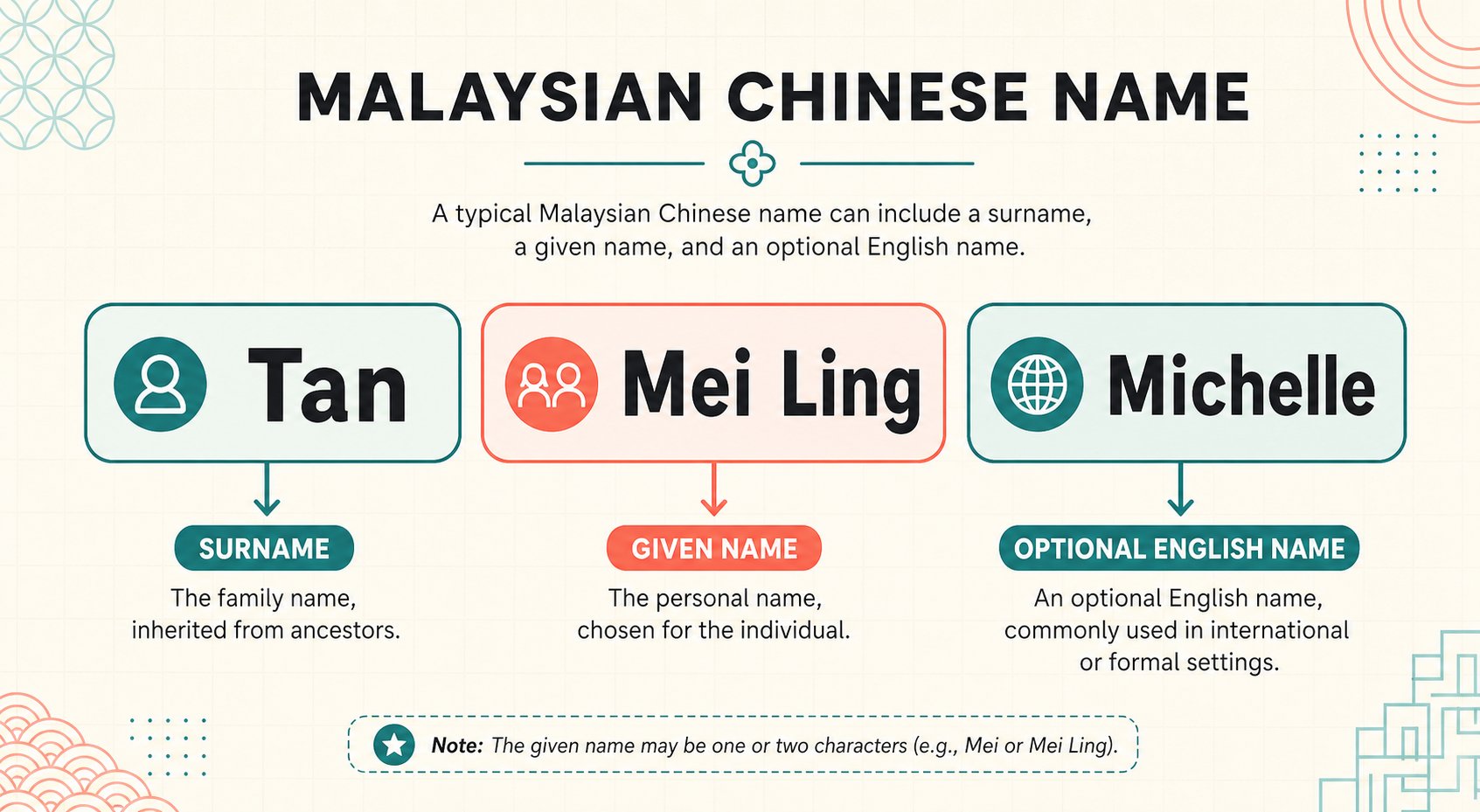
Malaysian names follow a consistent pattern: [Family name] [Given name]. The family name (surname) comes first and is typically a single syllable, such as Tan, Lim, Wong, or Lee. The given name follows and usually consists of two syllables or Chinese characters, though single-syllable given names also exist. Unlike Malay names, which use patronymics like bin (son of) or binti (daughter of), Malaysian Chinese names carry a hereditary surname passed down through paternal lineage and shared among siblings.
What Makes Malaysian Chinese Names Unique
The defining feature of this naming system is dialect-based romanization. When Chinese immigrants settled in Malaysia during the British colonial era, their names were transcribed into the Roman alphabet based on how they actually pronounced them in their native dialects, whether Hokkien, Cantonese, Hakka, or Teochew. This means the same Chinese character can look completely different on paper depending on the family's dialect background. The surname character 陈, for instance, appears as "Tan" in Hokkien but "Chan" in Cantonese and "Chen" in Mandarin Pinyin. This single difference makes a Malaysian name visually distinct from a mainland Chinese or Taiwanese name at a glance.
Malaysian Chinese names use dialect romanization rather than Hanyu Pinyin, making them visually distinct from other Chinese naming systems and impossible to decode using standard Mandarin pronunciation rules alone.
Why This Format Confuses International Readers
The confusion typically falls into a few predictable patterns. Imagine receiving an email from someone named Goh Mei Ling. International readers often assume "Goh" is a given name and "Ling" is the surname, reversing the entire structure. Others split two-character given names incorrectly, treating "Mei" as a middle name and "Ling" as a last name. Hyphenated variations like Mei-Ling or combined forms like Meiling add another layer of uncertainty.
These misidentification problems have real consequences. Names of Malaysia's Chinese community get mangled in airline bookings, academic citations, and corporate directories. A person's surname ends up in the "first name" field, their given name gets split across two separate fields, or their identity is fragmented across multiple systems that each format the same Malaysian name differently.
The good news: once you understand the underlying logic, you can decode any Malaysian Chinese name you encounter. The structure is consistent, the surname pool is relatively small and recognizable, and the formatting conventions follow clear rules. The sections ahead break down each component so you can identify surnames, given names, and English names with confidence, regardless of which dialect romanization you're looking at.
Breaking Down the Three Name Components
Every Malaysian Chinese name is built from up to three distinct parts, each serving a different function. Recognizing these components is the key to reading any name correctly, whether you encounter it on a business card, a university roster, or an immigration form. Let's look at each one.
Surname Comes First in Official Format
The surname, or family name, always occupies the first position. It is typically a single syllable: Tan, Lim, Wong, Lee, Ng, Ong, Goh, or Yap. This is the hereditary element passed from father to children, and it identifies which family or clan a person belongs to. On all official Malaysian documents, the surname appears first without exception.
Here's where people unfamiliar with the last name in Malaysia's Chinese community get confused. Unlike Malay naming conventions, Malaysian Chinese names carry no patronymic marker. In Malay names, bin means "son of" and binti means "daughter of," connecting a person's given name to their father's name. The binti meaning is straightforward: it signals a father-daughter relationship, not a shared family surname. The same applies to binte, an alternate spelling with the same meaning as binti. Malaysian Chinese names skip this entirely. There is no "son of" or "daughter of" indicator. The surname in Malay communities functions differently from the Chinese surname, which is a true hereditary family name shared across generations.
Two-syllable Chinese surnames do exist but are uncommon. Names like Situ or Ouyang occasionally appear, though the vast majority of Malaysian Chinese carry single-syllable surnames drawn from a relatively small pool of common family names.
Given Names With One or Two Characters
The given name follows the surname and reflects the number of Chinese characters parents chose at birth. A two-character given name produces two syllables in romanized form, such as Wei Ling, Mei Fong, or Kok Wai. A single-character given name results in just one syllable, like Jun, Hao, or Yi.
Two-character given names are far more common. You'll notice them written in several ways: as two separate words (Wei Ling), hyphenated (Wei-Ling), or merged into one word (Weiling). All three represent the same name. The variation comes down to personal preference or how the name was originally registered, not any difference in meaning or structure.
The Role of English or Christian Names
Some Malaysian Chinese adopt an English or Christian name that sits before the surname in the full name sequence. According to the Malaysian High Commission, if a Chinese Malaysian has taken a Western name or is a Christian, they may add that name before their family name. So Emily Tan Mei Ling places the English name first, followed by the standard surname-plus-given-name structure. She might choose to be known professionally as Ms Emily Tan.
Not everyone has an English name. It is entirely optional and used primarily in informal, social, or international professional settings. Some people adopt one later in life for workplace convenience, while others never use one at all.
| Full Name | Surname | Given Name | English Name |
|---|---|---|---|
| Tan Mei Ling | Tan | Mei Ling | None |
| Emily Tan Mei Ling | Tan | Mei Ling | Emily |
| Lim Jun | Lim | Jun | None |
| David Wong Kok Wai | Wong | Kok Wai | David |
| Lee Wei-Ling | Lee | Wei-Ling | None |
| Michelle Ng Siew Hoon | Ng | Siew Hoon | Michelle |
This three-part structure stays consistent regardless of dialect background or generation. The surname anchors the name, the given name personalizes it, and the optional English name adapts it for international contexts. But the romanized spelling of each component, particularly the surname, varies dramatically depending on which Chinese dialect the family speaks. That variation is where the real complexity begins.
Dialect Romanization and Surname Variations
Why does the surname character 陈 appear as "Tan" on one Malaysian passport and "Chan" on another, when both belong to people from the same ethnic group? The answer lies in dialect romanization, the single most important factor shaping how to spell Malay-Chinese names in their romanized form. This system is not random. It reflects a specific historical process that locked dialect pronunciations into official records over a century ago.
Why Dialect Romanization Instead of Pinyin
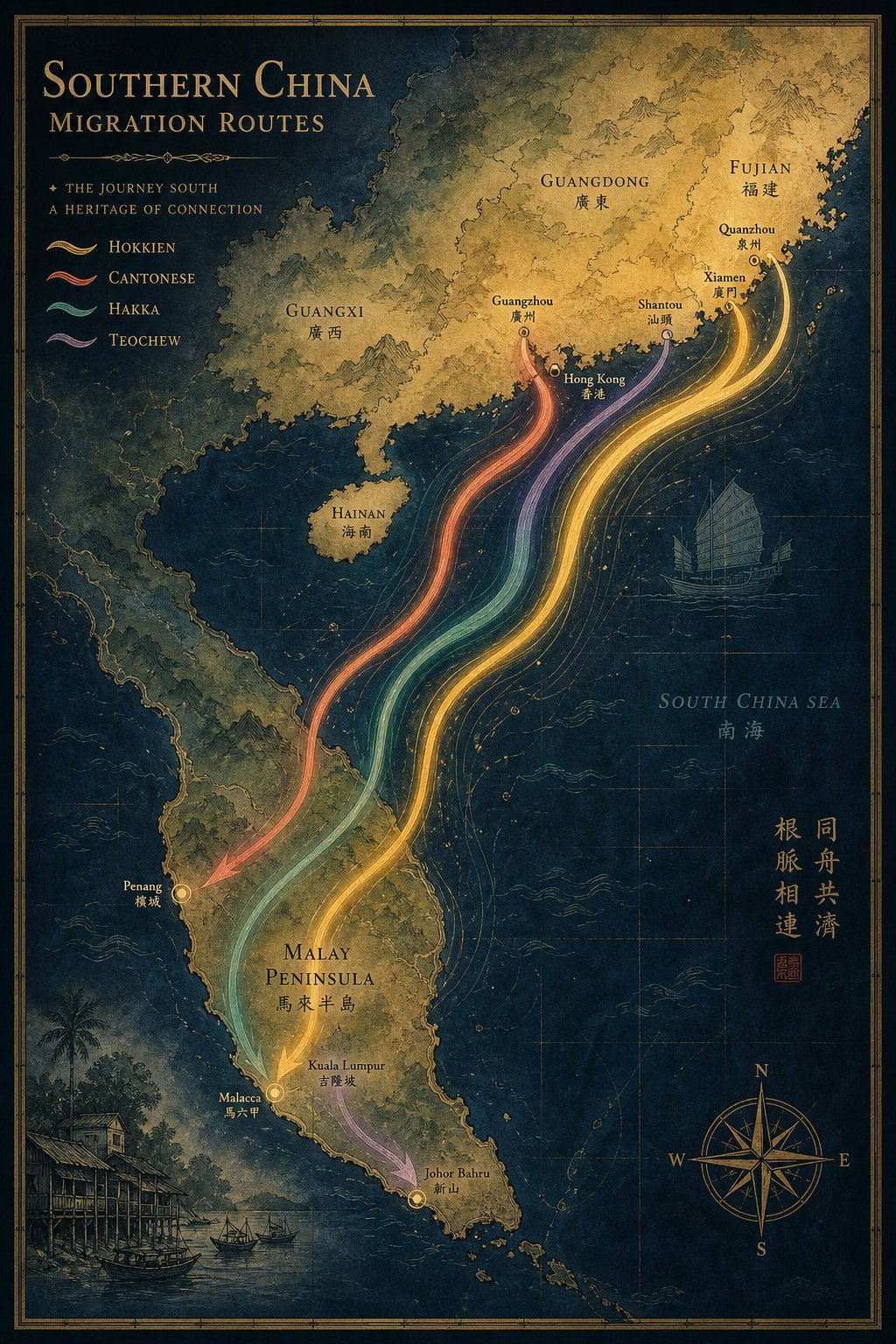
Chinese immigration to the Malay Peninsula peaked during the 19th and early 20th centuries under British colonial rule. These immigrants came from distinct dialect groups, primarily Hokkien, Cantonese, Hakka, and Teochew speakers from southern China's coastal provinces. When colonial administrators registered their names, they transcribed what they heard. A Hokkien speaker pronouncing 黄 as "Wee" or "Ng" had that pronunciation recorded in Roman letters. A Cantonese speaker pronouncing the same character as "Wong" received a completely different spelling on paper.
As the South China Morning Post explains, the naming convention for people of Chinese descent in Singapore and Malaysia follows a distinct pattern: names are romanized based on the pronunciation in a person's ancestral dialect. A person whose ancestors originated from Fujian province would have their name spelled as an approximation of the Hokkien pronunciation, while a family from Guangdong would use Cantonese romanization.
Here's the critical timeline that explains everything. Hanyu Pinyin, the standardized romanization system used in mainland China today, was not officially adopted until 1958 by the People's Republic of China. By that point, Malaysian Chinese communities had already been registering names in dialect romanization for generations. Malaysia's National Registration Department (Jabatan Pendaftaran Negara, or JPN) continued this established practice after independence in 1957. Parents chose the romanized spelling of their child's name at birth, typically reflecting their spoken dialect, and that spelling became the permanent legal record.
This means there was never a moment when Malaysian Chinese switched to Pinyin. The dialect-based system was already entrenched in identity cards, land titles, business registrations, and family records. Unlike mainland China, where Pinyin became the universal standard for official romanization, Malaysia preserved the older, dialect-specific approach. The result is a naming landscape where the same malay family name character can produce half a dozen different English spellings depending on which dialect community the family belongs to.
How the Same Surname Looks Across Dialects
This is where things get practical. If you encounter malay surnames that look unfamiliar, chances are you're simply seeing a dialect variant of a common Chinese character. The table below maps the most frequently encountered Malaysian Chinese surnames across their major dialect romanizations. You'll notice that a single character can produce strikingly different spellings.
| Chinese Character | Hokkien | Cantonese | Hakka | Teochew | Mandarin Pinyin |
|---|---|---|---|---|---|
| 陈 | Tan | Chan | Chin | Tan | Chen |
| 林 | Lim | Lam | Lim | Lim | Lin |
| 黄 | Ng / Wee | Wong | Vong | Ng | Huang |
| 李 | Lee | Lei | Li | Lee | Li |
| 王 | Ong / Heng | Wong | Vong | Heng | Wang |
| 吴 | Goh | Ng | Ng | Goh | Wu |
| 张 | Teo / Tiong | Cheung | Chong | Teo | Zhang |
| 刘 | Lau | Lau | Lew | Lau | Liu |
| 杨 | Yeo / Yeoh | Yeung | Yong | Yeo | Yang |
| 蔡 | Chua | Choi | Chai | Chua | Cai |
| 郭 | Kuek / Kwek | Kwok | Kok | Kuek | Guo |
| 谢 | Chia / Cheah | Tse | Chia | Chia | Xie |
Look at the character 黄 as an example. In Hokkien, it becomes "Ng" or "Wee." In Cantonese, it becomes "Wong." In Mandarin Pinyin, it is "Huang." Someone unfamiliar with this system would never guess that Ng, Wong, and Huang all represent the same Chinese character and the same family lineage. Yet in Malaysia, all three spellings coexist because different dialect communities settled in different regions and registered their names accordingly.
The character 吴 presents another common source of confusion. Hokkien speakers romanize it as "Goh," while Cantonese speakers write "Ng." This means "Ng" can represent either 黄 (Hokkien) or 吴 (Cantonese), two completely different surnames sharing the same romanized spelling from different dialects. Context, specifically knowing the person's dialect background, is sometimes the only way to distinguish them.
This dialect diversity is precisely what makes the Malaysian Chinese naming system both rich and challenging. It preserves linguistic heritage that has largely disappeared in mainland China, where Pinyin flattened all regional pronunciations into a single standard. In Malaysia, a person's surname spelling still tells you something about their ancestral roots, their family's dialect group, and the region of southern China their forebears left generations ago.
Understanding dialect romanization solves the spelling puzzle, but it introduces a different practical question: how do these names actually appear on official documents? The answer varies depending on which document you're looking at, and the inconsistencies between them create real-world headaches for Malaysian Chinese navigating bureaucratic systems at home and abroad.
Names on Official Malaysian Documents
A Malaysia name doesn't look the same across every official document. The same person can have their name displayed as a single unbroken string on one card and neatly split into surname and given name fields on another. These formatting differences aren't errors. They reflect different administrative systems with different design requirements, and they create a layer of confusion that affects everything from bank account applications to international travel.
Names on MyKad and Identity Cards
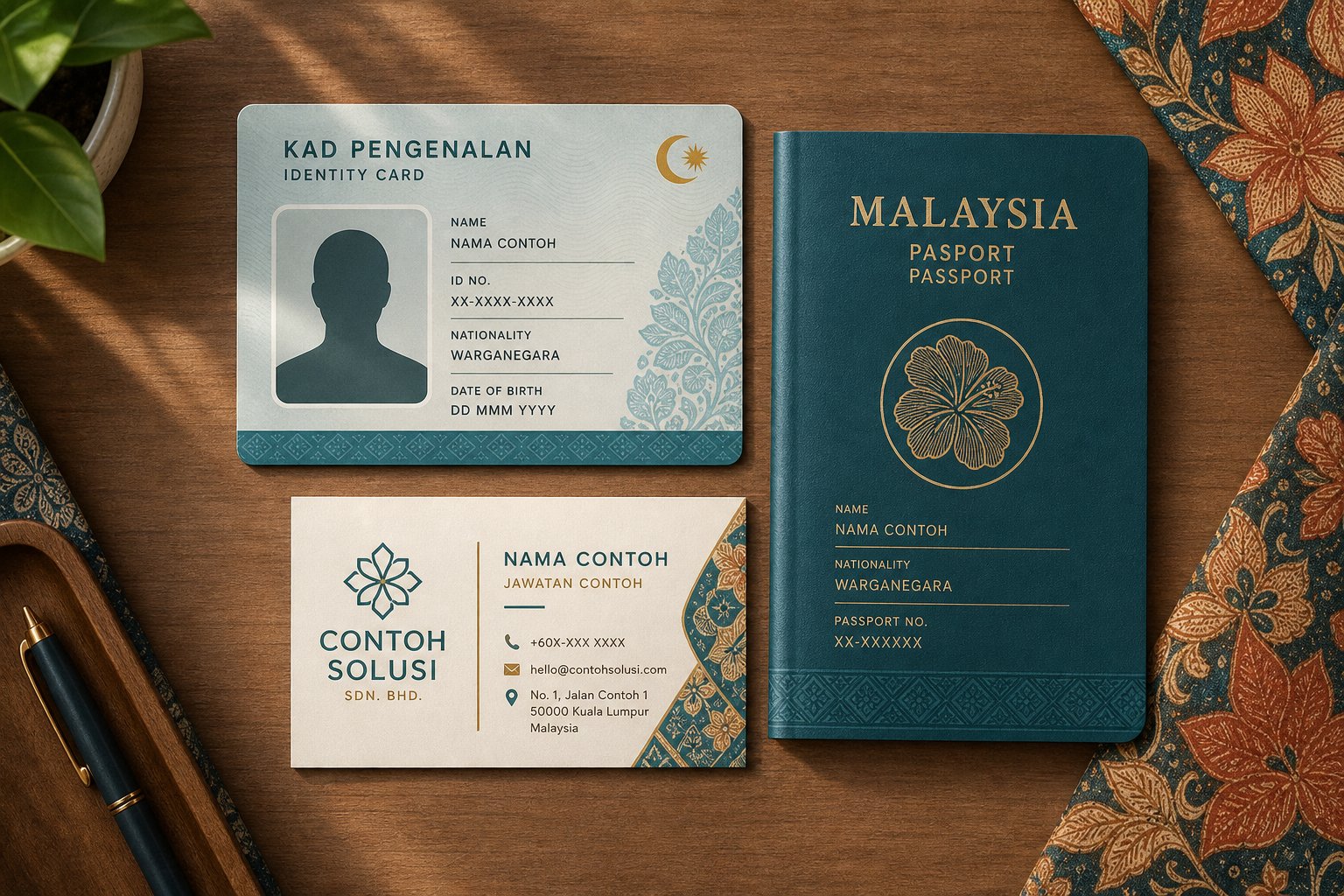
The MyKad, Malaysia's compulsory national identity card issued to citizens at age 12, displays the holder's full name as a single continuous string in capital letters. There are no commas, no hyphens, and no field separating the surname from the given name. A person named Tan Mei Ling appears on the MyKad simply as TAN MEI LING, with no visual indicator telling you where the family name ends and the personal name begins.
This matters more than it might seem. The IC treats the entire name as one unit. It does not label any portion as "surname" or "given name." For someone already familiar with Malaysian Chinese naming conventions, picking out the surname is straightforward. For an international system or a foreign administrator processing the card, there is no built-in guidance. The name is just a block of text.
You'll also notice that the MyKad strips out any hyphens or punctuation that a person might use informally. Someone who writes their name as Wei-Ling in daily life will see WEILING or WEI LING on their IC, depending on how it was originally registered. English or Christian names, if included in the legal registration, appear as part of the same unbroken string. EMILY TAN MEI LING reads identically to any other sequence of words on the card, with no formatting to distinguish the English name from the Chinese name components.
Passport Format Differences
Malaysian passports follow International Civil Aviation Organization (ICAO) standards, which require two separate name fields: one for the surname and one for given names. This is where things get tricky for Malaysian Chinese holders. The passport forces a split that the MyKad never makes.
When applying for a passport, the holder must designate which part of their name is the surname and which part constitutes the given name. For most Malaysia names in the Chinese community, this means placing the first word (the family name) in the surname field and everything else in the given name field. Tan Mei Ling becomes Surname: TAN, Given Names: MEI LING.
Sounds simple enough, but inconsistencies creep in. Some people register their English name in the given name field alongside their Chinese given name, producing entries like Surname: TAN, Given Names: EMILY MEI LING. Others leave the English name out of the passport entirely. And because the MyKad provides no surname/given-name distinction to reference, different family members sometimes split their names differently when applying for passports at different times. One sibling might place the full two-character given name in a single field, while another inadvertently splits it across fields.
The machine-readable zone (MRZ) at the bottom of the passport compounds this further. It uses angle brackets to separate surname from given names, and any spaces within the given name are replaced with filler characters. The result can look unfamiliar even to the passport holder themselves.
Birth Certificate Registration Rules
The birth certificate is where a Malaysia name officially begins. Under the Births and Deaths Registration Act 1957 (Act 299), every birth must be registered with Malaysia's National Registration Department (Jabatan Pendaftaran Negara, or JPN). Parents choose the romanized spelling of their child's name at the point of registration, and that spelling becomes the legal version for life.
This is a critical detail. JPN does not impose a standardized romanization system on Chinese names. Parents decide whether to spell the surname as Tan, Chan, or Chen. They decide whether the given name is written as two words, hyphenated, or merged. Whatever they register is what appears on the birth certificate and subsequently carries through to the MyKad and passport. The JPN does review names under Section 16 of Act 299, which gives the Registrar General authority to reject names deemed offensive or unsuitable, but the romanization choice itself is left to the family.
One important limitation: once registered, the birth certificate is extremely difficult to change. If a child is under one year old, corrections can be made directly in the Birth Register. After that window closes, name changes can only be applied for during a MyKad application or after receiving a MyKad, and the new name will only appear on the MyKad itself. The birth certificate remains unchanged under Act 299. This means any romanization decision made at birth, whether it perfectly reflects the family's dialect or contains a clerical approximation, tends to persist permanently in the official record.
- MyKad (Identity Card): Full name displayed as a single field in capital letters, no surname/given-name separation, no hyphens or punctuation
- Passport: Name split into separate surname and given name fields per ICAO standards, requiring the holder to designate which portion is which
- Birth Certificate: Name recorded exactly as registered by parents, romanization chosen by the family, serves as the foundational legal spelling for all subsequent documents
These formatting gaps between documents mean that a single person's name can look subtly different depending on which official record you're referencing. The MyKad gives you no structural clues. The passport imposes a Western-style split that may not match how the person actually uses their name. And the birth certificate locks in a spelling that may or may not align with modern conventions. For Malaysia names entering international systems, airline databases, or foreign government records, these inconsistencies multiply into real practical problems.
Navigating International Systems and Misformatting
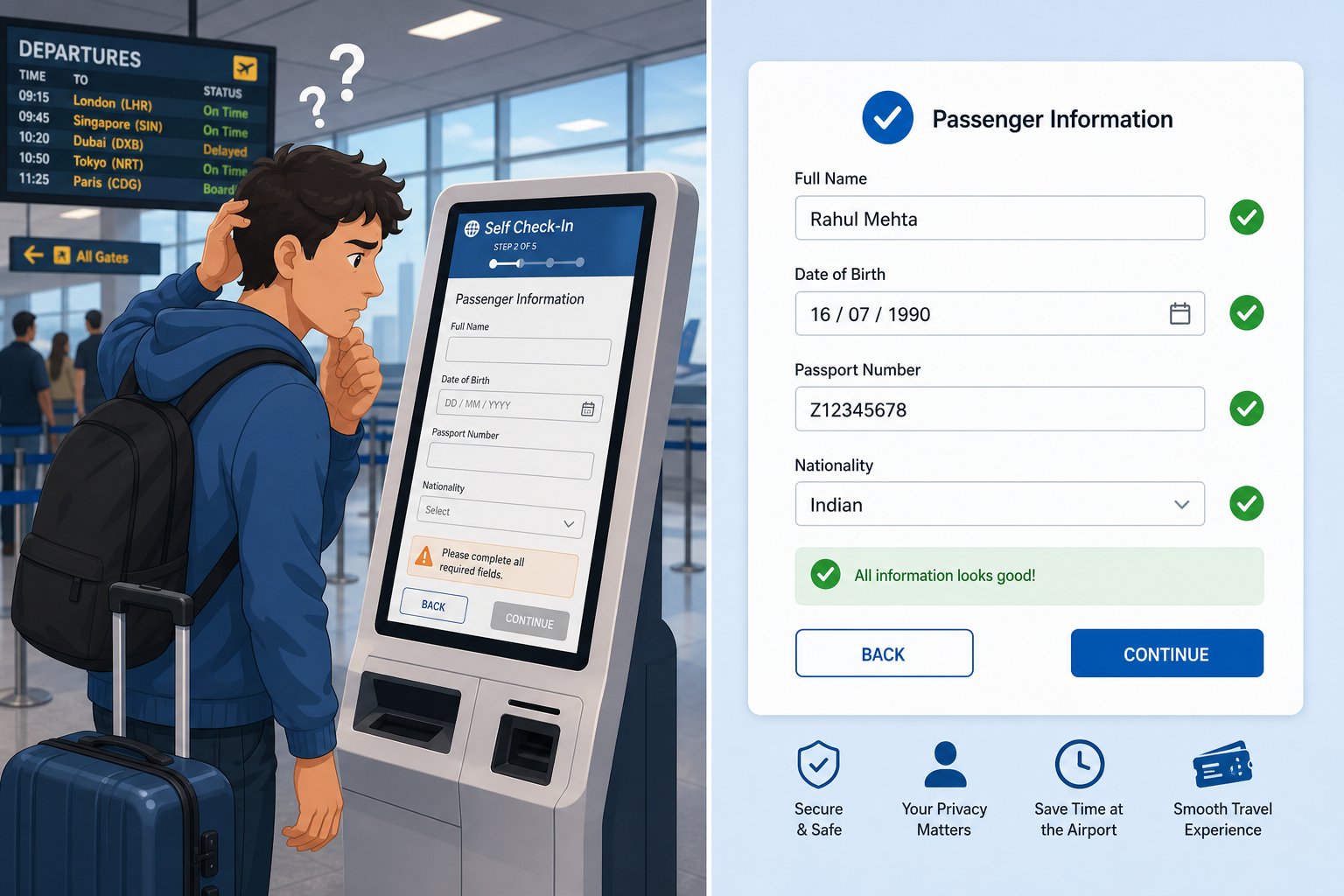
Those document-level inconsistencies don't stay contained within Malaysia. The moment a Malaysian Chinese name crosses a border, whether digitally or physically, it enters systems designed around Western naming assumptions: one first name, one last name, maybe a middle name. That two-field or three-field structure simply doesn't map cleanly onto a name like Tan Mei Ling or David Wong Kok Wai. The result is a cascade of formatting errors that follow people through airports, universities, and professional networks.
Airline Bookings and Travel Documents
Imagine booking a flight. The form asks for a "First Name" and a "Last Name." For someone whose MyKad reads TAN MEI LING with no surname indicator, which part goes where? Many travelers guess differently each time, and that inconsistency triggers problems at check-in when the booking doesn't match the passport's surname/given-name split.
Malaysia Airlines and AirAsia have updated their name entry rules specifically to address these long-standing check-in issues. Both airlines now use a clear "Given Name" and "Family Name/Surname" format to accommodate Malaysian, Chinese, Indian, Filipino, Thai, and Vietnamese naming conventions. AirAsia also advises passengers to replace hyphens with spaces when booking, since their system does not accept special characters. Despite these improvements, the burden still falls on travelers to ensure their booking matches their passport exactly, and many only discover a mismatch at the departure gate.
The core problem remains structural. Because the MyKad provides no surname field, people entering their details into airline systems have no single authoritative reference telling them how to split their name. One trip, they enter "Mei Ling" as the first name and "Tan" as the last name malay-style (surname last). The next trip, they correctly place "Tan" in the surname field. Two bookings, same person, different formatting, potential denial at boarding.
University Records and Academic Citations
Academic systems create a different kind of headache. When a Malaysian Chinese student enrolls at a foreign university, the registration form typically asks for first name, middle name, and last name. A name like Goh Wei Ling gets fragmented: "Goh" lands in the first name field, "Wei" becomes a middle name, and "Ling" is treated as the malay last name. The actual surname disappears into the wrong slot entirely.
This misformatting carries into academic publishing. Journal citations, conference proceedings, and library databases all rely on the surname to index and retrieve an author's work. NIE Library's citation guidelines explicitly note that for Chinese names, the convention is surname first, and authors should not invert the order when citing in APA style. Yet many international journals and databases automatically flip the name into Western order, scattering a researcher's publications across multiple entries. One paper appears under "Goh, W. L.," another under "Ling, G. W.," and a third under "Wei Ling, Goh." The same scholar becomes three different people in the system.
Professional Databases and Business Cards
In Malaysian business culture, cards typically follow the Chinese convention: surname first, given name second, with any English name printed above or beside the Chinese name. A card might read "David Wong Kok Wai" with the Chinese characters alongside. Locally, everyone understands that Wong is the surname.
International contexts flip this expectation. LinkedIn profiles, corporate directories, and CRM systems all default to Western order. Malaysian Chinese professionals often adapt by placing their surname in the "Last Name" field and their given name (plus optional English name) in the "First Name" field. But not everyone does this consistently. Some enter their full name as a single string. Others treat their English name as the first name and their entire Chinese name as the last name. The result is that malay last names get buried, duplicated, or misidentified across every professional platform that assumes a Western structure.
For anyone processing or entering Malaysian Chinese names into international systems, here's a reliable method:
- Identify the surname. It is almost always the first word in the full name. Common examples include Tan, Lim, Wong, Lee, Ng, Ong, Goh, and Yap. Place this in the "Last Name" or "Surname" field.
- Determine the given name. Everything after the surname (excluding any obvious English/Christian name) is the given name. If there are two syllables like "Mei Ling," keep them together in the "First Name" or "Given Name" field. Do not split them into first and middle names.
- Handle English names correctly. If the name begins with a Western name (e.g., "Emily Tan Mei Ling"), recognize it as an informal addition. Place the Chinese given name in the given name field and note the English name separately if the system allows it.
- Preserve spacing and avoid adding punctuation. If the original name has no hyphen, don't insert one. If it does, retain it. Match the person's passport or official document spelling exactly.
- When in doubt, ask. A quick confirmation of "Which part is your family name?" is far better than guessing and creating a record that follows the person through every linked system for years.
These formatting challenges aren't unique to Malaysia. Any naming system that places the surname first will collide with Western-default databases. But the dialect romanization layer adds an extra dimension of difficulty, because international readers often can't even recognize common Malaysian Chinese surnames as surnames. That recognition gap becomes even more apparent when you compare how the same Chinese name behaves across different countries and administrative systems.
How Malaysian Chinese Names Differ From Other Regions
Take the Chinese character combination 陈美玲. A person bearing this name in Beijing would be romanized as Chen Meiling. In Taipei, older records might show Ch'en Mei-ling using Wade-Giles. In Hong Kong, it becomes Chan Mei-ling. In Malaysia, it could appear as Tan Mei Ling. Same characters, same meaning, four visually distinct names. If you treat all Chinese names as interchangeable, you'll misidentify people across every one of these systems.
Malaysia Versus Mainland China and Taiwan
Mainland China adopted Hanyu Pinyin in 1958 as its sole official romanization standard. Every Chinese citizen's name on a passport or international document follows Pinyin rules, producing consistent and predictable spellings. The surname 黄 is always Huang. The surname 陈 is always Chen. There's no variation based on regional dialect because the system deliberately flattens those differences into a single Mandarin-based standard.
Taiwan historically used Wade-Giles romanization, which produces spellings like Huang (黄) and Ch'en (陈) with apostrophes marking aspirated consonants. More recently, Taiwan has shifted toward Hanyu Pinyin for passport names, though older generations and some municipalities still use Wade-Giles or alternative systems like Tongyong Pinyin. Either way, the romanization reflects Mandarin pronunciation, not regional dialects.
Malaysian Chinese names, by contrast, preserve dialect-level pronunciation in their spelling. As the South China Morning Post notes, names of Chinese descent in Malaysia are romanized based on the pronunciation in a person's ancestral dialect, whether Hokkien, Cantonese, Hakka, or Teochew. This is why a malay name like Tan bears no visual resemblance to its Pinyin equivalent Chen, even though both represent the exact same character 陈. A reader trained to recognize Pinyin spellings will not instinctively connect Tan, Chan, and Chen as variants of one surname.
Malaysia Versus Hong Kong and Singapore
Hong Kong shares one key trait with Malaysia: it also uses dialect-based romanization rather than Pinyin. Since Hong Kong's Chinese population is overwhelmingly Cantonese-speaking, names there consistently reflect Cantonese pronunciation. The surname 黄 is Wong, 陈 is Chan, and 张 is Cheung. However, Hong Kong follows its own administrative conventions. Names on Hong Kong identity cards typically place the surname first in a single field (similar to Malaysia's MyKad), but Hong Kong passports have long used the surname/given-name split under British and later HKSAR standards. Hyphenation of given names is also more consistently applied in Hong Kong, where two-character given names almost always appear hyphenated (e.g., Mei-ling rather than Mei Ling).
Singapore presents the closest parallel to Malaysia. Both countries share the same dialect heritage, the same historical immigration patterns from southern China, and the same colonial-era registration practices. A Hokkien name in malay communities looks nearly identical to a Hokkien name in Singapore. The surname 黄 appears as Ng or Wee in both countries. The key differences are subtle: Singapore has seen a stronger shift toward Pinyin among younger generations, and hyphenation practices vary slightly between the two nations. Singapore also introduced the option of registering names in Hanyu Pinyin starting in the 1980s, giving families a choice that Malaysian registration has not formally standardized in the same way.
The table below shows how the same person's name (陈美玲, female) would typically appear across five regions. Notice how the romanization system, formatting conventions, and surname identification methods all differ.
| Region | Romanization System | Example Format | Surname Identification |
|---|---|---|---|
| Malaysia | Dialect-based (varies by family) | Tan Mei Ling | First word is surname; no official separator on IC |
| Mainland China | Hanyu Pinyin | Chen Meiling | First syllable is surname; given name written as one word |
| Taiwan | Wade-Giles / Pinyin (varies) | Ch'en Mei-ling or Chen Mei-ling | First syllable is surname; given name often hyphenated |
| Hong Kong | Cantonese romanization | Chan Mei-ling | Surname field separated on passport; given name hyphenated |
| Singapore | Dialect-based (Pinyin option available) | Tan Mei Ling or Chen Meiling | First word is surname; similar to Malaysia |
A few patterns stand out. Mainland China merges the two-character given name into a single unhyphenated word (Meiling), making it visually obvious where the surname ends. Hong Kong and Taiwan consistently hyphenate (Mei-ling), providing a clear visual cue that those two syllables belong together. Malaysian and Singaporean malay names tend to leave the given name as two separate words with a space (Mei Ling), which is precisely why international systems so often mistake the second word for a separate "last name."
The practical takeaway is straightforward: you cannot apply Pinyin recognition rules to a Malaysian Chinese name, and you cannot assume Hong Kong formatting conventions apply either. Each region's system developed independently, shaped by different colonial histories, different dominant dialects, and different government standardization decisions. Recognizing which system you're looking at is the first step toward addressing the person correctly, a topic that carries its own set of etiquette rules depending on the formality of the situation.

Etiquette for Addressing Malaysian Chinese People
Knowing the structure of a name is one thing. Using it correctly in conversation, on an envelope, or in a formal introduction is another. Getting this wrong doesn't just cause confusion. It can signal disrespect, even when none is intended. The good news is that a few simple rules cover the vast majority of situations you'll encounter.
Identifying the Surname Correctly
The first word in a Malaysian Chinese name is almost always the surname. If you see Tan Wei Ling, Tan is the family name. If you see Goh Kok Wai, Goh is the family name. This holds true whether the name has two words after the surname or just one.
You'll find that the pool of common Malaysian Chinese surnames is relatively small and recognizable with a little practice. Names like Tan, Lim, Lee, Wong, Ng, Ong, Goh, Teh, Lau, Yap, Chin, Chan, Chong, and Koh appear frequently enough that they become easy to spot. If the first word of a name matches one of these, you can be confident it's the surname.
Two-syllable surnames do exist but are rare. Ouyang, Situ, and Sima are examples you might occasionally encounter. In these cases, the first two words form the surname together, and the given name follows. Unless you recognize these specific compound surnames, the safest assumption remains that the surname is a single syllable occupying the first position.
Formal and Informal Address Conventions
In formal settings, Malaysian titles follow a straightforward pattern: use Mr., Ms., Mrs., or Dr. followed by the surname. Tan Wei Ling becomes Ms. Tan. Goh Kok Wai becomes Mr. Goh. If the person holds a professional or academic title, use Dr. Lim or Professor Wong. This mirrors how malaysia titles work across professional and official contexts.
Informally, colleagues and friends typically use either the given name or the English name. Close associates might call Tan Wei Ling simply "Wei Ling" or, if she goes by an English name, "Emily." Among younger Malaysian Chinese, malaysian nicknames and English names function as the primary social identifier. You'll hear people introduce themselves as "Just call me David" or "I go by Michelle," reserving the full Chinese name for official paperwork.
Where non-Chinese speakers commonly stumble is in three specific areas. First, calling someone by their surname alone without a title. Saying "Tan" by itself sounds abrupt and impersonal in Malaysian culture. It needs a Mr. or Ms. in front. Second, using only the first character of a two-character given name. If someone's given name is Wei Ling, calling them just "Wei" truncates their name in a way that feels incomplete, similar to shortening "Michael" to "Mic" without permission. Third, placing the surname last when introducing someone. Saying "this is Ling Tan" reverses the name entirely and misidentifies both components.
Married Women and Name Changes
Unlike Western conventions where women commonly adopt their husband's surname after marriage, Malaysian Chinese women do not change their legal names at marriage. Tan Mei Ling remains Tan Mei Ling on her MyKad, passport, and all official records regardless of marital status. Her surname stays with her for life.
In some social contexts, a married woman may informally place her husband's surname before her own full name. If Tan Mei Ling married Lee Shin Cheng, she might be introduced as Lee Tan Mei Ling in certain family or community settings. However, this is a social convention rather than a legal change, and it does not appear on official documents. You should never assume a Malaysian Chinese woman's surname has changed because she is married.
Here's a quick reference of common etiquette mistakes and how to correct them:
- Mistake: Calling someone "Tan" without a title. Correction: Use "Mr. Tan" or "Ms. Tan" in formal settings.
- Mistake: Shortening "Wei Ling" to just "Wei." Correction: Use the full given name "Wei Ling" unless the person invites you to shorten it.
- Mistake: Reversing the name to Western order ("Ling Tan"). Correction: Keep the surname first: "Tan Wei Ling" or address as "Ms. Tan."
- Mistake: Assuming a married woman uses her husband's surname. Correction: Use her original surname unless she specifically tells you otherwise.
- Mistake: Addressing someone by their English name in formal correspondence without invitation. Correction: Default to title plus surname ("Dear Ms. Tan") until the person signs off with their English name.
- Mistake: Treating the second word of a two-word given name as a "last name." Correction: Recognize that "Mei Ling" is one given name composed of two characters, not a first-and-last combination.
These conventions apply consistently across professional, academic, and social settings. When in doubt, title plus surname is always safe for a first interaction, and most Malaysian Chinese will quickly tell you their preferred form of address once the conversation is underway. The etiquette is forgiving as long as the effort is genuine.
Of course, these conventions aren't frozen in time. Younger generations are reshaping how names are chosen, formatted, and used in daily life, introducing new patterns that coexist alongside traditional practices.
Generational Shifts in Malaysian Chinese Naming
A grandparent named Ng Ah Kow and a grandchild named Chen Yi. Same family, same dialect roots, completely different naming logic on paper. The Malaysian Chinese names format is not a fixed system. It evolves with each generation, shaped by language education, cultural attitudes, and how people want to present themselves in an increasingly connected world. If you only learn the traditional conventions, you'll still be caught off guard by the names younger Malaysians carry today.
The Rise of Pinyin and Simplified Romanization
Older generations had their names locked into dialect romanization because that was the language they spoke at home and in their communities. A Hokkien-speaking family registered Tan. A Cantonese-speaking family registered Chan. The romanization reflected lived linguistic reality.
Younger parents are making a different choice. With Mandarin now the dominant language of instruction in Chinese-medium schools (SJK(C) primary schools and independent Chinese secondary schools), many families feel a stronger connection to standard Mandarin than to their ancestral dialect. The result is a growing number of malaysian boy names and malaysian names girl registrations that use Hanyu Pinyin spellings rather than dialect-based ones. A family surnamed 陈 that would have registered "Tan" two generations ago might now register "Chen" for their newborn. A given name like 美玲 appears as "Meiling" rather than the Hokkien-influenced "Bee Leng."
This shift isn't universal. Families with strong dialect identity, particularly in states like Penang (heavily Hokkien) or Ipoh (significant Cantonese and Hakka populations), often still prefer traditional romanization. The trend is most visible in urban areas like Kuala Lumpur and Johor Bahru, where Mandarin has largely replaced dialect as the everyday Chinese language among younger speakers. The practical effect is that you can no longer assume a person's dialect background from their surname spelling alone, especially if they were born after the 1990s.
English Names as Primary Identifiers
Walk into any Malaysian startup office or university campus and you'll hear people introduce themselves as "Hi, I'm Rachel" or "Just call me Marcus." Among younger Malaysian Chinese, English names have shifted from an optional add-on to a primary social and professional identifier. The Cultural Atlas notes that many Malaysian Chinese prefer to use their English name to introduce themselves and address one another on a casual basis, especially amongst the younger generation, as it is seen as the most convenient name in educational and commercial settings.
What's changed is how early these names enter the picture. Previous generations might have adopted an English name in secondary school or university. Today, many parents register an English name on the birth certificate itself, making it part of the child's legal identity from day one. A malaysia female names registration might read "Rachel Tan Yi Xuan" on the birth certificate, with Rachel appearing on the MyKad and passport as part of the official name string. This person may never go by "Yi Xuan" in any social context, using Rachel Tan exclusively in both personal and professional life.
The choice of English name also reflects generational taste. Older Malaysian Chinese who adopted English names tended toward classic choices: David, Michael, Susan, Patricia. Younger malaysian male names and female names lean toward trendier or more international options: Ethan, Aiden, Chloe, Zara. Some parents select English names that echo the sound of the Chinese given name, a practice that bridges both identities. Ming becomes "Mindy," Jia becomes "Gia," and Kai stays as "Kai" since it works in both languages.
Hyphenation Trends and Single-Word Given Names
How a two-character given name gets written down is also shifting. The traditional Malaysian convention separates the two syllables with a space: Wei Ling, Kok Wai, Mei Fong. Hyphenation (Wei-Ling) was less common in Malaysia compared to Hong Kong or Taiwan. But younger registrations show more variety. Some parents hyphenate for clarity, ensuring international systems don't split the given name into first and middle name fields. Others merge the two syllables into a single word (Weiling, Kokwai), creating a format that looks cleaner in Western databases.
There's also a noticeable trend toward single-character given names among malaysian names boy and girl registrations in recent years. Names like Yi, Xuan, Hao, or Jie, just one syllable after the surname, produce shorter, simpler full names: Tan Yi, Lee Hao, Lim Xuan. These names feel modern and streamlined, and they sidestep the hyphenation question entirely. A single-character given name can't be accidentally split by a database because there's nothing to split.
This preference for brevity also connects to the Pinyin shift. Mandarin Pinyin spellings tend to produce shorter, crisper romanizations than some dialect equivalents. "Chen Hao" is more compact than "Tan Hock Hau." The aesthetic of the name on paper, how it looks on a resume, a social media profile, or an email signature, increasingly factors into parents' decisions.
Malaysian Chinese naming is not static. Readers may encounter different formatting conventions depending on the person's generation and family background, from dialect-romanized multi-syllable names among older Malaysians to Pinyin-based single-character names among the youngest generation.
These generational layers mean that any quick-reference guide to reading Malaysian Chinese names needs to account for both traditional and modern patterns. A name from the 1950s follows different visual cues than one registered last year. The underlying structure, surname first followed by given name, remains constant. But the spelling system, the length, the presence of an English name, and the formatting choices all vary depending on when and where the name was registered. Pulling all of these threads together into a practical decoding tool is the final step.
Quick Reference Guide to Reading Malaysian Chinese Names
You've seen the structure, the dialect variations, the document inconsistencies, and the generational shifts. Here's where it all comes together into something you can use immediately. Whether you're processing a job application, addressing a conference attendee, or entering a name into a database, this guide gives you a reliable method for decoding any Malaysian Chinese name you encounter.
Step-by-Step Name Decoding Guide
When you see an unfamiliar Malaysian Chinese name, work through these steps in order. The process takes seconds once you've practiced it a few times.
- Identify the surname (first word). The family name is almost always the first word in the sequence. It is typically one syllable: Tan, Lim, Wong, Lee, Ng, Ong, Goh, Yap, Lau, or Teh. If the first word matches a common Malaysian surname from the reference table below, you've found it. Rare two-syllable surnames like Ouyang or Situ exist but are uncommon enough that the single-syllable rule covers the vast majority of cases.
- Check for an English name prefix. If the name begins with a recognizable Western name (Emily, David, Michelle, Kevin), that's an informal English or Christian name. Skip past it to find the surname. In "David Wong Kok Wai," David is the English name and Wong is the surname. The English name is not the family name.
- Determine if the given name is one or two words. Everything after the surname (excluding any English name) is the given name. It will be either one syllable (Jun, Hao, Yi) or two syllables (Wei Ling, Kok Wai, Mei Fong). Two-syllable given names may appear as separate words, hyphenated (Wei-Ling), or merged (Weiling). All three formats represent the same name. Do not split a two-word given name into "first name" and "middle name" in any system.
- Note hyphenation or spacing conventions. Preserve whatever format the person uses. If their passport says WEI LING as two words, enter it that way. If their business card shows Wei-Ling with a hyphen, keep the hyphen. Do not add or remove punctuation based on your system's preferences.
- Map to database fields correctly. Place the surname in the "Last Name" or "Family Name" field. Place the full given name (both syllables if applicable) in the "First Name" or "Given Name" field. If the system has a separate "Preferred Name" or "Known As" field, that's where the English name goes.
Sounds straightforward? It is, once you know what to look for. The key insight is that Malaysian last names sit at the front of the name, not the back. Reverse that one assumption and everything else falls into place.
Common Malaysian Chinese Surnames Reference
This table lists the most frequently encountered malaysian surnames alongside their Chinese character and likely dialect origin. Use it as a quick lookup when you need to confirm whether a word is a surname or part of a given name. If the first word of a name appears in this list, you can be confident it's the family name.
| Surname | Chinese Character | Primary Dialect Origin | Notes |
|---|---|---|---|
| Tan | 陈 | Hokkien / Teochew | One of the most common malaysian family names; equivalent to Chan (Cantonese) and Chen (Pinyin) |
| Lim | 林 | Hokkien / Hakka / Teochew | Equivalent to Lam (Cantonese) and Lin (Pinyin) |
| Lee | 李 | Hokkien / Teochew | Also spelled Lei (Cantonese) or Li (Pinyin/Hakka) |
| Wong | 黄 | Cantonese | Same character as Ng/Wee (Hokkien) and Huang (Pinyin) |
| Ng | 黄 or 吴 | Hokkien (黄) / Cantonese (吴) | Can represent two different characters depending on dialect; context needed |
| Ong | 王 | Hokkien | Equivalent to Wong (Cantonese) and Wang (Pinyin) |
| Goh | 吴 | Hokkien / Teochew | Equivalent to Ng (Cantonese) and Wu (Pinyin) |
| Teh | 郑 | Hokkien | Equivalent to Cheng (Cantonese/Pinyin) |
| Lau | 刘 | Cantonese / Hokkien / Teochew | Equivalent to Lew (Hakka) and Liu (Pinyin) |
| Yap | 叶 | Hokkien / Cantonese | Equivalent to Yip (Cantonese) and Ye (Pinyin) |
| Chin | 陈 | Hakka | Hakka variant of the same character as Tan/Chan/Chen |
| Chan | 陈 or 曾 | Cantonese | Usually 陈 (Chen in Pinyin); occasionally 曾 (Zeng in Pinyin) |
| Chong | 张 or 庄 | Hakka | Often 张 (Zhang in Pinyin); sometimes 庄 (Zhuang in Pinyin) |
| Koh | 许 | Hokkien | Equivalent to Hee (Cantonese) and Xu (Pinyin) |
| Foo | 符 | Cantonese / Hokkien | Equivalent to Fu (Pinyin) |
| Chua | 蔡 | Hokkien / Teochew | Equivalent to Choi (Cantonese) and Cai (Pinyin) |
| Yeoh / Yeo | 杨 | Hokkien / Teochew | Equivalent to Yeung (Cantonese) and Yang (Pinyin) |
| Teo / Teoh | 张 | Hokkien / Teochew | Equivalent to Cheung (Cantonese) and Zhang (Pinyin) |
| Cheah / Chia | 谢 | Hokkien | Equivalent to Tse (Cantonese) and Xie (Pinyin) |
| Ooi / Wee | 黄 | Hokkien | Hokkien variants of the same character as Wong (Cantonese) |
A few things to notice. Several surnames in Malaysia share the same romanized spelling but represent different Chinese characters. Ng can be either 黄 or 吴. Chan can be 陈 or 曾. Wong can be 黄 or 王. Without knowing the person's dialect background or seeing the Chinese characters, the romanized spelling alone sometimes isn't enough to pinpoint the exact malaysia surname. In professional contexts, this ambiguity rarely matters for addressing someone correctly, but it's worth knowing if you're working with genealogical records or cross-referencing names across systems.
You'll also notice that many of these malaysian last names cluster around a handful of Chinese characters. The character 陈 alone produces Tan, Chan, Chin, and Chen depending on dialect. The character 黄 generates Wong, Ng, Ooi, Wee, and Huang. This is why the list of common surnames in Malaysia looks longer than it actually is at the character level. Roughly a dozen Chinese characters account for the majority of surnames you'll encounter, just expressed through multiple dialect spellings.
Keep this reference handy the next time you're reviewing a list of Malaysian names, setting up a database, or preparing name badges for an international event. The surname is always first. The given name stays together. And if the spelling looks unfamiliar, it's almost certainly a dialect variant of one of the characters listed above. With that knowledge, you'll never need to guess again.
Frequently Asked Questions About Malaysian Chinese Names Format
1. How do you tell the surname from the given name in a Malaysian Chinese name?
The surname is almost always the first word in a Malaysian Chinese name and is typically one syllable. Common examples include Tan, Lim, Wong, Lee, Ng, Ong, and Goh. Everything that follows the surname is the given name, which can be one or two syllables. For instance, in the name Tan Mei Ling, Tan is the surname and Mei Ling is the two-character given name. If a recognizable Western name like David or Emily appears at the very beginning, it is an informal English name and the surname comes immediately after it.
2. Why do Malaysian Chinese names look different from mainland Chinese names?
Malaysian Chinese names use dialect-based romanization rather than Hanyu Pinyin. When Chinese immigrants registered their names during British colonial rule, administrators transcribed names based on spoken dialect pronunciation, whether Hokkien, Cantonese, Hakka, or Teochew. Since Pinyin was only standardized in mainland China in 1958, long after these communities were established, Malaysia never adopted it as the official system. This is why the same surname character 陈 appears as Tan in Malaysia (Hokkien) but Chen in mainland China (Pinyin).
3. Do Malaysian Chinese women change their surname after marriage?
No, Malaysian Chinese women traditionally retain their birth surname on all official documents after marriage. Unlike Western conventions, a woman's MyKad, passport, and legal records remain unchanged. In some social or community settings, a married woman may informally place her husband's surname before her own full name, but this is purely a social convention and does not appear on any official documentation.
4. How should I enter a Malaysian Chinese name into an international booking or database system?
Place the first word of the name in the Last Name or Surname field, as this is the family name. Put the remaining words (the given name) together in the First Name or Given Name field without splitting them into first and middle names. If an English name like Emily or David appears before the surname, note it in a preferred name field if available. Always match the spelling and spacing exactly as shown on the person's passport to avoid mismatches during travel or verification.
5. Can the same romanized Malaysian surname represent different Chinese characters?
Yes, this is a common occurrence due to dialect romanization. For example, Ng can represent either 黄 (from Hokkien, meaning the Huang family) or 吴 (from Cantonese, meaning the Wu family). Similarly, Chan can be 陈 or 曾, and Wong can be 黄 or 王. Without knowing the person's dialect background or seeing the Chinese characters, the romanized spelling alone may not identify the exact surname character. In most professional contexts this ambiguity does not affect how you address the person, but it matters for genealogical or cross-referencing purposes.