What Pinyin Name Meaning Really Involves
Imagine you receive a business card from a new colleague. It reads: Wei Zhang. You might wonder what their name means, but here's the catch — you can't actually know. Not from the pinyin alone. The name "Wei" could map to dozens of distinct Chinese characters, each carrying a completely different meaning. It might be 伟 (great), 薇 (fern), 威 (power), or 微 (subtle). Without seeing the original characters, a pinyin name is a locked door with multiple keys.
This is the core challenge behind any chinese name interpretation: pinyin tells you how a name sounds, but it stays silent on what it means. And that distinction matters more than most people realize.
What Pinyin Actually Tells You About a Name
Pinyin literally breaks down into two parts — pin (spell) and yin (sound). Developed in the 1950s and formally adopted by the People's Republic of China, pinyin is a romanization system built on the Latin alphabet. Its purpose was never to replace Chinese characters. Instead, it was designed to standardize pronunciation based on the Beijing dialect of Mandarin, teach literacy, and make Chinese accessible to foreign learners.
When you encounter chinese names written in pinyin — whether on an academic paper, an email signature, or a LinkedIn profile — you're looking at a phonetic transcription. It captures sound with precision. Meaning? That lives in the characters themselves. Think of name pinyin as a voice recording of someone saying a word: you hear it clearly, but you can't see what's written on the page.
Why Romanization Creates Meaning Ambiguity
Here's where the puzzle deepens. Mandarin Chinese compresses thousands of distinct characters into roughly 375 unique syllables. Research from the Complexity Science Hub highlights how this transliteration process blurs the individuality of characters by grouping them into clusters that share the same sound. Two people with entirely different chinese name meanings — different characters, different family stories, different cultural references — can end up with identical pinyin spellings.
Pinyin is a sound map, not a meaning map. It tells you how to say a name, never what the name says about the person.
This is why understanding a name in chinese meaning requires more than reading the romanized letters on a screen. The chinese name definition you're looking for lives one layer deeper, in the characters a person's parents chose with care and intention. Pinyin is the doorway you walk through to reach that meaning — but it is not the meaning itself.
So how do you start making sense of what you see? The structure of the name itself offers the first set of clues — beginning with how surnames and given names are arranged in pinyin format.
How Chinese Names Work in Pinyin Format
Chinese full names follow a structure that's the mirror image of most Western naming conventions. The surname (family name) comes first, followed by the given name. A name like Zhang Wei places the family identity before the individual one — Zhang is the chinese last name, Wei is the personal name. This order reflects a cultural emphasis on lineage and collective identity before the self.
Most chinese first and last names fit a compact pattern: one syllable for the surname, one or two syllables for the given name. So a typical chinese full name in pinyin is either two or three syllables total. Occasionally you'll encounter a two-syllable surname like Ouyang or Sima, but these compound surnames are relatively rare in modern usage.
Surname and Given Name Structure in Pinyin
When you see a name like Li Xiaoming, here's what you're looking at structurally:
- Li — the surname (one syllable, one character)
- Xiaoming — the given name for chinese individuals in this case (two syllables, two characters written as one connected word)
The official pinyin spelling rules specify that the surname is capitalized as one unit, and a two-syllable given name is written as a single word with no space or hyphen between its syllables. You won't see "Xiao Ming" as two separate capitalized words in correct pinyin — it should be "Xiaoming." This matters for meaning parsing because it tells you those two syllables form one combined given name, not a middle name plus a first name.
Understanding first name and last name for chinese names means recognizing that "first" and "last" refer to position in the Western sense, not the Chinese one. In native Chinese order, the family name is literally first. When Chinese names get adapted for English-speaking contexts, the order often flips — and that's where confusion starts.
How Name Formatting Varies Across Contexts
The same person's name can look dramatically different depending on where you encounter it. Imagine someone named Li Xiaoming. Here's how their name might appear across various real-world situations:
| Context | Format Example | What It Reveals |
|---|---|---|
| Academic papers (Chinese order) | Li, Xiaoming | Comma separates surname from given name; Chinese order preserved |
| Legal documents / passports | LI XIAOMING | All caps; surname often listed in a separate field; no spacing clue for given name syllables |
| Social media / Western contexts | Xiaoming Li | Western order adopted; given name placed first, surname last |
| Informal / email signatures | Xiaoming or XM Li | Given name used alone or abbreviated; surname may be dropped entirely |
You'll notice that in the legal format, the all-caps styling erases the capitalization cues that normally help you distinguish the surname from the given name. And in the Western-order format, you might mistake "Li" for a chinese first name rather than the surname it actually is. These formatting shifts don't change the pinyin name meaning — the underlying characters remain the same — but they can make it harder to identify which part of the name is which.
Context clues help. In academic citations, the element before the comma is almost always the surname. On a Chinese passport, the surname field is labeled separately. On social media, you may need to rely on your knowledge of common chinese surnames (Li, Wang, Zhang, Chen, Liu) to figure out which component is the family name.
This structural awareness is your first practical tool. Once you can reliably separate the surname from the given name, you're ready to tackle the deeper challenge: figuring out which characters — and which meanings — hide behind each syllable.
The Many Characters Behind a Single Pinyin Sound
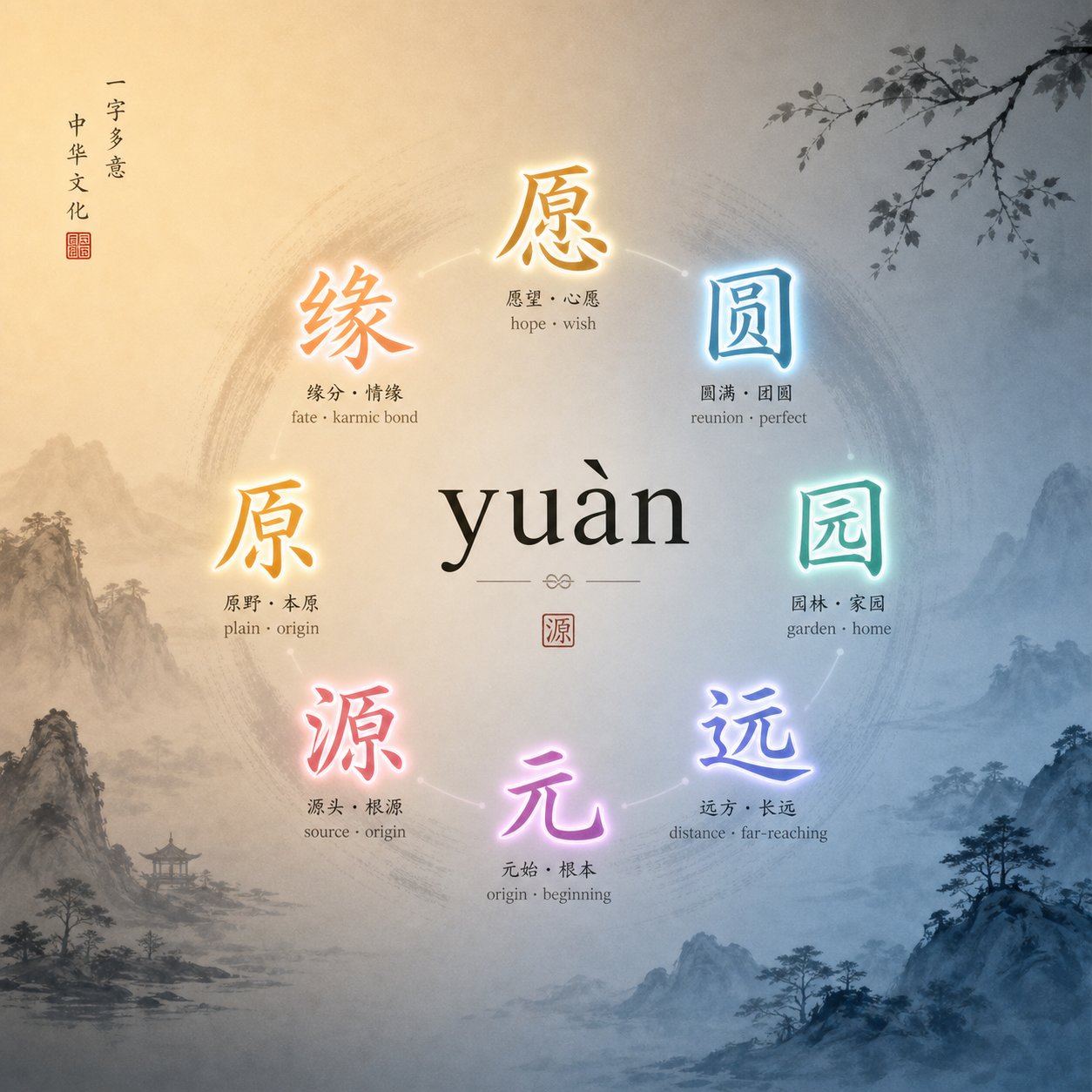
Here's where the relationship between chinese names and characters gets genuinely complex. Every pinyin syllable doesn't point to one character — it points to dozens, sometimes over a hundred. Mandarin compresses thousands of unique characters into roughly 375 distinct syllables. That means any single syllable you see in a name is shared by a crowd of characters, each with its own meaning, history, and visual identity.
One Pinyin Syllable and Dozens of Possible Characters
Take the syllable "li" — one of the most common sounds in Chinese names. When you see it written in pinyin, it could represent any of these characters:
- 李 — plum (also one of China's most common surnames)
- 丽 — beautiful, elegant
- 力 — power, strength
- 莉 — jasmine
- 立 — to stand, to establish
- 理 — reason, logic, principle
- 利 — sharp, benefit, profit
That's seven possibilities from a single syllable — and the full list runs much longer. This homophone phenomenon is fundamental to how Chinese works. Characters like 他, 她, and 它 all share the pronunciation "ta" yet mean "he," "she," and "it" respectively. Context and written form are the only reliable disambiguators.
Now scale this up to a full given name. A two-syllable name like "Meiling" multiplies the ambiguity. It could be written as:
- 美玲 — beautiful jade chime
- 梅玲 — plum jade chime
- 美灵 — beautiful spirit
- 梅铃 — plum bell
Each combination carries a different image, a different poetic resonance. The name chinese characters a parent selects tell a story that pinyin alone simply cannot convey. Consider the artist Ai Weiwei (艾未未) — his given name uses two identical characters, but the pinyin "wei" maps to so many other characters that without seeing the written form, you'd have no way to know which "wei" was intended.
What You Can and Cannot Infer From Pinyin Alone
So when you encounter names in chinese and meanings are what you're after, what can pinyin actually give you? More than nothing — but less than certainty.
What pinyin reveals:
- Possible meaning families — certain syllables cluster around specific themes ("mei" often relates to beauty or plum blossoms)
- Gender tendencies — syllables like "fang," "yan," and "li" (beautiful) lean feminine, while "gang," "wei" (great), and "jun" lean masculine
- Cultural era clues — names with syllables like "hong" (red) or "jun" (army) may suggest someone born during a particular political period
- Surname identification — common surname syllables are recognizable even without characters
What pinyin conceals:
- The exact character and its precise meaning
- Literary or classical references embedded in the name
- Family significance or generational naming patterns
- The visual beauty or structural elegance of the chosen character
- Homophones — whether "li" means beautiful, jasmine, or strength
Meaning chinese names accurately always requires seeing the characters. Chinese name meanings live in the written form, not the sound. You can make educated guesses from pinyin — and those guesses improve with experience — but the definitive answer sits in the characters themselves.
There's one more layer that sharpens or blurs this picture further: tone. The same syllable pronounced with a rising pitch versus a falling one maps to entirely different character sets — and that tonal dimension often disappears when pinyin names appear in English-language contexts.
How Tones Transform Pinyin Name Meanings
Mandarin is a tonal language, and that single fact reshapes everything about how pinyin name meaning works. A syllable spoken with a high flat pitch is a fundamentally different word than the same syllable spoken with a falling pitch. Tones aren't decoration — they're as important as vowels in determining which word you're actually saying. For names, this means tone is a powerful filter that can slash the number of possible characters a syllable represents.
How Four Tones Create Four Different Meanings
Mandarin uses four main tones plus a neutral tone. The first tone (marked with a macron, like ā) is high and flat. The second tone (acute accent, like á) rises. The third tone (caron, like ǎ) dips low then rises. The fourth tone (grave accent, like à) falls sharply. Each tone channels a syllable toward a completely different set of characters.
Consider the syllable "li" from the previous chapter. Without tone information, it maps to dozens of characters. Add a tone mark, and the field narrows dramatically:
- lī (first tone) — rarely used in names, but can appear in characters like 哩
- lí (second tone) — 离 (depart), 梨 (pear), 黎 (dawn/darkness before dawn)
- lǐ (third tone) — 李 (plum/surname Li), 理 (reason), 里 (inside)
- lì (fourth tone) — 丽 (beautiful), 力 (power), 立 (establish), 利 (benefit), 莉 (jasmine)
A single tone mark eliminates roughly 75% of the possible characters. That's an enormous gain in clarity. The same principle applies to every syllable in yin pinyin — tone is the first and most efficient disambiguation tool available.
To see this pattern more concretely, look at how the syllable "mei" behaves across all four tones — a syllable that appears constantly in Chinese names:
| Tone | Pinyin with Mark | Common Name Characters | Meanings |
|---|---|---|---|
| 1st tone | mēi | Rarely used in names | — |
| 2nd tone | méi | 梅, 媒 | Plum blossom; matchmaker/medium |
| 3rd tone | měi | 美, 每 | Beautiful/good; every/each |
| 4th tone | mèi | 妹, 魅 | Younger sister; charm/enchantment |
Notice how different the meanings become. A name containing měi (third tone) likely references beauty or aesthetics — 美 is one of the most popular characters in female given names. But méi (second tone) points toward the plum blossom 梅, a symbol of resilience in Chinese culture. Same letters on the page, entirely different meaning depending on pitch.
Reading Pinyin Names Without Tone Marks
Here's the practical problem: in most English-language contexts, tone marks vanish. Business cards, email signatures, passport stamps, academic citations — they almost universally strip the diacritics away. You see "Mei" or "Li," not "měi" or "lì." This is similar to how yuan pronunciation loses its tonal specificity when written in plain English text, or how the ā pronunciation and ā meaning of a first-tone syllable become invisible once the macron disappears.
Without tone marks, you're back to the full ambiguity problem. So how do native speakers and experienced readers still manage to interpret names correctly? They rely on a combination of strategies:
- Character frequency — some characters appear in names far more often than others. 美 (měi, beautiful) is vastly more common in given names than 每 (měi, every).
- Gender patterns — certain tonal variants cluster by gender. 丽 (lì, beautiful) skews heavily female; 力 (lì, power) skews male.
- Common pairings — experienced readers recognize frequent two-syllable combinations. "Meiling" almost always maps to 美玲 or 梅玲, not to obscure alternatives.
- Context and generation — a person's age, profession, and regional background all provide probabilistic clues about which characters their parents likely chose.
None of these strategies guarantee certainty. They narrow the odds, sometimes considerably, but the definitive answer still requires seeing the characters or simply asking. Tones are the invisible architecture of pinyin name meaning — present in speech, absent on paper, and always shaping which meanings are possible.
With tones and ambiguity understood, a natural question follows: are there patterns in which syllables parents actually choose? Certain sounds cluster around specific themes — nature, virtue, strength, beauty — and recognizing those clusters gives you a practical shortcut for reading meaning into the names you encounter.

Common Pinyin Syllables Grouped by Meaning
Chinese parents don't pick name characters at random. Naming a child is a deliberate act — one shaped by hopes, cultural values, and sometimes even cosmological calculations. Certain pinyin syllables appear in names again and again because the characters behind them carry meanings that parents want to bestow. Recognizing these thematic clusters gives you a practical lens for reading pinyin names, even when the exact characters remain hidden.
Nature and Beauty Syllables in Chinese Names
Nature imagery runs deep in Chinese naming traditions. Parents draw from flowers, trees, landscapes, and seasons to evoke qualities they admire. Many chinese names for girls pull from this category — orchids for refinement, plum blossoms for resilience, jade for purity. Beauty and grace syllables overlap heavily with nature, since elegance in Chinese culture often connects to the natural world.
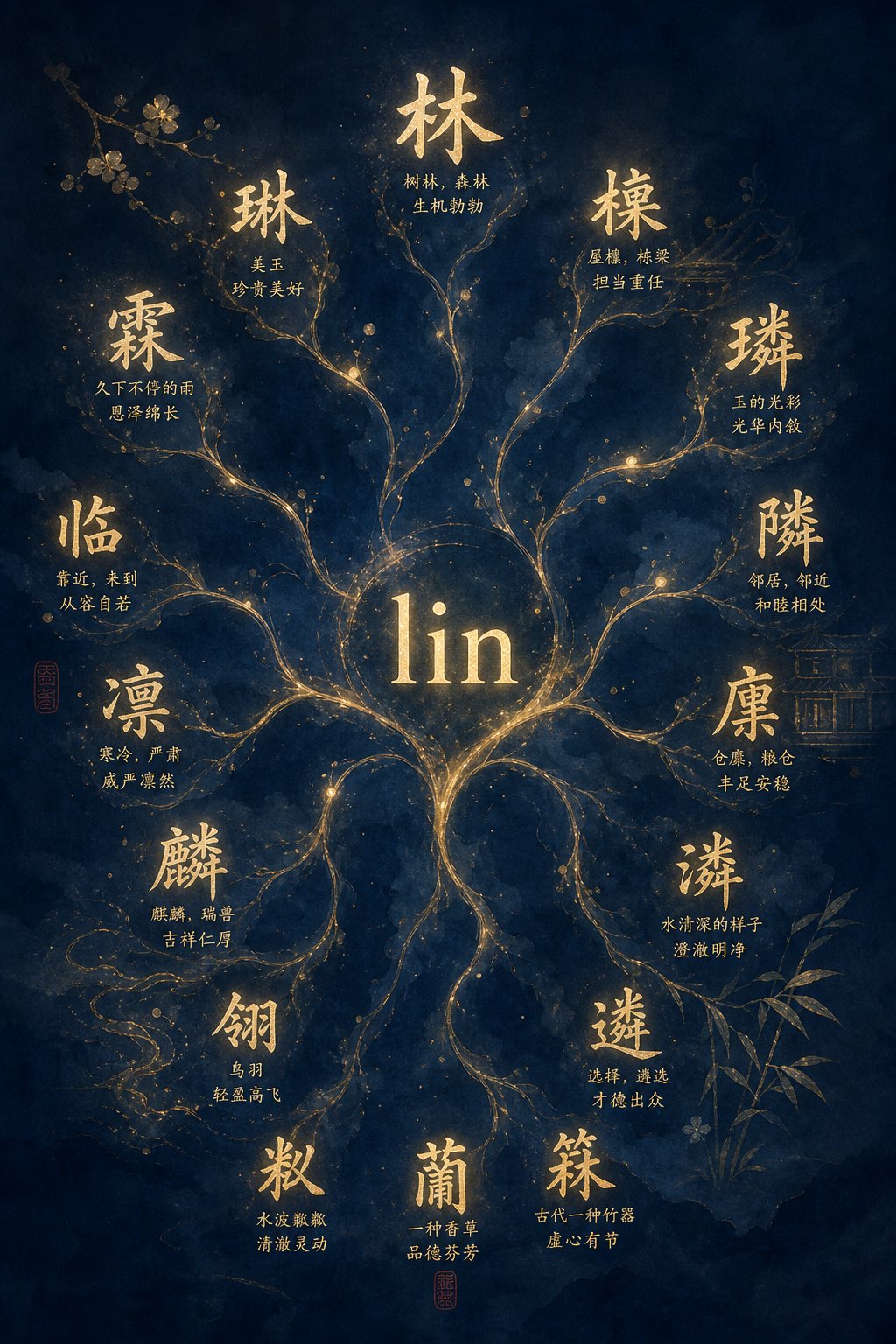
Common nature and beauty syllables you'll encounter include lan (orchid), mei (plum blossom), lin (forest), hai (sea), ya (elegant), and jing (quiet grace). These syllables appear frequently in female chinese names, though some — like hai (sea) and lin (forest) — cross gender lines depending on the character chosen.
Virtue and Strength Syllables for Name Meanings
Confucian values have shaped Chinese naming for centuries. Names chosen for boys often symbolize strength and power, while virtue syllables can appear across genders. Parents selecting chinese boy names frequently reach for syllables that convey ambition, moral character, or physical force.
Virtue-oriented syllables include ren (benevolence), yi (righteousness), xin (trust/faith), and de (virtue/morality). Strength and ambition syllables lean heavily masculine: wei (great/mighty), gang (steel), yong (brave), zhi (aspiration/will), and jun (army/sovereign). Prosperity syllables like fu (fortune), rong (glory), and xing (flourishing) round out the picture, often appearing in chinese male names from families hoping for worldly success.
The following table maps common pinyin syllables to their typical characters, meanings, and gender associations:
| Category | Pinyin Syllable | Common Character | Meaning | Typical Gender |
|---|---|---|---|---|
| Nature | lan | 兰 | Orchid | Female |
| Nature | mei | 梅 | Plum blossom | Female |
| Nature | lin | 林 | Forest | Neutral/Male |
| Nature | hai | 海 | Sea | Male |
| Beauty | li | 丽 | Beautiful | Female |
| Beauty | ya | 雅 | Elegant | Female |
| Beauty | jing | 静 | Quiet grace | Female |
| Virtue | ren | 仁 | Benevolence | Male |
| Virtue | xin | 信 | Trust/Faith | Neutral |
| Virtue | de | 德 | Virtue/Morality | Male |
| Strength | wei | 伟 | Great/Mighty | Male |
| Strength | gang | 刚 | Steel/Firm | Male |
| Strength | yong | 勇 | Brave | Male |
| Strength | zhi | 志 | Aspiration/Will | Male |
| Prosperity | fu | 福 | Fortune/Blessing | Male |
| Prosperity | rong | 荣 | Glory | Neutral |
| Prosperity | 兴 | Flourishing | Male |
Gender Patterns in Pinyin Name Syllables
Gender tendencies in Chinese naming are strong but not absolute. Chinese female names gravitate toward softness, beauty, and nature — syllables like fang (fragrance), yan (swallow bird), and xiu (elegant) appear overwhelmingly in women's names. Many asian names for girls share this aesthetic sensibility, favoring sounds tied to flowers, grace, and gentleness. Meanwhile, chinese names for boys lean toward power, ambition, and moral strength — syllables like qiang (strong), bo (broad/abundant), and ming (bright/brilliant) signal masculine naming intent.
These patterns aren't rules, though. Modern parents in China increasingly cross traditional gender lines, and china female names from recent decades sometimes incorporate syllables once reserved for boys, like yi (resolute) or han (vast). Generational naming also plays a role — families using a shared generational character apply it regardless of gender, which can override typical associations.
The five elements theory (wuxing) adds another layer. Some families consult a fortune teller to determine which element — wood, fire, earth, metal, or water — a child's birth chart lacks. They then choose characters containing the radical for that element. A child needing water might receive a name with characters like 海 (hai, sea) or 洁 (jie, clean/pure), both containing the water radical. This means the same pinyin syllable might be chosen not for its surface meaning but for the elemental balance its character provides.
These thematic clusters and gender patterns give you a probabilistic framework. When you see a pinyin name, you can make informed guesses about its likely meaning territory. But moving from educated guess to confident interpretation requires a more systematic approach — a step-by-step method for decoding what each component of a name most likely represents.
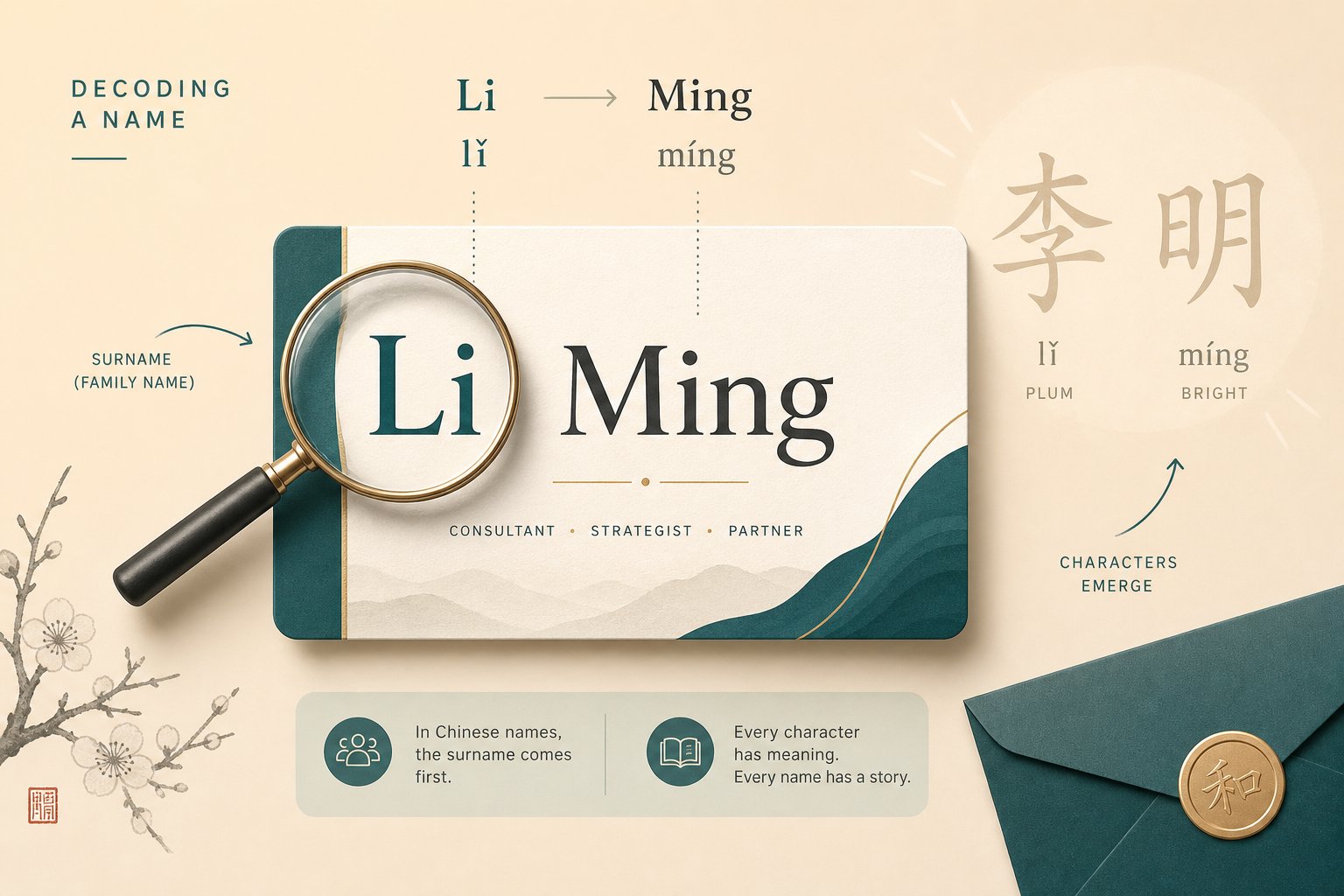
How to Decode a Pinyin Name You Encounter
You've got a pinyin name in front of you — maybe on a conference badge, a co-authored paper, or a new team member's Slack profile. You understand the ambiguity problem. You know tones matter and that syllables cluster around meaning themes. So what do you actually do with all that knowledge? Here's a practical, repeatable method for working through a chinese name translation from pinyin to probable meaning.
Identifying the Surname Component
Your first move is always the same: find the surname. In standard Chinese order, it's the first syllable. In Western-adapted order, it's the last element. Either way, chinese surnames are drawn from a surprisingly small pool. The Hundred Family Surnames (百家姓) — a classic text dating to the Song Dynasty — catalogues the most common chinese family names, and the top 100 of these account for roughly 85% of China's population.
This concentration works in your favor. If the first syllable of a name matches one of the most common chinese surnames — Wang, Li, Zhang, Liu, Chen, Yang, Huang, Zhao, Wu, Zhou — you can be fairly confident you've identified the family name. Chinese surname meanings often trace back to ancient clans, geographic features, or occupations: Wang (王) means "king," Zhang (张) means "bow-maker," and Lin (林) means "forest." Recognizing these chinese last name meanings gives you an immediate anchor point before you even touch the given name.
What if the first syllable doesn't match a common surname? Consider whether the name might be in Western order (given name first, surname last). Check the final syllable against the common surnames list. If neither end matches, you may be looking at a less common family name — or a two-character compound surname like Ouyang or Sima.
Step-by-Step Decoding of Given Name Syllables
Once the surname is isolated, the remaining one or two syllables form the given name. Here's how to work through them systematically:
- Separate the given name syllables. If the given name is written as one word (like "Xiaoming"), split it at the syllable boundary: Xiao + Ming. Each syllable corresponds to one character.
- Check for tone marks. If diacritics are present — like Míng versus Mìng — use them immediately. A tone mark eliminates roughly three-quarters of possible characters for that syllable, dramatically narrowing your search.
- Look up possible characters by frequency. For each syllable, identify the characters most commonly used in names. Not all homophones are equally likely. The syllable "ming" in a given name almost always maps to 明 (bright) or 铭 (inscribe/remember), not to 鸣 (cry of a bird) or 冥 (dark/underworld). Frequency-based thinking saves you from chasing unlikely options.
- Apply gender and thematic patterns. Use what you learned about meaning clusters. A syllable like "jing" in a woman's name probably points to 静 (quiet grace) or 晶 (crystal), while in a man's name it might be 景 (scenery/prospect) or 京 (capital city).
- Factor in context clues. The person's approximate age, regional background, and professional context all help. Someone born in the 1960s-70s might carry politically influenced characters. A person from southern China might have a name reflecting Cantonese naming preferences. An academic in their thirties likely has a name reflecting modern aesthetic choices.
A worked example: You meet someone named Chen Meiling at a professional event. She appears to be in her early forties.
- Surname: Chen — matches 陈 (chén), the 5th most common Chinese surname, meaning "ancient" or referencing the historical Chen state.
- Given name: Meiling — splits into Mei + Ling.
- Mei: No tone marks visible. Female name, beauty/nature theme likely. Most probable characters: 美 (beautiful) or 梅 (plum blossom). Both are extremely common chinese names for women of her generation.
- Ling: In female names, overwhelmingly maps to 玲 (tinkling jade) or 灵 (spirit). The combination 美玲 (beautiful jade chime) is one of the most popular given names for women born in the 1980s.
- Best guess: 陈美玲 — Chen Meiling, "beautiful jade chime of the Chen family."
That's an educated interpretation, not a certainty. The meaning of chinese last names like Chen can be confirmed quickly, but the given name remains probabilistic until you see the characters.
And that brings us to the most reliable decoding method of all: asking. A simple question like "I'd love to know which characters are in your name — would you mind sharing?" is both respectful and effective. Most people are happy to explain their name's characters and the story behind them. No lookup tool or frequency table replaces a direct conversation.
Still, even with the characters confirmed, there's another layer that trips people up — pronouncing the name correctly once you've decoded it. Pinyin letters don't always behave the way English speakers expect, and mispronunciation can undermine the cultural awareness you've just built.
Pronouncing Pinyin Names Without Mangling the Meaning
You've identified the surname, separated the given name syllables, and even narrowed down the likely characters. But when you say the name out loud, something goes wrong. Your colleague winces slightly, or politely corrects you, or just lets it slide. The problem? Pinyin letters don't map to English sounds the way they appear to. And mispronouncing someone's name — especially in a professional setting — can signal unfamiliarity with their culture in ways that undermine the effort you've already put into understanding it.
This gap between how pinyin looks and how it sounds is one of the biggest obstacles when converting chinese names into english speech. A chinese to english name translator can help with character meanings, but pronunciation still requires knowing how pinyin's alphabet actually works.
Pinyin Letters That Trick English Speakers
Pinyin was designed to represent Mandarin sounds using Latin letters — but it wasn't designed with English speakers in mind. Several letters and combinations represent sounds that simply don't exist in English, or that map to completely different sounds than English readers expect. The result? Predictable errors that native Mandarin speakers hear immediately.
The most common traps:
- X — English speakers see "Xiao" and want to say "ksao" or "eksiao." The actual sound is closer to "shyao," produced with the tongue pressed forward near the teeth in a hissing position. Think of the "sh" in "sheep" but with your mouth shaped into a smile.
- Q — Seeing "Qian," most English readers produce something like "kee-an." The correct sound is closer to "chyen" — like the "ch" in "cheese" but lighter and more forward in the mouth.
- Zh — Often confused with English "j." While similar, "zh" is a retroflex sound made with the tongue curled back. "Zhang" sounds closer to "jahng" with the tongue pulled back, not like the "j" in "jeans."
- C — English readers default to a /k/ sound, as in "cat." In pinyin, "c" is a "ts" sound like in "Tsar," with a strong puff of air. The name "Cai" sounds like "tsai," not "kai."
- R — Not the English "r" at all. Mandarin "r" is retroflex, produced with the tongue curled back near the "zh" position. It's closer to the French "j" in "bonjour" than anything in English.
- Ü — Often written as "u" in names (especially after j, q, x), this vowel requires rounded lips while saying "ee." Mispronouncing it turns nǚ (女, woman) into something closer to nǔ — a completely different character.
These aren't minor accent differences. In a language where tone and precise consonant placement carry meaning, getting the initial sound wrong can push listeners toward an entirely different character — and an entirely different pinyin name meaning — than what's intended.
Quick Pronunciation Guide for Name Syllables
You don't need perfect Mandarin pronunciation to show respect. You just need to avoid the most jarring misreadings. The following table gives you workable English approximations for the pinyin sounds that cause the most trouble in chinese english name translation:
| Pinyin Letter/Combo | Common English Misreading | Correct Approximate Sound | Example Name |
|---|---|---|---|
| x | "ks" or "eks" | "sh" with a smile (tongue forward) | Xiao → "shyao" |
| q | "k" or "kw" | "ch" as in "cheese" (tongue forward) | Qian → "chyen" |
| zh | "z" or soft "j" | "j" with tongue curled back | Zhang → "jahng" |
| c | "k" as in "cat" | "ts" as in "Tsar" + air puff | Cai → "tsai" |
| r | English "r" | French "j" (retroflex, near "zh") | Rui → "rway" (tongue back) |
| ü (after j/q/x) | "oo" as in "blue" | Round lips + say "ee" | Xu → "shü" (not "shoo") |
| z | English "z" as in "zoo" | "dz" as in "friendz" | Zi → "dzuh" |
A practical tip: when you encounter chinese names in english text and aren't sure how to pronounce them, focus on getting the initial consonant right. That's where the biggest errors happen. The vowels are more forgiving — a slightly off vowel still sounds close enough. But saying "ksaoming" instead of "shyaoming" for Xiaoming creates a sound that no Mandarin speaker would recognize.
Chinese translation for names involves more than swapping characters for English words — it also means bridging the phonetic gap between two very different sound systems. Even a rough approximation, delivered with confidence and genuine effort, communicates respect. Most people appreciate the attempt far more than they judge the imperfection.
Pronunciation is the audible layer of cultural competence. Getting it reasonably right signals that you've taken the time to understand how chinese name translation to english actually works — not just the meaning, but the sound that carries it. And that awareness extends naturally into broader situations where pinyin name knowledge becomes genuinely useful: professional introductions, academic citations, and cross-cultural conversations where names are the first bridge between two people.

Putting Pinyin Name Knowledge Into Practice
Knowing how pinyin works, how tones shape meaning, and how syllables cluster around themes is valuable — but only if you can apply it in real situations. Whether you're addressing a new colleague, citing a researcher, or choosing a Chinese name for yourself, the practical stakes are surprisingly high. Names are personal. Getting them right builds trust. Getting them wrong creates distance.
Professional and Academic Name Situations
In professional settings, pinyin name literacy shows up in small but meaningful ways. Imagine you're preparing a presentation and need to introduce a visiting partner from Shanghai. Their email signature reads Wang Jianhua. Do you call them "Mr. Jianhua" or "Mr. Wang"? If you've internalized the surname-first structure, you know Wang is the family name — and addressing them as "Mr. Wang" is correct. Flip it, and you've just called them by their given name with a formal title attached, which feels oddly intimate to a Chinese professional.
Document handling raises similar questions. On contracts, visa applications, and HR forms, you'll encounter names in all-caps without spacing cues. Knowing that the first element in Chinese order is the surname — and cross-referencing against common family names — prevents filing errors, misdirected correspondence, and awkward corrections later.
Academic contexts carry their own conventions. Citation styles vary: some journals use "Li, X." while others use "Xiaoming Li." When you're co-authoring a paper or reviewing submissions, understanding that the same person might appear as "ZHANG YIFAN," "Zhang, Yifan," or "Yifan Zhang" across different databases prevents duplicate entries and attribution mistakes. Knowing what is your name in chinese language conventions helps you parse these variations without confusion.
For anyone wondering how to find your chinese name — perhaps you're studying Mandarin, moving to China for work, or simply want a name that resonates with Chinese colleagues — understanding syllable meanings becomes directly personal. Choosing a name isn't just picking sounds you like. Each syllable carries character-level meaning, gender associations, and cultural weight. A well-chosen Chinese name signals respect for the language. A poorly chosen one — assembled from random syllables without regard for meaning — can sound comical or even offensive to native speakers.
When someone asks "what is your chinese name?" they're often curious about the characters and the story behind them. If you've selected your name thoughtfully — understanding that the pinyin is just the surface and the characters carry the real significance — you'll have something meaningful to share. The question "what's your name in chinese" or "what is your name in mandarin" opens a conversation that goes far deeper than pronunciation alone.
Asking About Name Meaning With Cultural Sensitivity
The most reliable way to understand someone's name will always be asking them directly. But how you ask matters. A blunt "What does your name mean?" can feel reductive — as if you're expecting a one-word translation. Chinese names rarely reduce to a single English equivalent. They carry layered references, family history, and sometimes private significance that people may or may not want to share with a casual acquaintance.
Better approaches sound like this:
- "I'd love to know which characters are in your name — would you be willing to share?"
- "I know pinyin can map to many different characters. Which ones did your parents choose?"
- "I've been learning about how Chinese names work. Would you mind telling me about yours?"
These phrasings show you already understand the complexity. They signal that you know a name isn't just a label — it's a deliberate composition. Most people respond warmly to this kind of informed curiosity. Many will pull out their phone to show you the characters, explain the meaning, or share the story of how their name was chosen.
What you want to avoid: assuming you already know what their name means based on pinyin alone, guessing the characters out loud (you'll likely be wrong), or treating the question as trivial small talk when it's actually quite personal in Chinese culture.
As global collaboration with Chinese-speaking professionals continues to grow — across tech, academia, finance, and international organizations — pinyin literacy becomes a quiet professional advantage. You don't need fluent Mandarin. You need enough understanding to navigate names with awareness rather than confusion. Knowing that "my name is in chinese" involves characters, tones, and cultural intention — not just a string of romanized letters — puts you ahead of most English speakers encountering these names for the first time.
The question "what is my chinese name" is one that more people are asking as cross-cultural connections deepen. Whether you're decoding someone else's name or building your own, the same principle applies: pinyin is where you start, never where you stop.
Pinyin is the doorway to meaning, not the meaning itself — and understanding this distinction is what separates cultural awareness from cultural guesswork.
Frequently Asked Questions About Pinyin Name Meaning
1. Can you determine the meaning of a Chinese name from pinyin alone?
No, pinyin is a phonetic system that represents sound, not meaning. A single pinyin syllable like 'li' can correspond to dozens of different Chinese characters, each with a unique meaning such as beautiful, plum, power, or jasmine. To know the exact meaning, you need to see the original Chinese characters. However, pinyin can offer clues about possible meaning families, gender tendencies, and cultural era based on common naming patterns.
2. Why do Chinese pinyin names have so many possible meanings?
Mandarin Chinese compresses thousands of unique characters into approximately 375 distinct syllables. This creates a massive one-to-many relationship where each pinyin sound is shared by numerous characters with completely different meanings. Adding tones helps narrow possibilities by about 75%, but in most English-language contexts, tone marks are omitted, leaving the full ambiguity intact. Only the written characters provide definitive meaning.
3. How do you tell the surname from the given name in a pinyin Chinese name?
In standard Chinese order, the surname comes first and is typically one syllable, followed by a one or two-syllable given name. For example, in 'Zhang Wei,' Zhang is the surname and Wei is the given name. However, in Western contexts, the order may be reversed to 'Wei Zhang.' Cross-referencing the name components against common Chinese surnames like Wang, Li, Zhang, Liu, and Chen helps identify which part is the family name.
4. What are the most common meaning categories in Chinese given names?
Chinese parents typically choose name characters from five thematic categories: nature names (orchid, plum, sea, forest), virtue names (benevolence, righteousness, trust), beauty and grace names (elegant, quiet grace, beautiful), strength and ambition names (great, brave, steel, aspiration), and prosperity names (fortune, glory, flourishing). Female names tend toward nature and beauty syllables, while male names lean toward strength and virtue, though modern naming increasingly crosses these traditional boundaries.
5. How should you ask someone about the meaning of their Chinese name?
Rather than asking bluntly 'What does your name mean?', show awareness of the complexity by asking which characters are in their name. Phrases like 'I know pinyin can map to many different characters - which ones did your parents choose?' demonstrate cultural understanding and invite a richer conversation. Most people appreciate informed curiosity and are happy to share the characters and stories behind their names.