Why English Speakers Struggle With Chinese Names in Pinyin
You see the name on an email signature: Qian Xuefeng. A conference badge reads: Zheng Xiaoli. Your calendar shows a meeting with someone named Cui Yuhan. You want to say these names correctly, but the letters on the page don't behave the way your English-trained brain expects them to. The "Q" has no "u" after it. The "X" sits in front of vowels where it has no business being. And "Zh" looks like it should sound one way but actually sounds like something else entirely.
This moment of hesitation is universal among English speakers encountering Chinese names for the first time. And it matters more than you might think.
Why Pronouncing Chinese Names Correctly Matters
Getting someone's name right is one of the most basic forms of professional respect. Research published in MIT Sloan Management Review found that 38% of people have had their name mispronounced at work, and 74% of employees reported struggling to pronounce colleagues' names, with some avoiding those colleagues altogether. Names are tied to identity, family, and culture. Mispronunciation can trigger feelings of alienation, while getting it right promotes belonging and psychological safety in teams.
Pinyin pronunciation isn't just a linguistic curiosity. It's an interpersonal skill that signals you've made an effort, that you see the person in front of you as worth that effort. The good news: Chinese pinyin pronunciation follows consistent, learnable rules. Once you understand the system, you can decode any unfamiliar name into pronounceable parts without memorizing each one individually.
What Pinyin Actually Is and Why It Confuses English Readers
To define pinyin pronunciation in simple terms: Pinyin (officially Hanyu Pinyin) is the standard romanization system for Mandarin Chinese. It uses the same 26 Latin letters you already know, but it reassigns many of them to represent Mandarin sounds that don't exist in English. The system was developed in the 1950s by Chinese linguists to help Chinese citizens learn to read their own language, not to help foreigners speak it.
Pinyin was designed for Chinese speakers learning to read, not for English speakers learning to speak. Every letter you recognize is a potential trap because your brain defaults to English sound values that simply don't apply.
As Hacking Chinese puts it plainly: "Pinyin is not English. You should never guess how something is pronounced based on your understanding of English spelling." The letter "q" doesn't make a "kw" sound. The letter "x" doesn't make a "ks" sound. The letter "c" doesn't make a "k" or "s" sound. Each one maps to a specific Mandarin consonant that English simply doesn't have.
This is why chinese pinyin english pronunciation feels so counterintuitive at first glance. You're reading familiar letters through an unfamiliar code. But here's what makes pinyin to english pronunciation manageable: the system is entirely regular. Unlike English, where "ough" can be pronounced five different ways, pinyin pronunciation in english follows predictable patterns every single time. Once you learn the code, it never changes on you.
This guide gives you a repeatable method to crack that code. You'll walk away with the ability to look at any Chinese name in pinyin and produce a respectful, recognizable approximation of how it actually sounds.
The Logic Behind Pinyin Spelling Conventions
The code is consistent, but why does it look so strange? Why would anyone assign "q" to a "ch"-like sound or use "x" for something closer to "sh"? These choices weren't random. They were deliberate engineering decisions, and understanding the reasoning behind them gives you a mental model that makes the entire pronunciation of pinyin predictable rather than something you memorize name by name.
Why Pinyin Letters Do Not Match English Sounds
Mandarin Chinese has around 400 unique syllables. The designers of Hanyu Pinyin needed to represent all of them using just 26 Latin letters, no more. English doesn't use all 26 letters efficiently for this purpose. Letters like "q" and "x" are rare in English and carry very specific baggage ("qu" as in "queen," "x" as in "box"). But in Mandarin's sound inventory, those letters were available real estate.
The logic works like this: Mandarin has several groups of consonants that English lacks entirely. Rather than invent new symbols or use awkward multi-letter combinations for every sound, the system's creators repurposed underused Latin letters to keep spellings short and efficient. The letter "x" was assigned to a palatal fricative (a soft, hissing "sh" made with the tongue flat). The letter "q" was assigned to a palatal affricate (a sharp "ch" made in the same tongue position). These sounds needed single-letter representations, and "x" and "q" were simply available.
The same principle applies to "c" and "z." In English, "c" bounces between "k" and "s" sounds. In chinese pinyin alphabet pronunciation, "c" consistently represents a "ts" sound, like the end of "cats." The letter "z" represents a "dz" sound, like the end of "adds." No exceptions, no context-dependent shifts.
The Mental Model That Makes Pinyin Predictable
Here's the framework that saves you from rote memorization: pinyin alphabet pronunciation follows a one-letter-one-sound principle. Every letter or letter combination maps to exactly one sound, every time. When you see "x" in a name, it always makes the same soft sound. When you see "q," it always makes the same sharp sound. This is the opposite of English, where context changes everything.
Think of it as a simple substitution cipher. You just need the key. The following chinese pinyin pronunciation chart maps the letters that trip up English speakers most often, showing what your brain expects versus what the letter actually represents:
| Pinyin Letter | What English Speakers Expect | What It Actually Sounds Like | English Approximation |
|---|---|---|---|
| q | "kw" as in "queen" | A sharp, aspirated "ch" | "ch" in "cheese" (tongue forward) |
| x | "ks" as in "box" | A soft, hissing "sh" | "sh" in "she" (tongue flat, lips spread) |
| c | "k" or "s" as in "cat" or "city" | A sharp "ts" | "ts" in "cats" (with a puff of air) |
| z | "z" as in "zoo" | A quick "dz" | "ds" in "adds" (no buzz) |
| zh | "zh" as in "measure" | A retroflex "j" | "j" in "judge" (tongue curled back) |
| r | "r" as in "red" | A buzzy retroflex sound | Between "r" and "zh" (tongue curled back) |
This pinyin english pronunciation chart covers the biggest offenders. You'll notice a pattern: the sounds that confuse English speakers most are the ones where pinyin borrows a familiar letter for an unfamiliar sound. But the system never contradicts itself. Once you internalize these mappings, you can look at any unfamiliar name and predict its pronunciation without having heard it before.
The real power of this mental model becomes clear when you start applying it to actual initials and finals, the building blocks that combine to form every possible Chinese syllable.
Every Pinyin Initial Mapped to English Sounds
The mental model gives you the logic. This section gives you the complete pinyin pronunciation chart you can return to every time you encounter an unfamiliar name. All 21 pinyin initials fall into three clear categories based on how much adjustment your English-speaking mouth needs to make. Some require zero effort. Some need a small tweak. And some ask you to put your tongue somewhere it has never been before.
Think of this as your reference table for chinese pinyin initials pronunciation. Bookmark it, screenshot it, print it out. When a new name lands in your inbox, this is where you come back.
Pinyin Initials That Match English Sounds
Good news first: eleven of the 21 initials sound close enough to their English counterparts that you can use your existing instincts. These are the labial, dental, and velar consonants that behave almost identically to what you already know.
| Pinyin Initial | Closest English Sound | Example in a Name | Common Mistake to Avoid |
|---|---|---|---|
| b | "b" in "spin" (unaspirated) | Bai, Bo | Don't add a strong puff of air like English "b" in "boy" |
| p | "p" in "pan" (aspirated) | Peng, Pan | Make sure you feel a clear burst of air |
| m | "m" in "mother" | Ma, Mei | No adjustment needed |
| f | "f" in "father" | Feng, Fan | No adjustment needed |
| d | "d" in "stop" (unaspirated) | Deng, Ding | Softer than English "d" in "dog" |
| t | "t" in "top" (aspirated) | Tian, Tang | Needs a strong puff of air |
| n | "n" in "name" | Ning, Nan | No adjustment needed |
| l | "l" in "love" | Li, Liu, Liang | No adjustment needed |
| g | "g" in "skill" (unaspirated) | Guo, Gao | Softer than English "g" in "go" |
| k | "k" in "key" (aspirated) | Kong, Kai | Needs a strong puff of air |
| h | "h" in "hot" (but rougher) | Huang, He | Slightly more friction than English "h," closer to the "ch" in Scottish "loch" |
The subtle difference here is aspiration. In English, the distinction between "b" and "p" is voicing: your vocal cords vibrate for "b" but not for "p." In Mandarin, both are voiceless. The difference is whether you release a puff of air. Hold your hand in front of your mouth: "p," "t," and "k" should produce a noticeable burst of air. Their partners "b," "d," and "g" should not. For name pronunciation purposes, though, English speakers can use their normal "b/p" distinction and still be understood.
Pinyin Initials That Need New Mouth Positions
The remaining ten initials split into two groups: three that are close to English but slightly off, and seven that require genuinely new tongue positions. This is where the pinyin consonants pronunciation diverges from anything in your native sound inventory.
First, the "close but different" group:
| Pinyin Initial | Closest English Sound | Example in a Name | Common Mistake to Avoid |
|---|---|---|---|
| z | "ds" in "adds" | Zhang (different initial), Zou, Zeng | Not a buzzy "z" like "zoo." It starts with a "d" and releases into "s" |
| c | "ts" in "cats" | Cai, Cui, Chen (different initial) | Not a "k" or "s" sound. Think of the end of "bits" with a puff of air |
| s | "s" in "sun" | Sun, Song, Su | No adjustment needed. Identical to English |
And the group with no direct English equivalent, the sounds that make chinese pinyin initials and finals pronunciation genuinely challenging:
| Pinyin Initial | Closest English Sound | Example in a Name | Common Mistake to Avoid |
|---|---|---|---|
| zh | "j" in "judge" (tongue curled back) | Zhang, Zhao, Zhou, Zheng | Not like the "zh" in "measure." Curl your tongue tip back toward the roof of your mouth |
| ch | "ch" in "church" (tongue curled back) | Chen, Cheng, Chu | Same tongue-curled position as "zh" but with a puff of air |
| sh | "sh" in "shirt" (tongue curled back) | Shen, Shi, Shao | Tongue tip curls back further than English "sh" |
| r | Between "r" in "run" and "zh" in "measure" | Ren, Rui, Rong | Not a clean English "r." Curl tongue back, let it buzz slightly |
| j | "j" in "jeep" (tongue flat, behind lower teeth) | Jia, Jin, Jiang | Tongue stays flat and forward, not curled back like "zh" |
| q | "ch" in "cheese" (tongue flat, strong air puff) | Qian, Qin, Qi | Not "kw" like "queen." Keep tongue flat and forward, push air out |
| x | "sh" in "she" (tongue flat, lips spread) | Xu, Xie, Xiao, Xi | Not "ks" like "box." Spread your lips into a smile shape and hiss gently |
You'll notice a pattern in this chinese pinyin table pronunciation reference: the seven hardest initials form two mirror-image groups. The retroflex set (zh, ch, sh, r) all require curling your tongue backward. The palatal set (j, q, x) all require keeping your tongue flat and forward. Within each group, the mouth mechanics are identical. The only difference is airflow: one member is unaspirated, one is aspirated, and one is a pure fricative.
For practical name pronunciation, here's the shortcut that gets you 90% of the way there: if you see "zh," say "j" as in "judge." If you see "q," say "ch" as in "cheese." If you see "x," say "sh" as in "she." These approximations aren't perfect, but they're close enough that a Chinese colleague will recognize the name you're attempting. The pinyin pronunciation table above gives you the refinements when you're ready to go further.
The initials are only half the equation, though. Each one pairs with a vowel sound, a final, that completes the syllable. And some of those finals shift their pronunciation depending on which initial comes before them.
Pinyin Vowels and Finals Decoded for English Ears
Initials get you started, but finals carry the weight of the syllable. In Mandarin, there are 39 pinyin finals in total, ranging from single vowels to complex combinations with nasal endings. These are the sounds that give each name its distinctive shape. Mastering pinyin finals pronunciation is what separates a vague attempt from a recognizable name.
The system breaks finals into three categories: simple finals (single vowel sounds), compound finals (two or three vowels gliding together), and nasal finals (vowels ending in "n" or "ng"). Most are straightforward for English speakers. A few will require you to do something new with your mouth.
Simple and Compound Vowel Sounds in Pinyin
The six simple finals form the foundation of chinese pinyin vowels pronunciation. Four of them map closely to English sounds. Two of them don't.
| Pinyin Final | English Approximation | Example Name | Notes |
|---|---|---|---|
| a | "ah" as in "father" | Ma, Fang, Jia | Open and broad, never like "a" in "cat" |
| o | "aw" as in "law" (with rounded lips) | Bo, Mo, Po | Lips round more than English "o" in "go" |
| e | "uh" as in "duh" (back of throat) | He, Ge, Zeng | Not "ee" or "eh." Relax your jaw, pull tongue back |
| i | "ee" as in "see" | Li, Ji, Qi | Straightforward, but changes after zh, ch, sh, z, c, s |
| u | "oo" as in "food" | Lu, Zhu, Wu | Round your lips tightly |
| ü | No English equivalent | Lü, Nü, Xu, Yu | Say "ee" but round your lips as if saying "oo" |
The e pinyin pronunciation trips up nearly every English speaker. When you see "e" standing alone or in combinations like "en" and "eng," it doesn't sound like any English "e." Imagine saying "uh" while keeping your mouth half-open and your tongue pulled slightly back. It's the sound you might make when hesitating mid-sentence, a neutral, relaxed grunt from the back of your throat.
Compound finals combine these simple vowels into gliding sounds. Most behave predictably if you just pronounce each vowel in sequence, quickly blending them together:
| Pinyin Final | English Approximation | Example Name | Notes |
|---|---|---|---|
| ai | "eye" | Bai, Cai, Dai | Like the English word "eye" |
| ei | "ay" as in "day" | Mei, Wei, Lei | Rhymes with "hey" |
| ao | "ow" as in "cow" | Gao, Zhao, Mao | Starts with "ah" and glides to "oo" |
| ou | "oh" as in "go" | Zhou, Dou, Gou | Starts with "o" and glides to "oo" |
| ia | "ya" as in "yard" | Jia, Xia | Quick "ee" gliding into "ah" |
| ie | "ye" as in "yes" | Xie, Jie, Tie | Quick "ee" gliding into "eh" |
| iu | "yo" as in "yoke" | Liu, Niu, Jiu | Actually "iou" compressed. Glides through three vowels |
| uo | "waw" as in "wall" | Guo, Huo, Luo | Starts with rounded "oo" into open "aw" |
| üe | "ü" + "eh" | Xue, Yue, Que | Round lips for ü, then open into "eh" |
Nasal finals add either "n" (tongue tip touches the ridge behind your upper teeth) or "ng" (back of tongue rises toward soft palate) to the end of a vowel. The distinction matters: "an" (like "ahn") and "ang" (like "ahng") are different syllables that appear in different names. When you see Fang versus Fan, the difference is where the nasal resonance sits, front of the mouth versus back.
| Pinyin Final | English Approximation | Example Name | Notes |
|---|---|---|---|
| an | "ahn" (tongue tip forward) | Pan, Han, Tan | Not like "an" in "can." Use the "ah" vowel |
| en | "un" as in "taken" | Chen, Shen, Ren | Short, neutral vowel before "n" |
| ang | "ahng" (open, nasal) | Wang, Zhang, Yang | Wide open "ah" with nasal ending |
| eng | "ung" as in "sung" | Cheng, Feng, Deng | Not "eng" as in "English." Uses the neutral "uh" vowel |
| ing | "ing" as in "sing" | Ding, Ming, Ning | This one actually matches English |
| ong | "oong" (rounded) | Dong, Gong, Rong | More rounded than English "ong" in "song" |
The Tricky Vowels With No English Equivalent
Two finals deserve extra attention because no amount of English comparison fully captures them: "e" and "ü."
The standalone "e" sound requires you to relax your jaw, pull your tongue slightly back and up, and produce a sound from the middle-back of your mouth. Imagine you're about to say "uh" but you stop your tongue from moving forward. It's not "eh" as in "bed," not "ee" as in "see," and not "ay" as in "day." It lives in a space English vowels simply don't occupy.
The "ü" sound is the other major hurdle. As experienced Mandarin teachers explain, the trick is to start by saying "ee" (as in "see"), then without changing your tongue position, round your lips into a tight circle as if you were about to whistle. Your tongue stays forward and high while your lips do the work of "oo." The result is a sound that exists in French ("tu") and German ("über") but not in English.
Why does this matter for names? Because "Lü" and "Lu" are completely different people. The name Lü (律, 吕) uses the front-rounded vowel, while Lu (陆, 鲁) uses the back-rounded "oo." Mixing them up is like calling someone "Tim" when their name is "Tom."
Here's the critical rule for chinese pinyin initials and compound finals pronunciation: whenever you see "u" after the initials j, q, or x, it's actually "ü" in disguise. The two dots are dropped for cleaner spelling, but the pronunciation stays the same. So "Xu" is pronounced "shü," not "shoo." "Qu" is "chü," not "choo." And "Juan" is "jü-en," not "joo-an." This single rule, explained clearly in the pinyin u vs ü guide, eliminates one of the most common errors English speakers make with Chinese names.
Finals also shift subtly depending on their partner initial. The "i" after zh, ch, sh, r, z, c, and s doesn't sound like "ee" at all. It becomes a barely-there buzzing vowel, almost swallowed. When you say "Shi" (as in the surname), the vowel is more like holding the "shh" sound and letting your voice hum briefly, not a clear "shee." This pinyin chart with pronunciation context is what separates reading pinyin from actually producing recognizable sounds.
Understanding pinyin initials and finals pronunciation as a complete system, where each initial-final pairing follows predictable rules, means you can approach any name with confidence. But some sounds in this system have no English parallel at all, and those deserve their own focused attention.

Mastering the Sounds That Do Not Exist in English
Tables and charts give you the map. But some sounds on that map lead to territory your mouth has genuinely never visited. The retroflex consonants (zh, ch, sh, r) and the palatal consonants (j, q, x) are the reason most English speakers hesitate before saying a Chinese name out loud. These seven initials, plus the vowel ü, have no direct equivalent in English. No amount of reading about them replaces the physical act of putting your tongue in a new position.
The good news: these sounds follow a clear physical logic. Once you understand what your tongue and lips are doing, you can produce them reliably. This chinese pinyin pronunciation guide breaks each sound into concrete mouth mechanics you can practice right now, wherever you're reading this.
Mouth Positions for Retroflex Sounds zh ch sh r
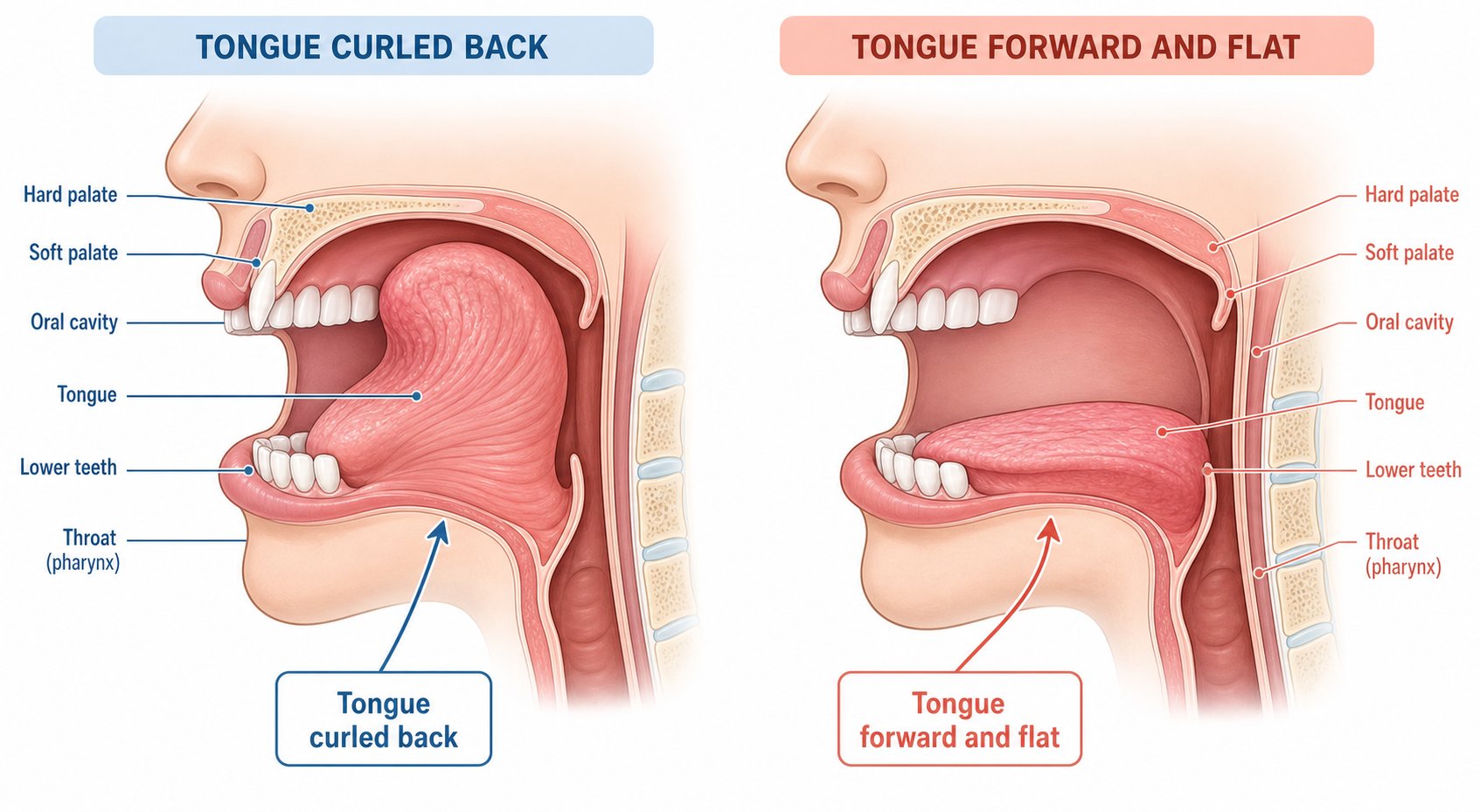
Retroflex means "tongue curled back." All four sounds in this group share one defining feature: the tip of your tongue curls upward and backward toward the hard palate (the bony roof of your mouth, just behind the ridge where your upper teeth meet the gums). If you've ever tried to touch the roof of your mouth with your tongue tip while keeping your mouth closed, you already know the general area.
The key distinction from English: when you say "judge" or "church" in English, your tongue tip stays relatively flat and forward. For Mandarin retroflex sounds, the tongue tip pulls back further, creating a slightly different resonance. According to the University of Iowa's Mastering Mandarin Sounds textbook, the tongue tip curls toward the hard palate without fully touching it, and air squeezes through the narrow channel between the tongue and the palate.
Here's how to produce each retroflex sound:
zh (as in Zhang, Zhao, Zhou)
- Curl your tongue tip upward and back so it lightly touches or nearly touches the hard palate, about a centimeter behind the tooth ridge.
- Build up a small pocket of air pressure behind that contact point.
- Release the air in a short burst, letting the tongue drop slightly. No puff of air follows.
- The result sounds like a "j" in "judge" but with a darker, more hollow quality because the tongue is further back.
ch (as in Chen, Cheng, Chu)
- Start in the exact same tongue position as zh: tip curled back, touching or nearly touching the hard palate.
- Build up air pressure behind the tongue.
- Release with a strong, deliberate puff of air. This aspiration is the only difference between ch and zh.
- The result sounds like "church" but with that same hollow, tongue-back quality.
sh (as in Shen, Shi, Shao)
- Curl your tongue tip back toward the hard palate, but don't let it touch. Leave a narrow gap.
- Push air continuously through that gap. No buildup, no burst, just steady friction.
- The result sounds like English "sh" in "shirt" but slightly thicker and more resonant because the tongue is further back in the mouth.
r (as in Ren, Rui, Rong)
- Position your tongue exactly as you would for sh: curled back, hovering near the hard palate.
- Now add voicing. Let your vocal cords vibrate while air passes through the gap.
- The result is a buzzy, humming sound that sits somewhere between English "r" in "run" and the "zh" in "measure." It's not a clean, crisp English "r" at all.
A useful way to learn pinyin pronunciation for this group: say the English word "shirt" slowly, paying attention to where your tongue sits during the "sh." Now push your tongue tip about half a centimeter further back. That's your retroflex position. Hold it there, and you have the starting point for all four sounds.
Mouth Positions for Palatal Sounds j q x
The palatal group is the mirror image of the retroflex group. Where retroflex sounds curl the tongue backward, palatal sounds push the tongue forward and flat. The front of the tongue (not the tip) presses against or approaches the hard palate, and the tongue tip tucks down behind the lower front teeth. Your lips spread slightly, as if you're about to smile.
This forward, flat tongue position is what makes the chinese pinyin j pronunciation so different from English "j." In English, "j" as in "jeep" uses the tongue tip near the tooth ridge. In Mandarin, j uses the blade of the tongue (the flat area just behind the tip) pressed against the front of the hard palate, with the tip resting against the back of the lower teeth.
j (as in Jia, Jin, Jiang)
- Place the tip of your tongue behind your lower front teeth. Let it rest there.
- Raise the flat middle portion of your tongue so it presses against the front part of the hard palate.
- Build up air pressure, then release it in a short burst. No strong puff of air follows.
- The result sounds like a softer, thinner version of English "j" in "jeep," produced further forward in the mouth.
q (as in Qian, Qin, Qi)
- Same tongue position as j: tip behind lower teeth, blade of tongue against the front hard palate.
- Build up air pressure behind the tongue blade.
- Release with a strong, aspirated puff of air. This is the only difference from j.
- The result sounds like "ch" in "cheese" but thinner and sharper, produced with the tongue flat and forward rather than curled back.
x (as in Xu, Xie, Xiao, Xi)
- Tongue tip stays behind the lower teeth.
- Raise the blade of your tongue toward the hard palate, but leave a narrow gap. Don't let it touch.
- Push air steadily through that gap. Spread your lips slightly, as if smiling.
- The result is a thin, hissing "sh" sound, lighter and sharper than English "sh." Imagine whispering "she" while smiling.
The contrast between these two groups is the single most important distinction in this guide to pinyin pronunciation. Retroflex sounds (zh, ch, sh, r) curl the tongue tip back. Palatal sounds (j, q, x) push the tongue blade forward. If you can feel that difference physically, you can produce both groups reliably.
Choosing Your Depth: Good Enough vs. Near-Native
Not everyone needs near-native mandarin chinese pinyin pronunciation. For professional name pronunciation, there are two levels you can aim for:
Level 1: Respectful and recognizable. Use these simplified approximations:
- zh = English "j" as in "judge"
- ch = English "ch" as in "church"
- sh = English "sh" as in "shirt"
- r = English "r" with a slight buzz
- j = English "j" as in "jeep" (softer)
- q = English "ch" as in "cheese"
- x = English "sh" as in "she" (thinner)
- ü = say "ee" with rounded lips
These approximations will get you understood. A colleague named Xu will recognize you're saying their name, not some random syllable. Someone named Qian will hear the right consonant, even if the tongue position isn't textbook perfect.
Level 2: Accurate and distinct. At this level, you physically differentiate retroflex from palatal sounds. You curl your tongue back for Zhang and keep it flat for Jiang. You produce a genuinely different sound for Shi versus Xi. This level takes practice, but it signals real effort and earns genuine appreciation. The step-by-step guides above give you everything you need to get there.
The basic pinyin pronunciation skill that matters most in professional settings is consistency. Pick your level and apply it reliably. A confident, consistent approximation always sounds better than a hesitant, half-attempted guess. And once the physical mechanics become muscle memory, the difference between Level 1 and Level 2 shrinks quickly.
These consonant distinctions shape how a name begins. But Mandarin adds another layer that English lacks entirely: the pitch pattern applied to each syllable changes the word's meaning. In names, these tonal patterns are what give each syllable its full identity.
How Tones Work in Two-Syllable Chinese Names
Consonants and vowels give a Chinese name its shape. Tones give it its identity. Mandarin is a tonal language, meaning the pitch pattern you apply to a syllable changes its meaning entirely. The syllable "ma" can mean mother, hemp, horse, or scold depending on whether your voice stays high, rises, dips low, or drops sharply. For chinese pinyin pronunciation, how many tones are there? Four main tones plus a neutral (unstressed) tone.
In names, tones are baked into each character's identity. Your colleague's name isn't just the consonants and vowels you see in pinyin. It's those sounds delivered at specific pitches. That said, tones are also the hardest element for English speakers to master, and the least critical for basic name recognition in professional settings. Here's why, and how to approach them practically.
The Four Tones Explained With Name Examples
Each Mandarin syllable carries one of four tonal patterns, or occasionally a light, unstressed neutral tone. Think of them as melodic instructions layered on top of the consonant-vowel combination you've already decoded.
| Tone | Tone Mark | Description | What Your Voice Does | Example Names |
|---|---|---|---|---|
| First tone | ā, ē, ī | High and level | Hold your voice at a steady high pitch, like sustaining a musical note | Fāng, Gāo, Fēi |
| Second tone | á, é, í | Rising | Start mid-range and rise sharply, like asking "What?" in English | Chén, Lín, Huáng |
| Third tone | ǎ, ě, ǐ | Low dipping | Drop your voice low and let it creep back up slightly at the end | Hǎi, Wěi, Yǔ |
| Fourth tone | à, è, ì | Sharp falling | Start high and drop quickly and decisively, like a firm command | Zhào, Lì, Jìn |
| Neutral tone | No mark | Light and unstressed | Short, soft, pitch depends on the preceding syllable | Rare in names; appears in particles like "de" |
A useful way to feel the difference: say "yes" in a flat, bored monotone (first tone). Now say "yes?" as a surprised question (second tone). Now say a drawn-out, grumbling "yeahhh..." starting low (third tone). Finally, say "yes!" as a sharp, decisive command (fourth tone). Those four pitch movements map roughly to Mandarin's four tones.
In practice, the third tone rarely gets its full dip-and-rise contour in connected speech. As CLI's tone change guide explains, it's often realized as simply a low tone that doesn't fully rise back up. This matters for names because most Chinese names are two syllables spoken in quick succession, not isolated words pronounced in textbook form.
How Tones Change When Two Syllables Meet in Names
Here's where mandarin pinyin pronunciation gets interesting. Tones don't always stay fixed. When certain tones appear next to each other, one of them shifts. Linguists call this tone sandhi, and the most important rule for names is the third-tone sandhi rule.
The rule is simple: when two third-tone syllables appear consecutively, the first one shifts to a second tone in actual speech. The "3-3" tone change rule means that a name written with two third tones isn't pronounced the way it looks on paper.
Consider these real examples:
- Lǐ Hǎi (李海) - Written as third + third, but spoken as "Lí Hǎi" (second + third). The first syllable rises instead of dipping.
- Mǎ Yǔ (马宇) - Spoken as "Má Yǔ." The surname shifts to a rising tone.
- Zhǎng Wěi - Spoken as "Zháng Wěi." Same pattern: first third tone becomes second.
This shift happens automatically in natural speech. Native speakers don't think about it consciously. They simply find it physically uncomfortable to produce two low-dipping tones back-to-back, so the first one rises. For you as an English speaker, the practical takeaway is: if you see two third-tone marks in a two-syllable name, pronounce the first syllable with a rising pitch instead.
Standard pinyin notation keeps the original tone marks even when sandhi applies. A mandarin pinyin pronunciation table will show "nǐ hǎo" with two third-tone marks, but the spoken form is "ní hǎo." This convention preserves each character's underlying tone for reference, even though pronunciation differs in context. It's one reason why mandarin pinyin pronunciation audio resources are so valuable as a supplement to written guides. Hearing the actual spoken tones, including sandhi shifts, reinforces what the page alone can't fully convey.
Other tone combinations in names are more straightforward. A first tone followed by a fourth tone (like Gāo Jìn) stays exactly as written. A second tone followed by a first tone (like Chén Fēi) stays put too. The third-tone sandhi rule is the only mandatory shift you need to watch for in typical two-syllable names.
A Practical Hierarchy for Professional Settings
Here's the honest truth about tones and name pronunciation: getting the consonants and vowels right matters more for recognition than getting the tones perfect. If you say "Xu" with the correct "shü" sound but the wrong tone, your colleague will still recognize their name. If you say "Zoo" with perfect tonal contour, they won't.
For pronunciation chinese pinyin in professional contexts, follow this priority order:
- Get the consonant sounds right. Use the correct initial. Don't say "ks" for x or "kw" for q.
- Get the vowel sounds right. Distinguish ü from u, use the correct final.
- Attempt the tones. Even a rough approximation shows effort and respect.
This hierarchy isn't an excuse to ignore tones entirely. It's a recognition that in a noisy conference room or a quick hallway greeting, the segmental sounds (consonants and vowels) carry more identification weight than pitch patterns. Tones matter enormously in full Mandarin conversation, but for the specific task of saying someone's name recognizably, they're the polish rather than the foundation.
If you want to refine your tonal accuracy, hanyu pinyin pronunciation audio tools let you hear each tone pattern applied to real names. Listening repeatedly to how native speakers produce two-syllable name combinations builds intuition faster than memorizing rules. The goal isn't perfection. It's a confident, consistent attempt that signals genuine respect.
With the sound system covered, from initials through finals to tones, the next step is applying all of it to the names you'll actually encounter most often. Some Chinese surnames are mispronounced so consistently by English speakers that the errors have become almost standardized. Correcting those specific defaults is where this knowledge becomes immediately practical.

Common Chinese Names With Correct English Approximations
You've learned the system. You understand retroflex versus palatal, you know that "q" isn't "kw," and you can describe what your tongue should do for "x." But when you're standing in front of someone at a networking event and their badge says "Xu Qianwei," theory needs to become reflex. This section bridges that gap by correcting the specific errors English speakers make most often with real Chinese surnames and given name syllables.
The pattern is predictable: English speakers see familiar Latin letters and default to English sound values. The result is a version of the name that's sometimes unrecognizable to the person it belongs to. The fixes below are based on the ASU SILC pronunciation guide and the phonetic principles covered in earlier sections.
The Most Mispronounced Chinese Surnames and How to Fix Them
These are the surnames you'll encounter most frequently in professional settings. For each one, the table shows what English speakers typically say, what it should actually sound like, and a quick tip to lock in the correction. This is the pinyin chinese pronunciation reference you'll want to keep handy.
| Surname in Pinyin | Common Wrong Pronunciation | Correct Approximation | Tip |
|---|---|---|---|
| Zhang | "Zang" or "Zayng" | "Jahng" (rhymes with "song" but starts with a "j" sound) | The "zh" sounds like English "j" in "judge," not "z." The vowel is open "ah" + nasal "ng" |
| Wang | "Wayng" (rhyming with "bang") | "Wahng" (the "a" is broad like "father") | Think "Wong" but with a wider, more open "ah" vowel. Not the "a" in "cat" |
| Li | "Lie" or "Lye" | "Lee" | The li pinyin pronunciation is simply "lee" as in Bruce Lee. Straightforward |
| Liu | "Loo" or "Lee-oo" | "Lyo" (like "Leo" but quicker) | The "iu" final glides through three vowels rapidly: ee-oh-oo compressed into one beat |
| Chen | "Chen" (like the English name) | "Chun" (with a neutral "uh" vowel) | The "e" in "en" is not English "e." It's closer to the "u" in "taken." Softer than you think |
| Xu | "Zoo" or "Ksoo" | "Shü" ("sh" with lips rounded, tongue forward) | The "x" is a thin "sh" and the "u" after x is actually "ü." Say "she" with rounded lips |
| Zhao | "Zow" or "Zay-oh" | "Jow" (rhymes with "cow") | Same "zh" = "j" rule as Zhang. The "ao" sounds like "ow" in "cow" |
| Huang | "Hoo-ang" (two syllables) | "Hwahng" (one syllable) | It's one syllable, not two. Glide quickly from "hw" into "ahng" |
| Zhou | "Zoo" or "Zoh" | "Joe" (close to the English name) | "Zh" = "j" and "ou" = "oh." This one is easier than it looks |
| Wu | "Wuh" (rhyming with "duh") | "Woo" (like "woo-hoo" without the hoo) | Round your lips tightly. The vowel is a pure "oo" as in "food" |
| Qian | "Kee-an" or "Kwee-an" | "Chee-en" (soft "ch" + "yen") | The "q" is a forward "ch" sound. The "ian" final sounds like "yen" in Japanese currency |
| Xi | "Zy," "Ksee," or "Zy-ee" | "Shee" (thin, hissing "sh" + "ee") | No "k" or "z" sound at all. Spread your lips into a smile and hiss gently into "ee" |
| Xie | "Zy-eh" or "Ksee-eh" | "Shee-eh" (like "she" + short "eh") | Same "x" = thin "sh" rule. The "ie" final sounds like "ye" in "yes" |
| Sun | "Sun" (like the star) | "Swun" (with a rounder, shorter vowel) | The vowel is closer to "oo" in "book" than "u" in "sun." Quicker and rounder |
| Bai | "Bay" or "Bah-ee" | "Bye" (like saying goodbye) | The bai pinyin pronunciation is simply "bye." The "ai" final = "eye" |
Notice how many errors come from the same few sources: treating "zh" as "z," treating "x" as "ks" or "z," treating "q" as "k," and using English vowel values for pinyin vowels. Fix those four habits and you eliminate the majority of surname mispronunciations in one sweep.
A Quick Reference for Common Given Name Syllables
Surnames are only half the name. Given names in Chinese draw from a much larger pool of syllables, but certain ones appear frequently. Here are common given name syllables that English speakers routinely mangle, along with their corrections. These same patterns apply whether the syllable appears as a surname or part of a given name.
| Syllable | Common Wrong Pronunciation | Correct Approximation | Tip |
|---|---|---|---|
| Wei | "Wee" or "Way" | "Way" (rhymes with "day") | The "ei" final sounds like "ay" in "day." This one is close to English instinct |
| Hui | "Hoo-ee" (two syllables) | "Hway" (one syllable, like "way" with an "h") | The hui pinyin pronunciation glides from "hw" into "ay" in a single beat |
| Jie | "Jee" or "Jye" | "Jee-eh" (soft "j" + "eh" as in "yes") | For jie2 pinyin pronunciation, the "ie" final sounds like "ye" in "yet." Rising tone (second tone) lifts the pitch upward |
| Chuan | "Choo-an" (two syllables) | "Chwahn" (one syllable) | The chuan pinyin pronunciation compresses into one beat: a quick "chw" gliding into "ahn" |
| Dian | "Dee-an" (two syllables) | "Dyen" (one syllable, like "d" + "yen") | For dian in pinyin pronunciation, the "ian" final always sounds like "yen." One syllable, not two |
| Xiao | "Zy-ow" or "Eks-ee-ow" | "Shee-ow" (thin "sh" + "ow" as in "cow") | Same "x" rule. Glide from the hissing "sh" into "ee" then "ow" |
| Yun | "Yun" (like "fun" with a "y") | "Yün" ("ee" with rounded lips + "n") | The "u" after "y" is actually ü. Round your lips while keeping tongue forward |
| Can | "Can" (like a tin can) | "Tsahn" (starts with "ts," open "ah" vowel) | The can pinyin pronunciation starts with a "ts" sound, not a "k." The vowel is "ah," not the flat "a" in English "can" |
| Rui | "Roo-ee" | "Rway" (buzzy "r" + "way") | The "r" is retroflex (tongue curled back) and "ui" sounds like "way" |
A recurring theme across both tables: syllables that look like two beats to English eyes are almost always one beat in Mandarin. "Huang" is one syllable. "Chuan" is one syllable. "Dian" is one syllable. If you find yourself splitting a name into more syllables than it has characters, you're likely over-pronouncing it. Each Chinese character maps to exactly one syllable, so a two-character name is always exactly two beats.
These corrections give you immediate, practical upgrades for the names you're most likely to encounter. But what happens when you meet a name that isn't on any list? The real skill isn't memorizing corrections for individual names. It's having a repeatable method to break down any unfamiliar name into its component sounds and decode them on the spot.
How to Break Down and Pronounce Any Chinese Name You Encounter
Memorizing corrections for common names only gets you so far. Sooner or later, you'll encounter a name that isn't on any reference list. That's when a repeatable decoding method becomes your most valuable tool. The process works the same way every time, regardless of the name.
A Three-Step Method to Decode Any Chinese Name
Imagine you receive an email from someone named Zhuang Peiyun. You've never seen this name before. Here's how to break it down:
- Identify the surname. In Chinese names, the surname comes first. It's almost always one syllable. In "Zhuang Peiyun," the surname is Zhuang. Everything after it is the given name. If you see a name written as three syllables (like Wang Xiaoming), the single syllable at the front is the family name and the remaining two syllables form the given name. According to the Asia Media Centre, all of China's top 100 family names have only one syllable, covering about 85 percent of the population.
- Break each syllable into initial + final. Take "Zhuang": the initial is "zh" (retroflex "j" sound) and the final is "uang" ("wahng"). Take "Pei": the initial is "p" (aspirated, with a puff of air) and the final is "ei" ("ay" as in "day"). Take "yun": no consonant initial, and the final is "ün" (rounded "ee" + "n"). Every Chinese syllable follows this formula: Initial + Final + Tone = one complete sound.
- Map each pair to its English approximation. Use the reference tables from earlier sections. "Zh" = "j" in "judge." "Uang" = "wahng." "P" = aspirated "p." "Ei" = "ay." "Yun" = "yün." Result: "Jwahng Pay-yün." Three beats, one per character. You've decoded a name you've never seen before.
This method works for any chinese character pronunciation pinyin you encounter. A chinese pinyin pronunciation dictionary or pinyin pronunciation tool can help verify your breakdown, but the logic stays the same: isolate the surname, split syllables into their component parts, and apply the sound mappings you already know.
For names where you can't determine the pinyin from the spelling alone, a chinese character to pinyin converter with pronunciation can translate characters directly into their romanized form with tone marks. These tools are especially useful when you see a name written in Chinese characters on a document or social media profile and need the chinese pinyin translation pronunciation to prepare for a meeting.
Name Order and Etiquette in Professional Settings
The biggest structural difference between Chinese and English names is order. In Chinese, the family name always comes first. "Wang Xiaoming" is Mr. Wang, not Mr. Xiaoming. This is the opposite of English convention, and it causes frequent confusion in international workplaces.
Some Chinese professionals reverse their name order when working in English-speaking environments, placing their given name first and surname last. Others keep the traditional order. Some adopt an English first name entirely. When you're unsure, a simple question resolves everything: "How would you like me to address you?"
A few practical etiquette points for professional settings:
- Default to the full name or surname + title until invited to use the given name. In Chinese culture, using someone's given name implies closeness. Jumping to it prematurely can feel overly familiar.
- Look for capitalization cues. Many Chinese professionals capitalize their surname on business cards (like "WANG Xiaoming") specifically to help international colleagues identify which part is the family name.
- Ask once, remember always. If someone corrects your pronunciation, repeat it back to confirm. Writing a phonetic note next to their name in your contacts saves you from asking twice.
- Don't avoid the name. Sidestepping someone's name because you're afraid of mispronouncing it is worse than an imperfect attempt. The effort itself communicates respect.
A chinese pinyin dictionary with pronunciation or a chinese pinyin pronunciation tool can help you prepare before a meeting, but nothing replaces the simple act of asking the person directly. Most people appreciate the question far more than they'd appreciate a confident but wrong guess. The combination of preparation and willingness to learn signals exactly the kind of professional respect that makes cross-cultural collaboration work.

Other Romanization Systems and Continued Practice
Not every Chinese name you encounter will be spelled in Hanyu Pinyin. Older academic papers, Taiwanese business cards, and historical documents use different romanization systems that follow entirely different spelling rules. Recognizing which system you're looking at prevents you from applying pinyin sound mappings to a name that was never written in pinyin to begin with.
Pinyin vs Wade-Giles and Other Romanization Systems
Hanyu Pinyin became the international standard in 1982, but names romanized before that date, or names from Taiwan and certain diaspora communities, often use older systems. The most common alternative is Wade-Giles, developed in the 19th century by British diplomats. You'll also encounter Taiwanese Tongyong Pinyin, Yale Romanization (common in older American textbooks), and various informal spellings based on local dialects like Cantonese or Hokkien.
Here's how to tell them apart:
- Apostrophes between syllables (like "Ch'en" or "T'ai") signal Wade-Giles. Pinyin never uses apostrophes this way.
- "Hs" at the start of a syllable (like "Hsieh" or "Hsu") is Wade-Giles for what pinyin writes as "x." If you see "hs," read it as the thin "sh" sound.
- "Ts" or "Tz" at the start (like "Tsai" or "Tzu") is Wade-Giles for pinyin's "z" or "c."
- Doubled vowels or unusual clusters (like "Soong" or "Chiang") often indicate older postal spellings or dialect-based romanizations that predate any formal system.
- Names from Taiwan may use a mix of Wade-Giles, Tongyong Pinyin, or personal preference. Taiwanese names like "Tsai" (pinyin: Cai) and "Hsieh" (pinyin: Xie) are Wade-Giles holdovers still in common use.
The practical rule: if a name looks unusual by pinyin standards, especially if it contains "hs," apostrophes, or "ts/tz" clusters, it's likely not pinyin. Don't apply pinyin pronunciation rules to it directly. Instead, search for the pinyin equivalent or ask the person how they pronounce their name.
Regional variation adds another layer. A colleague from Hong Kong may spell their name using Cantonese romanization ("Ng," "Cheung," "Leung"), which represents entirely different sounds from Mandarin pinyin. Someone from Fujian province might use Hokkien-based spellings. These aren't mispellings or alternative pinyin. They're different languages romanized differently.
Next Steps for Building Pronunciation Confidence
This written guide gives you the framework. But sounds live in the ear, not on the page. To move from intellectual understanding to reliable muscle memory, you'll want to supplement your reading with audio practice.
Practical resources for continued pinyin pronunciation practice:
- Audio-based pinyin charts. Several universities and language platforms offer interactive charts where you can click any initial-final combination and hear it spoken by a native speaker. These are ideal for pinyin pronunciation online practice because you can drill specific sounds that give you trouble.
- A chinese pinyin pronunciation app on your phone gives you on-demand access before meetings. Apps like Pleco, HelloChinese, and Du Chinese include pinyin pronunciation audio for individual syllables and full words. Having one installed means you can check a name's pronunciation in seconds.
- Downloadable reference sheets. A pinyin pronunciation chart pdf that you keep on your desktop or print for your office wall serves as a quick visual reference. Several language education sites offer free downloadable charts with IPA transcriptions alongside English approximations.
- Chinese pinyin pronunciation online tools. Web-based text-to-speech tools let you type any pinyin syllable and hear it spoken aloud. Google Translate, Forvo, and dedicated Mandarin pronunciation sites all offer this functionality without requiring an account or download.
- Practice with real names. Pick five colleagues' or public figures' names and practice them daily for a week. Repetition with specific names builds the neural pathways faster than abstract drills. Record yourself and compare against native audio.
One honest note: regional pronunciation differences exist even among native Mandarin speakers. Someone from Beijing may produce stronger retroflex sounds than someone from Shanghai or Chengdu. The "standard" pronunciation you learn from textbooks and apps reflects Putonghua (standard Mandarin), but your actual colleagues may speak with regional coloring. This isn't a problem to solve. It's simply a reminder that language is living and variable, and your goal is respectful communication, not robotic perfection.
The system you've built through this guide, from understanding why pinyin letters behave unexpectedly, through mapping every initial and final to English approximations, to practicing tones and decoding unfamiliar names on the spot, gives you everything you need to approach any Chinese name with confidence. The rest is repetition. Every name you attempt correctly reinforces the patterns. Every correction you receive sharpens your ear. And every effort you make tells the person across from you that their name, their identity, is worth getting right.
Frequently Asked Questions About Pinyin Name Pronunciation
1. Why do pinyin letters sound different from English letters?
Pinyin uses the same 26 Latin letters as English but assigns many of them to different sounds. The system was created in the 1950s for Chinese speakers learning to read Mandarin, not for English speakers learning to speak it. Letters like q, x, and c were repurposed because they were underused in representing Mandarin's sound inventory. For example, q represents a forward ch-like sound, x represents a thin sh-like sound, and c represents a ts sound. Unlike English where letters change pronunciation based on context, each pinyin letter or combination maps to exactly one sound every time, making it fully predictable once you learn the mappings.
2. How do you pronounce the Chinese surname Xu in English?
The surname Xu is pronounced approximately as 'shü,' not 'zoo' or 'ksoo' as many English speakers assume. The x in pinyin represents a thin, hissing sh sound made with the tongue flat and lips slightly spread. The u after x is actually the ü vowel in disguise, which requires saying 'ee' while rounding your lips into a tight circle. This rule applies whenever u follows j, q, or x in pinyin. The two dots on ü are dropped in these cases for cleaner spelling, but the rounded front vowel pronunciation remains.
3. What is the difference between zh and j in pinyin pronunciation?
Both zh and j sound similar to English j in judge, but they use different tongue positions. For zh, you curl your tongue tip backward toward the hard palate, creating a darker, more hollow sound. This is called a retroflex consonant. For j, you keep your tongue flat and forward with the tip resting behind your lower front teeth while the blade of the tongue presses against the front hard palate. This produces a thinner, lighter sound. The distinction matters because Zhang and Jiang are different surnames that start with different sounds, even though both approximate English j to untrained ears.
4. Do you need to use tones when pronouncing Chinese names?
Tones are part of a Chinese name's full identity, but for professional name recognition, getting the consonants and vowels correct matters more than perfect tonal accuracy. If you say Xu with the correct shü sound but the wrong tone, your colleague will still recognize their name. If you say zoo with perfect tones, they likely will not. A practical approach is to prioritize correct consonant sounds first, then accurate vowel sounds, and finally attempt tones as the finishing layer. Even a rough tonal approximation signals effort and respect in professional settings.
5. How do you know which part of a Chinese name is the surname?
In Chinese names, the surname always comes first and is almost always one syllable. In a name like Wang Xiaoming, Wang is the family name and Xiaoming is the given name. About 85 percent of Chinese people have single-syllable surnames from the top 100 most common family names. Some professionals reverse the order when working internationally or capitalize their surname on business cards for clarity. If you are unsure, look for capitalization cues or simply ask how the person prefers to be addressed. Defaulting to surname plus title is the safest professional approach until invited to use the given name.