Why Pinyin Names Sound Nothing Like They Look
You open your inbox and see a new colleague's name: Qian Xuefeng. A meeting is in twenty minutes. You want to greet this person correctly, but the letters on your screen don't behave the way your brain expects. Does the Q sound like "kw"? Is the X like "ks"? Your instincts, trained on decades of English reading, are about to mislead you on almost every syllable.
This is the core problem with pinyin name pronunciation in English. Pinyin is the official romanization system for Mandarin Chinese, adopted in the 1950s to help Chinese citizens learn standard pronunciation of mandarin characters. It uses the same 26 Latin letters sitting on your keyboard, but it was never designed for English speakers. It was built to represent Chinese sounds for Chinese learners. The result is a system where familiar letters map to unfamiliar sounds, and reading a name "the English way" almost guarantees you'll get it wrong.
Why Pinyin Tricks English Speakers
When you see the letter Q in English, you expect a "kw" sound. When you see X, you think "ks" or "z." In pinyin, Q represents a sound closer to "ch," and X represents something like a soft "sh." Letters like C, Zh, and R all behave differently than anything in English spelling conventions. This isn't a flaw in the system. As Migaku's guide to pinyin explains, the system "cleverly uses letters in ways an English speaker might not expect to capture sounds that don't exist in European languages."
The mismatch runs deeper than consonants. Vowel combinations shift meaning too. The spelling "ian" doesn't rhyme with "Ian" — it sounds closer to "yen." The combination "ui" sounds like "way," not "oo-ee." If you try to sound out a Chinese name using English phonics, you'll produce something the name's owner may not even recognize.
Think of it this way: English spelling is already inconsistent within its own language ("though," "through," "thought"). Pinyin is actually more consistent than English — each spelling always produces the same sound. The catch is that those sounds follow Chinese rules, not English ones. Once you learn the actual rules for chinese pronunciation in english contexts, every name becomes decodable.
What You Will Learn From This Guide
This article gives you a repeatable method for handling any Chinese name you encounter, whether it appears on a conference badge, a research paper, or a Zoom invite. Rather than memorizing a disconnected list of sounds, you'll build a decoding framework that covers:
- How Chinese names are structured, so you can identify surname and given name boundaries
- Which consonants work like English and which ones need translation
- How vowel combinations change pronunciation in ways that are invisible to English readers
- The most common surnames and given-name syllables with clear phonetic equivalents
- A step-by-step method you can apply to any unfamiliar name
Pinyin uses the same 26 letters as English, but nearly half of them represent different sounds.
Understanding chinese language pronunciation in english doesn't require years of Mandarin study. It requires knowing which letters to distrust and what sounds to substitute. The process of converting chinese to pinyin and english approximations follows predictable patterns, and those patterns are exactly what the following sections break down — starting with the structure of Chinese names themselves.
Understanding Chinese Name Structure
Before you can pronounce a Chinese name, you need to know where one part ends and the next begins. Imagine seeing "Zhang Xiaoming" on a meeting invite. Which part is the surname? Which is the given name? Where do the syllables break? Getting the structure right is the first step toward accurate chinese name pronunciation, because it tells you how many sound units you're actually dealing with.
Chinese names follow a different architecture than Western names. In English, you expect "first name + last name" — personal identity first, family identity second. Chinese names reverse that order entirely. The family name leads, and the given name follows. This isn't a quirk or a formatting error. It reflects a naming tradition that has remained consistent for over two thousand years, placing lineage before individual identity.
Surname First and Given Name Second
In the name Wang Xiaoming, Wang is the surname and Xiaoming is the given name. In Li Jing, Li is the surname and Jing is the given name. The pattern holds across virtually all Chinese names: family name up front, personal name after.
Most Chinese surnames are a single syllable. The Asia Media Centre notes that all of the top 100 Chinese family names have only one syllable, and these surnames cover about 85 percent of China's citizens. So when you see a three-syllable name like Chen Weijun, you can confidently assume the first syllable (Chen) is the surname and the remaining two syllables (Weijun) form the given name.
Two-syllable surnames do exist — Ouyang, Zhuge, and Shangguan are examples — but they're rare. In everyday professional contexts, you'll almost always encounter single-syllable surnames.
Here's where confusion multiplies: in Western contexts, many Chinese people reverse their name order to match local conventions. Someone whose Chinese name is Liu Wei might introduce themselves as "Wei Liu" on LinkedIn or a business card. Others keep the traditional order. Without asking, you can't always tell which convention someone has chosen. If you're wondering how to write your name in Chinese, the answer involves selecting characters and following the surname-first format — but when that name crosses into English-language settings, the order may flip.
How to Parse a Name You Have Never Seen Before
Knowing the structure helps, but you still need to break names in chinese into pronounceable pieces. Each pinyin syllable contains one vowel nucleus (a main vowel sound) and typically begins with a consonant. According to Pinyin.info's syllable boundary rules, pinyin syllables are presumed to begin with a consonant — including y and w — or a consonant cluster like ch, sh, or zh, unless the beginning of a word or an apostrophe indicates otherwise.
In practice, this means you can identify syllable breaks by looking for consonants that start new sound units. Take "Xiaoming" — the X starts one syllable (Xiao), and the m starts the next (ming). Take "Junwei" — J starts the first syllable (Jun), and w starts the second (wei).
Chinese names and pronunciation become much more manageable once you recognize the structural patterns they follow:
- Single-syllable surname + one-syllable given name (e.g., Li Wei — two syllables total)
- Single-syllable surname + two-syllable given name (e.g., Zhang Xiaoming — three syllables total)
- Two-syllable surname + given name (e.g., Ouyang Fei — three syllables total)
The two-syllable given name pattern is the most common in mandarin name pronunciation contexts. The key is reading those two syllables as a fluid unit rather than two choppy, isolated sounds. "Xiaoming" should flow as one name, not "Xiao... Ming" with an awkward pause. Think of how you say "Christina" — three syllables, one smooth motion. The same principle applies.
If you've ever searched how do you write your name in chinese or how to write your name in mandarin, you've probably noticed that the resulting characters map neatly to these syllable units. Each character equals one syllable, which means a two-character given name always has exactly two syllables. No exceptions, no silent letters hiding extra characters. This one-to-one relationship between characters and syllables is what makes pinyin parsing so reliable once you know the rules.
With the name's architecture clear — where the surname sits, where the given name begins, and how many syllables you're working with — the next challenge is figuring out what those syllables actually sound like. And that starts with the consonants that trip up English speakers most.

Pinyin Consonants English Speakers Get Wrong
You've identified the surname, counted the syllables, and you're ready to say the name out loud. Then you hit a wall: the consonants don't behave. A Q that isn't "kw," an X that isn't "ks," a C that isn't "k" or "s." These letters look familiar but produce sounds your English-trained mouth has never associated with them. The good news? Only about seven or eight consonants actually cause problems. The rest work almost exactly like English.
Consonants That Work Like English
Roughly half of pinyin's consonant inventory requires zero adjustment. If you can read English, you can already pronounce these correctly in Chinese names:
- b, p, m, f — same as English (bo, po, mo, fo)
- d, t, n, l — same as English (da, ta, na, la)
- g, k, h — same as English, though note that h is never silent in pinyin
- s — same as English "s" in "sun"
- w, y — same as English "w" in "wait" and "y" in "yes"
That's 14 consonants you already know. When you see a name like "Li Fang" or "Ma Bin," every consonant behaves exactly as expected. No translation needed. The challenge lives entirely in the remaining group — and that's where most mispronunciations of Chinese names originate.
The Sounds That Fool Everyone
Seven consonants (and one two-letter combination) account for nearly all pronunciation errors English speakers make with Chinese names. Each one uses a Latin letter that triggers the wrong English reflex. Here's how to retrain your instincts.
X — This is the single most confusing letter for English speakers. How is x pronounced in chinese? Not as "ks" (like "box") or "z" (like "xylophone"). The pronunciation of x in chinese is closer to "sh," but with the tongue positioned forward, near the teeth. Imagine whispering the word "she" — that breathy, forward "sh" sound is a workable approximation. The surname Xu sounds like "shü" (rhymes with a rounded "shoe"), and Xie sounds like "shee-eh."
Q — English speakers see Q and instinctively reach for "kw" as in "queen." In pinyin, Q sounds like "ch" in "cheese," but with the tongue pushed forward. How do you say Qi? Think "chee" — like the start of "cheese" without the "z." The surname Qian sounds like "chee-en," not "kwee-an."
J — The j in chinese letters represents a sound similar to the English "j" in "jeep," but lighter and with the tongue positioned forward against the hard palate. For most practical purposes, pronouncing it like English "j" gets you close enough. The name Jing sounds like "jing" (rhyming with English "sing" but starting with a "j").
Zh — This two-letter combination sounds like the "j" in "judge" or the "dr" in "dream." It's a heavier, more retroflex sound than pinyin's plain J. The surname Zhang sounds like "jahng" — not "zang" or "thang." Think of the English name "John" with an added "ng" at the end.
Ch — Paired with Zh, this sounds like "ch" in "chocolate" — the heavier, tongue-curled-back version. Chen sounds exactly like you'd expect: "chuhn," rhyming roughly with "fun."
C — This is the consonant that produces the most baffled looks. In pinyin, C sounds like "ts" in "cats" or "boots." It's never a hard "k" sound and never a soft "s." The surname Cao (as in Tsao) sounds like "tsow" — the "ts" of "cats" followed by the "ow" of "cow." If you've ever seen the older romanization "Tsao," that tsao pronunciation is the same name, just spelled in a way that makes the "ts" sound more obvious to English readers.
Z — Similar to C but without the puff of air. Z sounds like "dz" — imagine saying "kids" and isolating that final "dz" buzz. The surname Zou sounds like "dzoh."
R — Pinyin's R doesn't match the English "r" in "red." According to Peng Qi's pinyin cheatsheet, it actually sounds more like the "s" in "vision" — a voiced, buzzy sound made with the tongue curled back. Think of a blend between English "r" and the French "j" in "bonjour." The name Rui sounds roughly like "rway" with that slightly buzzy onset.
The table below consolidates these tricky consonants with their closest English approximations and real name examples:
| Pinyin Consonant | English Speakers Expect | Actual Sound (English Approximation) | Name Example | Sounds Like |
|---|---|---|---|---|
| X | "ks" or "z" | "sh" with tongue forward (whispered "she") | Xu, Xie, Xiao | "shü," "shee-eh," "shee-ow" |
| Q | "kw" | "ch" with tongue forward (like "cheese") | Qi, Qian, Qiu | "chee," "chee-en," "chee-oh" |
| J | Same as English J | Lighter "j" with tongue forward (like "jeep") | Jing, Jia, Jun | "jing," "jee-ah," "jwen" |
| Zh | "z" | "j" as in "judge" (tongue curled back) | Zhang, Zhao, Zheng | "jahng," "jaow," "juhng" |
| C | "k" or "s" | "ts" as in "cats" | Cao, Cai, Cui | "tsow," "tsai," "tsway" |
| Z | English "z" | "dz" as in "kids" | Zou, Zhu, Zeng | "dzoh," "joo," "dzuhng" |
| R | English "r" | Between English "r" and French "j" (like "vision") | Ren, Rui, Rong | "ruhn," "rway," "rohng" |
Notice the pattern: the most common mistakes all come from applying English letter-sound rules to a system that deliberately repurposed those letters. When someone wants to pronounce x in chinese names correctly, the fix isn't memorizing exceptions — it's replacing the English reflex with the pinyin rule. X always means "sh-forward," Q always means "ch-forward," and C always means "ts." No exceptions, no irregularities. Once you internalize these seven substitutions, the chinese x pronunciation and its companions stop being mysterious and start being predictable.
To learn how to pronounce chinese x and the other tricky consonants reliably, anchor each sound to a surname you'll encounter often. Every time you see Xu, think "shoe." Every time you see Qian, think "chee-en." Every time you see Cao, think "cats" without the final sound. These surname anchors turn abstract phonetic rules into instant recall.
Consonants, though, are only half the equation. The vowels and vowel combinations that follow them shift in ways that are even less visible to English readers — and that's where the next layer of decoding comes in.
Vowel Combinations That Change in Names
Consonants get all the attention because they look so obviously wrong — a Q that says "ch," a C that says "ts." But vowels are where most name pronunciation errors actually happen. The reason is simple: vowel mistakes are invisible. When you see "ian" in a name, nothing about those three letters warns you that they don't sound like the English name "Ian." You read them, apply English rules, and produce a sound that's completely off — without ever realizing something went wrong.
Mastering pronunciation pinyin requires treating vowel combinations as complete units with their own rules, not as individual letters you can sound out one by one. Here's how to decode them.
Simple Vowels and Their English Equivalents
Pinyin has six base vowels. Four of them map reasonably well to English sounds. Two require a small adjustment.
- a — sounds like "ah" in "father" (never like "a" in "cat")
- e — sounds like "uh" in "the" or the "er" in "serve" without the r. If you've wondered how to pronounce e in chinese, think of the lazy, unstressed vowel in "again."
- i — sounds like "ee" in "sheep" (never like "i" in "bit")
- o — sounds like "aw" in "short" without the r
- u — sounds like "oo" in "food"
- u (after j, q, x, y) — this is actually the sound linguists write as "u with umlaut." Imagine saying "ee" but with rounded lips, like the French "u" or pronouncing the English letter name "u." In the name Xu, this is the vowel you hear after the "sh" sound.
These six base sounds are straightforward in isolation. The trouble starts when they combine — because pinyin vowel combinations often produce sounds that bear no resemblance to what English readers expect.
Combination Vowels That Change Everything
When you try to pronounce chinese words containing vowel pairs, sounding out each letter individually will lead you astray. Pinyin treats these combinations as single sound units. The table below covers the combinations that appear most frequently in Chinese names, with the english pronunciation of chinese words spelled out clearly.
| Pinyin Spelling | Actual Sound (English Approximation) | Example Name |
|---|---|---|
| ian | "yen" (not "ee-an") | Tian, Jian, Qian |
| ui | "way" (the middle vowel is hidden) | Hui, Rui, Cui |
| iu | "yo" as in "trio" (the middle vowel is hidden) | Liu, Jiu, Qiu |
| ao | "ow" as in "cow" | Hao, Tao, Xiao |
| ou | "oh" as in "go" | Zhou, Dou, Gou |
| ei | "ay" as in "may" | Wei, Mei, Fei |
| uo | "waw" (like "war" without the r) | Guo, Huo, Luo |
| ue (after j, q, x, y) | "you-eh" (rounded u + "eh") | Yue, Xue, Jue |
Look at the "ian" row. The name Tian doesn't rhyme with "Ian" — it rhymes with "yen" preceded by a "t." The name Qian sounds like "chee-en," not "kee-an." This single combination probably causes more mispronunciations than any other vowel pattern in Chinese names.
The "ui" and "iu" rows reveal another pattern: pinyin abbreviates certain vowel combinations by dropping a middle sound. The spelling "ui" is actually short for "uei" — which is why it sounds like "way" rather than "oo-ee." Similarly, "iu" abbreviates "iou," giving you something closer to "yo" or the vowel in "trio." If you've ever seen the name Liu and wondered why it sounds like "lee-oh" rather than "lee-oo," this hidden vowel is the reason.
Understanding how do you pronounce chinese words with these combinations comes down to one principle: never split pinyin vowel pairs into individual English letter sounds. Treat each combination as a single, indivisible unit with its own pronunciation.
When Vowels Shift Based on Context
Some pinyin vowels change their sound depending on which consonant precedes them. This is the trickiest layer of chinese words pronunciation in english, because the spelling stays identical while the sound shifts underneath.
The most important context shift involves the letter "i":
- After most consonants (b, d, j, l, m, n, x, q, etc.), "i" sounds like "ee" in "sheep." The name Li sounds like "lee." The name Jing sounds like "jing" with a clear "ee" vowel.
- After zh, ch, sh, and r, "i" becomes a buzzy, held consonant sound — not "ee" at all. In the name Zhi, you don't hear "jee." Instead, you hear the "zh" sound sustained with a slight vibration, almost like holding the "dge" of "judge" without releasing into a vowel. A rough English approximation is "jr" with the tongue curled back.
- After z, c, and s, "i" becomes a different buzzy sound — the tongue stays forward and flat. In the name Si, you don't hear "see." You hear something closer to a prolonged "sss" with a tiny voiced element at the end.
This means the name Shi doesn't rhyme with "she" — it has that distinctive retroflex buzz. And the name Ci doesn't sound like "see" — it sounds like "tsss" with a barely-there vowel. These are subtle distinctions, and getting them perfect requires listening to native speakers. But simply knowing they exist prevents you from confidently saying "shee" or "see" when the actual sound is quite different.
The letter "e" also shifts based on context. As a standalone vowel, it sounds like "uh" (as in the surname He, which sounds like "huh"). But inside the combination "ei," it sounds like the "ay" in "may." Inside "ie," it sounds like "eh" in "bet." One letter, at least four different sounds depending on what surrounds it. The key insight for pronunciation in chinese names is that you should never pronounce "e" the same way in every context — always check what letters sit next to it.
These chinese words in english pronunciation challenges share a common solution: learn the vowel combinations as whole units rather than trying to decode them letter by letter. When you see "ian," your brain should jump straight to "yen" — not "i... a... n." When you see "ui," think "way" immediately. When you see "i" after "sh," override the "ee" instinct. Building these automatic associations is what transforms halting, uncertain attempts into confident pronunciation.
With consonants decoded and vowel combinations mapped, you have the tools to handle any pinyin syllable in isolation. The real test comes when those syllables form actual names — starting with the surnames you'll encounter most often in professional life.

Common Chinese Surnames and How to Say Them
You now have the decoding rules for consonants and vowels. But when you're staring at a name on a meeting invite with three minutes to spare, you don't want to run through a mental flowchart. You want instant recall. That's what this section delivers: a ready-made reference for the surnames you'll encounter most often, with clear English approximations you can use immediately to pronounce chinese names with confidence.
Chinese surnames draw from a relatively small pool. The top 100 surnames cover roughly 85 percent of the population, and the top 10 alone account for a significant share. If you learn to pronounce these common surnames correctly, you'll handle the majority of chinese name letters you see in professional contexts.
The Ten Most Common Surnames Decoded
These ten surnames appear with overwhelming frequency. For each one, the English approximation gives you a close-enough pronunciation that a native speaker will immediately recognize.
- Wang — sounds like "wahng" (rhymes with "song" but starts with "w"). Not like the English word "wang." The vowel is the open "ah" of "father" followed by the nasal "ng."
- Li — sounds like "lee." Straightforward. Rhymes with "free."
- Zhang — sounds like "jahng." Think of the English name "John" with an "ng" added at the end. The Zh produces a "j" sound with the tongue curled back.
- Liu — sounds like "lee-oh" blended into one syllable. Remember, "iu" abbreviates "iou," so the hidden vowel gives you that "oh" quality.
- Chen — sounds like "chuhn." The "ch" is like English "ch" in "church," and the "en" has that slightly muted "uh" quality rather than a bright "eh."
- Yang — sounds like "yahng." Rhymes with "song" but starts with "y" and uses the open "ah" vowel.
- Huang — sounds like "hwahng." The "hu" before a vowel acts like English "w," so you get a "hw" onset followed by "ahng."
- Zhao — sounds like "jaow" (rhymes with "cow" but starts with the "zh/j" sound). Sishu Mandarin's cheat sheet describes it as "J + ow as in wow."
- Wu — sounds like "woo." Simple. Rhymes with "two."
- Zhou — sounds like "joe." The "ou" combination produces an "oh" sound, and the "zh" sounds like English "j." Think of the name Joe — that's essentially it.
Notice that six of these ten surnames use consonants and vowels that behave exactly like English (Wang, Li, Liu, Yang, Huang, Wu). The pronunciation of chinese names gets tricky only with Zhang, Chen, Zhao, and Zhou — and even those become intuitive once you remember that "zh" equals "j" as in "judge."
Surnames That Use Tricky Sounds
Beyond the top ten, you'll regularly encounter surnames built on those difficult consonants covered earlier: X, Q, C, and Zh. These are the names that make English speakers hesitate, stumble, or avoid saying the name altogether. The table below gives you a quick-reference guide for how to pronounce chinese names containing these sounds.
| Pinyin Surname | English Approximation | Rhymes With | Common Mispronunciation to Avoid |
|---|---|---|---|
| Xu | "shü" (like "shoe" with rounded lips) | Roughly like "shoe" | Not "zoo" or "ksoo" |
| Xie | "shee-eh" (two quick sounds blended) | Roughly like "shee-yeah" said fast | Not "zy" or "ksee" |
| Xiao | "shee-ow" ("sh" + "ee" + "ow" as in cow) | Roughly like "sh-yow" | Not "zy-oh" or "ex-ee-ow" |
| Qian | "chee-en" ("ch" + "yen") | Roughly like "chee-en" | Not "kwee-an" or "kyan" |
| Qiu | "chee-oh" ("ch" + "yo") | Roughly like "chee-oh" | Not "kwoo" or "kyoo" |
| Zhu | "joo" (like "juice" without the "ce") | Rhymes with "two" | Not "zoo" — the onset is "j," not "z" |
| Zheng | "juhng" (like "jung" with a nasal ending) | Roughly like "jung" | Not "zeng" or "zheng" with a hard "z" |
| Cai | "tsai" ("ts" + "eye") | Rhymes with "sigh" but starts with "ts" | Not "kai" or "say" |
| Cui | "tsway" ("ts" + "way") | Roughly like "tsway" | Not "kwee" or "coo-ee" |
| Cao | "tsow" ("ts" + "ow" as in cow) | Rhymes with "cow" but starts with "ts" | Not "cow" or "kay-oh" |
The pattern is consistent: X surnames always start with that forward "sh" sound, Q surnames always start with the forward "ch" sound, and C surnames always start with "ts." If you remember just these three substitutions, you can handle any surname in this group. The chinese pronunciation of names containing these consonants follows the same rules every single time — no exceptions, no irregularities.
When the Same Name Is Spelled Differently
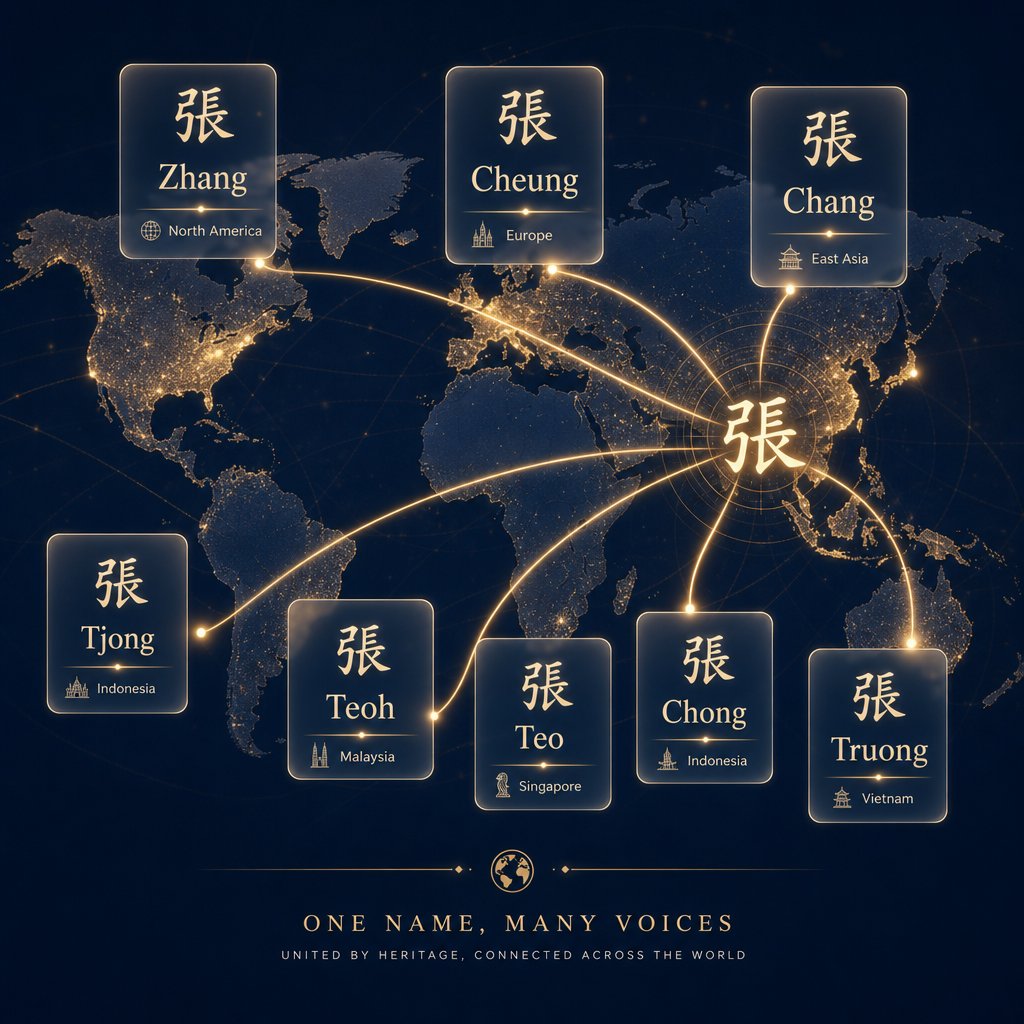
Here's a complication that catches even experienced professionals off guard. You might see "Zhang" on one colleague's email and "Chang" on another's — and they're the same surname. The difference isn't a typo. It's a different romanization system.
Pinyin became the international standard in the 1980s, but before that, the dominant system was Wade-Giles, developed in the 19th century. Many Chinese people — especially those from Taiwan, older diaspora communities, or families who emigrated before pinyin's adoption — still use Wade-Giles or other legacy spellings. According to the Library of Congress Pinyin Conversion Project, you can often distinguish the two systems by looking for specific markers: Wade-Giles uses apostrophes to indicate aspiration (like "Ch'en") and hyphens in given names (like "Tse-tung"), while pinyin joins syllables together and never uses apostrophes for aspiration.
The most common surname variations you'll encounter:
- Zhang (pinyin) = Chang (Wade-Giles) — both sound like "jahng"
- Xu (pinyin) = Hsu (Wade-Giles) — both sound like "shü"
- Xie (pinyin) = Hsieh (Wade-Giles) — both sound like "shee-eh"
- Zhou (pinyin) = Chou (Wade-Giles) — both sound like "joe"
- Zhu (pinyin) = Chu (Wade-Giles) — both sound like "joo"
- Qian (pinyin) = Ch'ien (Wade-Giles) — both sound like "chee-en"
Wade-Giles actually makes some sounds more intuitive for English speakers — "Hsu" hints at the "sh" onset more clearly than "Xu" does, and "Chang" at least starts with a "ch" sound rather than the misleading "Zh." But pinyin is more systematic and consistent once you learn its rules, which is why it became the global standard.
When you encounter chinese letters for names that look unfamiliar — especially spellings with apostrophes, "hs" combinations, or hyphens between given-name syllables — you're likely looking at Wade-Giles or another legacy system. The pronunciation is the same regardless of which romanization was used. "Hsieh" and "Xie" are the same name, the same sound, just written through different lenses. Recognizing this prevents the embarrassing moment of treating two colleagues with the same surname as if they have different names simply because one uses pinyin and the other uses an older spelling.
Surnames give you a reliable anchor point — a known quantity you can nail with confidence. But the given name that follows is where the real variety lives, drawing from a much wider pool of syllables and combinations that surnames rarely use.
Given Name Syllables English Speakers Encounter Most
Surnames repeat. The same handful of Wangs, Lis, and Zhangs appear across every department and conference roster. Given names, though, pull from a much wider inventory of sounds. This is where pronouncing chinese names gets genuinely difficult, because you can't rely on a short memorized list. A given name might combine any two syllables from Mandarin's full phonetic range — and many of those syllables never appear in common surnames.
The good news: certain given-name syllables show up far more often than others. Chinese parents draw from a pool of characters chosen for their ming meaning — brightness, strength, beauty, ambition — and those aspirational characters cluster around a predictable set of sounds. Learn the twenty or so most frequent syllables, and you'll be able to handle the majority of given names you encounter.
High-Frequency Given Name Syllables
Rather than listing these alphabetically, grouping them by sound similarity makes memorization faster. If you know how to say one syllable in a group, the others follow the same vowel pattern.
- "Ee" vowel group: Wei ("way"), Mei ("may"), Fei ("fay"), Lei ("lay") — all use the "ei" combination that sounds like English "ay"
- "Ing" ending group: Ming ("ming" as in English "sing" with an "m"), Jing ("jing"), Ying ("ying"), Ling ("ling") — these rhyme with English "-ing" words
- "An/en" ending group: Yan ("yen"), Lan ("lahn"), Fang ("fahng"), Wen ("wuhn") — open vowels followed by nasal endings
- "Oo/ü" vowel group: Jun ("jwen"), Yun ("ywen"), Rui ("rway") — these use rounded vowels that English speakers often flatten
- "Ah/ow" vowel group: Hao ("how" as in "how are you"), Tao ("dow" rhyming with "cow"), Hua ("hwah") — open, broad sounds
- Tricky-consonant group: Xin ("shin"), Qi ("chee"), Zhi ("jr" with a retroflex buzz), Yi ("ee"), Jie ("jee-eh") — these require the consonant substitutions from earlier sections
Notice how many of these syllables carry specific character meanings that parents choose deliberately. Ming can mean "bright" or "brilliant." Wei can mean "great" or "mighty." Jing can mean "quiet" or "crystal." If you're curious about how do you say name in chinese, the answer is "mingzi" — and that same syllable "ming" appears in countless given names precisely because of its positive connotations. According to Berlitz's guide to Chinese names, characters like Wei, Ming, Jing, and Hua rank among the most commonly selected for given names across generations.
Reading Two-Syllable Given Names Smoothly
Most Chinese given names have two syllables. And here's where English speakers often stumble — not on individual sounds, but on rhythm. You decode each syllable correctly, then deliver them as two separate, choppy units with an awkward gap between them. The name sounds robotic rather than natural.
Imagine someone pronouncing "Christina" as "Chris... Tina" with a full stop in the middle. Technically correct, but it sounds strange. The same principle applies to how to pronounce a chinese name with two syllables. "Xiaoming" should flow as one word, not "Xiao... Ming" with a pause.
The key to natural delivery involves stress and connection:
- Stress is nearly even. Unlike English names where one syllable dominates ("chrisTIna"), Chinese given names distribute weight more equally. In casual speech, the second syllable may carry slightly more emphasis, but the difference is subtle.
- Connect through the vowel. Let the ending sound of the first syllable flow directly into the consonant of the second. In "Junwei," the "n" of Jun leads straight into the "w" of Wei without a breath break.
- Maintain consistent speed. Don't slow down between syllables. Say both at the same pace you'd use for a two-syllable English word like "sunset."
Here's what the difference sounds like in practice when you try to how to say chinese names naturally:
| Name | Stilted (Avoid This) | Natural (Aim for This) |
|---|---|---|
| Xiaoling | "SHEE-ow ... LING" (pause, uneven stress) | "shee-ow-ling" (smooth, even pace) |
| Junwei | "JWEN ... WAY" (two separate words) | "jwen-way" (one fluid unit) |
| Huaming | "HWAH ... MING" (choppy) | "hwah-ming" (connected, like "humming" with different vowels) |
| Zhiyuan | "JR ... YOU-EN" (halting) | "jr-you-en" (three sounds, one motion) |
The faculty and student names listed by ASU's School of International Letters and Cultures illustrate this perfectly. Names like Jianling, Xiaoqiao, and Zhaokun all contain two given-name syllables that native speakers deliver as single fluid units. Listening to their audio recordings reveals how smoothly those syllables connect — no gaps, no dramatic stress shifts, just even-paced flow.
A practical trick: before saying a two-syllable given name out loud, say it silently in your head at full speed first. This primes your mouth to deliver it as one unit rather than two isolated pieces. How do you pronounce chinese names with confidence? The same way you'd say any unfamiliar two-syllable word — commit to the whole thing at once rather than tiptoeing through it one piece at a time.
Getting the syllables right and connecting them smoothly handles the segmental side of pronunciation — the consonants, vowels, and rhythm. But Mandarin has another layer that sits on top of all these sounds, shaping meaning in ways that English never does: tones.

Why Tones Matter Even If You Cannot Master Them
You've decoded the consonants, mapped the vowel combinations, and connected the syllables into smooth units. At this point, you're already pronouncing Chinese names far more accurately than most English speakers ever will. But there's a dimension of Mandarin that sits invisibly above all those sounds — pitch. Mandarin is a tonal language, meaning the melody you apply to a syllable changes its meaning entirely. And yes, this applies to names too.
Should you panic about this? No. Should you ignore it? Also no. Tones occupy a middle ground for English speakers encountering Chinese names: you probably won't nail them from reading an article, but understanding that they exist — and listening for them — signals genuine respect.
How Tones Change Name Meanings
In English, pitch conveys emotion or emphasis. You raise your voice at the end of a question. You drop it for a firm statement. But the word itself doesn't change meaning based on pitch. Mandarin works differently. The tonal definition that matters here is straightforward: a tone is a fixed pitch pattern attached to every syllable that determines which word that syllable represents.
The classic tone examples use the syllable "ma." Spoken with a high, flat pitch, ma means "mother." With a rising pitch, it means "hemp." With a low, dipping pitch, it means "horse." With a sharp falling pitch, it means "to scold." Same consonant, same vowel, four completely different words. As ThoughtCo's guide to Mandarin tones explains, tones are necessary to differentiate words because several characters share the same base sound.
This matters for names because Chinese given names are chosen for the meaning of their characters — and tone determines which character a syllable represents. The syllable "wei" with a falling tone can mean "great" or "mighty" (伟). With a rising tone, it can mean "to surround" (围). A person named Wei chose — or was given — a specific character with a specific tone and a specific meaning. When you flatten all tones into monotone English delivery, you erase that distinction.
The British Council illustrates this vividly with a name example: if a man's family name is Yang (杨) and his given name is Wei (偉), the name literally means "Great Yang." But the pronunciation of 杨偉 is identical to 阳痿 (yangwei), which means "impotence" — a different set of characters with the same pinyin spelling but different tone words. Chinese parents actually check for these tonal collisions before finalizing a name, precisely because tone determines meaning so completely.
For English speakers, the practical takeaway is this: two colleagues might both have names spelled "Li Wei" in pinyin, yet carry entirely different characters and meanings depending on which tones their parents selected. You won't see those tones on a business card or email signature — pinyin in professional contexts rarely includes diacritical marks — but they exist underneath the spelling.
A Practical Approach to Tones for Non-Speakers
Here's the honest truth: you will not master Mandarin tones from reading this section. Tones require extensive listening practice, feedback from native speakers, and time. According to Hacking Chinese's comprehensive tone guide, learning to hear and produce tones as an adult "takes time but with the right methods and resources, you can do it" — though the guide is aimed at dedicated language learners investing months or years of study.
You're not trying to become fluent. You're trying to say a colleague's name respectfully. So here's a realistic strategy that works:
Step one: get the consonants and vowels right. This is where your effort pays the highest dividend. A name pronounced with correct consonants and vowels but flat tone will still be recognized immediately. A name with wrong consonants won't be recognized regardless of tone.
Step two: know the four tones exist. Mandarin has four pitched tones plus a neutral (unstressed) tone. You can define tone in Mandarin using simple English analogies:
- First tone (flat, high): Like the sound you make when a doctor asks you to say "aah" — steady, level, held at a consistent high pitch
- Second tone (rising): Like the pitch of a one-word question — "What?" or "Huh?" — starting mid-range and climbing up
- Third tone (low/dipping): Like a drawn-out, skeptical "well..." that drops low before slightly rising at the end
- Fourth tone (falling): Like a sharp command — "Stop!" or "No!" — starting high and dropping firmly to the bottom
In written pinyin, these tones are indicated by diacritical marks above the vowel: a macron for first tone (ā), an acute accent for second (á), a caron for third (ǎ), and a grave accent for fourth (à). You'll rarely see these marks in everyday professional contexts, but they appear in dictionaries, language-learning materials, and some formal documents.
Step three: listen when someone says their own name. This is the most powerful move available to you. When a Chinese colleague introduces themselves, pay attention not just to the sounds but to the melody — the rise and fall of pitch across each syllable. That melody is the tone. You may not reproduce it perfectly, but even a rough approximation shows you're paying attention to something most English speakers never notice.
Getting the consonants and vowels right puts you ahead of 90% of English speakers — tones are the next level of respect.
The effort itself communicates something. When you listen carefully, attempt the pitch pattern, and show awareness that tones exist, you're signaling that you see this person's name as worth getting right — not just a string of letters to approximate carelessly. That awareness, even imperfect, matters far more than flawless execution delivered without thought.
Tones round out the phonetic picture. You now understand the structure of Chinese names, the consonant and vowel rules that govern their sounds, and the tonal layer that sits on top. What remains is putting all of these pieces together into a single, repeatable method you can apply to any name you encounter — along with the cultural etiquette that makes the whole effort land well.

Your Step-by-Step Method for Any Chinese Name
You have the individual pieces: name structure, consonant rules, vowel combinations, common surnames, given-name syllables, and tonal awareness. Separately, they're useful. Together, they form a repeatable chinese pronunciation guide you can apply to any name that lands in your inbox, appears on a conference badge, or shows up in a research paper. Here's how to combine everything into a single workflow — plus the social skills that make the effort count.
A Five-Step Method for Any Chinese Name
Imagine you've just received a meeting invite from someone named Zheng Xiuying. You've never seen this name before. Here's exactly how to decode it:
- Identify surname vs. given name. The first syllable is almost always the surname. "Zheng" is a common single-syllable surname. "Xiuying" is the two-syllable given name.
- Break into individual syllables. Look for consonants that start new sound units. You have three syllables: Zheng / Xiu / Ying.
- Decode consonants using the tricky-sound rules. Zh = "j" as in "judge" (tongue curled back). X = "sh" with tongue forward. Y = same as English.
- Decode vowel combinations. "eng" = "uhng" (like "sung" without the s). "iu" = "yo" (the hidden vowel shortcut). "ing" = same as English "-ing."
- Say it at natural speed. Connect the syllables without pausing: "juhng shyo-ying." Deliver it as one fluid name, not three isolated chunks.
That's it. Five steps, applicable to any name. The first few times you run through this chinese language pronunciation guide mentally, it might take thirty seconds. After a dozen names, the pattern recognition becomes automatic — you'll spot the Zh and think "j" without consciously recalling the rule.
The method works because pinyin is consistent. Unlike English, where "ough" produces five different sounds depending on the word, pinyin's rules never change. Once you know that X always means "sh-forward" and "iu" always sounds like "yo," those facts hold for every name you'll ever encounter. No exceptions to memorize, no irregular spellings to trip over.
How to Ask About Pronunciation Respectfully
Even with a solid decoding method, there will be names that stump you — unusual syllable combinations, ambiguous name order, or simply a moment where you're not confident enough to commit. In those situations, asking is always better than guessing or avoiding the name entirely.
The key is framing your question as effort, not ignorance. Try these approaches:
- "I want to make sure I say your name correctly — could you help me with the pronunciation?"
- "I've been practicing your name but I'd love to hear you say it so I can get it right."
- "Would you mind saying your name for me? I want to pronounce it properly."
As The Muse's guide to name pronunciation etiquette emphasizes, people with frequently mispronounced names generally appreciate being asked directly — what they don't appreciate is "Whoa, not even going to try" or having their name avoided altogether. The effort signals respect. The avoidance signals indifference.
When you do mispronounce — and you will — correct yourself briefly and move on. "Sorry — Xiuying, right?" is far better than an extended apology that makes the moment awkward for everyone. A quick, graceful correction shows you're paying attention without turning the interaction into a spectacle about your discomfort.
For situations where you can't ask directly — preparing for a presentation, reading a paper, or joining a meeting with someone you haven't met — your five-step method handles the decoding. If you want additional confirmation, sites like howtopronounce.com let you search names and hear audio recordings from real speakers, which can validate your decoded pronunciation or reveal nuances you missed.
Building Confidence With Practice
Knowing the rules intellectually and producing the sounds confidently are two different things. The gap between them closes with practice — but that practice doesn't require enrolling in a Mandarin course. A few targeted habits build fluency quickly:
- Use audio tools actively. When you encounter a new name, look it up on a chinese name pronunciation tool like Forvo, YouGlish, or a pronounce dict resource that offers native-speaker recordings. Hearing the name spoken aloud anchors your mental model far more effectively than reading phonetic approximations alone. Chinese language pronunciation audio gives you the melody and rhythm that text can't convey.
- Practice with willing colleagues. If you work with Chinese colleagues, most will happily say their name for you multiple times if you explain you're genuinely trying to learn. This isn't imposing — it's flattering. Ask once, listen carefully, repeat it back, and ask if you're close.
- Start with the names you encounter most. Don't try to master every possible pinyin syllable at once. Focus on the five or ten Chinese names in your actual professional life. Getting those right builds muscle memory and confidence that transfers to new names later.
- Accept "close enough" delivered with respect. Your pronunciation will never be identical to a native speaker's. That's fine. The goal isn't perfection — it's demonstrating that you see someone's name as worth the effort. An approximate pronunciation delivered with genuine care lands far better than either a mangled guess or an awkward avoidance.
Resources like the Chinese Pronunciation Wiki Pinyin Chart let you hear every possible syllable with all four tones — useful when you want to pronounce chinese words audio-first rather than guessing from spelling alone. Bookmark one of these tools and use it as your go-to reference whenever a new name appears.
The entire approach outlined in this article — from structure to consonants to vowels to tones to this five-step method — is really about one thing: treating someone's name as worthy of your attention. You don't need to speak Mandarin. You don't need perfect tones. You need the willingness to learn how to pronounce names in english contexts when those names come from a different phonetic system, and the humility to ask when you're unsure. That combination — knowledge plus respect — is what transforms a name from an obstacle into a connection.
Frequently Asked Questions About Pinyin Name Pronunciation
1. Why does pinyin not follow English pronunciation rules?
Pinyin was created in the 1950s to help Chinese citizens learn standard Mandarin pronunciation using Latin letters. It was never designed for English speakers. Letters like X, Q, and C were repurposed to represent Chinese sounds that have no direct English equivalent. For example, X represents a forward 'sh' sound, Q represents a forward 'ch' sound, and C represents a 'ts' sound like the ending of 'cats.' The system is internally consistent — each spelling always produces the same sound — but those sounds follow Mandarin phonetic rules rather than English ones.
2. How do you pronounce X, Q, and Zh in Chinese names?
X sounds like a soft 'sh' with the tongue positioned forward near the teeth — imagine whispering the word 'she.' Q sounds like 'ch' in 'cheese' with the tongue pushed forward, not 'kw' as in 'queen.' Zh sounds like the 'j' in 'judge' with the tongue curled back. So the surname Xu sounds like 'shoo,' Qian sounds like 'chee-en,' and Zhang sounds like 'jahng.' These three substitutions alone resolve the majority of consonant errors English speakers make with Chinese names.
3. What is the correct order of a Chinese name?
In Chinese naming convention, the family name (surname) comes first and the given name follows. For example, in Wang Xiaoming, Wang is the surname and Xiaoming is the given name. Most Chinese surnames are a single syllable, while given names are typically one or two syllables. However, in Western professional contexts, some Chinese people reverse the order to match local conventions, so Wei Liu might actually be surname Liu, given name Wei. When uncertain, it is respectful to ask which part is the family name.
4. Why do some Chinese surnames have different spellings like Zhang and Chang?
Different spellings often represent the same surname romanized through different systems. Pinyin became the international standard in the 1980s, but the older Wade-Giles system remains common among people from Taiwan, older diaspora communities, or families who emigrated before pinyin's adoption. Zhang (pinyin) and Chang (Wade-Giles) both sound like 'jahng.' Similarly, Xu and Hsu both sound like 'shoo,' and Zhou and Chou both sound like 'joe.' The pronunciation is identical regardless of which romanization system was used.
5. Do I need to learn Mandarin tones to pronounce Chinese names correctly?
You do not need to master tones to pronounce a name recognizably. Getting the consonants and vowels right is the highest-impact step and will make the name immediately identifiable to its owner. However, being aware that tones exist shows cultural respect. Mandarin has four tones — flat, rising, dipping, and falling — and the same syllable with different tones represents entirely different characters and meanings. A practical approach is to focus on accurate consonants and vowels first, then listen carefully when a Chinese person says their own name to pick up the tonal melody.