Why Your Chinese Name Looks Different Across Systems
Imagine handing over your passport at an airport counter, only to have the officer frown because the name on your birth certificate does not match. Not because you changed it, but because one document spells your surname "Wong" and the other says "Wang." Same Chinese character. Same family. Two completely different romanizations. This is the everyday reality for millions of people navigating pinyin vs jyutping names across borders, institutions, and official records.
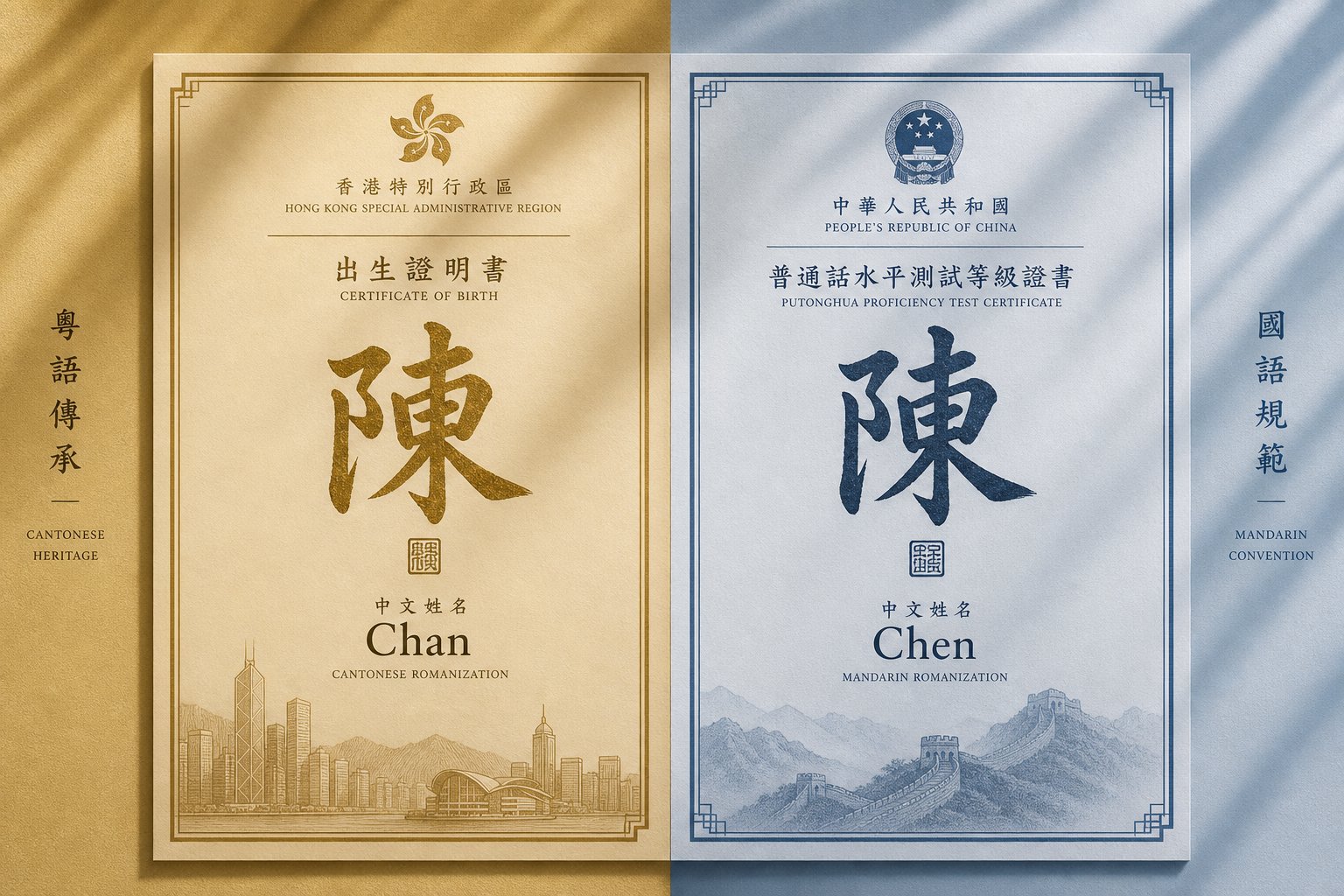
The character 王 is pronounced "Wang" in Mandarin and "Wong" in Cantonese. The character 陳 becomes "Chen" in Pinyin and "Chan" in Cantonese romanization. These are not errors or typos. They reflect two distinct spoken languages using different systems to represent the same written Chinese characters in the Latin alphabet. In territories with a sizeable Chinese diaspora, the way a family name is spelled often signals the region a person's ancestors come from, whether that is Guangdong province, Hong Kong, Taiwan, or northern China.
Why the Same Name Looks Different in Mandarin and Cantonese
The root of the confusion is straightforward: Mandarin and Cantonese are different spoken languages that share a written script. Mainland China uses Hanyu Pinyin as its official romanization system for Mandarin, while Cantonese speakers in Hong Kong and the diaspora rely on systems like jyutping (粤拼) or older government conventions. Each system maps sounds to letters differently because the sounds themselves are different. Cantonese has six tones compared to Mandarin's four, and many characters carry entirely different pronunciations across the two languages. A person named 張 is "Zhang" in Pinyin but "Cheung" in common Cantonese spelling. Neither is wrong. They simply reflect different linguistic realities.
The romanization system you choose for your name is more than a spelling preference. It signals regional heritage, cultural identity, and linguistic community to everyone who reads it.
What This Ranked Guide Covers
This guide ranks the major romanization systems specifically for personal names, comparing their strengths and limitations for passports, academic records, business cards, and digital databases. You will find detailed reviews of Hanyu Pinyin, jyutping, Yale romanization, and legacy Hong Kong government systems, along with a side-by-side comparison of the top 20 Chinese surnames across every system. Whether you are a Cantonese speaker deciding how to romanize your name on a new passport, a bilingual professional managing documents in both systems, or someone trying to understand why your family's name looks different depending on which country issued the paperwork, this guide provides the clarity you need to make an informed choice.
The question is not which system is universally "correct." It is which system best represents your name, your pronunciation, and your identity in the contexts that matter most to you.
How We Ranked These Romanization Systems for Names
Romanizing a word in a textbook is one thing. Romanizing a person's legal name is something else entirely. A textbook spelling can be revised in the next edition. A name on a passport follows you through immigration checkpoints, bank accounts, university transcripts, and employment records for decades. That permanence demands a different set of standards when evaluating which cantonese romanization or Mandarin system performs best for personal names.
Evaluation Criteria for Name Romanization
To compare these systems fairly, we scored each one against five criteria that matter most when cantonese letters or Mandarin syllables become a person's official identity:
- Official recognition on government documents - Is the system accepted or required on passports, national IDs, and civil records? A system with government backing reduces friction at borders and in legal proceedings.
- Phonetic accuracy for the target dialect - Does the romanization of cantonese or Mandarin actually reflect how the name sounds when spoken? A system that distorts pronunciation undermines the core purpose of romanization.
- International readability - Can someone unfamiliar with Chinese languages read the romanized name and produce a reasonable approximation of the sound? This affects everything from conference introductions to customer service calls.
- Consistency across contexts - Does the system produce the same spelling every time, regardless of who applies it? Ambiguous rules lead to one person holding documents with multiple conflicting spellings.
- Practical usability for data matching and record-keeping - Can databases, search engines, and administrative systems reliably link records that use this romanization? Inconsistent or overly complex spellings create matching failures that cause real problems in banking, immigration, and academic publishing.
Why Names Require Different Standards Than General Text
When you romanize a sentence for a language lesson, small inconsistencies are tolerable. A student can look up the character and move on. Names do not get that flexibility. Your romanized name must remain identical across your passport, your diploma, your published research, your business card, and your airline booking. A single discrepancy, say "Cheung" on one document and "Zoeng" on another, can trigger identity verification failures that delay visa applications or freeze financial accounts.
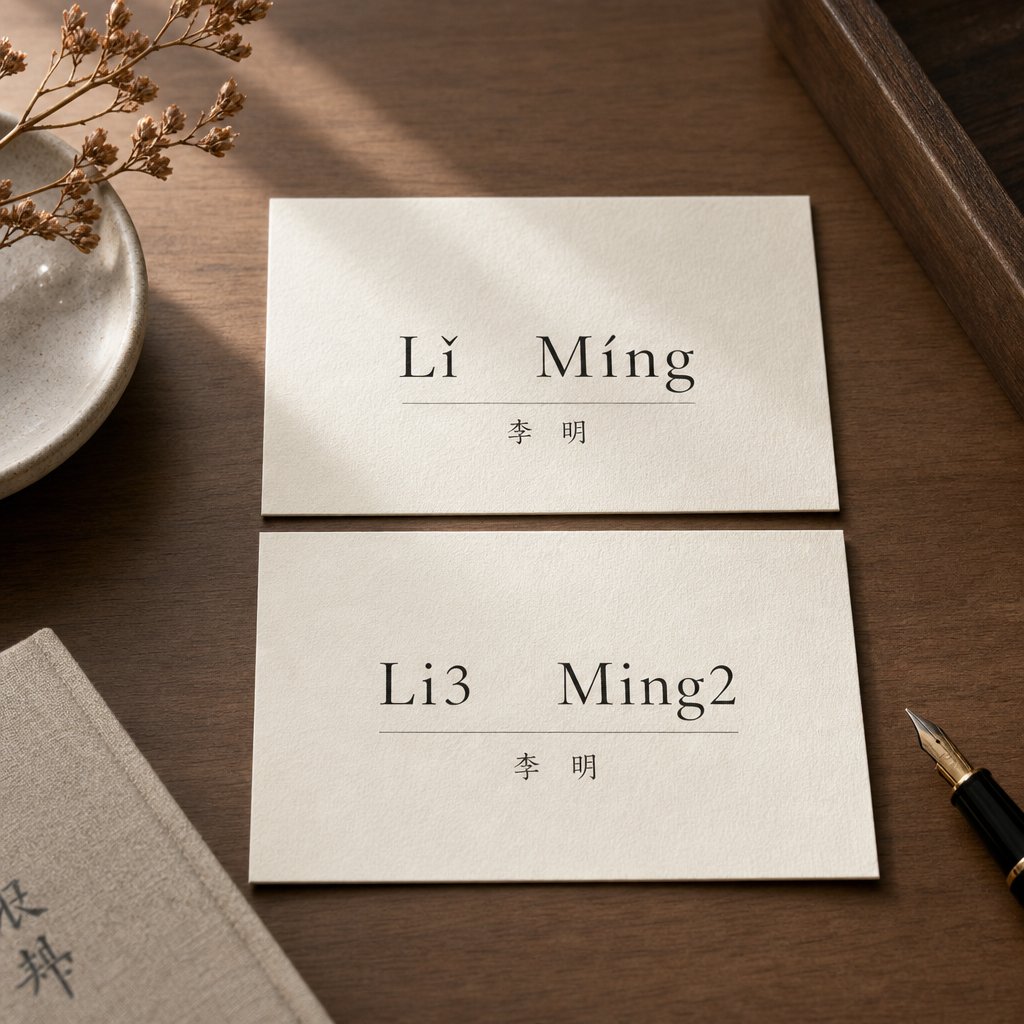
Tone representation adds another layer of complexity. Mandarin operates with 4 tones plus a neutral tone, while Cantonese uses 6 distinct tones. Systems like Jyutping append tone numbers (1 through 6) after each syllable, while Pinyin uses diacritical marks above vowels. In practice, though, tone markers are almost universally dropped from personal names on official documents. Taiwan's Guidelines for Transliteration of Chinese specify Hanyu Pinyin for name romanization but allow individual choice to override standard rules, reflecting how personal and contextual these decisions are.
This means the systems we evaluate are not just linguistic tools. They are identity infrastructure. The right system balances phonetic faithfulness with the practical reality that your name needs to work the same way in a Hong Kong immigration queue, a London HR database, and a Canadian university registrar's office. Each system handles that balance differently, and those differences become clear when we examine them one by one, starting with the global standard for Mandarin.
Hanyu Pinyin - The Global Mandarin Standard
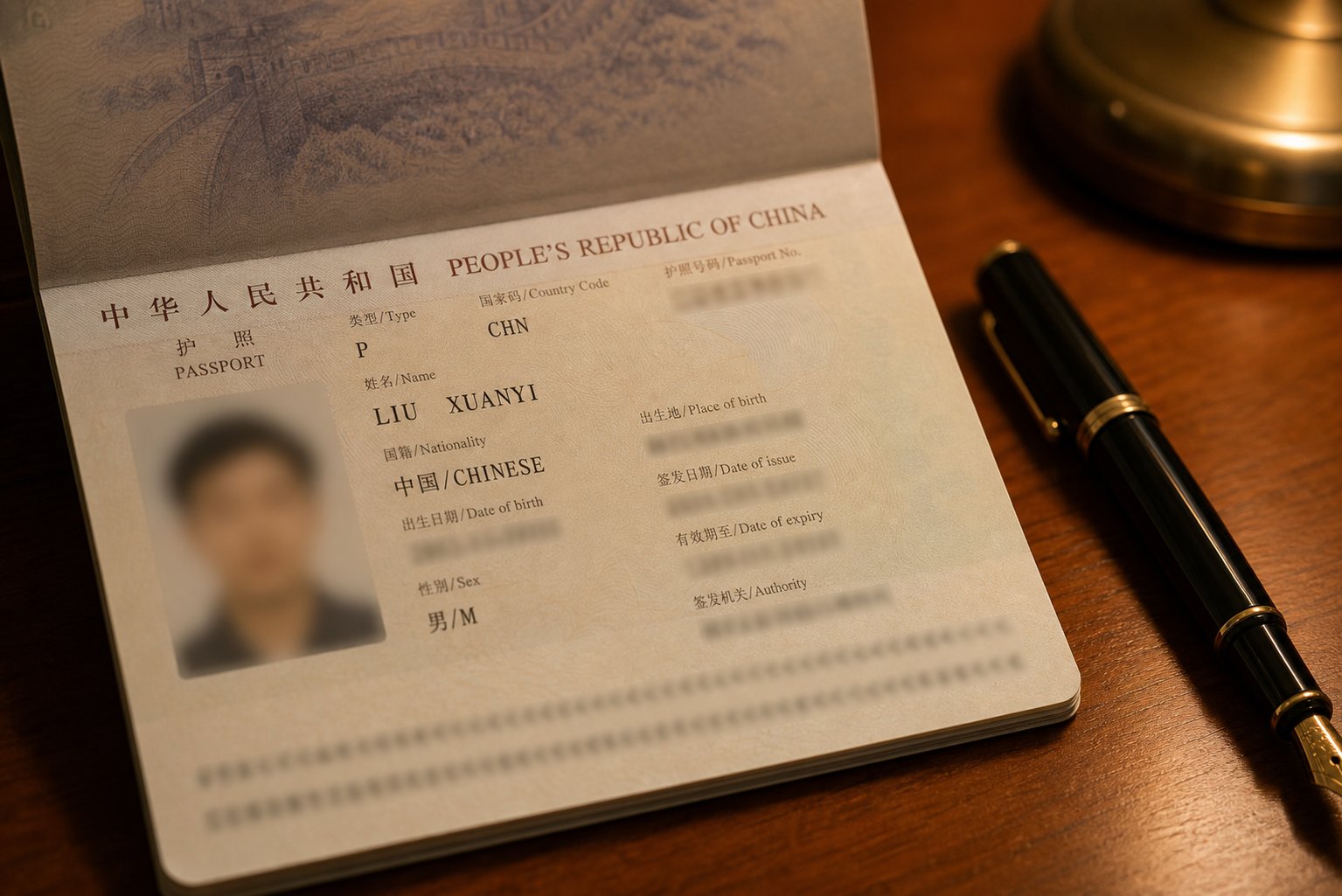
Hanyu Pinyin is the romanization system most people encounter first. Developed in the 1950s by Chinese linguists and officially adopted by the People's Republic of China in 1958, it has since become the international default for representing Mandarin Chinese in Latin letters. The United Nations adopted it in 1986, and the International Organization for Standardization codified it as ISO 7098. When you see surnames like Li, Zhang, Wang, or Chen on international news, academic journals, or diplomatic documents, you are reading Pinyin.
That level of institutional backing makes Pinyin the most widely recognized romanization system in the world for Chinese. But recognition and suitability are not the same thing, especially when it comes to personal names.
How Pinyin Formats Personal Names
Pinyin follows specific structural rules for names that differ from how it handles general text. Taiwan's Ministry of Education guidelines lay out the conventions clearly:
- The surname comes first, followed by the given name, with no comma between them.
- Only the initial letter of each part is capitalized. The rest stays lowercase.
- Given name syllables are written together without a space. For example, 陳志明 becomes "Chen Zhiming," not "Chen Zhi Ming."
- If the second syllable of a given name begins with a, o, or e, an apostrophe separates it from the first syllable to prevent misreading.
- Tone diacritics (marks above vowels indicating Mandarin's 4 tones) are part of the formal system but are almost universally dropped on passports, IDs, and official records.
That last point matters more than it might seem. Pinyin without tone marks loses a layer of phonetic specificity. Two characters with identical consonants and vowels but different tones become indistinguishable in writing. Research from University College London found that removing tonal information from Pinyin reduced the number of unique name representations in a dataset, making it harder to distinguish between different individuals during data linkage.
Pinyin Strengths and Limitations for Names
Pros
- International recognition - Accepted by the UN, ISO, and virtually every government and institution worldwide. A Pinyin-spelled name requires no explanation in most contexts.
- Official ISO standard - Provides a single, codified set of rules, reducing ambiguity in how any given character should be spelled.
- Simpler tone system - Mandarin's 4 tones (plus neutral) are easier to notate than Cantonese's 6, even when tone marks are included.
- No-space given names - Joining given name syllables reduces the risk of characters being misplaced into separate database fields, a common problem with systems that space out each syllable.
Cons
- Cannot represent Cantonese pronunciation - Pinyin maps Mandarin sounds only. Using pinyin for cantonese names forces a Mandarin reading onto characters that the name-holder pronounces entirely differently.
- Limited to 4 tones - Even with diacritics, Pinyin cannot capture the tonal distinctions of Cantonese. How many tones does Cantonese have? Six, each carrying meaning that Pinyin's four-tone framework simply cannot encode.
- Creates identity mismatch for Cantonese speakers - A Hong Kong native whose family has always pronounced 黃 as "Wong" would be forced into "Huang" under standard Cantonese Pinyin conventions from the mainland, erasing their spoken identity on paper.
- Tone marks routinely dropped - In practice, official documents strip diacritics, leaving Pinyin less phonetically precise than its design intends.
Where Pinyin Falls Short for Cantonese Speakers
The core limitation is simple: Pinyin was built for Mandarin. It does exactly what it was designed to do, and it does it well. But applying it to a Cantonese name is like using a French pronunciation guide for a Spanish word. The letters might look plausible, but the sound they produce is wrong.
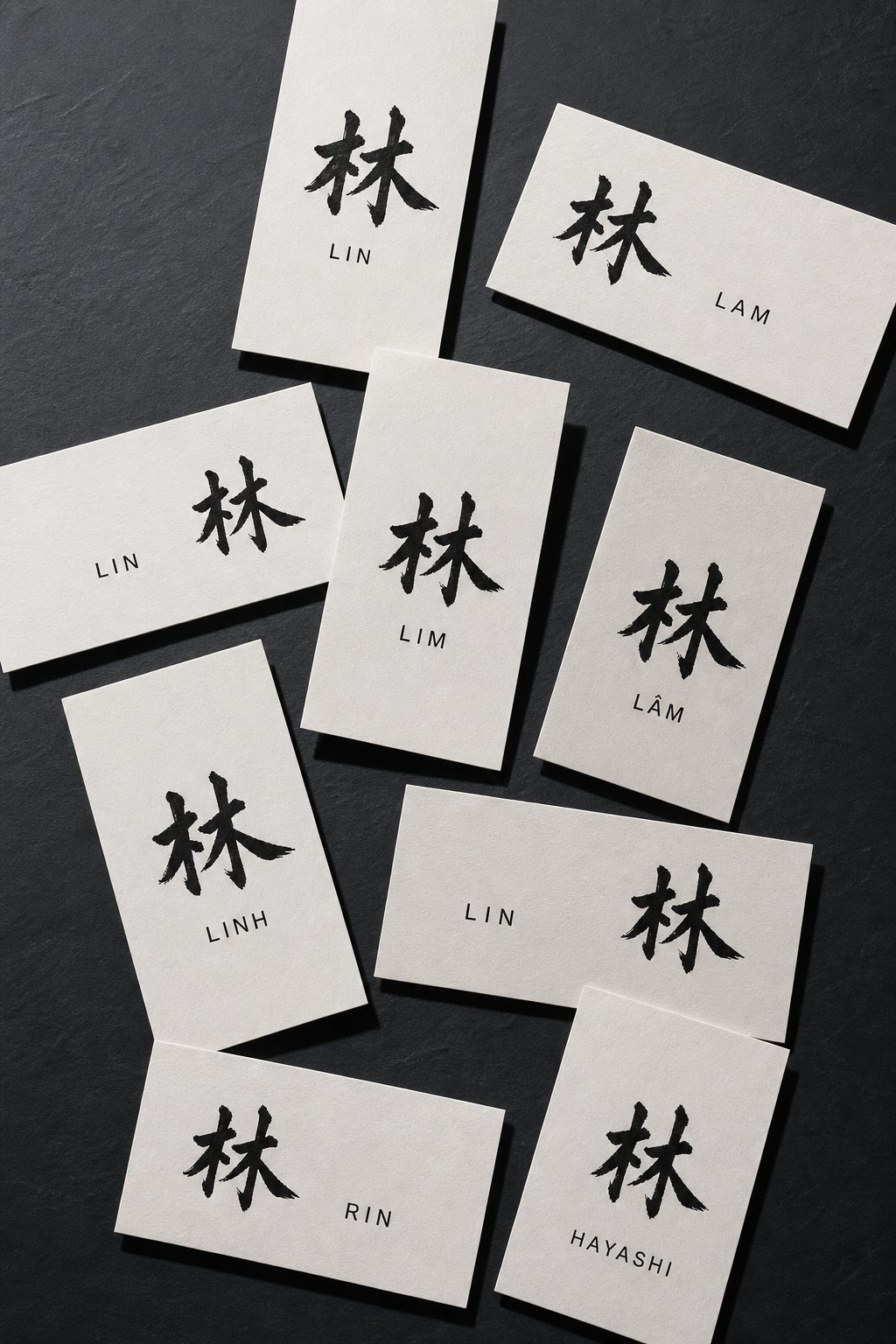
Consider the surname 林. In Mandarin, it is "Lin." In Cantonese, it is "Lam." A Cantonese speaker named Lam who is forced to use Pinyin on an international document becomes "Lin," a name they do not recognize as their own and that their family has never used. Multiply this across millions of Cantonese speakers in Hong Kong, Macau, Guangdong, and diaspora communities worldwide, and you see why a Mandarin-only system cannot serve as a universal solution for Chinese name romanization.
This gap is precisely what motivated the development of a dedicated Cantonese standard, one designed from the ground up to handle six tones, distinct initial consonants, and the specific phonetic inventory that Mandarin-based systems ignore.
Jyutping - The Modern Cantonese Standard
Where Pinyin was designed for Mandarin speakers, Jyutping (粵拼) was built specifically for Cantonese. Developed in 1993 by the Linguistic Society of Hong Kong (LSHK), it addresses the exact problem the previous section raised: Cantonese speakers need a romanization system that reflects their actual pronunciation, not a Mandarin approximation of it. The name itself is a contraction of 粵語拼音 (jyut6 jyu5 ping3 jam1), literally meaning "Cantonese phonetic alphabet."
Unlike the patchwork of informal conventions that developed over decades in Hong Kong, Jyutping follows a single, consistent set of rules. Every Cantonese syllable maps to one and only one spelling. Every spelling maps back to one and only one sound. That one-to-one correspondence is what makes it a true standard rather than a collection of habits.
How Jyutping Represents Cantonese Names
The system's structure is straightforward. Each syllable is spelled using an initial consonant (or none), a vowel nucleus, an optional final consonant, and a tone number from 1 to 6 placed at the end. No diacritics, no special characters, just standard Latin letters and a single digit.
Here is how some of the most common Cantonese surnames look in Jyutping compared to their Pinyin equivalents:
| Chinese Character | Jyutping | Pinyin | Common HK Spelling |
|---|---|---|---|
| 黃 | Wong4 | Huang2 | Wong |
| 陳 | Can4 | Chen2 | Chan |
| 林 | Lam4 | Lin2 | Lam |
| 王 | Wong4 | Wang2 | Wong |
| 李 | Lei5 | Li3 | Lee |
| 張 | Zoeng1 | Zhang1 | Cheung |
Notice something interesting: 黃 and 王 share the same Jyutping pronunciation (Wong4) but have completely different Pinyin spellings (Huang and Wang). This reflects a real feature of Cantonese phonology, not a flaw in the system. Both characters genuinely sound identical in spoken Cantonese, and Jyutping honestly represents that. The tone number "4" tells you both carry a low-falling tone, which is information that older Hong Kong government spellings discard entirely.
For given names, each character gets its own Jyutping syllable separated by a space. A name like 志明 becomes "Zi3 Ming4" rather than being joined together as Pinyin would do ("Zhiming"). This character-by-character separation makes the system transparent but does introduce the name-order issues that affect database matching, a tradeoff worth understanding.
Jyutping Strengths and Limitations for Names
Pros
- Phonetically precise for Cantonese - Every Cantonese sound has exactly one spelling. The character 周 is always "Zau1" in Jyutping, whereas Hong Kong government romanization might render it as "Chow," "Chau," or "Chiau" depending on who filled out the form.
- Handles all 6 tones - Cantonese distinguishes six tones that change meaning. Jyutping captures each one with a simple number suffix, preserving phonetic information that other systems lose.
- No ambiguous spellings - Research on Chinese name data linkage found that Jyutping represented the same characters consistently across all records, while Hong Kong government romanization produced multiple different codes for identical characters. In a study of 771 Hong Kong student names, Jyutping and Pinyin both achieved over 95% recall in surname-blocking strategies, compared to just 68.8% for non-standardized government romanization.
- Growing digital tool support - Jyutping converters and input methods are increasingly available. Python packages like pinyin_jyutping can automatically derive Jyutping from Chinese characters, and open-source dictionaries like CC-Canto provide lookup databases for developers building Cantonese language tools.
Cons
- Less internationally recognized than Pinyin - Outside of Cantonese linguistics circles, most institutions default to Pinyin. Immigration officers, university registrars, and HR systems worldwide are far more familiar with Pinyin conventions.
- Tone numbers unfamiliar to non-linguists - Seeing "Wong4" or "Can4" on a name card can confuse people who do not know what the trailing digit means. In casual contexts, the numbers are often dropped, which removes the very precision that makes the system valuable.
- Not used on Hong Kong government IDs - Despite being the academically recognized standard for Cantonese, Jyutping is not the system used on Hong Kong passports or identity cards. Residents still receive names in the older, non-standardized government romanization.
- Spaces between given name characters - Separating each syllable with a space can cause database systems to misinterpret forename characters as middle names, creating record-matching problems in international contexts.
Jyutping in Academic and Digital Contexts
Even though Hong Kong's Immigration Department has not adopted Jyutping for official documents, the system has gained significant ground in education and technology. Cantonese language courses at universities increasingly teach 粤拼 as the primary romanization method. Wikipedia's Cantonese edition uses it. Digital input tools allow users to type Cantonese by entering Jyutping syllables, making it a practical everyday tool rather than just an academic notation.
The data linkage research is particularly telling. When researchers needed to match Chinese names across databases, standardized systems like Jyutping dramatically outperformed informal romanization. Incorporating tonal information further improved precision, meaning that the tone numbers critics find unfamiliar are exactly what makes the system powerful for record-keeping. A jyutping converter that processes Chinese characters into standardized syllables with tone numbers creates a consistent, searchable representation that ad-hoc spellings simply cannot match.
For Cantonese speakers weighing their options, Jyutping represents the most linguistically accurate way to romanize a name. It captures pronunciation faithfully, eliminates ambiguity, and works well in digital systems designed to handle it. The gap between its academic strength and its absence from government documents is the system's central tension, one that leaves many people caught between the spelling on their ID and the spelling that actually represents how they say their own name.
That tension is not new. Before Jyutping existed, Western academics and language learners relied on a different system entirely, one that prioritized intuitive readability for English speakers over systematic precision.

Yale Romanization - The Academic Legacy System
The system that dominated Cantonese learning in the West for decades was not Jyutping. It was Yale romanization. Developed at Yale University by Parker Huang and Gerald Kok, the Yale romanization system was designed specifically for American students learning Cantonese, with pronunciation cues based on English reading habits. If you picked up a Cantonese textbook published between the 1970s and early 2000s in the English-speaking world, chances are it used Yale. For many learners and academics, cantonese yale romanization was simply the default.
That familiarity came with a design philosophy: make the spellings look intuitive to English readers, even if it meant sacrificing systematic consistency. For general language learning, this tradeoff worked well enough. For personal names, it introduces complications that become harder to ignore.
How Yale Romanization Handles Cantonese Names
Yale represents Cantonese tones using a combination of diacritics (accent marks above vowels) and the letter "h" placed after the vowel to signal low-register tones. A high-level tone gets a macron (e.g., si), a high-rising tone gets an acute accent (e.g., si), and low tones add an "h" (e.g., sih, sih). This approach avoids numbers entirely, which looks cleaner on paper but creates problems in digital environments where diacritics are easily stripped or corrupted.
For surnames, Yale produces spellings that differ from both Jyutping and Hong Kong government romanization. Consider these comparisons:
| Chinese Character | Jyutping | Yale | Common HK Spelling |
|---|---|---|---|
| 陳 | Can4 | Chahn | Chan |
| 黃 | Wong4 | Wohng | Wong |
| 李 | Lei5 | Leih | Lee |
| 張 | Zoeng1 | Jeung | Cheung |
| 林 | Lam4 | Lahm | Lam |
You will notice that Yale uses "h" after vowels in low-tone surnames like 陳 (Chahn) and 李 (Leih). This "h" is not a consonant sound. It is a tone indicator. For someone unfamiliar with the system, seeing "Leih" on a name card gives no obvious clue that the "h" signals pitch rather than pronunciation. In practice, many people drop the diacritics and tone-marking "h" entirely, leaving spellings that overlap with but do not exactly match other systems.
Yale Strengths and Limitations for Names
Pros
- Intuitive for English readers - Vowel and consonant choices align with English pronunciation expectations. A person unfamiliar with Cantonese can look at a Yale spelling and produce a closer approximation than they might with Jyutping's "z" and "c" initials.
- Widely used in older textbooks - Decades of published learning materials use Yale, making it familiar to anyone who studied Cantonese before the mid-2000s.
- Familiar to Western academics - Linguistic papers, dictionaries, and university courses in North America and Europe built their Cantonese resources around yale romanization cantonese conventions for over 30 years.
Cons
- Being phased out in favor of Jyutping - The Linguistic Society of Hong Kong, major Cantonese dictionaries, and digital tools increasingly default to Jyutping. New educational materials rarely adopt Yale as their primary system.
- Diacritics often dropped in practice - Passports, email addresses, and databases cannot reliably handle accent marks. Once diacritics disappear, Yale loses its tone-marking capability entirely, leaving bare spellings with no phonetic advantage over informal romanization.
- Inconsistent digital support - Few modern input methods or converter tools support Yale. Searching for a Yale-spelled name in a database designed around Jyutping or Pinyin produces no match.
- Ambiguous letter-to-sound mapping - The letter "a" in Yale can represent two different vowel sounds (/a/ and /ɐ/) depending on whether the syllable is open or closed. As the Jyutping.org technical analysis explains, this violates the one-symbol-to-one-sound principle and creates confusion when the same letter produces different pronunciations in different positions.
- Cannot represent all Cantonese sounds - Yale merges the vowels /ɵ/ and /œ/ into a single spelling "eu," making it unable to transcribe certain syllables that Jyutping handles without difficulty.
Yale vs Jyutping for the Same Surname
The practical difference comes down to this: yale romanization prioritizes how a name looks to an English reader, while Jyutping prioritizes how precisely the system encodes the sound. "Chahn" feels more readable than "Can4" to someone who has never studied Cantonese. But "Can4" tells a linguist, a database, or a language tool exactly which sound and tone is intended, with zero ambiguity.
For personal names, that ambiguity gap matters. If your surname is spelled "Chahn" on one document and "Chan" on another (because someone dropped the tone-marking "h"), you now have two different spellings of the same name in the same system. Jyutping's numeric tones are either present or absent. They do not get confused with consonants.
Many Cantonese learners still encounter Yale first, especially through older textbooks and dictionaries like the English-Cantonese Dictionary from the New Asia-Yale-in-China Chinese Language Centre. But the linguistic community's direction is clear. Jyutping's consistent one-to-one mapping, its ASCII-friendly design, and its growing ecosystem of digital tools have made it the preferred standard for new Cantonese resources. Yale remains important for reading older academic work, but for name romanization going forward, it occupies a legacy position.
Of course, neither Yale nor Jyutping accounts for the millions of Cantonese names already printed on Hong Kong identity cards and passports, names that follow yet another set of conventions with their own distinct history and their own persistent complications.
Legacy Hong Kong Systems - Sidney Lau and Government Romanization
Here is the uncomfortable truth for millions of Hong Kong residents: the cantonese spelling on your identity card probably does not follow any recognized linguistic standard. Not Pinyin. Not Jyutping. Not Yale. Instead, it follows conventions rooted in a system developed over a century ago, applied inconsistently, and never formally published as a complete specification. If you have ever wondered why your surname is spelled one way on your HKID while a cousin with the same character has a slightly different spelling, you are not dealing with a clerical error. You are dealing with a system that was never fully standardized in the first place.
Sidney Lau and Hong Kong Government Systems Explained
Two legacy systems dominate the cantonese romanised names found on Hong Kong documents, and understanding their origins explains why they behave the way they do.
Sidney Lau romanisation was developed in the 1970s by Sidney Lau to teach Cantonese to British expatriates working in the Hong Kong Government. It built upon the older Standard Romanisation created by James D. Ball and Ernst J. Eitel roughly a century earlier. Lau's innovation was adding superscript tone numbers so learners could distinguish between the six Cantonese tones without diacritics. The University of Hong Kong initially adopted it for Cantonese courses, though the university has since switched to Jyutping.
Hong Kong Government Cantonese Romanisation is the system used by the Registration of Persons Office when assigning romanized names to identity cards. The word "system" deserves quotation marks here. The government has never formally published its romanisation method. Instead, departments consult the Three Way Chinese Commercial/Telegraphic Code Book, originally produced by the Royal Hong Kong Police Force Special Branch in 1971, to determine how characters should be spelled. This code book is devoid of tone indications and, as linguistic researchers have noted, is "grossly simplified" and "susceptible to confusion."
The result? A cantonese romanisation approach that omits all tones, makes no distinction between aspirated and unaspirated consonants, and carries inconsistencies inherited from a time when Cantonese had sound distinctions (like palatal versus alveolar consonants) that no longer exist in modern speech. The character 發 ("to issue") and 佛 ("Buddha") both become "Fat" despite having different vowel lengths. The character 尖 can appear as either "Tsim" or "Chim" depending on which historical convention the clerk followed.
Why Legacy Spellings Persist on Official Documents
If these systems are so inconsistent, why do they remain on millions of documents? The answer is practical inertia. Cantonese spelling on a Hong Kong identity card becomes a person's legal English name. It appears on passports, bank accounts, property deeds, employment contracts, and immigration records across multiple countries. Changing it requires filing an application with the Immigration Department, attending an in-person interview, producing original supporting documents, potentially making a statutory declaration, and paying HK$460 for a replacement card. Even then, the change only affects future documents. Previous records, academic transcripts, published papers, and foreign government files retain the old spelling indefinitely.
For most people, the cost and complexity of changing their romanized name outweighs the benefit. A person whose HKID says "Cheung" is not going to switch to Jyutping's "Zoeng1" when every bank account, professional license, and international visa they hold already uses the legacy spelling. The system perpetuates itself because the switching costs are too high.
Pros
- Already on existing documents - Millions of identity cards, passports, and legal records use these spellings. They are the de facto standard for Hong Kong residents regardless of linguistic accuracy.
- Familiar to Hong Kong residents - People recognize common surname spellings like Chan, Wong, Cheung, Lam, and Lee instantly. These spellings carry decades of social and cultural familiarity.
- No learning curve for current holders - Unlike Jyutping's tone numbers or Yale's diacritics, legacy spellings require no special knowledge to read or write. They function as simple English-like names in everyday use.
Cons
- Inconsistent rules - The same character can produce different spellings depending on which clerk processed the document, which edition of the code book was consulted, or which historical convention was applied. One person's "Tsang" is another's "Cheng" for the same character 曾.
- No official standardization body - Unlike Pinyin (maintained by China's State Language Commission) or Jyutping (maintained by the Linguistic Society of Hong Kong), no organization publishes, updates, or enforces rules for Hong Kong government romanisation.
- Creates data-matching problems - Research on name linkage found that non-standardized Hong Kong romanization achieved only 68.8% recall in surname-blocking strategies, compared to over 95% for both Jyutping and Pinyin. When the same character produces multiple possible spellings, databases cannot reliably connect records belonging to the same person.
- Confusing for international contexts - A person named "Ng" (吳) faces constant mispronunciation abroad because the spelling follows Cantonese phonology that English speakers cannot parse. Similarly, "Tse" (謝) baffles anyone unfamiliar with the convention.
Navigating Identity When Your ID Matches No Standard
The practical reality is this: legacy Hong Kong cantonese romanisation is not going away. It is embedded in the legal identity of an entire population. For people navigating pinyin vs jyutping names in academic or professional contexts, the legacy spelling on their HKID often becomes a third variable they must manage alongside any standardized system they prefer.
Some people maintain their government spelling for legal documents while using Jyutping or Pinyin in academic publications. Others adopt their legacy spelling as their permanent international identity, treating "Chan" or "Wong" as their English name regardless of which system produced it. Neither approach is wrong. Both reflect the messy reality of living between systems that were never designed to work together.
What matters is consistency within each context. Use the same spelling on all legal documents. Use the same spelling across all academic publications. And when systems collide, as they inevitably do at border crossings and in HR databases, be prepared to explain that "Chan" and "Can4" and "Chahn" all point to the same character: 陳. The spelling changed. The person did not.
Seeing these differences in isolation only tells part of the story. The full picture emerges when you line up the same set of surnames across every system simultaneously and observe just how dramatically a single character can fragment into different spellings depending on which convention applies.
Common Surnames Compared Across Every System
Theory only takes you so far. You can read about the differences between Pinyin, Jyutping, Yale, and Hong Kong government romanization all day, but the real picture snaps into focus when you see the same surnames lined up side by side. The table below compares the top 20 most common Chinese surnames across all four systems, revealing just how dramatically a single character can splinter into different spellings depending on which convention applies.
Top 20 Surnames Compared Across All Systems
These 20 surnames represent hundreds of millions of people worldwide. According to China's Ministry of Public Security data, the top five surnames alone (Wang, Li, Zhang, Liu, Chen) account for 30.8% of China's registered population. In Hong Kong, the same characters appear on identity cards with entirely different spellings. Here is how each system handles them:
| Chinese Character | Pinyin | Jyutping | Yale | Common HK Spelling |
|---|---|---|---|---|
| 王 | Wang | Wong4 | Wohng | Wong |
| 李 | Li | Lei5 | Leih | Lee |
| 张 | Zhang | Zoeng1 | Jeung | Cheung |
| 刘 | Liu | Lau4 | Lauh | Lau |
| 陈 | Chen | Can4 | Chahn | Chan |
| 杨 | Yang | Joeng4 | Yeuhng | Yeung |
| 黄 | Huang | Wong4 | Wohng | Wong |
| 赵 | Zhao | Ziu6 | Jiuh | Chiu |
| 吴 | Wu | Ng4 | Ngh | Ng |
| 周 | Zhou | Zau1 | Jau | Chow |
| 徐 | Xu | Ceoi4 | Cheuih | Tsui |
| 孙 | Sun | Syun1 | Syun | Suen |
| 马 | Ma | Maa5 | Mah | Ma |
| 朱 | Zhu | Zyu1 | Jyu | Chu |
| 胡 | Hu | Wu4 | Wuh | Woo |
| 郭 | Guo | Gwok3 | Gwok | Kwok |
| 何 | He | Ho4 | Hoh | Ho |
| 林 | Lin | Lam4 | Lahm | Lam |
| 罗 | Luo | Lo4 | Loh | Lo |
| 高 | Gao | Gou1 | Gou | Ko |
Scan the table and a few patterns jump out immediately. Some surnames look nearly identical across systems (何 is "He" in Pinyin and "Ho" everywhere else). Others are unrecognizable as the same name. Would you guess that "Huang" and "Wong" refer to the same character? Or that "Zhang" and "Cheung" represent the same surname? Without this kind of cantonese to jyutping and Pinyin cross-reference, people searching databases or verifying identities have no reliable way to connect these spellings.
Why the Same Character Produces Different Name Spellings
The divergence is not random. It follows directly from how Mandarin and Cantonese pronounce the same characters differently. Take 吴 as an example. In Mandarin, the initial sound is a "w" glide followed by a vowel, giving us "Wu." In Cantonese, the entire syllable is a nasal consonant with no vowel at all, just "Ng." These are genuinely different sounds produced by different phonological systems. The romanization simply reflects what each language actually does with the character.
The consonant shifts are systematic. Mandarin's "zh" initial (as in Zhang) corresponds to Cantonese's "z" (Zoeng) in cantonese jyutping, which Hong Kong government romanization renders as "Ch" (Cheung). Mandarin's "x" (as in Xu) maps to Cantonese's "c" (Ceoi), which becomes "Ts" (Tsui) in the legacy system. Once you recognize these patterns, the seemingly chaotic spelling differences start to make sense as predictable correspondences between two phonological systems.
Notice also that 王 and 黄 share identical Jyutping (Wong4) and identical HK spellings (Wong), despite being completely different characters with different Pinyin spellings (Wang vs. Huang). In Cantonese, these two surnames genuinely sound the same. A Cantonese speaker distinguishes them by context or by seeing the character, not by pronunciation. This is not a flaw in the romanization. It is an honest representation of how the language works.
Tone Differences That Change Everything
Beyond consonants and vowels, tones create another layer of divergence. Mandarin uses 4 tones plus a neutral tone. Cantonese uses 6 distinct tones. The number 2 in Cantonese tone notation represents a high-rising pitch, while 2 in Mandarin Pinyin represents a rising tone as well, but the two systems divide their tonal space differently. Cantonese tone 4 (low falling) has no direct Mandarin equivalent, and Cantonese tone 6 (low level) occupies a pitch range that Mandarin simply does not use for lexical distinction.
What does this mean for names? Consider 赵. In Pinyin, it carries tone 4 (falling): Zhao4. In Jyutping, it carries tone 6 (low level): Ziu6. These are not the same tone mapped to different numbers. They are genuinely different pitch contours reflecting how each language pronounces the character. The Jyutping tone number encodes phonetic information that has no Pinyin equivalent, and vice versa.
When tone information is stripped, as it always is on passports and identity cards, the remaining letters must do all the work of distinguishing names. Research from University College London demonstrated this concretely: removing tonal information from Pinyin reduced the number of unique surname representations in a dataset of 771 names by 12.2%, meaning more people became indistinguishable on paper. Jyutping without tones showed a 4.9% reduction. Hong Kong government romanization, which never included tones to begin with, produced 29 extra surname variants compared to the original Chinese characters because the same character was spelled differently by different clerks, while simultaneously collapsing different characters into identical spellings.
The practical consequence for data matching is severe. If you search a database for all records belonging to people surnamed 周, you need to know that "Zhou," "Zau1," "Jau," "Chow," and "Chau" all point to the same character. Miss any one of those variants and you have incomplete results. A standardized system like Jyutping or Pinyin produces one consistent spelling per character, making searches reliable. Legacy systems produce multiple spellings per character, making comprehensive retrieval nearly impossible without manual cross-referencing.
This is not just an academic concern. Immigration databases, medical records, financial compliance systems, and academic citation indices all depend on name matching. Every time a system fails to connect "Cheung" with "Zhang" or "Ng" with "Wu," a real person's records become fragmented. Their medical history is incomplete. Their publication count is split. Their visa application flags a discrepancy. The table above is not just a linguistic curiosity. It is a practical map for anyone who needs to navigate, search, or verify Chinese names across the systems that divide them.
Full Comparison Matrix and Rankings
Seeing individual surnames side by side reveals the spelling differences. But which system actually performs best when you need to put a name on a passport, a research paper, or a company directory? The answer depends on what you prioritize. Some systems excel at phonetic precision but lack official backing. Others carry government authority but produce inconsistent results. The feature matrix below scores each system against the five evaluation criteria established earlier, giving you a clear visual hierarchy for making decisions about your own name.
Feature Matrix and Final Rankings
Each system is rated on a scale from Low to High across the criteria that matter most for personal name romanization. These ratings reflect real-world performance rather than theoretical design, meaning a system gets credit for official recognition only if governments actually accept it on documents, and digital tool support only if functional cantonese keyboard input methods and converters exist today.
| System | Official Recognition | Phonetic Accuracy | International Readability | Digital Tool Support | Best For |
|---|---|---|---|---|---|
| Hanyu Pinyin | High (ISO, UN, PRC passports) | High for Mandarin; N/A for Cantonese | High | High (native OS support, widespread cantoneseinput alternatives) | Mandarin speakers, international documents, academic publishing |
| Jyutping | Medium (LSHK standard, not on HK IDs) | High for Cantonese (all 6 tones) | Medium (tone numbers unfamiliar) | Medium-High (growing converter tools, cantonese wikipedia adoption) | Cantonese speakers in academic, digital, and new-document contexts |
| Yale Romanization | Low (no government adoption) | Medium-High (merges some vowels) | High (designed for English readers) | Low (few active tools or input methods) | Reading older academic materials, Western university contexts |
| Sidney Lau | Low (historically used in HK government training) | Medium (tone numbers available but rarely used) | Medium | Low (no maintained digital tools) | Historical reference, older HK educational materials |
| HK Government Romanisation | High (on all HK identity cards and passports) | Low (no tones, inconsistent mappings) | Medium (familiar spellings but unpredictable) | Low (no standardized digital input) | Legal identity in Hong Kong, existing document continuity |
A few things stand out immediately. Pinyin and HK Government Romanisation both score high on official recognition, but for entirely different reasons and in entirely different territories. Pinyin carries international institutional weight. HK Government Romanisation carries legal weight within Hong Kong's administrative system. Neither substitutes for the other.
Jyutping occupies an interesting middle position. It scores highest on phonetic accuracy for Cantonese, outperforming every other system on the precision that matters most for representing how a name actually sounds. Its growing digital ecosystem, including open-source dictionaries, Python libraries, and browser-based converters, pushes its tool support above Yale and Sidney Lau. But its absence from government-issued documents keeps its official recognition at medium rather than high.
Yale's strongest asset, international readability, is also its most fragile. The moment diacritics are stripped (which happens in virtually every digital system, email address, and database field), Yale loses its tonal encoding and becomes an informal approximation no more systematic than the legacy HK spellings it was meant to improve upon.
Best System by Use Case
Pinyin and Jyutping are not interchangeable for names. Each serves a distinct linguistic community, and choosing between them depends on whether your name's pronunciation is Mandarin or Cantonese.
That distinction sounds simple, but real life is messier. What if you speak both? What if your family is Cantonese but you grew up in a Mandarin-speaking city? What if your legal documents already use one system but your professional identity uses another?
Here is how the rankings translate into practical guidance by situation:
- Your primary language is Mandarin - Pinyin is the clear choice. It carries the broadest international recognition, produces consistent spellings, and matches how you actually pronounce your name. No other system comes close for Mandarin speakers.
- Your primary language is Cantonese and you are creating new documents - Jyutping gives you the most accurate and consistent representation. It handles all six tones, eliminates spelling ambiguity, and works well with digital tools designed for Cantonese input.
- You already have Hong Kong identity documents - Keep your existing government romanisation for legal continuity. The switching costs (time, money, document mismatches) almost never justify changing to Jyutping on official records, even though Jyutping is linguistically superior.
- You speak both Mandarin and Cantonese - The deciding factor is which pronunciation you consider primary for your name. If your family says "Wong" at home, Jyutping or the HK legacy spelling reflects your identity more faithfully than Pinyin's "Huang" or "Wang." If you grew up saying "Wang" in Mandarin and that is how you introduce yourself, Pinyin is the honest choice. There is no rule that forces bilingual speakers into one system. The question is which sound your name carries when you say it aloud.
- You need maximum searchability across databases - Use either Pinyin or Jyutping, not legacy systems. Both standardized systems produce one consistent spelling per character, which is what data-matching algorithms need. Legacy HK romanisation's inconsistency makes it the worst performer for record linkage by a wide margin.
For bilingual speakers managing professional identities across both communities, a practical approach is to designate one system as your legal and primary professional spelling, then note the alternative in parentheses where context demands it, such as academic papers that cite both Mandarin and Cantonese sources. The goal is not to pick the "correct" system in some absolute sense. It is to pick the system that most faithfully represents how your name sounds in the language you claim it in, then use that spelling with unwavering consistency.
Rankings and matrices clarify the landscape, but they do not make the decision for you. The right choice depends on your specific documents, your specific community, and the specific contexts where your name needs to function. That is where a structured decision framework becomes more useful than any comparison table.
Which System Should You Choose for Your Name
You have seen the systems, the comparison tables, and the tradeoffs. The question that remains is personal: what do you actually do with your name? The answer depends less on which system is technically superior and more on where you live, which documents you already hold, and how you want to be recognized professionally and culturally.
Choosing the Right System for Your Situation
Rather than a one-size-fits-all recommendation, here is a ranked decision framework based on the most common scenarios people face:
- Mainland Chinese speaker living or working abroad - Use Hanyu Pinyin. Your passport already carries it, international institutions recognize it, and it matches how you pronounce your name in Mandarin. Consistency with your existing government documents eliminates friction at every checkpoint.
- Cantonese speaker in Hong Kong with existing identity documents - Keep your legacy government romanisation for all legal and official purposes. The spelling on your HKID is your legal English name, and changing it creates cascading mismatches across bank accounts, property records, and foreign visas. For new academic or digital contexts where you have a free choice, jyut ping (Jyutping) offers the most accurate and consistent representation of your Cantonese pronunciation.
- Cantonese speaker creating documents for the first time - Choose Jyutping. It encodes your pronunciation precisely, produces one unambiguous spelling per character, and integrates well with growing digital tools. If you anticipate heavy interaction with English-speaking audiences unfamiliar with Cantonese phonology, consider whether the tone numbers will cause confusion in casual contexts and drop them selectively on business cards while retaining them in formal linguistic or academic settings.
- Bilingual speaker navigating both Mandarin and Cantonese communities - Decide which pronunciation is primary for your name. If your family says "Lam" and that is how you introduce yourself, a Cantonese system reflects your identity more honestly than Pinyin's "Lin." If you grew up in a Mandarin environment and think of yourself as "Lin," use Pinyin. The system should follow the sound, not the other way around.
- Diaspora individual managing multiple documents across countries - Audit every document you hold and identify which spelling appears most frequently. That dominant spelling becomes your anchor. Use it on all new documents going forward. Where discrepancies already exist, a translator's explanatory note or affidavit of identity can bridge the gap for immigration and legal proceedings without requiring you to change existing records.
Practical Steps for Name Consistency Across Documents
Whichever system you choose, consistency is what protects you from administrative headaches. A few concrete steps help:
- Use identical spelling on your passport, academic publications, professional profiles, and financial accounts. Even a single-letter variation ("Lee" versus "Li") can trigger identity verification failures.
- When publishing academic work, pick one romanization and stick with it across your entire career. Research published in Psychonomic Bulletin & Review found that surname alphabetical order significantly affects citation frequency in disciplines using alphabetical citation systems, with approximately 18% of citation variance attributable to name position. Splitting your publications across two different name spellings fragments your citation count further, compounding an already uneven playing field.
- If you use cantonese yale romanization in older publications but have since switched to Jyutping, add a note to your academic profiles (ORCID, Google Scholar) listing both spellings so citation aggregators can link your work correctly.
- For professional networking, include the Chinese characters alongside your romanized name on business cards and email signatures. This eliminates ambiguity for anyone who reads Chinese, regardless of which romanization system they expect.
When to Use Multiple Romanizations Strategically
Some situations call for deploying more than one system deliberately. A Cantonese academic publishing in both English and Chinese journals might use their HK government spelling as their professional name (because it matches their passport and institutional records) while noting the Jyutping equivalent in linguistic papers where phonetic precision matters. A business professional working across mainland China and Hong Kong might print both "Wong" and "Huang" on a bilingual business card, signaling fluency in both communities without forcing either audience to decode an unfamiliar spelling.
This is not inconsistency. It is code-switching, the same skill bilingual people use when greeting someone in Cantonese at a dim sum restaurant and switching to Mandarin for a Shanghai conference call. Your name can operate the same way, adapting its written form to the linguistic context while remaining anchored to a single primary spelling for legal and administrative purposes.
The choice you make about your romanized name is ultimately a statement about who you are and where you come from. There is no single correct answer. There is only the best fit for your pronunciation, your documents, your professional life, and the community you want your name to speak to. Choose the system that sounds like you, then use it with the kind of consistency that makes every database, every border agent, and every colleague recognize you as exactly one person, no matter which system they are reading.
Frequently Asked Questions About Pinyin vs Jyutping Names
1. Why is my Chinese surname spelled differently on different documents?
Chinese surnames appear differently because Mandarin and Cantonese are distinct spoken languages that pronounce the same characters differently. Pinyin romanizes Mandarin pronunciation while Jyutping and Hong Kong government systems romanize Cantonese pronunciation. For example, the character 陳 becomes 'Chen' in Pinyin but 'Chan' in Cantonese romanization. Neither spelling is incorrect. They reflect different linguistic systems applied to the same written character, and the spelling on your document depends on which system the issuing authority uses.
2. Can I use Jyutping on my passport instead of Hong Kong government romanization?
Currently, Hong Kong's Immigration Department does not use Jyutping when issuing identity cards or passports. Names are assigned using the legacy government romanization system based on an internal code book. If you already hold documents with a government-assigned spelling, changing it requires a formal application, an in-person interview, supporting documents, and a fee of HK$460. Even after changing, previous records retain the old spelling. Most people keep their existing government romanization for legal continuity and use Jyutping in academic or digital contexts where they have free choice.
3. How many tones does Cantonese have compared to Mandarin?
Cantonese has 6 distinct lexical tones, while Mandarin has 4 tones plus a neutral tone. This tonal difference directly affects name romanization. Jyutping marks all 6 Cantonese tones with numbers 1 through 6 appended after each syllable. Pinyin uses diacritical marks above vowels for Mandarin's 4 tones. In practice, tone markers are almost always dropped from names on official documents in both systems, which reduces the ability to distinguish between characters that share the same consonants and vowels but carry different tones.
4. Which romanization system is best for database matching and record-keeping?
Standardized systems like Pinyin and Jyutping significantly outperform legacy Hong Kong government romanization for data matching. Research on 771 Hong Kong student names found that both Pinyin and Jyutping achieved over 95% recall in surname-blocking strategies, while non-standardized government romanization managed only 68.8%. The key advantage is consistency: standardized systems produce exactly one spelling per character, allowing databases to reliably link records. Legacy systems can produce multiple different spellings for the same character depending on which clerk processed the document.
5. What should bilingual Mandarin-Cantonese speakers use for their name?
Bilingual speakers should choose based on which pronunciation they consider primary for their name. If your family pronounces your surname in Cantonese and that is how you introduce yourself, a Cantonese system like Jyutping or your existing HK spelling reflects your identity more faithfully. If you grew up in a Mandarin environment and naturally use the Mandarin pronunciation, Pinyin is the honest choice. Some professionals strategically use both systems in different contexts, maintaining one primary legal spelling while noting the alternative on bilingual business cards or academic profiles.