What the Qi Character Actually Means in Chinese
You've seen it on tea packaging, in martial arts films, and scattered across wellness blogs. But whats qi, really, when you strip away the mysticism and look at it as a piece of written language?
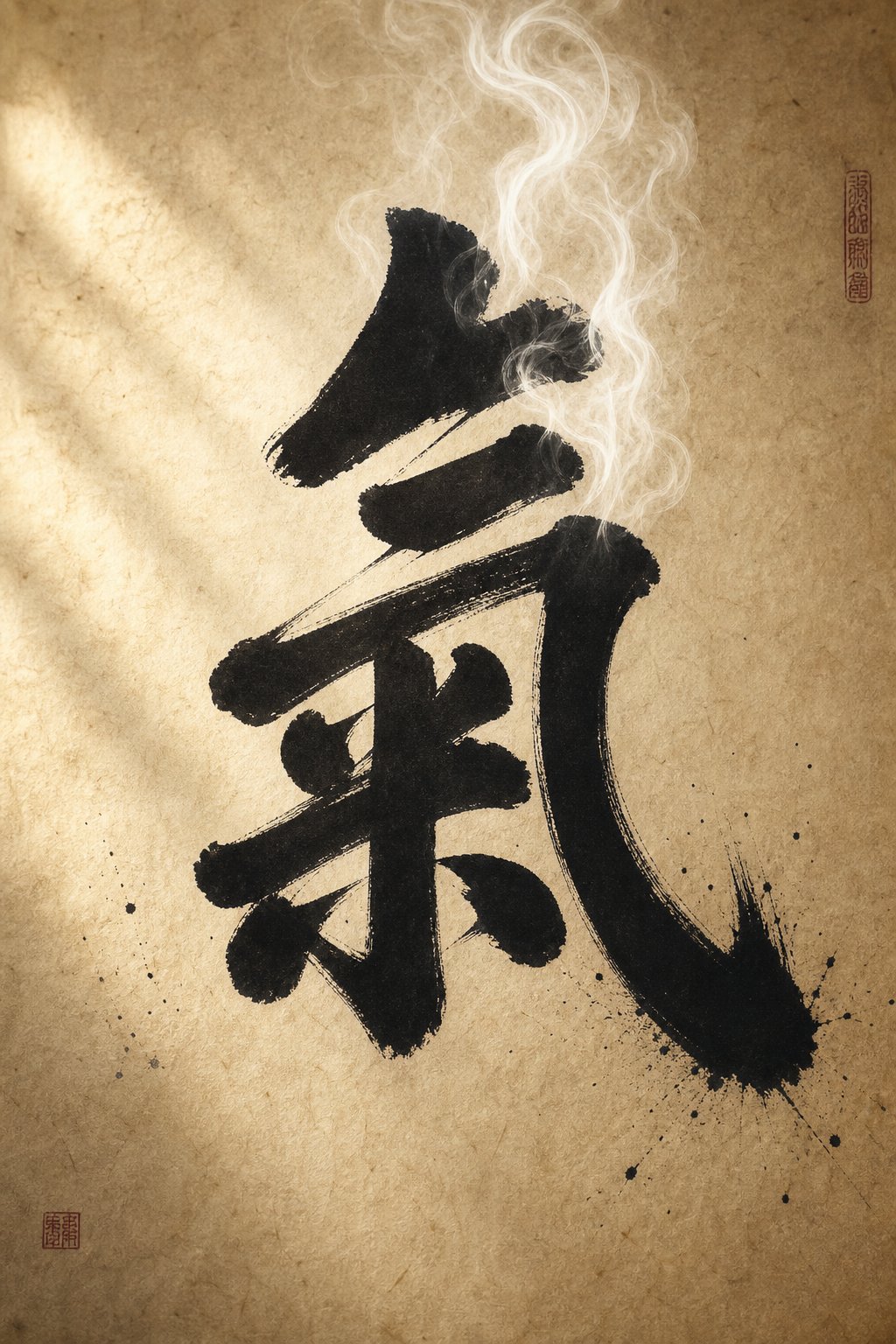
The qi Chinese character (traditional: 氣, simplified: 气, pinyin: qì) literally means vapor, air, gas, or breath. It is a polysemous Chinese logograph used across thousands of everyday compound words, from weather reports to descriptions of mood, courage, and atmosphere.
Defining the Qi Character in Chinese
At its core, qi in Chinese is a character that describes something observable: the visible vapor rising from a hot surface, the breath you see on a cold morning, the air filling your lungs. The word is polysemous, meaning it carries multiple related definitions depending on context. In modern Mandarin, what is qi? It can refer to literal gas, emotional states, atmospheric conditions, or the philosophical concept of vital force. The character appears in over 1,400 compound words in standard Chinese dictionaries, making it one of the most productive building blocks in the language.
English speakers often encounter this qi Chinese character through a narrow lens: traditional Chinese medicine or martial arts. That framing, while not wrong, captures only a fraction of how the character actually functions in Chinese. Imagine reducing the English word "spirit" to its religious meaning alone and ignoring "team spirit," "spirited debate," or "distilled spirits." That's roughly what happens when qi gets locked into a single translation like "life energy."
Why Qi Matters Beyond Martial Arts and Medicine
So what is the qi character doing in a weather forecast? Or on a gas station sign? Or in a sentence about someone losing their temper? The answer lies in the character's structural logic and its centuries of accumulated meaning. Understanding qi meaning starts not with philosophy but with linguistics: how the character was built, what its components represent, and how those components generate meaning across wildly different contexts.
This article treats qi as what it is: a character with etymology, radical structure, pronunciation rules, regional variants, and usage patterns. Whether you're a Chinese language learner, a calligraphy enthusiast, or someone trying to understand what is a qi reference in a text you're reading, the layers hidden inside this character reward close attention. Each stroke carries history, and that history shapes every modern use.
The Visual Etymology of Qi Through Centuries of Script
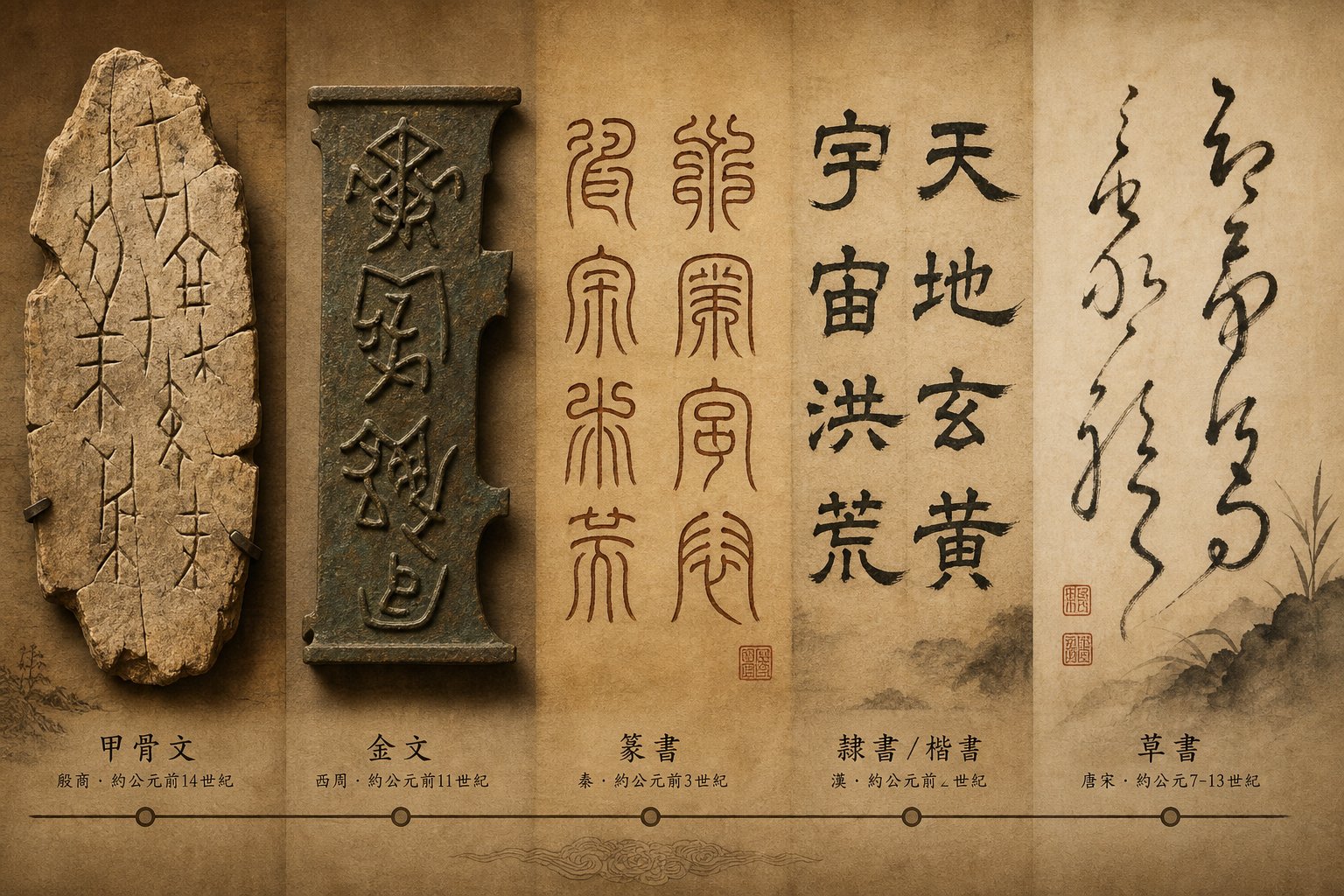
Every Chinese character carries a fossil record inside its strokes. The chinese character for qi is no exception. Its visual history stretches back over three thousand years, and each stage of its evolution reveals something about how ancient people understood the invisible forces around them. Tracing that evolution is like watching a concept solidify from mist into ink.
From Oracle Bones to Modern Strokes
The earliest known form of the chinese character qi appears in oracle bone inscriptions (甲骨文), dating from roughly 1600 to 1100 BCE. These were carved into turtle shells and animal bones by Shang dynasty diviners. In this archaic script, qi appeared as three wavy horizontal lines stacked on top of each other, representing rising vapor or drifting clouds. The image was purely pictographic: you'll notice it looks like what you'd actually see watching steam curl upward from a hot surface.
During the bronze inscription period (金文, roughly 1400 to 700 BCE), the character retained its wavy-line structure but gained slightly more formality. Bronze inscriptions were cast into ritual vessels, and their style sat somewhere between the raw scratches of oracle bones and the more regulated forms that followed. The qi symbol at this stage still clearly depicted vapor, but the lines became more uniform and deliberate.
The seal script era brought two major developments. In the greater seal script (大篆, 1000 to 200 BCE), strokes became rounder and more symmetrical. Then came the lesser seal script (小篆), standardized around 221 BCE when the Qin dynasty unified China's writing systems. Here, the qi character took on the geometric precision and "iron wire" quality characteristic of seal carving. The three vapor lines became more stylized, less obviously pictorial, but still recognizable as flowing air.
The real visual break came with clerical script (隸書), which emerged around 200 BCE and became dominant during the Han dynasty. Clerical script replaced curves with angular, efficient strokes suited to the rapid writing needs of imperial bureaucrats. The qi in chinese character form flattened out, losing its undulating vapor quality in favor of speed and legibility. This is also the period when the rice radical (米) was added beneath the vapor component, creating the traditional form 氣 that persists in Taiwan and Hong Kong today.
What the Shuowen Jiezi Tells Us About Qi
The Shuowen Jiezi (說文解字), compiled by Xu Shen around 100 CE, is the earliest comprehensive Chinese character dictionary. It provides the foundational definition that shaped how scholars understood the chinese character for chi for centuries afterward. In this text, qi is defined as a pictograph representing cloud vapor, the breath of the sky rising and flowing. The dictionary treats the character as depicting something observable and natural rather than abstract or mystical.
This matters because it anchors the character's meaning in physical reality. The ancient Chinese watched steam rise from cooking rice. They saw their own breath become visible on cold mornings. They observed clouds forming and dissipating. The qi symbol grew directly from these everyday observations. As Harvard's Center for the Study of World Religions notes, traditional lexicography identifies qi as a pictograph representing vapor or breath, encompassing wind, cloud, and mist.
Imagine standing over a pot of rice on a winter morning. Steam rises from the pot, your breath hangs in the air, and mist clings to the ground outside. Three manifestations of the same phenomenon: something invisible becoming briefly visible, something insubstantial yet undeniably real. That is the pictographic logic encoded in the qi in chinese character form, from its earliest oracle bone scratches to the modern strokes you see printed today.
The simplified form (气) used in mainland China retains only the upper vapor component, those original three lines now compressed into four quick strokes. The traditional form (氣) preserves the full pictographic story: vapor above, rice below. Both descend from the same ancient image, but they carry different amounts of visual history in their structure. That structural difference raises questions about what gets preserved and what gets lost when a character is simplified, a tension explored in the radicals that make up each version.
Breaking Down the Radicals Inside the Qi Character
The traditional chinese symbol for qi doesn't just represent a single idea. It's a composite image built from two distinct radicals, each contributing a layer of meaning. When you look at 氣, you're looking at a tiny visual story: vapor rising from cooked rice. Understanding these components unlocks why this character carries so many meanings across such different contexts.
The Vapor Radical and Rice Radical Explained
The upper portion of 氣 is the radical 气, known in Chinese lexicography as the "steam" or "vapor" radical. According to Kanjigen's etymological analysis, this four-stroke component represents the curving trajectory that breath takes as it emerges from the mouth. You'll notice the radical is strikingly hollow inside, as if enclosing nothing but air. That visual emptiness is intentional: it's a radical designed to hold space for something invisible yet present.
The lower portion is 米 (mi), the character for rice. But within 氣, it doesn't simply mean "rice" as a food item. It depicts the steam rising from rice as it cooks. As practitioners of Chinese medicine note, this component gives life and motion to an otherwise static concept. Everyone has a relationship with this visual. Imagine lifting the lid off a rice cooker: that warm mist curling upward across your hand is exactly what the qi symbol chinese writers encoded into this character thousands of years ago.
Together, the two radicals create a complete sensory image. The vapor radical provides the concept of something gaseous and flowing. The rice radical grounds it in the physical world, connecting breath and air to nourishment, sustenance, and the transformation of matter through heat. This is why the chinese symbol for chi carries connotations of both the atmospheric and the vital. It's not abstract energy floating in a void. It's steam from a pot, breath from a body, air that sustains life.
The Daoist Variant 炁 and Its Fire Radical
Most Chinese readers today wouldn't recognize the character 炁. It appears almost exclusively in ancient shamanic and Daoist texts, and it offers a fascinating alternative to the standard form. Where 氣 pairs vapor with rice, 炁 pairs a different top radical with fire (火) on the bottom.
The upper component of 炁 is 无 (wu), meaning "nothing," "emptiness," or "the primordial state of nature." The lower component, fire, functions as a symbol for mind, heart, spirit, desire, or anger in traditional Chinese spiritual cultivation. The conceptual shift is significant: while 氣 roots qi in the observable, physical world of cooking and breathing, 炁 points toward something pre-material and cosmological. It's the energy chinese symbol used when Daoist writers needed to distinguish refined, spiritualized qi from the ordinary vital breath of daily life.
Think of it this way. The standard 氣 says: "qi is what you see rising from your rice pot." The Daoist 炁 says: "qi is the formless fire at the origin of existence." Both are valid symbol for qi concepts, but they operate at different registers of meaning.
| Character Form | Components | Primary Usage Context | Conceptual Emphasis |
|---|---|---|---|
| 氣 (traditional) | 气 (vapor) + 米 (rice) | Taiwan, Hong Kong, classical texts | Observable vapor, breath, nourishment transformed into air |
| 气 (simplified) | 气 (vapor) alone | Mainland China, modern standard usage | Air, gas, atmosphere (physical emphasis retained, rice imagery removed) |
| 炁 (Daoist variant) | 无 (emptiness) + 火 (fire) | Ancient Daoist and shamanic texts | Primordial energy, spiritualized breath, pre-material force |
What gets lost in simplification? The simplified 气 retains the vapor radical but drops the rice component entirely. You lose the grounding image of steam rising from food, the connection between nourishment and breath. What remains is a chinese energy symbol stripped to its most abstract element: air itself, without a visible source. For learners searching for the chinese symbol for energy in its fullest pictographic sense, the traditional 氣 tells the richer story. But the simplified form carries its own elegance: four strokes, one hollow frame, nothing inside but possibility.
These structural choices aren't just academic. They shape how speakers and readers intuitively feel the character's weight. And that intuitive weight matters when qi appears in compound words, where it combines with other characters to produce meanings ranging from weather to courage to electricity.
How to Pronounce Qi and Why Chi Is the Same Word
The character's internal structure tells a clear visual story, but the moment you try to say it out loud, confusion sets in. English speakers encounter two different spellings in books, websites, and product labels: "qi" and "chi." Are these two different words? Two different concepts? The answer is simpler than it looks, and it comes down to which romanization system a writer chose to use.
Pinyin vs Wade-Giles and Why Both Spellings Exist
Chi and qi refer to the exact same character, the exact same sound, and the exact same meaning. The difference is purely a matter of spelling convention. Two competing systems for writing Chinese sounds in the Latin alphabet have coexisted for over a century, and both remain visible in English-language texts today.
Wade-Giles romanization was developed by Thomas Wade in 1859 and refined by Herbert Giles in 1892. Under this system, the character 氣 is spelled "ch'i" (with an apostrophe indicating aspiration). Pinyin, developed in China during the 1950s and adopted internationally in the 1980s, spells the same sound as "qi." The Library of Congress identifies one key distinction: Pinyin syllables can begin with the letter Q, while Wade-Giles syllables cannot. When you see a Q at the start of a Chinese word, you're looking at Pinyin.
So how to pronounce qi? The sound is identical regardless of spelling. Say "chee" as in "cheese," but start with a sharper, more forward tongue position. The tip of your tongue presses briefly behind your lower teeth while the body of the tongue rises toward the roof of your mouth. It's not the "kw" sound from English words like "quit" or "queen." It's not "ky" or "kai." It's a single syllable that sounds like the English word "chee" spoken with a decisive, downward pitch.
The pronunciation of qi trips up English speakers partly because the letter Q behaves completely differently in Pinyin than in English. In Pinyin, Q always produces a "ch" sound with a palatal quality. There's no "u" following it, no "kw" combination. If you can say "cheap" or "cheese," you already have the mouth shape for qi pronounce correctly.
How Tone Changes the Meaning Completely
Getting the consonant and vowel right is only half the challenge. Mandarin Chinese is a tonal language, and the pitch contour you place on a syllable determines which word you're actually saying. The qi character meaning "vital breath" or "air" uses the fourth tone (qì): a sharp, falling pitch that drops from high to low, like the tone of voice you'd use saying "Stop!" with authority.
Change the tone, and you change the word entirely. The same "chee" sound with a third tone (qǐ) means "to beg" or "to request." With a second tone (qí), it can mean "strange" or "to ride." These aren't subtle shades of the same concept. They're completely unrelated words that happen to share a consonant-vowel combination.
Here are common mispronunciations and how to correct them:
- Saying "kee" or "kwee" — The Q in Pinyin is never a "k" sound. Correct to "chee" with the tongue forward and flat.
- Saying it with a rising pitch — A rising tone (second tone) produces a different word. For 氣, use a sharp falling pitch, like giving a firm command.
- Pronouncing it as two syllables ("kw-ee") — It's one syllable. No glide, no "w" sound in the middle.
- Rhyming it with "sky" or "tie" — The vowel is "ee" as in "see," not "eye" as in "my."
- Dropping the tone entirely — A flat, toneless delivery sounds unnatural and may be misunderstood. Commit to the downward fourth-tone drop.
How do you pronounce qi in casual conversation? Think of it as saying "chee" while simultaneously letting your voice fall like you're disappointed. That falling pitch is the fourth tone, and it's what separates the qi of breath and energy from every other meaning that syllable can carry.
The chi and qi spelling split also explains why older English texts about martial arts and medicine use "chi kung" while newer ones write "qigong," or why you'll see "t'ai chi" alongside "taiji." These aren't different practices. They're the same Chinese words filtered through different romanization eras. How to say qi hasn't changed in centuries. Only the way English writers transcribe it has shifted, and both systems remain in active circulation depending on the author's background and regional conventions.
Those regional conventions extend beyond spelling into which version of the character itself appears on the page. The same word, pronounced the same way, gets written differently depending on whether you're reading a newspaper in Beijing, Taipei, or Tokyo.
Simplified Versus Traditional Forms Across Regions
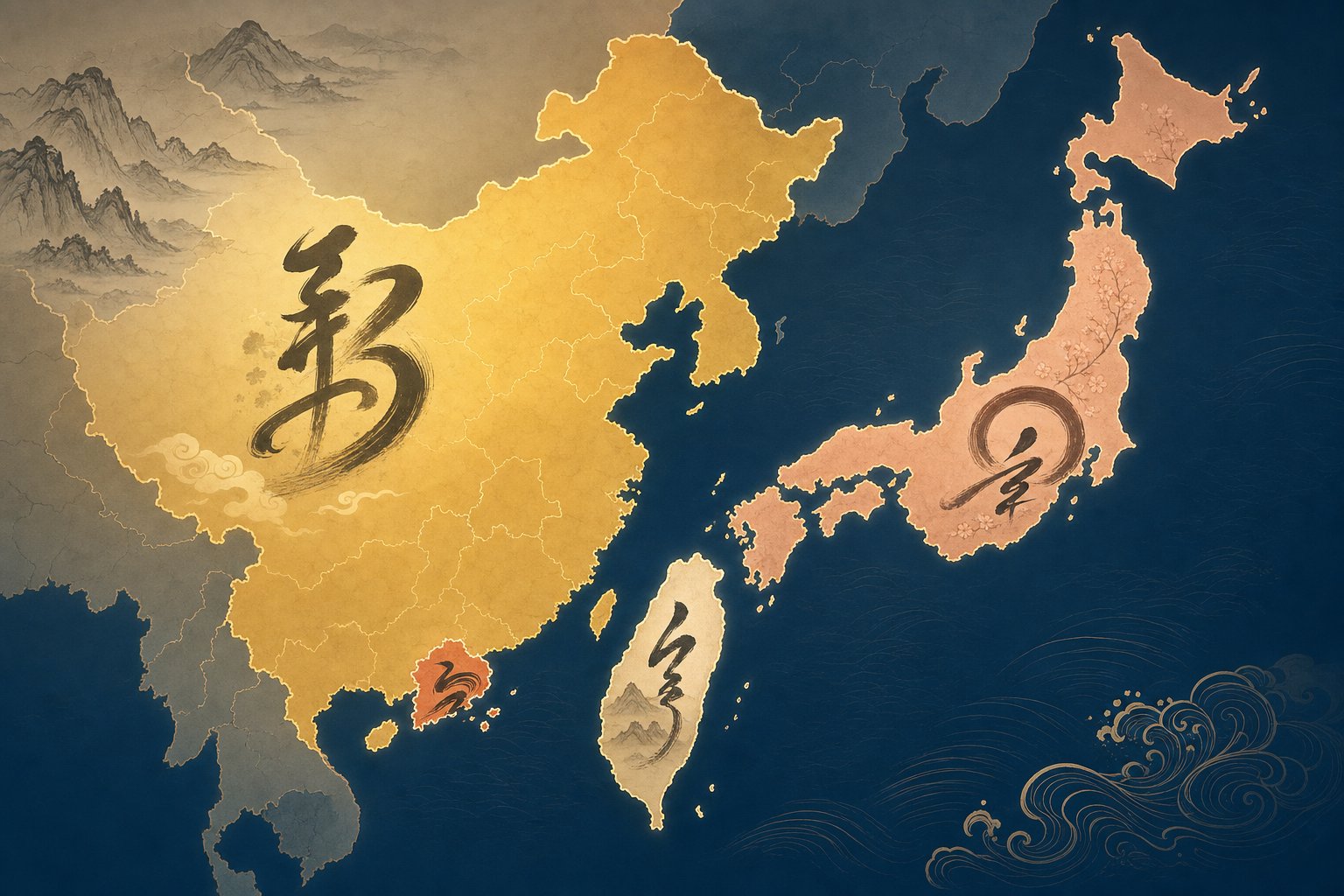
The pronunciation stays constant, but the character itself shapeshifts depending on where you are in East Asia. Pick up a newspaper in Beijing, and you'll see 气. Fly to Taipei, and the same word appears as 氣. Stop in Tokyo, and it becomes 気. Same concept, same sound (adjusted for local phonology), three different written forms. For anyone studying chinese qi or trying to read texts from multiple regions, this variation matters more than most guides acknowledge.
Regional Usage Across Chinese-Speaking Territories
The split between simplified and traditional characters isn't random. It traces back to deliberate government policy. In the 1950s and 1960s, mainland China introduced Simplified Chinese (简体字) as part of a literacy campaign, reducing stroke counts across thousands of characters. The qi character went from ten strokes (氣) to four (气), losing the rice radical entirely. Taiwan, Hong Kong, and Macau retained Traditional Chinese (繁體字) for cultural and historical continuity, keeping 氣 intact with all its pictographic richness.
Japan followed its own path. After World War II, the Japanese government compiled the Toyo Kanji list and introduced simplified forms called Shinjitai (新字体). The character 氣 was simplified to 気, which replaced the rice radical (米) with the mark 㐅. This Japanese simplification happened independently from China's reforms, producing a form that resembles neither the mainland Chinese simplified version nor the full traditional character. The result is three distinct written forms of the same word coexisting across the region.
Here's how the qi character appears across major territories:
| Region | Character Form | Writing System Context | Common Appearance Contexts |
|---|---|---|---|
| Mainland China | 气 | Simplified Chinese (GB standard) | All printed media, digital text, education, signage, official documents |
| Taiwan | 氣 | Traditional Chinese (national standard) | All printed media, education, government, literature, calligraphy |
| Hong Kong / Macau | 氣 | Traditional Chinese (regional conventions) | Media, signage, legal documents, education |
| Japan | 気 | Shinjitai kanji (JIS standard) | All modern Japanese text, from novels to weather reports |
If you're searching for the chinese word for chi in a Japanese dictionary, you'll find 気 listed under the reading "ki" rather than "qi" or "chi." The character carries many of the same compound-word functions in Japanese as it does in Chinese: 天気 (tenki, weather), 元気 (genki, health/vitality), 空気 (kuuki, air). The semantic range transferred across cultures even as the written form diverged.
What Simplification Changed About the Character
Simplification is never just a cosmetic trim. When qi in China went from 氣 to 气, the rice radical disappeared. That means the visual metaphor of steam rising from cooked rice, the grounding image connecting breath to nourishment, vanished from the everyday written form. What remains is the vapor radical alone: a hollow frame suggesting air, gas, or atmosphere without pointing to a source.
Does this matter in practice? For most native speakers in mainland China, no. The character 气 functions perfectly well in all its compound words. Context does the heavy lifting. But for learners, calligraphers, and scholars interested in how meaning is encoded visually, the traditional 氣 preserves a layer of information that the simplified form simply doesn't carry.
Japan's 気 sits in an interesting middle ground. It retains a mark inside the vapor frame (㐅, historically a variant of the character for "five"), giving it slightly more visual weight than China's bare 气. Some martial arts practitioners have speculated that replacing 米 with 㐅 symbolically "closes off" the character's energy, though etymological evidence doesn't support this interpretation. What's clear is that each region's version reflects independent reform decisions made for practical literacy goals rather than philosophical ones.
For anyone reading about qi china's traditional medicine, Taiwanese qigong manuals, or Japanese martial arts texts, recognizing all three forms as the same word prevents confusion. Whether you encounter 氣, 气, or 気, you're looking at the same ancient concept filtered through different modern writing standards. The pronunciation, the compound words, and the core meaning remain consistent. Only the visual packaging changes, shaped by each region's unique relationship with its own script history.
That consistency across regions becomes especially visible when you look at how the character combines with other characters to form compound words. The same qi appears in weather forecasts in Beijing, anger idioms in Taipei, and health vocabulary in Tokyo, revealing just how deeply embedded this single character is in everyday East Asian life.
Everyday Compound Words That Use the Qi Character
Here's something that surprises most English speakers learning Chinese: the qi chinese word shows up far more often in conversations about weather, mood, and gas bills than it does in discussions about meditation or martial arts. Open any Chinese dictionary entry for qi, and you'll find over 40 common compound words before you even reach the philosophical definitions. The character functions less like a mystical term and more like a linguistic building block, combining with other characters to produce meanings that range from "oxygen" to "stingy."
Qi in Weather Reports and Gas Stations
Imagine turning on the evening news in Beijing. The anchor says "tiānqì" (天气) and a weather map appears. Walk past a gas station, and you'll see "tiānránqì" (天然气, natural gas) on the signage. Text a friend that you're angry, and you'll type "shēngqì" (生气). None of these uses carry any spiritual weight. They're as ordinary as saying "air" or "atmosphere" in English.
Is qi a word in English? Technically, yes. It entered English dictionaries primarily through Scrabble communities and traditional medicine references. But the meaning of the word qi in English captures only a sliver of what the character does in Chinese. In its home language, qi is less a standalone concept and more a productive root that generates dozens of everyday terms. Calling it just "life energy" is like defining the English word "run" only as physical jogging, ignoring "run a business," "run out of time," and "a run in your stockings."
Compound Words That Reveal the Character's Range
The word qi combines with other characters through a logic that traces back to its core meanings: air, breath, vapor, mood, and force. When paired with 天 (sky/heaven), it produces weather. Paired with 空 (empty/sky), it becomes the air you breathe. Paired with 勇 (brave), it becomes courage. Each compound reveals a different facet of the character's semantic range.
| Compound | Pinyin | Literal Components | Modern English Meaning |
|---|---|---|---|
| 天气 (天氣) | tiānqì | sky + vapor | weather |
| 空气 (空氣) | kōngqì | empty/sky + air | air |
| 生气 (生氣) | shēngqì | generate + qi (mood) | angry / to get angry |
| 勇气 (勇氣) | yǒngqì | brave + qi (spirit) | courage |
| 电气 (電氣) | diànqì | electricity + qi (gas/force) | electrical (as in electrical engineering) |
| 气氛 (氣氛) | qìfēn | qi (atmosphere) + vapor | atmosphere / mood of a place |
| 气功 (氣功) | qìgōng | qi (vital energy) + exercise | qigong (breathing exercises) |
| 氧气 (氧氣) | yǎngqì | oxygen element + gas | oxygen |
| 脾气 (脾氣) | píqì | spleen + qi (disposition) | temper / temperament |
| 运气 (運氣) | yùnqì | luck/movement + qi | fortune / luck |
| 力气 (力氣) | lìqì | strength + qi (force) | physical strength |
| 天然气 (天然氣) | tiānránqì | natural + gas | natural gas |
You'll notice a pattern. When qi pairs with concrete, physical terms (sky, empty, oxygen), it tends to mean literal gas or air. When it pairs with emotional or abstract terms (brave, generate, luck), it shifts toward mood, spirit, or force. The character acts as a semantic hinge, swinging between the physical and the psychological depending on its partner. This is why any qi dictionary entry runs so long: the character's meaning isn't fixed but relational.
Is qi an English word in the way "air" or "breath" is? Not quite. English borrowed it as a narrow cultural term. But in Chinese, the word qi operates more like a root morpheme, productive and flexible, building vocabulary across science, emotion, weather, personality, and philosophy. The fact that 氧气 (oxygen) and 勇气 (courage) share the same character tells you everything about how Chinese encodes meaning: through combination rather than isolation.
This combinatorial power also hints at something deeper. If qi can mean both "the air in a room" and "the courage in your heart," then the ancient Chinese saw a connection between breath and bravery, between atmosphere and attitude. That connection isn't accidental. It's philosophical, and it runs through centuries of Chinese thought about how the physical and the spiritual interrelate.
Qi in Philosophy and Its Relationship to Other Core Concepts
That link between breath and bravery, between the air in a room and the courage in a person's chest, didn't emerge from nowhere. It grew out of a philosophical framework that treated qi energy as the fundamental substance connecting everything in the universe: matter and mind, body and spirit, heaven and earth. To understand why a single character can stretch across so many meanings, you need to see where it sits within the larger constellation of Chinese philosophical concepts.
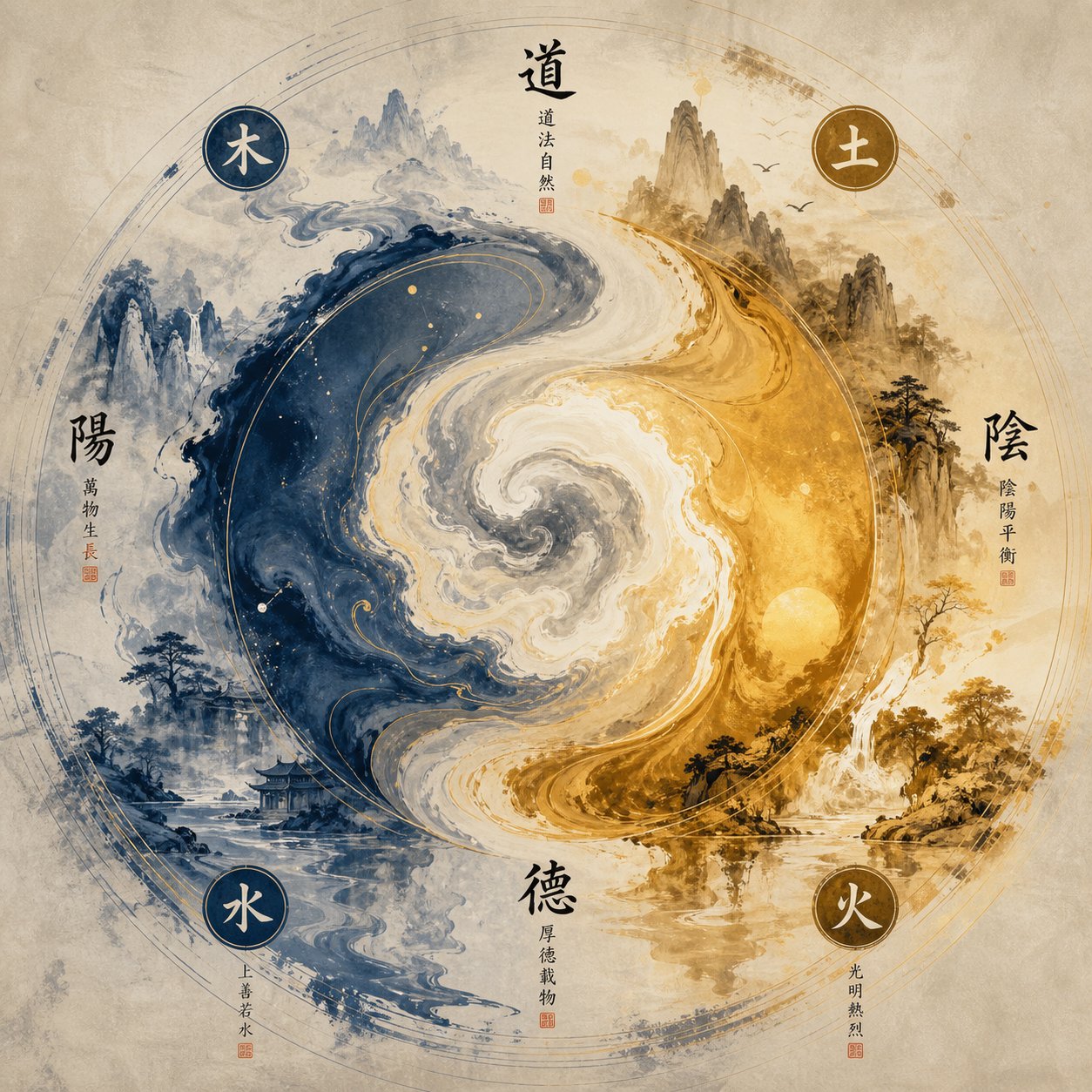
Qi Within the Dao-Yin-Yang Framework
In classical Chinese thought, qi doesn't operate alone. It exists in dynamic relationship with several other foundational concepts, each represented by its own character. Think of these as interlocking gears rather than separate ideas.
道 (dao) represents the Way, the underlying principle or pattern of the universe. Qi is what fills that pattern, the substance that flows through the structure dao provides. If dao is the riverbed, qi is the water. Daoist texts describe the cosmos as emerging from a primordial dao that generates qi, which then differentiates into the myriad things of the physical world.
陰陽 (yin-yang) describes the polarity within qi itself. Qi isn't uniform. It manifests in complementary opposites: rising and sinking, warming and cooling, expanding and contracting. Yang qi rises, warms, and activates. Yin qi descends, cools, and nourishes. Health, weather, seasons, and social harmony all depend on the balanced interplay of these two modes. The character qi names the substance; yin-yang describes its behavior.
精 (jing) and 神 (shen) complete what's sometimes called the "Three Treasures" of Chinese philosophy and medicine. Jing is essence, the dense, material substrate of life inherited from your parents. Shen is spirit or consciousness, the most refined and luminous expression of vitality. Qi sits between them: denser than shen, subtler than jing. Together, these three form a spectrum from matter to mind, with qi as the bridge. This is why chi energy carries connotations of both physical breath and spiritual vitality. It occupies the middle ground by design.
Each major philosophical tradition interpreted these relationships differently. Daoism emphasized qi as the spontaneous, self-organizing force of nature, best cultivated through non-interference (wu wei). Confucianism treated qi as moral atmosphere, something a person of virtue could cultivate through righteous conduct. The Confucian philosopher Mencius famously described his "flood-like qi" (浩然之氣) as a vast moral force generated by accumulated righteous action. Neo-Confucians like Zhu Xi (12th century) formalized a distinction between li (理, principle) and qi (氣, material force), arguing that principle gives qi its structure while qi gives principle its physical reality. Buddhism, arriving in China from India, initially had no equivalent concept but gradually absorbed qi into its vocabulary, particularly in Chan (Zen) meditation practices focused on breath regulation.
Types of Qi in Traditional Chinese Thought
The character 氣 doesn't refer to a single, undifferentiated substance. Chinese thinkers identified multiple types of qi, each with distinct origins, functions, and locations in the body. These distinctions shape how the character gets interpreted depending on context. When someone references the chinese life force, they might be pointing to any of the following:
- Yuan qi (元氣, original qi) — The foundational qi inherited at conception from your parents. It's stored in the kidneys and considered finite, declining naturally over a lifetime. Think of it as your constitutional baseline.
- Zong qi (宗氣, gathering qi) — Formed from the combination of inhaled air and nutrients extracted from food. It accumulates in the chest and powers the heartbeat and respiration.
- Wei qi (衛氣, defensive qi) — A fast-moving, protective layer that circulates on the body's surface. Wei qi guards against external pathogens like wind and cold, functioning somewhat like an immune perimeter.
- Ying qi (營氣, nutritive qi) — Circulates within the blood vessels and meridians, nourishing organs and tissues from the inside.
- Yang qi (陽氣) — The warming, activating aspect of qi that drives metabolism, movement, and transformation.
- Spleen qi (脾氣) — The digestive and transformative force associated with the spleen organ system, responsible for converting food into usable energy and transporting nutrients upward.
These categories aren't arbitrary labels. They reflect centuries of clinical observation and philosophical reasoning about how chi life force manifests at different levels of the body. Yuan qi explains why some people seem constitutionally robust while others are fragile from birth. Wei qi explains why you catch a cold when you're exhausted. Spleen qi explains why poor digestion leads to fatigue. Each type gives the character 氣 a specific clinical or philosophical address.
What's striking is that chi life force energy as a concept isn't unique to China. Other ancient civilizations developed remarkably similar ideas about a living energy that animates the body and connects it to the cosmos. A roundtable at the American Academy of Religion's 2025 Annual Meeting explored these parallels directly, describing qi and prana as "terms for vital force or breath analogous to pneuma, ruach, and spiritus" with "ancient roots" still "widely practiced and theorized in almost all Asian cultures."
| Tradition | Term | Literal Meaning | Core Concept |
|---|---|---|---|
| Chinese | 氣 (qi) | Vapor, breath, air | Vital force animating all life and matter; flows through meridians |
| Indian (Sanskrit) | Prāṇa | Breath, life | Life breath circulating through nadis; cultivated via pranayama |
| Greek | Pneuma (πνεῦμα) | Breath, wind, spirit | Vital spirit connecting body and soul in Stoic philosophy |
| Hebrew | Ruach (רוּחַ) | Wind, breath, spirit | Divine breath; animating force from God in biblical tradition |
| Latin | Spiritus | Breath, spirit | Life breath; root of English "spirit" and "respiration" |
The AAR scholars noted that while it may be "tempting to see them as referring to the same phenomenon, a deeper look reveals nuance and complexity." Prana circulates through nadis (energy channels) and is cultivated through pranayama (breath exercises), paralleling how qi flows through meridians and is cultivated through qigong. But the cosmological frameworks, the relationship to divinity, and the specific bodily maps differ substantially. These aren't identical concepts wearing different linguistic costumes. They're independent attempts by different civilizations to name something they all observed: that breath, vitality, and consciousness share a common root.
Understanding chi and energy within this philosophical web reveals why no single English translation works. "Energy" misses the breath dimension. "Breath" misses the cosmic dimension. "Life force" misses the mundane, atmospheric dimension. The character 氣 holds all these layers simultaneously because the philosophical system it belongs to never separated them in the first place. Body, breath, cosmos, and spirit were always one continuous spectrum of the same living energy, differentiated by density and function but never divided into separate categories.
That philosophical unity between body and cosmos also shaped how qi entered medical practice. When practitioners assess a patient's health, they're reading the same qi the philosophers theorized about, just through a clinical lens focused on deficiency, stagnation, and flow.
How the Medical Meaning Connects to the Character
Philosophers described qi as the substance connecting body to cosmos. Clinicians took that same concept and built a diagnostic system around it. In traditional Chinese medicine (TCM), qi isn't an abstraction you meditate on. It's something a practitioner assesses, measures through indirect signs, and treats when it goes wrong. The character's etymology, that image of vapor rising from rice, turns out to align more closely with clinical usage than most English translations suggest.
Qi Deficiency and Qi Stagnation Explained
What is qi deficiency? In TCM terms, it means the body isn't producing or circulating enough vital breath to maintain normal function. Think of it as a system running low on the very thing that keeps it moving. TCM practitioners believe qi deficiency is closely linked to the spleen, which they consider responsible for extracting qi from food and distributing it throughout the body. When spleen qi weakens, the whole system feels the drag.
A 2015 study published in the Journal of Traditional Chinese Medical Sciences identifies five core signs used to diagnose a qi deficiency:
- Fatigue and general low energy
- Shortness of breath or reluctance to speak
- Spontaneous sweating without exertion
- A swollen tongue with teeth marks on the sides
- A weak pulse
Qi stagnation is a different problem. Here, the body has adequate qi, but it's stuck. It isn't flowing smoothly through the meridians and organ systems. Imagine a river with enough water but a logjam blocking the current. The result is pressure, distension, and irritability rather than the fatigue and weakness of deficiency. Common signs of qi stagnation include:
- A feeling of distension or tightness in the chest or abdomen
- Emotional volatility, especially frustration or mood swings
- Pain that moves around rather than staying fixed
- Sighing frequently (the body's attempt to move stuck qi)
- Symptoms that worsen with stress and improve with movement
These two patterns, deficiency and stagnation, represent the most common clinical presentations involving qi. They can also overlap. A person with chronic qi deficiency may develop secondary stagnation because there isn't enough force to keep things circulating. Acupuncture for qi deficiency typically focuses on strengthening the spleen and stomach systems, using points that tonify and lift qi upward. For stagnation, the approach shifts toward moving and spreading, often targeting the liver channel to restore smooth flow.
Tongue diagnosis plays a central role in distinguishing these patterns. A qi deficiency tongue typically appears pale, swollen, and marked with scalloped indentations along the edges where it presses against the teeth. Research published in the Journal of Alternative and Complementary Medicine confirms that a swollen, tooth-marked tongue indicates accumulation of fluids often caused by deficient qi or yang, while a quivering tongue quality points to chronic spleen qi or spleen yang deficiency. Practitioners reading qi deficiency on tongue presentations look for this combination of swelling, pallor, and teeth marks as a reliable visual indicator that the body's vital breath is insufficient.
Why Practitioners Prefer Vital Breath Over Energy
Here's where the character's etymology circles back into clinical relevance. Some classical scholars have pointed out that the "qi as energy" idea rests on mistranslations of ancient texts. As a 2024 article in Medical Acupuncture explains, Chinese writing uses suggestive pictograms rather than linear text, and all translations must, at best, be approximations. Pictograms have a fluidity that reflects process and change, and the specific meaning varies with context.
The English word "energy" implies something quantifiable, something physics can measure in joules or calories. But the character 氣 depicts vapor, breath, atmosphere. When a TCM practitioner says a patient has chi deficiency, they're describing something closer to "insufficient vital breath" than "low battery." The breath metaphor captures what clinicians actually observe: shallow respiration, a weak voice, a tongue that looks waterlogged and limp. These are signs of something not flowing, not animating, not rising. They're vapor that has stopped steaming.
This is why some scholars argue that "vital breath" or "influence" translates the medical meaning more accurately than "energy." The character itself supports this reading. Remember: 氣 shows steam rising from rice. It's a process, not a substance you can store in a container. Qi tongue deficiency signs, the pallor and swelling and quivering, all point to a process that has slowed or weakened rather than a fuel tank running empty.
The clinical framework treats qi as something generated continuously through breathing and eating, circulated through channels, and expressed through the body's warmth, movement, and resistance to illness. When that process falters, you don't "recharge" qi like a battery. You restore the conditions that allow it to generate and flow again: rest, proper food, regulated breathing, and sometimes acupuncture to nudge the system back into rhythm.
This distinction between qi as process and qi as substance matters for anyone trying to bridge the character's meaning with its medical application. The vapor rising from rice isn't a thing you can hold. It's a transformation happening in real time. That's exactly how TCM practitioners understand the qi they're diagnosing and treating: not as a mystical substance hidden inside the body, but as the ongoing process of vitality expressing itself through breath, warmth, movement, and resilience.
Yet even "vital breath" doesn't fully capture what the character means across all its contexts. The translation problem runs deeper than choosing between "energy" and "breath," and it reveals something fundamental about why certain concepts resist crossing linguistic borders at all.
The Translation Problem and What Gets Lost in English
Every translation is a trade-off. You gain accessibility and lose precision. With most Chinese characters, the loss is manageable. 水 means water. 火 means fire. But what does qi mean in chinese when a single character covers air, breath, vapor, mood, courage, weather, gas, atmosphere, spirit, and vital force? The honest answer is that no single English word captures it, and pretending otherwise flattens centuries of meaning into a convenient but misleading shorthand.
Why No Single English Word Captures Qi
The core difficulty isn't that qi is exotic or mystical. It's that English carves up reality differently than Chinese does. English treats "air," "breath," "mood," "spirit," and "energy" as separate concepts belonging to separate domains: physics, biology, psychology, religion, and science respectively. Chinese, through the character 氣, treats them as manifestations of a single underlying phenomenon. The qi word meaning shifts depending on context, but the character itself remains one unified sign pointing to something English requires five or six words to approximate.
Consider the range of valid translations scholars have proposed:
- Breath — captures the respiratory, embodied dimension
- Vapor/steam — preserves the character's pictographic origin
- Air — covers the atmospheric, environmental sense
- Vital force — reflects the philosophical and medical usage
- Influence — conveys how qi affects things without direct contact
- Atmosphere — works for emotional and spatial contexts
- Spirit — aligns with the more refined, consciousness-related meanings
Each translation is correct in certain contexts and misleading in others. "Breath" works beautifully for medical discussions but sounds odd when describing weather. "Energy" resonates with martial arts practitioners but imports physics connotations the original character never carried. The meaning of word qi is genuinely context-dependent, not because the concept is vague, but because it's broader than any single English category.
Reducing qi to "energy" strips away the layers of meaning embedded in the character's structure and history. The pictograph shows vapor rising from rice — a process, not a substance. Every English gloss captures one facet while casting the others into shadow.
An interdisciplinary study published in Body & Society situates qi alongside other breath-related concepts across cultures, noting that qi represents "an embodied wind of spiritual inspiration, inhalation and exhalation: a way of living and the movement of being directly aware." The same study observes that qi "as mood, movement and atmosphere, fills the body and flows over the world at the same time." That simultaneity — inside and outside, personal and cosmic, physical and psychological — is precisely what no single English word can hold.
Choosing the Right Translation for Your Context
So how do you decide which English word to use? The answer depends entirely on what the character is doing in its specific sentence. Here's a practical framework:
When qi appears in scientific or physical compounds (氧气, oxygen; 天然气, natural gas; 空气, air), translate it as "gas" or "air." The character is functioning in its most literal, material register. No philosophical weight needed.
When qi appears in emotional or interpersonal compounds (生气, angry; 脾气, temper; 气氛, atmosphere), translate it as "mood," "temperament," or "atmosphere." Here the character bridges the physical and psychological, describing something felt but not seen.
When qi appears in medical contexts (气虚, qi deficiency; 气滞, qi stagnation), "vital breath" or "vital force" preserves the clinical meaning better than "energy." Practitioners are describing a process of animation and circulation, not a measurable quantity.
When qi appears in philosophical or cosmological texts (元气, original qi; 浩然之气, flood-like qi), leaving it untranslated as "qi" is often the most honest choice. At this level of abstraction, any English word introduces more confusion than clarity.
The definition of the word qi, then, isn't a single statement you can memorize. It's a spectrum you learn to navigate. And the best navigation tool isn't a dictionary entry. It's the character itself: its radicals showing vapor rising from rice, its etymology tracing back to oracle bone images of drifting clouds, its compound words revealing how breath connects to weather connects to courage connects to the cosmos.
The meaning of qi in english will always be an approximation. But understanding the character's internal architecture — the vapor radical, the rice radical, the Daoist fire variant, the thousands of compounds it generates — gives you something no translation can: direct access to the logic that holds all those meanings together. You stop needing a single English equivalent because you can see the concept from the inside, the way a Chinese reader does, as one coherent image with many applications rather than many separate words awkwardly stitched into one.
That's the real payoff of studying the qi chinese character meaning at the level of strokes and radicals rather than settling for a glossary definition. A translation tells you what a word means in someone else's language. The character itself shows you how a civilization thinks.
Frequently Asked Questions About the Qi Chinese Character
1. What is the literal meaning of the qi character in Chinese?
The qi character (氣/气) literally means vapor, air, gas, or breath. Its traditional form combines the vapor radical (气) with the rice radical (米), creating a pictographic image of steam rising from cooked rice. In modern Chinese, it appears in over 1,400 compound words covering weather, mood, courage, scientific gases, and philosophical concepts, making it far more versatile than the common English translation of 'life energy' suggests.
2. Is qi and chi the same thing?
Yes, qi and chi refer to the exact same Chinese character and concept. The spelling difference comes from two romanization systems: Pinyin (developed in 1950s China) spells it 'qi,' while the older Wade-Giles system (from 1859) spells it 'ch'i.' Both are pronounced like 'chee' with a sharp falling tone. Older English texts tend to use 'chi' or 'ch'i,' while modern publications favor 'qi' following international Pinyin adoption.
3. Why is qi translated as 'energy' and is that accurate?
Translating qi as 'energy' is common but considered imprecise by many scholars. The English word 'energy' implies something measurable in physics, while the character 氣 depicts vapor and breath — a process rather than a quantifiable substance. More accurate translations include 'vital breath,' 'influence,' or 'atmosphere' depending on context. Medical practitioners often prefer 'vital breath' because it aligns with clinical observations like shallow respiration and weak voice in qi-deficient patients.
4. What is the difference between simplified and traditional qi characters?
The traditional form 氣 (ten strokes) contains both the vapor radical and rice radical, preserving the pictographic image of steam rising from cooking rice. The simplified form 气 (four strokes), used in mainland China, retains only the vapor radical, removing the rice component. Japan uses its own variant 気, which replaces rice with the mark 㐅. Taiwan and Hong Kong continue using the full traditional 氣. Each form functions identically in meaning but carries different amounts of visual etymology.
5. How do you correctly pronounce qi in Mandarin Chinese?
Pronounce qi like 'chee' (as in cheese) with a sharp falling pitch from high to low, similar to saying 'Stop!' with authority. This falling pitch is Mandarin's fourth tone. Common mistakes include saying 'kee' or 'kwee' (the Q in Pinyin is never a K sound), using a rising pitch (which changes the word to mean 'strange' or 'to ride'), or splitting it into two syllables. The tongue tip should press behind the lower teeth while the tongue body rises toward the palate.