The Chinese Character for River and Its Core Meaning
When you look up the river Chinese character meaning, the answer starts with three simple strokes. The character 川 (chuān, first tone) is a pictograph that depicts water flowing between two riverbanks. It is one of the oldest and most visually intuitive characters in the Chinese writing system, carrying the core meaning of "river" or "stream."
川 (chuān): A pictographic Chinese character for river, representing flowing water between two banks. It also carries extended meanings of "plain" and "open flatland."
What Does the River Character Mean in Chinese
The river chinese character 川 works like a tiny sketch of nature. Its three vertical strokes mirror the image of a current running through a channel, with the outer lines representing the banks and the center line capturing the flow of water itself. This makes 川 one of the rare characters whose meaning you can almost guess just by looking at it.
In classical Chinese, 川 served as a general term for rivers and waterways. A line from the ancient text Zhuangzi illustrates this perfectly: 百川灌河 (bǎi chuān guàn hé) meaning "a hundred rivers pour into the Yellow River." Here, 川 refers broadly to all rivers, while 河 specifically names the Yellow River.
Why Chinese Has More Than One River Character
Chinese doesn't rely on a single character to express "river." Three characters share this territory: 河 (hé), 江 (jiāng), and 川 (chuān). Each one carries distinct historical baggage and geographic associations. Originally, 河 was the proper noun for the Yellow River alone, while 江 referred exclusively to the Yangtze. Over centuries, both evolved into generic words for rivers, splitting roughly along a north-south line. Meanwhile, 川 shifted from its ancient river meaning toward "plain" or "flatland," surviving today mostly in place names, classical literature, and idioms.
Understanding these distinctions is more than academic trivia. It shapes how you read Chinese maps, interpret place names like Sichuan, and grasp the cultural weight behind each character. The differences between these three river characters reveal layers of geography, history, and regional identity baked into the language itself.
Pictographic Origin of 川 and Why It Looks Like Water
That visual simplicity of 川 is no accident. It belongs to a category of Chinese characters called pictographs (象形字, xiàngxíng zì), meaning its shape was drawn directly from nature. Imagine standing on a bridge three thousand years ago, looking down at a river cutting through the landscape. The ancient scribes carved exactly what they saw: flowing lines of water bounded by earth on either side. That image became the chinese character river we recognize today.
How Three Strokes Became a River
Each stroke in 川 plays a specific visual role. You'll notice the character isn't just three random lines placed side by side. It's a miniature landscape compressed into a writing system.
- Left stroke (丿): Represents one riverbank, the boundary where land meets water on one side.
- Center stroke (丨): Represents the main current, the flowing body of water itself moving between the banks.
- Right stroke (丨): Represents the opposite riverbank, completing the channel that contains the river's flow.
Together, these three strokes create a cross-section of a river viewed from above or from the side. The outer strokes frame the water, while the inner stroke gives it motion. This is what makes the river character in chinese so memorable for learners. You don't need to decode abstract logic or memorize arbitrary associations. The character simply looks like what it means.
The Pictograph That Mirrors Nature
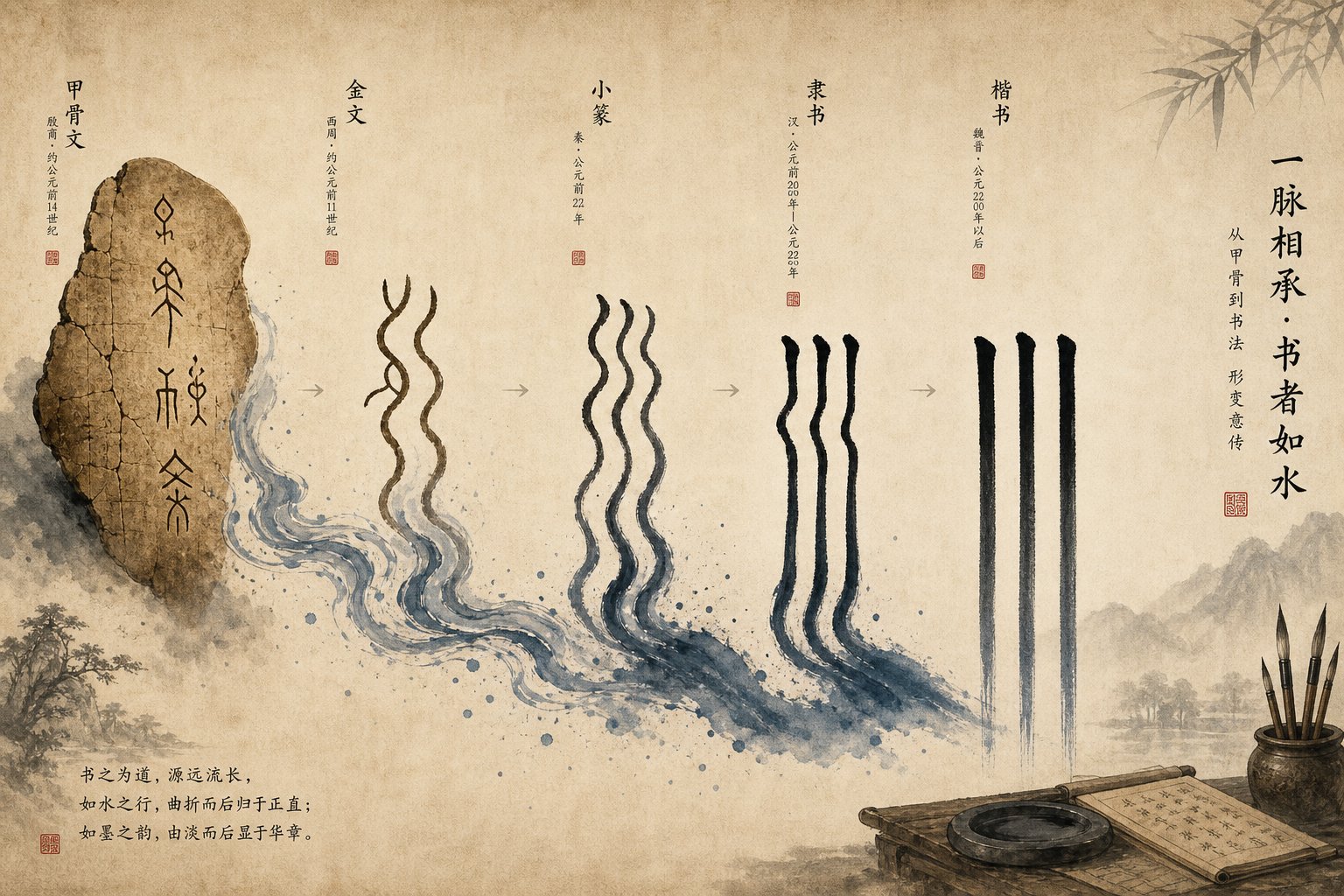
In oracle bone script (甲骨文), the earliest known form of Chinese writing dating to around 1200 BCE, 川 appeared as three flowing lines representing the currents of a river. These weren't the straight, rigid strokes we write today. The oracle bone versions used wavy, undulating lines that mimicked actual water currents, making the pictographic connection even more obvious. Picture three serpentine curves running parallel, and you have the ancient form of this character.
This directness is rare. Many Chinese characters started as pictures but became so stylized over millennia that their original imagery is nearly impossible to spot without scholarly guidance. Think of 馬 (horse) or 龍 (dragon), characters whose pictographic roots are buried under layers of abstraction. The river water in chinese character form, however, stayed close to its source. Three lines of flowing water looked simple enough that scribes never needed to complicate them.
The character is classified as Kangxi Radical 47, one of the 214 radicals used to organize Chinese dictionaries since the 18th century. Its inclusion as a standalone radical, rather than a component tucked inside other characters, signals its fundamental importance in the writing system. Radical 47 carries the semantic meaning of rivers, streams, and flowing water, and it appears in characters like 州 (zhōu, meaning "state" or "province"), where the dots originally represented land emerging from waterways.
An archaic variant of this radical, 巛 (with curved strokes), preserves even more of that original wavy-water quality. Known in Japanese as まがりかわ (magarikawa, "curving river"), this form reminds us that the straight lines we write today are a modern simplification of something that once danced on the page like water itself.
That remarkable stability across three thousand years raises a natural question: how exactly did 川 travel from oracle bones to modern ink, and what happened to it along the way?
Historical Evolution Through Ancient Scripts
Most Chinese characters went through dramatic transformations over the centuries. Strokes were added, components merged, and original pictographic forms became unrecognizable. The river chinese characters tell a different story. Because 川 was already so minimal and abstract from the start, it had almost nowhere to evolve. Three lines depicting water remained three lines depicting water, era after era, dynasty after dynasty.
From Oracle Bones to Modern Ink
The journey of 川 through Chinese script history follows the same major stages as every other character, but with far less visual drama. Here's how the river in traditional chinese character form developed across each writing era:
- Oracle Bone Script (甲骨文, circa 1200 BCE): The earliest known form of 川 appeared on tortoise shells and animal bones during the Shang dynasty. Scribes carved three wavy, undulating lines running vertically to represent flowing water currents. The curves gave the character a fluid, organic quality that closely mimicked actual river movement.
- Bronze Inscriptions (金文, circa 1000-200 BCE): Cast into ritual bronze vessels during the Western Zhou dynasty, 川 retained its three-line structure. The strokes became slightly more angular or extended compared to oracle bone versions, reflecting the different medium and tools used. The core pictographic idea of water in motion remained intact.
- Seal Script (篆书, circa 221 BCE onward): During the Qin dynasty's standardization of writing, 川 appeared in small seal script as three curved lines. The Shuowen Jiezi, China's first comprehensive character dictionary compiled in the Han dynasty, defined the seal form as representing "broadly streaming water." The variant 巛 with its pronounced curves dates from this period.
- Clerical Script (隶书, circa 200 BCE-200 CE): As scribes shifted toward faster, more angular writing during the Han dynasty, the wavy curves of 川 straightened into the near-vertical lines we recognize today. This was the pivotal moment when the character lost its visible waviness but gained the clean, efficient form that would persist for two thousand years.
- Regular Script (楷书, circa 200 CE onward): The standard script solidified 川 into its final modern form: three distinct downward strokes, the left one slightly curved, the middle and right ones more vertical. This is the form used in handwriting, print, and digital text today.
You'll notice something striking about this timeline. While characters like 馬 (horse) or 鳥 (bird) became so stylized that their pictographic origins vanished, 川 at every stage still looks like what it means. The transformation was cosmetic rather than structural.
A Character That Barely Changed in Three Thousand Years
Why did 川 resist the forces of change that reshaped nearly every other character in the system? The answer lies in its original design. When a pictograph starts with just three strokes, there's very little to simplify, merge, or abbreviate. The character was already abstract enough to write quickly and simple enough to remember instantly. Scribes across dynasties had no practical reason to alter it.
This stability carries a practical consequence that learners appreciate: the traditional chinese character for river and the simplified form are identical. Unlike characters such as 龍/龙 (dragon) or 書/书 (book), where simplified and traditional versions look completely different, 川 is 川 regardless of whether you're reading a text from Taiwan, mainland China, Hong Kong, or a three-thousand-year-old archaeological artifact. The Kangxi Dictionary lists it under Radical 47 with the same three-stroke structure that Shang dynasty scribes carved into bone.
This consistency also extends across borders. The same character appears in Japanese kanji and Korean hanja with its form unchanged, making 川 one of the most universally stable glyphs in all of East Asian writing. Whether you encounter it on an ancient bronze vessel or a modern street sign in Tokyo, the visual identity holds.
That visual consistency, however, doesn't mean the river characters all behave the same way in practice. While 川 stayed frozen in form, the Chinese language developed multiple characters for "river" with very different personalities, geographic loyalties, and levels of formality.
Comparing 河 川 and 江 for Different Types of Rivers
Three characters, one concept, very different personalities. If you've been wondering why Chinese needs multiple words where English gets by with just "river," the answer is rooted in thousands of years of geography, politics, and regional identity. Each of the he river chinese characters, jiang river chinese characters, and 川 carries its own history and its own rules about when and where it belongs.
Here's the key insight: 河 and 江 didn't start as generic words for "river" at all. They were proper nouns. In ancient texts, 河 referred exclusively to the Yellow River, and 江 referred exclusively to the Yangtze. A different word entirely, 水 (shuǐ, "water"), served as the generic suffix for naming all other rivers. It wasn't until the Eastern Han dynasty (25-220 CE) that 河 began evolving into a general-purpose river word, with 江 following several centuries later during the Tang dynasty.
河 Hé vs 川 Chuān vs 江 Jiāng
Imagine you're looking at a map of China and pointing at different waterways. Depending on where your finger lands, you'd reach for a different character. The table below breaks down how these three characters compare across the dimensions that matter most for learners and anyone exploring the river chinese character meaning in depth.
| Feature | 河 (hé) | 江 (jiāng) | 川 (chuān) |
|---|---|---|---|
| Pinyin & Tone | hé (2nd tone) | jiāng (1st tone) | chuān (1st tone) |
| Original Meaning | Proper noun for the Yellow River | Proper noun for the Yangtze River | General term for rivers; later "plain" or "flatland" |
| Modern Meaning | River (generic, most common word) | River (generic, especially large rivers) | River (literary/archaic); plain; used in place names |
| Geographic Association | Northern and Central China; Yellow River drainage basin | Southern China; Yangtze River drainage basin | Place names nationwide (e.g., Sichuan); classical texts |
| Typical River Size | Any size; also the default for foreign rivers | Tends toward large rivers in southern regions | Rarely used for specific rivers today |
| Formality Level | Neutral; everyday spoken and written Chinese | Neutral; everyday spoken and written Chinese | Literary, classical, or geographic; not conversational |
| Example | 黄河 (Huáng Hé, Yellow River) | 长江 (Cháng Jiāng, Yangtze River) | 川流不息 (chuānliú bùxī, flowing ceaselessly) |
| Foreign River Names | Almost always used (e.g., 尼罗河 Nile, 亚马逊河 Amazon) | Only for rivers on China's borders (e.g., 鸭绿江 Yalu) | Never used for foreign rivers |
A few patterns jump out immediately. If you're talking about a river in everyday modern Chinese, you'll almost certainly use 河 or 江. The choice between those two is largely fixed by tradition and geography rather than by the speaker's preference. You can't swap them around freely. Calling the Yangtze 长河 or the Yellow River 黄江 would confuse everyone, even though both 河 and 江 technically mean "river."
When to Use Each River Character
The north-south divide is the simplest rule of thumb. Song Dynasty historian Song Qi observed this pattern nearly a thousand years ago, writing: "In the south, people call all waterways 'jiang,' while in the north, people call them 'he,' following their local customs." That geographic split still holds remarkably well today.
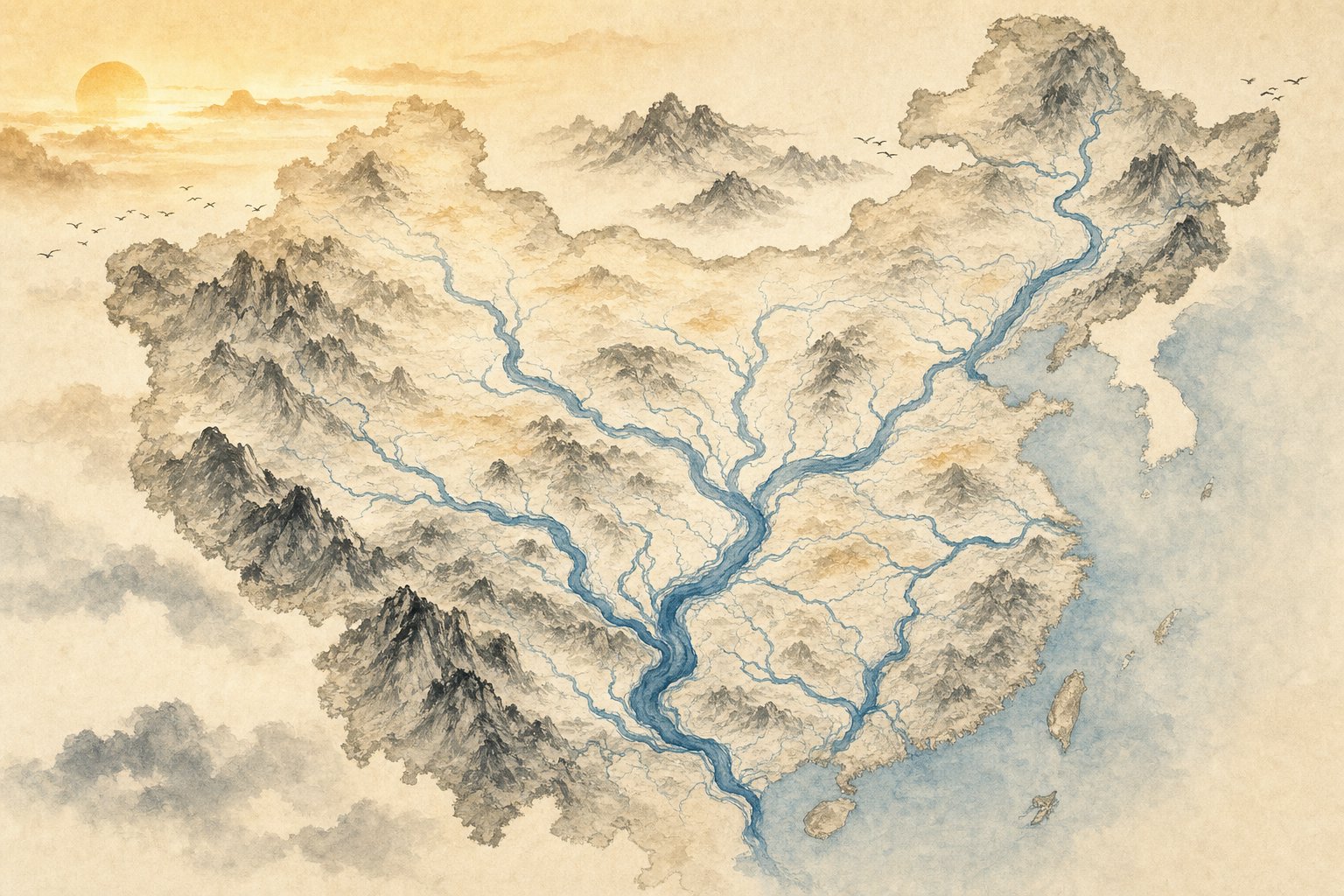
Rivers in Northern and Central China, or those associated with the Yellow River drainage basin, overwhelmingly use 河. Think of the Wei River (渭河), Huai River (淮河), Liao River (辽河), and Fen River (汾河). Rivers in Southern China, or those connected to the Yangtze drainage basin, lean toward 江. The Xiang River (湘江), Gan River (赣江), and Pearl River (珠江) all follow this pattern.
There's also a hydrological angle. Rivers that flow into inland seas or lakes tend to be named 河, like the Yellow River emptying into the Bohai Sea. Rivers that flow into external oceans are more often called 江, like the Yangtze reaching the East China Sea. Additionally, rivers with year-round strong flow and less distinct flood seasons tend to carry 江, while those with dramatic seasonal variation lean toward 河.
In Cantonese-speaking regions of southern China, an additional size distinction applies: 江 is generally reserved for large and medium rivers, while 河 covers smaller rivers and urban watercourses. This is the only part of the country where a large river in chinese character form is definitionally always 江 rather than 河.
As for 川, its role in modern Chinese is fundamentally different. You won't hear someone point at a river and call it a 川 in casual conversation. The character lives in place names like 四川 (Sichuan), in classical idioms like 川流不息, and in literary contexts where its archaic flavor adds weight. Only a handful of actual rivers in modern China still carry 川 in their names, such as the Dajin River (大金川) in western Sichuan, making it the rarest way to name a river in the country.
These geographic and historical layers mean that every river name in Chinese is a small piece of cultural data. The character chosen tells you something about where the river flows, when it was named, and which cultural sphere claimed it. That information becomes especially vivid when you look at specific place names on the map.
River Characters in Chinese Place Names and Geography
Every river name on a Chinese map is a small history lesson. The character chosen, whether 河, 江, or 川, encodes geographic facts, administrative decisions, and cultural memory that stretch back centuries. You've likely encountered some of these names already without realizing how much the characters reveal.
四川 Sichuan and the Four Rivers
The most famous place name containing 川 is undoubtedly 四川 (Sichuān), the southwestern province known for its spicy cuisine and giant pandas. The name literally breaks down as 四 (sì, "four") + 川 (chuān), which popular etymology interprets as "four rivers." The reality is more layered.
Historically, the name traces back to the Song Dynasty (1001 AD), when the region was divided into four administrative circuits called the "Four Circuits of Sichuan and Xia" (川峡四路). These four circuits were the Yizhou, Zizhou, Lizhou, and Kuizhou routes. The term itself evolved from the "Three Chuan" (三川) of the mid-Tang Dynasty, which in turn originated from the "Two Chuan" of an earlier period. So while 川 in this context technically refers to administrative divisions rather than literal rivers, the administrative names themselves were rooted in the region's identity as a land defined by waterways. The Sichuan Basin sits in the upper reaches of the Yangtze, fed by the Min, Tuo, Jialing, and Wu rivers, making the "four rivers" reading poetically accurate even if historically imprecise.
The name has been in continuous use for over a thousand years, and the province is still abbreviated as 川 (Chuān) in modern Chinese, appearing on license plates, news tickers, and shipping labels across the country.
Famous Chinese Rivers and Their Characters
Beyond Sichuan, the river characters show up in some of the most recognizable geographic names in East Asia. Here's how the major rivers break down character by character:
- 黄河 (Huáng Hé) — Yellow River: 黄 means "yellow" (referring to the heavy silt load), and 河 is the river character associated with northern China. This is the original 河, the river that gave the character its generic meaning. Writing the yellow river in chinese characters always uses 河 because this was its proper noun first.
- 长江 (Cháng Jiāng) — Yangtze River: 长 means "long," and 江 is the river character tied to southern China. The yangtze river in chinese characters uses 江 because this was the river that 江 originally named. At 6,300 kilometers, it earned the descriptor "long" honestly. Note that "Yangtze" itself comes from a local name for just one section of the river; the full Chinese name has always been 长江.
- 漓江 (Lí Jiāng) — Li River: Wondering what is li river in chinese characters? The 漓 character combines the water radical (氵) with 离 (lí, "to separate"), and 江 marks it as a significant southern waterway. Located in Guangxi province, the Li River uses 江 because it flows through southern China and empties into the Pearl River system, following the geographic pattern for southern rivers.
- 澜沧江 (Láncāng Jiāng) — Lancang River (Mekong): The lancang jiang river chinese characters break down as 澜 (lán, "waves") + 沧 (cāng, "vast/blue-green") + 江 (jiāng, "river"). This is the Chinese name for the upper Mekong, which flows through Yunnan province before crossing into Southeast Asia. It uses 江 because of its massive size and southern location.
- 珠江 (Zhū Jiāng) — Pearl River: 珠 means "pearl," named after a pearl-shaped rock formation in the river near Guangzhou. As a major southern waterway, it naturally takes 江.
- 淮河 (Huái Hé) — Huai River: The Huai flows through central China and historically served as the dividing line between north and south. It uses 河, placing it firmly in the northern character tradition.
A pattern emerges clearly from this list. Rivers south of the Yangtze almost universally carry 江. Rivers in the Yellow River basin and northern plains carry 河. And 川 lives on not in individual river names but in the broader geographic identity of places shaped by rivers.
These naming conventions aren't just Chinese phenomena. The same river characters crossed borders into Japanese and Korean, carrying their meanings into entirely different languages and cultural contexts.
Cross-Linguistic Usage of the River Character in East Asian Languages
Chinese characters didn't stay in China. Over centuries of cultural exchange, trade, and political influence, the writing system spread across East Asia, embedding itself in the literary traditions of Japan, Korea, and Vietnam. The river character in east asian languages offers one of the clearest examples of this transmission because 川 kept its core meaning of "river" everywhere it traveled, even as each language wrapped it in different sounds and cultural associations.
川 in Japanese as Kawa
In Japanese, 川 is read as かわ (kawa) in its native Japanese reading (kun'yomi) and せん (sen) in its Sino-Japanese reading (on'yomi). The native reading "kawa" is by far the more common one in everyday life. You'll encounter it in place names, family names, and ordinary vocabulary throughout Japan.
The river kanji chinese character japanese learners encounter is identical in form to the Chinese original. Three strokes, same structure, same visual logic of water flowing between banks. What changed is the sound attached to it and the grammatical context surrounding it. Japanese uses the character both as a standalone word meaning "river" and as a component in compound words and proper nouns.
Some of the most recognizable Japanese place names feature 川 prominently:
- 川崎 (Kawasaki): 川 (kawa, "river") + 崎 (saki, "cape" or "promontory"). A major industrial city in Kanagawa Prefecture, named for its position near a river cape.
- 神奈川 (Kanagawa): 神 (kana, from an older reading) + 川 (gawa, voiced form of kawa). This prefecture, home to Yokohama, carries the river character right in its name. The "gawa" pronunciation is a common phonetic shift that occurs when 川 appears as the second element in a compound.
- 石川 (Ishikawa): 石 (ishi, "stone") + 川 (kawa, "river"). A prefecture on the Sea of Japan coast, literally "stone river."
- 香川 (Kagawa): 香 (ka, "fragrance") + 川 (gawa, "river"). The smallest prefecture on Shikoku island.
Beyond geography, 川 appears in common Japanese words like 小川 (ogawa, "stream" or "brook"), a frequent family name, and 川上 (kawakami, "upstream"). The character is so deeply embedded in Japanese that it functions as naturally as any native element of the writing system. As Zev Handel notes in Chinese Characters across Asia, kanji remains "firmly embedded in the modern writing system" of Japan, unlike in Korea or Vietnam where Chinese characters have largely faded from daily use.
The Character Across East Asian Languages
In Korean, 川 is read as 천 (cheon) and classified as hanja, the Korean term for Chinese characters. Historically, it appeared in place names, classical texts, and formal writing throughout the Korean peninsula. The city of Incheon (인천, 仁川) is one of the most well-known examples. It literally means "benevolent river," combining 仁 (in, "benevolence") with 川 (cheon, "river"). Chuncheon (춘천, 春川), the capital of Gangwon Province, translates to "spring river."
Korean usage of Chinese characters has declined dramatically over the past century. North Korea eliminated hanja entirely by government policy in 1949, and South Korea has progressively reduced their role in education and publishing. Today, most Koreans encounter 川 only in place names, historical documents, or specialized contexts. The character's meaning is still understood, but it lives at the margins of the modern writing system rather than at its center.
The table below shows how 川 behaves across all three languages:
| Feature | Chinese (Mandarin) | Japanese | Korean |
|---|---|---|---|
| Character Form | 川 | 川 | 川 |
| Pronunciation | chuān (1st tone) | かわ (kawa) / せん (sen) | 천 (cheon) |
| Core Meaning | River, stream, plain | River, stream | River, stream |
| Writing System Name | Hanzi (汉字) | Kanji (漢字) | Hanja (漢字) |
| Current Usage Level | Active (place names, idioms, literary) | Active (everyday vocabulary, place names, surnames) | Limited (place names, historical texts) |
| Famous Place Name | 四川 (Sìchuān) | 神奈川 (Kanagawa) | 仁川 (Incheon) |
| Common Compound | 川流不息 (flowing ceaselessly) | 小川 (ogawa, brook) | 산천 (sancheon, mountains and rivers) |
What's remarkable is the semantic stability. Across three languages with completely different grammars, phonologies, and writing conventions, 川 still means "river." The chuan character meaning in japanese (pronounced "sen" in on'yomi compounds) retains the same water-between-banks concept that Chinese scribes carved into oracle bones over three millennia ago. The sound shifted dramatically from language to language, but the visual form and core meaning held firm.
This persistence reflects something deeper about how pictographic characters travel. When a character's shape so clearly mirrors its meaning, the connection survives translation. A Japanese child learning 川 can see the same flowing water that a Chinese child sees, even though one says "kawa" and the other says "chuān." The river in chinese character form became a shared cultural inheritance across East Asia, a visual shorthand that transcends spoken language.
That shared inheritance carries more than geographic labels. Rivers in Chinese culture are loaded with philosophical weight, appearing in idioms and classical texts as symbols of time, persistence, and the unstoppable flow of change.
Cultural Significance and Chinese River Character Symbolism
Rivers didn't just shape China's geography. They shaped its thinking. Chinese civilization began along the Yellow River and Yangtze, and that intimate relationship with water seeped into philosophy, literature, and everyday language. The river symbol in chinese culture carries meanings far beyond hydrology: continuity, moral virtue, the irreversible passage of time, and the quiet power of persistence.
These ideas crystallized into idioms that Chinese speakers still use daily, idioms where 川 and other river characters do philosophical heavy lifting in just four syllables.
River Idioms and Their Deeper Meanings
The most well-known river idiom in chinese is 川流不息 (chuānliú bùxī). If you break it apart: 川 (river) + 流 (flow) + 不 (not) + 息 (cease). The literal image is a river that never stops flowing.
川流不息 (chuānliú bùxī): "Flowing ceaselessly like a river." Used to describe anything continuous and unending, from traffic on a busy street to the passage of generations. The chuan liu bu xi meaning chinese speakers understand carries both admiration for persistence and a quiet acknowledgment that nothing stays still.
You'll hear this idiom in surprisingly mundane contexts. A news anchor describing holiday traffic might say 车辆川流不息 (chēliàng chuānliú bùxī, "vehicles flowing without cease"). A novelist might use it to describe crowds in a marketplace. But beneath the everyday usage sits a deeper philosophical current: the idea that motion, not stillness, is the natural state of things.
Other river idioms in chinese reinforce this theme:
- 百川归海 (bǎi chuān guī hǎi): "A hundred rivers return to the sea." Meaning all things converge toward a common destination, or that unity is inevitable despite diversity.
- 海纳百川 (hǎi nà bǎi chuān): "The sea accepts a hundred rivers." A metaphor for tolerance and open-mindedness, the capacity to embrace all perspectives.
- 一马平川 (yī mǎ píng chuān): "A single horse on a flat plain." Here 川 carries its extended meaning of "plain" or "open land," describing a situation with no obstacles ahead.
Notice how 川 in these expressions rarely means a specific river. It functions as an archetype, the idea of flowing water as a universal force. That abstraction is exactly what made it useful to philosophers.
Rivers as Symbols in Chinese Philosophy
Confucius stood at a riverbank and said one of the most quoted lines in Chinese intellectual history: 逝者如斯夫,不舍昼夜 (shì zhě rú sī fū, bù shě zhòu yè), meaning "Time flows away like this water, never resting day or night." The river became his metaphor for the irreversibility of time. You can't step into the same current twice, and you can't reclaim a moment once it passes. For Confucius, watching a river was a meditation on mortality and urgency.
Confucius also praised nine virtues of water in his writings, including virtue, loyalty, courage, justice, and enlightenment. He observed that a wise person loves water because wisdom, like flowing water, is smooth, responsive, and adaptable. The river doesn't force its way through rock. It finds the path of least resistance and, given enough time, reshapes the landscape entirely.
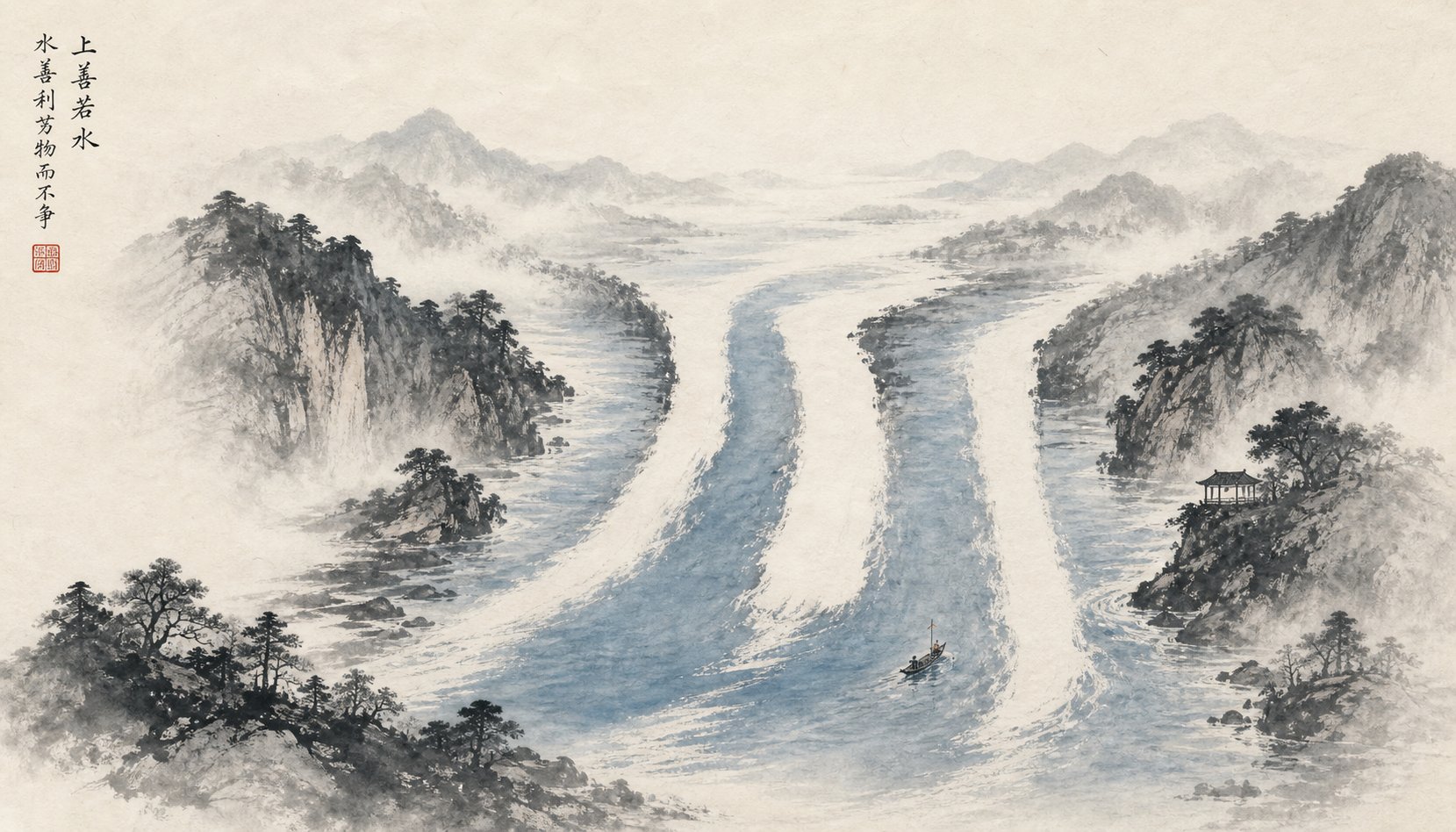
Daoist philosophy pushed the river symbol even further. Lao Tzu's famous declaration 上善若水 (shàng shàn ruò shuǐ), "the highest goodness is like water," placed water at the pinnacle of moral philosophy. In the Tao Te Ching, water nourishes all things without competing, settles in low places that others avoid, and remains closest to the Dao precisely because it doesn't strive. The river doesn't announce its power. It simply flows, and over centuries, it carves canyons.
This Daoist framing gave the chinese river character symbolism an additional layer: humility as strength. A river succeeds not by dominating but by yielding. It takes the shape of whatever contains it, yet nothing can permanently contain it. Bruce Lee distilled this into modern terms with his famous "Be water, my friend" philosophy, drawing directly from the same Daoist tradition that Lao Tzu articulated over two thousand years earlier.
Tang Dynasty emperor Li Shimin applied the same logic to governance, declaring that "water can carry a boat, and it can also overturn it." The people are the river; the ruler is the boat. Govern well, and the current supports you. Govern poorly, and it capsizes you. This metaphor shaped Chinese political thought for centuries, reinforcing the idea that rivers represent collective power, quiet until provoked, unstoppable once in motion.
These philosophical threads explain why 川 carries so much weight beyond its dictionary definition. When a Chinese speaker encounters this character, they're not just seeing "river." They're seeing a symbol of time, adaptability, moral virtue, and the quiet persistence that reshapes the world. That symbolic richness is what makes the character compelling not only as vocabulary but as a concept worth carrying into daily life, whether in a sentence, a piece of calligraphy, or even a tattoo.
Modern Usage Examples and Practical Sentences
Philosophy and history give 川 its depth, but the character also shows up in completely ordinary moments: planning a trip, describing scenery, or reading a news headline. Seeing how the river characters work in real sentences bridges the gap between textbook knowledge and actual comprehension.
Example Sentences for Everyday Use
The following sentences move from beginner-friendly structures to more complex literary usage. You'll notice 川 appearing alongside 河 and 江 in the kinds of contexts a learner or traveler would realistically encounter.
- 这条河很长。
Zhè tiáo hé hěn cháng.
"This river is very long."
Context: Basic description using 河, the most common everyday word for river. - 我想去四川旅游。
Wǒ xiǎng qù Sìchuān lǚyóu.
"I want to travel to Sichuan."
Context: Travel planning. 川 appears here as part of the province name. - 长江是中国最长的江。
Cháng Jiāng shì Zhōngguó zuì cháng de jiāng.
"The Yangtze is China's longest river."
Context: Geography fact using 江 for a major southern river. - 黄河水流很急。
Huáng Hé shuǐliú hěn jí.
"The Yellow River's current is very fast."
Context: Describing river conditions using 河 in its original proper-noun role. - 街上的人川流不息。
Jiē shàng de rén chuānliú bùxī.
"People on the street flow by without stopping."
Context: The idiom 川流不息 applied to a busy urban scene. - 百川归海,万物归一。
Bǎi chuān guī hǎi, wànwù guī yī.
"A hundred rivers return to the sea; all things converge into one."
Context: Literary or philosophical writing using 川 in its classical sense of "rivers" as a collective force.
These examples show the practical split between the three characters. In conversation, 河 and 江 do the heavy lifting for actual rivers. 川 appears in fixed expressions, place names, and elevated prose rather than casual speech.
Using the River Character in Art and Tattoos
The visual elegance of 川, three clean strokes that unmistakably depict flowing water, makes it a popular choice for decorative and artistic use. If you're considering a river chinese character tattoo, 川 offers genuine advantages over more complex characters: its simplicity reduces the risk of proportional errors, and its pictographic clarity means the meaning remains legible even at small sizes.
That said, a few practical considerations matter:
- Stroke accuracy: Three strokes sounds simple, but each one has a specific angle and weight. The left stroke curves slightly outward, while the center and right strokes are more vertical. A tattoo artist unfamiliar with Chinese calligraphy might space them too evenly or make them identical, which looks "off" to any native reader even if technically correct.
- Calligraphic style: A font-based stencil produces flat, mechanical lines. For body art, brushwork-style renderings in running script (行书) or semi-cursive carry more visual energy and authenticity. The best designs preserve the stroke dynamics of a calligrapher's hand.
- Meaning verification: 川 is unambiguous in meaning, which is rare for tattoo characters. Unlike characters that look similar to unrelated words (爱 vs. 受, for example), 川 has no common lookalikes. This makes it one of the safer single-character choices.
- Design resources: If you're working with a designer, look for a chinese character for river vector file or a chinese character for river transparent PNG sourced from a reputable calligraphy reference rather than a random font generator. Vector formats preserve stroke quality at any scale, and transparent backgrounds allow clean integration into larger compositions.
The strongest approach is the same one that applies to any Chinese character tattoo: have a native speaker who writes Chinese by hand produce your reference. A photograph of genuine brushwork, not a screenshot from a translation app, gives your tattoo artist the structural information they need to get proportions, spacing, and stroke energy right.
Whether 川 ends up on your skin, in your notebook, or just in your vocabulary, the final step is making sure it sticks in memory. A few targeted strategies can lock this character in place permanently.
How to Remember and Write the River Character
Knowing what 川 means is one thing. Recalling it instantly when you see it on a sign in Chengdu or reproducing it confidently on paper is another. The good news: this is one of the easiest characters in the entire system to lock into long-term memory, precisely because its form already tells you its meaning. The trick is reinforcing that connection with deliberate strategies rather than relying on passive recognition alone.
Memory Tricks for the River Character
Visualization is your strongest tool here. When you look at 川, you're already seeing a picture of flowing water. The mnemonic work is about making that picture vivid and personal enough that it sticks without effort.
- Picture a river canyon from above: Imagine looking down at a narrow gorge. The left and right strokes are cliff walls, and the center stroke is the ribbon of water running between them. Every time you write 川, you're sketching that aerial view.
- Three fingers in a current: Hold up three fingers and imagine water rushing past them. The gaps between your fingers are the channels. This physical gesture anchors the character in muscle memory as well as visual memory.
- Connect it to Sichuan food: If you've ever eaten mapo tofu or hot pot, you already know 四川. Associating 川 with the spice and heat of Sichuan cuisine gives the character an emotional hook that pure repetition can't match.
- Distinguish from similar characters: Learners sometimes confuse 川 with 三 (sān, "three") because both use three strokes. The difference is orientation: 三 uses horizontal lines stacked vertically, while 川 uses vertical lines arranged side by side. Think of it this way: water flows down, so the strokes in 川 run downward. Counting goes across, so the strokes in 三 run horizontally.
- Separate 河 and 江 by their radicals: Both 河 and 江 contain the water radical (氵) on the left, telling you they relate to water. Their right-side components (可 and 工) distinguish them. Meanwhile, 川 stands alone with no radical wrapper because it is the radical. If you remember that 川 is the purest, most stripped-down river character, the other two become "river plus something extra."
Stroke Order and Common Mistakes
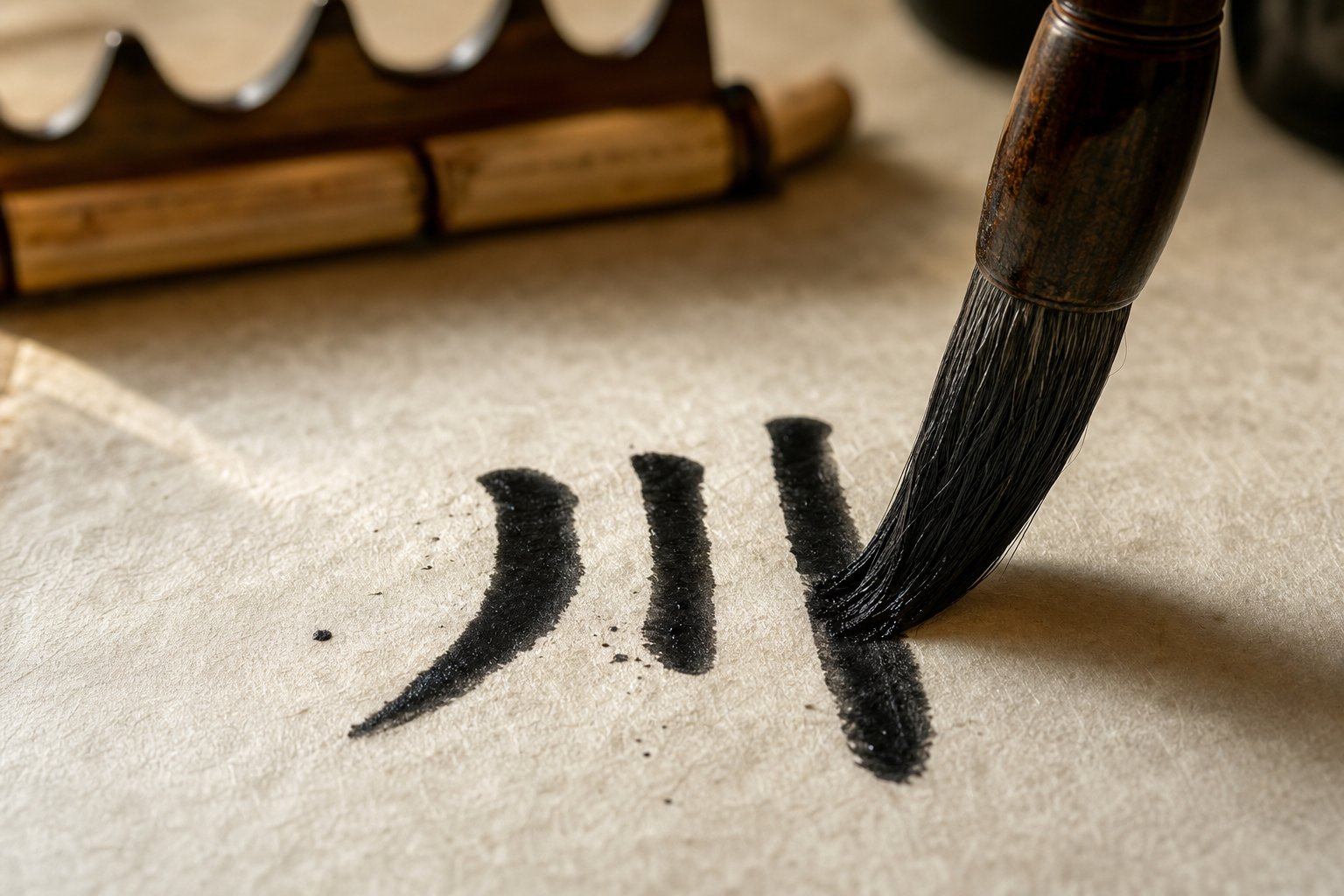
Writing 川 correctly takes about two seconds, but those two seconds need to follow the right sequence. The chinese character river stroke order follows a core rule of Chinese calligraphy: left part before right part. Since 川 consists of three vertical elements arranged side by side, you write them from left to right.
Here's the stroke-by-stroke breakdown for how to write river in chinese:
- Stroke 1 (left): A short downward-left stroke (撇, piě), curving slightly outward. Start near the top and sweep down to the lower left. This stroke is shorter than the other two.
- Stroke 2 (center): A straight vertical stroke (竖, shù) running from top to bottom. It sits slightly to the right of center and is taller than the first stroke.
- Stroke 3 (right): Another straight vertical stroke, parallel to the second, positioned on the far right. This stroke matches the height of the center stroke.
Common mistakes to watch for:
- Making all three strokes identical: The left stroke should curve and be shorter. If all three look the same, you've written something closer to a fence than a river.
- Starting from the right: Writing right-to-left feels intuitive for some learners, but it produces awkward hand positioning and unnatural stroke weight. Always start from the left.
- Spacing too widely: The three strokes should sit close together, forming a compact unit. Spread them too far apart and the character loses its visual identity as a single glyph.
- Confusing with 巛: The archaic variant 巛 uses curved strokes. In modern writing, stick with the straight-stroke version unless you're deliberately practicing seal script calligraphy.
To remember chinese character for river permanently, pair writing practice with context. Write 四川 while thinking about the province. Write 川流不息 while picturing a busy street. Write 川 by itself while visualizing water between banks. Each repetition that connects the physical act of writing to a meaningful image strengthens retention far more than copying the character fifty times in a row with a blank mind. The river character writing tips chinese learners benefit from most all share this principle: meaning-first practice beats mechanical repetition every time.
Frequently Asked Questions About the River Chinese Character
1. What is the Chinese character for river?
Chinese has three main characters for river: 川 (chuan), 河 (he), and 江 (jiang). The character 川 is the oldest pictograph, depicting water flowing between two banks with just three strokes. In modern usage, 河 is the most common everyday word for river, while 江 typically refers to large southern rivers. 川 survives primarily in place names like Sichuan, classical idioms, and literary contexts rather than casual conversation.
2. What is the difference between 河 and 江 in Chinese?
The key difference is geographic and historical. 河 (he) originally referred exclusively to the Yellow River and is now the standard term for rivers in northern and central China. 江 (jiang) originally meant the Yangtze and is used for rivers in southern China. Rivers flowing into inland bodies of water tend to use 河, while those reaching external oceans often use 江. For foreign river names, Chinese almost always uses 河 (e.g., Nile is 尼罗河). The two characters are not interchangeable in established river names.
3. Why is Sichuan called four rivers?
The name 四川 (Sichuan) literally combines 四 (four) and 川 (rivers/circuits). While popular etymology interprets it as 'four rivers,' the name actually traces to the Song Dynasty (1001 AD) when the region was divided into four administrative circuits. These evolved from earlier 'Three Chuan' and 'Two Chuan' designations. The interpretation as 'four rivers' remains poetically fitting since the Sichuan Basin is fed by the Min, Tuo, Jialing, and Wu rivers in the upper Yangtze watershed.
4. How do you write the Chinese character for river?
The character 川 is written in three strokes from left to right. Stroke one is a short curved downward-left sweep (pie stroke). Stroke two is a straight vertical line in the center, taller than the first stroke. Stroke three is another vertical line on the right, matching the center stroke's height. The left stroke should be noticeably shorter and curved, while the center and right strokes remain straight and parallel. All three strokes sit close together as a compact unit.
5. What does 川 mean in Japanese?
In Japanese, 川 is a kanji character read as kawa (native Japanese reading) or sen (Sino-Japanese reading). It retains the same core meaning of river or stream that it carries in Chinese. The character appears extensively in Japanese place names like Kawasaki (川崎, river cape), Kanagawa (神奈川), and Ishikawa (石川, stone river), as well as in common surnames like Ogawa (小川, brook). Unlike in Korean where Chinese characters have largely faded from daily use, 川 remains an active part of everyday Japanese writing.