The Many Names of China's Oldest Poetry Collection
The Shijing (詩經) is the oldest existing collection of Chinese poetry, comprising 305 works that date from approximately the 11th to the 7th centuries BCE. Spanning the Western Zhou dynasty through the Spring and Autumn period, this chinese poetry collection holds a foundational place in East Asian literary history. It stands as one of the Five Classics of Confucianism, a text memorized, debated, and revered by scholars for over two thousand years.
Yet for a single anthology, it carries a surprising number of names. If you have ever searched for this text and wondered what is a book of poems called in the Chinese tradition, you have likely encountered a confusing tangle of titles: Shijing, Classic of Poetry, Book of Songs, Mao Shi, Shi Sanbai, and more. Each label points to the same 305 poems, but each tells a different story about how the text was understood, transmitted, and valued across centuries.
What Is the Shijing
At its core, the Shijing is an anthology of verse drawn from court ceremonies, ancestral temple rituals, and the folk traditions of fifteen regional states. The poems range from simple love songs and harvest chants to elaborate dynastic hymns praising the founders of the Zhou royal house. Six additional poems survive only as titles, bringing the full catalog to 311 entries. As a book of songs in the most literal sense, the collection was originally performed with musical accompaniment, not merely read as written text.
Its significance extends well beyond literature. Confucius regarded the anthology as essential to moral education, diplomacy, and self-cultivation. By the Han dynasty (206 BCE - 220 CE), it had been elevated to canonical status alongside the Classic of Changes, the Classic of Documents, the Book of Rites, and the Spring and Autumn Annals.
Why One Text Has Many Names
So why does one collection carry so many titles? The accumulation reflects over two millennia of textual transmission, commentary traditions, imperial canonization, and cross-cultural translation. Each era left its mark in the form of a new designation. When you encounter a reference to what is a book of poems called in classical Chinese scholarship, the answer depends entirely on which historical layer you are looking at.
This article decodes every major name associated with the text, organized by category:
- Shi (詩) - the original pre-canonical name used by Confucius and his contemporaries
- Shi Sanbai (詩三百) - the numerical descriptor meaning "Poetry Three Hundred"
- Mao Shi (毛詩) - the commentary-tradition name tied to the Han-dynasty Mao recension
- Shijing (詩經) - the canonical title with the jing (經) suffix denoting classic or scripture
- Feng (風), Ya (雅), Song (頌) - the structural division names reflecting poetic function
- Book of Songs, Classic of Poetry, Book of Odes - Western translation titles shaped by each translator's interpretive lens
Together, these shijing classic of poetry names form a map of how one text traveled through time, absorbing new meanings at every turn. The bare title "Shi" tells us about a living educational resource in pre-imperial China. The "Jing" suffix tells us about state orthodoxy under the Han. The English translations tell us about how Western scholars chose to frame an ancient chinese poem tradition for modern readers.
Each name is a window into a different moment in the text's long life. The earliest of those windows opens onto a single character that meant, simply, "poetry."
The Original Name Shi and Its Pre-Canonical Usage
That single character, 詩 (shī), carried the entire weight of the collection for centuries before anyone thought to add a suffix or a qualifier. Imagine a text so universally known among the educated class that it needed no further introduction. You simply said "Shi," and everyone understood exactly which poems you meant. This is the chinese word for poetry in its most elemental form, and it served as the anthology's first and oldest name.
The Character Shi and Its Meaning
Look closely at the character 詩 (shī) and you will find two components working together. On the left sits the radical 言 (yán), meaning "speech" or "words." On the right stands 寺 (sì), which in this context functions as a phonetic element indicating pronunciation rather than contributing its standalone meaning of "temple." The combination gives us a character whose core sense is "words arranged with intention" or, more fluidly, "patterned speech."
The semantic range of 詩 is broader than the English word "poetry" might suggest. In its earliest usage, a chinese poem shi referred to verse that was sung, chanted, or recited aloud with musical accompaniment. It encompassed folk song, courtly ode, and ritual hymn alike. The character did not draw a hard line between literary composition and musical performance. A shi poem was something heard as much as something read.
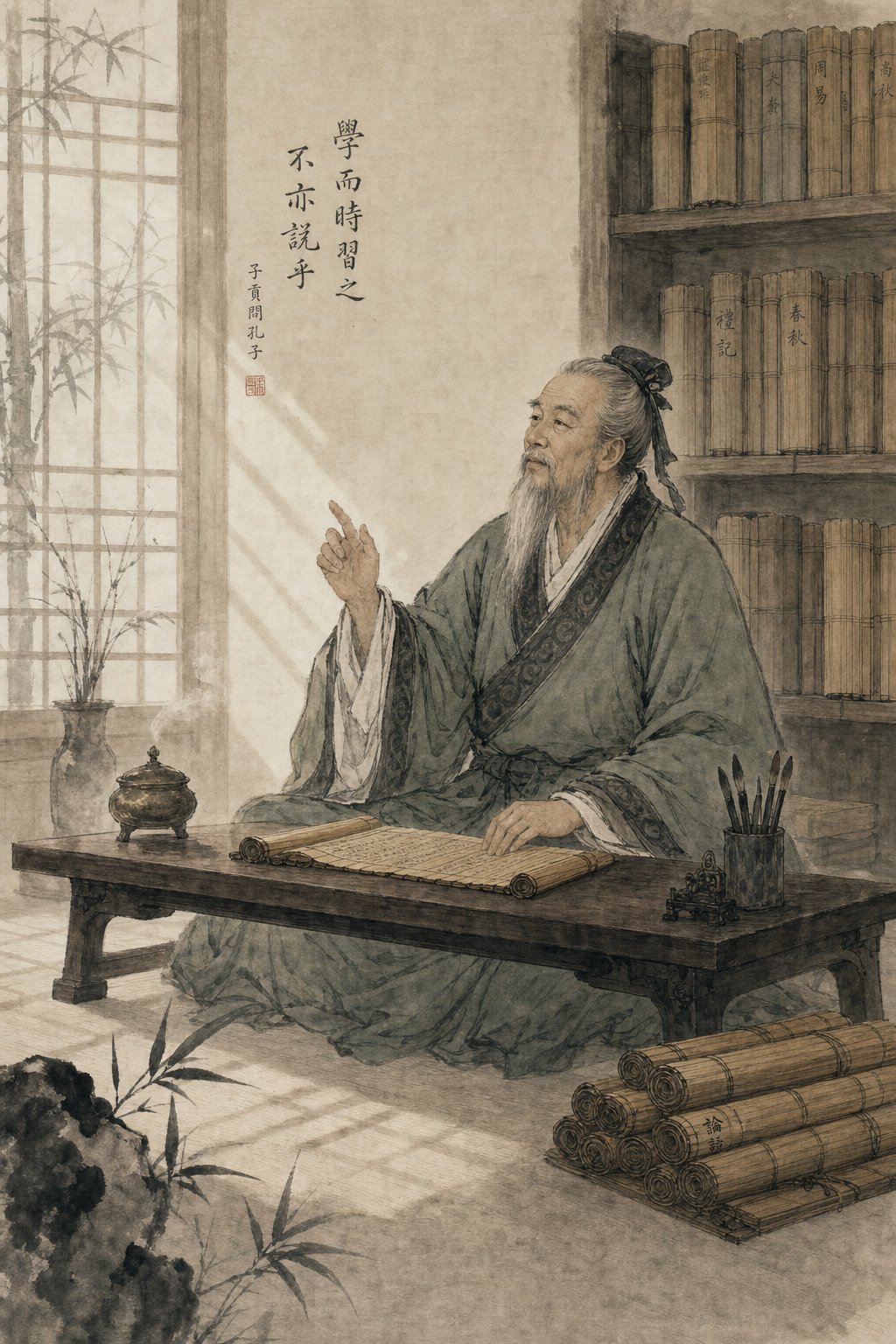
When Confucius (孔子, Kǒngzǐ) referenced the collection in the Analerta (論語, Lúnyǔ), he used the bare title 詩 without any additional marker. In passage after passage, he says simply "the Shi" (詩). This was not shorthand or abbreviation. It reflected the text's status as the poetry collection, so central to Zhou-era education that no qualifier was needed.
Shi in Pre-Qin Texts
This pattern holds across the major philosophical works of the pre-Qin period (before 221 BCE). In the Zuozhuan (左傳, Zuǒzhuàn, "Commentary of Zuo"), diplomats quote from the collection by saying "the Shi says" (詩云, shī yún). In the Mencius (孟子, Mèngzǐ), the philosopher cites individual poems using the same unadorned title. The Xunzi (荀子, Xúnzǐ) follows the identical convention.
What does this tell us? During the Spring and Autumn and Warring States periods, the collection functioned as a living educational and diplomatic resource. Envoys quoted its verses to make political arguments. Students memorized its lines to cultivate moral character. Teachers used it to train rhetorical skill. The text was not yet sacred scripture locked behind a canonical title. It was a practical tool, and its name reflected that practicality. Calling it "Shi" was like calling it "the Poems" with a capital P, a designation rooted in familiarity rather than reverence.
This pre-canonical naming also reveals something about ancient chinese poetry as a cultural institution. The collection had no single author claiming ownership, no formal title page. It was simply "the poetry" that everyone knew. Only later, when rival versions began circulating and imperial courts sought to fix orthodoxy, did the text acquire the additional names that distinguished one transmission lineage from another.
Shi Sanbai and the Poetry Three Hundred
A collection that everyone simply called "the Poems" eventually needed a way to signal its scope. Enter the numerical descriptor Shi Sanbai (詩三百), literally "Poetry Three Hundred." This name does something the bare title "Shi" cannot: it tells you the anthology is a finite, countable body of work. Not a loose gathering of verses still growing, but a defined set. Among the shijing classic of poetry names, this one functions as a practical shorthand that doubles as a statement about completeness.
Poetry Three Hundred as a Practical Label
You will find "Shi Sanbai" scattered across early texts, most notably the Analects (論語, Lúnyǔ). Confucius himself used the phrase when discussing the collection's moral and educational value. For his students and contemporaries, "Poetry Three Hundred" worked the way a round figure works in everyday speech. It was memorable, easy to cite, and immediately communicated that the speaker meant the entire corpus of shijing poems rather than a single piece or a subset.
The actual count, however, is not a clean three hundred. The precise breakdown of these ancient chinese poetry pieces looks like this:
- Feng (風, Airs) - 160 poems from fifteen regional states
- Xiao Ya (小雅, Minor Odes) - 74 poems of court life and governance
- Da Ya (大雅, Major Odes) - 31 poems of dynastic narrative and royal ceremony
- Song (頌, Hymns) - 40 poems of ancestral temple ritual
- Sheng (笙, Reed-organ poems) - 6 pieces surviving only as titles without text
That gives us 305 complete chinese poems plus 6 title-only entries, totaling 311 catalog items. So why say "three hundred"? The convention reflects a common practice in classical Chinese of rounding to a convenient figure. Three hundred captures the order of magnitude without pretending to decimal precision. It is a cultural habit, not an error. Early readers understood the phrase as meaning "the full set" rather than an exact tally.
The collection, as noted by translator William Jennings, predates Confucius by some three centuries, though he is often credited with arranging it into its current form around 520 BCE. This arrangement into a bounded set of roughly three hundred verses is precisely what the numerical name commemorates. These are among the oldest poems in any continuous literary tradition, and the round-number label helped fix them as a unified whole in cultural memory.
What the Numerical Name Reveals
Think about what it means to give a collection a number-based name. It signals closure. An open anthology, one still accepting new entries, would not benefit from a fixed count. By calling the corpus "Poetry Three Hundred," early scholars communicated that the oldest poetry in the Chinese tradition had been gathered, sorted, and sealed. Nothing more would be added. Nothing would be removed. The number became a boundary marker.
This matters because it tells us the collection was understood as a complete curriculum. Confucius treated it that way. His most famous statement about the anthology uses the numerical title to frame the entire set as a single moral lesson:
The Master said: "The three hundred Shi (詩三百), in a single phrase, can be summed up as: thoughts without deviation." (子曰:詩三百,一言以蔽之,曰思無邪。)
That line from Analects 2.2 does two things at once. It uses the numerical name to invoke the full scope of the collection, and it assigns the entire body of work a unified moral character. "Thoughts without deviation" (思無邪, sī wú xié) suggests that every one of those three hundred-odd poems, from rustic love songs to solemn hymns, expresses something genuine and morally upright. The numerical title makes this sweeping claim possible. You cannot say "all of them" without first establishing that "them" is a bounded set.
This framing shaped how later generations approached the anthology. It was not a casual reading list you could dip into selectively. It was a complete system, and mastering it meant working through the full three hundred. The numerical name carried that expectation forward, reinforcing the idea that these chinese poems formed an indivisible educational whole rather than a menu of optional selections.
The name also hints at something subtler about authority. A numbered collection implies someone counted, someone decided what was in and what was out. Whether that editorial hand belonged to Confucius or to earlier court musicians remains debated, but the name itself encodes the act of curation. "Poetry Three Hundred" is not just a description. It is a claim that the anthology is finished, authoritative, and sufficient.
That sense of sufficiency would soon attract an even stronger marker of authority: the character 經 (jīng), meaning "classic" or "canon," which transformed the collection's status from a respected teaching resource into state-sanctioned scripture.
Mao Shi and the Han Commentary Tradition
Before the text gained its canonical suffix, it faced a different kind of identity crisis. During the Han dynasty, the Shi did not exist as a single agreed-upon text. Multiple versions circulated simultaneously, each tied to a distinct scholarly lineage with its own interpretive framework. The name Mao Shi (毛詩) emerges from this period of textual competition, and among the shijing classic of poetry names, it is the one that tells us most about how old chinese books survived or perished based on institutional patronage and scholarly prestige.
The Mao Recension and Its Dominance
Picture the early Han dynasty as a marketplace of competing editions. Four major recensions of the Shi jing vied for scholarly attention and imperial support:
- Lu Shi (魯詩) - the Lu tradition, associated with the state of Lu
- Qi Shi (齊詩) - the Qi tradition, from the state of Qi
- Han Shi (韓詩) - the Han tradition, linked to the scholar Han Ying (韓嬰)
- Mao Shi (毛詩) - the Mao tradition, attributed to Mao Heng (毛亨) and Mao Chang (毛萇)
The first three traditions, Lu, Qi, and Han, held official positions at the Imperial Academy (太學, Tàixué) and enjoyed direct imperial patronage during the early Western Han. The Mao tradition, by contrast, operated largely outside official channels. It received formal recognition only briefly under Emperor Ping (r. 1 BCE - 6 CE). For most of the Western Han, the Mao Shi was the underdog.
Yet the underdog won. Several factors tipped the balance. Proponents of the Mao tradition claimed their text descended directly from the first generation of Confucius's students, lending it an aura of authenticity that the other versions could not match. The influential dictionary Shuowen Jiezi (說文解字), compiled by Xu Shen (許慎) in the 2nd century CE, quoted almost exclusively from the Mao text. Most decisively, the renowned Eastern Han scholar Zheng Xuan (鄭玄, 127-200 CE) chose the Mao Shi as the basis for his annotated edition, the Mao Shi zhuan jian (毛詩傳箋). Zheng Xuan's authority was immense, and his endorsement effectively sealed the Mao tradition's dominance.
The competing recensions faded one by one. The Qi tradition died out during the third century. The Lu tradition disappeared in the early fourth century, surviving only in fragments carved into the Xiping Stone Classics (熹平石經) of 175 CE. The Han tradition left behind a single work, the Han Shi waizhuan (韓詩外傳, "Outer Commentary on the Han Tradition"), but was no longer taught by the sixth century. By the 5th century, only the Mao Shi remained intact.
Why Mao Shi Persisted as a Name
Here is where things get interesting for anyone studying confucian poetry transmission. If the Mao version is the only one that survived, why not just call it "the Shijing" and drop the Mao label entirely? The answer lies in what the name actually signals.
Calling the text "Mao Shi" does more than identify a manuscript. It points to an entire interpretive apparatus that came bundled with the poems themselves. The Mao tradition included:
- Mao xu (毛序) - prefaces divided into a daxu (大序, "Major Preface") and xiaoxu (小序, "Minor Prefaces") that assign each poem a specific historical context and moral reading
- Mao zhuan (毛傳) - glosses and commentary explaining difficult vocabulary and interpreting allegorical meaning
- Zheng jian (鄭箋) - Zheng Xuan's sub-commentary layered on top of the Mao glosses
These layers of interpretation shaped how every subsequent reader encountered the poems. When scholars say "Mao Shi," they mean the poems as filtered through this specific framework, one that reads folk songs as political allegory and love poetry as moral instruction. The name distinguishes the transmitted text, with all its interpretive baggage, from the hypothetical "original" poems that might have existed before any commentary tradition touched them.
This distinction matters more than it might seem. Among old chinese books that survived the ancient world, the shijing is unique in being preserved through only a single interpretive lineage. The other Four Classics each retained multiple commentary traditions. The Mao Shi stands alone as a case where one scholarly family's reading became the only reading available for nearly two millennia.
Zheng Xuan's edition of the Mao text was formally designated the imperially authorized version in 653 CE during the Tang dynasty. Kong Yingda (孔穎達, 574-648) incorporated it into the Wujing zhengyi (五經正義, "Corrected Meanings of the Five Classics"), cementing its place in the examination system. From that point forward, any scholar preparing for the imperial exams studied the Mao Shi specifically, not some generic "Shijing."
For modern readers, the name carries a quiet reminder. The text you hold when you read the shi jing today is not a neutral document. It is the Mao recension, shaped by the Mao prefaces, filtered through Zheng Xuan's annotations, and standardized by Tang-dynasty imperial decree. The older romanization "Shih Ching" that appears in earlier Western scholarship refers to this same transmitted Mao text. Every layer of commentary is baked into the version that survived.
That survival story raises a deeper question about what happens when a text crosses the threshold from respected anthology to state-sanctioned scripture. The mechanism for that transformation was a single character, 經 (jīng), and its addition changed everything about how the collection was read, taught, and named.
The Jing Suffix and Confucian Canonization
A single character turned a poetry collection into scripture. The character 經 (jīng) is what separates "Shi," a familiar anthology quoted by diplomats and teachers, from "Shijing," a state-sanctioned chinese classic carrying the weight of imperial orthodoxy. Understanding this suffix is essential to grasping how the classic of poetry shijing acquired its most enduring and widely recognized name.
What Jing Means and When It Was Added
The character 經 (jīng) has a concrete origin that might surprise you. Its earliest meaning refers to the warp threads of a loom, the vertical threads that run the full length of a piece of cloth and hold the entire fabric together. The weft threads (緯, wěi) cross back and forth, but the warp threads are the structural foundation. From this textile metaphor, 經 extended to mean something that runs through everything, something foundational and indispensable. By the Han dynasty, it had become the standard term for canonical writings that formed the structural backbone of Confucian learning.
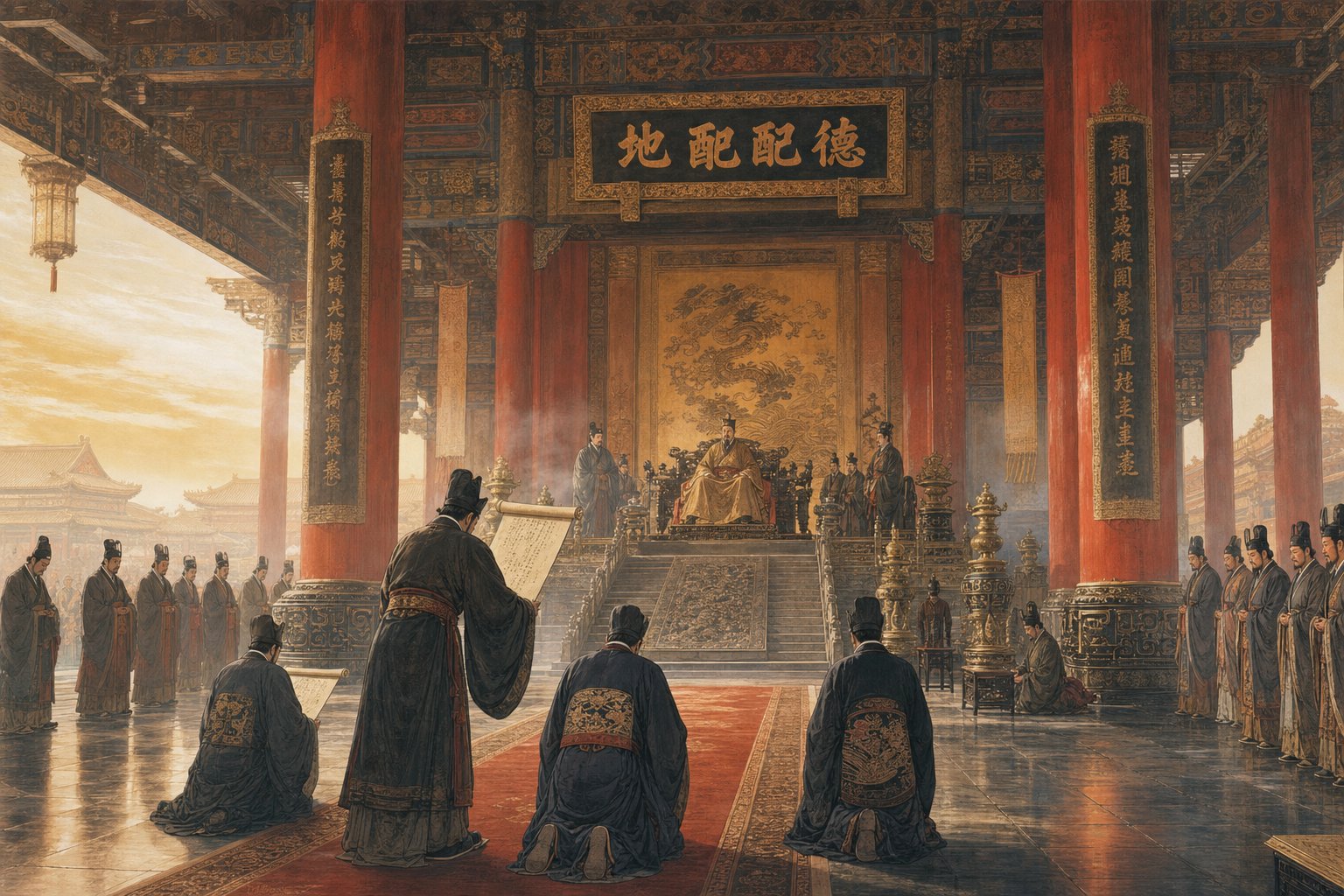
The compound "Shijing" (詩經) became standard usage during the reign of Emperor Wu of Han (漢武帝, r. 141-87 BCE). This was the ruler who, on the advice of scholar Dong Zhongshu (董仲舒), established Confucianism as state doctrine and appointed official erudites (博士, bóshì) for each of the Five Classics (五經, Wǔjīng). The act of adding 經 to 詩 was not merely a naming convention. It was a political declaration. The poetry collection was no longer just useful. It was now canonical, meaning it carried the authority of the state and the weight of required study for anyone seeking government office.
Think of it this way: before Emperor Wu, the Shi was something you studied because it made you a better thinker and speaker. After Emperor Wu, the Shijing was something you studied because your career depended on it. The suffix encoded that shift from cultural prestige to institutional power.
The Jing Designation Among the Five Classics
The Shijing did not receive this elevation alone. Emperor Wu's canonization created a set of five foundational texts, each carrying the 經 suffix or its equivalent canonical status. The naming pattern is consistent across the group, and seeing them together reveals how the system worked:
| Chinese Characters | Romanization | English Translation | Title Components |
|---|---|---|---|
| 詩經 | Shījīng | Classic of Poetry / The Book of Poetry | 詩 (poetry) + 經 (classic) |
| 易經 (周易) | Yìjīng (Zhōuyì) | Classic of Changes | 易 (change) + 經 (classic) |
| 書經 (尚書) | Shūjīng (Shàngshū) | Classic of Documents | 書 (documents) + 經 (classic) |
| 禮記 | Lǐjì | Record of Rites | 禮 (rites) + 記 (record) |
| 春秋 | Chūnqiū | Spring and Autumn Annals | 春 (spring) + 秋 (autumn) |
Notice something interesting in that table. Not every text in the Five Classics actually carries the 經 suffix in its most common title. The Liji uses 記 (jì, "record") and the Chunqiu uses a seasonal metaphor. The Shujing is sometimes called Shangshu (尚書, "Esteemed Documents") without the 經 at all. Yet all five are collectively referred to as the Wujing (五經), and the 經 designation applies to the group as a whole. The Shijing and Yijing are the two that most consistently wear the suffix in everyday scholarly usage.
Originally, tradition spoke of Six Classics (六經, Liùjīng) rather than five. The sixth was a Classic of Music (樂經, Yuèjīng) that was reportedly lost, possibly during the Qin dynasty's suppression of Confucian texts. Some scholars believe its contents survive partially within the "Records of Music" (樂記, Yuèjì) chapter of the Liji. Whether it ever existed as a standalone text remains debated, but its absence shaped the canon into the five-text structure that persisted for two millennia.
Here is where a productive tension emerges. The 經 designation implies something elevated, authoritative, even sacred. It places the book of poetry alongside texts of divination, statecraft, ritual protocol, and historical chronicle. Yet the Shijing's actual contents include rustic courtship songs, complaints about military conscription, and bawdy harvest celebrations. A farmer's daughter singing about picking herbs by the river sits in the same canonical frame as the Yijing's cosmological hexagrams. The jing shi relationship, the binding of "classic" to "poetry," yokes together the sacred and the earthy in a way that no other text in the Five Classics quite replicates.
This tension was not lost on later scholars. The Mao Prefaces (毛序) worked hard to resolve it by reading every folk song as political allegory. A love poem became a commentary on good governance. A lament about an unfaithful lover became a critique of a negligent ruler. The 經 suffix demanded that kind of interpretive labor. Once you call something a "classic," you need to explain why a song about a girl waiting by the river deserves the same reverence as a document recording the words of sage kings.
For modern readers encountering the shujing, Yijing, and Shijing as a group, the shared suffix signals a shared institutional history. These texts were studied together, tested together in civil service examinations, and commented upon using the same philological methods. The 經 label is what bound them into a coherent educational curriculum rather than a random assortment of old writings. It transformed each text from a standalone work into a node in a larger system of knowledge that the imperial state considered essential for governance.
The canonization also froze the text's boundaries. Before the jing designation, the collection could theoretically have grown or shifted. After it, the 305 poems were locked in place. You do not add new chapters to scripture. The suffix did for the text's contents what the numerical name "Shi Sanbai" did for its reputation: it declared the anthology complete, closed, and authoritative.
Yet within that fixed frame of 305 poems, an internal architecture existed that gave rise to yet another set of names. The three structural divisions, Feng, Ya, and Song, each carried their own title and their own implications about where a poem came from and how it was meant to be performed.
Feng Ya Song and the Structural Division Names
Most anthologies organize poems by author or chronology. The Shijing does something different. Its internal architecture sorts 305 poems into three functional categories based on where they came from and how they were performed. These categories, Feng (風), Ya (雅), and Song (頌), are not just organizational labels. They function as names in their own right, each one encoding a distinct social world, a distinct performance setting, and a distinct relationship between poet and audience. Within the broader system of shijing classic of poetry names, these structural division titles tell you what kind of classical poetry you are reading before you encounter a single line of verse.
Feng Ya Song as Functional Categories
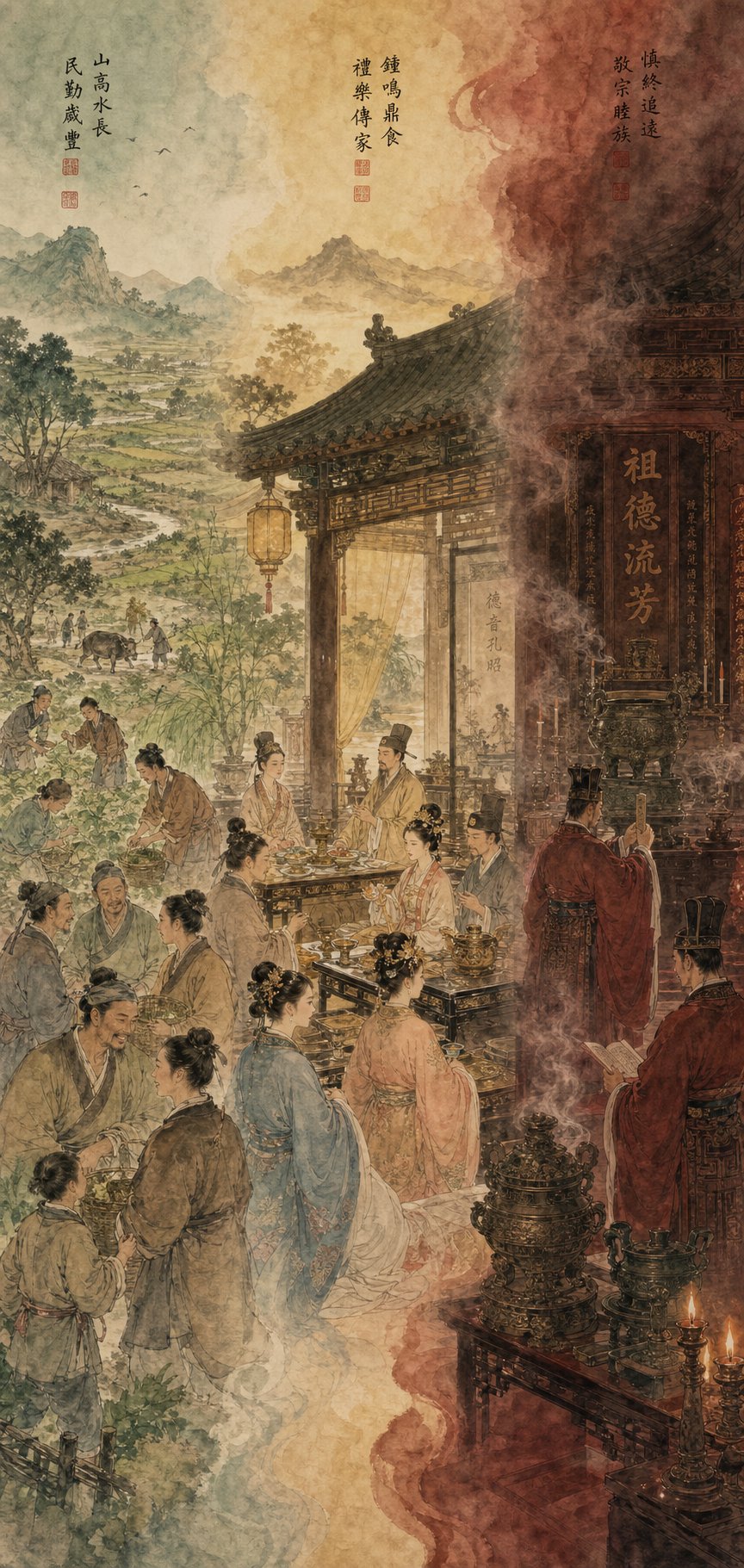
Imagine three concentric circles of Zhou-dynasty society. At the outermost ring, ordinary people in regional states sing about love, labor, and loss. At the middle ring, aristocrats and officials compose verse for court banquets and political gatherings. At the innermost ring, ritual specialists perform sacred chants in ancestral temples. Each ring produced its own body of traditional poetry, and each received its own categorical name.
Feng (風, Airs or Winds) literally means "wind." The metaphor suggests something that blows across the land, carrying local customs and sentiments from place to place. The 160 Feng poems are arranged by the regional state they originated from, which is why this section is formally called Guofeng (國風, "Airs of the States"). Fifteen states are represented, from Zhou Nan (周南) and Shao Nan (召南) in the south to Bin (豳) in the northwest. These are folk songs in the truest sense: courtship lyrics, harvest chants, soldiers' complaints, and wedding celebrations. Their language is direct, their imagery drawn from daily life, and their emotional register personal rather than ceremonial.
Ya (雅, Odes or Elegantiae) carries a meaning closer to "refined" or "correct." The character suggests the speech and manners of the capital region, the cultural standard against which provincial customs were measured. The Ya section splits into two tiers:
- Xiao Ya (小雅, Minor Odes) - 74 poems associated with the courts of regional rulers and lower-ranking aristocrats, covering themes of governance, feasting, friendship, and political discontent
- Da Ya (大雅, Major Odes) - 31 poems tied to the royal court itself, narrating dynastic founding myths, praising ancestral kings, and addressing matters of state at the highest level
The Ya poems are organized internally into "decades" (什, shí), groups of ten, each named after its opening poem. This arrangement reflects their use as a curated repertoire for court occasions rather than a spontaneous folk tradition.
Song (頌, Hymns or Lauds) refers to sacred chants performed during ancestral temple rituals. The character 頌 has been linked by scholars like Ruan Yuan (阮元, 1764-1849) to the word 容 (róng, "appearance" or "deportment"), suggesting these pieces accompanied choreographed ritual movements. The 40 Song poems divide into three groups: Hymns of Zhou (周頌, 31 poems), Hymns of Lu (魯頌, 4 poems), and Hymns of Shang (商頌, 5 poems). These are the oldest layers of the collection, with the Zhou Hymns likely dating to the earliest decades of the dynasty. Their language is solemn, their purpose liturgical, and their audience includes both the living participants and the ancestral spirits being honored.
Each category name, then, encodes three kinds of information simultaneously: geographic origin (regional states vs. capital vs. temple), social register (commoners vs. aristocrats vs. ritual specialists), and performance function (entertainment vs. political expression vs. sacred worship). No single English word captures all three dimensions, which is why translators have rendered these terms so differently across the centuries.
How Division Names Relate to the Overall Title
Here is something that often surprises readers encountering the book of odes for the first time. These three division names were not always subordinate to a single overarching title. In some early references, scholars treated Feng, Ya, and Song as quasi-independent collections rather than subsections of one anthology. The Tang-dynasty commentator Kong Yingda (孔穎達) noted that during the Han period, the four designations of feng, daya, xiaoya, and song were interpreted as the "four beginnings" (四始, sìshǐ), each representing a different phase in the rise and fall of the Zhou royal house. Under this reading, the divisions were not just organizational bins. They were a historical narrative told in four movements.
This conceptual independence shows up in how the classical poem traditions were taught. A student might specialize in the Guofeng for its linguistic richness or focus on the Da Ya for its historical content. The division names gave scholars a way to talk about distinct bodies of material within the larger collection without constantly invoking the whole. You could say "the Airs" and your audience knew you meant folk songs from the regional states, not court odes or temple hymns.
The following table summarizes how each division functions as both a structural category and a name in its own right:
| Chinese Character | Romanization | Literal Meaning | Number of Poems | Original Performance Context |
|---|---|---|---|---|
| 風 (國風) | Fēng (Guófēng) | Wind / Airs of the States | 160 | Regional folk settings: festivals, fieldwork, courtship gatherings across 15 states |
| 小雅 | Xiǎo Yǎ | Minor Odes / Lesser Elegantiae | 74 | Aristocratic court banquets, diplomatic gatherings, and official ceremonies |
| 大雅 | Dà Yǎ | Major Odes / Greater Elegantiae | 31 | Royal court audiences, dynastic commemorations, and state rituals |
| 頌 | Sòng | Hymns / Lauds | 40 | Ancestral temple sacrifices with choreographed dance and instrumental music |
Together, these four rows account for all 305 complete poems in the collection. The tripartite system of Feng, Ya, and Song (with Ya subdivided into two tiers) gave later scholars a vocabulary for discussing not just what the poems say but what they originally did. A Feng poem entertained and expressed. A Ya poem advised and commemorated. A Song poem invoked and sanctified. The division names carry those functional distinctions forward across millennia, even as the original musical settings have long since fallen silent.
This internal naming system operated entirely in Chinese. But when Western translators began rendering the collection into English, they faced a different challenge: choosing a single title that could represent the whole anthology to readers who had never encountered any of these categories. Their choices, from "She King" to "Book of Songs" to "Classic Anthology," reveal as much about Western literary assumptions as they do about the Chinese text itself.
Western Translation Titles and Their Implications
Every English title given to this collection is an argument disguised as a label. When a translator sits down with 305 ancient Chinese poems and must choose a single phrase for the cover, that choice reveals assumptions about what the text fundamentally is. Is it literature? Music? Sacred canon? The history of the Shijing in English is a history of translators answering that question differently, and each answer has shaped how generations of Western readers conceptualize chinese poetry from the Zhou era.
From She King to Classic Anthology
The first major English rendering came from Scottish missionary and sinologist James Legge, who published his translation in 1871 under the title The She King, or the Book of Poetry. That romanization, "She King," follows the Wade-Giles system that dominated 19th-century sinology. "She" represents 詩 (shī) and "King" represents 經 (jīng). Legge's title preserves the Chinese compound directly, transliterating rather than translating. His subtitle, "Book of Poetry," offers the English equivalent, but the primary title keeps the Chinese name front and center. For Legge, the text was first and foremost a Chinese classic to be presented on its own terms. In a later 1876 edition, he shifted to The She King, or The Book of Ancient Poetry, adding "Ancient" to signal the collection's historical distance from modern verse.
William Jennings followed in 1891 with The Shi King: The Old "Poetry Classic" of the Chinese. His title is revealing in a different way. By placing "Poetry Classic" in quotation marks, Jennings signals that the canonical designation is a Chinese cultural category he is reporting rather than endorsing. He treats the jing status as a fact about Chinese reception history, not a universal literary judgment.
Arthur Waley's 1937 translation broke decisively from this pattern. He called it simply The Book of Songs. No romanization, no "Classic," no reference to Confucius. Waley's title foregrounds the musical and oral origins of the poems. "Songs" tells English readers that these verses were sung, not merely written. It emphasizes performance over textuality, folk tradition over canonical authority. For readers encountering the book of songs chinese tradition for the first time, Waley's title made the collection feel accessible and human rather than remote and scholarly. His translation remains one of the most widely read versions in English, and its title has become almost synonymous with the collection in general humanities circles.
Bernhard Karlgren, the Swedish linguist whose reconstructions of Old Chinese phonology drew heavily on the Shijing's rhyme patterns, published his translation in 1950 as The Book of Odes. "Odes" carries a different weight than "Songs." It evokes Pindar and Horace, suggesting formal ceremonial verse composed for public occasions. Karlgren's choice reflects his scholarly focus on the text's structural and linguistic properties rather than its folk origins. The book of odes, in his framing, is a collection of carefully crafted compositions, not spontaneous folk melodies.
Then came Ezra Pound. The American poet published his version in 1954 under the title The Confucian Odes: The Classic Anthology Defined by Confucius. This is the most ideologically loaded title in the collection's English history. Pound foregrounds Confucius not as a passive transmitter but as the defining editorial intelligence behind the anthology. "Defined by Confucius" asserts that the collection's meaning and boundaries are products of a single sage's judgment. Pound was deeply invested in Confucian philosophy as a model for social order, and his title makes that investment explicit. The word "Classic" appears not as a translation of 經 but as an English literary category, placing the text alongside Homer and Virgil.
Poetry vs Songs vs Odes in Translation
Step back from individual translators and you will notice that the English-language debate over this collection's name comes down to three key words: Poetry, Songs, and Odes. Each carries distinct connotations that shape reader expectations before a single verse is encountered.
"Poetry" implies literary art. It suggests deliberate composition, aesthetic refinement, and a tradition of written craft. When you call the collection a book of "poetry," you frame it as belonging to the same category as Keats or Rilke. This is the choice that most emphasizes the text's status as high literature.
"Songs" emphasizes musical performance and oral transmission. It reminds readers that these verses had melodies, that they were heard before they were read, and that many originated among common people rather than court literati. Waley's choice of "Songs" democratizes the collection, pulling it away from the rarefied air of canonical scripture and toward the living breath of folk tradition.
"Odes" occupies a middle ground with a lean toward formality. In English literary tradition, an ode is a structured lyric poem often written for a specific occasion, typically elevated in tone. Karlgren's "Odes" and the common translation "Book of Odes" suggest ceremonial gravity without quite claiming sacred status. It is the choice that most closely mirrors the Ya (雅, "refined") section's aesthetic register, though it fits the folk songs of the Feng section less comfortably.
More recent scholarship has largely settled on "Classic of Poetry" as the standard English rendering in academic contexts, a direct translation of the Chinese compound 詩經 that preserves both the content word (poetry) and the canonical marker (classic). This is the title you will find in most university press publications and peer-reviewed journals today. It avoids the interpretive lean of "Songs" or "Odes" while acknowledging the text's canonical status within the Confucian tradition.
The following table maps the major translations against their title choices and what those choices communicate:
| Translator | Publication Date | English Title | Interpretive Implication |
|---|---|---|---|
| James Legge | 1871 | The She King, or the Book of Poetry | Preserves Chinese romanization (Wade-Giles); frames text as literary art with canonical status |
| William Jennings | 1891 | The Shi King: The Old "Poetry Classic" of the Chinese | Reports canonical status as a Chinese cultural fact rather than a universal claim |
| Arthur Waley | 1937 | The Book of Songs | Emphasizes musicality, oral origins, and folk accessibility over canonical authority |
| Bernhard Karlgren | 1950 | The Book of Odes | Suggests formal, structured verse; aligns with Western classical tradition (Pindar, Horace) |
| Ezra Pound | 1954 | The Classic Anthology Defined by Confucius | Foregrounds Confucian editorial authority; positions text as world-literary classic |
| Modern academic standard | 1990s onward | Classic of Poetry | Direct translation of 詩經; neutral, preserving both content and canonical marker |
You will notice that no two translators from the early period agreed on a title. That disagreement is itself informative. It tells us that the Chinese compound 詩經 resists easy one-to-one translation because it compresses two concepts, "poetry" and "canonical scripture," that English keeps separate. A "classic" in English is not quite a 經 in Chinese. A "song" is not quite a 詩. Every title is a compromise, and the specific compromise each translator chose reveals their priorities: fidelity to the Chinese, accessibility for Western readers, or alignment with a particular literary-philosophical agenda.
These translation titles also carry practical consequences. A student searching for "the book of songs" in a library catalog will find Waley. A student searching for "the book of odes" will find Karlgren. The proliferation of English names can make it genuinely confusing to determine whether two references point to the same text. They do. Every title in that table refers to the same 305 poems. The difference lies entirely in how each translator wanted you to hear them before you began reading.
That confusion about which name to use in which context is not limited to English. It extends across academic disciplines, style guides, and even into other East Asian scholarly traditions where the same Chinese characters receive entirely different pronunciations.
Which Name to Use in Academic Writing
With so many titles pointing to the same 305 poems, a practical question emerges: which one should you actually use when writing about classical chinese poetry? The answer depends on your audience, your discipline, and what aspect of the text you want to foreground.
Conventions in Academic Publishing
Anglophone sinology has largely standardized on pinyin romanization. That means "Shijing" (or "Shi jing" with a space, depending on the journal) is the default in specialist publications. The journal Early China, for instance, requires pinyin and lists the text as "Shi jing" in its citation guidelines. The Yale University Library romanization guide confirms that pinyin replaced Wade-Giles as the standard across U.S. library systems, meaning catalog searches now require pinyin forms rather than older spellings like "Shih Ching" or "She King."
That said, style guides vary. Some university presses prefer the two-word form "Shi jing" while others use the single compound "Shijing." Both are acceptable. What matters is consistency within a single piece of writing. If you open with "Shijing," do not switch to "Shi Jing" three paragraphs later.
English translation titles remain common in running prose even within specialist work. "Classic of Poetry" and "Book of Songs" both appear regularly in peer-reviewed articles and monographs. Neither is wrong. They simply reflect different translation philosophies, as the previous section explored. The key point for anyone confused by the proliferation of names in chinese poetry books and bibliographies: "Classic of Poetry," "Book of Songs," and "Book of Odes" all refer to the same text. They are not three different anthologies.
Matching the Name to Your Context
Think of it as a register question. You would not use the same vocabulary in a conference paper that you would in a magazine article for general readers. The same logic applies to how you name this collection of chinese verse. Here is a quick guide organized by context:
- Specialist sinological writing - Use "Shijing" (pinyin). Your readers know the text and expect standard romanization. Add 詩經 in Chinese characters at first mention for precision.
- General humanities audiences - Use "Classic of Poetry" or "Book of Songs" as your primary reference. These English titles communicate immediately without requiring readers to know pinyin. Introduce "Shijing" in parentheses at first mention so readers can connect the dots across sources.
- Textual criticism and commentary studies - Use "Mao Shi" (毛詩) when you are specifically discussing the transmitted recension, its prefaces, or its commentary apparatus. This signals that you are engaging with the text as a product of a particular interpretive lineage, not just citing poems in the abstract.
- Comparative literature or world poetry courses - "Book of Songs" tends to work best here because it emphasizes the collection's literary and musical qualities over its canonical status. Students encountering classic poetry from multiple traditions respond well to a title that sounds inviting rather than forbidding.
- Historical or philosophical writing - "Classic of Poetry" aligns with the naming conventions used for the other Four Classics (Classic of Changes, Classic of Documents) and keeps your terminology parallel across references to the Confucian canon.
One last note on a common source of confusion. If you encounter a citation referencing "the Book of Songs" and another referencing "the Classic of Poetry," do not assume these are different works requiring separate bibliography entries. They are the same collection of 305 poems, the same Shijing, wearing different English-language hats. The multiplicity of names reflects translation history, not textual diversity.
This naming flexibility within English scholarship mirrors a broader phenomenon. Across East Asia, the same Chinese characters 詩經 receive entirely different pronunciations depending on which scholarly tradition is reading them, a pattern that extends the naming story well beyond any single language.

Names Across East Asian Scholarly Traditions
The characters 詩經 do not belong to China alone. For centuries, scholars in Japan, Korea, and Vietnam read, memorized, and commented on the same text using the same written characters, yet pronounced them according to their own linguistic systems. This means the naming story of the Shijing extends far beyond Mandarin Chinese or English translation choices. It is a story about how an entire region shared a literary inheritance while reading it aloud in fundamentally different ways.
Japanese, Korean, and Vietnamese Readings
In Japanese scholarship, the text is known as Shikyo (詩経, しきょう). The characters are identical to the Chinese original (with the minor difference that modern Japanese uses the simplified shinjitai form 経 rather than the traditional 經), but the pronunciation follows Sino-Japanese on'yomi readings inherited from medieval Chinese. Japanese scholars have engaged with the collection since at least the 8th century, when Confucian classics became required study at imperial academies under the Taiho Code.
In Korean, the same characters 詩經 are read as Sigyeong (시경). Korean scholarship absorbed the text through the Hanja writing system, which uses Chinese characters with Korean pronunciation. The Five Classics Doctorate (五經博士) system, modeled directly on Chinese institutional practice, was established in the Baekje kingdom as early as the 4th century. From that point forward, the Sigyeong occupied a central place in Korean Confucian education, tested in civil service examinations and taught in both state and private academies throughout the Joseon dynasty.
Vietnamese tradition knows the text as Kinh Thi (經詩). You will notice something interesting here: the word order is reversed. Vietnamese places the canonical marker 經 (Kinh) before the content word 詩 (Thi), following Vietnamese syntactic norms where modifiers precede the noun. The characters are the same, the canonical status is the same, but the grammar reshapes the name. Before the invention of Chu Nom script in the 11th century, Chinese characters served as Vietnam's sole official writing system, and all ancient chinese poems in the Confucian curriculum were studied in their original written form.
Each of these readings preserves the 經 (jing/kyo/gyeong/kinh) element, maintaining the text's canonical designation across every tradition. The "classic" suffix traveled with the characters wherever they went.
Naming Conventions as Cultural Transmission
What does this pattern tell us? The shared use of Chinese characters across East Asian literary traditions created what scholars call the Sinographic Sphere or the East Asian Cultural Sphere, a region united not by spoken language but by a common written medium. Within this sphere, the Shijing's naming history is not a purely Chinese phenomenon. It is a regional one. When the Baekje kingdom sent Five Classics Doctors to Japan in the 6th century to teach Confucianism, they carried the text and its canonical title together. The name traveled as part of the package.
This gives us a framework for understanding how chinese classical poetry circulated more broadly. Every text in the Five Classics followed the same pattern: identical characters, different local pronunciations, shared canonical status. The Yijing becomes Ekikyo in Japanese and Yeokgyeong in Korean. The Shujing becomes Shokyo and Seogyeong. The naming conventions are systematic, not accidental. Once you understand how one classic received its title across the Sinosphere, you understand the mechanism for all of them.
The persistence of these shared names also reveals something about the depth of cultural integration. Poetry ancient in origin, composed during the Western Zhou dynasty over three thousand years ago, remained a living educational text across four distinct linguistic communities well into the modern era. Korean students in the 18th century and Japanese students in the Edo period studied the same 305 poems that Confucius discussed in the Analects, reading the same characters their Chinese counterparts read, differing only in how those characters sounded when spoken aloud.
This is perhaps the most remarkable dimension of the collection's naming history. A text can carry dozens of names across languages and centuries, yet remain recognizable through its written form. The characters 詩經 function as a visual anchor, stable across time and space, even as pronunciations shift from Shijing to Shikyo to Sigyeong to Kinh Thi. For anyone studying ancient china poetry traditions or tracing how classical texts moved through East Asian intellectual networks, the naming patterns of the Shijing offer a compact case study in how culture transmits itself through script rather than sound.
The full catalog of names decoded in this article, from the bare pre-canonical "Shi" to the commentary-specific "Mao Shi" to the regional readings across four countries, maps a single anthology's journey through two and a half millennia of human thought. Each name is a timestamp, marking the moment a new community claimed the text as its own. Poetry ancient enough to predate Confucius himself continues to acquire new designations as fresh translations and scholarly editions appear. The names will keep accumulating. The 305 poems remain the same.
Frequently Asked Questions About Shijing Names
1. Are the Book of Songs and the Classic of Poetry the same text?
Yes, they refer to the identical collection of 305 ancient Chinese poems dating from the Western Zhou through the Spring and Autumn period. The difference lies purely in translation choice: Arthur Waley's 1937 translation used 'Book of Songs' to emphasize the musical and oral origins of the verses, while 'Classic of Poetry' is a direct rendering of the Chinese compound Shijing (詩經) that preserves both the content word and the canonical marker. Other English titles like 'Book of Odes' (Karlgren, 1950) also point to this same anthology. The proliferation of English names reflects translator priorities rather than textual diversity.
2. Why is the Shijing called Poetry Three Hundred when it has 305 poems?
The name Shi Sanbai (詩三百) uses 'three hundred' as a round number following a common classical Chinese convention of approximating to a convenient figure rather than citing an exact count. The actual collection contains 305 complete poems plus 6 additional pieces that survive only as titles. Confucius himself used this rounded label in the Analects when discussing the anthology's moral value. The numerical name served as practical shorthand signaling the collection's completeness as a bounded, finite corpus rather than an open-ended anthology.
3. What does the character jing mean in Shijing?
The character 經 (jīng) originally referred to the warp threads of a loom, the vertical threads that run the full length of fabric and hold the structure together. This concrete textile metaphor extended to mean something foundational and indispensable. By the Han dynasty under Emperor Wu (r. 141-87 BCE), it became the standard suffix for canonical Confucian writings. Adding 經 to 詩 transformed the collection from a respected teaching resource into state-sanctioned scripture required for civil service examination preparation. The same suffix appears in Yijing (Classic of Changes) and Shujing (Classic of Documents).
4. What is the difference between Feng, Ya, and Song in the Shijing?
These three terms represent functional categories based on origin and performance context. Feng (風, Airs) contains 160 regional folk songs from 15 states covering themes like courtship, labor, and daily life. Ya (雅, Odes) splits into Minor Ya (74 court poems) and Major Ya (31 royal poems) dealing with governance and dynastic history. Song (頌, Hymns) comprises 40 sacred chants performed during ancestral temple rituals with choreographed dance. Each category encodes geographic origin, social register, and ritual function simultaneously.
5. How is the Shijing named in Japanese and Korean scholarship?
In Japanese, the text is called Shikyo (詩経, しきょう), using Sino-Japanese on'yomi pronunciation of the same Chinese characters. In Korean, it is read as Sigyeong (시경) through the Hanja system. Vietnamese tradition reverses the word order to Kinh Thi (經詩), placing the canonical marker before the content word per Vietnamese syntax. All three traditions preserve the 經 canonical suffix, maintaining the text's scriptural status. These shared naming patterns reflect the broader Sinographic Sphere where classical texts circulated through written characters rather than spoken language.