Why Song Dynasty Poetry Offers the Most Beautiful Baby Names
Imagine giving your child a name that carries a thousand years of literary beauty in just two characters. In Chinese tradition, naming a baby from poetry is not a trend. It is an art form with deep cultural roots, one where each character holds layers of meaning, sound, and visual elegance. And among all the dynasties that shaped Chinese literature, the Song Dynasty (960-1279) produced a body of poetry uniquely suited for this purpose.
Song Dynasty poetry baby names draw from an era when verse reached extraordinary emotional depth and linguistic precision. Unlike the bold grandeur of Tang Dynasty poetry before it, Song-era verse turned inward, exploring subtlety, personal feeling, and the quiet beauty of everyday life. The result is a treasury of two-character phrases that feel both timeless and intimate, perfect qualities for a name your child will carry through life.
Why Song Dynasty Poetry Stands Apart for Baby Names
What makes this period so rich for Chinese poetry inspired baby names? The Song Dynasty was marked by spectacular literary output, driven largely by the improvement of printing technology and the establishment of public schools throughout the empire. This created a culture where poetic literacy was not reserved for elites but woven into the fabric of daily life. Poets like Li Qingzhao, Su Shi, and Xin Qiji wrote verses filled with vivid natural imagery, emotional honesty, and philosophical clarity. Their words were crafted to be sung, recited, and remembered.
Consider this line from Jiang Kui, a Southern Song poet known for his musical lyricism:
Aged moonlight, how many times have you shone on me, beside the plum blossoms?
Within that single line, you'll find characters for moonlight, jade, and plum blossom, each one a potential name carrying associations of beauty, resilience, and quiet radiance. This is the naming potential hidden throughout Song Dynasty verse: not just pretty sounds, but characters embedded in stories.
Who This Guide Serves
This guide speaks to two audiences. If you come from a Chinese-heritage family, you may be looking for a name rooted in tradition, one that honors the practice of traditional Chinese naming from poetry while feeling fresh rather than overused. Song Dynasty works offer exactly that: a source less commonly mined than Tang poetry, yet equally rich in meaning and beauty.
If you are a non-Chinese parent drawn to the aesthetic power of classical Chinese verse, this guide will help you understand not just the sounds and meanings of potential names, but the literary stories behind them. Because in Chinese naming, a name is never just a label. It is a compressed narrative, a wish, a piece of inherited culture.
Throughout this article, you will find Song Dynasty names for babies with their meanings traced back to specific poems, practical guidance on character selection, and the cultural context that transforms a beautiful word into a meaningful name. The goal is twofold: to deepen your appreciation of one of history's great literary traditions, and to help you find a name that tells a story in two characters.
That story begins with understanding the culture that made poetry-based naming not just possible, but expected.
The Literati Culture That Made Poetry-Based Naming Flourish
A society does not develop the habit of naming children from poetry unless poetry itself holds real social power. In the Song Dynasty, it did. Poetic skill was not merely an artistic pursuit but a gateway to political influence, family prestige, and economic security. This created an environment where every educated household had reason to engage deeply with verse, and where drawing a child's name from a celebrated poem was both a cultural statement and a practical investment in that child's identity.
The Civil Service Examinations and Literary Culture
The engine behind Song Dynasty literati naming culture was the civil service examination system. While examinations had existed since the Sui Dynasty, it was only during the Song that they became the recognized path to government office and social advancement. Early Song emperors deliberately expanded the system to counter the dominance of military men in government, drawing literary-educated candidates into civil administration.
The numbers tell the story of how deeply this reshaped society. The pool of examination candidates grew from fewer than 30,000 early in the dynasty to roughly 400,000 by its end. With available posts remaining limited, competition became fierce, with odds of passing dropping as low as one in 333 in some prefectures. Men spent years preparing, memorizing the Confucian classics down to the most obscure passages, and candidates were even required to write poetry in specified forms as part of their examination.
What does this have to do with baby names? Everything. When a family's future depended on literary mastery, poetry saturated household life from childhood onward. Parents who named a son from a famous verse were doing more than honoring tradition. They were signaling literary ambition, embedding poetic consciousness into the child's identity from birth. A name drawn from a well-known poem served as a kind of cultural credential, immediately recognizable to other educated families.
How Literati Values Shaped Naming Practices
The Song Dynasty's Confucian revival reinforced this connection between literary cultivation and personal identity. Neo-Confucian thinkers like Zhu Xi emphasized self-cultivation as a path to both individual fulfillment and social harmony. A person's name was understood as the first expression of that cultivation, a declaration of the values a family hoped to instill.
Scholar-officials who dominated Song society modeled this practice. Their Confucian training encouraged them to aspire to government service while also speaking up for moral principles. Names chosen from poetry reflected these dual aspirations: characters suggesting integrity, clarity of thought, natural beauty, or quiet perseverance. The history of poetry-based naming in China reaches back centuries, but the Song period transformed it from an elite habit into a widespread cultural expectation among the educated class.
Song Dynasty cultural naming practices also differed from neighboring eras in important ways. Tang Dynasty poetry, with its bold imagery and regulated verse forms, tended to produce names that felt grand and outward-facing. The Song, by contrast, saw the flourishing of ci poetry, lyric verse set to musical tunes, which favored intimate emotion, subtle natural imagery, and aesthetic refinement. This shift gave families access to a different register of naming characters: softer, more nuanced, and often carrying layered personal meaning rather than public declaration.
The development of official rhyme books during this period further standardized poetic language. Works like the Enlarged Edition of Qieyun and the Simplified Rhymes of the Ministry of Rites codified 206 rhyme categories that governed how characters sounded together. Families choosing names from poetry could draw on this shared phonetic framework, selecting characters that harmonized not just in meaning but in tonal quality, a consideration that remains central to Chinese naming today.
Later dynasties, the Ming and Qing, inherited these practices but often formalized them into rigid clan rules. The Song period represents the moment when poetry-based naming was at its most creative and least constrained, when the practice was driven by genuine literary engagement rather than bureaucratic obligation. For modern parents exploring Chinese civil service examination naming traditions and their legacy, this distinction matters. The Song offers names born from authentic artistic feeling, not rote compliance.
This literary ecosystem produced two distinct poetic forms, each offering different qualities for name selection, and understanding the difference between them opens up entirely separate pools of naming characters.
Understanding Ci and Shi Poetry Forms for Name Selection
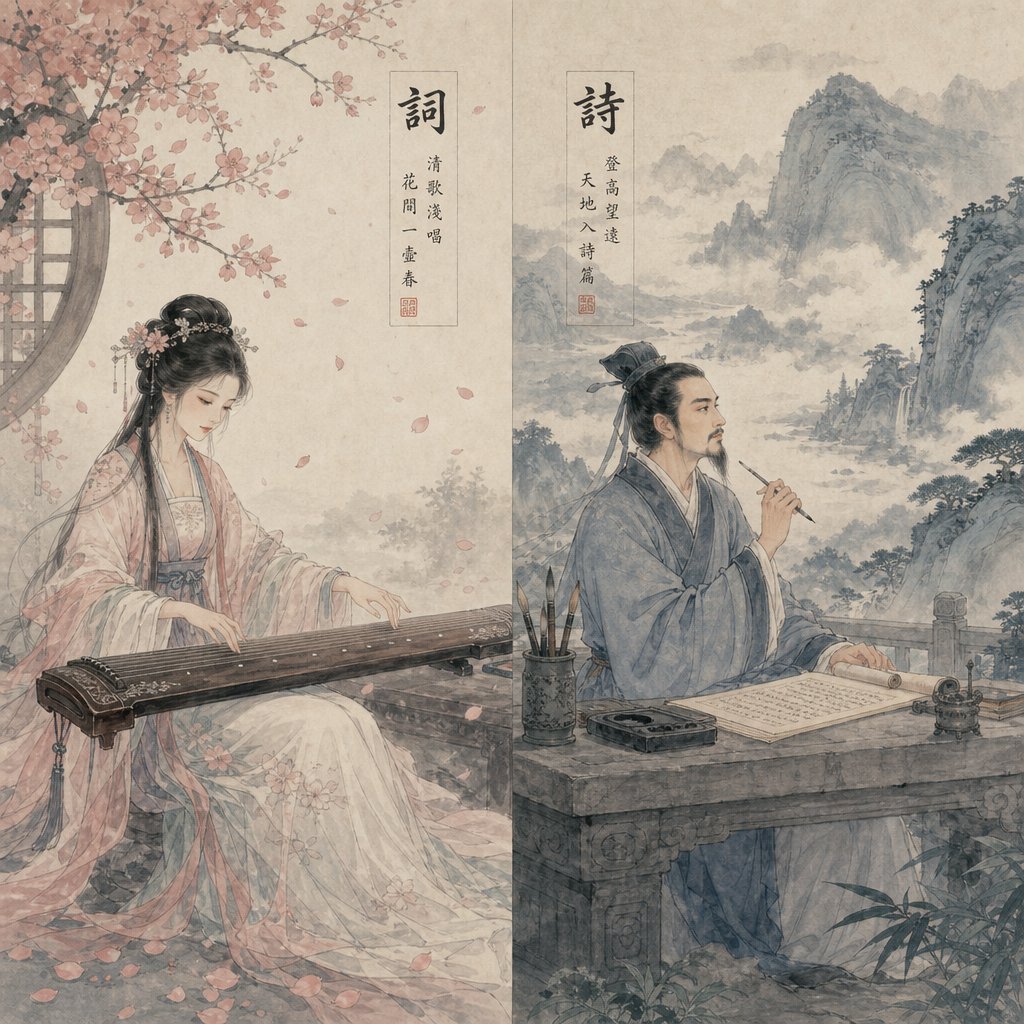
Two poetic traditions dominated Song Dynasty literary life, and each one opens a different door for parents searching for the right name. Ci poetry, lyric verse written to fit existing musical melodies, tends toward emotional intimacy and sensory imagery. Shi poetry, the older regulated verse form inherited from the Tang, carries more philosophical gravity and moral weight. Knowing the difference between ci and shi for naming purposes helps you choose characters that match the feeling you want your child's name to convey.
Think of it this way: ci gives you names that feel like a whispered song. Shi gives you names that feel like a carved inscription.
Ci Poetry and Its Emotional Naming Potential
Ci poetry originated as lyrics adapted to popular melodies, and this musical origin shaped everything about its language. Because poets had to fit words to pre-existing tunes, ci verses use lines of varying length, creating a flowing, conversational rhythm. The form demanded vivid imagery compressed into short phrases, exactly the kind of evocative two-character combinations that work beautifully as given names.
The thematic range of ci poetry names for babies leans heavily toward nature, emotion, and sensory experience. Li Qingzhao, widely regarded as the greatest female ci poet in Chinese history, filled her verses with images of plum blossoms, moonlight, jade censers, and autumn rain. Su Shi expanded ci into broader territory, covering philosophy, history, and daily life, but even his ci retained a personal, emotionally direct quality absent from his more formal shi compositions. Xin Qiji brought heroic passion into the form, blending martial imagery with deep feeling.
What makes ci especially productive for Chinese lyric poetry name ideas is its structure. Each ci poem follows a specific cipai (tune pattern) that dictates line lengths and tonal sequences. Patterns like Rumengling (As in a Dream) or Dianjiangchun (Rouged Lips) naturally produce compact, melodic phrases. When Li Qingzhao writes of "slim flowers trembling with heavy dew" or "light clouds drifting to and fro," the imagery condenses into character pairs that carry both visual beauty and emotional resonance, qualities any parent would want embedded in a name.
Shi Poetry for Names with Moral Weight
Shi poetry operates under stricter formal rules. Lines are uniformly five or seven characters long, arranged in quatrains or eight-line regulated verse with prescribed tonal patterns and parallelism. This structure encourages precision, balance, and intellectual density. Where ci flows like water, shi stands like architecture.
Song Dynasty shi poetry baby names tend to carry different associations. The great shi poets of this era, Lu You, Yang Wanli, Fan Chengda, used the form to address political conviction, moral duty, and philosophical reflection. Lu You's shi poems about national loyalty and personal integrity offer characters suggesting steadfastness, clarity, and purpose. The Jiangxi poetry school, led by Huang Tingjian, emphasized metrical craftsmanship and allusive depth, producing verses where every character carries concentrated meaning.
Shi also maintained stronger connections to the Confucian classics. Because the civil service examinations required candidates to compose shi poetry, the form retained its association with scholarly achievement and public virtue. A name drawn from shi verse signals intellectual seriousness in a way that a ci-derived name might not. For families who value moral weight alongside beauty, shi offers a different palette entirely.
The difference becomes concrete when you consider how the same theme, say, moonlight on water, yields different naming characters depending on the poetic form. In a ci poem, a poet might write yue ying (moon shadow) or qing bo (clear ripples), emphasizing sensory impression and emotional mood. In a shi poem addressing the same scene, you are more likely to encounter ming jian (bright mirror) or cheng guang (clear radiance), characters that carry philosophical overtones about clarity of perception or moral illumination.
| Characteristic | Ci Poetry | Shi Poetry |
|---|---|---|
| Typical imagery | Flowers, moonlight, rain, seasons, personal longing | Mountains, rivers, historical events, moral ideals |
| Character types | Sensory, emotional, nature-based | Abstract, philosophical, virtue-oriented |
| Tonal quality | Musical, flowing, varied line lengths | Balanced, structured, parallel phrasing |
| Gender associations | Historically feminine-leaning, now flexible | Historically masculine-leaning, now flexible |
| Naming feel | Intimate, lyrical, emotionally warm | Dignified, grounded, intellectually resonant |
| Example theme: perseverance | Han mei (cold plum), a blossom enduring frost | Zhi yuan (ambition reaching far), a declaration of will |
Neither form is inherently better for naming. The choice depends on what story you want the name to tell. A ci-derived name like Ruomeng (as in a dream) carries a quality of wonder and softness. A shi-derived name like Mingzhi (clear purpose) projects determination and direction. Many parents find that pairing a ci-inspired given name with a shi-inspired courtesy name or middle name creates a satisfying balance between feeling and principle.
These two forms did not exist in isolation. The greatest Song poets, Su Shi and Xin Qiji among them, wrote masterfully in both, and their collected works offer naming candidates from each tradition. Exploring their specific poems reveals just how many hidden names wait inside verses that have been read for a millennium but rarely examined through the lens of naming.
Famous Song Dynasty Poets and the Names Hidden in Their Works
Every Song Dynasty poem carries a story, and within that story sit characters waiting to become someone's name. The five poets profiled here represent the full emotional and philosophical range of the era. Each wrote from a distinct life experience, exile, war, love, loss, scholarly ambition, and those experiences shaped the characters they chose. When you select baby names from Su Shi poems or draw from Li Qingzhao's lyrics, you are not just borrowing pretty sounds. You are giving your child a piece of a specific human story.
Names Inspired by Su Shi and Xin Qiji
Su Shi (1037-1101), also known as Su Dongpo, lived one of the most dramatic lives in Chinese literary history. A brilliant scholar who passed the imperial examination at twenty, he rose to high office only to be repeatedly exiled for his political convictions. His poetry reflects this arc: bold, philosophical, and ultimately accepting of life's impermanence. What makes his verses so productive for naming is his ability to compress profound ideas into vivid, concrete images.
His famous ci poem "Prelude to Water Melody" (Shui Diao Ge Tou), written during the Mid-Autumn Festival while separated from his brother, contains the line: "May people live long, sharing the beautiful moon even thousands of miles apart." The closing characters chan juan, meaning graceful beauty or the luminous moon, have long been used as a feminine name suggesting elegance and enduring connection. But the same poem yields other possibilities less commonly explored.
- Changjiu (chang jiu) - from "dan yuan ren chang jiu" (may people live long). Characters mean "enduring" and "long-lasting." Pinyin: chang jiu. Embodies a wish for longevity and resilience. Works for any gender.
- Qingying (qing ying) - from "qi wu nong qing ying" (dancing with my clear shadow). Characters mean "clear" and "shadow/reflection." Pinyin: qing ying. Suggests grace, self-awareness, and quiet beauty. Traditionally feminine.
- Xuxing (xu xing) - from "Ding Feng Bo": "he fang yin xiao qie xu xing" (why not sing and walk slowly). Characters mean "slow" and "walk." Pinyin: xu xing. Conveys calm deliberation and unhurried confidence. Gender neutral.
- Chenguang (chen guang) - from various shi poems where Su Shi describes morning light breaking over rivers. Characters mean "morning" and "light/radiance." Pinyin: chen guang. Suggests new beginnings and clarity of purpose.
Su Shi's "Ding Feng Bo" (Calm the Storm), written during his exile in Huangzhou, is essentially a manifesto of resilience. Caught in a rainstorm without shelter, he refuses to hurry, declaring that "bamboo staff and straw shoes are lighter than a horse." The poem's final line, "there is neither wind and rain nor sunshine," expresses a transcendence beyond circumstance. Xin Qiji poem names for children draw from a different emotional register entirely.
Xin Qiji (1140-1207) was a warrior-poet, a man who led cavalry charges against Jurchen invaders as a young man and spent his later decades writing fierce, passionate ci poetry lamenting the Southern Song court's failure to reclaim the north. His verses burn with patriotic energy and frustrated ambition, yet they also contain moments of surprising tenderness.
- Ruohong (ruo hong) - from "Qingpingle": describing wild geese against a vast sky. Characters mean "like" and "swan/great ambition." Pinyin: ruo hong. Suggests aspiration and freedom of spirit.
- Yueming (yue ming) - from "Xijiang Yue" (West River Moon): "ming yue bie zhi jing que" (the bright moon startles the magpie from its branch). Characters mean "moon" and "bright." Pinyin: yue ming. Carries associations of illumination and quiet power.
- Zhuangyun (zhuang yun) - from multiple poems expressing heroic aspiration. Characters mean "grand/magnificent" and "cloud." Pinyin: zhuang yun. Embodies bold vision and expansive ambition. Traditionally masculine.
Names from Li Qingzhao and Lu You
Li Qingzhao (1084-1155) is often called the greatest female poet in Chinese history, though that label undersells her. She was simply one of the finest ci poets of any gender, celebrated for the precision of her imagery and the emotional honesty of her work. Her early poems capture the pleasures of a happy marriage: wine, flowers, word games with her husband. Her later work, written after his death and during the chaos of the Jin invasion, carries a weight of grief that never becomes self-pity.
Li Qingzhao poetry baby names tend toward the lyrical and sensory. Her verses are filled with specific flowers, weather patterns, and moments of domestic beauty that compress into elegant character pairs.
- Shuxiang (shu xiang) - from "Zuihuayin": describing the lingering fragrance of wine and flowers at dusk. Characters mean "sparse/gentle" and "fragrance." Pinyin: shu xiang. Suggests understated elegance and natural grace.
- Ruiqi (rui qi) - from poems describing auspicious morning mist. Characters mean "auspicious" and "air/vital energy." Pinyin: rui qi. Carries connotations of good fortune and vitality.
- Anwan (an wan) - from her ci describing peaceful evenings. Characters mean "tranquil" and "evening/graceful." Pinyin: an wan. Evokes serenity and gentle beauty.
- Yuxue (yu xue) - from poems comparing plum blossoms to snow. Characters mean "jade" and "snow." Pinyin: yu xue. Suggests purity, resilience, and refined beauty.
Lu You (1125-1210) wrote more poems than almost any other figure in Chinese literary history, over nine thousand surviving works. A deeply patriotic poet of the Southern Song, he spent his life advocating for military campaigns to reclaim northern China from Jurchen control. His poetry oscillates between fierce political conviction and tender personal feeling, particularly his lifelong regret over a forced divorce from his first wife.
Names inspired by Lu You poetry carry a distinctive quality: they tend to pair beauty with strength, gentleness with resolve.
- Tiexin (tie xin) - from poems about unwavering loyalty. Characters mean "iron" and "heart/mind." Pinyin: tie xin. Embodies steadfastness and moral courage. Traditionally masculine but increasingly flexible.
- Chunfeng (chun feng) - from "You Shanxi Cun" (Traveling to a Mountain Village): describing spring wind over village paths. Characters mean "spring" and "wind." Pinyin: chun feng. Suggests warmth, renewal, and gentle vitality.
- Yishan (yi shan) - from poems contemplating mountains at dusk. Characters mean "one" and "mountain." Pinyin: yi shan. Conveys solitary strength and grounded presence.
Ouyang Xiu and the Scholarly Tradition
Ouyang Xiu (1007-1072) was not just a poet but a statesman, historian, and intellectual leader who shaped Song Dynasty culture at its foundations. He helped write two of the official Twenty-Four Histories, reformed the civil service examination system, and mentored a generation of writers including Su Shi himself. His literary style favored clarity, directness, and a kind of relaxed elegance that rejected the ornate excesses of earlier periods.
Ouyang Xiu inspired baby names reflect his values: intellectual clarity, moral integrity, and an appreciation for simple pleasures. His famous prose piece "The Old Drunkard's Pavilion" (Zuiweng Ting Ji) produced the well-known idiom about finding joy beyond the obvious, and his ci poetry explores the quiet satisfactions of friendship, nature, and scholarly life.
- Tingfeng (ting feng) - from ci poems describing listening to wind in the pines. Characters mean "listen" and "wind/breeze." Pinyin: ting feng. Suggests attentiveness, contemplation, and harmony with nature.
- Wenqing (wen qing) - from poems celebrating literary culture. Characters mean "literature/culture" and "clear/pure." Pinyin: wen qing. Embodies scholarly refinement and intellectual clarity.
- Leshan (le shan) - from philosophical passages about finding joy in goodness. Characters mean "joy" and "goodness/virtue." Pinyin: le shan. Carries Confucian overtones of moral happiness.
Each of these poets offers a different emotional palette. Su Shi gives you philosophical acceptance. Xin Qiji offers heroic passion. Li Qingzhao provides sensory precision. Lu You delivers moral conviction. Ouyang Xiu contributes scholarly grace. The name you choose signals not just a sound or a meaning, but an alignment with a particular way of moving through the world.
These individual names, however, represent only one layer of Song Dynasty naming practice. Families of this era did not always name children in isolation. They often embedded names within larger poetic structures that connected generations, creating literary threads that linked grandparents to grandchildren through shared verse.
The Generational Poem Tradition and Its Song Dynasty Roots
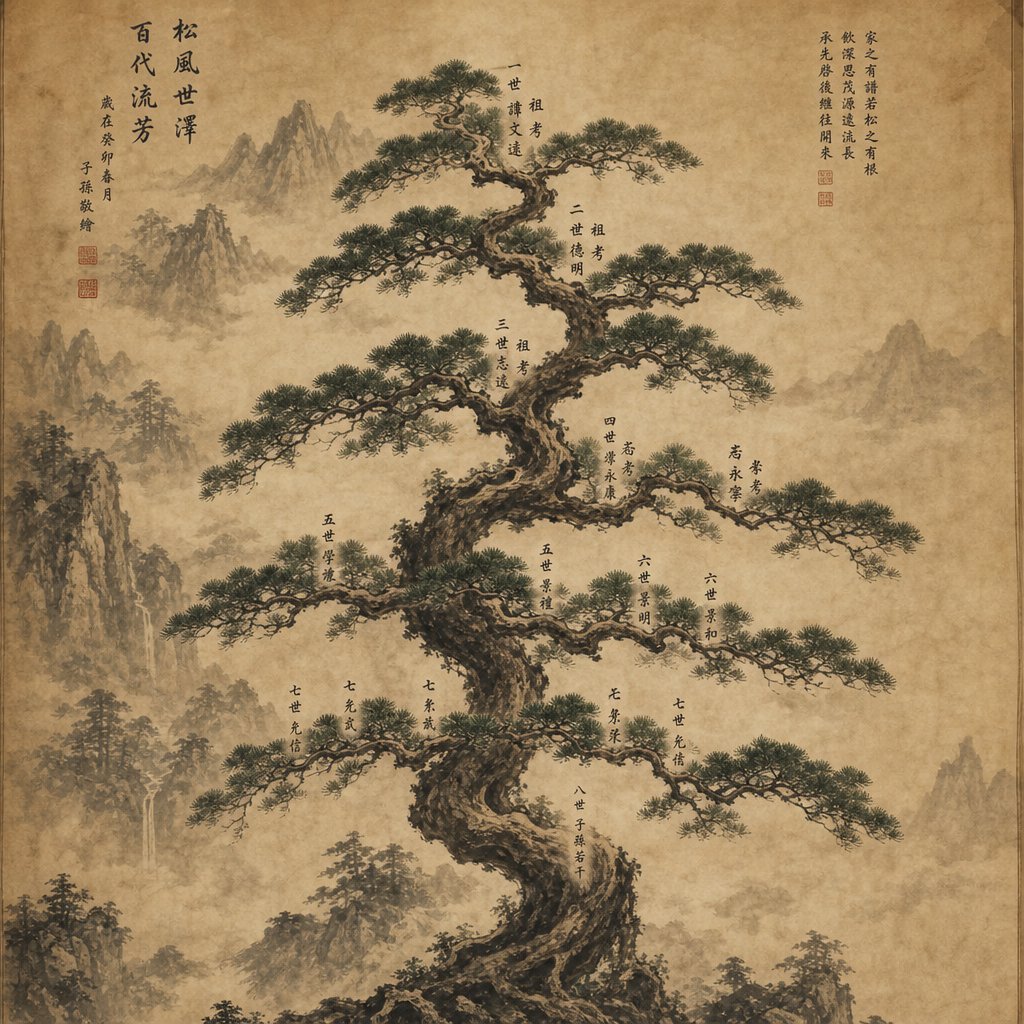
A single name connects a child to parents. A generational poem connects an entire lineage across centuries. The Chinese generational poem naming tradition, known as beifen shi, is one of the most elegant systems ever devised for structuring family identity through literature. And its roots trace directly to the Song Dynasty period, when recording generational names in familial genealogies became almost a standard practice among educated clans.
What Is a Generational Poem
Imagine a short poem, typically four to eight lines, composed by a family's ancestors. Each character in that poem corresponds to one generation. When a baby is born, the family identifies which generation the child belongs to, finds the matching character in the poem, and incorporates it into the child's given name. All cousins, even very distant ones within the same clan, share that same generational character.
The result is a naming system where you can identify someone's generational position simply by knowing their name. Meet two people surnamed Wong whose given names share the character "chuan," and you immediately know they belong to the same generation, even if their families have not spoken in decades.
As novelist Wendy Chen describes it, a generation poem is one that a clan agrees to use when naming descendants. The first character names the first generation, the second character names the next, and so on. When the family reaches the poem's final character, they begin again at the start, creating an endless literary cycle.
The poems themselves are not random collections of characters. They typically look backward and forward simultaneously, praising ancestral virtues while voicing hopes for future prosperity. Consider this example from the Wong family of Gom Benn Village, composed during the Ming Dynasty but following a tradition established in the Song era:
The Holy Emperor begot civilization; the imperial court respects morality. Etiquette is passed down from generation to generation; family traditions are invigorated from age to age.
Each of the twenty characters in that poem served a different generation. A child born into the twenty-third generation received the character "chuan" (transmit/pass down), while their grandchildren in the twenty-fifth generation received "yi" (righteousness). The poem functioned as both a naming guide and a compressed family philosophy.
How Families Created and Used Beifen Shi
The practice of beifen shi generational names did not appear overnight. According to academic research on Chinese naming traditions, the earliest evidence of generational naming dates to the Spring and Autumn Period (722-481 BC), but the more systematic use of poems to structure naming across generations emerged during the Tang and Song Dynasties. By the Song period (960-1279), recording these Song Dynasty family naming poems in clan genealogies had become widespread among literate families.
The system reached its height during the Ming and Qing Dynasties, but the Song Dynasty provided the cultural infrastructure that made it possible: widespread literacy, a reverence for poetic composition, and the genealogical consciousness that came with Neo-Confucian emphasis on family continuity.
Here is how a generational poem functions across family lines:
- A respected ancestor or clan leader composes a poem, typically between 16 and 40 characters, expressing family values and aspirations.
- The poem is recorded in the family genealogy book and distributed to all branches of the clan.
- Each character in the poem is assigned to a successive generation, in order.
- When a child is born, the family identifies the current generation's assigned character and uses it as one element of the child's two-character given name.
- The second character of the given name is chosen individually, allowing personal meaning while maintaining the generational link.
- All members of the same generation across all branches of the clan share the same generational character, making kinship immediately visible.
- When the poem's characters are exhausted, the cycle restarts from the beginning, or a new poem is composed.
This system meant that a well-crafted poem could guide naming for twenty or more generations, spanning five hundred years or longer. The Mao family's generational poem, for example, was established in 1737 and extended in 1881, providing forty characters to cover forty generations of descendants.
For modern families interested in how to create a generational naming poem, the Song Dynasty approach offers a compelling model. You do not need forty characters or centuries of clan history. A couplet of fourteen characters drawn from Song Dynasty verse, chosen for both meaning and phonetic beauty, can serve a family for seven generations. The key is selecting characters that work well as name components: characters with positive associations, pleasing tonal variety, and enough flexibility to pair naturally with a wide range of second characters.
The generational poem tradition reveals something essential about Chinese naming philosophy. A name is never just about the individual. It positions a person within a web of relationships, backward to ancestors and forward to descendants yet unborn. Song Dynasty poetry, with its balance of personal feeling and communal values, provides ideal raw material for families who want to honor this tradition while choosing characters of genuine literary beauty.
Selecting the right characters from a poem, whether for a generational system or a single child's name, requires understanding a subtle but critical distinction: the difference between choosing a name based on a poem's imagery and choosing one based on its literal characters.
Choosing Between Poetic Imagery and Literal Characters
You have found a Song Dynasty poem that moves you. The imagery resonates, the characters look beautiful on paper, and the meaning feels right. But here is where many parents pause: do you name your child after what the poem makes you feel, or after the specific characters sitting on the page? These are two fundamentally different approaches to choosing a Chinese name from poetry meaning, and they produce very different results.
Imagery-Based Name Selection
When you select a name based on poetic imagery, you are responding to the emotional atmosphere of a verse rather than lifting characters directly from it. The poem serves as inspiration, not as a word bank. You identify the feeling, the scene, or the philosophical idea the poet evokes, and then you find characters that capture that essence, even if those exact characters never appear in the poem itself.
Consider Su Shi's famous "Red Cliff Rhapsody," which meditates on the passage of time as the poet drifts in a boat beneath ancient cliffs. The poem's imagery conjures vastness, acceptance, and the beauty of impermanence. A parent moved by this piece might choose a name like Haoran (vast and boundless) or Yunjing (cloud stillness), neither of which appears verbatim in the text, but both of which distill its emotional core into two characters suitable for a name.
This approach gives you creative freedom. You are not limited to the specific vocabulary the poet happened to use. Instead, you are translating a literary experience into naming language. The trade-off is that the connection between name and source poem becomes personal rather than traceable. Someone reading the name will not immediately recognize its origin unless you explain it.
Literal Character Selection and Meaning Shifts
The literal approach is more direct. You identify a two-character phrase or a pair of adjacent characters within the poem and use them as the given name. The connection to the source is explicit, sometimes even recognizable to anyone familiar with the verse. This is the method behind many classical Chinese names that carry immediate literary weight.
But here is the complication: a character's meaning can shift significantly when it moves from poetic context to naming context. In a poem, a character participates in a sentence, modified by what comes before and after it. As a name, it stands alone or pairs with just one other character, stripped of its original grammatical relationships.
Take this line from Li Qingzhao's ci poem "Yijianmei" (A Twig of Plum Blossoms):
Clouds send the dawn of spring away; plum blossoms bring the dusk of spring near.
Using the imagery approach, you might focus on the poem's theme of seasonal transition and bittersweet beauty, arriving at a name like Chunxi (spring dawn) or Muying (evening reflection), characters chosen to echo the mood without quoting the text. Using the literal approach, you could extract Yunxiao (cloud dawn) directly from the line's opening image, or Meimu (plum dusk) from its closing phrase. The literal selections carry the poem's specific fingerprint, but "mu" (dusk/evening) as a name element introduces associations of endings or decline that the poem itself balances through context. Alone in a name, that balance disappears.
This is the core challenge of poetic imagery versus literal character naming. A character that functions beautifully within a verse may carry unwanted connotations when isolated. The word "han" (cold) in a poem about plum blossoms enduring frost suggests resilience and quiet courage. As a standalone name element, it might simply feel bleak to someone unfamiliar with the source. Context does heavy lifting in poetry. Names must do their own lifting.
Song Dynasty scholars understood this distinction intuitively, and their practice of choosing courtesy names offers a model for navigating it.
The courtesy name, or zi, was a secondary name given at the age of twenty during a capping ceremony. It was meant to complement or expand upon the given name, often drawing from the same literary source but approaching it from a different angle. Su Shi's given name "Shi" means "axis" or "pivot," while his courtesy name "Zizhan" means "to gaze far." Both relate to the idea of perspective and centrality, but one is concrete and the other is aspirational. Many scholars chose their Chinese courtesy name from Song poetry, selecting a zi that reframed their given name's meaning through a different poetic lens.
Modern parents can adapt this practice even without a formal capping ceremony. If you choose a literal character pair from a poem for the given name, consider selecting an imagery-based middle name or English name that captures the broader feeling of the same verse. This layered approach honors both methods: the given name carries a direct literary lineage, while the complementary name preserves the poem's emotional wholeness.
Knowing how to pick characters from poems for names is only half the equation. The characters you select still need to function as a name in the practical world, balancing tonal harmony, visual elegance, and cross-cultural pronounceability in ways that pure literary appreciation does not require.
Practical Rules for Turning Song Dynasty Verses into Modern Names
A character can be poetically beautiful, rich in meaning, and drawn from a masterpiece, yet still fail as a name. Why? Because names live in the real world. They get called across playgrounds, typed into passport forms, and written thousands of times over a lifetime. The leap from poem to name requires more than literary appreciation. It demands attention to how characters sound together, how they look on paper, and how they travel across languages and borders.
This is where the Song Dynasty name character selection guide gets practical. You have identified a poem that resonates and characters that carry the right meaning. The next question is whether those characters actually work as a name your child will wear comfortably for decades.
Tonal Harmony and Stroke Count Balance
Chinese is a tonal language, and how to choose tonal balance in a Chinese baby name matters as much as meaning. Mandarin has four tones plus a neutral tone, but classical Chinese phonology divides all syllables into two broader categories: ping (level tones, corresponding to modern first and second tones) and ze (oblique tones, corresponding to modern third and fourth tones). Song Dynasty poets were obsessed with tonal patterning. Every ci poem followed a strict tonal template dictated by its cipai. You can borrow that same sensitivity when constructing a name.
The general principle is contrast. A given name where both characters share the same tone can sound flat or monotonous when spoken aloud. Pairing a ping-tone character with a ze-tone character creates a natural rise and fall that makes the name more musical and memorable. For example, "Mingzhi" pairs a second-tone character (ming, level) with a fourth-tone character (zhi, oblique), producing a satisfying tonal arc. "Yuhan" pairs a third-tone character with a second-tone character, creating a dip-then-rise pattern that feels dynamic.
When you add the family surname into the equation, you are working with a three-syllable tonal sequence. If the surname is a fourth tone like Zhao, pairing it with a given name that opens on a first or second tone prevents three consecutive falling syllables. Song Dynasty poets understood this instinctively. Their verses were designed to be sung, and the tonal variety that made lyrics singable also makes names pleasant to hear.
Stroke count is the visual equivalent of tonal balance. Each Chinese character is composed of a specific number of brushstrokes, and the stroke count for Chinese baby names affects how the written name looks on paper. A name where both characters have very high stroke counts (fifteen or more strokes each) can appear dense and cramped, especially in smaller print. Conversely, two very simple characters (under five strokes each) can look sparse and insubstantial.
The sweet spot for most parents is pairing one character of moderate complexity (seven to twelve strokes) with one that is slightly simpler or slightly more complex. This creates visual rhythm on the page, a balance between density and openness that mirrors the tonal contrast in pronunciation. Characters drawn from Song Dynasty poetry tend to fall naturally into this range because the poets themselves favored characters that were visually elegant rather than excessively ornate.
Gender Associations and Modern Flexibility
Chinese names carry gender associations, but these associations are cultural conventions rather than fixed rules. Research on Chinese name-to-gender patterns involving over thirty million individuals shows that while many characters skew strongly male or female in usage, a meaningful proportion of names sit in a gender-neutral zone. About 4.82% of Chinese character names fall between 40% and 60% female usage, meaning they are used nearly equally by both genders.
Traditional associations run along predictable lines. Characters referencing jade (yu), fragrance (xiang), grace (wan), and flowers tend feminine. Characters suggesting strength (gang), ambition (zhi), greatness (wei), and mountains lean masculine. But gender neutral Chinese poetry names are increasingly common among modern parents who want to move beyond these conventions.
Song Dynasty ci poetry, with its emphasis on emotional sensitivity and natural beauty, offers particularly rich territory for gender-flexible naming. Characters like "qing" (clear), "yun" (cloud), "ming" (bright), and "ze" (marsh/grace) appear frequently in Song verse and work comfortably for any gender. The key is checking how a character is actually used in contemporary naming, not just how it was used historically. A character that felt exclusively masculine in the twelfth century may have shifted toward neutral usage today, and vice versa.
International Pronounceability Considerations
For families living outside China or raising bilingual children, internationally pronounceable Chinese names from poetry become a practical concern. Not every beautiful Chinese character translates into a pinyin syllable that English, Spanish, or French speakers can manage comfortably.
Sounds that tend to travel well across languages include: "ming," "lin," "kai," "an," "yu," and "lei." These use phonemes common to most European languages and avoid the sounds that trip up non-Mandarin speakers most often. The trickiest pinyin initials for international contexts are "x" (as in Xin), "q" (as in Qing), and "zh" (as in Zhi), because they have no close equivalent in English pronunciation. That does not mean you should avoid them entirely, but it is worth considering whether your child will spend significant time in non-Chinese-speaking environments.
One practical approach: choose characters whose pinyin happens to resemble or echo names familiar in other cultures. "An" sounds natural in many languages. "Mei" works in Japanese and English contexts. "Lin" is recognizable worldwide. Song Dynasty poetry contains plenty of characters with these accessible sounds, so international pronounceability rarely requires sacrificing literary quality.
A final practical note concerns character simplification. Mainland China uses simplified characters, while Taiwan, Hong Kong, and many overseas Chinese communities use traditional characters. Some characters look identical in both systems, but others differ significantly. If your family spans these regions, or if you want the name to work in both written forms, check whether your chosen characters simplify gracefully. A character that looks elegant in traditional script but becomes visually awkward in simplified form (or vice versa) may cause frustration. Characters from Song Dynasty poetry were originally written in traditional forms, so verifying the simplified version is a worthwhile step for families connected to mainland China.
The table below brings these considerations together, showing how specific characters drawn from Song Dynasty poems perform across all the practical dimensions that matter:
| Character | Pinyin | Tone Pattern | Stroke Count | Meaning | Source Poem |
|---|---|---|---|---|---|
| 清远 (Qingyuan) | qing yuan | 1st + 3rd (ping + ze) | 11 + 7 | Clear and far-reaching | Su Shi, "Hou Chibi Fu" |
| 安晴 (Anqing) | an qing | 1st + 2nd (ping + ping) | 6 + 12 | Peaceful clarity | Li Qingzhao, "Rumengling" |
| 明远 (Mingyuan) | ming yuan | 2nd + 3rd (ping + ze) | 8 + 7 | Bright and far-seeing | Lu You, shi poetry on ambition |
| 云舒 (Yunshu) | yun shu | 2nd + 1st (ping + ping) | 4 + 12 | Clouds unfolding at ease | Su Shi, "Ding Feng Bo" |
| 若林 (Ruolin) | ruo lin | 4th + 2nd (ze + ping) | 8 + 8 | Like a forest; abundant | Xin Qiji, ci on nature |
| 瑞风 (Ruifeng) | rui feng | 4th + 1st (ze + ping) | 13 + 4 | Auspicious wind | Ouyang Xiu, spring ci poems |
| 书宁 (Shuning) | shu ning | 1st + 2nd (ping + ping) | 4 + 7 | Literary serenity | Li Qingzhao, ci on quiet study |
| 铁心 (Tiexin) | tie xin | 3rd + 1st (ze + ping) | 10 + 4 | Iron-willed heart | Lu You, patriotic shi verse |
Notice how each pairing balances complexity. Yunshu combines a visually simple four-stroke character with a more elaborate twelve-stroke one, creating contrast on the page. Ruolin uses two eight-stroke characters for symmetry. Ruifeng pairs a complex thirteen-stroke character with a breezy four-stroke one, producing visual tension that mirrors the meaning: something grand carried on something light.
These practical filters, tonal contrast, stroke balance, gender flexibility, international sound, and script compatibility, are not obstacles to poetic naming. They are refinements that ensure the literary beauty you found in a Song Dynasty verse survives the transition into daily life. A name that sounds awkward when called aloud or looks cramped on a form will not serve your child well, no matter how exquisite its literary pedigree.
With both the literary knowledge and the practical toolkit in hand, what remains is a framework for bringing these threads together into a confident final decision.
Bringing It All Together for Your Baby's Name
You have a poem that speaks to you, characters that carry the right meaning, and practical knowledge about tone, stroke count, and pronounceability. The final step is evaluating whether a candidate name holds together across every dimension that matters. A poetry baby name decision framework does not need to be complicated. It just needs to ask the right questions in the right order.
A Decision Framework for Poetry-Based Names
When you have narrowed your choices to two or three candidates, run each one through this checklist. A strong name does not need to score perfectly on every point, but it should feel solid across most of them.
- Cultural resonance: Can you trace the name to a specific poem and poet? Does the source carry a story you would be proud to tell your child someday?
- Character meaning: Do both characters carry positive associations when standing alone, outside the poem's context? Check for unintended homophones or negative connotations in modern usage.
- Phonetic quality: Say the full name aloud, surname included, at least ten times. Does it flow naturally? Do the tones create contrast rather than monotony?
- Written aesthetics: Write the characters by hand. Do they look balanced together? Is the stroke count manageable for a child learning to write their own name?
- Gender clarity: Does the name signal what you intend, whether that is traditionally gendered or deliberately neutral?
- International functionality: If your child will live across cultures, can the pinyin be pronounced reasonably by non-Mandarin speakers?
- Personal meaning: Beyond literary beauty, does this name connect to something your family values, a quality you hope for, a feeling you want your child to carry?
A name that checks five or six of these boxes is a strong candidate. One that checks all seven is rare, and worth holding onto.
Honoring Tradition While Embracing Modern Identity
The real-world impact of this tradition is visible today. As recent reporting on Chinese naming trends shows, names like "Yanzhou," drawn from a Northern Song Dynasty poem by Zeng Gong, have become popular choices among new parents across multiple provinces. Cultural sociologists describe this not as a pursuit of uniqueness but as young parents reclaiming classical culture as a living aesthetic in everyday life. A name rooted in Song Dynasty verse is not a museum piece. It is a bridge between centuries of literary tradition and a child's unwritten future.
The most meaningful Chinese baby name from classical poetry is not necessarily the most obscure or the most elegant on paper. It is the one whose story you know well enough to tell. When your child asks why they have this name, you want an answer that goes beyond "it sounded nice." You want to say: this came from a poem written nine hundred years ago by someone who understood something true about the world, and I wanted you to carry that understanding with you.
So read the poems. Not just the lines quoted here, but the full works of Su Shi, Li Qingzhao, Lu You, Xin Qiji, and Ouyang Xiu. Let the verses sit with you. The right name rarely announces itself on first reading. It surfaces slowly, the way a Song Dynasty ci poem reveals its meaning only after you have lived with it for a while. That patience is itself part of the gift you are giving your child: a name chosen not in haste, but in genuine literary love.
Frequently Asked Questions About Song Dynasty Poetry Baby Names
1. How do I choose a baby name from a Song Dynasty poem?
Start by reading poems from major Song Dynasty poets like Su Shi, Li Qingzhao, or Xin Qiji. Identify characters or two-character phrases that resonate with you. Then evaluate each candidate for tonal harmony (mixing ping and ze tones), stroke count balance (pairing simple and complex characters), positive standalone meaning outside the poem's context, and international pronounceability if relevant. You can either lift characters directly from the verse or use the poem's imagery as inspiration to find related characters that capture the same feeling.
2. What is the difference between ci and shi poetry for naming purposes?
Ci poetry was written to fit musical melodies, producing intimate, emotionally warm names drawn from nature imagery, sensory experience, and personal feeling. Shi poetry follows stricter formal rules with uniform line lengths, yielding names that carry more philosophical weight, moral conviction, and intellectual seriousness. For example, a ci-derived name like Ruomeng (as in a dream) feels lyrical and soft, while a shi-derived name like Mingzhi (clear purpose) projects determination. Neither form is inherently better; the choice depends on the emotional quality you want the name to convey.
3. Are Song Dynasty poetry names suitable for both boys and girls?
Yes. While traditional Chinese naming conventions associate certain characters with specific genders (jade and fragrance lean feminine, strength and ambition lean masculine), Song Dynasty ci poetry is especially rich in gender-flexible characters. Words like qing (clear), yun (cloud), ming (bright), and an (peaceful) appear frequently in Song verse and work comfortably for any gender. Modern parents increasingly choose characters based on meaning rather than historical gender associations, and about 4.82% of Chinese character names already fall in a statistically gender-neutral zone.
4. What is a generational poem (beifen shi) and how does it relate to Song Dynasty naming?
A generational poem is a short verse composed by a family ancestor where each character corresponds to a successive generation. When a child is born, the family uses that generation's assigned character as one element of the given name, linking all cousins across clan branches. This practice became widespread during the Song Dynasty when recording generational names in family genealogies became standard among educated clans. Modern families can create their own generational poem using Song Dynasty verse, selecting a couplet of characters with positive meanings and pleasing tonal variety to guide naming for multiple generations.
5. Can non-Chinese parents use Song Dynasty poetry for baby names?
Absolutely. The key is understanding the cultural context behind each name rather than treating characters as purely decorative. This means learning the poem a name comes from, the poet who wrote it, and the values the characters embody. For practical considerations, focus on characters whose pinyin romanization is pronounceable across languages. Sounds like ming, lin, an, and mei travel well internationally. Avoid pinyin initials like x, q, and zh if your child will primarily live in non-Mandarin-speaking environments, though these remain beautiful options for bilingual families.