What the Chinese Character 星 Actually Means
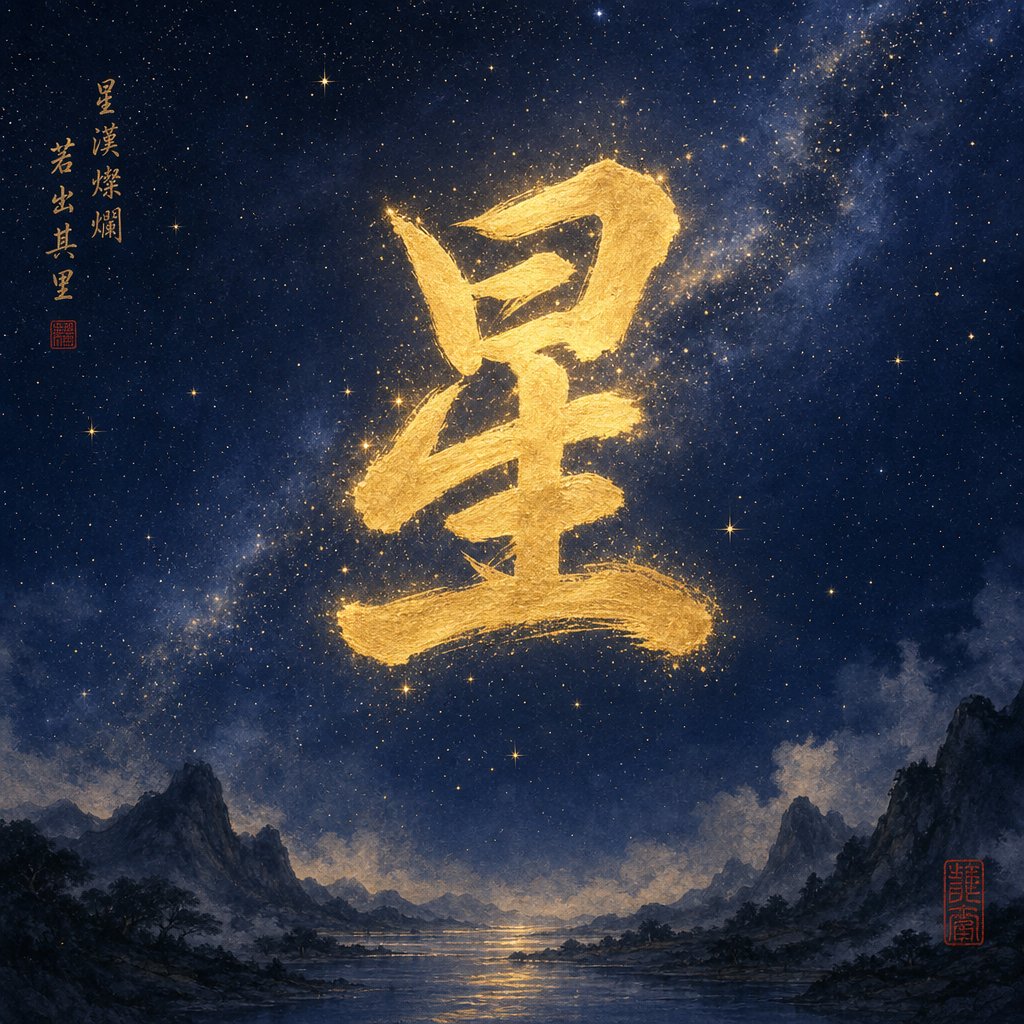
When you first encounter the character 星, you're looking at one of the most versatile building blocks in the Chinese language. Pronounced xīng (first tone), this single character carries a meaning that stretches from the literal night sky all the way to the red carpet. It translates as "star" in English, but its range of use goes far beyond twinkling lights overhead.
What Does 星 Mean in Chinese
At its core, 星 refers to a celestial body, any point of light visible in the night sky. Think stars, planets, and satellites. But just like the English word "star," it also carries a figurative punch. In modern Mandarin, 星 is the go-to character for celebrity, fame, and anything that shines brightly in public life.
星 (xīng): noun. 1. Star or heavenly body. 2. Satellite. 3. Celebrity or famous person. 4. A small amount (as in tiny specks, like stars scattered across the sky).
This dual nature, cosmic and cultural, makes the star Chinese character meaning surprisingly rich for a single syllable. You'll find it in words for "week" (星期), "movie star" (影星), "planet" (星球), and even "constellation" (星座). It's a character that keeps showing up once you know where to look.
Why This Character Matters for Learners
星 appears in the HSK 1 vocabulary list through the word 星期 (xīngqī, meaning "week"), making it one of the first characters new learners encounter. By HSK 5, you'll meet it again in 明星 (míngxīng, celebrity), and at HSK 6 in compounds like 卫星 (wèixīng, satellite). Its 9-stroke structure contains the 日 (sun) radical, connecting it to a family of characters related to light and time.
Whether you're a complete beginner trying to read a calendar or an intermediate learner discussing pop culture, understanding this character unlocks dozens of common words. This guide covers everything you need: pronunciation, etymology, compound vocabulary, idioms, cultural significance, and cross-language connections. By the end, you'll know not just what 星 means, but why it means what it does, and that story starts with how ancient Chinese scribes first imagined stars being born from the sun.
Etymology and Character Breakdown of 星
Imagine looking at the character 星 and seeing a tiny story embedded in its strokes. That's exactly what's happening here. Chinese characters aren't random squiggles. They're built from meaningful parts, and 星 is a perfect example of how those parts create a memorable picture.
The Components of 星 Explained
The modern character 星 splits neatly into two components stacked vertically:
- 日 (ri, sun) sits on top, acting as the semantic radical. It tells you the character relates to celestial light.
- 生 (sheng, birth/life) sits on the bottom, providing the phonetic element. It hints at the pronunciation (sheng and xing share similar final sounds in older Chinese).
This structure follows the phono-semantic principle of formation (形声, xingsheng), one of the six classical methods for building Chinese characters documented in the Shuowen Jiezi, China's first comprehensive etymological dictionary compiled by Xu Shen around 100 AD. In this system, one component carries meaning while the other carries sound.
Here's the mnemonic that makes this character stick: think of stars as lights "born from the sun." When the sun (日) departs at dusk, the stars are born (生) into the sky. It's not the strict historical derivation, but as a memory device, it's hard to beat. Sun plus birth equals star. Once you see it, you won't forget it.
How Ancient Chinese Saw the Stars
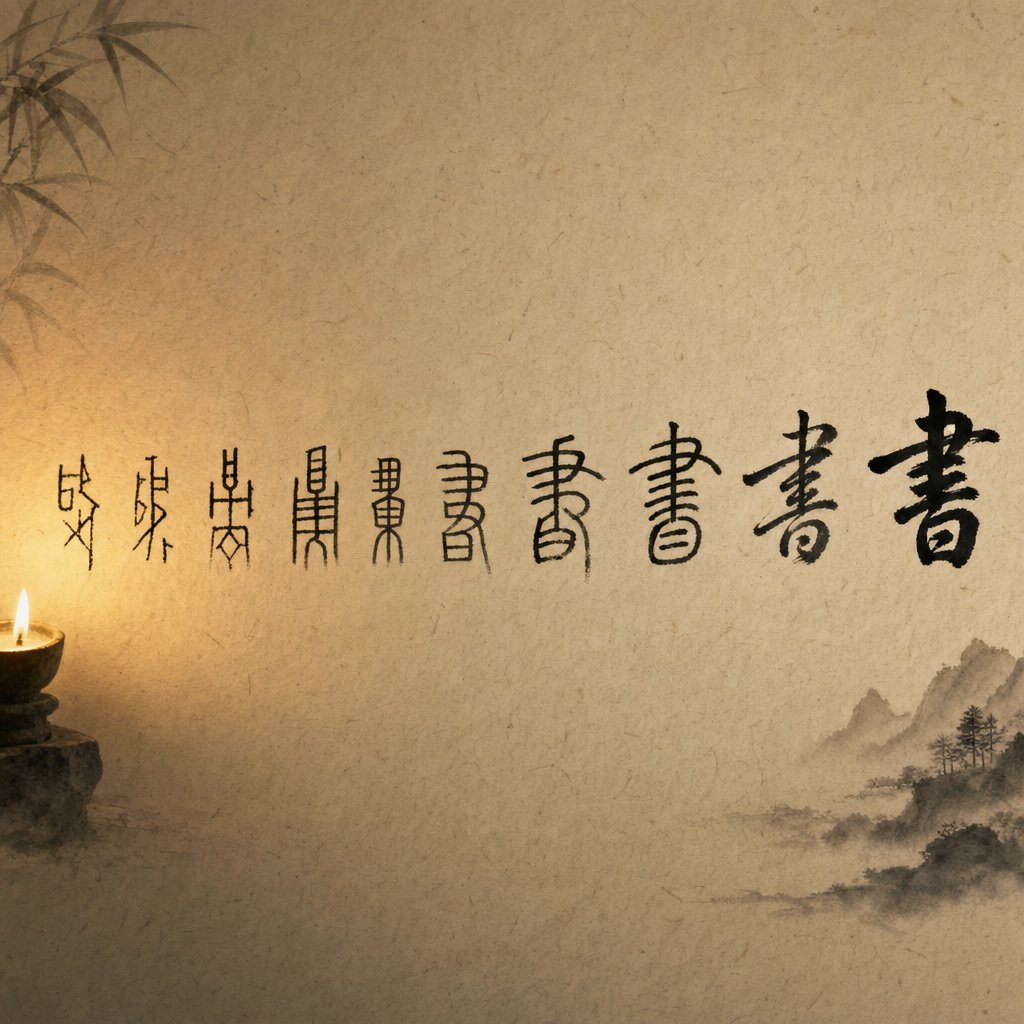
The character's actual history is even richer than the mnemonic suggests. In its oldest oracle bone script form, 星 didn't look like the tidy nine-stroke character you write today. The original form was 曐, which featured not one but three suns stacked together (晶) on top of 生. Those three 日 components represented the multitude of luminous points scattered across the night sky, essentially a cluster of lights.
The component 晶 (jing, meaning "shiny" or "gleaming") served as the semantic half of the character, visually depicting the brilliance of many stars. Meanwhile, 生 on the bottom anchored the pronunciation. Over centuries of use, scribes simplified the top portion. Three suns became one. The character evolved from 曐 through seal script variations until it settled into the streamlined 星 we recognize in modern Chinese.
This simplification pattern is common in Chinese writing history. Characters that were once visually elaborate got trimmed for efficiency without losing their core logic. The ancient and archaic forms of 星 preserved in historical dictionaries show this gradual compression clearly.
The component 生 itself carries a beautiful origin story. It originally depicted a plant (屮) sprouting from the ground (土), representing new life pushing upward. So even the phonetic half of 星 carries an image of something emerging, rising, appearing, which poetically mirrors what stars do each evening.
For learners, this radical breakdown offers a practical advantage. When you encounter unfamiliar characters containing 日, you can guess they relate to the sun, light, or time. Characters with 生 often share a similar pronunciation cluster. Recognizing these patterns turns character learning from brute memorization into pattern recognition, and 星 is one of the clearest examples of that system at work.
With the character's internal logic decoded, the next question is practical: how do you actually say it? The pinyin xing looks straightforward on paper, but the Mandarin "x" sound and first tone trip up English speakers more often than you'd expect.
Pronouncing 星: A Beginner's Guide to Xīng Tone and Pinyin
The pinyin reads xīng. Simple enough on screen. But when you actually try to say it, two things go wrong almost immediately: the "x" doesn't behave like any English letter, and the tone requires a kind of vocal control English rarely demands. Let's break both apart so you can nail this sound on the first try.
How to Pronounce Xīng Correctly
Start with the tone. The macron over the "i" (xīng) marks first tone, which means your pitch stays high and flat from start to finish. Imagine holding a single musical note at the top of your comfortable range, steady and unwavering, like a flatline on a heart monitor. No dip, no rise, just a sustained high pitch. English speakers tend to let their voice trail downward at the end of a word. Resist that pull. Keep the note level all the way through.
The consonant is where most learners stumble. Mandarin "x" is not the English "x" you hear in "box" or "extra." It's a palatal fricative, which sounds technical but feels intuitive once you try this:
- Say the English word "she."
- Notice where your tongue sits, pulled back slightly.
- Now smile, spread your lips, and push your tongue forward so the tip rests just behind your lower front teeth.
- Blow air through that narrow gap. The hissing sound you produce is the Mandarin "x."
Think of it as a "sh" with a smile, tongue forward rather than curled back. The distinction matters because Mandarin also has a separate "sh" sound (retroflex, tongue curled) that contrasts directly with "x." Mixing them up turns xī (west) into shī (poem), completely different words.
The final "-ing" also deserves attention. In English, the "ng" in "sing" or "ring" sits at the back of the throat. Mandarin "-ing" is brighter and more forward. The vowel before the nasal is a clear "ee" sound, not the muffled short "i" of English "king." Say "ee" clearly, then close with the nasal "ng." The result is closer to "eeng" than the English "ing."
Put it all together: tongue forward for "x," a bright "ee" vowel, a clean nasal "ng" ending, all held at a steady high pitch. That's xīng.
Common Pronunciation Mistakes to Avoid
English speakers consistently hit the same walls with this syllable. Here's what to watch for:
| Mistake | What Happens | How to Fix It |
|---|---|---|
| Using English "sh" for "x" | Tongue curls back, producing the retroflex shīng instead of xīng | Smile and push tongue forward, tip behind lower teeth |
| Dropping the tone | Pitch falls at the end, sounding like a question or a fourth tone | Sustain the high note evenly, like holding a steady hum |
| English-style "-ing" | Vowel becomes muddy, closer to "ihng" | Pronounce a clear "ee" before the nasal ending |
| Adding stress patterns | Syllable gets punched with English-style emphasis | Keep weight even; tone carries meaning, not stress |
A useful drill for the x/sh distinction is to alternate between minimal pairs: xī / shī, xīn / shēn, xīng / shēng. Record yourself and listen back. If you can hear the difference in your own recordings, you're on track.
星 Across Languages: Mandarin, Cantonese, Japanese, and Korean
If you're studying more than one East Asian language, you'll notice 星 shows up everywhere, but it sounds completely different in each context. In Cantonese, it's pronounced sing1 (high level tone, similar to Mandarin first tone). In Japanese, the character has two readings: the native kun'yomi reading "hoshi" (used when the character stands alone, as in 星 meaning star) and the Sino-Japanese on'yomi reading "sei" or "shou" (used in compounds like 星座, seiza, constellation). In Korean, it's pronounced seong (성).
Despite these pronunciation differences, the meaning stays remarkably stable across all four languages. A star is a star. This shared semantic core is one of the advantages of learning CJK characters: master the meaning once, and you carry that knowledge across language boundaries.
For practice, dedicated dictionary platforms like Pleco, Forvo, and YouGlish offer native speaker audio recordings that let you hear xīng in natural speech contexts rather than isolated pronunciation. Listening to the character embedded in real sentences, like 星期一 (Monday) or 明星 (celebrity), trains your ear to recognize it at conversational speed.
Pronunciation is the gateway, but the real payoff comes when you start combining 星 with other characters. That's where a single syllable multiplies into dozens of everyday words, from planets to pop stars.
Common Words and Compounds with 星
A single character becomes truly useful when it starts forming words. And 星 is prolific. It appears in dozens of common Chinese words spanning astronomy, entertainment, daily scheduling, and even brand names. Knowing these compounds transforms one character into an entire vocabulary cluster you can deploy in real conversations.
Essential Vocabulary Words Using 星
The compound words built with 星 fall into clear categories. Some describe the physical universe. Others describe the cultural universe of fame and celebrity. A few, like 星期 (week), have drifted so far from the original meaning that their connection to "star" feels almost invisible. Here's a complete breakdown organized by context:
| Category | Chinese | Pinyin | English Meaning | Context |
|---|---|---|---|---|
| Astronomy | 星星 | xīngxīng | stars (in the sky) | Casual, everyday word for visible stars |
| Astronomy | 星球 | xīngqiú | planet / celestial body | General term for any heavenly sphere |
| Astronomy | 行星 | xíngxīng | planet (scientific) | Formal astronomical term |
| Astronomy | 卫星 | wèixīng | satellite / moon | Both natural moons and man-made satellites |
| Astronomy | 星座 | xīngzuò | constellation / zodiac sign | Used for both astronomy and horoscopes |
| Astronomy | 流星 | liúxīng | meteor / shooting star | Literally "flowing star" |
| Astronomy | 恒星 | héngxīng | fixed star | Scientific term for stars like our sun |
| Astronomy | 彗星 | huìxīng | comet | Literally "broom star" |
| Pop Culture | 明星 | míngxīng | celebrity / star | General term for any famous person |
| Pop Culture | 歌星 | gēxīng | singing star | Famous singer or pop vocalist |
| Pop Culture | 影星 | yǐngxīng | movie star | Film actor or actress |
| Pop Culture | 星探 | xīngtàn | talent scout | Literally "star scout" |
| Daily Life | 星期 | xīngqī | week / day of the week | One of the first words beginners learn |
| Daily Life | 星光 | xīngguāng | starlight | Poetic and literal uses |
| Daily Life | 火星 | huǒxīng | Mars / spark | Planet name and also "spark" in daily speech |
Notice how Chinese vocabulary for stars and planets follows a logical pattern. Each planet in the solar system is named by combining an element or descriptor with 星: 水星 (Mercury, "water star"), 金星 (Venus, "gold star"), 火星 (Mars, "fire star"), 木星 (Jupiter, "wood star"), and 土星 (Saturn, "earth star"). The five classical Chinese elements map directly onto the five visible planets, a naming system that dates back thousands of years.
星 in Everyday Modern Chinese
Lists are helpful, but you need to hear these words in action. Here's how native speakers actually use 星 compounds in daily conversation:
- 星星 in context: 点缀着夜空的星星更引起人们无边的遐想。(The stars dotting the night sky inspire endless imagination.) Use 星星 when talking casually about stars you can see overhead.
- 明星 in context: 她是中国最有名的明星之一。(She is one of China's most famous celebrities.) This is the default word for any public figure with star power.
- 星期 in context: 今天是星期五。(Today is Friday.) You'll say this word multiple times every single week.
- 卫星 in context: 中国发射了一颗新的卫星。(China launched a new satellite.) Common in news and technology discussions.
- 星座 in context: 你是什么星座的?(What's your zodiac sign?) A popular conversation starter among young Chinese speakers.
One distinction trips up learners regularly: the difference between 星星 and 明星. Both contain 星, but they live in completely different worlds. 星星 (xīngxīng) refers exclusively to physical stars in the sky, the kind you see on a clear night. 明星 (míngxīng) refers exclusively to famous people, celebrities who "shine brightly" in public consciousness. You'd never use 星星 to describe an actor, and you'd never use 明星 to describe a point of light overhead. Context makes the distinction automatic for native speakers, but learners should internalize this early.
The word 火星 deserves a special note too. It means both "Mars" (the planet) and "spark" (a tiny flying ember). Which meaning applies depends entirely on context. Talking about space exploration? It's Mars. Talking about welding or grinding metal? It's a spark. Same character combination, two unrelated meanings.
With this compound words list and pinyin guide as your foundation, you'll start recognizing 星 everywhere: in news headlines about satellites, in entertainment gossip about celebrities, in casual texts about weekend plans. The character's reach extends even further when you look at classical Chinese, where 星 anchors some of the language's most vivid four-character idioms.
Star Related Chengyu: Chinese Idioms with the Star Character
Four-character idioms, known as chengyu (成语), are the compressed wisdom of Chinese literary tradition. Each one packs a story, a moral, or a vivid image into just four syllables. The character 星 anchors several of the most expressive chengyu in the language, drawing on the star's qualities of smallness, brightness, distance, and multitude to paint pictures that still resonate in modern speech.
For learners, star-related chengyu offer a double reward. You reinforce your understanding of 星 while gaining access to a layer of Chinese expression that textbooks rarely cover. These aren't museum pieces. Native speakers drop them into essays, speeches, and even casual conversation when the moment calls for something more vivid than plain description.
Famous Chinese Idioms Featuring 星
Three chengyu stand out for their frequency, cultural weight, and usefulness to intermediate learners. Each one uses 星 in a different way, highlighting a different quality of stars.
-
星星之火 (xīngxīng zhī huǒ) - A single spark can start a prairie fire
Literal meaning: A star-like fire. The image is of a tiny flame, no bigger than a distant star, flickering in the darkness.
Figurative meaning: Something small and seemingly insignificant can grow into a powerful, unstoppable force. A minor beginning holds the potential for massive change.
Origin and context: This phrase gained its modern fame from Mao Zedong's 1930 essay "A Single Spark Can Start a Prairie Fire" (星星之火,可以燎原), where he argued that small revolutionary bases could eventually transform the entire country. The full expression, 星星之火,可以燎原 (xīngxīng zhī huǒ, kěyǐ liáoyuán), has since become one of the most quoted lines in modern Chinese history.
Usage scenario: A startup founder encourages her small team after a difficult quarter: "别小看我们现在的规模,星星之火,可以燎原。" (Don't underestimate our current size. A single spark can start a prairie fire.) You'll hear this chengyu in motivational speeches, business contexts, and any situation where someone wants to emphasize that humble beginnings don't predict final outcomes.
-
披星戴月 (pī xīng dài yuè) - Wearing stars and carrying the moon
Literal meaning: To drape oneself in starlight and wear the moon as a hat. The image is of someone traveling so early and returning so late that only celestial bodies witness their journey.
Figurative meaning: Working tirelessly from before dawn until after dark. It describes extreme dedication, long hours, and relentless effort, often with a tone of admiration rather than complaint.
Origin and context: This idiom draws from classical Chinese literature describing travelers, soldiers, and scholars who labored through the night. The poetic structure pairs 星 (stars) with 月 (moon) to represent the full span of darkness, implying the person never sees daylight because they're always working.
Usage scenario: A journalist profiles a rural doctor who serves remote villages: "他披星戴月地奔波在各个村庄之间。" (He travels tirelessly between villages, leaving under the stars and returning under the moon.) This chengyu fits any context where you want to honor someone's grueling work ethic without making it sound like a complaint.
-
星罗棋布 (xīng luó qí bù) - Spread like stars and scattered like chess pieces
Literal meaning: Arranged like stars across the sky and distributed like pieces on a chessboard. Both images suggest things placed at intervals across a wide area, numerous but with a sense of pattern.
Figurative meaning: Scattered densely and widely across a large area. Used to describe things that are numerous and spread out, like shops across a city, islands across an ocean, or military outposts across a frontier.
Origin and context: The idiom combines two spatial metaphors. Stars (星罗) represent the vastness of the sky, while chess pieces (棋布) represent deliberate placement on a grid. Together they convey both abundance and distribution.
Usage scenario: A travel writer describes the lakes of southern China: "大大小小的湖泊星罗棋布地分布在这片土地上。" (Lakes of all sizes are scattered like stars and chess pieces across this land.) You'll encounter this chengyu in geography descriptions, urban planning discussions, and any writing that needs to convey "many things spread across a wide space."
Using Star Idioms in Context
A few practical notes for learners working these chengyu into active use:
- Register matters. All three idioms lean toward written or formal spoken Chinese. You'll find them in news articles, essays, and speeches more often than in text messages. Using them in conversation signals education and literary awareness.
- Don't modify the structure. Chengyu are fixed phrases. You can't swap 星 for 月 or rearrange the characters. Treat them as single vocabulary units.
- Grammar integration. 星星之火 typically appears as a subject or in a quoted clause. 披星戴月 functions as an adverbial phrase (describing how someone works). 星罗棋布 works as a predicate or adverbial modifier (describing how things are distributed).
Beyond these three, you'll occasionally encounter 众星捧月 (zhòng xīng pěng yuè), meaning "myriad stars surrounding the moon," a metaphor for people clustering around someone they admire. It pairs nicely with the celebrity meaning of 星 discussed earlier, bridging the astronomical and social dimensions of the character in a single four-character phrase.
These idioms reveal something deeper about how Chinese culture relates to stars. They aren't just pretty lights. They represent persistence, potential, vastness, and devotion. That cultural weight extends well beyond chengyu into folklore, festivals, and spiritual traditions where stars carry the fate of individuals and nations alike.
Cultural Significance of Stars in Chinese Tradition
A dictionary gives you the definition. Culture gives you the feeling. And in Chinese tradition, 星 carries a weight that no translation can fully capture. Stars aren't just objects to observe. They're forces that shape destiny, lovers separated by cosmic rivers, and invisible energies flowing through your living room. The cultural meaning of 星 in China reaches into astrology, folklore, festivals, and spatial philosophy in ways that make the English word "star" feel almost flat by comparison.
Stars in Chinese Folklore and Festivals
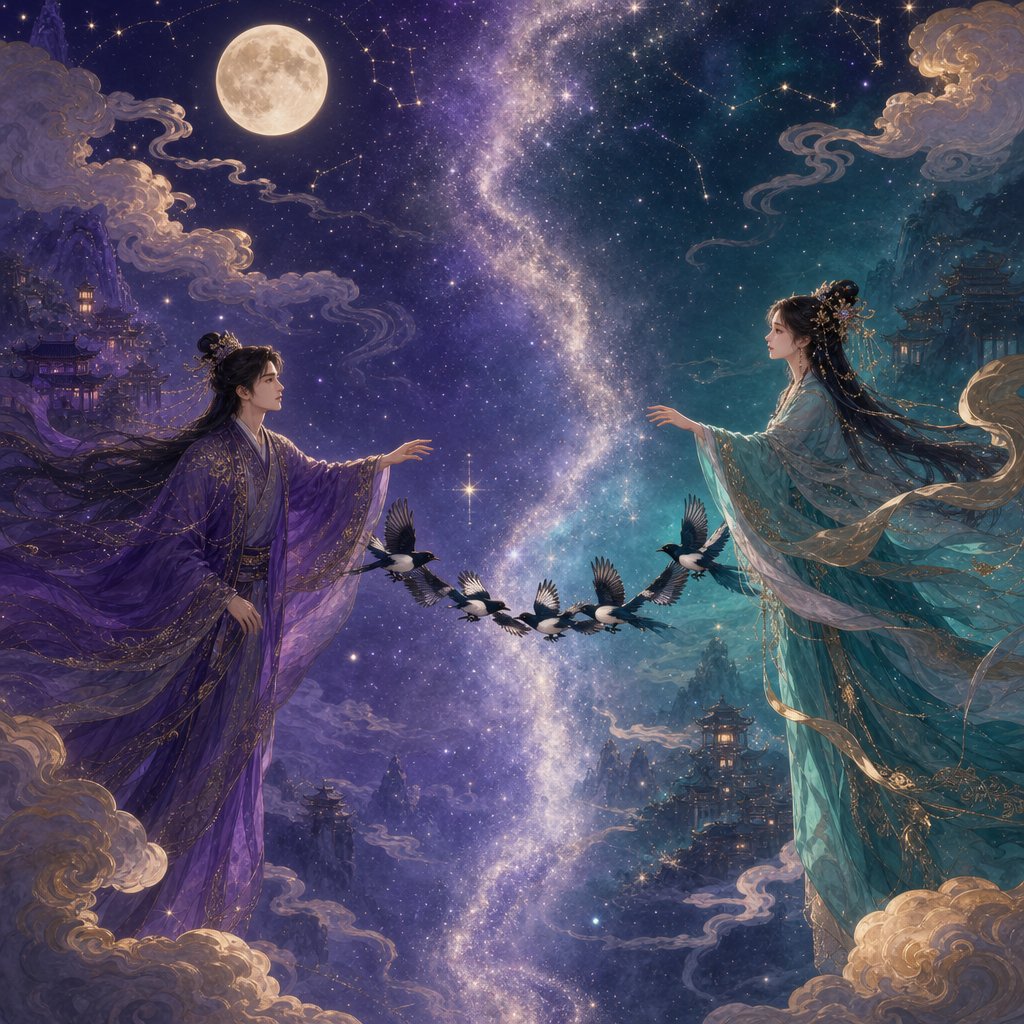
The most beloved star legend in Chinese culture is the story of the Cowherd and the Weaver Girl (牛郎织女, Niulang Zhinü). You've probably seen the stars without knowing their story. Altair and Vega, two of the brightest points in the summer sky, represent two lovers separated by the Milky Way.
The legend goes like this: Zhinü, a weaving goddess from heaven, descended to earth and fell in love with a mortal cowherd named Niulang. They married and had two children. When the Goddess of Heaven discovered the union, she flew into a rage and dragged Zhinü back to the sky, creating a vast celestial river (the Milky Way) to keep them apart forever. But their love moved the magpies so deeply that each year, on the seventh day of the seventh lunar month, magpies fly up to form a bridge so the lovers can reunite for one night.
This story is the origin of the Qixi Festival (七夕节), often called Chinese Valentine's Day. First recognized as a formal occasion during the Han Dynasty over 2,600 years ago, the festival transforms two literal stars into symbols of devotion, longing, and the belief that love transcends even cosmic separation. On this night, young women traditionally offer prayers and showcase domestic skills, hoping for a love as enduring as the one written in the stars above.
The Qixi Festival star legend explained in this way reveals something important for learners: when Chinese speakers say 星, they may be invoking not just a point of light but an entire emotional universe of romance, sacrifice, and reunion.
Beyond Qixi, stars appear throughout Chinese mythology and cultural life. Here are the major references you'll encounter:
- 牛郎织女 (Niulang Zhinü) - The Cowherd and Weaver Girl, representing Altair and Vega. Symbolizes faithful love that endures separation. Central to the Qixi Festival.
- 北斗七星 (Běidǒu Qīxīng) - The Big Dipper's seven stars. Considered a cosmic clock regulating seasons, yin and yang, and the five elements. Central to both astrology and feng shui.
- 文曲星 (Wénqǔxīng) - The Literary Star. In folklore, a deity governing intelligence and scholarly success. Parents still say a gifted child is "文曲星下凡" (the Literary Star descended to earth).
- 福星 (Fúxīng) - The Lucky Star. One of the three star gods (福禄寿) representing fortune, prosperity, and longevity. You'll see these figures in homes, restaurants, and temples across China.
- 扫帚星 (Sàozhǒuxīng) - The Broom Star (comet). A folk term for someone who brings bad luck wherever they go. Calling someone a 扫帚星 is a serious insult rooted in the ancient belief that comets signaled disaster.
- 命星 (Mìngxīng) - Fate Star. The star believed to govern an individual's destiny from birth. When someone's luck turns catastrophically bad, people say their 命星 has dimmed.
星 in Astrology and Feng Shui
Chinese astrology treats stars not as distant suns but as active forces shaping human fate. The most sophisticated expression of this idea is 紫微斗数 (Zǐ Wēi Dǒu Shù), or Polestar Astrology. This system, which emerged during the Tang Dynasty (618-907 CE) and was further developed in the Song Dynasty, uses 36 symbolic "stars" to map the patterns of an individual's fate. The system is named after 紫微 (Zǐ Wēi), the Polestar, the one star in the sky that does not move. Ancient Chinese astronomers saw it as the Emperor of Heaven, the pivot around which all other celestial bodies revolve.
In Polestar Astrology, the Chinese astrology star meaning goes far beyond horoscopes. Each "star" in the system represents a character in the Imperial Court: the Emperor, the Empress, the General, the Oracle, the Concubine. These aren't literal astronomical objects. They're mathematical patterns, sequences of time expressed through poetic symbols that describe the nature of one's inherited fate (命, Ming). The tradition teaches that our fate is a mandate from our ancestors, and the stars reveal the shape of that mandate.
Feng shui draws on the same celestial logic. In Flying Star Feng Shui (玄空飞星), the word "stars" refers to types of Qi energy symbolized numerically from 1 to 9. These Nine Stars represent energies felt on earth that reflect the seven visible stars of the Big Dipper plus two invisible "assistant stars." The Big Dipper was seen as a giant universal clock in the heavens, regulating the waxing and waning of seasons, yin and yang, and the five elements. Practitioners analyze how these star energies move through a building over time, determining which rooms carry auspicious or inauspicious Qi in any given period.
What ties all of this together is a single idea: stars in Chinese culture are never passive. They act. They influence. They connect the human world to something larger. When you learn the character 星, you're not just learning a word for a shiny dot in the sky. You're touching a concept that Chinese civilization has used for millennia to explain why things happen, why people meet, and why certain lives unfold the way they do.
This spiritual dimension of 星 coexists with something far more modern. The same character that once described cosmic fate now lights up entertainment news and social media feeds, because somewhere along the way, Chinese speakers decided that famous people shine just like celestial bodies do.
How 星 Became the Word for Celebrity
When did a word for distant balls of gas start describing people on magazine covers? The answer is the same in Chinese and English: metaphor. Stars shine. Famous people shine. The cognitive leap is so natural that both languages made it independently, centuries apart. But the Chinese version of this metaphor has its own texture, its own history, and its own modern complications worth unpacking.
From Celestial Bodies to Celebrities
The key compound is 明星 (mingxing). Break it apart and you get 明 (bright, clear) plus 星 (star). Literally: a bright star. The term originally referred to Venus, the most luminous point in the predawn sky, visible when all other stars have faded. Classical texts used 明星 this way for centuries, describing the planet that outshines everything around it.
The metaphorical shift happened gradually. By the early twentieth century, as Chinese cinema and popular music emerged, writers needed a word for performers who captivated public attention. 明星 was a perfect fit. A celebrity, like Venus at dawn, stands out from the crowd. They radiate something that draws every eye. The word carried built-in admiration without needing explanation.
This is why 星 means celebrity in Chinese: the metaphor maps brightness and visibility onto fame and public presence. A star doesn't choose to be seen. It simply shines, and people look up. The same logic applies to a performer who commands attention effortlessly.
Research in cognitive linguistics confirms that this kind of cross-domain mapping, using concrete sensory experience to understand abstract social concepts, operates across cultures. A 2025 study on conceptual metaphors in Chinese and English songs found that the Chinese word 星辰 (stars) appeared with a frequency of 53 across 100 Chinese inspirational songs, functioning as an orientational metaphor where "GOAL IS UP" maps onto the act of looking upward at stars. The English word "stars" appeared 22 times in the parallel English corpus, functioning more as an ontological metaphor where "SUCCESS IS LIGHT." Both languages use stars to represent aspiration and achievement, but Chinese emphasizes the upward gaze while English emphasizes the radiance itself.
How 星 Mirrors the English Word Star
The parallel between Chinese and English is striking. English speakers call actors "stars," award restaurants "stars," and rate hotels with "stars." Chinese does the same thing with 星. Five-star hotels are 五星级 (wuxingji). A-list celebrities are 大明星 (da mingxing, big bright stars). Talent scouts are 星探 (xingtan, literally "star scouts"). The metaphorical architecture is nearly identical.
But there's a nuance. In Chinese, the celebrity meaning of 星 almost always appears in compound form. You rarely see 星 alone meaning "celebrity." It needs a partner:
- 明星 (mingxing) - general celebrity, the default term
- 歌星 (gexing) - singing star, a famous vocalist
- 影星 (yingxing) - movie star, a film actor
- 球星 (qiuxing) - sports star, a famous athlete
- 童星 (tongxing) - child star
Each compound specifies the domain of fame. English does this too ("rock star," "film star"), but Chinese is more systematic about it. The character 星 acts as a suffix that transforms any field into a category of stardom.
The 明星 meaning and origin also illuminate a modern distinction that confuses learners: the difference between 明星 and 网红 (wanghong). Both describe famous people, but they carry different connotations. A 明星 is a traditional celebrity, someone discovered by a 星探, trained by a studio, and promoted through established media channels. The word implies polish, professionalism, and institutional backing. A 网红 (literally "internet red") is someone who became famous through social media, short videos, or livestreaming. The word implies self-made virality, often with a hint of impermanence.
You wouldn't call a TikTok influencer a 明星 unless they'd crossed over into mainstream entertainment. And you wouldn't call a classically trained film actress a 网红 unless you wanted to insult her. The distinction maps roughly onto the English difference between "celebrity" and "influencer," but the Chinese terms make the boundary sharper because 明星 carries that embedded metaphor of celestial permanence. Stars endure. Internet trends flicker.
This metaphorical weight shows up in brand names and pop culture too. One of China's earliest film studios was literally called 明星影片公司 (Mingxing Film Company, or "Star Film Company"), founded in 1922. The Starbucks Chinese name, 星巴克 (Xingbake), keeps the 星 front and center. Entertainment shows use 星 in their titles the way English programs use "star": 星光大道 (Avenue of Stars), 我是歌手 rebranded segments with 全星 (all-star) labels. The character sells aspiration.
How Chinese character 星 is used for fame ultimately comes down to a metaphor so intuitive it barely needs explaining. Bright things attract attention. Stars are the brightest things in the dark. Famous people are the brightest presences in public life. The logic is universal, but the Chinese expression of it, layered with centuries of celestial reverence, gives 明星 a gravity that "celebrity" sometimes lacks.
This shared metaphorical DNA between Chinese and English raises an interesting question. If the character means the same thing across both languages, does it also mean the same thing across East Asian writing systems? The answer involves a single character traveling through three different languages, picking up different sounds but keeping its meaning remarkably intact.
星 in Chinese vs Japanese vs Korean
If you search "star kanji" or "kanji for star," you'll land on the exact same character: 星. That's not a coincidence. Chinese, Japanese, and Korean all share this character because Japan and Korea historically borrowed Chinese writing through the spread of Buddhism and classical scholarship, beginning around the 5th and 6th centuries CE. The character traveled intact. Its pronunciation, however, did not.
星 as a Shared Character Across East Asian Languages
In linguistics, these shared characters are called CJK unified ideographs, characters used across Chinese, Japanese, and Korean writing systems. The character 星 is one of the clearest examples. It means "star" in all three languages, it carries the same figurative extension to "celebrity," and it even appears in parallel compound words. But each language pronounces it according to its own phonological rules, reflecting how Middle Chinese sounds were adapted centuries ago.
Here's a side-by-side CJK character 星 comparison:
| Feature | Mandarin Chinese | Japanese | Korean |
|---|---|---|---|
| Character | 星 | 星 | 星 |
| Writing system name | Hanzi (汉字) | Kanji (漢字) | Hanja (한자) |
| Pronunciation | xīng | hoshi (native) / sei (Sino-Japanese) | seong (성) |
| Meaning: celestial body | Yes | Yes | Yes |
| Meaning: celebrity | Yes (明星 mingxing) | Yes (スター is more common, but 星 sei used in compounds) | Yes (스타 is more common, but 성 used in Hanja compounds) |
| "Constellation" | 星座 (xingzuo) | 星座 (seiza) | 성좌 (seongjwa) |
| "Planet" | 行星 (xingxing) | 惑星 (wakusei) | 행성 (haengseong) |
| "Satellite" | 卫星 (weixing) | 衛星 (eisei) | 위성 (wiseong) |
| Current usage frequency | Very high (daily use in 星期) | High (second grade kanji) | Low (Hanja rarely written; Hangul preferred) |
Star Kanji vs Star in Chinese
The star kanji meaning in Japanese is functionally identical to the Chinese meaning. The difference lies in how the character is read aloud. Japanese gives 星 two pronunciation layers. The native Japanese reading (kun'yomi) is hoshi, derived from the Proto-Japonic word *posi. This is the reading used when the character stands alone, as in "星がきれいだ" (hoshi ga kirei da, "the stars are beautiful"). The Sino-Japanese reading (on'yomi) is sei, borrowed from Middle Chinese pronunciation patterns. This reading appears in compound words like 星座 (seiza, constellation) and 衛星 (eisei, satellite).
Korean follows a simpler pattern. The character 星 has one Sino-Korean reading: 성 (seong). In modern South Korea, you'll rarely see the Hanja character written out. Koreans use Hangul almost exclusively in daily life. But the pronunciation seong lives on in vocabulary: 위성 (wiseong, satellite), 행성 (haengseong, planet), 성좌 (seongjwa, constellation). The Hanja character sits invisibly behind these words, shaping their meaning even when it's no longer written.
For learners studying multiple East Asian languages, this is a genuine shortcut. Learn the meaning of 星 once, and you've unlocked vocabulary across three languages simultaneously. The kanji for star pronunciation differs in each system, but the semantic core, a luminous body in the sky that metaphorically represents brilliance, stays constant from Beijing to Tokyo to Seoul.
Knowing how 星 functions across borders gives you the big picture. The practical question for Chinese learners, though, is more immediate: how do you write this character correctly, stroke by stroke, without confusing it with the dozen similar-looking characters that share its components?
How to Write the Chinese Character Star: Stroke Order and Practice Tips
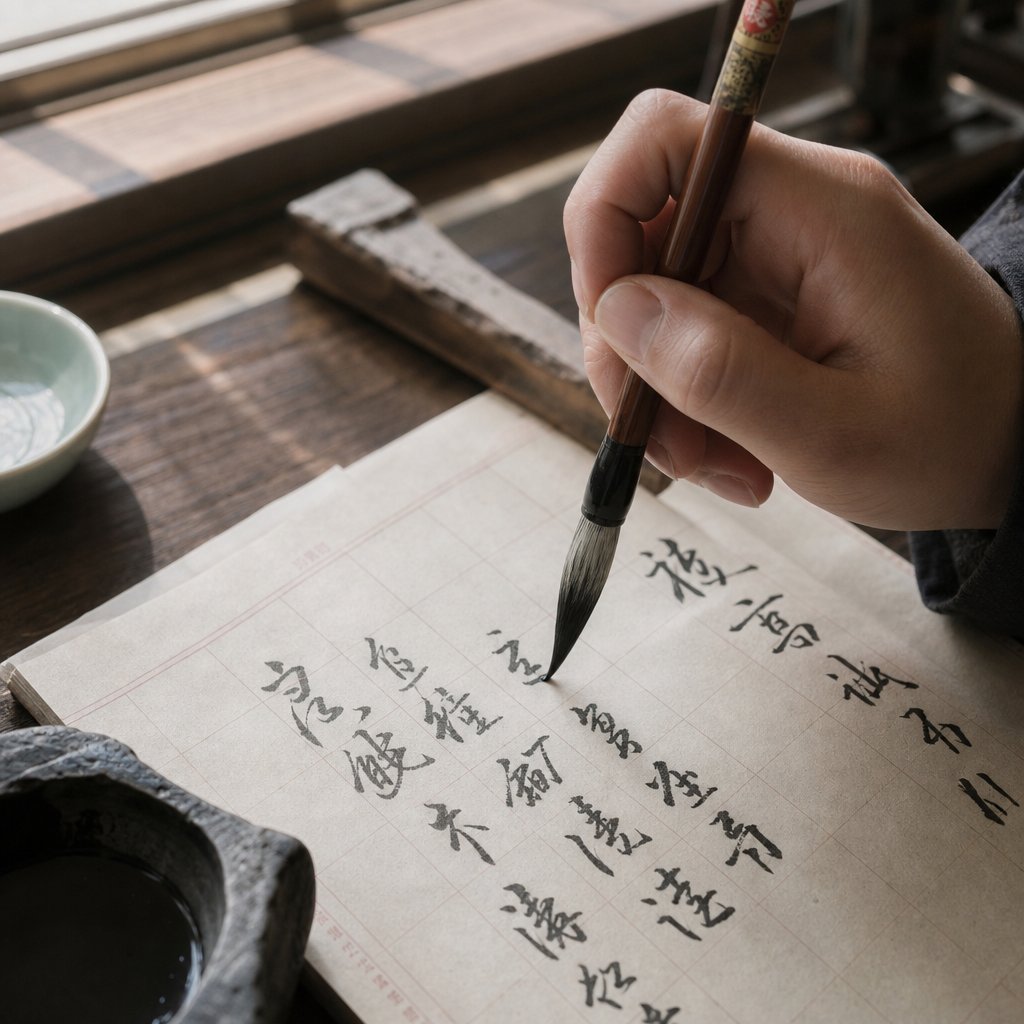
You know what 星 means, how it sounds, and where it shows up in vocabulary. The final piece is physical: putting pen to paper (or stylus to screen) and writing it correctly. With 9 strokes total, 星 isn't particularly complex, but its structure demands attention to proportion and sequence. Get the stroke order right from the start, and muscle memory will carry you forward. Get it wrong, and you'll fight bad habits for months.
How to Write 星 Step by Step
The character splits visually into two stacked sections: 日 (sun) on top and 生 (birth) on the bottom. You write top to bottom, left to right, following the universal rules of Chinese stroke order. Here's the 星 stroke order and writing guide broken into its nine strokes:
- Stroke 1: Vertical stroke on the left side of 日 (top-down).
- Stroke 2: Horizontal-turning stroke forming the top and right side of 日.
- Stroke 3: Short horizontal stroke inside 日 (the middle bar).
- Stroke 4: Bottom horizontal stroke closing 日.
- Stroke 5: Short horizontal stroke at the top of 生 (the first horizontal line).
- Stroke 6: Second horizontal stroke of 生 (slightly longer).
- Stroke 7: Central vertical stroke of 生 (drops straight down through the horizontals).
- Stroke 8: Third horizontal stroke of 生 (the widest one).
- Stroke 9: Final horizontal stroke at the base of 生 (the bottom line, anchoring the character).
The key proportion to watch: the 日 component on top should be slightly narrower than the 生 component below. Think of it like a head sitting on shoulders. If you make 日 too wide, the character looks top-heavy and unbalanced. The bottom horizontal stroke of 生 is the widest element, giving the whole character a stable base.
For animated demonstrations of each stroke in sequence, WriteChinese.com offers stroke-by-stroke animations and printable practice worksheets that let you trace the character repeatedly until the motion feels natural.
A practical tip for 星 stroke count and practice: count your strokes as you write. If you consistently land on 9, you're on track. If you get 8 or 10, you're likely merging two strokes into one or splitting a single stroke incorrectly. The most common error is treating the vertical-plus-turn in stroke 2 of 日 as two separate strokes. It's one continuous motion: horizontal across the top, then turning downward along the right side.
Characters Often Confused with 星
Several characters share visual components with 星, and learners mix them up regularly, especially during reading. Here are the ones that cause the most trouble:
- 早 (zao, early) - Contains 日 on top with 十 below. At a glance, the top half looks identical to 星. The difference is everything below 日: 星 has 生 (four horizontal strokes plus a vertical), while 早 has just a simple cross shape. If you see 日 on top and only two strokes below it, that's 早, not 星.
- 晨 (chen, morning) - Also starts with 日 on top, but the bottom component is 辰 (a much more complex structure with diagonal strokes). 晨 has 11 strokes total compared to 星's 9. The visual weight below 日 is heavier and wider in 晨.
- 量 (liang, measure/quantity) - Contains 日 in the middle of the character, sandwiched between other components. The overall shape is taller and more vertically stacked than 星. If you see 日 buried in the center rather than sitting cleanly on top, you're looking at 量.
- 生 (sheng, birth/life) - The bottom half of 星 standing alone. Learners sometimes write 生 when they mean 星 by forgetting the 日 on top. If your character has no sun radical, it's just "birth," not "star."
- 昌 (chang, prosperous) - Two 日 components stacked vertically. It looks like 星 if you squint, but there's no 生 component at all. Two suns, no birth.
The mnemonic from the etymology section is your best defense against confusion. When you see 日 on top and 生 on the bottom, recall the story: the sun departs, and stars are born. That narrative anchors the specific combination of components that makes 星 unique. No other common character pairs 日 with 生 in this exact arrangement.
For learners following structured programs, 星 typically appears early. It's part of the HSK 1 vocabulary through the word 星期 (week), meaning most curricula introduce it within the first few months of study. By the time you reach HSK 3 or 4, you should be able to write it from memory without hesitation and recognize it instantly in compound words like 明星 and 卫星.
If you're still building confidence with this character, here's a simple daily exercise: write 星期一 through 星期天 (Monday through Sunday) each morning. Seven repetitions of 星 per day, embedded in practical vocabulary you'll actually use. Within two weeks, the stroke order will feel automatic, and you'll have reinforced one of the most common word patterns in Mandarin at the same time.
The star Chinese character meaning spans everything from ancient cosmology to modern celebrity culture, from oracle bone inscriptions to smartphone keyboards. You've now covered its definition, its internal structure, its sound, its vocabulary, its idioms, its cultural weight, its cross-language connections, and its physical form on the page. That's a complete picture of one character, and it's exactly the kind of deep understanding that turns passive recognition into active fluency. Pick another character that interests you, apply the same layered approach, and watch your reading ability compound, one star at a time.
Frequently Asked Questions About the Chinese Character 星
1. What is the Chinese character for star and how is it pronounced?
The Chinese character for star is 星, pronounced xing in first tone (high and flat pitch). The Mandarin 'x' sound is similar to 'sh' but with the tongue pushed forward behind the lower teeth. The character carries both a literal meaning referring to celestial bodies and a figurative meaning related to fame and celebrity. It appears in HSK 1 vocabulary through the word 星期 (week) and remains one of the most frequently used characters across all proficiency levels.
2. Why does 星 mean both star and celebrity in Chinese?
The character 星 evolved from its purely astronomical meaning to also represent celebrity through metaphor, much like English uses 'star' for famous people. The key compound is 明星 (mingxing), literally 'bright star,' which originally referred to Venus, the brightest object in the predawn sky. By the early twentieth century, as Chinese cinema emerged, the term was applied to performers who shone brightly in public consciousness. The metaphor maps celestial brightness onto social visibility and fame.
3. How do you remember and write the Chinese character 星?
The character 星 has 9 strokes and breaks into two components: 日 (sun) on top and 生 (birth/life) on the bottom. A helpful mnemonic is to think of stars as lights 'born from the sun' that appear when the sun departs at dusk. When writing, complete the 日 component first (4 strokes), then write 生 below (5 strokes). Keep 日 slightly narrower than 生 for proper proportion, with the bottom horizontal stroke being the widest element to give the character a stable base.
4. Is the kanji for star the same as the Chinese character?
Yes, the Japanese kanji for star is the identical character 星, borrowed from Chinese writing centuries ago. The meaning stays the same across Chinese, Japanese, and Korean. However, pronunciation differs: xing in Mandarin, hoshi (standalone) or sei (in compounds) in Japanese, and seong in Korean. Many compound words also parallel each other, such as 星座 meaning constellation in both Chinese (xingzuo) and Japanese (seiza).
5. What are common Chinese idioms that use the character 星?
Three widely used chengyu feature 星: 星星之火 (a single spark can start a prairie fire) emphasizes that small beginnings can lead to massive change; 披星戴月 (wearing stars and carrying the moon) describes working tirelessly from before dawn until after dark; and 星罗棋布 (spread like stars and chess pieces) means scattered densely across a wide area. These idioms lean toward formal or written Chinese and appear frequently in essays, speeches, and news articles.