What Makes Telling Gender from a Chinese Name So Difficult
Imagine you see the name "Michael" on a list. You immediately assume male, and you're almost certainly right. English names carry strong gender signals baked into their spelling and sound patterns. Chinese names work nothing like this. Telling gender from a Chinese name requires navigating a completely different linguistic landscape, one where a single syllable can map to dozens of characters, each carrying its own meaning and gender association.
Why Chinese Names Present a Unique Gender Challenge
Chinese is a logographic language. Each character is a compact bundle of meaning, sound, and visual structure rather than a sequence of phonetic letters. When you encounter the name "Wei," you're not looking at a gendered spelling pattern. You're looking at a romanized shell that could represent characters meaning "great" (伟, typically male), "micro" (微, leaning female), or "protect" (卫, often male), among many others. This homophone problem is the core reason Chinese name gender identification challenges differ so fundamentally from those in alphabetic languages. There are no suffixes like "-a" or "-ette" to rely on, no gendered name endings that hold across the language.
Characters vs. Pinyin as Starting Points
The accuracy of any gender inference depends heavily on what information you actually have. Are you looking at the original Chinese characters, or only a romanized pinyin spelling? This distinction changes everything.
When you have access to the original Chinese characters, gender inference accuracy improves dramatically compared to working from romanized pinyin alone. Characters reveal meaning, radicals, and visual cues that pinyin completely strips away.
If you're trying to determine gender from Chinese characters vs pinyin, think of it this way: characters give you a high-resolution photograph, while pinyin gives you a blurry thumbnail. Both contain information, but the depth differs enormously.
This guide walks through both scenarios systematically. Whether you're a researcher analyzing author lists, an HR professional reviewing international applications, a marketer personalizing outreach, or a language learner building cultural fluency, you'll find a structured framework for how to tell gender from a Chinese name with appropriate confidence levels. The key is understanding exactly where certainty ends and assumption begins.
That framework starts with something deceptively simple: knowing which part of a Chinese name is actually the given name.
How Chinese Names Are Structured
Getting gender inference wrong often has nothing to do with misreading a character's meaning. It starts earlier, at the most basic structural level: mistaking the surname for the given name, or vice versa. Before you can analyze any character for gender signals, you need to know exactly which characters to analyze.
Surname First and Given Name Second
Chinese names follow a strict order. The family name (姓, xing) comes first, followed by the given name (名, ming). This is the reverse of most Western naming conventions. In the name Wang Xiaoming (王小明), "Wang" is the surname and "Xiaoming" is the given name. Only the given name carries gender-relevant information. The surname tells you about lineage, not gender.
A typical Chinese name consists of either two or three characters total. The most common structure is a one-character surname followed by a two-character given name, producing a three-character full name. Less common but still frequent is a one-character surname paired with a single-character given name, creating a two-character full name.
Here's what this looks like in practice:
| Structure Type | Example | Surname | Given Name | Total Characters |
|---|---|---|---|---|
| Single surname + two-character given name | 李金泽 (Li Jinze) | 李 (Li) | 金泽 (Jinze) | 3 |
| Single surname + single-character given name | 张伟 (Zhang Wei) | 张 (Zhang) | 伟 (Wei) | 2 |
| Compound surname + given name | 欧阳雪 (Ouyang Xue) | 欧阳 (Ouyang) | 雪 (Xue) | 3 |
| Compound surname + two-character given name | 司马子轩 (Sima Zixuan) | 司马 (Sima) | 子轩 (Zixuan) | 4 |
You'll notice that the total character count alone doesn't tell you where the surname ends and the given name begins. A three-character name could be a single surname plus a two-character given name, or a compound surname plus a single-character given name. This ambiguity is where parsing errors creep in.
Why the Boundary Between Surname and Given Name Matters
Imagine you encounter the name 欧阳雪 (Ouyang Xue). If you incorrectly assume a single-character surname, you'd parse it as surname 欧 (Ou) with given name 阳雪 (Yangxue). You'd then analyze 阳 (yang, meaning "sun" or "masculine") and 雪 (xue, meaning "snow") together for gender signals, arriving at a mixed or male-leaning reading. The actual given name is just 雪 (xue, "snow"), which leans strongly female. One parsing mistake, completely opposite conclusion.
This is why identifying the given name vs surname in Chinese is the non-negotiable first step in any gender inference process. The surname carries zero gender information, so including it in your analysis introduces noise at best and outright errors at worst.
Fortunately, the vast majority of Chinese surnames are a single character. The top 100 surnames in China are all single-character and cover roughly 85 percent of the population. Compound surnames like 欧阳 (Ouyang), 司马 (Sima), and 上官 (Shangguan) exist but are relatively rare. There are only about 81 compound surnames in common use. So for most names you'll encounter, the first character is the surname and everything after it is the given name.
Common Pitfalls When Parsing Chinese Names
Even with this knowledge, several traps catch people unfamiliar with Chinese name structure surname given name order:
- Reversed order in international contexts. Many Chinese people living abroad adopt Western name order on business cards or publications, placing their given name first. "Xiaoming Wang" and "Wang Xiaoming" are the same person. Without context, you may not know which format you're looking at.
- Hyphenated or spaced given names. A two-character given name might appear as "Xiao-Ming," "Xiao Ming," or "Xiaoming" depending on the romanization style. Splitting it into two separate words can make it look like a middle name plus a given name in Western terms.
- Mistaking a compound surname for a given name. If you don't recognize 欧阳 or 诸葛 (Zhuge) as surnames, you might try to read gender signals from characters that are actually part of the family name.
- Anglicized first names added to Chinese surnames. Names like "David Chen" or "Jenny Liu" tell you nothing about the person's actual Chinese given name, which may carry different gender associations than the English name suggests.
The practical takeaway: when you're trying to parse a Chinese name for gender, always isolate the given name first. Confirm the surname, set it aside, and focus your analysis exclusively on the remaining characters. Those are the characters that hold the gender clues, encoded in their meaning, radicals, and sound, which is exactly where the real detective work begins.
Gender Indicators Hidden in Chinese Characters
Chinese characters aren't random squiggles. Each one is built from layers of meaning, visual components, and phonetic elements that parents deliberately choose when naming a child. These layers form a taxonomy of gender signals, some obvious and some subtle, that you can learn to read systematically. Understanding how character meaning reveals gender in Chinese names comes down to four main categories: semantic meaning, radical components, phonetic qualities, and visual complexity.
Semantic Meaning as the Strongest Gender Signal
The most reliable clue is the literal meaning of a character. Chinese parents typically select given name characters with intentional symbolism, and those symbolic choices follow strong gendered patterns. Female names gravitate toward beauty, nature, grace, and gentleness. Male names lean toward strength, ambition, vastness, and achievement.
Here are common Chinese characters that indicate female names:
- 婷 (ting) - graceful, elegant
- 芳 (fang) - fragrant, virtuous
- 丽 (li) - beautiful
- 静 (jing) - quiet, serene
- 雪 (xue) - snow
- 梦 (meng) - dream
- 夏 (xia) - summer
And here are male Chinese name characters and meanings that appear frequently:
- 伟 (wei) - great, mighty
- 强 (qiang) - strong
- 军 (jun) - army, military
- 刚 (gang) - firm, unyielding
- 龙 (long) - dragon
- 宏 (hong) - grand, magnificent
- 力 (li) - power, strength
You'll notice the pattern immediately. Female-associated characters evoke sensory beauty and inner qualities, while male-associated characters project outward force and scale. The famous singer Wang Leehom (王力宏) carries both 力 (power) and 宏 (grand) in his given name, a textbook example of stacked male semantic signals.
Radicals That Reveal Gender Patterns
What if you encounter an unfamiliar character and don't immediately know its meaning? This is where radicals come in. Radicals are the building-block components within a character, and certain Chinese radical components act as gender signals even before you look up the full definition.
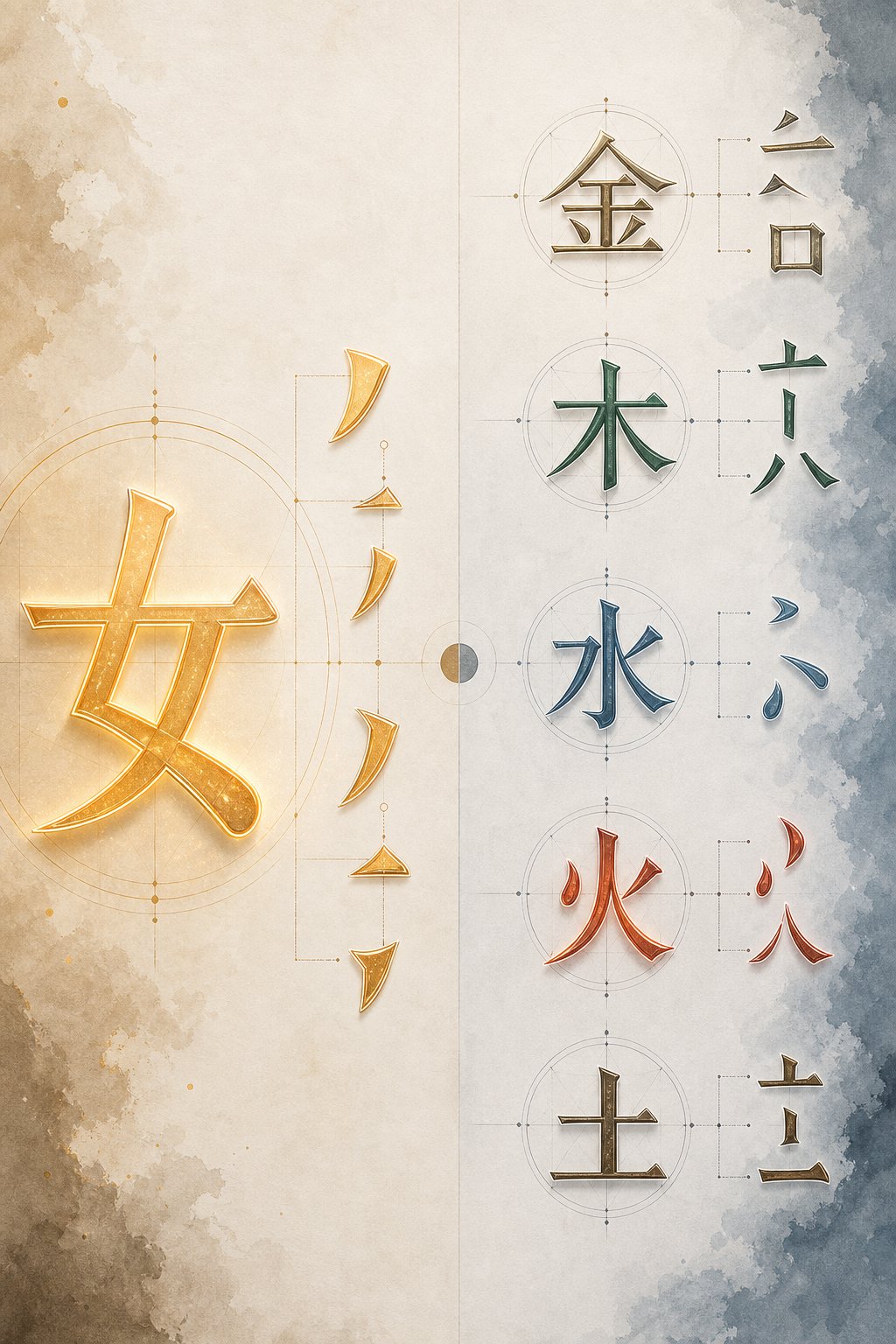
The strongest female indicator is the 女 (woman) radical. Characters containing it, like 娜 (graceful), 婉 (gentle), and 婷 (elegant), are overwhelmingly found in female names. The grass radical 艹 (indicating plants and flowers) also skews heavily female, appearing in characters like 蓉 (lotus), 薇 (fern), and 苗 (sprout). The jade radical 王 shows up in characters like 瑞 (auspicious), 琪 (fine jade), and 瑶 (precious jade), which are commonly used in girl names.
On the male side, the five elemental radicals tied to Chinese cosmology, 金 (metal), 木 (wood), 水 (water), 火 (fire), and 土 (earth), lean male. The tree radical 木 appears in characters like 楠 (cedar), 杨 (poplar), and 桢 (hardwood). The metal radical 钅 shows up in characters like 钢 (steel) and 铭 (inscription). The person radical 亻 in characters like 伟 (great) and 佳 (excellent) also trends male, though less exclusively.
Think of radicals as a quick-scan shortcut. Spot a 女 or 艹 radical and you can lean female with reasonable confidence before doing any deeper analysis.
Phonetic and Visual Complexity Cues
Beyond meaning and radicals, subtler patterns exist in how characters sound and look. Female names tend to favor softer phonetic qualities: open vowels, nasal endings, and lighter initial consonants. Characters like 婷 (ting), 莉 (li), and 芳 (fang) have a flowing, melodic quality. Male names more often feature harder consonant onsets and abrupt stops: 刚 (gang), 强 (qiang), 军 (jun).
Visual complexity offers a weaker but still observable signal. Some researchers note that female name characters tend toward moderate stroke counts with aesthetically balanced structures, while male names sometimes use bolder, simpler characters that project directness. This pattern is far less reliable than semantic meaning or radicals, so treat it as a tiebreaker rather than a primary indicator.
These four layers, meaning, radicals, sound, and visual form, don't operate in isolation. In a two-character given name, they compound. A name combining two characters with flower radicals and soft phonetics sends a much stronger female signal than either character alone. That compounding effect is precisely why the number of characters in a given name changes the confidence equation entirely.
Single vs Two-Character Given Names and Gender Ambiguity
That compounding effect isn't just a theoretical nicety. It's the single biggest factor determining whether you can confidently infer gender or whether you're essentially guessing. The number of characters in a given name directly controls how much information you have to work with, and the difference between one character and two is enormous.
Two-Character Given Names and Compound Signals
Most Chinese given names contain two characters. Research from ShanghaiTech University found that two-character names make up 84.55% of Chinese given names, making them the dominant pattern. This matters for gender detection because two characters give you two independent data points that reinforce or clarify each other.
Consider the name 宇桐 (Yutong). The character 宇 (yu, meaning "universe" or "space") leans slightly male but appears in names across genders. The character 桐 (tong, meaning "paulownia tree") is similarly ambiguous on its own. But combined, the pairing of a cosmic-scale character with a sturdy tree character creates a compound signal that tilts noticeably male. Each character narrows the probability window that the other leaves open.
Two-character given names also benefit from sequence information. The same research demonstrated that when you reverse the order of two characters in a name, 14.77% of names would have a reversed gender tendency. In other words, A-B and B-A can point to different genders even though they use identical characters. This sequential context is an extra layer of signal that single-character names simply cannot provide.
There's another surprising finding: 1.75% of two-character names combine characters that individually associate with one gender but together indicate the opposite. The classic example is 胜男 (Shengnan), where 胜 (win) and 男 (male) are both male-leaning characters, yet the combination means "triumph over males" and is a distinctly female name. Two-character given names gender prediction accuracy benefits from capturing these combinatorial patterns that character-by-character analysis would miss entirely.
Single-Character Names and Higher Ambiguity
When a given name has only one character, you lose all of that compound context. You're left with a single data point, and many individual characters are used across genders with surprising frequency.
Take 桐 (tong) by itself. Without a companion character to anchor its gender direction, this character sits in ambiguous territory. It evokes a tree, which could fit either a male name emphasizing sturdiness or a female name emphasizing natural beauty. Compare that to 宇桐 where the pairing resolves the ambiguity. Single character Chinese name gender ambiguity is fundamentally a problem of insufficient context.
The challenge intensifies when you consider characters that are genuinely popular across both genders. Characters like 宇 (universe), 晨 (morning), 瑞 (auspicious), and 辰 (celestial) appear frequently in both male and female names. With a two-character name, the second character usually disambiguates. With a single-character name, you're stuck with whatever probability that lone character carries, and for many common characters, that probability hovers uncomfortably close to 50/50.
How Name Length Affects Confidence Levels
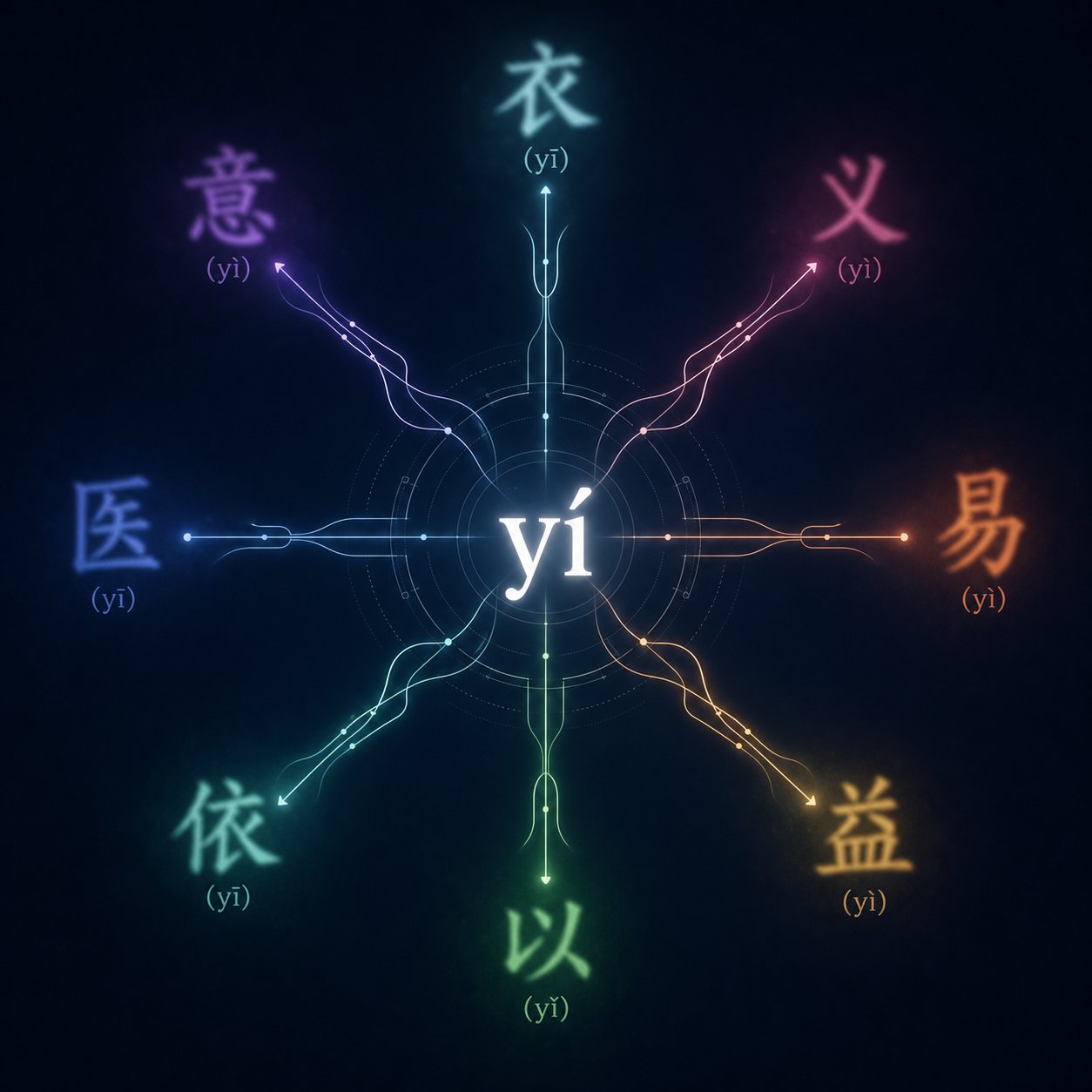
Imagine you only have the pinyin "yutong" with no characters visible. This single romanized form maps to dozens of possible character combinations: 宇桐, 雨桐, 玉桐, 宇彤, 雨彤, 玉彤, and many more. Some of these lean strongly female (雨桐, where 雨 means "rain" paired with the tree), others lean male (宇桐), and still others are nearly neutral. Without knowing which characters are intended, your confidence collapses. A two-character name in characters gives you rich signal; that same name in pinyin scatters into a cloud of possibilities.
The table below summarizes how name length affects Chinese gender detection across several dimensions:
| Dimension | Single-Character Given Name | Two-Character Given Name |
|---|---|---|
| Ambiguity level | High. One character often used across genders. | Lower. Character combination narrows possibilities. |
| Gender split | Many characters sit near 50/50 male-female usage. | Combinations tend to push clearly toward one gender. |
| Analysis difficulty | Harder. No compound context to resolve ambiguity. | Easier. Sequence and pairing provide extra signals. |
| Pinyin impact | Fewer homophones per syllable, but still ambiguous. | Exponentially more character combinations per pinyin pair. |
| Confidence ceiling | Moderate even with characters visible. | High when characters are visible; moderate with pinyin only. |
A dataset study covering over 30 million Chinese individuals found that applying a 0.9 confidence threshold to names in Chinese characters allowed gender assignment for over 80% of the population. That figure drops to around 65% when the same names are converted to pinyin. The gap widens further for single-character names, where fewer semantic and combinatorial signals survive the romanization process.
The practical lesson is straightforward: the more characters you can see, the more confident your inference can be. Two characters in their original written form give you the best shot. One character in pinyin gives you the worst. Everything else falls somewhere in between, and that "in between" is exactly where the pinyin romanization problem turns a manageable challenge into a genuinely difficult one.
The Pinyin Romanization Challenge for Gender Detection
Here's the uncomfortable reality for anyone working with international datasets: you often don't have Chinese characters at all. Academic citation databases, conference registration systems, business directories, and HR platforms typically store names in romanized pinyin. And the moment characters get converted to Latin letters, a massive amount of gender-relevant information vanishes. Understanding the pinyin gender detection accuracy limitations is essential before you trust any inference drawn from romanized names alone.
Why Romanized Pinyin Dramatically Reduces Accuracy
Pinyin is a phonetic transcription system. It captures how a character sounds but discards everything else: the meaning, the radical structure, the visual form. All those rich gender signals discussed in previous sections? Gone. What remains is a bare syllable that could represent any number of completely unrelated characters.
The scale of information loss is staggering. A study published in Scientific Data found that 1,051,891 unique given names in Chinese characters collapse into just 96,797 unique names in pinyin format. That's roughly an 11-to-1 compression ratio. On average, every single pinyin spelling maps to about eleven distinct character-based names, each potentially carrying different gender associations.
Character-based gender analysis can assign gender to over 80% of individuals at a 0.9 confidence threshold. The same names in pinyin format drop that figure to around 65%. This gap represents millions of people whose gender becomes undetectable through romanization alone.
Research by Sebo found that the error rate of commonly used gender detection tools predicting gender from Chinese given names in pinyin format ranges from 43% to 94%, essentially rendering them useless for this population. Part of the problem is data scarcity: only 0.57% of the name data in the widely used Genderize.io API comes from China. But even with better data, the fundamental issue remains. Romanized Chinese name gender identification is fighting against a structural ceiling imposed by the writing system itself.
The Homophone Problem in Gender Inference
Consider the pinyin syllable "li." Without tones, without characters, just those two letters. Here's a sample of what it could represent:
- 丽 (li) - beautiful (strongly female)
- 莉 (li) - jasmine (strongly female)
- 力 (li) - power, strength (strongly male)
- 立 (li) - to stand, independent (leans male)
- 李 (li) - plum tree, also a common surname (gender-neutral)
- 理 (li) - reason, logic (leans male)
- 丽 (li) - beautiful (strongly female)
One syllable. Completely opposite gender signals depending on which character the person's parents actually chose. This is the Chinese homophone problem in name gender inference at its most basic level, and it scales across nearly every syllable in the language.
The problem compounds with two-character given names. Take "jing" paired with "yi." The combination "jingyi" could be 静怡 (serene and joyful, strongly female), 景逸 (scenic and carefree, leans male), 敬义 (respectful and righteous, strongly male), or dozens of other pairings. Each romanized two-syllable name maps to an exponentially larger set of possible character combinations than a single syllable does. What was a manageable ambiguity with one character becomes a combinatorial explosion with two.
This is why telling gender from pinyin without characters is fundamentally a different problem than character-based inference. You're not reading gender signals. You're estimating probabilities across a cloud of possible characters, hoping the statistical weight tips clearly enough in one direction.
Working with Tonal vs. Toneless Pinyin
Does adding tone marks help? Partially. Mandarin has four tones plus a neutral tone, and tone information narrows the character possibilities for each syllable. The pinyin "li" without tones maps to characters across all four tones. Specifying "li4" (fourth tone) eliminates characters pronounced in the first, second, or third tones, cutting the candidate pool significantly. "Li4" still maps to 力 (strength, male), 丽 (beautiful, female), and 立 (stand, male-leaning), but at least you've removed 莉 (li2, jasmine, female) and 理 (li3, reason, male) from consideration.
In practice, though, tonal pinyin is rarely available in the contexts where you most need it. Academic databases like Web of Science and Scopus store author names without tones. Business cards written in English omit them. Email addresses and social media handles can't encode them. Conference registration forms almost never capture them. The practical reality is that most professionals working with romanized Chinese names are stuck with toneless pinyin, which is the worst-case scenario for gender inference.
Even when tones are present, ambiguity persists. A single tonal syllable still maps to multiple characters, and the gender associations of those characters can still conflict. Tonal pinyin narrows the odds but doesn't resolve them. You move from guessing among dozens of characters to guessing among several, which is better but still far from the near-certainty that seeing the actual character provides.
The proportion of gender-neutral names illustrates this gap neatly. In Chinese characters, about 4.82% of names fall into the gender-neutral zone (between 40% and 60% female usage). Convert those same names to pinyin, and that figure jumps to 7.66%. Romanization doesn't just reduce accuracy for clearly gendered names; it actively pushes more names into the ambiguous middle ground where no confident call is possible.
For researchers and professionals who only have pinyin to work with, the honest answer is that confidence ceilings are lower and error rates are higher. That doesn't mean inference is impossible, but it does mean you need to calibrate your expectations and build uncertainty into your workflow. Some names in pinyin still carry strong statistical signals. Others become genuinely unreadable. Knowing which category you're dealing with, and what to do when a name resists classification, is where practical strategy comes in.
Gender-Neutral Chinese Names and Handling Ambiguity
Some names simply refuse to pick a side. And in Chinese naming culture, that refusal is neither accidental nor rare. A significant portion of characters sit comfortably in the middle ground, used by parents for children of any gender without raising an eyebrow. If you're trying to infer gender from a Chinese name and you hit one of these characters, no amount of radical analysis or semantic decoding will give you a clear answer, because the name was never designed to signal gender in the first place.
Characters Commonly Used Across Genders
Certain characters appear so frequently in both male and female names that treating them as gendered indicators would be a mistake. These are the unisex Chinese names used for both genders, and recognizing them saves you from false confidence.
Here are some of the most common gender-neutral characters in Chinese given names:
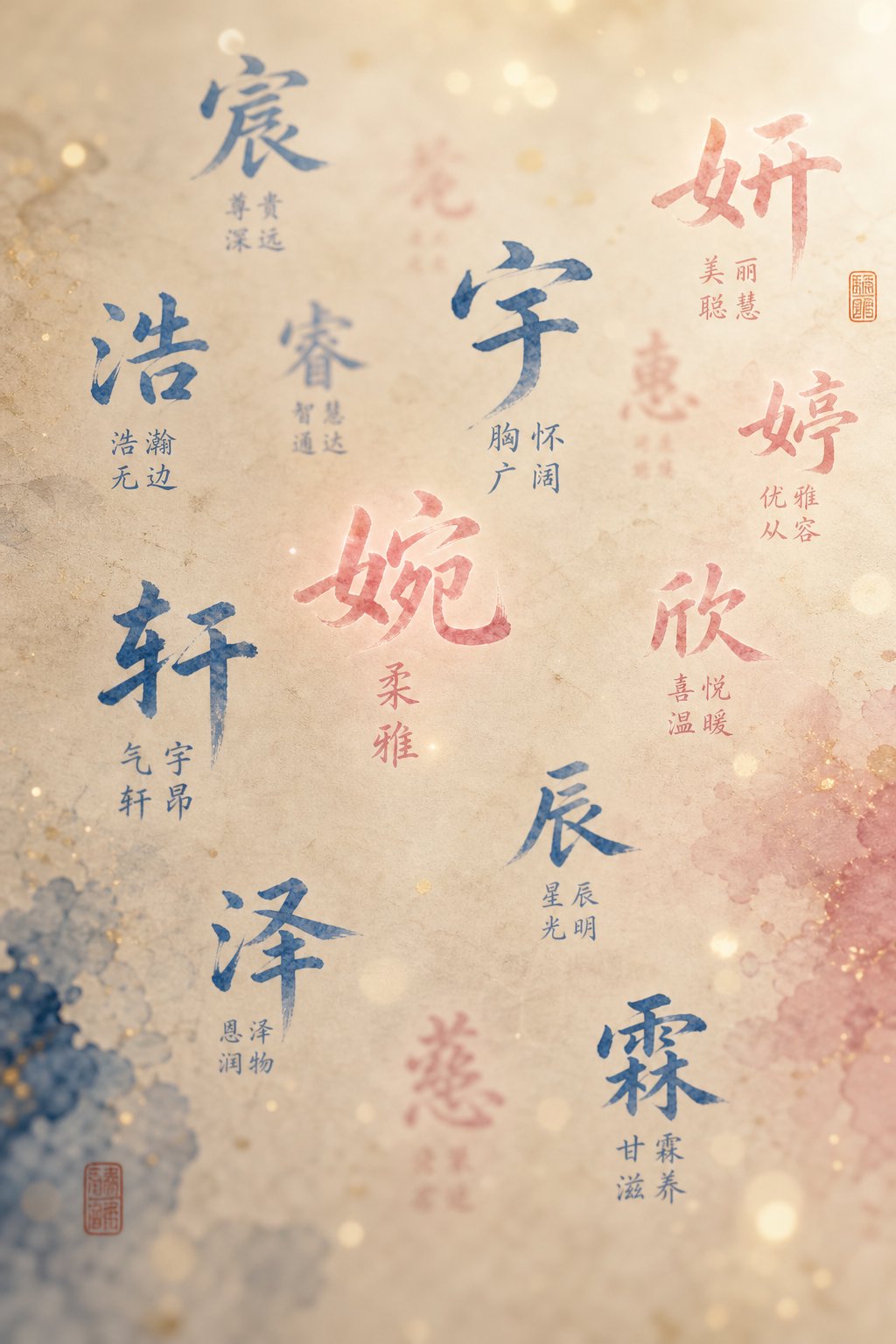
- 宇 (yu) - universe, space, house. Evokes vastness without implying masculine force or feminine grace.
- 晨 (chen) - morning, dawn. A time-of-day reference that carries freshness and hope for either gender.
- 瑞 (rui) - auspicious, lucky. A positive omen character parents choose regardless of the child's gender.
- 嘉 (jia) - excellent, fine, praiseworthy. Broad enough in meaning to fit any child.
- 辰 (chen) - celestial bodies, time. Abstract and cosmic, with no inherent gender lean.
- 子 (zi) - child, seed, or a classical honorific. Despite literally meaning "son" in some contexts, it appears widely in female names too.
- 安 (an) - peace, safety. A wish for the child's wellbeing that transcends gender.
- 明 (ming) - bright, clear. Intellectual clarity as a virtue for anyone.
- 天 (tian) - sky, heaven. Grand in scale but neutral in association.
- 逸 (yi) - carefree, outstanding. Suggests ease and talent without gendered framing.
You'll notice a pattern in this gender neutral Chinese name characters list: these characters tend to reference abstract qualities, natural phenomena, or universal aspirations rather than physical attributes or social roles. They describe what parents hope for a child's life rather than what they expect from a child's gender.
The Rise of Gender-Neutral Naming in Modern China
Gender-neutral naming isn't new in Chinese culture, but its prevalence has shifted dramatically in recent decades. Traditional naming conventions drew sharp lines. A girl born in the 1960s might receive 红梅 (Hongmei, "red plum blossom"), while her brother got 建国 (Jianguo, "build the nation"). The gender signals were loud and deliberate.
Modern Chinese gender neutral naming trends tell a different story. Urban parents, particularly millennials and Gen Z, increasingly gravitate toward names that prioritize aesthetic beauty, individuality, and aspiration over gender conformity. Names like 梓涵 (Zihan), 子轩 (Zixuan), and 宇辰 (Yuchen) dominate recent birth registries for both boys and girls. The character 梓 (zi, meaning "catalpa tree") has become so popular across genders that it topped naming charts for both sexes in multiple recent years.
Several forces drive this shift. The one-child policy era (1980-2015) concentrated parental hopes onto a single child regardless of gender, making aspirational naming more important than gendered naming. Rising education levels and exposure to global culture introduced the idea that names need not broadcast biological sex. And evolving attitudes toward gender identity, particularly among younger generations in major cities, have made deliberately ambiguous names a conscious choice rather than an oversight.
This trend means that for names belonging to people born after roughly 1990, gender-neutral characters appear with much higher frequency than in older generations. A name that would have been clearly male or female in the 1970s might be genuinely ambiguous when given to a child born in 2020. Age context matters when you're assessing how to handle ambiguous Chinese name gender.
Professional Strategies When Gender Is Unclear
So what do you actually do when a name doesn't cooperate? When the characters are neutral, the pinyin is ambiguous, and you have no other context? The answer depends on your situation, but the principle stays constant: don't guess when you can ask, and don't assume when you can adapt.
Practical approaches for professionals:
- Use the full name as address. In Chinese business culture, addressing someone by their full name (surname + given name) is perfectly polite and sidesteps gendered titles entirely.
- Deploy gender-neutral honorifics. Titles like 老师 (laoshi, "teacher"), 总 (zong, "director/manager"), or 同事 (tongshi, "colleague") work regardless of gender and carry professional respect.
- Include a pronoun or title field in forms. If you're designing intake forms, registration systems, or databases, let people self-identify rather than forcing your system to guess.
- Flag rather than force. In bulk data analysis, mark ambiguous names with a confidence score rather than assigning a binary gender. A 55% probability is not the same as a 95% probability, and your downstream analysis should reflect that difference.
- Ask directly when stakes are high. For individual communications, a brief, respectful inquiry is always better than an embarrassing assumption. Most people appreciate the consideration.
When a Chinese name does not clearly signal gender, default to gender-neutral communication rather than risking an incorrect assumption. The cost of asking is minimal; the cost of getting it wrong can damage professional relationships.
The existence of genuinely neutral names also serves as a useful calibration check. If your gender detection method assigns high confidence to names like 宇辰 or 嘉瑞, something is wrong with your method, not with the name. These characters exist in the ambiguous zone by design, and any honest system should reflect that uncertainty rather than forcing a binary answer.
Gender-neutral names represent the clearest case where inference hits a wall. But ambiguity also arises from a different source entirely: the same characters carrying different gender weight depending on when and where a person was named. Regional conventions and generational shifts add yet another layer of complexity to the puzzle.

Regional and Generational Trends That Affect Gender Inference
A character's gender association isn't fixed across time and place. The name 建国 (Jianguo, "build the nation") screams male to anyone familiar with 1950s China, but a twenty-something in Shanghai today might find it quaint rather than masculine. Meanwhile, 梓涵 (Zihan) dominates birth registries for both boys and girls in modern mainland China, yet barely registers in Hong Kong naming culture. Chinese naming conventions by region and generation create a moving target for anyone trying to infer gender, because the same characters carry different weight depending on where and when a person was born.
Regional Differences in Naming Conventions
Greater China isn't a monolith. Mainland China, Taiwan, Hong Kong, and overseas Chinese communities each developed distinct naming aesthetics shaped by different political histories, languages, and cultural influences.
In mainland China, naming trends track closely with political eras and government campaigns. The simplified character set (used since the 1950s) shapes which characters feel natural and accessible to parents. Modern mainland names tend toward poetic, literary characters that reflect rising education levels and internet-era aesthetics.
Taiwan preserves traditional characters and draws on a different cultural reservoir. Naming conventions there often reflect Confucian literary traditions, Buddhist influences, and a more conservative aesthetic sensibility. Taiwanese female names frequently use characters like 雅 (ya, elegant), 淑 (shu, virtuous), and 惠 (hui, kind), which signal femininity through classical refinement rather than natural beauty alone. Male names lean toward characters like 志 (zhi, ambition), 宗 (zong, ancestry), and 銘 (ming, inscription), reflecting family continuity and scholarly aspiration.
Hong Kong Cantonese name gender differences emerge from a unique blend of Cantonese linguistic culture, British colonial influence, and commercial pragmatism. Hong Kong parents often choose characters that sound auspicious in Cantonese pronunciation specifically, not Mandarin. A character that sounds elegant in Cantonese might sound flat in Mandarin, and vice versa. Female names in Hong Kong frequently feature characters like 嘉 (gaa1), 詠 (wing6), and 慧 (wai6), while male names favor 俊 (zeon3), 偉 (wai5), and 健 (gin6). The gender signals are similar in category to mainland names but differ in specific character preferences.
The table below highlights how Taiwan vs mainland China naming gender patterns diverge, with Hong Kong adding its own distinct flavor:
| Region | Common Female Name Characters | Common Male Name Characters | Naming Influences |
|---|---|---|---|
| Mainland China (modern) | 梓涵, 欣怡, 诗涵, 雨桐 | 子轩, 浩宇, 宇辰, 梓豪 | Internet culture, literary aesthetics, trending charts |
| Taiwan | 雅婷, 怡君, 淑芬, 佳穎 | 志明, 家豪, 建宏, 冠宇 | Confucian tradition, literary classics, family continuity |
| Hong Kong | 嘉欣, 慧琳, 詠詩, 美玲 | 俊傑, 偉明, 健文, 志強 | Cantonese phonetics, commercial auspiciousness, British-era influence |
| Overseas Chinese | Varies widely by host country | Varies widely by host country | Ancestral dialect, assimilation pressure, generational distance from origin |
For overseas Chinese communities, naming conventions depend heavily on which generation emigrated and from which region. A third-generation Chinese-American family with Cantonese roots may use naming patterns that froze in the 1940s, reflecting the era their grandparents left China. Their names might look archaic compared to modern Hong Kong or mainland conventions, making generational assumptions based on character style unreliable.
Generational Shifts from Revolutionary to Modern Names
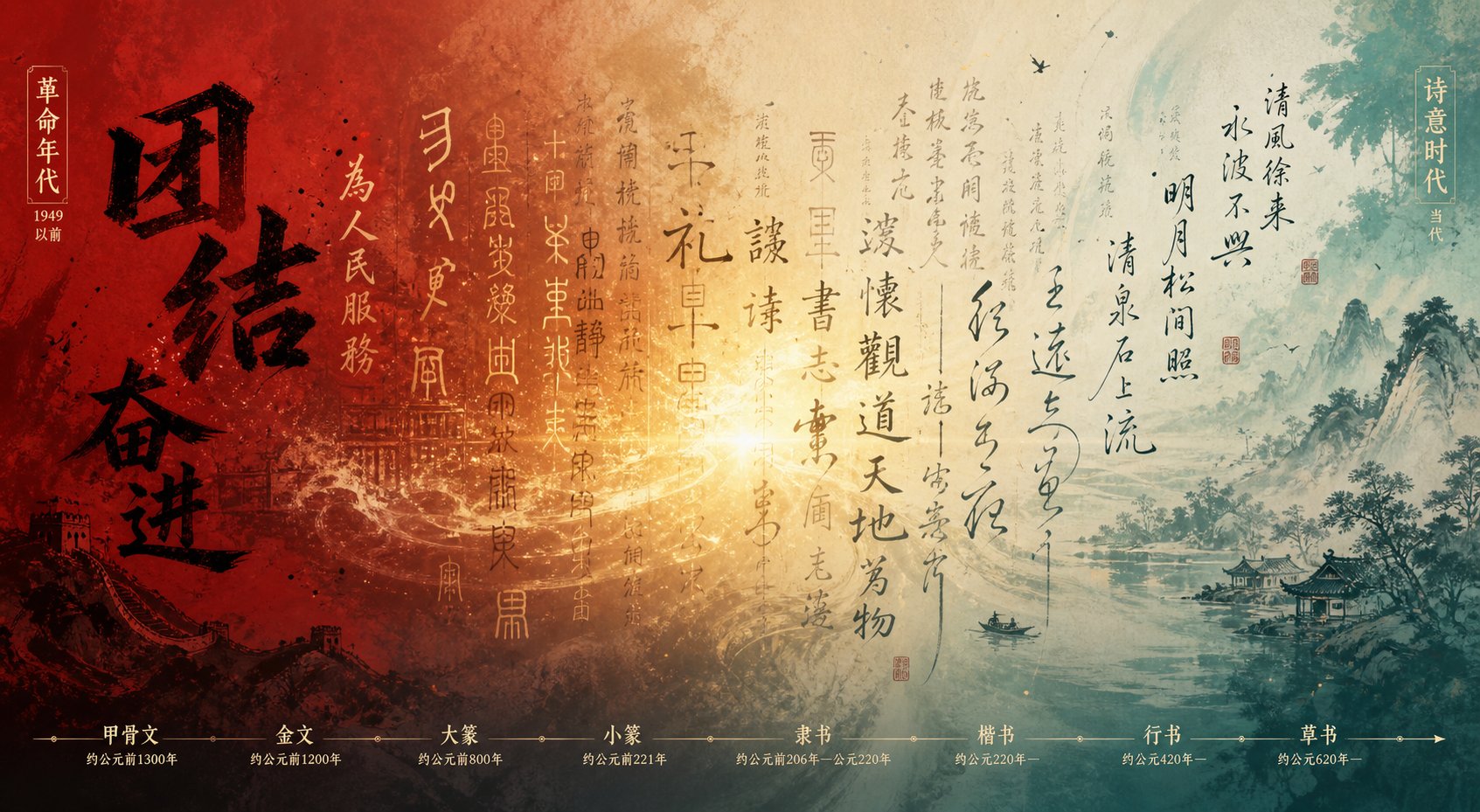
Perhaps no factor distorts gender inference more than generational context. Chinese generational naming trends affect gender detection because the entire vocabulary of "appropriate" name characters has shifted dramatically every few decades, driven by political upheaval and cultural transformation.
Consider the arc from the 1950s to today. Research covering nearly 1.2 billion Han Chinese individuals born between 1930 and 2008 reveals distinct naming eras, each with its own gender logic:
Pre-1960s and 1960s: Nation-building names. After decades of war and revolution, parents named children to reflect collective hope. Male names featured characters like 建国 (build the nation), 建军 (build the army), and 国强 (nation strong). Female names used 红梅 (red plum blossom), 红霞 (red clouds), and 秀英 (elegant hero). Gender signals were loud and unambiguous. If you see 军 (army) or 红 (red) in a name from this era, the gender inference is straightforward.
1970s: Revolutionary fervor peaks. The Cultural Revolution pushed naming even further into political territory. The character 军 (army) dominated male names after Mao called on citizens to "learn from the PLA." Female names incorporated revolutionary vocabulary too, with 红 (red) and 卫 (defend) appearing in women's names more than in any other era. This is one period where traditionally male-coded characters like 卫 crossed gender lines due to political context.
1980s: The one-child pivot. With the one-child policy concentrating all parental hopes onto a single child, naming became more individualistic. Single-character given names peaked during this decade as parents dropped generation-sharing characters that had linked siblings and cousins. Characters emphasizing personal excellence, like 杰 (outstanding), 超 (surpass), and 磊 (open and upright), surged for males. Female names shifted toward 静 (quiet), 丽 (beautiful), and 婷 (graceful), reasserting traditional femininity after the revolutionary era's gender blurring.
1990s-2000s: Aesthetic and aspirational names. Economic prosperity and globalization introduced new naming aesthetics. Parents with higher education levels began choosing literary, poetic characters. The data shows characters scoring higher in "warmth" overtaking those scoring higher in "competence" after the 1970s. Male and female names started converging toward shared characters like 宇 (universe), 涵 (contain/cultivate), and 梓 (catalpa tree), making gender inference harder for this generation.
The practical implication? A name's era changes its gender signal strength. The character 文 (wen, cultured) has been popular across all decades for males, but after the 1980s it appears increasingly in female names too as women's social position rose. If you encounter 文 in a name and know the person was born in the 1960s, it leans male. For someone born in 2005, it's genuinely ambiguous. Without age context, you're missing a critical variable.
How Romanization Systems Vary by Region
Regional differences don't just affect which characters parents choose. They also determine how those characters get converted into Latin letters, and different romanization systems can make the same character look completely different on paper.
Mainland China uses Hanyu Pinyin as its official standard. Taiwan historically used Wade-Giles and has partially transitioned to a modified pinyin system, though many older names retain Wade-Giles spellings. Hong Kong uses various Cantonese romanization systems, none of which are fully standardized. As one analysis of Chinese naming conventions notes, a single name like 龍振飛 can be romanized as "Lung Chen Fei" in Wade-Giles, "Lung Jan Fei" in Yale, or "Lung Zan Fei" in Jyutping, depending on the system used.
This creates a compounding problem for gender inference. You're already losing information by working from romanized text instead of characters. But if you don't even know which romanization system produced the spelling you're looking at, you can't reliably map it back to possible characters.
Consider a name spelled "Wing" on a business card from Hong Kong. In Cantonese romanization, this could represent 穎 (clever, leans female), 榮 (glory, leans male), or 詠 (chant/recite, used across genders). The same characters in Mandarin pinyin would be spelled "ying," "rong," and "yong" respectively, completely different letter sequences. Someone trained only on Mandarin pinyin patterns would have no framework for interpreting Cantonese romanizations, and vice versa.
Hong Kong adds another layer: the convention of separating given name characters with a space or hyphen. A name written as "Ka Yan" (嘉欣, female-leaning) looks like two separate words to someone unfamiliar with the convention. In mainland pinyin, this would be written as "Jiaxin" as a single unit. Taiwan uses hyphens, producing forms like "Chih-Ming" (志明, male). Each formatting convention changes how a reader parses the name structure, which in turn affects whether they correctly identify which syllables constitute the given name.
For anyone working across regions, the romanization system itself becomes a clue. Seeing "Ng" as a surname tells you the name likely originates from a Cantonese-speaking context. "Hsiao" suggests Wade-Giles and therefore a Taiwanese or older-generation background. "Xiao" points to mainland pinyin. These contextual signals help you calibrate which regional naming patterns to apply when estimating gender, even if they don't directly reveal it.
The layered complexity of region, generation, and romanization system means that no single rule set works universally. A gender inference approach calibrated on modern mainland Chinese names will misfire on 1970s Taiwanese names romanized in Wade-Giles. This is precisely why automated tools struggle, and why understanding their underlying mechanics matters before you trust their output.
How Automated Gender Detection Tools Actually Work
So how do Chinese name gender prediction algorithms work when they attempt to do this at scale? Behind every API call or library function, there's a pipeline of steps that mirrors, in compressed form, the same logic a human would follow: parse the name, isolate the given name, extract features, and make a probabilistic guess. The difference is speed and volume. What takes a human minutes of careful analysis, a machine does in milliseconds across millions of records.
Here's the general pipeline most systems follow:
- Input parsing. The system determines whether it's receiving Chinese characters or romanized pinyin, and normalizes the input accordingly.
- Surname detection. A lookup against a known surname list identifies the family name and separates it from the given name. Compound surnames like 欧阳 or 司马 are checked first to avoid misparsing.
- Character decomposition. For character-based inputs, the system breaks each given-name character into its components: radicals, sub-radicals, and structural relationships.
- Feature extraction. The algorithm pulls signals from the characters: semantic meaning, radical type, pronunciation, stroke count, and how the characters combine.
- Probabilistic classification. A model assigns a probability of the name being male or female based on learned patterns from training data.
- Confidence scoring. The output includes not just a binary prediction but a confidence level, letting users decide whether the result is trustworthy enough for their purposes.
Statistical Models and Character Frequency Analysis
The simplest approach, and the one most early tools used, is character frequency analysis. You take a large database of names with known genders, count how often each character appears in male versus female names, and multiply those probabilities together for multi-character given names.
The widely used Ngender tool works exactly this way, using Naive Bayes to calculate the probability of each character belonging to a female or male name. It's fast and transparent, but it has clear limitations. It treats each character independently, ignoring the fact that character combinations carry their own gender signals. It also can't handle characters it has never seen in training data.
A dataset study covering over 30 million Chinese individuals demonstrated that frequency-based lookup using Chinese characters achieves an errorCoded rate of just 0.13 on a dataset of nearly 100,000 scientists, meaning 87% of individuals were correctly classified or left unclassified rather than misclassified. That's a solid baseline, but it still leaves meaningful gaps, particularly for rare names and gender-neutral characters.
Machine Learning Approaches to Name Classification
More sophisticated systems move beyond simple frequency counting. Machine learning Chinese name gender classification uses neural networks that learn richer representations of characters, capturing relationships that frequency tables miss.
One influential approach concatenates character embeddings from pre-trained language models like BERT with pronunciation embeddings, allowing the system to leverage both semantic and phonetic gender signals simultaneously. This handles the "out-of-sample" problem: even characters the model hasn't seen in its training names can get meaningful representations from the language model's broader understanding of Chinese.
The most advanced current method, the Chinese Heterogeneous Graph Attention (CHGAT) model, goes further still. It constructs a graph that connects characters to their semantic components, phonetic components, and pronunciations through different types of edges. This captures the heterogeneity discussed in earlier sections: the same radical means different things depending on whether it contributes meaning or sound to a character. The model uses multi-level attention to weigh these different relationship types, achieving a state-of-the-art accuracy of 93.62% when trained on a dataset of 58 million names from official Chinese government records.
What makes graph-based methods powerful is their ability to model exactly the kind of structural knowledge a human expert uses. When you recognize that 珍 (precious) and 珠 (pearl) share the semantic component 王 (jade) while 旺 (prosperous) shares it only as a phonetic component, you're doing what the heterogeneous graph encodes formally. Characters connected through semantic components tend to share gender associations; characters connected only through phonetic components often don't.
Understanding Accuracy Limitations and Confidence Scores
Even the best models hit a ceiling. That 93.62% figure represents performance on character-based inputs from a well-matched dataset. Real-world conditions introduce noise that degrades accuracy in predictable ways:
- Training data bias. Most large Chinese name-gender datasets come from business registration records, which skew toward older, male, middle-to-upper-class individuals. Female names and younger-generation naming patterns are underrepresented. The CHGAT training data has a male-to-female ratio of 111.58%, meaning the model has seen more male examples.
- Generational mismatch. A model trained primarily on names from the 1960s-1990s may struggle with post-2000 naming trends where gender-neutral characters dominate.
- Pinyin-only inputs. When only romanized text is available, automated gender inference from Chinese names limitations become severe. Error rates for pinyin-based prediction range from 43% to 94% depending on the tool, according to research published in Scientific Data.
- Regional variation. Models trained on mainland Chinese names perform poorly on Hong Kong Cantonese names or overseas Chinese naming patterns. One evaluation found that Chinese Pinyin methods applied to U.S.-based Chinese names achieved only 58% precision for males and 75% for females.
Confidence scores are the system's way of communicating uncertainty. A prediction returned with 95% confidence means the model's training data overwhelmingly associates that name with one gender. A prediction at 55% confidence means the name sits near the decision boundary, and you should treat it as ambiguous rather than resolved. Responsible use means setting a threshold, commonly 0.8 or 0.9, below which you decline to assign gender rather than forcing a low-confidence guess.
When should you use these tools versus other approaches? The decision is straightforward. Automated methods make sense for bulk data analysis: processing thousands of author names in a bibliometric study, segmenting a marketing database, or auditing gender representation across a large organization. The error rate is acceptable when averaged across a population, even if individual predictions carry uncertainty.
For individual communications, sending an email, addressing a conference speaker, or writing a recommendation letter, automated tools are the wrong choice. The cost of a single misgendering is social and professional, not statistical. In those cases, direct inquiry or gender-neutral language is always the better path. Chinese name gender detection API accuracy, however impressive in aggregate, offers no comfort when it's your specific interaction that falls into the error margin.

Practical Applications and Professional Best Practices
Knowing how these systems work is one thing. Knowing when to use them, when to skip them, and when to simply ask a person directly is where theory meets professional reality. The best practices for inferring gender from Chinese names depend entirely on your context: what data you have, how many names you're processing, and what happens if you get it wrong.
Use Cases for Researchers and Data Analysts
If you're analyzing author lists in academic papers, auditing gender representation in patent filings, or studying publication patterns across disciplines, you're working at scale. Thousands or millions of names. Manual verification isn't feasible, and direct inquiry isn't possible when you're working with historical records or public databases.
For these scenarios, automated tools are appropriate, but calibration matters. A dataset published in Scientific Data demonstrated that character-based methods achieve an errorCoded rate of just 0.13 on scientist names, while pinyin-based methods still outperform commercial tools like Genderize.io, which correctly classified only 53% of Chinese grantees. Set your confidence threshold at 0.8 or higher, report the proportion of names left unclassified, and acknowledge the limitation in your methodology section. Transparent uncertainty is better than false precision.
When your dataset contains only romanized names, consider whether the multi-task learning approaches that bridge pinyin and character information might serve you better than generic commercial APIs. These specialized models outperform commercial tools by 9.70% to 20.08% on Chinese pinyin names specifically.
Guidelines for HR and Marketing Professionals
HR professionals reviewing international applicants and marketers personalizing communications face a different calculus. You're dealing with individual people, not statistical populations. The stakes of misgendering someone are personal and immediate.
For HR teams, cultural sensitivity around Chinese name gender assumptions means never using inferred gender to filter candidates or make assumptions about qualifications. If your applicant tracking system needs gender data for diversity reporting, add a self-identification field rather than guessing from names. When preparing interview materials or correspondence, use the candidate's full name rather than guessing at "Mr." or "Ms."
For marketers segmenting audiences, automated inference can work for broad personalization at scale, like adjusting product recommendations across a database of thousands. But for direct outreach, especially high-value communications like partnership proposals or executive invitations, verify before you personalize. A wrongly gendered salutation in a cold email doesn't just feel awkward. It signals that you didn't care enough to check.
Conference organizers face a practical version of this problem: name badges, introductions, and pronoun cards. The simplest solution is to ask registrants for their preferred title and pronouns during signup. This respects everyone, not just those with ambiguous names, and removes the guessing game entirely.
A Decision Framework for Choosing Your Approach
When you encounter a Chinese name and need to determine gender, run through this decision framework for gender detection from Chinese names:
- Do you have Chinese characters or only pinyin? Characters give you access to meaning, radicals, and combinatorial signals. Pinyin alone drops your accuracy ceiling significantly. If you only have romanized text, acknowledge that your confidence will be lower regardless of method.
- Is this for bulk data analysis or individual communication? Bulk analysis tolerates error rates because mistakes average out across populations. Individual communication does not. A 90% accurate tool still misclassifies one in ten people, and you never know if your specific person is that one.
- What confidence threshold do you need? For academic research, a threshold of 0.8 or 0.9 with transparent reporting of unclassified names is standard practice. For marketing segmentation, even 0.7 might be acceptable if you're only adjusting tone rather than using gendered titles. For direct address, nothing short of certainty is appropriate.
- Can you verify directly? If the person is reachable, asking is always the most accurate and most respectful option. A brief "How would you prefer to be addressed?" costs nothing and eliminates all uncertainty. When automated Chinese name gender tools are available but direct contact is also possible, choose direct contact every time.
The framework is deliberately simple because the underlying principle is simple: match your method to your stakes. High volume, low individual stakes? Automate with appropriate thresholds. Low volume, high individual stakes? Ask.
When in doubt, respectful inquiry will always outperform algorithmic assumption. No tool, however sophisticated, replaces the accuracy and dignity of letting people tell you who they are.
Gender inference from Chinese names is a legitimate analytical need in research, business, and cross-cultural communication. The techniques exist, the tools are improving, and the linguistic patterns are real. But the most important skill isn't knowing how to read a radical or tune a confidence threshold. It's knowing when to put the algorithm aside and simply ask.
Frequently Asked Questions About Telling Gender from Chinese Names
1. How accurate is gender detection from a Chinese name in pinyin versus Chinese characters?
Character-based gender analysis can assign gender to over 80% of individuals at a 0.9 confidence threshold, while pinyin-only analysis drops that figure to around 65%. Error rates for commercial tools predicting gender from pinyin range from 43% to 94%, largely because romanization collapses hundreds of distinct characters into a handful of syllables. For example, the pinyin 'li' maps to both strongly female characters like 丽 (beautiful) and strongly male characters like 力 (power), making confident inference nearly impossible without the original characters.
2. What Chinese characters are most commonly associated with female or male names?
Female names frequently use characters evoking beauty, nature, and grace, such as 婷 (graceful), 芳 (fragrant), 丽 (beautiful), 静 (serene), and 雪 (snow). Male names tend toward characters projecting strength and ambition, like 伟 (great), 强 (strong), 军 (army), 刚 (firm), and 龙 (dragon). The 女 (woman) radical and the grass radical 艹 strongly signal female names, while elemental radicals tied to metal, wood, water, fire, and earth lean male.
3. Are there Chinese names that are gender-neutral and used for both boys and girls?
Yes, many Chinese characters are genuinely unisex. Common gender-neutral characters include 宇 (universe), 晨 (morning), 瑞 (auspicious), 嘉 (excellent), 辰 (celestial), 安 (peace), and 明 (bright). These characters reference abstract qualities or universal aspirations rather than gendered attributes. Gender-neutral naming has become increasingly popular in modern China, especially among parents born after 1990, with names like 梓涵 and 子轩 topping birth registries for both sexes.
4. How do automated Chinese name gender detection tools work and what are their limitations?
These tools typically follow a pipeline: parse the input, detect the surname, decompose characters into radicals and features, extract gender signals, and run a probabilistic classifier that outputs a confidence score. The best models, like the CHGAT graph-based approach, achieve 93.62% accuracy on character inputs. However, limitations include training data bias toward older male names, poor performance on pinyin-only inputs, regional mismatch when applied across mainland China, Taiwan, and Hong Kong, and inability to handle modern gender-neutral naming trends.
5. When should I use a tool versus simply asking someone their gender?
Use automated tools for bulk data analysis where thousands of names need processing and individual errors average out across the population, such as bibliometric studies or diversity audits. For individual communication like emails, introductions, or HR correspondence, always ask directly or use gender-neutral language. A 90% accurate tool still misclassifies one in ten people, and the professional cost of misgendering someone in direct interaction far outweighs the minor effort of a respectful inquiry.