Why the Top 100 Chinese Characters Unlock Real Reading Ability
Imagine picking up a Chinese menu, a street sign, or a text message and actually recognizing nearly half the characters on the page. That is exactly what happens when you learn the most common Chinese characters, specifically the top 100 by frequency. These characters account for roughly 40-50% of all characters you will encounter in typical written Chinese, from news articles to social media posts.
You do not need thousands of characters to start reading. You need the right ones. The top 1,000 most frequent characters cover about 90% of everyday written Chinese, and the first 100 alone give you a surprisingly strong foundation to decode real text.
Why Start With the Most Common Characters
Frequency matters more than complexity. A character like 的 (de) appears in almost every sentence, while a rare character like 鬱 might show up once in months of reading. By focusing on the chinese 100 most frequent characters first, you maximize your return on every hour of study. In this guide, you will get each character's meaning, pinyin pronunciation, common compound words, and memory tips to help you retain chinese characters and meanings efficiently.
Characters Are Not Letters or Words
One of the biggest beginner mistakes is treating Chinese characters like alphabet letters. They are not. Chinese uses a logographic writing system where each character represents a syllable and typically carries its own meaning. A single character can function as a complete word, like 人 (ren, person), or combine with others to form multi-character words, like 中国 (zhongguo, China). When people search for chinese letters and meanings or chinese writing symbols and meanings, they are really looking for these characters and the ideas they represent. Understanding chinese symbol meanings starts with accepting that each character is its own unit of meaning, not a building block for spelling.
Mastering just 100 characters gives you partial reading ability of real Chinese text, letting you recognize patterns on signs, menus, and messages that were previously invisible.
With that foundation in place, the natural next question is how these characters actually work as a system, what makes them tick structurally, and why they look the way they do.
How Chinese Characters Work and Why They Are Not an Alphabet
When you hear the phrase "chinese alphabet," it is natural to picture something like the English ABCs, a set of letters that combine to spell out sounds. Chinese does not work that way. There is no chinese alphabet in the traditional sense. Instead, Chinese uses a logographic system where each character represents a meaning and a syllable simultaneously. You cannot "sound out" an unfamiliar character the way you would an English word. Each one must be learned as its own unit.
So how many chinese characters are there in total? The largest dictionaries catalog over 50,000, though many are archaic or extremely rare. For everyday literacy, you need far fewer. Chinese government standards define functional literacy at around 2,500 to 3,000 characters, which covers roughly 99% of modern written text. The top 100 characters in this guide represent the essential starting layer of that pyramid.
What are chinese characters called? In Mandarin, they are known as hanzi (汉字), which literally translates to "Han characters." This term distinguishes them from other writing systems and reflects their origin in ancient Chinese civilization, with the earliest known examples carved into oracle bones over 3,000 years ago.
Simplified vs Traditional Character Forms
Chinese characters exist in two standard forms today. Simplified Chinese is used in Mainland China and Singapore, while traditional Chinese characters remain the standard in Taiwan, Hong Kong, and Macau. The split happened in the 1950s when the Chinese government reduced stroke counts in many characters to boost literacy rates.
Not every character differs between the two systems. Many simplified chinese characters look identical to their traditional counterparts. But where they do differ, the gap can be dramatic. The character for "learn" goes from 學 (traditional) to 学 (simplified), dropping from 16 strokes to 8. For this guide, we use simplified forms since they serve the largest population of readers, but knowing both systems exist helps you recognize chinese alphabet characters in different contexts.
Radicals as Building Blocks and Memory Aids
Here is where the system gets elegant. Most Chinese characters are not random drawings. They are built from smaller components called radicals and character parts. Think of radicals as recurring visual ingredients. The radical 氵(three dots on the left) signals a connection to water. The radical 木 signals a connection to trees or wood. Spotting these patterns turns character learning from brute memorization into pattern recognition.
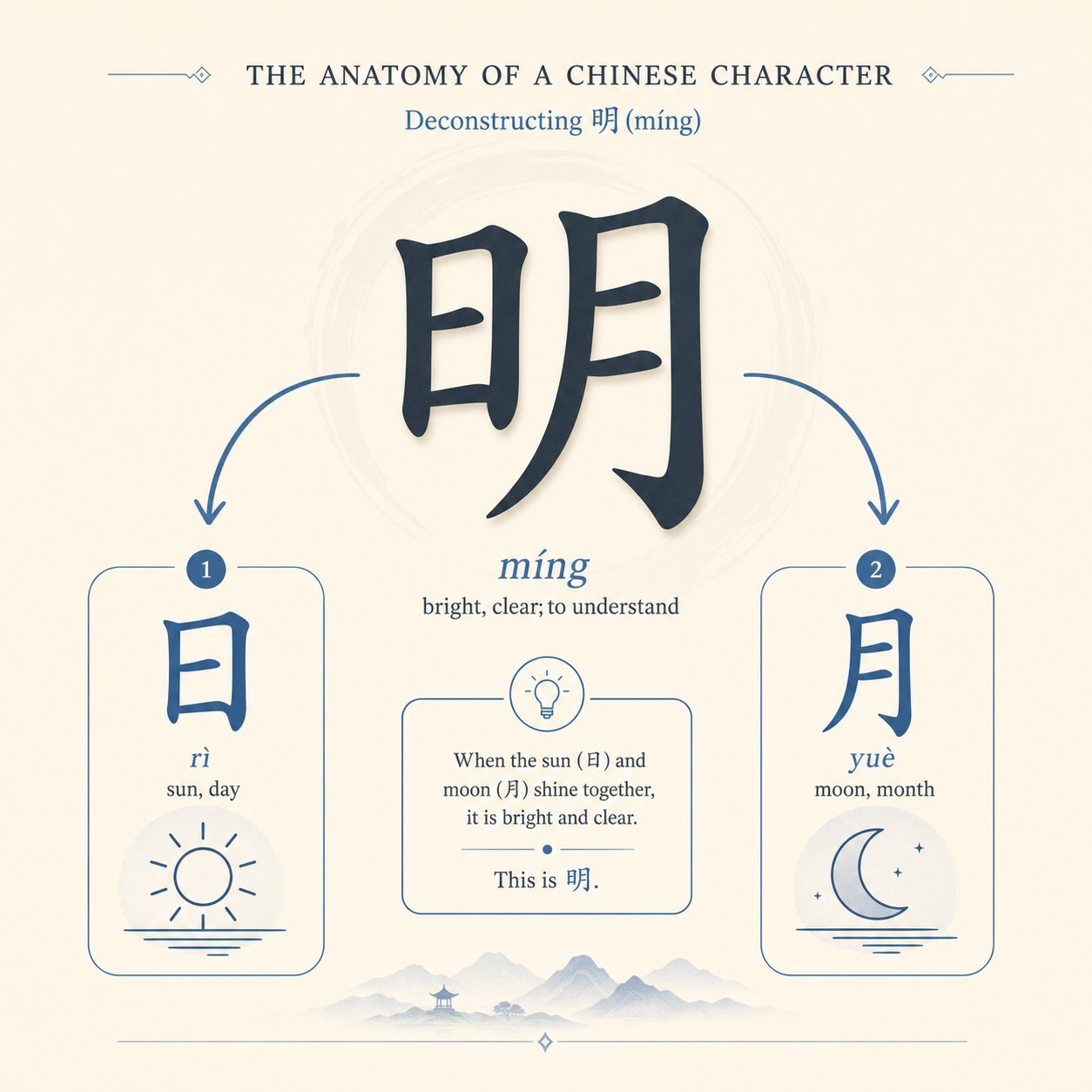
For example, the character 明 (ming, bright) combines 日 (sun) and 月 (moon). Sun plus moon equals brightness. That logic is baked into the character's structure, and once you see it, you will not forget it. There are roughly 200 commonly used radicals, and learning even a handful accelerates your ability to decode unfamiliar characters.
How Pinyin Connects Sound to Characters
If characters do not encode sound directly, how do learners know how to pronounce them? That is where pinyin comes in. Pinyin is a romanization system that spells out Mandarin pronunciation using Latin letters and tone marks. It is a learning tool and an input method for typing, not the writing system itself. Chinese people do not read pinyin in daily life the way they read characters.
When you see 人 labeled as "ren" with a second tone mark, that is pinyin doing its job: bridging the gap between the visual character and its spoken sound. Every character in this guide includes its pinyin so you can practice pronunciation alongside recognition. People sometimes wonder about chinese letters how many exist, but the answer is that Chinese does not use letters at all. It uses characters, and pinyin simply helps you access their sounds.
| Character | Radical | Simplified | Traditional | Pinyin | Meaning |
|---|---|---|---|---|---|
| 学 | 子 (child) | 学 | 學 | xue | learn, study |
| 国 | 囗 (enclosure) | 国 | 國 | guo | country, nation |
| 门 | 门 (gate) | 门 | 門 | men | door, gate |
| 长 | 长 (long) | 长 | 長 | chang/zhang | long / to grow |
Notice how the traditional forms carry more strokes while the simplified versions strip them down. The meanings and pronunciations stay the same. Whether you encounter traditional chinese characters in a Hong Kong newspaper or simplified forms on a Shanghai street sign, the underlying logic of radicals and compounds remains consistent.
With this structural foundation in place, you are ready to meet the actual characters. The first 25 are dominated by grammatical particles, the invisible glue that holds every Chinese sentence together.
Characters 1 to 25 and the Grammatical Particles That Shape Chinese
You might expect the most frequent characters in Chinese to be concrete nouns like "water" or "house." In reality, the top of any chinese characters list is dominated by tiny grammatical words that glue sentences together. These particles, pronouns, and function words appear so often that recognizing them alone lets you parse the skeleton of almost any sentence you encounter.
Grammatical Particles That Dominate Chinese Text
If you scan through a mandarin characters list ranked by frequency, you will notice something surprising: characters like 的, 了, and 在 have no clean one-word English translation. They serve structural roles. The character 的 (de) marks possession and modifies nouns, similar to the English apostrophe-s or "of." The character 了 (le) signals that an action has been completed, functioning as what linguists call a perfective aspect marker rather than a simple past tense. And 在 (zai) indicates location or an ongoing action, depending on its position in the sentence.
Particles like 的 and 了 confuse beginners because they have no direct English equivalent. You cannot translate them word-for-word. Instead, think of them as invisible grammar markers that tell you how other words in the sentence relate to each other.
This is why memorizing every chinese character in isolation is not enough. You need to understand how these basic chinese characters behave in context. A particle changes the meaning of the words around it without carrying much standalone meaning itself. Once you internalize how 的, 了, and 在 work, Chinese sentence structure starts to feel far less foreign.
Characters 1 Through 25 With Meaning and Compounds
The following chinese character list presents the 25 most frequently occurring characters based on frequency data collected by linguist Jun Da from classical and modern Chinese writings. For each entry, you will find the pinyin pronunciation, core meaning, and common compound words that show how the character functions in real vocabulary.
| Rank | Character | Pinyin | Meaning | Common Words |
|---|---|---|---|---|
| 1 | 的 | de | possessive particle, "of" | 我的 (my), 好的 (okay), 目的 (purpose) |
| 2 | 一 | yi | one, single | 一个 (one/a), 一起 (together), 一定 (certainly) |
| 3 | 是 | shi | is, am, are | 不是 (is not), 是的 (yes), 但是 (but) |
| 4 | 不 | bu | not, no | 不好 (not good), 不是 (is not), 不能 (cannot) |
| 5 | 了 | le / liao | completion marker / to understand | 好了 (done), 为了 (in order to), 了解 (understand) |
| 6 | 人 | ren | person, people | 人们 (people), 大人 (adult), 中国人 (Chinese person) |
| 7 | 我 | wo | I, me | 我们 (we/us), 我的 (my/mine), 自我 (self) |
| 8 | 在 | zai | at, in, exist | 现在 (now), 在家 (at home), 存在 (exist) |
| 9 | 有 | you | to have, there is | 没有 (don't have), 有人 (someone), 有时 (sometimes) |
| 10 | 他 | ta | he, him | 他们 (they/them), 他的 (his), 其他 (other) |
| 11 | 这 | zhe | this, these | 这个 (this one), 这里 (here), 这些 (these) |
| 12 | 为 | wei / wei | for, because of / to do, to act as | 因为 (because), 为了 (in order to), 以为 (to think) |
| 13 | 之 | zhi | of, him/her/it (classical) | 之后 (after), 之前 (before), 之中 (among) |
| 14 | 大 | da | big, large, great | 大学 (university), 大人 (adult), 大家 (everyone) |
| 15 | 来 | lai | to come | 来到 (arrive), 出来 (come out), 原来 (originally) |
| 16 | 以 | yi | to use, in order to, because of | 以后 (after), 以前 (before), 可以 (can/may) |
| 17 | 个 | ge | measure word, individual | 一个 (one), 个人 (individual), 这个 (this one) |
| 18 | 中 | zhong | middle, center, within | 中国 (China), 中心 (center), 中间 (between) |
| 19 | 上 | shang | above, on, up, previous | 上面 (above), 上学 (attend school), 早上 (morning) |
| 20 | 们 | men | plural marker for pronouns | 我们 (we), 他们 (they), 人们 (people) |
| 21 | 到 | dao | to arrive, to, until | 到达 (arrive), 来到 (come to), 得到 (obtain) |
| 22 | 说 | shuo | to speak, to say | 说话 (speak), 小说 (novel), 听说 (hear that) |
| 23 | 国 | guo | country, nation, state | 中国 (China), 国家 (country), 国人 (nationals) |
| 24 | 和 | he | and, with, peace | 和平 (peace), 和好 (reconcile), 温和 (gentle) |
| 25 | 地 | di / de | earth, ground / adverb marker (-ly) | 地方 (place), 土地 (land), 地上 (on the ground) |
A few radical breakdowns worth noting: 人 (person) looks like a figure with two legs, and it appears as a component inside dozens of other characters like 他, 们, and 以. The character 国 (country) shows a jade 玉 enclosed within borders 囗, suggesting something precious contained within boundaries. And 中 is literally a line through the center of a box, visually representing "middle."
Notice how many compound words in this list of chinese symbols are formed by combining characters from within the same top-25 group. 中 + 国 = 中国 (China). 我 + 们 = 我们 (we). 不 + 是 = 不是 (is not). This combinatorial pattern is central to how Chinese vocabulary works, and it becomes even more powerful as you add the next batch of characters covering pronouns, verbs, and everyday nouns.
Characters 26 to 50 Covering Pronouns Verbs and Everyday Nouns
The first 25 characters gave you the grammatical skeleton of Chinese. Characters 26 through 50 start putting flesh on those bones. This group introduces essential pronouns like 你 (you), time-related nouns like 年 (year), and versatile verbs like 出 (to go out) and 得 (to obtain). These are the mandarin characters that let you move from recognizing sentence structure to understanding what a sentence actually says.
You will also notice something important here: many of these characters carry multiple pronunciations and meanings depending on context. The character 得, for example, can be pronounced de, dei, or de in its neutral tone, each with a different grammatical function. This is a core feature of chinese writing and meaning. Context determines everything, and learning these common chinese words in compound form helps you internalize which reading applies where.
Characters 26 Through 50 With Pinyin and Usage
The table below continues the frequency-ranked list from data collected by linguist Jun Da. Each entry includes the chinese word pinyin, core meaning, and compound words showing real usage. When you study chinese characters in pinyin alongside their written forms, you build both visual recognition and pronunciation skills simultaneously.
| Rank | Character | Pinyin | Meaning | Common Words |
|---|---|---|---|---|
| 26 | 也 | ye | too, also, as well | 也是 (also is), 也好 (that works too), 也许 (perhaps) |
| 27 | 子 | zi | child, son, suffix | 孩子 (child), 子女 (children), 日子 (days/life) |
| 28 | 时 | shi | time, when, hour | 时间 (time), 有时 (sometimes), 小时 (hour) |
| 29 | 道 | dao | way, road, path, to say | 知道 (to know), 道路 (road), 道理 (reason/logic) |
| 30 | 出 | chu | to go out, to produce | 出来 (come out), 出国 (go abroad), 出生 (be born) |
| 31 | 而 | er | and, but, yet | 而且 (moreover), 然而 (however), 而是 (but rather) |
| 32 | 要 | yao | to want, must, will | 要是 (if), 不要 (don't), 重要 (important) |
| 33 | 于 | yu | at, in, regarding | 对于 (regarding), 由于 (due to), 于是 (thereupon) |
| 34 | 就 | jiu | then, at once, just | 就是 (precisely), 成就 (achievement), 就要 (about to) |
| 35 | 下 | xia | below, under, down, next | 下来 (come down), 下面 (below), 一下 (a moment) |
| 36 | 得 | de / dei | obtain, get / must / structural particle | 得到 (obtain), 觉得 (feel/think), 记得 (remember) |
| 37 | 可 | ke | can, may, able to | 可以 (can/may), 可是 (but), 可能 (possible) |
| 38 | 你 | ni | you | 你们 (you all), 你好 (hello), 你的 (your) |
| 39 | 年 | nian | year | 今年 (this year), 年中 (mid-year), 去年 (last year) |
| 40 | 生 | sheng | to be born, life, to grow | 学生 (student), 生活 (life), 出生 (be born) |
| 41 | 自 | zi | self, from, since | 自己 (oneself), 自然 (nature/natural), 自由 (freedom) |
| 42 | 会 | hui | can, able, meeting | 不会 (cannot), 会议 (meeting), 社会 (society) |
| 43 | 那 | na | that, those | 那个 (that one), 那里 (there), 那些 (those) |
| 44 | 后 | hou | after, behind, later | 以后 (after), 后来 (afterwards), 后面 (behind) |
| 45 | 能 | neng | can, capable, energy | 能力 (ability), 不能 (cannot), 可能 (possible) |
| 46 | 对 | dui | correct, pair, toward | 对不起 (sorry), 对于 (regarding), 不对 (incorrect) |
| 47 | 着 | zhe / zhao | ongoing action marker / to touch | 看着 (looking at), 着急 (anxious), 接着 (then/next) |
| 48 | 事 | shi | matter, thing, affair | 事情 (matter), 故事 (story), 大事 (big deal) |
| 49 | 其 | qi | his, her, its, that | 其他 (other), 其中 (among them), 尤其 (especially) |
| 50 | 里 | li | within, inside | 这里 (here), 那里 (there), 心里 (in one's heart) |
A few characters deserve extra attention. The character 得 (rank 36) is one of the trickiest mandarin basic characters because it has three distinct pronunciations. As de (second tone), it means "to obtain." As de (neutral tone), it acts as a structural particle linking a verb to a description of how the action was done. And as dei (third tone), it means "must" or "have to." Context is your only guide here, which is why seeing these characters in compound words matters so much.
The character 生 (rank 40) is equally versatile. Its core meaning relates to life, birth, and growth. Pair it with 学 (learn, which appears later in the list) and you get 学生 (xuesheng, student). Pair it with 出 from this same group and you get 出生 (chusheng, to be born). This is the combinatorial logic of chinese words and meanings at work: each character contributes a piece of meaning, and together they form something specific.
How Single Characters Build Into Vocabulary
The real power of learning these characters emerges when you combine them with the first 25. Characters from both groups snap together like building blocks to form common chinese words you will encounter daily. Here are examples using only characters from ranks 1 through 50:
- 后来 (hou lai) - afterwards (后 #44 + 来 #15)
- 出国 (chu guo) - go abroad (出 #30 + 国 #23)
- 可以 (ke yi) - can, may (可 #37 + 以 #16)
- 你们 (ni men) - you (plural) (你 #38 + 们 #20)
- 那里 (na li) - there (那 #43 + 里 #50)
- 也是 (ye shi) - also is (也 #26 + 是 #3)
Notice the pattern: converting character to pinyin mandarin pronunciation and then combining meanings gives you a reliable way to guess what new words mean. 出 (go out) + 国 (country) = go abroad. 后 (after) + 来 (come) = afterwards. This predictability is what makes Chinese vocabulary surprisingly learnable once you have the foundational pieces in place.
With 50 characters now in your toolkit, you can recognize pronouns, express time, negate statements, and identify basic actions. The next group pushes further into descriptive territory, adding characters for size, direction, and appearance that let you start forming opinions and descriptions in Chinese.
Characters 51 to 75 Plus Commonly Confused Pairs to Watch For
Descriptive power arrives with this next group. Characters 51 through 75 introduce words for size, appearance, direction, and action that let you move beyond bare sentence structure into expressing qualities and opinions. This is also where you encounter characters with multiple pronunciations, a feature that trips up learners who assume one character always equals one sound.
Characters 51 Through 75 With Multiple Meanings
Several characters in this batch carry two or more distinct readings. The character 好 is a perfect example. How do you say beautiful in chinese? One answer starts right here: 好 (hǎo) means "good" or "fine," but it also carries the sense of "beautiful" and "pretty in chinese" contexts when paired with other characters. Pronounced hao in its fourth tone (hao), it shifts meaning entirely to "to be fond of" or "to like," as in 爱好 (aiho, hobby). The character 长 works similarly: pronounced chang (second tone), it means "long," but as zhang (third tone), it means "to grow" or refers to a leader or elder.
Around 20% of the most commonly used characters have more than one pronunciation, and several appear in this group. Context is your guide. When you see 长 in 长大 (zhangda), it means "to grow up." In 很长 (hen chang), it means "very long." The surrounding characters tell you which reading applies.
| Rank | Character | Pinyin | Meaning | Common Words |
|---|---|---|---|---|
| 51 | 小 | xiao | small, little, young | 小时 (hour), 小心 (careful), 大小 (size) |
| 52 | 过 | guo | to pass, past tense marker | 过去 (past), 过来 (come over), 不过 (however) |
| 53 | 多 | duo | many, much, more | 多少 (how many), 多大 (how old), 很多 (a lot) |
| 54 | 方 | fang | direction, square, method | 地方 (place), 方法 (method), 方面 (aspect) |
| 55 | 成 | cheng | to become, to accomplish | 成为 (become), 成功 (succeed), 完成 (complete) |
| 56 | 天 | tian | sky, day, heaven | 今天 (today), 天气 (weather), 每天 (every day) |
| 57 | 只 | zhi / zhi | only / measure word (animals) | 只是 (just/only), 只有 (only have), 一只 (one animal) |
| 58 | 当 | dang / dang | when, to serve as / proper | 当时 (at that time), 当然 (of course), 应当 (should) |
| 59 | 没 | mei | not have, not (negation) | 没有 (don't have), 没人 (nobody), 没事 (no problem) |
| 60 | 动 | dong | to move, action | 动物 (animal), 运动 (exercise), 活动 (activity) |
| 61 | 面 | mian | face, surface, side, noodles | 上面 (above), 面前 (in front of), 方面 (aspect) |
| 62 | 起 | qi | to rise, to start, to get up | 起来 (get up), 一起 (together), 对不起 (sorry) |
| 63 | 看 | kan | to look, to see, to read | 看到 (see), 好看 (good-looking), 看书 (read a book) |
| 64 | 开 | kai | to open, to start, to drive | 开始 (begin), 开心 (happy), 打开 (open up) |
| 65 | 好 | hao / hao | good, beautiful / to like | 好看 (pretty), 好人 (kind person), 爱好 (hobby) |
| 66 | 头 | tou | head, top, first | 头发 (hair), 前头 (ahead), 开头 (beginning) |
| 67 | 作 | zuo | to do, to make, to write | 工作 (work), 作为 (as/being), 作家 (writer) |
| 68 | 如 | ru | like, as, if | 如果 (if), 如何 (how), 不如 (not as good as) |
| 69 | 家 | jia | home, family, specialist | 家人 (family), 大家 (everyone), 国家 (country) |
| 70 | 长 | chang / zhang | long / to grow, leader | 长大 (grow up), 很长 (very long), 家长 (parent) |
| 71 | 新 | xin | new, fresh | 新年 (new year), 新人 (newcomer), 新的 (new) |
| 72 | 手 | shou | hand | 手机 (phone), 对手 (opponent), 动手 (take action) |
| 73 | 从 | cong | from, since, to follow | 从来 (always/never), 从前 (before), 从中 (from within) |
| 74 | 去 | qu | to go, to leave | 过去 (past), 出去 (go out), 去年 (last year) |
| 75 | 很 | hen | very, quite | 很好 (very good), 很多 (a lot), 很长 (very long) |
Look at how compound words form naturally from this group. 好看 (haokan) combines "good" and "look" to mean "good-looking" or pretty in mandarin. If someone asks how to say beautiful in chinese, 好看 is one of the most common everyday answers. 开心 (kaixin) pairs "open" with "heart" to mean "happy," a vivid image of the heart opening up. 家人 (jiaren) joins "home" and "person" to mean "family members." The character 好 itself is a beauty chinese symbol in its own right: it combines the radicals for "woman" (女) and "child" (子), suggesting that a woman with her child represents something good and beautiful.
The character 天 (tian) deserves special attention because it means both "day" and "sky" depending on context. 今天 (jintian) means "today" (this + day), while 天气 (tianqi) means "weather" (sky + air). This dual meaning is not a flaw but a feature: in Chinese thought, the sky and the passage of days are conceptually linked. Recognizing this kind of logic helps you remember the chinese symbol for beauty in meaning, not just in form.
Commonly Confused Character Pairs and How to Tell Them Apart
As your character count grows, you will inevitably encounter pairs that look almost identical but carry completely different meanings. Mixing them up can change a sentence entirely. Here are the most common traps for learners at this stage, with visual distinction tips for each pair.
| Character A | Meaning | Character B | Meaning | How to Tell Them Apart |
|---|---|---|---|---|
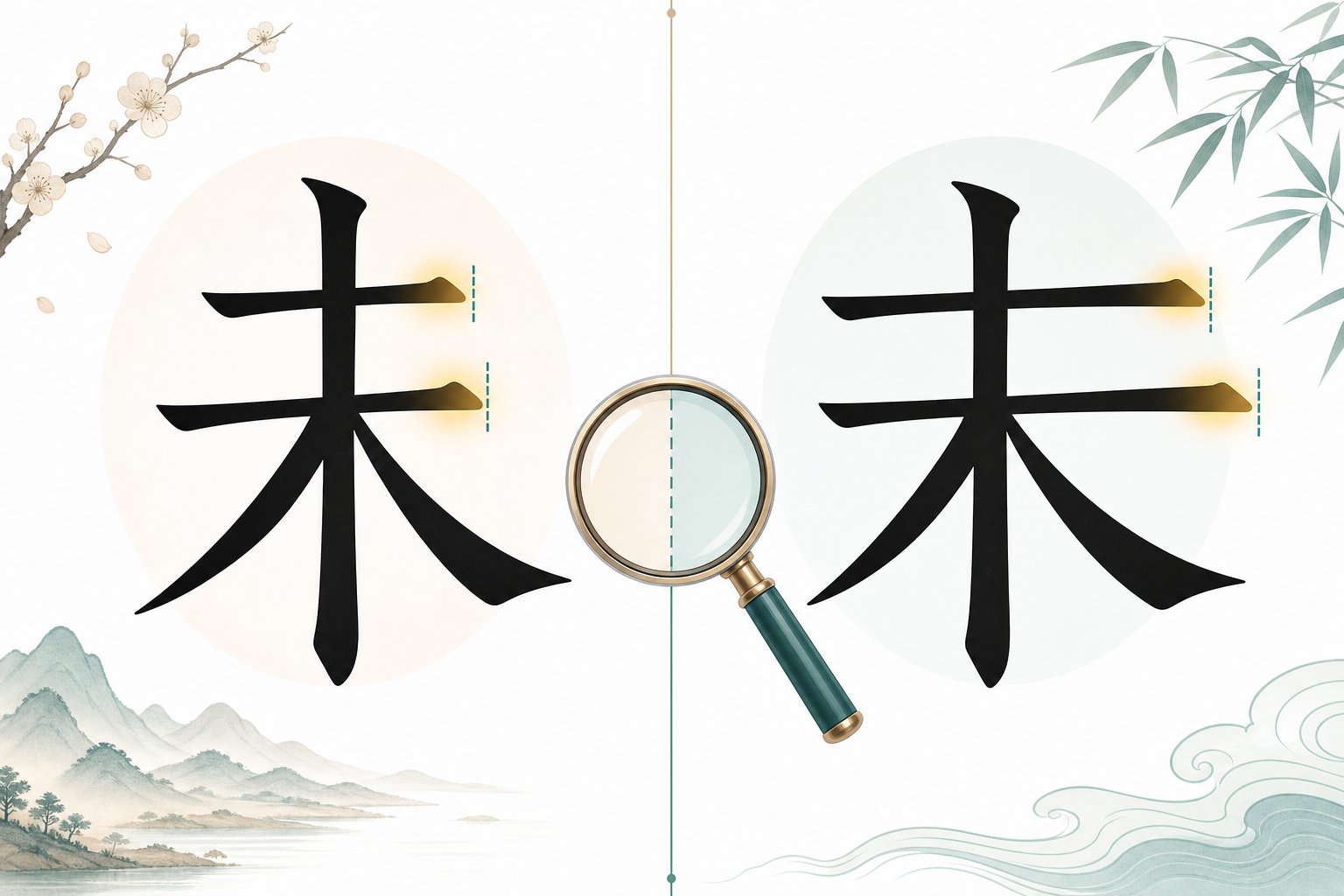
| 大 (da) | big, large | 太 (tai) | too, very, excessively | 太 has an extra small dot below the main strokes. Think: "big" plus a dot becomes "too much." |
| 人 (ren) | person | 入 (ru) | to enter | 人 has a longer left stroke like a person standing. 入 has two more symmetrical strokes like someone stepping inward. |
| 了 (le) | completion marker | 子 (zi) | child, suffix | 子 has a horizontal stroke across the middle that 了 lacks. Think: the child (子) has arms stretched out. |
| 天 (tian) | sky, day | 夫 (fu) | husband, man | In 夫, the vertical stroke cuts through the top horizontal line. In 天, it sits below both horizontals. |
| 小 (xiao) | small | 少 (shao) | few, less | 小 has a central downward hook with two dots. 少 replaces the hook with a vertical stroke plus an extra slanted stroke. |
The 大/太 pair is especially common because both characters appear frequently. The character 大 (da, big) consists of just three strokes forming a person with arms spread wide. Add one tiny dot beneath and it becomes 太 (tai, too much or excessively). A useful mnemonic: when something is already big and you add even a dot more, it becomes "too much."
For 人 versus 入, imagine 人 as a person standing with weight on their left leg (the longer left stroke). The character 入 has balanced strokes pointing inward, like someone ducking through a doorway to enter. These visual stories stick better than rote memorization, and they become second nature after a few weeks of reading practice.
With 75 characters now covered, you have the tools to describe things, express direction, talk about time, and form dozens of compound words. The final group of 25 characters rounds out the foundation with numbers, abstract concepts, and some of the most elegant radical combinations in the Chinese writing system.
Characters 76 to 100 and Radical Stories for Better Memory
The final 25 characters complete your one hundred chinese character foundation. This group brings in abstract concepts, numbers, and some of the most visually elegant characters in the system. Several of these carry rich chinese character symbol meanings that become obvious once you understand the radicals inside them. Where the previous groups gave you grammar, pronouns, and descriptions, this batch rounds out your toolkit with characters for thinking, time, movement, and structure.
Two number characters appear here: 三 (san, three) and 十 (shi, ten). Combined with 一 (one) from rank 1, you now have the building blocks for counting. One hundred in chinese is 一百 (yi bai), and while 百 falls outside this list, knowing 一, 三, and 十 gives you a numeric foothold. The character 十 is simply a cross shape, representing the idea of completeness or "ten directions." And 三 is three horizontal lines stacked, as visually intuitive as it gets.
Characters 76 Through 100 Completing the Foundation
This table completes the 100 mandarin characters and meanings you need for a reading foundation. For characters where simplified and traditional forms differ significantly, both are noted in the meaning column.
| Rank | Character | Pinyin | Meaning | Common Words |
|---|---|---|---|---|
| 76 | 想 | xiang | to think, to want, to miss | 想到 (think of), 思想 (thought), 想法 (idea) |
| 77 | 实 | shi | real, solid, fruit (trad: 實) | 其实 (actually), 现实 (reality), 实在 (indeed) |
| 78 | 日 | ri | sun, day, date | 日本 (Japan), 生日 (birthday), 日子 (days) |
| 79 | 三 | san | three | 三个 (three of), 三年 (three years), 三月 (March) |
| 80 | 都 | dou / du | all, both / capital city | 都是 (all are), 首都 (capital), 都有 (all have) |
| 81 | 发 | fa / fa | to send, to emit / hair (trad: 發/髮) | 发现 (discover), 出发 (depart), 头发 (hair) |
| 82 | 现 | xian | now, present, to appear | 现在 (now), 发现 (discover), 出现 (appear) |
| 83 | 于 | yu | at, in, to, from | 于是 (thereupon), 终于 (finally), 属于 (belong to) |
| 84 | 经 | jing | to pass through, scripture (trad: 經) | 已经 (already), 经过 (pass through), 经验 (experience) |
| 85 | 样 | yang | manner, appearance, type (trad: 樣) | 一样 (same), 这样 (like this), 样子 (appearance) |
| 86 | 明 | ming | bright, clear, next | 明天 (tomorrow), 明白 (understand), 说明 (explain) |
| 87 | 行 | xing / hang | to walk, okay / row, profession | 行人 (pedestrian), 不行 (not okay), 银行 (bank) |
| 88 | 高 | gao | tall, high, advanced | 高中 (high school), 高大 (tall and big), 提高 (improve) |
| 89 | 间 | jian | between, room, space (trad: 間) | 时间 (time), 中间 (middle), 房间 (room) |
| 90 | 体 | ti | body, form, system (trad: 體) | 身体 (body), 体育 (sports), 具体 (specific) |
| 91 | 与 | yu | and, with, to give (trad: 與) | 与其 (rather than), 参与 (participate), 与人 (with people) |
| 92 | 什 | shen / shi | what (in 什么), assorted | 什么 (what), 什么时候 (when) |
| 93 | 本 | ben | root, origin, this, book (measure word) | 本来 (originally), 日本 (Japan), 一本 (one book) |
| 94 | 所 | suo | place, that which | 所以 (therefore), 所有 (all/own), 厕所 (restroom) |
| 95 | 十 | shi | ten | 十分 (very/extremely), 十年 (ten years), 十个 (ten of) |
| 96 | 无 | wu | without, none, not (trad: 無) | 无法 (unable), 无人 (unmanned), 无所 (nothing) |
| 97 | 正 | zheng | correct, straight, just now | 正在 (currently), 正好 (just right), 正是 (precisely) |
| 98 | 分 | fen | to divide, minute, part | 分开 (separate), 十分 (very), 部分 (part) |
| 99 | 第 | di | ordinal prefix (1st, 2nd, etc.) | 第一 (first), 第三 (third), 第十 (tenth) |
| 100 | 门 | men | door, gate, field of study (trad: 門) | 门口 (doorway), 出门 (go out), 专门 (specialized) |
Notice how many characters in this group have significantly different traditional forms. The character 体 (body) simplifies from the 23-stroke traditional form 體 down to just 7 strokes. Similarly, 门 (door) drops from 8 strokes in its traditional form 門 to just 3. These differences matter if you travel between Mainland China and Taiwan or Hong Kong, but the core chinese character semantic meaning stays identical regardless of form.
The character 行 (rank 87) is another multi-reader. Pronounced xing (second tone), it means "to walk" or "okay/acceptable." Pronounced hang (second tone), it means "a row" or "a profession," as in 银行 (yinhang, bank, literally "silver row"). Chinese character interpretation often depends entirely on the word a character appears in, and 行 is a textbook example.
Radical Stories That Make Characters Memorable
The character 明 (ming, bright) is perhaps the most satisfying example of how radicals encode meaning visually. It combines two characters you already know from this list:
明 = 日 (sun) + 月 (moon). When the sun and moon shine together, the result is brightness. This is radical logic at its most elegant: two sources of light combine to create the concept of clarity and illumination.
This is not a one-off trick. The character 间 (jian, between/space) shows 日 (sun) peeking through 门 (door), suggesting light visible through a gap, hence "space between." The character 想 (xiang, to think) places 心 (heart/mind) beneath 相 (mutual/appearance), connecting thought to the heart. And 本 (ben, root/origin) is simply 木 (tree) with a horizontal stroke at the base marking where the roots are.
These radical stories transform rote memorization into visual logic. When you understand why a character looks the way it does, you remember it without brute-force repetition. The 100 chinese characters in this guide are not random symbols. They are built from a system of meaningful parts, and recognizing those parts accelerates everything that comes next.
With all 100 characters now in place, the real magic begins: combining them. Individual characters are useful, but the hundreds of compound words they form together are what actually let you read Chinese in the wild.

How These 100 Characters Combine to Form Hundreds of Real Words
A single character is a building block. Two characters snapped together become a word you can actually use. This combinatorial quality is what makes Chinese vocabulary surprisingly predictable once you know the parts. Every common chinese characters list teaches individual meanings, but the real payoff comes when you see how those chinese characters simple forms combine into compound words with logical, guessable definitions.
Think of it this way: you already know 中 means "middle" and 国 means "country." Put them together and you get 中国 (zhongguo), the Middle Kingdom, China. You know 不 means "not" and 是 means "is." Together: 不是 (bu shi), "is not." The meanings are not random. They follow a pattern you can learn to predict.
How Top 100 Characters Combine Into Common Words
The table below shows over 20 compound words formed exclusively from characters within the top 100 list. Each combination uses chinese words characters you have already studied, organized by the type of logic holding them together.
| Character A | Character B | Word | Pinyin | Meaning | Pattern |
|---|---|---|---|---|---|
| 中 (middle) | 国 (country) | 中国 | zhongguo | China | modifier + noun |
| 大 (big) | 学 (study) | 大学 | daxue | university | modifier + noun |
| 学 (study) | 生 (life/born) | 学生 | xuesheng | student | verb + noun |
| 中 (center) | 心 (heart) | 中心 | zhongxin | center | modifier + noun |
| 开 (open) | 心 (heart) | 开心 | kaixin | happy | verb + noun |
| 不 (not) | 是 (is) | 不是 | bu shi | is not | negation + verb |
| 我 (I) | 们 (plural) | 我们 | women | we/us | pronoun + suffix |
| 他 (he) | 们 (plural) | 他们 | tamen | they/them | pronoun + suffix |
| 中 (middle) | 间 (space) | 中间 | zhongjian | between, middle | modifier + noun |
| 明 (bright) | 天 (day) | 明天 | mingtian | tomorrow | modifier + noun |
| 出 (go out) | 来 (come) | 出来 | chulai | come out | verb + direction |
| 出 (go out) | 去 (go) | 出去 | chuqu | go out | verb + direction |
| 出 (go out) | 国 (country) | 出国 | chuguo | go abroad | verb + object |
| 好 (good) | 看 (look) | 好看 | haokan | good-looking | modifier + verb |
| 好 (good) | 人 (person) | 好人 | haoren | good person | modifier + noun |
| 大 (big) | 家 (home/expert) | 大家 | dajia | everyone | modifier + noun |
| 国 (country) | 家 (home) | 国家 | guojia | country/nation | noun + noun |
| 生 (life) | 日 (sun/day) | 生日 | shengri | birthday | noun + noun |
| 高 (tall) | 中 (middle) | 高中 | gaozhong | high school | modifier + noun |
| 小 (small) | 心 (heart) | 小心 | xiaoxin | be careful | modifier + noun |
| 没 (not) | 有 (have) | 没有 | meiyou | don't have | negation + verb |
| 现 (present) | 在 (at/exist) | 现在 | xianzai | now | noun + noun |
| 正 (just now) | 在 (at) | 正在 | zhengzai | currently doing | adverb + particle |
Combinatorial Logic That Makes Chinese Vocabulary Predictable
Look at the patterns in that table. A few rules emerge quickly:
- Modifier + noun: a descriptive character placed before a noun narrows its meaning. 大 + 学 = big + study = university. 高 + 中 = high + middle = high school. 明 + 天 = bright + day = tomorrow.
- Verb + direction: action characters pair with directional ones to show movement. 出 + 来 = exit + come = come out. 出 + 去 = exit + go = go out.
- Negation + verb: 不 or 没 placed before a verb flips its meaning. 不是 = is not. 没有 = don't have.
- Noun + noun: two concrete meanings merge into a new concept. 国 + 家 = country + home = nation. 生 + 日 = birth + day = birthday.
This is why learning chinese characters and symbols pays exponential returns. Each new character you add does not just give you one more word. It gives you dozens of potential combinations with characters you already know. The chinese meanings and symbols you memorized individually now multiply into a vocabulary far larger than 100 entries. A learner who knows these chinese word symbols can reasonably guess the meaning of unfamiliar compounds by reading the parts, the same way an English speaker might guess "sunflower" without ever seeing the word before.
Vocabulary in Chinese is not a list to memorize. It is a system to decode. And with 100 characters generating hundreds of chinese words symbols and meanings through combination, the question shifts from "how do I memorize all these words" to "how do I practice recognizing them efficiently."
A Structured Study Plan to Master All 100 Characters
Knowing which characters to learn is one thing. Knowing how to learn chinese characters efficiently, in the right order and with the right rhythm, is what separates people who finish from people who stall at character 30. Pure frequency order is not the best learning sequence. Grouping characters by theme creates stronger memory hooks and lets you form compound words earlier in the process.
Thematic Learning Clusters for Faster Retention
Rather than tackling characters in strict frequency rank, cluster them by meaning. When you learn mandarin characters in related groups, each one reinforces the others. Numbers connect to counting. Pronouns connect to sentence building. Verbs connect to actions you can immediately practice.
Here is the recommended daily learning sequence, designed so you can recognise chinese characters in real context as early as possible:
- Numbers first: 一, 三, 十 (plus 第 for ordinals). These are the easiest chinese characters visually and give you immediate real-world use on signs, prices, and dates.
- Pronouns next: 我, 你, 他, 们, 自, 其. These let you identify who a sentence is about.
- Essential verbs: 是, 有, 来, 去, 看, 说, 想, 开, 出, 到. Action words that appear in nearly every conversation.
- Particles and connectors: 的, 了, 在, 着, 得, 而, 也, 就, 都. The grammatical glue that holds sentences together.
- Nouns and descriptors: 人, 大, 小, 中, 国, 家, 天, 年, 日, 心, 手, 头, 门. Concrete words that label the world around you.
- Abstract and structural characters: 能, 会, 要, 可, 对, 正, 无, 所, 本, 方. These round out your ability to express possibility, correctness, and relationships.
This sequence means you can form simple chinese characters into real phrases within the first week. By day three, you already have enough pieces to read 我们 (we), 他们 (they), and 你好 (hello).
A Three-Week Study Schedule for All 100 Characters
Learning 5-7 characters per day with spaced repetition is the sweet spot for most learners. Fewer feels too slow; more leads to forgetting. The schedule below breaks all 100 characters into manageable daily groups following the thematic clusters above.
| Week | Focus | Characters Per Day | Total by End of Week | What You Can Do |
|---|---|---|---|---|
| Week 1 | Numbers, pronouns, core verbs | 5-6 | ~35 | Read simple phrases like 我是, 他们, 不好, 中国人 |
| Week 2 | Particles, time words, descriptors | 5-6 | ~70 | Parse basic sentences, recognize signs with 大, 小, 开, 门 |
| Week 3 | Abstract characters, remaining nouns, review | 5-6 new + daily review | 100 | Decode short texts, guess compound word meanings |
Each day should follow a read-recognize-write progression. Start by reading the character with its pinyin and meaning. Then test recognition using flashcards or a spaced repetition app like Anki or Pleco. Finally, write the character by hand to lock it into muscle memory. This three-step loop is how to read mandarin chinese characters with lasting retention rather than short-term cramming.
Spend 10-15 minutes on new characters and another 10 minutes reviewing previous days. Short daily sessions beat long weekly marathons because spaced repetition relies on consistent, distributed practice to move characters from short-term to long-term memory.
Stroke Order Basics and Writing Practice Tips
Writing by hand might seem old-fashioned when you can type pinyin into a phone, but it dramatically improves recognition. The physical act of tracing strokes builds a motor memory pathway that pure visual study cannot replicate. You do not need beautiful calligraphy. You need basic chinese writing practice that reinforces structure.
Stroke order follows predictable rules that apply to nearly every character:
- Top to bottom: write upper strokes before lower ones (三 starts with the top line)
- Left to right: left-side components come first (从 starts with the left 人)
- Horizontal before vertical: when strokes cross, the horizontal line goes first (十)
- Outside before inside: enclosing frames are drawn before their contents (国 draws the outer box first)
- Close the frame last: the bottom stroke of an enclosure comes after filling the inside (国 closes the bottom last)
You do not need to memorize these rules as abstract principles. After writing 20-30 characters following correct stroke order, the patterns become intuitive. Use a stroke order app or dictionary to check yourself on the first attempt, then trust the muscle memory that builds through repetition.
For daily practice, write each new character 5-10 times on grid paper, then try writing it from memory without looking. If you cannot reproduce it, study the structure again and repeat. This is how to read mandarin characters with true confidence: recognition built on the foundation of physical familiarity. Even five minutes of writing practice per day compounds into strong recall over three weeks.
The goal is not perfection. The goal is building enough familiarity that when you encounter these simple chinese characters on a sign, a menu, or a message, your brain retrieves the meaning without conscious effort. And that retrieval speed is exactly what transforms character knowledge into real reading ability.

What You Can Actually Read After Learning These 100 Characters
So you have studied all 100 characters. You know their pinyin, their meanings, and how they combine. But what does that look like in practice? Can you actually read anything real? The answer is yes, more than you might expect. These characters appear on street signs, restaurant menus, text messages, and social media posts every single day. Recognizing them transforms a wall of unfamiliar symbols into partially decoded text where meaning starts to emerge.
Real Text You Can Decode With 100 Characters
Here are real phrases and short sentences you can now read using only characters from the top 100 list. Each one is something you might encounter on a sign, in a message, or on a menu in a Chinese-speaking environment. This is chinese writing with meaning you can actually use:
- 中国人 (zhongguoren) - Chinese person
- 大学生 (daxuesheng) - university student
- 我们的 (women de) - ours
- 不好看 (bu haokan) - not good-looking
- 他是中国人 (ta shi zhongguoren) - He is Chinese
- 我想出去 (wo xiang chuqu) - I want to go out
- 你好大家 (ni hao dajia) - Hello everyone
- 现在没有人 (xianzai meiyou ren) - There is nobody right now
- 明天我们去 (mingtian women qu) - Tomorrow we go
- 这个很好 (zhege hen hao) - This one is very good
Look at that list. These are not textbook drills. They are fragments of real conversation and real signage. When you see 出门 on a sign near a doorway, you know it relates to "going out through the door." When a message says 我不在 (wo bu zai), you understand "I'm not here." Each chinese character meaning you learned now works together with the others to produce readable, meaningful text.
You will also find that knowing how to read chinese characters at this level lets you partially decode longer sentences. Even when a sentence contains characters you have not studied yet, the ones you do recognize provide context clues. Imagine seeing a sentence where you understand 6 out of 10 characters. That is often enough to grasp the general topic, the same way you might understand a foreign-language sentence where you recognize most of the words but not all of them.
For learners who want to save useful phrases or share examples with study partners, having chinese writing to copy and paste makes practice more accessible. You can copy and paste chinese characters from this guide directly into flashcard apps, messaging conversations, or handwriting practice sheets without needing a Chinese keyboard installed.
The Path From 100 to Functional Literacy
One hundred characters will not make you fluent. That is an honest assessment. But they give you something more valuable than fluency at this stage: they give you scaffolding. Every new character you learn from here connects to ones you already know, forming new compound words and unlocking new sentences. The returns are not linear. They are exponential.
Research into how to read chinese symbols at scale supports this. According to computational analysis by Confused Laowai, the top 100 most frequent characters can form approximately 1,128 dictionary words through their various combinations. That is a ratio of roughly 1 character to 11 words. At the 50-character level, the ratio was only 1:6.5. The combinatorial explosion means each additional character you learn produces more vocabulary than the last one did.
Character knowledge compounds like interest. The first 100 characters produce over 1,000 possible words. Each new character after that does not just add one word to your vocabulary. It multiplies against every character you already know.
The jump from 100 to 500 characters covers roughly 75% of everyday written Chinese text. From 500 to 1,000, you reach approximately 90%. The steepest part of the learning curve is already behind you. The grammatical particles, the structural words, the high-frequency glue that holds every sentence together: you already own those. What remains are content words, nouns and verbs specific to particular topics, that slot into patterns you now understand.
Your next steps are straightforward. Keep adding 5-7 characters per day using the same spaced repetition approach. Start reading graded texts designed for learners at the 100-300 character level. Pay attention to how new characters combine with the ones you already know. And most importantly, read real material: signs, menus, short social media posts, product labels. Every char in chinese that you recognize in the wild reinforces your memory far more powerfully than any flashcard session.
You started this guide looking at 100 unfamiliar symbols. You are leaving it with a system for decoding a living language. That is the difference between memorizing a list and building a reading foundation.
Frequently Asked Questions About the Top 100 Chinese Characters
1. How many Chinese characters do I need to know to read everyday text?
Functional literacy in Chinese requires about 2,500 to 3,000 characters, covering roughly 99% of modern written text. However, the top 100 most frequent characters alone account for 40-50% of characters in typical texts, and expanding to 500 characters covers about 75%. The first 1,000 characters reach approximately 90% coverage, meaning you can start reading real material long before mastering the full set needed for complete literacy.
2. What is the difference between simplified and traditional Chinese characters?
Simplified Chinese characters have fewer strokes and are used in Mainland China and Singapore. Traditional characters retain their original complex forms and are standard in Taiwan, Hong Kong, and Macau. The simplification happened in the 1950s to improve literacy rates. Many characters look identical in both systems, but where they differ, the stroke count reduction can be dramatic, such as 学 (8 strokes simplified) versus 學 (16 strokes traditional). Both systems share the same meanings and pronunciations.
3. How long does it take to learn 100 Chinese characters?
With consistent daily practice of 5-7 new characters per day using spaced repetition, most learners can cover all 100 characters in about three weeks. The key is combining visual recognition with writing practice and reviewing previously learned characters each session. Short daily sessions of 20-25 minutes are more effective than long weekly study marathons because spaced repetition relies on distributed practice to build long-term memory.
4. Why do some Chinese characters have multiple pronunciations?
Around 20% of commonly used Chinese characters have more than one pronunciation, each tied to a different meaning or grammatical function. For example, 长 is pronounced chang (meaning long) or zhang (meaning to grow or a leader). The character 得 has three readings depending on whether it means to obtain, acts as a structural particle, or means must. Context and surrounding characters always determine which pronunciation applies.
5. How many words can you form from the top 100 Chinese characters?
The top 100 most frequent Chinese characters can combine to form approximately 1,128 dictionary words, a ratio of roughly 1 character to 11 words. This is possible because Chinese vocabulary is largely combinatorial. Characters snap together in predictable patterns like modifier plus noun, verb plus direction, or negation plus verb. Each new character you learn multiplies against every character you already know, creating exponential vocabulary growth.