Why Translating Your English Name to Pinyin Matters
Imagine handing over your business card in Shanghai and watching your Chinese colleague squint at your name, unsure how to pronounce it. Or picture filling out a visa application that asks for your name in Chinese characters, and you have no idea what to write. These situations happen constantly to English speakers navigating Chinese-speaking regions, and the solution starts with one system: pinyin.
What Is Pinyin and Why It Matters for Names
Pinyin (formally Hanyu Pinyin) is the official romanization system for Standard Mandarin Chinese, using Latin letters with tone marks to represent the pronunciation of Chinese characters.
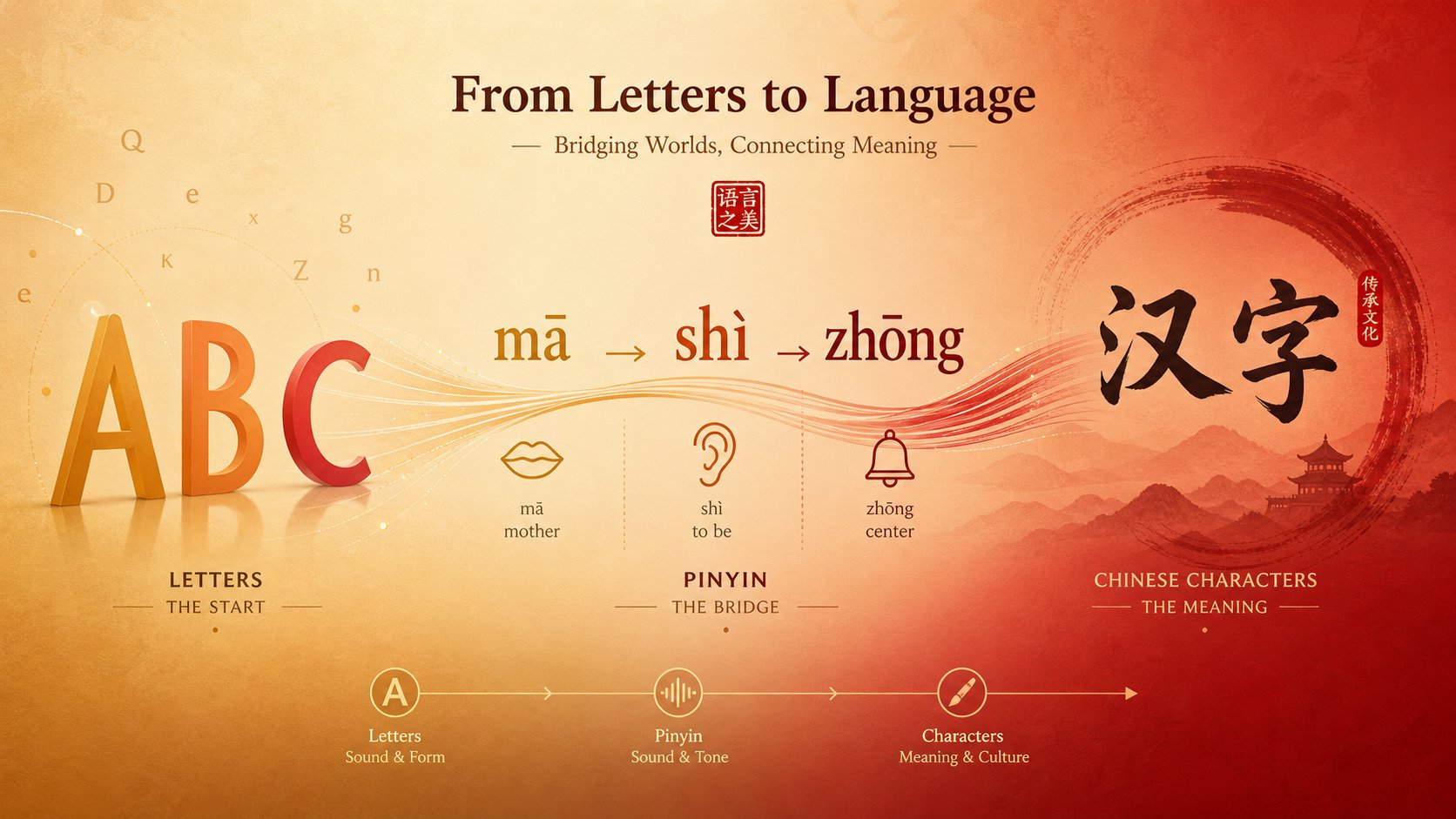
So what is pinyin in practical terms? It is the bridge between the Latin alphabet you already know and the sounds of Mandarin Chinese. Developed in the 1950s and based on the pronunciation of the Beijing dialect, pinyin was designed to help teach pronunciation, standardize spelling of Chinese names abroad, and serve as an input method for typing Chinese characters on keyboards. It was never meant to replace Chinese characters, but rather to make them accessible.
When you are translating an English name to pinyin, you are essentially finding the closest Mandarin syllables that approximate how your name sounds. This is not a direct english to chinese translation in the traditional sense. It is transliteration, a sound-matching process that maps your name into a system with its own phonetic rules and constraints. Understanding this distinction gives you control over how your name sounds rather than leaving it to guesswork or an unreliable automated tool.
When You Need Your English Name in Pinyin
You might wonder, how do I say my name in Chinese in a way that actually sounds natural? The answer depends on context. Here are the most common scenarios where having your name in pinyin (and the corresponding characters) becomes essential:
- Business cards and professional introductions - Chinese colleagues and clients need a way to address you. A pinyin version of your name, printed alongside your English name, removes the awkwardness of mispronunciation.
- Visa and official document applications - Chinese government forms often require your name in characters. Knowing the pinyin equivalent helps you verify that the characters chosen actually represent your name rather than something unintended.
- Social media and messaging platforms - Apps like WeChat are central to both personal and professional life in China. Having your name in characters, derived from pinyin, makes you searchable and recognizable.
- Academic contexts - Students studying abroad or publishing research in Chinese institutions need a consistent Chinese rendering of their name for transcripts, papers, and campus records.
In each of these cases, the question of how to say my name is in Chinese goes beyond simple curiosity. It is a practical need. Getting your name in characters wrong can range from mildly embarrassing to genuinely confusing on legal documents. The chinese for name (名字, mingzi) carries cultural weight, and Chinese speakers notice when a transliteration sounds clumsy or uses characters with unfortunate meanings.
This is exactly why an education-first approach matters. Rather than blindly trusting a converter, you will benefit from understanding the underlying logic of pinyin. When you grasp how the system works, you can evaluate whether a suggested transliteration of your name actually sounds right in Mandarin, whether the characters carry appropriate connotations, and whether the result fits the context you need it for. Seeing your name in my name in chinese language form should feel intentional, not random.
The real challenge, though, is that Mandarin operates with a fixed inventory of possible syllables, and English names are full of sounds that simply do not exist in that inventory. How those gaps get bridged is where the process gets interesting.
Pinyin System Fundamentals You Need to Know
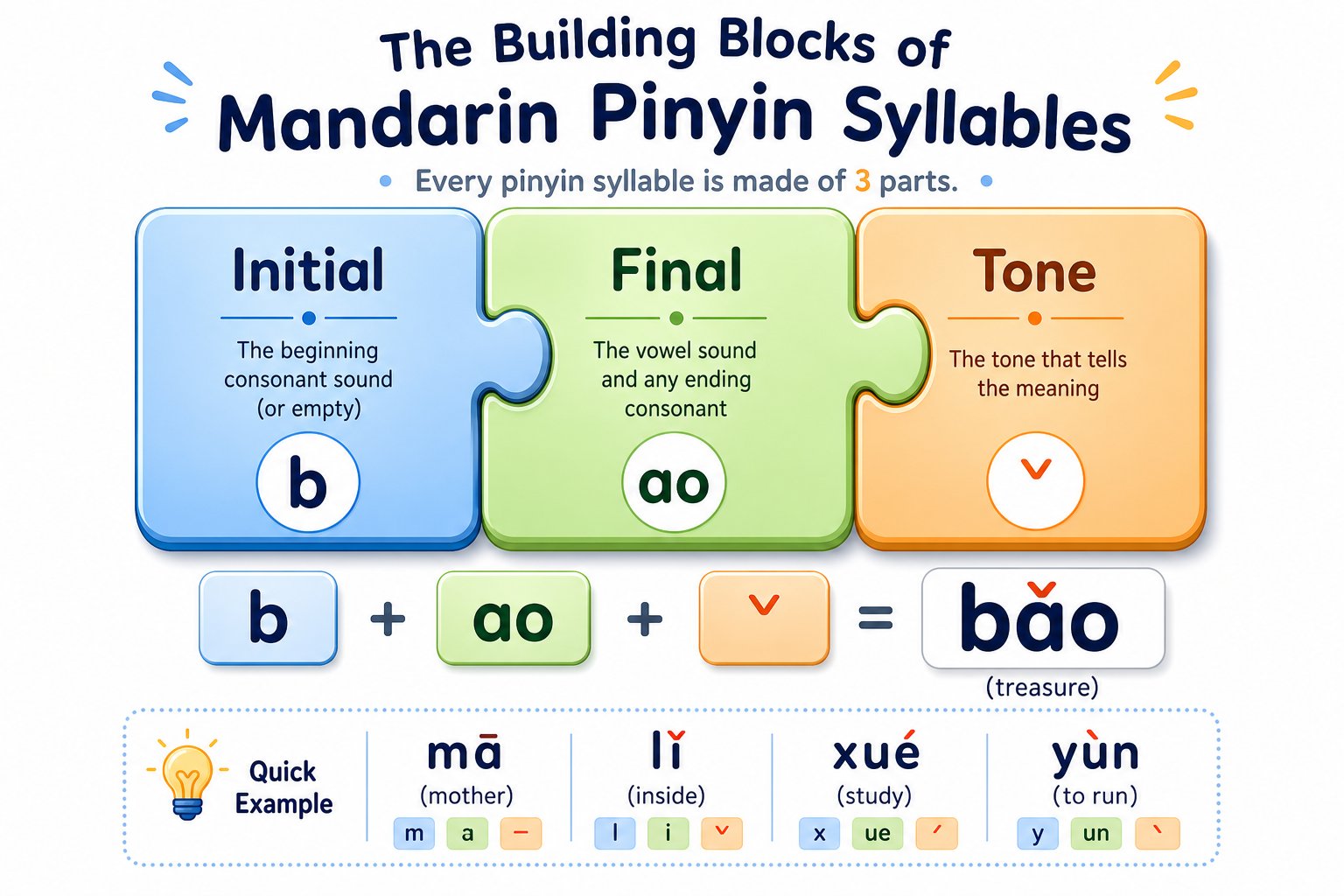
That fixed inventory of Mandarin syllables mentioned earlier? It is built from a surprisingly compact set of building blocks. Every single syllable in Mandarin Chinese is assembled from just three components: an initial, a final, and a tone. Think of it like a formula. The initial is the consonant sound that starts the syllable, the final is the vowel (or vowel combination) that completes it, and the tone tells you the pitch contour. When you are translating an English name to pinyin, you are essentially trying to reconstruct your name using only the combinations this formula allows.
Pinyin Initials and Finals Explained
The Chinese pinyin system contains 21 initials and 36 finals. Initials are grouped by where and how they are produced in the mouth. Finals range from single vowels to complex combinations with nasal endings. Here is how they break down:
| Category | Initials | Approximate English Comparison |
|---|---|---|
| Labials | b, p, m, f | Similar to English b/p/m/f but b is unaspirated (like p in "spy") |
| Alveolars | d, t, n, l | Similar to English d/t/n/l but d is unaspirated (like t in "sty") |
| Velars | g, k, h | g is unaspirated (like k in "sky"); h is rougher than English h |
| Palatals | j, q, x | j like "jee"; q like "ch" in cheap; x like "sh" in she |
| Sibilants | z, c, s | z like "ds" in suds; c like "ts" in cats; s as in English |
| Retroflexes | zh, ch, sh, r | Tongue curled back; zh/ch/sh are retroflex versions of z/c/s |
You will notice that some letters look familiar but do not behave the way you expect. The letter "q" does not make a "kw" sound. The letter "x" is not a "ks." This is one of the first traps people fall into when reading a pinyin table without guidance. The letters were borrowed from the Latin alphabet, but their sound values were reassigned to fit Mandarin's phonetic needs.
Finals are equally structured. They fall into three main groups:
| Final Type | Examples | Description |
|---|---|---|
| Simple finals | a, o, e, i, u, u (with umlaut) | Single vowel sounds forming the core of the system |
| Compound finals | ai, ei, ao, ou, ia, ie, iao, iu, ua, uo, uai, ui | Two or three vowels gliding together (diphthongs and triphthongs) |
| Nasal finals | an, en, ang, eng, ong, ian, in, iang, ing, uan, un, uang | Vowels ending with a nasal consonant (n or ng) |
Here is the critical point for name transliteration: not every initial can pair with every final. The actual number of valid syllables in use is roughly half the number of possible combinations. For example, the palatals j, q, and x can only combine with finals starting in i or u (with umlaut). You cannot just stick any consonant in front of any vowel and call it a valid pinyin syllable. A full pinyin chart maps out exactly which pairings exist, and when you are matching English sounds to Chinese pronunciation, you are limited to this grid.
This constraint is why transliterating names requires creative problem-solving. Your name might contain a syllable that maps perfectly to a valid pinyin combination, or it might land in a gap where no direct match exists. Consulting a pinyin chart or table pinyin reference helps you see at a glance which options are actually available.
Understanding the Four Tones Plus Neutral Tone
Mandarin is a tonal language, meaning the pitch pattern you use when saying a syllable changes its meaning entirely. The tones of chinese language are not optional decoration. They are as fundamental as consonants and vowels. The classic example: "ma" pronounced with four different tones means mother, hemp, horse, or scold.
There are four main mandarin chinese tones plus one neutral tone:
- First tone (macron: a) - High and level. Your pitch starts high and stays flat, like sustaining a musical note.
- Second tone (acute accent: a) - Rising. Starts at mid-range and climbs higher, similar to the intonation of asking "what?" in English.
- Third tone (caron: a) - Falling then rising. Dips low before coming back up. In connected speech, it often just stays low.
- Fourth tone (grave accent: a) - Falling sharply. Starts high and drops quickly, like a curt command.
- Neutral tone (no mark) - Light and short, unstressed. Appears in particles and the second syllable of some words.
Sounds complex? Here is the good news for name transliteration: tone selection when converting a foreign name into Chinese and pinyin does not follow the same rules as regular vocabulary. You are not choosing tones based on meaning the way a native speaker selects characters for a word. Instead, the tones are determined by whichever Chinese characters are conventionally used to represent that sound. The character 克 (ke, fourth tone) is commonly used in foreign name transliterations not because "ke" means anything relevant, but because that character has become a standard transliteration building block.
This means you do not need to agonize over which tone "sounds more like" your English name. English is not tonal, so there is no tone to preserve. The tone comes along with the character choice, and character choice follows established convention. What matters more is getting the initial-final combination right so the overall chinese pronunciation of your name is recognizable.
For anyone using hanyu pinyin input on a computer or phone, tone marks also serve a practical function. When typing pinyin to select characters, specifying the tone narrows down which characters appear. Knowing the correct tone for each syllable in your transliterated name helps you type it accurately and find the right characters every time.
With the structure of initials, finals, and tones mapped out, the next question becomes practical: how do you actually break an English name apart and match each piece to this system's limited menu of valid syllables?
How English Names Get Converted to Pinyin
Mandarin has roughly 400 unique syllables (around 1,300 if you count tonal variations). English, by contrast, uses thousands of distinct syllable shapes. When you translate a name from English into Chinese, you are compressing a rich phonetic landscape into a much smaller set of available sounds. This is not guesswork. It follows a repeatable logic.
Breaking English Names Into Transliterable Syllables
The first step is splitting your English name into chunks that can each map to a single Chinese syllable. Consider the name "Christopher." An English speaker hears three syllables: Chris-to-pher. But Mandarin cannot start a syllable with a consonant cluster like "kr" or end one with a bare consonant like "s." So the name gets re-segmented into smaller, open-syllable pieces that Mandarin can handle: ke-li-si-tuo-fu (克里斯托夫). Five syllables instead of three.
This expansion is normal. Chinese transliteration almost always produces more syllables than the original name because Mandarin syllables follow a strict consonant-vowel structure. Every consonant needs a vowel partner. Every closed syllable in English (one ending in a consonant) gets opened up by inserting a vowel or splitting into multiple parts.
Here is the general process:
- Identify each distinct sound unit in the English name based on pronunciation, not spelling.
- Separate consonant clusters into individual consonants, each paired with a vowel.
- Drop silent letters and reduce unstressed vowels to their closest Mandarin equivalent.
- Match each resulting chunk to the nearest valid pinyin syllable from the ~400 available options.
The key insight: you are working from how the name sounds, not how it is spelled. "Stephen" is transliterated based on the pronunciation "Stee-ven," not the letters S-t-e-p-h-e-n. Spelling is irrelevant. Only the spoken sounds matter when translating names into Chinese.
Matching English Sounds to Valid Pinyin Combinations
This is where the distinction between transliteration and translation becomes critical. When you chinese translate name using meaning, you would pick characters based on what the name signifies (for example, translating "Grace" as 优雅, meaning elegance). Transliteration ignores meaning entirely. It only cares about sound. The characters chosen are phonetic vessels, selected because they approximate the right pronunciation, not because their individual meanings form a coherent phrase.
A pinyin converter or pinyin translator tool automates this matching, but the underlying logic is straightforward: for each sound chunk, find the closest valid pinyin syllable. "Da" maps directly. "Tha" has no match (Mandarin lacks the "th" sound), so it becomes "sa" or "ta" depending on convention. "Vi" does not exist in Mandarin, so it shifts to "wei" or "fi."
This is not a free-for-all. Official Chinese media follow the Xinhua News Agency transliteration tables, which provide standardized chinese to mandarin pinyin mappings for foreign sounds. These tables dictate, for example, that the English syllable "son" becomes 森 (sen) rather than 松 (song), and that "tion" maps to 申 (shen) rather than being improvised differently by each translator. The Xinhua standards ensure that when you name convert to chinese through official channels, the result is consistent across all government documents, news broadcasts, and diplomatic communications.
Why does this matter for you? Because if your name already has an established transliteration in Chinese media, using a different version creates confusion. A quick search through Chinese news sources can reveal whether a standardized rendering of your name already exists. If it does, that version carries recognition and consistency that a custom attempt cannot match.
The real challenge emerges when your name contains sounds that fall between two valid pinyin options, or when multiple reasonable approximations exist. Knowing which English sounds map cleanly to pinyin and which require creative substitution is the difference between a transliteration that sounds natural and one that makes native speakers wince.

English to Pinyin Sound Mapping Reference
Some English sounds slide into pinyin with barely any friction. Others hit a wall. The difference between a smooth-sounding transliteration and an awkward one often comes down to knowing which sounds transfer cleanly and which require workarounds. Think of this section as your pinyin cross reference chart for the most common English phonemes you will encounter in names.
Consonant Sound Mappings From English to Pinyin
English consonants present the first set of challenges. Several sounds that English speakers use constantly, like "th," "v," and certain "r" qualities, simply do not exist in Mandarin's phonetic inventory. When a pinyinizer tool or human translator encounters these, substitution is the only option. Here is how the most common consonant sounds map:
| English Sound | Example in English Name | Closest Pinyin Syllable | Notes |
|---|---|---|---|
| th (voiced, as in "the") | Theodore, Heather | si / te | No "th" in Mandarin; voiced version often becomes "s" or "d" |
| th (voiceless, as in "think") | Thatcher, Cathy | sa / te | Voiceless version typically maps to "s" or "t" |
| v | Victor, David | wei / fu | Mandarin lacks "v"; "w" or "f" substitutes depending on position |
| r (English approximant) | Robert, Rachel | luo / rui | English "r" differs from Mandarin retroflex "r"; "l" is sometimes preferred |
| j (soft, as in "judge") | James, Jennifer | jie / zhan | English "j" maps to pinyin "j" or "zh" depending on following vowel |
| ch (as in "church") | Charles, Richard | cha / qi | Chi pronunciation in pinyin uses a retroflex tongue position unlike English "ch" |
| sh | Shannon, Ashton | sha / xiang | Pinyin "sh" is retroflex; "x" is palatal, used before i/u sounds |
| z (voiced, as in "zone") | Zachary, Elizabeth | za / zi | Pinyin "z" is unaspirated "ts"; close enough for transliteration |
Notice how a single English sound can map to different pinyin syllables depending on what vowel follows it. The chi pronunciation in Mandarin, for instance, sounds quite different from English "chi" in a name like "Richie" because the tongue curls back in a retroflex position. Context determines which substitution sounds most natural to a Chinese ear.
Vowel and Diphthong Equivalents in Pinyin
Vowels are where things get particularly creative. English has around 15 distinct vowel sounds (depending on dialect), while Mandarin works with a smaller, more rigid set. Diphthongs, those gliding vowel combinations, need careful matching:
| English Sound | Example in English Name | Closest Pinyin Syllable | Notes |
|---|---|---|---|
| ay / ei (as in "day") | Jason, Kate | ei / ai | Pinyin "ei" is the closest match for the long "a" sound |
| ee (as in "see") | Steven, Keegan | yi / i | Pinyin "yi" when syllable-initial; "i" after an initial consonant |
| oo (as in "moon") | Luke, Susan | wu / u | Pinyin "wu" when syllable-initial; "u" after a consonant |
| ar (as in "car") | Arthur, Margaret | a / ya | The "r" coloring is dropped; only the open vowel remains |
| er (as in "her") | Herbert, Bernice | er / e | Pinyin "er" exists but is limited in combinations |
| ow (as in "now") | Howard, Brown | ao | Pinyin "ao" captures this diphthong well |
| oh (as in "go") | Joseph, Owen | ou / o | Pinyin "ou" for the gliding version; "o" for pure vowel |
| schwa (unstressed "uh") | Alan, Susan (final a) | a / e / en | English's most common vowel; requires a deliberate choice in pinyin |
The schwa deserves special attention. It is the vague, unstressed vowel in syllables like the second "a" in "Margaret" or the "o" in "person." English speakers barely notice it, but when converting chinese to pinyin equivalents for a name, you must commit to a specific vowel. There is no "sort of" vowel in Mandarin. Every syllable gets a clear, full vowel sound.
Consonant clusters create the biggest headaches. A name like "Strauss" starts with three consonants jammed together. Since Mandarin syllables can only begin with a single consonant or the digraphs zh, ch, and sh (as noted in Pinyin.info's syllable boundary rules), "str" must be broken apart. It becomes "si-te-lao" or similar, inserting vowels between each consonant to create valid syllables. The same logic applies to clusters like "bl" (bu-la), "gr" (ge-lei), and "pr" (pu-la).
When you look at a pinyin to english comparison, the asymmetry is obvious. English allows complex onsets and codas that Mandarin simply cannot reproduce. Accepting this gap, rather than fighting it, is what separates a natural-sounding chinese name pronunciation from a forced one. The goal is not perfect phonetic replication. It is finding the closest approximation that flows naturally in Mandarin while remaining recognizable to English speakers.
Seeing these mappings laid out makes the process feel systematic rather than arbitrary. But how do all these individual sound choices come together in practice? Walking through complete name examples reveals how each decision compounds into a final result.
Worked Examples of Popular English Names in Pinyin
Sound mappings on a chart are useful, but they only click once you see them applied to real names. Walking through complete examples from start to finish reveals how individual phonetic decisions stack up into a final chinese name translation that native speakers actually recognize. Let's break down three of the most common English names and trace exactly how each one moves from English syllables to pinyin to name chinese characters.
Transliterating Michael, Elizabeth, and James Step by Step
Each name below is split into its English sound units, matched to the closest valid pinyin syllables, and then paired with the conventional Chinese characters. You will notice that the Michael pronunciation in Chinese sounds noticeably different from the English original, and that is perfectly normal. The goal is approximation within Mandarin's phonetic constraints, not a perfect replica.
| English Name | English Sound Segments | Pinyin Syllables | Chinese Characters | Full Pinyin |
|---|---|---|---|---|
| Michael | Mai - ke - er | mai + ke + er | 迈克尔 | Maike'er |
| Elizabeth | Yi - li - sha - bai | yi + li + sha + bai | 伊丽莎白 | Yilishabai |
| James | Zhan - mu - si | zhan + mu + si | 詹姆斯 | Zhanmusi |
Look at how Michael becomes three syllables in Chinese. The English diphthong "ai" in "Mi-" maps cleanly to pinyin "mai." The hard "k" sound in "-chael" becomes "ke," and the faint "l" at the end transforms into "er" since Mandarin cannot end a syllable on a bare "l" sound. The result, 迈克尔, is so well-established in Chinese media that any english to chinese name converter will produce this same output.
Elizabeth follows a similar pattern. The opening "E-" becomes "yi" (伊), the "-liz-" portion splits into "li" (丽) plus "sha" (莎) to capture the "z" transitioning into the "-abeth" ending, and "-beth" maps to "bai" (白). James is more compact: the "J" maps to "zh" (a retroflex sound), "-ames" splits into "mu" and "si" to handle the nasal "m" and the final sibilant "s."
How Syllable Choices Lead to Character Selection
Here is where the process gets culturally interesting. Converting pinyin to chinese characters is not a one-to-one lookup. Multiple characters share the same pinyin pronunciation, so translators must choose which character to assign to each syllable. The chinese symbols and meanings behind those choices follow deliberate conventions:
| Character | Pinyin | Meaning | Why It Is Chosen |
|---|---|---|---|
| 丽 (li) | li | Beautiful, elegant | Used in female names like Elizabeth (伊丽莎白) for feminine association |
| 克 (ke) | ke | To overcome | Neutral, high-frequency transliteration character; appears in Michael, Eric, Nick |
| 德 (de) | de | Virtue, morality | Auspicious; used in Richard (理查德), Edward (爱德华), Harold (哈罗德) |
| 安 (an) | an | Peace, tranquility | Positive connotation; appears in Anthony (安东尼), Diana (戴安娜), Ryan (赖安) |
| 杰 (jie) | jie | Outstanding, heroic | Masculine and aspirational; used in Jack (杰克), Jason (杰森), Jeffrey (杰弗里) |
The name in chinese meaning is shaped by these character choices. Chinese parents follow similar logic when naming their own children, selecting characters with auspicious or gender-appropriate connotations. Transliterators apply the same cultural awareness. A female name like Patricia (帕特丽夏) includes 丽 (beautiful) and 夏 (summer), while a male name like Benjamin (本杰明) uses 杰 (outstanding) and 明 (bright).
This is also why you should not casually swap characters in an established transliteration. Using a chinese name converter that picks random characters matching the right pinyin sound but carrying negative or inappropriate meanings can produce results that look bizarre to native readers. The character 死 (si, death) has the same pinyin as 斯 (si, a common transliteration particle), but no translator would ever use the former in a name.
Names like Michael, Elizabeth, and James have been used so consistently across Chinese news, film subtitles, and official documents that their transliterations are essentially fixed. When a name already has this kind of established rendering, deviating from it creates confusion rather than personalization. A quick search through Chinese media sources confirms whether your name has a standard version worth adopting.
These examples all involve names with clean, well-documented transliterations. But what happens when the same English name needs to work across Mainland China, Hong Kong, and Taiwan, where different romanization systems and even different spoken languages come into play?
Regional Differences in Name Transliteration
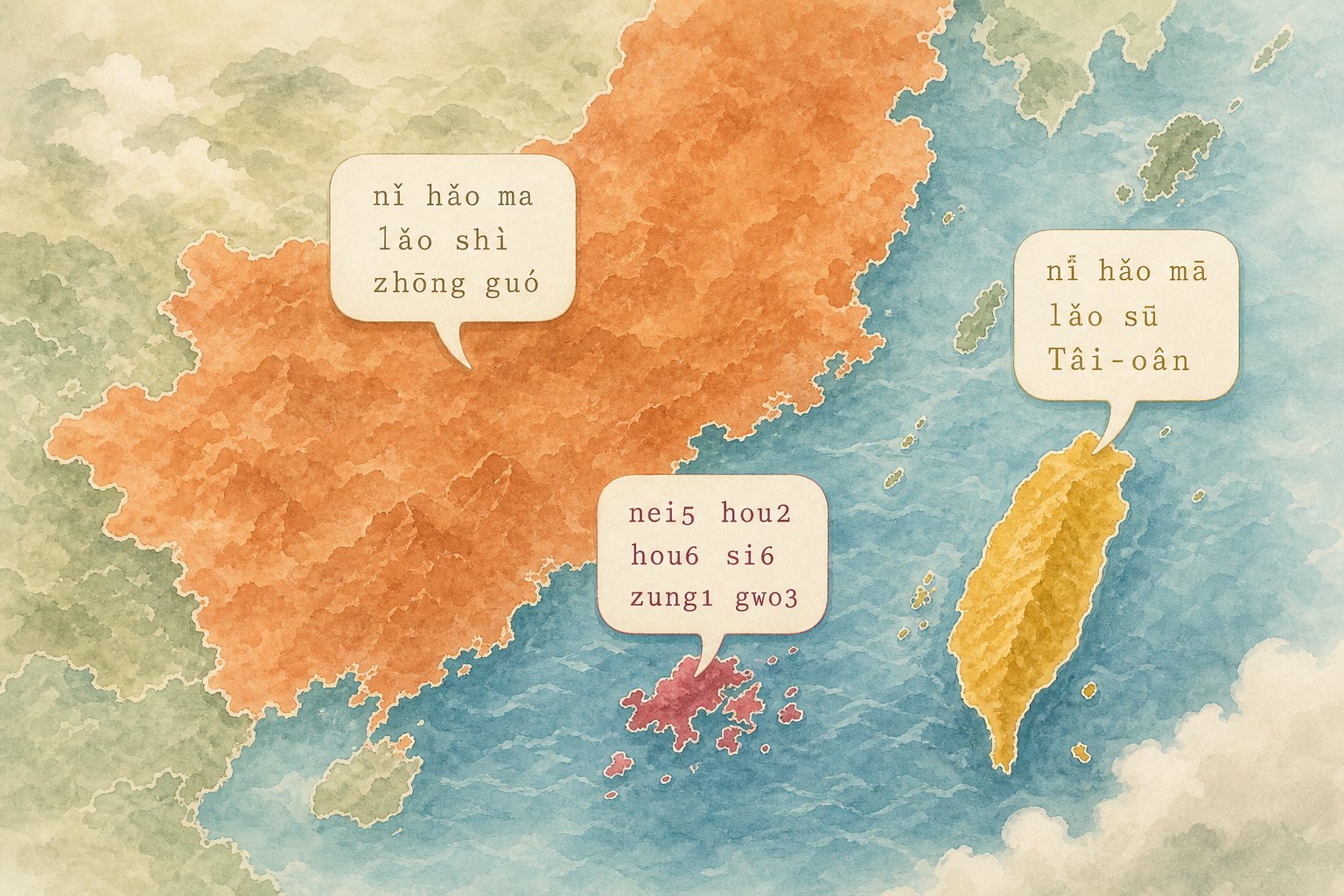
The same Chinese character can sound completely different depending on whether someone is reading it in Mandarin or Cantonese. And the system used to romanize that sound varies by region too. So a single English name can end up looking like three different names on paper depending on whether you are dealing with Mainland China, Hong Kong, or Taiwan. Knowing which system applies where saves you from printing the wrong version on a business card or submitting an inconsistent name on official documents.
Mainland China Pinyin Conventions
Mainland China uses Hanyu Pinyin as its sole official romanization standard. All government documents, passports, and media in china simplified chinese contexts follow this system. When foreign names appear in Chinese news broadcasts or diplomatic records, they are rendered using Hanyu Pinyin conventions paired with simplified Chinese characters.
The practical implication? If you are doing business in Shanghai, Beijing, or anywhere on the mainland, your transliterated name should follow Hanyu Pinyin. Visa applications, bank accounts, and corporate registrations all expect this format. The system is consistent and well-documented, which makes it the most straightforward region to work with.
Hong Kong Jyutping and Taiwan Wade-Giles Differences
Hong Kong operates in Cantonese, not Mandarin. The romanization systems used there, primarily Jyutping and Yale Romanization, reflect Cantonese pronunciation with its distinct cantonese tones (six full tones compared to Mandarin's four). When you cantonese translate a name, the resulting syllables can look dramatically different from their Mandarin pinyin equivalents because the underlying spoken language has shifted. The 粤语拼音 (Cantonese pinyin) system captures sounds that simply do not exist in Mandarin romanization.
Taiwan adds another layer. Historically, Taiwan used the Wade-Giles system, which represents Mandarin sounds with different letter conventions than Hanyu Pinyin. You will see apostrophes and letter combinations like "hs" and "ch'" that look unfamiliar if you have only studied pinyin. Taiwan also uses zhuyin (bopomofo), a phonetic script with its own symbols, for domestic education and input. Some Taiwanese documents use Tongyong Pinyin, a system that blends elements of both Wade-Giles and Hanyu Pinyin. Traditional chinese writing is standard in both Taiwan and Hong Kong, meaning the characters themselves differ visually from mainland simplified forms.
Here is how the same family name looks across all three systems, based on PacTranz's regional comparison data:
| Chinese Name | Mainland China (Hanyu Pinyin) | Taiwan (Wade-Giles) | Hong Kong (Jyutping) |
|---|---|---|---|
| 謝 / 谢 | Xie | Hsieh | Tse |
| 張 / 张 | Zhang | Chang | Cheung |
| 蕭 / 萧 | Xiao | Hsiao | Siu |
| 王 | Wang | Wang | Wong |
| 李 | Li | Li | Lee |
Notice how "Zhang" in Hanyu Pinyin becomes "Chang" in Wade-Giles and "Cheung" in Hong Kong's Cantonese-based system. These are not errors or alternate spellings. They reflect genuinely different pronunciation systems applied to the same written character. If you need an english to traditional chinese converter for Taiwan or Hong Kong contexts, the output characters may be identical, but the romanized spelling on a passport or business card will differ based on regional convention.
The practical takeaway: always confirm which region your documents are intended for. A name romanized for a Mainland Chinese visa will not match what Hong Kong immigration expects, and a Taiwanese university transcript will use yet another format. Mixing systems within a single document looks unprofessional at best and creates identity verification problems at worst.
Regional systems explain how the same characters get romanized differently. But the challenges do not stop at system choice. English names themselves contain sounds that resist clean conversion regardless of which system you use.
Common Pitfalls When Transliterating Names
English is generous with its consonant combinations. Mandarin is not. That mismatch is the single biggest source of awkward-sounding transliterations. You can memorize every sound mapping chart available, but if you do not anticipate the structural collisions between the two languages, your name in Chinese will sound clunky or, worse, unrecognizable. Here are the specific traps people fall into and how to navigate around them.
Handling Consonant Clusters and Silent Letters
English names are packed with consonant clusters that Mandarin simply cannot reproduce as a unit. Research on Mandarin phonotactics confirms that Mandarin allows at most one consonant at the start of a syllable (or a digraph like zh, ch, sh), and syllables can only end in -n or -ng. Everything else must be broken apart. This is the same challenge Chinese speakers face in reverse when learning how to spell in chinese words that originated in English.
- Initial clusters (str, bl, gr, pr, cl) - Each consonant gets its own syllable with an inserted vowel. "Strauss" becomes si-te-lao-si (four syllables from one). "Blake" becomes bu-lai-ke. "Grant" becomes ge-lan-te. The inserted vowels are not random; they follow conventions where "u" typically follows labials (b, p) and "e" or "i" follows velars (g, k).
- Final clusters (nds, lts, mps, ks) - English names ending in clusters like "-nds" (Edmonds) or "-lts" (Schultz) get simplified. The cluster is broken into separate syllables or the final consonant is dropped entirely. "Schultz" becomes shu-er-ci, not a four-consonant pileup.
- Silent letters - These get dropped completely since transliteration works from pronunciation, not spelling. The "k" in "Knight" disappears. The "w" in "Wright" is ignored. The "b" in "Lamb" does not exist in the Chinese version. If you are trying to figure out how to spell chinese equivalents of these names, remember: only audible sounds get transliterated.
- Double consonants - English "ll," "tt," or "nn" in names like "Bennett" or "Connolly" are pronounced as single consonants, so they produce single pinyin syllables. Do not double up.
The pattern is consistent: wherever English stacks consonants, Chinese inserts vowels to open up the syllables. Accepting this expansion rather than fighting it produces results that sound natural in Mandarin even if they look longer on paper.
Dealing With Sounds That Do Not Exist in Mandarin
Some English phonemes have no equivalent in the chinese alphabet to english mapping at all. They require outright substitution, and the substitution choice affects how natural your name sounds to Chinese ears.
- The "th" sounds (voiced and voiceless) - Names like Theodore, Heather, and Cathy contain sounds Mandarin does not have. The voiceless "th" (as in "think") typically becomes "s" or "t." The voiced "th" (as in "the") shifts to "d" or "z." "Heather" becomes xi-se (希瑟) rather than attempting a nonexistent "th" syllable.
- The "v" sound - Mandarin has no labiodental fricative. "Victor" becomes wei-ke-tuo (维克托) using "w" as the substitute, while "David" uses "wei" for the final "-vid" portion. Some dialects use "f" instead, so you may see variation.
- English "r" (approximant) - The English "r" is produced differently from Mandarin's retroflex "r." In practice, "r" at the start of a name often maps to pinyin "r" or "l" depending on convention. "Robert" becomes luo-bo-te (罗伯特) with an "l" substitution that sounds more natural in Chinese.
- The schwa (unstressed vowel) - English reduces unstressed vowels to a vague "uh" sound. Mandarin does not do this. Every syllable gets a full, clear vowel. When transliterating, you must commit to a specific vowel for each schwa, which means making a deliberate choice where English leaves things ambiguous.
These substitutions are not failures of the system. They are the system working as designed. Mandarin's phonetic inventory is different, not deficient, and the chinese letter format for foreign names reflects centuries of adaptation practice.
One more practical consideration: length. Very long English names get shortened in Chinese convention. "Alexander" (four syllables in English) becomes ya-li-shan-da (亚历山大, four syllables), which works fine. But a full name like "Christopher Alexander Worthington" would produce an unwieldy string of twelve or more characters. Chinese convention typically transliterates only the given name and surname separately, and sometimes abbreviates the given name to its most recognizable portion. News media routinely shorten names to three or four characters total for readability.
The underlying tension in all of these pitfalls is the same: phonetic accuracy versus natural-sounding Chinese. A transliteration that tries to capture every nuance of English pronunciation ends up sounding foreign and difficult for Chinese speakers to remember. One that prioritizes natural Mandarin rhythm and familiar syllable patterns may drift further from the original sound but lands better in conversation. The best transliterations find the middle ground, close enough to be recognizable, smooth enough to feel like a real name rather than a tongue twister.
Knowing what can go wrong is half the battle. The other half is deciding whether a phonetic transliteration is even the right approach for your situation, or whether adopting a fully Chinese name might serve you better.

Cultural Context and Choosing Your Approach
A phonetic transliteration gets you through a visa application or a first meeting. But is it the right long-term solution? That depends entirely on how deep your engagement with Chinese-speaking communities runs. The choice between a transliterated name and a fully adopted Chinese name is not about which is "better." It is about which fits your situation, your goals, and the cultural expectations of the people you interact with.
Transliterated Name vs Adopted Chinese Name
A transliterated name, like 迈克尔 (Michael) or 伊丽莎白 (Elizabeth), signals that you are a foreigner with a foreign name rendered into Chinese sounds. Native speakers recognize it immediately as a transliteration. It is functional, official, and perfectly appropriate in many contexts. But it does not sound like a real Chinese name any more than "Chen Yonghui" sounds like a native English name.
An adopted Chinese name, on the other hand, follows authentic naming conventions. It uses a common Chinese surname, pairs it with one or two given-name characters that carry deliberate meaning, and sounds indistinguishable from a name Chinese parents might choose for their child. As China Admissions notes, having a well-chosen Chinese name demonstrates cultural understanding and helps you connect with Chinese speakers on a deeper level. It signals effort, respect, and a willingness to meet people in their linguistic space.
The chinese name meaning behind an adopted name matters. Each character carries connotations shaped by thousands of years of use. A name like 任桐慕 (Ren Tongmu) communicates something about the person's values and aesthetic sensibility in a way that a transliteration never can. The mandarin name meaning embedded in those characters becomes part of how people perceive you.
Choosing the Right Approach for Your Context
So which route should you take? Here is a practical breakdown by scenario:
- Short business trips or conferences - A transliteration is standard and expected. Print it on your business card alongside your English name. Chinese colleagues will appreciate having something to call you, and the formality of a transliteration matches the formality of the setting.
- Studying in China or long-term residence - Consider adopting a Chinese name. Classmates, professors, and neighbors will use it daily, and a natural-sounding name makes social interactions smoother. Many universities encourage international students to choose chinese names for english names as part of orientation.
- Official documents and legal contexts - Follow institutional requirements. Passports, visas, and bank accounts typically use the transliterated version of your legal name. Do not substitute an adopted Chinese name on government paperwork unless specifically instructed to do so.
- Social media and informal networking - Either works. Some people use a transliteration on WeChat for professional contacts and an adopted name with friends. Others pick one and stick with it for consistency.
- Publishing or academic work in Chinese - Established scholars often have both. The transliteration appears in formal citations, while an adopted name may be used in Chinese-language publications or campus life.
The key distinction: transliterations are for identification. Adopted names are for integration. Neither is wrong, but using a transliteration when deeper cultural engagement is expected can feel distant, while using an adopted name in a purely transactional context might seem presumptuous.
If you decide to go the adopted-name route, resist the urge to do it alone. As one language learner recounted after calling himself "Golden Skill Universe" (金才宇), choosing characters based on a dictionary and personal ambition without native guidance leads to embarrassment. Every character has layered connotations, homophones to avoid, and gender associations that are invisible to non-native speakers. A mandarin name generator tool can offer starting points, but the results often sound artificial or carry unintended meanings that only a native speaker would catch.
Instead, ask Chinese colleagues, teachers, or friends for help. The best approach involves someone who knows you personally, understands your personality, and can navigate the cultural nuances of character selection. Give them time. Good names are not produced in five minutes. Expect the process to take a week or two as they consider options, test them against homophones, and get feedback from other native speakers. A chinese name generator online might produce three options instantly, but those options rarely survive scrutiny from an educated native speaker.
A few practical guidelines when working with a native speaker on my chinese name:
- Share your English name's pronunciation so they can incorporate phonetic echoes if desired.
- Mention any personal values or qualities you would like reflected in the chinese name from english name they suggest.
- Ask them to explain why they chose specific characters and what associations those characters carry.
- Get feedback from at least two or three additional native speakers before committing.
- Avoid celebrity names, overly grandiose meanings, or characters that sound like common insults when spoken aloud.
Whether you end up with a transliteration or an adopted name, the underlying principle stays the same: understand the system rather than outsourcing the decision entirely to an algorithm. Automated tools are useful for generating initial options or verifying pinyin accuracy, but they cannot assess cultural fit, regional connotations, or the subtle impression a name makes in conversation. The knowledge you have built through this article, from pinyin structure to sound mappings to regional conventions, gives you the ability to evaluate any suggestion critically. You can spot when a tool produces an awkward syllable combination, when a character carries unfortunate associations, or when a transliteration drifts too far from your actual pronunciation.
Your name is how people remember you. In Chinese-speaking contexts, getting it right is not vanity. It is respect, both for the language and for the people using it to address you. Take the time to get it right, lean on native speakers for guidance, and trust the logic of the system over shortcuts.
Frequently Asked Questions About Translating English Names to Pinyin
1. Is translating my English name to pinyin the same as getting a Chinese name?
No, these are two different processes. Translating your name to pinyin is transliteration, where you match English sounds to the closest available Mandarin syllables to approximate your name's pronunciation. An adopted Chinese name, by contrast, follows authentic Chinese naming conventions with a real surname and meaningful given-name characters. Transliterations are standard for official documents and short-term interactions, while adopted names suit long-term residents or students seeking deeper cultural integration.
2. Why does my English name become longer when converted to Chinese pinyin?
Mandarin syllables follow a strict consonant-vowel structure, meaning every consonant needs a vowel partner and syllables can only end in -n or -ng. English names often contain consonant clusters like 'str' or 'bl' and closed syllables ending in bare consonants. These must be split apart with inserted vowels to create valid Mandarin syllables. For example, 'Christopher' (three English syllables) expands to five pinyin syllables: ke-li-si-tuo-fu. This expansion is normal and expected in all Chinese transliterations of foreign names.
3. How do I know which Chinese characters to use for my transliterated name?
Character selection follows established conventions maintained by institutions like the Xinhua News Agency. Transliterators choose characters based on three factors: correct pinyin pronunciation match, positive or neutral meaning, and gender appropriateness. Characters like 克 (ke, to overcome) and 斯 (si) are neutral high-frequency transliteration blocks, while 丽 (li, beautiful) appears in female names and 杰 (jie, outstanding) in male names. Always check whether your name already has a standardized transliteration in Chinese media before creating a custom version.
4. Will my name in pinyin sound the same in Mainland China, Hong Kong, and Taiwan?
Not necessarily. Mainland China uses Hanyu Pinyin with simplified characters, Hong Kong uses Jyutping based on Cantonese pronunciation, and Taiwan historically uses Wade-Giles or Tongyong Pinyin with traditional characters. The same written character can sound completely different in Cantonese versus Mandarin, and the romanized spelling on passports or business cards varies by region. Always confirm which region your documents are intended for to avoid inconsistencies.
5. Can I use an online converter to translate my English name to pinyin accurately?
Online converters provide useful starting points but have limitations. They cannot assess cultural connotations of character choices, detect unfortunate homophones, or account for regional preferences. Automated tools may also produce awkward syllable combinations for names with unusual sounds like 'th' or consonant clusters. Use converters for initial options, then verify results with a native Mandarin speaker who can evaluate whether the transliteration sounds natural and whether the characters carry appropriate associations.