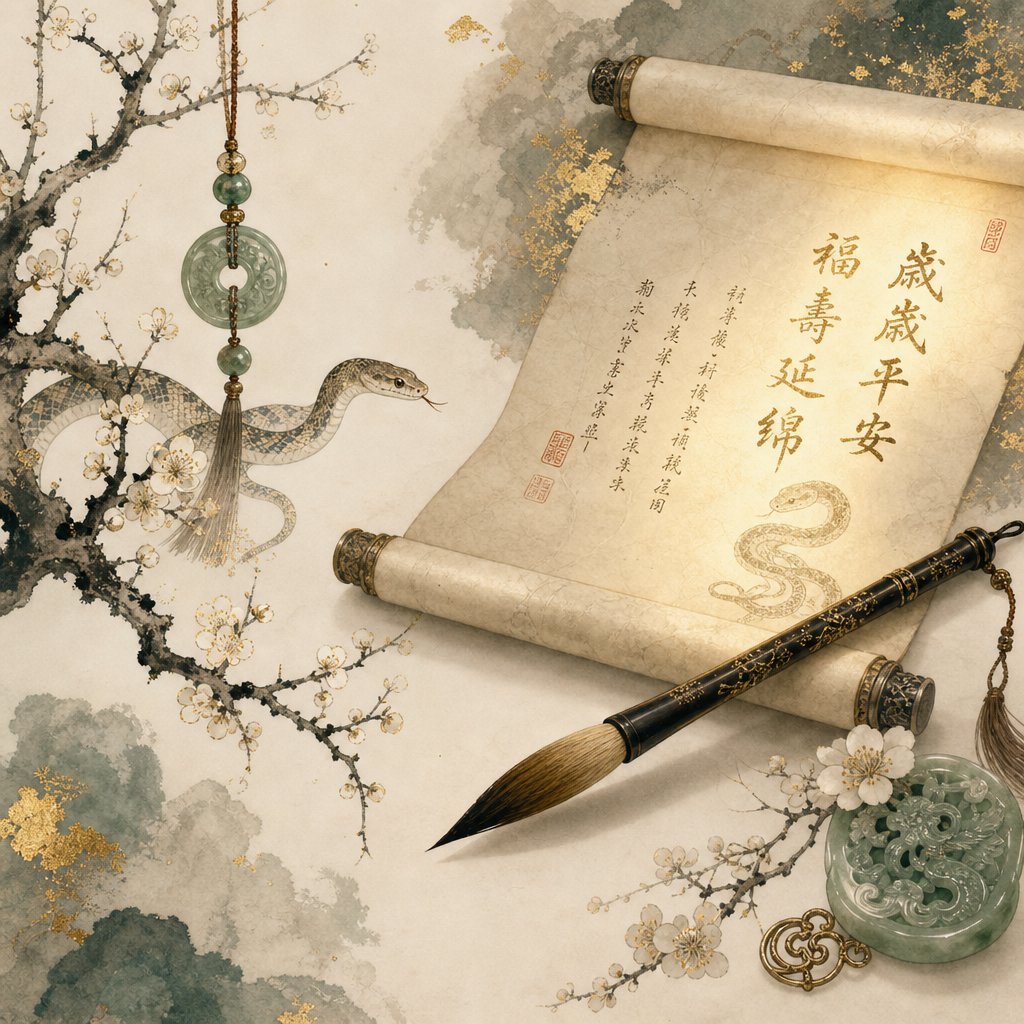
Why Chinese Naming for Snake Babies Goes Beyond Zodiac Themes
When you search for names meaning snake or serpent-inspired options, most lists hand you a collection of Western names loosely tied to reptile imagery. That approach misses something fundamental. For a year of the snake baby born in 2025, the Chinese naming tradition treats the zodiac sign not as a theme but as a diagnostic tool, one that reveals what a child's name should energetically provide.
In Chinese culture, a name is not decoration. It is a deliberate act of support. Parents believe the right characters can compensate for elemental gaps in a child's destiny chart, reinforce strengths, and set a tone for how the world receives their child. Names that mean snake in a literal sense are actually rare in Chinese naming. Instead, the goal is to select characters whose radicals, meanings, and stroke patterns harmonize with the Snake zodiac's specific elemental profile.
The Cultural Weight of a Chinese Zodiac Name
Chinese naming philosophy operates on a principle that sounds simple but runs deep: a name should fit the child the way a key fits a lock. The zodiac year provides the first layer of context. It tells you which elemental energy dominates the year, which symbolic associations are favorable, and which character components offer protection or growth. This is why year of the snake Chinese baby names require more than a quick scroll through a baby name database.
In traditional Chinese belief, a well-chosen name does not merely label a child. It actively participates in shaping their fortune by restoring balance to whatever the birth chart leaves incomplete.
How Bazi Connects Birth Timing to Name Selection
Bazi (八字), or the Eight Characters system, calculates a child's elemental makeup from four data points: birth year, month, day, and hour. Each point generates a "pillar" containing specific elemental energies. The Snake zodiac year supplies one pillar, but the remaining three depend entirely on when the baby arrives. A bazi-based naming process identifies the Day Master, checks which of the Five Elements is weak or missing, and then selects characters that provide what the chart needs.
This means two Snake babies born weeks apart may need completely different name characters. One child's chart might call for Water energy to cool excess Fire. Another might need Wood to strengthen a fragile Day Master. The zodiac year sets the stage, but bazi refines the script down to the individual child.
That level of precision is what separates authentic Chinese naming from surface-level zodiac lists. And it all begins with understanding the specific elemental signature of the 2025 Wood Snake.
Understanding the Wood Snake and Five Elements
Every Chinese zodiac year carries a dual identity: the animal sign and its paired element. For 2025, the year of the snake in Chinese characters is written as 乙巳 (yi3 si4) — Yin Wood sitting on the Snake branch. The chinese character for snake in everyday language is 蛇 (she2), but in the zodiac system, the Earthly Branch character 巳 (si4) is what appears in bazi charts and formal astrological notation. This distinction matters for naming because character selection draws from the branch's elemental properties, not the literal animal character.
So what does 乙巳 actually tell you about a child's elemental needs? To answer that, you need to understand how the Five Elements (Wu Xing / 五行) interact with each other and with the Snake zodiac specifically.
The Five Elements Cycle and What Wood Snake Means
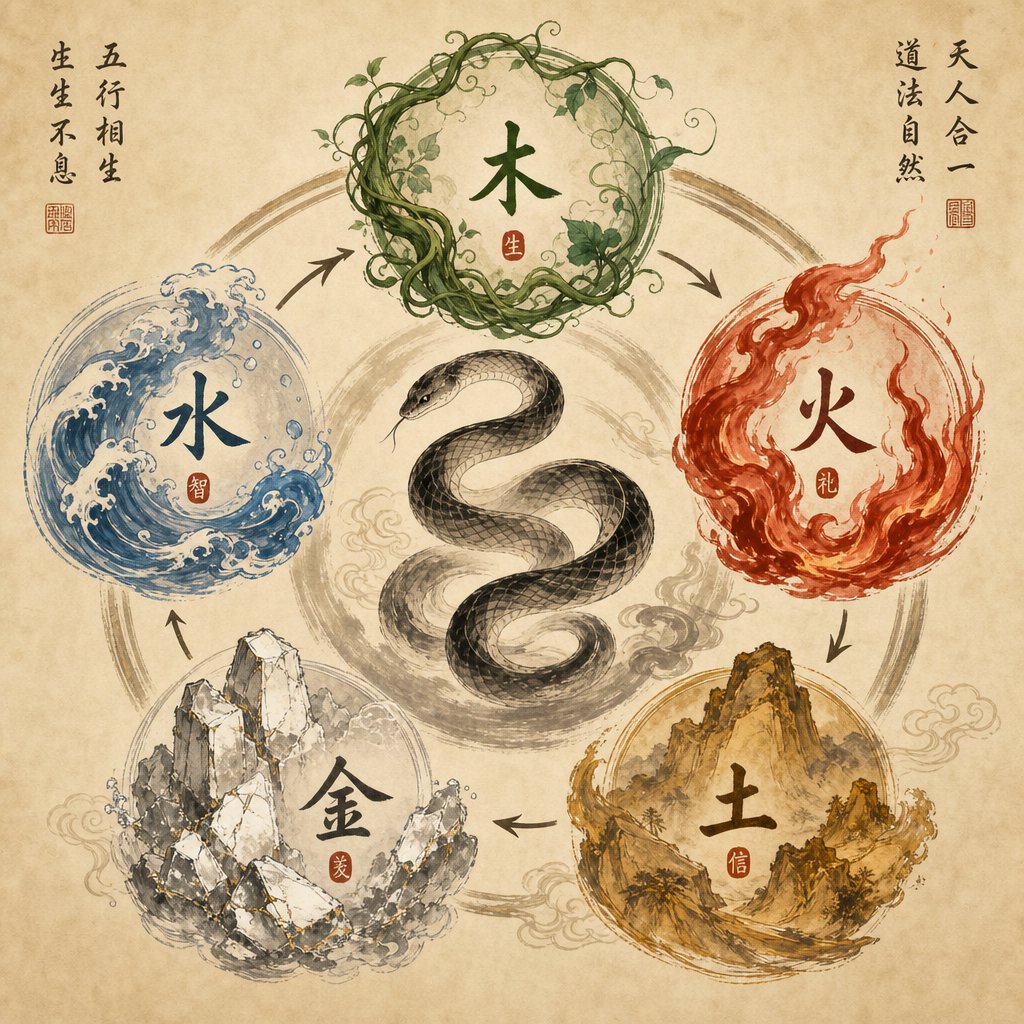
Wu Xing theory holds that five fundamental energies — Wood, Fire, Earth, Metal, and Water — cycle through creation and control relationships that keep the universe in balance. Each element feeds one and restrains another, forming two interlocking cycles that directly influence how naming practitioners choose characters.
The productive cycle (相生 / xiang1 sheng1) works like this: Wood feeds Fire, Fire creates Earth (through ash), Earth produces Metal (from ore), Metal carries Water (through condensation), and Water nourishes Wood. Think of it as a chain of support where each element acts as a "mother" nurturing the next.
The destructive cycle (相克 / xiang1 ke4) provides checks and balances: Wood breaks Earth, Earth absorbs Water, Water extinguishes Fire, Fire melts Metal, and Metal cuts Wood. Neither cycle is inherently good or bad. Both are necessary for equilibrium.
Here is where the 2025 Wood Snake gets interesting. The Heavenly Stem 乙 (Yin Wood) represents the supple vine or small plant — adaptive, flexible, and dependent on the right supports to thrive. Meanwhile, the Earthly Branch 巳 (Snake) carries a primary flavor of Yin Fire, with hidden stems of Yang Fire (丙), Yang Earth (戊), and Yang Metal (庚). You have Wood on top feeding Fire below. The energy naturally flows downward through the productive cycle, which means the Wood element is being consumed to fuel Fire.
Imagine a small vine growing beside a campfire. The warmth helps it initially, but too much heat dries it out. This is the core tension of the 乙巳 year pillar: Wood is being spent. A child born under this configuration often benefits from characters that either replenish Wood (through Water, which nourishes it) or ground the excess Fire energy (through Earth, which absorbs it).
How the Wood Element Shapes Character Choices
The snake name meaning in Chinese naming is never about literal serpent imagery. It is about responding to the elemental dynamics the Snake branch introduces. Because 巳 runs hot with hidden Fire, and the Yin Wood stem is already being consumed, naming practitioners typically look at the child's full bazi chart and ask: does this baby need cooling, grounding, or strengthening?
- If the chart shows excess Fire and depleted Wood, characters with Water radicals (氵) or Wood radicals (木) can restore balance.
- If the chart already has adequate Wood and Water, Earth-element characters (土) help stabilize the Fire energy productively.
- If Metal is weak or absent, characters carrying Metal energy (金/钅) can introduce structure and clarity.
The table below maps each element to its core attributes and shows how it relates to the Snake zodiac's elemental profile:
| Element | Chinese | Characteristics | Color | Season | Relation to Snake (巳) |
|---|---|---|---|---|---|
| Wood (木) | mu4 | Growth, creativity, flexibility | Green | Spring | 2025's Heavenly Stem; feeds the Snake's Fire — often consumed and may need replenishing |
| Fire (火) | huo3 | Passion, energy, transformation | Red | Summer | Snake's native element; 巳 is early summer Fire — already abundant in most Snake charts |
| Earth (土) | tu3 | Stability, nourishment, grounding | Yellow/Brown | Late summer | Hidden within 巳 as Yang Earth (戊); can absorb excess Fire and provide balance |
| Metal (金) | jin1 | Precision, discipline, structure | White/Gold | Autumn | Hidden within 巳 as Yang Metal (庚); adds clarity but is controlled by Fire |
| Water (水) | shui3 | Wisdom, adaptability, depth | Black/Blue | Winter | Nourishes the depleted Wood stem; cools excess Fire — often beneficial but must not overwhelm |
Notice that Fire is already the dominant force within the Snake branch. Adding more Fire-element characters to a 2025 baby's name risks overheating the chart unless the child's specific bazi shows a genuine Fire deficiency. This is why Wood Snake personalities are described as elegant and easygoing — the Wood softens Fire's intensity — but also why health concerns for this combination tend to center on the liver and kidneys, organs associated with Wood and Water respectively.
The practical takeaway: knowing the snake in chinese character form (巳) and its elemental contents gives you a starting framework, but the real naming decisions depend on which elements the individual child's Day Master needs most. The year pillar sets the climate. The name provides the shelter, sunlight, or rain that climate demands.
With the elemental logic in place, the next question becomes structural: which specific radicals and character components carry these elemental energies in a form that also aligns with the Snake's symbolic associations?
Auspicious Radicals and Character Components for Snake Babies
Elemental balance tells you what kind of energy a name should carry. Radicals tell you how to deliver that energy through the physical structure of each character. In the Chinese Name Selection system, every radical carries symbolic weight rooted in the animal's natural behavior. For snake related names, practitioners look at how the snake lives — where it rests, how it moves, what makes it feel safe — and translate those observations into character components that support a child's fortune.
Think of it this way: the snake is a small, intelligent creature that thrives in enclosed spaces, climbs trees to elevate its status, and wears intricate patterned skin. Each of these traits maps directly to a category of auspicious radicals. When you understand the reasoning behind each category, you can evaluate potential names with snake meanings far more effectively than simply picking characters off a list.
Radicals That Symbolize Protection and Growth
The logic here is grounded in observation. A snake at rest coils inside a cave or burrow. A snake in motion glides through fields or ascends trees. A snake displaying its scales signals beauty and elevated status. Each scenario corresponds to specific radical families that naming practitioners consider favorable.
- 口 (kou3 / mouth, enclosure) and 宀 (mian2 / roof) — These radicals represent the snake resting safely inside a hole, cave, or sheltered space. In Chinese metaphysics, a snake that has a secure hiding place is protected and free to show its talents. Characters like 容 (rong2 / tolerant), 安 (an1 / peaceful), 宇 (yu3 / universe), 富 (fu4 / wealthy), 嘉 (jia1 / excellent), 品 (pin3 / quality), 周 (zhou1 / thorough), and 国 (guo2 / nation) all contain these enclosure shapes. The symbolism is stability, security, and the freedom to thrive within a protected environment.
- 木 (mu4 / wood, tree) — The snake climbing a tree is one of the most powerful images in Chinese zodiac naming. A snake that ascends a tree is said to transform into a dragon — the ultimate symbol of status elevation and success. Characters like 杰 (jie2 / outstanding), 松 (song1 / pine), 柏 (bai3 / cypress), 森 (sen1 / forest), 桐 (tong2 / paulownia), 枫 (feng1 / maple), 楚 (chu3 / clear), and 东 (dong1 / east) carry this radical. For a child, these characters signal upward mobility, growth, and the potential to rise above ordinary circumstances.
- 糸 (mi4 / silk), 衣 (yi1 / clothing), 示 (shi4 / ritual), and 采 (cai3 / colorful) — These radicals reference the snake's beautifully patterned skin. In traditional symbolism, a snake adorned with vibrant scales is elevated to dragon status, much like a person dressed in fine garments gains respect and recognition. Characters like 彬 (bin1 / refined), 彩 (cai3 / colorful), 祥 (xiang2 / auspicious), 祺 (qi2 / blessed), 福 (fu2 / fortune), 裕 (yu4 / abundant), 纬 (wei3 / latitude), and 绩 (ji4 / achievement) belong to this family. They suggest elegance, social standing, and the kind of recognition that comes from presenting oneself well.
- 田 (tian2 / field) — Snakes naturally move through grasslands and paddy fields, finding comfort and food in open terrain. The character 田 also visually contains four enclosed openings, echoing the cave symbolism. Characters like 思 (si1 / think), 由 (you2 / from), 界 (jie4 / boundary), 留 (liu2 / remain), 画 (hua4 / painting), 福 (fu2 / fortune), and 迪 (di2 / enlighten) incorporate this radical. They represent the snake in its comfort zone — protected by the environment and free to explore.
- Snake-shaped radicals: 辶 (chuo4), 廴 (yin3), 弓 (gong1), 己 (ji3) — Characters whose structural components visually resemble the snake's winding body are considered naturally harmonious. Examples include 建 (jian4 / build), 廷 (ting2 / court), 达 (da2 / reach), 远 (yuan3 / far), 进 (jin4 / advance), 道 (dao4 / path), and 强 (qiang2 / strong). These characters carry the energy of movement, progress, and natural alignment with the snake's form.
You'll notice some characters appear in multiple categories. 福 (fu2), for instance, contains both the 示 radical (clothing/ritual family) and an enclosure shape. This kind of overlap makes a character doubly auspicious — it satisfies two symbolic requirements simultaneously.
Three Harmonies and Six Harmonies in Character Selection
Beyond individual radical symbolism, Chinese astrology identifies specific zodiac relationships that amplify a name's positive energy. The most powerful of these is the Three Harmonies (三合 / san1 he2) — a trinity of zodiac animals whose Earthly Branches form a stable, mutually supportive triangle.
For the Snake (巳 / si4), the Three Harmonies partners are the Rooster (酉 / you3) and the Ox (丑 / chou3). Together, these three animals form the Metal triangle in Chinese astrology. Characters containing components associated with the Rooster or Ox are considered especially lucky for Snake babies because they invoke the presence of supportive allies throughout life.
- 酉-related characters (Rooster energy) — Look for characters containing 酉, 鸟 (bird), 羽 (feather), or 金 (metal/gold). Examples: 翔 (xiang2 / soar), 鹃 (juan1 / cuckoo), 凤 (feng4 / phoenix), 翰 (han4 / writing brush), 鹤 (he4 / crane), 金 (jin1 / gold), and 西 (xi1 / west). These characters signal that helpful people — mentors, allies, supporters — will appear throughout the child's life.
- 丑-related characters (Ox energy) — Characters containing 丑 or 牛 (ox/cow) components bring grounding, steady support. Examples: 妞 (niu1 / girl), 纽 (niu3 / button/bond), 牧 (mu4 / shepherd), 特 (te4 / special), 生 (sheng1 / life), and 星 (xing1 / star). The Ox energy adds reliability and endurance to the Snake's natural intelligence.
There is also the Six Harmonies (六合 / liu4 he2) relationship, where the Snake's partner is the Monkey (申 / shen1). Characters containing 申 or related components — such as 绅 (shen1 / gentleman), 坤 (kun1 / earth), or 畅 (chang4 / smooth) — can also be favorable, though the Three Harmonies relationship is traditionally considered stronger.
So how do these radicals combine into actual names? Imagine a surname like 张 (Zhang1). A practitioner might pair it with 嘉桐 (jia1 tong2) — where 嘉 provides the enclosure radical (mouth/cave protection) and 桐 delivers the Wood radical (tree-climbing ascension). The full name 张嘉桐 carries both security and upward growth. Another combination: 安翔 (an1 xiang2) pairs the roof radical (shelter) with a Rooster-energy character (Three Harmonies support), creating a name that means "peaceful soaring" while satisfying two layers of zodiac logic.
For a two-character given name like 品杰 (pin3 jie2), you get the enclosure radical in 品 (the snake resting in its cave, showing quality) combined with the Wood radical in 杰 (outstanding, tree-climbing energy). A name like 祺远 (qi2 yuan3) blends the clothing/ritual radical in 祺 (blessed, dragon transformation) with the snake-shaped radical 辶 in 远 (far-reaching, natural movement).
The key principle: each character in a given name should ideally draw from a different auspicious category, creating layered protection rather than redundant symbolism. A name that combines shelter + ascension, or patterned beauty + Three Harmonies support, covers more ground than doubling up on a single radical family.
With the right radicals identified and combined, the next step is seeing how these principles translate into complete, ready-to-use names — starting with options that capture the grace and wisdom traditionally associated with Snake daughters.
Girl Names for Snake Year Babies With Meaning and Grace
The Snake zodiac carries a distinctly feminine energy in Chinese culture. Snakes are associated with intuition, elegance, and quiet intelligence — qualities that have earned Snake year girls the affectionate nickname 小龙女 (xiao3 long2 nu3), meaning "little dragon girl." This nickname reflects the belief that a snake adorned with the right attributes transforms into a dragon, and for daughters, that transformation is expressed through names carrying grace, depth, and beauty.
When selecting snake names for girls born in 2025, the goal is to match elemental needs (identified through bazi analysis) with characters that also resonate with the Snake's symbolic strengths. You want names that feel both structurally sound in their radicals and emotionally resonant in their meaning. The following selections are organized by elemental association, so you can match them to whatever your child's chart requires.
Girl Names Aligned With Snake Elegance and Wisdom
Each name below incorporates at least one auspicious radical discussed in the previous section — whether that is the 宀 (roof/shelter), 木 (wood/tree), 糸 (silk/pattern), or a Three Harmonies component. The element column indicates which of the Five Elements the name primarily strengthens, helping you cross-reference with your child's bazi needs.
| Chinese Characters | Pinyin | Meaning | Element | Why It Suits a Snake Baby |
|---|---|---|---|---|
| 宛柔 | wan3 rou2 | Graceful and gentle | Earth | 宛 contains the 宀 radical (shelter/protection); 柔 evokes the Snake's supple, flexible nature |
| 梓瑶 | zi3 yao2 | Catalpa tree and precious jade | Wood | 梓 carries the 木 radical (tree-climbing ascension); 瑶 suggests rare beauty and purity |
| 煜柔 | yu4 rou2 | Radiant and tender | Fire | 煜 means brilliant light; paired with 柔 it balances intensity with softness — ideal when bazi needs mild Fire |
| 安琪 | an1 qi2 | Peaceful and precious as jade | Earth | 安 contains 宀 (roof protection); 琪 carries the jade radical suggesting refinement and value |
| 桐雅 | tong2 ya3 | Noble paulownia, elegant bearing | Wood | 桐 has the 木 radical (dragon transformation); 雅 directly names the elegance Snake daughters embody |
| 涵逸 | han2 yi4 | Inclusive spirit, free and graceful | Water | 涵 carries the 氵 radical (Water to nourish depleted Wood); 逸 contains 辶 (snake-shaped movement radical) |
| 祺宁 | qi2 ning2 | Blessed and serene | Earth | 祺 contains the 示 radical (ritual/clothing family — dragon elevation); 宁 has 宀 (shelter) |
| 翔婉 | xiang2 wan3 | Soaring grace | Metal | 翔 contains 羽 (feather — Rooster/Three Harmonies energy); 婉 means gentle elegance |
| 思妤 | si1 yu2 | Deep thought and beauty | Earth | 思 contains 田 (field radical — snake's comfort zone); 妤 is a classical character for a talented woman |
| 慧宸 | hui4 chen2 | Wisdom and noble shelter | Water | 慧 means intelligent (Snake's core trait); 宸 has 宀 (roof) and historically refers to the imperial palace |
A few pronunciation notes for families navigating between dialect communities: 安琪 is pronounced on1 kei4 in Cantonese, which sounds close to the English name "Angie" — making it a popular choice in Hong Kong for bilingual families. 梓瑶 becomes zi2 jiu4 in Cantonese, where the tonal flow remains smooth. 桐雅 (tung4 ngaa5 in Cantonese) is widely used in both Mandarin and Cantonese communities across Singapore and Taiwan because both characters are common enough to avoid mispronunciation issues.
Mythical and Modern Options for Daughters
For parents drawn to mythical female snake names, Chinese mythology offers rich inspiration. Nuwa (女娲 / nu3 wa1), the serpent goddess who repaired the sky and created humanity, is the most powerful feminine figure associated with snakes. While using 娲 directly in a name is uncommon, characters that echo her attributes — creation, protection, and cosmic wisdom — carry her spirit. Names like 补天 (bu3 tian1 / "mending the heavens") are too literal, but 瑾瑶 (jin3 yao2 / "fine jade and precious stone") references the colored stones Nuwa used to patch the sky, making it a subtle mythological nod.
Another mythological figure is Bai Suzhen (白素贞) from the Legend of the White Snake — a story about a snake spirit whose love, loyalty, and grace made her one of Chinese literature's most beloved female characters. The character 素 (su4 / pure, plain) from her name appears in modern girl names like 素心 (su4 xin1 / "pure heart") and 素雅 (su4 ya3 / "simple elegance"). These girl names that mean snake in spirit rather than in literal translation connect a daughter to powerful feminine archetypes without being heavy-handed.
Among modern options trending across mainland China and Taiwan, names combining wisdom and nature imagery dominate. 雅睿 (ya3 rui4 / "elegant and wise") ranks high for its direct expression of Snake personality traits. 熙悦 (xi1 yue4 / "bright and joyful") appeals to parents who want Fire-element energy without aggressive intensity. 宸宁 (chen2 ning2 / "noble serenity") doubles down on the shelter radical while sounding contemporary and dignified.
For families seeking female names meaning snake through symbolic rather than literal channels, consider that the Snake's core identity is about transformation, hidden depth, and quiet power. Names like 蕴 (yun4 / "containing hidden richness"), 琢 (zhuo2 / "polishing jade to reveal beauty"), or 韫 (yun4 / "treasuring within") all capture the Snake's essence — something precious concealed beneath a calm surface, waiting to be revealed.
The snake names female tradition in Chinese culture ultimately celebrates interiority over display. The best names for Snake daughters suggest that wisdom runs deep, beauty is understated, and strength does not need to announce itself. Whether you draw from mythology, modern trends, or pure elemental logic, the guiding principle remains the same: choose characters that protect, elevate, and quietly empower.
These same principles apply to sons, though the character choices shift toward different expressions of the Snake's intelligence — ambition, strategic thinking, and the kind of depth that commands respect in public life.
Boy Names for Snake Year Babies With Power and Depth
The Snake zodiac's masculine expression channels differently than its feminine side. Where Snake daughters embody quiet grace and intuitive wisdom, Snake sons are associated with strategic intelligence, deep ambition, and the kind of composed authority that influences without force. People born in the Year of the Snake are said to possess great wisdom, charm, and an analytical mind that sees several moves ahead. Famous people born in year of the Snake — Martin Luther King Jr. (1929), John F. Kennedy (1917), Muhammad Ali (1942), and Xi Jinping (1953) — all demonstrate this pattern of quiet intensity paired with transformative impact.
For boy snake names rooted in Chinese tradition, the character selection process follows the same elemental and radical logic outlined earlier, but the emphasis shifts toward characters expressing ambition, intellectual depth, and leadership. A name that means serpent in spirit — coiled potential, hidden strength, decisive action — serves a Snake son better than anything overtly aggressive or flashy.
Boy Names That Channel Snake Intelligence and Strength
The names below each incorporate at least one auspicious radical for Snake babies while expressing masculine qualities aligned with the zodiac's personality profile. They are organized by the primary element each name strengthens, so you can match them to your child's bazi requirements.
| Chinese Characters | Pinyin | Meaning | Element | Why It Suits a Snake Son |
|---|---|---|---|---|
| 宇哲 | yu3 zhe2 | Universe and wisdom | Earth | 宇 carries the 宀 radical (shelter/protection); 哲 means philosophical wisdom — the Snake's defining trait |
| 柏宸 | bai3 chen2 | Cypress tree, imperial dwelling | Wood | 柏 has the 木 radical (tree-climbing/dragon ascension); 宸 contains 宀 (roof) and references imperial authority |
| 鹏远 | peng2 yuan3 | Mythical roc soaring far | Metal | 鹏 carries bird/Rooster energy (Three Harmonies); 远 contains 辶 (snake-shaped movement radical) |
| 品森 | pin3 sen1 | Character and forest depth | Wood | 品 has triple 口 enclosure (cave protection); 森 triples the 木 radical — maximum ascension energy |
| 涵杰 | han2 jie2 | Inclusive and outstanding | Water | 涵 carries 氵 (Water to nourish depleted Wood); 杰 has 木 (tree-climbing) — replenishment plus elevation |
| 祺翰 | qi2 han4 | Blessed and scholarly | Earth | 祺 contains 示 (ritual/clothing — dragon elevation); 翰 has 羽 (feather — Rooster/Three Harmonies ally) |
| 思远 | si1 yuan3 | Deep thought reaching far | Earth | 思 contains 田 (field — snake's comfort zone); 远 has 辶 (snake-body radical) — contemplation in motion |
| 嘉铭 | jia1 ming2 | Excellent and inscribed legacy | Metal | 嘉 has 口 enclosure (cave safety); 铭 carries 金 (Metal radical) — adding structure and lasting impact |
| 彦博 | yan4 bo2 | Accomplished scholar, broadly learned | Water | 彦 contains 彡 (pattern/adornment radical — dragon transformation); 博 means vast knowledge |
| 隆杰 | long2 jie2 | Prosperous and outstanding | Earth | 隆 carries Ox energy (丑 — Three Harmonies support); 杰 has 木 (ascension) — grounded rise to prominence |
| 国栋 | guo2 dong4 | Pillar of the nation | Wood | 国 has 口 enclosure (protection); 栋 carries 木 (tree) — the snake sheltered and elevated simultaneously |
| 翔宇 | xiang2 yu3 | Soaring across the universe | Metal | 翔 has 羽 (Rooster/Three Harmonies); 宇 has 宀 (shelter) — allies supporting boundless ambition |
Several of these names draw indirect inspiration from historical figures. 思远 echoes the contemplative depth of thinkers born in Snake years, while 翔宇 shares characters with Zhou Enlai's courtesy name (翔宇), connecting to one of modern China's most strategically brilliant leaders. 彦博 references the Tang dynasty chancellor Li Yifu's literary circle, where 彦 specifically denoted men of exceptional talent and moral standing.
For parents interested in mythical male snake names, Chinese mythology offers figures like the Dragon Kings (龙王) — serpentine deities who control water and weather. Characters like 龙 (long2 / dragon) itself, while powerful, is considered too dominant for most names unless the child's bazi specifically supports it. Subtler mythological references work better: 泽 (ze2 / marsh, grace) references the dragon's watery domain, while 辰 (chen2 / celestial, the Dragon branch) carries draconic energy without the weight of the full character.
Surname Compatibility and Tonal Pairing
A beautiful given name can fall flat if it clashes tonally or structurally with the family surname. Chinese names sound best when the tones create a varied, flowing pattern rather than a monotone sequence. Here is how the five most common surnames — which together cover roughly 30% of the Chinese population — pair with the names above.
The tonal categories of these surnames:
- 王 (wang2) — 2nd tone (rising)
- 李 (li3) — 3rd tone (dipping)
- 张 (zhang1) — 1st tone (flat/high)
- 刘 (liu2) — 2nd tone (rising)
- 陈 (chen2) — 2nd tone (rising)
The core rule: avoid placing three characters of the same tone in sequence. A name like 张嘉翰 (zhang1 jia1 han4) flows well because it moves 1st-1st-4th, ending with a decisive falling tone. But 刘涵杰 (liu2 han2 jie2) stacks three rising tones, creating a monotonous upward pull that sounds unresolved to native ears.
Ideal pairings create a tonal arc — rising then falling, or flat then dipping then rising. Consider these combinations:
- 王柏宸 (wang2 bai3 chen2) — 2-3-2 pattern. The dipping third tone in the middle creates a valley effect, giving the name rhythmic depth.
- 李翔宇 (li3 xiang2 yu3) — 3-2-3 pattern. The rising tone sandwiched between two dips produces a distinctive, memorable cadence.
- 张品森 (zhang1 pin3 sen1) — 1-3-1 pattern. The high-low-high structure sounds balanced and authoritative.
- 刘宇哲 (liu2 yu3 zhe2) — 2-3-2 pattern. Same valley structure as 王柏宸, equally smooth with this surname.
- 陈思远 (chen2 si1 yuan3) — 2-1-3 pattern. A gentle descent from rising to flat to dipping, creating a contemplative, unhurried feel that matches the name's meaning.
Beyond tonal flow, structural balance matters too. Surnames with few strokes (王 at 4 strokes, 李 at 7) pair well with slightly more complex given-name characters, preventing the name from looking visually top-heavy or bottom-heavy when written. A name like 王品森 (4 + 9 + 12 strokes) creates a pleasing visual crescendo on paper, while 张鹏远 (11 + 13 + 7) might feel front-loaded.
In Cantonese-speaking communities — Hong Kong, Guangdong, and parts of Southeast Asia — the same characters carry different phonetic weight. 宇哲 becomes jyu5 zit3 in Cantonese, which sounds crisp and decisive. 柏宸 shifts to paak3 san4, maintaining its dignified tone. Parents in these communities often test a name in both Mandarin and Cantonese pronunciation before finalizing, since the child may use both throughout life. A name that sounds elegant in Mandarin but awkward in Cantonese (or vice versa) creates friction in bilingual environments.
One practical tip from naming practitioners: the middle character (first given-name character) governs relationships with spouse, siblings, and peers, while the last character influences career and wealth luck. For Snake sons, placing a shelter or protection radical in the middle position and an ascension or achievement radical in the final position creates a narrative arc within the name itself — security as the foundation, ambition as the direction.
Selecting the right characters and pairing them with your surname is only part of the equation. The total stroke count of the complete name, and how those strokes distribute across specific positional calculations, adds another layer of verification that separates a good name from a truly harmonious one.
Stroke Count and Tonal Harmony in Chinese Name Selection
You have the right radicals. You have characters aligned with the Snake's elemental needs. But in traditional Chinese naming, a name that means snake in spirit — carrying all the right symbolic weight — can still be considered inauspicious if its stroke count falls into an unfavorable configuration. This is where the art of naming becomes almost mathematical, and where many parents either consult a professional or learn to run the numbers themselves.
Stroke Count Analysis for Auspicious Names
Every Chinese character is built from a specific number of brush strokes. The system called 笔画 (bi3 hua4) analysis evaluates how the stroke counts of each character in a full name interact across five positional calculations. Think of it as a structural audit — checking whether the building blocks of a name add up to stable, fortunate totals.
A standard Chinese name has three characters: one surname character and two given-name characters. The traditional stroke count method divides the name into five configurations, each governing a different life domain:
- Heaven Grid (天格 / tian1 ge2) — The surname's stroke count plus one. This represents inherited fortune from ancestors and family legacy. Because you cannot change your surname, this grid is fixed.
- Human Grid (人格 / ren2 ge2) — The surname's strokes plus the first given-name character's strokes. This governs personality, relationships with peers and spouse, and overall life direction. It is considered the most influential grid.
- Earth Grid (地格 / di4 ge2) — The combined strokes of both given-name characters. This influences youth, health, and early career development.
- External Grid (外格 / wai4 ge2) — Total name strokes minus the Human Grid strokes, plus one. This affects social relationships and external opportunities.
- Total Grid (总格 / zong3 ge2) — The combined strokes of all three characters. This represents overall life fortune, particularly in later years.
Each grid's stroke total is then evaluated against a table of auspicious and inauspicious numbers. Favorable totals include 3, 5, 6, 7, 8, 11, 13, 15, 16, 17, 18, 21, 23, 25, 29, 31, 32, 33, 37, 39, 45, 47, 48, 52, 63, 65, 67, 68, 73, and 81. Numbers outside this set are considered less favorable or outright problematic.
Beyond raw totals, there is a Yin-Yang balance requirement. Characters with an even number of strokes are classified as Yin; odd-numbered strokes are Yang. The three characters of a name should follow one of four balanced patterns:
- Yang - Yang - Yin (odd - odd - even)
- Yin - Yin - Yang (even - even - odd)
- Yang - Yin - Yin (odd - even - even)
- Yin - Yang - Yang (even - odd - odd)
A name where all three characters are Yang (odd-odd-odd) or all Yin (even-even-even) is considered imbalanced. For example, take the name 王品森 (wang2 pin3 sen1) from the previous section. 王 has 4 strokes (Yin), 品 has 9 strokes (Yang), and 森 has 12 strokes (Yin). The pattern is Yin-Yang-Yin — which does not appear in the four approved configurations. A practitioner might flag this and suggest adjusting one character. Swap 森 (12 strokes) for 杰 (8 strokes, also Yin) and the pattern remains the same. But swap 品 for 宸 (10 strokes, Yin) and you get Yin-Yin-Yin — still problematic. This is why stroke count checking happens iteratively alongside radical selection, not as an afterthought.
Sounds complex? It is. But the logic is consistent: every grid should land on a favorable number, and the Yin-Yang pattern should alternate rather than cluster. Modern naming apps automate these calculations, but understanding the framework helps you evaluate their suggestions critically.
Tonal Flow and the Complete Naming Process
Stroke count handles the visual and numerological dimension. Tonal flow handles the auditory one. Mandarin Chinese has four tones (plus a neutral tone), and how those tones sequence across a name determines whether it sounds elegant or awkward when spoken aloud.
The cardinal rule: never stack three characters of the same tone. A name like 张嘉安 (zhang1 jia1 an1) — three first-tone characters in a row — sounds flat and monotonous, like a single sustained note. The ear craves variation. Ideal names create a tonal arc: rising then falling, high then low then high, or flat then dipping then rising. The previous chapter demonstrated specific pairings, but the underlying principle is simple — contrast creates musicality.
Generational naming (辈分 / bei4 fen4) adds one more layer to consider. In this tradition, all members of the same generation within a family share one character in their given name — typically the first of the two given-name characters. A generational poem (字辈诗 / zi4 bei4 shi1) predetermines which character each generation uses, sometimes mapping out twenty or more generations in advance. If your family follows this convention, one character is already locked in, and all the stroke count and tonal optimization must happen within the remaining character.
Do modern families still follow generational naming? It depends on the community. In rural and traditional families across mainland China, the practice remains common. In urban centers like Shanghai, Shenzhen, and Beijing, younger parents increasingly treat it as optional — respecting the tradition for the first child or using it informally without strict adherence. In diaspora communities, generational naming often fades within two or three generations unless the family maintains strong ties to a clan association or ancestral village.
Bringing all these threads together — elemental balance, auspicious radicals, stroke count harmony, tonal flow, and generational constraints — here is the complete process for assembling a name that means snake in the deepest traditional sense: a name built to support a Snake child's destiny.
- Determine the surname's tonal and stroke profile. Identify your surname's tone (1st, 2nd, 3rd, or 4th), its stroke count, and whether it is Yin (even) or Yang (odd). Add one to the stroke count to calculate the Heaven Grid. This is your fixed starting point.
- Analyze the child's bazi chart. Using the birth year, month, day, and hour, identify the Day Master and determine which elements are strong, weak, or missing. The 2025 Wood Snake year pillar provides one data point, but the full chart reveals what the name needs to supply — more Water, Earth, Wood, or Metal.
- Select characters with auspicious radicals that deliver the needed element. Draw from the radical categories covered earlier (宀, 口, 木, 糸, 田, Three Harmonies components) while ensuring the characters carry the elemental energy your child's chart requires. If a generational character is predetermined, work around it.
- Check stroke count harmony across all five grids. Calculate the Human Grid (surname + first given character), Earth Grid (both given characters), External Grid, and Total Grid. Verify each total falls within the list of auspicious numbers. Confirm the Yin-Yang pattern matches one of the four approved configurations.
- Verify tonal flow. Read the full name aloud. Ensure no three consecutive characters share the same tone. Aim for a pattern that rises and falls naturally — creating a name that sounds as good spoken as it looks written.
- Cross-check for hidden inauspicious components. Before finalizing, verify that none of your chosen characters contain zodiac clash radicals or components that conflict with the Snake. A character might pass every other test but carry a hidden 亥 (Pig) or 虎 (Tiger) component that undermines the name's zodiac alignment.
That final step — checking for hidden conflicts — is where many parents get tripped up. A character can look perfect on the surface, carry the right element, hit the right stroke count, and still contain a buried component that clashes with the Snake zodiac. Knowing what to avoid is just as important as knowing what to choose.
Characters and Radicals to Avoid for Snake Babies
Choosing the right characters is half the equation. The other half? Knowing which characters carry hidden conflicts that can undermine everything else you have built into the name. In Chinese zodiac naming, certain radicals and components directly clash with the Snake's energy — and some of the most problematic ones hide inside characters that otherwise look perfectly appealing.
Zodiac Clash Characters to Avoid
The Chinese zodiac assigns each animal a direct adversary through the 相冲 (xiang1 chong1) system — a six-pair opposition structure where animals positioned directly across from each other on the zodiac wheel create friction. For the Snake (巳), the primary clash is with the Pig (亥). The secondary conflict comes from the Tiger (寅), which "punishes" the Snake in the 相刑 (xiang1 xing2) relationship.
What does this mean practically? Any character containing components associated with the Pig or Tiger introduces oppositional energy into the name. Even if the character's surface meaning is beautiful, its structural DNA works against the Snake child's zodiac alignment.
- 亥 and 豕 (pig-related components) — The Pig is the Snake's direct zodiac opposite. Characters containing 亥 or 豕 (shi3 / pig radical) create a head-on clash that traditional practitioners consider the most damaging conflict for names meaning serpent energy. Avoid: 该 (gai1 / should), 核 (he2 / core), 孩 (hai2 / child), 骸 (hai2 / skeleton), 家 (jia1 / home — contains 豕 beneath the roof), 豪 (hao2 / heroic), 象 (xiang4 / elephant — contains 豕), and 蒙 (meng2 / cover — contains 豕). The character 家 is particularly tricky because it carries the 宀 roof radical (normally auspicious for Snake) but hides a pig component underneath — the shelter is occupied by the Snake's enemy.
- 虎, 寅, and tiger-related components — The Tiger punishes the Snake in the 寅巳相刑 relationship, creating friction around authority and control. Avoid: 虎 (hu3 / tiger), 彪 (biao1 / tiger stripes), 虔 (qian2 / devout — contains 虎), 虞 (yu2 / worry — contains 虎), 处 (chu4 / place — traditional form 處 contains 虎), and 琥 (hu3 / amber — contains 虎). Characters with 寅 are rare in given names but watch for them in less common choices.
- 亻paired with 亥 energy — Some characters combine the person radical with pig-branch sounds or structures. 侯 (hou2 / marquis) looks noble but phonetically echoes 猴 (monkey) and structurally borders pig energy in some traditional analyses. When in doubt, check the character's full decomposition.
Hidden Inauspicious Components in Common Characters
The real danger is not in obviously pig- or tiger-themed characters — few parents would name their Snake baby 虎 or 猪. The pitfall lies in attractive, commonly used characters that conceal these components beneath layers of meaning.
Consider these examples:
- 家 (jia1 / home, family) — One of the most popular characters in Chinese names. It has the 宀 radical on top (shelter — normally great for Snake) but 豕 (pig) on the bottom. The snake enters a shelter only to find its adversary already inside. Practitioners universally flag this character for Snake babies despite its warm meaning.
- 豪 (hao2 / heroic, bold) — Appears in many boy names and sounds powerful. But it contains 豕 at its base. For names of serpents and snake-aligned children, this creates a foundation of conflict beneath a surface of strength.
- 逸 (yi4 / free, graceful) — Contains 辶 (snake-shaped radical, normally auspicious) but also 兔 (rabbit). While rabbit does not directly clash with Snake, some stricter practitioners note that the Rabbit's branch (卯) forms a minor penalty with Snake in certain bazi configurations. This one is debatable — most naming consultants still approve it, but it is worth noting if your child's chart already shows 卯-巳 tension.
- Excess Water characters when bazi is already Water-heavy — Characters like 淼 (miao3 / vast water), 海 (hai3 / ocean), 洋 (yang2 / ocean), or 泽 (ze2 / marsh) carry strong Water energy. Water controls Fire in the destructive cycle, and since the Snake's native element is Fire, too much Water can extinguish the Snake's vitality. If the child's bazi already shows three or more Water elements, stacking Water-radical characters in the name risks overwhelming the chart. A single Water character for balance is fine — flooding the name with Water is not.
The principle behind all these avoidances is consistent: a name should create an environment where the Snake thrives, not one where it encounters predators, adversaries, or elemental forces that suppress its nature. Think of it as designing a habitat. You would not place a snake in a pen with a wild boar or submerge it in deep water and expect it to flourish.
For parents researching serpent names mythology or exploring names of serpents across cultures, this clash system is unique to Chinese naming. Greek snake names or Western serpent-inspired options do not carry these structural constraints because they operate outside the Five Elements and zodiac branch framework. If you are blending Chinese and Western naming traditions, the avoidance rules apply only to the Chinese characters — your English name choice remains unconstrained by zodiac logic.
With a clear picture of both what to seek and what to sidestep, the next challenge many families face is practical: how do you pair a carefully constructed Chinese name with a Western name that works across languages, documents, and daily life?
Pairing Chinese Snake Names With Western Names for Bilingual Families
A name built on auspicious radicals, balanced stroke counts, and zodiac harmony does its work beautifully within the Chinese language. But what happens when that child also needs an English name for school enrollment, passport records, or daily life in a bilingual community? For diaspora families, mixed-heritage households, and internationally-minded parents raising children across cultures, the challenge is making both names feel like they belong to the same person rather than two separate identities stitched together.
The good news: Chinese and English names can complement each other through sound, meaning, or both. The approach you choose depends on what matters most to your family — phonetic continuity, thematic resonance, or pure independence between the two names.
Phonetic Bridging Between Chinese and English Names
Phonetic bridging means selecting characters whose Mandarin (or Cantonese) pronunciation echoes the sounds of the English name, or choosing an English name that naturally mirrors the Chinese one. This creates a sense of unity when the child moves between language contexts. You hear one name inside the other.
Imagine you have already chosen the Chinese name 安琪 (an1 qi2 / peaceful and precious). In Cantonese, this sounds close to "Angie" — making it a natural phonetic bridge without any forced transliteration. The child is 安琪 at home and Angie at school, and both names feel organic rather than artificially matched.
Here are the most common pairing strategies families use:
- Sound-first approach (Chinese leads) — Choose the Chinese name based on zodiac and elemental logic first, then find an English name whose sounds overlap. Example: 凯文 (kai3 wen2) pairs naturally with Kevin. 慧琳 (hui4 lin2) echoes Helen or Evelyn. For Snake babies, 宛柔 (wan3 rou2) could pair with Wanda or Rowan, picking up either character's initial sound.
- Sound-first approach (English leads) — Start with a preferred English name and select Chinese characters that approximate its sounds while still carrying auspicious radicals. Example: parents who love the name Sophia might choose 索菲亚 as a pure transliteration, but a more meaningful option is 舒菲 (shu1 fei1 / comfortable and fragrant) — phonetically close, genuinely meaningful, and containing no clash radicals for Snake babies.
- Meaning-matching approach — Both names share a thematic connection rather than a phonetic one. The English name Grace pairs thematically with 雅 (ya3 / elegant) or 婉 (wan3 / graceful). The name Sage connects to 慧 (hui4 / wisdom) or 睿 (rui4 / astute). For snake themed names that evoke the zodiac's core traits, Sophia (wisdom) matches beautifully with 慧宸 (hui4 chen2 / wisdom and noble shelter) — both names tell the same story in different languages.
- Initial-sound anchoring — A lighter touch where only the first letter or syllable connects the two names. The Chinese name 祺宁 (qi2 ning2) shares its opening sound with Quinn or Queenie. 柏宸 (bai3 chen2) anchors to names starting with B — Benjamin, Blake, or Barrett. This gives parents maximum freedom on both sides while maintaining a subtle thread between them.
- Full independence — Some families deliberately keep the Chinese and English names completely separate, treating each as its own complete identity. The Chinese name follows zodiac and elemental logic without any phonetic compromise, and the English name is chosen purely for its sound and meaning in Western culture. This is common among heritage Chinese families who view the Chinese name as the "real" name and the English name as a practical tool for non-Chinese contexts.
A word of caution from experienced bilingual naming practitioners: pure transliterations — converting an English name sound-for-sound into Chinese characters — often produce snake like names that sound foreign and carry no meaningful content. Charlotte becomes 夏洛特 (xia4 luo4 te4), which is technically functional but reads as obviously borrowed rather than authentically Chinese. For year of the snake Chinese baby names, where every character ideally serves an elemental or symbolic purpose, transliteration wastes valuable character slots on phonetic duty alone.
Practical Considerations for Bilingual Naming
Beyond the creative pairing itself, bilingual families face real-world documentation questions that vary by country. How the name appears on a birth certificate, passport, and school records depends on where the child is born and which citizenship they hold.
In mainland China, the birth certificate and hukou (household registration) record only the Chinese name. If the child also holds foreign citizenship through a parent, the foreign passport carries the English name — and the two documents may never formally reference each other. Name mismatches across Chinese administrative systems are already a known challenge for adults; for children with dual naming, establishing consistency early prevents complications later.
In the United States, Canada, the UK, and Australia, parents can typically include a Chinese name on the birth certificate as a middle name or in a "also known as" field, depending on the jurisdiction. The most common approach: the English given name appears first, the Chinese name (in pinyin) serves as the middle name, and the family surname closes. For example: Grace Qining Zhang — where Qining is the pinyin rendering of 祺宁. Some families reverse this order or use the Chinese name as the legal first name with the English name as the middle.
School enrollment adds another layer. In international schools across Asia, children routinely use both names — Chinese name for Mandarin classes, English name for everything else. In Western countries, the name on school records typically matches the birth certificate, but teachers and classmates will use whichever name the family designates. Choosing a Chinese name that non-Chinese speakers can reasonably pronounce (even approximately) reduces friction in these settings. Names with sounds that exist in English — like An, Kai, Lin, or Ming — cross over more easily than names requiring tones or sounds absent from English phonology.
For non-Chinese families drawn to Chinese zodiac naming — perhaps because of a personal connection to Chinese culture, a mixed-heritage extended family, or simply a deep appreciation for the naming philosophy — the path is slightly different. Without a Chinese surname to anchor the name, some families adopt a Chinese surname phonetically related to their own (the Smith family might use 施 / shi1, for instance) while others give only a Chinese given name without a surname, using it as a meaningful middle name within their Western naming structure.
Whatever approach you choose, the underlying principle stays the same: the Chinese name should be built on solid zodiac and elemental foundations first. Phonetic bridging and document logistics are secondary considerations that shape how the name interfaces with the outside world — they should never compromise the name's internal integrity. A Snake baby's Chinese name exists to support their destiny. The English name exists to help them navigate a multilingual life. Both jobs matter, but they operate on different planes.
The strategies above work regardless of whether your family sits firmly within Chinese tradition or approaches it from the outside. What shifts across these different starting points is not the naming logic itself but the cultural context surrounding it — how much weight parents place on zodiac alignment, how they balance tradition with personal taste, and how regional trends shape what feels contemporary versus old-fashioned.

Modern Naming Trends for Snake Babies Across Chinese Communities
Cultural context shapes everything. A family in rural Sichuan, a young couple in Taipei, a Singaporean household balancing English and Mandarin daily — each approaches zodiac naming from a different angle, with different pressures and different aesthetics. The naming logic itself (elemental balance, auspicious radicals, stroke harmony) remains consistent, but how much weight parents give each layer, and how they blend tradition with personal taste, varies dramatically across regions and generations.
For babies born in 2025 Chinese zodiac year of the Wood Snake, the naming landscape reflects a broader cultural moment: young parents reclaiming traditional knowledge not as rigid obligation but as creative raw material.
Regional Naming Trends Across Chinese Communities
In mainland China, the post-1990 generation of parents — now in their late twenties to mid-thirties — has driven a visible shift toward names rooted in classical literature and philosophy. Recent data from provincial newborn registries in Sichuan and Yunnan shows names like Jincheng (锦程 / splendid prospects) and Yanzhou (砚舟 / inkstone boat, from a Northern Song dynasty poem) trending across multiple regions simultaneously. These are not zodiac-specific choices, but they reveal the aesthetic environment into which Snake baby names are born: parents want characters that feel literary, layered, and culturally grounded rather than generic or trendy.
One mother in Chengdu named her daughter Chirou (驰柔), drawn from Chapter 43 of the Tao Te Ching — a passage about the quiet power of softness overcoming hardness. As she described it, the name is a "first life gift" that carries cultural tradition as something "beyond value." This philosophy aligns naturally with Snake zodiac naming, where the goal has always been embedding meaning beneath the surface rather than displaying it loudly.
Cultural sociologist Xu Shumin frames this trend as more than a pursuit of uniqueness. Young parents are "reclaiming traditional Chinese culture as a living aesthetic in everyday life" — the same impulse that drives Hanfu fashion and classical poetry appreciation among millennials. Naming becomes another form of cultural identity expression.
In Taiwan, the trend leans toward characters that sound gentle and contemporary while still carrying classical resonance. Taiwanese parents tend to favor two-character given names (less common in mainland China, where single-character given names were once dominant) and often prioritize how a name sounds in both Mandarin and Taiwanese Hokkien. For Snake babies, this means selecting characters whose auspicious radicals work within both phonetic systems — a constraint that narrows options but produces names with genuine cross-dialect elegance.
Hong Kong parents navigate between Cantonese pronunciation, English-language compatibility, and traditional naming principles. The city's bilingual environment means many families choose Chinese characters partly based on how the Cantonese reading pairs with an English name. Snake-year considerations layer on top of this existing bilingual calculus. In Singapore, where families often operate across Mandarin, Hokkien, Cantonese, and English, the naming process can involve checking a single name against four phonetic systems before anyone evaluates its zodiac alignment.
Balancing Tradition With Modern Naming Aesthetics
How do younger parents actually use zodiac naming in practice? The spectrum is wide. At one end, families consult professional naming masters (命名师 / ming4 ming2 shi1) who run full bazi analyses, check stroke counts across all five grids, and produce a shortlist of pre-approved characters. At the other end, parents browse naming apps like Qimingtong (起名通) or Meiming (美名) that automate the calculations and generate suggestions based on birth data. Between these poles, many parents do their own research — reading about auspicious radicals and elemental balance — then make intuitive choices informed by tradition but not bound by it.
The naming consultant industry has grown significantly in Chinese-speaking communities. In mainland China, professional naming services range from budget app-generated reports to premium consultations costing thousands of yuan. The premium services typically include a full bazi reading, multiple name options with detailed explanations, stroke count verification, and follow-up adjustments. For Snake year babies specifically, consultants report that parents most commonly request names reinforcing wisdom, intuition, and elegance — the Snake's signature personality traits — without being overtly serpentine.
Modern parents treat traditional naming not as a set of rigid rules to obey but as a vocabulary of meaning to draw from — selecting the elements that resonate with their values while leaving behind what feels arbitrary or outdated.
One practical concern driving modern naming choices: duplicate names. In a country of 1.4 billion people, popular characters cluster predictably. A child named Zihan (子涵) or Yuxi (雨昕) in 2015 likely shares their name with several classmates. Parents of babies born in 2025 Chinese zodiac Snake year actively seek less common characters to avoid this problem — but "less common" does not mean obscure. The sweet spot is a character that educated adults recognize and can write without difficulty, but that does not appear in the top-fifty name lists. Characters like 砚 (yan4 / inkstone), 筠 (yun2 / bamboo skin), or 珩 (heng2 / jade ornament) hit this balance: culturally rich, visually distinctive, and unlikely to produce classroom duplicates.
Popular culture also leaves its mark. Chinese costume dramas (古装剧) have made names with classical, poetic structures feel aspirational rather than old-fashioned. A character that appeared in a beloved drama — like 扶苏 (Fusu), which references both the Book of Songs and the eldest son of Emperor Qinshihuang — can spike in popularity overnight. For mythological snake names and serpent names mythology enthusiasts, the Legend of the White Snake adaptations periodically revive interest in characters associated with that story, though parents typically draw inspiration from its themes (devotion, transformation, hidden power) rather than using character names directly.
The Snake zodiac personality itself — wisdom, intuition, elegance, determination — gives parents a thematic compass without dictating specific characters. A parent who values the Snake's intellectual depth might choose 哲 (zhe2 / philosophy) or 睿 (rui4 / astute). One drawn to the Snake's quiet elegance might prefer 韵 (yun4 / charm) or 婉 (wan3 / graceful). The zodiac provides direction; personal values determine the destination. This is how mythological serpent names and traditional zodiac logic coexist with modern aesthetics — not as competing systems but as layers that parents mix according to their own cultural fluency and priorities.
What remains constant across all these variations — regional, generational, traditional, modern — is the underlying belief that a name participates in a child's life rather than merely labeling it. Whether a family runs every calculation or simply chooses characters that feel right, the act of naming a Snake baby with intention connects them to a tradition thousands of years deep. The strokes you choose carry weight. The radicals you select tell a story. And the name you give becomes the first sentence of your child's narrative — written with care, built to last.
Frequently Asked Questions About Year of the Snake Chinese Baby Names
1. What makes Chinese naming for Snake year babies different from Western zodiac-themed name lists?
Chinese naming for Snake babies uses the zodiac as a diagnostic tool rather than a theme. Instead of choosing names that literally mean snake, practitioners analyze the child's bazi (Eight Characters) chart to identify elemental imbalances, then select characters whose radicals, stroke counts, and meanings compensate for what the birth chart lacks. Two Snake babies born weeks apart may need entirely different name characters based on their individual elemental profiles.
2. Which radicals are considered auspicious for babies born in the Year of the Snake?
Five main radical categories are favorable for Snake babies. The enclosure radicals (口 and 宀) symbolize the snake resting safely in a cave. The wood radical (木) represents the snake climbing a tree to transform into a dragon. Silk and clothing radicals (糸, 衣, 示) reference the snake's beautiful patterned skin. The field radical (田) represents the snake's natural habitat. Snake-shaped radicals (辶, 廴, 弓) align with the animal's winding form. Characters from the Three Harmonies group — Rooster and Ox components — also bring supportive zodiac energy.
3. What characters should you avoid when naming a baby born in the Year of the Snake?
Avoid characters containing pig-related components (亥, 豕) since the Pig is the Snake's direct zodiac adversary. Tiger-related components (虎, 寅) also create conflict through the punishment relationship. The character 家 (home) is a common pitfall — it has the auspicious roof radical on top but hides the pig radical underneath. Characters like 豪, 象, and 孩 also contain hidden pig components. Additionally, avoid stacking too many Water-element characters if the child's bazi already shows excess Water, as this can overwhelm the Snake's native Fire energy.
4. How does the Wood element in 2025 affect name selection for Snake babies?
The 2025 year pillar is 乙巳 (Yin Wood on Snake), where the Wood stem feeds the Snake branch's inherent Fire energy. This means Wood is being consumed, similar to a small vine growing beside a campfire. Most 2025 Snake babies benefit from characters that replenish Wood through Water-element radicals, or ground excess Fire through Earth-element characters. However, the specific balance depends on the child's complete bazi chart — the year pillar provides only one of four pillars that determine elemental needs.
5. How do you pair a Chinese Snake year name with an English name for bilingual families?
Families can use several strategies: phonetic bridging (choosing characters whose sounds echo the English name, like 安琪 pairing with Angie), meaning-matching (both names share a theme, like Sophia paired with 慧宸 for wisdom), initial-sound anchoring (matching only the first syllable), or full independence where each name operates on its own terms. The key principle is building the Chinese name on solid zodiac and elemental foundations first, then finding an English complement — never compromising the Chinese name's structural integrity for phonetic convenience.