The Power and Symbolism Behind Chinese Thunder Names
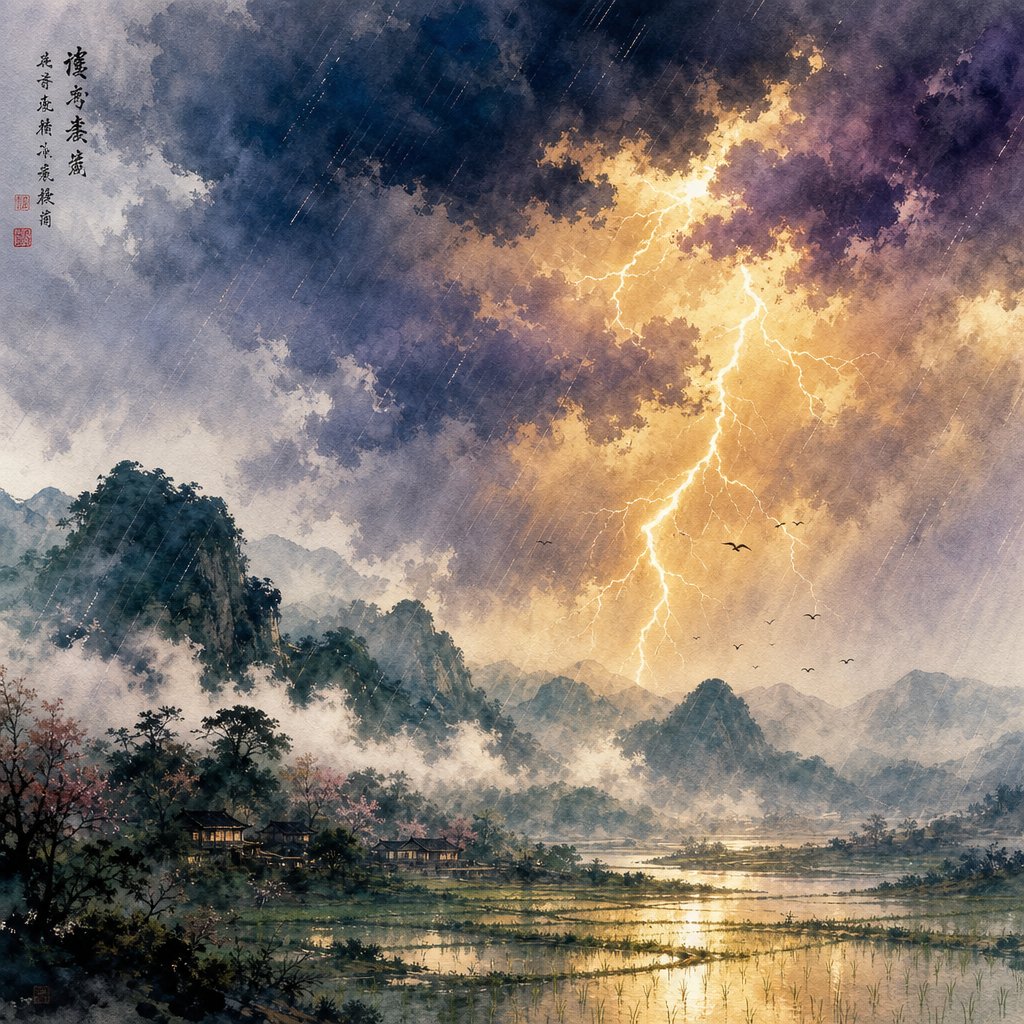
Imagine the first crack of thunder after a long, silent winter. In Chinese tradition, that sound is not just noise. It is the voice of the cosmos announcing renewal, stirring dormant life back into motion. For thousands of years, thunder has represented raw strength, moral authority, and the unstoppable force of spring. When Chinese parents choose names that mean thunder, they are drawing on this deep well of symbolism to shape their child's identity.
Why Thunder Carries Deep Meaning in Chinese Culture
Thunder names trace their roots to one of the oldest belief systems in China. The worship of the Thunder God dates back to at least the Han Dynasty (206 BCE-220 CE), when thunder was already associated with cosmic justice and the power over life and death. By the Tang Dynasty, Emperor Xuanzong formally integrated the Thunder God into state rituals, declaring that thunder marks the beginning of spring's awakening and that its power is bestowed upon all living things.
This connection between thunder and spring is still alive in the solar term Jingzhe, or "Awakening of Insects." On this day each March, the first rolling thunder awakens sleeping creatures from hibernation, signaling that the earth is ready to grow again. Thunder names carry this same energy: the idea that your child arrives like a force of nature, breaking through stillness and calling the world to attention.
In Chinese philosophy, thunder does not destroy. It awakens. A name rooted in thunder is a name rooted in new beginnings.
Chinese naming culture treats each name as a story told through characters, tones, and meaning. A child's name reflects their parents' hopes and is believed to influence their destiny. Names for thunder offer parents a way to encode strength, courage, and vitality without aggression. The thunder does not fight. It announces. It clears the way.
What This Guide Covers
This guide walks you through everything you need to choose the right thunder name for your child. You will learn the structure and pronunciation of key thunder characters, explore the mythology of Lei Gong and Dian Mu, discover curated lists of boy and girl names with full pinyin and meaning breakdowns, and understand how Five Element theory and tonal harmony affect your final choice. Whether you are looking for names that mean thunder for a boy, lightning-inspired options for a girl, or unisex thunder names that work across cultures, the sections ahead cover each angle in detail.
The character at the heart of it all is 雷 (lei), and its visual structure alone tells a story worth understanding before you name your child.
Understanding the Character 雷 and Its Structure
Before you commit a character to your child's birth certificate, you want to know exactly what you are writing. The Chinese for thunder is 雷 (lei), and its visual architecture is more than decorative. It is a miniature landscape painting compressed into 13 brushstrokes.
Radical Composition and Visual Meaning of 雷
Look at 雷 and you will see two distinct components stacked vertically. On top sits 雨 (yu, rain), the rain radical that appears in dozens of weather-related characters. Below it rests 田 (tian, field), the character for an agricultural plot of land. Picture it: rain clouds gathering above open farmland, and then the deep rumble of thunder rolling across the fields during a spring storm.
This is not accidental. Ancient Chinese character designers built meaning into structure. When you write 雷, you are literally drawing a rainstorm over a field. For a baby name, this visual story adds a layer of richness that purely phonetic names cannot match. Your child carries a landscape in their name, a scene of power meeting the earth.
The character totals 13 strokes: 8 for the rain radical on top and 5 for the field component below. In Chinese naming numerology, stroke count matters for balance and auspiciousness when paired with a surname, something we will address in a later section.
Mandarin and Cantonese Pronunciations
Getting the pronunciation right is essential, especially if your family speaks multiple Chinese dialects. In Mandarin, 雷 is pronounced lei with the second tone, a rising pitch that sounds similar to the English word "lay" spoken with an upward inflection, like you are asking a question. The pinyin final "ei" starts with an open "e" sound and glides toward "i," creating that distinctive rising rumble in the mouth.
In Cantonese, the same character is pronounced leui4 (Jyutping romanization), with a low falling tone. The vowel quality shifts noticeably. Where Mandarin gives you a clean rising "ay" sound, Cantonese rounds the vowel closer to "oy" or "oey." If your family uses both dialects, test how the full name sounds in each system before finalizing your choice.
One critical point: thunder in Mandarin uses the second (rising) tone. Mixing it up with the fourth (falling) tone changes 雷 (lei, thunder) into 泪 (lei, tears). That is not the energy most parents want encoded in a name.
Homophones to Know Before Naming
Here is where many parents trip up. Mandarin is full of homophones, characters that share the same sound but carry completely different meanings. When someone hears your child's name spoken aloud, they may picture the wrong character entirely unless context makes it clear. Three characters pronounced "lei" appear frequently in Chinese names, and each tells a very different story:
| Character | Pinyin | Tone | Meaning | Radical | Stroke Count | Naming Implication |
|---|---|---|---|---|---|---|
| 雷 | lei | 2nd (rising) | Thunder | 雨 (rain) | 13 | Strength, power, awakening, cosmic force |
| 蕾 | lei | 3rd (dipping) | Flower bud | 艹 (grass/plant) | 16 | Potential, beauty about to bloom, femininity |
| 磊 | lei | 3rd (dipping) | Pile of rocks; upright | 石 (stone) | 15 | Honesty, openness, strong moral character |
Notice that 蕾 and 磊 both use the third tone (dipping), while 雷 uses the second tone (rising). In casual speech, though, tonal distinctions can blur. If you name your son 雷 intending thunder and power, be aware that listeners might initially think of 磊, which conveys moral uprightness, or 蕾, which leans feminine and floral. Context and the full two-character name usually resolve this ambiguity, but it is worth considering how the name sounds in isolation versus in combination.
The lightning chinese character 电 (dian) is a separate character entirely and does not share this homophone issue, which is one reason some parents prefer lightning-based alternatives. But 雷 remains the most direct and culturally resonant way to put thunder into a name.
With the character's bones laid bare, its sound mapped across dialects, and its lookalikes identified, the next question becomes: where does this character come from in the mythological imagination? The answer lives in the sky, in the hands of Lei Gong and his lightning-wielding partner.
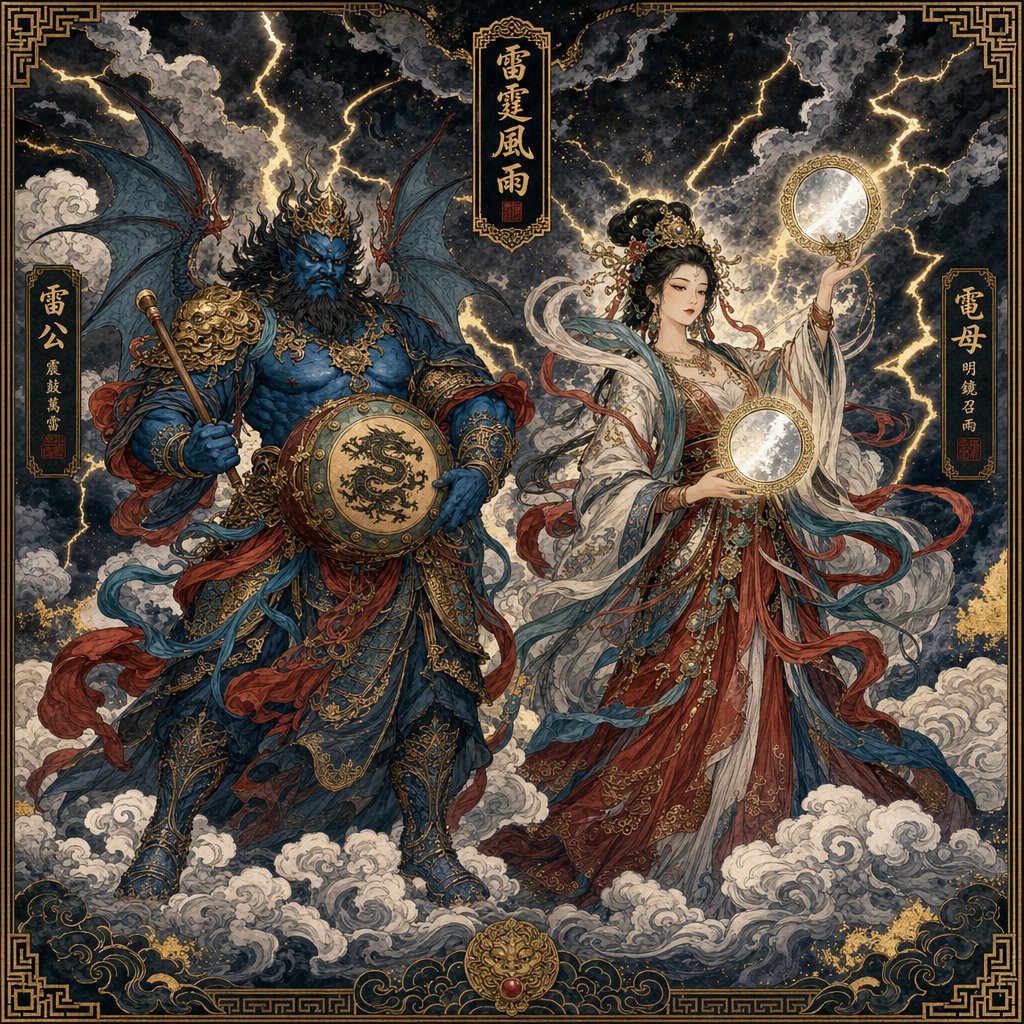
Lei Gong and Dian Mu: Thunder God Names and Lightning Goddess Names in Chinese Mythology
Every thunder name carries an echo of the deities who first wielded that power in Chinese myth. When you name a child after thunder or lightning, you are not just picking a sound. You are connecting them to a mythological lineage thousands of years old, one that encodes justice, clarity, and cosmic authority into a single syllable.
Lei Gong the Thunder God and His Influence on Boy Names
Lei Gong (雷公) is the god of thunder in Chinese mythology, and his name literally translates to "Thunder Lord." He is one of the most visually striking figures in the Chinese pantheon. According to Mythopedia, Lei Gong has dark blue skin, the wings and claws of a dragon, and carries both a drum and a hammer. The drum generates the sound of thunder. The hammer strikes down evildoers.
His role is not random destruction. Lei Gong serves the Jade Emperor's court as an enforcer of moral law. When he sees injustice on Earth, he beats his drum as a warning. If the wrongdoers refuse to stop, he uses his hammer to deliver punishment. One famous legend describes him striking dead two robbers who were exploiting a blind salesman. From that day forward, villagers understood the sound of thunder as a direct warning from Heaven to avoid corrupt behavior.
This is why thunder god names resonate so strongly for boys. Parents who choose names built from 雷 or 霆 are invoking Lei Gong's core qualities:
- Justice — Lei Gong punishes wrongdoing and protects the vulnerable
- Moral authority — He acts on behalf of Heaven's highest court
- Fearlessness — His appearance alone commands respect and deters evil
- Decisive action — He warns first, then acts without hesitation
- Cosmic power — His drum shakes the sky itself
A boy named with thunder characters inherits this archetype: someone who stands for what is right, who speaks with authority, and whose presence cannot be ignored.
Dian Mu the Lightning Mother and Girl Name Inspiration
Where Lei Gong brings the sound, Dian Mu (电母) brings the light. Known as the "Mother of Lightning" or "Lightning Goddess," she is Lei Gong's wife and partner in every storm. Taoist traditions depict her as a beautiful woman in a flowing gown, holding bright mirrors that she tilts toward the earth to create flashes of lightning.
Her role is deeply purposeful. Dian Mu illuminates the sky so that Lei Gong can see his targets clearly and avoid striking the innocent. Without her light, his justice would be blind. This makes her a symbol of discernment, precision, and the kind of power that guides rather than destroys.
For parents seeking lightning goddess names or thunder-adjacent options for girls, Dian Mu offers a compelling template:
- Illumination — She reveals truth and dispels darkness
- Discernment — Her light ensures justice hits the right target
- Partnership in power — She is equal to Lei Gong, not subordinate
- Grace under force — Beautiful and devastating in the same moment
- Protection — Associated with warding off evil spirits and negative energies
Girl names using 电 (dian, lightning) or 闪 (shan, flash) draw directly from Dian Mu's energy. They suggest a child who will see clearly, act precisely, and light the way for others.
Storm Deities Across Chinese Folklore
Lei Gong and Dian Mu do not work alone. They belong to a larger pantheon of gods of storms that Chinese families have revered for centuries. Understanding this broader network helps you see how thunder names fit within a complete cosmological system.
Lei Gong's uncle is Feng Bo (风伯), the Wind Lord, a mighty warrior who rides a dragon and controls the winds with a fan or sword. His assistant Yun Zhongzi (云中子) generates clouds, while Yu Shi (雨师), the Rain Master, creates rainfall by dipping his sword into water and letting the drops fall over the earth. Together, these figures form a complete weather system: wind gathers the clouds, rain fills them, lightning illuminates the sky, and thunder announces the storm's arrival.
This interconnected mythology means that storm-related names carry layered associations. A name referencing thunder also implicitly connects to rain, wind, and renewal. Parents who understand this system can make more intentional choices, pairing thunder characters with elements that reference other parts of the storm cycle for richer meaning.
The mythology gives you the "why" behind thunder names. The next step is seeing how these archetypes translate into actual name combinations, starting with specific boy names that channel Lei Gong's strength into characters your son will carry for life.
Chinese Boy Names That Mean Thunder
Lei Gong's justice, his drum-shaking authority, his refusal to let wrongdoing pass unchallenged — these qualities live inside the characters Chinese parents choose for their sons. The question is which character, and which pairing, best captures the specific shade of thunder you want your child to carry. Some names roar. Others rumble with quiet inevitability. Here is a breakdown of the strongest options, organized from single characters to full two-character combinations.
Single-Character Thunder Names for Boys
A single-character given name is bold and direct. In Chinese naming, using just one character after the surname creates a punchy, memorable name. Three characters dominate the thunder category for boys:
- 雷 (lei, 2nd tone) — Thunder itself. 13 strokes. The most literal and recognizable thunder name. It projects raw power and unstoppable force. As a standalone name, 雷 is a symbol of unstoppable power that needs no embellishment.
- 霆 (ting, 2nd tone) — Thunderbolt. 15 strokes. Where 雷 is the rolling sound, 霆 is the sudden, violent strike. It carries the rain radical (雨) on top with 廷 (court) below, suggesting thunder that commands like a royal decree.
- 震 (zhen, 4th tone) — Quake, shake, awe. 15 strokes. This character connects directly to the I Ching thunder trigram and implies a power that shakes the world into attention. The name 震宇 (Zhenyǔ), meaning "shakes the universe," demonstrates how this character scales to cosmic proportions.
Single-character names work best with two-character surnames (like 欧阳 Ouyang or 司马 Sima) where the total name already has three syllables. With a common one-character surname like 王 (Wang) or 李 (Li), a single-character given name can feel abrupt, which is why most parents opt for two-character combinations.
Two-Character Combinations with Auspicious Pairings
This is where naming becomes an art. Each character in a two-character name should complement the other, creating meaning that neither character achieves alone. Think of it like a chord versus a single note. The best thunder name pairings balance power with direction, giving the thunder somewhere purposeful to go.
Consider 春雷 (chunlei) — spring thunder. The character 春 (chun, spring, 9 strokes) paired with 雷 (lei, thunder, 13 strokes) creates a name that means "the first thunder of spring." This is not destructive thunder. It is the thunder that wakes the earth, the sound of new beginnings. Total stroke count: 22.
Or take 雷霆 (leiting) — thunderbolt. Pairing 雷 with 霆 doubles down on storm energy, creating a name that means overwhelming, decisive power. This combination appears in classical Chinese literature to describe military force so sudden and complete that resistance is pointless. Total stroke count: 28.
The name 雷震 (Leizhen), meaning "thunderclap," combines the sound of thunder with the physical shaking it produces. It is a name that suggests someone whose words and actions create real impact in the world.
Here is a comprehensive table of boy names that mean thunder, with full breakdowns:
| Characters | Pinyin | Literal Meaning | Connotative Meaning | Total Strokes |
|---|---|---|---|---|
| 春雷 | Chunlei | Spring + Thunder | New beginnings, awakening force | 22 |
| 雷霆 | Leiting | Thunder + Thunderbolt | Overwhelming, decisive power | 28 |
| 雷震 | Leizhen | Thunder + Quake | Impact that shakes the world | 28 |
| 震宇 | Zhenyu | Quake + Universe | Shakes the cosmos, boundless ambition | 21 |
| 冠霆 | Guanting | Crown + Thunderbolt | Crowned champion by thunder itself | 24 |
| 浩雷 | Haolei | Vast + Thunder | Thunder that echoes across vast distances | 24 |
| 震霆 | Zhenting | Quake + Thunderbolt | Earth-shaking force, unstoppable momentum | 30 |
| 雷鸣 | Leiming | Thunder + Cry/Sound | A voice that commands attention like thunder | 27 |
| 震坤 | Zhenkun | Quake + Earth | Power that moves the earth itself | 23 |
| 霆锋 | Tingfeng | Thunderbolt + Blade | Sharp and sudden as a lightning strike | 30 |
You will notice that stroke counts range from 21 to 30. Higher stroke counts are not inherently better or worse, but they do affect visual balance when written alongside a surname. A surname with few strokes (like 丁, 2 strokes) paired with a high-stroke given name can look top-heavy on paper. More on this balance in the surname pairing section later.
Names Starting with T in Pinyin
Some parents specifically search for names meaning thunder that start with T, either because they want a particular initial for English-language contexts or because they are looking for gods of thunder names that transliterate smoothly. Several strong options begin with T in pinyin:
- 天雷 (Tianlei) — Heavenly thunder. 天 (tian, sky/heaven, 4 strokes) + 雷 (lei, thunder, 13 strokes). Total: 17 strokes. This name places thunder in the realm of the divine, suggesting power that descends from above. It carries the weight of celestial authority.
- 霆宇 (Tingyu) — Thunderbolt universe. 霆 (ting, thunderbolt, 15 strokes) + 宇 (yu, universe, 6 strokes). Total: 21 strokes. A name that pairs sudden force with infinite space, implying ambition without limits.
- 霆轩 (Tingxuan) — Thunderbolt pavilion. 霆 (ting, thunderbolt, 15 strokes) + 轩 (xuan, lofty/pavilion, 7 strokes). Total: 22 strokes. Combines raw power with refinement, suggesting someone who is both forceful and cultured.
- 天震 (Tianzhen) — Heaven quakes. 天 (tian, sky, 4 strokes) + 震 (zhen, quake, 15 strokes). Total: 19 strokes. A name that evokes the moment the sky itself trembles, perfect for parents wanting names that mean lightning boy energy with cosmic scale.
These T-initial names also work well for bilingual families because "Tian" and "Ting" are relatively easy for English speakers to pronounce without distortion. The hard "T" sound at the start gives the name a crisp, strong opening in both languages.
Boy names built from thunder characters project strength and moral weight. But thunder does not belong exclusively to one gender, and the growing tradition of powerful female naming in China draws from the same storm.
Chinese Girl Names Meaning Thunder and Lightning
Thunder has never been a boys-only domain in Chinese culture. Dian Mu, the Lightning Mother, stands as proof that storm power and femininity coexist without contradiction. Modern Chinese parents are increasingly drawn to this idea, choosing female names meaning thunder and lightning that refuse to trade strength for softness. The result is a growing collection of girl names that hit like a thunderclap and flow like silk in the same breath.
Girl Names Inspired by Thunder and Lightning
The most direct approach is pairing a storm character with a traditionally feminine element. This creates names where power and beauty reinforce each other rather than compete. A name that means lightning paired with a character for jade or grace tells a complete story: this child is both forceful and refined.
Consider 霆婷 (Tingting). The first character, 霆 (ting, thunderbolt, 15 strokes), delivers raw storm energy. The second, 婷 (ting, graceful/elegant, 12 strokes), softens the landing with poise. They share the same pinyin sound but carry entirely different meanings, creating a musical echo within the name itself. Total strokes: 27.
For parents drawn to lightning specifically, 电 (dian, lightning/electricity, 5 strokes) offers a sleek, modern option. The character is visually simple and carries associations with speed, brilliance, and illumination. A name like 电萱 (Dianxuan) pairs lightning with the daylily flower (萱, xuan, 12 strokes), a plant traditionally associated with forgetting sorrow and maternal love. Total strokes: 17. The contrast is striking: electric force grounded in nurturing warmth.
Here is a table of girl names connected to thunder and lightning, with layered meanings:
| Characters | Pinyin | Literal Meaning | Connotative Meaning | Gender Usage |
|---|---|---|---|---|
| 霆婷 | Tingting | Thunderbolt + Graceful | Powerful elegance, storm wrapped in poise | Primarily female |
| 电萱 | Dianxuan | Lightning + Daylily | Brilliant energy with nurturing warmth | Female |
| 雷琳 | Leilin | Thunder + Beautiful jade | Strength as precious as jade | Female |
| 闪瑶 | Shanyao | Flash + Precious jade | A flash of rare beauty | Female |
| 霆萱 | Tingxuan | Thunderbolt + Daylily | Fierce protector with a gentle heart | Female |
| 震玥 | Zhenyue | Quake + Mythical pearl | World-shaking uniqueness | Female |
| 电瑾 | Dianjin | Lightning + Lustrous jade | Brilliant integrity, sharp and beautiful | Female |
| 雷萍 | Leiping | Thunder + Duckweed | Free-spirited power, untethered strength | Female |
You will notice that jade characters (琳, 瑶, 玥, 瑾) appear frequently as pairing partners. Jade has represented virtue, beauty, and resilience in Chinese culture for millennia. When paired with thunder or lightning, jade grounds the storm energy in something enduring and precious. Your daughter's name says: she is not just powerful, she is valuable beyond measure.
Unisex Thunder Names That Cross Gender Lines
Some thunder names refuse to pick a side, and that flexibility is their strength. These work equally well for any child, giving parents freedom to choose based on meaning rather than gendered expectation.
震 (zhen, quake, 15 strokes) is the most versatile thunder character for unisex naming. Connected to the I Ching trigram for thunder, it carries philosophical weight without leaning masculine or feminine. Names like 震宁 (Zhenning, quake + peaceful, 20 strokes) balance force with calm, while 震溪 (Zhenxi, quake + mountain stream, 28 strokes) pairs earth-shaking power with the clarity of flowing water.
霆 (ting, thunderbolt) also crosses gender lines when paired thoughtfully. 霆悦 (Tingyue, thunderbolt + joy, 26 strokes) works for any child, suggesting someone whose energy brings happiness to others. The character 悦 (yue, joy) is itself gender-neutral and adds emotional warmth to the thunderbolt's intensity.
Other unisex options include:
- 震晨 (Zhenchen) — Quake + Morning. The first light after the storm. 21 strokes.
- 霆安 (Ting'an) — Thunderbolt + Peace. Power held in reserve, calm authority. 21 strokes.
- 雷恒 (Leiheng) — Thunder + Constancy. Enduring strength that never fades. 22 strokes.
Combining Power with Grace in Female Names
The cultural shift happening in Chinese naming is significant. As naming trends for 2026 show, modern parents are moving away from overly soft or "sugary" names for daughters. The preference now leans toward what Chinese naming culture calls 大气 (daqi) — names that feel atmospheric, open, and intelligent rather than merely pretty.
Thunder and lightning characters fit this trend perfectly. They offer female names that relate to thunder fantasy and mythology without sacrificing femininity. The key is in the pairing strategy. A storm character alone might feel stark for a girl's name. But combined with characters that evoke nature's gentler side — flowers, jade, water, moonlight — the name achieves what Chinese aesthetics call 刚柔并济 (gang rou bing ji): hardness and softness advancing together.
Imagine a daughter named 闪月 (Shanyue) — flash of moonlight. Or 霆溪 (Tingxi) — thunderbolt meeting a clear stream. These names do not apologize for their power. They simply place that power within a complete picture, the way Dian Mu's lightning illuminates rather than destroys.
The characters explored here — 雷, 霆, 震, 电, 闪 — form a family of related but distinct storm elements. Each carries its own shade of meaning, its own stroke count, its own philosophical lineage. Understanding the full range of these thunder-adjacent characters opens up even more naming possibilities beyond the core character 雷 itself.
Beyond 雷: Other Thunder and Lightning Characters for Names
雷 is the most recognizable thunder character, but it is not the only one. Chinese has an entire family of storm-related characters, each carrying a distinct shade of meaning. Some emphasize the sound of thunder. Others capture the visual flash of lightning or the physical tremor that follows a strike. Choosing between them is like choosing between different instruments in the same orchestra — they all belong to the storm, but each plays a different note.
Here is the full lineup of thunder and lightning characters used in Chinese naming, compared side by side:
| Character | Pinyin (Mandarin) | Cantonese | Meaning | Strokes | Radical | Connotation in Names | Best Pairing Characters |
|---|---|---|---|---|---|---|---|
| 雷 | léi (2nd tone) | lèuih | Thunder | 13 | 雨 (rain) | Raw power, awakening, cosmic voice | 春, 浩, 鸣, 霆 |
| 霆 | tíng (2nd tone) | tìhng | Thunderbolt | 15 | 雨 (rain) | Sudden decisive force, royal authority | 轩, 宇, 锋, 婷 |
| 震 | zhèn (4th tone) | jan | Quake, shake, awe | 15 | 雨 (rain) | Philosophical depth, arousing, I Ching thunder | 宇, 坤, 宁, 玥 |
| 霹 | pī (1st tone) | pīk | Thunderclap | 21 | 雨 (rain) | Sudden dramatic impact, breaking through | 雳 (always paired) |
| 电 | diàn (4th tone) | dihn | Lightning, electricity | 5 | ⻗ (rain, simplified) | Speed, brilliance, modernity | 萱, 瑾, 华, 辉 |
| 闪 | shǎn (3rd tone) | sím | Flash | 5 | 门 (door/gate) | Quick brilliance, fleeting beauty, spark | 瑶, 月, 耀, 星 |
Each of these characters tells a different story about storm energy. Let's break them down individually so you can see exactly what you are putting into a name.
霆 Tíng and 震 Zhèn as Naming Alternatives
霆 (tíng) is the thunderbolt — not the rolling rumble of 雷, but the single, violent crack that splits the sky. Its structure places the rain radical (雨, 8 strokes) on top with 廷 (tíng, royal court, 7 strokes) below. That lower component is revealing. A thunderbolt that carries the character for "court" inside it suggests authority that strikes with the weight of law behind it. When you name a child 霆, you are encoding the idea of power exercised with legitimacy, not chaos.
At 15 strokes, 霆 is visually dense and carries a sense of weight on paper. It pairs well with lighter characters (6-8 strokes) to maintain visual balance. Names like 霆轩 (Tíngxuān, thunderbolt + lofty, 22 strokes) or 霆宇 (Tíngyǔ, thunderbolt + universe, 21 strokes) give the heavy storm character room to breathe.
震 (zhèn) operates differently. Where 霆 is the sound, 震 is the physical effect — the shaking, the tremor, the moment the ground moves beneath your feet. Its radical composition is 雨 (rain) on top with 辰 (chén, celestial body/time, 7 strokes) below. The combination suggests a cosmic disturbance, something that shakes the very fabric of time and space.
But 震 carries a layer of meaning that no other thunder character can match: its direct connection to the I Ching. This is where the lightning name meaning deepens into philosophy.
The I Ching Thunder Trigram Connection
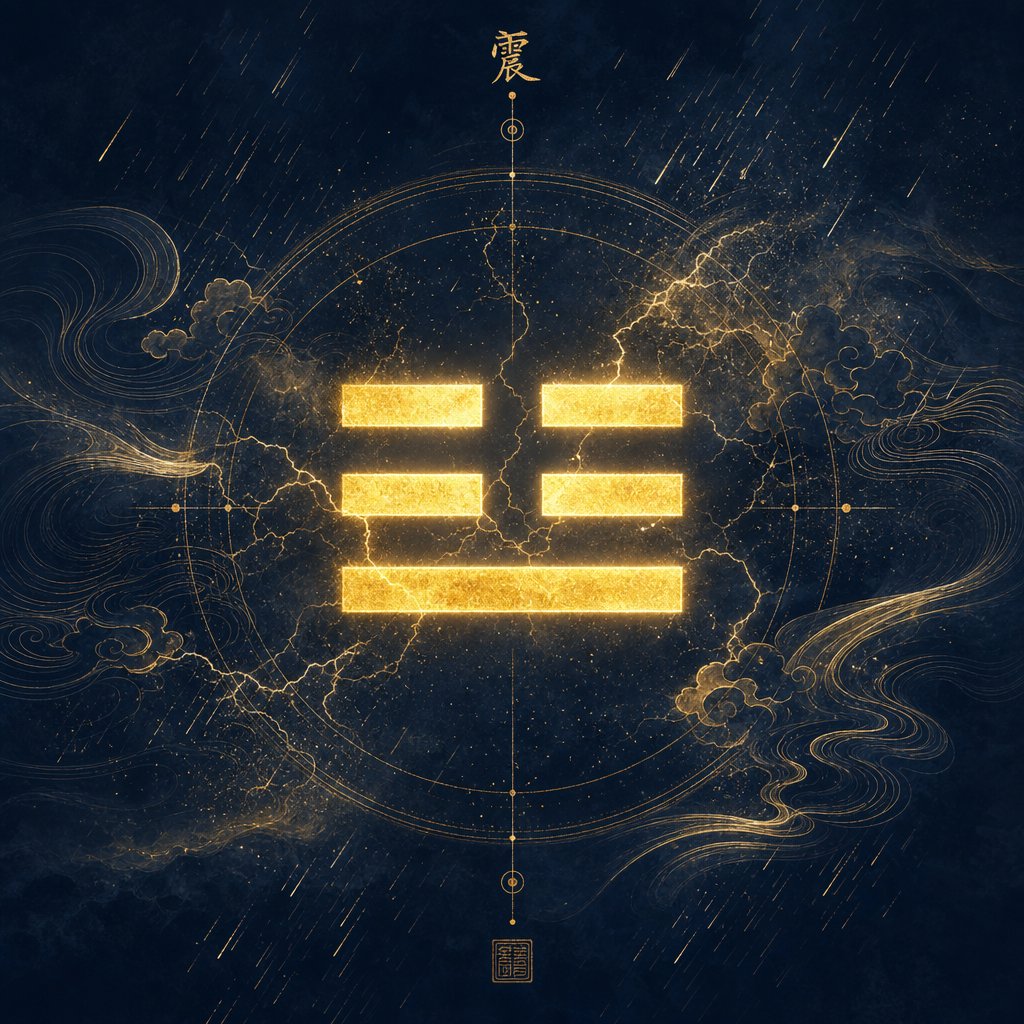
In the I Ching (Book of Changes), 震 is not just a character. It is one of the eight fundamental trigrams (八卦) that form the basis of Chinese cosmological thought. The trigram ☳ consists of one solid yang line at the bottom with two broken yin lines above — the firm pushing up from beneath the soft.
The classical interpretation describes 震 as the trigram of arousing, movement, and shock. Its image is thunder — the sudden voice that breaks open spring after the long silence of winter. The single yang line at the bottom represents an active impulse pushing through accumulated stillness, while the two yin lines above are the matter waiting to be moved. This is the moment when potential converts into action.
Within the eight-trigram family system, 震 holds the position of the Eldest Son. Its classical correspondences include:
- Element: Wood (木) in the Five-Element system
- Season: Spring — the time when 震's energy dominates
- Direction: East in the Post-Heaven Bagua
- Body part: The foot — what propels the body forward
- Animal: The dragon — embodying the trigram's archetypal motion
- Quality: Arousing, awakening, the beginning of motion
The classical phrase from hexagram #51 (where 震 doubles itself as thunder upon thunder) reads: "Thunder repeated; thus the noble person, in fear and trembling, sets his life in order and examines himself." This is not about being afraid. It is about using shock as a catalyst for self-improvement — letting the thunder wake you into becoming better.
When you name a child 震, you are not just giving them a word that means "shake." You are connecting them to an entire philosophical system that says: this child is the eldest son energy, the first movement of spring, the dragon rising from stillness into action. That is a depth of meaning no purely phonetic name can achieve.
For naming purposes, 震 sits in the East of the Post-Heaven Bagua and corresponds to spring. A child born in spring whose name contains 震 carries a double resonance — their birth season and their name align with the same trigram energy. This kind of alignment matters in traditional Chinese naming consultations.
Lightning Characters 电 and 闪 for Modern Names
If thunder characters lean classical and weighty, the Chinese for lightning offers something sleeker. 电 (diàn) and 闪 (shǎn) are both just 5 strokes each — visually clean, quick to write, and carrying a modern edge that heavier characters lack.
电 (diàn) originally meant lightning but has expanded in modern Chinese to also mean electricity. Its radical in simplified Chinese derives from the rain component (⻗), though the character has been streamlined significantly from its traditional form 電 (13 strokes). The simplified version's brevity is part of its appeal for names. It suggests speed, brilliance, and the sharp clarity of a lightning bolt cutting through darkness.
Names that mean lightning or electricity built from 电 tend to feel contemporary. 电华 (Diànhuá, lightning + splendor, 11 strokes) or 电辉 (Diànhuī, lightning + radiance, 17 strokes) work for parents who want storm energy without the weight of classical tradition. The character also connects directly to Dian Mu, the Lightning Mother, giving it mythological grounding despite its modern feel.
闪 (shǎn) means flash — the brief, brilliant burst of light that precedes thunder. Its radical is 门 (mén, door/gate), with 人 (rén, person) inside. Picture a person appearing suddenly in a doorway — that is the visual logic of 闪. It captures the fleeting, dazzling quality of lightning rather than its destructive force.
For names, 闪 works beautifully when paired with characters that extend the metaphor of light: 闪耀 (Shǎnyào, flash + shine, 25 strokes) means dazzling brilliance, while 闪星 (Shǎnxīng, flash + star, 14 strokes) suggests a shooting star. These names carry the energy of lightning without the heaviness of thunder, making them popular choices for parents seeking something bright and quick rather than deep and rumbling.
One character worth mentioning separately is 霹 (pī, thunderclap, 21 strokes). It almost never appears alone in names because it belongs to the compound word 霹雳 (pīlì, thunderclap/bolt from the blue). At 21 strokes, it is visually complex and difficult to pair with other characters gracefully. Most naming consultants steer parents toward 霆 or 震 instead, which deliver similar impact with better pairing flexibility.
Each of these characters — from the philosophically rich 震 to the sleek modern 电 — gives you a different tool for building a thunder or lightning name. The character you choose determines not just the sound of your child's name but its entire symbolic architecture. And that architecture interacts with another ancient system that many Chinese families still consult: the Five Elements and the generational naming tradition that determines how a name fits within a family's larger story.
Five Elements and Generational Naming Traditions
You have picked a thunder character you love. It sounds right, looks balanced on paper, and carries the meaning you want for your child. But in the Chinese five elements naming tradition, a character's meaning is only one layer of the decision. The deeper question is whether that character's elemental energy matches what your child's birth chart actually needs.
Thunder and the Wood Element Connection
Wu Xing (五行) is not a set of physical materials like the periodic table. The character Xing (行) means "movement" or "phase," so Wu Xing is better understood as five patterns of energy that cycle through nature and human life. Each phase corresponds to a season, a direction, and a set of natural phenomena:
- Wood (木, Mu) — Spring, East. Associated with thunder, wind, growth, and upward expansion. The energy of a seedling breaking through soil.
- Fire (火, Huo) — Summer, South. Associated with lightning's heat, radiance, and maximum expression. Energy ascending and radiating outward.
- Earth (土, Tu) — Transitional seasons, Center. Associated with mountains, stability, and grounding. The energy between seasons.
- Metal (金, Jin) — Autumn, West. Associated with clarity, refinement, and contraction. The energy of letting go and honing.
- Water (水, Shui) — Winter, North. Associated with rain, rivers, stillness, and depth. Energy descending and conserving.
Thunder sits squarely in the Wood phase. The I Ching trigram 震 (Zhen, thunder) corresponds to Wood, spring, and the East. This means thunder characters like 雷, 霆, and 震 carry Wood energy by default. The thunder name meaning extends beyond "powerful sound" into an entire elemental identity: growth, vitality, forward momentum, and the benevolence that classical Chinese philosophy associates with Wood.
Characters with the rain radical (雨) — which includes 雷, 霆, and 震 — are sometimes classified under Water in naming systems that prioritize radical composition. This dual association actually makes thunder characters versatile. They bridge Wood (through trigram correspondence) and Water (through their radical), potentially serving children who need either element strengthened.
Birth Chart Compatibility for Thunder Names
Here is where the system gets personal. BaZi (八字), or the Four Pillars of Destiny, is calculated from your baby's exact birth year, month, day, and hour. Each pillar contains a Heavenly Stem and an Earthly Branch, and each of those carries an elemental value. The result is a chart showing how much Wood, Fire, Earth, Metal, and Water your child was born with.
A naming consultant reads this chart by first identifying the Day Master — the element that represents the child's core self. Then they assess whether that Day Master is strong or weak based on the surrounding elements and the birth season. The goal is not to mechanically "fill in" whatever is missing. It is to find what supports the chart as a whole.
Imagine a baby born in autumn. Autumn belongs to Metal, and Metal controls Wood in the Five Elements cycle. If that baby's chart already shows weak Wood and little Water to nourish it, a thunder name could provide exactly the elemental support needed. The Wood energy of 震 or 雷 counterbalances the Metal pressure of the birth season, restoring flow to the chart.
But a baby born in spring — when Wood is already at peak strength — might not benefit from adding more Wood through a thunder name. An overloaded element can be just as problematic as a missing one. In that case, a naming consultant might suggest pairing the thunder character with a Fire or Earth character to drain excess Wood energy through the generating cycle (Wood feeds Fire, Fire creates Earth).
What should parents consider before consulting a BaZi-based naming approach?
- The baby's exact birth date, time, and location (time zone matters for calculating the Hour Pillar)
- Whether the family surname already carries a strong elemental association
- The Day Master's strength relative to the birth season
- Which element genuinely supports balance, not just which element is absent
- Whether the chosen characters sound natural and carry positive meaning beyond their elemental function
A good BaZi name is not a technical patch. It should still feel like a blessing — something that sounds beautiful, carries clear meaning, and works in daily life. Names meaning electric or thunder should earn their place through harmony with the whole chart, not just because a website flagged a missing element.
Fitting Thunder into Generational Naming Systems
Beyond elemental balance, many Chinese families follow a generational naming tradition called 字辈 (zibei). In this system, males of the same generation share one character in their given name, with the sequence determined in advance — sometimes centuries in advance — by a family poem or ancestral record.
If your family uses a zibei system, one character of your child's two-character given name is already fixed. The thunder character must occupy the remaining slot. For example, if the generational character for your child's generation is 文 (wen, literature/culture, 4 strokes), the name becomes 文雷 (Wenlei, cultured thunder) or 文震 (Wenzhen, cultured quake). The generational character comes first in some families, second in others — the family record dictates the position.
This constraint actually simplifies the naming process. Instead of choosing two characters from infinite options, you only need to find one thunder character that pairs well with the predetermined generational character in terms of meaning, tonal flow, and stroke balance.
Some families have moved away from strict zibei observance, especially in diaspora communities. But even without a formal system, many parents still avoid characters used by living elders (a taboo called 避讳, bihui) or choose characters that echo a sibling's name thematically. A family with a son named 春雷 (Chunlei, spring thunder) might name a daughter 春电 (Chundian, spring lightning) to maintain the seasonal-storm pattern across siblings.
Elemental compatibility and generational fit give you the philosophical and familial framework for a thunder name. The final practical challenge is more immediate: how does that name actually sound when spoken aloud with your surname, and are there combinations that accidentally create problems?
Pairing Thunder Names with Chinese Surnames
A thunder name can carry all the right meaning and still fall flat if it clashes with your family surname. Say the full name aloud five times fast. Does it flow, or does your tongue stumble? Chinese surname and name pairing rules exist precisely because a name is not just read on paper — it is spoken thousands of times over a lifetime. The wrong tonal sequence, an unfortunate stroke imbalance, or an accidental homophone can turn a powerful name thunder into a daily source of awkwardness.
Tonal Harmony Rules for Thunder Names
Mandarin has four tones: high and flat (1st), rising (2nd), low/dipping (3rd), and falling (4th). Every syllable in a Chinese name carries one of these tones, and the sequence matters enormously for how pleasant the name sounds when spoken aloud.
The core principle is contrast. A name where every syllable shares the same tone sounds monotonous or strained. Three consecutive second tones (rising, rising, rising) create an exhausting upward climb. Three consecutive fourth tones (falling, falling, falling) sound harsh and abrupt, like someone barking orders.
Thunder characters have specific tonal identities that constrain your options:
- 雷 (léi) — 2nd tone (rising)
- 霆 (tíng) — 2nd tone (rising)
- 震 (zhèn) — 4th tone (falling)
- 电 (diàn) — 4th tone (falling)
- 闪 (shǎn) — 3rd tone (dipping)
When you pair these with a surname, you want tonal variety across the full name. A surname like 王 (Wáng, 2nd tone) followed by 雷霆 (Léitíng, 2nd + 2nd) creates three consecutive rising tones: Wáng Léitíng. That is three syllables all climbing upward with no relief. The mouth tires. The ear loses interest.
Compare that with 王震宇 (Wáng Zhènyǔ, 2nd + 4th + 3rd). The pitch rises, then falls sharply, then dips low. You get a complete melodic arc in three syllables — engaging and easy to say. This is what naming consultants mean by tonal flow.
The ideal patterns for a three-character name (one-character surname + two-character given name) include:
- 1st + 2nd + 4th (high, rising, falling) — smooth descent after a climb
- 2nd + 4th + 2nd (rising, falling, rising) — a satisfying wave pattern
- 4th + 2nd + 3rd (falling, rising, dipping) — dramatic range
- 3rd + 2nd + 4th (dipping, rising, falling) — builds then resolves
Patterns to avoid:
- 2nd + 2nd + 2nd — monotonous upward strain
- 4th + 4th + 4th — aggressive staccato
- 3rd + 3rd + 3rd — the third tone changes to a rising tone before another third tone, creating confusion about the intended sound
Stroke Count Balance with Common Surnames
Visual harmony matters as much as sound. When a name is written in Chinese characters, the stroke count of each character determines how dense or sparse it looks on paper. A surname with 3 strokes next to a given name character with 15 strokes creates a lopsided appearance — like pairing a whisper with a shout.
The general guideline is to keep the stroke ratio between surname and given name characters within a comfortable range. A light surname (2-5 strokes) pairs best with medium-weight given name characters (8-13 strokes). A heavy surname (10+ strokes) can handle lighter given name characters without looking unbalanced.
Thunder characters tend to be stroke-heavy. 雷 has 13 strokes, 霆 has 15, and 震 has 15. Pairing these with China's most common surnames creates specific visual dynamics:
- 李 (Lǐ, 7 strokes) + 雷 (13) = moderate contrast, visually acceptable
- 王 (Wáng, 4 strokes) + 霆 (15) = noticeable imbalance, the given name dominates
- 丁 (Dīng, 2 strokes) + 震 (15) = extreme contrast, visually jarring
- 黄 (Huáng, 11 strokes) + 雷 (13) = well-matched density, harmonious on paper
For two-character given names with thunder, the second character can compensate. If your surname is light (like 王, 4 strokes) and your thunder character is heavy (like 霆, 15 strokes), choose a lighter second character: 霆宇 (15 + 6 = 21 total given name strokes). The average per character (10.5) sits closer to the surname's weight than 霆 alone would.
Traditional naming numerology goes further. According to the zhōng gé system, the total stroke count of the full name should hit specific auspicious numbers, and the Yin-Yang balance of odd and even stroke counts across all characters should follow approved patterns like Yang-Yang-Yin or Yin-Yang-Yang. If your family observes these traditions, run the final stroke totals before committing.
Combinations to Avoid and Why
The most dangerous trap in Chinese naming is not choosing a bad character — it is creating an accidental phrase. When surname and given name are spoken together quickly, they can sound like common words or expressions that carry meanings you never intended. This is especially true with names with thunder, because 雷 (léi) is a homophone for several unfortunate words in regional dialects.
Here are real examples of problematic surname + thunder name pairings:
| Surname + Name | Pinyin | Tonal Pattern | Problem | Rating |
|---|---|---|---|---|
| 王雷霆 | Wáng Léitíng | 2-2-2 | Three consecutive rising tones; monotonous and tiring to say | Poor |
| 赵震震 | Zhào Zhènzhèn | 4-4-4 | Three falling tones; sounds aggressive and repetitive | Poor |
| 付雷 | Fù Léi | 4-2 | Sounds like 负累 (fùlěi, "burden") in fast speech | Avoid |
| 梅雷 | Méi Léi | 2-2 | Sounds like 没了 (méi le, "gone/lost") in some dialects | Caution |
| 李震宇 | Lǐ Zhènyǔ | 3-4-3 | Good tonal variety; no homophone issues | Excellent |
| 陈春雷 | Chén Chūnléi | 2-1-2 | Rising-high-rising; pleasant wave pattern | Good |
| 张霆轩 | Zhāng Tíngxuān | 1-2-1 | High-rising-high; stable with a lift in the middle | Good |
| 刘雷 | Liú Léi | 2-2 | Two rising tones back-to-back; flat but not terrible for a two-syllable name | Acceptable |
| 黄震霆 | Huáng Zhèntíng | 2-4-2 | Rising-falling-rising; excellent melodic arc | Excellent |
| 杨电 | Yáng Diàn | 2-4 | Clean contrast; no homophone risk | Good |
A few additional rules worth remembering:
- Test in dialects. A name that sounds fine in Mandarin might create problems in Cantonese, Hokkien, or Shanghainese. If your extended family speaks a regional dialect, say the full name in that dialect before deciding.
- Watch for unintended words across syllable boundaries. 雷明 (Léimíng) is fine on its own, but paired with surname 黎 (Lí), the full name 黎雷明 spoken quickly can blur into 离雷鸣 (lí léimíng, "away from thunderclap") — not harmful, but odd.
- Avoid matching the surname's tone with both given name characters. If your surname is 2nd tone, do not pick two given name characters that are also 2nd tone. One match is fine. Two creates the monotone problem.
- Say it angry, say it gentle, say it fast. A name gets spoken in every emotional register. Test how it sounds whispered to a sleeping child and shouted across a playground. If it only works in one register, reconsider.
The practical takeaway: your thunder name needs to survive contact with real life. It will be called out in classrooms, typed into government forms, spoken by people who have never seen it written down. Tonal flow ensures it sounds natural. Stroke balance ensures it looks right. And homophone awareness ensures it never accidentally says something you did not mean.
These pairing mechanics are universal — they apply whether your family lives in Beijing, Hong Kong, or Toronto. But the question of where your family lives raises a different set of considerations entirely: how thunder names land in modern contexts, across cultures, and in the ears of people who may not speak Chinese at all.
Modern Perspectives on Chinese Thunder Names
A generation ago, names like 雷 (Léi) or 震 (Zhèn) might have sounded like something from a grandfather's era — strong, blunt, and rooted in a time when single-character names dominated Chinese naming. So where do thunder names sit today? Are they relics, or are they riding a wave back into relevance?
Are Thunder Names Traditional or Trendy Today
The answer is both. Cultural sociologist Xu Shumin notes that young Chinese parents, especially the post-1990 generation, are "reclaiming traditional Chinese culture as a living aesthetic in everyday life." Names drawn from classical texts, philosophy, and nature imagery are surging in popularity. Parents who wear Hanfu and study the I Ching are choosing names that reflect that same cultural identity.
Thunder names fit squarely within this revival. They draw from the same well as other nature-meaning names — chinese names that mean moon (月, yuè), jade (玉, yù), mountain (山, shān), or rain (雨, yǔ) — but carry a bolder edge. Where moon names suggest quiet beauty and jade names imply refined virtue, thunder names announce arrival. They are the dramatic counterpart in the nature-naming family.
Looking at current naming data, the top characters for 2021 newborns lean toward softer nature imagery: 泽 (marshland), 沐 (bathe), 雨 (rain), and 涵 (mellow). Thunder characters like 雷 and 震 do not crack the top 50 most-used characters. This means they are distinctive without being common — another name for thunder that stands apart from the crowd rather than blending into a classroom of identical-sounding peers. For parents who want nature-rooted meaning without the risk of duplication, thunder offers exactly that rarity.
Thunder Names for Bilingual and Diaspora Families
For families raising children across languages, a name needs to survive translation. Thunder names hold up well. The pinyin initials — L for Léi, T for Tíng, Z for Zhèn — all produce sounds that English speakers can approximate without distortion. "Lei" sounds close to "lay." "Zhen" maps easily to "Jen" as a nickname. "Ting" needs no adaptation at all.
Nickname potential matters too. A child named 天雷 (Tiānléi) might go by "Tian" in English-speaking contexts — short, clean, and easy to spell. 霆轩 (Tíngxuān) shortens naturally to "Ting." These nicknames carry no awkward associations in English and require no explanation at a coffee shop counter.
Diaspora parents often wrestle with how much cultural weight to place on a name. Some choose an Anglo first name and keep the Chinese name informal. Others lead with the Chinese name and let the child decide later how to present themselves. Thunder names work in either structure. As a legal first name, 震 (Zhen) functions internationally. As a middle or informal Chinese name, it preserves cultural depth without creating daily friction in English-dominant environments.
God of thunder names also carry cross-cultural recognition. Thor in Norse mythology, Raijin in Japanese tradition, Indra in Hindu cosmology — thunder deities exist in nearly every culture. A child named after Chinese thunder finds unexpected common ground with peers from other backgrounds. The concept translates even when the character does not.
Choosing the Right Thunder Name for Your Child
After all the characters, tones, stroke counts, and elemental charts, the final decision comes down to something simpler: resonance. Does the name feel right when you say it to your child? Does it carry the story you want their life to tell?
The best thunder name honors tradition without being trapped by it. It gives your child roots in Chinese cosmology and wings to move through a modern, multilingual world.
Here is a practical framework for making your final choice:
- Start with meaning. Do you want awakening (春雷), decisive power (霆), philosophical depth (震), or modern brilliance (电)? Let the meaning guide the character.
- Test the sound. Say the full name — surname included — in every dialect your family uses. Say it fast, slow, loud, and soft.
- Check the balance. Verify stroke counts against your surname. Confirm tonal variety across all syllables.
- Consider the context. Will this name travel well? Can teachers pronounce it? Does it shorten into a natural nickname?
- Trust your instinct. After the research is done, the name that keeps coming back to you is usually the right one.
A name is, as one parent described it, the "first life gift" you give your child. Thunder names offer something rare in that gift: a sound that has echoed through Chinese culture for thousands of years, carrying the energy of spring, the authority of heaven, and the promise that your child arrives in this world not quietly, but with the full force of a storm breaking open the sky.
Frequently Asked Questions About Chinese Thunder Names
1. What is the Chinese character for thunder used in baby names?
The primary Chinese character for thunder is 雷 (lei, 2nd tone), composed of the rain radical 雨 on top and 田 (field) on the bottom. It totals 13 strokes and visually represents thunder rolling over farmland during a rainstorm. Other thunder-related characters include 霆 (ting, thunderbolt, 15 strokes) and 震 (zhen, quake, 15 strokes), each carrying distinct shades of storm energy suitable for naming.
2. Are thunder names suitable for Chinese baby girls?
Yes, thunder and lightning names work beautifully for girls. Modern Chinese naming trends favor powerful female names that balance strength with grace. Parents often pair storm characters like 霆 or 电 with traditionally feminine elements such as 婷 (graceful), 琳 (jade), or 萱 (daylily). Examples include 霆婷 (Tingting, powerful elegance) and 闪瑶 (Shanyao, a flash of rare beauty). The Lightning Mother deity Dian Mu also provides mythological grounding for female thunder names.
3. How do the Five Elements affect choosing a thunder name?
Thunder characters carry Wood element energy in the Wu Xing system, corresponding to spring, growth, and forward momentum. A child whose BaZi birth chart shows weak Wood or was born in autumn (when Metal controls Wood) may benefit from a thunder name to restore elemental balance. However, a spring-born baby with already strong Wood might need the thunder character paired with Fire or Earth characters to avoid elemental overload. Consulting the child's exact birth date and time helps determine compatibility.
4. What is the difference between 雷, 霆, and 震 in Chinese names?
Each character captures a different aspect of thunder. 雷 (lei) is the rolling sound of thunder itself, projecting raw power and awakening. 霆 (ting) is the thunderbolt, a sudden decisive strike carrying royal authority through its lower component 廷 (court). 震 (zhen) is the physical quake or tremor that follows, connected to the I Ching thunder trigram representing arousing and spring. Choosing between them depends on whether you want to emphasize sound, sudden force, or philosophical depth.
5. Do Chinese thunder names work well for bilingual families?
Thunder names translate well across languages. Pinyin initials like L (Lei), T (Ting), and Z (Zhen) produce sounds English speakers can approximate easily. Names shorten into natural nicknames: 天雷 becomes Tian, 霆轩 becomes Ting. Thunder deities exist across cultures (Thor, Raijin, Indra), giving children unexpected common ground with peers from other backgrounds. The names function as legal first names internationally or as meaningful Chinese middle names in English-dominant environments.