Why Chinese Character Writing Practice Matters More Than You Think
Chinese character writing practice is the deliberate, repeated act of forming characters by hand, stroke by stroke, with attention to order, proportion, and structure. It goes far beyond copying shapes onto paper. When you physically write a character, your brain encodes it through movement, spatial awareness, and visual feedback all at once. Recognition-only study, like flashcard apps or reading exercises, engages just a fraction of those neural pathways.
Why Writing by Hand Builds Lasting Memory
Imagine tracing the strokes of a character with your pen. Each movement your hand makes is different from the last. That physical variation is exactly what your brain needs to form durable memories. A study published in Frontiers in Psychology monitored brain activity in students and found that those writing by hand showed higher electrical activity across regions responsible for movement, vision, sensory processing, and memory. Typing, by contrast, produced minimal activity in those same areas.
Why does this matter for learning Chinese? Every character has a unique motor signature. Writing the character for "water" (水) feels entirely different from writing "fire" (火) in your hand. That bodily sensation becomes part of how you remember each one. As neuropsychologist Audrey van der Meer explains, when you write by hand, the physical feeling of producing one letter or character is entirely different from producing another, and that distinction strengthens recall.
When you produce something tangible through writing, the visual system processes it again, reinforcing the connection between the action and the image. This feedback loop between motor output and visual recognition is what makes handwriting the best way to practice writing Chinese characters for long-term retention.
Research from the University of Tokyo supports this further. Japanese participants who had spent years learning to write Chinese characters scored significantly higher on visual recall tests compared to American participants across all age groups tested. Their visual memory also declined less with age, suggesting that the sustained practice of writing complex characters shapes brain development and strengthens recall of visual forms in general.
What Effective Character Practice Looks Like
So how should you practice writing Chinese characters? Most learners grab a worksheet, copy each character ten times, and call it done. That approach treats writing as mechanical repetition rather than active learning. Effective practice is methodical. It means understanding why each stroke goes where it does, recognizing the smaller components inside complex characters, and spacing your review sessions so your brain consolidates what you have written.
This guide takes a methodology-first approach. Instead of handing you a stack of printable sheets and wishing you luck, it walks you through a structured learning path: stroke order fundamentals, radical decomposition, proper grid usage, spaced repetition scheduling, and self-assessment techniques. You will learn how to practice in a way that compounds over time, where each session builds on the last and every new character becomes easier because you already know its parts.
The journey starts with the most foundational skill every learner needs but many skip over entirely: stroke order.
Mastering Stroke Order as Your Foundation
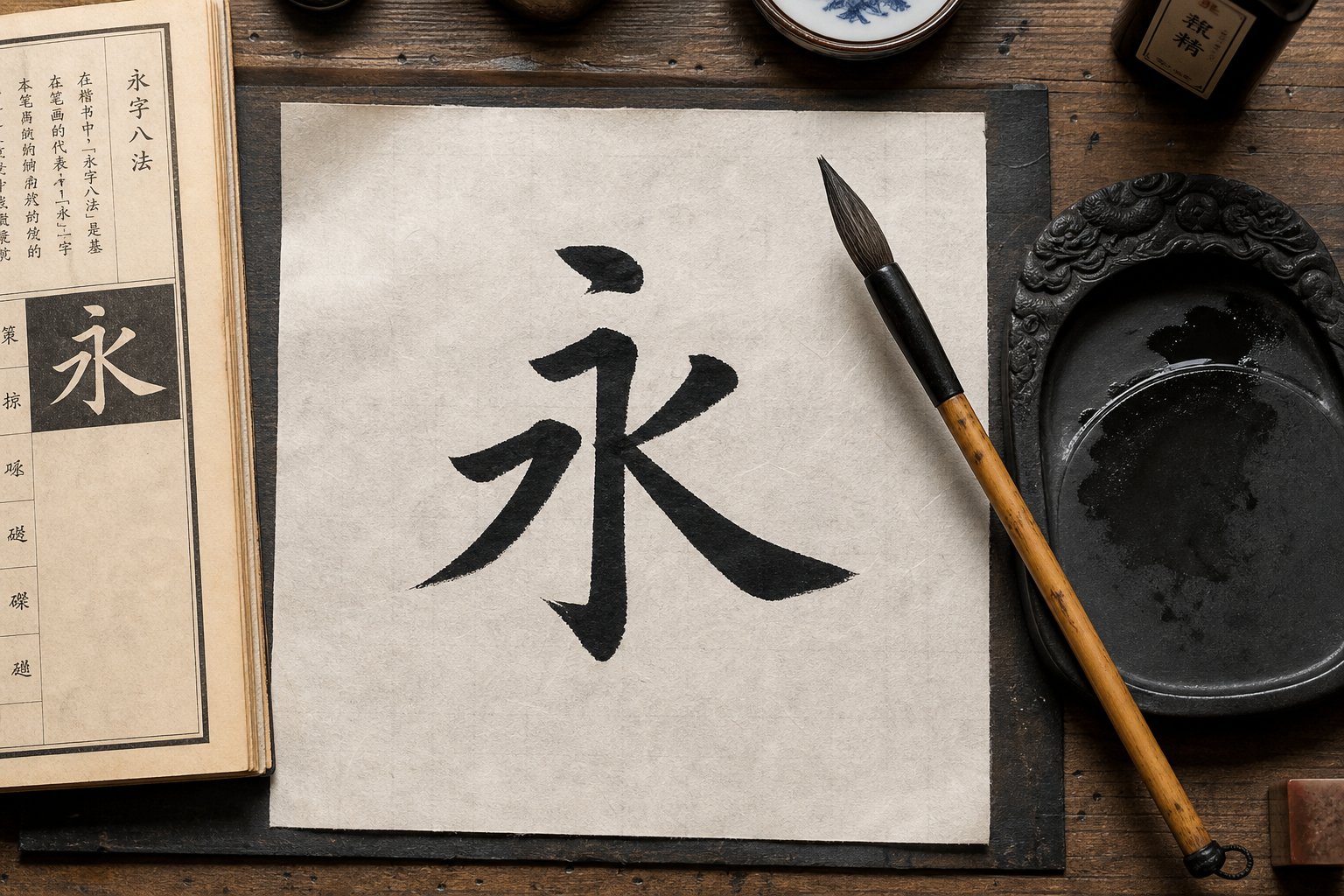
Stroke order is not a suggestion. It is the structural logic that holds every Chinese character together. The system was originally designed for brush calligraphy, where each stroke flows naturally into the next, minimizing unnecessary hand movements and producing balanced, readable characters. When you practice writing Chinese characters without following stroke order, you are essentially assembling furniture without the instructions. The result might vaguely resemble the picture on the box, but it will wobble.
Why is this non-negotiable? Your hand develops muscle memory based on the sequence you repeat. If that sequence is wrong, you are training your muscles to produce characters that look off-balance, take longer to write, and become harder to recall from memory. Correct stroke order also matters for practical reasons: handwriting recognition software on phones and tablets relies on expected stroke sequences to identify what you are writing. Feed it strokes in the wrong order, and it will not recognize even a perfectly shaped character.
The Core Stroke Order Rules Every Learner Needs
The good news is that stroke order follows a small set of consistent principles. Once you internalize these rules, you can predict the correct order for most characters you encounter, even unfamiliar ones. Here they are in priority sequence:
- Top to bottom. When a character is stacked vertically, write the upper elements first. For example, in 三 (san, three), you write the top horizontal line, then the middle, then the bottom.
- Left to right. When elements sit side by side, start with the left component. In 湖 (hu, lake), the water radical on the left is completed before moving to the right portion.
- Horizontal before vertical. When strokes cross, the horizontal line comes first. The character 十 (shi, ten) starts with the horizontal stroke, then the vertical one drops through it.
- Outside before inside. Build the frame before filling it in. Think of it as constructing a fence before putting the animals inside. In 日 (ri, sun), the outer box takes shape before the horizontal line inside.
- Close frames last. If a character has an enclosure, the bottom closing stroke is written after the interior content. In 国 (guo, country), the bottom horizontal line of the outer box is the final stroke, sealing everything inside.
- Center before wings. In symmetrical characters, the center stroke is written first. The character 小 (xiao, small) begins with the center vertical stroke, then adds the left and right dots.
- Character-spanning strokes last. A stroke that cuts through the entire character is saved for the end. In 中 (zhong, middle), the long vertical line that passes through the box is the final stroke.
These seven rules cover the vast majority of characters you will encounter. Conflicts between rules do arise occasionally, but with consistent practice, the correct order starts to feel intuitive rather than memorized.
How Stroke Order Affects Character Balance and Readability
Stroke order is not just about sequence. It directly shapes how your characters look on the page. Each rule exists because it produces natural pen movement that results in properly proportioned strokes. When you write top to bottom, your hand maintains a consistent downward rhythm that keeps vertical spacing even. When you write left to right, the weight of the character distributes naturally across the grid square.
Consider what happens when a beginner ignores these principles. Writing the vertical stroke of 十 before the horizontal one forces an awkward hand position for the crossing point. The intersection ends up off-center, and the character looks lopsided. Multiply that small error across dozens of characters in a sentence, and the text becomes genuinely difficult to read.
As DigMandarin notes, well-written characters are much easier to read, and knowing the correct stroke order helps you memorize more characters because your hand retains a kind of muscle memory with practice. That muscle memory only works in your favor if the sequence is correct from the start. Retraining bad habits later takes significantly more effort than learning properly the first time.
There is another benefit that surprises many learners: stroke order reveals character structure. When you practice writing Chinese characters online or on paper with correct order, you begin to see how components relate to each other. The left-to-right rule, for instance, trains your eye to identify radicals and phonetic components as distinct units. That structural awareness becomes the foundation for a far more powerful learning strategy: breaking characters into their meaningful parts.
Using Radical Decomposition to Memorize Characters Faster
Breaking characters into their meaningful parts is not just a nice trick. It is the single most effective shift you can make in your chinese character writing practice. Instead of treating each new character as a unique shape to memorize from scratch, you learn to see it as a combination of pieces you already know. That changes the entire game.
What Radicals Are and Why They Unlock Faster Learning
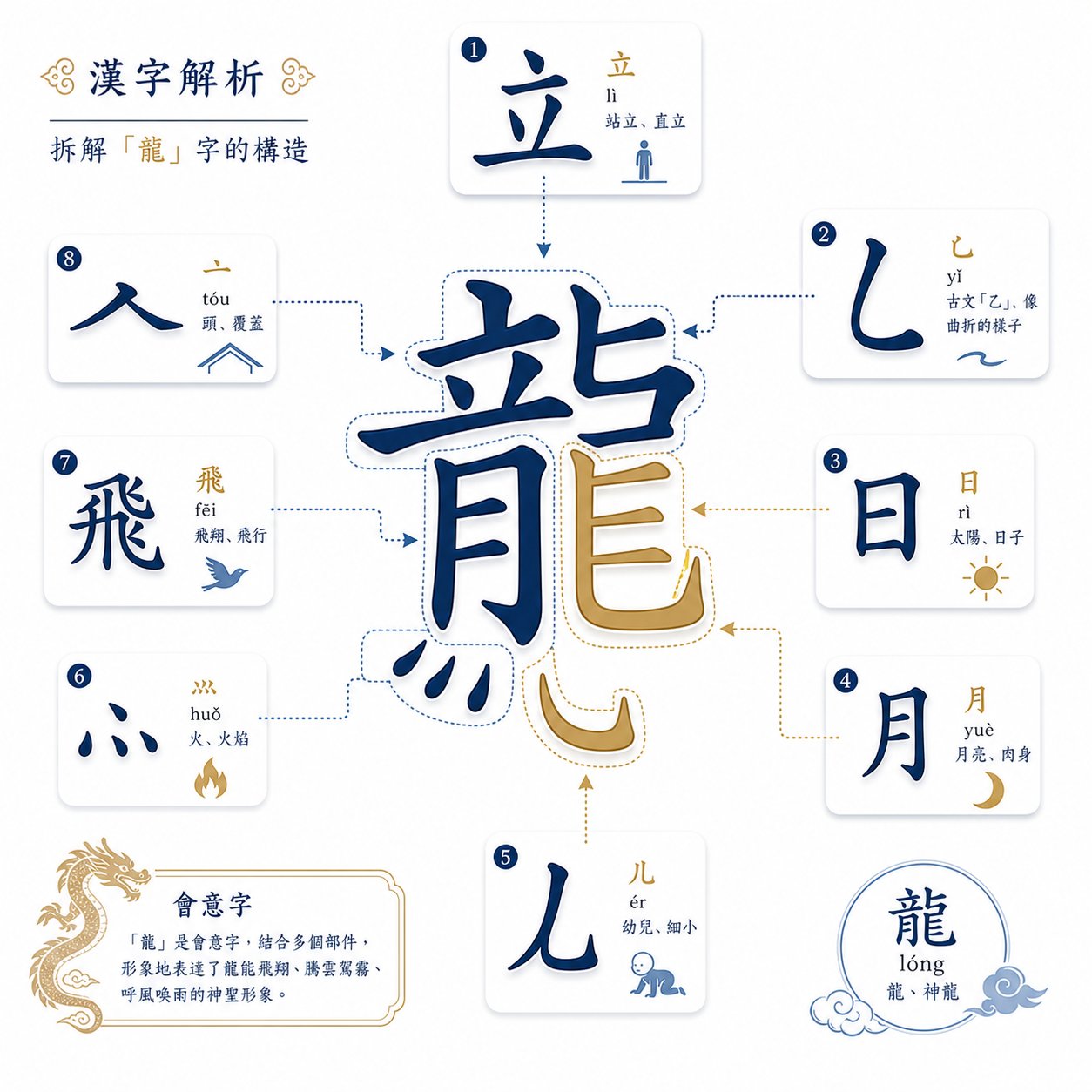
Radicals are the recurring components that appear inside Chinese characters. There are 214 radicals in total, but you do not need all of them. Learning just 50 to 100 of the most common ones gives you the building blocks that appear across thousands of characters. Think of them as a small alphabet hidden inside what looks like an impossibly large writing system.
Each radical carries meaning. The radical 水 (shui, water) appears in characters related to liquids and flowing: 海 (sea), 河 (river), 湖 (lake), 江 (river), 洗 (wash). Spot the three-dot water form 氵 on the left side of a character, and you immediately have a clue about what that character relates to. The radical 心 (xin, heart) shows up in characters tied to emotions and thought: 忆 (remember), 忘 (forget), 忙 (busy), 快 (fast/happy).
This is not always reliable. As Berlitz notes, radicals sometimes hint at pronunciation rather than meaning, and occasionally they offer no obvious clue at all. But even an imperfect system beats brute-force memorization. When you recognize a radical inside an unfamiliar character, you have a foothold. You are no longer staring at a random collection of strokes.
Here are ten of the most frequently occurring radicals, the ones that give you the biggest return on investment for any chinese character writing practice book or study plan:
| Radical | Pinyin | Meaning | Example Characters |
|---|---|---|---|
| 女 | nu | Woman | 妈 好 始 姓 安 |
| 水 / 氵 | shui | Water | 海 河 湖 江 洗 |
| 人 / 亻 | ren | Person | 你 他 仕 仙 例 |
| 心 / 忄 | xin | Heart | 忆 忘 忙 快 必 |
| 木 | mu | Tree | 森 林 相 根 本 |
| 口 | kou | Mouth | 吃 叹 品 吵 叫 |
| 火 / 灬 | huo | Fire | 灯 炎 热 点 然 |
| 讠 | yan | Speech | 说 话 语 讲 试 |
| 宀 | mian | Roof | 宁 安 定 容 它 |
| 子 | zi | Child | 孔 字 季 学 孩 |
Building Characters from Components Instead of Memorizing Whole Shapes
Most Chinese characters are compounds. They consist of two or more meaningful components arranged in predictable patterns. As Hacking Chinese explains, learning the building blocks transforms the task from memorizing thousands of unique symbols into learning to combine a few hundred pieces you already know.
Take the character 休 (xiu, to rest). It combines 人 (person) on the left with 木 (tree) on the right. A person leaning against a tree, resting. Once you know both components, writing this character from memory becomes straightforward. You are not recalling seven abstract strokes. You are writing "person" and then "tree," two shapes your hand already knows.
This decomposition approach directly improves your writing accuracy. When you sit down with a chinese character writing practice table or generator, you are no longer guessing what comes next mid-stroke. You know the character breaks into specific components, you know the order those components appear (left before right, top before bottom), and you know the internal stroke order of each piece. The whole character assembles itself from familiar parts.
Consider 想 (xiang, to think). It breaks into three layers: 木 (tree) and 目 (eye) stacked on top forming 相, with 心 (heart) sitting underneath. Tree, eye, heart. Each component is a radical you can learn independently, and each one carries meaning that connects to the whole: you see something (eye), consider it (tree as a phonetic element), and feel it in your heart. That kind of structural story sticks in memory far longer than raw repetition ever could.
The practical takeaway is simple. Before you fill pages with repetitions of a new character, spend thirty seconds breaking it apart. Identify the radicals. Note their positions. Understand why they are there. Then write the character as a sequence of known components rather than a single monolithic shape. This habit turns every practice session into compounding knowledge, where each new character reinforces the pieces you have already learned and makes the next unfamiliar character that much easier to decode.
Of course, knowing which characters to practice and in what order depends on the writing system you choose to study. That decision, simplified versus traditional, shapes everything from stroke count to which reference lists guide your progress.
Simplified or Traditional Characters and Which Path to Follow
Every radical you learn, every stroke order rule you internalize, applies to both simplified and traditional Chinese. But the characters themselves differ significantly between the two systems, and that difference affects your daily writing practice in concrete ways: how many strokes per character, which reference lists to follow, and what resources are available in your chosen system.
Simplified vs Traditional Characters for Practice
Simplified characters were introduced in mainland China during the 1950s to boost literacy rates. At the time, roughly 80% of the population was illiterate, and reducing stroke counts made reading and writing more accessible. Traditional characters, used for thousands of years prior, remain the standard in Taiwan, Hong Kong, and Macau.
What does this mean for your writing practice? Consider the character for "country." In simplified form, it is 国 (11 strokes). In traditional form, it is 國 (11 strokes as well in this case, though the interior differs). But look at "dragon": simplified 龙 has 5 strokes, while traditional 龍 has 16. Or "turtle": simplified 龟 uses 7 strokes, while traditional 龜 demands 16. That gap in stroke complexity adds up across hundreds of characters.
For someone focused on practice writing traditional chinese characters, each session naturally takes longer per character. You are forming more strokes, managing more complex spatial relationships within the grid, and building muscle memory for denser compositions. A worksheet designed for traditional characters needs larger grid squares and more repetition time per entry. If you are working from a chinese character writing practice book pdf, check whether it targets simplified or traditional, because the two systems require different pacing strategies.
That said, many characters are identical in both systems. Common words like 我 (I), 你 (you), 大 (big), and 一二三 (one, two, three) look the same regardless of which system you study. The radical knowledge you build transfers directly. The structural logic is shared. Choosing one system does not lock you out of the other permanently.
Choosing Your Study Path with HSK Standards
If you want a structured character list to guide your practice, the HSK (Hanyu Shuiping Kaoshi) proficiency exam provides one. But which version should you follow? The landscape has shifted recently.
The older HSK 2.0 system uses six levels with cumulative vocabulary counts: 150 words at HSK 1, scaling up to 5,000 words at HSK 6. The new HSK 3.0 (2026 update) restructures this into nine levels with adjusted word counts: 300 words at HSK 1, 500 at HSK 2, 1,000 at HSK 3, and so on up to 11,000 words across levels 7-9. The new system also distinguishes between characters you must recognize and characters you must be able to write by hand, which directly shapes how you allocate practice time.
For learners starting fresh, the HSK 3.0 framework offers a more gradual progression and includes modern everyday vocabulary. It is expected to fully replace HSK 2.0 in the second half of 2026. If you are building a long-term study plan and want to practice writing chinese characters pdf resources aligned with current standards, targeting the new HSK 3.0 word lists makes sense.
So how do you decide which system fits your goals? Consider these factors:
- Where you plan to live or travel. Mainland China and Singapore use simplified characters. Taiwan, Hong Kong, and Macau use traditional.
- Academic or professional requirements. Most university Chinese programs and the HSK exam use simplified. AP Chinese and some heritage programs may use traditional.
- Cultural interests. Classical literature, calligraphy, and historical texts use traditional characters. Modern media, business, and technology content from China uses simplified.
- Available resources. Simplified materials are far more abundant. Roughly 98% of new Chinese publications worldwide use simplified characters.
- Long-term flexibility. If your destination is uncertain, simplified gives you broader coverage. You can always layer traditional knowledge on top later, since recognizing traditional characters is easier once you know the simplified equivalents and their shared radicals.
Neither choice is wrong. Both systems share the same spoken language, the same grammar, and the same radical foundations. The difference lives entirely on the page, in the number of strokes your hand must produce and the specific shapes those strokes form. Pick the system that matches where you will actually use the language, then commit to it fully in your daily practice.
Whichever path you choose, the physical act of writing demands the right tools. Grid paper, pen selection, and workspace setup all influence how well your characters turn out, and different grid formats serve surprisingly different purposes.
Practice Materials and Setting Up Your Writing Space
A character written without spatial awareness is like a word spelled with the right letters in the wrong order. You might recognize it, but something feels off. Chinese characters live inside an invisible square, and every component must sit in its proper position within that square for the character to look correct. The tools you use to practice, especially your grid paper, directly shape how well you develop that spatial sense.
Understanding the Character Grid and Spatial Balance
Every Chinese character occupies roughly the same amount of space, regardless of whether it has 3 strokes or 23. A simple character like 一 (one) fills the same square as a complex one like 藏 (hide). This is fundamentally different from alphabetic writing, where word length varies. In Chinese, each character must be balanced within its box, and components need to be sized proportionally to each other.
What does spatial balance actually mean in practice? Consider a left-right character like 好 (good). The left component 女 (woman) and the right component 子 (child) do not split the square evenly. The left side typically takes about 40% of the width, while the right side takes 60%. If you give both halves equal space, the character looks cramped on the right and loose on the left. These proportional relationships are not random. They follow patterns based on component complexity and stroke density.
Top-bottom characters work similarly. In 想 (think), the upper portion 相 takes roughly 60% of the vertical space, while the lower component 心 (heart) sits compactly in the remaining 40%. Enclosed characters like 国 (country) need the interior content centered within the frame, with consistent margins on all sides. Getting these proportions right is what separates legible handwriting from characters that look like they are falling apart.
This is where chinese character writing practice paper becomes essential. Writing on blank paper gives you no reference points. You end up with characters that drift in size, lean to one side, or crowd their components together. Grid paper provides the scaffolding your eye needs while spatial awareness is still developing.
Choosing the Right Practice Paper Format
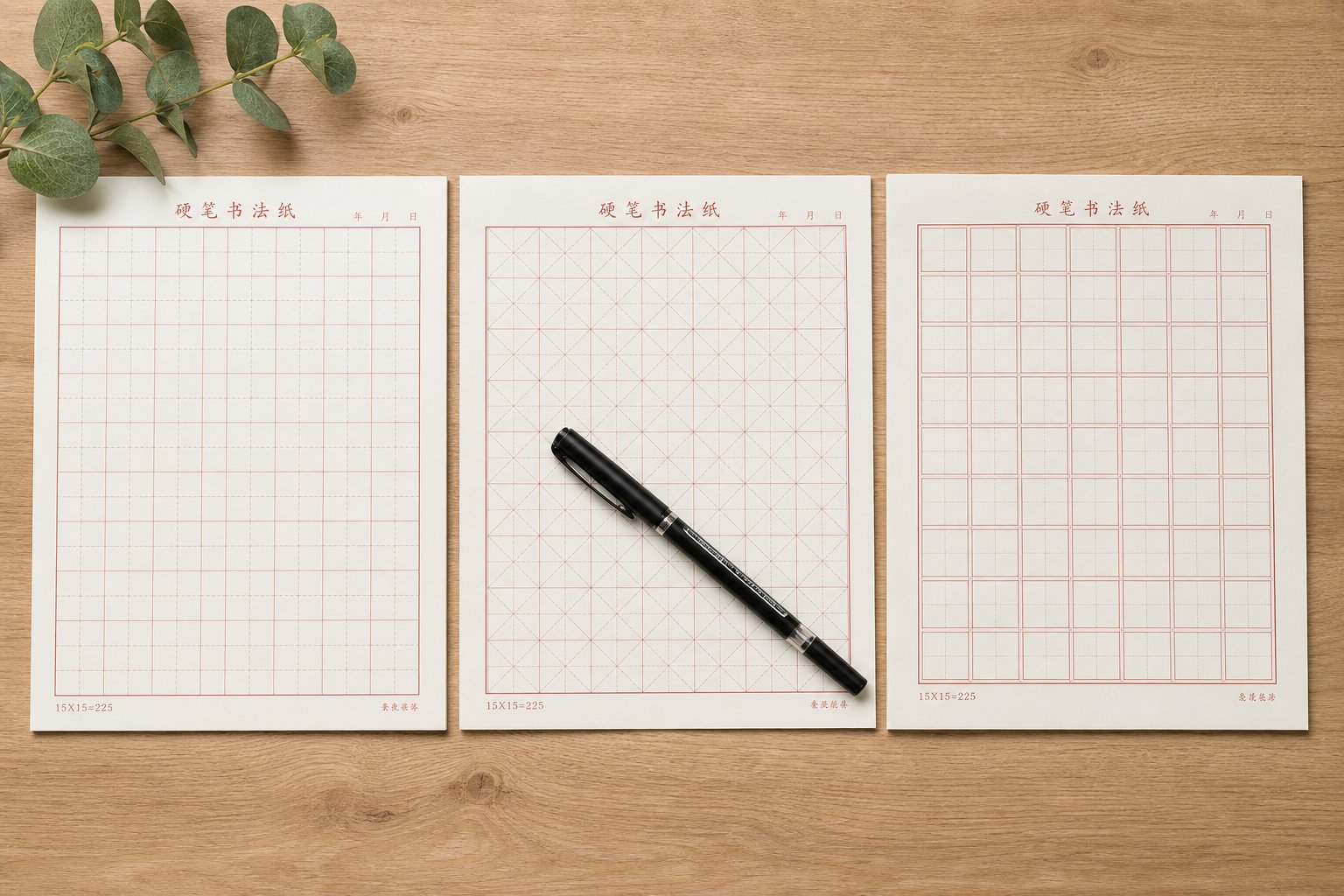
Not all grid paper is created equal. Different formats offer different levels of structural guidance, and the right choice depends on your current skill level and what aspect of writing you are working to improve. Here are the three most common types used for chinese character writing practice sheets:
| Grid Type | Structure | Best For | When to Use |
|---|---|---|---|
| Tian Zi Ge (田字格) | Square divided into four equal quadrants by a vertical and horizontal center line | Beginners learning stroke placement, character proportion, and basic structure | First 3-6 months of practice or when learning new characters with unfamiliar structures |
| Mi Zi Ge (米字格) | Square divided by vertical, horizontal, and two diagonal lines forming the shape of 米 (rice) | Refining symmetry, diagonal stroke angles, and precise stroke placement for calligraphy | After basic proportions feel comfortable, or when practicing characters with prominent diagonal strokes |
| Jiu Gong Ge (九宫格) | Square divided into nine equal sub-blocks in a 3x3 arrangement | Visualizing component positioning, radical placement, and correcting proportion errors | When struggling with multi-component characters or when a teacher identifies specific spatial issues |
Tian Zi Ge is the standard starting point and the format used in Chinese elementary schools. The center lines give you two critical reference points: where the vertical axis of your character should fall, and where the horizontal midpoint sits. When you write a character like 中 (middle), the main vertical stroke should land directly on that center line. The horizontal stroke of the inner box should align with the horizontal guide. These visual anchors train your eye to center characters naturally.
Mi Zi Ge adds diagonal guides that help with strokes like 撇 (left-falling) and 捺 (right-falling). If you are practicing characters with strong diagonal elements, like 大 (big) or 人 (person), the diagonal lines show you exactly what angle those strokes should follow. This format is popular among calligraphy learners who need precision beyond what four-quadrant grids provide.
Jiu Gong Ge offers the most granular guidance. With nine sub-blocks, you can pinpoint exactly where each component of a character should begin and end. For a left-right character, the left component might occupy the left column of blocks while the right component fills the center and right columns. This level of detail is especially useful for younger students or in handwriting correction exercises where specific proportion problems need targeted fixing.
As your spatial awareness improves, you will naturally graduate to simpler formats. Many intermediate learners move to Fang Ge Zhi (方格纸), plain squares with no internal lines, which encourages self-reliant structure without visual scaffolding. The progression looks like this: Jiu Gong Ge or Tian Zi Ge for beginners, Mi Zi Ge for refinement, Fang Ge Zhi for independence, and eventually blank paper for fluency.
For paper size, A4 or B5 formats work well for desk practice. If you want portability, bound notebooks are easier to carry. If you prefer printing custom pages from a chinese character writing practice table pdf, loose-leaf sheets give you flexibility to generate exactly the characters you need for each session.
Creating an Effective Practice Environment
Your writing tools and workspace matter more than most learners realize. A wobbly table, a scratchy pen, or a cluttered desk introduces friction that pulls your attention away from the characters themselves.
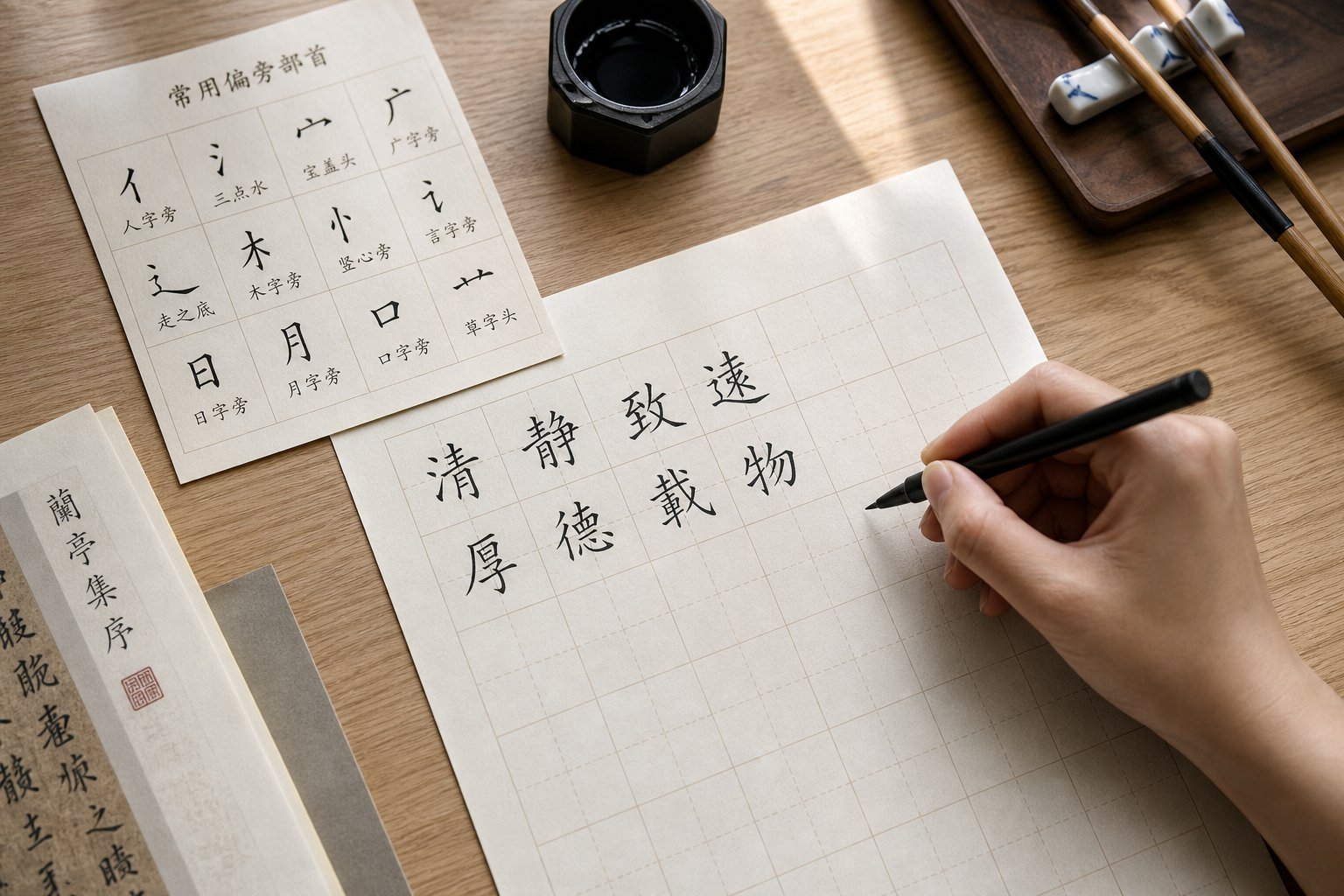
For pens, a standard ballpoint or gel pen with a 0.5mm or 0.7mm tip works well for everyday practice in chinese characters boxes. The ink should flow smoothly without skipping or blobbing. Some learners prefer felt-tip pens because they mimic the slight variation in stroke width that brush writing produces, giving characters a more natural appearance. Avoid pencils for regular practice. The graphite smudges easily, and the lack of commitment (you can erase) reduces the mental engagement that builds memory.
If you are interested in brush calligraphy, that requires different materials entirely: a Chinese brush (毛笔), ink or ink stick, and absorbent paper like xuan paper (宣纸). But for standard character learning, a good pen and proper grid paper are all you need.
Your physical setup should minimize distractions. Write at a desk or table with a flat, stable surface. Keep your reference material, whether a textbook, phone with stroke order animations, or printed character list, positioned above or to the side of your writing paper so your eyes move naturally between the model and your work. Avoid writing in bed or on soft surfaces where your hand lacks a firm base.
Timing matters too. Even 10 to 15 minutes of focused daily practice produces better results than an hour-long session once a week. Set a consistent time, gather your materials beforehand, and treat the session as a quiet, deliberate activity. Say the pronunciation aloud as you write each character. This links the sound to the motor memory and reinforces the connection between spoken and written Chinese.
With the right grid format under your pen and a distraction-free space around you, the physical conditions for effective practice are set. The next question is what goes on those sheets: which worksheets and printable resources actually help you improve, and what separates a useful practice sheet from a waste of paper.
Worksheets and Printable Practice Sheets That Work
A practice worksheet is only as good as the structure it provides. Printing a page of empty grid squares and filling them with random characters might keep your hand busy, but it will not build skill efficiently. The difference between a productive session and wasted effort often comes down to what is on the sheet before you start writing.
What Makes a Practice Worksheet Effective
Think about what you actually need when sitting down to practice writing chinese characters. You need to see the target character clearly. You need to know the correct stroke order. You need pronunciation information so the sound connects to the shape. And you need a progression that moves from guided tracing to independent recall. A well-designed worksheet delivers all of this on a single page.
Here is what to look for when choosing chinese character writing practice worksheets or generating your own:
- Stroke order diagrams. Each character should include a step-by-step breakdown showing the sequence of strokes. Without this, you are guessing, and guessing builds bad habits.
- Pinyin and tone marks above the character. Seeing the pronunciation while you write reinforces the sound-shape connection. You are training two skills simultaneously.
- Graded repetition boxes. The best sheets start with a lightly printed trace character, then a dotted outline, then empty squares. This moves you from copying to recall within a single row.
- Appropriate grid size. Squares should be at least 2 cm for beginners. Anything smaller cramps your strokes and hides proportion errors. Larger grids (3-4 cm) work better for complex characters.
- Radical or component labels. Sheets that identify the radicals within each character help you practice decomposition alongside writing.
- Progressive difficulty. Characters should be ordered from fewer strokes to more, or grouped by shared radicals, not presented randomly.
- Meaning in context. A short example word or phrase using the character gives you a reason to remember it beyond the isolated form.
If a practice writing chinese characters worksheet pdf lacks most of these features, it is essentially blank grid paper with a character printed at the top. That is fine for review, but not for learning new characters.
Printable Sheets and PDF Resources for Structured Practice
Several online generators let you create custom chinese character writing practice pdf sheets tailored to your current study list. You type in the characters you want to practice, select your grid type, choose whether to include pinyin and stroke order, and download a printable page. This approach beats generic workbooks because you control exactly which characters appear and in what order.
When evaluating a practice writing chinese characters printable resource, check whether it allows you to adjust grid size, select between simplified and traditional forms, and toggle stroke order visibility. The ability to print the same character with stroke guides on one page and without them on the next gives you a built-in self-test. Write with the guide first, then attempt the character from memory on the blank grid.
A chinese character writing practice book works well for learners who prefer a bound, sequential format. The best ones organize characters by HSK level or radical family, include writing space alongside stroke diagrams, and provide periodic review sections that mix previously learned characters with new ones. Look for books that include audio access or QR codes linking to pronunciation, since hearing the tone while writing deepens the memory trace.
This brings up a connection many learners overlook: pinyin is not separate from character writing. It is part of the same learning loop. When you write a character, saying its pinyin aloud activates phonological memory alongside motor memory. When you later hear that sound in conversation, your brain retrieves not just the meaning but the physical sensation of writing it. As Hacking Chinese emphasizes, learners should practice pronunciation and meaning at the same time as writing, because roughly 90% of characters contain a phonetic component that hints at their sound. Knowing pinyin helps you spot those phonetic patterns, which in turn helps you predict and remember how unfamiliar characters are written.
The strongest practice routine pairs physical worksheets with a digital feedback layer. You write on paper for the motor memory benefits, then check your work against an app that shows correct stroke order and flags errors. That combination of analog writing and digital verification is where the next set of tools comes in.
Apps and Online Tools for Digital Writing Practice
Paper builds the motor memory. Digital tools tell you whether what you wrote is actually correct. That feedback loop, writing by hand and then verifying with technology, is where real improvement happens. But not every app to practice writing chinese characters delivers equal value. Some are glorified flashcard decks. Others offer genuine stroke-level analysis that catches errors your eye would miss.
Key Features to Look for in Writing Practice Apps
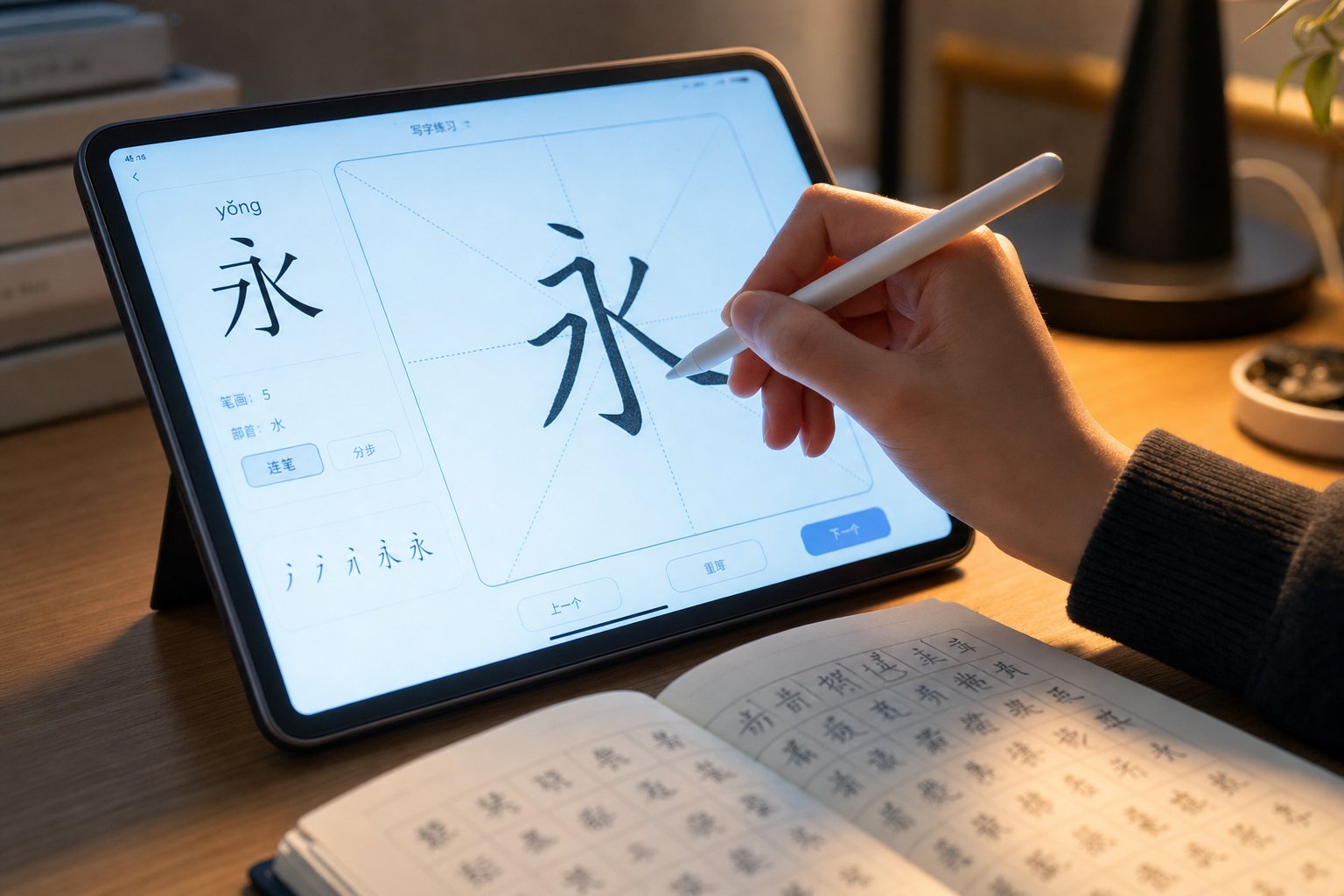
The best app to practice writing chinese characters does more than show you an animation and let you trace over it. It watches how you write, evaluates your output, and tells you specifically what went wrong. When evaluating a chinese character writing practice app, rank these features by how directly they improve your actual handwriting:
- Handwriting recognition with stroke-level feedback. This is the most critical feature. The app should detect incorrect stroke order, wrong stroke direction, and missing strokes in real time. Research on AI stroke recognition shows that current deep learning systems achieve character recognition accuracy between 92% and 98%, with stroke order recognition reaching 86% accuracy. That level of precision is sufficient to catch the errors that matter most for learners.
- Stroke order animation with speed control. You should be able to watch each stroke form slowly, pause between strokes, and replay specific sequences. Static diagrams work on paper, but animation reveals the flow and rhythm between strokes that static images cannot convey.
- Spaced repetition integration. An app that tracks which characters you have written correctly and which ones gave you trouble, then schedules review accordingly, saves you from the common mistake of practicing what you already know while neglecting what you have forgotten.
- Writing canvas that mimics paper resistance. On tablets especially, the writing surface should feel responsive. A slight delay or overly smooth canvas distorts your stroke proportions and trains incorrect muscle memory.
- Offline access. Practice happens in waiting rooms, on commutes, and in places without reliable internet. If the app requires a connection to display characters or provide feedback, it becomes useless exactly when you have spare time to practice.
- Grid overlay options. The app should offer tian zi ge or mi zi ge guides on the writing canvas, matching the grid paper formats you use for physical practice. Consistency between your digital and paper environments reinforces spatial awareness.
- Character set alignment with HSK or custom lists. You want to practice the characters relevant to your current level, not a random selection. Look for apps that let you import custom word lists or follow structured curricula.
A practice writing chinese characters app that checks most of these boxes gives you something no worksheet can: immediate, objective correction. You do not need to wait for a teacher to review your work or compare your characters against a model and hope you spot the difference.
Online Platforms for Interactive Character Practice
Beyond standalone apps, browser-based platforms offer practice writing chinese characters online without installing anything. These work well on shared computers or when you want a larger screen for detailed stroke work. The best platforms combine dictionary lookup, stroke animation, and a writing canvas in one interface, so you can search for a character, watch its construction, and immediately practice it.
Phone and tablet options each have distinct advantages. Tablets, particularly with a stylus, provide a writing surface close to paper size. Your hand moves naturally, and stroke proportions translate more accurately to real handwriting. Phones are more portable but force you to write in a smaller area, which can distort your sense of character proportions. If your primary device is a phone, use it for stroke order review and spaced repetition quizzes, but do your actual writing practice on paper or a tablet where the scale matches real handwriting.
One pattern worth noting from recent research: the relationship between digital tools and physical writing is not competitive but complementary. The DTIF-OCCI framework published in 2026 proposes that beginners benefit from heavier AI scaffolding (around 60% digital, 40% handwriting) because real-time error correction prevents bad habits from forming early. As proficiency grows, the ratio flips. Intermediate and advanced learners should spend 70-80% of their time on physical handwriting, using apps primarily for diagnostic feedback on problem characters rather than as the main practice surface.
The takeaway is straightforward: digital tools are your quality control system, not your primary training ground. Write on paper to build the motor pathways. Use apps to verify accuracy, review forgotten characters, and maintain a structured schedule. That division of labor, pen for encoding and screen for checking, produces faster progress than relying on either one alone.
Knowing which features matter in an app is half the equation. The other half is knowing when and how often to use it. A structured review schedule, built on spaced repetition principles, determines whether characters stick for days or for years.
Building a Spaced Repetition Routine and Self-Assessment Skills
Writing a character correctly once proves you can do it in that moment. Writing it correctly three weeks later, without any reference, proves you actually know it. The gap between those two outcomes is where most learners lose characters they thought they had memorized. Spaced repetition closes that gap by scheduling reviews at precisely the intervals your brain needs to consolidate a memory before it fades.
Applying Spaced Repetition to Character Writing Sessions
The core principle is simple: review a character just before you would forget it. Each successful recall pushes the next review further into the future. Each failure pulls it back to a shorter interval. Over time, well-known characters appear rarely while troublesome ones show up frequently. This is far more efficient than writing every character the same number of times regardless of difficulty.
The spacing effect works because each retrieval effort strengthens the memory trace more than passive re-exposure ever could. Writing a character from memory after three days of not seeing it does more for retention than writing it twenty times in a single sitting.
For character writing specifically, the retrieval must be productive, not receptive. That means your prompt should be the pinyin and meaning, and your task is to produce the character on paper from memory. Seeing the character and recalling its meaning is a different skill entirely. A chinese character practice writing program for phone or tablet can handle the scheduling automatically, showing you prompts at calculated intervals and tracking your accuracy over time.
How many new characters should you introduce per day? For most learners, 3 to 5 new characters is sustainable. That number sounds small, but it compounds. Five characters per day, with proper retention, gives you over 1,800 characters in a year. That exceeds HSK 4 requirements. The mistake learners make is adding 10 or 15 new characters daily, which creates a review backlog that becomes unmanageable within weeks. Your daily review load grows with every new character you add, so conservative introduction rates keep the total session time reasonable.
A practical weekly schedule balances new character introduction with review sessions and rest. Here is a sample structure that keeps total daily practice under 30 minutes:
- Monday: Introduce 3-5 new characters. Write each one 5-8 times with full attention to stroke order and proportion. Study the radicals and components before writing.
- Tuesday: Review Monday's characters from memory (no peeking). Then complete spaced repetition reviews of older characters due today. Introduce 3-5 new characters if time allows.
- Wednesday: Spaced repetition reviews only. No new characters. Use this session to focus on quality, rewriting any character you got wrong until it feels solid.
- Thursday: Introduce 3-5 new characters. Review any characters from earlier in the week that gave you trouble.
- Friday: Full review session. Write all characters introduced this week from memory. Mark any you cannot produce correctly for extra review next week.
- Saturday: Contextual practice. Write sentences or short phrases using characters from your active study list. This reinforces individual characters while building fluency.
- Sunday: Rest or light review. If you feel motivated, browse your character list and identify patterns. If not, take the day off entirely. Consistency across months matters more than perfection in any single week.
This schedule works whether you use a dedicated chinese character practice writing program for phone or tablet android, a desktop application like Anki, or a simple notebook with a manual tracking system. The key variable is not the tool but the consistency. As Migaku's writing guide emphasizes, the spaced repetition algorithm only works when you trust it and show up daily. Skipping reviews for a week breaks the spacing and causes you to forget characters you had already learned.
If you prefer a free chinese character practice writing program for iphone or Android, look for apps that let you create production cards rather than recognition-only cards. The prompt shows pinyin and English meaning. You write the character on paper, then flip the digital card to check your answer. Mark it correct or incorrect, and the algorithm adjusts the next review date accordingly. This hybrid approach gives you the motor memory benefits of pen-on-paper with the scheduling intelligence of software.
How to Self-Assess Your Writing Without a Teacher
Spaced repetition tells you when to review. Self-assessment tells you whether what you wrote is actually good enough. Without a teacher looking over your shoulder, you need a reliable method for evaluating your own characters. Here is how to do it honestly.
Start with stroke order verification. After writing a character from memory, check it against a stroke order diagram or animation. Did you produce every stroke in the correct sequence? A single stroke out of place might not make the character unrecognizable, but it means your muscle memory is encoding the wrong pattern. Count this as incorrect in your spaced repetition system, even if the final shape looks right. The process matters as much as the product.
Next, evaluate proportions. Place your written character beside a printed model at the same size. Ask yourself three questions: Are the components sized correctly relative to each other? Is the character centered within its grid square? Do the strokes extend to appropriate lengths, or are some too short or too long? Proportion errors are the hardest to self-diagnose because your eye adjusts to your own handwriting. Comparing directly against a model, side by side, forces objectivity.
Check for missing or extra strokes. This sounds obvious, but complex characters with 15 or more strokes are easy to shortchange. Count the strokes in your version and compare against the reference. A missing dot or an extra tick changes the character entirely. The difference between 大 (big) and 太 (too much) is a single dot. Between 末 (end) and 未 (not yet), it is the relative length of two horizontal strokes.
Finally, test readability at a distance. Hold your practice sheet at arm's length. Can you still identify each character clearly? If any character blurs into ambiguity, its proportions or stroke clarity need work. Native readers process characters at a glance. If your writing requires close inspection to decode, it is not yet at a functional level.
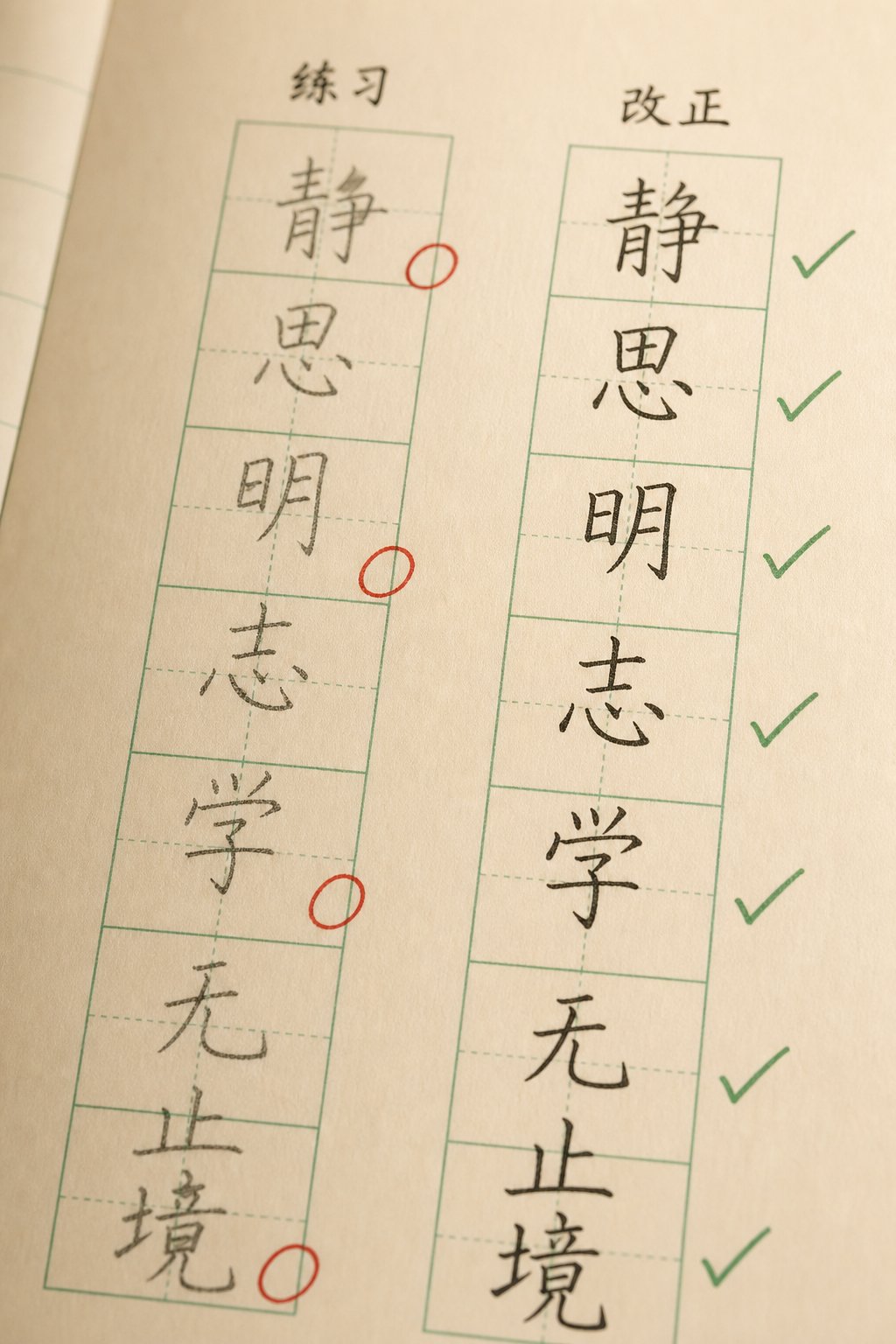
Dedicate the last two minutes of each practice session to this self-assessment routine. Circle characters that failed any of the four checks: stroke order, proportion, stroke count, and distance readability. These circled characters get extra repetitions in your next session and a shorter interval in your spaced repetition schedule. Over weeks, the number of circled characters per session will shrink. That shrinking is your most concrete measure of progress.
Even with a solid routine and honest self-evaluation, certain errors persist because learners do not realize they are making them. The most common mistakes follow predictable patterns, and knowing what to watch for can save you months of reinforcing the wrong habits.
Common Mistakes to Avoid and How to Fix Them
Some mistakes are obvious the moment you compare your character to a model. Others hide in plain sight, quietly reinforcing themselves session after session until they become deeply embedded habits. The most damaging errors in chinese characters writing practice are not the ones you catch immediately. They are the ones you repeat a hundred times before realizing something is wrong.
Stroke Order and Proportion Errors That Hold You Back
Incorrect stroke order tops the list because it is invisible in the final product. Your character might look fine, but if you built it in the wrong sequence, your muscle memory is encoding a pattern that will eventually betray you. When speed increases or you attempt semi-cursive writing, wrong stroke order produces characters that fall apart. The fix is straightforward but requires discipline: verify stroke order for every new character before you write it the first time. Never assume. Even experienced learners discover they have been writing common characters in the wrong order for years.
Poor proportions are the second most persistent issue. Beginners tend to give equal space to every component, but Chinese characters are not symmetrical by default. A left-right character like 说 (speak) allocates roughly one-third of the width to the speech radical 讠 and two-thirds to 兑. Writing both halves the same size makes the character look bloated on the left and cramped on the right. The correction: always practice on grid paper with center lines, and consciously observe how much space each component occupies in the printed model before you write.
Missing strokes are especially common in characters with high stroke counts. A character like 赢 (win) has 17 strokes, and skipping one small dot or tick changes it into nonsense. The fix is to count strokes after writing and compare against the reference. If your count does not match, find the missing piece before moving on. Practicing too many characters at once amplifies all of these problems. As Migaku's practice guide notes, learning 50 new characters in one weekend feels productive, but you will forget most of them without proper review. Three to five new characters per day with thorough attention beats volume every time.
Confusing Similar Characters and How to Tell Them Apart
Visually similar characters are the trap that catches intermediate learners hardest. As Hacking Chinese explains, the real challenge shifts over time: beginners struggle to remember how components look, but experienced learners struggle to keep similar characters apart. You know both characters individually, yet in the moment of writing, you reach for the wrong one.
Here are commonly confused pairs and the specific differences that distinguish them:
| Character A | Character B | Key Difference |
|---|---|---|
| 己 (ji, self) | 已 (yi, already) | 己 has an open top-right corner. 已 closes that corner with the last stroke extending further right. |
| 末 (mo, end) | 未 (wei, not yet) | 末 has a longer top horizontal stroke. 未 has a longer bottom horizontal stroke. |
| 土 (tu, earth) | 士 (shi, scholar) | 土 has a longer bottom stroke. 士 has a longer top stroke. |
| 大 (da, big) | 太 (tai, too much) | 太 adds a single dot below the intersection. 大 has no dot. |
| 拨 (bo, to move) | 拔 (ba, to pull) | 拨 contains 发 on the right. 拔 contains 犮 with a longer top stroke and no dot. |
| 贝 (bei, shell) | 见 (jian, see) | 贝 has two interior dots. 见 has a horizontal stroke and a vertical hook inside. |
The solution for confused pairs is not more repetition. It is deliberate contrast. Write both characters side by side on the same writing chinese characters practice sheets page. Label the exact stroke or proportion that differs. Create a mnemonic that anchors the distinction. For 末 and 未, imagine the "end" (末) pressing down heavily on the bottom, making that stroke longer. For "not yet" (未), the longer bottom stroke suggests something still growing upward, not finished. Whatever story sticks for you personally works best.
When you catch yourself confusing a pair, add both characters to your spaced repetition queue as linked items. Review them together so your brain practices the distinction, not just the individual shapes. This targeted approach resolves confusion far faster than simply writing each character more times in isolation.
Every mistake discussed here traces back to the same root cause: practicing without a system. Copying characters mindlessly, skipping structural analysis, and ignoring review schedules all produce the same outcome: slow progress and frustrating plateaus. The methodology-first path laid out in this guide, start with radicals, respect stroke order, use proper grids, apply spaced repetition, and self-assess honestly, turns chinese writing characters practice from a grind into a compounding skill. Each session builds on the last. Each new character becomes easier because you already know its parts. Start with the system, trust the process, and let consistency do the heavy lifting.
Frequently Asked Questions About Chinese Character Writing Practice
1. How many Chinese characters should I practice writing per day?
For sustainable progress, aim for 3 to 5 new characters per day. This may seem modest, but it compounds to over 1,800 characters in a year, exceeding HSK 4 requirements. Introducing too many characters at once, such as 10 or 15 daily, creates an unmanageable review backlog within weeks. The key is pairing new introductions with consistent spaced repetition reviews of previously learned characters, keeping total daily practice under 30 minutes while ensuring strong long-term retention.
2. What is the best grid paper for Chinese character writing practice?
Tian Zi Ge (田字格) is the best starting grid for beginners. It divides each square into four quadrants with vertical and horizontal center lines, helping you place strokes accurately and develop proportional awareness. As you improve, Mi Zi Ge adds diagonal guides for refining angled strokes, while Jiu Gong Ge offers a 3x3 sub-block layout for correcting specific proportion problems. Most learners progress from guided grids to plain squares and eventually blank paper as their spatial awareness matures.
3. Should I learn simplified or traditional Chinese characters?
Your choice depends on where you plan to use the language. Simplified characters are standard in mainland China and Singapore, while traditional characters are used in Taiwan, Hong Kong, and Macau. Simplified offers more abundant learning resources and lower stroke counts per character, making daily practice sessions shorter. However, both systems share the same radicals, grammar, and spoken language. If your destination is uncertain, simplified provides broader coverage, and you can layer traditional knowledge on top later.
4. Do apps replace handwriting for Chinese character practice?
No. Digital tools complement physical writing but cannot replace it. Research shows that handwriting activates brain regions responsible for movement, vision, sensory processing, and memory in ways that screen-based input does not. The most effective approach uses paper for building motor memory and apps for verifying stroke order accuracy, scheduling spaced repetition reviews, and diagnosing problem characters. As proficiency grows, learners should spend 70-80% of practice time on physical handwriting.
5. Why is stroke order important when practicing Chinese characters?
Stroke order determines character balance, readability, and writing speed. Following correct sequences produces natural pen flow that results in properly proportioned strokes. Incorrect order trains muscle memory patterns that cause characters to look lopsided at higher writing speeds and fail handwriting recognition on digital devices. Stroke order also reveals character structure by training your eye to identify radicals and components as distinct units, which accelerates memorization of new characters.