What Chinese Family Names Reveal About Your Ancestry
Imagine carrying a piece of history in your name that stretches back over 4,000 years. That's exactly what Chinese surnames do. They form the oldest continuous naming system on the planet, with roots reaching into the third millennium BC, when the legendary Yellow Emperor is said to have ordered people to adopt hereditary family names. Western surnames, by comparison, didn't become common until the Middle Ages. Chinese family names were already ancient by then.
Why Chinese Surnames Are the World's Oldest Naming System
A family name in Chinese isn't just an identifier. It's a compressed archive. Each of the roughly 12,000 Chinese last names recorded throughout history encodes specific information about where your ancestors lived, what they did, which clan they belonged to, or whether an emperor granted them a new identity. Some Chinese names trace back to ancient fiefdoms. Others reflect official titles, totemic animals, or ethnic origins absorbed through centuries of cultural exchange. When you understand the chinese name meaning behind your surname, you're reading a story written across millennia.
What Your Chinese Family Name Encodes About Your Ancestors
Here's what makes this personal. With only about 400 different chinese family names in active use today, and out of those, a handful dominating the population, knowing the origin of your specific surname becomes essential for distinguishing your lineage from millions of others.
The three most common Chinese surnames, Li, Wang, and Zhang, are shared by more than 270 million people, making an understanding of chinese family name origins critical for tracing individual ancestry.
This concentration means that two people sharing chinese last names might descend from entirely different clans, regions, or historical circumstances. The surname alone isn't enough. You need the origin story. And those stories, it turns out, begin with a dual naming system so old that it predates unified China itself.
The Ancient Dual Naming System Before the Han Dynasty
Before there was one surname system, there were two. And the difference between them shaped how do chinese names work at the deepest structural level. In ancient China, people didn't carry a single family name. They carried a xing (姓) and a shi (氏), two distinct markers that served entirely different social functions. Confusing them is one of the most common mistakes people make when studying ancient chinese names, so let's break it down simply.
Xing and Shi Explained Simply
Think of xing as the broad clan banner and shi as the specific family branch beneath it. During the Zhou Dynasty (1046-256 BC), xing functioned as matrilineal clan identifiers tied to mythological or semi-divine ancestors. Notice the character itself: 姓 contains the radical 女 (woman), reflecting these matrilineal origins. Each xing traced back to a legendary figure whose deeds survived only in ancient literature, half human and half divine.
Shi, on the other hand, was more concrete and more recent. It was granted to male descendants based on their fiefdoms, official titles, or occupations. While the ancestor behind a xing might be impossible to verify historically, the ancestor behind a shi could usually be traced with precision because the family organization it represented was newer, with clearer genealogical records.
Here's the practical distinction: xing determined who you could marry (people sharing the same xing could not wed), while shi determined your social rank and political identity. Women used xing; men were known by their shi in public life. One clan sharing a single xing could contain dozens of different shi families beneath it.
How Two Ancient Systems Merged Into One
The ancient chinese surname 姬 (Ji) offers the clearest illustration. Ji was the ancestral xing of the entire Zhou royal house, tracing its mythological origin to the culture hero Houji, whose miraculous birth was attributed to his mother stepping into a footprint left by the supreme god Shangdi. Thirty-nine Zhou kings carried this xing.
But as the Zhou dynasty parceled out territory to royal relatives, each branch adopted a shi based on their granted state or fief. Descendants ruling the State of Wu took Wu as their shi. Those governing the State of Lu became the Lu family. Rulers of the states of Zheng, Wey, Jin, Yan, Cai, and Cao all descended from Ji but carried different shi names. Over centuries, one xing spawned dozens of ancient chinese family names that are still in use today, including Wang, Zhou, Wu, Zheng, and Wei.
The Han Dynasty Turning Point
So when did these two layers collapse into the single surname in chinese that we recognize today? The merger happened gradually between the Warring States period (481-221 BC) and the Western Han Dynasty (202 BC - 9 AD). As feudal structures disintegrated under Qin unification, the social conditions that kept xing and shi separate disappeared. Fiefdoms were abolished. The rigid hierarchy that once reserved shi for nobility broke down. Commoners, who previously had no surnames at all, began adopting fixed hereditary names.
By the middle of the Han Dynasty, the distinction between xing and shi had fully dissolved. The marriage taboo tied to xing weakened. The status signaling of shi faded. What remained was a single, unified surname (中文: 姓) passed from father to child, generation after generation. This is the system that persists today and the foundation for understanding first name and last name chinese naming conventions in the modern era.
The merger was efficient, but it also erased visible connections. Families that once shared the same xing now appeared unrelated because their shi had become their only surname. This is precisely why understanding the origin category behind each modern surname matters so much, and why those categories are more varied than most people expect.
Six Ways Chinese Surnames Were Created
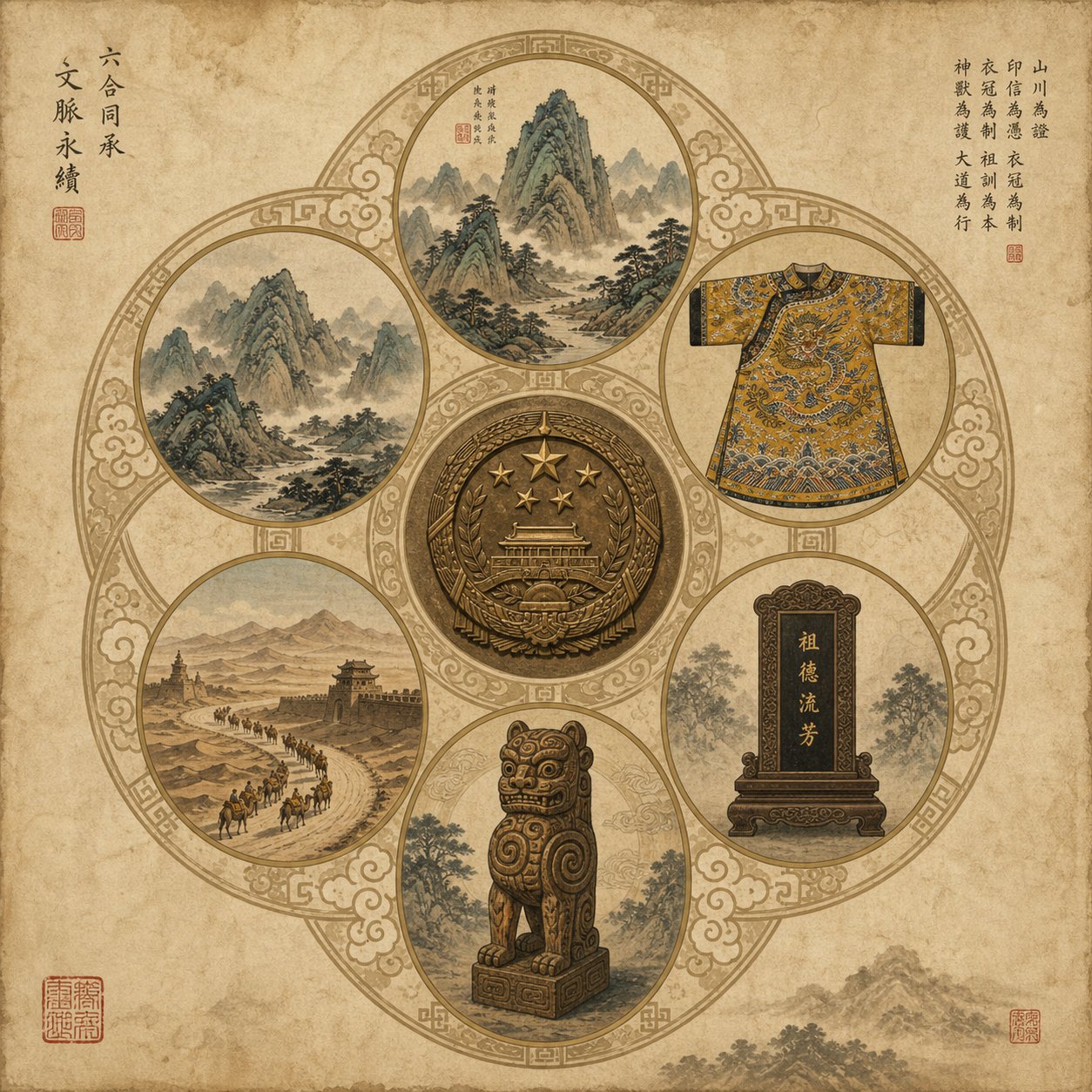
Historians have identified at least six distinct pathways through which chinese surnames and meanings came into existence. Some families took their name from the land they governed. Others inherited the job title of a distant ancestor. Still others received a brand-new surname from an emperor's decree. When you trace chinese last names and meanings back to their source, each one falls into a recognizable category, and knowing which category yours belongs to tells you something concrete about your ancestors' lives.
Geographic and Place-Based Surname Origins
The largest single source of Chinese surnames is geography. During the Zhou Dynasty's feudal era, nobles received fiefdoms, and those place names became hereditary identifiers for their descendants. The state of Chen gave rise to the surname Chen. The state of Song produced the surname Song. The state of Wu became the Wu surname. When these kingdoms fell, commoners who lived within their borders often adopted the state name as a marker of identity and allegiance.
Beyond state names, smaller geographic features also generated surnames. A township, a mountain, or a river crossing could become a family's permanent label. The surname Lu traces to the ancient state of Lu in modern Shandong. Ouyang originated from a fief called Ouyangting. According to FamilySearch records, nearly 200 surnames derive from place names alone, though many of the compound versions have since disappeared.
Occupation and Title-Derived Surnames
Imagine your great-great-grandfather held the title "Minister of War." Centuries later, that job title is your last name. That's exactly what happened with Sima (司马), which originally meant military commander. Tao (陶) came from potters. Wu (巫) descended from shamans. Situ (司徒) traces to an official responsible for land and population management.
Official positions weren't the only occupations that became surnames. Humbler trades left their mark too. The meaning of chinese last names in this category is often hiding in plain sight once you know the character's original definition.
A related but distinct pathway involved ancestral given names or style names being passed down as surnames. A grandfather's courtesy name could become his grandchildren's permanent family identifier. Yuan, for instance, derives from an ancestor whose style name was Boyuan (伯爰), with descendants adopting the second character. Historians have cataloged five to six hundred surnames originating this way.
Imperial Grants and Ethnic Adoption
Emperors wielded the power to bestow surnames as rewards or impose them as punishments. The surname Kwong (邝), for example, originated from a royal decree. Receiving the emperor's own surname was considered the highest honor, binding a family's identity to the dynasty itself. Conversely, disgraced officials sometimes had their surnames forcibly changed as a mark of shame.
The final two categories reflect China's long history as a multiethnic civilization. Totemic surnames emerged from ancient nature worship, where clans identified with animals, plants, or natural forces and eventually adopted those symbols as names. And through sinicization across multiple dynasties, non-Han ethnic groups adopted Chinese-style surnames to integrate into society. The surname Hu (胡), originally a term for northern frontier peoples, became a common surname when those groups assimilated into Han culture. Similarly, Jurchen and Manchu peoples adopted surnames like Jin (金) and Man (满) as they entered the Chinese cultural sphere.
The table below maps these six origin categories side by side, showing how chinese surname meanings connect directly to the mechanism that created them:
| Category | Mechanism | Example Surnames |
|---|---|---|
| State or Place Name | Fiefdom, state, or geographic feature became hereditary name | Chen (陈), Song (宋), Lu (鲁), Wu (吴) |
| Occupation or Title | Official position or trade passed down as surname | Sima (司马), Tao (陶), Wu (巫), Situ (司徒) |
| Imperial Grant | Emperor bestowed or imposed a surname by decree | Kwong (邝), Li (李, granted by Tang emperors) |
| Ancestral Given Name | Ancestor's personal or style name adopted by descendants | Yuan (袁), Meng (孟), Kong (孔) |
| Totemic Origin | Clan totem from nature worship became family identifier | Long (龙, dragon), Xiong (熊, bear), Ma (马, horse) |
| Ethnic Adoption | Non-Han groups adopted Chinese surnames through sinicization | Hu (胡), Jin (金), Man (满) |
Understanding chinese surnames meaning through these categories transforms a single character from a simple label into a historical document. Each category points toward a different kind of ancestor: a landowner, a craftsman, a royal favorite, a clan elder, a nature worshiper, or a cultural migrant. The chinese family names and meanings you uncover depend entirely on which pathway your surname traveled. And for the most common surnames, those pathways lead to remarkably specific stories, complete with named ancestors, datable events, and identifiable homelands.
Origin Stories of the Most Common Chinese Surnames
Every one of those six origin categories produced surnames that millions of people carry today. But which specific stories sit behind the most common chinese last names? Each of the top ten surnames traces to a named ancestor, a datable historical event, and a geographic starting point. These aren't vague legends. They're narratives preserved in clan records and dynastic histories for over two thousand years.
Wang, Li, and Zhang — Stories Behind the Big Three
The wang last name (王) is the single most popular chinese last name, carried by over 100 million people. Its origin story reads like a fall-from-grace narrative. During the Eastern Zhou period (770-256 BC), Crown Prince Jin, the eldest son of King Ling of Zhou, was known for his intelligence and moral courage. His honest counsel displeased the king, and he was demoted from the line of succession. His son Zongjing fled to Taiyuan, where locals recognized his royal blood and respectfully called him "Wang", meaning "king." The character itself tells the story: three horizontal strokes representing Heaven, Earth, and Humanity, connected by a single vertical line symbolizing the ruler who unites them. Beyond Prince Jin's line, other Zhou royals who lost power during the Spring and Autumn period also adopted Wang as a surname to preserve their noble heritage. Descendants of Bigan, a Shang Dynasty prince, and Tian Jian, the last King of Qi, similarly took the name after their dynasties collapsed.
Li (李) ranks second, with roots in the ancient office of court judge. The legendary ancestor Gao Yao served as Minister of Justice under Emperor Yao, and his descendants held the hereditary title li (理, meaning "judge"). When one descendant fled political persecution during the Shang Dynasty, he survived by eating wild plums (li 李). In gratitude, the family changed their surname character from 理 to 李, keeping the same sound but adopting the plum tree as their identity. The Li surname later exploded in population when Tang Dynasty emperors, themselves surnamed Li, granted their imperial surname to loyal generals and officials as a mark of honor.
Zhang (张) comes third, tracing to Huangdi's grandson Hui, who is credited with inventing the bow and arrow. The character 张 literally means "to draw a bow," and Hui's descendants adopted it as their surname in honor of his contribution. The Zhang ancestral homeland centers on Qinghe in modern Hebei Province, a fact still referenced in clan halls bearing the name "Qinghe Tang" (清河堂).
Chen, Liu, and Yang — Southern Powerhouse Surnames
The chen surname (陈) offers one of the clearest examples of a state-name origin. After King Wu of Zhou overthrew the Shang Dynasty around 1046 BC, he searched for descendants of ancient sage-emperors to honor their memory. He found Gui Man, a descendant of the legendary Emperor Shun, and granted him the region of Chen in present-day Henan Province, along with the title Marquis of Chen. Gui Man was posthumously named Chen Hugong, and his descendants adopted Chen as their hereditary surname. The chen last name origin thus connects directly to one of China's most revered mythological rulers. Most Chens who emigrated overseas in the past four centuries came from Guangdong and Fujian provinces, where the surname migrated during the Song Dynasty as wars pushed families southward.
Liu (刘) rose to prominence as the imperial surname of the Han Dynasty (202 BC - 220 AD). Its ancestor was Liu Lei, said to have been a dragon-tamer during the Xia Dynasty. But the surname's massive population growth came from Emperor Gaozu of Han, who granted the Liu surname to allies and meritorious subjects. Four centuries of Han rule cemented Liu as one of the most popular chinese last names in southern China.
Yang (杨) derives from the state of Yang, a fiefdom granted to descendants of the Zhou royal house. The character references the willow tree (杨柳), and the surname's ancestral homeland is Hongnong in modern Henan. The Yang family produced the famous Sui Dynasty emperors who reunified China in 589 AD.
The remaining four surnames in the top ten each carry equally specific origin narratives:
- Huang (黄) — Traces to the ancient state of Huang in modern Henan, whose rulers descended from the legendary emperor Zhuanxu. After the state was conquered by Chu in 648 BC, its people adopted Huang as a memorial surname. The Hakka migrations later carried this surname deep into southern China and Southeast Asia.
- Zhao (赵) — Originates from Zaofu, a charioteer for King Mu of Zhou, who was rewarded with the city of Zhao for his service. His descendants built the powerful State of Zhao during the Warring States period. The surname holds the first position in the Hundred Family Surnames text because it was the imperial surname of the Song Dynasty.
- Wu (吴) — Derives from the ancient State of Wu in the Yangtze Delta region, founded by Taibo, the eldest son of King Tai of Zhou, who voluntarily ceded his succession rights and moved south. After the state fell to Yue in 473 BC, its people adopted Wu as their surname.
- Zhou (周) — Comes directly from the Zhou Dynasty itself. When the dynasty collapsed in 256 BC, royal descendants adopted the dynastic name as their surname. The ancestral homeland centers on Runan in modern Henan Province.
The Junwang Concept and Ancestral Homelands
You'll notice each surname above connects to a specific region. This isn't accidental. It reflects the concept of junwang (郡望), which translates roughly as "regional prestige" or "ancestral homeland." Every major Chinese surname has at least one junwang, a geographic origin point where the clan first rose to prominence. Wang traces to Taiyuan. Zhang traces to Qinghe. Chen traces to Yingchuan in Henan.
Why does this matter practically? Because when two people share the most common chinese surnames, junwang is what distinguishes their lineages. A Wang from Taiyuan and a Wang from Langya (in modern Shandong) descend from entirely different branches of Zhou royalty. Their shared surname masks separate histories, separate migration routes, and separate clan records. Knowing your family's junwang narrows your ancestry from millions of possible connections down to a specific regional clan.
Clan halls (堂号, tanghao) reinforce this geographic identity. The "Qinghe Tang" for Zhang, the "Yingchuan Tang" for Chen, the "Taiyuan Tang" for Wang — these names appear on ancestral halls, genealogy books, and even funeral banners, serving as shorthand for which branch of a massive surname group your family belongs to. They're the next layer of specificity beneath the surname itself, and for anyone researching the most common chinese surnames, they're indispensable.
These origin stories and homeland markers apply to single-character surnames, which account for the vast majority of Chinese family names. But a smaller, fascinating subset breaks the one-character rule entirely, carrying two-character compound surnames whose formation followed different historical logic altogether.
Compound Surnames and Rare Variants Through History
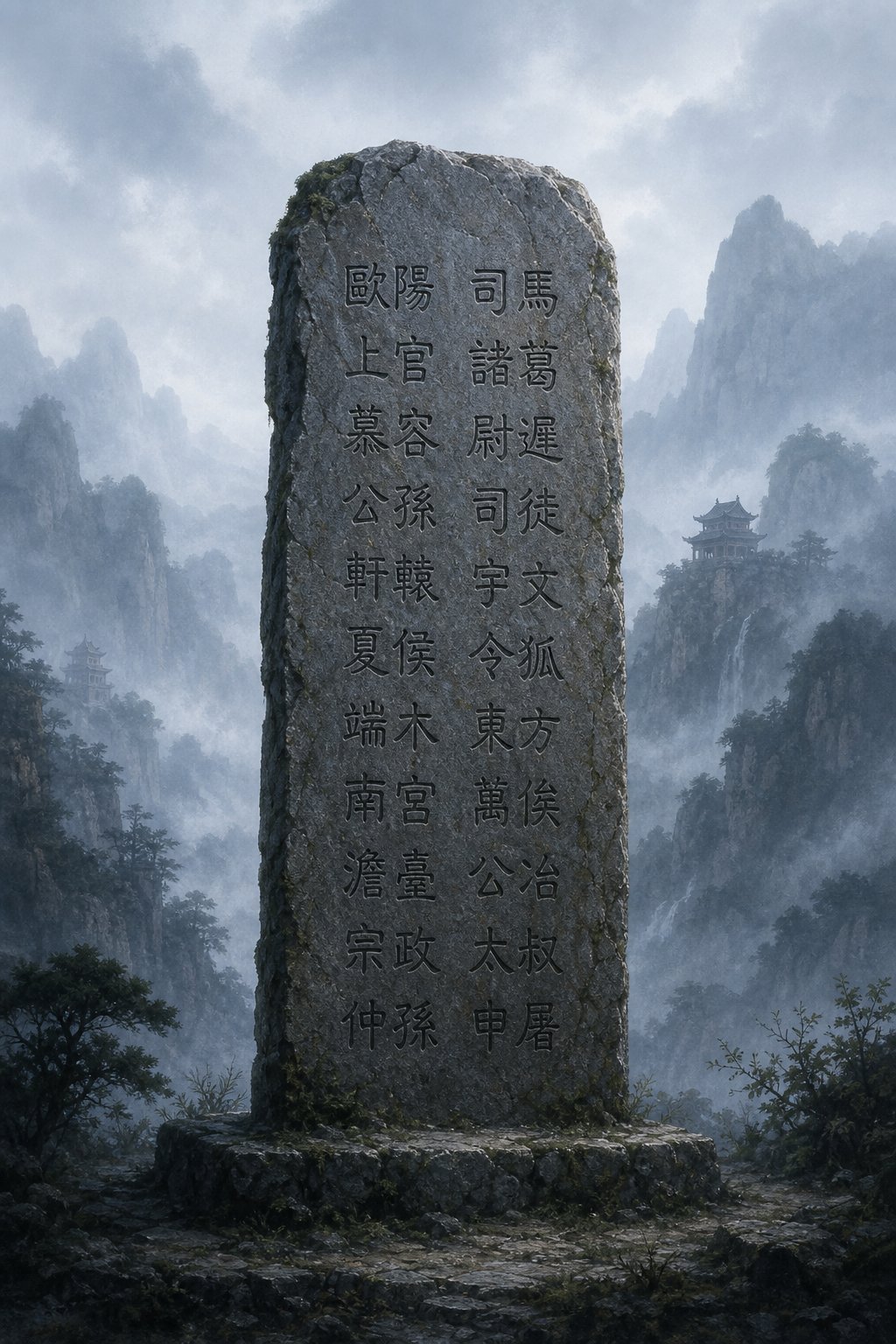
Most Chinese surnames fit neatly into a single character. But a distinct class of two-character surnames, called fuxing (复姓), breaks that pattern entirely. These compound surnames didn't form through the same mechanisms as their single-character counterparts. Their origins lie in official titles, geographic descriptions, and tribal identities that required more than one syllable to express. Today they represent some of the most unique chinese surnames still in active use, and their rarity makes them instantly recognizable.
How Compound Surnames Like Sima and Ouyang Formed
Consider Sima (司马). The two characters literally mean "master of horses," referring to the Zhou Dynasty military official responsible for cavalry and warfare. When descendants of men who held this title needed a hereditary surname, they adopted the full job title rather than abbreviating it. Sima Qian, China's greatest historian, carried this surname because his ancestors served as marshals. The same logic produced Situ (司徒, "Minister over the Masses"), Sikong (司空, "Minister of Works"), and Siko (司寇, "Minister of Justice"). Each was a high-ranking position among the Three Excellencies of the Han Dynasty, and each became a hereditary compound surname.
Geographic compounds followed a different path. Ouyang (欧阳) referred to the southern side of Mount Ou Yu, where a particular branch of the Yue royal family settled. Shangguan (上官) originally denoted a high official's residence but became fixed as a place-derived surname during the Spring and Autumn period. Dongfang (东方, "East") traces its legendary origin to descendants of the mythical Fuxi clan.
Ethnic origins added another layer. Non-Han peoples who entered Chinese society brought multi-syllable names that were transliterated into two or more characters. The Xianbei contributed Yuwen (宇文), Murong (慕容), and Tuoba (拓跋). Manchu clans carried names like Aisin Gioro (爱新觉罗), the imperial surname of the Qing Dynasty. Many of these royal chinese surnames eventually simplified into single characters as families assimilated, which is why compound surnames grew rarer over time. Zhuge (诸葛), made famous by the legendary strategist Zhuge Liang, originated as a branch of the Ge (葛) clan that relocated to a place called Zhu, combining the two identifiers into one surname.
Only a handful of compound surnames remain common today. Ouyang, Shangguan, Sima, and Situ appear most frequently, while others like Xiahou (夏侯), Huangfu (皇甫), and Huyan (呼延) survive in smaller numbers.
Rare Surnames Born from Imperial Taboo and Political Change
Compound surnames aren't the only rare chinese last names with unusual backstories. Some of the most uncommon chinese surnames exist because of a cultural practice called bihui (避讳), or name taboo. Under this system, no subject could use the same character as the reigning emperor's personal name. If your surname happened to share a character with the new ruler, you had to change it immediately.
This created permanent splits within families. One branch might alter a single stroke in their surname character, producing a visually similar but technically different name. Another branch might substitute a synonym or adopt an entirely new character. Over generations, these forced changes became permanent, and descendants lost awareness that their "new" surname was once something else. The result is a scattering of rare chinese surnames that appear unrelated to their parent names but trace back to a single imperial decree.
Political upheaval drove similar fragmentation. When a ruling clan fell from power, survivors often changed their surnames to avoid persecution. Descendants of overthrown dynasties scattered across provinces under assumed names, their original identities preserved only in private genealogies. Voluntary changes during migration added to the mix. Families crossing into regions with different dialects sometimes adopted local surname variants to blend in, creating last names uncommon in their homeland but established in their new territory.
These processes explain why China's surname landscape contains thousands of rare last names alongside the dominant few. The gap is striking: while the top 100 surnames cover roughly 85% of the population, the remaining thousands of uncommon surnames are each carried by only a few hundred or a few thousand people. Some survive in a single village. Others persist only in overseas communities whose ancestors left China centuries ago, carrying rare chinese last names that have since vanished from the mainland.
This tension between concentration and diversity is precisely what a Song Dynasty scholar tried to capture when he compiled the first comprehensive surname catalog, a text whose internal ordering reveals as much about political power as it does about naming conventions.
The Hundred Family Surnames and Romanization Puzzle
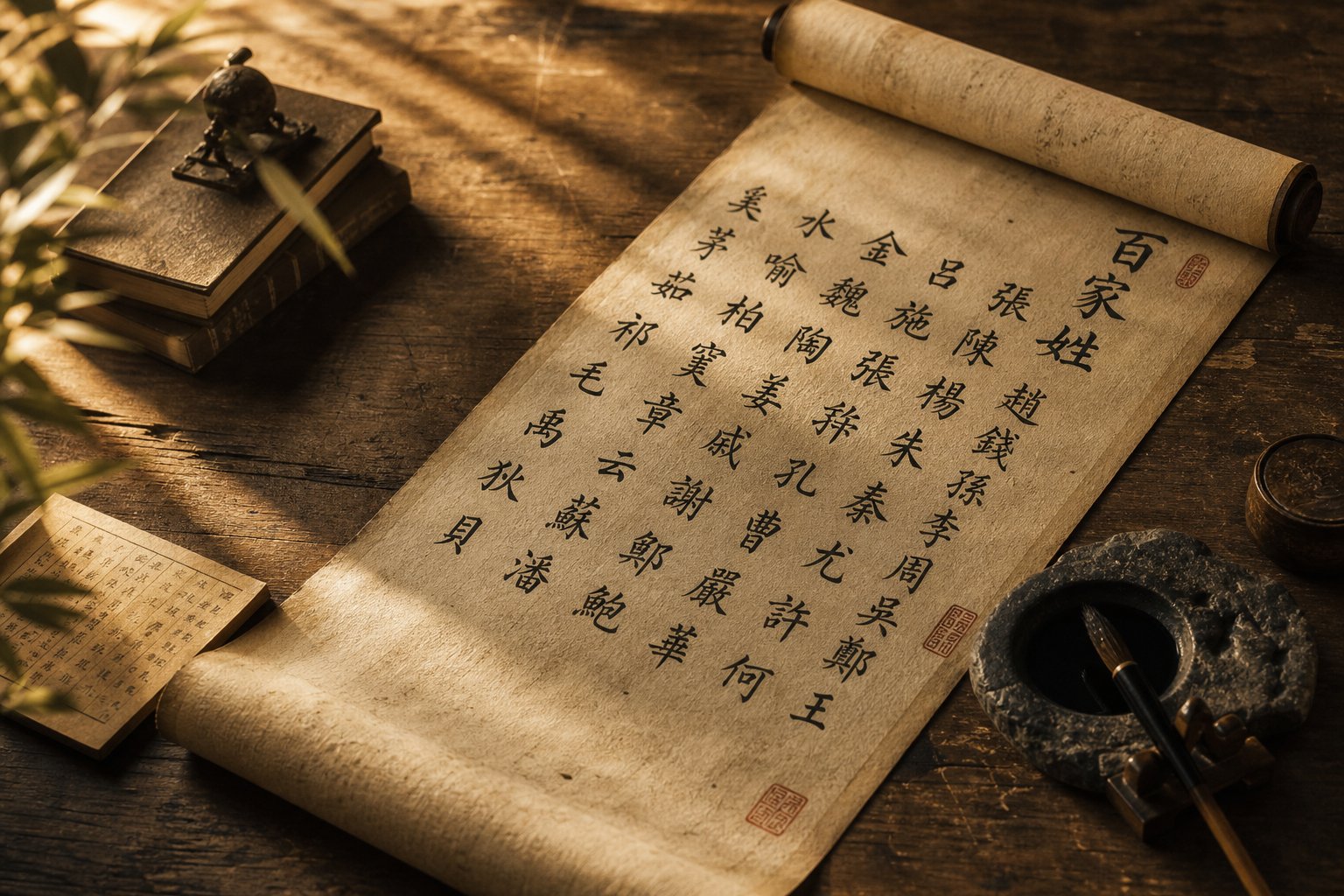
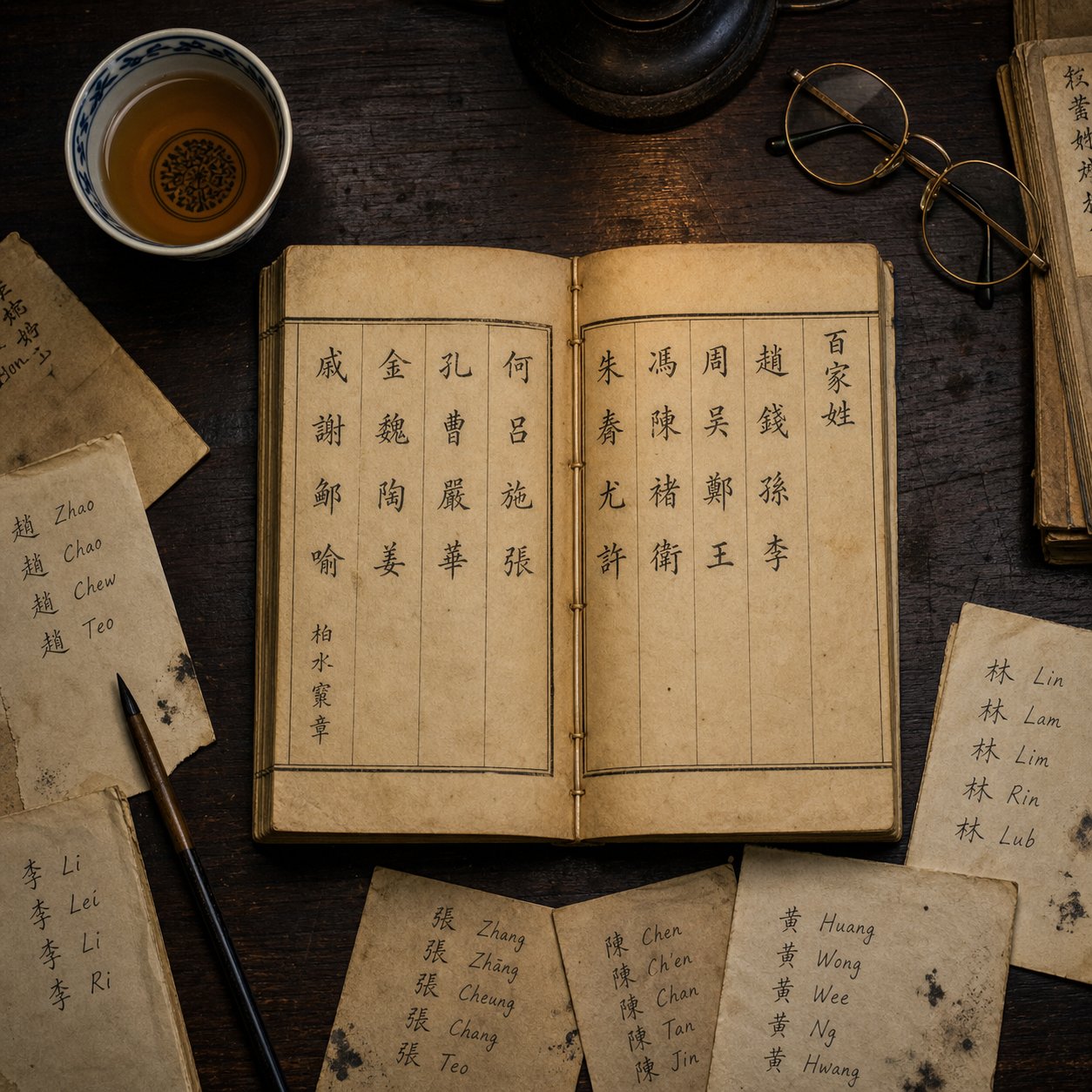
That Song Dynasty scholar was an otherwise obscure writer named Qian Mu, and his creation, the Baijiaxing (百家姓, Hundred Family Surnames), became one of the most memorized texts in Chinese history. Compiled during the early Northern Song period in the tenth century, it listed 438 known Chinese surnames arranged as a rhyming poem so schoolchildren could commit them to memory. The word "hundred" in the title doesn't mean literally one hundred. It means "all" or "every," a claim to completeness. And for centuries, this chinese surnames list served as the definitive catalog of who existed in the Chinese naming universe.
The Baijiaxing and Its Hidden Political Order
Here's what most people miss: the surnames aren't alphabetical, phonetic, or ranked by population. Their order is political. The very first surname is Zhao (赵), the imperial surname of the Song Dynasty rulers who held power when the text was written. The second is Qian (钱), the surname of the kings of Wuyue, the last independent kingdom to peacefully surrender to the Song. Sun (孙) and Li (李) follow, also connected to important political figures of the era. Every child who recited "Zhao Qian Sun Li" as the opening line was unknowingly rehearsing a power hierarchy frozen in time.
Beyond its political subtext, the Baijiaxing functioned as a literacy primer for over a thousand years. Children memorized it alongside the Three Character Classic and the Thousand Character Classic, learning to read by absorbing surname characters in rhythmic four-character lines. The text's influence persists: surnames from the original chinese family name list still account for roughly 90% of all Chinese surnames in use today, and the top ten alone cover about 40% of the population.
Why One Character Becomes Many Spellings
If the Baijiaxing gives us a definitive list of chinese surnames, why do those same surnames look completely different when written in English? The answer lies in China's linguistic diversity. Mandarin is the most widely spoken language, but Cantonese, Hokkien, Teochew, Hakka, and dozens of other regional languages pronounce the same written characters in entirely different ways. Layer on top of that multiple romanization systems, including Pinyin, Wade-Giles, Cantonese Jyutping, and various colonial-era transliterations, and a single surname character can appear as four or five unrelated English spellings.
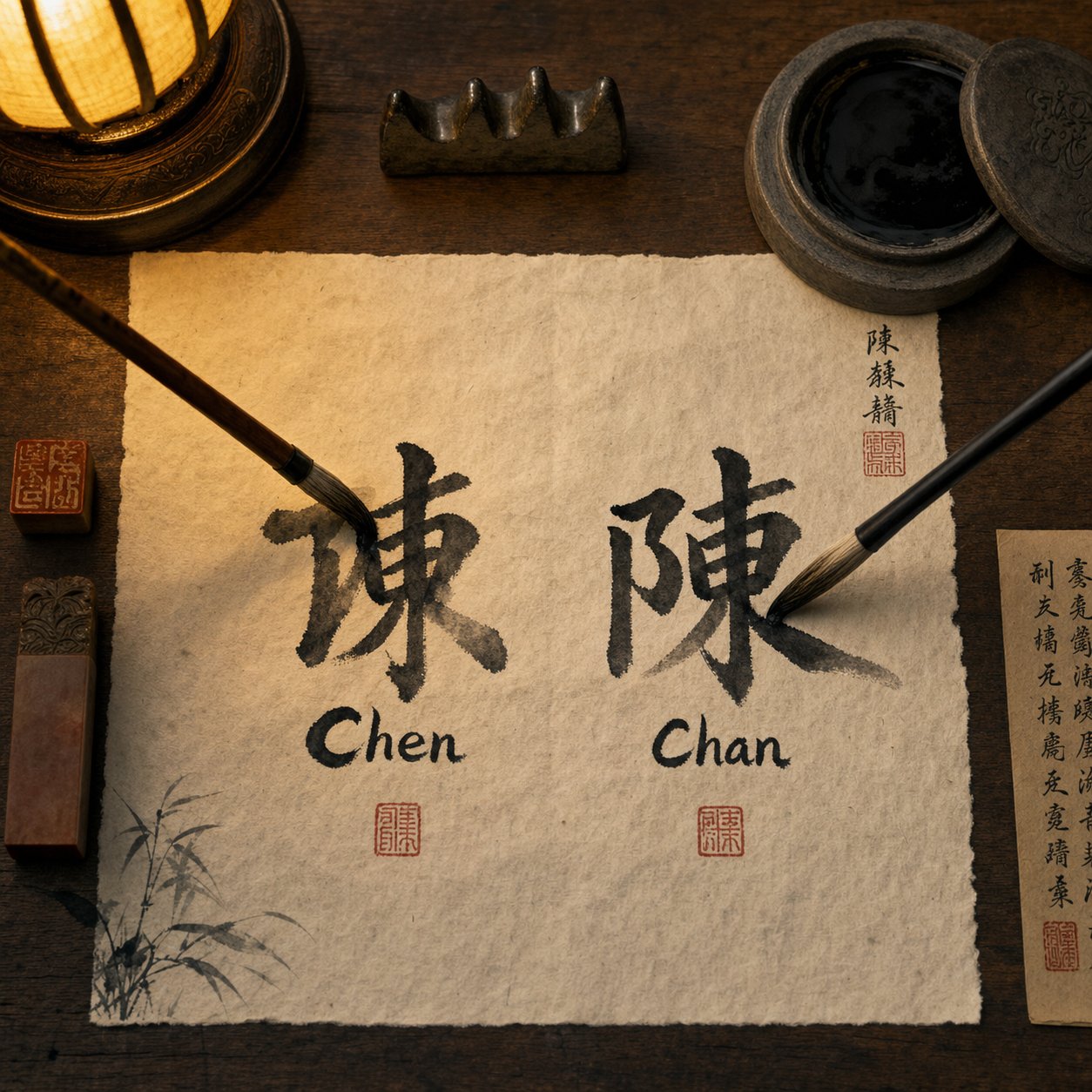
Take the chan last name origin as an example. The character 陈 is pronounced Chen in Mandarin Pinyin, but Cantonese speakers say Chan, Hokkien speakers say Tan, and Hakka speakers say Chin. A person surnamed Chan and a person surnamed Tan might share the exact same chinese family name origins, the exact same ancestor, and the exact same written character. They simply come from regions that pronounce it differently. In diaspora communities across Southeast Asia, the spelling of a family name signals which region a person's ancestors came from, making cantonese last names like Wong, Chan, and Cheung immediate markers of Guangdong or Hong Kong heritage.
Romanization Variants Across Dialects
The table below shows how six common surname characters from the chinese last names list appear across major dialect groups and romanization systems. Notice how a single character produces spellings that look like completely unrelated names:
| Character | Mandarin (Pinyin) | Cantonese | Hokkien | Hakka | Teochew |
|---|---|---|---|---|---|
| 王 | Wang | Wong | Ong | Wong | Heng |
| 陈 | Chen | Chan | Tan | Chin | Tan |
| 张 | Zhang | Cheung | Teo / Teoh | Chong | Teo |
| 刘 | Liu | Lau | Lau | Liew / Lew | Low |
| 黄 | Huang | Wong | Ng / Ooi | Vong | Ng |
| 林 | Lin | Lam | Lim | Lim | Lim |
This fragmentation means that any comprehensive list of chinese surnames must account for dialect variants or risk treating one family as several. A researcher looking for cantonese surnames like Cheung won't find them under Zhang in a Mandarin-based index. Someone tracing the surname Tan in Singapore might never connect it to Chen in Beijing without understanding the Hokkien pronunciation link.
For diaspora families, this romanization puzzle isn't academic. It's the reason cousins in Hong Kong, Taipei, and Manila can carry what appear to be three different surnames while sharing a single ancestor. And it's one of the key challenges facing anyone who tries to trace chinese family name origins across national borders, where the same character was transliterated by different colonial administrations using different phonetic rules. The written character remains constant. Everything else shifts depending on who heard it and how they chose to spell it.
How Chinese Surnames Shaped East Asian Naming Traditions
That romanization puzzle doesn't stop at China's borders. The same Chinese characters that fragment into multiple spellings within Chinese dialect groups also traveled outward, seeding the surname systems of Korea, Vietnam, and Taiwan. When you look at popular asian last names across the region, the structural DNA is unmistakably Chinese: surname first, one or two syllables, drawn from a limited pool of characters that trace back to the same dynastic origins discussed throughout this article. Understanding asian family names means recognizing that Chinese naming conventions became the template for much of East Asia.
Korean and Vietnamese Surnames with Chinese Roots
Korea's surname system mirrors China's in striking ways. Korean family names, called seong (성), are placed before the given name, drawn from a small set of characters, and tied to specific ancestral clans. The three most common Korean surnames, Kim (김), Lee (이), and Park (박), together account for nearly 45% of the population. Each corresponds to a Chinese character: Kim is 金 (gold), Lee is 李 (plum), and Park is 朴 (simple). These characters and the surname-first convention were adopted during periods of heavy Chinese cultural influence, particularly the Silla Dynasty (57 BC-935 AD), when only aristocrats carried surnames modeled on the Chinese system.
Korea's bon-gwan (본관) system parallels China's junwang concept almost exactly. Two people named Kim aren't necessarily related because their ancestral clan origins differ. Gimhae Kim and Gyeongju Kim represent entirely separate lineages, much like a Wang from Taiyuan differs from a Wang from Langya. As of a 2000 census, Korea had 286 surnames split across 4,179 distinct clans.
Vietnam tells a similar story with a dynastic twist. The surname Nguyen (阮) is carried by roughly 40% of all Vietnamese people. Its dominance traces to the Nguyen Dynasty (1802-1945), Vietnam's last ruling house. Earlier, during the Tran Dynasty (1225-1400), members of the preceding Ly family changed their surname to Nguyen to escape persecution. The character 阮 itself stems from the Chinese word ruan, referring to a plucked string instrument. Tran (陈) maps directly to the Chinese surname Chen, sharing the same character and the same ancient state-name origin. These connections reveal how Chinese dynastic naming conventions embedded themselves into Vietnamese identity across centuries of cultural exchange.
Taiwanese Surname Pronunciations and Their Mainland Connections
Taiwanese last names use the same characters as mainland Chinese surnames but pronounce them through Hokkien and Hakka dialect filters. A person surnamed Tan in Taiwan carries the character 陈, identical to Chen in Mandarin. Ong is 王, the same as Wang. These taiwanese surnames aren't different names. They're the same names heard through a different linguistic lens, reflecting the Fujian and Guangdong origins of most Taiwanese families who migrated during the 17th through 19th centuries.
This dialect-based variation means that surnames in asia often appear more diverse than they actually are. A Kim in Seoul, a Nguyen in Hanoi, a Tan in Taipei, and a Chen in Beijing all participate in naming systems shaped by Chinese conventions: limited surname pools, clan-based differentiation, and characters carrying layered historical meaning. The shared architecture across asian names and surnames points back to a common cultural source, even as local histories added unique layers of meaning.
Non-Han ethnic groups within China itself followed a parallel path. Across multiple dynasties, Xianbei, Jurchen, Mongol, and Manchu peoples adopted Han-style surnames through sinicization policies or voluntary assimilation. These adoptions created new origin pathways for existing asian last names, adding ethnic diversity beneath characters that appear uniformly Han on the surface. A surname like Ma (马), for instance, was widely adopted by Hui Muslim communities, giving the same character an entirely different ancestral story depending on the family carrying it.
All of these cross-border and cross-ethnic connections survive today in one form: written records. Clan genealogies, regional gazetteers, and family registers preserved the specific origin stories that distinguish one Kim from another, one Chen from a Tan, one Ma from its homophone. For diaspora families separated from those records by oceans and generations, reconnecting with them has become both a personal quest and a growing cultural movement.
Tracing Your Chinese Surname Through Clan Records and Modern Research
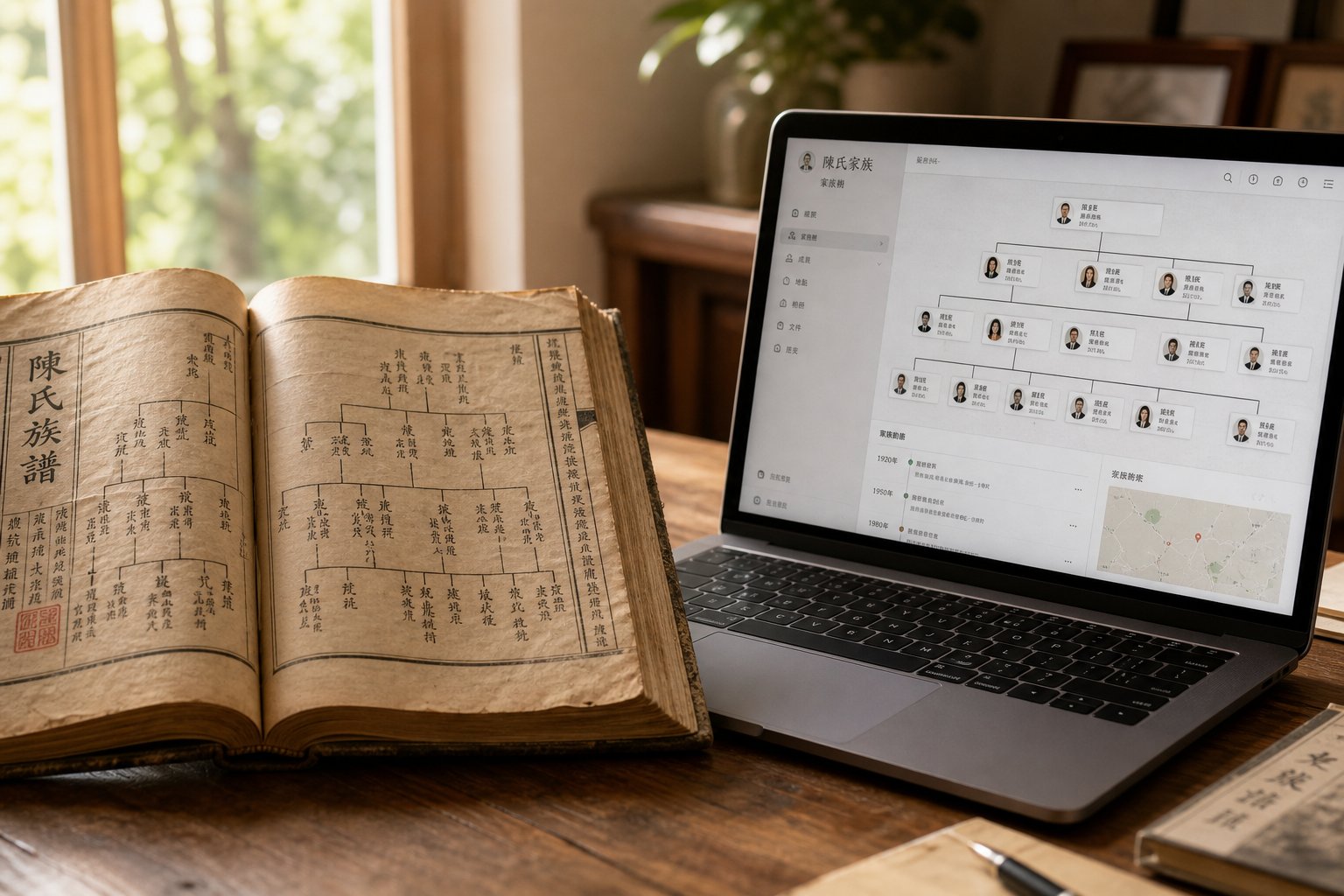
Those written records aren't abstract historical artifacts locked behind museum glass. They're working documents, many still held by families, updated across generations, and actively used today by people of chinese descent seeking to understand where they came from. The tradition of clan genealogy books represents one of the most detailed systems of family documentation ever created, and for anyone researching chinese ancestry, these records are the primary source.
Zupu and Jiapu — Clan Records as Living History
A jiapu (家谱), also called a zupu (族谱), is a traditional book that records a single clan's lineage from its founding ancestor through every subsequent generation. Think of it as a family tree in chinese names, but far more comprehensive than a simple chart. According to FamilySearch's jiapu research guide, these records typically include surname origins, migration histories, ancestral portraits, cemetery maps, family rules, generation poems that determined naming conventions, and biographical entries for notable members. Some trace back to the Shang Dynasty (1523-1028 BC), when genealogical information was inscribed on turtle shells and bronze vessels.
The depth of information is remarkable. Standard entries document personal names, birth and death dates, burial locations, official titles, marriage records, and the names of all sons in birth order. Chinese clans maintained these records with extraordinary discipline because they served practical purposes: proving inheritance rights, enforcing marriage taboos between related families, and establishing eligibility for clan resources. A china clan's genealogy wasn't sentimental. It was legal and social infrastructure.
FamilySearch estimates that existing genealogies may cover as much as 25% of the historical population since the 1600s, and that figure would approach 60% if more records had survived the Cultural Revolution. Many were destroyed during that period, but copies often survived through distant relatives or clan members who emigrated overseas before the 1960s. Complete jiapu have been found in Malaysia, Singapore, and the United States decades after being presumed lost.
Ancestral Pilgrimages and Diaspora Identity
For overseas communities, surname research has become a bridge back to ancestral villages. The practice of xungen (寻根), literally "searching for roots," drives thousands of chinese american surnames holders to travel to China each year seeking the specific village their family left generations ago. Armed with a surname, a junwang region, and sometimes a generation poem, these travelers connect with local clan associations that maintain genealogies and ancestral halls.
Unlike a chinese family crest in the European heraldic tradition, Chinese identity markers are textual rather than visual. Your clan's identity lives in its tanghao (hall name), its generation poem, and its jiapu. Clan reunions organized by surname associations in Guangdong, Fujian, and increasingly online bring together people of shared chinese roots who may have never met but share documented ancestors. For diaspora families, discovering their place within a jiapu transforms a surname from a label into a confirmed lineage stretching back centuries.
Starting Your Own Surname Origin Research
If you're ready to trace your own chinese ancestry, the process is more accessible than most people assume. You don't need to read classical Chinese or travel to a remote village on day one. Start with what you already know and work backward systematically.
- Interview elder relatives — Ask parents and grandparents about your ancestral village name, dialect group, generation poem, or any clan documents they may have seen. Even partial information narrows the search dramatically.
- Identify your dialect group — Knowing whether your family spoke Cantonese, Hokkien, Hakka, or Teochew helps determine which region of China your ancestors likely came from and which romanization variant your surname uses.
- Search digitized jiapu collections — FamilySearch's China Collection of Genealogies (1239-2014) and the Shanghai Library's online jiapu database together hold tens of thousands of digitized clan records searchable by surname and region.
- Locate your junwang and tanghao — Reference books on surname origins list the ancestral homeland and hall name for each major surname. These identifiers help you find the correct branch among millions who share your character.
- Connect with clan associations — Many chinese clans maintain active associations in both China and overseas communities. These organizations often hold genealogies, organize reunions, and can help verify your connection to a specific lineage.
- Consult local gazetteers (地方志) — Regional gazetteers compiled during the Ming and Qing dynasties document which surname groups lived in specific counties, providing geographic confirmation for family oral histories.
The journey from a single surname to a documented lineage isn't always quick, but the records exist in greater quantity than most people realize. Whether your family left China two generations ago or ten, the genealogical infrastructure built by centuries of chinese clans preserving their histories means that your surname isn't just a name. It's a key, and somewhere, a jiapu holds the door it opens.
Frequently Asked Questions About Chinese Family Name Origins
1. How old are Chinese surnames compared to Western last names?
Chinese surnames date back over 4,000 years to the era of the Yellow Emperor, making them the oldest continuous naming system in the world. Western surnames only became widespread during the Middle Ages, roughly 800-1,000 years ago. The Chinese system was already ancient by the time Europeans began adopting hereditary family names, and many modern Chinese surnames can be traced to specific Zhou Dynasty fiefdoms or official titles from the 11th century BC.
2. What is the difference between xing and shi in ancient Chinese naming?
Xing (姓) were broad matrilineal clan identifiers tied to mythological ancestors, used primarily to regulate marriage by preventing unions between people of the same clan. Shi (氏) were more specific lineage markers granted to male descendants based on their fiefdoms, official titles, or occupations. Women were identified by xing while men used shi in public life. These two systems merged into a single hereditary surname during the Qin and Han Dynasty period when feudal structures collapsed.
3. Why do Chinese surnames like Chen appear as Chan, Tan, or Chin in different countries?
A single Chinese character can be pronounced differently across dialect groups including Mandarin, Cantonese, Hokkien, Hakka, and Teochew. When these pronunciations were transliterated into English by different colonial administrations, they produced varied spellings. For example, the character 陈 becomes Chen in Mandarin Pinyin, Chan in Cantonese, Tan in Hokkien, and Chin in Hakka. People carrying these seemingly different surnames may share the exact same ancestor and written character.
4. What are the main ways Chinese surnames were created?
Historians identify six primary pathways: state or place names from ancient fiefdoms, occupation or official title inheritance, imperial grants bestowed by emperors as honor or punishment, ancestral given names adopted by descendants, totemic origins from nature worship where clans identified with animals or natural forces, and ethnic adoption through sinicization when non-Han groups integrated into Chinese society. Each category points to a different type of ancestor and historical circumstance.
5. How can I trace the origin of my Chinese family name?
Start by interviewing elder relatives about your ancestral village, dialect group, and any clan documents. Identify whether your family spoke Cantonese, Hokkien, Hakka, or another dialect to narrow your geographic origin. Search digitized jiapu collections on platforms like FamilySearch and the Shanghai Library database. Locate your surname's junwang (ancestral homeland) and tanghao (hall name) to identify your specific branch. Connect with active clan associations that maintain genealogies both in China and overseas communities.