What Are Chinese Royal Surnames and Why Do They Dominate Today
Imagine discovering that your family name was once spoken only in throne rooms, stamped on imperial decrees, and feared across an empire. For hundreds of millions of people carrying Chinese surnames like Li, Liu, or Zhao, that is not imagination. It is genealogical fact. The most common chinese names in use today are not common by accident. They are common because they once belonged to dynasties that ruled for centuries, expanded their clans across vast territories, and bestowed their names on loyal subjects as political currency.
Chinese royal surnames are those carried by the ruling houses of China's imperial dynasties. Unlike European royal names that remained confined to small aristocratic circles, Chinese family names tied to imperial power spread outward through enormous royal clans, strategic name-granting, and the sheer prestige of association. The result is a modern population where a handful of dynasty-linked surnames account for a staggering share of over 1.4 billion people.
What Makes a Chinese Surname Royal
Not every chinese last name traces back to a palace. Historically, Chinese surnames originated from several distinct sources: ancient tribal clans, geographic regions, occupations, and noble or royal lineage. A surname like Tao (陶) connects to pottery-making. A name like Lu (鲁) points to the ancient state of Lu in present-day Shandong. But surnames like Li (李), Liu (刘), and Zhao (赵) carry a different weight entirely. These were the ruling surnames of the Tang, Han, and Song dynasties respectively, and their dominance in modern demographics is a direct echo of imperial power.
What separates royal chinese surnames from other categories is not just origin but mechanism of spread. Imperial families were polygamous, producing dozens of princes per generation. Over centuries, a single dynasty could generate tens of thousands of direct descendants. Add to that the practice of emperors granting their surname to allies and generals, and you get a demographic multiplier effect that no occupation-based or geography-based surname could match.
Why Royal Surnames Still Matter Today
The numbers tell the story clearly. Li and Wang each represent roughly 100 million people, while Liu accounts for approximately 70 million. These are not just the most common chinese surnames. They are living demographic monuments to dynasties that ended centuries ago. The top 10 chinese last names alone cover over 500 million people worldwide, and the majority of those names connect directly to imperial rule.
An estimated several hundred million people alive today carry surnames that were once exclusive to ruling houses, making Chinese royal surnames the most widely inherited markers of political power in human history.
This concentration is no coincidence. Chinese names have remained remarkably stable for millennia. Unlike Western naming systems where surnames diversified across regions and eras, the Chinese surname system consolidated early and stayed fixed. Royal surnames, amplified by centuries of imperial privilege, locked in their demographic advantage permanently. The dynasties fell, but their names kept multiplying through every generation that followed.
Ancient Origins of Chinese Surnames in Ruling Clans
That demographic dominance did not appear out of nowhere. It grew from roots planted thousands of years before the first emperor unified China. To understand where surnames originate from in the Chinese world, you have to go back to a time before written history, when clan identity passed through mothers rather than fathers, and when a handful of ancient surnames defined the entire ruling class of early Chinese civilization.
Here is a detail that surprises most people: the oldest ancient chinese surnames all contain the radical 女, meaning "woman." This is not coincidence. It is linguistic evidence of a matrilineal era when clan membership and lineage traced through the female line. These last names ancient in origin were not personal choices. They were markers of which ruling clan you belonged to, and they carried the authority of the earliest known Chinese states.
The Eight Ancient Surnames of Early China
Chinese tradition identifies eight foundational surnames from high antiquity, each tied to a legendary ruler or powerful clan. These ancient chinese family names served as the root system from which hundreds of later surnames branched out over millennia.
- 姬 (Ji) — Ancestral surname of the Zhou dynasty royal house, traced to the legendary Houji and the Yellow Emperor. Ji alone is said to have generated over 400 modern surnames through its many vassal states.
- 姜 (Jiang) — Surname of the Yan Emperor (Shennong) lineage and the rulers of the state of Qi. The Ji and Jiang clans intermarried extensively, forming the political backbone of early Zhou society.
- 姒 (Si) — Associated with the Xia dynasty's ruling house, descended from the legendary Yu the Great who tamed the floods.
- 嬴 (Ying) — Ancestral surname of the Qin dynasty rulers who would eventually unify China, as well as the state of Zhao.
- 妘 (Yun) — Linked to Zhuanxu, one of the Five Emperors, and the ruling clan of the state of Yan (鄢).
- 妫 (Gui) — Surname of the rulers of the state of Chen, descended from the sage-king Emperor Shun.
- 姚 (Yao) — Also connected to Emperor Shun, who was born at Yao Xu. This surname shares its royal origin with Gui.
- 姞 (Ji) — Associated with descendants of the Yellow Emperor who governed smaller fiefdoms during the early Zhou period.
Notice the pattern. Every single one of these ancient last names carries the 女 radical on its left side. These were not just names. They were the original political identities of China's founding ruling clans, and every ancient chinese name in this list connects to a legendary sovereign or a state-founding lineage.
The sheer productivity of Ji (姬) deserves emphasis. When the Zhou dynasty distributed fiefdoms to royal relatives, each new vassal state eventually adopted its state name as a new surname. The states of Lu, Jin, Zheng, Wey, Wu, Yan, Cai, and Cao all descended from Ji-surnamed lords. Their descendants took names like Zhou, Wu, Zheng, Wei, Lu, and dozens more. One ancient surname became an entire constellation of modern ones.
From Matrilineal Clans to Patrilineal Dynasties
During the Shang and Zhou periods, ancient chinese names operated under a dual system that can feel unfamiliar today. The surname (姓, xing) identified your ancestral clan, your deep bloodline stretching back to legendary founders. The clan name (氏, shi) identified your specific branch, often derived from a fief, title, or occupation. A nobleman might share the xing of Ji with the Zhou king himself but carry a completely different shi based on his granted territory.
This distinction served a practical purpose beyond identity. The xing regulated marriage. People sharing the same xing could not marry each other, a rule reflecting ancient taboos against inbreeding within the same matrilineal clan. The shi, meanwhile, marked social rank and political affiliation. You could rise or fall in shi status, but your xing was permanent and inherited.
By the Qin and Han dynasties, this dual system collapsed into one. The distinction between xing and shi blurred as ancient chinese last names merged into the single-surname system still used today. What had once been branch names (shi) became permanent family names indistinguishable from the old clan surnames. The eight original xing faded into relative obscurity as surnames, but their genetic and political legacy lived on in the hundreds of derivative names they had produced. The ancient ruling clans did not disappear. They simply scattered into new identities, carrying fragments of royal lineage into every corner of Chinese society.
Every Dynasty and Its Imperial Surname
Those scattered fragments of ancient royal identity did not stay scattered for long. Beginning in 221 BCE, a series of unified empires consolidated power under single ruling houses, and each dynasty stamped its surname onto the population in ways that still register in census data today. When you look at chinese dynasty names and the surnames attached to them, you are looking at a direct map of how political power translated into demographic dominance over two thousand years.
Understanding chinese surnames and meanings requires tracing each imperial name back to the dynasty that elevated it. A surname like Liu does not just mean "kill" or "axe" in its ancient etymology. It means four centuries of Han dynasty rule, tens of thousands of imperial descendants, and a legacy that produced roughly 72 million bearers alive today. These are not abstract historical footnotes. They are chinese last names and meanings written in living populations.
From Qin to Han — Ying and Liu as Imperial Names
The Qin dynasty (221-207 BCE) gave China its first emperor, Qin Shi Huang, whose personal name was Ying Zheng (嬴政). The Ying surname traces back to one of those eight ancient matrilineal clans, connecting the first imperial house directly to China's deepest genealogical roots. Yet despite founding the empire, the Qin lasted only 15 years. The Ying surname never achieved mass demographic spread because the dynasty simply did not rule long enough to multiply its clan or bestow its name widely.
The Han dynasty (202 BCE - 220 CE) tells a completely different story. Liu Bang (刘邦), a commoner who rose through rebellion, established a dynasty that would rule for over four centuries across its Western and Eastern periods. The liu last name origin traces to the ancient Tao Tang clan, with the surname derived from a fiefdom called Liu. But it was imperial power, not etymology, that made Liu enormous.
During the Han, the Liu clan expanded through massive royal families. Emperor Gaozu alone had eight sons, and subsequent emperors maintained large harems producing dozens of princes per generation. By the Eastern Han, Liu-surnamed princes governed territories across the empire. The liu last name became so widespread that even after the dynasty fell, successor states like Shu Han under Liu Bei and the Southern Han under Liu Yan continued claiming the name's imperial prestige centuries later.
Tang, Song, and Ming — Li, Zhao, and Zhu
The Sui dynasty (581-618) under the Yang (杨) surname reunified China after centuries of division but lasted only 37 years. Its real significance was setting the stage for the Tang dynasty (618-907), whose Li (李) surname would become the most common in China.
The Tang emperors did something no previous dynasty had done at such scale: they actively gave away their surname. Li Yuan and his successors bestowed the Li name on military allies, foreign generals who served the empire, and loyal officials from non-Li backgrounds. This practice of surname bestowal inflated the Li population far beyond what natural reproduction alone could achieve. The Tang ruled for nearly three centuries, and by its end, the Li surname had penetrated every social class and region.
The Song dynasty (960-1279) elevated Zhao (赵) to imperial status. Zhao Kuangyin seized power from the Later Zhou and built a dynasty that, between its Northern and Southern periods, lasted over 300 years. The Zhao surname's chinese surname meanings connect to the ancient state of Zhao and ultimately to the Ying clan of Qin, making it one of the few surnames that links two separate imperial houses across a millennium.
The Ming dynasty (1368-1644) brought Zhu (朱) from obscurity to imperial dominance. Before Zhu Yuanzhang founded the dynasty, the Zhu surname had a relatively small population. His family had been devastated by famine and plague. Yet once in power, the Ming imperial clan exploded in size. Zhu Yuanzhang himself fathered 26 sons, and by the late Wanli era, the imperial clan alone numbered over 80,000 people. The Ming demonstrates how a single dynasty could transform a minor surname into a major one within just a few generations.
The following table provides the definitive reference for chinese family names and meanings tied to imperial rule, connecting each major dynasty to its ruling surname and modern demographic legacy:
| Dynasty | Ruling Surname | Pinyin | Years of Rule | Duration | Estimated Modern Bearers |
|---|---|---|---|---|---|
| Qin (秦) | 嬴 | Ying | 221–207 BCE | 15 years | ~700,000 |
| Han (汉) | 刘 | Liu | 202 BCE–220 CE | ~400 years | ~72 million |
| Sui (隋) | 杨 | Yang | 581–618 | 37 years | ~46 million |
| Tang (唐) | 李 | Li | 618–907 | 289 years | ~100 million |
| Song (宋) | 赵 | Zhao | 960–1279 | 319 years | ~27 million |
| Yuan (元) | 孛儿只斤 | Borjigin | 1271–1368 | 97 years | N/A (non-Chinese surname) |
| Ming (明) | 朱 | Zhu | 1368–1644 | 276 years | ~16 million |
| Qing (清) | 爱新觉罗 | Aisin Gioro | 1644–1912 | 268 years | ~300,000 (plus sinicized variants) |
Several patterns emerge from this data. Duration of rule matters, but it is not the only factor. The Tang lasted 289 years and produced the largest surname population, yet the Han's 400-year reign produced fewer modern Liu bearers than there are modern Li bearers. The difference comes down to policies like surname bestowal, which the Tang practiced aggressively and the Han did not. Meanwhile, the Yuan and Qing dynasties, ruled by non-Han peoples, operated partially outside the Chinese surname system entirely, creating a fascinating gap in the pattern.
The chinese surnames meaning embedded in these imperial names goes beyond etymology. Each one encodes a specific political story: how long a family held power, how generously they shared their name, and how successfully their descendants survived the inevitable fall. That question of survival, and the political tools emperors used to spread or suppress surnames, reveals an even more deliberate layer of imperial name politics.

Imperial Surname Bestowal and the Politics of Names
Surnames were not just inherited. They were given, taken away, and weaponized. To understand how do chinese names work at the deepest political level, you need to look beyond genealogy and into statecraft. Chinese emperors treated surnames as instruments of governance, rewarding loyalty by granting the imperial name and punishing disloyalty by stripping it away. This practice, known as surname bestowal (赐姓, ci xing), transformed what we think of as a simple last name in chinese culture into something far more dynamic: a tool of empire.
The concept behind this system was the "national surname" (国姓, guoxing). The emperor's surname was not merely his family's property. It was the nation's most prestigious identifier. Bearing the same surname in chinese as the ruling emperor placed you, at least symbolically, within the imperial family itself. It signaled that the throne recognized your value, your loyalty, or your military power as worthy of the highest honor the state could confer without granting actual territory.
How Emperors Bestowed Surnames as Political Rewards
The Tang dynasty perfected this practice. Li Yuan and his successors granted the Li surname to an extraordinary range of people: military commanders who helped found the dynasty, frontier generals who defended its borders, and even foreign leaders whose cooperation the empire needed. During the waning years of the Tang, Zhuye Chixin (朱邪赤心), the leader of a Turkic tribe who heavily influenced northern Chinese politics, was bestowed the national surname Li and given the Chinese name Li Guochang (李国昌). This was not charity. It was strategic incorporation, binding a powerful non-Chinese military leader to the dynasty through the most personal identifier possible.
The cumulative effect was staggering. Each bestowal did not just add one person to the Li surname rolls. It added that person's entire clan, their descendants, and all future generations. Multiply this across nearly three centuries of Tang rule, and you begin to see why Li became the most common surname in China. Natural reproduction within the imperial family was only part of the equation. Deliberate political inflation of the surname's population was the other half, a mechanism no other naming system in the world replicated at this scale.
The chinese name meaning embedded in a bestowed surname carried weight beyond prestige. It meant tax advantages, social deference, and political protection. Families who received the imperial surname often recorded the bestowal in their clan genealogies for generations, treating it as their most prized ancestral achievement. The chinese names and characters written in those genealogies served as permanent proof of imperial favor.
Surname Revocation as Imperial Punishment
The reverse was equally powerful. If an emperor could elevate you by granting his surname, he could destroy you by taking yours away. Empress Wu Zetian (武则天), China's only female emperor, demonstrated this with brutal clarity. After seizing power, she changed the former Queen Wang's family surname to Hui (虺), the name of a venomous snake. The chinese name interpretation here was unmistakable: the family was being publicly branded as poisonous, dangerous, and subhuman.
This was not an isolated incident. The practice of punitive surname change (赐恶姓) turned a family's identity into a mark of shame carried by every descendant. Some disgraced clans were forced to adopt characters meaning "slow" or "stupid." Others received animal names meant to dehumanize them. The surname 中文 tradition, so often discussed as a matter of heritage and pride, had this darker dimension where identity itself became a sentence.
Surnames in imperial China were not merely inherited identifiers passed passively from parent to child. They were active instruments of state power, granted as the highest political reward and revoked as the most personal form of punishment.
Even the fear of surname-related punishment shaped behavior. The historian Sima Qian's imprisonment during the Han dynasty reportedly caused his relatives to change their surname from Sima to Feng (冯) or Tong (同) to avoid collective punishment under the "family annihilation" (诛九族) policy. A surname in chinese society was not just who you were. It was a liability or an asset, depending entirely on your relationship to power.
This system of bestowal and revocation explains something that pure demographics cannot. It explains why certain imperial surnames grew far beyond what natural population growth would predict, and why others shrank or vanished after a dynasty's fall. The emperors were not passive observers of their surname's spread. They were active architects of it, engineering the demographic landscape of China one granted or revoked name at a time. That engineering did not stop at the borders of Han Chinese culture, either. Non-Han conquest dynasties brought entirely different naming traditions into collision with this system.

Non-Han Dynasties and Their Royal Surname Legacies
Not every dynasty that ruled China played by the same naming rules. When conquest dynasties from the northern steppes and Manchurian forests seized power, they brought naming traditions that did not fit neatly into the single-character Chinese surname system. The result was a fascinating collision: polysyllabic clan names, tribal identities, and entirely foreign naming logic operating at the top of a civilization built around monosyllabic surnames. These non-Han ruling houses left behind some of the most complex asian surnames in the broader landscape of east asian last names, and their legacies still hide inside common Chinese surnames today.
Mongol Rule and the Yuan Dynasty Surname Question
The Yuan dynasty (1271-1368) created a unique gap in the pattern of imperial surnames. Kublai Khan and his successors belonged to the Borjigin (孛儿只斤) clan, a Mongol tribal name that functioned nothing like a Chinese surname. It was polysyllabic, tied to steppe kinship structures, and carried no Chinese character meaning. The Mongol rulers simply never adopted a Chinese-style surname during their century of rule.
This was not an oversight. It was a deliberate assertion of separateness. The Yuan court maintained Mongol naming conventions at the highest levels while administering a Chinese bureaucratic state beneath them. Mongol nobles used clan names and personal names without conforming to the xing-shi system that had governed Chinese identity for millennia. For the only time in imperial history, the ruling house operated entirely outside the traditional surname framework, leaving no single-character imperial surname behind in the population.
Some Mongol families who remained in China after the Yuan collapsed did eventually adopt Chinese surnames. Borjigin descendants took names like Bao (包) or Bo (博). But these were survival adaptations made after the dynasty fell, not imperial policy during its reign. The Yuan stands alone as a dynasty whose royal name never entered the Chinese surname system through the usual channels of bestowal and prestige adoption.
Manchu Eight Great Surnames of the Qing Dynasty
The Qing dynasty (1644-1912) took a different approach entirely. The Manchu ruling house, the Aisin Gioro (爱新觉罗) clan, governed China for 268 years while maintaining their own polysyllabic Manchu surname system alongside the Chinese one. Unlike the Mongols, the Manchu eventually underwent deep integration with Chinese naming culture, but this happened gradually and often against imperial wishes.
The Aisin Gioro name itself translates roughly to "Golden Clan" in Manchu, with "aisin" meaning gold. This was the royal surname proper, but beneath it sat an entire aristocratic naming hierarchy. The Eight Great Manchu Surnames (满洲八大姓) represented the most prominent noble clans of the Qing era, families whose members served as founding generals, chief councilors, and imperial consorts. These surnames originated primarily in the Liaodong region and evolved from Jurchen clan names dating back to the Jin dynasty (1115-1234).
What makes these asian family names particularly interesting is their origin logic. Most derived from place names where the clan once settled, a pattern tied to the Jurchen fishing, hunting, and migratory lifestyle. The Tunggiya clan took its name from the Tungjia River basin. The Guwalgiya clan adopted the name of their settlement area. The Niohuru clan's name connected to the Manchu word "niohe," meaning wolf. These were not arbitrary labels but encoded geographic and cultural histories within their syllables.
The Qianlong Emperor himself grew alarmed at the trend of Manchu families abandoning their original surnames for Chinese ones. He issued edicts attempting to stop the practice, declaring that "surnames are the foundation of the Manchus, a matter of great importance." He specifically criticized the Niohuru clan for adopting the surname Lang, arguing that if they must shorten their name, it should be Niu, not Lang. His efforts failed. The cultural gravity of the Chinese single-surname system proved stronger than imperial decree.
After the Xinhai Revolution of 1911 toppled the Qing, the process accelerated dramatically. Manchu bannermen adopted Han surnames en masse to change their household registrations, avoid persecution, and seek livelihood opportunities in the new republic. The methods of sinicization varied: some took the first character of their Manchu surname, others used phonetic translation, and still others adopted entirely new names based on meaning.
The following table shows how the major Manchu noble surnames transformed into common asian last names still carried by their descendants today:
| Manchu Clan Name | Origin/Meaning | Modern Chinese Surname | Pinyin | Notable Historical Figures |
|---|---|---|---|---|
| Aisin Gioro (爱新觉罗) | "Golden Clan" — Imperial house | 金 (Jin), 赵 (Zhao), 罗 (Luo), 艾 (Ai) | Jin, Zhao, Luo, Ai | Nurhaci, Kangxi Emperor |
| Tunggiya (佟佳) | Tungjia River basin, Liaodong | 佟 (Tong) | Tong | Tong Yangzheng |
| Guwalgiya (瓜尔佳) | Settlement place name; "guan" means hall | 关 (Guan) | Guan | Fiongdon, Oboi |
| Majia (马佳) | Place name in Manchuria | 马 (Ma) | Ma | Hedong'e |
| Socolo (索绰罗) | Place name; originally Nimaha clan | 索 (Suo) | Suo | Songguotuo |
| Heseri (赫舍里) | Heseri River, adopted as clan name | 赫 (He), 何 (He) | He | Soni, Sose Baksi |
| Fuca (富察) | Place name; originally Pucha clan | 富 (Fu) | Fu | Wangginu |
| Nara (那拉) | Nara River basin | 那 (Na) | Na | Naqibu |
| Niohuru (钮祜禄) | "Niohe" = wolf in Manchu | 郎 (Lang) | Lang | Eidu |
The pattern here reveals something broader about asian names and surnames under political pressure. When a ruling ethnic group loses power, their distinctive naming conventions face enormous pressure to conform to the dominant system. The Manchu experience mirrors what happened to many asia surnames across the region during periods of political upheaval: complex, multi-syllabic clan identities compressed into single characters, with layers of meaning and history lost in translation.
Yet the compression was never total. Families who know their Manchu heritage can still trace the path backward, from a common-looking surname like Guan or Lang to the Guwalgiya or Niohuru clans that once stood at the pinnacle of Qing power. These surnames in asia's northeast carry hidden aristocratic weight that a surface reading would never reveal. The person surnamed Tong sitting next to you might descend from a clan whose ancestors traded along the Ming frontier before joining Nurhaci's unification campaigns. The colleague named He might trace back to the Heseri clan whose members served as First-Class Imperial Bodyguards.
This absorption of conquest-dynasty names into the Chinese surname system represents the final stage of a recurring historical cycle: foreign rulers arrive with their own naming traditions, maintain them during their reign, and eventually see those names folded into the Chinese system after their power fades. The names survive, but transformed, compressed, and hidden in plain sight among the hundreds of common surnames that make up modern Chinese society. That hiding in plain sight is not accidental. It connects to one of the most politically charged texts in Chinese history: the Hundred Family Surnames, where even the ordering of names was an act of imperial power.
The Hundred Family Surnames and Hidden Political Hierarchies
A children's textbook might seem like an unlikely place to encode imperial propaganda. Yet the Hundred Family Surnames (百家姓, Baijiaxing), one of the most widely memorized texts in Chinese history, did exactly that. Compiled during the early Song dynasty between 976 and 984 CE, this chinese surname list was never organized alphabetically, by population size, or by any neutral principle. It was organized by political power. The very first surname on the list tells you who ruled the empire when the book was written.
Why Zhao Comes First in the Hundred Family Surnames
Open the Hundred Family Surnames and you read: Zhao, Qian, Sun, Li. Four surnames, four political statements. Zhao (赵) sits at the top because it was the imperial surname of the Song dynasty. Not because it was the most common chinese common last names of the era. Not because it was the oldest. Because the emperor's family name came first, full stop.
The second surname, Qian (钱), reveals an even more specific political story. Qian Hongchu was the last king of the Wuyue Kingdom, a regional state centered on modern Zhejiang. In 978 CE, Qian Hongchu surrendered his thirteen prefectures peacefully to the Song dynasty rather than resist militarily. Placing his surname second was a reward, a public acknowledgment that the Qian family had chosen submission over bloodshed. The third surname, Sun (孙), belonged to the principal consort of the King of Wuyue. The fourth, Li (李), referenced the imperial house of the recently conquered Southern Tang.
You are looking at a political hierarchy frozen in text: first the imperial family, then the vassal kings who surrendered, then their consorts, then the defeated rivals. The Southern Song scholar Wang Mingqing confirmed this reading, noting that the text "seems to have been written by a commoner during the time when the Qian clan ruled the Two Zhe regions." The entire chinese surnames list functioned as a map of early Song political relationships, disguised as a children's primer.
This was not a one-time phenomenon. Later dynasties produced their own versions. The Ming dynasty's Huangming Qianjia Xing opened with Zhu, the Ming imperial surname. The Qing dynasty's Yuzhi Baijiaxing began with Kong, honoring Confucius rather than the Manchu ruling house, a diplomatic choice that avoided forcing the polysyllabic Aisin Gioro into a system built for single characters. Each revision proved the same point: whoever controlled the state controlled the ordering of names.
The Hundred Family Surnames was never a neutral reference. It was a political document that encoded imperial hierarchy into the most basic educational text a child would memorize, ensuring that every literate person internalized the ruling family's supremacy from their earliest years of study.
The text originally contained 411 surnames, later expanded to 504, organized in four-character rhyming lines. Generations of Chinese children memorized it the way English-speaking children memorize the alphabet. But unlike the alphabet, this sequence carried political meaning in every position. Your surname's placement on the chinese family name list was a public ranking of your clan's relationship to power.
Wang — The Surname That Means King
If Zhao encodes active imperial power, Wang (王) encodes something more poignant: royalty that was lost. The character itself is unmistakable. Three horizontal strokes representing heaven, earth, and humanity, connected by a single vertical stroke symbolizing the ruler who unites them. Wang literally means "king." It is among the most direct surnames that mean power in any language on earth. And it became a surname precisely because so many royal families lost their thrones.
The wang last name origin is not singular. It is a convergence of multiple fallen royal houses, each adopting the title "king" as a surname after their political power evaporated. The most prominent ancestor is Crown Prince Jin of the Eastern Zhou dynasty (770-256 BCE). Known for his intelligence and integrity, Prince Jin was the eldest son of King Ling of Zhou. His straightforward counsel displeased the king, leading to his demotion. His son Zongjing fled to Taiyuan, where locals recognized his royal ancestry and respectfully called him "Wang." The title became the family name.
But Prince Jin's line was only one tributary feeding into the massive river of the wang last name. During the turbulent Spring and Autumn and Warring States periods, numerous Zhou royals lost power, faced exile, or had their territories confiscated. Many adopted Wang as a surname to preserve a symbolic connection to their noble heritage. The following royal lineages all contributed to the modern Wang surname:
- Descendants of Prince Jin (太子晋) — The primary Wang lineage, tracing through the Zhou royal house of the Ji (姬) clan. This branch produced the famous Taiyuan Wang and Langya Wang families.
- Descendants of Bi Gao (毕高) — The younger brother of King Wu of Zhou, whose descendants adopted Wang after their fiefdom was lost.
- Descendants of King Ping of Zhou (周平王) — Royal offspring who took the Wang surname after the Zhou court's authority collapsed during the Eastern Zhou period.
- Descendants of Bigan (比干) — A prince of the Shang dynasty (1600-1046 BCE) who was executed for his honest counsel. His descendants adopted Wang to honor their royal Shang lineage.
- Descendants of Tian Jian (田建) — The last King of Qi (approximately 280-221 BCE), whose family took the Wang surname after Qin conquered their state.
- Descendants of the Duke of Huan (桓公揭) — Another Zhou royal branch that adopted Wang during the dynasty's decline.
This convergence explains why Wang is one of the most common surnames in China today, with over 100 million bearers. It is not one family grown large. It is dozens of separate royal families, from different eras and different states, all independently choosing the same surname because they shared one thing: they had once been kings. The wang last name origin is really a collection of origin stories, each one a record of political collapse transformed into permanent identity.
The Wang family name never established a lasting centralized dynasty, yet its bearers founded over a dozen smaller kingdoms, including the short-lived Xin dynasty (9-23 CE). The name produced 151 prime ministers and 36 empresses across Chinese history, a record of influence that rivals any imperial surname despite never holding the top position for long.
Together, the Hundred Family Surnames and the Wang surname reveal the same truth from opposite directions. Zhao shows how active power shaped the ordering of names. Wang shows how lost power created names in the first place. Both demonstrate that the chinese family name list was never a neutral catalog. It was a political landscape, with every position and every character encoding relationships to imperial authority that persisted across millennia. That encoding did not stop at the level of individual names. It scaled up to shape the entire demographic map of modern China.
How Ancient Imperial Power Shaped Modern Surname Demographics
That political landscape is not just visible in old texts and genealogies. It shows up in raw population numbers. When researchers compile data on the most popular surnames in china, the same names appear at the top of every list: Li, Wang, Zhang, Liu, Chen. These are not random statistical winners. They are the direct demographic output of imperial policies enacted centuries ago. Large royal clans, mass surname bestowal, prestige adoption by commoners, and centuries of compounding growth turned a handful of dynasty-linked names into the most common chinese last names on earth.
The connection between ancient power and modern population is not metaphorical. It is mathematical. A dynasty that ruled for 400 years, produced dozens of princes per generation, and granted its surname to thousands of non-relatives created a population base that kept multiplying long after the dynasty itself collapsed. Each generation doubled or tripled the previous one. Over a thousand years of post-dynastic reproduction, even a modest initial advantage snowballed into tens of millions of bearers.
From Imperial Courts to Millions of Modern Bearers
Consider the Li surname. The Tang dynasty ruled from 618 to 907 CE, nearly three centuries during which every emperor carried the Li name. The imperial clan itself was enormous, but that alone does not explain why Li is the most common chinese surname today with roughly 100 million bearers. The real multiplier was bestowal. Tang emperors granted the Li surname to military allies, foreign generals, and loyal officials across the empire. Each bestowal added not just one person but an entire clan and all their future descendants to the Li population. By the time the Tang fell, the Li surname had been seeded into every region and social class of China.
The Liu surname followed a different but equally powerful path. Liu Bang founded the Han dynasty in 202 BCE, and his family held power for roughly 400 years across the Western and Eastern Han periods. Unlike the Tang, the Han did not practice large-scale surname bestowal. Instead, the sheer duration of rule did the work. Four centuries of imperial polygamy produced an extraordinary number of princes. By the Eastern Han, Liu-surnamed nobles governed territories across the empire. Even after the dynasty fell in 220 CE, successor states like Shu Han under Liu Bei and later the Southern Han under Liu Yan continued expanding the surname's reach. The result: approximately 70 million Liu bearers alive today, making it the fourth most common surname in china.
The Zhao surname tells a story of moderate but sustained growth. The Song dynasty's 319-year reign (960-1279) gave the Zhao clan time to expand, though the Song emperors were less aggressive about surname bestowal than the Tang had been. The Song imperial family was large but not exceptionally so by dynastic standards. Still, three centuries of compounding produced roughly 27 million modern bearers, enough to rank Zhao among the top ten common surnames china has today.
The following ranking connects each major imperial-origin surname to its dynastic source and modern population, showing how ancient political power translated directly into demographic dominance:
- Li (李) — Tang dynasty (618-907) — ~100 million bearers. Amplified by aggressive surname bestowal to allies and foreign generals, plus a large imperial clan reproducing across 289 years of rule.
- Wang (王) — Multiple Zhou-era royal houses — ~100 million bearers. A convergence surname adopted by descendants of numerous fallen kingdoms, not tied to a single dynasty but to royalty itself.
- Liu (刘) — Han dynasty (202 BCE-220 CE) — ~72 million bearers. Four centuries of imperial polygamy and continued prestige adoption by successor states after the dynasty's fall.
- Yang (杨) — Sui dynasty (581-618) — ~46 million bearers. Though the Sui lasted only 37 years, the Yang surname had deep pre-imperial roots in northern Chinese aristocracy that predated and outlasted the dynasty.
- Zhao (赵) — Song dynasty (960-1279) — ~27 million bearers. Steady growth through 319 years of rule, reinforced by the cultural prestige of heading the Hundred Family Surnames text.
- Zhu (朱) — Ming dynasty (1368-1644) — ~16 million bearers. Explosive growth from a small base, driven by the Hongwu Emperor's 26 sons and a clan that reached over 100,000 male members by the late Ming.
- Sima (司马) — Jin dynasty (265-420) — ~2.3 million bearers. A compound surname that never achieved mass scale due to shorter rule and post-dynastic persecution.
The pattern is clear. Duration of rule, size of the royal clan, and active bestowal policies are the three variables that determine whether an imperial surname becomes a demographic giant or remains a historical footnote. The Tang hit all three. The Qin, despite founding the empire, hit none: 15 years of rule, no bestowal program, and a violent end that scattered the Ying clan into obscurity.
What Happened to Royal Surname Bearers After Dynasties Fell
Demographic growth was never guaranteed. Every dynasty's fall brought danger to those carrying its surname. The most common chinese last names today are common partly because their bearers survived persecution, but not all did so under their original names.
The Ming dynasty's collapse in 1644 provides the starkest example. When the Manchu-led Qing dynasty conquered China, the House of Zhu went from producing over 100,000 male descendants to facing systematic elimination. The Qing hunted Ming princes as political threats. The last Ming emperor, the Yongli Emperor, fled to Burma and was executed there in 1662. Across southern China, Zhu-surnamed families faced a brutal choice: keep the name and risk death, or change it and survive.
Many chose survival. Some Zhu descendants adopted the surname Zhuang (庄) or Zou (邹), names phonetically similar enough to preserve a coded connection to their origins. Others took entirely unrelated surnames to sever any traceable link to the fallen dynasty. In Fujian and Guangdong, Zhu families who fled to Southeast Asia sometimes adopted local names while maintaining private genealogies recording their true lineage. The diaspora communities that formed in these regions preserved Ming identity in secret for generations.
This pattern repeated across dynasties. After the Tang fell, some Li families in border regions changed their surnames to avoid association with the collapsed regime. After the Song fell to the Mongols, Zhao descendants in the south scattered and some adopted new identities. The historian Sima Qian's descendants reportedly split into the Feng and Tong surnames after his disgrace during the Han, fragmenting a once-unified clan into separate lineages that lost contact with each other.
Yet persecution was never total. The Qing, despite hunting Ming princes, did not systematically target every Zhu-surnamed commoner. Most ordinary Zhu families survived simply because they posed no political threat. The surname's modern population of 16 million reflects both the enormous size the clan reached during the Ming and the losses it sustained afterward. Without the Qing persecution, that number would likely be significantly higher.
The survival strategies themselves created lasting demographic effects. Families that changed their names contributed to the growth of other surnames while reducing the count of their original one. Families that fled to diaspora communities carried their surnames into new geographic contexts, creating pockets of imperial-origin names in Taiwan, Southeast Asia, and beyond. The most common last name in china today is not just a product of ancient growth. It is a product of survival, of families who kept their names through every political upheaval that followed their dynasty's fall.
These survival stories raise a natural question for anyone carrying one of these surnames today. If your name is Li, Liu, Zhao, or Zhu, does that actually mean you descend from royalty? And if you want to find out, where do you even begin looking?
Tracing Royal Lineage in Your Own Chinese Surname
The answer depends on which surname you carry and how far back your family records go. Not every Li descends from Tang emperors, and not every Liu traces to Han royalty. But the tools to find out are more accessible than most people realize. Between clan genealogies, historical texts, and digital archives, the path from a modern surname back to its imperial or noble origins is well-documented for dozens of names on the list of chinese family names.
Surnames With Confirmed Royal Origins
Some surnames carry near-certain connections to imperial or noble lineages. Others are more ambiguous, with both royal and commoner origins feeding into the same name. The following list organizes surnames with documented royal connections by the dynasty or ruling house they trace to. If your surname appears here, it does not guarantee personal descent from royalty, but it confirms that your name has imperial roots somewhere in its history.
- Zhou dynasty and pre-Qin royal houses: Wang (王), Ji (姬), Wei (卫), Zheng (郑), Lu (鲁), Wu (吴), Yan (燕), Cai (蔡), Cao (曹), Ye (叶, from Chu royalty), Xiong (熊, Chu royal surname)
- Qin dynasty: Ying (嬴), Zhao (赵, shares Ying clan origin), Qin (秦)
- Han dynasty: Liu (刘)
- Jin dynasty (265-420): Sima (司马)
- Sui dynasty: Yang (杨)
- Tang dynasty: Li (李)
- Song dynasty: Zhao (赵)
- Ming dynasty: Zhu (朱)
- Qing dynasty (Manchu noble clans): Jin (金, from Aisin Gioro), Guan (关, from Guwalgiya), Lang (郎, from Niohuru), Tong (佟, from Tunggiya), Na (那, from Nara), Fu (富, from Fuca), He (赫, from Heseri)
Some of these are among the rarest chinese surnames today, like Sima and Ying, while others rank among the most common. A few unique chinese surnames on this list, such as Xiong and Ye, surprise people because they are not typically associated with royalty in popular imagination. Yet historical records in the Shiji (Records of the Grand Historian) confirm their connections to the Chu royal house, one of the most powerful states of the Warring States period. Even uncommon chinese surnames like Gongsun and Linghu trace directly to noble lineages, though their bearers number only in the thousands today.
How to Research Your Chinese Surname History
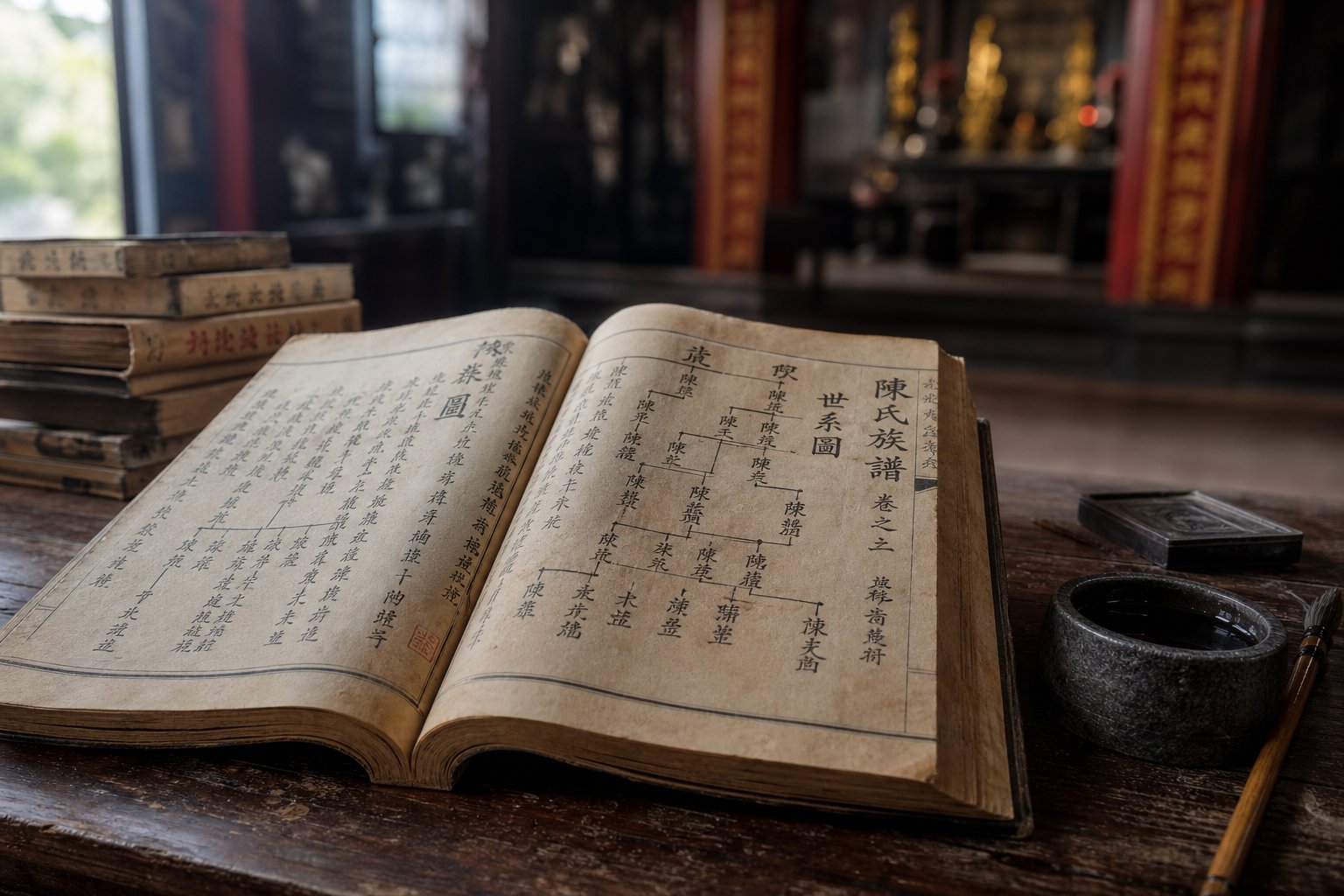
The single most valuable resource for tracing surname lineage is the clan genealogy, known as jiapu (家谱) or zupu (族谱). These are multi-volume family records maintained by clans across China for centuries, documenting lineage charts, ancestral biographies, migration histories, and founding narratives. A well-preserved jiapu can trace a family back twenty or thirty generations, sometimes connecting directly to a dynastic founder.
FamilySearch hosts a digitized collection of Chinese genealogies searchable by surname, province, and county. You can search using pinyin or Chinese characters to locate jiapu connected to your family name and ancestral region. The process involves identifying your surname, narrowing by province and county of origin, and then examining the genealogy images for lineage charts and origin narratives.
Beyond digital archives, physical ancestral halls (祠堂, citang) remain important repositories. These clan temples, found throughout southern China, often display lineage tablets, calligraphy recording the clan's founding ancestor, and sometimes a chinese family crest or emblem unique to that branch. The hall's founding inscription typically states which historical figure the clan claims descent from, providing a direct link to royal or noble origins if one exists.
Historical texts offer another verification layer. The Shiji by Sima Qian and the Book of Han (Hanshu) by Ban Gu both contain detailed surname origin narratives. The Yuan He Xing Zuan, compiled during the Tang dynasty, systematically traces hundreds of surnames to their founding ancestors. For anyone serious about researching their name's history, these texts provide the scholarly foundation that clan genealogies build upon.
Diaspora communities maintain these traditions with regional variations. Taiwanese last names follow the same system as mainland surnames, but taiwanese surnames often connect to specific waves of migration from Fujian and Guangdong during the Qing era. Clan associations in Taiwan maintain their own genealogical records, sometimes preserving lineage information that was destroyed on the mainland during the Cultural Revolution. Similarly, singaporean last names among the Chinese community reflect Hokkien, Teochew, and Cantonese migration patterns, with surname associations in Singapore actively maintaining ancestral halls and genealogical databases that connect families back to their origin villages in China.
Hong Kong's surname heritage occupies yet another niche. The New Territories contain some of the oldest continuously inhabited clan villages in the Chinese world, with families like the Tang (邓) of Kam Tin maintaining genealogies stretching back to the Song dynasty. These communities preserved records through British colonial rule that might otherwise have been lost.
Whether your surname ranks among the most common or the rarest chinese surnames still in use, the research path follows the same logic: identify your ancestral region, locate the relevant jiapu or clan association, and trace the lineage narrative backward through time. The connection may be direct and documented, or it may be lost to centuries of migration and upheaval. But the possibility exists for hundreds of millions of people. Chinese royal surnames are not museum artifacts. They are living connections to thousands of years of political history, carried forward in every generation that inherits them, from ancient throne rooms to modern households scattered across the globe.
Frequently Asked Questions About Chinese Royal Surnames
1. What are the most common Chinese royal surnames still used today?
The most widespread Chinese royal surnames in modern use include Li (from the Tang dynasty, ~100 million bearers), Liu (from the Han dynasty, ~72 million bearers), Zhao (from the Song dynasty, ~27 million bearers), Yang (from the Sui dynasty, ~46 million bearers), and Zhu (from the Ming dynasty, ~16 million bearers). Wang, meaning 'king,' is also carried by ~100 million people and traces to multiple fallen royal houses from the Zhou era. These surnames dominate modern Chinese demographics because imperial families were large, ruled for centuries, and in some cases actively bestowed their names on loyal subjects.
2. Why is Li the most common surname in China?
Li became the most common Chinese surname through a combination of nearly three centuries of Tang dynasty rule (618-907 CE) and an aggressive policy of surname bestowal. Tang emperors granted the Li surname to military allies, foreign generals, and loyal officials as a political reward. Each bestowal added an entire clan and all their future descendants to the Li population. This practice inflated the surname far beyond what natural reproduction within the imperial family alone could achieve, creating a demographic snowball effect that continued compounding for over a thousand years after the dynasty fell.
3. How can I find out if my Chinese surname has royal origins?
Start by checking whether your surname appears on documented lists of imperial-origin names. Then locate your family's clan genealogy (jiapu or zupu), which may trace your lineage back to a dynastic founder. Digital resources like FamilySearch host searchable collections of Chinese genealogies organized by surname and province. Physical ancestral halls in southern China often display lineage tablets and founding narratives. Historical texts like the Shiji and the Tang-era Yuan He Xing Zuan systematically document surname origins. Diaspora communities in Taiwan, Singapore, and Hong Kong also maintain clan associations with genealogical records.
4. What happened to royal surname bearers when their dynasty fell?
When dynasties collapsed, bearers of the imperial surname often faced persecution from the new ruling house. Some changed their names to survive — for example, many Zhu descendants adopted surnames like Zhuang or Zou after the Ming fell to avoid Qing persecution. Others fled to diaspora communities in Southeast Asia while maintaining private genealogies. However, persecution was rarely total. Most ordinary bearers of a former imperial surname survived because they posed no political threat. The modern populations of these surnames reflect both their peak growth during imperial rule and the losses sustained during transitions of power.
5. Why does the character Wang literally mean 'king' if it is a common surname?
Wang became a surname precisely because multiple royal families lost their thrones and adopted the title 'king' as their family name. The primary lineage traces to Crown Prince Jin of the Eastern Zhou dynasty, whose descendants were called Wang by locals who recognized their royal blood. But at least five other fallen royal houses independently adopted the same surname during the Spring and Autumn and Warring States periods. This convergence of multiple royal lineages into one name explains why Wang has over 100 million bearers today — it is not one family grown large, but dozens of separate royal families who all chose the same name after losing power.