How One Name Could Silence an Entire Empire
Imagine waking up one morning to discover that a common word you use every day — in conversation, in letters, even in your own name — has been banned. Not because it is offensive, but because a new emperor happens to share that character. Overnight, millions of people across China had to find substitutes, rewrite documents, and even legally change their names. This was not a rare event. It happened with every new reign for over two thousand years.
What Is Bihui and Why Did It Matter
Bihui (避諱) is the Chinese practice of naming taboo — a strict prohibition against writing or speaking the personal name characters of the reigning emperor, his ancestors, and other revered figures. Violating this taboo could result in punishment ranging from exam disqualification to execution.
The concept sounds extreme to modern ears, but it was deeply embedded in Chinese social values. As a Leiden University doctoral study explains, the custom "had an enormous impact on Chinese culture and serious consequences for the daily lives of many Chinese, as well as for Chinese historiography." The practice was not merely about politeness. It functioned as a mechanism of political authority, reinforcing the idea that the emperor's person was sacred and untouchable — even linguistically.
The Scope of Imperial Naming Power
So why were emperor names forbidden in China? The logic rested on Confucian principles of hierarchy and respect. A subject who casually wrote or uttered the sovereign's personal characters was, symbolically, placing themselves on equal footing with the ruler. The taboo extended beyond the emperor himself to include his ancestors, and in some periods, even the names of Confucius and other sages. Not respecting the appropriate naming taboos was considered a sign of lacking education, bringing shame to both the offender and the offended.
This was not a suggestion — it was enforced by law throughout imperial China, with cultural and possibly religious origins predating the Qin dynasty. The practice touched everything from official documents and literary works to city gates, calendar terms, and personal surnames. Its reach was total, and its consequences were real.
Understanding how this system worked requires tracing it back to its earliest roots — a time when avoiding a ruler's name was still a matter of courtesy rather than criminal law.
Origins of Naming Taboos in Ancient China
When did naming taboos start in China? The practice did not appear fully formed with the first emperor. Its roots stretch back centuries earlier, growing quietly within aristocratic families before the state claimed it as a tool of absolute power.
Naming Taboos Before the First Emperor
The origin of naming taboos in the Zhou dynasty (1046-256 BCE) was modest. During this period, avoiding the personal names of elders and rulers was a matter of ritual propriety — part of the broader Confucian emphasis on filial piety and social hierarchy. Families observed the custom privately, steering clear of characters used in their ancestors' names going back several generations. Among the aristocracy, it signaled good breeding and education.
Crucially, Zhou-era kings often chose uncommon or obscure characters for their personal names. This was a deliberate kindness. A rare character meant fewer people would need to alter their daily vocabulary. The burden on the population remained light, and enforcement was social rather than legal. You might embarrass yourself by using a taboo character in polite company, but you would not face prison.
This informal system worked well enough in a feudal society where political authority was fragmented among regional lords. The history of Chinese imperial name avoidance, however, was about to take a dramatic turn.
From Courtesy to Imperial Law Under Qin Shi Huang
Everything changed with unification. When Qin Shi Huang consolidated China under a single centralized state in 221 BCE, his Legalist philosophy demanded total obedience — and naming taboos became one more instrument of control. The practice jumped from social custom to enforceable imperial law.
Consider how Qin Shi Huang enforced name taboos in practice. His personal name, Zheng (政), was homophonous with the word for the first month of the year, zhengyue (正月). The pronunciation of that calendar term was officially altered, and the month was eventually renamed entirely to duanyue (端月) to avoid any overlap with the emperor's name. This was not a polite request. It was state policy applied across an entire empire.
The Qin template proved durable. Every subsequent dynasty inherited this framework: the emperor's personal characters became off-limits the moment he took the throne, and the state bore responsibility for enforcement. What had once been a gesture of respect among peers became a one-directional demand from ruler to subject.
Later emperors would push this logic even further. While early kings had chosen rare characters to spare their people inconvenience, some later rulers selected common characters — a quiet demonstration that their authority could reshape the daily language of millions without apology. The question was no longer whether the taboo would be observed, but how severely violations would be punished — and what methods people would use to comply.
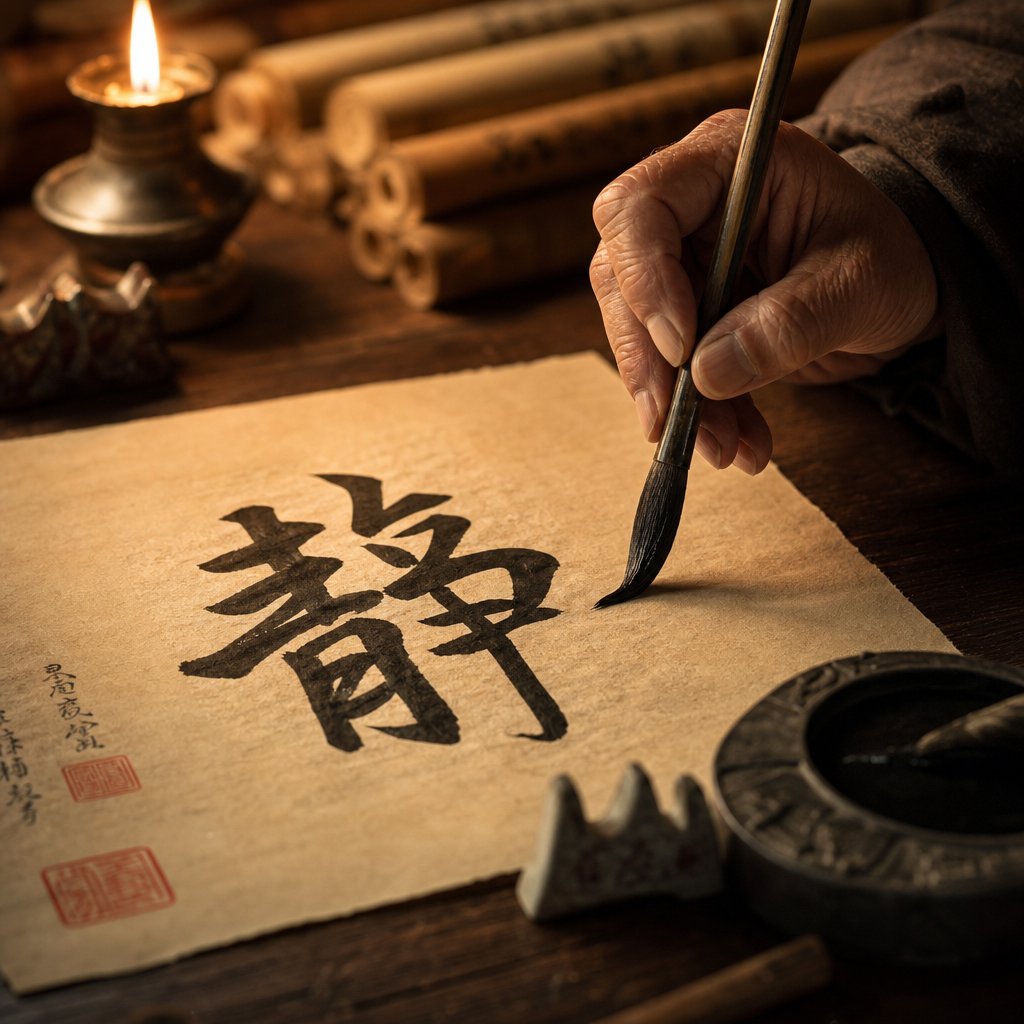
Types and Methods of Imperial Name Avoidance
The system of naming taboos was not a single, monolithic rule. It operated on multiple levels, each with its own scope, audience, and degree of enforcement. Understanding the difference between state taboo and family taboo in China reveals how deeply the practice penetrated every layer of society — from the imperial court down to individual households.
State Taboos and the Emperor's Personal Name
The most powerful category was guohui (国讳), the state taboo. This applied to the emperor's given name characters and those of his ancestors. Everyone in the empire — officials, scholars, merchants, farmers — was bound by it. You could not write these characters in documents, examinations, or published works. You could not speak them aloud in formal settings. The taboo carried the full weight of law behind it.
Consider a concrete example. During the Qin dynasty, the character zheng (政) from Qin Shi Huang's personal name forced an entire calendar term to be renamed. During the Tang dynasty, the character zhi (治) from Emperor Gaozong's name was replaced empire-wide with its synonym li (理). Research by Tokio Takata at Fudan University has shown that this substitution was not merely a written convention — the character zhi was actually pronounced as "li" in everyday speech, and this alternate pronunciation became stable in the lexicon long after the original enforcement period ended.
The state taboo also extended to homophones in some periods. Characters that merely sounded like the emperor's name — called xianming (嫌名) — could also be flagged. During the Tang dynasty, the character shi (勢), which was homophonous with one character of Emperor Taizong's name shimin (世民), was replaced in Buddhist texts with an entirely different word.
Family Taboos and Sage Taboos
Below the state level, two other categories operated with different rules. The family taboo, jiahui (家讳), required individuals to avoid the personal name characters of their own ancestors — typically going back seven generations. This was a private obligation. You would not expect strangers to observe your family's taboos, but in diplomatic correspondence or formal letters between clans, each family's naming restrictions were respected as a courtesy.
Imagine writing a letter to a colleague and needing to check whether any character in your message happened to match one of their great-grandparents' names. That was the social reality for educated Chinese across centuries.
The third category, shenghui (圣讳), the sage taboo, protected the names of revered cultural figures — most notably Confucius. During the Jin dynasty, writing the name of Confucius was formally taboo. This category was less consistently enforced than the state taboo, varying significantly by dynasty and political climate, but it reflected the same underlying logic: certain names carried such weight that ordinary people should not casually invoke them.
| Type | Chinese Term | Scope | Who Must Observe | Enforcement |
|---|---|---|---|---|
| State Taboo | Guohui (国讳) | Emperor's name and ancestors | All subjects in the empire | Legal punishment, exam disqualification |
| Family Taboo | Jiahui (家讳) | One's own ancestors (up to 7 generations) | Family members and correspondents | Social shame, loss of reputation |
| Sage Taboo | Shenghui (圣讳) | Confucius and other revered figures | Scholars and officials (varies by dynasty) | Social and sometimes legal consequences |
Methods of Avoidance in Writing and Speech
So how did Chinese avoid writing the emperor's name in practice? Over centuries, scribes, scholars, and ordinary people developed several reliable techniques. The methods of character substitution in imperial China were surprisingly systematic.
- Synonym substitution: Replace the taboo character with one that carries the same meaning. For example, the Xuanwu Gate (玄武門) of the Forbidden City was renamed the Gate of Divine Might (神武門) to avoid the character xuan (玄) from the Kangxi Emperor's personal name, Xuanye.
- Homophone substitution: Swap the taboo character for one that sounds similar but has a different meaning. The Tang-era Buddhist text Foding zunsheng tuoluoni replaced shijie (世界, "world") with shengjie (生界) to avoid Emperor Taizong's name character shi (世).
- Omitting a stroke (quebi 闕筆): Write the character with its final stroke removed. This was one of the most common methods — the character remained recognizable but was technically "incomplete," signaling deference. The Kangxi Emperor's name characters xuan (玄) and ye (燁) were routinely written with their last strokes missing.
- Leaving a blank space: Simply leave the position empty where the taboo character would appear. Readers understood the gap and mentally filled in the forbidden word.
- Sound change in speech: Alter the pronunciation of the taboo character entirely. The character zhi (治) was read aloud as "li" during and long after the Tang dynasty. Similarly, the character hu (虎), the name of a Tang imperial ancestor, was pronounced "wu" — a substitution so entrenched it was recorded in contemporary dictionaries.
What makes these methods fascinating is their staying power. Many substitutions outlived the dynasties that created them. A pronunciation changed to dodge a seventh-century taboo could still be in use centuries later, embedded so deeply in the language that speakers no longer remembered why it existed.
The techniques were practical solutions to an impossible demand — but they did not eliminate risk. A single slip in the wrong context, especially during the high-stakes civil examinations or in a published work, could bring consequences ranging from a failed career to far worse.
How Naming Taboos Evolved Across Chinese Dynasties
The severity of naming taboo enforcement was never static. Each dynasty inherited the system from its predecessor, then tightened or loosened the rules based on its own political needs. Some periods treated violations as minor embarrassments. Others turned them into capital offenses. Tracing this evolution dynasty by dynasty reveals a clear arc — from cautious formalization under the Han, through intensification in the Tang, to an almost suffocating peak during the Song.
Han Through Tang Dynasty Enforcement
The Han dynasty (206 BCE - 220 CE) gave the taboo system its first real bureaucratic structure. Officials were expected to check documents for taboo characters before submission, and the practice became routine in government correspondence. Yet enforcement remained relatively lenient. Emperor Xuan of Han even changed his own name from Bingyi (病已), which contained two extremely common characters, to Xun (詢), a far rarer one — explicitly to reduce the burden on his subjects. That kind of imperial consideration would become increasingly rare in later centuries.
The Sui dynasty (581-618) marked a turning point. Scholars have identified 141 taboo instances from this short period alone — more than in all previous dynasties combined. The character zhong (忠), the name of the Sui founder's father, forced the renaming of the entire Secretariat from zhongshusheng (中書省) to neishusheng (內書省). Dozens of geographical names containing the character zhong (中, meaning "middle") were changed to nei (內, meaning "inside"). The modern city of Neijiang in Sichuan still carries a name that originated from this Sui-era taboo substitution.
The Tang dynasty (618-907) then pushed the system into new territory. For the first time, concrete legal penalties were codified. The Tang Code prescribed eighty blows with a heavy stick for using a taboo character in a petition to the emperor, and three years of penal servitude for directly offending by using the emperor's name. The Tang also introduced the stroke-omission method — removing the final stroke of a taboo character rather than replacing it entirely — which first appeared in an imperial edict of 660 CE. This visual solution allowed the original character to remain recognizable while still signaling deference.
Tang dynasty emperor name avoidance examples are abundant. When Emperor Gaozong began his reign (650-683), the Ministry of Revenue (minbu 民部) was renamed hubu (户部) to avoid the character min from Emperor Taizong's name. The chancellor Li Shiji was forced to drop a character from his own name, becoming simply Li Ji. Even foreign visitors were not exempt — the Japanese monk Ennin, studying in Chang'an during the ninth century, was given a complete list of Tang taboo characters and instructed to avoid their homophones.
Song Dynasty Peak and Yuan-Ming Variations
Which dynasty had strictest naming taboos? Most scholars point to the Song (960-1279). The Song dynasty naming taboo rules reached a level of complexity unmatched before or after. During the reign of Emperor Gaozong of the Southern Song, more than fifty characters had to be avoided because of a single imperial name — the character gou (構) and all its homophones. Lists of prohibited characters circulated in official compilations like the Chunxi chongxiu wenshushi, and bureaucrats actively lobbied to expand them further.
The Song emperors also extended the taboo backward in time, requiring avoidance of distant ancestors' names and even legendary forebears. Emperor Zhenzong proclaimed the Yellow Emperor as a direct ancestor of the Song imperial line, making the characters of his mythical name xuanyuan (軒轅) off-limits across the empire. The famous Tang-era temple name Xuanzong had to be changed to Minghuang during the Song period because of these ancestral taboos.
The Yuan dynasty (1271-1368), founded by Mongol rulers, relaxed enforcement considerably. The Mongol emperors had their own naming customs and did not invest the same political energy in the Chinese taboo system. The Ming dynasty (1368-1644) restored the practice but with a practical twist — Ming emperors deliberately chose rare, obscure characters for their given names to minimize disruption. This was a conscious return to the ancient principle of making taboos "easy to avoid."
Qing Dynasty Practices and the End of Imperial Taboos
The Qing dynasty (1644-1912) brought its own intensity. The Manchu rulers adopted the Chinese taboo system enthusiastically, sometimes wielding it as a political weapon. The Kangxi Emperor's personal name, Xuanye (玄燁), required both characters to be written with their last strokes omitted in all documents. Anyone whose name shared these characters had to change them. The Xuanwu Gate of the Forbidden City was renamed the Gate of Divine Might (Shenwu Gate) to avoid the character xuan.
In 1777, the scholar Wang Xihou was executed — along with members of his family — for writing the Qianlong Emperor's name without omitting the required strokes in his dictionary. The case illustrates how taboo enforcement could escalate into lethal political persecution during the Qing literary inquisitions.
When did imperial naming taboos end in China? The practice collapsed with the Qing dynasty itself in 1912. The Republic of China that followed had no emperor, no throne, and no mechanism for enforcing personal name prohibitions. China does not have an emperor today, and the taboo system has no legal standing. Yet its cultural echoes persist in the language — in place names, character variants, and pronunciations that were permanently altered during two millennia of enforcement.
| Dynasty | Enforcement Level | Notable Taboo Examples | Key Policies |
|---|---|---|---|
| Han (206 BCE - 220 CE) | Moderate | Emperor Xuan changed his own name to spare subjects | Bureaucratic checking of documents; emperors sometimes chose rare characters |
| Sui (581-618) | High | 141 recorded instances; zhong (中) replaced by nei (內) in dozens of place names | Systematic renaming of offices and geography; homophone avoidance enforced |
| Tang (618-907) | High | Li Shiji forced to drop a character; Ministry of Revenue renamed | First legal code with specific penalties; stroke-omission method introduced (660 CE) |
| Song (960-1279) | Very High (Peak) | 50+ characters banned for one emperor's name; legendary ancestors' names taboo | Extensive homophone lists; exam candidates eliminated for violations; ancestral taboo expanded |
| Yuan (1271-1368) | Low | Limited enforcement under Mongol rule | Mongol naming customs took precedence; Chinese system largely relaxed |
| Ming (1368-1644) | Moderate | Emperors chose rare characters to minimize disruption | Restored Chinese taboo practice; deliberate use of obscure name characters |
| Qing (1644-1912) | High to Severe | Wang Xihou executed (1777); Kangxi's name forced gate renaming | Stroke omission mandatory; literary inquisitions weaponized taboo violations |
The pattern is clear: naming taboo enforcement by Chinese dynasty correlated closely with how much the ruling house needed to assert centralized authority. Dynasties facing internal fragmentation or legitimacy challenges — like the Song, surrounded by rival states — tended to enforce taboos most aggressively. Those secure in their power, or culturally distinct from the Chinese tradition like the Yuan Mongols, could afford to be lenient.
But enforcement severity tells only part of the story. Behind the statistics and legal codes were real people — scholars whose careers ended, officials who lost their posts, and in the worst cases, writers who lost their lives. The question of what actually happened when someone broke the taboo reveals the system's darkest dimension.
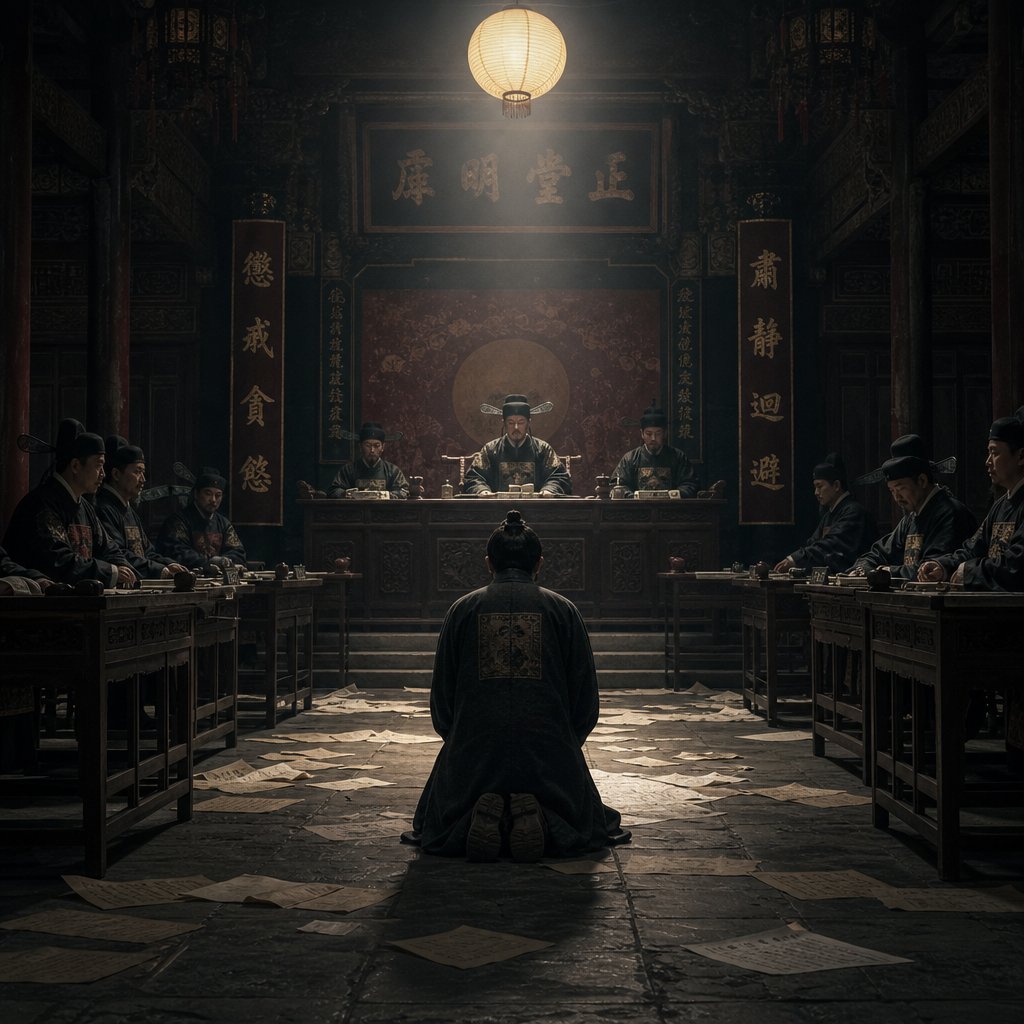
Consequences of Breaking an Emperor's Name Taboo
What happened if you said the emperor's name — or worse, wrote it in an official document? The answer depended on when you lived, who was watching, and whether anyone had a political reason to make an example of you. Punishments ranged from a quiet reprimand to the execution of your entire extended family. The gap between those extremes was not always predictable, and that uncertainty was itself a form of control.
Punishments From Fines to Execution
The punishment for using an emperor's name in China was never a single fixed penalty. It scaled according to dynasty, context, and intent. An accidental slip in casual conversation might go unnoticed. The same character written into a memorial to the throne could end a career — or a life.
Here is how the severity levels stacked up, from mildest to most extreme:
- Social embarrassment and loss of reputation: In earlier periods and informal contexts, using a taboo character simply marked you as uneducated or disrespectful. No legal action followed, but the social damage could be significant in a culture that prized propriety.
- Exam disqualification: Civil service candidates who inadvertently wrote a taboo character in their examination essays were immediately failed — regardless of the quality of their arguments. Years of preparation could vanish over a single brushstroke.
- Demotion or dismissal from office: Officials who allowed taboo characters to appear in documents under their supervision faced removal from their posts. During the Ming dynasty, the examiners Liu Yan and Huang Jian were punished by the Embroidered Uniform Guard in 1456 after a naming taboo violation appeared in a test they oversaw.
- Corporal punishment: The Tang legal code prescribed eighty blows with a heavy stick for using a taboo character in a petition to the emperor. Three years of penal servitude followed for directly writing the sovereign's name without modification.
- Imprisonment: Under stricter dynasties, deliberate or repeated violations could result in indefinite detention. Writers whose published works contained taboo characters were sometimes jailed while authorities investigated whether the offense was intentional.
- Execution of the offender: In the most severe cases, the violator was sentenced to death. This was especially common during the Qing dynasty's literary inquisitions, where perceived disrespect toward the emperor's name could be treated as equivalent to treason.
- Execution of the offender's family (zu): The ultimate punishment extended beyond the individual. Under the principle of collective responsibility, an offender's immediate family, extended relatives, and sometimes even associates could be killed, exiled, or enslaved.
The jump from level two to level seven could happen within a single dynasty, depending entirely on political circumstances. A violation that would earn a quiet demotion in peacetime might trigger mass executions during a period of imperial paranoia.
Famous Cases of Taboo Violations and Political Manipulation
The most chilling aspect of the system was not its formal penalties — it was how easily those penalties could be weaponized. Emperors and officials learned to use alleged taboo violations as pretexts to destroy political rivals, silence critics, and intimidate the educated class into submission.
The most infamous case belongs to Wang Xihou. In 1777, this scholar published a dictionary that criticized the Kangxi Dictionary and — critically — wrote the Qianlong Emperor's personal name without omitting the required strokes. The offense was real but minor. The response was catastrophic: Wang Xihou was executed, his family members were sentenced to death (though most relatives were ultimately pardoned), and their property was confiscated. The case sent a clear message to every literate person in the empire: even a technical slip in an academic work could be fatal.
Wang Xihou's case was not isolated. It belonged to the broader pattern of literary inquisition naming taboo persecution that defined the Qing era. The literary inquisition (wenziyu, 文字狱) — literally "imprisonment due to writings" — was a system where rulers deliberately extracted words or phrases from an author's work to fabricate charges. Some of these persecutions owed to a single character that was part of the emperor's personal name. During the Qianlong Emperor's reign alone, 53 cases of literary persecution were recorded, and naming taboo violations featured prominently among the pretexts.
The political manipulation ran in multiple directions. During the Song dynasty, literary inquisition became a conscious tool in factional struggles. Opposing political parties used alleged taboo violations to suppress and eliminate opponents. The famous poet Su Shi was jailed in 1079 after rivals accused his poems of slandering the court — a case where literary expression was twisted into evidence of disloyalty. While Su Shi's case centered on political satire rather than naming taboos specifically, it established the template: any textual offense, however minor, could be inflated into a capital crime when powerful people wanted someone gone.
The Qing dynasty perfected this approach. The Manchu rulers were especially sensitive to any writing that could be interpreted as questioning their legitimacy. A poet named Xu Jun was executed for writing "The clear winds cannot read, so why do they flip the book pages?" — where "clear" (qing, 清) was also the dynasty's name. The line was interpreted as calling the Manchu rulers illiterate. In another case, a scholar named Hu Zhongzao was beheaded because his poem placed the character zhuo (浊, "murky") before qing (清, "clear/Qing") — read as an insult to the dynasty itself.
These famous naming taboo violation cases share a common thread: the actual textual offense was often trivial or ambiguous. What mattered was whether someone in power wanted to use it. The taboo system gave authorities an almost unlimited supply of potential charges. Any document could be scrutinized, any character could be reinterpreted, and any writer could be retroactively found guilty of disrespect they never intended.
The result was a culture of pervasive self-censorship. Writers did not merely avoid taboo characters — they avoided entire topics, metaphors, and word combinations that might be twisted into evidence of disloyalty. This chilling effect reached far beyond the specific characters on any taboo list, reshaping how people thought about language itself. And nowhere was that reshaping more visible than in the permanent marks the system left on the Chinese written language — characters altered, simplified, or abandoned entirely because of imperial names that have been dead for centuries.
The Permanent Mark on Chinese Characters and Language
Languages evolve for many reasons — trade, migration, technological change. But how many languages were reshaped because a single person sat on a throne? Chinese characters changed by naming taboos did not simply revert to their original forms once an emperor died. Many substitutions stuck. Pronunciations shifted permanently. Entire characters fell out of everyday use and never returned. The cumulative result, compounded across two thousand years of successive reigns, is a modern Chinese lexicon carrying invisible scars of imperial power.
Characters Lost and Changed Forever
Some of the most striking examples involve characters that were so thoroughly replaced during a taboo period that the original form became archaic — or vanished from common literacy altogether.
Take the character shi (世), meaning "generation" or "world." When Emperor Taizong of Tang took the throne with the personal name Shimin (世民), the character shi was banned from general use. Scribes replaced it with dai (代) in countless documents. Emperor Gaozong later tightened the restriction, requiring complete avoidance of shi even in isolation — forcing the chancellor Li Shiji to permanently drop the character from his own name. The word dai became so entrenched in certain compound expressions that it persisted long after the Tang fell.
During the Han dynasty, Emperor Ming's personal name Zhuang (莊) forced most people with the surname Zhuang to change their family name to its synonym Yan (嚴). Generations later, many families never changed back. The surname Yan persists today partly because of a naming taboo imposed nearly two thousand years ago.
The Kangxi Emperor's name, Xuanye (玄燁), removed the character xuan (玄) from active circulation in formal writing for over a century. The Xuanwu Gate of the Forbidden City became the Gate of Divine Might (Shenwu Gate) — a name it still carries. The character xuan, once common in philosophical and cosmological texts, became something writers instinctively avoided even after the Qing fell, simply because generations of scholars had trained themselves to work around it.
How Taboo Substitutions Became Standard Usage
The most fascinating dimension of this permanent linguistic impact is what happened to pronunciation. Research by Takata Tokio has demonstrated that sound changes made to avoid taboo characters were "not a case of temporary substitution but were used as one of the stable pronunciations of the characters." In other words, what began as a political workaround became the accepted way to say a word — permanently.
The clearest example is the first month of the Chinese calendar. Originally pronounced zhengyue with a falling tone (正月, rhyming with zheng 政, Qin Shi Huang's personal name), the pronunciation was officially shifted to a level tone — zhengyue (征) — to avoid the taboo. That altered pronunciation is still standard in modern Mandarin, more than two thousand years after the First Emperor's death. Most speakers today have no idea they are observing a Qin-era naming taboo every time they say the word.
Similar patterns appear across the lexicon:
- The character hu (虎, "tiger"), taboo during the Tang because it appeared in an imperial ancestor's name, had its pronunciation altered to "wu" in certain compounds — a shift recorded in contemporary dictionaries and preserved in some regional dialects.
- The character zhi (治, "to govern") was read as "li" throughout the Tang period to avoid Emperor Gaozong's name. Buddhist texts from Dunhuang show this pronunciation was used consistently in religious recitation, embedding it into liturgical tradition.
- The Sui dynasty's taboo on zhong (忠/中) led to the permanent renaming of government offices and cities. The modern city of Neijiang in Sichuan still carries a name that originated from a sixth-century taboo substitution of zhong with nei.
Characters simplified because of emperor names also contributed to the broader trajectory of Chinese script evolution. The stroke-omission method — removing the final stroke of a taboo character — produced variant forms that circulated for decades or centuries. Some of these simplified variants entered common handwriting practice and influenced later standardization efforts, though the direct line between imperial taboo and modern simplified Chinese is complex and debated among scholars.
What emerges from this evidence is a pattern unlike anything in other writing systems. Political authority did not merely suppress certain words temporarily — it permanently rewired how imperial taboos affected modern Chinese language at the level of sound, script, and vocabulary. Each dynasty added its own layer of alterations, and because Chinese civilization maintained continuous written records, these layers accumulated rather than being wiped clean.
The broader implication resonates well beyond ancient China. When a state has the power to dictate which words people may use, the effects do not disappear when the policy ends. Language absorbs the change, normalizes it, and passes it forward to speakers who never knew the original form existed. It is a quiet reminder that political control over communication leaves traces far outlasting the regimes that imposed it.
For the millions of scholars who lived under this system, however, the linguistic impact was not abstract. It was intensely practical — especially for anyone preparing to sit the imperial civil service examinations, where a single forgotten taboo character could destroy years of study in an instant.
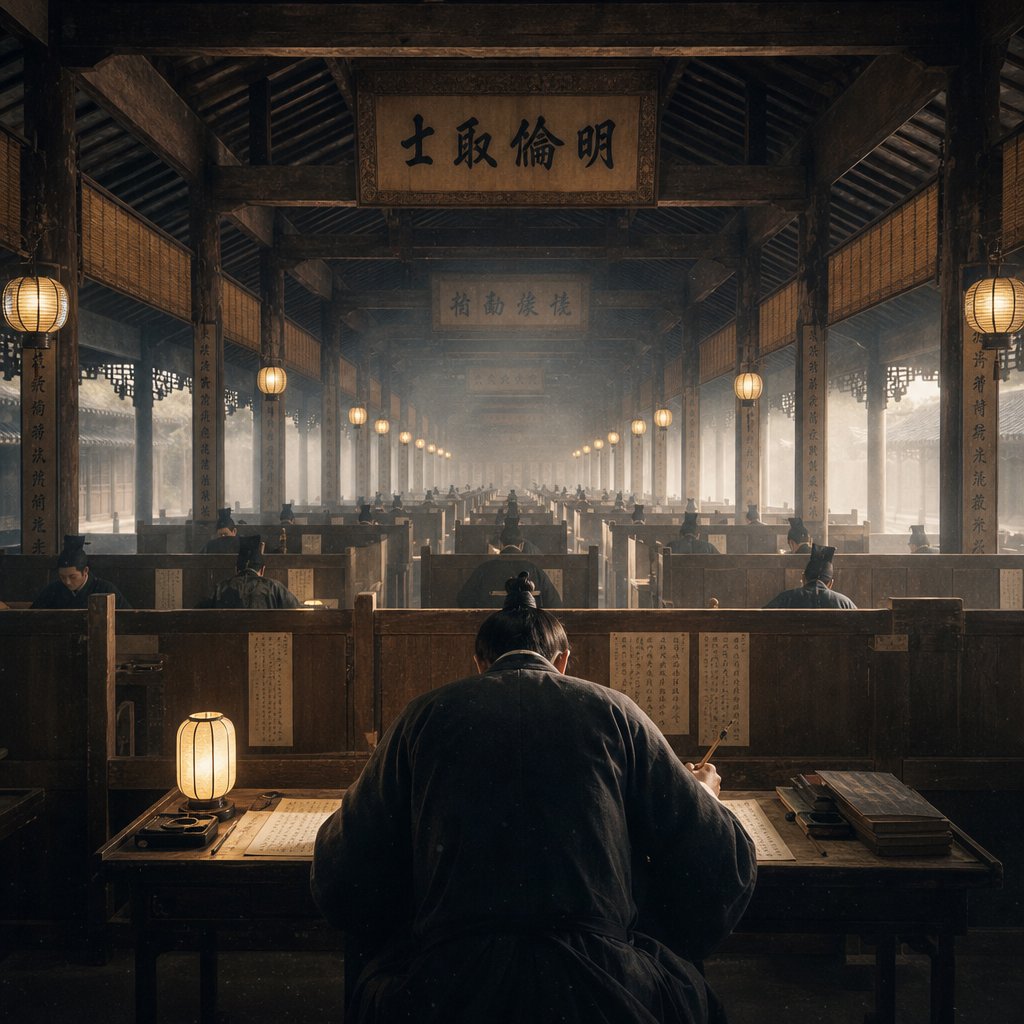
Naming Taboos and the Civil Examination System
Picture spending a decade mastering the Confucian classics, perfecting your calligraphy, and honing your essay technique — only to fail the most important test of your life because of a single character. Not a wrong answer. Not a weak argument. Just one brushstroke that happened to match a forbidden imperial name. For candidates in the keju (科举) civil service examinations, naming taboos in Chinese civil service exams were not an academic curiosity. They were a live minefield embedded in every sentence they wrote.
Memorizing Taboo Lists Before the Imperial Exam
Before candidates even entered the examination hall, they needed to carry a mental catalog of every active taboo character — the reigning emperor's name, his father's name, his grandfather's name, and in some dynasties, ancestors stretching back generations. During the Song dynasty, when enforcement reached its peak, this could mean memorizing fifty or more prohibited characters along with all their homophones and approved substitutions.
How did keju exam candidates avoid taboo characters in practice? Preparation guides circulated among scholars listing current prohibitions and their acceptable replacements. Tutors drilled students on these lists alongside the classical texts themselves. The government occasionally published official compilations — like the Song-era Chunxi chongxiu wenshushi — specifying exactly which characters were off-limits and which substitutes were permissible. But these lists changed with every new reign, and candidates sitting exams during a transition period faced the added anxiety of confirming which taboos were currently active.
The stakes were brutal. Imperial exam disqualification for taboo violation was automatic and non-negotiable. Examiners reviewed essays specifically for taboo infractions before even evaluating content. A candidate could produce the most brilliant policy argument of the session, demonstrate flawless command of history and philosophy, and still receive a failing mark because one character in one sentence matched a name on the prohibited list. As Piotr Adamek's research notes, people "had to stop their careers" because of naming taboos — and for examination candidates, the career had not even started yet.
The pressure was compounded by the sheer volume of writing required. Exam essays ran thousands of characters long. Candidates composed them under time pressure, in unfamiliar examination cells, without reference materials. A character that you had successfully avoided in a hundred practice essays might slip through in the heat of the actual test — especially if it appeared naturally in a classical quotation you were citing from memory.
How Taboos Shaped Literary Style and Word Choice
This constant vigilance did something unexpected to Chinese literary culture. It made writers extraordinarily creative with language — not by choice, but by necessity.
When certain common characters were forbidden, scholars could not simply leave gaps in their arguments. They developed elaborate circumlocutions, synonym chains, and alternative phrasings to express ideas without touching the prohibited words. Over time, these workarounds became stylistic conventions. The influence of naming taboos on classical Chinese writing style is visible in the dense, allusive quality of formal prose — where a writer might use three indirect references rather than one direct statement, partly because directness risked hitting a taboo character.
Consider what happens when the word for "govern" (zhi, 治) is banned, as it was during the Tang dynasty. Every essay about governance — the central topic of civil service examinations — had to find alternative vocabulary. Writers reached for li (理, "to order"), ping (平, "to pacify"), mu (牧, "to shepherd"), and dozens of other synonyms. This forced diversification of vocabulary became a hallmark of elegant writing. Candidates who could navigate taboo restrictions gracefully, without their prose sounding strained or awkward, demonstrated a level of linguistic mastery that examiners valued independently of the taboo system itself.
Taboo awareness also became a sharp marker of education and social class. Knowing which characters to avoid — and knowing the approved substitutions — signaled that you belonged to the literate elite. Someone who stumbled over a taboo character in conversation or correspondence revealed themselves as insufficiently educated, regardless of their actual intelligence. The system reinforced existing class boundaries: families wealthy enough to hire tutors and purchase updated taboo guides had a structural advantage over self-taught scholars from rural areas who might not learn about a new emperor's taboo characters for months after they took effect.
The irony is striking. A system designed to protect imperial dignity ended up shaping the aesthetic standards of an entire literary tradition. The circumlocutions born from political fear became the building blocks of what later generations admired as classical elegance. Writers who mastered the art of saying everything while writing nothing forbidden were, in effect, turning censorship into craft.
Yet this same forensic attention to individual characters — which taboo was active when, which substitution was used where — would eventually give modern scholars an unexpected gift: a precise tool for dating ancient manuscripts and exposing forgeries, based on the very avoidance patterns that once terrorized examination candidates.

How Modern Scholars Use Naming Taboos to Solve Mysteries
A system built to protect imperial egos left behind something its creators never intended: a forensic timestamp embedded in every document produced under its rules. Because taboo characters changed with each emperor — and because the specific method of avoidance (stroke omission, homophone substitution, blank space) often changed within a single reign — the avoidance patterns in a manuscript function like a fingerprint, pinpointing when it was written or copied with surprising precision.
Dating Documents Through Taboo Evidence
The logic is straightforward. If a text avoids the personal name characters of Emperor A but not Emperor B, it was almost certainly produced during Emperor A's reign — after the taboo took effect but before Emperor B's taboo was imposed. This textual dating method using Chinese naming avoidance gives scholars a tool that works even when a document carries no explicit date, colophon, or preface.
A concrete example illustrates the method's power. The Bodleian Library holds two copies of Hongjianlu (弘簡錄), a massive Ming-dynasty historical work whose printing blocks were completed in 1699. The title contains the character hong (弘) — which happens to be part of the Qianlong Emperor's personal name, Hongli (弘曆). In later impressions, the final stroke of that character was physically excised from the printing block, and the title page substituted the homophone hong (宏) instead. These modifications tell scholars the impression was pulled after the taboo became mandatory — not in 1699 when the blocks were carved, but decades later.
The dating can be refined even further. Using naming taboos to date Chinese manuscripts requires knowing exactly when each avoidance rule became enforceable. In the Qianlong period, the order to omit the last stroke was not issued until 1748 — the thirteenth year of the reign. The option to substitute a homophone came even later, in 1760. So a copy showing homophone substitution on its title page cannot have been printed before 1760, even though the blocks themselves are sixty years older. That level of precision — narrowing a print date to within a specific decade — is difficult to achieve through any other method.
Detecting Forgeries and Resolving Attribution Disputes
The same logic works in reverse. How do scholars detect forgeries with taboo characters? If a document claims to date from the Tang dynasty but avoids characters that were only taboo during the Song, the anachronism exposes it as a later copy or outright fabrication. A forger who failed to research the correct taboo patterns for their claimed period left evidence as damning as using the wrong type of paper or ink.
This technique has helped resolve long-standing attribution disputes over classical texts. When multiple versions of a work exist and scholars disagree about which is earliest, taboo evidence in historical research can settle the question. A version that avoids Kangxi-era taboos but not Qianlong-era ones was clearly produced in the intervening period — regardless of what its title page claims.
The method does have limitations. Not all scribes followed taboo rules consistently, especially in private or informal documents. Regional variation in enforcement means that a text produced far from the capital might show incomplete avoidance. And some taboos were applied retroactively to older texts during reprinting, which can create false signals if scholars are not careful to distinguish original composition from later editorial intervention.
Despite these caveats, naming taboo evidence remains one of the most reliable tools in the bibliographer's kit — particularly when combined with other approaches like paper analysis, printing-block degradation, and calligraphic style comparison. Each method covers the others' blind spots.
A system designed to enforce political submission inadvertently created one of the most precise forensic dating tools in historical textual analysis — turning two thousand years of imperial censorship into an indelible, dynasty-by-dynasty timestamp readable by anyone who knows what to look for.
There is something deeply satisfying about this reversal. The emperors who imposed naming taboos sought to elevate themselves above ordinary language. They succeeded — but in doing so, they left a trail so consistent and so detailed that modern scholars can now reconstruct the exact circumstances of a document's creation, centuries after the dynasty that produced it turned to dust. The very mechanism of control became, in the end, a mechanism of knowledge.
Frequently Asked Questions About Emperor Naming Taboos in China
1. What is bihui (避諱) in Chinese culture?
Bihui is the practice of naming taboo in imperial China, where all subjects were strictly forbidden from writing or speaking the personal name characters of the reigning emperor, his ancestors, and sometimes revered figures like Confucius. It was enforced by law for over two thousand years, from the Qin dynasty (221 BCE) until the fall of the Qing dynasty in 1912. Violations could lead to consequences ranging from failed civil service exams to execution, depending on the dynasty and political context.
2. How did people avoid using the emperor's name in writing?
Chinese scribes and scholars developed several systematic methods to comply with naming taboos. The most common techniques included replacing the forbidden character with a synonym or homophone, omitting the final stroke of the character (called quebi), leaving a blank space where the taboo character would appear, and altering the pronunciation of the character in speech. For example, the Kangxi Emperor's name character xuan was routinely written with its last stroke removed, and the Xuanwu Gate of the Forbidden City was entirely renamed to the Gate of Divine Might.
3. What happened if someone broke an emperor's naming taboo?
Punishments varied dramatically by dynasty and intent. Minor or accidental violations might result in social embarrassment or exam disqualification. More serious offenses under strict dynasties could bring corporal punishment (the Tang Code prescribed 80 blows with a heavy stick), imprisonment, or dismissal from office. In extreme cases, particularly during the Qing dynasty's literary inquisitions, violators faced execution. The scholar Wang Xihou was killed in 1777 for writing the Qianlong Emperor's name without omitting required strokes in his dictionary.
4. Which Chinese dynasty had the strictest naming taboo enforcement?
Most scholars identify the Song dynasty (960-1279) as having the strictest enforcement. During Emperor Gaozong's reign in the Southern Song, more than fifty characters had to be avoided because of a single imperial name and all its homophones. The Song also extended taboos backward to legendary ancestors, and exam candidates were automatically eliminated for any violation. By contrast, the Yuan dynasty under Mongol rule was the most lenient, largely relaxing the Chinese taboo system in favor of their own naming customs.
5. Did emperor naming taboos permanently change the Chinese language?
Yes, many taboo-era substitutions became permanent features of modern Chinese. The most striking example is the first month of the lunar calendar (zhengyue), whose pronunciation was altered during the Qin dynasty to avoid Qin Shi Huang's name and remains changed in modern Mandarin over 2,200 years later. Place names like Neijiang in Sichuan, surnames like Yan (originally Zhuang), and architectural names like the Gate of Divine Might all preserve taboo substitutions from dynasties that ended centuries ago.