What a Feng Shui Name Compatibility Test Actually Measures
When you search for a feng shui name compatibility test, you probably expect something rooted in Chinese metaphysics. Instead, most results serve up generic love calculators, Pythagorean numerology percentages, or a chinese horoscope compatibility calculator dressed up with vague Eastern imagery. None of that is what this method actually involves.
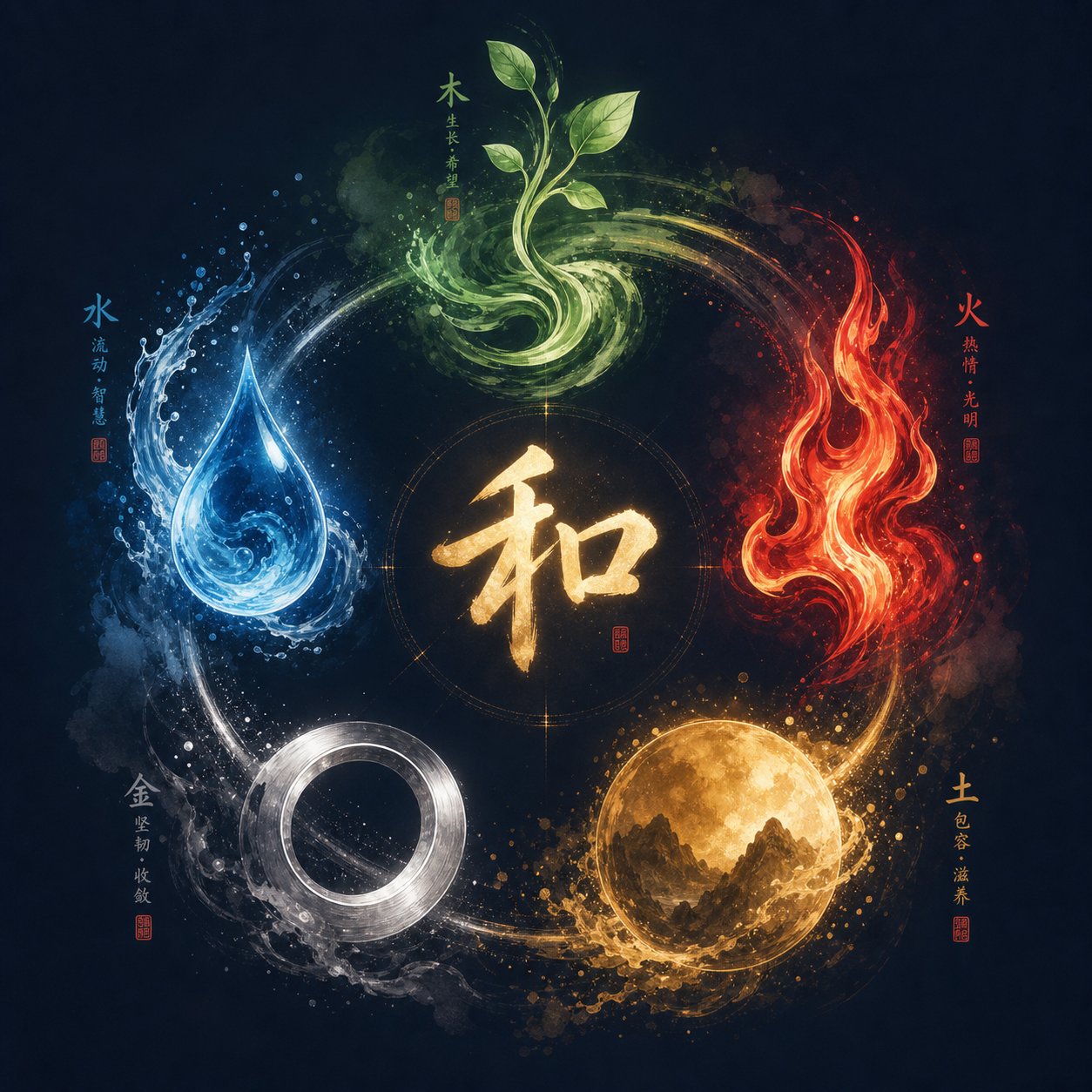
So what does it measure? At its core, this compatibility test analyzes the five elements (wood, fire, earth, metal, water) embedded within each person's name and checks whether those elements support or clash with each other. It draws from the same wu xing framework that governs traditional feng shui spatial design, except here the "space" being harmonized is the energetic relationship between two people.
A feng shui name compatibility test maps the elemental profile of each name through stroke count, phonetic resonance, and semantic meaning, then evaluates whether the two profiles share a productive (harmonious) or destructive (conflicting) five-element relationship.
Defining Feng Shui Name Compatibility
This name compatibility test belongs to a branch of Chinese metaphysics called xing ming xue (nameology). Practitioners assess the strokes, pronunciation, and meaning of each character in a name to determine its dominant element. When two names are compared, the interaction between their elements reveals whether the pairing is naturally supportive, neutral, or friction-prone. Think of it like checking whether two pieces of furniture create flow or block energy in a room, except the "furniture" is the vibrational signature carried by each name.
How This Differs from Zodiac and Numerology Matching
You might wonder how this differs from chinese zodiac compatibility tools or a bazi compatibility calculator. The distinction is straightforward. A zodiac compatibility calculator compares animal signs based on birth year. BaZi analysis examines the full birth chart (year, month, day, hour). Pythagorean numerology reduces names to single digits using a Western letter-number grid. Each system has its own logic, but none of them perform the specific task of mapping name characteristics to the five elements and reading the generative or destructive cycle between two people's names.
This article walks you through the authentic methodology step by step so you can run your own compatibility test without relying on black-box tools or paying for a consultation. You will learn how elements are assigned, how cycles work, and how to interpret results, all grounded in the same framework professional Chinese metaphysics practitioners use.
Why Names Carry Energetic Significance in Feng Shui
A name might seem like just a label, but Chinese metaphysics treats it as something far more active. In this tradition, every name functions as a vibrational signature, a compact bundle of energy shaped by its sound, meaning, and physical structure. When two people interact, their names interact too, creating either resonance or friction at an elemental level. This is the philosophical foundation behind matching names through the five-element framework.
The Energetic Theory Behind Names in Chinese Metaphysics
Imagine each Chinese character as a small energy system. Its radical carries elemental weight. Its stroke count maps to a numerical value tied to one of the five phases. Its pronunciation vibrates at a specific tonal frequency. And its semantic meaning evokes particular qualities, whether growth, stability, sharpness, or flow. In name numerology, these dimensions are not decorative. They are diagnostic. A practitioner reads them the way an acupuncturist reads pulse points: as indicators of where energy concentrates and where it may be lacking.
As Hong Kong feng shui practitioner Lee Shing-chak explains, a person's name is believed to be one of the key factors that decide their destiny. Under this system, a baby is named after careful analysis of birth timing and which of the five elements coincide on the astrological calendar. The name should "balance out" the elements to improve one's luck. This same logic extends to a chinese astrology compatibility test between two people: if your name's dominant element clashes with your partner's, the energetic friction is considered real.
In feng shui philosophy, a name is not a passive identifier. It is an active energy carrier whose sound, structure, and meaning continuously broadcast elemental frequencies into the world, shaping how its bearer interacts with people and environments.
Yuan Fen and the Role of Names in Destined Connections
There is a concept in Chinese culture called yuan fen (缘分), often translated as "destined affinity" or "fated connection." It describes the invisible thread that draws two people together, or keeps them apart. Yuan fen is not purely random. Chinese metaphysics holds that it operates through layers: Heavenly Destiny (天缘), Earthly Destiny (地缘), and Humanly Destiny (人缘), each influencing relationships at different levels.
Where do names fit? They sit at the intersection of these layers. Your name reflects the elemental conditions present at your birth, and it broadcasts a numerology name value that either harmonizes or conflicts with the people around you. When you run a chinese astrology match between two names, you are essentially checking whether yuan fen is supported or strained at the elemental level. A productive five-element relationship between names suggests natural affinity. A destructive one hints at friction that requires conscious effort to navigate.
The Bazi Sheng Xiao Xing Ming system formalizes this idea within Chinese metaphysics, treating name analysis as one layer in a broader destiny assessment that also includes birth charts and timing cycles. Names are not the whole picture, but they are a persistent, daily influence, spoken aloud dozens of times, written repeatedly, and carried as an energetic signature through every interaction.
This energetic weight is precisely why the structural details of a name matter so much. The question becomes practical: how exactly does a name get classified into wood, fire, earth, metal, or water? That classification depends on a specific framework, the five elements cycle, and the mechanics of how each element generates or restrains the others.
The Five Elements Framework Behind Name Compatibility
The five elements, or wu xing (五行), are not static substances. They are dynamic forces that flow into each other, support each other, and restrain each other in predictable patterns. When you apply this framework to names, each name gets classified by its dominant element based on stroke count, phonetic quality, and meaning. The compatibility between two people then comes down to one question: do their name elements feed each other, or do they fight?
The Five Elements and Their Name Associations
Each element carries distinct qualities that show up in name characteristics. Wood names tend to feature characters with the 木 radical, sounds that rise in tone, and meanings tied to growth or flexibility. Fire names carry the 火 radical, sharp or explosive phonetics, and meanings linked to warmth or illumination. Earth names use the 土 radical, grounded tones, and meanings suggesting stability. Metal names feature the 钅 radical, clear and crisp sounds, and meanings evoking precision or strength. Water names carry the 氵 radical, flowing phonetics, and meanings associated with depth or adaptability.
The table below maps each element to its name-relevant characteristics, including the stroke count endings traditionally used to assign elemental values:
| Element | Core Qualities | Associated Sounds | Stroke Count Ending | Harmonizes With | Conflicts With |
|---|---|---|---|---|---|
| Wood | Growth, vitality, flexibility | Rising tones, soft onsets (zh, j) | 1 or 2 | Water (parent), Fire (child) | Metal (cuts it), Earth (it parts) |
| Fire | Passion, energy, transformation | Sharp, explosive sounds (ch, sh) | 3 or 4 | Wood (parent), Earth (child) | Water (extinguishes it), Metal (it melts) |
| Earth | Stability, nourishment, grounding | Flat, open vowels (a, o) | 5 or 6 | Fire (parent), Metal (child) | Wood (parts it), Water (it absorbs) |
| Metal | Precision, strength, clarity | Crisp consonants (s, x, q) | 7 or 8 | Earth (parent), Water (child) | Fire (melts it), Wood (it chops) |
| Water | Depth, adaptability, wisdom | Flowing, nasal sounds (m, n, ng) | 9 or 0 | Metal (parent), Wood (child) | Earth (absorbs it), Fire (it extinguishes) |
You will notice that every element has a "parent" that supports it and a "child" it nurtures. This parent-child relationship is the backbone of compatibility assessment. When a chinese zodiac compatibility calculator or chinese compatibility calculator gives you a result, it often draws from these same elemental relationships, though applied to birth year animals rather than name structure.
Productive Cycle for Harmonious Name Pairings
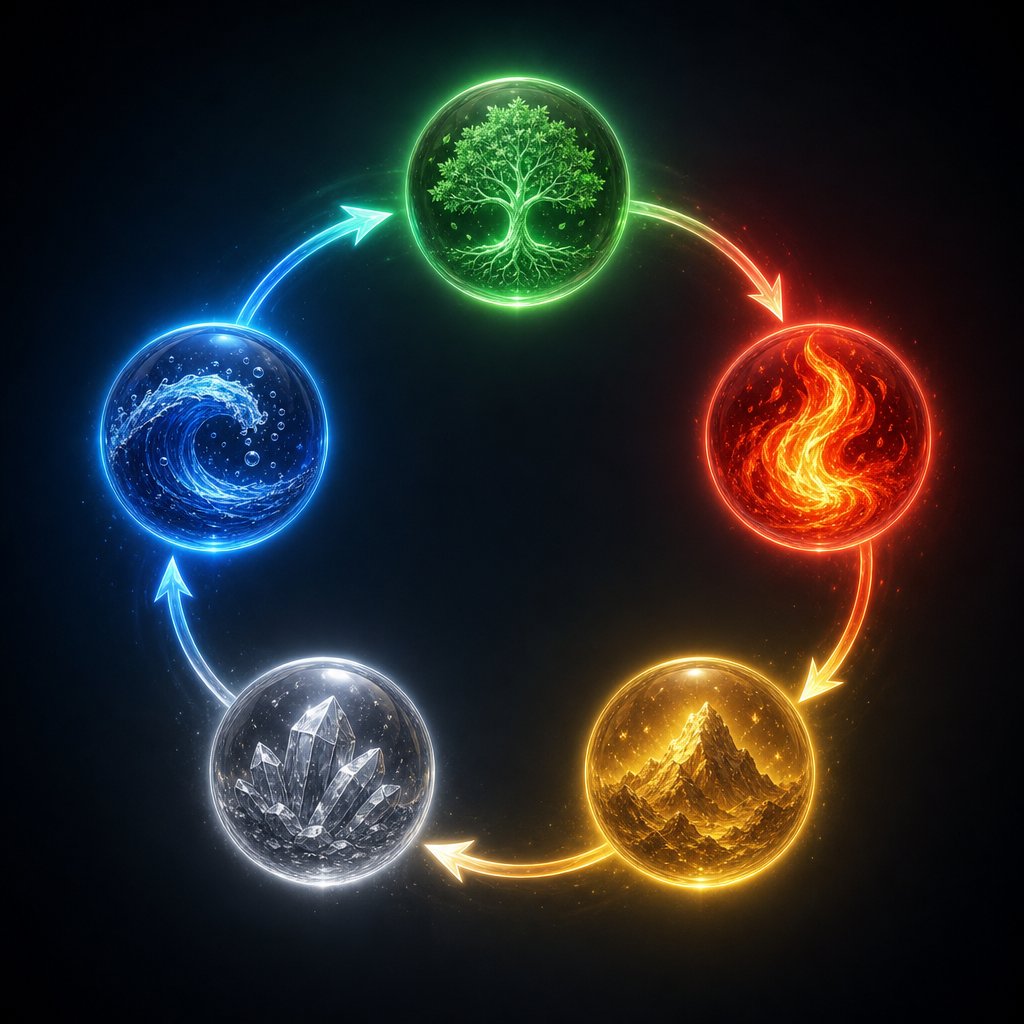
The productive cycle, called the sheng cycle (相生), describes how each element nourishes the next in a continuous loop. Picture it as a circle where energy flows forward:
- Water nourishes Wood (rain feeds a tree)
- Wood feeds Fire (burning wood creates flame)
- Fire creates Earth (ash becomes soil)
- Earth bears Metal (ore is mined from the ground)
- Metal collects Water (condensation forms on metal surfaces)
When two names sit in a productive relationship, one person's elemental energy naturally supports the other. For example, if your name's dominant element is Wood and your partner's is Fire, your energy "feeds" theirs. This does not mean one person gives while the other takes. In practice, the element being nourished also stabilizes the one doing the nourishing, creating mutual benefit. Chinese zodiac couples whose names align along the sheng cycle often report a sense of ease, as if the relationship flows without forced effort.
The mother-child metaphor is useful here. The element that produces is called the "mother," and the one receiving nourishment is the "child." A therapeutic principle within this system holds that strengthening the mother element indirectly strengthens the child, which is why some practitioners recommend name adjustments that reinforce the supporting element rather than the weak one directly.
Destructive Cycle and Conflicting Name Energies
The destructive cycle, or ke cycle (相克), describes how each element controls or limits another. This is not inherently negative. It functions like a checks-and-balances system that prevents any single element from becoming dominant. The relationships follow this pattern:
- Wood parts Earth (roots break through soil)
- Earth absorbs Water (soil dams a stream)
- Water extinguishes Fire (rain puts out flame)
- Fire melts Metal (heat liquefies ore)
- Metal chops Wood (an axe fells a tree)
When two names fall into a destructive relationship, one person's elemental energy naturally restrains the other. This can manifest as subtle friction, a feeling that one partner's strengths inadvertently suppress the other's expression. If your name is dominated by Water and your partner's by Fire, your energy may "extinguish" their warmth and drive, while their intensity may feel threatening to your calm depth.
Does a destructive pairing mean the relationship is doomed? Not at all. The ke cycle exists to maintain balance, and many strong partnerships include a controlling dynamic that keeps both people grounded. The key distinction is between healthy control and overacting control. When the restraining element becomes too dominant, what should be gentle regulation turns into suppression. A chinese astrology calculator compatibility reading flags these dynamics so you can address them consciously rather than letting them operate invisibly.
Understanding both cycles gives you the interpretive lens you need. But identifying which element actually dominates a given name requires a more granular analysis, one that examines the pictorial, aural, semantic, and numerical dimensions of each character individually.
Four Pillars of Chinese Name Analysis Explained
Assigning a single element to a name is not a one-step calculation. A practitioner reads each name through four distinct lenses, and only when all four agree, or when their combined weight tips clearly toward one element, does the name receive its elemental classification. Think of it like building a numerology chart with multiple data points rather than relying on a single number. Each dimension contributes evidence, and the final verdict emerges from the pattern they form together.
Here are the four pillars and what each one reveals:
- Pictorial (Form) - Examines the visual structure of each character, including its radical composition, stroke architecture, and calligraphic balance. A character containing the water radical (氵) visually signals the Water element regardless of how it sounds or what it means.
- Aural (Sound) - Analyzes phonetic resonance, tonal quality, and how the name flows when spoken aloud. Certain sound families map to specific elements: flowing nasal tones suggest Water, sharp explosive consonants point to Fire.
- Meaning (Semantics) - Reads the literary, cultural, and symbolic associations carried by each character. A character meaning "mountain" carries Earth energy; one meaning "blade" carries Metal energy, even if its radical or sound suggests otherwise.
- Numerical (Stroke Count) - Calculates the total strokes in each character and maps the resulting numerical value to an element using the traditional digit-to-element system. This is the most quantifiable pillar and the one most name numerology calculator tools rely on.
Pictorial Analysis of Name Structure
Every Chinese character is a visual composition built from smaller components called radicals. These radicals often carry explicit elemental meaning. The wood radical (木), fire radical (火), earth radical (土), metal radical (钅), and water radical (氵) are the most direct indicators. When a character contains one of these, its elemental affiliation is partly declared by its very shape.
But pictorial analysis goes deeper than spotting obvious radicals. Practitioners also assess calligraphic balance, the density of strokes, and whether the character's visual weight feels expansive (Wood, Fire) or compact (Metal, Earth). A name composed entirely of dense, heavy characters projects a different elemental signature than one built from open, airy strokes. This visual dimension is entirely absent from Western systems, where letters carry no pictorial elemental weight.
Aural Resonance and Tonal Compatibility
Mandarin is a tonal language with four distinct tones, and each tone creates a different energetic impression. A name spoken in rising tones feels upward and expansive, qualities associated with Wood and Fire. A name dominated by falling tones feels grounding, pointing toward Earth or Metal. Flat, level tones suggest steadiness, while dipping tones carry a Water-like quality of depth and return.
Beyond tones, the consonant and vowel sounds themselves carry elemental associations. Crisp sibilants (s, x, q) resonate with Metal's precision. Open vowels (a, o) ground into Earth. Nasal endings (ng, n) flow like Water. When you hear someone's name spoken aloud, you are hearing its elemental broadcast, even if you cannot consciously decode it. This is why practitioners insist on hearing a name pronounced, not just seeing it written, before completing their assessment.
Meaning-Based and Numerical Element Mapping
The semantic pillar reads what a character evokes culturally. Characters referencing forests, spring, or growth carry Wood energy. Those evoking brightness, warmth, or intensity carry Fire. Meanings tied to harvest, soil, or nurturing signal Earth. References to sharpness, purity, or precious metals point to Metal. And characters suggesting oceans, rain, or wisdom align with Water. A skilled numerology name calculator accounts for these layers rather than reducing everything to a single digit.
The numerical pillar is the most systematic. Each character's stroke count produces a numerical value that maps directly to an element. This is where the process most resembles what Western practitioners might recognize as a life path no. calculation, though the mapping system is entirely different. In Western numerology, someone asking "what is my life path number" reduces their birth date to a single digit. In Chinese name analysis, stroke counts are grouped by their final digit (1-2 for Wood, 3-4 for Fire, and so on) to reveal elemental alignment. The numerical pillar provides the hard data that anchors the more interpretive readings from the other three dimensions.
Practitioners weigh all four pillars together. When three or four dimensions point to the same element, the classification is clear. When they split, say two pointing to Water and two to Metal, the name carries a blended profile, and the compatibility reading must account for both elements. This layered approach is what separates authentic feng shui name analysis from simple tools that check only one dimension. It also explains why two names with identical stroke counts can receive different elemental classifications: their sound, form, and meaning may tell a different story than the numbers alone.
With a complete elemental profile built from all four pillars, the next question becomes mechanical: how exactly do you calculate stroke counts and apply the traditional mapping system? That process has its own structure, a grid system that assigns different weight to different character positions within the full name.
Chinese Stroke Count Analysis and Element Mapping
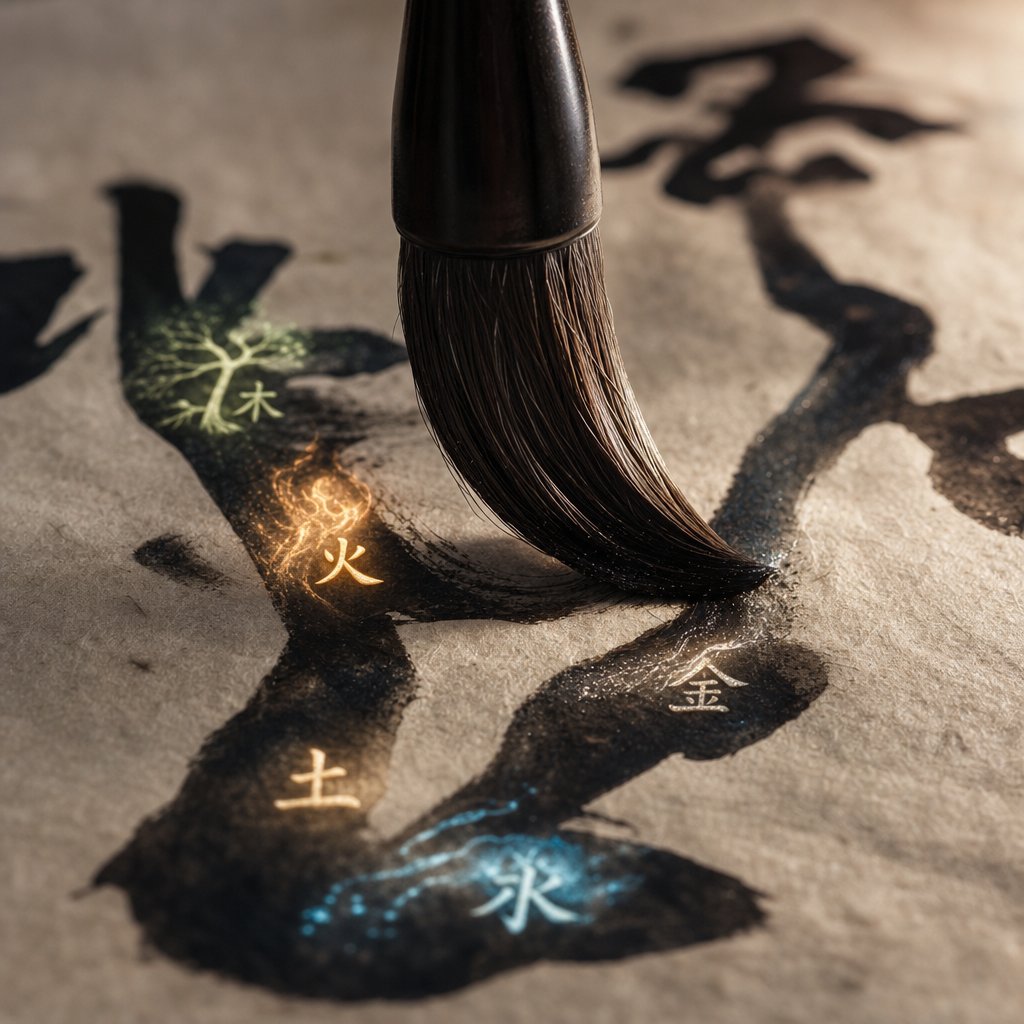
Stroke count analysis is the quantitative backbone of Chinese name numerology. While the pictorial, aural, and semantic pillars require interpretive judgment, stroke counting gives you hard numbers you can look up, calculate, and compare. The system is called xing ming xue (姓名学), and it converts the physical structure of each character into an elemental assignment based on a simple digit-to-element mapping.
Here is the traditional mapping system practitioners use. You take the total stroke count of a character (or a grid total) and look at its last digit:
| Last Digit of Stroke Count | Assigned Element | Associated Qualities |
|---|---|---|
| 1 or 2 | Wood | Growth, upward movement, vitality |
| 3 or 4 | Fire | Expansion, warmth, transformation |
| 5 or 6 | Earth | Stability, grounding, nourishment |
| 7 or 8 | Metal | Precision, structure, clarity |
| 9 or 0 | Water | Depth, flow, adaptability |
So a character with 12 strokes ends in 2, making it Wood. One with 17 strokes ends in 7, making it Metal. In the context of numerology 8, a character with 8 or 18 strokes carries Metal energy. The number 9 meaning in this system points to Water, the element of wisdom and adaptability, which is why 9 in numerology here carries a very different connotation than the "completion" meaning it holds in Western systems. Similarly, 4 numerology in this framework signals Fire rather than the "unlucky" association many people assume from Cantonese phonetics.
One critical note: stroke counts must follow the Kangxi Dictionary (康熙字典) standard, not modern simplified character counts. The character 王, for instance, counts as 4 strokes under Kangxi rules. Using ordinary dictionaries can produce incorrect elemental assignments, so always verify against the traditional standard when precision matters.
Understanding Stroke Count Numerology in Chinese Names
Sounds complex? The practical application is more straightforward than it appears. Consider the name 林威 (Lin Wei). Under Kangxi standards, 林 has 8 strokes and 威 has 9 strokes. The last digit of 8 maps to Metal. The last digit of 9 maps to Water. Already you can see that this name carries a Metal-Water signature, two elements in a productive relationship since Metal generates Water in the sheng cycle.
When comparing two names for compatibility, you perform this calculation for both names and then check whether their dominant elements support or clash with each other. A name ending in numerology 2 (Wood) paired with one ending in numerology 4 (Fire) sits in a productive relationship because Wood feeds Fire. A name dominated by numerology 5 (Earth) paired with one dominated by numerology 2 (Wood) sits in a destructive relationship because Wood parts Earth. The 4th number numerology position, Fire, becomes particularly relevant when assessing whether a name's energy will harmonize with or overpower its partner's elemental profile.
The Heaven Earth and Human Grid System
Individual character stroke counts are only the starting point. Traditional practitioners organize a full name into a grid system called Wu Ge (五格), or Five Structures, where different character positions carry different elemental weights. The three most important grids for compatibility assessment are:
- Heaven Grid (Tian Ge) - Calculated as the surname's stroke count plus 1. Represents ancestral energy and inherited influences. For a surname like 林 (8 strokes), the Heaven Grid equals 9, mapping to Water.
- Human Grid (Ren Ge) - The sum of the surname's last character strokes plus the first given name character's strokes. Represents core personality and the main life path. This is considered the most important grid for compatibility readings.
- Earth Grid (Di Ge) - The sum of all given name character strokes. Represents foundational energy, personal growth, and early life development.
Using the example 林威辰 (Lin Wei Chen) with Kangxi counts of 8, 9, and 7: the Heaven Grid is 9 (Water), the Human Grid is 8 + 9 = 17, last digit 7 (Metal), and the Earth Grid is 9 + 7 = 16, last digit 6 (Earth). This produces a Water-Metal-Earth configuration, which flows along the productive cycle since Water is generated by Metal, and Metal is generated by Earth. A name with this kind of sequential generation is considered inherently harmonious.
When testing compatibility between two people, you compare their Human Grids first, since these represent each person's core energy. If both Human Grids sit in a productive relationship, the pairing has strong foundational support. If they clash, you check whether the Heaven and Earth Grids offer compensating harmony. This layered reading prevents oversimplification and accounts for the reality that most names carry mixed elemental signatures across their grid positions.
Keep in mind that this mapping system is a traditional framework with regional variations. Some schools use slightly different digit assignments or prioritize different grids. If you are working with a specific lineage or reference text, verify the numerical assignments against that source before drawing conclusions. The structure described here reflects the most widely documented approach in classical xing ming xue literature.
With the elemental profile of each name now calculable through both the four pillars and the grid system, the practical question shifts: how do you actually run a complete compatibility test from start to finish, step by step, without a practitioner guiding you?
Step-by-Step Method to Test Feng Shui Name Compatibility
You have the theory. You understand the cycles. You know how stroke counts map to elements and how the grid system works. The question is: how do you pull all of this together into a single, repeatable process you can run on any two names? Here is the complete method, laid out so you can test name compatibility yourself without booking a consultation or relying on a generic couple name generator that ignores elemental logic entirely.
Calculating Your Name's Dominant Element
Start with one name at a time. You are building an elemental profile, not jumping straight to a comparison. Follow these steps for each person's name:
- Write out the full name in Chinese characters. If working with a romanized name, identify the original characters if possible. For non-Chinese names, use the phonetic-to-element mapping covered later in this article.
- Count the strokes of each character using the Kangxi Dictionary standard. Do not use simplified stroke counts. Online Kangxi stroke count tools can help verify your numbers.
- Calculate the three main grids. Heaven Grid (surname strokes + 1), Human Grid (surname's last character strokes + first given name character strokes), and Earth Grid (sum of all given name character strokes).
- Map each grid total to its element using the last digit. Remember: 1-2 = Wood, 3-4 = Fire, 5-6 = Earth, 7-8 = Metal, 9-0 = Water.
- Assess phonetic resonance. Say the full name aloud. Note whether the dominant sounds are flowing (Water), sharp (Fire), crisp (Metal), open (Earth), or rising (Wood).
- Check semantic meaning. Do the characters reference nature, brightness, stability, sharpness, or depth? Note which element the meanings point toward.
- Identify the dominant element. Look at your Human Grid element first, since it carries the most weight. Then check whether the phonetic and semantic readings confirm or contradict it. If three or more indicators point to the same element, that is your dominant. If they split evenly, the name carries a dual-element profile.
Repeat this entire process for the second person's name. You should now have a dominant element (or a primary-secondary pair) for each name.
Comparing Two Names Using the Element Cycles
With both elemental profiles in hand, the comparison is straightforward. Place the two dominant elements side by side and check their relationship against the productive and destructive cycles:
- Productive (sheng) relationship: One element generates the other. Wood feeds Fire, Fire creates Earth, Earth bears Metal, Metal collects Water, Water nourishes Wood. This signals natural support and flow between the two names.
- Same element: Both names share the same dominant element. This can indicate deep understanding but also competition for the same energetic space. Neither person "feeds" the other, which may feel stagnant over time.
- Destructive (ke) relationship: One element controls the other. Wood parts Earth, Earth absorbs Water, Water extinguishes Fire, Fire melts Metal, Metal chops Wood. This signals friction that requires awareness and conscious navigation.
What if both names carry dual-element profiles? Check all possible pairings between the two sets. If the primary elements clash but the secondary elements support each other, the relationship has built-in tension alongside a compensating channel of harmony. This is actually common and far more realistic than a clean single-element reading. Most people are not purely one element, and compatibility through names reflects that complexity.
Interpreting Your Compatibility Result
Your result falls into one of five general categories. Here is how to read each one:
- Mutual generation (both directions productive): The strongest harmony. Each person's energy naturally supports the other. Relationships in this category often feel effortless in their early stages.
- One-way generation: One name feeds the other, but not in reverse. This is still positive, though it may create a dynamic where one person gives more energetically. Awareness helps balance the flow.
- Same element pairing: Strong mutual understanding, but watch for stagnation or rivalry. Two Fire names may burn bright together but also compete for attention. Two Water names may flow beautifully but lack the spark of transformation.
- One-way control: One name's element restrains the other. This is not a death sentence for the relationship. Healthy control provides structure. The key question is whether the controlling element is gentle or overwhelming relative to the other name's overall strength.
- Mutual destruction: Both names restrain each other in a cycle of friction. This is the most challenging pairing and the one that benefits most from conscious effort, external support, or environmental feng shui adjustments to introduce a mediating element.
A soulmate test based on this system does not produce a simple percentage or a pass-fail verdict. It produces a relationship map showing where energy flows easily and where it meets resistance. Unlike a love compatibility calculator by date of birth, which reads fixed birth data, name-based analysis reveals the energetic signature you carry daily, the one people hear, write, and respond to in every interaction.
If your result shows a destructive pairing, consider whether a mediating element exists between the two. For example, if one name is Fire and the other is Metal (Fire melts Metal), introducing Earth energy, through a shared environment, a business name, or even a child's name, can bridge the gap since Fire creates Earth and Earth creates Metal. This mediating principle is one of the most practical tools in the system and transforms a "bad" result into an actionable insight.
The method above works cleanly for Chinese names where stroke counts and radicals are directly accessible. But what about names written in English, Korean, Hindi, or other scripts? The framework can still apply, though it requires adaptation, and those adaptations come with important caveats about authenticity and interpretive range.
Adapting Feng Shui Name Compatibility for Non-Chinese Names
Stroke counts and radicals belong to Chinese characters. If your name is Sarah, Dmitri, or Hyun-ji, you cannot count radicals that do not exist. Does that mean the five-element compatibility framework is off-limits? Not entirely. Practitioners working with multicultural clients have developed adapted approaches that preserve the core logic, elemental classification followed by cycle comparison, while substituting different input methods for the stroke-based system.
The key principle is this: the five elements are universal categories of energy. What changes across cultures is how you identify which element a name carries. For Chinese characters, radicals and stroke counts provide direct evidence. For romanized names, practitioners shift their focus to phonetic vibration and letter-based numerical systems, particularly chaldean numerology, which assigns values based on sound energy rather than alphabetical order.
Phonetic Element Mapping for Western Names
Sound remains the most transferable dimension across writing systems. Whether a name is written in Hangul, Devanagari, or the Latin alphabet, it still produces tonal and consonant patterns when spoken aloud. The same elemental sound associations apply: flowing nasal sounds (m, n, ng) suggest Water, crisp sibilants (s, x) point to Metal, sharp plosives (t, k, p) carry Fire energy, open rounded vowels (o, ah) ground into Earth, and rising aspirated sounds (h, wh) align with Wood.
For a numerical layer, many practitioners turn to the Chaldean system rather than Pythagorean numerology. The Chaldean chart maps letters to numbers 1 through 8 based on vibrational frequency rather than sequential alphabet position. The Chaldean people of ancient Babylon developed this system around the principle that sound carries measurable energy, a concept that resonates directly with how Chinese metaphysics treats phonetic vibration in names. Once you calculate a name's Chaldean value, you can map the resulting digit to the five elements using the same last-digit system: 1-2 for Wood, 3-4 for Fire, 5-6 for Earth, 7-8 for Metal, 9-0 for Water.
This approach works for korean surnames like Park (박), Kim (김), or Lee (이) when romanized, and equally for indian male names and surnames such as Arjun Sharma or Vikram Patel. You analyze the phonetic output and numerical value of the romanized form, then classify accordingly.
Bridging Eastern and Western Name Energy Systems
The table below shows how each analysis dimension translates from Chinese-character methods to adapted Western approaches:
| Analysis Dimension | Chinese Character Method | Adapted Western Method |
|---|---|---|
| Numerical | Kangxi stroke count per character, mapped by last digit | Chaldean numerology value of full name, mapped by last digit |
| Phonetic | Mandarin tonal analysis (4 tones + neutral) | Consonant/vowel sound-to-element associations |
| Visual/Structural | Radical identification (氵, 火, 木, 土, 钅) | Not directly applicable; omitted or replaced by letter shape symbolism |
| Semantic | Character meaning and literary allusion | Name etymology and cultural meaning (e.g., "Blaze" = Fire) |
| Grid System | Wu Ge five-structure calculation | Simplified: first name value vs. surname value comparison |
Notice that the visual/structural pillar has no clean equivalent for non-Chinese scripts. This is the dimension that gets lost in translation, and it is why adapted methods operate with fewer data points than the original system. You are working with three pillars instead of four, which reduces diagnostic precision.
Transparency matters here: these adaptations are interpretive extensions, not traditional practice. No classical Chinese text prescribes Chaldean letter values as a substitute for Kangxi stroke counts. Practitioners who bridge these systems are making a philosophical argument, that vibrational energy is universal and can be measured through different cultural instruments, rather than following an established lineage. The results can still offer meaningful insight, especially when phonetic and semantic readings align clearly. But they carry less authority than a full four-pillar analysis performed on Chinese characters, and honest practitioners acknowledge that distinction.
Whether you are working with the original system or an adapted version, name compatibility remains just one layer in a broader feng shui assessment. Birth data, directional alignment, and timing cycles all contribute additional context, and understanding how these layers interact gives you a far more complete picture than any single method alone.
How Name Testing Fits Within Broader Feng Shui Compatibility
Name analysis tells you how two people's elemental signatures interact in daily life, through the energy broadcast every time a name is spoken or written. But feng shui compatibility does not stop at names. It operates in layers, each one reading a different dimension of the relationship. Your name is the energetic signature you carry. Your Kua number is the spatial energy you were born into. Together, they paint a far richer picture than either one alone.
Kua Numbers as Supplementary Compatibility Data
A Kua number is derived from your birth year and determines which cardinal directions support you and which work against you. Everyone falls into one of two groups: Eastern (Kua numbers 1, 3, 4, 9) or Western (Kua numbers 2, 6, 7, 8). People within the same group share favorable directions, which means they thrive in similar spatial configurations. People from opposite groups have conflicting directional needs.
Imagine two partners whose names sit in a beautiful productive cycle, Wood feeding Fire. Their elemental name energy flows effortlessly. But if one person is Eastern group and the other is Western group, they need opposite directions for sleep, work, and relaxation. The name harmony is real, yet the spatial friction is also real. This is why a feng shui kua number calculator adds a critical second data point. You can use a kua calculator to determine each person's number, then cross-reference it against the compatibility grid that ranks pairings from F1 (Wealth, the most favorable) through U4 (Life-Threatening, the most challenging).
A calculator kua number tool requires only a birth year and gender to produce results, making it one of the fastest compatibility checks available. When the Kua-based reading confirms what the name analysis already showed, you have strong convergent evidence. When they contradict each other, say names in harmony but Kua numbers in conflict, you know the relationship has both natural flow and environmental friction that needs conscious management.
Building a Complete Feng Shui Compatibility Picture
Name compatibility is one instrument in an orchestra. Here are the layers that practitioners consider when building a full feng shui compatibility assessment, and how each one contributes differently:
- Name Element Analysis - Reads the daily energetic signature each person broadcasts. Reflects how two people's energies interact in conversation, communication, and social identity. This is the layer you have learned to calculate throughout this article.
- Kua Number and Directional Compatibility - Reveals whether two people thrive in the same physical environments. A kua no calculator shows if both partners benefit from the same sleeping direction, office orientation, and home layout, or if their spatial needs conflict.
- BaZi Birth Chart Analysis - Examines the full Four Pillars of Destiny (year, month, day, hour) to assess personality compatibility, emotional patterns, and life timing. This is the deepest layer and the one a chinese zodiac compatibility calculator for marriage typically draws from.
- Flying Stars and Timing Cycles - Evaluates how annual and monthly energy shifts affect the relationship differently depending on where each person sits in their personal cycles. A pairing that works beautifully in one decade may face pressure in another.
- Shared Space Feng Shui - Analyzes the actual home or office where both people spend time together. The building itself carries a Kua number based on its facing direction, and its sectors affect each occupant differently based on their personal Kua.
Each layer answers a different question. Names answer: do our daily energies support each other? Kua numbers answer: can we thrive in the same space? BaZi answers: are our deeper personalities and life paths compatible? Flying Stars answer: how does timing affect us? And shared space analysis answers: does our actual environment help or hinder the relationship?
No single layer overrides the others. A couple with clashing name elements but perfectly aligned Kua numbers may struggle in communication yet feel completely at home in their shared apartment. Another couple with harmonious names but opposing Kua groups may connect beautifully in conversation yet argue constantly about room temperature, furniture placement, or which side of the bed feels right. The complete picture emerges only when multiple layers are read together.
This layered reality is precisely why a feng shui name compatibility test should be understood as one meaningful data point rather than a final verdict. It reveals something genuine about the energetic dynamic between two people, but it cannot account for spatial alignment, birth chart depth, or timing cycles on its own. Knowing where name analysis fits within the larger system helps you interpret your results with appropriate weight, neither dismissing them as trivial nor treating them as the whole story.
Limitations and Honest Accuracy Considerations
A feng shui name compatibility test reveals genuine patterns in how two people's elemental energies interact. It does not, however, predict whether a relationship will succeed or fail. That distinction matters more than any result you calculate. Treating name analysis as a diagnostic tool rather than a verdict keeps you grounded in what the system can actually deliver.
What Name Compatibility Testing Cannot Tell You
Name compatibility cannot measure effort, communication skills, shared values, or emotional maturity. Two people with a perfect productive cycle between their names can still build a miserable relationship if they refuse to listen to each other. Conversely, couples sitting in a destructive pairing often thrive because they recognize the friction and actively work with it. As Master Sean Chan notes, he has seen couples with clashing charts who are perfectly happy together because they embrace the different perspectives each person brings.
This is not a love calculator love percentage tool. It does not spit out "87% compatible" and call it a day. Those simple matching engines, including the popular love tester namen style apps, reduce complex energetic relationships to a single number with no methodology behind it. A soul mate compatibility calculator that gives you a score without explaining the underlying framework is entertainment, not analysis. The method you have learned here is transparent about its logic, which means you can evaluate its reasoning rather than blindly trusting a result.
Name analysis also cannot account for personal growth. People change. Someone who was passive and withdrawn at twenty may become assertive and driven at forty. Their name stays the same, but how they express its elemental energy shifts dramatically. A natal chart love compatibility reading captures birth-moment energy, and birthday compatibility tools read fixed dates, but neither tracks the living, evolving person standing in front of you today.
Approach feng shui name compatibility as insight that illuminates tendencies, not as absolute truth that dictates outcomes. The system shows where energy flows easily and where it meets resistance. What you do with that information is entirely yours to decide.
When to Consult a Professional Practitioner
The DIY method in this article gives you a solid foundation. You can identify dominant elements, check cycle relationships, and interpret basic results. But certain situations benefit from professional depth:
- Names with evenly split elemental profiles where no clear dominant emerges across the four pillars. A practitioner can weigh subtle factors you may miss.
- High-stakes decisions like marriage, business partnerships, or naming a child where you want the name analysis cross-referenced against full BaZi charts and Kua numbers.
- Contradictory results where name compatibility says one thing but lived experience says another. A skilled practitioner reads context, timing cycles, and chart quality to explain the gap.
As the reference material from nameology practitioners emphasizes, matching names can serve as a reference tool to analyze interaction patterns between two people, but it absolutely cannot be the sole criterion for judgment. The success of a relationship ultimately depends on actual communication, effort, and mutual understanding.
Soulmate compatibility by date of birth, name element analysis, Kua directional readings, these are all lenses. None of them replaces the irreducible human work of showing up, being honest, and choosing each other daily. What this system gives you is awareness. You know where the natural currents flow and where the undertow pulls. You can navigate consciously instead of wondering why certain dynamics keep repeating without explanation.
That awareness is the real value. You are no longer dependent on black-box calculators that hide their logic. You understand the framework, you can run it yourself, and you can decide how much weight to give the results based on your own judgment. That is a fundamentally different relationship with compatibility testing than typing two names into a website and hoping the percentage is high enough.
Frequently Asked Questions About Feng Shui Name Compatibility
1. How does a feng shui name compatibility test work?
A feng shui name compatibility test assigns each person's name a dominant element (wood, fire, earth, metal, or water) based on stroke count, phonetic resonance, radical composition, and semantic meaning. Once both names have elemental profiles, the test checks whether those elements sit in a productive (supportive) or destructive (conflicting) relationship using the wu xing cycle. A productive pairing, like Wood with Fire, suggests natural energetic flow, while a destructive pairing, like Water with Fire, indicates friction that benefits from conscious navigation.
2. Can you use feng shui name compatibility for English or non-Chinese names?
Yes, though with adaptations. Since stroke counts and radicals apply only to Chinese characters, practitioners working with Western names shift focus to phonetic vibration and Chaldean numerology values. Consonant and vowel sounds carry elemental associations (flowing nasals suggest Water, sharp plosives suggest Fire), and the Chaldean letter-number system provides a numerical layer that can be mapped to the five elements using the same last-digit method. These adapted approaches work with three analytical pillars instead of four, offering meaningful but less precise results than full Chinese character analysis.
3. What is the difference between feng shui name compatibility and Chinese zodiac compatibility?
Chinese zodiac compatibility compares animal signs based on birth year, while feng shui name compatibility analyzes the elemental energy embedded in the characters, sounds, and structure of each person's name. Zodiac readings are fixed at birth and never change, whereas name energy is the signature you broadcast daily through speech and writing. BaZi compatibility goes deeper still, examining the full birth chart across four pillars. Each system reads a different layer of the relationship, and professional practitioners often combine all three for a complete assessment.
4. What does a destructive element pairing mean for a relationship?
A destructive (ke cycle) pairing means one person's dominant name element naturally restrains the other, such as Metal controlling Wood or Water extinguishing Fire. This does not mean the relationship is doomed. The ke cycle exists to maintain balance, and many strong partnerships include a controlling dynamic that keeps both people grounded. The concern arises only when the restraining element becomes overwhelming. Practitioners often recommend introducing a mediating element, for example adding Earth energy between a Fire-Metal clash, to bridge the gap and restore flow.
5. How accurate is a feng shui name compatibility test?
Name compatibility testing reveals genuine patterns in how two people's elemental energies interact, but it cannot predict relationship success or failure on its own. It does not measure communication skills, shared values, or emotional maturity. The system works best as one layer within a broader assessment that may include Kua number directional compatibility, BaZi birth chart analysis, and shared space feng shui. Treat results as insight that illuminates tendencies rather than absolute truth that dictates outcomes.