The Gold Character 金 and Why It Matters in Chinese Culture
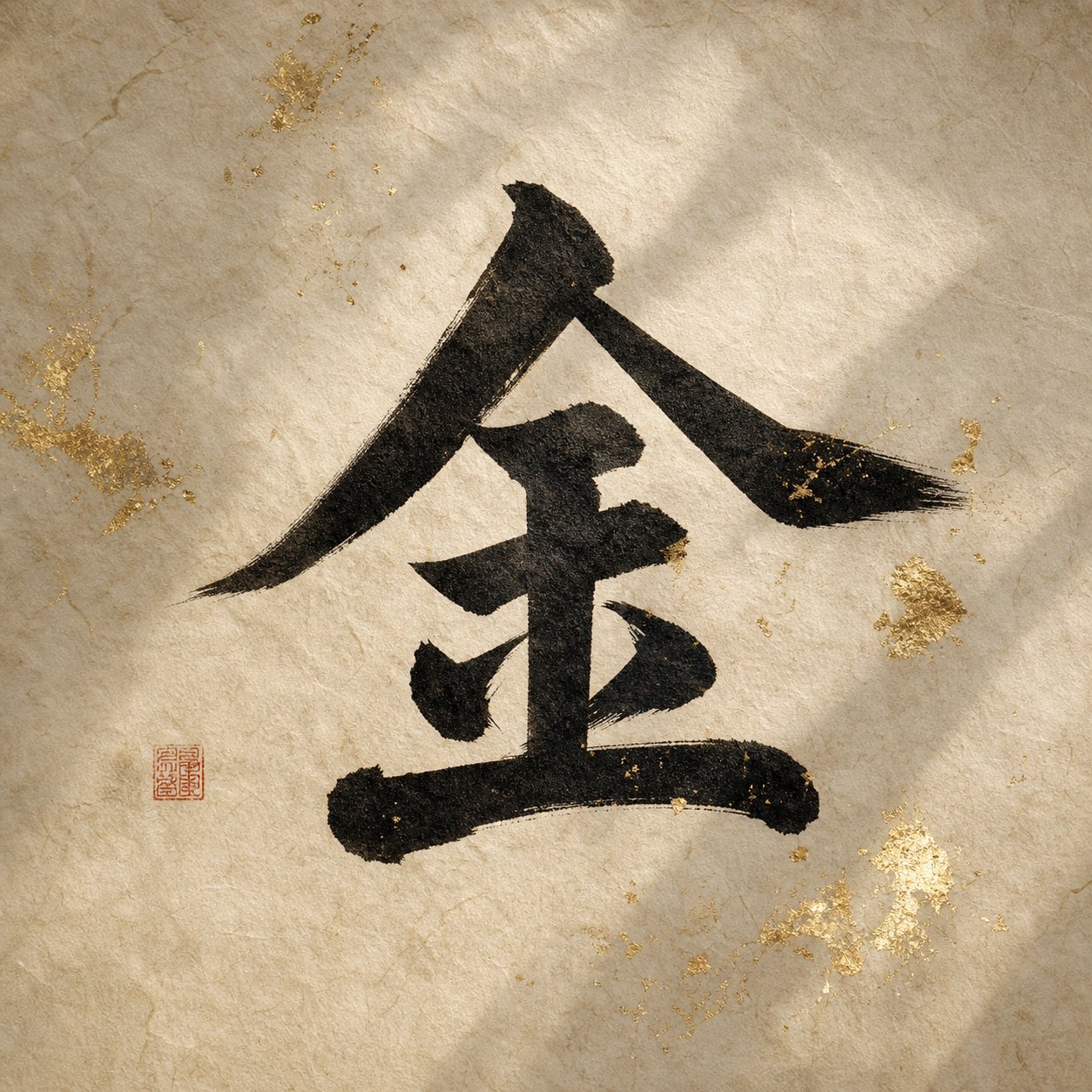
Maybe you spotted it on a piece of calligraphy art. Maybe you're considering it for a tattoo, a gift, or a deeper dive into Chinese philosophy. Whatever brought you here, the gold Chinese character meaning runs far deeper than a simple translation. The character 金 (jīn) is one of the most symbolically loaded symbols in the entire Chinese writing system, and getting its meaning wrong is surprisingly easy.
At its surface, 金 refers to gold, the precious metal. But reduce it to just that, and you miss the point entirely. This single character carries layers of significance that touch everything from ancient philosophy to modern-day celebrations. It represents metal as a material category, prosperity as a cultural ideal, permanence as a philosophical virtue, and purity as a moral standard.
Why 金 Is More Than Just a Word for Gold
What does the gold character mean in Chinese? The honest answer is: it depends on context. The Chinese symbol for gold functions simultaneously as a noun, an adjective, a radical that builds hundreds of other characters, and a philosophical concept tied to the Five Elements system. In Chinese metaphysics, 金 represents the West, autumn, and qualities like resilience and strength. In everyday life, it signals wealth, value, and nobility.
金 is not just a word but a cultural concept that permeates Chinese philosophy, language, and daily life, carrying meanings of wealth, resilience, value, and nobility all within a single character.
What You Will Learn About This Character
This article unpacks the jin character in Chinese culture across four distinct levels of meaning:
- Literal - gold the metal, and the broader category of metals and minerals
- Linguistic - how 金 works as a radical to build characters for iron, silver, copper, money, and more
- Philosophical - its role in the Five Elements (五行) system and what it represents about the natural world
- Cultural - why gold symbolism appears in Chinese New Year, weddings, idioms, and art
Each layer adds richness to the character, and understanding them all is what separates a surface-level translation from genuine cultural appreciation. The pronunciation alone carries nuances that most English speakers miss on the first try.
Pronunciation and the Full Semantic Range of 金
Knowing what 金 means is only half the picture. If you plan to use this character in conversation, order something engraved, or simply want to appreciate it fully, you need to know how it sounds. The chinese character jin meaning shifts depending on context, and the pronunciation itself trips up most English speakers on the first attempt.
How to Pronounce 金 Correctly
The pinyin for 金 is jīn, pronounced with Mandarin's first tone. So how do you pronounce jin in Chinese correctly? Start with the sound itself: the "j" in pinyin is softer than the English "j" in "jump." It sits closer to the "j" sound in "jeep" but with the tongue positioned just behind the lower teeth. The vowel combination "in" sounds like the English word "een" in "seen," not like "in" as in "bin."
The first tone is the part most learners struggle with. Imagine holding a single, steady high note, like the flat beep of a heart monitor. Your pitch stays level at the top of your vocal range without rising or falling. As Hacking Chinese explains, tones in Mandarin are differences in pitch that change the meaning of a spoken syllable, much like vowel length differentiates words in English. Getting the first tone wrong on 金 could lead a listener toward completely different characters like 近 (jìn, meaning "near") or 进 (jìn, meaning "enter"), both of which use the fourth tone.
A quick jin first tone pronunciation guide: say "jeen" at a steady, high pitch. Do not let your voice dip or rise. Hold it flat. That steady, high-pitched "jeen" is your target.
The Four Core Meanings of 金
Here is where the chinese character jin meaning gets interesting. Unlike English, where "gold" refers almost exclusively to the precious metal or its color, 金 covers a broader semantic territory. It functions as four distinct concepts depending on the sentence it appears in.
Does jin mean gold or metal? The answer is both, and more. In classical Chinese and philosophical contexts, 金 refers to the entire category of metals. In everyday modern usage, it leans toward gold specifically or money colloquially. The table below breaks down each meaning with the context that triggers it:
| Meaning | Context | Example Usage |
|---|---|---|
| Gold (precious metal) | Jewelry, finance, material references | 黄金 (huángjīn) - gold bullion or gold as a commodity |
| Metal (element category) | Philosophy, science, classical texts | 五行中的金 (wǔxíng zhōng de jīn) - Metal in the Five Elements |
| Golden (color/adjective) | Descriptions, aesthetics, figurative language | 金色 (jīnsè) - golden color; 金秋 (jīnqiū) - golden autumn |
| Money (colloquial) | Everyday speech, financial terms, idioms | 奖金 (jiǎngjīn) - bonus/prize money; 租金 (zūjīn) - rent |
When 金 Means Gold vs Metal vs Money
Context is everything. When you see 金 standing alone or paired with 黄 (yellow), it almost always points to gold the metal. The compound 黄金 is the standard term for gold as a precious material. You will encounter it in jewelry shops, financial news, and historical texts.
In philosophical or classical writing, 金 broadens to encompass all metals. This is the meaning at work in the Five Elements system, where 金 represents the Metal element rather than gold specifically. The same broadening appears in the radical system: characters built with the 金 component relate to metals in general, not just gold. As Nippon.com notes, kanji with the metal radical include kinds of metal like silver and iron, as well as metal objects like needles and keys.
The money meaning shows up in compound words rather than 金 used alone. Words like 现金 (xiànjīn, cash), 资金 (zījīn, capital/funds), and 金额 (jīn'é, monetary amount) all draw on this financial sense. You will not hear someone point at a coin and say "金" the way an English speaker might say "money," but the association runs deep in the language.
The golden/adjective usage appears in poetic and descriptive contexts. 金色的阳光 (jīnsè de yángguāng) means "golden sunlight." 金婚 (jīnhūn) means "golden wedding anniversary." Here, 金 evokes the warmth, brilliance, and value associated with the metal rather than the metal itself.
These four meanings are not random. They radiate outward from a single core idea: something precious, enduring, and elemental. That conceptual unity is exactly what makes 金 so versatile, and it explains why the character appears as a building block inside hundreds of other characters throughout the Chinese writing system.
How the Character 金 Evolved Over Thousands of Years
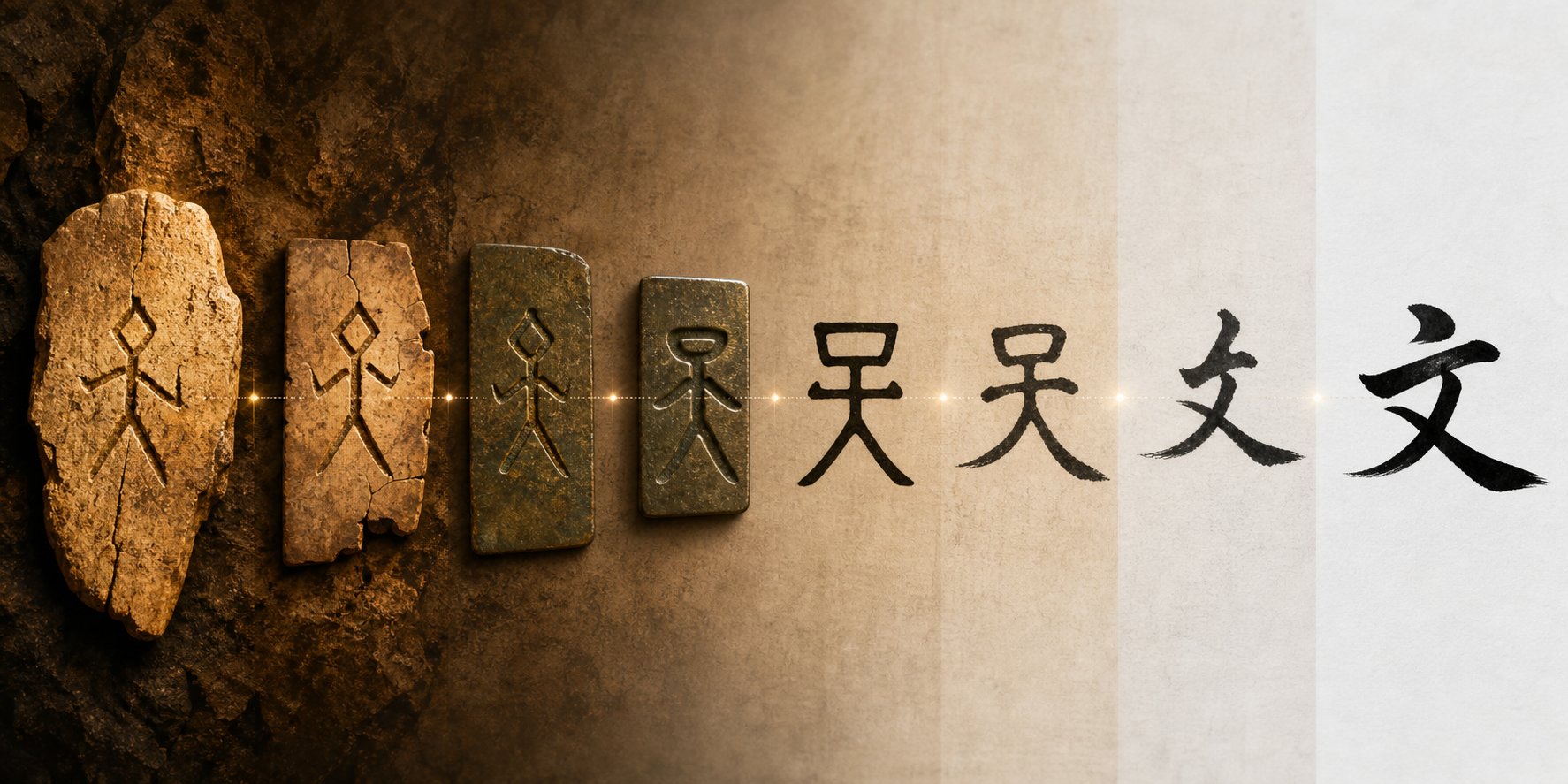
That versatility did not appear overnight. The evolution of Chinese character jin stretches back more than three thousand years, and each stage of its visual transformation reveals something about how ancient people understood metals and their place in the world. Tracing the history of the gold symbol in Chinese writing is like watching a concept crystallize from raw pictograph into polished abstraction.
Oracle Bone Script Origins
The earliest known form of 金 appears in oracle bone inscriptions from the late Shang dynasty, roughly 1200-1050 BCE. These were characters carved into turtle shells and animal bones for divination purposes. The gold character in oracle bone script looked nothing like the tidy modern form you see today.
Imagine a simple picture: two or four small dots or nugget shapes at the bottom, representing pieces of metal ore buried in the earth, with a triangular or roof-like shape above them suggesting a cover or the ground surface. Some scholars interpret the upper portion as a primitive smelting furnace, while others see it as a marker indicating something hidden underground. Either way, the visual logic is clear: precious metal concealed beneath the surface, waiting to be extracted.
From Bronze Inscriptions to Modern Strokes
How did the Chinese gold character develop from that rough pictograph into its current shape? The transformation happened in stages:
- Bronze script (Western Zhou, ~1046-771 BCE) - The character became more structured. The nugget shapes at the bottom grew more defined, and the upper "cover" component solidified into a recognizable roof-like element. Some bronze forms added extra strokes to indicate the earth surrounding the metal deposits.
- Seal script (Qin dynasty, ~221-206 BCE) - Standardization smoothed out regional variations. The character settled into a balanced, symmetrical form with a clear top section (今-like shape representing a lid or convergence point) and a lower section with two flanking strokes representing the metal nuggets or ingots.
- Regular script (Han dynasty onward) - The form we recognize today emerged. The top component (人 with a horizontal stroke beneath, resembling 今) sits above two small diagonal strokes and a horizontal base line, totaling eight strokes in the standard modern form.
How the Shape Tells the Story of Gold
Here is why this matters for learners. When you look at the modern character 金, you can still see echoes of its ancient logic. The top portion (亼) acts like a roof or convergence point. The lower strokes represent what lies beneath: nuggets of precious metal embedded in the earth. Think of it as a visual shorthand for "valuable material hidden below the surface."
This mental image makes the character far easier to remember than rote memorization alone. You are not just learning a random arrangement of strokes. You are looking at a three-thousand-year-old diagram of buried treasure, refined and compressed into eight elegant brushstrokes. That same pictographic DNA carries forward into every character that uses 金 as its radical, a structural role that shapes hundreds of words across the Chinese writing system.
金 as a Radical: How It Builds Hundreds of Metal-Related Characters
That pictographic DNA does not sit idle. The character 金 pulls double duty in the Chinese writing system: it stands alone as a word, and it works as a structural component inside other characters. This second role is where the gold radical meaning becomes a powerful tool for anyone learning to read Chinese. Spot it once, and you start seeing it everywhere.
The Metal Radical 钅 in Simplified Chinese
When 金 appears as a component on the left side of another character, it signals that the character relates to metal or metallic objects. In traditional Chinese, the full form 金 squeezes into the left position. In simplified Chinese, it compresses into a streamlined variant: 钅. This shortened form is called 金字旁 (jīn zì páng), literally meaning "gold character on the side."
The visual difference is straightforward. The full character 金 has eight strokes. The radical form 钅 trims that down to five strokes, keeping just enough structure to remain recognizable. You will see 钅 tucked into the left side of characters for silver, iron, copper, money, and dozens of everyday objects made from metal. Once you know what to look for, the pattern clicks fast.
Characters Built from the Gold Root
Here is where the jin radical in simplified Chinese really proves its value. Each of the following characters contains 钅 on the left, and each one connects back to metal in some way, whether directly naming a metal, describing a metal object, or referencing something historically made from metal:
- 银 (yín) - silver. The right side 艮 originally suggested "just after," giving the combined meaning of "the metal just after gold" in value.
- 铁 (tiě) - iron. The right component 失 (shī) provides the pronunciation rather than meaning. Used in everyday words like 地铁 (dìtiě, metro) and 铁路 (tiělù, railroad).
- 铜 (tóng) - copper/bronze. The right side 同 means "same," and since copper resembles gold in color, the logic is "the same as gold." In ancient China, copper was even called 赤金 (chìjīn), meaning "red gold."
- 钱 (qián) - money. The original right-side component represented spears or farm tools, which were used as currency before coins existed. Metal on the left, exchange value on the right.
- 针 (zhēn) - needle. A thin metal object. Appears in 打针 (dǎzhēn, to get an injection) and 针灸 (zhēnjiǔ, acupuncture).
- 锁 (suǒ) - lock. The right side includes 贝 (shell/currency), reinforcing the idea that you lock up your valuables. A metal device protecting metal wealth.
- 钟 (zhōng) - clock/bell. Originally described the metal bell rung during autumn harvest to mark time. Now used in 分钟 (fēnzhōng, minute) and 闹钟 (nàozhōng, alarm clock).
- 镜 (jìng) - mirror/lens. Ancient Chinese mirrors were made from polished copper. The right side 竟 provides pronunciation. Found in 眼镜 (yǎnjìng, glasses) and 镜子 (jìngzi, mirror).
- 钉 (dīng) - nail. The pictograph 丁 originally represented a nail on its own, but the metal radical was added later to clarify the material. Used in 钉子 (dīngzi, nail) and 螺钉 (luódīng, screw).
- 铅 (qiān) - lead. Appears in 铅笔 (qiānbǐ, pencil), literally "lead pen," a holdover from when pencil cores contained lead-based graphite.
- 错 (cuò) - mistake/wrong. This one surprises people. Originally, 错 named a decorative craft of inlaying gold or silver onto bronze. Adding expensive metals to cheap copper was considered nonsensical, and the meaning shifted to "incorrect."
Notice the pattern? The left side tells you the category (metal/metallic), while the right side often hints at pronunciation or adds a secondary layer of meaning. This structure repeats across the chinese metal radical characters list, making it one of the most productive radicals in the entire system.
Using Radical Recognition to Learn Faster
So how do you use Chinese radicals to learn characters more efficiently? Think of 钅 as a category tag. When you encounter an unfamiliar character with this radical on the left, you already know one thing: it probably relates to metal, a metallic object, or something historically connected to metalwork. That single piece of information narrows your guessing range dramatically.
Imagine seeing the character 铝 for the first time. You do not know the pronunciation or exact meaning yet. But you spot 钅 on the left and immediately know it is some kind of metal. The right side 吕 gives you a pronunciation hint (lǚ). Put them together, and you have aluminum. You decoded an unfamiliar character without a dictionary, using nothing but radical recognition.
This approach scales. The gold radical appears in well over a hundred commonly used characters. Learning to spot it is like gaining a skeleton key that partially unlocks every metal-related word you will ever encounter in Chinese. And 金 is just one of roughly 214 radicals in the system. Each one works the same way, tagging characters with semantic clues that make the writing system far more logical than it first appears.
That logical structure extends beyond linguistics. The same character that builds words for iron and silver also carries deep philosophical weight, representing an entire element in the system that ancient Chinese thinkers used to explain the natural world.
Cultural Symbolism of Gold in Chinese Traditions
The Five Elements system, known as 五行 (wǔxíng), is where 金 steps beyond language and into cosmology. In this ancient framework, Metal is not just a material. It is a governing force tied to specific seasons, directions, emotions, and moral qualities. Understanding the five elements metal gold meaning reveals why gold symbolism in Chinese culture runs so much deeper than simple wealth associations.
金 in the Five Elements System
Chinese philosophy organizes the natural world into five interacting elements: Wood, Fire, Earth, Metal, and Water. Each element governs a season, a cardinal direction, a color, an organ system, and a set of personality traits. Metal (金) corresponds to autumn, the west direction, the color white, the lungs, and the emotion of grief. Its associated virtue is 义 (yì), meaning righteousness or justice.
Why white and not gold? The color association comes from the element's connection to purity and clarity rather than the literal hue of the metal. Think of it this way: Metal in the Five Elements represents the quality of cutting through, of precision and decisiveness. A blade does not hesitate. It separates cleanly. That energy defines the Metal element's role in the cycle.
Metal also governs the process of contraction and consolidation. Autumn is when nature pulls inward, when leaves fall and energy concentrates. In Chinese astrology, the Metal element is associated with strength, discipline, and the ability to achieve goals, making it a powerful force for personal and financial success.
In Chinese metaphysics, 金 represents not wealth alone but the cosmic principle of refinement: the universe's tendency to compress raw potential into something pure, enduring, and incorruptible.
Gold Symbolism in Festivals and Celebrations
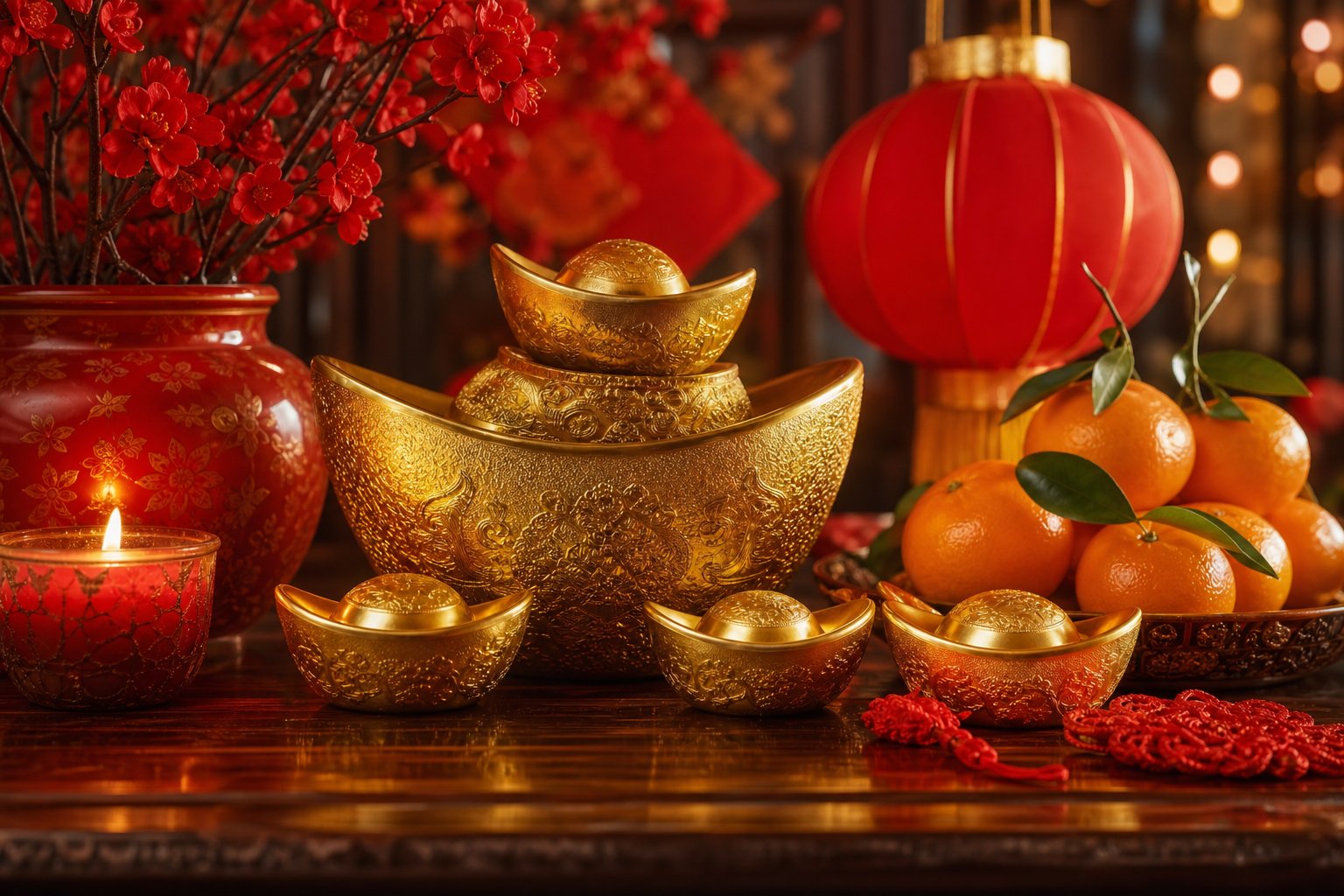
So why is gold important in Chinese New Year? The answer connects directly to the chinese gold symbol prosperity meaning. During Spring Festival celebrations, gold appears everywhere: paper ingots shaped like 元宝 (yuánbǎo) are burned as offerings, gold-colored decorations hang from doorways, and red envelopes (红包) often feature gold foil lettering and ingot motifs. The pairing of red and gold is deliberate. Red represents luck and happiness. Gold represents wealth and permanence. Together, they create a visual shorthand for "prosperous fortune that lasts."
Gold ingot decorations, often shaped like small boats with upturned edges, reference the sycee currency used in imperial China. Displaying them during New Year signals a wish for financial abundance in the coming year. Families also place golden tangerines and kumquats on altars because their names (金桔, jīnjú) contain the character 金, reinforcing the prosperity association through wordplay.
Weddings carry equally strong gold traditions. In many Chinese families, the bride receives gold jewelry from her in-laws as part of the betrothal gifts. Gold bangles, necklaces, and rings are not merely decorative. They represent the family's blessing for a stable, prosperous marriage. The metal's resistance to tarnish makes it a natural metaphor for a love that does not corrode over time.
Why Gold Represents Permanence and Purity
The physical properties of gold map neatly onto its cultural symbolism. Gold does not rust. It does not tarnish. It resists corrosion from nearly every acid. In a world where iron crumbles and silver blackens, gold endures unchanged across centuries. Ancient Chinese craftspeople observed this firsthand, and the observation became a philosophical principle: what is truly valuable remains unchanged by time and hardship.
This idea echoes through Chinese architecture and art. Imperial palaces feature gold-colored roof tiles. Buddhist temples use gold leaf on statues. Calligraphy scrolls are mounted on gold silk borders. In each case, the material choice communicates the same message: this is sacred, this is permanent, this deserves reverence.
Gold's incorruptibility also connects to moral character. A person described as having a 金子般的心 (jīnzi bān de xīn, a heart like gold) possesses integrity that cannot be bought or degraded. The metaphor works precisely because the metal itself refuses to degrade. Value, permanence, purity: these three qualities form the cultural core of the chinese gold symbol prosperity meaning, and they explain why 金 appears so frequently in the idioms and proverbs that Chinese speakers use every day.
Essential Chinese Idioms and Proverbs Using 金
Those three qualities, value, permanence, and purity, do not just live in philosophy textbooks. They show up in the everyday language Chinese speakers actually use. Chinese idioms with the gold character reveal exactly how deeply 金 is woven into the culture's moral vocabulary. These four-character expressions, called 成语 (chéngyǔ), pack entire life lessons into compact phrases, and 金 appears in some of the most widely quoted ones.
Idioms That Show How Chinese Culture Values Gold
Why does gold keep appearing in Chinese proverbs? Because it serves as a universal measuring stick for worth. When something is compared to gold in a chengyu, the speaker is saying: this is the real thing, the highest standard, the version that endures. Each of the following jin chengyu examples carries a distinct moral lesson, and each one gets used in real conversations, not just classical poetry.
| Idiom | Literal Meaning | Figurative Meaning | Usage Context |
|---|---|---|---|
| 金玉良言 (jīn yù liáng yán) | Golden jade good words | Valuable advice worth treasuring | When a mentor offers guidance that changes your perspective, you describe their words as 金玉良言. A student might say this about a teacher's career advice that proved correct years later. |
| 一诺千金 (yī nuò qiān jīn) | One promise worth a thousand gold | A person whose word is absolutely reliable | Used to praise someone who always follows through. If a business partner delivers exactly what they committed to, you might describe them as 一诺千金 to a colleague. |
| 金碧辉煌 (jīn bì huī huáng) | Gold and jade splendor shining | Magnificent, resplendent, dazzlingly grand | Describes architecture, interiors, or events of extraordinary grandeur. Walking into the Hall of Supreme Harmony in the Forbidden City, you would naturally reach for this phrase. |
| 真金不怕火炼 (zhēn jīn bù pà huǒ liàn) | Real gold does not fear fire testing | Truth and genuine quality withstand any trial | Used when someone faces unfair criticism or scrutiny. A colleague wrongly accused might hear this as encouragement: your integrity will prove itself. |
| 金蝉脱壳 (jīn chán tuō qiào) | The golden cicada sheds its shell | Escaping danger through a clever diversion | Describes a strategic retreat or misdirection. In business, someone who exits a failing partnership gracefully while protecting their assets might be said to have pulled a 金蝉脱壳. |
| 点石成金 (diǎn shí chéng jīn) | Touch a stone and turn it to gold | Transforming something ordinary into something extraordinary | Praises a skilled editor, designer, or leader who elevates mediocre work into something brilliant. A chef who transforms simple ingredients into a stunning dish earns this compliment. |
Notice a pattern? Gold in these idioms never represents mere wealth. It stands for authenticity, reliability, and transformative value. The common chinese gold idioms explained above each use 金 as a benchmark for what is genuine and lasting, not what is expensive.
Using 金 Idioms in Conversation
Knowing these phrases is one thing. Using them naturally is another. Chinese idioms, as LindaMandarin explains, are deeply embedded in both written and spoken Chinese, used by native speakers to convey complex ideas succinctly. The key is matching the idiom to the right moment.
Here is how each one fits into real speech:
- 金玉良言 works best as a compliment after receiving advice. "Your words are truly 金玉良言" sounds natural in both formal and casual settings. Use it when someone shares hard-won wisdom, not just any suggestion.
- 一诺千金 describes character, not a single event. You would say "He is a 一诺千金 kind of person" to vouch for someone's reliability over time. It carries weight precisely because it implies a pattern, not a one-off.
- 真金不怕火炼 functions as encouragement during adversity. When a friend faces unjust criticism at work, this proverb reminds them that scrutiny only proves quality. It is the Chinese equivalent of saying "the truth will come out."
- 金碧辉煌 is purely descriptive. Reserve it for genuinely impressive visual experiences: a palace, a lavish banquet hall, an elaborately decorated temple. Using it for something modest would sound sarcastic.
The figurative logic behind these chinese proverbs about gold stays consistent: gold equals the standard against which everything else is measured. A promise compared to gold is unbreakable. Advice compared to gold is invaluable. A person compared to gold is incorruptible. This metaphorical framework has remained stable for thousands of years, which is itself a kind of proof that real gold does not fear the fire of time.
Of course, Chinese is not the only language where 金 carries this weight. The same character crossed the sea to Japan centuries ago, where it took on new pronunciations and slightly different everyday uses while preserving much of the same symbolic reverence.

The Gold Kanji 金 in Japanese Language and Culture
When Chinese characters traveled to Japan over a thousand years ago, 金 made the journey intact. The shape stayed the same. The core meanings of metal, gold, and money survived. But the pronunciations split into multiple readings, and everyday usage shifted in ways that surprise learners who assume the gold character in Japanese vs Chinese works identically.
Japanese Readings and Pronunciations of 金
So how do you read jin in Japanese? You don't, exactly. The Chinese-derived pronunciation (on'yomi) became きん (kin) and こん (kon), not "jin." Japanese phonology reshaped the original Mandarin sound into something that fit its own syllable structure. The kin kanji meaning and readings depend entirely on which word the character appears in.
The native Japanese readings (kun'yomi) add another layer: かね (kane) means money in everyday speech, while かな (kana) appears as a prefix in compound words related to metal objects. There is also the older reading こがね (kogane), meaning gold specifically, though it appears less frequently in modern usage.
According to JLPT Sensei, 金 ranks as the 53rd most frequently used kanji in Japanese newspapers and is taught in first grade at Japanese schools. It is classified as an N5-level character, meaning it is among the first kanji any Japanese learner encounters.
Common Japanese Words Using the Gold Kanji
The gold kanji Japanese meaning shifts depending on the compound word it appears in. Here are the most common examples you will encounter:
- 金曜日 (きんようび / kinyoubi) - Friday. Literally "gold day," named after the planet Venus (金星), which the Japanese call the "gold star."
- お金 (おかね / okane) - money. The most common word for money in daily Japanese conversation. The お prefix adds politeness.
- 金色 (きんいろ / kin'iro) - golden color. Used to describe anything with a gold hue, from autumn leaves to decorative objects.
- 金メダル (きんメダル / kin medaru) - gold medal. Heard constantly during Olympic coverage.
- 現金 (げんきん / genkin) - cash. Literally "present metal," referring to physical money in hand.
- 金属 (きんぞく / kinzoku) - metal. The general term for metals as a material category, echoing the classical Chinese usage.
- 金持ち (かねもち / kanemochi) - wealthy person. Uses the kun'yomi reading kane, meaning someone who "holds money."
- 金魚 (きんぎょ / kingyo) - goldfish. Literally "gold fish," named for its color.
Notice how the kin reading dominates formal and compound words, while kane appears in colloquial, everyday expressions. This split mirrors the character's dual identity: precious metal in one context, practical currency in another.
Shared Symbolism Across East Asian Cultures
Despite the pronunciation differences, the symbolic weight of 金 remains remarkably consistent across East Asian cultures. In Japan, gold leaf adorns Buddhist temples like Kinkaku-ji (金閣寺, the Golden Pavilion in Kyoto). Gold screens (金屏風, kinbyobu) serve as backdrops for weddings and formal ceremonies. The association between gold and permanence, sacredness, and celebration crosses linguistic borders without losing its force.
The primary meaning of 金 in Japanese is actually "metal" in general, though it denotes gold more specifically. This mirrors the classical Chinese usage perfectly. The character appears in 1,256 Japanese words overall and is used as a component in 176 other kanji characters, most of which relate to specific metals or metal objects: 銀 (silver), 鉄 (iron), 銅 (copper), 鋼 (steel), 鏡 (mirror), 鍵 (key).
Where Chinese and Japanese diverge most is in daily financial vocabulary. In Japanese, お金 (okane) is the standard, neutral word for money in conversation. It carries no literary or elevated tone. You hear it at convenience stores, in household budgets, and from children asking for allowance. In Chinese, 金 leans more toward formal financial terminology (资金, 奖金, 现金) while colloquial speech favors 钱 (qián) for everyday money talk.
This divergence highlights something important about how characters evolve once they cross cultural boundaries. The shape stays fixed. The deep symbolism persists. But the practical, street-level usage adapts to each language's own patterns and preferences. For anyone researching the gold Chinese character meaning with plans to use it in art or design, this cross-cultural consistency is reassuring: 金 communicates value and prestige whether your audience reads Chinese, Japanese, or Korean.
That said, shared reverence does not prevent confusion. The character's visual simplicity makes it easy to mix up with lookalike characters, and its multiple meanings create pitfalls that catch even experienced learners off guard.
Common Mistakes With the Gold Chinese Character Most People Make
A single misplaced stroke can turn gold into something else entirely. The visual simplicity of 金 is deceptive. It sits just one or two strokes away from completely different characters, and its broad semantic range creates confusion even for intermediate learners. If you are planning to use this character for a tattoo, artwork, or gift, these are the pitfalls you need to know about before committing to anything permanent.
金 vs 全 and Other Lookalike Characters
The most common mistake with the gold Chinese character involves confusing it with 全 (quan, meaning complete or whole). At a glance, these two look nearly identical. Both have eight strokes. Both share the same lower structure. The jin vs quan Chinese character difference comes down to a single detail at the very top.
Look closely at the top of each character. 金 begins with a short left-falling stroke (撇, pie) followed by a dot-like stroke (点, dian) on the right, forming a small inverted "V" shape that resembles the character 人. Below that sits a horizontal stroke. The character 全, on the other hand, starts with a single horizontal stroke at the top connecting directly to the roof-like structure below, with the component 入 (enter) rather than 人 (person) forming the upper portion.
The practical difference? 金 means gold or metal. 全 means complete, entire, or whole. Getting these mixed up in a tattoo would be like asking for "strength" and ending up with "soup." The meaning changes completely.
Other chinese characters that look like jin include:
- 全 (quan) - complete/whole. Differs at the top stroke configuration. This is the most frequently confused character.
- 合 (he) - to combine/together. Shares the triangular top shape but has a completely different lower half (口 instead of the metal strokes).
- 会 (hui) - to meet/can. The simplified form has a similar upper portion (人 + cloud-like element) that can look like 金 in rushed handwriting.
- 令 (ling) - order/command. Shares the 人-shaped top and a similar vertical structure, but the lower portion differs significantly.
The safest way to verify? Count the strokes and check the bottom half. The lower portion of 金 contains two small diagonal strokes flanking a vertical stroke, sitting above a final horizontal base line. No other common character shares this exact bottom structure.
Mistakes to Avoid When Using 金 in Art or Tattoos
Beyond lookalike characters, several other misconceptions trip people up when working with 金 in real-world applications.
Confusing 金 with 黄金 when you mean gold specifically. The standalone character 金 can mean gold, metal, or money depending on context. If you specifically want to communicate "gold the precious metal" without ambiguity, the compound 黄金 (huangjin) is the precise term. Using 金 alone is not wrong, but it leaves room for interpretation. In a tattoo or artwork where context is absent, a viewer might read it as "metal" or "money" rather than "gold."
Assuming 金 always means wealth. The compound 金属 (jinshu) means "metal" in the general scientific sense, with no wealth connotation at all. Context determines everything. A character standing alone on someone's skin has no surrounding sentence to guide interpretation.
Mistaking decorative calligraphy for standard forms. Calligraphers often take artistic liberties with stroke shapes, especially in cursive (草书) and running script (行书) styles. A heavily stylized version of 金 might look beautiful but bear little resemblance to the standard form. If you copy a calligraphic variant without understanding which character it represents, you risk inking something unrecognizable or, worse, a different character altogether.
Overlooking the surname usage. Is jin a Chinese or Korean surname? Both, actually. 金 ranks as the single most common surname in Korea, romanized as Kim, representing over 10 million people according to Korean census data. It also functions as a Chinese surname (romanized as Jin). If you get a 金 tattoo and later meet Korean speakers, they may read it as a family name rather than a symbol of prosperity. This is not necessarily a problem, but it is worth knowing.
Using the wrong radical form. The full character 金 and the radical form 钅 are not interchangeable in standard writing. You would never write 钅 as a standalone character meaning "gold." It only appears as a component inside other characters. Conversely, using the full 金 where the simplified radical 钅 belongs would look odd in simplified Chinese text, like writing "telephone" when everyone else writes "phone."
The bottom line: verify before you commit. Cross-reference any character design with at least two reliable sources. Check that the stroke count matches (金 has exactly eight strokes). Confirm the style is appropriate for your intended purpose. And if you want the character to unambiguously say "gold" rather than "metal" or "money," consider whether a compound like 黄金 or a contextual phrase better serves your intent.
These distinctions matter most when the character will live permanently on skin, on a wall, or on a gift. The next step is choosing the right calligraphy style and verifying accuracy before anything becomes irreversible.
Practical Guide to Using 金 in Tattoos, Art, and Gifts
Choosing to put 金 on your body, your wall, or a meaningful gift is a commitment. The character carries thousands of years of cultural weight, and the way you present it visually communicates just as much as the meaning itself. A poorly executed version signals unfamiliarity. A well-chosen style signals respect. Here is how to get it right.
Choosing the Right Style for Tattoos and Art
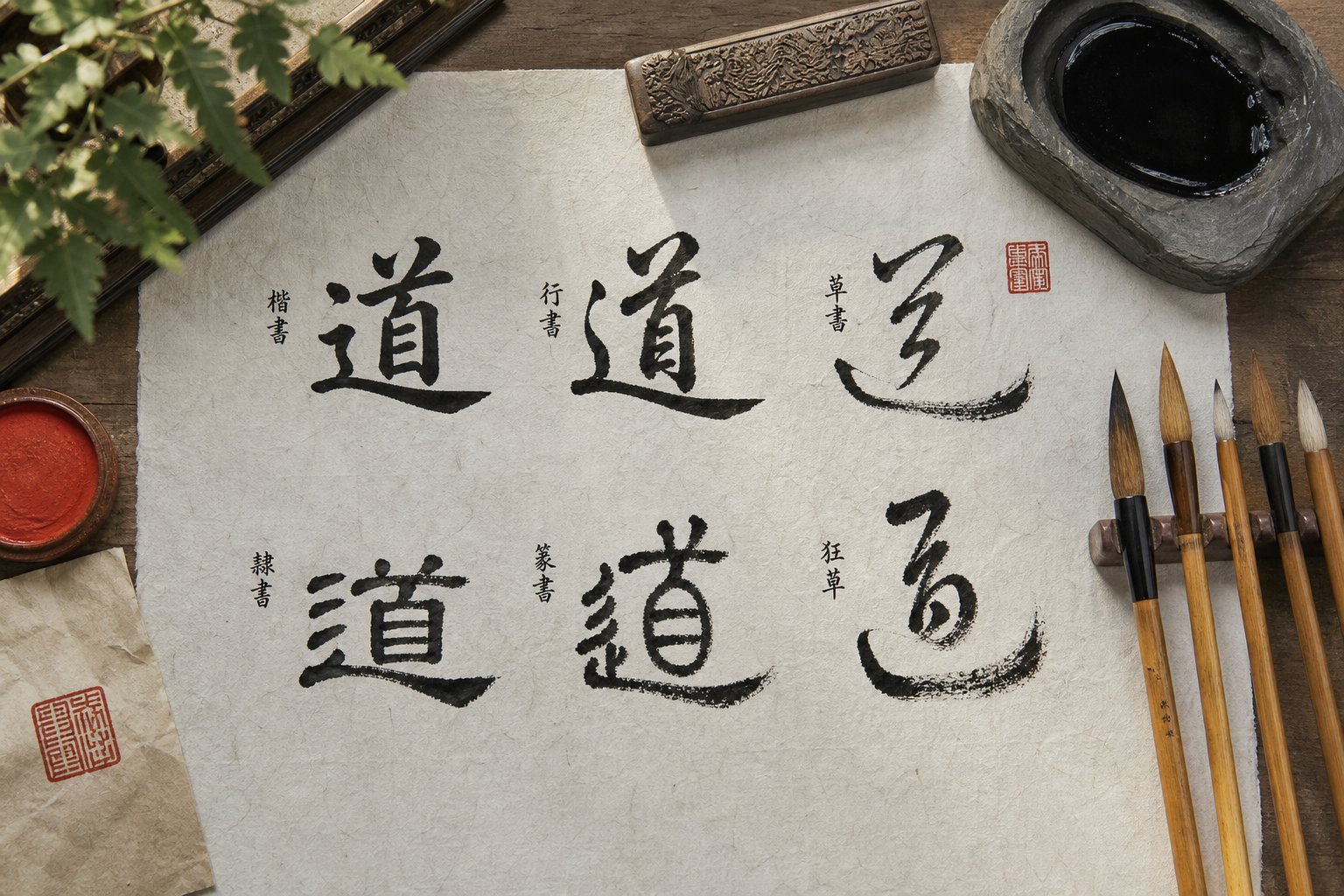
The best calligraphy style for a jin tattoo depends on what you want the character to communicate beyond its literal meaning. Each script style carries a different visual personality:
- Regular script (楷书, kaishu) - Clean, balanced, and immediately legible. This is the standard printed form with clearly defined strokes. Best for people who want the character to be instantly recognizable. It reads as classic and respectful.
- Running script (行书, xingshu) - Slightly more fluid, with strokes that connect naturally as if written at comfortable speed. It carries the energy of a calligrapher's hand without sacrificing readability. Best for people who want artistic warmth without abstraction.
- Seal script (篆书, zhuanshu) - The ancient form, rounded and symmetrical, resembling the character as it appeared over two thousand years ago. Visually striking and historically rich, but most modern Chinese readers will not recognize it immediately. Best for people who value the archaic aesthetic and historical depth.
- Cursive script (草书, caoshu) - Highly expressive and abstract. Strokes merge and simplify dramatically. Beautiful as art, but risky for tattoos because even native readers may struggle to identify the character without context.
One critical gold chinese character tattoo design tip: stroke order shapes the final form. A character drawn by someone who knows the correct eight-stroke sequence for 金 will have natural proportions, proper spacing between components, and the right visual weight distribution. A character traced from an image without understanding the construction often looks subtly wrong, like a building with slightly uneven floors. Tattoo artists who do not read Chinese should work from hand-drawn calligraphy by a native writer, not from digital fonts or screenshots.
For the chinese gold character for artwork and decor, placement matters culturally. Gold symbolism pairs naturally with entryways (welcoming prosperity), home offices (inviting financial success), and living rooms (signaling abundance). In traditional feng shui practice, metal element decor works best in the west and northwest areas of a space. Avoid placing it in bathrooms or kitchens where the symbolism clashes with the environment.
Gift-giving contexts where 金 works well include business openings, weddings, Lunar New Year, and milestone birthdays. A framed calligraphy piece featuring 金 or a gold-themed idiom like 金玉满堂 (may your hall be filled with gold and jade) makes a culturally appropriate and meaningful present.
Compound Words for More Specific Gold Meanings
If the standalone character feels too broad for your purpose, a compound word can sharpen the message. Consider which meaning you actually want to convey:
| Intended Meaning | Best Option | Pinyin | Why It Works |
|---|---|---|---|
| Gold the precious metal | 黄金 | huangjin | Unambiguous. Specifically refers to gold as a material. |
| Golden color | 金色 | jinse | Describes the hue without implying the physical metal. |
| Prosperity and abundance | 金玉满堂 | jin yu man tang | A blessing phrase meaning "hall filled with gold and jade." |
| Purity and integrity | 真金 | zhenjin | Means "real gold," implying tested and proven character. |
| Metal element (philosophical) | 金行 | jinxing | Refers specifically to the Metal phase in Five Elements theory. |
A single character on its own is powerful precisely because it holds all these meanings simultaneously. But if you need precision over poetry, a compound removes ambiguity.
Verifying Character Accuracy Before Permanent Use
How do you verify a Chinese character for a tattoo or permanent artwork? Follow this process:
- Ask a native speaker to write it from scratch. Do not show them your design and ask "is this right?" Instead, tell them the meaning you want and ask them to write the character on paper. Compare their version to your design. As Lan Ink Studio advises, always double-check meanings because incorrect tattoos are extremely common.
- Count the strokes. 金 has exactly eight strokes. If your reference image has seven or nine, something is wrong.
- Check the stroke order. Resources like Arch Chinese or the Pleco dictionary app show animated stroke-by-stroke breakdowns. Watch the sequence and confirm your design matches the natural proportions that correct stroke order produces.
- Verify the script style is consistent. Mixing elements from different calligraphy styles in a single character looks incoherent to anyone who reads Chinese. If you choose running script, every stroke should follow running script conventions.
- Get a second opinion. One native speaker might miss something. Two independent confirmations give you real confidence. Ideally, one should be someone with calligraphy training who can evaluate the artistic quality alongside the accuracy.
The gold Chinese character meaning spans literal metal, philosophical element, cultural blessing, and linguistic building block. It is a character that rewards deeper understanding. Every layer you uncover, from its oracle bone origins to its role in Japanese kanji, from its radical function to its presence in everyday idioms, adds richness to what might otherwise seem like a simple symbol. That depth is exactly what makes 金 worth getting right. And getting it right starts with treating it not as decoration, but as a doorway into one of the world's oldest continuous writing traditions.
Frequently Asked Questions About the Gold Chinese Character 金
1. What does the Chinese character 金 mean?
The character 金 (jin) carries four core meanings depending on context: gold as a precious metal, metal as a general element category, golden as a descriptive adjective for color or quality, and money in compound financial terms. In Chinese philosophy, it also represents the Metal element in the Five Elements system, associated with autumn, the west direction, righteousness, and precision. Its meaning is determined by the surrounding words and the context in which it appears.
2. How do you pronounce the Chinese character for gold?
The character 金 is pronounced 'jin' with Mandarin's first tone (flat, high pitch), written in pinyin as jin with a macron over the i. The 'j' sound is softer than English, similar to the 'j' in 'jeep' with the tongue behind the lower teeth. The vowel 'in' sounds like 'een' in 'seen.' Hold your voice at a steady high pitch without rising or falling. Mispronouncing the tone could lead listeners to hear jin (fourth tone), which means 'near' or 'enter' instead.
3. Is 金 the same in Chinese and Japanese?
The character 金 looks identical in both languages and shares core meanings of gold, metal, and money. However, the pronunciations differ significantly. In Japanese, the Chinese-derived readings are 'kin' and 'kon' (not 'jin'), while native Japanese readings include 'kane' (money) and 'kogane' (gold). Daily usage also diverges: Japanese uses okane as the standard casual word for money, while Chinese speakers prefer qian in everyday conversation and reserve jin for formal financial compounds.
4. What is the difference between 金 and 全 in Chinese?
These two characters look nearly identical but have completely different meanings. 金 (jin) means gold or metal, while 全 (quan) means complete or whole. The difference lies at the very top of each character: 金 starts with a left-falling stroke and a dot forming an inverted V shape resembling the character 人 (person), whereas 全 has a horizontal stroke connecting to the roof structure with the component 入 (enter). Both have eight strokes, making careful attention to the top portion essential for correct identification.
5. What Chinese idioms use the gold character 金?
Several widely used idioms feature 金 as a symbol of authenticity and value. Key examples include 真金不怕火炼 (real gold does not fear fire, meaning truth withstands testing), 一诺千金 (one promise worth a thousand gold, describing a reliable person), 金玉良言 (golden jade good words, meaning invaluable advice), and 点石成金 (turning stone to gold, praising someone who transforms the ordinary into the extraordinary). In each case, gold serves as a benchmark for what is genuine and lasting rather than simply expensive.