Understanding BaZi Naming and Why Element Balance Matters
You want to give your child a Chinese name that carries real meaning, not just a pretty sound. Maybe you have heard that a name should complement the child's birth chart, filling in what is missing energetically. That instinct is right, but the execution most people follow is flawed.
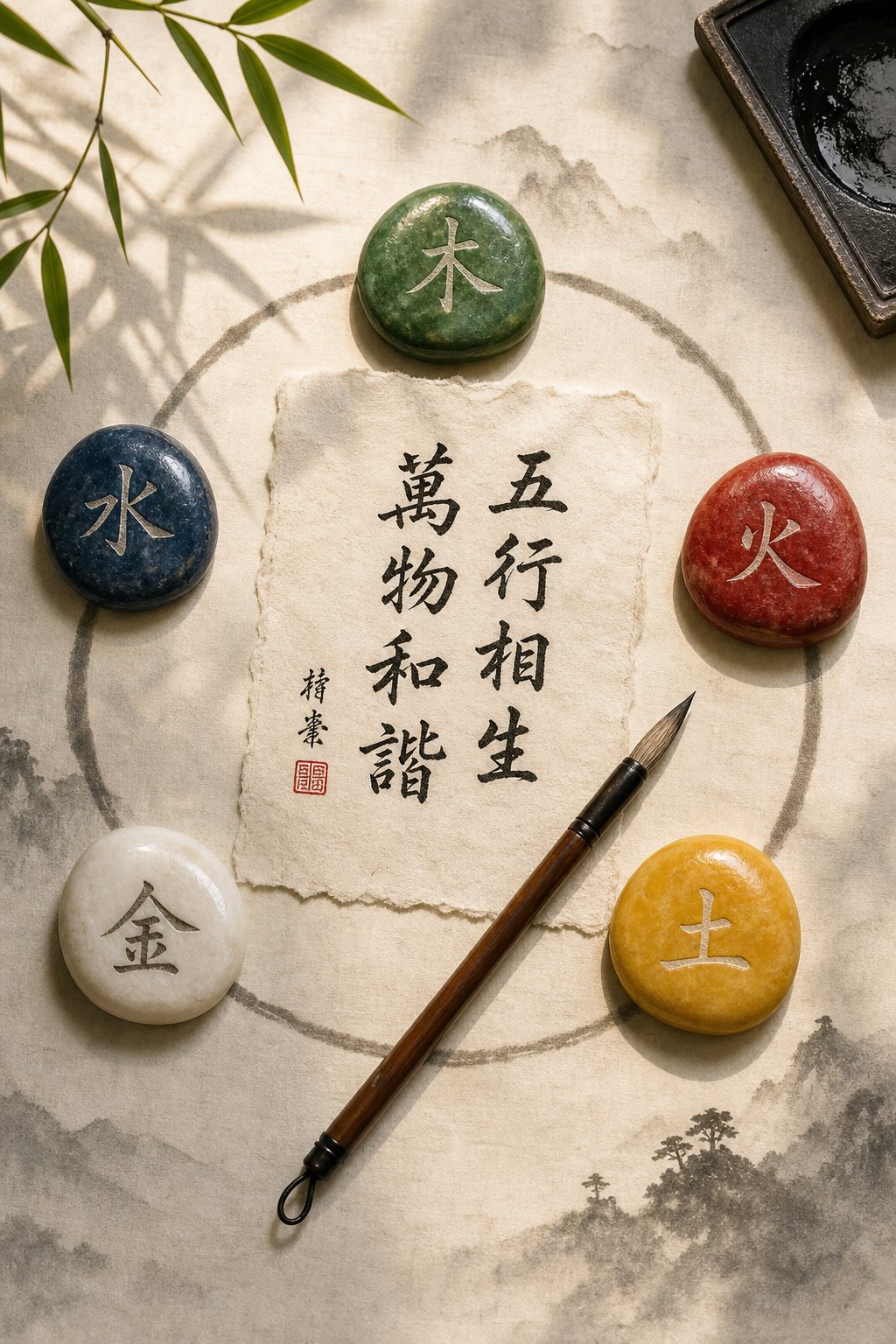
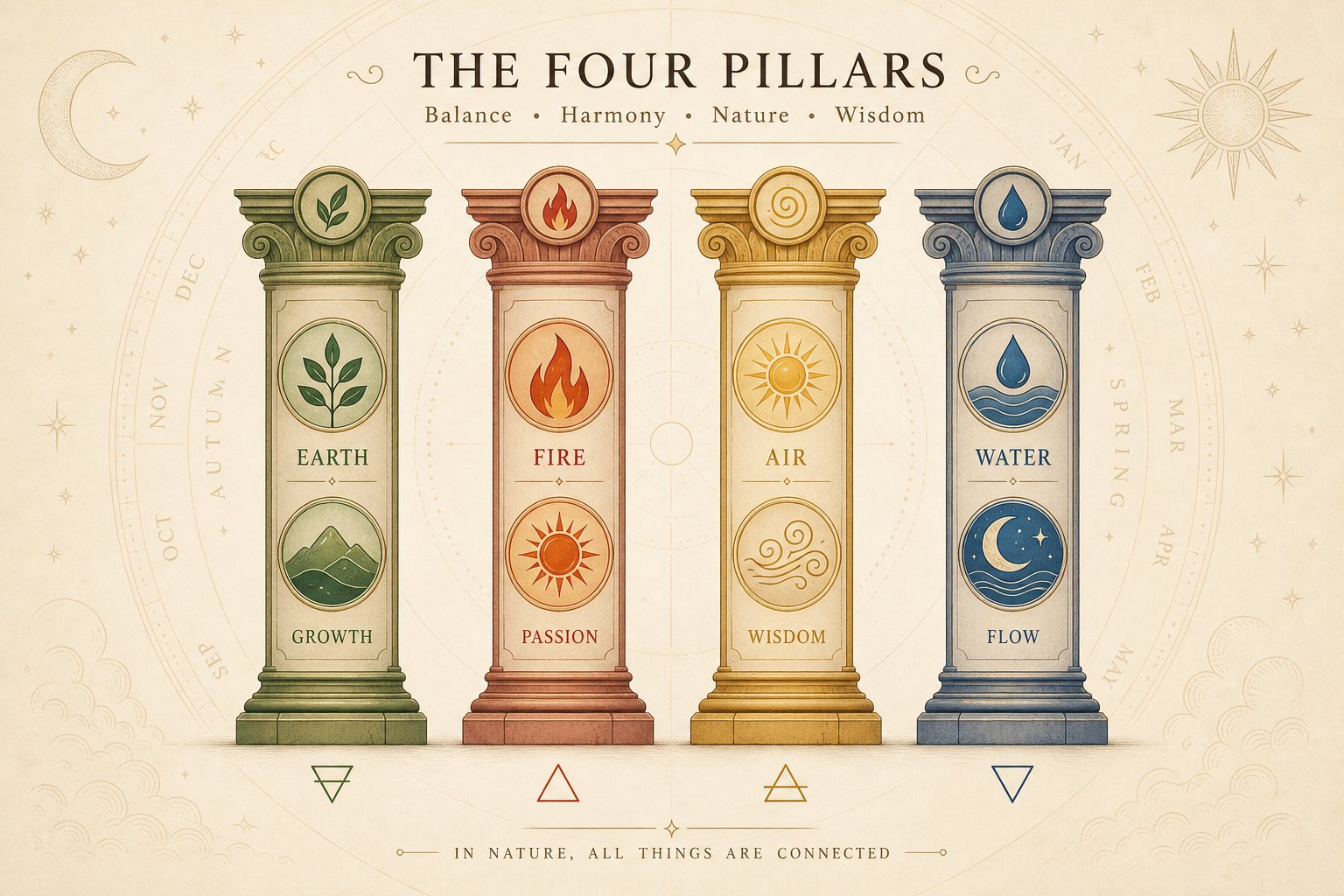
BaZi, also called the Four Pillars of Destiny, maps a person's birth energy across five elements: Wood, Fire, Earth, Metal, and Water. Chinese nameology treats a name as a living extension of that birth chart. The characters you choose carry elemental weight through their radicals, stroke counts, and meanings. When selected correctly, they act as a subtle counterbalance, nudging the chart toward harmony.
Here is where most parents go wrong. The common advice says: find which element is missing from the chart, then pick characters containing that element. Sounds logical. But as practitioner Sean Chan explains, blindly throwing in a missing element can actually collapse the chart's structure and make its flaws more obvious. A chart lacking Water, for example, might become destabilized if Water is forced in without considering the overall flow and interactions.
Why BaZi Naming Goes Beyond Missing Elements
The real key to learning how to balance BaZi with name lies in identifying the Useful God (用神). This is the element that genuinely benefits the chart from an energy flow perspective, bringing stability rather than just filling a gap. The Useful God strengthens the chart holistically by considering the Daymaster's strength, seasonal influences, and elemental interactions across all four pillars.
A balanced BaZi name strengthens the Useful God, not just fills elemental gaps.
Think of it this way. If your child's chart is like a building with structural imbalances, the Useful God is the specific reinforcement that stabilizes the whole structure. Adding random material just because it is absent from the blueprint could make things worse.
What You Will Learn in This Guide
This Chinese name elemental balance guide walks you through the full analytical chain that professional practitioners follow for four pillars of destiny name selection:
- Plotting the BaZi chart from accurate birth data
- Identifying the Daymaster and assessing its strength
- Determining the Useful God for naming purposes
- Mapping Five Elements to character radicals and strokes
- Selecting characters using the Three Talents framework
- Validating your final name against the original chart
Each step builds on the previous one. Skip ahead and you risk choosing characters that look right on the surface but work against the chart underneath. The process demands patience, but it rewards you with a name grounded in genuine BaZi naming useful god principles rather than guesswork.
Step 1: Plot Your BaZi Chart from Birth Data
Before you can select characters that strengthen a chart, you need to see the chart itself. A BaZi chart is built entirely from birth data: the year, month, day, and hour a person was born. These four time components become the Four Pillars, and each pillar holds two characters that carry specific elemental energy. Your job in this step is to generate that chart accurately so every decision downstream rests on solid ground.
Gathering Your Birth Data Accurately
You need four pieces of information to generate a BaZi chart from birth date:
- Birth year
- Birth month
- Birth day
- Birth hour (as precise as possible)
Of these four, birth hour causes the most trouble. The Hour Pillar changes every two hours in the Chinese system, so even a small error can shift the entire pillar and alter the elemental makeup of the chart. Check the birth certificate first. Hospital records or a parent's memory are your next best sources.
What if the birth hour is genuinely unknown? You still have options. The remaining three pillars (Year, Month, and Day) account for six of the eight characters. As BaZi Advisor notes, when the hour is unavailable, practitioners calculate only the three main pillars, which still provide roughly 75% of the chart's information. For naming purposes, this is less than ideal but workable. Some practitioners use 12:00 PM as a default, while others employ rectification techniques to narrow down the likely hour based on life events. If you are naming a newborn, record the exact birth time immediately so this never becomes an issue.
Converting Birth Data to the Solar Calendar
Here is a detail that trips up many beginners: BaZi does not use the standard Gregorian calendar directly. Chinese metaphysics calculations rely on the solar calendar (also called the Hsia calendar or the Chinese solar-lunar calendar), which marks months by solar terms rather than fixed dates. A baby born on February 2nd, for example, still falls under the previous year's energy until the solar term Li Chun (Start of Spring) arrives, typically around February 4th.
This BaZi chart solar calendar conversion matters because it determines which Heavenly Stems and Earthly Branches are assigned to each pillar. Get the conversion wrong and you could end up with an entirely different chart. Fortunately, online BaZi calculators handle this conversion automatically when you input the Gregorian birth date. Just make sure the tool you use specifies that it converts to the Chinese solar calendar rather than the lunar calendar, as these are different systems.
Reading the Four Pillars Structure
Each of the Four Pillars contains two characters stacked vertically: a Heavenly Stem on top and an Earthly Branch on the bottom. There are 10 Heavenly Stems and 12 Earthly Branches, and every one of them belongs to one of the Five Elements. The table below shows a sample chart layout with the elemental assignments visible:
| Position | Year Pillar | Month Pillar | Day Pillar | Hour Pillar |
|---|---|---|---|---|
| Heavenly Stem | 甲 (Yang Wood) | 丁 (Yin Fire) | 庚 (Yang Metal) | 壬 (Yang Water) |
| Earthly Branch | 子 (Water) | 丑 (Earth) | 寅 (Wood) | 午 (Fire) |
| Element Summary | Wood + Water | Fire + Earth | Metal + Wood | Water + Fire |
In this sample, you can count the elemental distribution across all eight characters: two Wood, two Fire, one Earth, one Metal, and two Water. That distribution is exactly what naming needs to address. The Heavenly Stems represent outward, visible energy, while the Earthly Branches carry deeper, more complex energy (branches also contain hidden stems, but that is an advanced layer you can explore later).
Notice how the four pillars heavenly stems and earthly branches together paint a complete elemental picture. No single pillar tells the whole story. The Year Pillar reflects broad environmental energy, the Month Pillar governs seasonal strength, the Day Pillar houses your Daymaster (the character that represents the self), and the Hour Pillar influences output and later life stages.
With your chart plotted and the elemental distribution visible, you have the raw data needed for the next critical question: how strong or weak is the Daymaster sitting at the center of this chart? That strength assessment shapes everything about which element the name should carry.
Step 2: Identify Your Daymaster and Assess Its Strength
Your BaZi chart has eight characters, but only one of them represents you. That character is the Daymaster (日主), and its strength dictates the entire direction of your naming strategy. Get this assessment wrong and every character you select afterward will work against the chart rather than with it.
Finding Your Daymaster in the Chart
How to identify the Daymaster in a BaZi chart is straightforward: look at the Heavenly Stem of the Day Pillar. That single character is your Daymaster. If the Day Pillar reads Geng-Yin (庚寅), the Daymaster is Geng Metal. If it reads Jia-Zi (甲子), the Daymaster is Jia Wood. As classical text Zi Ping Zhen Quan establishes: "The study of the Eight Characters takes the Day Stem as its master." Every other character in the chart is analyzed in relationship to this fixed reference point, including the characters you will eventually choose for the name.
Using the sample chart from Step 1, the Day Pillar Heavenly Stem was 庚 (Geng Metal). That means the Daymaster is Yang Metal. All naming decisions flow from this identity.
Assessing Seasonal Strength of the Daymaster
The Month Branch is the single most powerful factor in determining whether your Daymaster is strong or weak. It represents the season of birth, and season determines which element holds peak energy. Think of it this way: a plant thrives in spring and struggles in winter. Elements behave the same way across seasons.
The seasonal strength of the Day Pillar element follows a predictable pattern. A Wood Daymaster born in spring (Yin or Mao months, roughly February to April) is naturally strong because Wood energy dominates that season. That same Wood Daymaster born in autumn (Shen or You months, roughly August to October) faces Metal energy that directly controls Wood, making it weak. A Fire Daymaster flourishes in summer and weakens in winter. A Metal Daymaster peaks in autumn and struggles in spring when Wood drains it.
This BaZi Daymaster strength assessment method uses five classical states to describe the relationship between Daymaster and birth season: Flourishing (strongest), Prospering (supported), Resting (drained), Imprisoned (controlled), and Dead (completely unsupported). A Daymaster that is Flourishing or Prospering is considered "in season" and starts from a position of strength. One that is Resting, Imprisoned, or Dead has "lost season" and starts from weakness.
Counting Support vs Drain Across All Pillars
Season is the primary factor, but it is not the only one. You also need to scan all eight characters for elements that either support or drain the Daymaster. Two categories help the Daymaster:
- Companion elements (same element as the Daymaster) reinforce it directly
- Resource elements (the element that generates the Daymaster) nourish it
Three categories work against the Daymaster:
- Controlling elements (the element that restrains the Daymaster) pressure it
- Output elements (the element the Daymaster generates) drain its energy
- Wealth elements (the element the Daymaster controls) require energy expenditure
When Companions and Resources outnumber the draining forces and the Daymaster holds the season, you are looking at a strong chart. When the opposite holds, the chart is weak. Here are the indicators side by side:
- Strong Daymaster indicators: born in a favorable season, multiple same-element or resource-element characters across the chart, deep roots in the Earthly Branches (branches containing the Daymaster's element in their hidden stems)
- Weak Daymaster indicators: born in an unfavorable season, surrounded by controlling or draining elements, few or no roots in the Earthly Branches, output and wealth stars dominating the chart
The weak vs strong Daymaster naming implications are direct and consequential. A weak Daymaster needs a name that supports and nourishes it, typically through characters carrying the Resource element or the Companion element. A strong Daymaster needs a name that channels or controls its excess energy, typically through Output, Wealth, or Officer element characters. This is the logic that feeds directly into Useful God selection, which is the next step in the chain and the true heart of how to balance BaZi with name.

Step 3: Determine Your Useful God for Naming
The Daymaster strength assessment gives you a direction. The Useful God gives you a target. This is the element your name needs to carry, the specific force that brings the chart into functional balance. Misidentify it and even beautifully chosen characters will pull the chart in the wrong direction.
Why the Useful God Differs from the Missing Element
Imagine a chart with a weak Wood Daymaster born in autumn. The chart is missing Fire entirely. Conventional wisdom says: add Fire characters to the name. But here is the useful god vs missing element difference that changes everything. A weak Wood Daymaster needs support, which means Water (the element that generates Wood) or more Wood (companion energy). Fire actually drains Wood by drawing energy away from it. Adding Fire to "fill the gap" would weaken an already struggling Daymaster further.
The Useful God is determined by what the chart functionally needs, not by what happens to be absent. As Ming Ming Guan Zhi explains, the core idea is "support and curb": a weak Daymaster needs reinforcement, while a strong one needs management and outlets. The missing element might coincidentally be the Useful God, but treating absence as the diagnostic criterion is where most DIY naming attempts go wrong.
Determining Useful God for Weak vs Strong Daymasters
How to determine the useful god for BaZi naming follows a clear logic once you know the Daymaster's strength:
- Weak Daymaster: The Useful God is typically the Resource element (what generates the Daymaster) or the Companion element (same element). These nourish and reinforce.
- Strong Daymaster: The Useful God is typically the Output element (what the Daymaster generates), the Wealth element (what the Daymaster controls), or the Officer element (what controls the Daymaster). These drain excess energy or impose structure.
Climate also plays a role. A Metal Daymaster born in deep winter may need Fire to warm the chart regardless of strength assessment. A Wood Daymaster born in scorching summer may need Water to moisten it. Classical texts like Di Tian Sui stress that climate adjustment sometimes takes priority over the standard support-and-curb logic.
The table below maps common scenarios to their likely Useful God element and naming direction:
| Daymaster Element | Strength | Likely Useful God | Naming Direction |
|---|---|---|---|
| Wood | Weak | Water or Wood | Choose characters with Water or Wood radicals to nourish and support |
| Wood | Strong | Fire, Earth, or Metal | Choose characters that drain or control excess Wood energy |
| Fire | Weak | Wood or Fire | Choose characters with Wood or Fire radicals to generate and reinforce |
| Fire | Strong | Earth, Metal, or Water | Choose characters that absorb or restrain excess Fire energy |
| Earth | Weak | Fire or Earth | Choose characters with Fire or Earth radicals to warm and strengthen |
| Earth | Strong | Metal, Water, or Wood | Choose characters that draw off or control excess Earth energy |
| Metal | Weak | Earth or Metal | Choose characters with Earth or Metal radicals to produce and assist |
| Metal | Strong | Water, Wood, or Fire | Choose characters that drain or melt excess Metal energy |
| Water | Weak | Metal or Water | Choose characters with Metal or Water radicals to generate and bolster |
| Water | Strong | Wood, Fire, or Earth | Choose characters that absorb or dam excess Water energy |
For weak Daymaster useful god element selection, prioritize the Resource element first. If the chart already has some Resource energy but lacks Companion support, lean toward Companion characters instead. The goal is reinforcement through the path of least resistance within the chart's existing structure.
Handling Special Formations and Edge Cases
Some charts defy the standard weak-or-strong framework entirely. When a Daymaster is so profoundly weak that it has no roots anywhere in the Earthly Branches and receives zero support, the chart may qualify as a special formation (从格, or Follow Pattern). The BaZi special formation naming approach flips conventional logic on its head: instead of trying to rescue the Daymaster, you follow the chart's dominant momentum.
In a Follow Wealth formation, for example, the Useful God becomes the dominant Wealth element itself. You would choose name characters that reinforce Wealth rather than trying to strengthen the abandoned Daymaster. As Deep Oracle's analysis of special patterns emphasizes, the critical diagnostic question is whether the Day Master is genuinely and completely unrooted. If even one hidden stem in the branches provides a thread of support, the chart is not a true Follow Pattern and standard rules still apply.
This is precisely where DIY analysis reaches its limits. Distinguishing a genuinely weak Daymaster from a Follow Pattern requires examining hidden stems within every Earthly Branch, a skill that takes significant study to develop reliably.
Handling Conflicts Between Useful God and Surname Element
Here is a practical complication that textbooks rarely address. Your surname carries elemental energy too. If the surname belongs to the Fire element but the Useful God is Water, you have a direct clash built into the name before you even choose the given name characters.
Several workarounds exist for this scenario:
- Use the given name characters to carry the Useful God element strongly enough to outweigh the surname's opposing energy
- Choose a bridging element for one character that connects the surname's element to the Useful God (for example, if the surname is Fire and the Useful God is Metal, a middle character carrying Earth bridges the two since Fire generates Earth generates Metal)
- If the family uses generational characters (辈分字) that also conflict with the Useful God, concentrate the Useful God element entirely in the remaining free character position
When multiple constraints stack up, generational characters clash with the Useful God, the surname opposes it, and the chart sits on the borderline between strong and weak, you are looking at a case where professional consultation genuinely adds value. The analytical chain is sound, but the judgment calls at each node require experience that no single guide can fully replace.
With the Useful God identified and potential conflicts mapped, the next question becomes concrete: which actual Chinese characters carry the element you need? That requires understanding how radicals, meanings, and stroke counts each encode elemental energy differently.
Step 4: Map Five Elements to Character Radicals and Strokes
Knowing which element your name needs is only half the equation. You also need to know how to determine the element of a Chinese character reliably. This is where things get surprisingly nuanced, because Chinese nameology uses three distinct methods to assign elemental value to characters, and they do not always agree with each other.
The three primary methods are:
- The radical method (部首): Assigns element based on the character's structural radical
- The meaning method: Assigns element based on what the character semantically represents
- The stroke count method (笔画): Assigns element based on the total number of strokes using a numerical formula
Each method has its logic, its advocates, and its blind spots. Understanding all three gives you the tools to make confident character selections rather than guessing based on a single incomplete system.
Five Element Radical Reference Table
The radical method is the most intuitive starting point. Every Chinese character contains a radical, a structural component that often hints at the character's category or origin. Many radicals map directly to one of the Five Elements. When you are scanning a Chinese character radicals five elements list, you are looking for these visual cues embedded in the character's structure:
| Element | Common Radicals | Example Characters | Notes |
|---|---|---|---|
| Wood | 木 (wood), 艹 (grass), 竹 (bamboo), 禾 (grain) | 林, 芳, 筠, 秀 | Includes plants, trees, and vegetation-related characters |
| Fire | 火 (fire), 灬 (fire dots), 日 (sun), 光 (light) | 炎, 煜, 晨, 辉 | Includes light, heat, and brightness-related characters |
| Earth | 土 (earth), 山 (mountain), 石 (stone), 田 (field) | 坤, 岚, 磊, 畅 | Includes land, terrain, and mineral-related characters |
| Metal | 金 (gold/metal), 钅 (metal radical), 刂 (knife) | 鑫, 铭, 锐, 利 | Includes metals, sharp objects, and cutting-related characters |
| Water | 水 (water), 氵 (water radical), 雨 (rain), 冫 (ice) | 淼, 泽, 霖, 冰 | Includes liquids, weather, and cold-related characters |
This five element radical reference for BaZi names covers the most commonly encountered radicals, but it is not exhaustive. Some radicals sit in gray areas. The radical 月 (moon/flesh), for instance, relates to Water when it represents the moon but connects to Wood when it functions as the flesh radical in anatomy-related characters. Context matters.
The meaning method works differently. Instead of examining the character's physical structure, you consider what the character represents conceptually. The character 海 (sea) clearly belongs to Water through both radical (氵) and meaning. But consider 明 (bright), which combines 日 (sun, Fire) and 月 (moon, Water). The radical method might assign it to one element, while the meaning method, focusing on brightness and illumination, leans toward Fire.
Kangxi Stroke Counts vs Simplified Stroke Counts
The stroke count method introduces a mathematical layer. It assigns elements based on the total stroke count of a character using a simple formula: the last digit of the stroke count determines the element. Digits 1 and 2 correspond to Wood, 3 and 4 to Fire, 5 and 6 to Earth, 7 and 8 to Metal, and 9 and 0 to Water.
Sounds straightforward. But here is the critical question that divides practitioners: which stroke count do you use?
The Kangxi stroke count vs simplified for naming debate is not trivial. Simplified Chinese characters, used in mainland China and Singapore, often have fewer strokes than their traditional counterparts. The character 龙 (dragon) has 5 strokes in simplified form but 16 strokes in its traditional Kangxi dictionary form (龍). That difference shifts the elemental assignment entirely: 5 strokes maps to Earth, while 16 strokes (last digit 6) also maps to Earth in this case, but many other characters produce different results depending on which system you use.
The dominant position among classical nameology practitioners is clear: use Kangxi dictionary stroke counts regardless of whether you write the character in simplified or traditional form daily. The reasoning is that the Kangxi dictionary (康熙字典), compiled in 1716, established the authoritative stroke counts that the entire numerological naming system was built upon. Simplified characters were introduced in the 1950s and 1960s as a literacy reform, not a metaphysical recalibration. The energetic structure of a character, in this view, remains tied to its original traditional form.
However, some modern practitioners in mainland China argue that the simplified form carries its own energetic reality since it is the form people actually write and encounter daily. This is a minority position, but it exists. If you are working with a specific naming master or school, ask which system they follow. If you are doing this independently, the safer choice is Kangxi counts because the Three Talents framework and most stroke-based naming formulas were calibrated to traditional counts.
When Radical and Meaning Methods Conflict
What happens when the radical says one element but the meaning says another? This is more common than you might expect, and how you resolve it depends on which naming school you follow.
Consider the character 柄 (handle). Its radical is 木 (Wood), but it often refers to a metal tool's handle. Or take 沐 (to bathe), which has the Water radical 氵 but involves the concept of cleansing with Wood (木 appears in the character too). These hybrid characters force a decision.
Here is the general hierarchy most practitioners apply:
- Radical takes priority when the radical is one of the core Five Element radicals (木, 火, 土, 金, 水 and their variants) and clearly dominates the character's structure
- Meaning takes priority when the radical is ambiguous or unrelated to the Five Elements, and the character's semantic content points clearly to one element
- Stroke count serves as a tiebreaker when both radical and meaning are ambiguous or when they point to different elements with equal strength
In practice, the cleanest approach for BaZi naming is to choose characters where radical, meaning, and stroke count all align with your target element. Characters like 森 (forest, Wood radical, Wood meaning, 12 strokes ending in 2 which maps to Wood) leave zero ambiguity. When you are learning how to balance BaZi with name for the first time, prioritizing these unambiguous characters reduces your margin for error significantly.
Characters with conflicting signals are not unusable, but they require more confidence in your analytical framework. If you are uncertain, set them aside in favor of characters where the elemental assignment is beyond dispute. You will have plenty of options within any single element category.
With your target element identified and a working method for classifying characters, the next layer of complexity enters: how do these characters interact structurally within the name itself? That is where the Three Talents framework comes in, adding stroke-count relationships between surname and given name characters as another filter in the selection process.
Step 5: Select Characters Using Three Talents and Practical Filters
You have your Useful God element. You know which radicals and stroke counts carry that element. But dropping characters into a name without considering how they interact structurally is like assembling furniture without checking whether the pieces actually fit together. The Three Talents framework (三才) adds a structural layer that evaluates whether your surname and given name characters form a harmonious configuration as a unit.
Applying the Three Talents Framework to Name Structure
The three talents framework in Chinese naming divides a name into three energetic positions: Heaven (天才), Human (人才), and Earth (地才). These correspond to three of the Five Formations (五格) calculated from the stroke counts of your surname and given name characters. Specifically:
- Heaven Talent derives from the Heavenly Formation (天格) = surname stroke count + 1
- Human Talent derives from the Human Formation (人格) = last character of surname + first character of given name (stroke counts added together)
- Earth Talent derives from the Earthly Formation (地格) = sum of all given name character stroke counts
Each formation number carries a Five Element assignment based on its last digit: 1 or 2 = Wood, 3 or 4 = Fire, 5 or 6 = Earth, 7 or 8 = Metal, 9 or 0 = Water. The resulting three-element sequence (for example, Earth-Wood-Wood or Metal-Water-Wood) is your Three Talents configuration.
Here is how to calculate San Cai for a name using a concrete example. Suppose the surname is 陈 (Chen), which has 16 strokes in the Kangxi dictionary system. The given name is two characters: the first has 8 strokes, the second has 11 strokes.
| Formation | Calculation | Result | Last Digit | Element |
|---|---|---|---|---|
| Heavenly Formation (天格) | 16 + 1 | 17 | 7 | Metal |
| Human Formation (人格) | 16 + 8 | 24 | 4 | Fire |
| Earthly Formation (地格) | 8 + 11 | 19 | 9 | Fire |
The Three Talents configuration here is Metal-Fire-Fire. Is this harmonious? You assess it using the Five Elements generating and controlling cycles. Fire controls Metal, meaning the Human and Earth positions are attacking the Heaven position. This creates friction. A more harmonious configuration would have the elements in a generating sequence, such as Metal-Water-Wood (Metal generates Water, Water generates Wood), or at minimum avoid direct controlling relationships between adjacent positions.
The ideal Three Talents configuration follows generating relationships flowing downward: Heaven generates Human, Human generates Earth. Balanced configurations where all three share the same element also work. Configurations where Earth controls Heaven or Human controls Heaven introduce challenges that practitioners consider inauspicious.
Filtering Characters by Element and Stroke Count
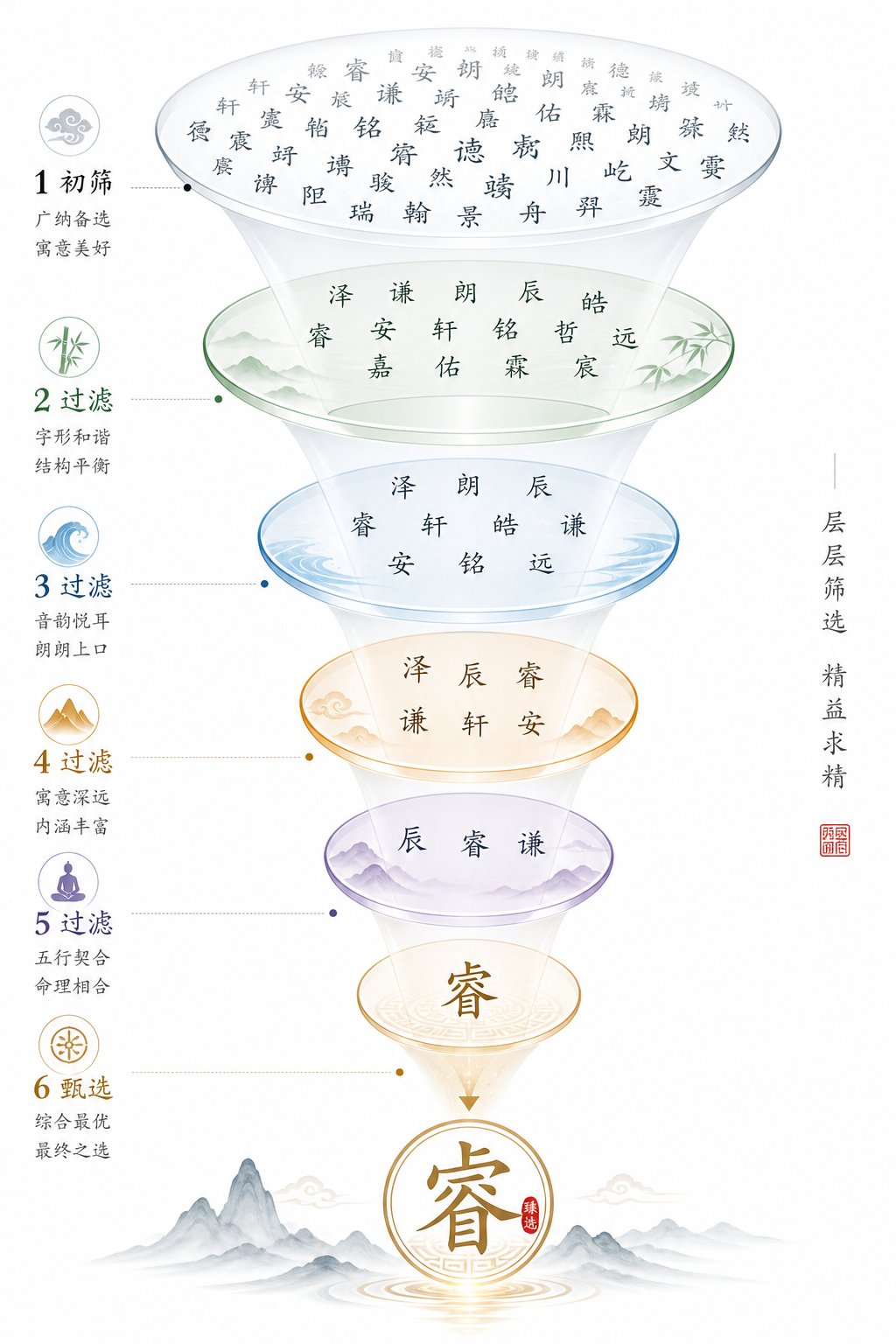
This is where the BaZi character selection step by step process becomes a practical filtering exercise. You are not browsing thousands of characters hoping one feels right. You are systematically narrowing the field through layered constraints. Here is the workflow:
- Start with your Useful God element. Pull a list of characters that carry your target element through their radical, meaning, or both. Prioritize characters where radical and meaning align unambiguously.
- Filter by stroke count for Three Talents compatibility. Calculate which stroke count combinations produce a harmonious Three Talents configuration given your fixed surname. This eliminates characters that carry the right element but create structural clashes in the name's numerology.
- Check the Human Formation specifically. The Human Formation (人格) is considered the most influential of the Five Formations because it represents the core of personal destiny. As the Chinese Name Numerology reference notes, this formation should be prioritized as the most important one. Ensure its number falls on an auspicious value.
- Verify pronunciation. Say the full name aloud, surname included. Listen for awkward tonal combinations, unintentional homophones with negative meanings, and whether the name flows naturally in Mandarin (or your family's dialect).
- Confirm character meaning. The characters should carry positive or neutral connotations individually and together. Avoid characters that form unfortunate compound meanings when placed beside each other or beside the surname.
- Test cross-cultural usability. If the family lives in an English-speaking country, consider whether the name's pinyin romanization creates pronunciation difficulties, unintended meanings, or awkward abbreviations in English contexts.
By the time you reach step six, your candidate list has shrunk from hundreds of characters to a manageable handful. Each survivor satisfies the BaZi requirement, passes the structural numerology test, sounds good, means something positive, and works across cultural contexts.
Balancing BaZi Requirements with Practical Naming Needs
Theory and life do not always cooperate neatly. Families face real constraints that interact with the metaphysical framework, and this cross-cultural Chinese name selection guide would be incomplete without addressing them directly.
Generational characters (辈分字). Some families assign a fixed character to all children of the same generation. If that character's element conflicts with the Useful God, you have one free character position to compensate. Concentrate the Useful God element entirely in that remaining character, choosing one with a strong, unambiguous elemental signal through both radical and meaning.
Dialect pronunciation. A name that sounds elegant in Mandarin might carry unfortunate associations in Cantonese, Hokkien, or Teochew. If your family uses a dialect at home, test the name in that dialect as well. Elemental correctness means little if the family avoids using the name because it sounds wrong in their daily language.
English-context usability. For families in the United States, Canada, Australia, or the UK, the pinyin romanization of the Chinese name often appears on school rosters, medical records, and legal documents. Consider whether the romanized form is pronounceable for English speakers without excessive coaching. Names like "Xin" or "Wei" translate smoothly. Names with "Zh," "Q," or "X" combinations may require constant correction, which can affect how the child relates to their Chinese name over time.
Sibling name harmony. If you have multiple children, their names often share a visual or thematic connection. This aesthetic goal sometimes conflicts with BaZi requirements since each child has a different chart and likely a different Useful God. Prioritize each child's individual chart balance over sibling name matching. A name that looks cohesive on paper but undermines one child's chart defeats the purpose of BaZi naming entirely.
The filtering process is methodical, but it still produces choices rather than a single inevitable answer. You will likely end up with two to five strong candidates that satisfy all the structural and elemental criteria. The final selection among those candidates is where personal preference, family meaning, and aesthetic taste legitimately enter the picture. At that stage, any choice within your filtered set is a sound one from a BaZi perspective.
What remains is the step most people skip: checking whether your chosen name actually does what you intended when mapped back against the original chart. That validation loop separates a rigorous naming process from an educated guess.
Step 6: Validate Your Chosen Name Against the Chart
You have a name candidate that carries the right element, passes the Three Talents test, sounds good, and means something positive. Done? Not quite. Selecting characters without verifying them against the original BaZi chart is like writing code without running tests. It might work. It might also introduce conflicts you never anticipated. This validation step closes the loop and confirms that your chosen name genuinely shifts the chart's balance toward the Useful God.
Mapping Your Name Back to the BaZi Chart
Start by listing the total elemental contribution of your chosen name. Each character brings elemental energy through its radical, meaning, and stroke count. Write out what your name adds to the chart's existing elemental distribution.
Suppose your original chart shows this distribution: two Wood, two Fire, one Earth, one Metal, two Water. The Daymaster is Yang Metal (weak), and the Useful God is Earth (to generate Metal). Your chosen given name characters both carry Earth energy through their radicals and meanings. Mapping them back, the adjusted distribution becomes: two Wood, two Fire, three Earth, one Metal, two Water. Earth now has a stronger presence, directly feeding the weak Metal Daymaster through the generating cycle.
Does that shift actually help? Ask yourself three questions:
- Is the Useful God element clearly represented in the name's elemental contribution?
- Does the added element strengthen the Daymaster through the generating or companion relationship you intended?
- Does the new distribution avoid creating a different imbalance, such as making Earth so dominant that it now overwhelms another critical element?
If all three answers are yes, the name passes the elemental mapping test. If the third question raises concerns, you may need to adjust one character to carry a secondary supportive element rather than doubling down on a single one.
Checking for Hidden Clashes and Penalties
Elemental balance is only one dimension. The Earthly Branches in your chart interact with each other through clashes, harms, breaks, and punishments, and name characters can trigger these interactions too. A character that carries the right element but whose associated branch clashes with your Day Branch or Month Branch introduces hidden friction that undermines the name's intended benefit.
How does this work in practice? Every Chinese character with an Earthly Branch association (through its radical or phonetic component) can interact with the branches already sitting in your chart. The most critical interactions to check are:
- Clash (冲): Direct opposition that creates instability and movement. If your Day Branch is 午 (Horse, Fire) and a name character strongly associates with 子 (Rat, Water), you have a Zi-Wu clash running through the name's relationship to your core self.
- Harm (害): Hidden friction that drains energy quietly. Less dramatic than a clash but persistent. A name character associated with 丑 (Ox) would harm a Day Branch of 午 (Horse).
- Punishment (刑): Repeated pressure patterns. Three branches forming a punishment triangle (such as 寅-巳-申) create ongoing strain. If two of those branches already exist in your chart, a name character carrying the third completes the punishment pattern.
The Day Branch and Month Branch are the two most sensitive positions. The Day Branch represents your core identity and marriage palace. The Month Branch governs career and carries the strongest seasonal energy. Clashes or punishments involving these two branches carry more weight than interactions with the Year or Hour Branch.
Checking name clashes with BaZi branches requires you to identify the branch associations of your chosen characters and cross-reference them against your chart's existing branches. If a destructive interaction appears, it does not automatically disqualify the character, but it raises a flag. Weigh the severity: a clash with the Day Branch is more concerning than a harm with the Year Branch. If you have alternative characters that carry the same Useful God element without triggering branch conflicts, prefer those.
The Complete Validation Checklist
Before finalizing any name, run it through this BaZi name validation checklist. Each point addresses a different layer of the naming system, and all of them need to pass for the name to be considered sound:
- Useful God element present in name: At least one given name character clearly carries the Useful God element through its radical, meaning, or both. Ideally, both characters support the Useful God directly or through the generating cycle.
- No destructive clash with Day or Month Branch: The name characters do not trigger a clash, punishment, or harm relationship with the two most sensitive branches in the chart.
- Three Talents configuration is harmonious: The Heaven-Human-Earth element sequence follows a generating pattern or avoids direct controlling relationships between adjacent positions.
- Stroke count totals align with chosen method: All stroke counts use the same system consistently, either Kangxi traditional counts throughout or simplified counts throughout. Mixing systems invalidates the numerological calculations.
- Pronunciation flows naturally: The full name, surname included, sounds smooth when spoken aloud. No awkward tonal collisions, no unintended homophones with negative meanings in Mandarin or the family's dialect.
- Character meanings remain positive in combination: The characters do not form unfortunate compound words or associations when placed beside each other or beside the surname.
Think of this checklist as a series of gates. A name that clears all six gates is ready. A name that fails one gate needs adjustment at that specific layer. A name that fails multiple gates likely needs to be reconsidered from the character selection stage rather than patched.
This feedback loop is what separates a methodical approach from hopeful guessing. You verify elemental balance after name selection not because the earlier steps were unreliable, but because naming involves multiple interacting systems. Element, structure, sound, meaning, and branch interactions all operate simultaneously. Only by checking the final result against all these dimensions can you confirm that nothing slipped through the cracks.
Of course, even a perfectly validated name exists within real-world constraints. Legal character restrictions, regional registration rules, and the practical realities of raising a bilingual child all impose boundaries that pure metaphysics does not account for. Knowing where those boundaries fall, and when a chart is genuinely too complex for self-guided analysis, is its own form of wisdom.
Step 7: Navigate Legal Restrictions and Know Your Limits
A name that satisfies every BaZi criterion still has to pass through one more filter: the real world. Governments regulate which characters can appear on birth certificates and identity documents. Families living across cultures need names that function in multiple languages. And some charts are genuinely too complex for self-guided analysis. Recognizing these boundaries early saves you from falling in love with a name that cannot legally exist or that rests on shaky analytical ground.
Legal Character Restrictions by Region
Not every Chinese character is available for naming purposes. Different countries and regions maintain their own rules about what can appear on official documents, and these rules directly affect your BaZi naming options.
Mainland China. The Regulations on Household Registration require names to use characters from the General Standard Chinese Characters Table (通用规范汉字表), which contains 8,105 characters. Rare or archaic characters that fall outside this list cannot be registered, even if they carry the perfect elemental energy for your chart. The system uses simplified characters exclusively, which also means your Kangxi stroke count calculations may reference a traditional form that differs visually from what appears on the birth certificate.
Taiwan. Taiwan's Name Act (姓名条例) permits characters found in the Chinese Standard Interchange Code (CNS 11643) character set, which is significantly larger than mainland China's approved list. Taiwan's household registration guidelines also specify that names must use characters from the approved set, with no creation of new characters permitted. Traditional characters are standard, which aligns naturally with Kangxi stroke count methods. Foreign nationals and stateless persons adopting Chinese names must follow the same conventions as Taiwanese nationals, with the family name preceding the given name.
Singapore. Singapore allows Chinese names to be registered in Chinese characters on the birth certificate alongside a romanized version. The Registry of Births and Deaths accepts standard simplified or traditional characters but may reject extremely obscure ones. Since English is the administrative language, the romanized form often becomes the name used in daily life, making cross-cultural usability especially important here.
Hong Kong and Macau. Both regions use traditional characters. Hong Kong's Births and Deaths Registration Ordinance is relatively permissive about character choice, but the name must be reproducible in the territory's Chinese character encoding system. Cantonese pronunciation takes precedence over Mandarin in daily use, which affects how you evaluate tonal flow.
Cross-Cultural Naming for International Families
BaZi naming for international families introduces a layer that purely domestic naming never encounters. The Chinese name needs to function as a complete identity marker in Chinese-speaking contexts while coexisting with an English name (or another Western name) on legal documents, school rosters, and medical records.
Several practical tensions arise:
- Romanization as legal identity. In countries like the United States, Canada, Australia, and the UK, the Chinese name often appears only in romanized form on official documents. The pinyin spelling becomes the version teachers, doctors, and government officials see. A name like 泽 (ze) works smoothly, while 翥 (zhu with a rising tone) creates pronunciation confusion for English speakers unfamiliar with pinyin conventions.
- Dual-name systems. Many families give their child both a Chinese name and a separate English name. In this case, the Chinese name carries the BaZi balancing function while the English name handles daily social interactions. This reduces pressure on the Chinese name to be easily pronounceable in English, giving you more freedom in character selection.
- Single-name systems. Some families want one name that works in both languages, often by choosing a Chinese name whose pinyin romanization sounds natural in English (e.g., 明 as "Ming" or 凯 as "Kai"). This constraint significantly narrows your character pool and may force compromises between optimal BaZi alignment and cross-cultural phonetics.
- Adapting a Chinese name for overseas registration. When registering a birth abroad, some countries require the name to be written in Roman letters only. The Chinese characters exist as a cultural and metaphysical identity but may not appear on the passport or birth certificate at all. In these cases, the BaZi name functions as a spiritual and familial anchor rather than a legal one.
Adapting When Ideal Characters Are Restricted
What happens when your carefully selected character falls outside the approved list for your region, or when legal and cultural constraints eliminate your top choices? You have several paths forward:
- Find elemental equivalents. If your ideal character is restricted, search for alternatives that carry the same element through the same method (radical, meaning, or both) but fall within the approved character set. For any given element, dozens of registrable characters exist.
- Shift stroke count targets. If a specific stroke count is needed for Three Talents harmony but the characters at that count are all restricted or carry poor meanings, recalculate which alternative stroke count combinations still produce a harmonious Three Talents configuration. Multiple valid combinations usually exist for any surname.
- Prioritize BaZi over numerology. When constraints force a choice, the Useful God element takes priority over Three Talents perfection. A name that carries the correct element but has a merely acceptable (rather than ideal) Three Talents configuration still serves the chart better than a name with perfect numerology but the wrong element.
- Use the traditional form for calculation, simplified for registration. In mainland China and Singapore, you can calculate stroke counts using Kangxi traditional forms while registering the simplified version. The metaphysical calculation references the character's energetic structure; the registration reflects its modern written form. These are parallel systems that coexist without conflict.
The key principle: legal restrictions limit your character pool but rarely eliminate all viable options for a given element. Treat restrictions as a filter in your selection process, not as a reason to abandon the BaZi framework entirely.
When to Consult a Professional BaZi Naming Master
This guide gives you the analytical chain that professionals follow. But honesty matters more than false confidence. Some charts present ambiguities that require years of pattern recognition to resolve reliably. Here are clear indicators that professional consultation would be worthwhile rather than optional:
- Borderline Daymaster strength. When the Daymaster is neither clearly strong nor clearly weak, the Useful God determination could go either direction. Choosing wrong means the name actively works against the chart. If you have counted supporting and draining elements multiple times and still cannot commit to a strength assessment, a practitioner's trained judgment resolves the ambiguity.
- Possible special formation (从格). If the Daymaster appears extremely weak with almost no support, the chart might qualify as a Follow Pattern, which reverses the entire naming logic. Misdiagnosing a Follow Pattern as a standard weak chart (or vice versa) produces a name that does the opposite of what is needed. This distinction requires examining hidden stems within every Earthly Branch, a skill that demands significant study.
- Multiple competing Useful Gods. Some charts need climate adjustment and strength support simultaneously, but the elements that serve each function conflict with each other. A Fire Daymaster born in winter might need Wood for support and Fire for warmth, but the chart also has excessive Earth draining it. Prioritizing among competing needs is where practitioner experience genuinely outperforms self-study.
- Complex branch interactions. Charts containing multiple clashes, punishments, or combinations among the Earthly Branches create a web of interactions that shift elemental values dynamically. A branch combination can transform one element into another entirely, changing the effective elemental distribution from what appears on the surface.
- Surname creates unavoidable conflict. When the surname's element directly clashes with the Useful God and the family also requires a generational character that compounds the problem, the remaining free character position carries enormous weight. A professional can identify creative bridging strategies that a beginner might miss.
Seeking professional help is not a failure of the DIY process. It is a recognition that some problems have a complexity threshold beyond which self-guided analysis introduces more risk than it resolves. A good practitioner will explain their reasoning, not just hand you a name, so the consultation becomes educational as well as practical.
The analytical framework you have built through this guide, plotting the chart, assessing the Daymaster, identifying the Useful God, selecting and validating characters, remains sound regardless of whether you execute it independently or bring it to a professional. Understanding the process means you can evaluate a practitioner's recommendations critically rather than accepting them on blind faith. That knowledge protects you from the most common pitfall of all: mistakes born from misunderstanding the system's logic in the first place.
Common Mistakes and How to Troubleshoot Your BaZi Name
Even with a solid framework in hand, the gap between understanding the process and executing it correctly is where most errors live. Some mistakes are minor and easily corrected. Others fundamentally undermine the name's purpose, sending elemental energy in the wrong direction entirely. Knowing which errors carry the most weight helps you audit your own work and catch problems before they become permanent.
Top Mistakes That Undermine BaZi Name Balance
These common BaZi naming mistakes to avoid are ranked from most damaging to least. The higher an error sits on this list, the more it distorts the final result:
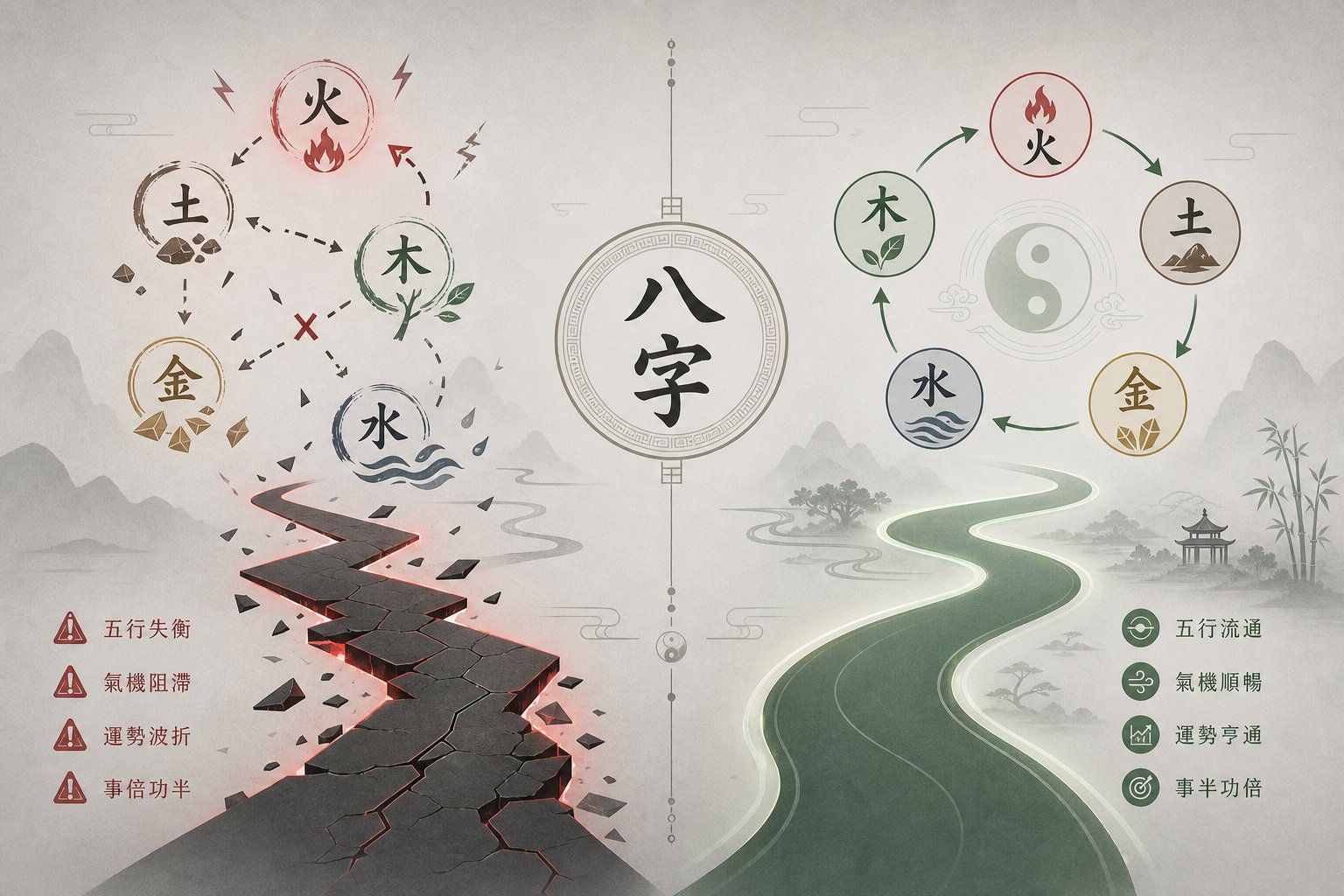
- Adding the missing element instead of the Useful God element. This is the single most consequential error. A chart missing Water does not automatically need Water in the name. If Water controls or drains the Daymaster, introducing it weakens the very person the name is supposed to support. As practitioner Sean Chan emphasizes, blindly throwing in a missing element can collapse the chart's structure and make its flaws more salient. The missing element vs useful god naming method distinction is not academic. It is the difference between helping and harming.
- Ignoring seasonal strength when assessing the Daymaster. A Metal Daymaster born in autumn looks identical on paper to one born in spring, but their strength levels are opposite. Skipping the seasonal assessment means your entire Useful God determination rests on incomplete data. You might conclude the Daymaster is weak when it is actually strong, or vice versa, reversing the naming direction completely.
- Using simplified stroke counts instead of Kangxi counts. This stroke count error in Chinese nameology cascades through every numerological calculation. The Three Talents configuration, the Five Formations, and the stroke-based elemental assignments all shift when you use the wrong count. The character 华 has 6 strokes in simplified form but 14 strokes in its Kangxi traditional form (華). That difference changes the element from Earth (digit 6) to Fire (digit 4) and alters the Three Talents configuration entirely. The entire classical naming system was calibrated to Kangxi dictionary values, so using simplified counts feeds incorrect inputs into formulas designed for traditional counts.
- Failing to account for surname element interactions. Your surname is fixed. Its elemental energy is already part of the name's total contribution. If the surname carries Fire and your Useful God is Water, ignoring that clash means the name works against itself internally. The given name characters must compensate for or bridge this tension, not pretend it does not exist.
- Choosing characters solely for meaning without checking elemental alignment. A character meaning "wisdom" or "prosperity" feels intuitively right. But if that character carries an element that drains or controls your Daymaster, its beautiful meaning becomes irrelevant from a BaZi perspective. Meaning is a filter applied after elemental alignment is confirmed, never before.
- Mixing stroke count systems within a single name. Using Kangxi counts for one character and simplified counts for another invalidates the mathematical relationships between them. The Three Talents framework depends on consistent inputs. Pick one system and apply it uniformly across every character in the name, including the surname.
- Neglecting pronunciation and tonal flow. This does not damage the metaphysical alignment, but it damages the name's practical function. A name the child dislikes saying, or that others consistently mispronounce, becomes a name the child distances themselves from. Energetic benefit requires the name to be actively used.
Notice the pattern. The most damaging mistakes all involve misidentifying what the chart needs. Technical errors like wrong stroke counts rank lower because they affect the structural layer rather than the foundational direction. Fix the direction first, then worry about the math.
Comparing BaZi Naming Schools of Thought
Part of the confusion around BaZi naming comes from the fact that multiple legitimate schools of thought exist, each emphasizing different aspects of the system. When you read conflicting advice online, you are often seeing practitioners from different schools talking past each other rather than one being right and the other wrong. This BaZi naming schools of thought comparison lays out the four main approaches honestly:
| Methodology | Core Principle | Strengths | Weaknesses | Best Used When |
|---|---|---|---|---|
| Useful God Approach (用神派) | Identify the element that balances the chart holistically, then select characters carrying that element | Most accurate alignment with the individual chart; addresses root cause rather than surface gaps | Requires advanced BaZi analysis skills; Useful God identification can be ambiguous in complex charts | You have confidence in your Daymaster strength assessment or are working with a practitioner |
| Missing Element Approach (缺什么补什么) | Find which of the Five Elements is absent from the chart and add it through the name | Simple to execute; requires minimal BaZi knowledge; accessible to beginners | Often produces incorrect results; a missing element may actively harm the chart if introduced; ignores Daymaster strength and seasonal context | Only when the missing element happens to coincide with the Useful God (verify independently) |
| Stroke Count School (五格剖象法) | Focus primarily on achieving auspicious stroke count totals across the Five Formations | Mathematically precise; easy to verify; produces clear pass/fail results for each formation | Can prioritize numerology over elemental alignment; a name with perfect stroke counts but the wrong element still fails the chart | As a secondary filter after Useful God element is established, not as the primary selection criterion |
| Three Talents School (三才派) | Prioritize the Heaven-Human-Earth elemental configuration derived from stroke counts | Evaluates structural harmony of the name as a unit; considers how elements within the name interact with each other | Does not directly address the birth chart's needs unless combined with Useful God analysis; a harmonious Three Talents configuration that carries the wrong element still misses the mark | As a structural validation layer combined with Useful God selection, ensuring the name's internal elements do not clash |
The most rigorous approach combines these methods in a hierarchy rather than choosing one exclusively. The Useful God approach determines direction. The stroke count and Three Talents methods provide structural validation. The missing element approach is useful only as a quick initial scan that must be verified against proper Daymaster analysis before acting on it.
If you have been following this guide sequentially, you have already been using the combined approach: Useful God first, then Three Talents and stroke counts as filters, with meaning and pronunciation as final checks. That layered methodology reflects how experienced practitioners actually work, even if they emphasize different layers depending on their training lineage.
Troubleshooting When Your Results Feel Wrong
Sometimes you complete the entire process and something still feels off. The name checks every box on paper but creates a nagging sense of misalignment. Here is how to troubleshoot BaZi name element conflicts and identify where the process may have gone sideways:
Recheck your Daymaster strength assessment. This is the most common source of downstream errors. Go back to the Month Branch and recount. Did you account for hidden stems within the Earthly Branches? A branch that appears to be one element on the surface may contain hidden stems that support or drain the Daymaster in ways you initially missed. The character 寅 (Tiger), for example, is classified as Wood but contains hidden stems of Wood, Fire, and Earth. Those hidden elements affect the true balance.
Verify your Kangxi stroke counts independently. Do not trust a single source. Cross-reference your stroke counts against at least two Kangxi dictionary references. Some characters have disputed counts depending on how certain strokes are classified. The character 辶 (walking radical) counts as 7 strokes in Kangxi, not the 3 or 4 it appears to have visually. These discrepancies are common enough to warrant double-checking every character.
Reassess whether you are dealing with a special formation. If your Daymaster strength assessment keeps producing ambiguous results, step back and ask: is this chart potentially a Follow Pattern? The telltale sign is a Daymaster with zero roots in any Earthly Branch and no support from any other stem. If you keep oscillating between "weak" and "extremely weak," the chart may have crossed the threshold into special formation territory, which reverses the naming logic entirely.
Check for branch combinations that transform elements. Two Earthly Branches sitting next to each other can combine and transform into a different element. The combination of 寅 (Tiger) and 亥 (Pig) transforms into Wood. If your chart contains such combinations, the effective elemental distribution differs from what a surface-level count shows. Your Useful God determination needs to account for these transformed values.
Consider whether climate adjustment overrides standard logic. A chart born in extreme cold (deep winter, 子 or 丑 months) or extreme heat (mid-summer, 午 or 未 months) may need climate adjustment that takes priority over the standard support-and-curb approach. If your Useful God selection followed pure strength logic but the chart was born in an extreme season, revisit whether a warming or cooling element should take precedence.
When troubleshooting leads you in circles rather than toward clarity, that is itself diagnostic information. It usually means the chart sits at a complexity level where the variables interact in ways that require pattern recognition built from analyzing hundreds of charts. Returning to the previous chapter's guidance on when to consult a professional is not retreating. It is recognizing that the analytical framework has done its job by revealing exactly where the ambiguity lives, giving you the vocabulary to have a productive conversation with a practitioner rather than starting from zero.
Frequently Asked Questions About BaZi Naming
1. Is the missing element in my BaZi chart always the one I should add to my name?
No. The missing element is not automatically the correct one for your name. The element your name should carry is the Useful God, which is determined by your Daymaster's strength and seasonal context. A missing element might actually drain or control your Daymaster, making the chart weaker. For example, if your weak Wood Daymaster is missing Fire, adding Fire would further exhaust Wood since Wood generates Fire. Always assess Daymaster strength first, then identify which element genuinely supports or balances the chart before selecting name characters.
2. How do I know if my Daymaster is strong or weak for naming purposes?
Start by checking the Month Branch, which represents the birth season and is the strongest indicator of Daymaster strength. A Daymaster born in its flourishing season starts strong, while one born in a controlling season starts weak. Then count all supporting elements (same element and resource element) versus draining elements (output, wealth, and controlling elements) across all eight characters. If supporters outnumber drainers and the season is favorable, the Daymaster is strong. If drainers dominate and the season is unfavorable, it is weak. This assessment directly determines whether your name should reinforce or channel the Daymaster's energy.
3. Should I use Kangxi traditional stroke counts or simplified stroke counts for BaZi naming?
The dominant position among classical nameology practitioners is to use Kangxi dictionary stroke counts regardless of whether you write simplified characters daily. The entire numerological naming system, including the Three Talents framework and Five Formations, was calibrated to traditional stroke values established in the 1716 Kangxi dictionary. Simplified characters were introduced as a literacy reform in the 1950s, not a metaphysical recalibration. Using simplified counts feeds incorrect inputs into formulas designed for traditional counts, potentially changing elemental assignments and Three Talents configurations entirely.
4. What is the Three Talents framework and why does it matter for BaZi naming?
The Three Talents (San Cai) framework evaluates the structural harmony between your surname and given name characters by dividing the name into three energetic positions: Heaven, Human, and Earth. Each position receives a Five Element assignment based on stroke count calculations. The ideal configuration has elements flowing in a generating sequence, such as Metal generating Water generating Wood. It matters because even if your characters carry the correct Useful God element, a clashing Three Talents configuration introduces internal friction within the name itself. It serves as a structural validation layer that ensures the name works as a cohesive unit.
5. When should I consult a professional BaZi naming master instead of doing it myself?
Professional consultation becomes worthwhile when your chart presents specific ambiguities: borderline Daymaster strength where you cannot confidently determine strong or weak, possible special formations (Follow Patterns) where the Daymaster has zero support, multiple competing Useful Gods that serve different functions, complex branch interactions involving clashes and punishments that transform elements, or when your surname creates unavoidable elemental conflicts compounded by generational character requirements. These scenarios involve judgment calls that require pattern recognition built from analyzing hundreds of charts, which goes beyond what self-guided analysis can reliably resolve.