What Makes Choosing a Chinese Baby Name Different
When you browse Western baby name books, you pick a name you like the sound of, maybe check its historical meaning, and you're done. Chinese baby names don't work that way. Every single character in a Chinese name is a living word with its own meaning, tone, and visual structure. The name isn't just a label — it's a tiny phrase that parents compose from scratch, carrying their hopes, values, and cultural identity in two or three carefully chosen characters.
That's why learning how to choose a Chinese name demands more than scrolling through a list. It requires understanding character meanings, tonal harmony, family traditions, and sometimes even metaphysical systems like the Five Elements. For many families, it also involves negotiating with grandparents who have strong opinions rooted in decades of cultural knowledge.
In English, the name "Grace" carries meaning by association. In Chinese, every character IS its meaning — choosing a name is closer to writing poetry than picking from a catalog.
Why Chinese Baby Naming Requires a Structured Process
Most guides treat Chinese names as a single creative decision. In reality, choosing a chinese name involves a sequence of dependent steps: structure, timing, elemental balance, character selection, sound testing, cultural vetting, and family validation. Skip a step or do them out of order, and you risk a name that looks beautiful on paper but sounds awkward spoken aloud — or worse, carries an unintended meaning that native speakers immediately catch.
This guide walks you through each decision in the exact order it needs to happen. It covers both traditional approaches (birth-date calculations, Five Elements balancing) and modern practical methods, so you can choose the path that fits your family.
Who This Guide Is For
Whether you and your partner are both Chinese, navigating a mixed-heritage family, or non-Chinese parents wanting a meaningful Chinese name for your child, this process applies to you. The steps ahead will take you from understanding name structure all the way through legal registration — giving you a complete workflow for one of the most culturally significant gifts you'll ever give your baby.
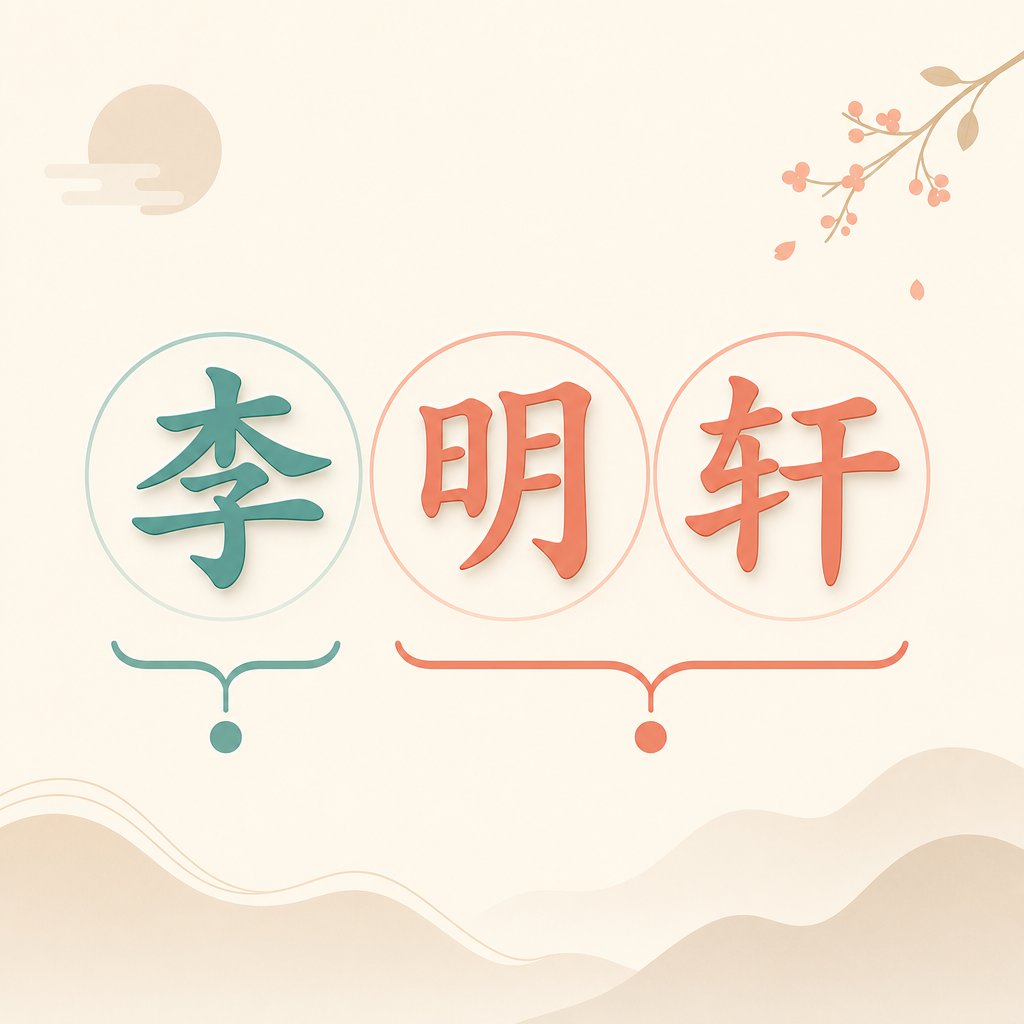
Step 1 – Understand How Chinese Names Are Structured
Before you start brainstorming characters, you need a clear picture of what a Chinese name actually looks like. The structure is fundamentally different from Western names, and understanding it prevents confusion at every step that follows.
A Chinese name in chinese reads as a compact unit — typically two or three characters with no spaces between them. Unlike English, where a first name and surname are independent words, each part of a Chinese name works together visually and phonetically as a single composed phrase.
Surname Plus Given Name Structure
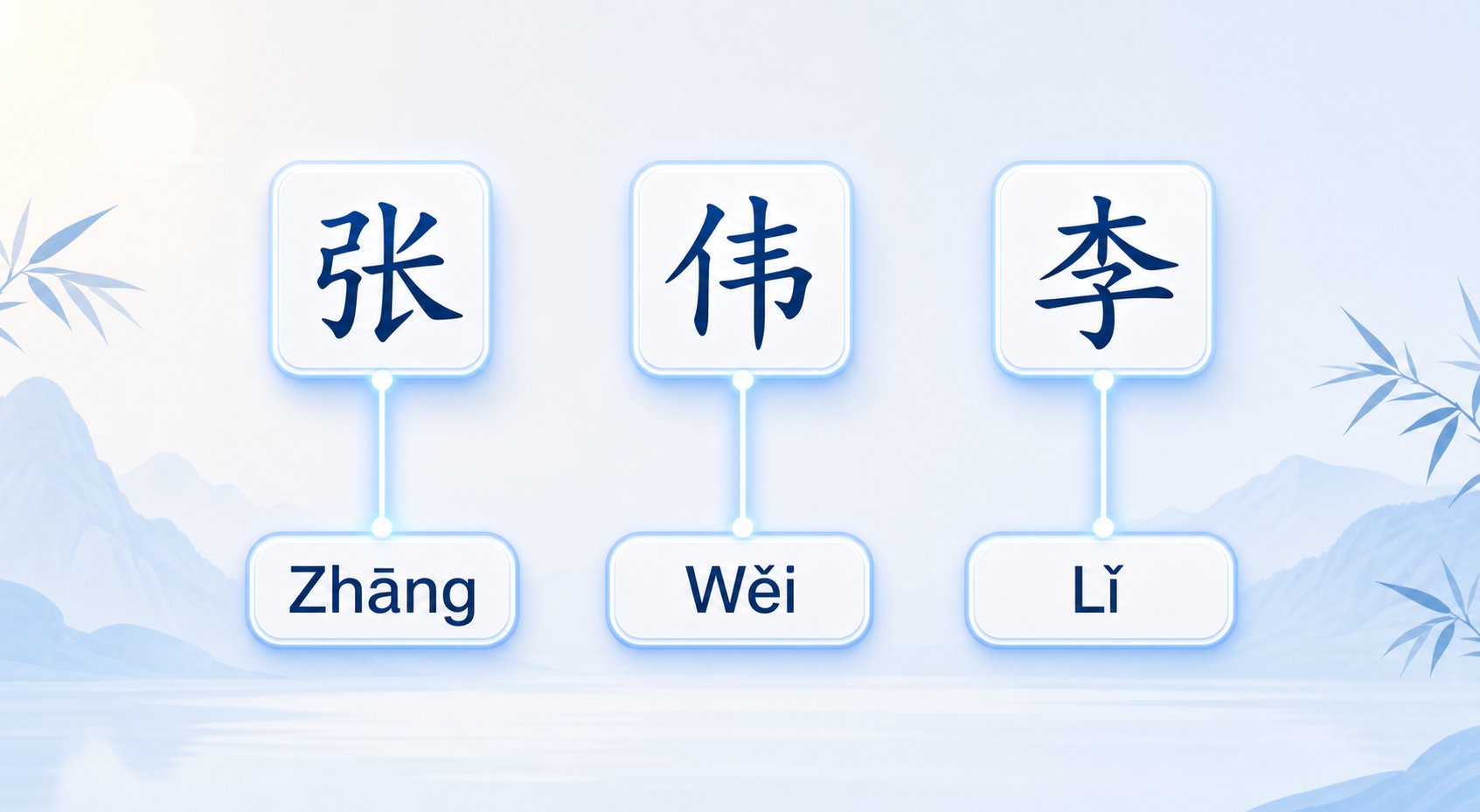
Here's the most important rule: the surname (姓, xing) always comes first. It's typically a single character inherited from the father, though modern families increasingly choose the mother's surname or even combine both parents' surnames. Only about 400 different family names are in common use across China, with the top three — Wang (王), Li (李), and Zhang (张) — shared by more than 270 million people.
The given name (名, ming) follows the surname and consists of one or two characters chosen by the family. This is the creative part — the chinese first name can theoretically draw from any of the language's tens of thousands of characters. Most Chinese names total two characters (one surname + one given name) or three characters (one surname + two-character given name). There is no fixed set of "approved" given names the way some cultures maintain name registries.
To see how do chinese names work in practice, here's a breakdown of common examples:
| Full Name | Surname | Given Name | Meaning of Each Character |
|---|---|---|---|
| 李明 (Li Ming) | 李 (Li) | 明 (Ming) | Li = plum; Ming = bright, clear |
| 王小红 (Wang Xiaohong) | 王 (Wang) | 小红 (Xiaohong) | Wang = king; Xiao = little; Hong = red |
| 陈伟 (Chen Wei) | 陈 (Chen) | 伟 (Wei) | Chen = ancient state; Wei = great, mighty |
| 张秀英 (Zhang Xiuying) | 张 (Zhang) | 秀英 (Xiuying) | Zhang = archer/stretch; Xiu = elegant; Ying = flower/hero |
Notice that the given name for chinese children carries deliberate meaning chosen by the parents — it's not drawn from a pre-existing list. Each character is selected for its individual meaning, its visual beauty when written, and how it sounds alongside the surname.
Milk Names and Formal Names Explained
Most Chinese children actually carry multiple names throughout life, each serving a different purpose:
- Legal name (大名, daming): The formal name registered on official documents. This is what you're building through this guide.
- Milk name (小名 or 乳名, xiaoming or ruming): A casual pet name used at home during infancy and childhood. These often use diminutives like doubling a character (e.g., 明明, Mingming) or adding 小 (xiao, "little") before a character. Some families traditionally chose unattractive milk names to ward off evil spirits — a superstition that's fading but still recognized.
- English/Western name: Used in international contexts, at school, or at work. This might echo the Chinese name phonetically (e.g., 美 Mei becoming "May") or be chosen independently.
You don't need to settle all three at once. The milk name is informal and can emerge naturally after birth. The English name can wait until the child is older. Your priority right now is the formal legal name — the name in mandarin characters that will anchor your child's identity.
Regional Differences in Naming Conventions
Where your family lives or holds citizenship affects naming rules in practical ways:
- Mainland China: Names must use simplified characters. The government requires registration within one month of birth. Unusual characters that aren't supported by the national ID system may be rejected — the public security bureau's computers recognize roughly 32,000 of the 55,000 characters in use.
- Taiwan: Traditional characters are standard. The Wade-Giles romanization system is commonly used, so the same chinese for name characters get spelled differently than in mainland pinyin (e.g., Zhang becomes Chang). Hyphenated given names are the norm in romanized form (e.g., Wei-Ting rather than Weiting).
- Overseas communities: Families in the US, Canada, UK, or Australia typically register the Chinese name as a middle name or on a separate birth certificate field. The romanization style often depends on the family's dialect — Cantonese speakers may spell 王 as "Wong" rather than "Wang," and 陈 as "Chan" rather than "Chen."
These regional differences matter because they determine which characters are legally available, how the name appears on official documents, and how others will read and pronounce it. A name that works perfectly in one system might create bureaucratic headaches in another — something worth considering if your child will live across borders.
With the structural foundation clear, the next question becomes timing: when in your pregnancy or after birth should each naming decision actually happen?
Step 2 – Decide Your Approach and Timing
Here's a question most naming guides skip entirely: when should you actually start? The answer depends on which naming philosophy your family follows — and getting this decision right early saves weeks of confusion later.
If you're wondering how to pick a chinese name using traditional methods, you'll quickly discover that the final choice literally cannot happen until after birth. Modern approaches, on the other hand, let you do most of the heavy lifting during pregnancy. Both paths are valid. The key is knowing which track you're on before you invest time in the wrong direction.
Traditional Timing Based on Birth Date
Traditional Chinese naming relies on the baby's BaZi (八字) — the Four Pillars of Destiny calculated from the exact birth year, month, day, and hour. This chart reveals which of the Five Elements (Wood, Fire, Earth, Metal, Water) are strong, weak, or missing. The chosen name characters then support elemental balance in the chart, giving the name a metaphysical foundation beyond pure aesthetics.
Because the Hour Pillar can shift the entire analysis, parents following this track must wait for the baby's arrival before finalizing anything. Here's what the traditional approach requires:
- Baby's exact birth date and time (even the hour matters)
- Birthplace for time zone confirmation
- A BaZi calculation — done by a naming master (起名师), a knowledgeable family elder, or an AI-assisted tool
- Knowledge of which elements the chart needs strengthened
- Character selection based on elemental direction, meaning, and sound
- Final validation with family before registration
This means the name typically comes together in the days or weeks after birth — often announced formally at the Manyue (满月, one-month celebration) or Bairi (百日, hundred-day banquet).
Modern Approach Starting During Pregnancy
Many contemporary families — especially those in the diaspora or mixed-heritage households — pick a chinese name using a meaning-first approach. You research characters, build shortlists, test sounds, and consult family well before the due date. The birth itself doesn't change the analysis because you're not tying the name to a metaphysical chart.
The modern track requires:
- Research into character meanings, radicals, and gender conventions
- A shortlist of 10-15 character combinations that pair well with the surname
- Tonal harmony testing (saying the full name aloud repeatedly)
- Homophone checks with native speakers
- Family consultation and consensus-building
- Final confirmation after birth — adjusting only if the name feels wrong once you meet the baby
Picking a chinese name this way gives you months of runway. Most parents who follow this path have two or three strong candidates ready before delivery, then make the final call in the first week.
When to Involve Family Elders
Regardless of which track you choose, involve grandparents and senior relatives early — ideally during the second trimester. This isn't about handing them veto power. It's about managing expectations and honoring their cultural knowledge before positions harden.
Elders often know the family's generation poem (字辈), remember which characters belong to deceased relatives (and are therefore off-limits), and carry dialect-specific knowledge about how a name sounds in Cantonese, Hokkien, or Shanghainese. Bringing them in early lets you absorb this information while you still have time to adjust. Waiting until after birth — when everyone is sleep-deprived and the registration deadline looms — turns a collaborative process into a pressured negotiation.
A practical approach: share your shortlist with elders as "options we're considering" rather than asking them to generate names from scratch. This keeps you in the driver's seat while giving them meaningful input. If a grandparent feels heard early, they're far less likely to push back on the final choice.
With your timing and approach settled, the next layer of decision-making opens up for families on the traditional track: understanding how the Five Elements and Chinese Zodiac actually influence which characters belong in your baby's name.
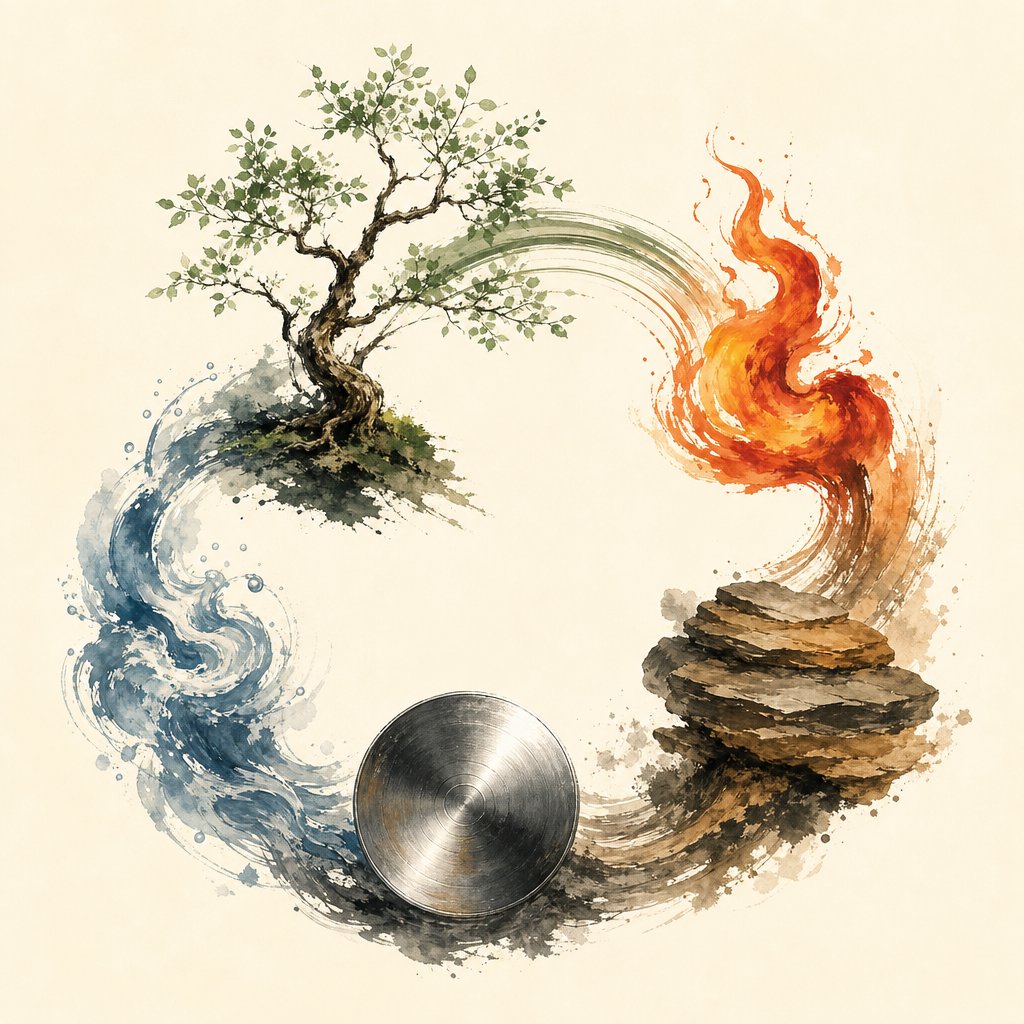
Step 3 – Consider Five Elements and Zodiac Influences
The Five Elements system (五行: Wood, Fire, Earth, Metal, Water) is the engine behind traditional Chinese naming. If you chose the traditional track in the previous step, this is where it gets specific. Each chinese name word you select can carry elemental energy through its radical, meaning, or historical association — and the goal is to choose characters that balance what your baby's birth chart needs.
If you're following the modern track? You can skip this step entirely and move straight to character selection. There's no obligation to incorporate metaphysical analysis, and many families make a chinese good name based purely on meaning, sound, and family tradition. Both paths produce names the child can carry proudly.
How the Five Elements Influence Character Choice
Here's the core idea: your baby's BaZi chart — calculated from the birth year, month, day, and hour using the Heavenly Stems and Earthly Branches system — reveals which elements are strong, weak, or absent. The ten Heavenly Stems each belong to a specific element: Jia and Yi are Wood, Bing and Ding are Fire, Wu and Ji are Earth, Geng and Xin are Metal, Ren and Gui are Water. The twelve Earthly Branches carry elemental associations too (Yin and Mao are Wood, Si and Wu are Fire, and so on).
The Day Master — the Heavenly Stem of your baby's birth day — represents the child. A naming adviser (or a parent doing their own research) checks whether the Day Master is well-supported or overwhelmed by surrounding elements, then identifies which element the name should strengthen. A baby with a weak Wood Day Master born in autumn (Metal season) might benefit from Water or Wood characters, since Water nourishes Wood.
Each element connects to specific radicals and characters you can use when building the name:
| Element | Associated Radicals | Example Characters | Imagery |
|---|---|---|---|
| Wood (木) | 木, 艹, 竹 | 林 (Lin), 芳 (Fang), 桐 (Tong) | Growth, spring, vitality, learning |
| Fire (火) | 火, 灬, 日 | 炎 (Yan), 煜 (Yu), 晨 (Chen) | Brightness, warmth, passion |
| Earth (土) | 土, 山, 石 | 坤 (Kun), 岩 (Yan), 城 (Cheng) | Stability, reliability, grounding |
| Metal (金) | 金, 钅 | 鑫 (Xin), 铭 (Ming), 锋 (Feng) | Decisiveness, strength, precision |
| Water (水) | 水, 氵, 雨 | 涵 (Han), 泽 (Ze), 霖 (Lin) | Wisdom, depth, clarity, flow |
The relationship between elements matters too. They follow a generating cycle (Wood feeds Fire, Fire creates Earth, Earth yields Metal, Metal collects Water, Water nourishes Wood) and an overcoming cycle (Wood parts Earth, Earth dams Water, Water quenches Fire, Fire melts Metal, Metal cuts Wood). When you make a chinese name using this system, you're not just patching a missing element — you're looking for characters that support the overall chart's balance rather than treating it like simple addition.
Chinese Zodiac and Auspicious Characters
Beyond the Five Elements, the baby's zodiac year adds another layer of character guidance. Each of the twelve animals has traits, habitats, and preferences that translate into favorable or unfavorable radicals.
The logic is intuitive once you see the pattern. Animals that eat grass (Ox, Rabbit, Horse, Goat) benefit from characters containing the grass radical 艹 — it symbolizes abundant food and comfort. Animals that shelter in caves or under roofs (Snake, Rat, Rabbit) do well with the 宀 or 口 radicals, suggesting safety and home. Animals associated with adornment (Horse, Rooster) pair nicely with radicals like 彡 or 巾.
Conversely, zodiac clashes create characters to avoid. The Rat (子) clashes with the Horse (午), so a Rat-year baby should steer clear of characters containing 午 or 马. A Snake-year baby traditionally avoids the 日 (sun) radical because snakes prefer shade. These aren't rigid rules — think of them as cultural guidelines that help narrow thousands of possible characters into a manageable set.
Great chinese names often emerge when Five Elements analysis and zodiac preferences point in the same direction. A Rabbit-year baby whose chart needs Wood, for example, has a natural fit with characters carrying the 艹 radical — the zodiac says "food and comfort" while the elements say "strengthening Wood." That convergence gives the name a layered resonance that feels intentional rather than random.
A Simplified Method for Non-Expert Parents
Sounds complex? You don't need to become a BaZi master to use this system. Here's a practical shortcut for parents who want elemental awareness without deep study:
- Use a free online BaZi calculator — input your baby's birth date, time, and location to generate the Four Pillars chart.
- Identify the Day Master element (the Heavenly Stem of the day pillar).
- Note which elements appear most and least frequently across all four pillars.
- Look at the season of birth: a summer baby already has strong Fire; a winter baby has strong Water.
- Choose characters from the element that supports or balances the Day Master, using the radical table above as your starting point.
This gives you a directional compass — not a precise prescription, but enough to make informed character choices. Many parents find that even this simplified approach helps them feel confident about why they chose specific characters, rather than selecting purely by gut feeling.
For families wanting deeper analysis, professional naming masters (起名师) combine BaZi, zodiac preferences, stroke-count numerology, and generational naming rules into a comprehensive recommendation. This service typically costs between a few hundred and several thousand yuan, depending on the practitioner's reputation and depth of analysis.
Whether you use the full traditional system, the simplified method, or skip this step altogether, you now have the elemental foundation to guide your character choices. The next step moves from the metaphysical to the creative: actually selecting characters that carry the meaning, gender signals, and family identity you want your child's name to express.
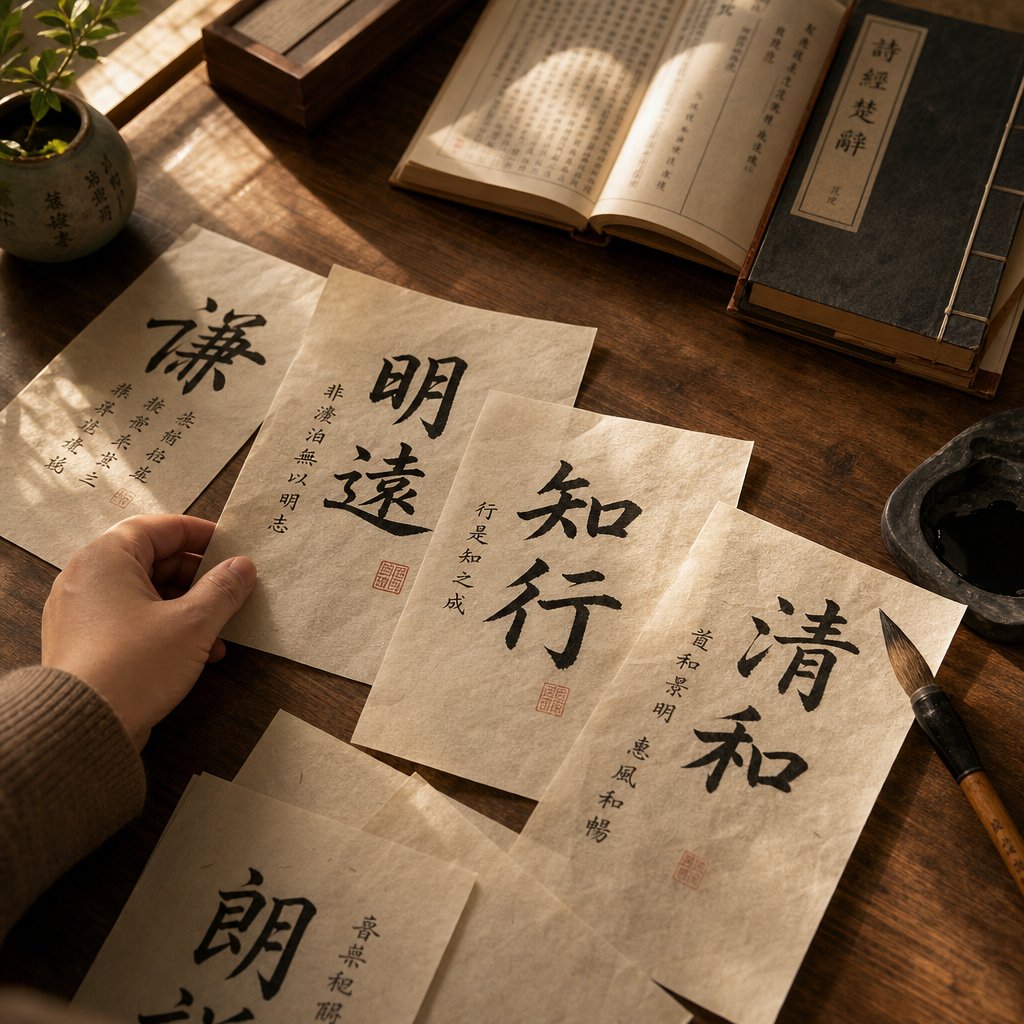
Step 4 – Select Characters with Meaningful Depth
This is the creative heart of the process — the step where chinese name ideas move from abstract research into actual candidates you can picture on a birth certificate. You've established your structural framework, chosen your timing approach, and (if following the traditional track) identified which elements to favor. Now you're selecting the one or two characters that will form your baby's given name.
Unlike Western naming, where you choose from an existing catalog of names, here you're composing something original from individual building blocks. Each character carries its own meaning, visual structure, and sound. The combinations are nearly infinite, which is both liberating and overwhelming. Gender conventions, family traditions, and practical readability all help narrow the field.
Gender Signals Through Character Choice
Chinese naming has strong gender conventions embedded in character selection. These aren't rigid rules — modern parents break them intentionally — but understanding the patterns helps you make deliberate choices rather than accidental ones.
For girls, popular characters cluster around themes of beauty, nature, grace, and inner virtue:
- Beauty: 美 (mei, beautiful), 丽 (li, graceful/pretty), 艳 (yan, gorgeous), 娟 (juan, beautiful/bewitching)
- Nature: 花 (hua, flower), 雪 (xue, snow), 月 (yue, moon), 霞 (xia, rosy clouds), 萱 (xuan, daylily)
- Grace: 雅 (ya, elegant), 婷 (ting, graceful), 静 (jing, tranquil), 怡 (yi, joyful)
- Virtue: 慧 (hui, wise), 淑 (shu, gentle/virtuous), 敏 (min, clever/quick)
Characters containing the 女 (woman) radical — like 婷, 娟, 妍, and 姝 — signal femininity through their visual structure alone. Even someone who can't read Chinese will notice that radical appearing in a girl's name.
When choosing a chinese name for boy, the character palette shifts toward strength, ambition, wisdom, and moral character. Here are common categories for boy chinese names:
- Strength: 强 (qiang, strong), 伟 (wei, great/mighty), 刚 (gang, hard/firm), 勇 (yong, brave)
- Ambition: 志 (zhi, aspiration), 鹏 (peng, mythical roc bird), 飞 (fei, to fly), 超 (chao, to surpass)
- Wisdom: 智 (zhi, wisdom), 哲 (zhe, philosophy/sage), 睿 (rui, astute), 杰 (jie, outstanding)
- Moral character: 仁 (ren, benevolence), 义 (yi, righteousness), 信 (xin, trustworthy), 德 (de, virtue)
A chinese name male readers of any generation would recognize often draws from these categories. Data on China's most common names confirms this: 伟 (wei, great) appears in millions of chinese names male holders carry, while 强 (qiang, strong) and 军 (jun, army) rank among the most popular chinese names boy families have chosen over the past several decades. Characters with the 王/玉 (king/jade) radical — like 琪 (qi, fine jade), 瑞 (rui, auspicious), and 珂 (ke, white jade) — work across genders, suggesting preciousness and value.
Modern parents increasingly choose gender-neutral characters that emphasize intellect or nature over traditional masculinity or femininity. Names like 宇航 (Yuhang, "space voyage") or 梓涵 (Zihan, "catalpa tree + encompassing") have surged in popularity for both boys and girls. If you're exploring chinese boy names and meanings but want something less conventional, characters like 泽 (ze, grace/marsh), 轩 (xuan, lofty), or 墨 (mo, ink) offer a contemporary feel while still carrying depth.
Generational Names and Family Traditions
Some families don't give you a completely blank canvas. In the generational naming tradition (字辈, zibei), one character in the given name is predetermined — shared by every member of the same generation within the family. Your creative freedom applies only to the remaining character.
How does this work? A generation poem — composed by family elders when a lineage was established — assigns one character per generation in sequence. Each successive character of the poem represents the shared generational name for all siblings and patrilineal cousins born in that generation. Once the poem's final character is reached, it cycles back or gets extended by the clan association.
The "Ze" (泽) in Mao Zedong, for example, was the fourteenth character in his family's generational cycle. These poems often contain characters expressing virtuous ideals — 俊 (jun, talented), 豪 (hao, heroic), 文 (wen, cultured) — because they were meant to guide each generation's aspirations.
To find your family's generation sequence:
- Ask the oldest living relatives — grandparents or great-uncles often know the poem by heart
- Check the family's genealogy book (族谱, zupu) if one exists
- Contact your surname's clan association, especially if the family originates from a specific village
- Look at the given names of your parents, uncles, and aunts — a shared character across siblings reveals the current generation's assigned character
Should you follow this tradition? It's genuinely optional today. The practice has largely fallen into abeyance since the mid-twentieth century, and many urban Chinese families no longer observe it. But for families with strong clan ties — particularly those with roots in rural Guangdong, Fujian, or Hunan — honoring the generation poem connects your child to centuries of family history. If grandparents mention it, take it seriously. Even if you ultimately choose not to follow it, understanding the tradition shows respect.
Evaluating Characters Without Chinese Fluency
What if you don't read Chinese? Maybe your partner's family is suggesting characters, or you've received recommendations from a naming service. You still need to evaluate those suggestions critically. Here's how:
- Ask for the character's full range of meanings. Many characters have multiple definitions depending on context. 芳 (fang) means "fragrance" but also "virtue" — both positive. Other characters carry one lovely meaning and one less desirable one.
- Check the stroke count. Extremely complex characters (15+ strokes) can be difficult for a child learning to write their own name. Ask how many strokes each suggested character requires.
- Request the radical breakdown. Knowing the radical tells you the character's visual "family" — a 氵(water) radical, a 木 (wood) radical, or a 女 (woman) radical each signals something about the character's nature.
- Look up frequency. Very rare characters may cause problems with computer systems, school enrollment forms, or airline bookings. Ask whether the character appears in standard dictionaries and digital fonts.
- Get multiple opinions. One family member's favorite character might strike another native speaker as old-fashioned, overly common, or associated with a specific era. Gather at least two or three independent reactions before committing.
You don't need fluency to make a good decision — you need the right questions. Treat character suggestions the way you'd treat a contractor's proposal: understand what's being recommended, why, and what the alternatives are.
With your characters shortlisted, there's one dimension that can make or break even the most meaningful name: how it actually sounds when spoken aloud. Tonal harmony and homophone traps are the hidden pitfalls that separate a name that reads beautifully from one that lives beautifully in daily conversation.
Step 5 – Test Tonal Harmony and Avoid Sound Pitfalls
A name can carry the most beautiful meaning on paper and still fall flat in daily life. Why? Because your child's name will be spoken thousands of times before it's ever read — called across playgrounds, announced in classrooms, repeated at family dinners. How do you say name in chinese in a way that flows naturally off the tongue? That depends entirely on tonal patterns and sound combinations most parents never think to test.
Tone Combinations That Sound Harmonious
Mandarin has four tones plus a neutral tone — high flat (1st), rising (2nd), dipping (3rd), and sharp falling (4th). When you string two or three characters together in a full name, the tone sequence creates a melody. Some melodies feel smooth and natural. Others feel clunky or monotonous.
The general principle: varied tones sound better than repeated ones. A name like 王志远 (Wang Zhiyuan: 2nd-4th-3rd) moves through different pitch contours, giving it a natural rhythm. Compare that to a name where all three characters share the same tone — the result sounds flat or sing-song in an unpleasant way.
The most important pitfall to avoid is three consecutive third tones. In Mandarin, when two third tones appear together, the first automatically shifts to a second tone (a rule called tone sandhi). Three third tones in a row create an awkward chain of shifts that sounds unnatural even to native speakers. If your surname is already third tone (like 李, Li), avoid pairing it with a two-character given name where both characters are also third tone.
A practical test: say the full name aloud ten times quickly, as if calling your child from another room. If it feels effortful or your tongue trips, the tonal pattern may need adjustment. You don't need perfect tonal knowledge — you need a native speaker's ear confirming it flows.
Checking for Embarrassing Homophones
Chinese has an extraordinary number of homophones — different characters sharing identical pronunciation. This means a name that looks elegant when written can sound identical to an embarrassing or unfortunate word when spoken aloud. This is arguably the most critical check in the entire naming process, and the reason you should always test how to say name in chinese contexts before committing.
Consider this: the characters 思 (si, to think) and 望 (wang, to hope) seem like a lovely pairing — thoughtful and aspirational. But spoken together, "Siwang" sounds exactly like 死亡 (death). A direct transliteration of "Charlotte" into Chinese (夏洛特, Xialuote) can sound uncomfortably close to "sha le ta" (kill him/her) in casual speech.
Here are the most common homophone pitfalls to check before finalizing any name in mandarin:
- Full name read together: Does the complete name (surname + given name) sound like any common word or phrase? Say it at normal speed — homophones often emerge only when syllables blur together naturally.
- Given name in isolation: Will teachers and friends call your child by their given name alone? Check whether those one or two syllables match any slang, insults, or unfortunate words.
- Reversed syllables: Chinese speakers sometimes playfully reverse names. Does the name sound problematic when flipped?
- Common nicknames: Will the obvious shortened version or doubled form (e.g., 明明, Mingming) create an unintended meaning?
- Rhyming with insults: Children are creative with teasing. Does the name rhyme with or closely resemble any common schoolyard insult?
- Brand or pop culture overlap: Does the name match a well-known brand, fictional character, or public figure in a way that would overshadow the child's identity?
The character 日 (ri, sun) illustrates how individual characters can carry hidden problems — in colloquial usage, it functions as a vulgar expletive. Characters like 芬 (fen, fragrance) are lovely alone but can form unfortunate combinations with certain surnames. These traps are nearly impossible to catch without native-speaker input.
For parents who want to understand how do you write names in chinese but lack the fluency to catch these sound issues themselves: this is not a step you can do alone. Even bilingual parents miss regional slang or generational associations. You need at least one native speaker — ideally someone outside your immediate family who won't feel pressured to approve — to listen to the name spoken aloud and flag anything problematic.
Testing Across Dialects
If your family speaks Cantonese, Hokkien, Teochew, or Shanghainese alongside Mandarin, the name needs to work in both languages. The same character can sound completely different across dialects — 王 is "Wang" in Mandarin but "Wong" in Cantonese and "Ong" in Hokkien. A name mandarin speakers find melodic might sound harsh or carry negative associations in your family's home dialect.
This matters practically. Grandparents who speak primarily Cantonese will use the Cantonese pronunciation daily. If the name sounds awkward or unfortunate in their dialect, it creates friction every time they call the child. When considering how do you write name in chinese for a family that spans dialect groups, test the full name's pronunciation in every language the child will regularly hear.
Ask dialect-speaking family members the same questions you'd ask Mandarin speakers: Does it sound natural? Does it remind you of anything negative? Is it easy to call out? A name that passes the homophone test in Mandarin but fails in Cantonese isn't truly safe — it's just safe in one context.
How to write name in mandarin is only half the equation. The written form stays fixed, but the spoken form shifts with every dialect and accent your child encounters. Getting the sound right across all relevant contexts is what separates a name that merely looks good from one that truly lives well — and it's the kind of validation that requires real human ears, which brings us to the broader question of who else should weigh in before you finalize your choice.
Step 6 – Respect Cultural Taboos and Family Dynamics
You've selected meaningful characters, tested the tones, and checked for homophones. The name sounds beautiful and carries the right meaning. But in Chinese naming, there's an invisible layer of rules that can disqualify an otherwise perfect name instantly — and breaking them signals deep cultural disrespect, even if you had no idea the rule existed.
Understanding what is a chinese name taboo matters as much as understanding what makes a name good. These aren't arbitrary superstitions. They're rooted in Confucian values of filial piety, hierarchical respect, and the belief that a name shapes destiny. Violating them won't just raise eyebrows — in traditional families, it can cause genuine hurt.
Names You Must Never Choose
The most important taboo in naming in chinese culture is straightforward: never use characters from a living elder's name. This means your baby's given name cannot share any character with the names of grandparents, parents, uncles, or aunts on either side of the family. Using a grandparent's name character isn't a tribute in Chinese culture — it's an act of disrespect that places the child on the same level as the elder, violating the generational hierarchy that structures family relationships.
This rule extends beyond exact characters. Historically, even homophones of an elder's name were avoided, though modern families are somewhat more relaxed about sound-alike characters as long as the written character itself differs.
Here's a clear list of what are chinese names you should never give your child:
- Characters from any living elder's name — grandparents, parents, uncles, aunts on both sides
- Characters from recently deceased close relatives' names — typically avoided for at least one or two generations out of respect
- Names of historical emperors or notorious figures — while no longer legally enforced, naming a child after an emperor (e.g., using 禹 from the legendary Yu the Great) can feel presumptuous to traditional family members
- Characters with vulgar, unlucky, or derogatory secondary meanings — even if the primary meaning is positive
- Extremely rare or archaic characters that most people cannot read or write, creating lifelong inconvenience
- Characters associated with death, illness, or misfortune — 病 (bing, illness), 衰 (shuai, decline), 亡 (wang, death/perish)
In Chinese culture, a name is not just personal identity — it is a position marker within the family hierarchy. Using an elder's character in a child's name collapses that hierarchy and is considered one of the most disrespectful naming choices a parent can make.
The imperial taboo (避讳, bihui) offers fascinating historical context. For thousands of years, the reigning emperor's name characters were forbidden throughout the entire kingdom — scholars would alter texts, officials would change their own names, and even common words were replaced if they shared a character with the emperor. Today this rule carries no legal weight, but it illustrates how seriously Chinese culture treats the relationship between names and social standing.
The Concept of a Name Being Too Grand
Imagine naming your newborn "Emperor" or "Supreme Ruler" in English — it would feel absurd, even arrogant. Chinese naming has a formalized version of this instinct called 太大 (tai da, "too big"). The belief holds that a name carrying excessively grand meaning — characters like 帝 (di, emperor), 皇 (huang, sovereign), 天 (tian, heaven), or even 龙 (long, dragon) and 凤 (feng, phoenix) used too directly — creates a destiny the child's fate cannot support.
The superstition works like this: a name sets expectations for the universe. If the name promises something enormous but the child's birth chart (BaZi) doesn't have the elemental strength to match, the imbalance supposedly invites misfortune. The name "crushes" the child rather than lifting them.
This doesn't mean you can't use powerful characters at all. The key is indirection. Instead of 龙 (dragon) directly, you might use 辰 (chen, which references the Dragon in the zodiac cycle but literally means "celestial body/time"). Instead of 凤 (phoenix), consider 鸣 (ming, the sound a phoenix makes, meaning "to sing" or "to become famous"). Chinese naming rewards subtlety — the most admired names suggest greatness through implication rather than declaration.
Characters considered safe for expressing ambition without being "too big" include 鹏 (peng, the mythical roc — grand but from legend rather than royalty), 瑞 (rui, auspicious omen), and 杰 (jie, outstanding). These carry aspiration without claiming divine status.
Navigating Family Disagreements Diplomatically
Cultural taboos are clear-cut — you either violate them or you don't. Family disagreements are messier. In cross-cultural families where one parent is not Chinese, naming conflicts often stem from fundamentally different frameworks: one side sees the name as personal expression, the other sees it as a family and cultural obligation.
Common friction points include:
- Grandparents insisting on a generation-poem character that the parents find outdated or unattractive
- Disagreement over whether to prioritize Five Elements balance or personal meaning
- One parent wanting a name that "sounds good in English" while the other prioritizes traditional Chinese aesthetics
- Elders rejecting a chosen name because of superstitious concerns the parents don't share
Here are diplomatic strategies that preserve relationships while protecting your autonomy as parents:
- Separate the milk name from the legal name. If grandparents love a character you find impractical for daily life, offer to use it in the child's milk name (小名) — a genuine honor that doesn't affect official documents.
- Give elders a constrained choice. Rather than asking "what should we name the baby?" (which invites full control), present two or three options you've already vetted: "We're deciding between these — which do you prefer?"
- Acknowledge the cultural weight explicitly. For non-Chinese partners, saying "I understand this carries meaning I'm still learning about" goes further than dismissing concerns as superstition.
- Use the two-character given name strategically. If the family has a generation character (字辈), use it as one character and choose the second freely. Both sides get something meaningful.
- Set a decision deadline together. Open-ended naming discussions spiral. Agree on a date by which the name will be finalized, giving everyone time to contribute but preventing indefinite negotiation.
The underlying principle? In Chinese family culture, what is chinese name selection if not a collective act? The name belongs to the child, but the process of choosing it belongs to the family. Honoring that collective dimension — even while making the final call yourselves — keeps relationships intact through what can be an emotionally charged process.
With taboos respected and family dynamics managed, your shortlist of names is nearly final. The remaining safeguard is external validation — testing your top candidates with native speakers outside your family circle who can catch what emotional investment might have blinded you to.
Step 7 – Validate Your Name Choice with Native Speakers
You've done the research, balanced the elements, tested the tones, and respected every taboo. Your shortlist is down to two or three strong candidates. Here's the step that separates confident parents from anxious ones: external validation. Before you commit, put each name in front of native Mandarin speakers who have no emotional stake in your decision — because love for a name can blind you to problems that outsiders catch in seconds.
As language experts have noted, not all native speakers will even agree on what makes a good name, which is exactly why you need feedback from more than one person. A name that sounds elegant to someone from Beijing might strike a Cantonese speaker as awkward or remind a Shanghainese elder of an outdated brand. The goal isn't unanimous approval — it's catching dealbreakers you couldn't see yourself.
Who to Ask and What Questions to Pose
Your validation panel should include at minimum:
- One native speaker outside your family — a colleague, friend, or community member who won't feel pressured to say something nice. Emotional distance produces honest reactions.
- The oldest family members available — their cultural memory runs deepest. They'll catch references to historical figures, outdated slang, or regional associations that younger speakers miss.
- Someone from a different region than your family — a name that works in northern Mandarin might carry different connotations in southern dialects or Taiwanese usage.
When you present each name, ask these specific questions rather than a vague "what do you think?":
- Does this name sound like a natural Chinese name, or does something feel off?
- Does it remind you of any famous person, brand, TV character, or historical figure?
- Would you find this name strange or unusual on a child born today?
- How does it sound in your dialect? Any negative associations?
- If you heard this name without seeing the characters, what would you assume about the person?
- Can you think of any teasing nicknames children might derive from it?
That last question matters more than parents expect. Adults evaluate names through a lens of meaning and elegance. Children evaluate them through a lens of rhyming potential and sound-alike jokes. A native speaker who remembers schoolyard dynamics will flag vulnerabilities that a dictionary never reveals.
Finding Native Speakers for Validation
Parents wondering how to find my chinese name validation resources — especially those living outside Chinese-speaking communities — have more options than they might realize. You don't need a large network. You need two or three honest voices.
If your personal circle doesn't include native Mandarin speakers, try these channels:
- Local Chinese cultural centers or community associations — many host family events and are happy to help with naming questions informally
- Chinese language teachers — whether at a university, community college, or language school, instructors deal with naming questions regularly and understand the cultural nuances
- Online communities — forums like Reddit's r/ChineseLanguage, Chinese parenting groups on WeChat, or dedicated naming discussion boards allow you to post candidates and receive feedback from speakers across multiple regions
- Chinese churches, temples, or cultural organizations — these communities often include multigenerational members who can offer both modern and traditional perspectives
Many parents in mixed-heritage families ask "what would my chinese name be?" as a starting point for their own cultural exploration — and the same communities that help adults find my chinese name can guide you through validating your baby's name. The key is presenting your shortlist with context: share the surname, explain the meaning you intend, and ask for unfiltered reactions. People are remarkably generous with naming feedback when they see you're approaching the process with genuine respect.
Simplified vs Traditional Character Considerations
If your family spans mainland China and Taiwan or Hong Kong, there's one more validation layer: confirming the name works in both simplified and traditional character systems. The same name needs to look right, feel balanced, and carry identical meaning regardless of which script is used on official documents.
Most characters translate directly between systems — 明 remains 明, 志 stays 志. But some characters simplify dramatically. The traditional 龍 (dragon) becomes 龙 in simplified form, losing much of its visual complexity. Characters with the 言 radical (like 語, 詩, 諾) simplify to 讠 (语, 诗, 诺), which changes the character's visual weight and aesthetic balance on paper.
Here's what to check:
- Stroke count shift: A character that feels visually balanced in simplified form might look overly dense or sparse in traditional, or vice versa. Write the full name in both scripts and assess whether it still looks harmonious.
- Radical visibility: Some radicals that signal meaning (like the water radical 氵 or grass radical 艹) remain unchanged across both systems. Others transform enough to obscure the elemental connection you carefully chose.
- Digital compatibility: Confirm the characters render correctly in both GB (mainland) and Big5 (Taiwan/Hong Kong) encoding systems. Most common characters work fine, but unusual choices occasionally display differently or fail to render on certain systems.
For families where grandparents in Taiwan will write the name in traditional characters while the birth certificate in Canada uses simplified pinyin, this dual-script check prevents the awkward discovery that a name chosen for its visual beauty in one system looks unbalanced in the other. Write it both ways, show it to speakers from both traditions, and confirm it carries the same weight in each.
Validation complete, your name has survived every test — meaning, sound, cultural rules, and real-world feedback. The final stretch is purely practical: making the name official and ensuring it serves your child well across every document, context, and life stage ahead.
Step 8 – Finalize and Register the Perfect Name
Your chinese name in chinese language is chosen, validated, and family-approved. The creative work is done. What remains is making it official — and ensuring the name functions smoothly across legal systems, cultural contexts, and the everyday life your child is about to begin.
Legal Registration Across Different Regions
Where you register the birth determines how your chinese name appears on documents, what character sets are accepted, and how much time you have. The rules vary significantly by jurisdiction:
| Region | Character System | Registration Deadline | Key Requirements |
|---|---|---|---|
| Mainland China | Simplified only | Within 1 month of birth | Characters must exist in the national ID database (~32,000 supported). Names limited to 2-6 characters total. No foreign letters or symbols. |
| Taiwan | Traditional only | Within 60 days of birth | Wade-Giles romanization on official documents. Given names hyphenated in romanized form (e.g., Xiu-Ying). No character restrictions beyond standard dictionary. |
| United States | Romanized (pinyin) | Varies by state (typically days to weeks) | Chinese characters not printed on birth certificate. Name recorded in romanized form only. Characters can appear on consular documents if dual nationality applies. |
| Canada | Romanized (pinyin) | Within 30 days in most provinces | Similar to US — romanized form on birth certificate. Some provinces allow a "also known as" field for characters. |
| United Kingdom | Romanized (pinyin) | Within 42 days | Birth certificate records romanized name only. Chinese characters maintained through family records and consular registration. |
| Australia | Romanized (pinyin) | Within 60 days | Characters not included on birth certificate. Romanized Chinese name can serve as legal first or middle name. |
For overseas families, the practical question is where to place the Chinese name on the birth certificate. Common strategies include using the Chinese name (romanized) as the legal first name, placing it as a middle name alongside a Western first name, or registering only the Western name on the birth certificate while maintaining the Chinese name through family use and consular documents. Each approach has implications for passports, school enrollment, and future travel to China or Taiwan.
If you plan to register your child with a Chinese consulate for dual nationality or travel documents, you'll need the name in chinese language characters — not just the romanized version. Prepare both forms before your appointment.
Pairing Chinese and English Names
Many families want their child to carry both a Chinese and an English name. The question is whether these two names should connect to each other or live independently. Three strategies work well:
- Phonetic echoing: The English name sounds similar to part of the Chinese name. 美 (Mei) pairs with May or Mia. 凯 (Kai) works directly in English. 安 (An) echoes Anna or Andrew. This creates a natural bridge — people hearing one name can intuit the other.
- Meaning matching: The names share thematic meaning without sounding alike. 慧 (Hui, wisdom) paired with Sophia (Greek for wisdom). 乐 (Le, joy) paired with Felix (Latin for happy). This approach satisfies parents who want conceptual unity without forcing a phonetic fit.
- Complete independence: The Chinese and English names have no connection at all. This gives maximum creative freedom in both languages and avoids compromising either name to serve the other. Many bilingual adults carry names that function entirely separately in each language — and it works fine.
There's no wrong answer here. Phonetic echoing makes introductions easier in mixed-language settings. Independent names give each cultural identity its own space. Choose based on how you imagine your child moving between communities as they grow.
Setting Your Child Up for a Lifetime with Their Name
Your chinese name will follow your child through contexts you can barely imagine right now — first day of school, passport applications, job interviews, wedding invitations, their own children's naming discussions someday. A few practical considerations help the name serve them well across all of these:
- Teach them to write it early. Children who learn how to write my name in chinese language alongside their English name develop a tangible connection to the characters. Even if they attend English-language schools, writing practice keeps the name alive as more than just a sound.
- Help them explain it. Give your child a simple sentence about what their name means. "My name means 'bright morning'" or "my grandmother chose it because..." — this narrative becomes part of their identity story.
- Use it consistently in family contexts. If grandparents, aunts, and cousins use the Chinese name at gatherings, it stays rooted in lived experience rather than existing only on paper.
- Prepare for mispronunciation gracefully. Non-Chinese speakers will mangle tones and sounds. Help your child understand this isn't disrespect — it's unfamiliarity — and give them confidence to correct gently.
The process you've just completed — from understanding structure through elemental analysis, character selection, sound testing, cultural vetting, and family validation — is one of the most thoughtful gifts a parent can give. Your chinese name choice carries your family's history, your hopes for the future, and a cultural bridge your child will walk across for the rest of their life. The name won't be perfect in every theoretical sense. No name is. But a name chosen with this much care, research, and love? That's a name worth carrying.
Frequently Asked Questions About Choosing a Chinese Baby Name
1. Can I choose a Chinese name for my baby before birth?
It depends on your approach. If you follow the traditional BaZi (Eight Characters) method, the final name requires the baby's exact birth date and time, so it cannot be finalized until after delivery. However, the modern meaning-first approach lets you research characters, build shortlists, and consult family during pregnancy. Most modern-track parents have two or three strong candidates ready before birth and make the final decision in the first week.
2. How many characters should a Chinese baby name have?
Most Chinese names are two or three characters total. The surname (typically one character inherited from a parent) always comes first, followed by a given name of one or two characters chosen by the family. Two-character names (one surname + one given name character) and three-character names (one surname + two given name characters) are both standard. There is no fixed registry of approved given names — parents compose them from individual characters.
3. What are the biggest mistakes to avoid when choosing a Chinese name?
The most critical mistakes include using a character from a living elder's name (deeply disrespectful in Chinese culture), choosing characters that sound like embarrassing words when spoken aloud (homophone traps), selecting overly grand characters like emperor or dragon that are considered 'too big' for a child's fate to support, and picking rare characters that cause problems with government ID systems or digital forms. Always validate your final choice with native speakers outside your family.
4. Do I need to follow the Five Elements system when naming my baby?
No, the Five Elements (Wu Xing) system is entirely optional. It belongs to the traditional naming track where characters are chosen to balance elemental energies identified in the baby's birth chart. Many modern families — especially in the diaspora or mixed-heritage households — skip this step and select characters based purely on meaning, sound, and family tradition. Both approaches produce culturally valid names.
5. How do I pair a Chinese name with an English name for my child?
Three strategies work well. Phonetic echoing matches sounds between names (e.g., Mei paired with May). Meaning matching connects themes without similar sounds (e.g., Hui meaning wisdom paired with Sophia). Complete independence gives each name its own space with no connection. Phonetic echoing makes introductions easier in bilingual settings, while independent names give maximum creative freedom in both languages.