Why Pronouncing Chinese Names Correctly Matters
You see a Chinese name on a meeting agenda or a conference badge, and you hesitate. Do you attempt it and risk butchering it? Do you mumble something vague and hope nobody notices? Most people default to avoidance, and that silence sends its own message.
Why Getting Chinese Names Right Matters
Learning how to pronounce Chinese names is not about achieving flawless Mandarin. It is about showing the person in front of you that they matter enough for you to try. Research from the University of Toronto found that habitually mispronouncing an unfamiliar name functions as a form of implicit discrimination, signaling to the person that they are "not important in this environment." In professional settings, that signal erodes trust before a working relationship even begins.
When you consistently mispronounce someone's name, you unintentionally communicate that their identity is not worth your effort. When you get it right, even imperfectly, you communicate the opposite: care, respect, and willingness to meet them where they are.
Chinese name pronunciation trips people up more than most because the sounds, tones, and spelling conventions differ sharply from English. The good news? A handful of specific patterns account for the vast majority of mistakes. Once you recognize them, pronouncing Chinese names becomes far less intimidating.
What This Guide Will Help You Achieve
This guide walks you through a practical, step-by-step approach to pronounce Chinese names with confidence. You will learn how Chinese names are structured, how tones work, which pinyin sounds cause the most confusion, and how to handle the different romanization systems you will encounter. You will also get quick-reference tables for the most common surnames and real-world scripts for professional situations where you need to ask about or clarify a name.
You do not need to speak Mandarin to get this right. You just need to understand how to pronounce Chinese sounds that have no direct English equivalent, and that starts with knowing what those sounds actually are.
Step 1 - Understand How Chinese Names Are Structured
Before you can pronounce a name in Chinese language correctly, you need to know which part is which. Chinese names follow a structure that is the mirror image of English names, and that reversal is the first source of confusion for most people.
Family Name First and Given Name Second
In the Chinese naming convention, the family name always comes first, followed by the given name. Think of it as identifying the group before the individual. In the name Yao Ming, Yao is the family name (equivalent to a last name in English) and Ming is the given name. In Mao Zedong, Mao is the family name and Zedong is the given name.
This ordering has remained consistent for over two thousand years, making it one of the oldest continuous naming systems in existence. By placing the family name first, the system signals that a person belongs to a lineage before being recognized as an individual. It is not "backwards" - it simply reflects a different cultural priority.
Where things get tricky is when Chinese people move into Western contexts. Some individuals reverse their name order to match English conventions, so "Zhang Wei" becomes "Wei Zhang." Others keep the original order. Some adopt a Western first name entirely, becoming "David Zhang." Without context, you might not know whether the first word you see is a family name or a given name. A practical clue: if a name appears in a Chinese-language publication or formal document, assume family-name-first order. If it appears on a Western business card or LinkedIn profile, the person may have already switched to given-name-first.
Common Name Lengths and Patterns
Most names in Mandarin follow a predictable syllable pattern. The family name is almost always one syllable. In fact, the top 100 Chinese family names all have a single syllable, and these surnames cover roughly 85 percent of China's population. Given names are typically one or two syllables, making the full name either two or three syllables total.
When you encounter a three-syllable Chinese name like Wang Xiaoming, you can reliably assume the single syllable (Wang) is the family name and the two-syllable portion (Xiaoming) is the given name. Two-syllable names like Li Na split evenly: one syllable for the family name, one for the given name. Compound family names like Ouyang or Zhuge do exist, but they are rare exceptions rather than the rule.
Here is how this breaks down with real examples:
| Full Name | Family Name | Given Name | Total Syllables |
|---|---|---|---|
| Yao Ming | Yao | Ming | 2 |
| Mao Zedong | Mao | Zedong | 3 |
| Li Na | Li | Na | 2 |
| Wang Xiaoming | Wang | Xiaoming | 3 |
| Zhuge Liang | Zhuge | Liang | 3 (rare compound surname) |
Notice the pattern: if you see a name with three syllables, the two-syllable portion is almost certainly the given name. If someone introduces themselves with what sounds like my Mandarin name and it has three syllables, you now know exactly where the family name ends and the personal name begins.
Naming in Chinese also carries deep personal meaning. Unlike many Western names where original meanings have faded over centuries, Chinese given names are deliberately chosen for what their characters symbolize. A name like Mei (beautiful), Yong (brave), or Kang (healthy) directly expresses parental hopes for the child. This is part of why getting the pronunciation right matters so much - you are not just saying a label, you are speaking someone's identity and their family's aspirations.
Understanding this structure gives you an immediate advantage. You know which syllable carries the family name, you can anticipate the length of the name, and you can avoid the common mistake of treating a given name as a surname. The next challenge is something English does not have at all: tones that change a word's meaning entirely.
Step 2 - Learn the Four Tones of Mandarin
English speakers change pitch all the time. You raise your voice at the end of a question. You drop it when giving a firm command. The difference? In English, pitch conveys emotion or sentence type. In Mandarin Chinese, pitch changes the actual word. Say a syllable with the wrong tone and you have said a completely different thing.
This is the single biggest reason chinese pronunciation feels alien to English speakers. The sounds themselves are learnable, but the idea that pitch is baked into each syllable, not layered on top for emphasis, takes a mental shift. Any useful chinese pronunciation guide will tell you the same thing: tones are not optional seasoning. They are the main ingredient.
The Four Tones Explained With English Analogies
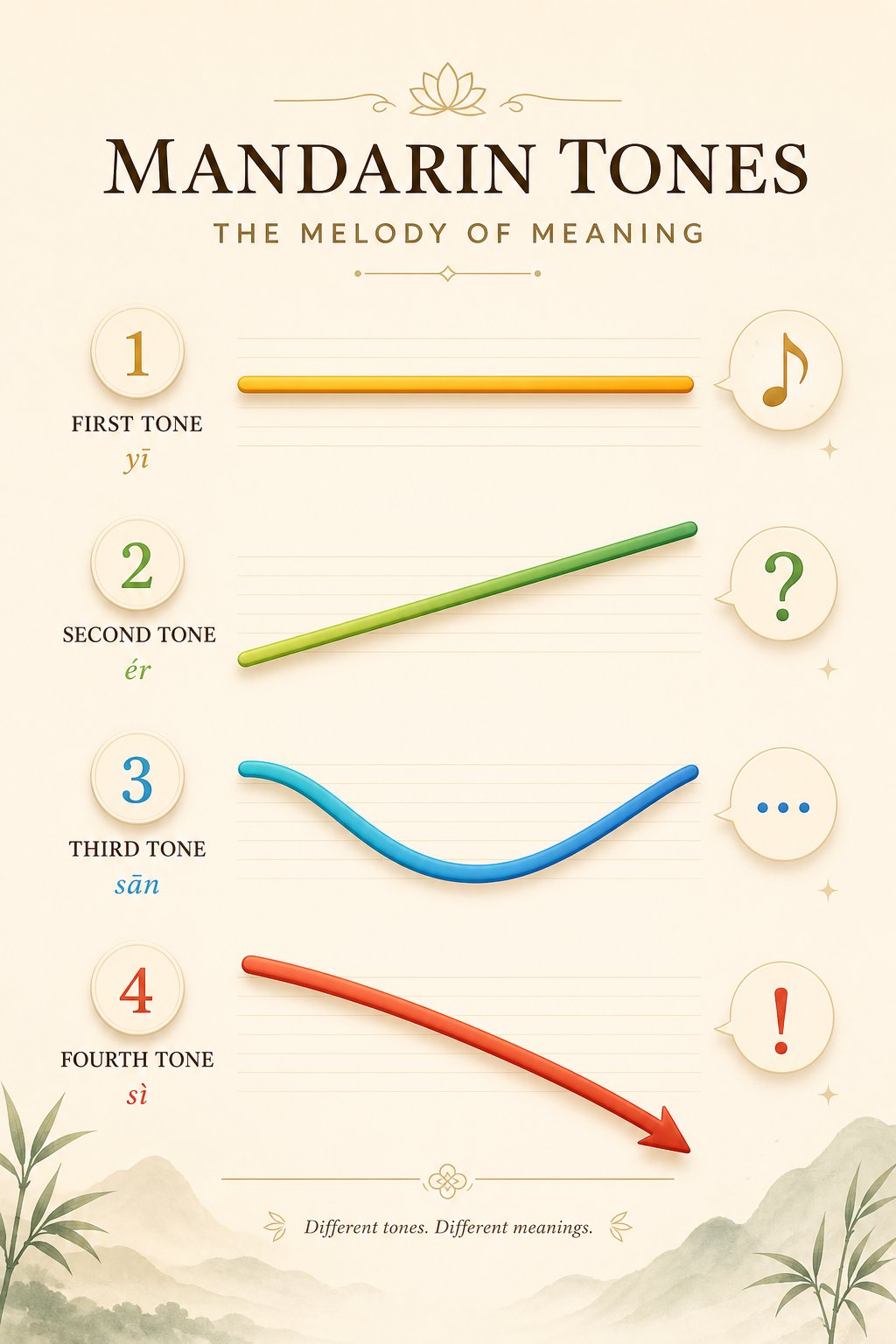
Mandarin has four main tones plus a light neutral tone. Each one follows a specific pitch direction that you can map onto something you already do in English. Here they are, from first to fourth:
- First tone (high and flat): Imagine holding a steady musical note, like singing "laaaa" at a comfortable high pitch without letting it waver up or down. Think of the sustained "Ahhhh" your doctor asks you to say during a checkup. The pitch stays level the entire time. In pinyin, it looks like this: ma with a flat line above it (mā).
- Second tone (rising): Picture the surprised pitch jump when someone tells you something shocking and you respond with "What?!" Your voice starts at a middle pitch and climbs upward. That rising motion is the second tone. In pinyin: má.
- Third tone (dipping then rising): Think of the low, drawn-out "Well..." you use when someone asks if you have a secret and the answer is yes. Your voice drops to a low grumble, sits there, then lifts slightly at the end. In everyday speech, the rise at the end is often minimal, and the tone mostly just stays low. In pinyin: mǎ.
- Fourth tone (sharp falling): Say "Stop!" or "No!" as a firm, downward command. Your voice starts high and drops sharply. That decisive falling motion is the fourth tone. In pinyin: mà.
There is also a neutral tone, which is short, light, and unstressed, similar to how English speakers breeze through the word "the" without giving it any particular pitch. It appears in grammatical particles and the second syllable of some words, but it rarely shows up in names.
Why Tones Matter for Names
Here is why this matters for mandarin name pronunciation specifically. The syllable "ma" is not one word. It is four entirely different words depending on tone:
| Pinyin | Tone | Character | Meaning |
|---|---|---|---|
| mā | 1st (high flat) | 妈 | mother |
| má | 2nd (rising) | 麻 | hemp |
| mǎ | 3rd (dipping) | 马 | horse |
| mà | 4th (falling) | 骂 | to scold |
Calling someone's mother a horse is the classic cautionary tale, and it is not an exaggeration. The same principle applies across every syllable in Mandarin. When you pronounce Mandarin names, the tone on each syllable is part of the name itself, not decoration.
Does this mean you need perfect tones to be understood? No. Native speakers use context to fill in gaps, and most will appreciate any genuine attempt. But awareness of tones changes how you listen. When someone says their name and you hear the pitch move, you now know that movement is meaningful. You will start to notice whether a syllable rises or falls, and that alone gets you closer to how to pronounce Mandarin Chinese names the way their owners actually say them.
A practical tip from this chinese language pronunciation guide: when you hear a Chinese name for the first time, pay attention to where the speaker's voice goes high, where it drops, and where it stays flat. You do not need to label each tone by number. Just mimic the pitch shape. If their voice rose on the second syllable, let yours rise too. That instinct will serve you better than memorizing tone charts in isolation.
Understanding how to pronounce Chinese words at the tonal level gives you the framework. The next piece of the puzzle is the consonant and vowel sounds themselves, because pinyin letters do not always map to the English sounds you expect.
Step 3 - Master the Pinyin Sounds That Trip Up English Speakers
Pinyin uses the same 26 letters as English, which creates a dangerous illusion of familiarity. You see a "Q" and your brain reaches for the English "kw" sound. You see an "X" and think of "ks" like in "box." Both instincts are wrong, and they lead to the most common butchering of Chinese names. The letters are familiar. The sounds behind them are not.
The good news: only about eight sounds in pinyin have no direct English equivalent. Learn those eight, and you can handle the vast majority of Chinese names you will encounter.
Mastering X, Q, and the Palatal Sounds
If you want to know how to pronounce X in Chinese, forget everything the letter "X" means in English. The Chinese X is not "ks," not "z," and not "eks." It is closer to "sh" but produced with your tongue in a completely different position. To make the sound, try saying "sh" while keeping the tip of your tongue pressed down behind your lower front teeth. The middle of your tongue rises to the roof of your mouth instead. According to AllSet Learning's pronunciation guide, one way to confirm you are making the correct sound is that you can comfortably smile while producing it, something that is difficult to do with the English "sh."
A helpful way to think about the pronunciation of X in Chinese: imagine whispering "she" very softly with a wide, flat mouth rather than rounded lips. That breathy, forward quality is what you are aiming for. The name Xiao, for instance, sounds closer to "shee-ow" than "zee-ow" or "ex-ee-ow."
The Chinese Q follows the same tongue position as X but adds a burst of air at the front, similar to how English "ch" relates to "sh." You are essentially adding a "t" to the front of the X sound. So Qian sounds like "chee-en" with that lighter, more forward tongue placement, not the hard "kee-an" that English speakers default to. Think of Q as X's punchier sibling.
The J in pinyin completes this family. Same tongue position as X and Q, but with less air. It is softer than the English "j" in "judge" and produced further forward in the mouth. Together, J, Q, and X form what linguists call the palatal series, and they share one critical rule: the tip of your tongue stays down behind your lower teeth for all three.
Retroflex Sounds Zh, Ch, and Sh
Where J, Q, and X are made with the tongue forward and flat, Zh, Ch, and Sh are their retroflex counterparts, produced with the tongue curled back. Imagine rolling the tip of your tongue upward toward the roof of your mouth, then releasing the sound from that position.
Zh sounds like the "j" in "judge" but with the tongue curled back. Ch sounds like "ch" in "church" with that same curled-back position and a strong puff of air. Sh sounds like English "sh" but thicker and heavier because of the retroflex tongue. As Hacking Chinese notes, the distinction between aspirated and non-aspirated consonants (like Zh vs. Ch) is a puff of air, not voicing. Hold your hand in front of your mouth: you should feel a burst of air on Ch but not on Zh.
The practical difference for names: Zhang uses the softer, unaspirated Zh (tongue curled back, no air puff), while Chen uses the aspirated Ch (tongue curled back, strong air puff). Getting this distinction right immediately improves how you handle two of the most common Chinese surnames.
The Tricky Ü Sound and Other Vowels
Two more consonants deserve attention. The pinyin C is not a "k" sound. It is the "ts" at the end of "cats" moved to the beginning of a syllable. The surname Cai sounds like "tsai," not "kai." Similarly, Z is a "dz" sound, like the end of "kids" placed at the start. The name Zou sounds like "dzoh," not "zoh."
Then there is the vowel Ü, which appears in names like Lü and Xu. To produce it, say "ee" as in "see," then round your lips into an "oo" shape without changing your tongue position. Your tongue says "ee" while your lips say "oo." This is why X pronounced in Chinese names like Xu does not sound like "zoo." The vowel is Ü, not U. Whenever you see a "u" after J, Q, X, or Y in pinyin, it is actually this Ü sound in disguise.
Here is a reference table pulling all these tricky sounds together with example names:
| Pinyin Sound | IPA | English Approximation | Example Name |
|---|---|---|---|
| X | [ɕ] | "sh" with tongue tip down behind lower teeth, mouth smiling | Xiao, Xu, Xi |
| Q | [tɕʰ] | "ch" with tongue tip down, lighter and more forward than English "ch" | Qian, Qin, Qi |
| J | [tɕ] | Soft "j" with tongue tip down, less air than Q | Jiang, Jin, Jia |
| Zh | [tʂ] | "j" in "judge" with tongue curled back, no air puff | Zhang, Zhao, Zhou |
| Ch | [tʂʰ] | "ch" in "church" with tongue curled back, strong air puff | Chen, Chang, Chu |
| Sh | [ʂ] | "sh" with tongue curled back, thicker than English "sh" | Shi, Shen, Shao |
| C | [tsʰ] | "ts" in "cats" at the start of a syllable, with air puff | Cai, Cui, Cao |
| Z | [ts] | "dz" in "kids" at the start of a syllable, no air puff | Zou, Zeng, Zhang |
| Ü | [y] | Say "ee" with lips rounded into an "oo" shape | Lü, Xu, Yu |
A pattern emerges from this table. The chinese X pronunciation and Q pronunciation are the two sounds people mangle most, because English has no equivalent tongue position for them. The retroflex Zh, Ch, and Sh are slightly easier since English speakers already curl their tongues for the "r" sound. And C and Z trip people up simply because the letters suggest completely different sounds in English.
You do not need to master all of these overnight. Start with X and Q, since those appear in some of the most common Chinese names. Once you can reliably pronounce X in Chinese names like Xie, Xiang, and Xu, the rest of the palatal and retroflex family falls into place through the same logic. The key insight from this pinyin cheatsheet is worth repeating: there is not a one-to-one mapping between each Latin letter and the corresponding sound in Mandarin. Treat pinyin as its own system, not as English with Chinese characteristics.
With these sounds in your toolkit, you are ready to apply them to the surnames you will encounter most often in real life.
Step 4 - Practice the Most Common Chinese Surnames
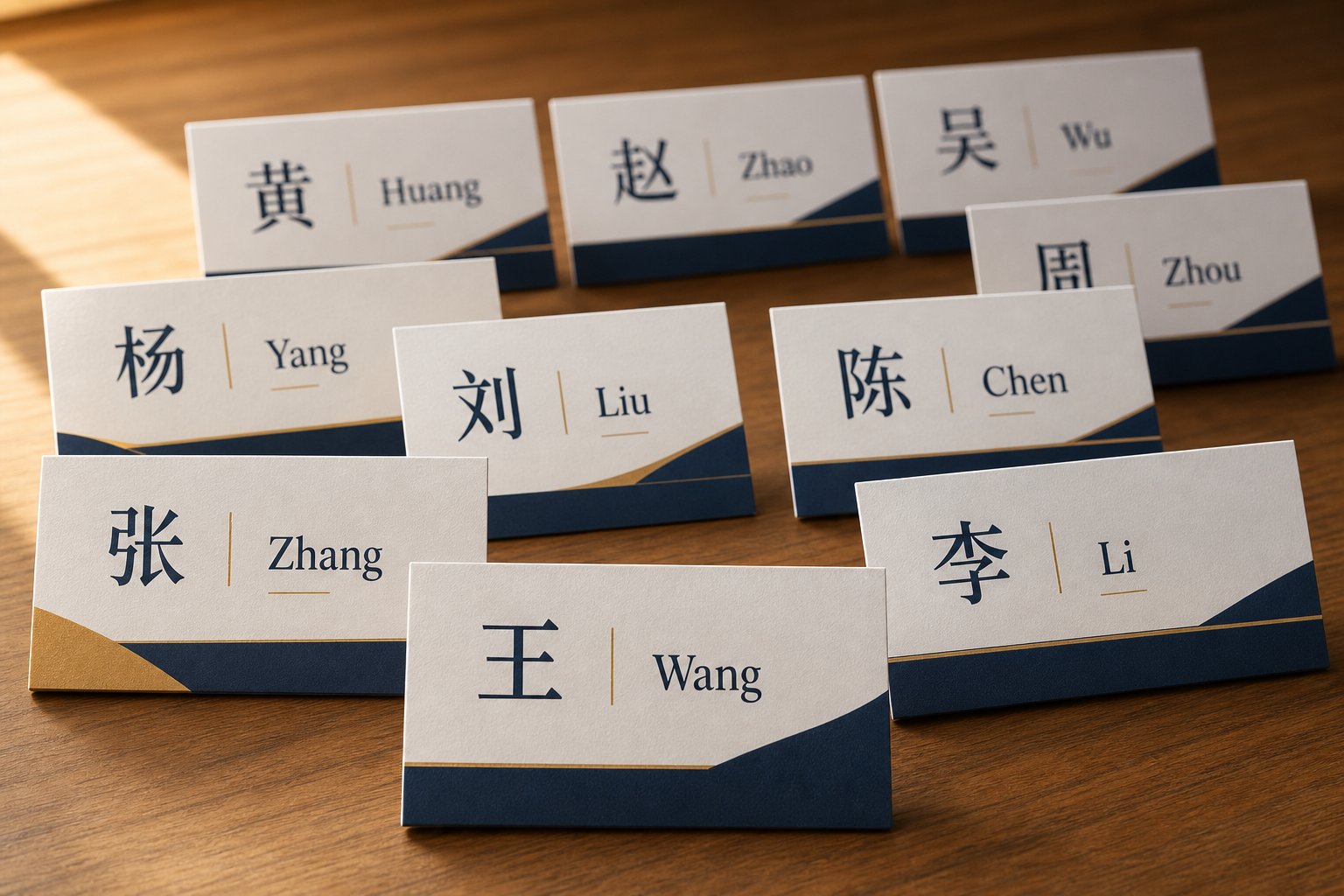
You now have the building blocks: name structure, tones, and the tricky pinyin sounds. The fastest way to put them to use? Focus on the surnames you will actually encounter. The top three Chinese family names alone (Li, Wang, and Zhang) are shared by more than 270 million people. Master the top ten, and you have practical coverage for a huge portion of the Chinese-speaking world.
The Top 10 Chinese Surnames With Phonetic Guides
Each surname below includes its pinyin with tone mark, an English-friendly approximation, and the mistake most people make. Notice how many of these use the exact sounds from the previous section: the retroflex Zh in Zhang and Zhao, the aspirated Ch in Chen, and the tricky "ang" and "ou" finals that do not behave like English spelling suggests.
| Surname (Character) | Pinyin with Tone | English Approximation | Common Mistake to Avoid |
|---|---|---|---|
| Wang (王) | Wáng | "Wahng" - rhymes with "song" but starts with W, the "a" is open like "father" | Saying "Wang" to rhyme with "bang" or "rang" |
| Li (李) | Lǐ | "Lee" - straightforward, just like the English name Lee | Pronouncing it "Lie" or "Lye" |
| Zhang (张) | Zhāng | "Jahng" - the Zh sounds like a soft "j" with tongue curled back | Saying "Zang" without the "h" quality, or rhyming with "hang" |
| Liu (刘) | Liú | "Lyoh" - like "Leo" but with the lips more rounded on the ending | Saying "Loo" or "Lee-oo" as two separate syllables |
| Chen (陈) | Chén | "Chuhn" - the vowel sits between "un" in "fun" and "en" in "open" | Saying "Chen" with a clear "e" as in "hen" |
| Yang (杨) | Yáng | "Yahng" - the "a" is open like in "father," not flat like "yang" in yin-yang | Flattening the vowel to rhyme with "hang" |
| Huang (黄) | Huáng | "Hwahng" - starts with a quick "hw" glide, open "ah" vowel, nasal ending | Saying "Hoo-ang" as two syllables or dropping the "H" |
| Zhao (赵) | Zhào | "Jaow" - retroflex Zh (soft "j") followed by the "ow" in "cow" | Saying "Zay-oh" or pronouncing it like "zero" |
| Wu (吴) | Wú | "Woo" - like the English word "woo" | Adding a hard "w" attack or saying "Wuh" |
| Zhou (周) | Zhōu | "Joe" - retroflex Zh (soft "j") plus "oh" gliding to a light "oo" | Saying "Zoo" or "Zoh" |
The chen pronunciation trips people up because the pinyin "en" does not sound like the English word "hen." It is closer to the unstressed "un" in "taken." Similarly, the "ou" in Zhou is not "oo" - it is a glide from "oh" toward "oo," making Zhou sound much closer to "Joe" than to "Zoo."
Quick Reference for Everyday Encounters
A few patterns make this list easier to remember. Wang, Yang, Zhang, and Huang all share the "-ang" ending, which uses the open "ah" vowel (like "father") followed by a nasal "ng." If you can nail that one final, you have four of the ten surnames handled. Zhao and Zhou both start with the retroflex Zh, so practicing that single initial covers two more.
You might also wonder how to pronounce Hua, since it appears in many given names and the compound surname Huangfu. The hua pronunciation follows the same pattern as Huang: a quick "hw" glide into an open "ah." To pronounce Hua correctly, think "hwah" as a single smooth syllable, not "hoo-ah." This same vowel pattern shows up in names like Huaiyu, which you can hear in faculty name lists from resources like ASU's Chinese pronunciation guide.
For historical names you might encounter in reading, the same rules apply. The zheng he pronunciation (the famous Ming dynasty explorer) uses the same retroflex Zh as Zhang and Zhao, followed by the "ung" final: "Juhng Huh." And if you see older romanizations like Tsao (the Wade-Giles spelling of Cao), recognize that the tsao pronunciation is simply the pinyin "C" sound - "ts" as in "cats" - followed by the "ao" diphthong: "tsow" rhyming with "cow."
These ten surnames, combined with the sound rules from the previous section, give you a working pronunciation toolkit for the majority of Chinese names you will encounter at work, in the news, or in daily life. The real complexity begins when you notice that not every Chinese name follows pinyin spelling conventions at all.
Step 5 - Handle Different Romanization Systems
You have learned pinyin rules, practiced the tricky sounds, and memorized the top surnames. Then you encounter a name like "Leung" or "Tse" and nothing in your pinyin toolkit applies. The spelling looks completely unfamiliar. What happened?
The answer: not every Chinese name is spelled using pinyin. Multiple romanization systems exist, each with its own rules for converting chinese name letters into Latin script. Pinyin is the standard in mainland China, but names from Hong Kong, Taiwan, older historical texts, and diaspora communities often use entirely different systems. If you only know one system, you will inevitably hit names that look unrecognizable despite representing the same characters.
Pinyin vs Wade-Giles vs Cantonese Romanization
Three systems account for most of the variation you will see. Pinyin (literally meaning "spell-sound") became the official system of the People's Republic of China in the late 1950s and is the international standard today. Wade-Giles, developed in the 19th century by British diplomat Sir Thomas Francis Wade and later refined by Cambridge professor Herbert Allen Giles, was the dominant system before pinyin took over. You still encounter it in older academic texts, library catalogs, and many Taiwanese names. Cantonese romanization covers names from Hong Kong and Guangdong province, where Cantonese rather than Mandarin is the primary spoken language.
The same Chinese character can look dramatically different depending on which system rendered it. The character 王 is "Wang" in pinyin, "Wang" in Wade-Giles (a rare overlap), but "Wong" in Cantonese. The character 张 is "Zhang" in pinyin, "Chang" in Wade-Giles, and "Cheung" in Cantonese. If you are wondering how do you spell Chinese names consistently, the short answer is: you cannot, because the spelling depends on which system the person or their family adopted.
Here is a comparison showing how the same names appear across systems:
| Character | Pinyin (Mainland China) | Wade-Giles (Taiwan/Older Texts) | Cantonese (Hong Kong) |
|---|---|---|---|
| 张 (Zhang) | Zhāng | Chang | Cheung / Cheong |
| 陈 (Chen) | Chén | Ch'en | Chan |
| 刘 (Liu) | Liú | Liu | Lau / Low |
| 王 (Wang) | Wáng | Wang | Wong |
| 李 (Li) | Lǐ | Li | Lee / Lei |
Notice how "Chan" from Hong Kong and "Chen" from mainland China are the same surname written in the same chinese letters for names (陈) but romanized through different systems. A person named "Cheung" and a person named "Zhang" share the exact same family name in chinese name in chinese letters (张). The spelling difference reflects geography and language variety, not a different name.
How to Identify Which System a Name Uses
Spelling patterns give reliable clues. Wade-Giles uses apostrophes to mark aspirated sounds (like Ch'en instead of Chen), hyphens between given-name syllables (Tse-tung instead of Zedong), and combinations like "hs" where pinyin uses "x." If you see apostrophes or "hs" in a name, you are likely looking at Wade-Giles. As the Yale Library romanization guide notes, well-established names like Chiang Ching-kuo and Lee Teng-hui remain in Wade-Giles even in modern library systems.
Cantonese romanization tends to produce endings that look unusual to pinyin-trained eyes: "-eung," "-ong," "-uk," and "-ng" as a standalone syllable. Names like Leung, Ng, Tsang, and Kwok are distinctly Cantonese. The famous beer brand "Tsing Tao" is another legacy spelling. In pinyin, those same characters read "Qingdao," but the older Chinese Postal Romanization based on French spelling conventions gave us the version that stuck as a brand name.
So how to spell in Chinese when multiple systems exist? The practical rule is simple: spell a person's name the way they spell it themselves. If someone's business card says "Cheung," do not "correct" it to "Zhang." Their spelling reflects their regional identity and personal choice. If you are curious about how do you write your name in chinese characters, the answer depends on which romanization system matches your dialect and background.
When you encounter an unfamiliar spelling, ask yourself three questions: Does it have apostrophes or hyphens? Probably Wade-Giles. Does it have endings like "-eung" or "-ong" that pinyin never produces? Likely Cantonese. Does it use "x," "q," or "zh"? Definitely pinyin. This quick mental filter helps you identify the system and adjust your pronunciation expectations accordingly.
Recognizing the system is half the battle. The other half is knowing what the name actually sounds like when spoken aloud, especially for names that have become so widely mispronounced that the wrong version feels normal.

Step 6 - Fix the Most Common Mispronunciations
You know the rules. You understand the sounds. But when a specific name lands in front of you on a meeting invite or a news headline, theory can feel abstract. This section is your quick-fix reference: the names English speakers get wrong most often, grouped by the type of error, with clear corrections you can use immediately.
Names Most People Get Wrong
Some Chinese names have become so widely mispronounced in English-speaking media that the wrong version feels "normal." If you have ever wondered how do you pronounce Xi Jinping, you are not alone. The name appears in news broadcasts daily, and yet many anchors still default to "Zee Jinping" or "Ksee Jinping." Neither is close. The correct approximation is "Shee Jeen-ping" because the pinyin X produces a "sh"-like sound with the tongue tip pressed behind the lower teeth.
The same X confusion applies across dozens of names. To xiao pronounce correctly, think "shee-ow" as a smooth two-part glide, not "ex-ee-ow" broken into three chunks. When you see Xia, the answer to how do you pronounce X-I-A is simply "shah" - one clean syllable, not three separate letters sounded out.
For historical figures, the pattern holds. To pronounce Mao Zedong correctly, remember that Zh sounds like a soft "j" with the tongue curled back: "Mow Zuh-dong" (where "Mow" rhymes with "cow" and "Zuh" uses that short unstressed vowel before "dong"). Similarly, to deng xiaoping pronounce accurately, apply the X rule: "Dung Shao-ping" ("Dung" with a short vowel like "young," "Shao" rhyming with "cow" but starting with "sh").
The yi xi pronunciation pattern also trips people up. "Yi" is simply "ee" and "Xi" is "shee." Two syllables, both straightforward once you know the X rule, but often mangled into "yee ksee" or "yih zai" by speakers guessing from the spelling.
Common Error Patterns and How to Fix Them
Rather than memorizing corrections one name at a time, you will get more mileage from recognizing the error patterns. Most mispronunciations fall into three categories: wrong initial consonant, wrong vowel sound, or invented extra syllables.
Wrong initial consonant: This is the most frequent mistake. English speakers map pinyin letters onto English sounds, and the result is often unrecognizable to a Chinese listener.
- Zhang: Not "Zang." The Zh matters. Say "Jahng" with a soft j and tongue curled back, not a buzzy English Z.
- Qian: Not "Kee-an." The Q is a "ch" sound. Say "Chee-en" with the tongue tip down behind lower teeth.
- Xiao: Not "Ex-ee-ow." The X is "sh." Say "Shee-ow" as one flowing motion.
- Xi Jinping: Not "Zee Jin-ping" or "Ksee Jin-ping." Say "Shee Jeen-ping." Xi jinping how to pronounce is one of the most searched questions about Chinese names, and the answer is always the same: X equals "sh."
- Cao: Not "Cow-oh" or "Kay-oh." The C is "ts." Say "Tsow" (rhymes with "cow").
- Zhu: Not "Zoo." The Zh is a retroflex "j." Say "Joo" with the tongue curled back.
Wrong vowel sound: Even when the consonant is correct, the vowel can derail the whole name.
- Xu: Not "Zoo" or "Ksoo." The vowel is ü, not u. Say "Shü" - tongue says "ee," lips round into "oo." The result sounds closer to "shwee" with rounded lips than anything resembling "zoo."
- Liu: Not "Lee-oo" as two separate syllables. The "iu" is a smooth glide: "Lyoh" in one beat, similar to "Leo" with rounder lips.
- Cui: Not "Kwee." The C is "ts" and the "ui" sounds like "way." Say "Tsway."
- Zhi: Not "Zee." The "i" after Zh sounds like "ur." Say "Jur" with the tongue curled back.
Invented extra syllables: English speakers sometimes break a single Chinese syllable into multiple beats because the spelling looks long.
- Xiang: Not "Zee-ang" or "Ex-ee-ang." It is one syllable: "Shee-ahng" spoken as a single flowing unit.
- Qiu: Not "Kwee-oo." One syllable: "Chee-oh" gliding smoothly.
- Zhuang: Not "Zoo-ang." One syllable: "Jwahng" with the tongue curled back on the initial.
- Deng: Not "Deh-eng." One syllable: "Dung" (short vowel, like "young" without the "y").
A useful rule of thumb: each Chinese character is exactly one syllable. If a name has two characters, it has two syllables. If you find yourself producing three or four syllables for a two-character name, you are adding sounds that do not exist. Pull back and simplify.
These corrections cover the errors you will encounter most often in professional and media contexts. But knowing the right sound is only part of the challenge. The real test comes when you are face-to-face with someone and need to say their name aloud, ask for clarification, or recover gracefully from a mistake you have already made.
Step 7 - Navigate Real-World Social and Professional Situations
Knowing the correct sounds is one thing. Using them confidently in a live conversation, where you might stumble, forget, or freeze, is another challenge entirely. The gap between theory and practice closes fastest when you have specific strategies for the situations that actually make you nervous: meeting someone new, preparing for a presentation, or recovering after you have already gotten it wrong.
How to Ask Someone to Say Their Name Again
The simplest approach is often the one people skip. If you are unsure how do you say this name, ask directly. Most people with Chinese names are accustomed to the question and will appreciate that you care enough to get it right rather than guessing badly. The key is framing your request around your own desire to be respectful, not around their name being "difficult" or "unusual."
"I want to make sure I say your name correctly. Would you mind saying it for me one more time?"
That single sentence works in nearly every professional context. It signals effort without drawing excessive attention to the moment. As The Muse points out, the longer you wait to clarify, the more uncomfortable the situation becomes. Asking early, during a first or second interaction, feels natural. Asking after six months of avoidance feels awkward for everyone.
A few more phrases you can use verbatim depending on the situation:
"Could you help me with the pronunciation of your name? I want to get it right."
"I didn't quite catch your name earlier. Would you say it once more so I can remember it properly?"
After they say it, repeat it back immediately. This confirms you heard correctly and gives them a chance to gently adjust your attempt. If you mispronounce it on the repeat, do not spiral into apologies. A brief "Got it, thank you" after their correction is enough. Over-apologizing, as Brown Girl Magazine notes, shifts the emotional labor onto the person whose name was mispronounced, forcing them to reassure you rather than simply moving on.
Preparing Before a Meeting or Presentation
When you see a Chinese name on a conference agenda or meeting invite, you have a window to prepare. Use it. Wondering how to pronounce a Chinese name before you are put on the spot is far less stressful than guessing in real time.
Start by searching the name on a pronunciation site like HowToPronounce.com or Pronounce Names, which offer audio recordings and phonetic spellings. If the person has given a talk, conference panel, or podcast interview, search their name on YouTube to hear how they introduce themselves. Many professionals also include phonetic guides in their email signatures or LinkedIn profiles.
If none of those options work, reach out to a mutual connection and ask. A quick message like "I'm presenting with Xu Yifan tomorrow and want to say their name correctly. Can you help me with the pronunciation?" takes thirty seconds and prevents a public stumble. You can also direct-message the person themselves before the meeting. Most people find this thoughtful rather than intrusive.
Once you have the pronunciation, say it out loud five or six times. Muscle memory matters. Reading a phonetic guide silently is not the same as physically producing the sounds. Practice until the name feels natural in your mouth, not like you are performing it.
Family Name or Given Name in Professional Settings
Knowing how to say Chinese names correctly also means knowing which part of the name to use. In Chinese business culture, the default is to address someone by their family name plus a title or honorific. According to eChineseLearning's business etiquette guide, common forms include the surname plus "xiansheng" (Mr.) or "nushi" (Ms.), or the surname plus their professional title, like "Wang Jingli" (Manager Wang).
In Western professional settings, the rules shift. Many Chinese colleagues will tell you their preferred name during introductions. Some use their given name in English-speaking workplaces. Others adopt a Western first name entirely. If someone introduces themselves as "David Chen," use David. If they introduce themselves as "Chen Wei," ask what they prefer to be called day-to-day.
When introducing someone at an event, mirror whatever form they used when they introduced themselves to you. If you are reading a name from a list and are unsure whether to use the family name or given name, default to the full name. Saying "I'd like to introduce Chen Wei" is always safe. Shortening it to just "Wei" without permission can feel overly familiar, while using only "Chen" without a title can sound abrupt in some contexts.
One important note: if you are curious about what is your name in Mandarin Chinese or how to say my name is in Chinese, the phrase is "Wo jiao..." followed by your name. Offering your own name clearly and slowly sets a reciprocal tone. When both people make an effort, the exchange feels balanced rather than one-sided.
The underlying principle across all these scenarios is straightforward: treat someone's name as important enough to get right, ask when you are unsure, correct quickly when you slip, and follow the person's own lead on how they want to be addressed. These habits matter more than perfect tones or flawless retroflex consonants. They signal that you see the person, not just the unfamiliar syllables.

Step 8 - Build Lasting Pronunciation Skills With Practice Tools
Asking, listening, and repeating in the moment gets you through a single interaction. Building real confidence means practicing between those moments so the sounds feel familiar before you need them. The right tools turn occasional effort into steady progress, and most of them cost nothing.
Audio Tools for Hearing Correct Pronunciations
Hearing a name spoken by a real person beats any written approximation. YouGlish is one of the most useful free resources for chinese name pronunciation audio. Type any name or syllable into the search bar and it pulls timestamped clips from YouTube where native speakers say that exact word in context. You can skip between dozens of clips rapidly, hearing different voices, speeds, and regional accents for the same name. As Hacking Chinese notes, this variety is critical because real-world Mandarin does not sound like a single textbook recording.
For quick lookups, Pleco (available on iOS and Android) offers native-speaker audio for nearly every syllable and word in Mandarin. Unlike synthesized text-to-speech, Pleco's premium audio pack uses individually recorded human pronunciations, making it a reliable chinese name pronunciation tool when you need to hear a specific surname or given name before a meeting.
Google Translate and Apple's built-in text-to-speech can also handle chinese words pronunciation reasonably well for common names. Type the pinyin or characters, tap the speaker icon, and listen. The quality is not perfect for tones, but it gives you a starting point when other resources are not available. For deeper practice with chinese language pronunciation audio, pinyin charts with full tone audio from AllSet Learning let you hear every possible syllable in all four tones, which is useful for isolating the exact sound in a name you are working on.
A Progressive Practice Routine for Building Confidence
Trying to master every tricky sound at once leads to frustration. A better approach: start with names that use sounds close to English, then gradually add the harder pinyin initials. Week one, practice names like Li, Wang, and Ming where the sounds map fairly well onto English. Week two, add retroflex initials like Zhang, Zhou, and Chen. Week three, tackle the palatal sounds in Xu, Qian, and Xiao.
Here is a five-step daily routine you can follow in under five minutes to pronounce chinese names audio-style, using your ears as much as your mouth:
- Pick one name. Choose a name you expect to encounter soon, whether from a colleague, a news figure, or a conference attendee list.
- Listen three times. Find the name on YouGlish or a pinyin chart and play it three times without speaking. Focus on the pitch shape and the initial consonant.
- Repeat aloud five times. Mimic what you heard, matching the tone contour and mouth position. Record yourself on the last attempt.
- Compare your recording. Play the native audio and your recording back to back. Notice where your pitch or consonant diverges and adjust on the next repetition.
- Use it in a sentence. Say something simple like "I'm meeting with [name] today" to practice the name in natural speech rhythm rather than isolation.
This routine works because it mirrors how pronunciation actually improves: through repeated listening, targeted mimicry, and self-correction. Five minutes a day compounds quickly. After a few weeks of consistent practice with chinese pronunciation audio resources, you will notice that names which once felt impossible now roll off your tongue without hesitation. The sounds stop being foreign and start being familiar, which is exactly the point.
Frequently Asked Questions About Pronouncing Chinese Names
1. Why do Chinese names have the family name first?
Chinese naming conventions place the family name before the given name to reflect a cultural priority of lineage and group identity over individuality. This system has been consistent for over two thousand years. In Western contexts, some Chinese individuals reverse the order to match local conventions, while others keep the traditional order. If you are unsure which part is the surname, a useful clue is that Chinese family names are almost always one syllable, while given names are one or two syllables.
2. How do you pronounce the X in Chinese names like Xi or Xiao?
The pinyin X does not correspond to any English X sound. It is produced similarly to 'sh' but with the tip of your tongue pressed down behind your lower front teeth while the middle of your tongue rises toward the roof of your mouth. A practical test: you should be able to smile while making the sound, which is difficult with a standard English 'sh.' So Xi sounds like 'shee' and Xiao sounds like 'shee-ow' spoken as one smooth glide.
3. What is the difference between Pinyin, Wade-Giles, and Cantonese romanization?
These are three different systems for writing Chinese sounds using Latin letters. Pinyin is the modern standard used in mainland China and internationally. Wade-Giles is an older British system still common in Taiwan and historical texts, recognizable by apostrophes and hyphens. Cantonese romanization is used for names from Hong Kong and Guangdong, producing distinctive endings like '-eung' and '-ong.' The same Chinese character can look very different across systems. For example, the surname 张 appears as Zhang in Pinyin, Chang in Wade-Giles, and Cheung in Cantonese.
4. How should I ask someone to repeat their Chinese name without being rude?
Frame your request around your desire to be respectful rather than implying their name is difficult. A simple phrase like 'I want to make sure I say your name correctly - would you mind saying it for me one more time?' works in nearly every professional context. Ask early in the relationship rather than waiting months. After they say it, repeat it back immediately for confirmation. If you get it wrong, correct yourself briefly without over-apologizing, which can shift emotional labor onto the other person.
5. Do I need to get the tones perfect when saying a Chinese name?
Perfect tones are not expected from non-Mandarin speakers, and native listeners use context to fill in gaps. However, tone awareness significantly improves your pronunciation. Rather than memorizing tone numbers, focus on mimicking the pitch shape you hear when someone says their name. If their voice rises on a syllable, let yours rise too. If it drops sharply, mirror that drop. This instinctive approach gets you closer to accurate pronunciation than ignoring tones entirely, and it signals genuine effort to the person whose name you are saying.