The Li Surname and Its Remarkable Place in World History
Imagine sharing your last name with over 100 million people across Asia alone. That's the reality for bearers of the Li surname, a name so deeply woven into history that it has outlasted empires, crossed oceans, and taken on dozens of spellings along the way.
Why Li Is One of the Most Widespread Surnames on Earth
Is Li a Chinese last name? Yes, but that answer barely scratches the surface. The Li last name, written as 李 in Chinese, ranks as the second most common surname in China, carried by roughly 93 million people in the country and over 100 million across the continent. To put that in perspective, that's nearly a third of the entire United States population sharing a single family name.
Li (李) is shared by more than 100 million people in Asia, making it one of the most widespread surnames on the planet and a living record of Chinese civilization itself.
The li surname origin isn't a single, tidy story. It branches into at least nine distinct roots, spanning legendary emperors, political upheaval, ethnic adoption, and centuries of migration. Some Li families trace their lineage to an ancient judicial title. Others owe their name to a desperate mother and child surviving on wild plums. Still others received it as a gift from Tang Dynasty emperors who wielded the name like political currency.
What This Surname Tells Us About Chinese History
Tracing the li surname is really tracing Chinese history in miniature. You'll encounter mythical rulers, Daoist philosophers, imperial conquest, and a global diaspora that scattered one character into spellings like Lee, Ly, Lim, and Rhee. Each variant carries its own story, its own cultural weight.
What follows is that full journey, from the ancient radicals inside the character itself to the clan branches and migration routes that might connect directly to your own family tree.
The Character 李 and Its Plum Tree Meaning
Every Chinese character tells a story, and the li chinese character is no exception. When you look at 李, you're not seeing an arbitrary symbol. You're looking at a tiny picture built from two meaningful parts, each contributing a layer of significance that stretches back thousands of years.
Breaking Down the 李 Character Radical by Radical
The character 李 is what linguists call a phono-semantic compound. It's constructed from two component radicals stacked vertically. On top sits 木 (mù), meaning "tree" or "wood." Below it rests 子 (zǐ), meaning "child" or "seed." Together, these radicals paint a vivid image: a tree that bears fruit, specifically the plum tree.
So what does li mean at its most literal level? It means "plum." The li in chinese character form captures the essence of a fruit-bearing tree, a living thing that produces offspring season after season. This isn't accidental. Ancient Chinese surnames frequently drew from the natural world, tying family identity to plants, animals, geographic features, or occupations. The li name meaning connects an entire lineage to one of the most revered trees in East Asian culture.
You'll notice this structure mirrors how many Chinese characters work. The 木 radical signals the word belongs to the category of trees or wood, while 子 provides a phonetic hint and adds the concept of reproduction or continuation. For a surname, that layered meaning feels almost poetic: a family tree, literally encoded in the writing system itself.
The Plum Tree in Chinese Cultural Symbolism
The li meaning chinese families carry isn't just botanical. The plum tree (李树) holds a deeply honored place in Chinese art, poetry, and philosophy. It blooms in late winter, pushing delicate white and pink flowers through frost and snow while other trees remain bare. That image alone made it a powerful cultural metaphor for centuries.
Here are the key symbolic associations the plum tree carries in Chinese tradition:
- Resilience in winter — The plum blossoms when conditions are harshest, symbolizing strength and perseverance through adversity.
- Purity — Its clean, simple flowers represent moral integrity and an unblemished character.
- Longevity — Plum trees can live for centuries, making them emblems of endurance across generations.
- Scholarly integrity — Literati painters and poets adopted the plum blossom as a symbol of the virtuous scholar who thrives despite hardship.
The plum tree is also one of the "Four Gentlemen" (四君子) in Chinese painting, alongside the orchid, bamboo, and chrysanthemum. Each represents a season and a set of virtues. The li plum stands for winter and the quiet courage it takes to bloom when everything else has gone dormant.
For families bearing this surname, the character 李 carries all of that weight. Li means more than a label passed down through generations. It encodes a cultural ideal: endurance, renewal, and the quiet dignity of flourishing against the odds. That symbolic richness helps explain why the name resonated so deeply across Chinese civilization, long before imperial politics turned it into the most powerful surname in the Tang Dynasty.
The Legendary Origins of the Li Family Name
A character meaning "plum" seems like a gentle, poetic choice for a surname. But the li name origin story is anything but gentle. It begins with power, moves through persecution, and ends with a desperate act of survival that permanently changed a family's identity.
From Imperial Judge to Fugitive — The Legendary Origin
The story reaches back to the mythical Emperor Zhuanxu, grandson of the Yellow Emperor himself. According to tradition, Zhuanxu's descendant Gaoyao served as a high-ranking judicial official, holding the title of Dali (大理), or Minister of Justice. His role was to uphold law and reason across the realm. Over generations, Gaoyao's descendants adopted the character 理 (lǐ, meaning "reason" or "to judge") as their surname, drawn directly from the title Li Guan (理官), the official post responsible for legislation and legal order in ancient China.
For centuries, the 理 surname carried prestige. It signaled a lineage rooted in governance and moral authority. The family traced its deeper ancestry to the royal house of Ying (赢), one of the oldest noble clans in Chinese civilization. So the li last name origin didn't start with plums at all. It started with judges.
That changed violently during the late Shang dynasty, around 1046 BC. A minister named Li Zheng (理徵) served under King Zhou of Shang, a ruler remembered in Chinese history for extraordinary cruelty and excess. Li Zheng spoke out against the king's tyranny. The cost of that defiance was his life.
How Plums Saved a Family and Created a Surname
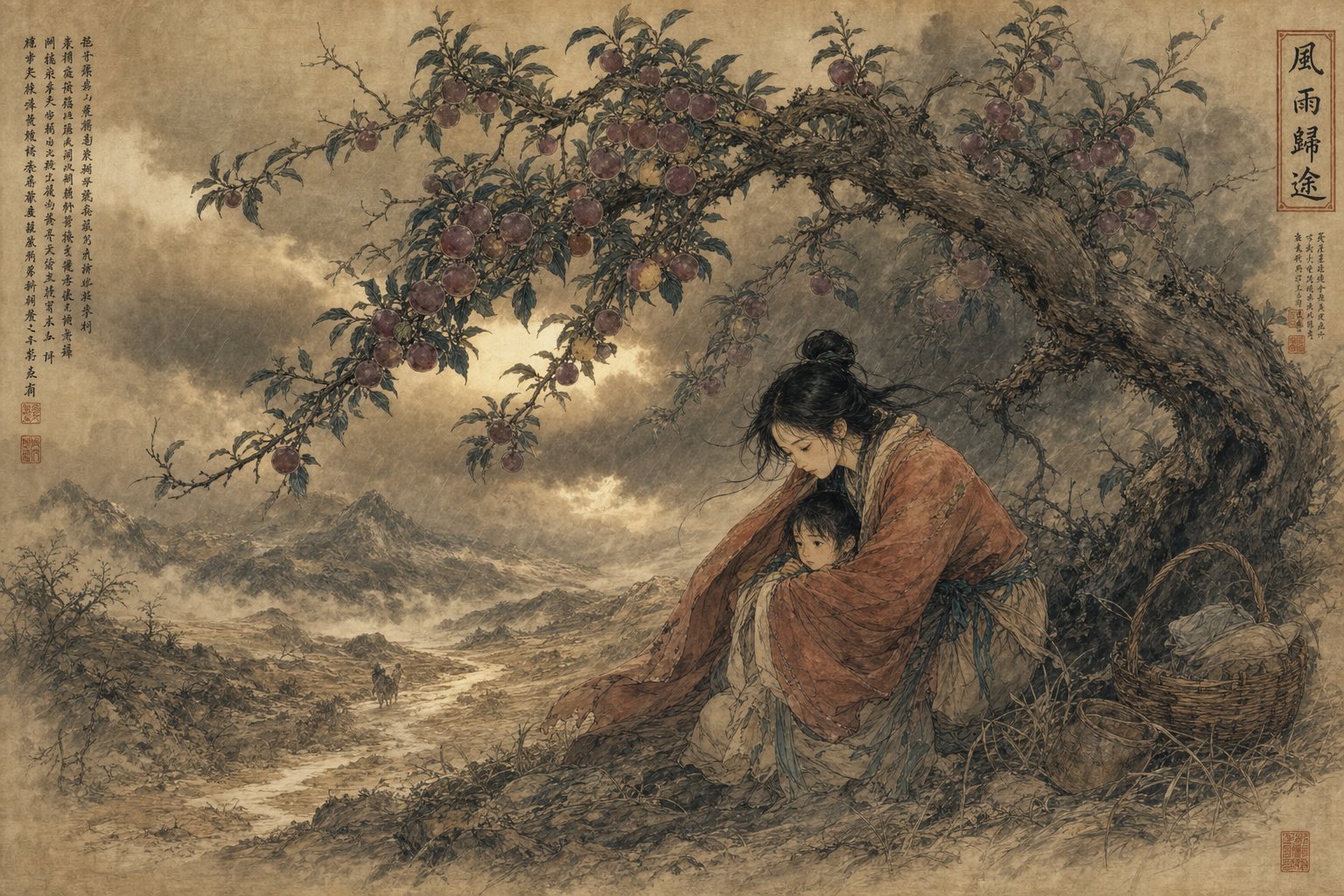
With Li Zheng executed, his wife Qiheshi and young son Li Lizhen (理利贞) fled westward into the wilderness of what is now Henan province. They were fugitives, cut off from the family's wealth and status, with nothing but open terrain between them and starvation.
What saved them? Wild plum trees. According to the traditional account, mother and son survived by eating the fruit of plum trees they found growing in the wasteland. When Li Lizhen eventually returned to civilization and rebuilt his life, he made a decision that would echo across millennia. In gratitude for the tree that kept his family alive, he changed the surname from 理 to 李, the character meaning "plum," which shared the same pronunciation.
That single act of renaming is considered the founding moment of the surname Li as we know it. The last name li origin, then, is a story of transformation: from a title of judicial power to a symbol of survival and renewal. The 理 lineage didn't disappear. It simply became 李, carrying forward both its ancient roots and a new layer of meaning.
By the time the Zhou dynasty replaced the Shang around 1046 BC, the Li family had already established itself across multiple generations. The surname Li predates the Zhou dynasty's founding, giving it an antiquity of over three thousand years. Li Er (李耳), better known as Laozi, the legendary founder of Daoism, is traditionally considered a descendant of Li Lizhen, placing the li name squarely at the intersection of philosophy, politics, and myth.
This deep antiquity matters. The surname li didn't emerge from a single moment in a single place. It accumulated meaning across the Shang and Zhou periods, absorbing layers of identity: judicial authority, survival against persecution, and eventually philosophical prestige. By the time imperial dynasties began wielding the name as a political tool, it already carried centuries of weight behind it.

How the Tang Dynasty Made Li the Dominant Surname
Centuries of accumulated prestige set the stage, but it took an empire to turn the Li family name into a demographic force. The Tang Dynasty (618-907 CE) didn't just carry the Li surname to the throne. It weaponized it, transforming a family name into a tool of statecraft that would permanently reshape the surname landscape of Li China and beyond.
The Tang Dynasty Imperial Family and the Power of a Name
In 618 CE, Li Yuan seized power from the crumbling Sui dynasty and declared himself Emperor Gaozu, founding what would become one of the most celebrated dynasties in Chinese history. His son Li Shimin, who later took the throne as Emperor Taizong, expanded the empire into a golden age of art, trade, and military dominance. The house of Li now sat at the center of the known world.
But the Tang emperors understood something subtle about power. Military conquest holds territory. Cultural legitimacy holds minds. To cement their authority, the Li dynasty rulers reached back through history and claimed direct descent from Laozi (Li Er, also called Li Dan), the legendary founder of Daoism. Whether this genealogical connection was genuine or constructed, it served a brilliant political purpose. It tied the ruling Li family to the most revered philosophical tradition in China, elevating their surname from merely noble to almost sacred.
Imagine the effect. The imperial family didn't just rule. They positioned themselves as spiritual heirs to the author of the Dao De Jing. Daoism was elevated to a state religion during the Tang period, and the Li surname absorbed all of that philosophical prestige. The li family wasn't just powerful. It was cosmically ordained.
Bestowed Surnames as Political Currency in Imperial China
Here's where the numbers exploded. The Tang emperors developed a practice called ci xing (赐姓), or "bestowed surnames," and they used it aggressively. When a general won a critical battle, he might receive the imperial Li surname as the highest possible honor. When a tribal leader on the frontier pledged allegiance, the emperor could grant him and his entire clan the Li name, folding them into the imperial family in a single stroke.
This wasn't a rare ceremony. Over the dynasty's nearly three centuries of rule, all twenty Tang emperors shared the surname Li, and they bestowed it liberally upon generals, officials, and allied clans as a sign of favor. The recipients weren't limited to Han Chinese. Turkic commanders, Xianbei nobles, and leaders from various Central Asian groups all received the Li surname, making the li family a multi-ethnic institution almost overnight.
The Tang Dynasty turned a family name into a national identity marker. Through bestowed surnames, the Li name ceased to represent a single bloodline and became a political network spanning ethnicities, regions, and social classes across the empire.
Think about what this meant in practice. A Turkic cavalry general on the northwestern frontier and a Han scholar-official in Chang'an could now share the same surname, not through ancestry but through imperial decree. The li dynasty created a system where loyalty was rewarded with identity itself. Your name became proof of your place in the imperial order.
The scale of this practice was staggering. Entire clans, sometimes numbering in the thousands, adopted the Li surname in a single generation. Soldiers, administrators, merchants, and their descendants all carried the name forward. By the time the Tang Dynasty fell in 907 CE, the number of Li surname bearers had multiplied far beyond what natural population growth could explain. The house of Li had seeded its name across every corner of the empire and into neighboring kingdoms.
This is why the li surname origin can't be reduced to a single ancestor or a single story. The Tang Dynasty fractured the name's meaning. For some bearers, Li traces back to the ancient judge Gaoyao and the plum tree survival story. For others, it traces to a moment of imperial favor on a battlefield or in a court ceremony. The surname became a mosaic, hundreds of separate lineages unified under one character but carrying entirely different histories beneath it.
That mosaic only grew more complex as the centuries passed. The same romanization "Li" would eventually represent not just different lineages within the 李 character, but entirely different Chinese characters with separate etymologies, separate meanings, and no shared ancestry at all.
Multiple Surnames Behind the Single Romanization Li
Here's something that catches most people off guard: when you see the last name Li written in English, you have no way of knowing which Chinese surname it actually represents. The Latin alphabet flattens what are, in reality, completely separate characters with different tones, different meanings, and entirely unrelated family histories. The li chinese surname isn't one name. It's at least five.
李 黎 厉 利 栗 — Five Surnames, One Romanization
Each li character chinese speakers recognize carries its own tone, its own radical structure, and its own origin story. Two families both bearing the chinese last name li in English might share zero ancestry. Their surnames simply collided in romanization, a quirk of transliteration rather than genealogy.
Here's how the major variants break down:
| Character | Pinyin Tone | Literal Meaning | Origin Region | Approximate Bearers in China |
|---|---|---|---|---|
| 李 | Lǐ (3rd tone) | Plum / plum tree | Henan (Luyi County) | ~93 million |
| 黎 | Lí (2nd tone) | Many / dark | Southern China, Guangdong | ~2 million (84th most common) |
| 厉 (厲) | Lì (4th tone) | Stern / severe | Northern China | Less common |
| 利 | Lì (4th tone) | Sharp / profit | Various regions | ~500,000 (299th most common) |
| 栗 | Lì (4th tone) | Chestnut | Northern China | ~400,000 (249th most common) |
Notice the tonal differences. In spoken Mandarin, these surnames sound distinct. Lǐ (falling-rising tone) and Lí (rising tone) and Lì (falling tone) are as different to a Chinese speaker as "Bill" and "Bell" are to an English speaker. The romanization erases that distinction entirely, which is why the chinese surname li question always requires a follow-up: which character?
The 黎 surname, for instance, has its own deep history. It connects to the ancient Lí people and carries no relationship whatsoever to the plum-tree 李 lineage. In Vietnamese, 黎 becomes Lê rather than Lý, preserving a distinction that English spelling collapses.
The Tuoba Clan and Non-Han Adoption of the Li Name
The story of chinese li gets even more layered when you factor in ethnic adoption. The 李 character didn't stay confined to Han Chinese families. Multiple non-Han peoples absorbed it across centuries of political convergence.
The most significant example involves the Tuoba clan (拓跋氏) of the Xianbei (鲜卑) people. The Tuoba founded the Northern Wei dynasty (386-534 CE) and ruled northern China for over a century. As they gradually adopted Chinese customs, Emperor Xiaowen decreed sweeping sinicization reforms in 496 CE, changing the imperial surname from Tuoba to Yuan (元). But the story didn't end there. Tuoba descendants and related Xianbei families continued to hold power through the Sui and Tang periods, and many eventually adopted or received the Li surname during the Tang dynasty's generous bestowal campaigns.
The Tangut people offer another striking case. A branch of the Tangut Tuoba living in northwestern China were granted the Tang imperial surname Li during the Tang period. These same families later founded the Western Xia dynasty (1038-1227), ruling a powerful kingdom under what was originally someone else's family name.
Beyond these major groups, the chinese last name li was adopted by at least 33 of China's 55 officially recognized ethnic minorities over the centuries. The Bai people have used it for over a thousand years. The Yao adopted it more than 800 years ago. The Miao have carried it for roughly 500 years. Khitan leaders, Turkic generals, Mohe chieftains, and even some Persian and Jewish communities in Tang-era China all took the Li surname through imperial grants or voluntary adoption.
What emerges from this history is a fundamental insight: the li chinese surname is not a marker of shared blood. It's a marker of shared political and cultural space. Families bearing the same character 李 might trace their roots to an ancient Han judicial lineage, a Xianbei steppe confederation, a Tangut mountain kingdom, or a Turkic cavalry regiment. The single romanization "Li" conceals not just multiple characters but multiple civilizations converging under one name.
That convergence didn't stop at China's borders. As the surname radiated outward into Korea, Vietnam, and Southeast Asia, each destination added its own pronunciation, its own spelling, and its own independent history to the name.
Korean Lee, Vietnamese Lý, and East Asian Variants
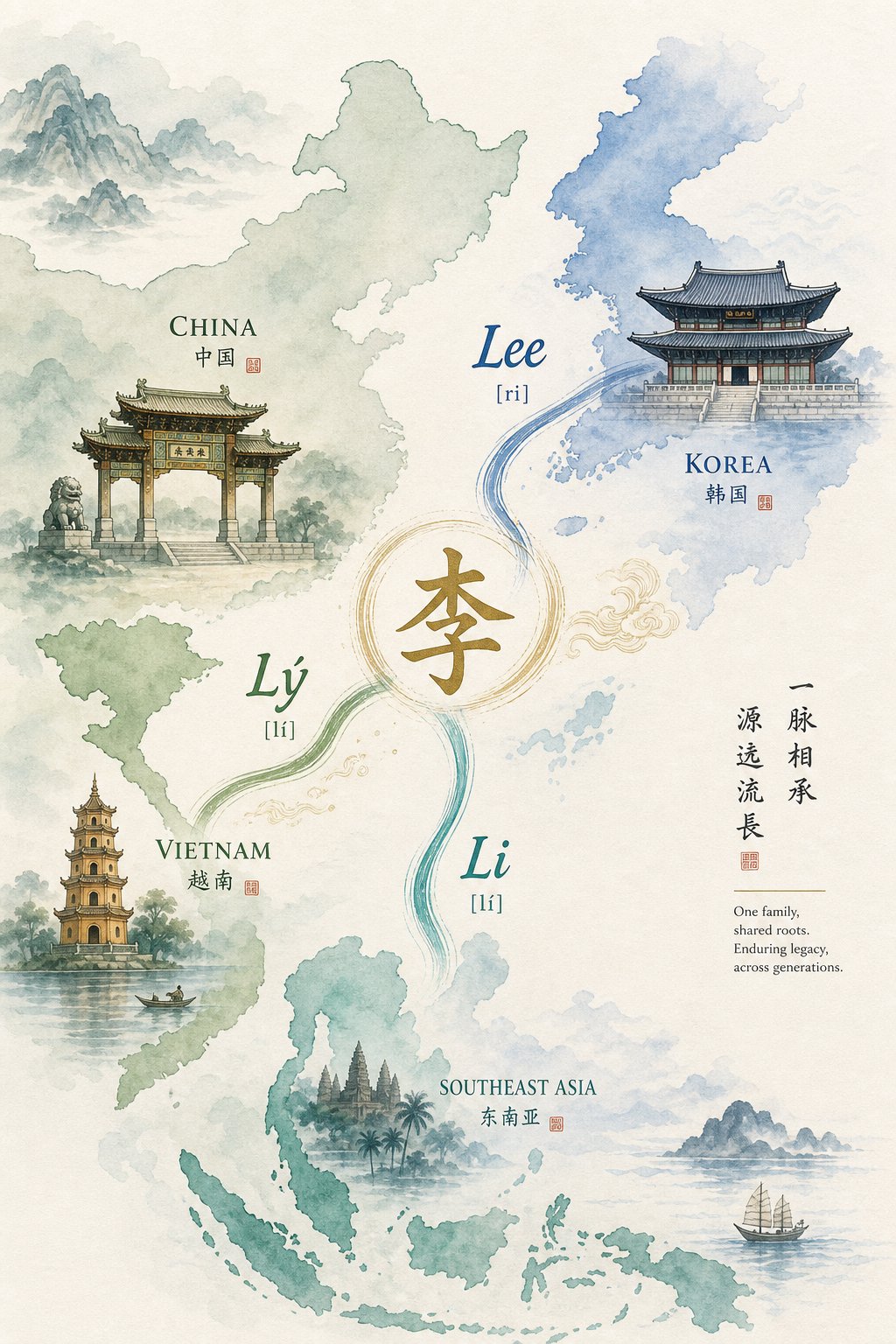
As the 李 character crossed into neighboring kingdoms, something interesting happened. It didn't simply transplant itself. Each culture that adopted it reshaped the name into something distinctly its own, with independent royal lineages, unique romanizations, and origin stories that diverge sharply from the Chinese original. The lee last name origin, depending on where you look, might lead you to a Korean general, a Vietnamese monk-king, or a Cantonese merchant arriving at a colonial port.
Lee, Yi, and Rhee — The Korean Branch of 李
In Korea, 李 is written as 이 (or 리 in North Korea) and romanized most commonly as Lee, though Yi and Rhee also appear. It's the second most common surname in South Korea, carried by over 7.3 million people as of the 2015 census, roughly 14.7% of the entire population. The family name Lee in Korean doesn't trace to a single ancestor. It splits into approximately 241 distinct patrilineal clans, each tied to a different ancestral seat and founder.
The most historically significant of these is the Jeonju Yi clan. Its founder, Yi Han, was a native of Baekje who married a Silla princess and rose to prominence as a high-ranking official. Twenty-two generations later, his descendant Yi Seong-gye overthrew the Goryeo dynasty and founded the Joseon Dynasty in 1392. The House of Yi then ruled Korea for 518 years, establishing many of the cultural, artistic, and linguistic foundations of modern Korean society.
Lee in Korean carries enormous weight because of that royal connection. South Korea's first president, Syngman Rhee, claimed descent from the Jeonju lineage. The Gyeongju Yi clan, another major branch, traces its origins even further back to Yi Al-pyeong, a village headman who helped choose the first King of Silla. That clan alone numbered over 1.4 million people by the 2000 census.
You'll notice the romanization varies wildly. A 2007 study of South Korean passport applications found that 98.5% of bearers spelled it "Lee" in Latin letters, while only 1.0% used "Yi," the form recommended by Korea's National Institute of the Korean Language. Other variants like Rhee, Ri, and Ee persist in older documents and among diaspora communities. The lee surname origin in Korea, then, is both linguistically tied to the Chinese 李 and culturally independent from it, shaped by centuries of Korean dynastic history.
The Vietnamese Lý Dynasty and Its Legacy
Vietnam's relationship with the 李 surname runs equally deep but follows its own path. The Lý dynasty (1009-1225) was founded by Lý Thái Tổ, who moved the capital to Thăng Long (modern Hanoi) and established a golden age of Vietnamese culture, Buddhism, and statecraft. For over two centuries, the Lý surname sat at the apex of Vietnamese political life.
The surname Lý carries independent historical weight in Vietnam that has nothing to do with Tang Dynasty bestowal or the plum-tree legend. Vietnamese bearers of this name connect it to their own national narrative of independence and cultural flowering. When the Lý dynasty fell, many clan members changed their surname to Nguyễn to avoid persecution, but the Lý name endured among those who kept it, carrying the memory of a distinctly Vietnamese imperial tradition.
So is lee a chinese last name? Yes, in one sense. The character 李 originated in China. But asking that question in Korea or Vietnam would get you a complicated answer. Korean bearers connect it to Joseon royalty and Silla-era founders. Vietnamese bearers connect it to the Lý dynasty's Buddhist golden age. The shared character is a starting point, not the whole story.
Here are the major East Asian variants of 李, each with its own pronunciation and cultural identity:
- Li (Mandarin) — Standard romanization used in mainland China and Singapore
- Lee (Cantonese/Korean) — Dominant spelling in Hong Kong, South Korea, and much of the English-speaking diaspora
- Lý (Vietnamese) — Carries independent dynastic associations tied to Vietnam's Lý dynasty
- Lí (Hokkien/Taiwanese) — Used among Fujian-origin communities in Taiwan and Southeast Asia
Each of these variants developed its own cultural gravity over centuries. A Korean Lee and a Cantonese Lee might share the same English spelling and the same Chinese character, yet their family histories, clan structures, and cultural associations diverge completely. The lee chinese connection is real at the etymological level, but identity runs deeper than etymology.
One question comes up frequently in multicultural settings: is Lee an Asian or white name? The honest answer is both. In East Asia, Lee traces to the 李 character through Korean, Cantonese, and other dialect romanizations. In the English-speaking West, Lee also exists as an Anglo-Irish surname derived from Old English "leah," meaning meadow or clearing. The two origins are entirely unrelated. Context, not spelling, determines which tradition a particular Lee belongs to.
This dual existence makes Lee one of the few surnames that genuinely bridges Eastern and Western naming traditions, though the two streams never actually converge. They simply occupy the same alphabetic space by coincidence, much like the multiple Chinese characters that all romanize to "Li" within China itself.
The geographic spread of these variants raises a practical question for anyone researching their own family history. Within China alone, the 李 surname fractured into distinct regional branches, each tied to specific provinces, migration routes, and clan organizations that kept meticulous records for centuries.
Major Li Clan Branches and Their Geographic Roots
Sharing the character 李 doesn't mean sharing a family tree. Within China, the li family name split into distinct regional branches centuries ago, each anchored to a specific homeland, each maintaining its own genealogical records, and each producing its own line of scholars, generals, and statesmen. Two branches tower above the rest in historical prestige: the Longxi Li and the Zhao Jun Li.
Longxi Li and Zhao Jun Li — The Two Great Branches
How old is li as an organized clan system? The answer stretches back well over two thousand years. The Longxi Li (陇西李氏) traces its founding to Li Chong (李崇), a descendant of the Qin dynasty general Li Xin, who served as Prefect of Longxi and Duke of Nanzheng. From that point forward, the Longxi branch rooted itself in what is now Gansu province, in China's arid northwest. This lineage produced the Han dynasty general Li Guang, the Western Liang dynasty founder Li Gao, and ultimately the Tang imperial family itself. When Li Yuan declared himself Emperor Gaozu in 618 CE, the Longxi Li became the most powerful family name in the known world.
The Zhao Jun Li (赵郡李氏) developed independently in what is now Hebei province, in China's northeast. This branch built its reputation through scholarship and civil service rather than military conquest. During the Tang dynasty, the Li family of Zhaojun was counted among the "Seven Great Families" (七姓十家), aristocratic clans so prestigious that intermarriage between them was actually banned by imperial law to prevent excessive concentration of power.
Think about what that means. The Tang emperors themselves bore the Longxi Li surname, yet they felt threatened enough by the Zhao Jun Li's social prestige to restrict marriage alliances. The two branches shared a character but occupied different worlds: one military and imperial, the other scholarly and aristocratic.
| Branch Name | Origin Region | Notable Historical Figures | Modern Concentration Areas |
|---|---|---|---|
| Longxi Li (陇西李氏) | Longxi Commandery, Gansu Province (northwest China) | Li Guang (Han general), Li Gao (Western Liang founder), Li Yuan and Li Shimin (Tang emperors), Li Bai (poet) | Gansu, Shaanxi, Fujian, and descendants scattered across southern China |
| Zhao Jun Li (赵郡李氏) | Zhao Commandery, Hebei Province (northeast China) | Li Mu (Zhao general), Li Deyu (Tang chancellor), multiple Tang-era scholars and officials | Hebei, Henan, Shandong, and northern China broadly |
The Longxi branch also spawned sub-lineages as cadet branches migrated south. The Guzang Li (姑臧李氏) split off early, while other descendants of the Tang imperial family eventually settled in Fujian province during the late Tang and Song periods. Some of those descendants still live in Chengcun village near the Wuyi Mountains, maintaining genealogical records that connect them directly to the Tang emperors.
Centuries of Migration Across Chinese Provinces
Geography shaped the li family name as much as politics did. Over centuries, wars, famines, and government-directed resettlement programs pushed Li families southward in successive waves. The An Lushan Rebellion (755-763 CE) triggered one of the largest internal migrations in Chinese history, sending millions of northerners into the Yangtze River valley and beyond. Many Li families relocated permanently during this upheaval, establishing new roots in Jiangsu, Zhejiang, and Fujian.
Later migrations during the Song dynasty pushed the li family further into Guangdong and the far south. Each move created a new sub-lineage, a new set of genealogical records, and often a new dialect pronunciation of the same character. A Li family in Fujian might speak Hokkien and trace their ancestry to a Tang prince who fled south. A Li family in Sichuan might speak Mandarin and trace their line to a Northern Wei official who never left the interior.
The Hundred Family Surnames (百家姓), compiled during the early Song dynasty around 960 CE, lists Li as the fourth surname. That ranking reflected political reality at the time of compilation: the Song emperors bore the surname Zhao (赵), which takes first place, while Li ranked high due to the still-fresh memory of Tang imperial glory. In earlier periods, Li would have topped any such list. The text itself became a standard educational primer for Chinese children, meaning generations grew up reciting the Li surname near the top of the cultural hierarchy.
What about a li chinese motto? Traditional clan mottos varied by branch. The Longxi Li often invoked the phrase "陇西世泽" (the legacy of Longxi endures), while genealogical prefaces emphasized loyalty, scholarship, and continuity across generations. These mottos appeared in ancestral halls and at the front of clan genealogy books (族谱), serving as identity markers that distinguished one Li branch from another even when they shared the same character.
The practical takeaway? If your family name is Li, knowing whether you descend from the Longxi or Zhao Jun branch, or from one of the dozens of smaller regional lineages, fundamentally changes your family story. The same surname connects to different homelands, different migration routes, and different historical experiences. And for the millions of Li descendants now living outside China entirely, those internal distinctions became even harder to trace once the surname crossed an ocean and entered a foreign romanization system.

The Li Surname in the Global Chinese Diaspora
Once 李 left China, it stopped being one name. Depending on which port a family departed from, which dialect they spoke at home, and which immigration clerk wrote down what they heard, the same single character splintered into a dozen or more English spellings. That fragmentation is the defining feature of the ly surname and its many cousins in the global diaspora, a story shaped less by family choice than by the accidents of history, geography, and bureaucracy.
How 李 Became Lee, Ly, Lim, and Lei Across the Globe
The core issue is straightforward: Chinese is not one spoken language. It's a family of mutually unintelligible dialects that share a writing system. The character 李 is pronounced "Lǐ" in Mandarin, "Lei" in Cantonese, "Lí" in Hokkien, "Ly" in Teochew, and "Li" in Hakka. When Chinese emigrants arrived at foreign ports, officials transliterated what they heard, not what was written. The result was permanent. Whatever spelling landed on that first immigration document became the family's legal surname in their new country.
In the United States and United Kingdom, the dominant spelling became Lee. Why? Because the earliest waves of Chinese immigration to these countries came overwhelmingly from Guangdong province, where Cantonese is spoken. In Cantonese, 李 sounds closer to "Lei" or "Lee" than to the Mandarin "Li." The lee last name origin asian communities carry today traces directly to this Cantonese pronunciation filtered through English-speaking ears. By the time Mandarin-speaking immigrants arrived in larger numbers decades later, "Lee" was already entrenched as the default English spelling for 李.
The ly last name tells a different story. In Cambodia, Laos, and parts of Thailand, Chinese communities with Teochew (Chaozhou) roots spelled the surname as Ly. The Teochew pronunciation of 李 drops the vowel sound that Mandarin preserves, producing something closer to a bare "Ly" or "Lye." French colonial transliteration systems in Indochina cemented this spelling. Today, the ly family name is common across Southeast Asian countries that were once part of French Indochina, carrying both Chinese ancestry and a colonial-era spelling convention in a single word.
The lim last name origin follows yet another dialect path. In Hokkien-speaking communities, particularly those from Fujian province who settled in Singapore, Malaysia, the Philippines, and Indonesia, 李 is not pronounced "Li" at all. It sounds like "Lim" (or sometimes "Leem"). The lim surname origin connects to the same 李 character and the same plum-tree meaning, but the pronunciation diverged so far from Mandarin that most English speakers would never guess the two names are identical in writing. Families bearing the Lim spelling share ancestry with families spelled Li or Lee, yet their names look completely unrelated on paper.
Here are the major romanization variants of 李 organized by region and dialect:
- Lee — United States, United Kingdom, Canada, Australia (Cantonese-origin communities); South Korea
- Li — Mainland China, Singapore (Mandarin standard pinyin)
- Ly — Cambodia, Laos, Vietnam, Thailand (Teochew-origin communities under French transliteration)
- Lim — Singapore, Malaysia, Philippines, Indonesia (Hokkien/Fujian-origin communities)
- Lei or Lay — Hong Kong, Macau (Cantonese, alternative romanizations)
- Lie or Lie — Indonesia (Dutch colonial-era transliteration of Hokkien pronunciation)
- Ri or Ree — North Korea, older Korean romanization systems
- Lý — Vietnam (Vietnamese national romanization, quốc ngữ)
Romanization Systems and Their Impact on Surname Spelling
The confusion deepened because no single romanization standard existed until well into the twentieth century. As FamilySearch notes, immigration officials unfamiliar with Chinese sounds would simply guess how best to spell a migrant's name. The Wade-Giles system, developed in the 1850s, rendered 李 as "Li." The Yale system used the same spelling. But these academic systems rarely reached the docks where actual immigrants were being processed. What mattered there was what the clerk heard and how they chose to write it down.
Colonial-era systems added another layer. The Dutch in Indonesia used their own phonetic conventions, turning Hokkien "Lim" into "Lie" or "Lie Tjeng" in official records. The French in Vietnam and Cambodia applied French phonetics, which is why the ly surname appears without a tone mark in Cambodian documents but with one (Lý) in Vietnamese. The British in Malaya and Hong Kong used yet another set of conventions, producing "Lee" and "Lei" depending on the registrar's preference.
Consider what this means for genealogical research. A family named Lim in Singapore, a family named Ly in Phnom Penh, and a family named Lee in San Francisco might all descend from the same village in Fujian province. Their shared ancestor wrote 李 in every document he ever signed. But three different colonial systems, three different dialect pronunciations, and three different immigration bureaucracies produced three surnames that look entirely unrelated in English. Reconnecting these branches requires working backward through layers of transliteration to reach the original character, a process that demands knowledge of dialect geography, colonial history, and local record-keeping practices.
The le surname origin question sometimes surfaces in this context as well. In some French-influenced regions, 李 was occasionally rendered as "Le" rather than "Ly," particularly when officials heard the Cantonese or Hakka pronunciation and applied French spelling conventions. This variant is less common but appears in older records from Mauritius, Reunion, and parts of West Africa where Cantonese-speaking traders settled during the colonial period.
Understanding lee in chinese writing helps clarify the underlying unity. Regardless of whether a family spells their name Lee, Li, Lim, Ly, or Lei, the character 李 remains the same on paper: 木 on top, 子 on the bottom, meaning plum tree. The fragmentation is entirely a product of spoken dialect and foreign transcription. It exists only in the Latin alphabet, never in the Chinese script itself.
For families trying to trace their roots across borders, this means the first step isn't searching for a spelling. It's recovering the character. Once you know whether your family's "Lee" or "Lim" or "Ly" corresponds to 李 or to one of the other Li-sounding surnames (黎, 利, 栗), you can begin narrowing down which branch, which province, and which migration wave your ancestors belonged to.
Identifying Which Li Surname Origin Is Yours
Recovering the character behind your spelling is the starting point. But which of the nine roots does your family actually belong to? The answer lives in a combination of clues: your ancestral region, your dialect group, your family's oral history, and sometimes a dusty genealogy book sitting in a relative's closet or a village archive halfway around the world.
Clues from Your Ancestral Region and Dialect
The origin of lee surname variants, whether spelled Lee, Li, Lim, or Ly, almost always traces back to a specific province and dialect community. A Hokkien-speaking family from Fujian points toward different clan branches than a Cantonese-speaking family from Guangdong. A family with roots in Gansu likely connects to the prestigious Longxi lineage, while Hebei origins suggest the Zhao Jun branch. These geographic markers narrow the field dramatically.
Here's a practical step-by-step approach to tracing your specific lineage:
- Identify the specific Chinese character your family uses. Is it 李 (plum), 黎 (many/dark), 利 (sharp), 厉 (stern), or 栗 (chestnut)? If your family left China generations ago, older relatives or immigration documents may preserve the character. This single step eliminates most confusion.
- Determine your ancestral province or dialect group. Ask family members where your earliest known ancestor came from. Province-level information (Fujian, Guangdong, Henan, Gansu) immediately narrows which clan branch you likely belong to. The dialect your grandparents spoke at home is equally telling.
- Check for a family genealogy book (族谱 or 家谱) if available. These jiapu records are the gold standard of Chinese genealogical research. They can trace lineages back hundreds or even thousands of years, listing names, migration routes, and clan branch affiliations generation by generation.
- Cross-reference with known clan branch histories. Once you have a character and a region, compare your information against published histories of the Longxi Li, Zhao Jun Li, or other documented branches. Clan associations in China, Taiwan, and Southeast Asia often maintain these records and can help verify connections.
Tracing Your Li Lineage Through Historical Records
Where is the last name Lee from in your particular family's case? The answer might be sitting in a digitized archive. FamilySearch hosts a searchable database of Chinese jiapu that you can access for free. You'll need your surname in Chinese characters, your family's ancestral village or county, and ideally a generation poem or ancestral hall name. Start by searching toward the end of any jiapu you find, where the most recent generations appear, and work backward from a known ancestor.
If your jiapu isn't online, it may still exist in your ancestral village, in a local library in China, or with a clan association in Southeast Asia. Many families in Malaysia, Singapore, and Indonesia preserved genealogy books that were destroyed on the mainland during the Cultural Revolution. Reaching out to village leadership or local clan organizations with photographs and whatever family details you have can sometimes unlock records that have waited decades for someone to claim them.
DNA testing offers a complementary approach, though it works differently for Chinese genealogy than for European research. Y-chromosome testing can confirm or rule out connections between Li families who believe they share a patrilineal ancestor. It won't tell you which emperor bestowed your surname or which plum grove saved your ancestor, but it can confirm whether two Lee families in different countries actually descend from the same male line.
The lee family name origin you uncover might surprise you. Your branch could trace to the ancient judicial lineage of Gaoyao, to a Tang-era bestowal ceremony, to a Xianbei clan that adopted Chinese customs, or to one of the dozens of smaller ethnic groups who took the name centuries ago. Lee surname history isn't a single thread. It's a web of convergent paths, and your family occupies one specific strand within it.
Whatever you find, the origin of name lee or Li in your family connects you to something larger than a spelling on a passport. It connects you to a specific moment in history when someone chose, received, or inherited a name that would travel across centuries and continents to reach you. That's worth knowing.
Frequently Asked Questions About the Li Surname Origin
1. Is Li a Chinese last name?
Yes, Li (李) is a Chinese last name and ranks as the second most common surname in China, carried by approximately 93 million people. However, the romanization 'Li' also represents several other distinct Chinese characters including 黎, 厉, 利, and 栗, each with separate etymologies. Beyond China, the same character 李 appears as Lee in Korea, Ly in Vietnam, and Lim in Hokkien-speaking communities, each carrying independent cultural and historical significance in those regions.
2. What does the Chinese character Li (李) mean?
The character 李 literally means 'plum tree.' It combines two radicals: 木 (wood/tree) on top and 子 (child/seed) below, forming an image of a fruit-bearing tree. The plum tree holds deep cultural significance in Chinese tradition, symbolizing resilience, purity, longevity, and scholarly integrity because it blooms in late winter when other trees remain dormant. This connection to nature reflects the ancient Chinese practice of deriving surnames from elements of the natural world.
3. Why is Li such a common surname worldwide?
The Li surname's extraordinary prevalence stems primarily from the Tang Dynasty (618-907 CE). The Tang emperors used a practice called 'bestowed surnames' (赐姓), granting the imperial Li name to loyal generals, officials, and allied tribal leaders from diverse ethnic backgrounds as the highest honor. Over nearly three centuries, entire clans numbering in the thousands adopted the surname in single generations. Combined with the name's ancient origins dating back over 3,000 years and its spread across Korea, Vietnam, and Southeast Asia, these factors pushed Li past 100 million bearers.
4. Are Lee, Lim, Ly, and Li the same surname?
They can be. Lee, Lim, Ly, Lei, and Li are all romanized variants of the single Chinese character 李. The spelling differences arose because Chinese dialects pronounce the character differently: 'Lei' or 'Lee' in Cantonese, 'Lim' in Hokkien, 'Ly' in Teochew, and 'Li' in Mandarin. When families emigrated, immigration officials wrote down what they heard using local transliteration conventions. However, not all bearers of these spellings share ancestry, as some may correspond to entirely different Chinese characters like 黎 or 利.
5. How can I trace which Li surname origin my family belongs to?
Start by identifying the exact Chinese character your family uses, as this eliminates most confusion between unrelated surnames. Next, determine your ancestral province and dialect group through family oral history or immigration documents. Check whether a family genealogy book (族谱) exists, either with relatives or in digitized archives like FamilySearch. Finally, cross-reference your character and region against known clan branch histories such as the Longxi Li of Gansu or the Zhao Jun Li of Hebei. DNA testing can also confirm patrilineal connections between branches.