What the Chinese Character 山 Means and Why It Matters
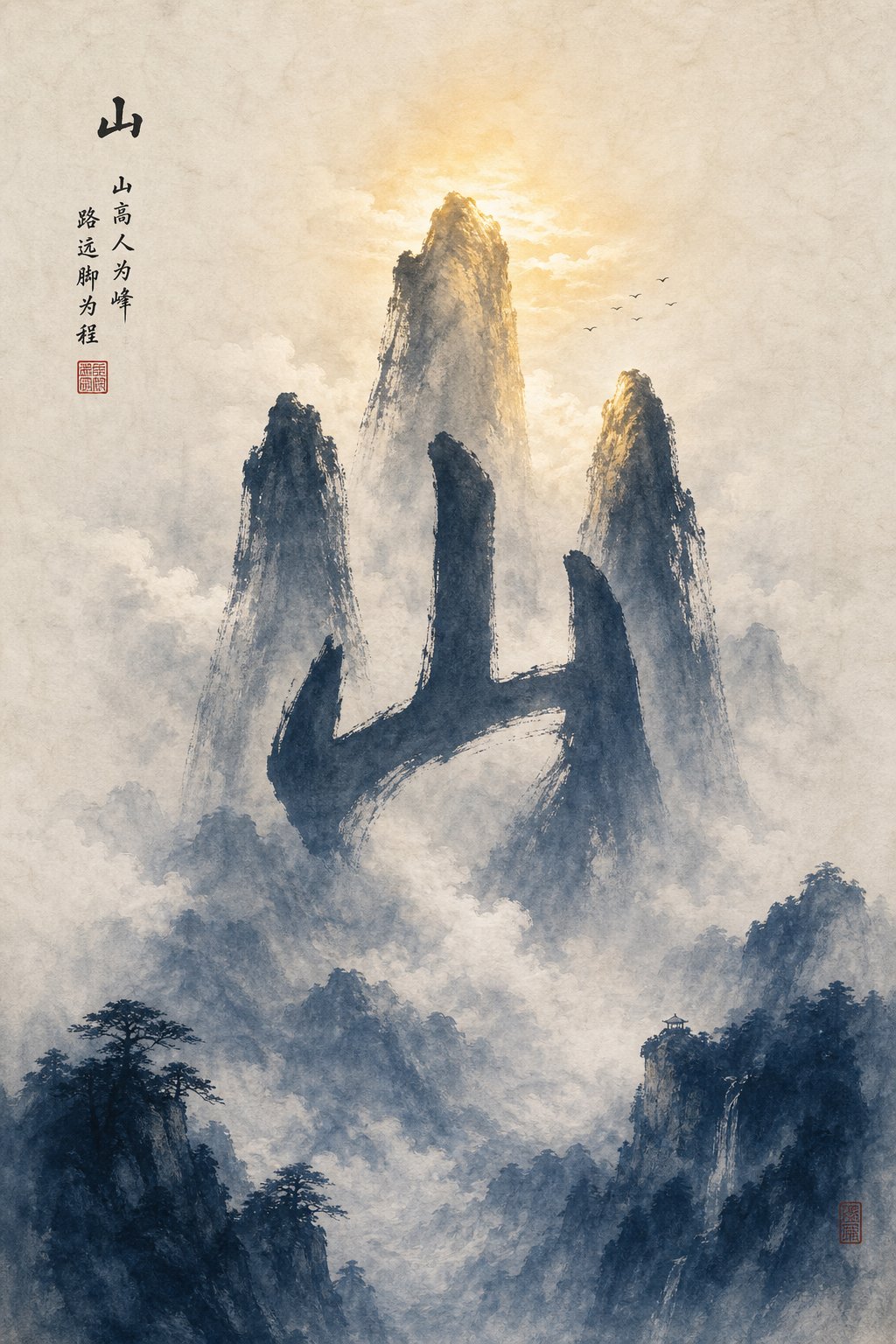
What does the Chinese character 山 mean? In its simplest form, 山 (pronounced shan, first tone) is the Chinese word for mountain. But calling it "just a word" undersells what makes this character remarkable. 山 is a pictograph - a written symbol that visually represents the thing it describes. Look at it closely, and you'll see three peaks rising from the earth: a tall central summit flanked by two shorter ridges. That visual directness is exactly why 山 has survived largely unchanged for over three thousand years.
Definition and Core Meaning of 山
The Shuowen Jiezi (说文解字), China's earliest comprehensive dictionary compiled around 100 CE, offers a definition that still resonates with learners today:
"山, xuanqi sanchu, you shi er guang." - A mountain is that which disperses and produces. It has stone and is vast. Its form, with three peaks, represents the shape of mountains.
In accessible English, the dictionary describes 山 as a landform that disperses vital energy, produces all living things, and is characterized by stone and expansiveness. The character's three-peaked shape directly mirrors the physical reality of mountain ranges. This is the mountain Chinese character meaning at its most fundamental: earth rising toward the sky, rendered in three elegant strokes.
As both an independent word and a radical (building block for other characters), 山 carries the meaning of mountains, hills, and elevated terrain across thousands of compound words and expressions in modern Chinese.
Why 山 Is a Gateway Character for Chinese Learners
Imagine you're staring at a page of unfamiliar Chinese characters for the first time. Most look abstract, even intimidating. Then you spot 山 - and suddenly, you can see it. Three vertical strokes resembling three mountain peaks. That moment of visual recognition is powerful, and it's why 山 ranks among the very first characters taught in nearly every Chinese language program.
Here's a mnemonic tip that makes this Chinese pictograph for mountain almost impossible to forget: picture the character as a simple landscape sketch. The tall center stroke is the main peak, and the two shorter strokes on either side are neighboring ridges. You're essentially looking at a mountain range drawn with just three lines. Once you see it, you can't unsee it.
Beyond memorization, 山 serves as a structural key to the writing system itself. It functions as Radical 46 in the Kangxi Dictionary classification, meaning it appears as a component inside dozens of other characters related to geography, terrain, and elevation. Learning 山 doesn't just give you one word - it gives you a lens for decoding an entire family of related characters.
This single symbol bridges etymology, daily vocabulary, and deep cultural philosophy in ways few other characters can match. The story of how it got here - from ancient oracle bones to your phone screen - reveals just how tightly Chinese writing is woven into the physical landscape.
How 山 Evolved From Ancient Pictograph to Modern Character
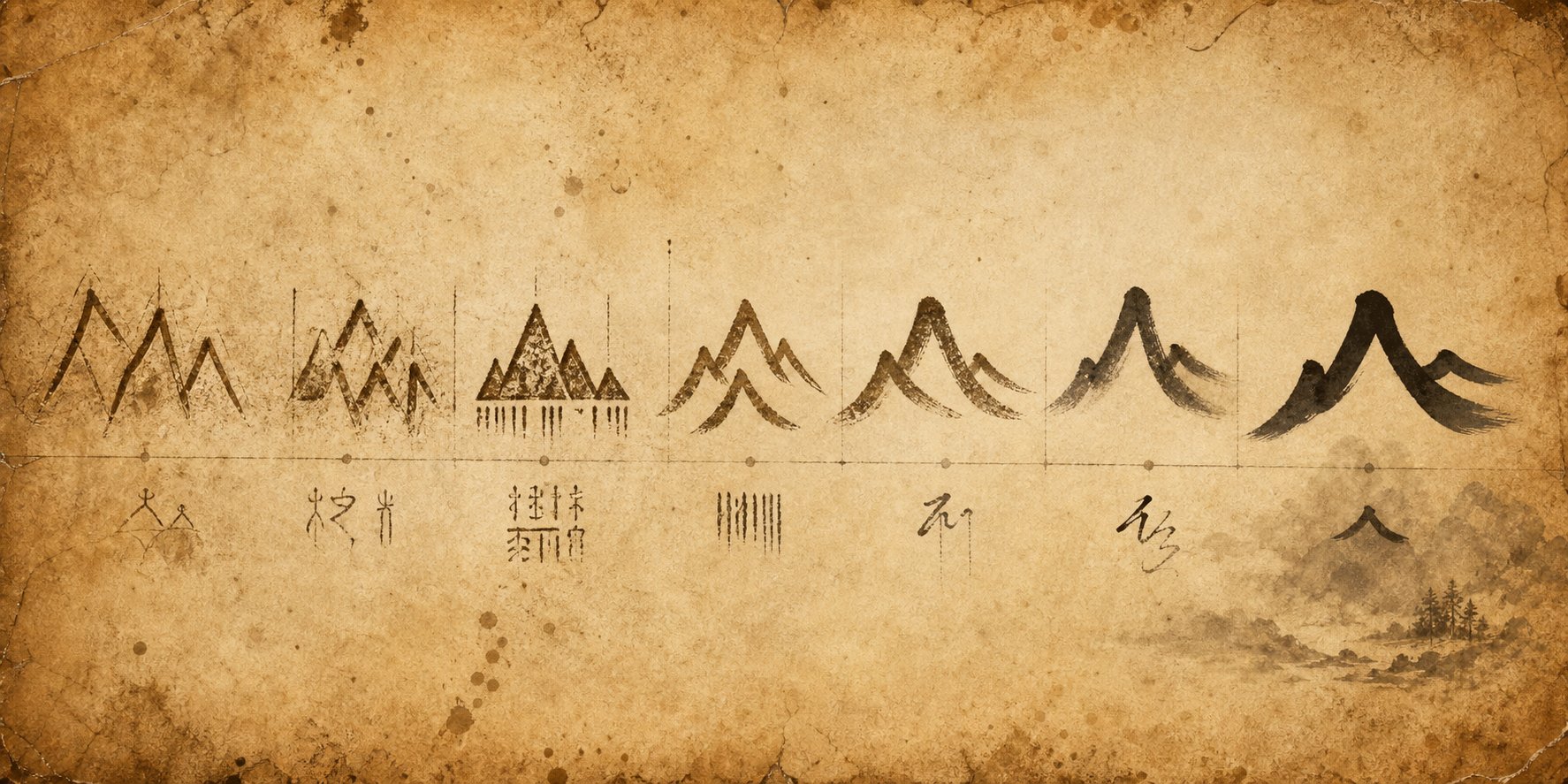
Most Chinese characters look dramatically different from their ancient ancestors. Thousands of years of simplification, stylization, and adaptation to new writing tools have reshaped them beyond recognition. 山 is a striking exception. Its evolution tells a story of remarkable stability - a character so visually intuitive that scribes across thirty centuries barely needed to change it.
Oracle Bone Script and the Original Pictograph
The earliest confirmed form of 山 appears on oracle bone inscriptions from the late Shang dynasty, roughly 1350-1046 BCE. Imagine three pointed peaks drawn with angular, scratchy lines - a tall central spike flanked by two shorter ones, all rising from a shared baseline. That's essentially what Shang scribes carved into turtle shells and animal bones during divination rituals.
Because carving into hard bone and shell demanded sharp, straight lines, the oracle bone form of 山 looks slightly more angular than what a brush would produce. Rounded shapes became squarish, and thick strokes became thin lines - a pattern common across all oracle bone characters. Still, the three-peak silhouette is unmistakable. You'd recognize it as a mountain even without context.
Bronze to Seal Script Transformations
During the Western Zhou period (1046-771 BCE), writing shifted primarily to bronze vessels. Bronze script served as the formal script of the era, and characters cast in metal tended to be slightly more rounded and pictographic than their oracle bone counterparts. For 山, this meant the peaks softened slightly at their tips, and the connecting baseline became more fluid. The overall shape, though, stayed the same: three vertical elements of varying height joined at the bottom.
As centuries passed through the Spring and Autumn period and into the Warring States era, most characters underwent significant regional variation and stylistic drift. The general trend across Chinese writing was toward linearization - thick pictographic shapes becoming thinner, more abstract lines. Yet 山 resisted this pressure. Its form was already so linear and minimal that there was little left to simplify.
When Qin Shihuang unified China in 221 BCE and standardized the script, the resulting small seal script (xiaozhuan) version of 山 looked almost identical to earlier forms. The peaks became slightly more uniform and symmetrical, with elegant, even-width strokes - but the fundamental three-peak structure remained intact. The Shuowen Jiezi dictionary, published in 121 CE to record this Qin standard, preserves this seal script form as the authoritative reference.
From Clerical Script to the Modern Character
Clerical script (lishu) emerged from the popular handwriting of Qin-era government clerks who needed to write quickly on bamboo strips. For many characters, this transition was dramatic - curves flattened, components merged, and pictographic origins vanished. For 山, the shift was minimal. The three vertical strokes became crisper, the baseline connecting the outer strokes squared off into a horizontal turn, and the character settled into the compact, balanced form we use today.
Here's what makes this history unusual: the simplified and traditional forms of 山 are identical. Unlike characters such as 龙/龍 (dragon) or 马/馬 (horse), which look completely different in their simplified and traditional versions, 山 never needed simplification. It was already simple enough.
Classified as Radical 46 in the Kangxi Dictionary - the standard reference compiled in 1716 that organizes all Chinese characters under 214 radicals - 山 anchors a family of 636 characters related to terrain and elevation. That classification endures in modern dictionaries, a testament to how central this ancient pictograph remains to the structure of written Chinese.
Few characters can claim such continuity. From Shang-era oracle bones to the screen you're reading now, 山 has looked like a mountain for over three thousand years. That visual transparency is also what makes it such an effective building block - a topic that becomes clear the moment you pick up a brush and write it yourself.
How to Write 山 With Proper Stroke Order
How many strokes in 山? Just three. That makes it one of the simplest characters you'll ever learn to write in Chinese - but the order and direction of those strokes still matter. Getting the sequence right builds muscle memory that carries over to every other character containing 山 as a component.
Three Strokes in the Correct Order
When you write mountain in Chinese, you follow a specific 山 stroke order step by step. The character fits inside an imaginary square, with the center peak rising tallest and two shorter peaks flanking it on either side. Here's the exact sequence:
- Center vertical stroke (丨) - Start at the top center of the character and draw straight down. This is the tallest stroke, representing the main peak. Lift your pen at the bottom.
- Left vertical-turning stroke (㇗) - Begin slightly above the midpoint on the left side. Draw a short vertical line downward, then turn sharply to the right along the baseline without lifting your pen. Stop at the bottom of the center stroke.
- Right vertical-turning stroke (㇗) - Start at the same height as stroke two, but on the right side. Draw downward, then turn to the right along the baseline. This completes the character's frame.
The key principle here is center first, then left to right. The outer strokes connect at the bottom to form a continuous baseline that grounds the three peaks together. Practice it a few times and you'll notice how naturally the shape emerges - it genuinely looks like a mountain range in miniature.
Understanding 山 as a Radical and Building Block
Beyond being a standalone character, 山 serves as Radical 46 in the Kangxi Dictionary system. When it appears inside other characters, it's called 山字旁 (shanziapang) as a left-side component or 山字头 (shanzitou) when positioned on top. In the Kangxi Dictionary alone, 636 characters fall under this radical - all connected to terrain, geography, or elevation.
Recognizing 山 as a radical unlocks a whole family of related characters:
- 峰 (feng) - peak, summit
- 岭 (ling) - mountain ridge or range
- 岛 (dao) - island (land rising from water)
- 崖 (ya) - cliff, precipice
- 岸 (an) - shore, bank
Notice the pattern: each of these characters contains 山 as a visual clue that the meaning relates to landforms or elevated terrain. Once you spot the radical, you can make educated guesses about unfamiliar characters even before reaching for a dictionary. That's the practical power of learning how to write mountain in Chinese properly - it's not just one character, it's a key that opens dozens more.
With the writing mechanics and radical system covered, the next natural question is how 山 actually sounds when spoken aloud - and how its pronunciation shifts across different Chinese dialects and even into Japanese.
Pronouncing 山 in Mandarin and Other Languages
Knowing how to write a character is only half the equation. How do you pronounce 山 in Chinese? The pinyin is shan, spoken in the first tone - a high, flat pitch that stays level from start to finish, like holding a single musical note. Sounds simple enough, but English speakers often trip over subtle details in both the initial consonant and the vowel.
Mastering the First Tone Pronunciation
The 山 pinyin and tone break down into two parts: the initial sh- and the final -an. Here's where it gets interesting for English speakers.
The Mandarin "sh" is a retroflex sound, meaning your tongue curls back slightly so the tip points toward the roof of your mouth, just behind the hard palate. In English, the "sh" in "ship" is produced with the tongue flat and positioned further forward. The Mandarin version sounds a bit thicker, almost like you're whispering "shr" without fully voicing the "r." Imagine saying the English word "shirt" but stopping right after the "sh" - that tongue position is close to what you need.
The final "-an" sounds like "ahn" in English, similar to the vowel in "father" followed by a soft "n." A common mistake is pronouncing it like the English word "an" (as in "an apple"), which produces a flatter, more nasal sound. Keep the vowel open and relaxed, as if you're saying "ah" and then gently closing with "n."
For the first tone itself, picture your voice at the top of its comfortable range and hold it steady. No dipping, no rising - just a clean, sustained high pitch. English speakers tend to let their pitch drop at the end of words, so consciously resist that habit. Think of it as a flat line drawn across the top of your vocal range.
How 山 Sounds in Compound Words
In isolation, shan maintains its first tone clearly. The good news is that first-tone syllables in Mandarin are relatively stable in compound words - they don't undergo the dramatic tone sandhi (tone-change rules) that affect third-tone characters. When you say 火山 (huoshan, volcano) or 山水 (shanshui, landscape), the first tone on shan stays high and level regardless of what tone precedes or follows it.
The one subtle shift you might notice is in rapid, casual speech. Native speakers sometimes slightly shorten first-tone syllables when they appear in the middle of longer phrases, but the pitch direction never changes. This makes shan one of the more predictable syllables to pronounce consistently across different vocabulary contexts.
A quick note on a common learner error: don't confuse shan (first tone) with san (third tone, meaning "three" - 三). The difference is both the initial consonant (retroflex "sh" versus flat "s") and the tone contour. Mixing these up can cause real confusion in conversation.
山 in Japanese as Kanji
If you're studying both Chinese and Japanese, you'll encounter 山 frequently in Japanese as well. The character is identical visually, but its readings differ depending on context. Japanese kanji typically carry two types of readings: the on'yomi (derived from Chinese pronunciation) and the kun'yomi (native Japanese reading).
| Language | Reading | Romanization | Tone/Pitch | Usage Context |
|---|---|---|---|---|
| Mandarin | 山 | shan (pinyin) | 1st tone (high, flat) | All contexts |
| Cantonese | 山 | saan1 (Jyutping) | High level tone | All contexts |
| Japanese (on'yomi) | サン | san | Pitch accent varies | Compounds: 山脈 (sanmyaku), 火山 (kazan) |
| Japanese (kun'yomi) | やま | yama | Pitch accent varies | Standalone or native words: 山 (yama), 山道 (yamamichi) |
You'll notice the Japanese on'yomi "san" closely mirrors the Mandarin pronunciation - both trace back to the same Middle Chinese source. The kun'yomi "yama" is purely Japanese in origin and bears no phonetic resemblance to the Chinese reading. In practice, Japanese uses "yama" when the character stands alone or appears in native Japanese compounds, and "san" in Sino-Japanese vocabulary borrowed from Chinese.
The Cantonese reading "saan1" shares the same high-level tone quality as Mandarin's first tone, though the vowel is slightly longer and more open. For learners focused on Mandarin, the key takeaway is straightforward: keep your tongue curled back for the retroflex "sh," open the vowel to a full "ah" sound, and hold your pitch high and steady. Master that, and you'll pronounce 山 correctly every time - whether you're naming a mountain, ordering 山药 (shanyao, Chinese yam) at a restaurant, or reading classical poetry aloud.
Pronunciation gives you the sound of the character. The real depth of 山, though, emerges when you see how it combines with other characters to build an entire vocabulary of landscapes, activities, and natural features.
Essential Vocabulary Built With 山
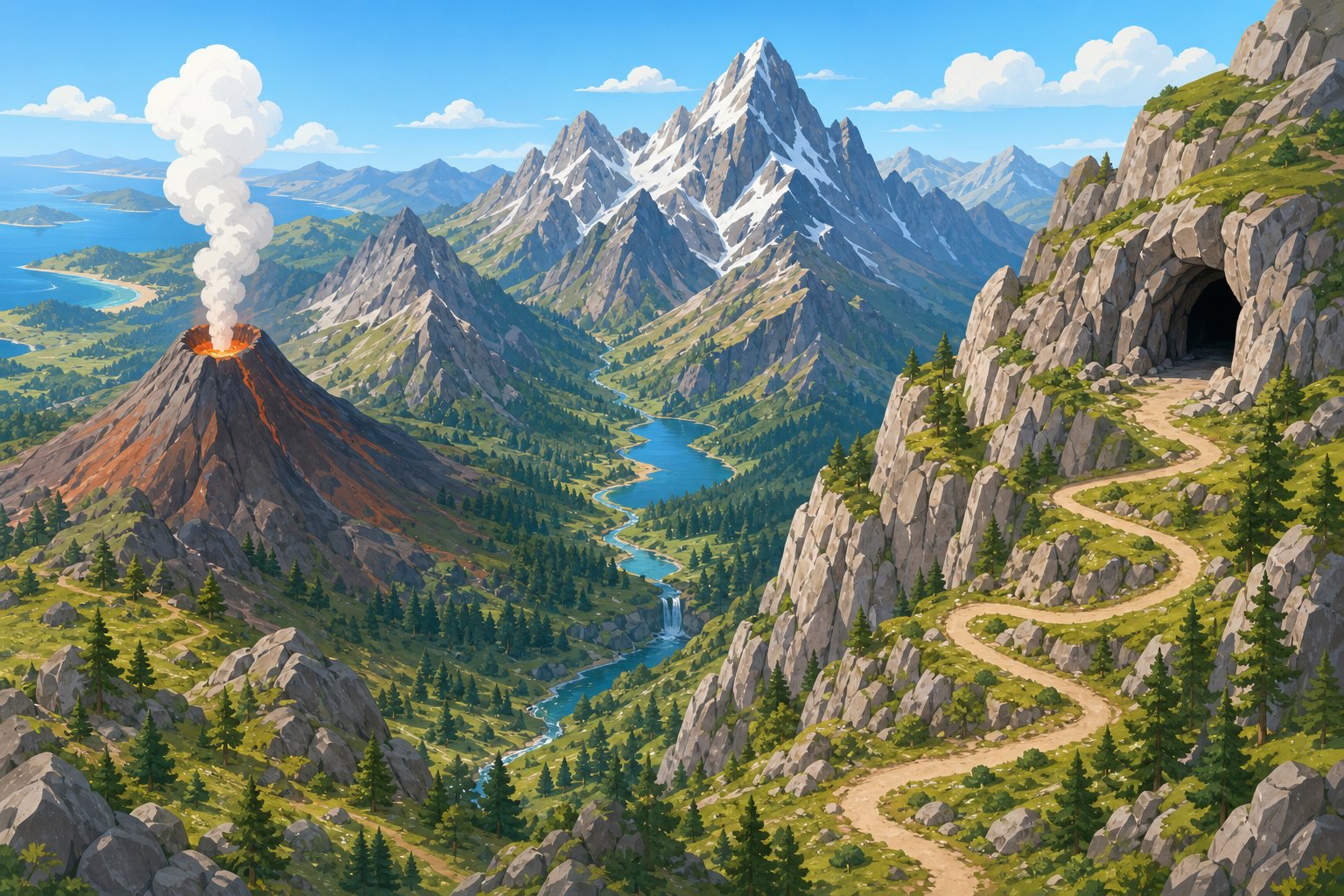
A single character only gets you so far in conversation. Say 山 on its own and people understand "mountain" - but the moment someone mentions a volcano, a valley, or a hiking trip, you need compound words. The common Chinese words with 山 form a practical vocabulary set that covers geography, outdoor activities, and everyday descriptions of the natural world. What makes these compounds satisfying to learn is their logic: each one pairs 山 with another character to create a meaning you can often guess before checking a dictionary.
Below, you'll find a 山 compound words list with pinyin organized from beginner-friendly essentials to intermediate and advanced terms. Rather than dumping fifty words on you at once, this progression lets you build Chinese mountain vocabulary for beginners first, then layer on more specific terms as your reading improves.
Beginner Compounds Every Learner Should Know
These are the words you'll encounter in textbooks, travel apps, and basic conversations about nature and geography. Each one appears frequently in daily Chinese and uses characters that most learners pick up within their first year of study.
| Characters | Pinyin | English Meaning | Example Context |
|---|---|---|---|
| 山水 | shānshuǐ | landscape; scenery (lit. "mountains and water") | Used in art, poetry, and travel. 桂林山水很美。(Guilin's landscape is beautiful.) |
| 火山 | huǒshān | volcano (lit. "fire mountain") | 那座火山现在很安静。(That volcano is quiet right now.) |
| 山谷 | shāngǔ | valley (lit. "mountain valley") | 我们走进山谷。(We walked into the valley.) |
| 山顶 | shāndǐng | summit; mountaintop | 我们终于到了山顶。(We finally reached the summit.) |
| 爬山 | páshān | to climb a mountain; hiking | 我们决定明天去爬山。(We decided to go hiking tomorrow.) |
| 山上 | shānshàng | on the mountain | 山上有一大片森林。(There's a large forest on the mountain.) |
| 山脚 | shānjiǎo | foot of a mountain | 小村子在山脚下。(The small village is at the foot of the mountain.) |
Notice how intuitive these are. 火山 is literally "fire mountain" - a mountain that produces fire. 山顶 combines 山 with 顶 (top/peak) to give you "mountaintop." 山谷 pairs mountain with 谷 (valley/gorge) to describe the low ground between peaks. This transparency is one of the reasons Chinese compound words feel rewarding to learn: the logic is visible right there in the characters.
The word 山水 deserves special attention. While it literally translates as "mountains and water," its cultural meaning extends far beyond geography. 山水 refers to the entire tradition of Chinese landscape painting, a genre of poetry, and a general aesthetic ideal of natural beauty. When someone says 山水画 (shanshuihua), they mean a traditional ink landscape painting - one of the most celebrated art forms in Chinese history.
For the compound 爬山, which appears in the HSK 3 vocabulary list, you'll hear it constantly in casual conversation. Weekend plans, fitness routines, travel stories - 爬山 covers everything from a gentle nature walk to serious mountaineering, depending on context.
Intermediate and Advanced 山 Vocabulary
Once the basics feel solid, these compounds let you describe terrain with more precision. You'll encounter them in news articles, travel writing, geography discussions, and more formal contexts.
| Characters | Pinyin | English Meaning | Example Context |
|---|---|---|---|
| 山脉 | shānmài | mountain range (lit. "mountain veins") | 这条山脉很长。(This mountain range is long.) |
| 山洞 | shāndòng | cave; mountain cavern | 探险队发现了一个山洞。(The expedition found a cave.) |
| 登山 | dēngshān | mountaineering; mountain climbing (formal) | 登山需要专业装备。(Mountaineering requires professional equipment.) |
| 山路 | shānlù | mountain road/path | 那边的山路很陡。(The mountain road over there is steep.) |
| 山区 | shānqū | mountainous area/region | 这个山区交通不方便。(Transportation is inconvenient in this mountainous area.) |
| 山林 | shānlín | mountain forest; wooded hills | 山林里空气很好。(The air in the mountain forest is fresh.) |
| 山坡 | shānpō | hillside; mountain slope | 羊群在山坡上吃草。(The sheep are grazing on the hillside.) |
| 山峰 | shānfēng | mountain peak | 远处的山峰被云雾遮住了。(The distant peaks are hidden by clouds.) |
| 山崩 | shānbēng | landslide; avalanche | 暴雨引发了山崩。(Heavy rain triggered a landslide.) |
| 山药 | shānyào | Chinese yam (a common food) | 山药可以煮汤。(Chinese yam can be used in soup.) |
A few distinctions worth noting here. 爬山 (beginner level) and 登山 (intermediate) both involve going up mountains, but they carry different weight. 爬山 is casual - weekend hiking, a walk up a local hill. 登山 implies serious mountaineering with gear, planning, and physical challenge. Think of it as the difference between "going for a hike" and "summiting a peak."
The compound 山脉 (shanmai), which appears in the HSK 6 vocabulary list, uses 脉 (mai, veins/pulse) as its second character. The metaphor is vivid: a mountain range is imagined as the veins of the earth, a connected network running through the landscape. Similarly, 山崩 pairs mountain with 崩 (collapse) to create a word that sounds exactly like what it describes - the mountain breaking apart.
You'll also notice 山药 on this list, which might seem out of place among geography terms. It's here because it shows how 山 extends beyond terrain into everyday life. Chinese yam is a staple ingredient in soups and stir-fries, and you'll see 山药 on restaurant menus and in grocery stores across China. The character 山 in this case indicates the plant's mountain origins.
Learning tip: pair each compound with one short sentence you can say aloud. Vocabulary without a sentence is just a flashcard taking a nap. Say the sentence with pinyin first, then again while looking only at the characters.
The practical pattern across all these compounds is consistent: 山 anchors the meaning to terrain, elevation, or the natural world, while the second character specifies what kind of mountain feature or activity you're talking about. Once you internalize this structure, new 山 compounds become almost self-explanatory when you encounter them in reading.
These vocabulary items describe the physical landscape. But mountains in Chinese carry weight far beyond geography - they sit at the center of philosophical traditions, spiritual practices, and cultural identity stretching back thousands of years.
Cultural and Philosophical Weight of Mountains in Chinese Thought
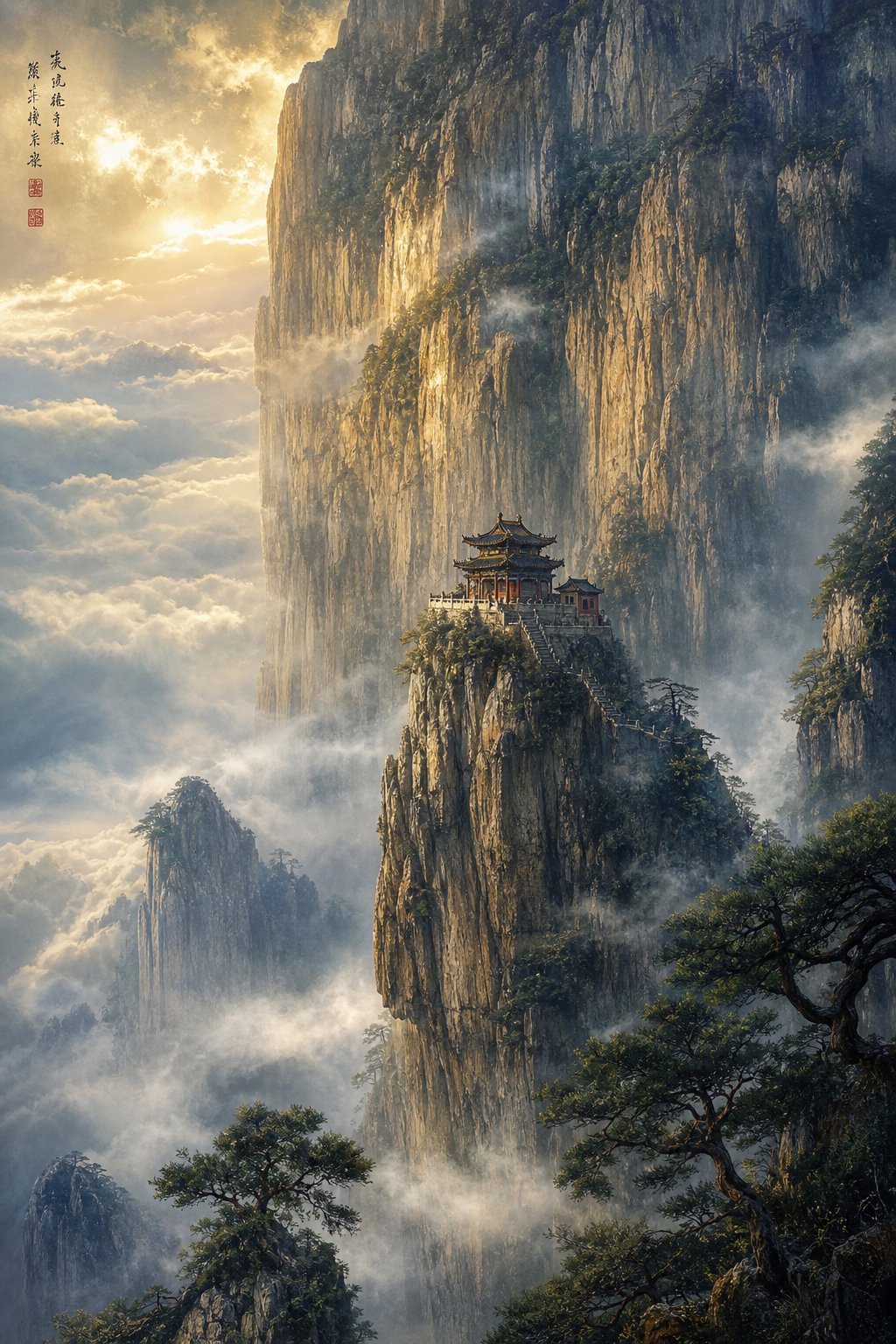
Why are mountains important in Chinese culture? The answer goes far deeper than scenery. For thousands of years, mountains have functioned as spiritual classrooms, political symbols, and philosophical metaphors all at once. The character 山 doesn't just label a landform - it carries the accumulated weight of Taoist immortality seekers, Buddhist monks choosing remote peaks for meditation, Confucian scholars drawing moral lessons from stone, and feng shui masters reading the energy of the earth. Understanding this cultural layer transforms the mountain Chinese character meaning from a simple vocabulary word into a gateway to Chinese civilization itself.
Mountains in Taoist and Buddhist Tradition
In Taoism, mountains are not merely beautiful - they are where heaven and earth meet. Taoist thought holds that mountains serve as a means of communication between the human world and the divine, and that immortality itself can be found among their peaks. Early Taoist texts describe mountain hermits cultivating spiritual energy (qi) in remote caves and forests, far from the distractions of society. The higher you climb, the closer you get to the Tao.
This isn't abstract philosophy. It shaped real behavior for centuries. Taoist priests established temples on the most dramatic peaks they could find, and practitioners retreated into mountain wilderness for years of solitary cultivation. The Four Sacred Mountains of Taoism - Mount Wudang in Hubei, Mount Longhu in Jiangxi, Mount Qiyun in Anhui, and Mount Qingcheng in Sichuan - remain active centers of Taoist practice today. As early as the fourth century, Taoist precepts included explicit rules about conserving mountain environments, reflecting a belief that these landscapes were sacred and alive.
Buddhism arrived in China and quickly adopted the same mountain-centered geography. Chinese Buddhist tradition identifies Four Sacred Buddhist Mountains, each associated with a specific bodhisattva: Mount Wutai in Shanxi (home of Manjusri, bodhisattva of wisdom), Mount Emei in Sichuan (Samantabhadra, bodhisattva of practice), Mount Jiuhua in Anhui (Ksitigarbha, protector of beings in hell realms), and Mount Putuo in Zhejiang (Avalokitesvara/Guanyin, bodhisattva of compassion). Monks chose these remote, elevated sites deliberately - the isolation and natural grandeur were considered ideal conditions for meditation and enlightenment.
The 山 symbolism in Taoism and Buddhism shares a common thread: mountains represent transcendence. Whether you're a Taoist seeking immortality or a Buddhist pursuing enlightenment, the mountain is where you go to leave the ordinary world behind and reach something higher - both literally and spiritually.
The Five Sacred Mountains of China
No discussion of mountains in Chinese culture and philosophy is complete without the Five Great Mountains (五岳, wuyue). These five peaks, arranged according to the cardinal directions of Chinese cosmology, have served as sites of imperial pilgrimage and state ritual since the Warring States period (475-221 BCE). Emperors from the Qin dynasty onward traveled to these mountains to perform sacrifices, claim divine legitimacy, and assert sovereignty over their domains.
The Five Great Mountains are associated with the supreme God of Heaven and the five cosmic deities of traditional Chinese religion. According to Chinese mythology, they originated from the body of Pangu, the first being and creator of the world. Here is the complete Five Sacred Mountains of China list:
- Mount Tai (泰山) - Eastern Mountain, Shandong Province, 1,545m. Known as the "epitome of Chinese Civilization" and the most sacred of the five. Associated with birth, renewal, and the Mandate of Heaven. More than a dozen ancient emperors visited for apotheosis or sacrifice ceremonies. Its image appears on the back of the 5 Yuan RMB note.
- Mount Hua (华山) - Western Mountain, Shaanxi Province, 2,154m. Called the "cradle of Chinese Civilization" and considered the origin of the name "China" (Zhonghua 中华). Famous for its dramatic cliffs and dangerous hiking trails.
- Mount Song (嵩山) - Central Mountain, Henan Province, 1,512m. Home to the Shaolin Temple and birthplace of Shaolin martial arts. A UNESCO World Geopark with geological history dating back 3.6 billion years, earning it the title "ancestor of mountains."
- Mount Heng (恒山) - Northern Mountain, Shanxi Province, 2,016m. A holy site for Taoism and the only historic battlefield among the five. Famous for the Hanging Temple, where Buddhism, Taoism, and Confucianism coexist under one roof.
- Mount Heng (衡山) - Southern Mountain, Hunan Province, 1,300m. A holy land of both Taoism and Buddhism with more than 200 temples. Known as the "Elegant Mountain" for its refined natural beauty across all four seasons.
A popular Chinese saying captures their collective status: "Trips to China's five great mountains make trips to other mountains unnecessary" (五岳归来不看山). The grouping itself reflects a cosmological worldview - the five directions (including center) mapped onto the physical landscape, turning geography into a sacred diagram of cosmic order.
山 in Feng Shui and Philosophical Thought
Confucius drew moral lessons directly from mountains. In the Analerta, he compared the benevolent person (仁者) to a mountain - stable, enduring, and content - while the wise person (智者) resembles water, flowing and adaptable. The famous line "仁者乐山, 智者乐水" (the benevolent delight in mountains, the wise delight in water) established mountains as symbols of moral steadfastness in Chinese thought. A mountain doesn't waver. It doesn't chase trends. It simply stands, century after century, embodying the Confucian ideal of unwavering virtue.
In feng shui practice, mountains carry equally specific meaning. The principle of "backing mountain" (靠山, kaoshan) holds that a mountain behind a building or settlement provides protective energy, shielding inhabitants from negative forces. Ideal feng shui positioning places mountains to the rear and water to the front - a configuration believed to channel prosperity and stability. This isn't just folk belief; it shaped the actual siting of cities, palaces, and tombs throughout Chinese history. The Forbidden City in Beijing, for example, was designed with Jingshan (景山) as its backing mountain.
Even the concept of 山 as overwhelming quantity or immovability permeates everyday Chinese thinking. When someone describes a problem as heavy as a mountain (压力像山一样大), they're drawing on the same philosophical association: mountains represent forces that are massive, permanent, and beyond individual control. This metaphorical weight - stability, protection, transcendence, moral virtue - is what separates the full cultural meaning of 山 from a simple geographic label.
These philosophical and spiritual associations didn't develop in isolation. They grew alongside a rich vocabulary of related characters that distinguish between different types of elevated terrain - sacred peaks, gentle hills, sharp ridges - each carrying its own shade of meaning.
Related Characters for Mountains, Hills, and Peaks
Chinese doesn't rely on a single character to describe every type of elevated terrain. Where English might add adjectives - "small mountain," "sacred peak," "rolling ridge" - Chinese often uses entirely different characters, each carrying its own connotation about size, shape, or cultural significance. Knowing the difference between 山 岳 丘 in Chinese gives you precision that 山 alone can't provide.
Think of 山 as the umbrella term. It covers everything from a modest hill to the Himalayas. The related Chinese characters for terrain below narrow that broad meaning into something more specific - and understanding when to use each one separates a textbook learner from someone who reads Chinese with real fluency.
山 vs 岳 vs 丘 for Different Elevations
The clearest way to grasp these distinctions is by scale and reverence. 山 is neutral and universal - any elevated landform qualifies. 岳 (yue) elevates the concept, literally and figuratively. It refers specifically to great or sacred mountains, the kind that inspire pilgrimages and imperial rituals. You wouldn't call a roadside hill an 岳. The Five Sacred Mountains discussed earlier are collectively called 五岳 precisely because 岳 signals grandeur and spiritual weight that ordinary 山 doesn't carry.
At the other end of the spectrum sits 丘 (qiu), meaning a hill or mound - something low, rounded, and gentle. A 丘 lacks the drama of a 山. It's the kind of rise you'd find in farmland or parkland, not the kind that challenges climbers. The character itself is ancient, appearing in oracle bone script as a depiction of two small humps. Confucius's birthplace name, 曲阜 (Qufu), historically connects to 丘 through his courtesy name 孔丘 (Kong Qiu), reflecting the modest hills of his home region in Shandong.
In practice, you'll encounter 丘 most often in compound words like 丘陵 (qiuling, hilly terrain), 沙丘 (shaqiu, sand dune), and 山丘 (shanqiu, hillock). It fills the gap between flat ground and true mountains - a space English handles awkwardly but Chinese addresses with a single, specific character.
峰 and 岭 for Peaks and Ranges
Where 山 describes the whole mountain, 峰 (feng) zooms in on the pointed top. It means peak or summit - the sharp, highest point of a mountain rather than the mountain as a complete landform. You'll see it in 山峰 (shanfeng, mountain peak), 高峰 (gaofeng, high peak or figuratively "peak period"), and 珠穆朗玛峰 (Zhumolangma Feng, Mount Everest). Notice that 峰 contains the 山 radical on its left side, signaling its terrain-related meaning at a glance.
岭 (ling) describes something different again: a mountain ridge or an extended range of connected peaks. Where 峰 is a single point, 岭 is a line - a continuous stretch of elevated terrain. The word 山岭 (shanling) refers to mountains and ridges collectively, while 秦岭 (Qinling) names one of China's most important geographic dividers, the Qinling Mountains separating northern and southern climate zones. The traditional form 嶺 makes the 山 radical even more visually prominent at the top of the character.
Here's a comparison that puts all five characters side by side:
| Character | Pinyin | Core Meaning | Usage Context | Example Words |
|---|---|---|---|---|
| 山 | shan | mountain (general term) | Any elevated landform; the broadest and most common term | 山水 (landscape), 火山 (volcano), 山区 (mountainous area) |
| 岳 | yue | great/sacred mountain | Majestic or spiritually significant peaks; formal and literary | 五岳 (Five Sacred Mountains), 岳父 (father-in-law, lit. "great mountain father") |
| 丘 | qiu | hill; mound | Low, gentle rises; smaller than a mountain | 丘陵 (hilly terrain), 沙丘 (sand dune), 山丘 (hillock) |
| 峰 | feng | peak; summit | The pointed top of a mountain; also used figuratively for "peak" of anything | 山峰 (mountain peak), 高峰 (high peak/rush hour), 珠穆朗玛峰 (Everest) |
| 岭 | ling | ridge; mountain range | Connected chain of peaks; extended elevated terrain | 山岭 (mountains and ridges), 秦岭 (Qinling Mountains), 岭南 (south of the ridges/Guangdong region) |
A few patterns worth noting. Both 峰 and 岭 contain the 山 radical, visually marking them as terrain characters. 岳 also contains 山 at its base (in its traditional form 嶽, the radical sits prominently at the bottom). 丘 stands alone structurally - it predates the radical system and doesn't incorporate 山 as a component, which makes sense given that hills are categorically different from mountains.
The figurative extensions are revealing too. 峰 has expanded into everyday language to mean any kind of peak or climax - 高峰期 (gaofengqi) means "rush hour" or "peak period," nothing to do with actual mountains. 岳 carries such weight that it became a respectful term for one's father-in-law: 岳父 (yuefu) literally means "mountain father," implying someone towering and worthy of reverence. These metaphorical uses show how deeply terrain vocabulary is woven into Chinese thinking about hierarchy, scale, and importance.
For learners, the practical takeaway is this: use 山 as your default when talking about mountains in general. Reach for 峰 when you mean a specific pointed summit, 岭 when describing a ridge or range, 岳 when the context is grand or sacred, and 丘 when the terrain is modest and low. That five-character toolkit covers virtually any elevation you'll need to describe in Chinese.
These characters handle the literal landscape. But 山 also lives a second life in figurative language - idioms, slang, and metaphors where mountains represent everything from loyalty to chaos to counterfeit goods.

Figurative and Metaphorical Uses of 山 in Modern Chinese
You've seen 山 describe physical terrain - peaks, valleys, ridges. But step into a Chinese conversation about work stress, romantic promises, or cheap electronics, and you'll hear 山 just as often. The character lives a rich second life as metaphor, showing up in idioms, slang, and everyday expressions where no actual mountain is in sight. These figurative uses reveal something important about the mountain Chinese character meaning: it's not frozen in a dictionary. It's a living element of modern speech, constantly generating new associations.
Why does 山 work so well as metaphor? Because the qualities people associate with mountains - immensity, permanence, immovability, overwhelming scale - translate effortlessly into abstract ideas. A mountain of paperwork. A rock-solid supporter. A vow as eternal as stone peaks. English does this too, but Chinese takes it further, embedding 山 directly into fixed expressions that every native speaker knows by heart.
Idiomatic Expressions Using 山
Chinese idioms (成语, chengyu) are typically four-character phrases drawn from classical literature, historical events, or folk wisdom. Several of the most common ones feature 山 in ways that have nothing to do with hiking. Here are the expressions you're most likely to encounter in conversation, media, and written Chinese:
- 人山人海 (ren shan ren hai) - Literal meaning: "people mountain, people sea." Figurative meaning: an enormous crowd; packed with people. You'll hear this describing holiday travel, concert venues, tourist sites, or any situation where the sheer number of people feels overwhelming. It's one of the first Chinese idioms with mountain character that learners pick up because it's vivid, easy to remember, and used constantly.
- 山盟海誓 (shanmeng haishi) - Literal meaning: "mountain alliance, sea oath." Figurative meaning: solemn vows of eternal love or loyalty, as enduring as mountains and as deep as oceans. This appears in romantic contexts - wedding speeches, love songs, dramatic breakup arguments where someone accuses the other of breaking their 山盟海誓. The 人山人海 山盟海誓 meaning and usage couldn't be more different in tone, but both draw on the same core idea: mountains represent something beyond ordinary human scale.
- 排山倒海 (pai shan dao hai) - Literal meaning: "push over mountains, overturn seas." Figurative meaning: overwhelming force; an unstoppable momentum. Used to describe powerful movements, decisive military action, or any force that sweeps everything aside.
- 山穷水尽 (shan qiong shui jin) - Literal meaning: "mountains exhausted, waters ended." Figurative meaning: reaching a dead end; running out of options. Often paired with its optimistic continuation: 柳暗花明又一村 ("beyond the dark willows and bright flowers lies another village") - meaning that hope appears just when things seem hopeless.
- 开门见山 (kai men jian shan) - Literal meaning: "open the door, see the mountain." Figurative meaning: to get straight to the point without preamble. When someone says 我开门见山地说 ("let me be direct"), they're using 山 as a symbol of something obvious and immediate - right there the moment you look.
Notice the pattern across these idioms. Mountains represent scale (人山人海), permanence (山盟海誓), force (排山倒海), finality (山穷水尽), and directness (开门见山). Each expression borrows a different quality of mountains to make its point, which is why 山 idioms and figurative meanings cover such a wide emotional range.
山 as Metaphor in Everyday Speech
Beyond classical four-character idioms, 山 appears in modern colloquial expressions and even internet slang. These aren't ancient literary phrases - they're words you'll hear in offices, on social media, and in casual chat.
靠山 (kaoshan) literally means "lean on a mountain." In practice, it refers to a powerful backer, patron, or supporter - someone whose strength and influence you can rely on. When people say 他有靠山 ("he has a backer"), they mean someone important is protecting or supporting that person. The metaphor is pure feng shui logic: a mountain at your back provides shelter and stability. In modern usage, your 靠山 might be a well-connected boss, a wealthy family member, or an influential mentor. The word carries a slightly informal, sometimes cynical tone - implying that success comes from connections rather than pure merit.
山寨 (shanzhai) is perhaps the most fascinating modern evolution of 山 in Chinese. Originally, 山寨 meant exactly what it sounds like: a mountain stronghold or fortified village in the hills, the kind of remote settlement where bandits and rebels operated beyond government control. Over time, the word shifted to describe anything operating outside official channels - unauthorized, unregulated, grassroots. By the mid-2000s, 山寨 meaning in modern Chinese had crystallized into its current primary sense: knockoff, counterfeit, or imitation. A 山寨手机 is a knockoff phone. A 山寨品牌 is a fake brand. The connection to mountains? These products, like mountain bandits, operate outside the legitimate system.
What makes 山寨 culturally interesting is its ambivalence. Unlike English "counterfeit" (purely negative), 山寨 sometimes carries a note of scrappy admiration - the underdog spirit of mountain outlaws who built their own world outside the establishment. Some Chinese commentators have described 山寨 culture as a form of grassroots innovation, even while acknowledging its legal problems.
The concept of 山 as overwhelming quantity also permeates daily speech. 压力山大 (yali shanda, "pressure big as a mountain") is a common way to describe feeling crushed by stress - a playful homophone of the name 亚历山大 (Alexander). 堆积如山 (duiji ru shan, "piled up like a mountain") describes any overwhelming accumulation: unread emails, unwashed dishes, unfinished assignments. In each case, 山 serves as the go-to image for "more than one person can handle."
These metaphorical extensions aren't decorative flourishes. They reveal how deeply the physical reality of mountains - their permanence, their scale, their position above ordinary life - has shaped Chinese thinking about power, loyalty, authenticity, and human limits. When you learn the character 山, you're not just learning a word for a landform. You're picking up a conceptual tool that Chinese speakers reach for every time they need to express something immovable, overwhelming, or enduring.
Frequently Asked Questions About the Chinese Character 山
1. What does the Chinese character 山 mean in English?
The Chinese character 山 (shan, first tone) means mountain. It is a pictograph that visually depicts three mountain peaks - a tall central summit with two shorter ridges on either side. Beyond its literal geographic meaning, 山 functions as Radical 46 in the Chinese writing system and appears in hundreds of compound words related to terrain, elevation, and landscape. It also carries deep cultural significance as a symbol of permanence, stability, and spiritual transcendence in Chinese philosophy.
2. How do you write and pronounce the Chinese character for mountain?
The character 山 is written in exactly three strokes: first a central vertical stroke downward, then a left vertical-turning stroke, and finally a right vertical-turning stroke. The pronunciation in Mandarin is 'shan' in the first tone (high and flat). The initial 'sh' is a retroflex sound where the tongue curls slightly back, and the vowel 'an' sounds like 'ahn' in English. In Cantonese it is pronounced 'saan1,' and in Japanese it has two readings: 'san' (from Chinese) and 'yama' (native Japanese).
3. Why is 山 considered one of the easiest Chinese characters to learn?
山 is considered beginner-friendly because it is a direct pictograph - its three strokes visually resemble three mountain peaks, making the connection between form and meaning immediately obvious. With only three strokes, it is one of the simplest characters to write. Additionally, its simplified and traditional forms are identical, so learners never need to memorize two versions. As Radical 46, learning 山 also helps decode dozens of related characters like 峰 (peak), 岛 (island), and 崖 (cliff), giving beginners a structural foothold in the writing system.
4. What are the most common Chinese words that use 山?
Common beginner compounds include 火山 (huoshan, volcano), 山水 (shanshui, landscape/scenery), 山谷 (shangu, valley), 山顶 (shanding, summit), and 爬山 (pashan, hiking). At intermediate levels, useful words include 山脉 (shanmai, mountain range), 登山 (dengshan, mountaineering), 山区 (shanqu, mountainous area), and 山坡 (shanpo, hillside). The character also appears in figurative expressions like 靠山 (kaoshan, backer/supporter) and 山寨 (shanzhai, knockoff/counterfeit).
5. What is the cultural significance of mountains in Chinese philosophy and religion?
Mountains hold profound spiritual and philosophical importance across Chinese traditions. In Taoism, they are places where heaven and earth meet, ideal for cultivating immortality. In Buddhism, remote peaks serve as meditation sites, with four mountains each sacred to a specific bodhisattva. Confucius compared the benevolent person to a mountain for its stability and endurance. In feng shui, a mountain behind a building provides protective energy. The Five Sacred Mountains (五岳) served as sites of imperial pilgrimage for over two thousand years, representing cosmic order mapped onto the physical landscape.