What Is Phonetic Translation of a Chinese Name
Imagine handing your business card to a colleague in Shanghai and hearing your name come back sounding completely different. That disconnect is not a mistake. It is the natural result of phonetic translation — a process called 音譯 (yīnyì), which literally means "sound translating." Rather than converting the meaning of your name, this method converts its sounds into Chinese characters that approximate how the original name is pronounced.
For anyone navigating cross-cultural business, travel, or personal identity in Chinese-speaking contexts, understanding how your name in Chinese gets created is more than a curiosity. It shapes first impressions, affects professional credibility, and determines whether native speakers can comfortably say and remember your name.
What Phonetic Translation Actually Means
Here is the core concept: every Chinese character carries both a syllable and a meaning. There are no standalone letters. So when a translator renders your name in characters, they are not simply spelling it out. They are selecting specific characters whose pronunciations, strung together, echo the sound of your original name. The character 丽 (lì), for example, sounds like "lee" but also means "beauty." The character 克 (kè) approximates the English sound "ke" or "k" and carries connotations of "overcoming." A skilled translator picks characters that get close to your name's sound while carrying positive or neutral chinese symbols and meanings — avoiding anything associated with misfortune.
This is why common Western chinese names already have well-established translations. "David" becomes 大卫 (Dàwèi), "Lisa" becomes 丽莎 (Lìshā), and "Anna" becomes 安娜 (Ānnà). Each version uses characters chosen for both phonetic closeness and pleasant associations.
Why Your Name Cannot Be Directly Spelled in Chinese
So what is chinese writing called, and why can't it just spell foreign words the way English does? The system — sometimes referred to when people ask what is chinese script called — is logosyllabic. Each character represents one syllable with a fixed tone and an inherent meaning. There is no alphabet, no set of letters you can rearrange freely.
English has 26 letters that combine into virtually unlimited sound combinations. Chinese works differently. You cannot map the letter "b" to a single character because characters do not represent individual consonants or vowels. They represent complete syllables like "ba," "bei," or "bo." A name like "Beckham" contains the consonant cluster "-ckh-" in the middle, which simply does not exist as a single unit in Mandarin. The result? Extra syllables get added to preserve those sounds, and the name stretches or shifts in ways that surprise English speakers.
Phonetic translation of a name into Chinese is an art of approximation, not a mechanical conversion. Every character choice involves trade-offs between sound accuracy, tonal flow, visual aesthetics, and cultural meaning.
This is precisely why your phonetic translation chinese name might sound "wrong" to you — it was never designed to be a perfect copy. It was designed to be the closest natural fit within a completely different sound system. The gap between your original name and its Chinese version is not an error. It is the inevitable result of bridging two fundamentally different linguistic architectures.
The real question, then, is not whether distortion happens — it always does. The question is how translators manage that distortion to produce a name that sounds natural to Chinese speakers while remaining recognizable to you. That process depends on the specific mechanics of Mandarin syllables, tones, and the surprisingly limited inventory of available sounds.
How the Phonetic Translation Process Works
Mandarin has a surprisingly small sound inventory compared to English. Where English speakers can produce thousands of distinct syllable combinations, Mandarin operates with roughly 400 unique syllables. Factor in the four tones (plus a neutral tone), and that number expands to about 1,200 tonal syllables total. Every single mandarin character maps to one of these syllables. So when a translator hears your name, they are essentially fitting foreign sounds into a fixed grid — and that grid has hard boundaries.
Understanding this constraint is the first step in any practical chinese pronunciation guide for name translation. The system that makes this possible is called pinyin, a romanization method that breaks each Chinese syllable into two parts: an initial (the leading consonant sound) and a final (the vowel or vowel-plus-ending that follows). Together, they form one complete syllable.
Breaking Your Name Into Chinese Syllables
When you pronounce mandarin syllables, each one follows a strict initial-plus-final structure. Translators listen to a foreign name and segment it into chunks that can be matched to available Mandarin sounds. Consider the name "Christopher." An English speaker hears three syllables: Chris-to-pher. But Mandarin has no "chr" cluster, no isolated "s" ending a syllable, and no "pher" sound. So the translator re-segments: something closer to ke-li-si-tuo-fu — five syllables instead of three.
This expansion happens because Mandarin syllables almost always end in a vowel, an "n," or an "ng." Consonant clusters like "str," "nk," or "lph" simply do not exist. Every foreign consonant cluster gets broken apart and padded with vowels to fit the system. That is why your chinese name pronunciation will almost always contain more syllables than your original name.
The pinyin system defines 21 initials (like b, p, m, f, d, t, zh, ch, sh) and around 35 finals (like a, ai, an, ang, ei, en, ou, ong). Only certain combinations of initials and finals are valid — roughly half of all possible pairings actually occur in the language. This means translators work within tight phonetic constraints when trying to pronounce chinese words that originated in other languages.
How Tones Influence Character Selection
Here is where chinese pronunciation gets even more layered. Each of those 400 syllables can be spoken in four distinct tones — high and flat, rising, dipping, or falling. The tone changes the meaning entirely. The syllable "ma" spoken in the first tone (mā) means "mother," in the third tone (mǎ) it means "horse," and in the fourth tone (mà) it means "to scold."
For name translation, this matters because the tone determines which characters are available. A translator wanting the sound "li" in the fourth tone (lì) can choose 丽 (beauty), 力 (strength), or 利 (benefit). The same sound in the second tone (lí) offers 黎 (dawn) or 离 (departure). Skilled translators select tones that create a pleasant melodic flow — ideally alternating between tones rather than stacking several fourth-tone characters in a row, which can sound harsh and abrupt to native ears.
Think of it as a chinese language pronunciation guide applied in reverse. Instead of learning how to pronounce an existing name, the translator is constructing a name that native speakers will find natural to say. The tonal melody of your translated name matters as much as the individual sounds. Below is a reference table showing common sounds found in Western names and the mandarin characters typically used to represent them in official transliteration conventions:
| Western Sound | Pinyin Match | Common Characters | Meaning |
|---|---|---|---|
| ma | mǎ / mà | 玛 / 马 | agate / horse |
| li | lì / lí | 丽 / 利 / 莉 | beauty / benefit / jasmine |
| ke | kè | 克 / 科 | overcome / science |
| er | ěr | 尔 / 耳 | you (literary) / ear |
| si | sī / sì | 丝 / 斯 | silk / this (literary) |
| na | nà / nà | 娜 / 纳 | graceful / accept |
| de | dé | 德 / 得 | virtue / gain |
| fu | fú / fù | 福 / 弗 | fortune / not (literary) |
| wei | wéi / wèi | 维 / 卫 / 威 | maintain / defend / power |
| lun | lún | 伦 / 轮 | ethics / wheel |
Notice how each sound offers multiple character options with different meanings. The translator's job is to pick the combination that sounds closest to the original name while reading naturally as mandarin name pronunciation. A name like "David" lands on 大卫 (Dàwèi) — not because those are the only characters available for those sounds, but because "great" (大) and "defend" (卫) create a strong, positive impression with a smooth tonal contour (fourth tone, fourth tone).
This interplay between sound inventory, tonal melody, and character meaning is what makes phonetic name translation a craft rather than a formula. But sound matching is only the starting point. The characters a translator ultimately selects depend on deeper cultural criteria — meaning, gender associations, and even visual balance on the page.
Step by Step Guide to Translating Your Name
So how do i say my name in chinese? The answer depends on a structured process that every translator follows — whether they are working from an official reference dictionary or crafting a custom translation. Let's walk through it using a concrete example: the name "Michael," one of the most commonly translated Western names in Chinese.
The standard translation of Michael in Chinese is 迈克尔 (Màikè'ěr). If you are wondering about the michael pronunciation in Mandarin, it sounds roughly like "my-kuh-are" — noticeably different from the English original. That gap is not random. It is the direct result of a three-step process that every english to chinese name converter — human or automated — must follow.
- Segment the name into syllable groups that map to Mandarin sounds
- Match each sound segment to available characters
- Evaluate the final combination for meaning, tone, and aesthetics
Step One — Segment the Name Into Sounds
Imagine hearing "Michael" and needing to break it into pieces that Mandarin can handle. English speakers hear two syllables: My-kul. But Mandarin cannot end a syllable on a "k" sound or produce the "ul" ending directly. The translator re-segments the name into sound chunks that align with available pinyin syllables.
"My" maps to mài (a valid Mandarin syllable). "K" needs a vowel attached — it becomes kè. The final "-ul" or "-ael" sound approximates ěr. The result: three Mandarin syllables (mài-kè-ěr) instead of the original two English syllables. This expansion is typical. As noted in the Xinhua transcription standards, consonant clusters foreign to Chinese must be broken into constituent sounds, adding syllables to preserve the original pronunciation as closely as possible.
Step Two — Match Sounds to Available Characters
Here is where the process gets interesting. Each pinyin syllable corresponds to dozens — sometimes over a hundred — possible characters. For the syllable mài, a chinese name translator could choose 迈 (to stride forward), 麦 (wheat), or 卖 (to sell). For kè, options include 克 (to overcome), 客 (guest), 刻 (to carve), or 课 (lesson). For ěr, there is 尔 (you, literary), 耳 (ear), or 洱 (a lake name).
The official translation uses 迈克尔. Why these specific characters? The Names of the World's Peoples dictionary (世界人名翻译大辞典), published by Xinhua News Agency, provides standardized translations for common foreign names. This reference selects characters from a fixed transliteration set — characters whose meanings are relatively neutral or abstract, making their phonetic function immediately apparent to Chinese readers. When a native speaker sees 迈克尔, they instantly recognize it as a foreign name rather than a Chinese one.
If you want to find my name in chinese or check how a common name is officially rendered, this dictionary serves as the authoritative starting point. It covers thousands of names across dozens of source languages, each with a pre-selected character combination.
Step Three — Evaluate Meaning and Aesthetics
The standardized version works for news articles and official documents. But what if you want a phonetic translation that feels more personal? This is where the third step — evaluating meaning and aesthetics — becomes critical.
Consider an alternative rendering of Michael: 麦克 (Màikè), a shorter two-character version sometimes used informally. The characters mean "wheat" and "overcome." Some people prefer this because it is concise and the character 克 carries a sense of strength. Others might explore 迈凯 (Màikǎi), swapping in 凯 (triumph, victory) for a more aspirational feel.
Each option balances three factors: how closely the sound matches the original michael pronunciation, whether the character meanings create positive or neutral associations, and how the tonal contour flows when spoken aloud. A combination like 迈克尔 uses tones 4-4-3 (falling, falling, dipping), which sounds natural in Mandarin. A hypothetical version using three consecutive first-tone characters would sound flat and unnatural.
For anyone asking how to say my name is in chinese, the honest answer is: there is no single "correct" version. There is a standardized version for official use, and there are alternative versions that prioritize different qualities — brevity, meaning, or tonal beauty. The best approach depends on context. A passport application calls for the Xinhua standard. A personal introduction at a dinner party might benefit from a more carefully crafted version that sounds like a natural Chinese name while still echoing your original name's rhythm.
What this three-step walkthrough reveals is that my name is in chinese never a simple lookup — it is a series of deliberate choices. And those choices extend far beyond sound. The characters selected carry cultural weight, gender signals, and visual associations that shape how Chinese speakers perceive the name's owner before they ever meet in person.
Character Selection Beyond Sound Matching
Cultural weight, gender signals, visual associations — these are not afterthoughts in phonetic name translation. They are central to the process. A character that matches your name's sound perfectly can still be the wrong choice if it carries unfortunate connotations, clashes with your gender, or looks visually awkward alongside its neighbors. Understanding chinese name meaning goes far deeper than pronunciation alone.
Think of it this way: in English, the sounds "die" and "dye" are identical, but you would never name a product "Die Beautiful." Chinese operates on the same principle, except the stakes are higher because every single character has visible, readable meaning. A native speaker does not just hear your name — they see the meanings embedded in it.
Choosing Characters With Positive Meanings
Since dozens of characters can share the same pronunciation, translators have real freedom in selecting which ones to use. This freedom comes with responsibility. The mandarin name meaning of each character shapes how people perceive you before a single word of conversation happens.
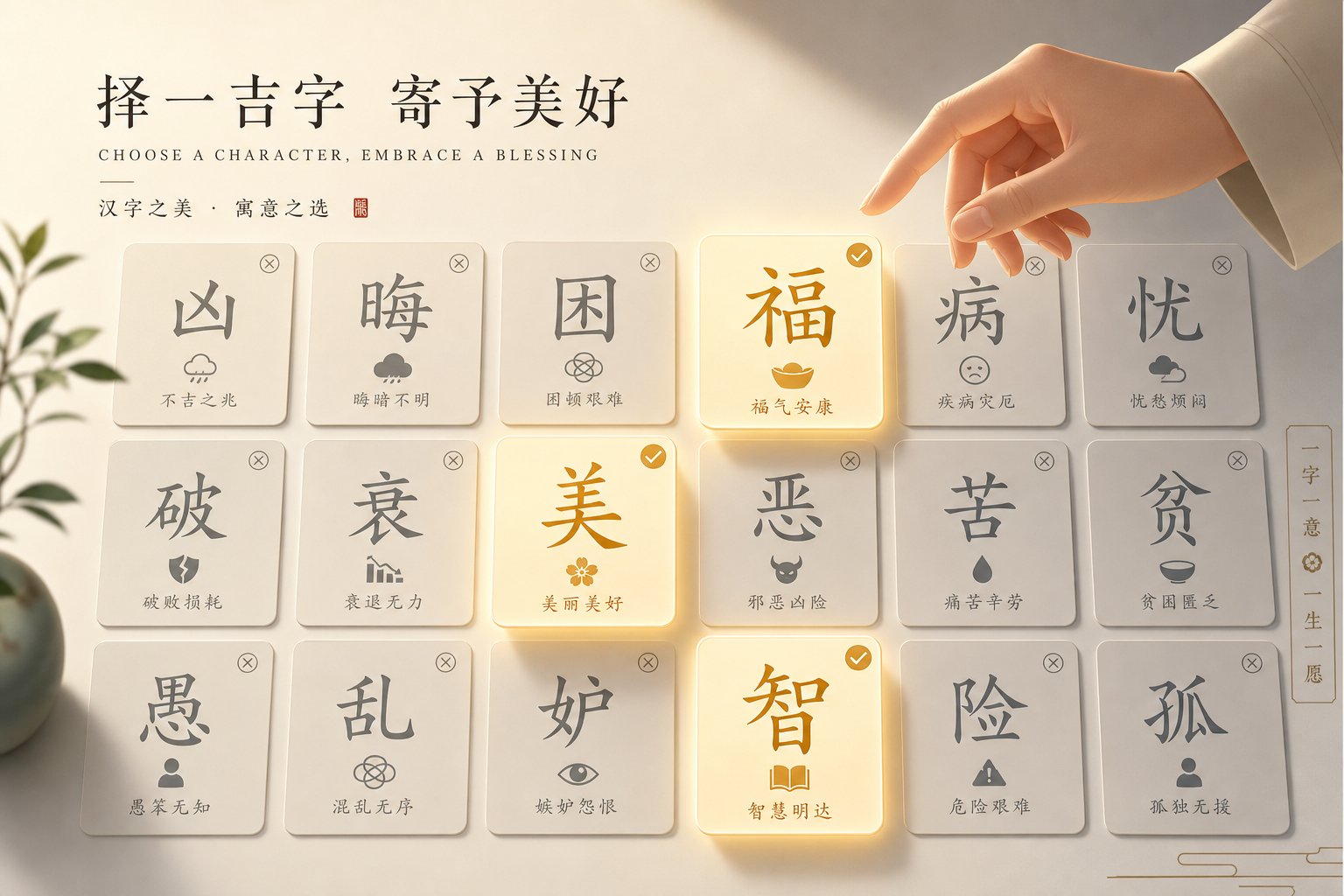
Skilled translators gravitate toward characters associated with nature, virtue, beauty, or aspiration. A character like 德 (dé, virtue) or 慧 (huì, wisdom) adds dignity. Characters like 瑞 (ruì, auspicious) or 嘉 (jiā, excellent) signal good fortune. Meanwhile, characters associated with death, illness, decline, or misfortune are strictly avoided — even when they offer a closer phonetic match.
This is not superstition. It is deeply embedded cultural practice. Chinese naming conventions also warn against characters whose pronunciation resembles unlucky words. The character 思 (sī, to think) is positive on its own, but paired with 旺 (wàng, prosperous), the combination 思旺 sounds dangerously close to 死亡 (sǐwáng, death). Sound-alike pitfalls like these make chinese name interpretation a task that requires cultural fluency, not just a pronunciation chart.
- Favorable associations: 福 (fortune), 美 (beauty), 安 (peace), 瑞 (auspicious), 慧 (wisdom), 嘉 (excellence), 龙 (dragon), 凤 (phoenix), 明 (bright), 乐 (joy)
- Unfavorable associations: 死 (death), 病 (illness), 坏 (bad), 衰 (decline), 丧 (mourning), 苦 (bitter), 败 (defeat), 毒 (poison)
- Context-dependent caution: 日 (sun — but vulgar slang in some regions), 草 (grass — vulgar in certain contexts), 四 (four — sounds like "death")
- Sound-alike traps: Any combination whose spoken form echoes negative words, regardless of individual character meanings
The best names in chinese and meanings work together seamlessly — the reader sees positive imagery while the listener hears a natural approximation of the foreign name.
Gender Considerations in Character Selection
Chinese names meaning and gender are closely linked through character choice. When translating female chinese names, translators tend to select characters featuring the female radical 女 (like 娜, graceful, or 妤, beautiful), characters related to flowers and plants (莉, jasmine; 芳, fragrance; 蓉, lotus), or characters evoking elegance and beauty (婉, gentle; 洁, pure; 秀, refined).
For chinese names male, the pattern shifts toward strength and ambition. Characters like 刚 (firm), 伟 (great), 峰 (mountain peak), 志 (ambition), and 勇 (brave) signal masculinity. Characters containing the radicals for wood (木), metal (钅), or mountain (山) also lean masculine in perception.
These are conventions, not rules. Gender-neutral names exist, and modern naming trends sometimes deliberately cross traditional boundaries. But for phonetic translation, matching gender expectations helps the translated name feel natural rather than jarring to native speakers. A name in chinese meaning "graceful jasmine" assigned to a male executive would raise eyebrows in a business context — not because it is wrong, but because it conflicts with cultural expectations.
Visual Aesthetics and Stroke Balance
One factor that surprises most Westerners: the visual appearance of characters written together matters. Chinese names are displayed on business cards, official seals, and documents where the characters sit side by side. A name combining one extremely simple character (like 一, one stroke) with one extremely complex character (like 鑫, 24 strokes) looks visually unbalanced.
Translators prefer characters with roughly similar stroke counts and complementary visual structures. A name that looks harmonious when written — whether in print or calligraphy — carries an additional layer of aesthetic appeal that has no equivalent in alphabetic writing systems. This visual dimension is subtle, but it influences how polished and intentional your translated name appears to native readers.
All of these criteria — meaning, gender, sound-alike risks, visual balance — operate simultaneously during character selection. And they produce different results depending on where in the Chinese-speaking world the translation happens. The same foreign name, run through these filters in Beijing, Taipei, and Hong Kong, can emerge looking quite different.
Regional Differences in Phonetic Name Translation
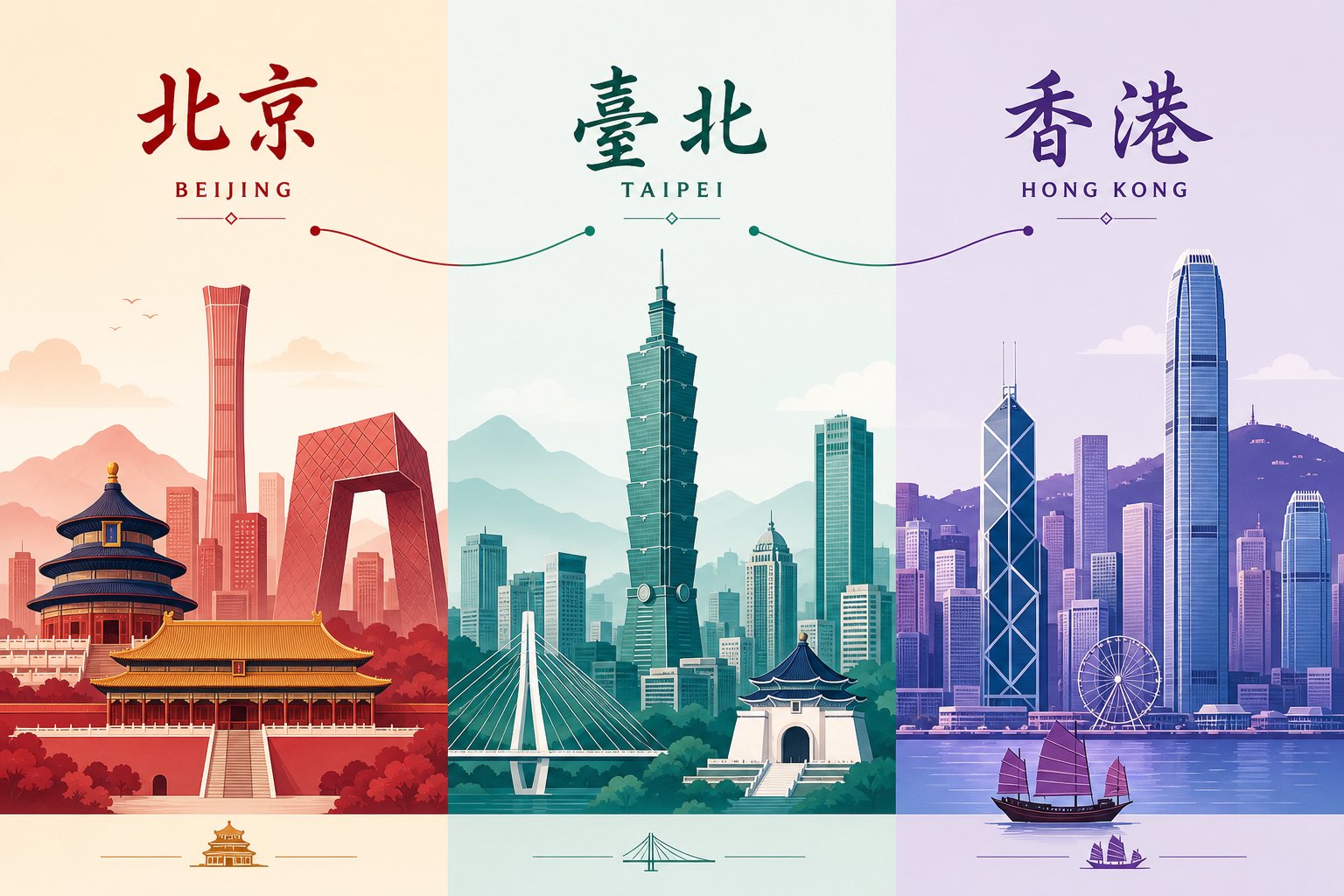
The same foreign name, filtered through Beijing, Taipei, and Hong Kong, can produce three visibly different sets of name chinese characters. This is not inconsistency — it reflects distinct transliteration standards, writing systems, and phonetic bases operating across the Chinese-speaking world. If you have ever tried to translate chinese characters to english from a Taiwanese newspaper and gotten a different result than a mainland source, regional convention is the reason.
Mainland China Standards
In the People's Republic of China, phonetic name translation is centrally standardized. The Proper Names and Translation Service of the Xinhua News Agency publishes the official reference: Names of the World's Peoples: A Comprehensive Dictionary of Names in Roman-Chinese (世界人名翻译大辞典). This dictionary controls most transcription for official media and publication across mainland China. It includes both a dictionary of common names and transcription tables for names not yet listed.
When you translate english to simplified chinese characters for a name, the mainland standard draws from a fixed set of characters chosen for phonetic clarity and neutral meaning. The system prioritizes fidelity to the source language's original pronunciation — not the English pronunciation. So a Russian name gets transliterated based on how it sounds in Russian, and a French name follows French phonetics. This principle produces results that sometimes surprise English speakers who expect their pronunciation to be the reference point.
Taiwan and Hong Kong Differences
Taiwan operates without a single centralized authority equivalent to Xinhua. Translators there often base their work on the English pronunciation of foreign names rather than the original language, and they write in english to traditional chinese characters rather than simplified ones. The result: different character choices even when the phonetic logic is similar.
Hong Kong adds another layer. Because Cantonese — not Mandarin — is the dominant spoken language, transliterations historically matched Cantonese pronunciations. A character chosen because it sounds right in Cantonese may sound quite different when read in Mandarin. Though this practice has become less common since the handover, many established translations remain in daily use. Singapore follows yet another path, with its own Translation Standardisation Committee setting standards for Chinese media.
The practical impact? A single chinese name in chinese language can look completely different depending on which region produced it. Here is how several well-known names appear across regions, drawing from documented journalistic and academic sources:
| Name | Mainland China (Simplified) | Taiwan (Traditional) | Hong Kong (Traditional) |
|---|---|---|---|
| Obama | 奥巴马 (Aobama) | 歐巴馬 (Oubama) | 奧巴馬 (Oubama) |
| Bush | 布什 (Bushi) | 布希 (Buxi) | 布殊 (Bousyu) |
| Clinton | 克林顿 (Kelindun) | 柯林頓 (Kelindun) | 克林頓 (Haklahmdeuhn) |
| Trump | 特朗普 (Telangpu) | 川普 (Chuanpu) | 特朗普 (Dahklohngpou) |
| Sydney | 悉尼 (Xini) | 雪梨 (Xueli) | 悉尼 (Siknei) |
Notice how Taiwan's version of "Trump" — 川普 (Chuānpǔ) — uses just two characters, while the mainland version 特朗普 (Tèlǎngpǔ) uses three. Taiwan's approach often favors brevity and impressionistic sound matching, while the mainland insists on capturing more phonetic detail. Hong Kong sometimes borrows the mainland's character choices wholesale, even when the local Cantonese reading no longer matches the original name closely.
These differences mean that chinese names in chinese are not universal — they are regional. If you receive a phonetic translation, it matters which standard it follows. A name crafted for mainland media may look unfamiliar to a Taiwanese audience, and vice versa. For anyone needing a chinese names english translation to verify what they have been given, knowing the source region is essential context.
Regional variation also raises a practical question: should you get one translation or several? The answer depends on where you will use the name — and whether your goal is official documentation, personal networking, or something else entirely.
Phonetic Translation vs Meaning-Based Chinese Names
Regional variation shapes how your name looks on paper — but there is an even more fundamental choice to make before worrying about which standard to follow. Should your chinese name from english name preserve the sound of your original name, or should it carry meaning that reflects your personality, values, or aspirations? These are two genuinely different approaches to translating names into chinese, and each serves a different purpose.
When Phonetic Translation Is the Right Choice
Sound-based translation works best when recognizability matters most. If someone hears your Chinese name and needs to connect it back to your original name, phonetic translation maintains that link. You will want this approach in several specific situations:
Official documents and legal contexts demand it. Passports, visa applications, and business registrations typically require a phonetic rendering so that your chinese name from english remains traceable to your legal identity. Media references follow the same logic — journalists use phonetic translations so readers can identify the person being discussed across languages.
Short-term professional interactions also favor phonetics. When you are attending a conference in Beijing or signing a contract in Taipei, a phonetic name lets Chinese-speaking counterparts recognize your name from your email signature or business card. The goal is not cultural immersion — it is practical identification.
When Meaning-Based Translation Works Better
Imagine living in Shanghai for five years, building friendships, and introducing yourself dozens of times a week. A phonetic translation that stretches to four or five syllables can feel cumbersome in daily conversation. This is where a meaning-based chinese translation for names becomes more practical.
A meaning-based name — sometimes called a "cultural name" — follows native Chinese naming conventions. It typically uses two or three characters with intentional meaning, sounds natural to native speakers, and does not signal "foreign" the way a phonetic translation does. People pursuing long-term residence, deep professional networking, or personal cultural integration often prefer this route. It signals respect for the language and a willingness to participate in Chinese naming culture on its own terms.
As naming experts note, a meaning-based name can capture qualities you admire or a new chapter in your life — strength, wisdom, grace — while fitting seamlessly into Chinese social contexts.
The Hybrid Approach
Many people discover they do not have to choose one method exclusively. The hybrid approach selects characters that approximate your name's sound while also carrying relevant meaning. A person named "Grace" might become 格蕾丝 (Géléisī) in strict phonetic translation, but could instead adopt 佳思 (Jiāsī) — where 佳 means "excellent" and 思 means "thought," yet the combined sound still echoes the original name loosely.
This method works particularly well for names that happen to overlap with existing Chinese sounds. Names like "Leo," "Anna," or "Mark" lend themselves to hybrid solutions because their phonetic components already correspond to meaningful characters. The result is an english name chinese name pairing that feels intentional rather than mechanical.
The best approach to translate name chinese depends on three factors: your purpose (legal vs. social), your context (short visit vs. long-term residence), and your personal preference for cultural integration vs. name recognition.
Still unsure which direction fits your situation? Here is a decision framework to help you name convert to chinese in the way that serves you best:
- Choose phonetic translation if: you need the name for official documents, media use, or short-term professional contexts where traceability to your original name matters most
- Choose meaning-based translation if: you are building long-term relationships in Chinese-speaking environments, want a name that sounds fully native, or prefer cultural integration over name recognition
- Choose a hybrid approach if: your original name has sounds that naturally overlap with meaningful Chinese characters, or you want both recognizability and cultural depth
- Consider having both: many people maintain a phonetic version for documents and a meaning-based version for social use — there is no rule requiring a single chinese names for english names solution
Whichever path you choose, the translation is only as good as the person — or tool — producing it. A phonetic version still needs cultural vetting for unfortunate meanings. A meaning-based version still needs to sound natural when spoken aloud. And both benefit enormously from validation by native speakers who understand the specific region where you will use the name.
How to Pronounce Chinese Names in English
Phonetic translation works in both directions. You might need a Chinese version of your name — but you also likely need to pronounce a Chinese colleague's or friend's name correctly. And here is the uncomfortable truth: English speakers mispronounce chinese names constantly, often without realizing it. The romanization system that converts Chinese characters into Latin letters — called pinyin — uses familiar letters in deeply unfamiliar ways.
Understanding Pinyin for Chinese Name Pronunciation
Pinyin was officially adopted in China in 1958 as a standardized way to represent Mandarin sounds using the Roman alphabet. It is the system behind every romanized Chinese name you encounter — from your coworker "Xiao" to the politician "Xi." The problem? Pinyin was designed for Mandarin learners, not English speakers reading at a glance. Several letters represent sounds that have no direct English equivalent.
How do you pronounce chinese names accurately? Start by recognizing that five initials cause the most confusion: x, q, zh, c, and z. These letters look familiar but produce sounds English speakers rarely associate with them. The initial "x" is not the "ks" sound of "box." It is closer to "sh" — but produced with the tongue flat and forward, pressing behind the lower teeth. The initial "q" is not the "kw" of "queen." It sounds closer to "ch" in "cheese," again with the tongue pushed forward.
The retroflex sounds — zh, ch, sh, and r — form a family. All four require curling the tongue backward. English speakers often skip this tongue position entirely, which collapses important distinctions. The Mandarin "r" in a name like "Rui" sounds nothing like the English "r" — it is closer to the "s" in "pleasure," produced with a curled tongue near the "zh" position.
Meanwhile, "c" is not the soft "s" of "city" or the hard "k" of "cat." It sounds like "ts" in "bits" — a sharp, aspirated burst. And "z" is its unaspirated partner, like "ds" in "woods." If a colleague's name starts with "Cai," you are aiming for something like "tsai," not "kai" or "sai."
Common Pronunciation Mistakes to Avoid
Knowing how to say chinese names correctly means unlearning English letter-sound associations for specific pinyin initials. The most frequent errors follow a predictable pattern: English speakers default to the sound their own language assigns to each letter. Here is a reference table showing the most commonly mispronounced initials alongside their actual Mandarin sounds:
| Pinyin Initial | English Speakers Say | Actual Sound (Approximate) | Example Name |
|---|---|---|---|
| x | "ks" (as in "box") | "sh" with tongue forward (like "she" with a smile) | Xiao, Xin, Xu |
| q | "kw" (as in "queen") | "ch" with tongue forward (like "cheese") | Qian, Qing, Qi |
| zh | "z" (as in "zoo") | "j" as in "jerk" with curled tongue | Zhang, Zhao, Zhu |
| c | "k" or "s" | "ts" as in "bits" (aspirated) | Cai, Chen, Cui |
| z | "z" (as in "zebra") | "ds" as in "woods" (unaspirated) | Zeng, Zou, Zhu |
| r | English "r" (as in "red") | French "j" (as in "jour") with curled tongue | Ren, Rui, Rong |
A few practical tips for pronouncing chinese names in everyday situations. When you see "Xi" in a name, think "shee" — not "ksee." When you see "Qian," think "chee-en" — not "kwee-an." For "Zhang," aim for "jahng" with a slightly curled tongue — not "zang." These approximations are not perfect, but they get you dramatically closer than English defaults.
One more pattern trips people up: pronunciation chinese names involves equal syllable weight rather than English-style stress. A name like "Xiaoqiao" should not become "SHAO-chow" with a heavy first syllable. Each syllable gets roughly the same emphasis, with tone — not stress — carrying the distinction. English speakers who hammer one syllable and swallow the rest make names harder for native speakers to recognize.
Getting these sounds right is a form of respect — and a complementary skill to phonetic translation. You are asking Chinese speakers to approximate your name in their sound system. Returning that effort by learning to pronounce their names accurately builds the kind of mutual regard that makes cross-cultural communication work. And if you want to go further — getting your own name translated, validated, and polished — the right tools and resources make all the difference.
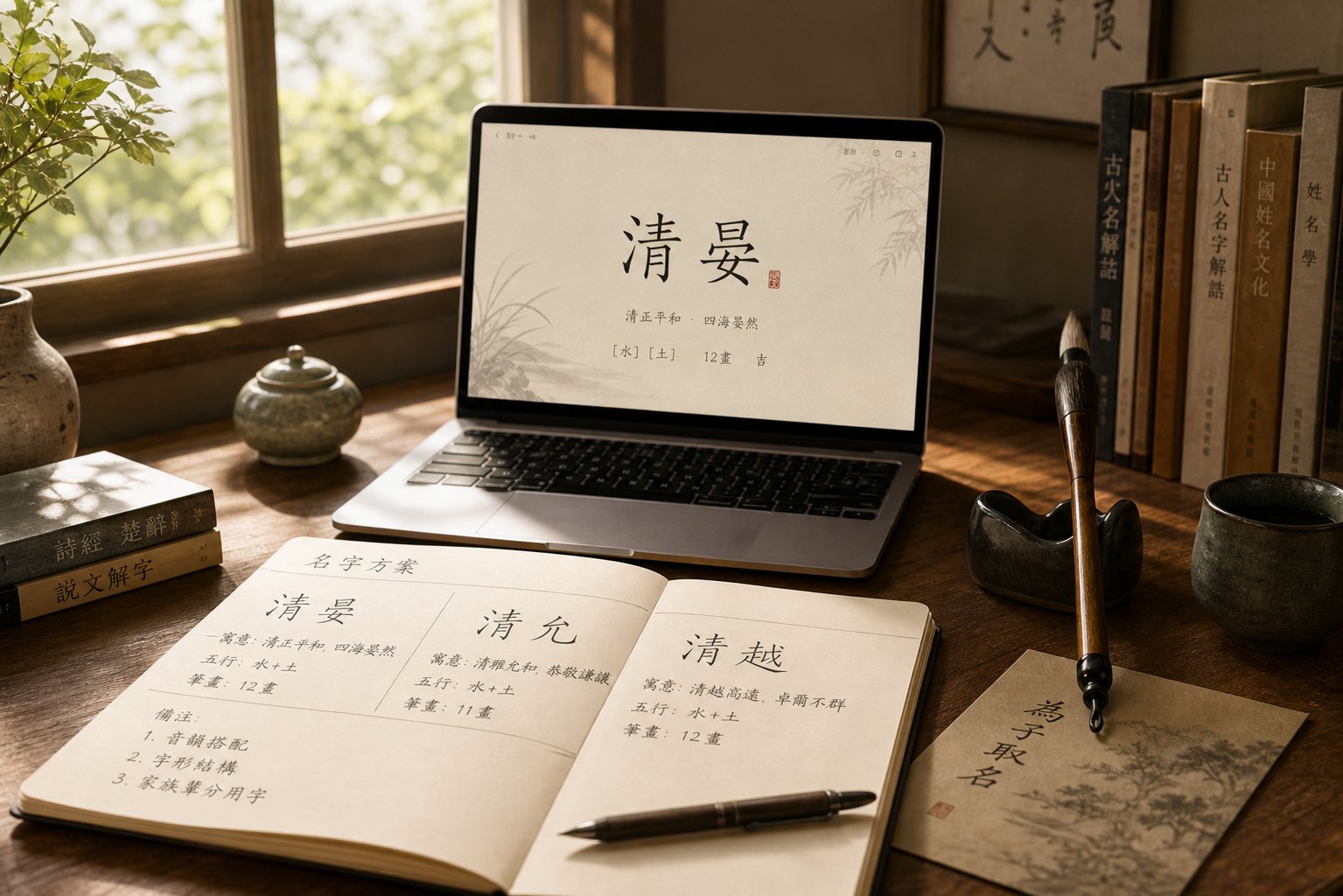
Tools and Resources for Getting Your Chinese Name
Knowing how phonetic translation works is one thing. Actually getting a name you can confidently use is another. Whether you are starting from scratch or verifying a translation someone already gave you, the quality of your source matters enormously. A phonetic match that ignores cultural nuance can leave you introducing yourself with characters that mean "wheat overcome you" instead of something dignified. So where should you turn?
Professional Translation Services and Language Schools
The most reliable path to getting my chinese name right is consulting a native speaker with expertise in naming conventions. Professional translators who specialize in Chinese bring cultural fluency that no algorithm can replicate. They understand regional standards, recognize sound-alike pitfalls, and can evaluate tonal flow in ways that require years of lived experience with the language.
Language schools with structured Chinese programs offer a particularly valuable resource. Institutions like Yoyo Chinese provide pedagogical guidance on name selection, helping learners understand not just what their translated name is, but why specific characters were chosen. Teachers at these schools can walk you through the reasoning behind each character choice — explaining the meaning, tonal considerations, and cultural associations in a way that builds your understanding of the language itself.
If you are working with a professional translator, look for someone who asks questions before providing a name. A good translator will want to know: Which region will you use this name in? Is it for official documents or social use? Do you have a gender preference for character associations? What qualities or meanings matter to you? These questions signal someone who understands that phonetic translation involves judgment calls, not just sound matching.
Using Chinese Name Generators Wisely
Online tools — from a basic chinese name generator to a more sophisticated chinese name generator male or chinese name generator female option — can feel like a convenient shortcut. Type in your English name, click a button, and receive characters. Sounds simple? It is. And that simplicity is exactly the problem.
Most automated name to chinese name converter tools work by mapping your name's syllables to a fixed set of characters using standard transliteration tables. They handle the phonetic matching step competently. What they typically miss:
- Tonal flow between characters — generators rarely optimize for pleasant melodic contour
- Sound-alike risks — automated tools may not flag combinations that resemble negative words when spoken aloud
- Regional appropriateness — a china names generator may default to mainland conventions without indicating whether the result works in Taiwan or Hong Kong
- Gender alignment — a male chinese name generator might produce technically correct phonetics using characters with feminine associations, or vice versa
- Visual balance — no algorithm evaluates whether the characters look harmonious when written side by side
Does this mean generators are useless? Not at all. They serve as a reasonable starting point — especially for common names that already have well-established translations. If you type "Jessica" into a chinese name gen tool and get 杰西卡 (Jiéxīkǎ), that matches the Xinhua standard and is perfectly serviceable for official contexts. The danger comes when people treat generator output as final without any human review.
Think of automated tools the way you would think of a first draft. They give you raw material to work with. The refinement — checking meaning, confirming tonal flow, verifying regional fit — still requires a human ear and cultural knowledge.
Validating Your Translated Name
Whether your name came from a professional translator, a language teacher, a chinese name generator female tool, or a friend who speaks Mandarin, validation is the step most people skip. And it is the step that prevents embarrassment.
Here is a practical checklist. Apply these criteria to any phonetic name translation you receive before committing to it:
- Check individual character meanings: Look up each character separately. Confirm none carry negative, vulgar, or death-related associations. A character that seems neutral in isolation might be problematic in your specific combination.
- Say it aloud to multiple native speakers: Ask at least two or three people from your target region to read the name aloud. Watch their facial expressions. Hesitation, a suppressed smile, or a raised eyebrow tells you something is off — even if they are too polite to say so directly.
- Confirm it sounds like a name: Native speakers should immediately recognize your translation as a name (foreign or Chinese) rather than a random string of characters. If someone reads it and asks "What does this mean?" rather than "How do you pronounce your original name?" — the phonetic function is not clear enough.
- Verify regional consistency: If you plan to use the name in mainland China, confirm it follows simplified character conventions. For Taiwan, check that traditional characters are used and the phonetic choices align with local preferences.
- Test the tonal contour: Ask a native speaker whether the tone sequence sounds natural or awkward. Three consecutive fourth-tone characters, for example, can sound aggressive. A mix of tones typically flows better.
- Check for unintended homophones: Read the full name aloud quickly. Does it accidentally sound like a common word, phrase, or idiom? This is the sound-alike trap that catches even experienced translators.
- Evaluate visual appearance: Write or print the characters together. Do they look balanced in terms of stroke complexity? An extremely simple character next to an extremely complex one can appear visually jarring on a business card or document.
One detail people overlook: memorability research suggests that names with characters under 10 strokes each, clear positive meanings, and natural tonal rhythm are significantly easier for native speakers to remember. If your translated name fails on memorability, it may be technically correct but practically ineffective — people will struggle to recall it after a single introduction.
The validation process does not need to be exhausting. A five-minute conversation with two native speakers, combined with a quick dictionary check of each character, catches the vast majority of problems. The small investment of time prevents the much larger cost of using a name that makes Chinese speakers uncomfortable — or worse, amused — every time they hear it.
With the right resources and a validated result in hand, the final question becomes practical: how do you actually put your phonetic Chinese name to work in the specific context where you need it?
Making Your Phonetic Chinese Name Work for You
You have the knowledge. You understand how syllables map, how characters carry meaning, how regions differ, and how validation works. The question "how can i write my name in chinese" no longer feels mysterious — it feels like a series of deliberate, informed choices. So what do you do with all of this?
Key Principles to Remember
Phonetic translation is a creative process, not a mechanical one. Every step involves trade-offs between sound accuracy, tonal flow, character meaning, visual aesthetics, and cultural context. There is no single "correct" answer to how do you write your name in chinese — there are better and worse answers depending on your purpose, your audience, and the region where you will use the name. Treat the process with the same care a Chinese parent would give to naming a child: thoughtfully, with attention to how the name sounds, reads, and feels.
The best phonetic Chinese name is one that sounds natural to Chinese speakers while remaining recognizable to the name's owner. If native speakers can say it comfortably and you can still hear your identity in it, the translation has done its job.
Your Next Steps Based on Your Goal
Your path forward depends on what you need. Here is tailored guidance based on the most common situations people face when figuring out how to write name in mandarin:
- For official documents and travel: Use the Xinhua standard transliteration. Look up your name in the Names of the World's Peoples dictionary or consult a professional translator familiar with mainland conventions. Consistency across documents matters more than creativity here.
- For building relationships in Chinese-speaking contexts: Invest in a culturally vetted name — phonetic, meaning-based, or hybrid. Have it validated by native speakers from your target region. Practice saying my name is in mandarin until the introduction feels natural and confident.
- For academic or professional research: Understand that how to spell name in chinese varies by region, era, and source language. Cross-reference multiple standards and note which convention each source follows.
However you approach it, remember that learning how to say my name is in mandarin is more than a linguistic exercise. It is an act of cultural bridge-building. The effort you put into getting your name right signals respect — and that respect gets returned. Approach the process with curiosity, verify your result with real people, and wear your Chinese name with the same confidence you bring to your original one.
Frequently Asked Questions About Phonetic Translation of Chinese Names
1. Why does my name sound different when translated into Chinese?
Mandarin Chinese has only about 400 unique syllables (around 1,200 with tones), compared to thousands of possible syllable combinations in English. Chinese syllables almost always end in a vowel, 'n,' or 'ng,' so consonant clusters like 'str' or 'nk' must be broken apart and padded with vowels. This means your translated name will often contain more syllables than the original and will inevitably sound different because it has been reshaped to fit within Mandarin's fixed phonetic grid.
2. Is there one correct way to write my name in Chinese characters?
No. The same foreign name can have multiple valid Chinese translations depending on the region (Mainland China, Taiwan, or Hong Kong), the intended use (official documents vs. social settings), and the translator's character choices. Mainland China follows Xinhua News Agency standards, Taiwan often uses different characters based on local preferences and traditional script, and Hong Kong historically incorporates Cantonese phonetics. Each version is legitimate within its own context.
3. Should I use a phonetic translation or a meaning-based Chinese name?
It depends on your purpose. Phonetic translation preserves recognizability and is preferred for official documents, media references, and short-term professional interactions. Meaning-based names sound more natural to native speakers and work better for long-term residence, deep networking, or cultural integration. A hybrid approach that approximates your name's sound while carrying positive meaning offers a middle ground. Many people maintain both versions for different contexts.
4. How do I know if my Chinese name has a bad meaning?
Check each character's meaning individually using a Chinese dictionary, then say the full name aloud to at least two or three native speakers from your target region. Watch for hesitation or suppressed reactions. Also check whether the combined syllables accidentally sound like negative words or phrases when spoken quickly. Characters associated with death, illness, or misfortune should be avoided, and sound-alike traps where positive characters together resemble negative words are a common pitfall.
5. Can I trust online Chinese name generators for an accurate translation?
Online generators handle basic phonetic matching competently and work well as a starting point, especially for common names with established standard translations. However, they typically miss tonal flow optimization, sound-alike risks, regional appropriateness, gender alignment in character choice, and visual balance. Treat generator output as a first draft and always validate the result with native speakers who can assess cultural nuance and natural pronunciation.