What Is Pinyin and Why Its Name History Matters
Imagine searching for a historical Chinese figure and finding two completely different spellings of the same person. Chou En-lai in one book, Zhou Enlai in another. Same individual, same characters, yet the Latin-script versions look nothing alike. This is the direct result of how Chinese names have been romanized across different eras, and it affects millions of records in libraries, news archives, and government databases worldwide.
The story of pinyin name history operates on two levels. First, there is the history of the word "pinyin" itself and the system it represents. Second, there is the broader timeline of how Chinese personal names have been spelled in Latin letters over centuries of contact between China and the West. Both threads are deeply intertwined.
What Pinyin Name History Actually Means
So what is pinyin, exactly? At its core, the pinyin system is a method for representing Mandarin Chinese pronunciation using the Latin alphabet. The term carries its purpose right in its name:
Pinyin (拼音) literally means "spell sound" — 拼 (pin) means to assemble or spell, and 音 (yin) means sound. It is a phonetic tool for transcribing Chinese characters, not a replacement for them.
The relationship between Chinese and pinyin is functional rather than competitive. Chinese characters remain the written language. Pinyin serves as a bridge, giving non-Chinese readers a way to pronounce names and words they would otherwise have no access to. People sometimes misspell it as "pinyum," but regardless of how you encounter the term, the concept stays the same: a standardized system for spelling Chinese sounds in Latin letters.
Why Romanization of Chinese Names Matters
Before pinyin became the global standard, Western writers used a patchwork of older romanization systems to spell Chinese names. Each system produced different results for the same characters. The surname 周 appeared as "Chou" under one system and "Zhou" under another. Multiply that inconsistency across thousands of names and several centuries, and you get a tangled web of duplicate identities scattered through Western records.
This matters because names are how we locate people in history. When the same person appears under multiple spellings, research becomes harder, citations break down, and cultural understanding suffers. The shift to a single standardized system did not happen overnight, and the systems that came before pinyin left a lasting imprint on how Chinese names appear in English to this day.
The Origin and Meaning of the Term Pinyin
A name that literally describes what it does — that is rare for any system, let alone one that reshaped global communication. The word "pinyin" was not chosen at random. It was selected precisely because it telegraphs the system's purpose in two syllables, drawing directly from the logic embedded in the Chinese writing system itself.
The Literal Meaning Behind the Word Pinyin
Break the term apart and you'll see how transparent it is. The first character, 拼 (pin), means to assemble, combine, or spell. The second, 音 (yin), means sound. Together, they form a compound that translates roughly to "spell sound" or "assembled sounds." The name tells you exactly what the system does: it assembles Latin letters to represent the sounds of spoken Chinese.
The full official name goes further. "Hanyu Pinyin" (汉语拼音) adds a critical qualifier. 汉语 (Hanyu) means "the language of the Han people" — essentially, Mandarin Chinese. This distinction matters because China is home to dozens of regional languages and dialects. The hanyu pinyin system was designed specifically for standard Mandarin pronunciation based on the Beijing dialect, not for Cantonese, Shanghainese, or any other variety. That specificity is baked right into the name.
Why does this matter for understanding Chinese transliteration more broadly? Because pinyin does not attempt to be a universal tool for all Chinese languages. It targets one standardized spoken form and maps it onto Latin letters. Every other variety of Chinese — and there are many — falls outside its scope, which is partly why Hong Kong and parts of southern China still use alternative romanization systems for personal names.
Hanyu Pinyin vs Other Names for the System
The committee that developed pinyin in the 1950s did not work in a vacuum. Several earlier romanization systems had already attempted to solve the same problem, each under its own name and with its own philosophy. When the People's Republic chose "Hanyu Pinyin" as the label for its new standard, it was deliberately distinguishing the system from these predecessors:
- Latinxua Sin Wenz (拉丁化新文字, "Latinized New Script") — developed in the Soviet Union in the early 1930s by Chinese and Russian scholars, this system was intended to fully replace Chinese characters and notably omitted tone markings entirely
- Gwoyeu Romatzyh (国语罗马字, "National Language Romanization") — created in the 1920s by linguist Yuen Ren Chao, this system used complex spelling variations to indicate tones rather than diacritical marks
- Zhuyin Fuhao / Bopomofo (注音符号) — a phonetic notation system using symbols derived from Chinese characters rather than Latin letters, still used in Taiwan today
- Wade-Giles — the dominant Western academic romanization from the late 19th century, named after its British creators rather than any Chinese term
Each of these systems carried ideological weight in its naming. Latinxua Sin Wenz emphasized revolution and modernity. Gwoyeu Romatzyh stressed national identity. The choice of "pinyin" — plain, descriptive, functional — reflected the PRC's goal of creating a practical tool rather than a political statement. As historian James Carter notes, the committee spent years debating whether to base the system on Latin letters, Cyrillic, or characters derived from Chinese script before settling on the Latin alphabet.
One crucial point often gets lost in discussions of the Chinese character system: pinyin was never meant to replace characters. Earlier systems like Latinxua Sin Wenz had that explicit goal, and prominent figures from Lu Xun to Mao Zedong himself flirted with the idea of abolishing characters entirely. But by the time pinyin was finalized, the PRC had formally abandoned character replacement. Pinyin would serve as an auxiliary — a pronunciation guide, a tool for literacy education, and a standard for international communication of Chinese names and words.
That decision shaped everything that followed. Because pinyin exists alongside characters rather than instead of them, it functions as a bridge between the Chinese writing system and the Latin alphabet. It gives each Chinese character a standardized spelling in Roman letters without claiming to capture meaning, context, or the visual richness of the original script. For personal names, this means pinyin provides a single consistent way to write any Chinese name for international use — a consistency that the competing systems before it never achieved.

Romanization Systems That Came Before Pinyin
That consistency pinyin eventually delivered? It took nearly four centuries of trial and error to get there. Before the 1950s, anyone trying to write a Chinese name in Latin letters had to pick from a confusing lineup of competing systems — each one producing a different spelling for the same characters. The result was a historical record riddled with duplicate identities, misattributions, and names that looked completely unrelated yet referred to the same person.
You might wonder: if there is no alphabet in Chinese language in the traditional sense, how did Westerners even begin to spell Chinese names? The answer lies in a long chain of improvisation, starting with European missionaries who needed to communicate Chinese sounds to readers back home.
Missionary Era Romanizations and Early Attempts
The first serious attempt at a consistent romanization system came from Jesuit missionaries in the late 16th century. Matteo Ricci and Michele Ruggieri developed a Portuguese-Chinese dictionary between 1583 and 1588, creating what is thought to be the earliest European system for transcribing Chinese words in Latin letters. Their manuscript was lost in the Jesuit Archives in Rome and not rediscovered until 1934.
By 1598, Ricci and his colleague Lazzaro Cattaneo had compiled a second dictionary that even used diacritical marks to indicate tones — a remarkably sophisticated approach for the era. Other missionaries followed with their own systems: Nicolas Trigault published his romanization in 1626, and Francisco Varo expanded on it in the 1670s and 1680s.
The problem? Each missionary created a system tailored to their own European language. A Portuguese priest romanized Chinese sounds differently than a French one, who romanized differently than an Italian one. There was no coordination, no standard, and no agreement on what are chinese letters called in Latin script or how they should be represented. The same Chinese surname could appear three or four different ways depending on which missionary's dictionary you consulted.
Wade-Giles and Postal Romanization Systems
The first system to gain widespread acceptance came from British diplomat Thomas Francis Wade in 1859. Wade created his romanization for the British Consular Service, and it was later revised and improved by sinologist Herbert Giles in 1892. The resulting Wade-Giles system became the dominant method for romanizing Chinese in English-language scholarship for nearly a century.
Wade-Giles used apostrophes to distinguish aspirated consonants (p' vs. p, t' vs. t, k' vs. k) and superscript numbers to mark tones. It was systematic, but its heavy reliance on punctuation marks made it cumbersome — and those apostrophes were frequently dropped in casual use, creating further ambiguity.
Meanwhile, a parallel system emerged for a very different purpose. Postal romanization, formally standardized at a conference in Shanghai in 1906, was designed specifically for place names on mail. Administered by the French-led Chinese Imperial Post, it blended traditional spellings, local dialect pronunciations, and the "Nanking syllabary" — a system based on Nanjing pronunciation rather than Beijing's. This is why we got "Peking" instead of "Beijing" and "Canton" instead of "Guangzhou." The postal system prioritized existing usage and local identity over phonetic consistency.
Then came two more Chinese-developed systems. Zhuyin Fuhao (Bopomofo), published in 1918, used symbols derived from Chinese characters rather than Latin letters — essentially creating a phonetic notation system for domestic use. And in 1928, a committee of five scholars including the brilliant linguist Zhao Yuanren (Yuen Ren Chao) produced Gwoyeu Romatzyh, which encoded tonal information directly into the spelling of each syllable. Clever in theory, but so complex that it never gained popular traction.
The Confusion of Multiple Competing Systems
Imagine trying to research a single Chinese historical figure and encountering their name spelled differently in every source. That was the reality for Western scholars, journalists, and librarians dealing with Chinese names before pinyin. People searching for the abc's in chinese romanization — some basic, consistent way to render Chinese sounds — found instead a maze of overlapping conventions.
The question "how many letters in the chinese alphabet" misses the point entirely, because Chinese does not use an alphabet. But the various romanization systems each imposed their own logic on Chinese sounds, and none of them agreed. To make this concrete, here is how the same Chinese names appeared under different systems:
| Chinese Characters | Missionary Era (approx.) | Wade-Giles | Postal Romanization | Gwoyeu Romatzyh | Pinyin |
|---|---|---|---|---|---|
| 周 (surname) | Cheu / Tcheou | Chou | Chow | Jou | Zhou |
| 北京 (Beijing) | Pe-king | Pei-ching | Peking | Beejing | Beijing |
| 毛泽东 | — | Mao Tse-tung | — | Mau Tzerdong | Mao Zedong |
| 广州 (Guangzhou) | Quang-tcheou | Kuang-chou | Kwangchow / Canton | Goangjoou | Guangzhou |
| 南京 (Nanjing) | Nan-king | Nan-ching | Nanking | Nanjing | Nanjing |
| 邓 (surname) | — | Teng | Tang / Teng | Deng | Deng |
Look at the surname 周 alone: five different systems produced five different spellings. For anyone trying to search abc in chinese name records or cross-reference historical documents, this was a nightmare. A researcher looking for "Chou" in one archive might completely miss the same person filed under "Zhou" or "Chow" in another. The concept of letters in het chinees — rendering Chinese in a Latin-letter format — had no single agreed-upon answer.
How many letters in china alphabet? Zero, technically. Chinese uses characters, not letters. But the romanization systems each tried to map roughly 400 distinct Mandarin syllables onto Latin letters, and they disagreed on nearly every mapping. Wade-Giles used "ch'" where pinyin uses "q." Postal romanization kept archaic spellings like "Tsingtao" where pinyin gives us "Qingdao." Gwoyeu Romatzyh changed vowels to indicate tone, making the same syllable look like four different words.
This accumulated confusion was not merely an academic inconvenience. It affected diplomacy, trade, journalism, and personal identity. By the mid-20th century, the need for a single, internationally recognized standard had become undeniable — and that pressure would fall on the shoulders of an unlikely economist-turned-linguist named Zhou Youguang.
How Zhou Youguang Created the Pinyin System
Zhou Youguang was not a linguist by training. He studied economics in Shanghai and later worked as a banker on Wall Street. When he returned to China after the communist victory in 1949, his expertise lay in finance and international trade — not phonetics. Yet it was precisely this outsider perspective that made him ideal for the task ahead. The government needed someone who understood standardization as a practical problem, not just an academic one.
Zhou Youguang and the Pinyin Committee
In 1955, the newly formed Committee for the Reform of the Chinese Written Language recruited Zhou to lead a team tasked with creating a romanization system for Mandarin. The committee spent three years developing what would become Hanyu Pinyin. As Zhou later told the BBC, "People made fun of us, joking that it had taken us a long time to deal with just 26 letters."
Those three years were not spent idly. The committee debated fundamental questions: Should the system use Latin letters, Cyrillic script, or entirely new symbols derived from Chinese characters? Zhou argued for the Latin alphabet on practical grounds — it was already the most widely used script in international communication, and adopting it would make Chinese names immediately accessible to the rest of the world. The PRC State Council agreed, and on February 11, 1958, pinyin was officially adopted as the national standard for romanizing Mandarin Chinese.
So when was pinyin invented? The formal answer is 1958, but the development work stretched from 1955 to 1957, with Zhou's committee drawing on decades of earlier romanization experiments. They did not start from scratch. They studied the strengths and failures of Wade-Giles, Gwoyeu Romatzyh, Latinxua Sin Wenz, and even the Yale system to build something better.
Design Decisions That Shaped How Names Are Spelled
Zhou's background as an economist shows in the system's design philosophy: maximum clarity with minimum complexity. The committee settled on 23 initials and 36 finals — a compact set that covers all possible Mandarin syllables. If you look at a complete pinyin chart or pinyin table, you'll notice that every combination maps to exactly one sound. No ambiguity, no overlapping spellings.
Several specific choices directly affected how Chinese names would appear internationally:
- Letters like Q, X, and Zh — The committee repurposed Latin letters that had no standard use in representing Chinese sounds. "Q" represents the aspirated palatal affricate (as in the zhou pronunciation "Qi"), while "X" handles the voiceless palatal fricative. These choices look unfamiliar to English speakers but eliminated the apostrophes and hyphens that cluttered Wade-Giles.
- Tone marks over vowels — Rather than encoding tones into spelling (as Gwoyeu Romatzyh did) or using superscript numbers (as Wade-Giles did), the committee adopted diacritical marks borrowed from the Yale system: macron, acute, caron, and grave (ā, á, ǎ, à). For personal names in international contexts, these chinese tones marks are often dropped — but the underlying spelling stays consistent regardless.
- One syllable, one spelling — Unlike earlier systems where the same sound could be written multiple ways depending on context, pinyin assigns exactly one romanization to each syllable. The surname 周 is always "Zhou." Never "Chou," never "Jou," never "Chow." This one-to-one mapping was the single most important decision for standardizing Chinese names globally.
Zhou Youguang's practical instincts shaped these choices at every turn. He understood that a romanization system for international use had to work for people who would never study Chinese linguistics. It had to be learnable, typeable on a standard keyboard, and unambiguous enough that a passport officer in Paris or a librarian in New York could handle a Chinese name without specialized training.
Before pinyin, 85% of Chinese people could not read. The system was designed primarily as a literacy tool — a way to teach pronunciation of characters to children and adults alike. But its secondary purpose, standardizing Chinese names for the outside world, would prove equally transformative. The real test came not in Chinese classrooms but in Western newsrooms, where decades of entrenched Wade-Giles spellings would have to give way to an entirely new set of names.

The Great Name Switch From Wade-Giles to Pinyin
That test arrived faster than anyone expected. Within two decades of pinyin's adoption inside China, Western newsrooms faced a stark choice: keep using the old Wade-Giles spellings their readers recognized, or switch to the system China itself now used for all international communication. The transition that followed reshaped how millions of Chinese names appeared in English — and left a trail of confusion that persists in archives to this day.
When Western Media Switched to Pinyin Names
The tipping point came on January 1, 1979. On that date, the People's Republic of China formally mandated that all official communications with foreign countries use pinyin romanization. The Foreign Ministry, the state press agency Xinhua, and all government publications switched overnight. Dispatches that had referred to "Teng Hsiao-ping" now read "Deng Xiaoping." References to "Mao Tse-tung" became "Mao Zedong."
Western media organizations could not ignore this shift. The New York Times announced in February 1979 that it would adopt pinyin spelling effective March 5 of that year, noting that the system "in most cases comes closer than other forms" to actual Chinese pronunciation. The paper delayed its switch by two months specifically to allow cross-referencing of names in its clipping files, picture archives, and computerized Information Bank — an early acknowledgment of the duplicate identity problem the change would create.
The Associated Press and Reuters followed with their own style guide changes in the same period. By the early 1980s, virtually every major English-language news organization had made the switch. The United Nations had already adopted pinyin, and the United States Board on Geographic Names had approved it for government use. The old spellings were not wrong, exactly — but they were now officially outdated.
One telling detail: even as they adopted pinyin, most publications retained a handful of deeply rooted conventional names. The New York Times kept "Peking" and "Canton" because, as the paper explained, these were "deeply rooted in English usage." This selective approach — converting chinese to pinyin for most names while preserving a few legacy spellings — created its own layer of inconsistency that took years to fully resolve.
Before and After Examples of Famous Name Changes
For readers who lived through this transition, the experience was disorienting. One day you were reading about Teng Hsiao-ping's economic reforms; the next, the same leader appeared as Deng Xiaoping. The person had not changed. The characters had not changed. Only the pinyin to english rendering shifted — but it shifted dramatically enough that casual readers sometimes thought they were reading about different people entirely.
Here is how the most prominent Chinese figures appeared before and after the switch:
| Chinese Characters | Wade-Giles Spelling | Pinyin Spelling | Notes |
|---|---|---|---|
| 毛泽东 | Mao Tse-tung | Mao Zedong | Surname unchanged; given name spelling shifted significantly |
| 周恩来 | Chou En-lai | Zhou Enlai | Both surname and given name changed |
| 邓小平 | Teng Hsiao-ping | Deng Xiaoping | Initial consonant and given name both transformed |
| 朱德 | Chu Teh | Zhu De | Every letter changed except the vowels |
| 林彪 | Lin Piao | Lin Biao | Surname stayed the same; given name shifted |
| 刘少奇 | Liu Shao-ch'i | Liu Shaoqi | Apostrophe and hyphen eliminated |
| 华国锋 | Hua Kuo-feng | Hua Guofeng | Initial K became G; hyphen removed |
| 孙中山 | Sun Chung-shan | Sun Zhongshan | Often still known internationally as Sun Yat-sen (Cantonese) |
Notice the pattern. Wade-Giles used hyphens to separate syllables in given names, while pinyin joins them together. Wade-Giles relied on aspirated/unaspirated pairs (T/T', K/K', Ch/Ch') that pinyin replaced with entirely different letters (D/T, G/K, Zh/Ch). For anyone trying to convert pinyin to chinese characters or trace a name back to its original form, these differences are systematic — but they are not intuitive without training.
The New York Times acknowledged this difficulty directly, noting that pinyin "uses some letters, such as 'q' and 'x,' in ways that are not readily interpreted by the English speaker." A Politburo member whose name had been spelled Hsu Hsiang-chien became Xu Xiangqian — a form the paper admitted was "unlikely to ease pronunciation for those unfamiliar with the new style."
The Duplicate Identity Problem in Western Records
Here is where the real damage accumulated. When news organizations switched their style guides, they changed how they spelled names going forward. But they did not — could not — go back and revise every article, index entry, and citation already published under the old system. The result? The same historical figure now existed under two different spellings in the same archive.
Search for "Chou En-lai" in a newspaper database and you'll find articles from before 1979. Search for "Zhou Enlai" and you'll find articles from after. A researcher unfamiliar with both systems might never connect the two. This problem multiplied across every institution that maintained records of Chinese names: universities, government agencies, immigration offices, and especially libraries.
The Library of Congress Pinyin Conversion Project tackled this challenge head-on, but not until the year 2000 — more than two decades after the media switch. The project required converting all Chinese-language bibliographic records from Wade-Giles to pinyin in the RLIN database, a process that took months of automated conversion followed by extensive human review. The old Wade-Giles forms were retained as cross-references so that searches under either system would still return results.
Even with cross-referencing, the conversion was not seamless. As Yale University's library guide notes, well-established personal names in Wade-Giles were sometimes left unconverted — figures like Chiang Ching-kuo and Lee Teng-hui retained their older spellings because those forms had become their recognized international identities. The conversion from chinese to mandarin pinyin was systematic in theory but riddled with exceptions in practice.
The Library of Congress also had to address a subtler issue: non-Chinese bibliographic records that referenced Chinese names. An English translation of a novel by the author known as "Mao Tun" (Wade-Giles) needed its author heading updated to "Mao Dun" (pinyin), and the uniform title of the work changed accordingly. Every cross-reference, every subject heading, every classification number that contained a romanized Chinese term had to be evaluated individually.
Academic citations posed their own headaches. A scholar who published under "Chou" in the 1970s might publish under "Zhou" in the 1990s — same person, same research lineage, but citation databases treated them as two separate authors. Conference proceedings, journal indexes, and dissertation records all carried these ghost duplicates. The pinyin to chinese lookup was straightforward for specialists, but general-purpose databases had no built-in mechanism to reconcile the two systems.
This mass renaming event was unprecedented in modern media history. No other language reform had forced Western institutions to simultaneously update millions of proper nouns across every domain of record-keeping. The transition revealed just how deeply a romanization system embeds itself into institutional infrastructure — and how disruptive it becomes when that system changes. The names themselves were never in question. Only the rules for writing them shifted. But rules, once embedded in bureaucratic systems, take on a life of their own.
Official Rules for Writing Chinese Names in Pinyin
Rules embedded in bureaucratic systems take on a life of their own — but what happens when the rules themselves are unclear? The 1958 adoption of pinyin gave China a phonetic standard, yet it left a surprising number of formatting questions unanswered. How do you spell chinese names when the given name has two characters? Do you capitalize both parts? Hyphenate them? Join them into one word? These seemingly minor details created decades of inconsistency before formal standards finally caught up.
Government Standards for Pinyin Name Formatting
When the PRC State Council approved pinyin in 1958, the primary focus was literacy and pronunciation — not the fine points of how personal names should appear on passports or in international databases. The system told you how to spell in chinese words using Latin letters, but it did not immediately codify every formatting rule for proper nouns.
That gap persisted for decades. It was not until 2012 that China issued GB/T 28039, a national standard titled "Rules for Chinese Phonetic Alphabet Spelling of Personal Names." This document finally consolidated the scattered guidelines into a single authoritative reference. The core rules it established are straightforward once you know them:
- Surname and given name are written as two separate words — the surname comes first, followed by the given name as a single unit. Example: 王秀英 becomes "Wang Xiuying," not "Wang Xiu Ying" or "Wangxiuying."
- Both surname and given name are capitalized — only the first letter of each word gets a capital. Example: "Zhang Weiguo," not "Zhang WeiGuo" or "ZHANG WEIGUO" (though all-caps appears on some passports for machine readability).
- Two-character given names are written together without a hyphen or space — this is the official mainland standard. "Xiaoping," not "Xiao-ping" or "Xiao Ping."
- Compound surnames stay as one unit — names like 司马 (Sima) or 欧阳 (Ouyang) are not split. Example: "Sima Qian," not "Si Ma Qian."
- Tone marks are included in formal contexts but often omitted in practice — the á pronunciation mark (second tone) and other diacriticals appear in dictionaries and textbooks but are routinely dropped on passports and official IDs.
That last point creates a practical problem. Without tone marks, dozens of Chinese names become homographs — identical spellings representing completely different characters. The name "Li Wei" could correspond to at least a dozen distinct character combinations. GB/T 28039 acknowledges this limitation but does not resolve it, treating tone marks as optional for international documents.
The Surname-First vs Given-Name-First Debate
Chinese names naturally place the surname first: 毛泽东 is Mao (surname) Zedong (given name). This order is preserved when converting chinese to han yu pin yin — the romanized form keeps the same sequence as the original characters. But Western naming conventions expect given name first, surname last. Which order should pinyin names follow in international contexts?
The PRC's position has always been clear: surname first. Chinese passports list the surname (姓) and given name (名) in separate fields, both in pinyin, maintaining the traditional order. Government communications, academic publications from mainland institutions, and Xinhua press dispatches all follow this convention. Western publications generally preserve this order for mainland Chinese names, unlike the treatment of Japanese names, which are typically reversed in English.
The confusion arises when Chinese individuals move between systems. A person named Zhang Wei might appear as "Zhang Wei" in Chinese documents but "Wei Zhang" on a Western university enrollment form. Some individuals adopt the Western order permanently when living abroad; others insist on the Chinese order. There is no universal rule — only competing conventions that depend on context.
ISO 7098 and International Name Standards
ISO 7098, first published in 1982 and most recently updated in 2015, provides the international framework for romanizing Chinese. Developed by ISO Technical Committee 46 (Information and Documentation), it formally endorses Hanyu Pinyin as the standard romanization system for Modern Chinese Putonghua. The standard applies to bibliographies, catalogues, indices, and toponymic lists — essentially any context where Chinese names appear in international documentation.
ISO 7098 addresses the name-order question by deferring to Chinese convention: surnames precede given names. It also confirms that given names composed of two characters should be written as a single word with no separator. These rules align with GB/T 28039, giving international institutions a clear reference point.
In practice, the standard's influence shows up in unexpected places. Library cataloging systems worldwide follow ISO 7098 when creating authority records for Chinese authors. International airline ticketing systems use pinyin for Chinese passport holders. Academic journals that publish Chinese scholars' work rely on these formatting rules to maintain consistency across citations.
Yet compliance remains uneven. Many Chinese citizens, unfamiliar with the spacing rules because Chinese script itself uses no spaces, instinctively put a gap between each character of their given name when filling out English-language forms. A person named 王秀英 might write "Wang Xiu Ying" — three words instead of two — leading foreign systems to misidentify "Xiu" as a middle name. This small formatting error cascades through databases, creating yet another layer of the identity fragmentation that pinyin was supposed to eliminate.
The gap between official rules and everyday practice reveals something important about standardization: publishing a rule is not the same as enforcing it. Decades after pinyin's adoption, the formatting of Chinese names in international contexts remains a negotiation between Chinese conventions, Western expectations, and the limitations of bureaucratic systems that were never designed to handle names from a fundamentally different linguistic tradition.

Taiwan, Hong Kong, and the Politics of Name Spelling
That negotiation between conventions becomes far more charged when national identity enters the equation. On the Chinese mainland, pinyin is simply the standard — no debate required. But in Taiwan, Hong Kong, and diaspora communities, the question of how to romanize a Chinese name carries political weight that goes well beyond phonetics. Choosing a romanization system is, in these contexts, choosing a side.
Taiwan and the Tongyong Pinyin Controversy
Taiwan's romanization history reads like a political thriller. For decades, most Taiwanese proper names — both people and places — were written in a simplified version of Wade-Giles that dropped diacritics, tone marks, and apostrophes. The system was never formally mandated for personal names; it simply became the default because government reference materials used it. Former president Lee Teng-hui's surname, for instance, would be "Li" in any major romanization — but "Lee" stuck because that is what his documents said.
The real fight erupted in 2002 when Taiwan's government officially adopted Tongyong Pinyin, a system designed to be roughly 85% identical to Hanyu Pinyin but with deliberate differences for sounds unique to Taiwanese Mandarin. The choice was explicitly political. Supporters argued that adopting Beijing's Hanyu Pinyin wholesale would signal subordination to the PRC. Opponents countered that Tongyong created unnecessary confusion for international travelers and scholars already familiar with the global standard.
Taipei, under then-mayor Ma Ying-jeou, refused to comply and adopted Hanyu Pinyin for its street signs independently. The result? Two different romanization systems operating simultaneously within the same country. Visitors to Taiwan encountered intersections where one street sign used Tongyong and the adjacent one used Hanyu — or even older Wade-Giles spellings left over from previous eras. Romanization errors compounded the chaos, with common mistakes reflecting the chinese accent of Taiwanese Mandarin, such as confusing the "-ng" and "-n" endings.
In 2009, Taiwan officially switched to Hanyu Pinyin as the national standard for signage and public use. Yet the change was far from complete. Cities like Kaohsiung continued using Tongyong on streets and metro stations. Most Taiwanese people still romanize their personal names in Wade-Giles because that is what appears on their existing identity documents. Since schools teach Bopomofo (Zhuyin) rather than any romanization system, most citizens never learn to romanize their own names — they simply inherit whatever spelling the government office assigned.
Hong Kong and Cantonese Romanization
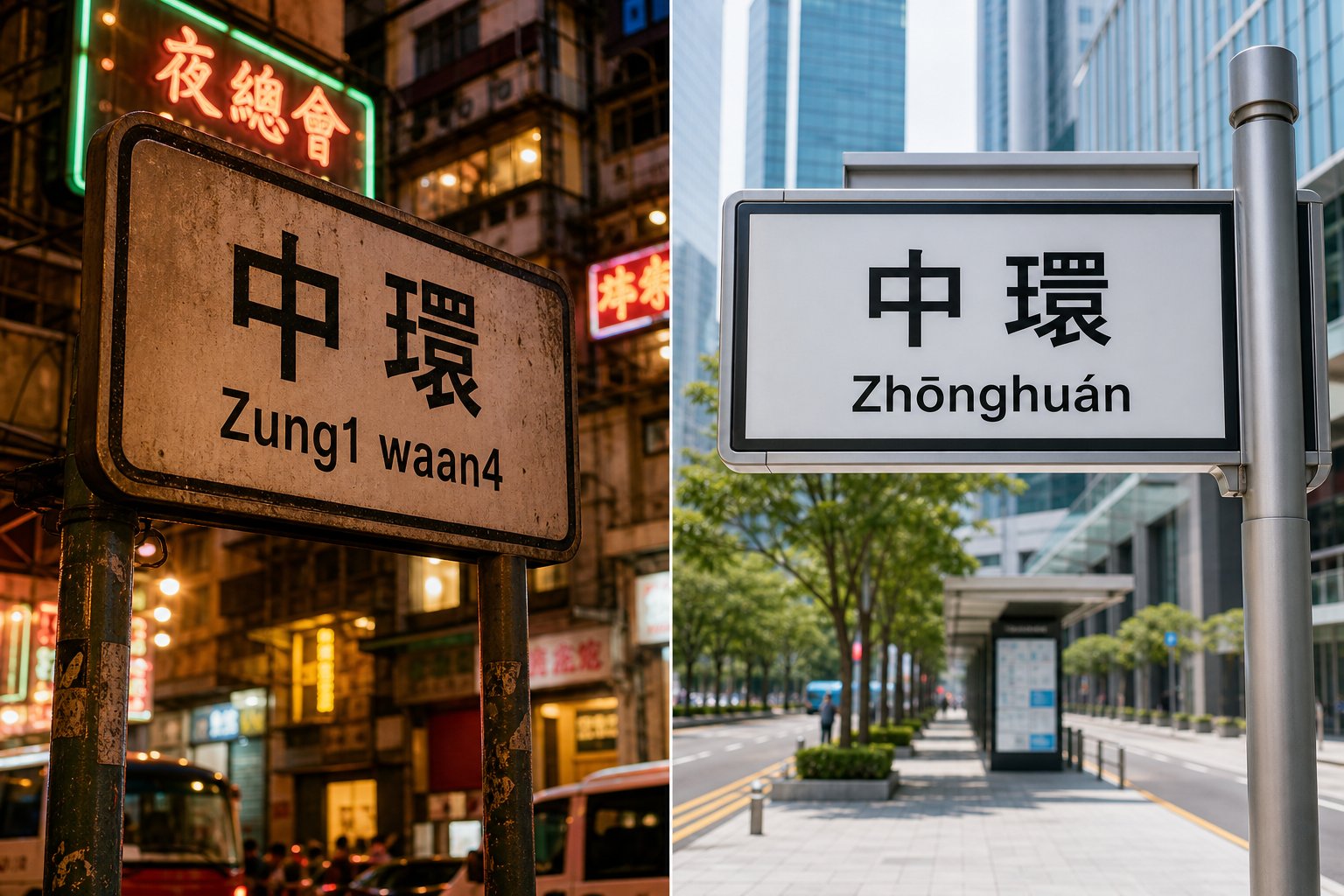
Hong Kong presents an entirely different situation. The issue is not which Mandarin romanization to use — it is that Mandarin romanization does not apply at all. Hong Kong names reflect Cantonese chinese pronunciation, not Mandarin, and the city uses its own unpublished government romanization system based on standards dating back to 1888.
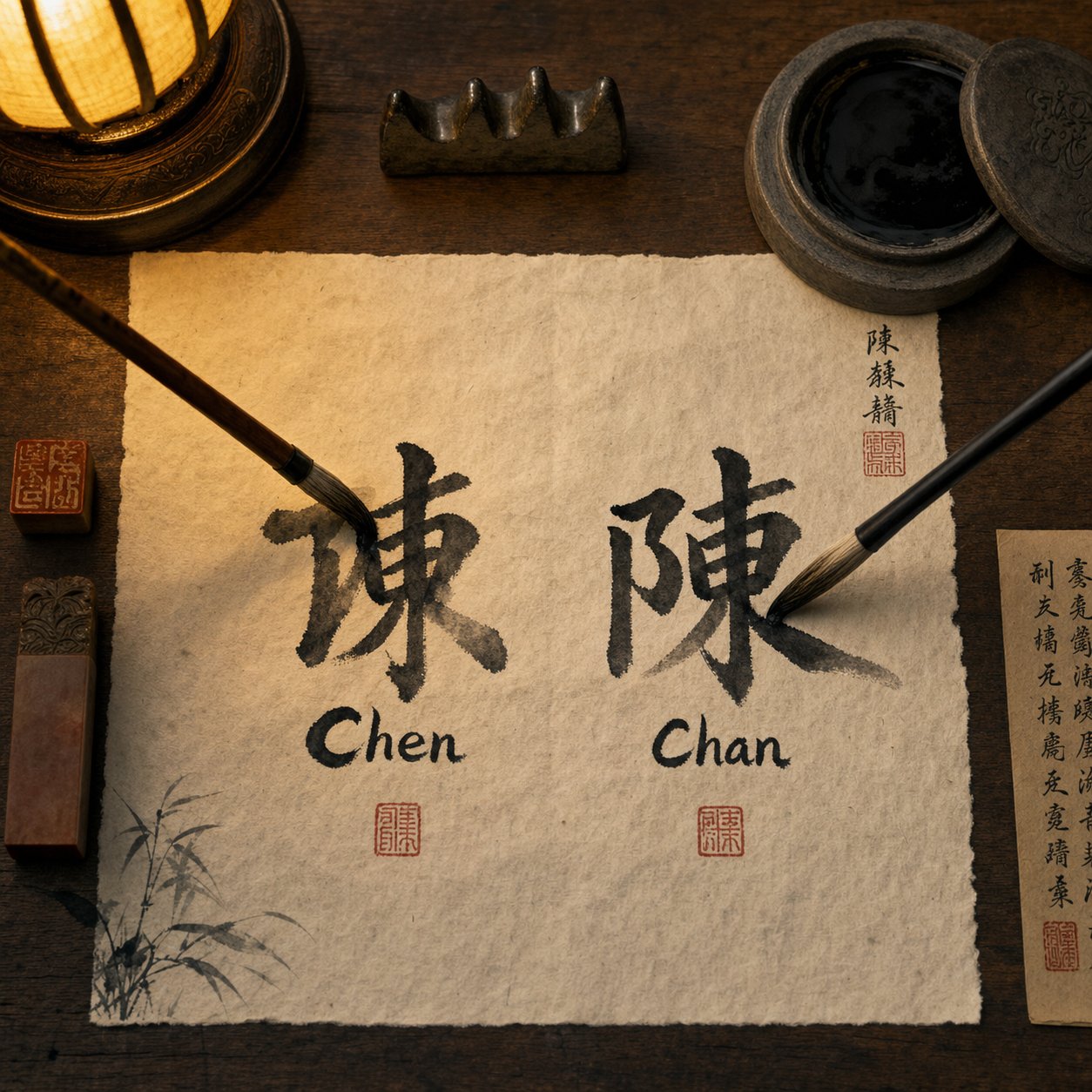
This system omits all tones in chinese and does not distinguish between aspirated and unaspirated consonants. The surname 陳, pronounced "Chan" in Cantonese but "Chen" in Mandarin pinyin, appears as "Chan" on Hong Kong identity cards. The surname 黃 is "Wong" in Hong Kong but "Huang" in pinyin. These are not errors or outdated spellings — they reflect a fundamentally different spoken language with its own tones of chinese language that pinyin was never designed to capture.
The Hong Kong Government Cantonese Romanisation has never been formally published as a complete standard. Government departments consult an internal code book originally produced by the Royal Hong Kong Police Force in 1971 for vetting proposed names. Individuals are technically free to choose their own romanization on identity documents, but most accept the default government spelling. The result is a population whose romanized names are systematically different from what pinyin would produce — and deliberately so.
Place names carry the same legacy. "Kowloon" would be "Jiulong" in pinyin. "Tsim Sha Tsui" would be "Jianshazui." These Cantonese romanizations are not relics waiting to be corrected; they are markers of Hong Kong's distinct linguistic identity.
Why Name Romanization Became Political
Step back and the pattern becomes clear. In Taiwan, choosing Tongyong over Hanyu Pinyin was a statement about sovereignty. In Hong Kong, maintaining Cantonese romanization is a statement about cultural distinctness. For diaspora communities — whether in Southeast Asia, North America, or Europe — the romanization on a family name often reflects the generation and region of emigration rather than any conscious political choice, yet it still functions as an identity marker.
Something as technical as spelling became a proxy for the most fundamental political question in the Chinese-speaking world: who gets to define what is standard, and whose authority do you recognize when you write your own name?
This dynamic explains why pinyin name history cannot be told as a simple story of progress from chaos to order. The mainland narrative — multiple systems replaced by one rational standard — is accurate within its borders. But from Taipei to Toronto, millions of Chinese-heritage individuals carry names that deliberately reject that standard, whether through Wade-Giles surnames on Taiwanese passports, Cantonese romanizations on Hong Kong IDs, or Hokkien-derived spellings in Singapore and Malaysia.
The inconsistencies are not bugs in the system. They are features — each one encoding a specific relationship to language, place, and political authority. And they ensure that even the most common Chinese names continue to appear in multiple forms across international records, long after pinyin supposedly settled the question of how to spell them.
Common Pinyin Name Confusions and Why They Exist
Those deliberate rejections of pinyin are only part of the picture. Even among names that nobody disputes or politicizes, the historical record is full of oddities that trip up researchers, students, and casual readers alike. Why does the world say "Confucius" instead of Kong Qiu? Why is China's founding revolutionary known as Sun Yat-sen rather than Sun Yixian? And how do you pronounce zhou when you see it written as "Chou" in one source and "Zhou" in another?
These are not random inconsistencies. Each one reflects a specific moment in the layered history of Chinese name romanization — a fossil record of which system was dominant, which dialect was spoken, and which Western language first captured the name in print.
Why Famous Chinese Names Do Not Follow Pinyin Rules
Consider the three most recognizable Chinese names in Western history: Confucius, Sun Yat-sen, and Chiang Kai-shek. Not one of them follows pinyin conventions. Each arrived in English through a completely different path.
Confucius is a Latinized form created by Jesuit missionaries in the 16th century. They took the honorific title Kong Fuzi (孔夫子, "Master Kong") and rendered it in Latin as "Confucius" — the same way they turned Greek names into Latin forms. This happened centuries before any Chinese romanization system existed. The name stuck because it entered European languages during the Renaissance, when Latin was still the lingua franca of scholarship. His actual name in pinyin would be Kong Qiu (孔丘), but almost nobody outside of Chinese-language contexts uses it.
Sun Yat-sen (孫逸仙) uses Cantonese romanization because, as Victor Mair explains on Language Log, Cantonese was by far the most widespread Chinese language around the world outside of China before about 1975. Sun acquired his art name "Yat-sen" while studying in Hong Kong, a Cantonese-speaking city. The name became so deeply ingrained in English — both in speech and writing — that switching to the Mandarin equivalent "Yixian" would have been impractical. Sun himself used many names throughout his life (his most popular name in China is actually Zhongshan, derived from a Japanese pseudonym), but the Cantonese form is what the English-speaking world locked in.
Chiang Kai-shek (蔣介石) is even more complicated. His surname "Chiang" is the Wade-Giles romanization of the Mandarin pronunciation. But "Kai-shek" is the Cantonese romanization of his courtesy name — even though Chiang himself was a native speaker of Wu Chinese (Zhejiangese), not Cantonese. The Cantonese form stuck because the Republican revolutionaries were based in Guangzhou, a Cantonese-speaking area. So his internationally known name is a hybrid: Mandarin surname in Wade-Giles plus Cantonese given name. In pinyin, he would be Jiang Jieshi. In Taiwan, he is known as Jiang Zhongzheng (蔣中正), yet another name entirely.
A similar question comes up with Chinese currency. People often ask, how do you pronounce yuan? The answer depends on which romanization system you are reading. In pinyin, it is straightforward: "yuan" rhymes roughly with "yen" but with a "oo" glide at the start. The confusion arises because older texts sometimes spell it differently, and English speakers unfamiliar with pinyin conventions struggle with the initial "yu-" sound.
Historical Oddities and Common Misconceptions
These famous examples are just the tip of the iceberg. Misconceptions about Chinese name romanization are widespread, and most stem from applying one system's logic to names that were created under a different system — or no system at all. Here are the most common ones:
- "Pinyin is the correct way to spell all Chinese names." It is the current PRC standard, but names established before 1958 — or outside mainland China — legitimately use other systems. Sun Yat-sen is not "misspelled"; it simply predates pinyin.
- "Wade-Giles and pinyin represent different pronunciations." They do not. "Chou En-lai" and "Zhou Enlai" represent the same Mandarin sounds. The difference is purely in how those sounds are mapped to Latin letters. If you want to pronounce zhou correctly, the sound is the same regardless of which spelling you encounter.
- "Names like Chiang Kai-shek are in Mandarin." Only partially. As noted above, "Kai-shek" is Cantonese. Many pre-1949 Chinese names in English are dialect hybrids that reflect the specific circumstances of how that person became known to the West.
- "All Chinese people from the same era use the same romanization system." They do not. Mao Zedong's name was rendered in Wade-Giles (Mao Tse-tung) because Western media used that system. But his contemporary Sun Yat-sen kept a Cantonese form, and Chiang Kai-shek kept a Cantonese-Mandarin hybrid — all in the same historical period.
- "Modern Chinese figures all use pinyin." Many do, but not all. Taiwanese politicians, Hong Kong celebrities, and diaspora business leaders frequently use non-pinyin spellings. Jackie Chan (Cantonese) is not "Cheng Long" (pinyin) in international media. Ang Lee (Wade-Giles-adjacent) is not "Li An" on his film credits.
- "You can convert any romanized Chinese name back to characters by knowing the system." Not reliably. Without tone information, a name like "Li Wei" could correspond to dozens of different character combinations. The yuan pronounce question illustrates this too — the syllable "yuan" maps to multiple characters with different meanings depending on tone.
These misconceptions persist because pinyin name history is not a clean before-and-after story. It is a palimpsest — layers of systems written over each other, with older forms showing through wherever a name became famous enough to resist updating. The English-speaking world did not adopt Chinese names through one consistent channel. Names arrived via Portuguese missionaries, British diplomats, Cantonese emigrants, Japanese intermediaries, and eventually the PRC government itself. Each channel left its own spelling conventions embedded in the historical record.
That layered reality is precisely why standardization efforts — from library catalogs to digital databases — have never fully succeeded in creating a single, unified system for all Chinese names in Western records. The next frontier is not choosing between systems but building infrastructure that can recognize and reconcile all of them simultaneously.
The Lasting Impact of Pinyin on Global Communication
Building that infrastructure is not a hypothetical — it has been underway for decades. The reconciliation of romanization systems across libraries, databases, and digital platforms represents one of the largest naming standardization efforts in modern history. And its effects reach far beyond how names are spelled on paper.
How Pinyin Changed Libraries and Academic Records
The Library of Congress Pinyin Conversion Project, launched in 2000, converted all Chinese-language bibliographic records in the RLIN and OCLC databases from Wade-Giles to pinyin. The scale was staggering: every variable field on every record coded as Chinese was subject to machine conversion, with a local MARC field (987) added to mark each converted record and prevent double-processing. Headings that could not be reliably converted by algorithm — ambiguous syllables, mixed-text fields, multi-syllable place names in descriptive subfields — were flagged for manual review.
Academic citation systems followed. Journals standardized on pinyin for mainland Chinese authors, while maintaining legacy spellings for figures whose reputations were built under older systems. The yin pinyin format became the default for new authority records, meaning any Chinese scholar entering the international publishing system after the 1980s carries a pinyin name in every major index.
Pinyin Names in the Digital Age and Language Learning
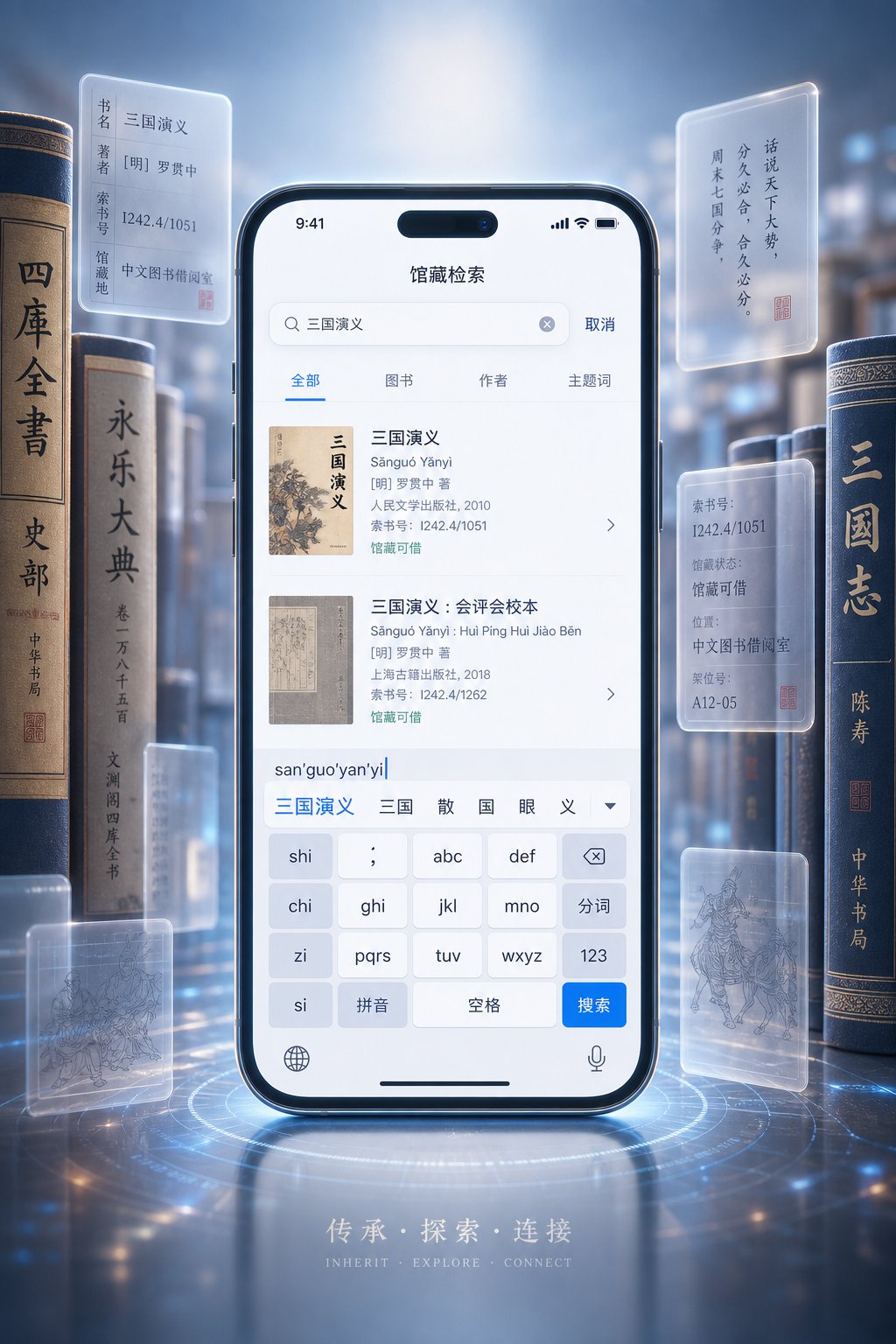
The most transformative impact may be technological. Every chinese typing method used on smartphones and computers today relies on pinyin as its input layer. When you type on a mandarin keyboard, you are entering pinyin syllables that the software converts into character suggestions. As Thomas Mullaney documents in The Chinese Computer, this pinyin-based input method evolved into predictive text and eventually contributed to the development of AI language models. By the 1990s, Chinese predictive text paired with pinyin input had mastered anticipating a user's next character — a precursor to the auto-complete features now standard across all languages.
In language education, pinyin became the universal on-ramp. Students worldwide learn to count in Mandarin — from mandarin 0 through the basic mandarin chinese numbers — using pinyin as their pronunciation guide before ever encountering characters. This pedagogical approach, built directly on the 1958 system, has made Chinese language learning accessible to millions who would otherwise have no entry point into a character-based writing system.
The domains where pinyin name standardization left measurable impact span nearly every institution that handles Chinese-language information:
- Passports and identity documents — pinyin is the sole romanization on all PRC travel documents
- Library cataloging — the Library of Congress, OCLC, and major research libraries worldwide converted entirely to pinyin
- News media — AP, Reuters, and every major English-language outlet adopted pinyin style guides
- Academic publishing — citation databases use pinyin for author name authority control
- Digital technology — pinyin-based input methods serve over a billion users daily
- International organizations — the UN, ISO, and national geographic boards all recognize pinyin as the standard
Pinyin name history is still being written. As Chinese scholars have noted, the system's international functions continue to expand — from standardizing Chinese brand names in global commerce to encoding cultural concepts that enter foreign languages as loanwords. What began as a literacy tool for a newly founded republic has become the invisible infrastructure connecting Chinese language and identity to the digital world. The spelling may look simple. The history behind it is anything but.
Frequently Asked Questions About Pinyin Name History
1. Why do some Chinese historical figures have multiple English spellings of their names?
Multiple spellings exist because different romanization systems were used across different eras. Before pinyin became the standard in 1958, systems like Wade-Giles, Postal Romanization, and missionary-era transcriptions each produced unique Latin-letter versions of the same Chinese characters. For example, Zhou Enlai appeared as Chou En-lai under Wade-Giles. When Western media switched to pinyin in 1979, older spellings remained in archives, creating duplicate identities for the same individuals across libraries, news databases, and academic citations.
2. When did pinyin replace Wade-Giles as the standard romanization system?
Pinyin was officially adopted by the PRC State Council on February 11, 1958, but it did not replace Wade-Giles in Western usage until much later. The turning point came on January 1, 1979, when China mandated pinyin for all international communications. The New York Times switched in March 1979, and the Associated Press and Reuters followed shortly after. By the early 1980s, most major English-language publications had adopted pinyin, though some legacy spellings like Peking persisted for years.
3. Why is Sun Yat-sen not spelled in pinyin?
Sun Yat-sen uses Cantonese romanization rather than Mandarin-based pinyin because he acquired the name while studying in Cantonese-speaking Hong Kong. Before 1975, Cantonese was the most widespread Chinese language internationally, and names that became famous during that period retained their Cantonese forms. In Mandarin pinyin, his name would be Sun Yixian, but the Cantonese version became too deeply embedded in English-language usage to change.
4. What are the official rules for writing Chinese names in pinyin?
According to China's GB/T 28039 national standard, the surname comes first as a separate capitalized word, followed by the given name written as one capitalized word with no hyphen or space between its syllables. For example, 王秀英 becomes Wang Xiuying. Compound surnames like 欧阳 stay as one unit (Ouyang). Tone marks are technically part of the standard but are routinely omitted on passports and international documents.
5. Why does Taiwan use different romanization for Chinese names than mainland China?
Taiwan's romanization choices are tied to political identity. Most Taiwanese personal names use a simplified Wade-Giles system inherited from older government documents. Taiwan briefly adopted Tongyong Pinyin in 2002 as a deliberate alternative to Beijing's Hanyu Pinyin, viewing adoption of the mainland system as a signal of political subordination. Although Taiwan officially switched to Hanyu Pinyin for signage in 2009, most citizens retain their existing Wade-Giles name spellings on identity documents because schools teach Bopomofo rather than any romanization system.