What Is Pinyin Name Radical Identification
Pinyin name radical identification is the practice of recognizing Chinese character radicals and calling them by their spoken Mandarin names. It goes beyond knowing what a radical means or which characters contain it. This skill is about learning the exact colloquial labels that native speakers and teachers use when they talk about how characters are built.
Most learners study chinese radicals as visual building blocks. They memorize meanings, match components to characters, and move on. But there is a parallel layer of knowledge that rarely gets taught explicitly to non-native learners: the naming system. When you can identify a radical and produce its pinyin name on sight, you gain access to a metalanguage that Chinese speakers use every day in classrooms, text messages, and casual conversation.
What Pinyin Radical Naming Actually Means
So what are radicals in terms of their names? Every chinese radical has at least two identities. There is its standalone pronunciation, the reading you would use if the radical appeared as an independent character. Then there is its colloquial positional name, the label native speakers actually use when describing character composition aloud.
Consider 水 (shui). As a standalone character it means water and is pronounced shui. But when it appears inside another character as 氵, native speakers do not call it shui. They call it 三点水 (san dian shui), literally "three dots of water." That colloquial name tells you both what the component looks like and where it sits in the character. This distinction between a radical's standalone radicals pronunciation and its positional name is the core of pinyin name radical identification.
Why This Skill Matters for Learners
Imagine your Chinese teacher says, "This character has 提手旁 on the left." If you have never learned that 提手旁 (ti shou pang) refers to the hand radical 扌, you are lost. The chinese radical definition your textbook gave you does not help in that moment because the teacher is using the colloquial naming system, not the dictionary entry.
This skill matters in three practical scenarios:
- Understanding teacher explanations when they describe unfamiliar characters verbally
- Using radical-based dictionary lookup, where knowing what are chinese radicals by name speeds up the search process
- Communicating character composition in spoken Mandarin, such as telling someone how to write your name over the phone
Pinyin radical naming bridges the gap between recognizing characters visually and discussing them in spoken Mandarin. It is the metalanguage that turns passive recognition into active communication about how Chinese writing works.
This article teaches the complete naming system as a learnable framework rather than handing you a static list to memorize. You will understand the logic behind each name, which makes the system predictable once you grasp a few core patterns. Those patterns trace back to a centuries-old organizational structure that still shapes how radicals are categorized and named today.
The Kangxi Radical System and Its Pinyin Legacy
That centuries-old organizational structure has a name: the Kangxi radical system. It is the reason Chinese characters are not a chaotic sea of strokes but a navigable library with a clear index. Understanding where this system came from, and how it evolved into the colloquial pinyin names used in classrooms today, gives you the structural backbone for identifying any radical by its spoken label.
The 214 Kangxi Radical Framework
So how many chinese radicals are there? The standard answer is 214. These are the Kangxi radicals, a classification system that has organized Chinese dictionaries for over three centuries. Each of the 214 radicals serves as a category header, grouping characters that share a common structural element. Think of them as the tabs in a filing cabinet containing tens of thousands of characters.
The system did not appear overnight. Its roots stretch back to the 2nd century CE, when the scholar Xu Shen (许慎) compiled the Shuowen Jiezi (说文解字), the first comprehensive dictionary to classify characters by shared components. Xu Shen used 540 radicals to organize roughly 9,000 characters. That was a monumental leap from memorizing characters one by one, but 540 categories proved unwieldy for practical lookup.
Centuries of refinement followed. The breakthrough came in 1615 with the Zihui (字汇), which consolidated the list down to 214 radicals ordered by stroke count. The 18th-century Kangxi Dictionary (康熙字典) adopted this same 214-radical framework, and its prestige cemented the system as the standard that lexicographers, teachers, and learners still reference today. Every entry in a traditional chinese radical dictionary traces back to one of these 214 categories.
Each radical in this framework carries a formal pinyin reading. Radical 85 is 水 (shui, water). Radical 61 is 心 (xin, heart). Radical 140 is 艸 (cao, grass). These standalone readings are the foundation, but they are only half the story. The other half is how those formal names transformed into the colloquial labels Chinese speakers actually use when talking about characters.
From Historical System to Modern Pinyin Names
Here is where most chinese radicals list resources stop. They give you the 214 radicals, their meanings, and their standalone pinyin. What they rarely explain is how the traditional classification evolved into a living, spoken naming system used in everyday Mandarin.
To understand this evolution, you need two key Chinese terms:
- 部首 (bushou) - literally "section head." This refers to the radical as a dictionary classification tool, the component that determines where a character gets filed. It is the formal, organizational term.
- 偏旁 (pianpang) - literally "side element." This refers to any structural component of a compound character, whether or not it serves as the dictionary radical. It is the broader, more practical term used when discussing how characters are built.
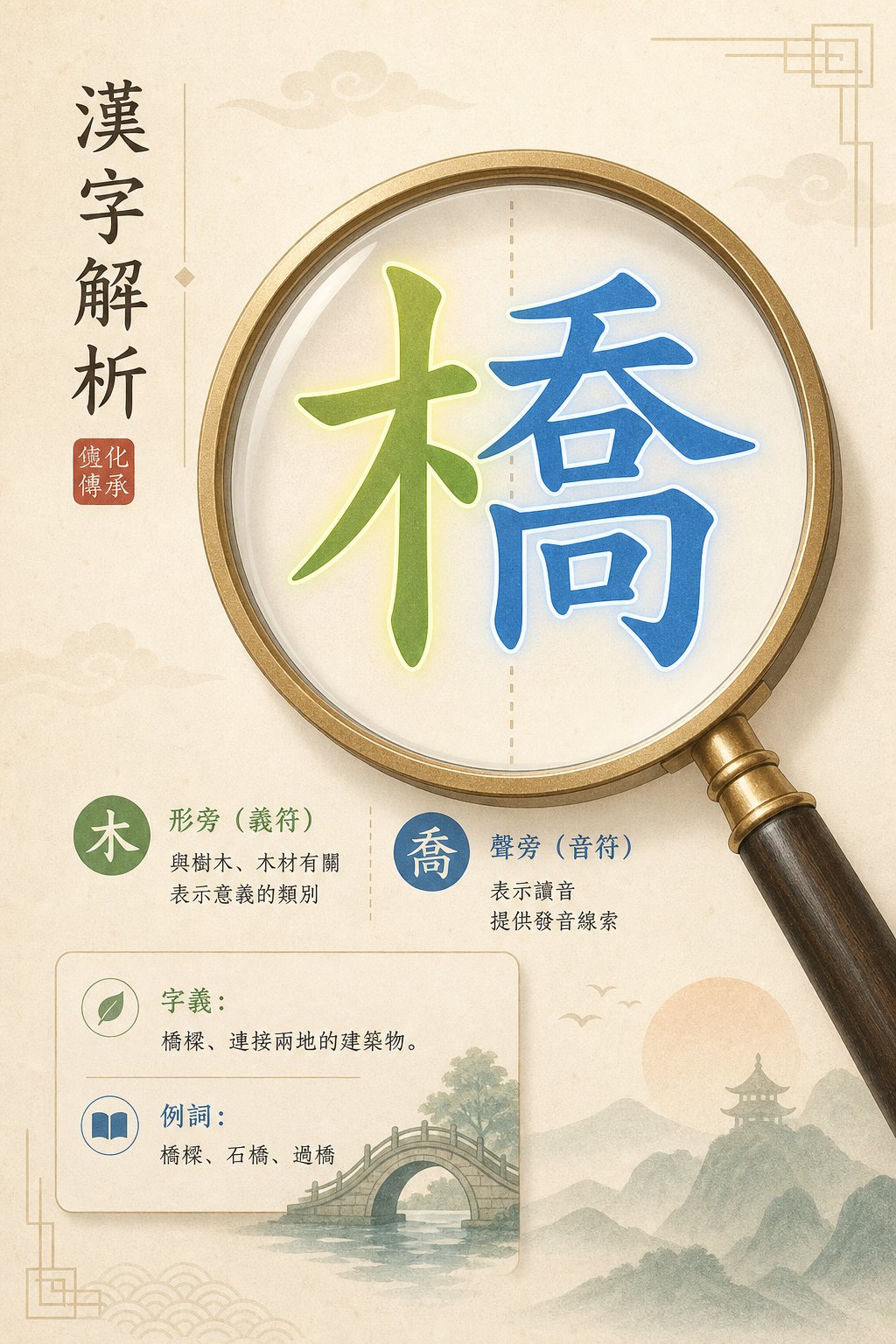
In everyday Chinese language radicals discussion, these terms overlap but are not identical. All bushou can function as pianpang, but not every pianpang qualifies as a bushou. For example, in the character 他 (ta, he), the left component 亻 is both a pianpang and a bushou. The right component 也 is a pianpang but not a bushou for that character. This distinction matters because the colloquial pinyin naming system applies primarily to common pianpang, the components people encounter and need to describe most often.
The modern naming conventions grew out of classroom necessity. Teachers needed a quick, unambiguous way to tell students which component goes where. Saying "the water radical" is vague when water can appear as 水, 氵, or 氺 depending on position. Saying 三点水 (san dian shui) is precise: it tells you the component has three dots and relates to water. That specificity is what makes the colloquial system so effective for verbal communication.
What emerged is a list of chinese radicals with colloquial names that encode three pieces of information simultaneously: what the radical looks like, what it derives from, and where it sits in the character. The formal Kangxi categories provided the "what it derives from" piece. Classroom usage added the visual description and positional markers. Together, they created the pinyin naming system that native speakers internalize as children and that this article teaches you as a learnable framework.
The beauty of this system is its predictability. Once you recognize the naming patterns, positional suffixes like 旁 (pang) for left-side elements, 头 (tou) for top elements, and 底 (di) for bottom elements, you can often predict a radical's colloquial name even before you have memorized it. Those positional patterns are exactly what the next section breaks down in detail.
How Radical Position Changes the Pinyin Name
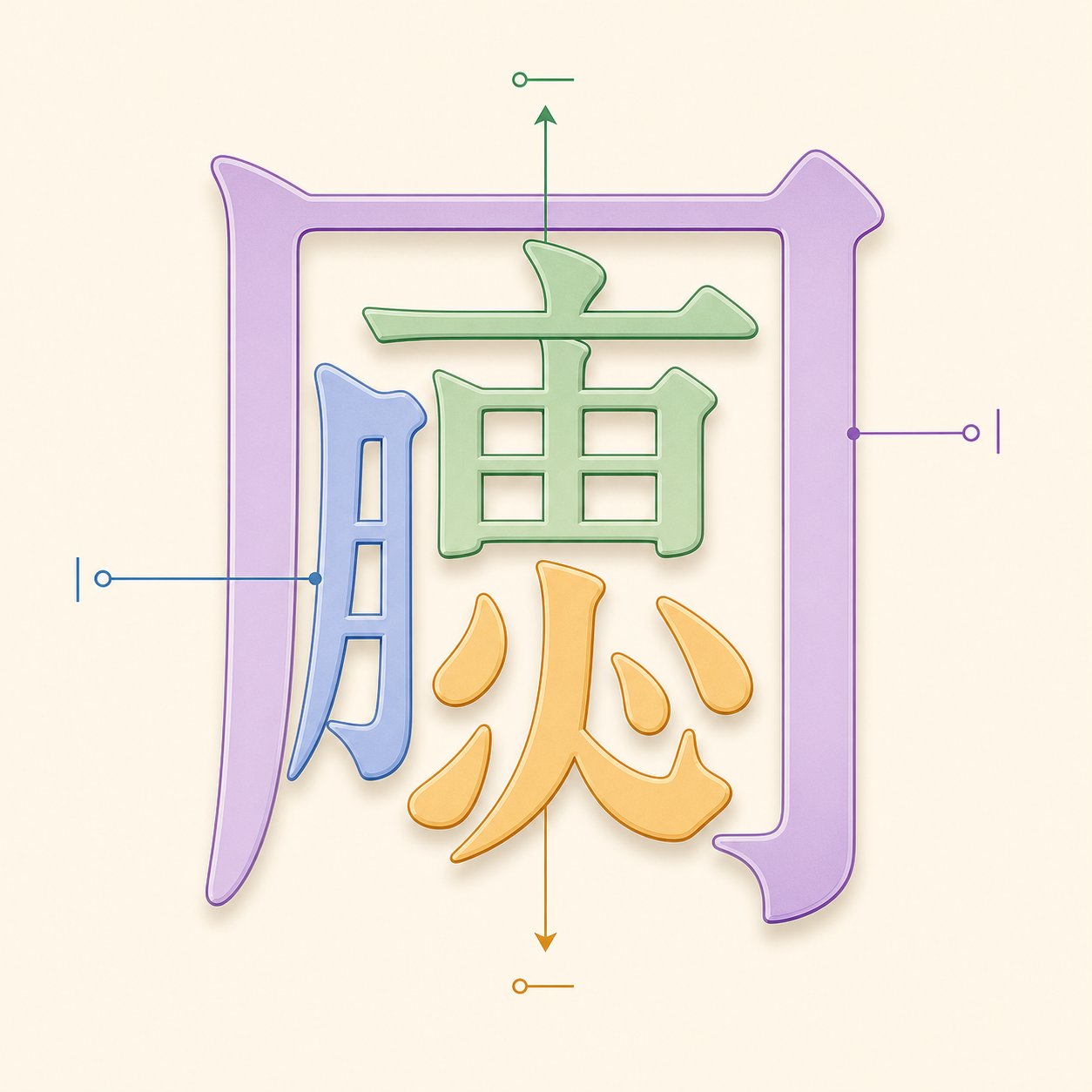
A single radical can carry different colloquial names depending on where it sits inside a character. This is the detail that trips up most learners of chinese character radicals. You memorize that 人 means "person" and is pronounced ren, then hear your teacher say 单人旁 (dan ren pang) and wonder what happened. What happened is position. The radical moved to the left side of a character, changed its visual form to 亻, and picked up a completely different spoken label.
This positional naming logic is not random. It follows a consistent system built on a handful of suffixes that signal exactly where a radical character sits within the overall structure. Learn the suffixes, and you unlock the ability to predict names for radicals in chinese you have never formally studied.
Left Side Radicals and Their Pinyin Names
The most common position for radicals of chinese characters is the left side. When a radical occupies this spot, its colloquial name almost always ends with 旁 (pang), which literally means "side" or "beside." This suffix is your first reliable signal: if you hear a radical name ending in 旁, you know the component sits on the left.
Here are the left-side radicals you will encounter most often:
- 亻 is called 单人旁 (dan ren pang), meaning "single person side." The 单 (dan, single) distinguishes it from 彳, which is called 双人旁 (shuang ren pang, "double person side") because its two strokes resemble two people.
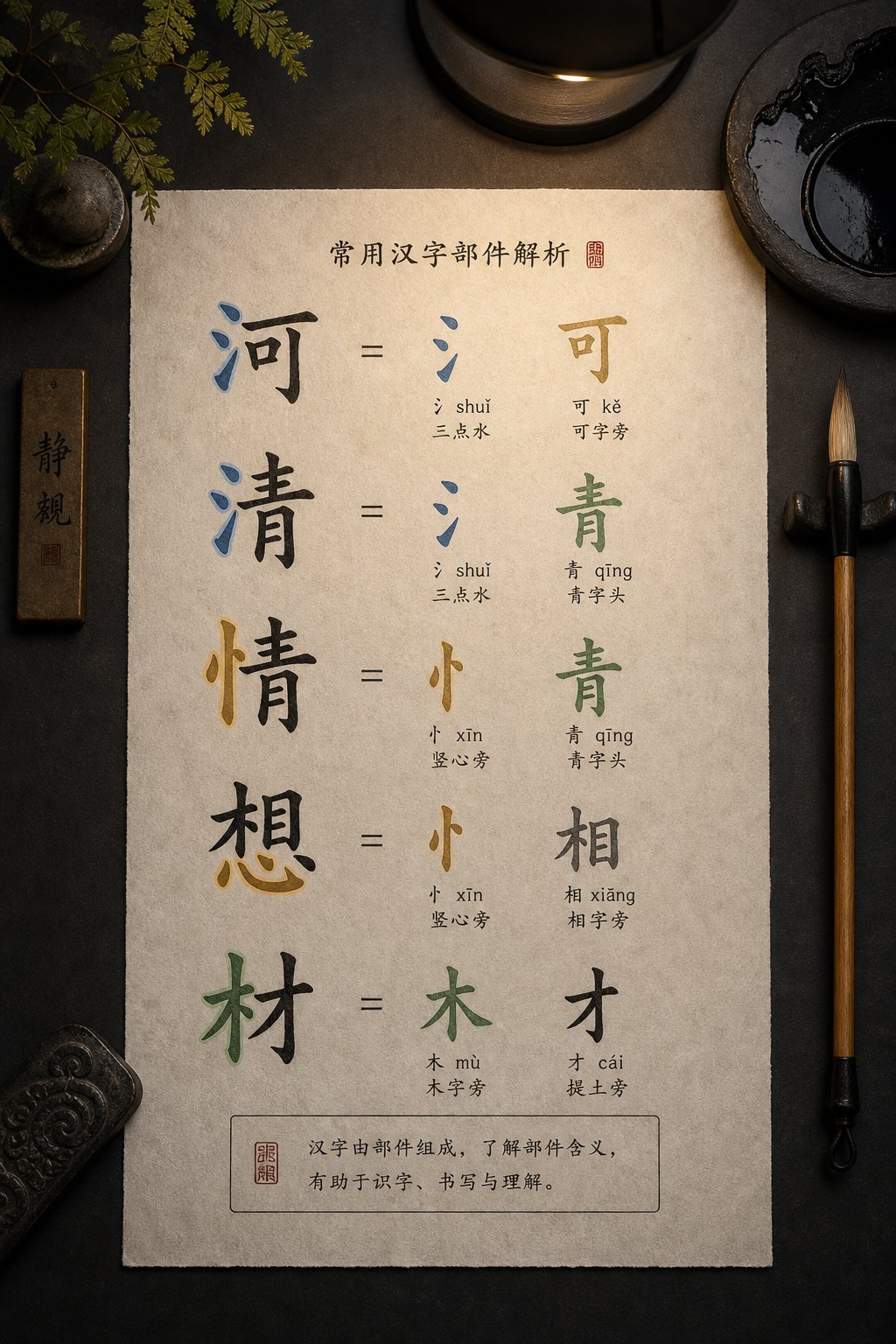
- 氵 is called 三点水 (san dian shui), literally "three dots of water." This name describes exactly what you see: three dots arranged vertically, derived from the character 水 (shui, water).
- 扌 is called 提手旁 (ti shou pang), meaning "raised hand side." It derives from 手 (shou, hand) and the name references the upward-flicking stroke at the bottom.
- 讠 is called 言字旁 (yan zi pang), meaning "speech character side." Even though the simplified form looks nothing like the original 言, the name preserves the connection to its source character.
- 犭 is called 反犬旁 (fan quan pang), meaning "reversed dog side," because the component looks like a mirror image of the character 犬 (quan, dog).
You will notice a pattern: these names combine a visual or semantic descriptor with the positional marker 旁. That formula, descriptor plus position suffix, is the engine driving the entire naming system for radical chinese characters on the left side.
Top and Bottom Position Naming Conventions
When a radical sits on top of a character, its name typically ends with 头 (tou, "head") or the fuller form 字头 (zi tou, "character head"). This makes intuitive sense. The radical is at the head of the character, sitting above everything else.
Common top-position examples include:
- 艹 is called 草字头 (cao zi tou), meaning "grass character head." It derives from 草 (cao, grass) and appears in characters related to plants and vegetation.
- ⺮ is called 竹字头 (zhu zi tou), meaning "bamboo character head." This simplified form of 竹 (zhu, bamboo) sits atop characters like 笔 (bi, pen) and 筷 (kuai, chopsticks).
- 宀 is called 宝盖头 (bao gai tou), meaning "treasure cover head." The name describes its shape: a lid or cover, like the top of a treasure chest.
Bottom-position radicals use 底 (di, "bottom") as their suffix. These are less common but equally predictable:
- 灬 is called 四点底 (si dian di), meaning "four dots bottom." This is the fire radical 火 (huo) in its bottom-position form, reduced to four dots spread horizontally beneath the character.
- 皿 is called 皿字底 (min zi di), meaning "dish character bottom." It appears beneath characters related to containers and vessels.
The logic is clean. Top radicals get 头 or 字头. Bottom radicals get 底. Once you internalize these two suffixes, you can decode or even predict the names of dozens of radicals based purely on where they appear.
Enclosing and Right Side Radical Names
Some radicals wrap around other components rather than sitting beside them. These enclosing radicals use 框 (kuang, "frame") in their names:
- 囗 is called 国字框 (guo zi kuang), meaning "country character frame." It fully encloses the inner component, as seen in characters like 国 (guo, country) and 园 (yuan, garden).
- 门 is called 门字框 (men zi kuang), meaning "gate character frame." It wraps around the top and sides, leaving the bottom open, as in 问 (wen, to ask) and 间 (jian, between).
- 冂 is called 同字框 (tong zi kuang), referencing the character 同 (tong, same) where this enclosing shape is prominent.
Right-side radicals are less standardized in their naming. Some use 旁 (pang) just like left-side radicals, while others use specific descriptive names. The knife radical 刂, for instance, is called 立刀旁 (li dao pang), meaning "standing knife side," describing its vertical two-stroke appearance on the right side of characters like 到 (dao, to arrive) and 别 (bie, to separate).
Semi-enclosing radicals that wrap around the bottom-left use their own conventions. The walking radical 辶 is called 走之旁 (zou zhi pang) or sometimes 走之底 (zou zhi di), reflecting its position cradling the bottom and left of characters like 过 (guo, to pass) and 还 (hai, still).
The table below brings these positional patterns together, showing how the same system applies across all positions:
| Radical | Standalone Character | Standalone Pinyin | Positional Variant | Colloquial Pinyin Name | Position |
|---|---|---|---|---|---|
| 亻 | 人 | ren | 亻 | 单人旁 (dan ren pang) | Left |
| 氵 | 水 | shui | 氵 | 三点水 (san dian shui) | Left |
| 扌 | 手 | shou | 扌 | 提手旁 (ti shou pang) | Left |
| 忄 | 心 | xin | 忄 | 竖心旁 (shu xin pang) | Left |
| 讠 | 言 | yan | 讠 | 言字旁 (yan zi pang) | Left |
| 艹 | 草 | cao | 艹 | 草字头 (cao zi tou) | Top |
| ⺮ | 竹 | zhu | ⺮ | 竹字头 (zhu zi tou) | Top |
| 宀 | 宝 | bao | 宀 | 宝盖头 (bao gai tou) | Top |
| 灬 | 火 | huo | 灬 | 四点底 (si dian di) | Bottom |
| 囗 | 国 | guo | 囗 | 国字框 (guo zi kuang) | Enclosing |
| 门 | 门 | men | 门 | 门字框 (men zi kuang) | Enclosing |
| 刂 | 刀 | dao | 刂 | 立刀旁 (li dao pang) | Right |
| 辶 | 走 | zou | 辶 | 走之旁 (zou zhi pang) | Semi-enclosing |
Study this table and a clear architecture emerges. The positional suffixes, 旁 for sides, 头 for top, 底 for bottom, 框 for enclosing, act as reliable tags. When you hear any of these suffixes in a radical's name, you immediately know where that component lives inside the character. That predictability is what transforms a seemingly endless list of names into a system with internal logic.
Position tells you the suffix. But what determines the first part of the name, the descriptor that comes before 旁 or 头 or 底? That depends on which of three distinct naming patterns the radical follows: naming by meaning, naming by visual resemblance, or naming by source character.
Three Naming Patterns That Make Radicals Predictable
Positional suffixes tell you where a radical sits. But the first half of the name, the descriptor before 旁 or 头 or 底, follows its own logic. That logic falls into exactly three categories. Once you recognize which pattern a radical uses, its full pinyin name becomes something you can predict rather than something you must memorize cold.
Think of these three patterns as lenses. Each lens answers a different question about the radical: What does it represent? What does it look like? Or which character did it come from? Every colloquial radical name in Mandarin uses one of these lenses to build its descriptor. Here they are as a numbered framework you can apply to any radical you encounter.
Radicals Named by Their Meaning
Some radicals carry names that directly reference what they represent, their semantic content. Understanding chinese radicals and meanings becomes straightforward with these because the name tells you the concept the radical encodes.
Radicals Named by Visual Resemblance
Other radicals earn their names from what they physically look like on the page, regardless of their deeper meaning. These names describe shape, stroke count, or visual impression rather than semantic content.
Radicals Named by Their Source Character
The third group of radicals incorporates the parent character's name directly into the colloquial label. The formula here is simple: take the original character's pronunciation, add 字 (zi, "character"), then attach the positional suffix. This pattern dominates when a radical has been visually simplified so much that its appearance no longer hints at its origin.
- Named by Meaning - The radical's name describes what it semantically represents.
- 忄 is called 竖心旁 (shu xin pang). The name means "vertical heart side" because this left-side variant of 心 (xin, heart) relates to emotions and feelings. The chinese radical meanings here are transparent: characters with 忄 almost always involve psychological states, like 情 (qing, emotion) and 快 (kuai, happy).
- 灬 is called 四点底 (si dian di), meaning "four dots bottom." It derives from 火 (huo, fire), and characters containing it often relate to heat or cooking, like 热 (re, hot) and 煮 (zhu, to boil). The meaning of chinese radicals in this category stays close to the surface.
- 钅 is called 金字旁 (jin zi pang), meaning "gold/metal character side." Characters with this radical relate to metals or metallic objects: 铁 (tie, iron), 银 (yin, silver), 钟 (zhong, bell).
- 饣 is called 食字旁 (shi zi pang), meaning "food character side." It appears in characters connected to eating and food: 饭 (fan, rice/meal), 饿 (e, hungry), 饮 (yin, to drink).
- Named by Visual Resemblance - The radical's name describes what it looks like, not what it means.
- 冫 is called 两点水 (liang dian shui), meaning "two dots of water." The name comes purely from its appearance: two dots stacked vertically. It contrasts with 氵 (three dots of water) by dot count alone. The actual radicals meaning here is "ice," but the colloquial name ignores that and focuses on visual form.
- 彳 is called 双人旁 (shuang ren pang), meaning "double person side." It looks like two strokes resembling two people walking, even though its actual meaning relates to movement or roads.
- ⺮ is called 竹字头 (zhu zi tou), meaning "bamboo character head." The name references the visual resemblance to bamboo leaves drooping downward, which is exactly what the two mirrored strokes look like at the top of a character.
- 宀 is called 宝盖头 (bao gai tou), meaning "treasure cover head." The shape looks like a roof or lid covering something precious underneath. The visual metaphor drives the name, not the radical's formal dictionary definition.
- Named by Source Character - The radical's name directly references the original character it derives from.
- 讠 is called 言字旁 (yan zi pang), meaning "speech character side." The simplified form bears little visual resemblance to 言 (yan, speech), so the name preserves the etymological link that the eyes can no longer trace.
- 纟 is called 绞丝旁 (jiao si pang), meaning "twisted silk side." It derives from 糸 (si, silk thread), and the name references the original material rather than the simplified appearance.
- 礻 is called 示字旁 (shi zi pang), meaning "show/reveal character side." It comes from 示 (shi, to show), which relates to rituals and spiritual matters. Examples of radicals in this category include those in 神 (shen, god) and 祝 (zhu, to wish).
- 衤 is called 衣字旁 (yi zi pang), meaning "clothing character side." It derives from 衣 (yi, clothing) and appears in characters like 裤 (ku, pants) and 袖 (xiu, sleeve).
These three patterns cover virtually every colloquial radical name you will encounter. Some radicals blend categories. For instance, 三点水 (san dian shui) is partly visual (three dots) and partly semantic (water). But the framework still holds as a diagnostic tool. When you meet an unfamiliar radical name, ask yourself: is this name describing what the radical means, what it looks like, or which character it came from? The answer will almost always be one of the three.
With the naming logic decoded, the next practical question is which radicals to learn first. Not all 214 carry equal weight. A small subset appears so frequently in modern Chinese text that mastering their pinyin names covers the vast majority of characters you will actually read and discuss.
Essential Radicals and Their Pinyin Names by Frequency
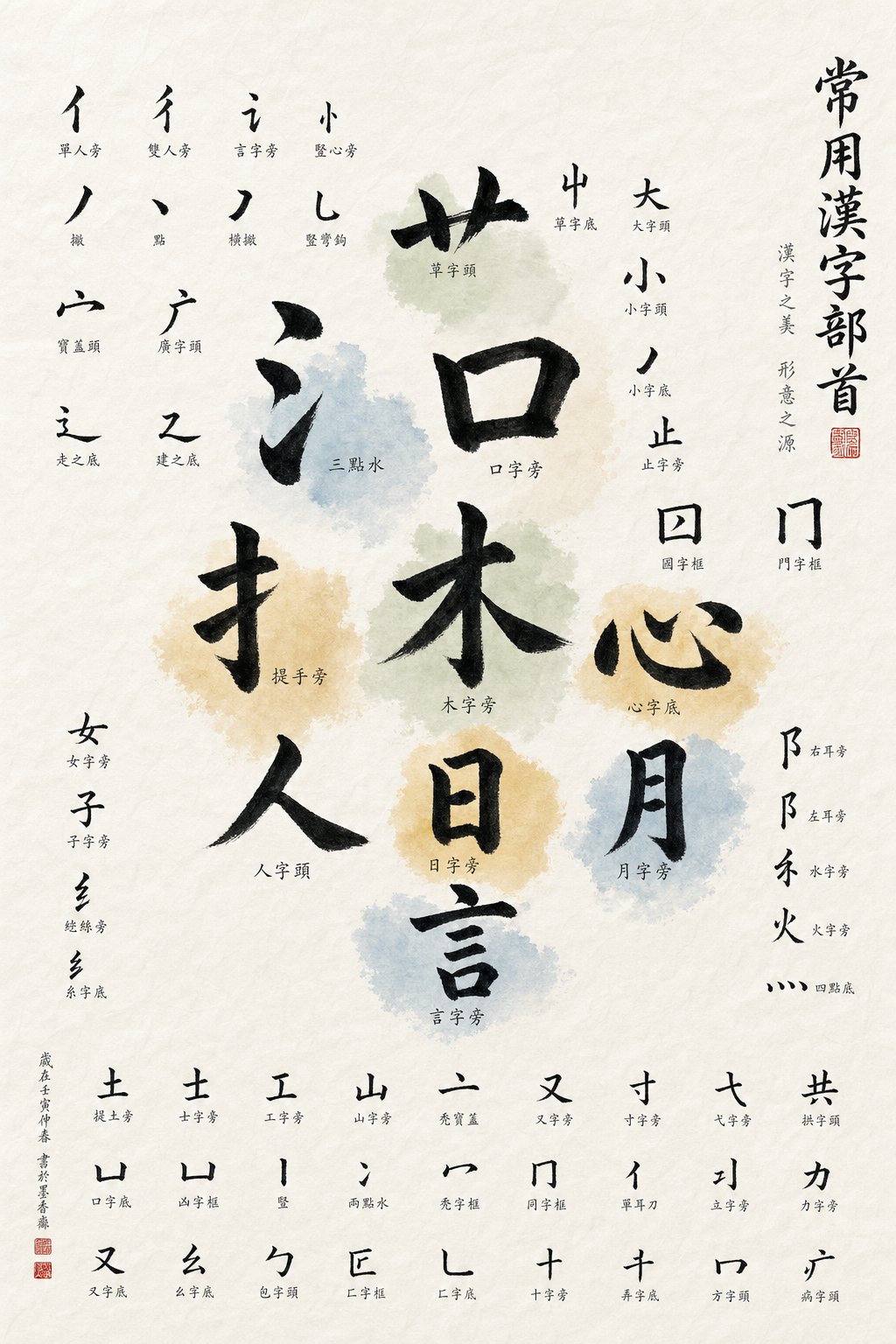
Not all 214 radicals deserve equal attention. Some appear in thousands of modern characters while others show up in fewer than a dozen. If your goal is to identify and name radicals on sight during real conversations, frequency should dictate your study order. The most common chinese radicals account for a disproportionate share of everyday text, which means a focused effort on roughly 20-25 high-frequency radicals gives you coverage far beyond what their small number suggests.
When you study the 100 most common chinese characters, you will notice the same handful of radicals appearing again and again. The water radical shows up in 河, 海, 湖, 洗, 没, and dozens more. The speech radical appears in 说, 话, 语, 请, 让, 识. These are the components worth learning first because you will encounter them constantly, and their pinyin names will come up in any classroom discussion about character composition.
The Most Frequent Radicals with Full Pinyin Names
The following radical table lists the most frequent chinese characters components organized by how often they appear in modern written Chinese. Each entry includes everything you need for pinyin name radical identification: the radical's form, its parent character, standalone pinyin, the colloquial name native speakers use, that name's pinyin, English meaning, and typical position.
| Radical | Standalone Character | Pinyin | Colloquial Name | Name Pinyin | Meaning | Position |
|---|---|---|---|---|---|---|
| 氵 | 水 | shui | 三点水 | san dian shui | Water | Left |
| 亻 | 人 | ren | 单人旁 | dan ren pang | Person | Left |
| 扌 | 手 | shou | 提手旁 | ti shou pang | Hand | Left |
| 口 | 口 | kou | 口字旁 | kou zi pang | Mouth | Left |
| 讠 | 言 | yan | 言字旁 | yan zi pang | Speech | Left |
| 木 | 木 | mu | 木字旁 | mu zi pang | Tree/Wood | Left |
| 忄 | 心 | xin | 竖心旁 | shu xin pang | Heart | Left |
| 艹 | 草 | cao | 草字头 | cao zi tou | Grass | Top |
| 纟 | 糸 | si | 绞丝旁 | jiao si pang | Silk/Thread | Left |
| 土 | 土 | tu | 提土旁 | ti tu pang | Earth | Left |
| 女 | 女 | nv | 女字旁 | nv zi pang | Woman | Left |
| 钅 | 金 | jin | 金字旁 | jin zi pang | Metal | Left |
| 辶 | 走 | zou | 走之旁 | zou zhi pang | Walk | Semi-enclosing |
| 日 | 日 | ri | 日字旁 | ri zi pang | Sun/Day | Left |
| 月 | 月 | yue | 月字旁 | yue zi pang | Moon/Flesh | Left |
| 火 | 火 | huo | 火字旁 | huo zi pang | Fire | Left |
| 宀 | 宝 | bao | 宝盖头 | bao gai tou | Roof | Top |
| 禾 | 禾 | he | 禾木旁 | he mu pang | Grain | Left |
| 竹(⺮) | 竹 | zhu | 竹字头 | zhu zi tou | Bamboo | Top |
| 犭 | 犬 | quan | 反犬旁 | fan quan pang | Dog/Animal | Left |
| 王 | 玉 | yu | 王字旁 | wang zi pang | Jade | Left |
| 礻 | 示 | shi | 示字旁 | shi zi pang | Spirit/Ritual | Left |
| 衤 | 衣 | yi | 衣字旁 | yi zi pang | Clothing | Left |
| 目 | 目 | mu | 目字旁 | mu zi pang | Eye | Left |
| 足 | 足 | zu | 足字旁 | zu zi pang | Foot | Left |
This table of radicals is not exhaustive. All chinese radicals number 214, and a complete radical chart would fill pages. But these 25 entries represent the components you will see most often in modern text and hear most often in spoken descriptions of characters.
Priority Learning Order for Radical Names
Why does frequency matter so much? Because the most common chinese radicals follow a power-law distribution. The top 30 or so radicals appear in the vast majority of compound characters used in daily life. Learning their pinyin names first means you can follow along when a teacher describes almost any character verbally, even if you have never seen that specific character before.
Consider the practical math. If you master the names of just the 25 radicals listed above, you can identify the radical component in most characters that appear in newspapers, textbooks, and everyday digital communication. That is a small memorization investment for enormous communicative payoff.
Mastering the pinyin names of the 25-30 most common radicals enables you to understand the majority of character composition discussions in Mandarin, turning what seems like an overwhelming system into a manageable and immediately useful skill.
The learning order itself should mirror the table above. Start with 氵 (san dian shui), 亻 (dan ren pang), and 扌 (ti shou pang) because these three alone cover hundreds of characters. Then move through the rest of the high-frequency left-side radicals before tackling top-position and enclosing radicals. Left-side components dominate Chinese character structure, so they deliver the fastest return on your study time.
Knowing these names in isolation is valuable. But the real power emerges when you use them in conversation, describing characters verbally, reconstructing unfamiliar characters from spoken descriptions, and navigating dictionary lookup by component. That conversational application is where pinyin radical names shift from academic knowledge to practical communication skill.

Using Pinyin Radical Names in Real Conversations
Knowing radical names in your head is one thing. Using them to communicate about characters in spoken Mandarin is where the skill becomes genuinely practical. Native speakers describe unfamiliar characters verbally all the time, over the phone, in text messages explaining how to write a name, or in classrooms when a teacher introduces a new word. If you understand mandarin radicals by their colloquial pinyin names, you can participate in these exchanges instead of sitting them out.
Describing Characters Verbally Using Radical Names
Imagine someone asks how to write your friend's name and it contains the character 湖 (hu, lake). You cannot draw it in the air over a phone call. Instead, you describe it the way native speakers do: 三点水加胡 (san dian shui jia hu), the water radical plus 胡. Done. The other person can reconstruct the character instantly.
The formula is straightforward:
[radical pinyin name] + 加 (jia, "plus") + [other component]
That single word 加 acts as the glue between components. When a character has a well-known radical on one side and a recognizable component on the other, this formula handles the description cleanly. For components that are themselves common characters, you just say their pronunciation or reference a familiar word that contains them. For example, describing 请 (qing, please): 言字旁加青, yan zi pang jia qing.
Chinese speakers also use reference characters to disambiguate. Instead of just saying the component's pinyin, they will anchor it to a well-known word. Describing 这 (zhe, this) might sound like: 走之旁加文化的文 (zou zhi pang jia wenhua de wen), the walking radical plus the 文 from 文化 (culture). This technique eliminates ambiguity when multiple characters share the same pronunciation.
Reconstructing Characters from Spoken Descriptions
The reverse process is equally important. When someone describes a character using radicals in mandarin, you need to mentally assemble it. Here are five worked examples moving from spoken description to written character:
- 三点水加每 (san dian shui jia mei) → 氵 + 每 = 海 (hai, sea)
- 提手旁加丁 (ti shou pang jia ding) → 扌 + 丁 = 打 (da, to hit)
- 单人旁加主 (dan ren pang jia zhu) → 亻 + 主 = 住 (zhu, to live)
- 草字头加明天的明 (cao zi tou jia mingtian de ming) → 艹 + 明 = 萌 (meng, sprout/cute)
- 金字旁加同 (jin zi pang jia tong) → 钅 + 同 = 铜 (tong, copper)
Notice how each description gives you two pieces of information: the radical's identity and position (encoded in the colloquial name) plus the remaining component. Your job is to place the radical where its name tells you it belongs, left side for 旁, top for 头, then attach the other component. With practice, this reconstruction becomes automatic.
Using Radical Names with Input Methods
Beyond conversation, understanding mandarin chinese radicals by name supports practical tools. A chinese dictionary with radicals lets you look up unknown characters by identifying their radical component first. If you spot an unfamiliar character and can name its radical, you can navigate a mandarin radical dictionary efficiently, filtering by radical and then by remaining stroke count.
Some input methods also leverage radical knowledge. Wubi and Cangjie-style systems decompose characters into structural components. While most learners use pinyin-based input, knowing radical names helps when you encounter a character whose pronunciation you have forgotten entirely. In those moments, a chinese dictionary strokes lookup or radical-based search becomes your fallback. You identify the radical, count the remaining strokes, and locate the character without needing to know its sound at all.
Here are the most common verbal description patterns Chinese speakers use when discussing characters:
- [Radical name] + 加 + [component] - the standard two-part description (e.g., 言字旁加青 for 请)
- [Radical name] + 加 + [familiar word] + 的 + [component] - disambiguation using a reference word (e.g., 三点水加湖南的湖 for 湖)
- [Top component] + 下面一个 + [bottom component] - top-bottom structure description (e.g., 草字头下面一个化 for 花)
- [Enclosing radical] + 里面一个 + [inner component] - enclosing structure description (e.g., 国字框里面一个玉 for 国)
- 左边 + [left part] + 右边 + [right part] - explicit left-right layout without using formal radical names (e.g., 左边一个木右边一个对 for 树)
These patterns work together as a toolkit. Simple characters need only the basic formula. Complex characters with unusual structures might require the explicit positional language. The key insight is that chinese dictionary strokes knowledge and radical naming are complementary skills. One helps you find characters in reference tools; the other helps you discuss them with people.
All of these verbal patterns work identically whether you are discussing simplified or traditional characters. The colloquial radical names stay remarkably stable across both systems, even when the visual forms diverge significantly. That stability is what makes pinyin radical names such an effective bridge between the two writing standards.
Simplified and Traditional Radical Names Compared
The visual gap between simplified and traditional chinese characters and meanings can feel enormous. A learner trained in one system opens a text in the other and sees unfamiliar shapes everywhere. But here is what most people miss: the colloquial pinyin names for radicals barely change between the two systems. The spoken label references the original character, not the visual form on the page. That makes radical naming one of the most reliable bridges between simplified and traditional Chinese.
Radicals That Changed in Simplification
During China's script reform in the 1950s, several high-frequency radicals were visually reduced to fewer strokes. The radical 言 (yan, speech) was simplified as 讠, dropping from seven strokes to just two. Similarly, 食 (shi, food) became 饣, and 金 (jin, metal) became 钅. The traditional forms 糸 (si, silk), 車 (che, cart), and 門 (men, gate) were streamlined into 纟, 车, and 门 respectively.
These changes were dramatic visually. The simplified 讠 looks nothing like the traditional 言. Yet when Chinese speakers describe a character containing either form, they use the same colloquial name: 言字旁 (yan zi pang). The name points back to the source character, not to the current appearance. This is why understanding chinese characters with meanings at the radical level works across both systems without requiring separate memorization.
Navigating Both Systems with Pinyin Names
Consider what this means practically. If you learn that 讠 is called 言字旁, you already know the traditional form's name too, because it is the same. The chinese character semantic connection encoded in the name, speech, food, metal, silk, stays constant regardless of how many strokes were trimmed. The pinyin name preserves the etymological link that simplification erased visually.
This bridging function is especially useful for learners who encounter both systems. Reading a traditional text from Taiwan? The radical 釒 in a character like 鐵 still carries the name 金字旁 (jin zi pang), identical to what you call 钅 in the simplified 铁. The chinese writing and meaning relationship encoded in the radical name transcends the visual difference.
The table below demonstrates this stability across 10 commonly simplified radicals from a comprehensive chinese characters radicals list:
| Traditional Form | Simplified Form | Stroke Reduction | Shared Pinyin Name | Meaning |
|---|---|---|---|---|
| 言 / 訁 | 讠 | 7 → 2 | 言字旁 (yan zi pang) | Speech |
| 食 / 飠 | 饣 | 9 → 3 | 食字旁 (shi zi pang) | Food |
| 金 / 釒 | 钅 | 8 → 5 | 金字旁 (jin zi pang) | Metal |
| 糸 / 糹 | 纟 | 5 → 3 | 绞丝旁 (jiao si pang) | Silk |
| 車 | 车 | 7 → 4 | 车字旁 (che zi pang) | Cart |
| 門 | 门 | 8 → 3 | 门字框 (men zi kuang) | Gate |
| 貝 | 贝 | 7 → 4 | 贝字旁 (bei zi pang) | Shell/Money |
| 見 | 见 | 7 → 4 | 见字旁 (jian zi pang) | See |
| 頁 | 页 | 9 → 6 | 页字旁 (ye zi pang) | Page/Head |
| 馬 | 马 | 10 → 3 | 马字旁 (ma zi pang) | Horse |
Every row tells the same story: the visual form changed, sometimes drastically, but the spoken name held steady. This consistency means that learning pinyin radical names once gives you a tool that works in both simplified and traditional contexts. You are not memorizing two separate systems. You are learning one naming layer that sits above both writing standards.
That stability also points toward a practical method. If you can isolate a radical in any character, determine its position, and apply the correct naming formula, you can produce the right pinyin name regardless of whether you are looking at simplified or traditional text. The question is how to do that systematically, step by step, for any character you encounter.
A Systematic Method for Identifying Radicals by Pinyin Name
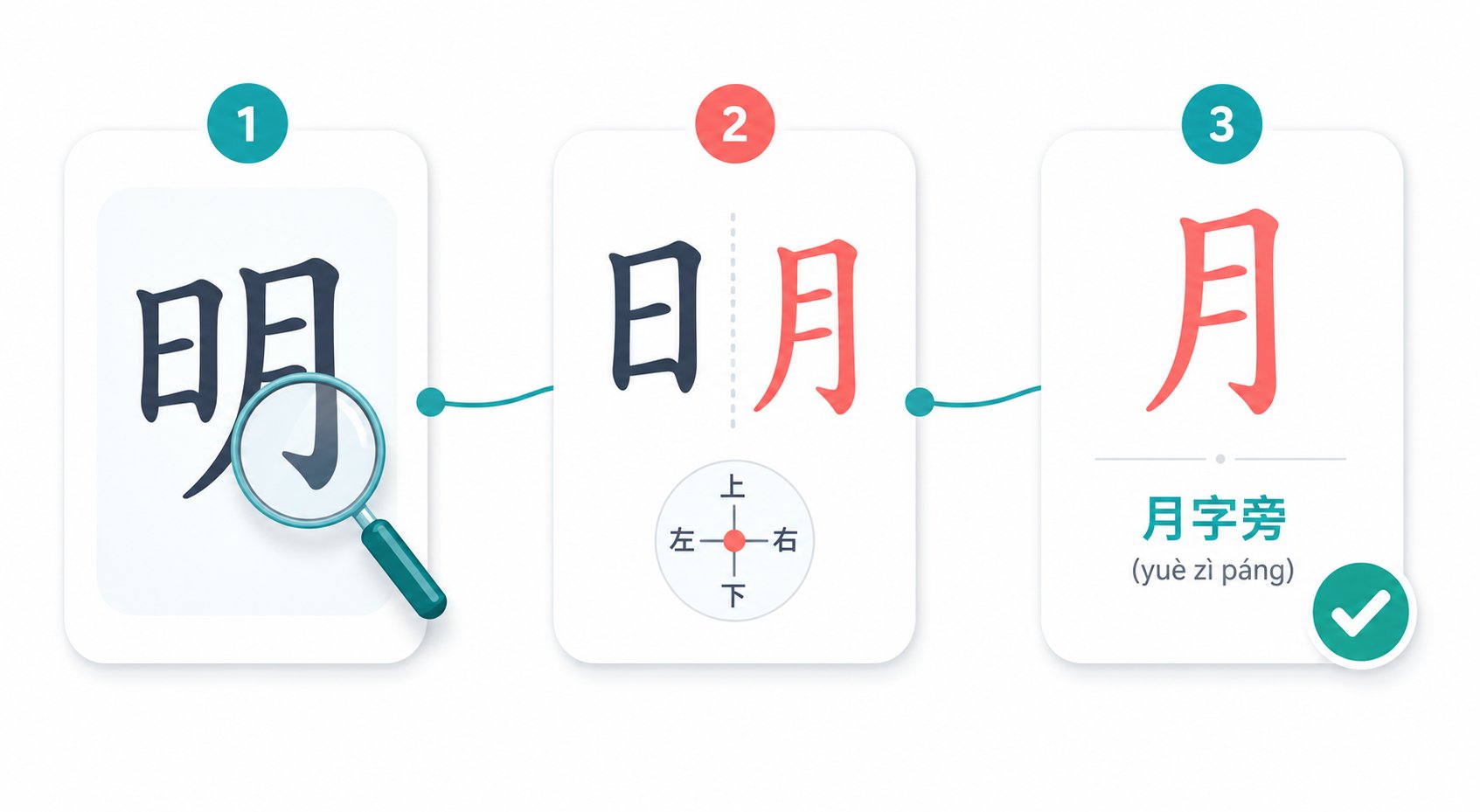
Every technique covered so far, positional suffixes, naming patterns, frequency priorities, converges into a single practical question: when you look at an unfamiliar character, how do you produce the correct pinyin name for its radical on the spot? The answer is a repeatable three-step process. It works whether you are staring at simplified or traditional text, whether the radical is on the left, top, or wrapping around the entire character.
What is a chinese radical in operational terms? It is the component you can isolate, name, and communicate. The method below turns that abstract definition into a concrete action sequence you can apply to any character you encounter.
Step One: Identify the Radical Component
Before you can name anything, you need to visually separate the radical from the rest of the character. This is easier than it sounds once you know what to look for. Most compound characters split cleanly into two or three structural zones: left-right, top-bottom, or enclosing-enclosed.
Start by asking: does this character divide vertically or horizontally? A left-right split is the most common structure in Chinese. If you see a narrow component on the left and a wider component on the right, the left piece is almost always the radical. For top-bottom characters, the smaller element on top is typically the radical. Enclosing structures are visually obvious because one component wraps around another.
Stroke count offers a secondary clue. Radicals tend to have fewer strokes than the phonetic component they accompany. If one half of a character has two or three strokes and the other half has five or more, the simpler piece is likely your radical.
Step Two: Determine the Radical's Position
Once you have isolated the radical, classify where it sits. This step matters because position determines which naming suffix applies. You are essentially choosing from a short list:
- Left side → suffix will be 旁 (pang)
- Top → suffix will be 头 (tou) or 字头 (zi tou)
- Bottom → suffix will be 底 (di)
- Enclosing → suffix will be 框 (kuang)
- Right side → often 旁 (pang) with a specific descriptor
Position classification is usually instant. You already performed it mentally during step one when you decided how the character splits. The key here is making the classification explicit, because it directly feeds into the name you will produce in step three.
Step Three: Apply the Naming Formula
Combine what you know about the radical's identity with its positional suffix. The formula is:
[Character reference or visual descriptor] + [position indicator]
The first part of the formula depends on which of the three naming patterns applies. If the radical is a well-known simplified form, use the source character's name plus 字 (zi). If the radical has a distinctive visual feature, use the visual descriptor. If the radical's meaning is transparent, the semantic label may drive the name instead.
Here is the method applied to a real character, step by step:
- Character: 请 (qing, please/to invite) - You see a narrow component on the left and a wider component on the right. The character splits vertically. The left piece is 讠, just two strokes. The right piece is 青, with eight strokes. The simpler left component is the radical.
- Position: left side - The radical 讠 sits to the left of 青. Left-side position means the suffix will be 旁 (pang).
- Naming formula: source character + 字 + 旁 - The component 讠 is the simplified form of 言 (yan, speech). Its visual form no longer resembles the original, so the name preserves the etymological link. Apply the formula: 言 + 字 + 旁 = 言字旁 (yan zi pang).
That is the complete identification. You looked at 请, isolated 讠, noted its left-side position, recognized it as a simplified form of 言, and produced the name 言字旁 (yan zi pang). The Princeton Chinese Characters Project confirms this breakdown: 讠 is the meaning radical of 请, simplified from 言, functioning as the radical of speech.
The same three steps work for any character. Try 花 (hua, flower): isolate 艹 on top, classify as top position, recognize it derives from 草 (cao, grass), apply the formula to get 草字头 (cao zi tou). Or take 国 (guo, country): isolate 囗 as the enclosing frame, classify as enclosing position, reference the character 国 itself, and arrive at 国字框 (guo zi kuang).
What are radicals in chinese if not components waiting to be named? This three-step process transforms what is a radical in chinese from a static dictionary concept into something you can actively identify and articulate in spoken Mandarin. The radical index in your mind stops being a lookup table and starts being a living skill.
Isolate the component, classify its position, apply the naming formula. These three steps turn any unfamiliar character into a radical you can name out loud in pinyin.
Practice this sequence with ten characters a day. Within a week, the steps collapse into a single fluid recognition. You will stop thinking about the formula consciously and start producing radical names the way native speakers do, on sight, without hesitation.
Frequently Asked Questions About Pinyin Name Radical Identification
1. What is the difference between a radical's standalone pinyin and its colloquial positional name?
Every Chinese radical has two spoken identities. The standalone pinyin is the pronunciation used when the radical appears as an independent character, such as shui for 水 (water). The colloquial positional name is the label native speakers use when describing that radical inside another character, such as san dian shui (三点水) for the three-dot water form 氵. The positional name encodes visual appearance, semantic origin, and location within the character all at once, making it far more informative for verbal communication about character structure.
2. How many Chinese radicals are there and which ones should I learn first?
The traditional Kangxi system contains 214 radicals, which remain the standard classification used in dictionaries today. However, you do not need to memorize all 214 names at once. The top 25-30 most frequent radicals appear in the vast majority of everyday characters. Starting with high-frequency left-side radicals like 氵 (san dian shui), 亻 (dan ren pang), and 扌 (ti shou pang) gives you the fastest return because left-position components dominate Chinese character structure.
3. How do I describe a Chinese character verbally using radical pinyin names?
Native speakers use a simple formula: state the radical's colloquial pinyin name, add 加 (jia, meaning plus), then name the other component. For example, 湖 (lake) is described as 三点水加胡 (san dian shui jia hu). For disambiguation, speakers reference a familiar word containing the component, such as 文化的文 (wenhua de wen) to specify which wen you mean. Top-bottom characters use 下面一个 (below is a), and enclosing structures use 里面一个 (inside is a) to clarify layout.
4. Do radical pinyin names change between simplified and traditional Chinese?
No, the colloquial pinyin names remain remarkably stable across both writing systems. Even when simplification drastically altered a radical's visual form, such as reducing 言 (seven strokes) to 讠 (two strokes), speakers still call it 言字旁 (yan zi pang) in both contexts. This consistency exists because the name references the original source character rather than the current visual appearance, making radical naming an effective bridge for learners navigating both simplified and traditional texts.
5. What are the positional suffixes used in Chinese radical names?
Chinese radical names use specific suffixes to indicate where the component sits within a character. The suffix 旁 (pang) signals a left-side or side position. The suffix 头 (tou) or 字头 (zi tou) marks a top position. The suffix 底 (di) indicates a bottom position. The suffix 框 (kuang) identifies an enclosing or framing position. Recognizing these suffixes lets you instantly determine a radical's location just by hearing its name, and helps you construct correct names for radicals you encounter for the first time.