What Spirit Really Means in Chinese
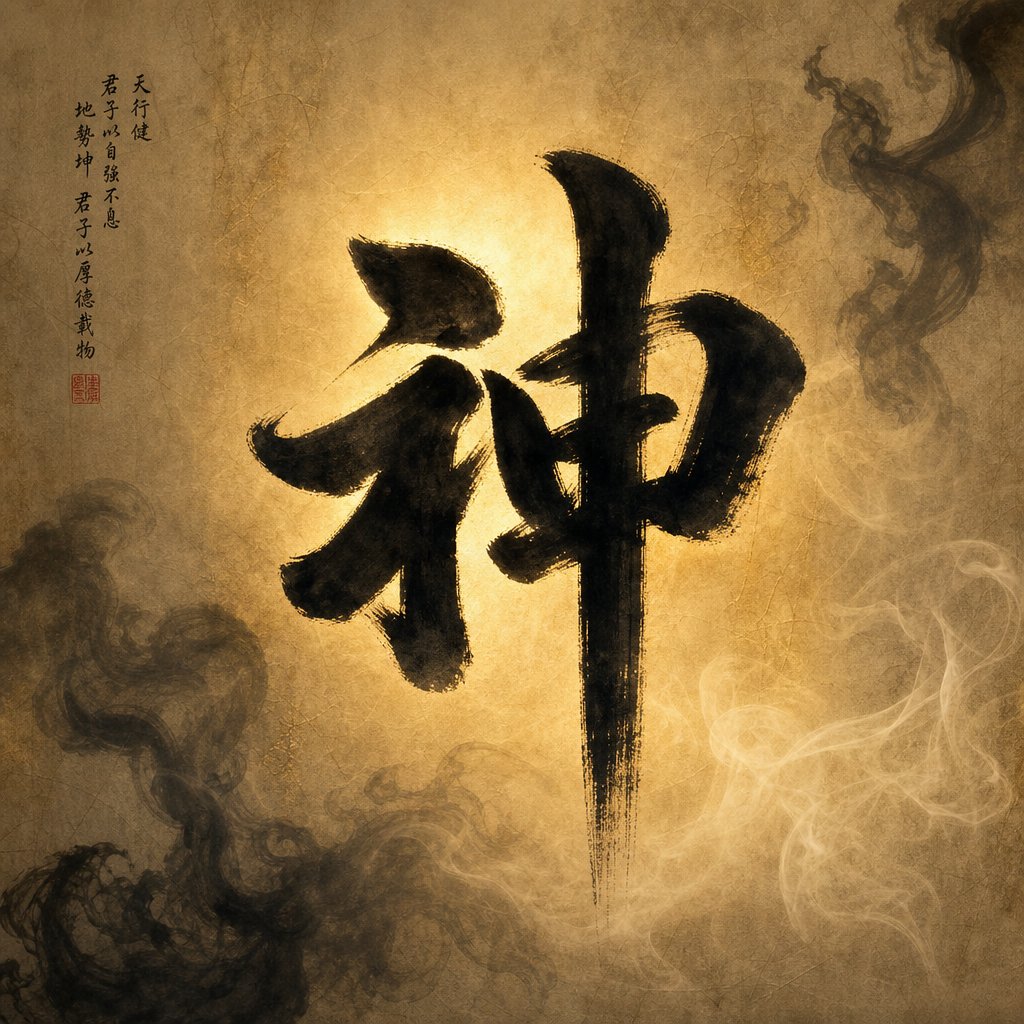
The spirit chinese character meaning is not a single definition but a constellation of ideas. Where English relies on one word — "spirit" — to cover everything from ghosts to vitality to divine beings, Chinese distributes these meanings across an entire family of characters, each with its own history, radical composition, and philosophical weight. The most common character is 神 (shen), broadly meaning "god, spirit, or consciousness," but it is only one piece of a much larger puzzle.
This distinction matters. If you are translating a Daoist text, prescribing in a Traditional Chinese Medicine clinic, or simply trying to express something spiritual in Chinese, choosing the wrong character changes the meaning entirely. Mandarin is characterized by a high level of near-synonymy — terms that overlap but cannot be used interchangeably — and the domain of spirit is a prime example of this phenomenon.
Why Chinese Has Multiple Characters for Spirit
Chinese thought never separated the sacred into a single, tidy category. The divine, the ancestral, the vital, and the ghostly each occupy distinct positions within a cosmological framework built on yin and yang. A language shaped by that worldview naturally developed separate written symbols for each facet. Understanding what counts as spiritual in Chinese requires grasping this multiplicity rather than forcing it into a Western one-word box.
A Roadmap to Every Spirit Character
Below is a quick-reference list of the major characters covered in this article, each capturing a different shade of the concept:
- 神 (shen) — god, deity, divine spirit, consciousness
- 靈 / 灵 (ling) — spiritual efficacy, the numinous, soul
- 魂 (hun) — ethereal soul, the spirit that ascends at death
- 魄 (po) — corporeal soul, the spirit that stays with the body
- 氣 / 气 (qi) — vital energy, life breath
- 精 (jing) — essence, refined spirit, vitality
Each character carries its own radical structure, historical evolution, and range of compound words. Together, they form the full spectrum of spirit in Chinese — from heavenly gods to the spark of awareness behind a person's eyes. The sections ahead break down each one so you can recognize, write, and use them with confidence.
The Character 神 (Shen) Explained
What does shen mean at its core? The character 神 (shen) is the single most important entry point into the Chinese vocabulary of the sacred. It is the default translation for both "god" and "spirit," and it appears in hundreds of compound words spanning religion, medicine, philosophy, and everyday slang. To truly define shen, you need to look inside the character itself — its radicals tell a story that stretches back over three thousand years.
Radical and Component Breakdown of 神
Every Chinese character is built from smaller meaningful parts, and 神 is no exception. It splits neatly into two components sitting side by side:
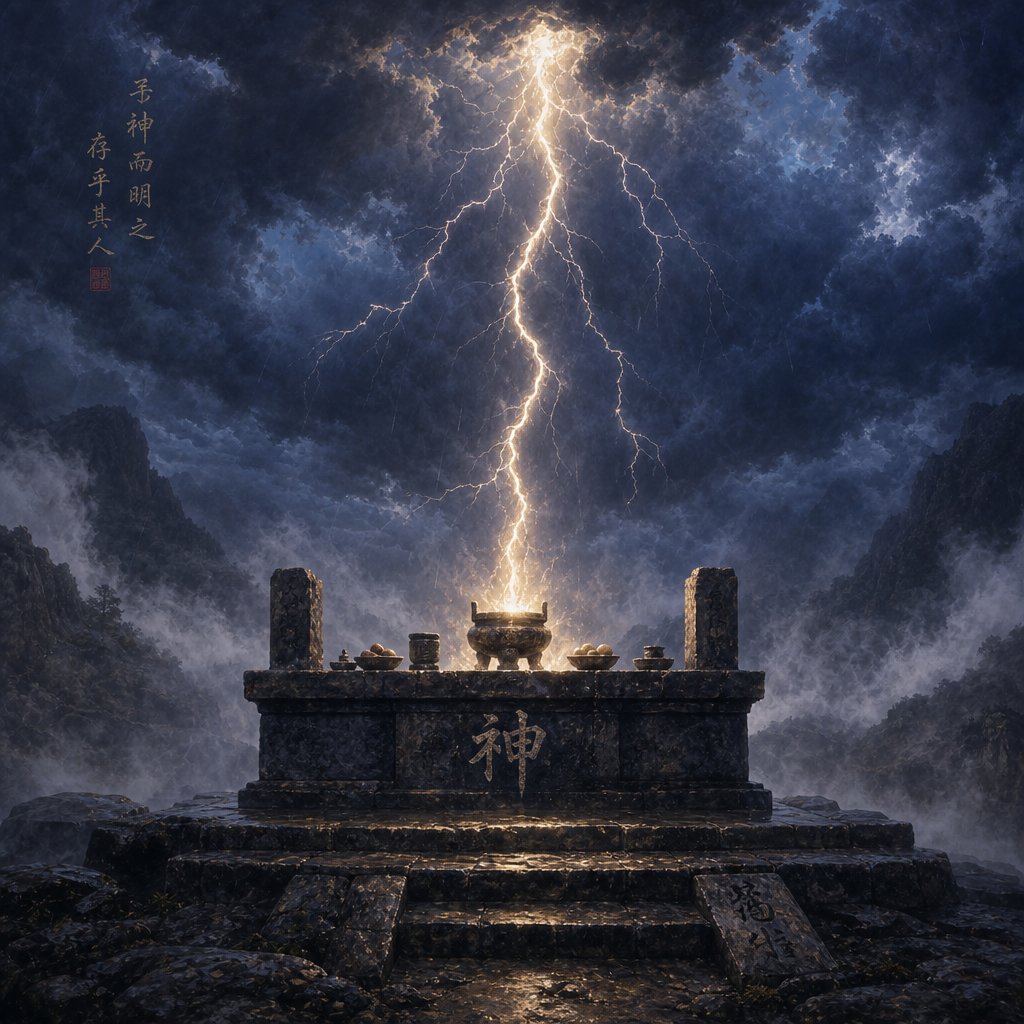
- Left side: 礻(示, shi) — the altar or worship radical. In its original form, 示 depicted a stone altar or sacrificial table used in rituals. Whenever you see this radical on the left side of a character, you know the word belongs to the domain of the sacred — prayer, blessings, ritual, or the divine.
- Right side: 申 (shen) — this component originally depicted a bolt of lightning stretching between heaven and earth. It carries the dual function of suggesting celestial power and providing the phonetic value (shen) for the whole character.
Imagine the visual logic: an altar on the left signals "this belongs to the realm of worship," while a lightning bolt on the right evokes the raw, awe-inspiring force of heaven. Put them together and you get 神 — the divine power that descends from the sky to the sacred space where humans make offerings. The 神 meaning, in other words, is baked right into its visual DNA.
How 神 Evolved from Oracle Bones to Modern Script
Chinese characters are not static inventions. They evolved across millennia, shifting shape as writing tools changed from carved bone to cast bronze to inked brush. The table below traces how 神 transformed through each major script period:
| Script Period | Approximate Era | Key Features |
|---|---|---|
| Oracle Bone Script | c. 1200–1050 BCE | Earliest known form; depicted lightning or was written with the 示 radical resembling a simple altar. Evidence is fragmentary for this character. |
| Bronze Script | c. 1050–400 BCE | Clearer two-part structure emerges. The altar radical (示) appears on the left, with 申 (lightning) on the right. Lines are thicker, cast into ritual vessels. |
| Seal Script | c. 400–200 BCE | Standardized under the Qin dynasty. Both components become more symmetrical and stylized, with flowing curved strokes. |
| Clerical Script | c. 200 BCE–200 CE | Strokes flatten and angularize for faster brush writing. The altar radical simplifies toward its modern form 礻. |
| Regular Script (Modern) | c. 200 CE–present | The form used today: 神. Nine strokes total, with 礻on the left (4 strokes) and 申 on the right (5 strokes). Identical in simplified and traditional Chinese. |
One notable detail: unlike many characters that differ between simplified and traditional systems, 神 looks the same in both. Whether you are reading a text printed in Beijing or Taipei, the character remains unchanged — a testament to how deeply rooted and stable this symbol has been throughout Chinese literary history.
Shuowen Jiezi on the Meaning of 神
The Shuowen Jiezi (说文解字), compiled by Xu Shen around 100 CE, is the earliest comprehensive Chinese dictionary and remains a foundational reference for character etymology. Its entry for 神 states that the character refers to "the spirits of heaven that guide and bring forth all things" (天神,引出万物者也). This definition places 神 firmly in the celestial realm — these are not earthly ghosts or ancestral shades but the governing forces of the cosmos itself.
The Shuowen's explanation aligns with how 神 was used in classical texts like the Rites of Zhou and the Zuo Zhuan, where it described heavenly deities involved in governance and ritual. Over centuries, the shen meaning expanded. It came to cover not just celestial gods but also the human mind and consciousness — a shift visible in philosophical works like the Zhuangzi, where 神 describes mental faculties that transcend ordinary perception.
When you translate 神 in English, then, no single word suffices. Depending on context, it can mean "god," "spirit," "divine," "consciousness," or even "remarkable." This breadth is not vagueness — it reflects a worldview where the divine and the mental share a common root, where the spark of awareness in a person's eyes and the power behind a lightning bolt are expressions of the same force.
That expansive quality is precisely what makes 神 the anchor character in Chinese spiritual vocabulary. Yet it does not stand alone. Alongside it sits another character — 靈 (ling) — that captures something 神 cannot: the responsive, numinous quality of things that seem to pulse with hidden life.
The Character 靈 (Ling) and Its Many Layers
What does ling mean in Chinese? Where 神 points upward toward celestial authority, the ling chinese character points outward — toward the responsive, alive quality of things that seem to vibrate with hidden power. The meaning of ling in chinese encompasses spirit, soul, efficacy, the supernatural, and even quickness or alertness. It is the word you reach for when something feels numinous, when a remedy works as if by magic, or when inspiration strikes from nowhere.
The character's visual structure tells you exactly why. Imagine a scene: shamans dancing between heaven and earth, mouths open in prayer, calling rain down from the sky. That image is literally encoded in the traditional form of the chinese character for ling.
Traditional 靈 vs Simplified 灵
The traditional form 靈 is one of the most visually complex characters in regular use — 24 strokes in total. Its components stack vertically into a vivid pictorial scene:
- Top: 雨 (yu) — rain, representing beneficial influence descending from heaven
- Middle: three 口 (kou) — three mouths, suggesting chanting, singing, or incantation
- Bottom: 巫 (wu) — shaman or shamaness, the human intermediary between heaven and earth
According to analysis of the character's etymology, the Dong Chinese dictionary classifies 靈 as a phonosemantic compound where 巫 (shaman) carries the meaning and 霝 (drops of rain) provides the sound. The Monkey Press analysis offers a more evocative reading: the shamans are situated between heaven and earth, possibly dancing, with three mouths singing or praying while rain falls from above. The whole character represents a kind of shamanic rain dance — spiritual power made visible through ritual action.
The simplified form 灵 (7 strokes) condenses all of this into a compact package: 彐 on top and 火 (fire) on the bottom. You will encounter 灵 in texts from mainland China, while 靈 remains standard in Taiwan, Hong Kong, and Macau. Both forms carry identical meaning and pronunciation (ling, second tone).
How 靈 Differs from 神 in Meaning
Ling in chinese and shen overlap but are not interchangeable. Think of it this way: 神 is the spirit itself — the deity, the consciousness, the divine being. 靈 is what that spirit does — its efficacy, its responsiveness, its capacity to affect the world. A temple might house a 神 (god), but if prayers there are consistently answered, the place is described as 靈 (efficacious, spiritually responsive).
| Dimension | 神 (Shen) | 靈 (Ling) |
|---|---|---|
| Core meaning | God, deity, divine consciousness | Spiritual efficacy, the numinous, soul |
| Emphasis | The divine being or force itself | The responsive, alive quality of things |
| Usage context | Religion, philosophy, medicine (mind) | Efficacy, inspiration, the supernatural |
| Emotional tone | Awe, reverence, authority | Wonder, mystery, aliveness |
| Common compounds | 精神 (vitality), 神话 (myth), 神经 (nerve) | 灵魂 (soul), 灵感 (inspiration), 精灵 (sprite) |
The classical text Xici (a commentary on the Yijing) positions 神 as constant and unchanging — above the influence of yin and yang. 靈, by contrast, implies dynamic interaction. It is spirit in motion, spirit that responds.
Common Compound Words Using 靈
The ling meaning chinese speakers use daily shows up in compounds that span the poetic and the practical:
- 灵魂 (linghun) — soul. The combination of 靈 (spiritual efficacy) and 魂 (ethereal soul) creates the standard modern word for the human soul.
- 精灵 (jingling) — elf, sprite, or spirit creature. Used in fantasy literature, gaming, and folklore to describe nimble supernatural beings.
- 灵感 (linggan) — inspiration. Literally "spiritual feeling" — the sudden flash of creative insight that seems to arrive from beyond the rational mind.
- 心灵 (xinling) — heart and spirit, the inner world. Often used in self-help and psychological contexts.
- 灵活 (linghuo) — flexible, agile. Here the "quick, responsive" sense of 靈 extends into everyday physical description.
You will also find 靈 embedded in one of the most important medical texts in Chinese history: the Ling Shu (靈樞), or "Spiritual Pivot," the second part of the Huangdi Neijing. The title refers to the acupuncture needle itself — acting as an intermediary between heaven and earth, spirit and matter. This connection between the ling chinese character and healing traditions runs deep, linking shamanic origins to clinical practice across millennia.
Yet spirit in Chinese thought is not only about the divine or the numinous. It also has a shadow side — a darker counterpart that governs what happens when life ends and the soul divides. That counterpart is 鬼 (gui), and its relationship to 神 reveals one of the most distinctive features of Chinese cosmology.
Spirit vs Ghost and the Dual Soul Concept
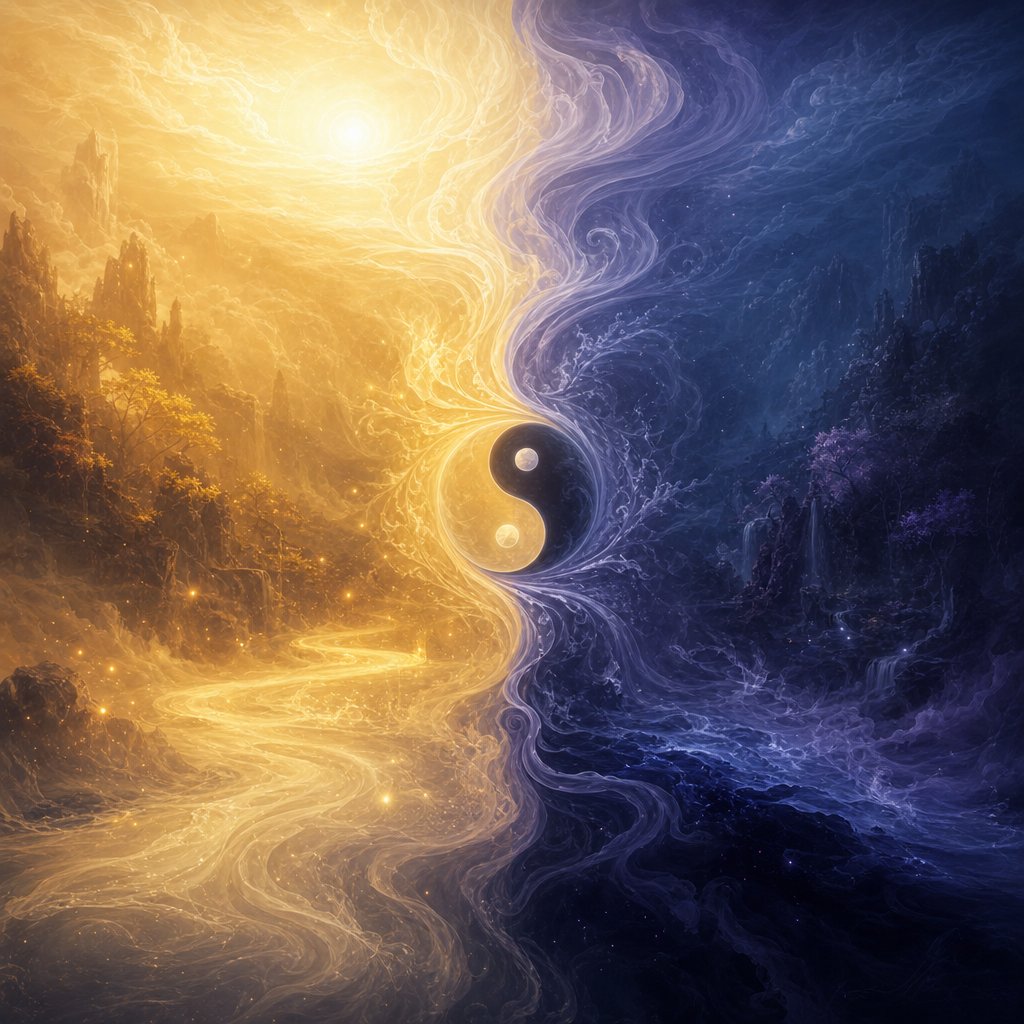
In Western thinking, "spirit" and "ghost" sit on opposite sides of a simple line — one is holy, the other is spooky. Chinese cosmology rejects that binary entirely. Instead, it organizes the invisible world along the axis of yin and yang, producing a framework where 神 (shen) and 鬼 (gui) are not enemies but complementary forces. Understanding this relationship is essential to grasping the full spirit chinese character meaning, because it reveals why Chinese philosophy needed so many characters for what English lumps into one or two words.
Shen vs Gui — The Yang and Yin of Spirit
The character 神 (shen) represents yang spiritual forces — heavenly, bright, ascending, and associated with consciousness and the divine. The character 鬼 (gui) represents yin spiritual forces — earthly, dark, descending, and associated with the dead and the unseen. Together, the compound 鬼神 (gui shen) refers to the entire spectrum of non-physical beings, from gods to ghosts and everything between.
This is not a good-versus-evil split. As Benebell Wen explains, gui means "a yin-dominant sentient but non-physical life force," while shen means "a yang-dominant sentient but non-physical life force." Neither is inherently malicious or benevolent. They are simply different polarities of the same spiritual reality — like night and day, cold and heat, or contraction and expansion.
The classical Chinese spiritual worldview treats this as a spectrum rather than a binary. In many legends, gui become shens, and shens become gui. The boundaries are fluid, shaped by context, merit, and cosmic cycles. The famous Sou Shen Ji (搜神记, "In Search of the Supernatural"), a fourth-century collection of tales about spirits and anomalies, illustrates this fluidity — its stories feature beings that shift between divine and ghostly states depending on circumstance.
The breath-soul (hun-qi 魂氣) returns to heaven; the bodily soul (xing-po 形魄) returns to earth. Therefore, in sacrificial-offering one should seek the meaning in the yin-yang principle. — Liji (Book of Rites)
This passage from the Liji captures the core logic: what ascends is yang and belongs to the domain of shen; what descends is yin and belongs to the domain of gui. The sacrificial system was designed around this cosmological architecture, with different rituals addressing each polarity.
Hun and Po — The Dual Soul in Chinese Thought
Where does the individual human fit within this cosmic framework? Chinese philosophy answers with one of its most distinctive concepts: every living person possesses two types of soul — the 魂 (hun) and the 魄 (po).
The hun is the ethereal, yang soul. It is associated with consciousness, personality, and the higher mental faculties. At death, the hun ascends — departing the body to join the heavenly realm. The po is the corporeal, yin soul. It is tied to the physical body, governing sensory perception and biological functions. At death, the po descends — remaining with the corpse and eventually returning to the earth.
The historian Yu Ying-shih describes hun and po as "two pivotal concepts that have been, and remain today, the key to understanding Chinese views of the human soul and the afterlife." The Daoist tradition further elaborated this into the concept of 三魂七魄 (sanhunqipo) — three hun souls and seven po souls — though this numerical framework was more scholastic than universally believed.
Both characters share the ghost radical 鬼 as their semantic component, signaling that they belong to the realm of souls and the unseen. The hun 魂 adds the phonetic element 云 (cloud), etymologically linking it to something vaporous and ascending. The po 魄 adds 白 (white, bright), connecting it to lunar phases — the waxing and waning of the moon's visible light.
| Character | Pinyin | Soul Type | Yin/Yang | At Death | Associated With |
|---|---|---|---|---|---|
| 神 (shen) | shen | Divine spirit | Yang | Worshipped at shrine | Heaven, consciousness, gods |
| 鬼 (gui) | gui | Ghost/demon | Yin | Resides in underworld | Earth, the dead, darkness |
| 魂 (hun) | hun | Ethereal soul | Yang | Ascends to heaven | Personality, mind, liver (in TCM) |
| 魄 (po) | po | Corporeal soul | Yin | Descends with body | Senses, body, lungs (in TCM) |
Why This Framework Matters for Understanding Chinese Culture
This dual-soul model shaped Chinese funeral customs for millennia. Han dynasty burials placed jade in bodily orifices to preserve the po, while rituals called 招魂 (zhaohun, "summoning the hun") attempted to recall the ethereal soul back to the body. The Lingshu Jing medical text associated the hun with the liver and blood, and the po with the lungs and breath — integrating soul theory directly into clinical diagnosis.
For anyone studying Chinese spiritual traditions, this framework explains why ancestor worship involves both grave offerings (nourishing the po) and shrine rituals (honoring the shen). It explains why the seventh lunar month — Ghost Month — is dedicated to gui rather than shen. And it explains why a single English word like "soul" can never fully capture what Chinese thought distributes across hun, po, ling, and shen.
The Western spirit/ghost binary asks: is it good or evil? The Chinese framework asks: is it ascending or descending, yang or yin, heavenly or earthly? That shift in questioning opens up an entirely different way of mapping the invisible world — one where the divine in chinese thought is not the opposite of the ghostly but its cosmic complement.
These same spirit characters do not stay locked in philosophy. They spill into everyday religious life, naming the gods that millions of people worship, pray to, and celebrate in festivals across the Chinese-speaking world.
Spirit Characters in Chinese Gods and Mythology
Walk into any Chinese temple and you will see 神 everywhere — carved above doorways, painted on scrolls, inscribed on incense burners. The character does not just mean "spirit" in the abstract. It is the building block used to name the gods themselves. In Chinese mythology and folk religion, 神 functions as both a standalone concept (the divine, the sacred) and as the operative word for "god" inside the names of specific deities worshipped across the Chinese-speaking world.
This dual role makes 神 one of the most productive characters in the language. It generates an enormous family of divine names, each one a compound that pairs 神 with a descriptor telling you what domain that god governs. Understanding how these names work gives you a direct window into how Chinese deities are organized — and why the character 神 sits at the center of an entire theological system.
How 神 Names the Chinese Gods
The naming pattern is elegant in its simplicity: take a word describing a domain of life, attach 神 to it, and you have a god. The result is a pantheon where every force of nature, every human need, and every social function has its own named deity. Here are some of the most widely worshipped Chinese gods whose names use 神:
- 財神 (Caishen) — God of Wealth. Cai Shen is arguably the most popular deity in Chinese folk religion, worshipped by merchants, business owners, and families hoping for prosperity. The character 財 means "wealth" or "riches," so the compound literally reads "wealth-god." During Chinese New Year, images of Cai Shen appear on doors and altars across the country. He is often called the chinese money god in English-language discussions of Chinese religion.
- 門神 (Menshen) — Door Gods. These guardian deities protect households from evil spirits. Historical records trace the Door Gods back to the Liji (Book of Rites), where the Zhou dynasty king brought offerings at palace gates. By the Han dynasty, the figures of Shentu and Yulei were painted on doors alongside tigers to repel ghosts. Later traditions identified the Door Gods as the Tang dynasty generals Qin Shubao and Yuchi Jingde.
- 土地神 (Tudi shen) — Earth God or God of the Local Land. Every village, neighborhood, and even individual plot of land has its own Tudi shen — a tutelary deity who watches over a specific locality. These are among the most accessible gods in the Chinese pantheon, worshipped at small roadside shrines rather than grand temples.
- 灶神 (Zaoshen) — Hearth God or Kitchen God. The master of household deities, Zaoshen monitors family behavior and reports to heaven at year's end.
- 雷神 (Leishen) — Thunder God. A deity of celestial phenomena, often depicted with drums and a fierce expression.
- 山神 (Shanshen) — Mountain God. Each sacred mountain has its own presiding spirit.
- 河神 (Heshen) — River God. Watercourse deities governing rivers, especially the Yellow River.
- 龍神 (Longshen) — Dragon Gods. Patrons of the Four Seas and controllers of rain and water.
Notice the pattern: the descriptor always comes first (wealth, door, earth, hearth), followed by 神. This structure tells you instantly what kind of god you are dealing with — no mythology textbook required.
Spirit Characters in Daoism, Buddhism, and Folk Religion
The character 神 does not carry the same weight in every Chinese religious tradition. Its meaning shifts depending on whether you are reading a Daoist philosophical text, a Buddhist sutra translated into Chinese, or a folk temple inscription.
In folk religion, 神 refers to specific, named deities — beings with personalities, backstories, and dedicated temples. These are the gods people pray to for rain, wealth, children, or protection. The Chinese pantheon is vast and polytheistic, with gods organized in a celestial hierarchy that mirrors the imperial bureaucracy. Every phenomenon has its own shen, and these gods are innumerable.
In philosophical Daoism, 神 takes on a more abstract meaning. Rather than referring to individual gods, it describes the cosmic principle of spirit itself — the animating intelligence behind all natural processes. The Daodejing uses 神 to describe the mysterious vitality of the valley (谷神, gushen, "Valley God"), which is really a metaphor for the inexhaustible creative power of the Dao. A taoist god in this philosophical sense is less a personal being and more an expression of cosmic pattern.
In Chinese Buddhism, the situation gets more complex. When Buddhist texts were translated from Sanskrit into Chinese, translators borrowed existing vocabulary. 神 was adapted to render concepts like "deva" (heavenly being), producing compounds like 天神 (tianshen, "celestial spirit"). But Buddhism also brought its own framework — bodhisattvas, buddhas, and dharma protectors — that did not map neatly onto the native Chinese spirit vocabulary. The result is a layered system where Buddhist and indigenous Chinese spirit concepts coexist, sometimes blending, sometimes maintaining distinct identities.
This three-way distinction matters for translation. When you encounter 神 in a text, the tradition it belongs to determines whether you should translate it as "god," "spirit," "the divine," or "cosmic principle." Context is everything.
From Caishen to Menshen — Gods Named with 神
The Door Gods offer a particularly rich example of how spirit characters function in living religious practice. The earliest references describe wooden figures or painted images placed on door panels to ward off evil. The tradition evolved over centuries — from the mythological guardians Shentu and Yulei in the Han dynasty, to the ghost-fighter Zhong Kui during the Tang period, to the military generals Qin Shubao and Yuchi Jingde from the Yuan dynasty onward. Each era reinterpreted who the 門神 were, but the character 神 remained constant in the name, anchoring the concept across two millennia of changing iconography.
Cai Shen similarly demonstrates how a single character generates an entire devotional culture. The God of Wealth is not one figure but several — different regions identify different historical or mythological persons as their Caishen. The compound 財神 functions as a title that can be filled by various candidates, much like "president" can refer to different people. What unites them is the 神 suffix, marking them as divine rather than merely human.
This naming system reveals something fundamental about how Chinese theology works. Gods are not defined primarily by creation myths or sacred scriptures. They are defined by function — what they do for worshippers. The character 神 acts as a grammatical marker of divinity, while the preceding character specifies the god's jurisdiction. It is a modular, expandable system that can accommodate new gods as communities need them, which is exactly why the Chinese pantheon has grown continuously for thousands of years.
The same character that names these gods also describes something far more intimate — the spark of awareness that a doctor looks for in a patient's eyes. In Traditional Chinese Medicine, 神 shifts from the cosmic to the clinical, becoming one of the Three Treasures that practitioners assess in every consultation.
Shen in Traditional Chinese Medicine
In a temple, 神 names the gods. In a clinic, it names something you can actually see — the brightness behind a patient's eyes, the coherence of their speech, the quality of their presence. Shen in chinese medicine refers not to a deity but to the totality of a person's mental and emotional vitality. It is the highest expression of health, and every practitioner learns to read it at a glance.
This clinical meaning of shen is not a modern reinterpretation. It is embedded in the oldest surviving medical texts, where 神 sits alongside two other fundamental substances as the pillars of human life. Together, they form a framework called the Three Treasures — and understanding their relationship is central to grasping how chinese medicine shen actually works in practice.
The Three Treasures — Jing, Qi, and Shen
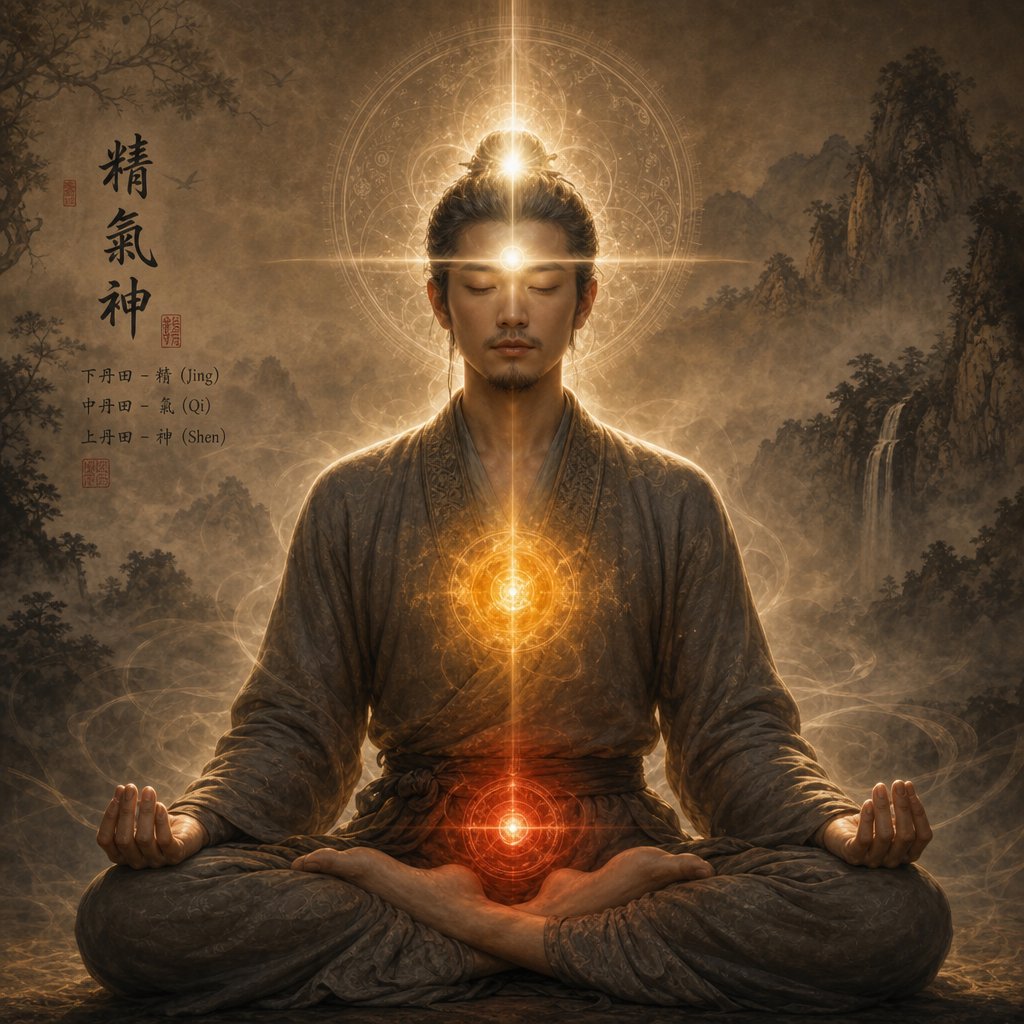
The Three Treasures (三宝, San Bao) are the three fundamental energies that sustain human life according to classical Daoist and medical theory: Jing (精, essence), Qi (氣, vital energy), and Shen (神, spirit-mind). Ancient practitioners considered these the basic substances of health — lose any one of them and the whole system falters.
A traditional analogy compares the Three Treasures to a candle. Jing is the wax and wick — the dense, material foundation that makes everything else possible. Qi is the flame — the active, transformative energy that burns through life. Shen is the light radiating outward — the luminous expression that others can perceive. Without wax, there is no flame. Without flame, there is no light. The treasures depend on each other in exactly this sequence.
| Treasure | Character | Translation | Physical Correlate | Signs of Health | Signs of Imbalance |
|---|---|---|---|---|---|
| Jing | 精 | Essence | Bone marrow, reproductive fluids, genetic constitution | Strong bones, thick hair, robust fertility, slow aging | Premature aging, weak knees, poor memory, infertility |
| Qi | 氣 | Vital energy | Breath, metabolic function, organ activity | Steady energy, warm limbs, strong digestion, clear voice | Fatigue, cold extremities, poor appetite, shortness of breath |
| Shen | 神 | Spirit / Mind | Consciousness, emotions, mental clarity (seated in the Heart) | Bright eyes, coherent speech, calm presence, restful sleep | Dull eyes, confused thinking, anxiety, insomnia, emotional instability |
The relationship flows upward: Jing is the root, Qi is the motive force, and Shen is the flowering. As the Daoist tradition explains, Jing connects us to our ancestors through genetic code and gives shape to the body, Qi drives all transformation and movement, and Shen governs mental, creative, and spiritual existence. A person with abundant Jing and smooth-flowing Qi will naturally display strong Shen — that unmistakable radiance of someone who is truly well.
How TCM Practitioners Assess Shen
When you visit a practitioner trained in shen tcm diagnosis, the assessment begins the moment you walk through the door. Before any pulse-taking or tongue inspection, the clinician is already reading your Shen through observation — one of the four classical examination methods outlined in the Nei Jing.
What are they looking for? The eyes come first. A person with healthy Shen has eyes that are bright, focused, and responsive — what classical texts call 神明 (shen ming), meaning "the radiance of spirit." It is said that the seat of Shen is the Heart, but the eyes are its window. Dull, unfocused, or vacant eyes signal Shen disturbance before any other symptom appears.
Beyond the eyes, practitioners observe:
- Speech — Is it coherent, appropriately paced, and responsive to context? Rambling, confused, or unusually slow speech suggests Shen disharmony.
- Demeanor — Does the person seem present and aware? Good Shen awareness, as described in clinical literature, means the patient knows where they are, recognizes their situation, and engages cooperatively.
- Emotional range — Healthy Shen balances emotions naturally. The Ling Shu (chapter 8) describes how excess or deficiency in organ Qi produces specific emotional disturbances — too much liver Qi brings anger, too little brings fear.
- Complexion — A subtle glow or luster to the skin, particularly the face, indicates that Shen is well-rooted in the body.
The concept of Shen unity is particularly important. In TCM, Shen is not a single monolithic force — it distributes across the five major organ systems. The Heart houses the overall Shen, but the liver houses the Hun (ethereal soul), the lungs house the Po (corporeal soul), the spleen houses the Yi (intention), and the kidneys house the Zhi (willpower). When all five aspects cooperate harmoniously, the person experiences what practitioners call "physique and Shen harmonizing in oneness."
Classical Medical Texts on Spirit
The foundational text for shen chinese medicine is the Huangdi Neijing (黄帝内经, Yellow Emperor's Classic of Internal Medicine), composed over several centuries and compiled roughly during the Han dynasty. It consists of two parts: the Su Wen (素问, Basic Questions) and the Ling Shu (靈樞, Spiritual Pivot).
Notice that second title — 靈樞. The character 靈 (ling), the same spirit character explored earlier in this article, appears right in the name of one of Chinese medicine's most important texts. The title is often translated as "Spiritual Pivot" or "Divine Pivot," referring to the acupuncture needle as a tool that pivots between the material and the spiritual. This is not coincidence. It reflects the deep conviction that healing operates at the boundary between body and spirit, between the physical and the numinous.
The Su Wen (chapter 1) opens with a description of the Yellow Emperor as "bright and clever when he was born" — language that implies harmonized Shen from the very start of life, rooted in strong pre-heaven essence. Chapters 13 and 25 elaborate on how emotional excess damages specific organs and disrupts Shen. The Ling Shu (chapter 8, Ben Shen) provides the most detailed classical discussion of how spirit distributes across the organ systems and how imbalance manifests as mental and emotional disorder.
Modern life — with its chronic stress, screen fatigue, and sleep deprivation — is not kind to Shen. The ancient Daoists prescribed stillness, meditation, and living in harmony with natural rhythms as the path to Shen cultivation. The clinical tradition offers acupuncture, herbal formulas, and lifestyle guidance aimed at the same goal: anchoring spirit firmly in the body so it can radiate outward as health, clarity, and presence.
These medical concepts do not stay locked inside clinics and classical texts. The spirit characters that name the Three Treasures also generate dozens of compound words used in everyday Mandarin — from internet slang to gaming terminology to the surnames printed on business cards.
Compound Words and Modern Everyday Usage
Spirit characters in Chinese do not live only in temples and medical texts. They show up in job interviews, text messages, video games, and casual conversation. The compounds they form are some of the most frequently used words in modern Mandarin — covering everything from mental health to mythology to calling someone a genius online. Knowing how shen in chinese and its sibling characters combine into everyday vocabulary is where textbook knowledge becomes real fluency.
Essential Compound Words with Spirit Characters
The table below collects the most important compounds built from the spirit character family. You will encounter these in newspapers, novels, medical reports, and daily speech:
| Compound | Pinyin | Literal Meaning | Modern Usage |
|---|---|---|---|
| 精神 | jingshén | essence + spirit | Vitality, morale, mental state, the "spirit" of a document or movement |
| 灵魂 | linghun | numinous + ethereal soul | Soul (the standard modern word for the human soul) |
| 精灵 | jingling | essence + spirit | Elf, sprite, fairy-like creature in fantasy and gaming |
| 神话 | shénhuà | spirit + speech | Myth, mythology; also used figuratively for "too good to be true" |
| 神奇 | shénqi | spirit + wondrous | Magical, miraculous, extraordinary |
| 神经 | shénjing | spirit + pathway | Nerve, nervous system; colloquially "crazy" (as an insult) |
| 神秘 | shénmì | spirit + secret | Mysterious, mystical |
| 灵感 | linggǎn | spirit + feeling | Inspiration, creative flash |
| 神态 | shéntài | spirit + manner | Demeanor, bearing, facial expression revealing inner state |
A few of these deserve special attention. The compound 精神 (jingshén) is arguably the most versatile shen chinese word in daily life. It spans the physical ("她今天精神很好" — she is full of energy today), the psychological (精神压力 — mental pressure), the collective (民族精神 — national spirit), and the textual (文件的精神 — the spirit of a document). The breadth is intentional. Chinese thought treats the animating force of a person and the animating force of a movement as the same kind of thing.
The compound 神经 (shénjing) has an interesting origin. It was coined in Meiji-era Japan as a translation of the Western medical term "nerve" — literally "spirit pathway" — and borrowed into Chinese in the late nineteenth century. The choice reflected an existing intuition that 神 and the body's signal pathways were connected. In casual speech, 神经病 (shénjingbìng, "nerve disease") has drifted far from its clinical meaning and become a common insult roughly equivalent to "what is wrong with you?"
Modern Slang and Pop Culture Usage
Step into any Chinese internet forum, gaming community, or social media platform and you will find spirit characters doing work their ancient creators never imagined. The character 神 has become a go-to intensifier in online slang, carrying the sense of "godlike" or "impossibly good." Here are the most common examples:
- 大神 (dàshén) — Literally "great god." In internet slang, it means guru, expert, or someone with elite-level skill. You might call a top-ranked gamer, a coding wizard, or even Google itself a 大神 (谷歌大神 — "Google the omnipotent").
- 神操作 (shén caozuò) — "Godlike move." Used when someone pulls off an incredible play in a game or an unexpectedly brilliant decision in real life.
- 神回复 (shén huifù) — "Godlike reply." A witty, devastating, or perfectly timed comment online.
- 灵 (ling) as "it works" — In casual speech, saying something is 灵 means it is effective or responsive. "这个方法很灵" means "this method really works." The ancient sense of spiritual efficacy has been domesticated into everyday problem-solving.
- 不灵 (bù ling) — The opposite: "it doesn't work," "it's not effective." Used for remedies, strategies, or gadgets that fail to deliver.
Gaming culture has pushed these characters even further. The term 精灵 (jingling) appears in countless game titles and character names — from Pokemon (宝可梦, formerly called 精灵宝可梦) to fantasy RPGs. The Spirit Blossom Shen skin in League of Legends draws directly on the mythological resonance of the character, reimagining the champion through the lens of East Asian spirit folklore. These pop culture appearances keep ancient characters alive in the minds of younger generations who might never read a classical text.
Brand names also lean heavily on spirit characters. Fitness brands use 精神 to evoke vitality. Tea companies use 神 to suggest transcendent quality. Tech startups use 灵 to imply responsiveness and cleverness. The characters carry thousands of years of accumulated meaning, and marketers know it.
The Surname Shen — A Common Confusion
Here is a question that trips up many learners: if someone's last name is Shen, does it use the spirit character? Almost always, no. The most common shen last name uses an entirely different character — 沈 — which has nothing to do with gods or spirits.
The shen last name origin traces back to the ancient state of Shen (沈国) during the Zhou dynasty. The character 沈 contains the water radical (氵) on the left and 冘 on the right, and its primary meaning is "to sink" or "to submerge." It is pronounced shěn in its verb sense (third tone, meaning "to sink") but as a surname it is read shěn in standard Mandarin. Some older romanization systems and regional pronunciations render it as shèn. The shen name meaning, in this case, connects to geography and clan history rather than anything divine.
This distinction matters because the tones and characters are completely different:
- 神 (shén, second tone) — spirit, god, divine. The character discussed throughout this article.
- 沈 (shěn, third tone as surname) — a common Chinese surname. No spiritual meaning. Written with the water radical.
Other less common surnames romanized as "Shen" include 申 (shēn, first tone — the lightning component from inside 神) and 慎 (shèn, fourth tone — meaning "cautious"). Each uses a different character, different tone, and carries a different shen last name origin story. When you see "Shen" written in English without tone marks or characters, you cannot know which one it is without additional context — a perfect illustration of why romanization alone never tells the full story in Chinese.
From ancient altar inscriptions to internet memes, from medical diagnoses to gaming handles, spirit characters remain among the most productive and culturally loaded elements in the Chinese writing system. Their compound words form a living vocabulary that evolves with each generation while keeping its roots firmly planted in millennia of philosophical and religious thought. The practical question that remains is: how do you actually write these characters correctly, and what patterns help you remember them?
How to Write and Remember Spirit Characters
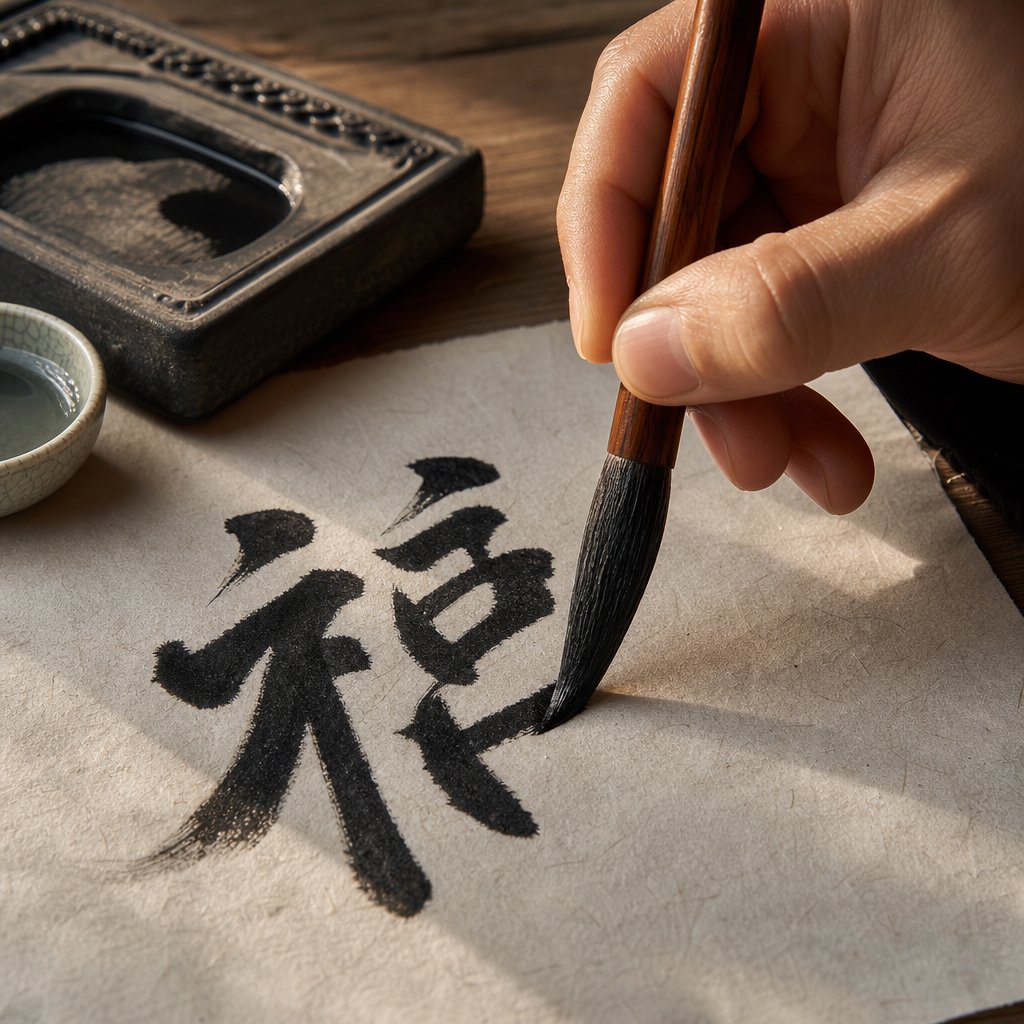
Knowing what spirit characters mean is one thing. Getting them onto paper — stroke by stroke, in the right order, with the right proportions — is another challenge entirely. The good news: Chinese characters are not random tangles of lines. They follow predictable rules, and once you internalize those rules, even a complex character like 靈 (24 strokes) becomes a sequence of manageable steps rather than an intimidating wall of ink.
The chinese character for god — 神 — is the ideal starting point. At only 9 strokes, it is compact enough for beginners yet structurally rich enough to teach you principles that apply to hundreds of other characters. Let's break it down.
Stroke Order for 神 Step by Step
The character 神 is a left-right composition. You write the left component (礻, the worship radical, 4 strokes) first, then the right component (申, 5 strokes). Within each component, three universal stroke order rules apply: top to bottom, left to right, and horizontal strokes before vertical strokes that cross them.
Here is the complete stroke sequence for writing the god in chinese symbol:
- Stroke 1 — Short horizontal dot (丶) at the top-left of the 礻radical
- Stroke 2 — Left-falling stroke (丿) sweeping down from the dot, forming the radical's backbone
- Stroke 3 — Short vertical stroke (丨) dropping straight down from the center of the radical
- Stroke 4 — Right-falling dot (丶) at the bottom-right of the radical, completing 礻
- Stroke 5 — Vertical stroke (丨) forming the central spine of 申
- Stroke 6 — Top horizontal stroke (一) of the rectangular box in 申
- Stroke 7 — Left vertical and bottom horizontal, forming the left side and base of the box (フ turning stroke)
- Stroke 8 — Right vertical stroke closing the box on the right side
- Stroke 9 — The central vertical stroke extends downward through and below the box, completing 申
Sounds complex? It is simpler than it looks once you practice it a few times. The key insight is that you are not writing 9 disconnected strokes — you are writing two familiar components in sequence. The 礻radical appears in dozens of characters, so after a few days of practice, your hand will produce it automatically. The 申 component is equally common. Once both are muscle memory, writing the shen symbol becomes effortless.
For the traditional form 靈 (24 strokes), most learners wisely start with the simplified 灵 (7 strokes) and work their way up. The simplified form pairs 彐 (a hand-like component, 3 strokes) on top with 火 (fire, 4 strokes) on the bottom — a top-bottom composition that follows the same "top first, bottom second" rule. Once you are comfortable with 灵, tackling 靈 becomes a matter of stacking familiar sub-components: 雨 (rain, 8 strokes) on top, three 口 (mouth, 3 strokes each) in the middle, and 巫 (shaman, 7 strokes) at the bottom.
The 示 Radical Family of Characters
Here is where stroke order practice pays dividends beyond a single character. The 礻radical (a compressed form of 示, meaning altar or worship) functions as a chinese traditional religion symbol — a visual flag telling you that the character belongs to the domain of the sacred. When you spot 礻on the left side of any character, you immediately know it relates to ritual, prayer, blessings, or the divine.
Recognizing this pattern lets you decode unfamiliar characters on sight. Even if you have never seen a particular character before, the presence of 礻narrows its meaning to the religious and ceremonial sphere. The Daily Zhongwen radical guide confirms that characters using 礻are "often related to sacrifices and ceremonies" — a consistent pattern across thousands of years of Chinese writing.
| Character | Pinyin | Meaning | How the Radical Connects |
|---|---|---|---|
| 神 | shén | God, spirit, divine | The altar radical + lightning = divine power descending to the sacred space |
| 祝 | zhù | Wish, pray, invoke blessings | The altar radical + a person kneeling = prayer at a shrine |
| 祈 | qí | Pray, supplicate | The altar radical + axe (斤) = ritual petition, cutting through to the divine |
| 福 | fú | Fortune, blessing, happiness | The altar radical + abundance = blessings received from the gods |
| 礼 | lǐ | Ritual, propriety, gift | The altar radical + ceremony = proper conduct before the sacred |
| 社 | shè | Society, community, earth altar | The altar radical + earth (土) = communal worship at the land shrine |
| 祖 | zǔ | Ancestor, forefather | The altar radical + a marker = those honored at the ancestral altar |
| 禅 | chán | Zen, meditation, Buddhist contemplation | The altar radical + simple (单) = spiritual practice of simplicity |
You will notice that every character in this family connects to worship, the sacred, or communal ritual life. This is not coincidence — it is the radical system working exactly as designed. The 礻component is a semantic signpost, and learning to read it gives you a shortcut into the meaning of any god in chinese writing that uses it.
Tips for Memorizing Complex Spirit Characters
Writing a character correctly once is not the same as remembering it permanently. Here are practical strategies that work specifically for spirit-related characters:
- Learn radicals as meaning clusters, not isolated strokes. When you study 神, you are not memorizing 9 arbitrary lines — you are combining "altar" with "lightning." That story sticks in memory far better than a stroke sequence alone. As Hacking Chinese emphasizes, understanding what you are doing is the foundation of efficient character learning — treating characters as "a jumble of disconnected strokes" and relying on mindless repetition is the worst-case scenario.
- Group characters by radical family. Practice 神, 祝, 福, and 祈 in the same session. Your hand learns the 礻radical once, then you only need to focus on the right-side component for each new character. This approach leverages the chinese traditional religion symbol as a shared anchor across the whole group.
- Use the simplified form as a stepping stone. For 靈/灵, master the 7-stroke simplified version first. Once it feels natural, the traditional form is just an expansion — more detail in the same structural slots, not a completely new character.
- Write with intention, not volume. Five focused repetitions where you visualize each component's meaning beat fifty mindless copies. Research consistently shows that meaningful association outperforms rote repetition for long-term retention.
- Connect stroke order to the character's story. For 神, you write the altar first (礻) because the sacred space must exist before the divine can arrive. For 靈, you write rain falling from above (雨) before the shamans chanting below (巫) — heaven acts first, humans respond. These narrative hooks make the sequence feel logical rather than arbitrary.
The god in chinese symbol is ultimately a gateway character. Master 神 and you have learned the 礻radical, the 申 phonetic component, and the left-right composition principle — tools that unlock dozens of related characters without starting from scratch each time. That is the real power of understanding stroke order and radical structure: each character you learn makes the next one easier.
With the ability to recognize, write, and remember these characters in hand, the final challenge is knowing which one to reach for in any given situation. The same English word "spirit" maps to different Chinese characters depending on whether you are ordering a drink, describing someone's mood, or translating a religious text.
Choosing the Right Spirit Character for Every Context
How do you say god in Chinese? How do you say spirit, soul, or ghost? If you have read this far, you already know the answer is never a single word. It depends entirely on what you mean. The shen definition shifts based on whether you are talking about a deity in a temple, the vitality in someone's eyes, or the consciousness described in a medical text. Each context demands a different character — and picking the wrong one does not just sound awkward, it changes the meaning entirely.
Which Spirit Character to Use — A Context Guide
The table below works as a decision matrix. Start with what you want to express in English, then follow the row to the correct Chinese character and an example sentence showing it in action:
| English Context | Chinese Character | Pinyin | Example Sentence |
|---|---|---|---|
| God or divine being | 神 | shen | 他信神。(Ta xin shen.) — He believes in God. |
| Soul / inner spirit | 灵魂 | linghun | 音乐触动了她的灵魂。(Yinyue chudong le ta de linghun.) — The music touched her soul. |
| Vitality / morale / fighting spirit | 精神 | jingshen | 团队精神很重要。(Tuandui jingshen hen zhongyao.) — Team spirit matters. |
| Ghost / departed spirit | 鬼 | gui | 他不怕鬼。(Ta bu pa gui.) — He is not afraid of ghosts. |
| Spirit-mind in TCM | 神 | shen | 她的神很好。(Ta de shen hen hao.) — Her spirit/awareness is strong. |
| Alcohol / spirits (the drink) | 烈酒 | liejiu | 这家店卖烈酒。(Zhe jia dian mai liejiu.) — This shop sells spirits. |
| Spiritual efficacy / "it works" | 灵 | ling | 这个方法很灵。(Zhe ge fangfa hen ling.) — This method really works. |
Notice the last row — alcohol. When English speakers say "spirits" meaning liquor, Chinese uses 烈酒 (literally "fierce liquor"), which contains no spirit character at all. This is a classic false-friend trap for translators who assume every sense of the English word maps onto the same Chinese root.
Spirit Characters in the Real World
These distinctions are not academic exercises. They show up in places you encounter daily if you spend time in Chinese-speaking environments:
- Temple signage — The plaque above a temple gate will read 神 in deity names (关帝神, Guandi shen) or 灵 in phrases praising the temple's efficacy (有求必灵, "prayers are always answered").
- Martial arts — Schools and competitions use 精神 (jingshen) for fighting spirit and mental focus. A coach telling students to show more 精神 is asking for intensity and presence, not religious devotion.
- Chinese medicine clinics — Clinic names often incorporate 神 or 灵 to signal healing traditions. The word 养神 (yangshen, "nourishing the spirit") appears on wellness products and spa signage, drawing on the TCM meaning of chinese shen as mental vitality.
- Brand names and marketing — Tech companies use 神 to imply extraordinary performance (神州, Shenzhou, a computer brand meaning "divine land"). Skincare brands use 灵 to suggest responsiveness and efficacy.
Even in casual conversation, the shen chinese meaning you intend determines which compound you reach for. Telling a friend "你今天精神不错" (your energy is good today) is a compliment. Saying "你信神吗" (do you believe in God?) is a completely different conversation. Same syllable, same tone, radically different territory.
Mastering the Full Spectrum of Spirit in Chinese
What is shen? It is not one thing. It is a doorway into a system where the divine, the vital, the conscious, and the ghostly each have their own character, their own radical logic, and their own place in a cosmological framework built over three thousand years. The spirit chinese character meaning is not a definition to memorize — it is a map to navigate.
The central insight of this entire exploration comes back to where we started: English uses one word where Chinese uses many. That multiplicity is not a complication. It is precision. Each character — 神, 靈, 魂, 魄, 氣, 精 — carves out a specific territory within the vast landscape of the unseen. Learning to choose the right one for each context is not just a language skill. It is a way of thinking about spirit itself with the kind of nuance that a single English word can never provide.
Frequently Asked Questions About Spirit Chinese Characters
1. What is the main Chinese character for spirit?
The primary Chinese character for spirit is 神 (shen), which broadly translates to god, deity, divine spirit, or consciousness. It consists of the altar radical 礻(示) on the left, signaling the sacred domain, and 申 on the right, originally depicting lightning stretching between heaven and earth. However, Chinese uses multiple characters for spirit depending on context, including 靈 (ling) for spiritual efficacy, 魂 (hun) for the ethereal soul, and 精 (jing) for essence or refined vitality.
2. What is the difference between 神 (shen) and 靈 (ling) in Chinese?
While both relate to spirit, they emphasize different aspects. 神 (shen) refers to the divine being or force itself, such as a god, deity, or consciousness. It carries a tone of awe and authority. 靈 (ling) emphasizes the responsive, alive quality of things, covering spiritual efficacy, the numinous, and inspiration. A temple houses a 神 (god), but if prayers there are consistently answered, the place is described as 靈 (spiritually efficacious). In compounds, 神 appears in words like 神话 (myth) while 靈 appears in 灵感 (inspiration) and 灵魂 (soul).
3. What does shen mean in Traditional Chinese Medicine?
In TCM, shen refers to the totality of a person's mental and emotional vitality rather than a deity. It is one of the Three Treasures (San Bao) alongside Jing (essence) and Qi (vital energy). Practitioners assess shen by observing a patient's eye brightness, speech coherence, demeanor, and emotional range. Healthy shen manifests as bright, focused eyes, calm presence, and restful sleep. The Heart is considered shen's primary seat, though it distributes across all five major organ systems, with each organ housing a specific aspect of spirit.
4. What are hun and po in Chinese philosophy?
Hun (魂) and po (魄) represent the dual-soul concept unique to Chinese thought. The hun is the ethereal, yang soul associated with consciousness and personality that ascends to heaven at death. The po is the corporeal, yin soul tied to the physical body and sensory perception that descends into the earth at death. This framework shaped Chinese funeral customs for millennia, with grave offerings nourishing the po and shrine rituals honoring the ascending hun. In TCM, the hun is housed in the liver while the po resides in the lungs.
5. How do you choose the right Chinese character for spirit in translation?
The correct character depends entirely on context. Use 神 (shen) for a god or divine being, 灵魂 (linghun) for the human soul, 精神 (jingshen) for vitality or morale, 鬼 (gui) for a ghost or departed spirit, and 灵 (ling) when describing something spiritually efficacious or effective. For alcohol or spirits as a beverage, Chinese uses 烈酒 (liejiu), which contains no spirit character at all. Misusing these terms does not just sound awkward but fundamentally changes the meaning of what you are communicating.