How Traditional Chinese Names Work
When you hear a Chinese name spoken aloud, you're hearing far more than a label. Traditional Chinese naming conventions form an integrated philosophical system, one that weaves together cosmology, family lineage, linguistics, and numerology into a single act of identity-making. Every character chosen carries tonal weight, visual meaning, and ancestral resonance. The chinese for name itself splits into two concepts: 姓 (xing) for surname and 名 (ming) for given name, each governed by distinct cultural rules.
So how are chinese names structured at their most basic level? A Chinese name typically follows a compact format: surname first, given name second. The given name consists of one or two characters. In the name 李明华 (Li Minghua), 李 (Li) is the surname and 明华 (Minghua) is the given name. This three-character pattern accounts for the vast majority of common chinese names you'll encounter, though two-character names (single-character given names) also exist.
How Chinese Names Are Structured
The surname-first order isn't arbitrary. It reflects a core Confucian principle: the family precedes the individual. Where Western naming conventions place the personal name up front, the chinese name structure reverses this priority entirely. Your clan identity, your lineage, your place within a multigenerational web of relationships comes before anything uniquely yours.
This ordering tells you something fundamental about how identity works in Chinese culture. You belong to a family before you belong to yourself. The surname (姓 xing) anchors you in history, connecting you to ancestors stretching back centuries. The given name (名 ming) then expresses what your family hopes you'll become within that inherited framework. Over 85% of China's population shares fewer than 100 surnames, making the given name the primary space for individual expression and aspiration.
Why Naming Matters in Chinese Culture
Here's where chinese naming conventions diverge most sharply from Western practice. In Chinese tradition, a name doesn't just identify a person. It actively shapes their fate. This belief draws from Daoist cosmology, where language and reality are deeply intertwined. The characters in a name carry energetic properties, tonal vibrations, and elemental associations that interact with the bearer's destiny throughout life.
Imagine choosing a name the way you'd compose a prescription: balancing elements, harmonizing sounds, aligning with cosmic timing. That's precisely how traditional naming works. Parents consult birth charts, analyze stroke counts, and weigh the Five Elements (五行 Wuxing) to select characters that compensate for what the child's destiny lacks and amplify what it already holds.
In Chinese philosophy, a name is not a passive identifier but an active force. It carries the weight of ancestral hopes, cosmological alignment, and linguistic precision, functioning as a bridge between who a person is and who they are meant to become.
Ancestor veneration adds another layer. Because names connect the living to the dead, choosing characters that honor family legacy without violating naming taboos requires careful navigation. The act of naming becomes a ritual of continuity, linking past generations to future ones through deliberately chosen language.
This philosophical depth explains why how do chinese names work remains such a rich question. The answer involves not just grammar and structure, but an entire worldview where sound, meaning, and cosmic order converge in two or three carefully selected characters. Each layer of this system, from surname origins to elemental balancing, deserves its own exploration.
The Historical Origins of Chinese Surnames
Chinese surnames didn't appear overnight. They emerged from one of the oldest continuous naming traditions on Earth, stretching back over 4,000 years to a time when clan identity meant survival. Understanding chinese surnames and meanings requires tracing a path through matrilineal tribes, feudal kingdoms, and imperial dynasties, each era leaving its mark on the family names still carried by over a billion people.
The Ancient Distinction Between 姓 and 氏
Here's something most people don't realize: what we call a "chinese last name" today actually descends from two separate systems that once operated independently. The character 姓 (xing) originally referred to a broad maternal clan identity. Notice the radical 女 (woman) embedded in the character itself. This isn't coincidental. During China's matriarchal period, children took their mother's clan name, and many of the earliest surviving surnames like 姬 (Ji), 姜 (Jiang), and 姚 (Yao) still carry the female radical as evidence of this origin.
The second system, 氏 (shi), emerged later as society shifted toward patriarchy and feudal hierarchy. Shi functioned as a branch identifier, distinguishing noble lineages within the same broader xing clan. A nobleman might share his xing with thousands of people but carry a unique shi based on his fief, title, or official position. Commoners had xing and given names but no shi at all.
By the Warring States Period (475-221 BC), this dual system began collapsing. As feudal structures dissolved and social mobility increased, the distinction between xing and shi lost practical meaning. During the Qin-Han unification period, the two merged into the single-surname system we recognize today, where every person, regardless of class, carries one hereditary family name.
Origins of the Most Common Chinese Surnames
The Song Dynasty text Baijiaxing (百家姓, "Hundred Family Surnames") compiled the known chinese family names of its era into a rhyming poem for easy memorization. Despite its title, the text recorded over 400 surnames. The expression laobaixing (老百姓, literally "old hundred surnames") remains a common term for ordinary people in modern Chinese.
So where did the most common chinese last names actually come from? Their origins fall into distinct categories, each reflecting a different slice of ancient life:
| Surname | Character | Pinyin | Meaning | Origin Type |
|---|---|---|---|---|
| Wang | 王 | Wang | King / Ruler | Title of nobility |
| Li | 李 | Li | Plum tree | Ancestral name / Imperial grant |
| Zhang | 張 | Zhang | To draw a bow | Occupation (archery official) |
| Liu | 劉 | Liu | To kill / Battle axe | Ancestral name |
| Chen | 陳 | Chen | To display / Ancient state | Place of origin (State of Chen) |
| Yang | 楊 | Yang | Poplar tree | Place of origin |
These six chinese last names alone account for a staggering portion of China's population. Wang (王) derives from the word for "king," originally designating descendants of royal houses. Li (李) gained dominance partly because the Tang Dynasty imperial family carried this surname and granted it to meritorious officials as an honor. Zhang (張) traces to an ancient official responsible for bows and arrows, the character itself depicting the act of drawing a bowstring.
How Surname Distribution Evolved Over Dynasties
The list of common chinese last names didn't remain static. Political upheaval, mass migrations, and imperial decrees continuously reshuffled which surnames dominated which regions.
Consider a few key shifts:
- The Tang Dynasty (618-907) elevated Li (李) to supreme status through imperial grants, swelling its numbers artificially as officials and allied ethnic groups adopted it.
- The Ming Dynasty's Zhu (朱) family similarly granted their surname to loyal subjects, though this practice reversed after the dynasty fell and many recipients quietly reverted.
- Massive southward migrations during the Jin and Song dynasties carried northern surnames like Wang and Zhang into regions previously dominated by local clan names.
- Ethnic assimilation transformed multi-character surnames from non-Han groups into single-character Han equivalents. The Xianbei surname Batuo, for instance, became Yuan (元).
Some families also changed their chinese last name to avoid persecution or imperial naming taboos. When an emperor's personal name contained a certain character, every family sharing that surname faced pressure to alter it, sometimes permanently reshaping regional surname distributions.
The result is a surname landscape shaped as much by politics as by biology. Among the most common chinese surnames, each carries layers of meaning: occupational, geographical, botanical, or noble. These aren't arbitrary labels but compressed histories, and they set the stage for the even more intricate system of given names, where individual destiny enters the picture.
The Complete Traditional Naming System
Surnames anchor a person in clan history, but the given name side of chinese name conventions is where things get truly layered. In traditional Chinese culture, a person didn't receive just one name at birth and carry it unchanged through life. Instead, they accumulated a sequence of names, each bestowed at a different stage and serving a distinct social function. Think of it as a naming lifecycle, one that tracked a person's journey from vulnerable infant to accomplished adult.
What Westerners typically call a "chinese name first name" is actually just one piece of a much larger system. The full traditional framework includes at least four distinct name types, each with its own timing, purpose, and rules of use:
- Milk name (乳名 rumíng) - Given at birth or shortly after. Used by family members during childhood. Function: protection from evil spirits through deliberate humility.
- Formal given name (名 míng) - Bestowed around one month of age at the full-month celebration. Used in official contexts. Function: expressing parental aspirations and cosmic alignment.
- Courtesy name (字 zì) - Received at the capping ceremony (冠礼 guānlǐ) around age 20. Used by peers and in formal address. Function: marking adulthood and expressing moral character.
- Literary name (號 hào) - Self-chosen in adulthood. Used in artistic and scholarly circles. Function: personal philosophical expression.
Each layer added depth to a person's identity. You'll notice that the relationship between names and characters in this system isn't random. Every transition carried ritual significance.
Milk Names and the Tradition of Protective Naming
Imagine deliberately naming your newborn "Little Dog" or "Ugly One." Sounds harsh, but this was standard practice in traditional China. The milk name (乳名 rumíng), also called the childhood name (小名 xiǎomíng), was intentionally humble, crude, or even repulsive. Why? Folk religion held that evil spirits and jealous ghosts targeted beautiful, promising children. A child with an impressive name attracted dangerous attention from the spirit world.
By giving an infant a lowly milk name, parents essentially made the child invisible to malevolent forces. Names like 狗蛋 (Gǒudan, "dog egg"), 铁柱 (Tiězhù, "iron pillar"), or 丑丑 (Chǒuchǒu, "ugly ugly") signaled that this child wasn't worth stealing. The logic mirrors a kind of spiritual camouflage. Even emperors followed this custom. Ancient Chinese families believed that names like pig or cow would not attract evil spirits, thereby assuring the child a long life.
These milk names stayed within the family circle. Only parents, grandparents, and close relatives used them. As the child grew, the milk name faded from public use but often persisted as a private term of endearment well into adulthood.
The Courtesy Name and Its Relationship to the Given Name
The chinese courtesy name represents one of the most sophisticated elements of this naming system. At age twenty, a young man underwent the capping ceremony (冠礼 guānlǐ), a formal rite of passage into adulthood. During this ritual, he received his 字 (zì), a courtesy name that would replace his given name in nearly all social interactions with peers.
Here's the key principle: according to the Book of Rites (礼记), once a man reached adulthood, it was disrespectful for others of the same generation to address him by his given name. The given name became reserved for oneself and one's elders. Everyone else used the courtesy name. This wasn't optional etiquette. It was a fundamental expression of respect in Chinese society.
The courtesy name didn't exist in isolation. It was deliberately crafted to complement, expand, or echo the meaning of the formal given name. The relationship between the two reveals the intellectual depth of chinese first names as a cultural practice. Consider these historical examples:
- Zhuge Liang (诸葛亮) - Given name: 亮 (Liàng, meaning "bright"). Courtesy name: 孔明 (Kǒngmíng, meaning "very bright" or "exceedingly luminous"). The courtesy name amplifies the given name's meaning.
- Yue Fei (岳飞) - Given name: 飞 (Fēi, meaning "to fly"). Courtesy name: 鹏举 (Péngjǔ, meaning "the great roc rises"). The courtesy name extends the metaphor into a grander image.
- Li Bai (李白) - Given name: 白 (Bái, meaning "white" or "pure"). Courtesy name: 太白 (Tàibái, meaning "great whiteness," also the Chinese name for Venus). The courtesy name elevates the concept to cosmic scale.
Courtesy names were typically disyllabic (two characters) after the Qin Dynasty. Some used the character 子 (zǐ, meaning "master" or "sir") as a respectful prefix. Others incorporated birth-order markers like 伯 (bó, eldest), 仲 (zhòng, second), 叔 (shū, third), or 季 (jì, youngest). Confucius himself, whose given name was 丘 (Qiū), carried the courtesy name 仲尼 (Zhòngní), where 仲 indicates he was the second son.
Literary Names and Self-Expression Through 號
While the milk name was chosen by parents and the courtesy name bestowed by elders, the literary name (號 hào) belonged entirely to the individual. Scholars, poets, and artists selected their own hào to express personal philosophy, aesthetic ideals, or life circumstances. This was the one name in the system where self-determination ruled.
Unlike the formal given name or the courtesy name, a person could adopt multiple hào throughout life, changing them as their outlook evolved. The poet Su Shi (苏轼), for instance, is better known by his hào: 东坡居士 (Dōngpō Jūshì, "The Hermit of the Eastern Slope"), chosen after he was exiled and began farming on an eastern hillside. The name captured both his circumstances and his philosophical acceptance of them.
Literary names often referenced landscapes, philosophical concepts, or self-deprecating humor. They functioned as a kind of personal branding in scholarly circles, signaling intellectual allegiance and aesthetic taste. A painter might choose a hào referencing mountains and mist. A Daoist-leaning scholar might pick something evoking emptiness or naturalness.
This layered system of names and characters meant that a single person might be known by four or five different designations depending on context, life stage, and the relationship between speaker and subject. The richness of this framework shows why reducing a chinese name first name to a simple equivalent of Western given names misses the deeper architecture at work. Each name type served as a lens, refracting identity through protection, aspiration, social respect, or personal truth.
With all these layers of meaning embedded in character choice, the question naturally arises: how exactly did families select the right characters? The answer involves a system far more precise than personal preference, one rooted in elemental cosmology and mathematical calculation.
Five Elements and Stroke Count in Name Selection
Character selection in traditional Chinese naming isn't a matter of taste. It's a diagnostic process. When families sought the right characters for a child's name, they turned to a cosmological framework that treated each person's birth moment as a unique energetic fingerprint. The meaning chinese names carry goes far beyond dictionary definitions. It extends into elemental physics, numerological calculation, and the deliberate engineering of balance.
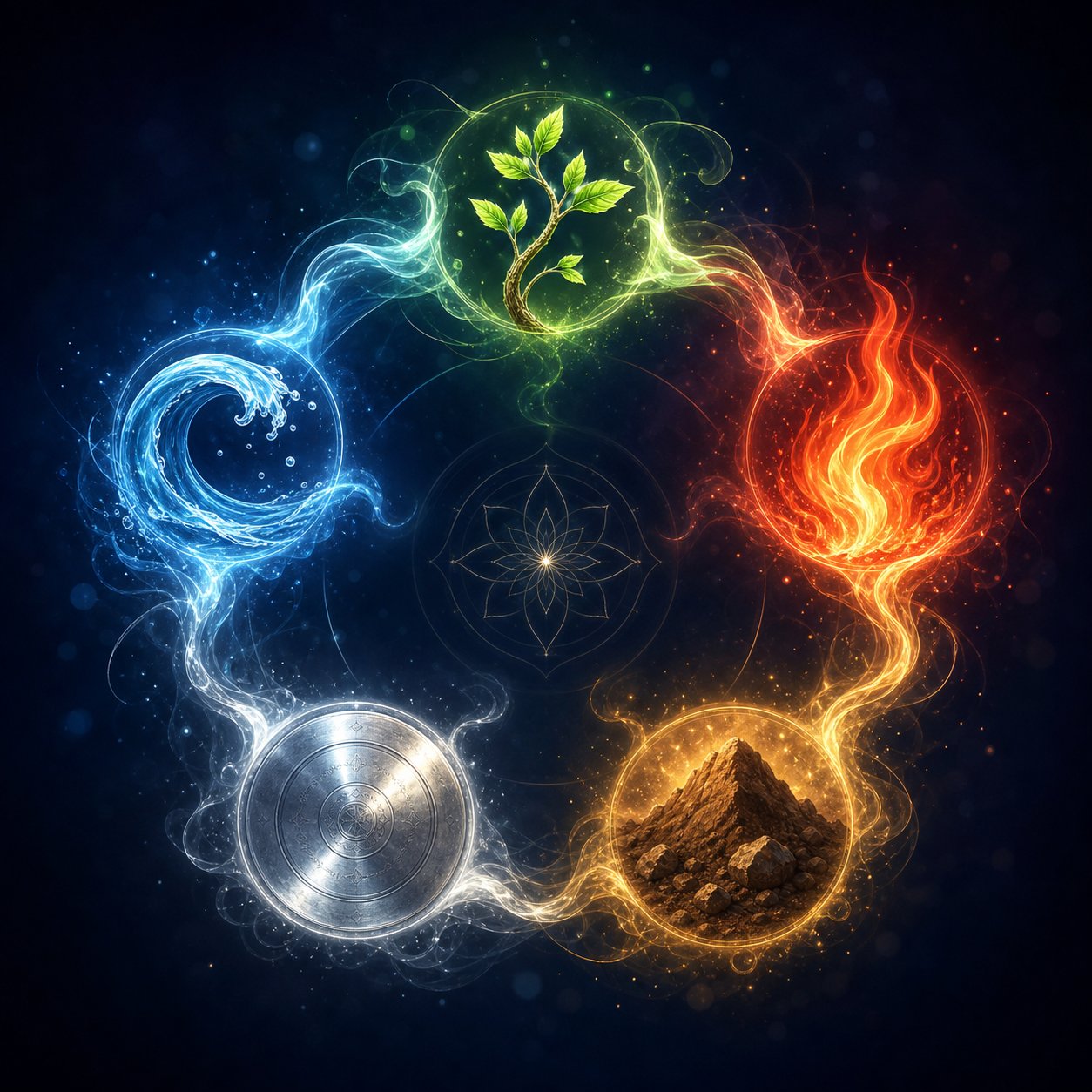
Two systems dominate this process: Five Elements (五行 Wǔxíng) analysis and stroke count numerology. Together, they transform naming from an art into something closer to a science, where every radical, every brushstroke, and every tonal vibration serves a calculated purpose.
Reading the Birth Chart for Naming Purposes
The foundation of elemental naming is the BaZi (八字 Bāzì) birth chart, literally meaning "eight characters." This system maps a child's birth year, month, day, and hour onto four pairs of Heavenly Stems and Earthly Branches, each carrying specific elemental values. The result is a chart showing exactly how much Wood (木 Mù), Fire (火 Huǒ), Earth (土 Tǔ), Metal (金 Jīn), and Water (水 Shuǐ) energy was present at the moment of birth.
A naming master reads this chart looking for three things: which elements dominate, which are weak, and which are entirely absent. The Day Master, the element representing the child's core self, determines whether the chart needs supportive elements to strengthen a weak identity or expressive elements to channel an overly strong one.
Sounds complex? Here's the practical logic. If a child's BaZi reveals abundant Fire and Earth but no Water, the name becomes a corrective prescription. Characters carrying Water energy are selected to fill that gap, restoring equilibrium to the child's elemental constitution. The chinese name meaning, in this context, functions as medicine for the soul, addressing what nature left incomplete.
This isn't metaphorical. Families historically consulted professional naming masters who spent hours calculating these charts before proposing a single character. The name in chinese meaning tradition treats this step as non-negotiable: you cannot choose well without first understanding what the child's destiny requires.
Stroke Count Numerology and Auspicious Numbers
Beyond elemental balance, traditional naming applies a separate mathematical layer: stroke count numerology. This system, formalized as the Five Grids Analysis Method (五格剖象法 Wǔgé Pōuxiàng Fǎ), evaluates a name by calculating the total brushstrokes in each character according to the Kangxi Dictionary standard.
The method divides a name into five numerical grids:
- Heaven Grid (天格 Tiāngé) - Derived from the surname stroke count. Represents inherited fortune and ancestral influence.
- Personality Grid (人格 Réngé) - Combines the surname's last character with the given name's first character. Governs overall life destiny.
- Earth Grid (地格 Dìgé) - Calculated from the given name characters. Reflects early life circumstances and personal foundation.
- Total Grid (总格 Zǒnggé) - The sum of all strokes in the full name. Indicates fortune trajectory from middle age through old age.
- Outer Grid (外格 Wàigé) - Derived from the difference between Total and Personality grids. Represents social environment and external relationships.
Each grid number maps to one of 81 numerological values, classified as auspicious, sub-auspicious, or inauspicious. For example, numbers like 1, 3, 5, 8, 11, 13, 15, 16, 24, and 31 are considered auspicious, while numbers like 2, 4, 9, 10, 14, 20, and 22 carry unfavorable associations. A skilled namer adjusts character choices until all five grids fall within favorable ranges.
The Three Talents (三才 Sāncái) analysis adds another check: the Five Elements attributes of the Heaven, Personality, and Earth grids must generate rather than control each other. Mutual generation signals harmony; mutual restraint signals conflict. This means a character that satisfies elemental requirements might still be rejected if its stroke count creates an inauspicious grid pattern.
Balancing Elements Through Character Selection
Here's where theory meets practice. Chinese characters carry elemental associations through their radicals, the structural components that form each character's visual foundation. A naming master diagnosing a Water deficiency doesn't just pick any pleasant-sounding character. They specifically seek characters built with Water-associated radicals like 氵(three-dot water) or 雨 (rain).
This is what makes chinese name interpretation so layered. A single character simultaneously communicates semantic meaning, elemental energy, tonal quality, and numerical value. The character 泽 (Zé, meaning "marsh" or "beneficence") doesn't just sound good. It introduces Water energy through its radical, carries a generous semantic meaning, and contributes a specific stroke count to the grid calculations.
| Element | Chinese | Common Radicals | Meaning / Energy | Example Name Characters |
|---|---|---|---|---|
| Wood | 木 (Mù) | 木 (wood), 艹 (grass) | Growth, vitality, spring energy | 林 (Lín, forest), 芳 (Fāng, fragrant), 桐 (Tóng, paulownia) |
| Fire | 火 (Huǒ) | 火 (fire), 灬 (fire dots) | Radiance, passion, summer energy | 炎 (Yán, flame), 煜 (Yù, radiant), 照 (Zhào, illuminate) |
| Earth | 土 (Tǔ) | 土 (earth), 山 (mountain) | Stability, nurturing, grounding | 坤 (Kūn, earth/feminine), 岳 (Yuè, peak), 城 (Chéng, city) |
| Metal | 金 (Jīn) | 金 (metal), 钅 (metal variant) | Precision, resilience, autumn energy | 鑫 (Xīn, prosperity), 铭 (Míng, inscription), 锐 (Ruì, sharp) |
| Water | 水 (Shuǐ) | 氵(water), 雨 (rain) | Wisdom, adaptability, winter energy | 涵 (Hán, contain), 泽 (Zé, marsh), 润 (Rùn, moist) |
The selection process works like a multi-variable equation. The character must satisfy the BaZi elemental prescription, produce favorable stroke count numerology across all five grids, carry positive semantic meaning, and sound harmonious with the surname. A character like 铭 (Míng, "to engrave") might be chosen for a child lacking Metal energy: it carries the metal radical 钅, suggests enduring memory and intellectual sharpness, and contributes a specific stroke count that the namer has already verified against the 81-number system.
Understanding names in chinese and meanings at this level reveals why traditional naming could take days or even weeks. Every china name meaning emerges from the intersection of cosmology, mathematics, linguistics, and family aspiration. The mandarin name meaning isn't simply what the dictionary says. It's what the character does within the larger architecture of elemental balance and numerical harmony.
Yet even after satisfying elemental and numerical requirements, one critical dimension remains: how the name actually sounds when spoken aloud. Tonal patterns and phonetic harmony introduce their own set of rules, ones that can override an otherwise perfect character choice.
Tonal Balance and Phonetic Harmony in Names
A name can satisfy every elemental requirement and hit perfect stroke counts, yet still fail the moment it's spoken aloud. Chinese name pronunciation introduces a musical dimension that no amount of cosmological calculation can bypass. Mandarin's four tones turn every name into a tiny melody, and skilled name-givers compose that melody with the same care a poet brings to verse.
When you pronounce zhang, for instance, the falling fourth tone (Zhàng) sounds decisive and strong, while the rising first tone (Zhāng) feels open and level. Pair that surname with given-name characters, and the tonal sequence either flows or stumbles. This phonetic layer is why names in chinese demand attention not just on paper but in the mouth and ear.
Tonal Patterns and Melodic Flow in Names
The core principle is tonal variation. Three consecutive characters sharing the same tone create a flat, monotonous sound that traditional namers considered inauspicious and aesthetically dead. The ideal pattern alternates between rising and falling pitches, producing a sense of movement and vitality.
Consider these contrasting examples:
- Zhāng Yīfēi (张一飞) - Three first-tone characters (high-high-high). The name drones on a single pitch, lacking energy or distinction.
- Zhāng Hàoyǔ (张浩宇) - First tone, fourth tone, third tone (high-falling-dipping). The pitch rises, drops, then curves, creating a pleasing arc when spoken aloud.
- Lǐ Míngyuǎn (李明远) - Third tone, second tone, third tone (dip-rise-dip). The alternation produces a wave-like rhythm that feels balanced and memorable.
Traditional naming guides recommended that the surname and given name together form a tonal contour resembling natural speech cadence. A name that sounds like a question (all rising tones) or a command (all falling tones) was considered unbalanced. The best chinese names in chinese sound effortless, as though the characters were always meant to sit together.
Avoiding Dangerous Homophones
Tonal aesthetics are only half the phonetic challenge. The other half involves homophones, characters that share identical or similar pronunciation but carry wildly different meanings. Because Mandarin has a relatively limited set of syllables (around 400 without tones), collisions are frequent and sometimes devastating.
A chinese name in chinese language must be tested not just for its intended meaning but for every unintended sound-alike it might evoke. Temple University's Center for Chinese Language Instruction notes that even a single mispronounced tone can transform a name's meaning entirely, turning a compliment into an insult.
Common phonetic pitfalls include:
- Wú Shuò (吴硕, meaning "great" or "large") - Sounds nearly identical to 无所 (wú suǒ, "nothing"), suggesting emptiness rather than grandeur.
- Shǐ Zhēn (史珍, meaning "precious history") - When spoken quickly, resembles 实真 or worse, sounds close to vulgar expressions depending on regional accent.
- Yáng Wěi (杨伟, meaning "great") - Unfortunately homophonous with 阳痿 (yángwěi, a medical term for impotence), making this name chinese characters combination deeply problematic despite its noble written meaning.
- Wèn (问, "to inquire") vs. Wén (蚊, "mosquito") - A single tone shift turns an intellectual name into an insect reference, as the syllable's meaning changes entirely between the second and fourth tones.
Dialect variation compounds the problem. A name that sounds perfectly dignified in Mandarin might create unfortunate associations in Cantonese, Hokkien, or Shanghainese. Families with roots in multiple linguistic regions historically tested proposed names across dialects before finalizing them. This cross-dialect checking reveals how deeply phonetic awareness shaped the selection of name chinese characters at every level.
Sound, however, represents only what a name does in the present moment. An equally powerful set of constraints governed what a name could never be, rules rooted not in aesthetics but in reverence, fear, and cosmic hierarchy.
Naming Taboos and Superstitions in Chinese Culture
Reverence, fear, and cosmic hierarchy didn't just influence which characters families chose. They dictated which characters were absolutely forbidden. The system of naming taboos (避讳 bìhuì) represents one of the most fascinating dimensions of chinese naming customs, a set of prohibitions so powerful they reshaped language itself, banned common words from public use, and sent violators to their deaths.
The practice of bìhuì emerged as early as the Shang Dynasty (c. 1600-1046 BCE) and persisted through every imperial era. At its core lies a belief that names carry intrinsic spiritual power. To speak or write a superior's name was to invoke their essence, an act considered profoundly disrespectful and potentially dangerous. Three major categories of taboo governed what could never appear in a person's name.
Imperial Name Taboos and Their Historical Impact
Imagine an entire character disappearing from public life overnight. That's exactly what happened each time a new emperor ascended the throne. The state taboo (国讳 guóhuì) prohibited every person in the realm from using any character contained in the emperor's given name, whether in speech, writing, official documents, or even personal names already in use.
The consequences were sweeping. When Liu Bang founded the Han Dynasty, the character 邦 (bāng, meaning "state" or "country") vanished from official texts because it appeared in his name. Writers substituted homophones or synonyms. People whose names contained the forbidden character were forced to change them. During the Tang Dynasty, the character 治 (zhì, meaning "to govern") became taboo under certain emperors, requiring replacement across all administrative records.
Enforcement wasn't symbolic. Under the Qing Dynasty, scholar Wang Xihou was sentenced to death along with nine generations of his family in 1777 for including characters from the Kangxi Emperor's name in a book title. The Qianlong Emperor's literary inquisitions treated even vague resemblances to imperial names as capital offenses. These weren't isolated incidents. They reflected a system where chinese traditional names operated under constant surveillance from state power.
Avoidance strategies became an art form. Scribes omitted single strokes from taboo characters to render them technically different. Others substituted synonyms or left blank spaces in texts. The Tang Dynasty formalized a method called quēbǐ (缺笔), where removing one brushstroke from a forbidden character made it legally usable while remaining recognizable. These adaptations permanently altered how certain characters were written, leaving traces that scholars still use to date ancient chinese names and manuscripts.
Family Taboos and Ancestor Veneration
The family taboo (家讳 jiāhuì) operated on a smaller scale but with equal seriousness. Within a clan, no descendant could use any character appearing in the names of parents, grandparents, or earlier ancestors. This prohibition connected directly to filial piety (孝 xiào), the Confucian principle that children owe absolute reverence to their elders.
The logic was emotional as much as spiritual. Classical texts explain that "a good son is sad if he hears the name of his father." Speaking a deceased parent's name was thought to disturb their spirit and cause grief to the living. This is why, as noted by the Cultural Atlas, it remains inappropriate in Chinese culture to name a child after an elder or family member.
In practice, this meant families maintained careful genealogical records listing every character used by ancestors across multiple generations. Before naming a child, parents cross-referenced proposed characters against this list. A beautiful, auspicious character that happened to match a great-grandfather's name was immediately disqualified, no matter how perfect it seemed otherwise. The deeper you look into the chinese behind the name, the more you realize that what a name avoids reveals as much as what it contains.
Sacred taboos added a third layer. Characters from the names of Confucius (孔丘 Kǒng Qiū) and other revered sages were occasionally proscribed in scholarly works, particularly during dynasties that elevated Confucianism as state orthodoxy. While less rigidly enforced than imperial taboos, this practice reflected the same underlying principle: greatness demands linguistic distance.
Superstitions and Protective Naming Strategies
Beyond formal prohibitions, folk beliefs created an additional web of constraints. Many chinese name origins trace back to superstitious reasoning about what attracts or repels fortune. Families avoided characters associated with:
- Overly grand meanings - Names suggesting perfection or supreme power were thought to invite jealousy from heaven. Calling a child "emperor" or "immortal" risked provoking cosmic punishment.
- Dangerous animals - Characters referencing tigers (虎), snakes (蛇), or other predators could attract the spirit of that animal, bringing aggression or misfortune.
- Zodiac conflicts - A child born in the Year of the Rat should avoid characters containing radicals associated with the Horse or Rooster, as these zodiac signs clash. The wrong combination was believed to create lifelong friction in the child's destiny.
- Death and illness imagery - Any character even tangentially connected to mortality, disease, or decline was excluded from consideration, regardless of its other qualities.
Some families took protective naming further by deliberately choosing humble or ugly names for children, a practice overlapping with the milk name tradition discussed earlier. The reasoning was consistent: don't attract attention from spirits, fate, or envious neighbors. Even among famous chinese names in history, you'll find figures whose childhood names were intentionally lowly before they received grander formal designations.
Naming taboos in Chinese culture are not mere superstition but expressions of a coherent worldview: names hold power, and power demands respect, restraint, and awareness of one's place within the cosmic and social order.
These layered prohibitions meant that naming a child was as much about elimination as selection. Families navigated imperial bans, ancestral records, phonetic pitfalls, elemental requirements, and folk taboos simultaneously. The characters that survived this gauntlet weren't just pleasant or meaningful. They were safe, permitted, and cosmically appropriate.
Yet individual families didn't face these constraints alone. Across generations, entire clans developed systematic approaches to naming that bound siblings, cousins, and descendants into recognizable patterns, creating identity markers visible across centuries.
Generational Name Poems and Clan Traditions
Those systematic approaches took a remarkably elegant form: poetry. The generational name poem system (字辈 zibei) gave entire clans a pre-written naming blueprint stretching centuries into the future. Rather than leaving each generation to navigate naming constraints independently, clan elders composed a poem or phrase where each character corresponded to one generation. Every child born into that generation incorporated the designated character into their given name, creating an instant, visible marker of where they stood in the family timeline.
This is why many names in china follow patterns that outsiders might mistake for coincidence. When you notice siblings or cousins sharing a character in their given names, you're likely seeing the zibei system at work. That shared character functions almost like what Western cultures call chinese middle names, though its placement and purpose differ significantly. It's a generational stamp, not a personal choice.
How Generational Name Poems Work
The mechanics are straightforward. A clan elder or respected scholar composes a poem, typically between 20 and 40 characters long. Each character in the sequence is assigned to one generation, usually placed as the first character of a two-character given name. The second character remains free for parents to choose based on elemental analysis, personal aspiration, or aesthetic preference.
Here's how a sample generational sequence maps across a family:
- Generation 16 - 怀 (Huai, "to cherish"): Grandfather's generation. All male cousins share names like 怀德 (Huaide), 怀仁 (Huairen), 怀志 (Huaizhi).
- Generation 17 - 开 (Kai, "to open"): Father's generation. Siblings and cousins carry names like 开明 (Kaiming), 开华 (Kaihua), 开文 (Kaiwen).
- Generation 18 - 泰 (Tai, "peace"): Current generation. Brothers and cousins share names like 泰安 (Tai'an), 泰宇 (Taiyu), 泰林 (Tailin).
- Generation 19 - 瑞 (Rui, "auspicious"): Children's generation. Future names will begin with 瑞, such as 瑞祥 (Ruixiang), 瑞杰 (Ruijie).
- Generation 20 - 昌 (Chang, "prosperous"): Grandchildren's generation. The sequence continues forward, already determined.
The power of this system becomes clear when two strangers sharing the same surname in chinese meet and discover they carry the same generational character. Instantly, they know their exact relationship within the clan hierarchy: same generation, one generation apart, or separated by centuries. Among asian surnames names traditions across East Asia, few systems encode relational information this efficiently.
The Role of Clan Genealogies in Preserving Naming Traditions
These generational poems didn't float in oral memory alone. They were recorded in clan genealogies called 族谱 (zupu), comprehensive family records that trace back over 2,000 years in Chinese history. A zupu typically included not just family trees and biographies but also the generation poem itself, written as a formal section called 字派 (zipai) or 派字歌 (paizi ge). These books told families exactly which character to use for each new generation's names.
The Qiu clan zupu referenced by My China Roots, for example, has followed its generation poem continuously since the 16th generation of the family. Siblings, cousins, and even distant relatives scattered across provinces all share their generational character, making kinship immediately recognizable on paper or in conversation. The character surnames and generational markers together form a two-layer identification system: the surname tells you which clan, and the zibei character tells you which generation.
Many zupus were destroyed during the Cultural Revolution (1966-1976), when campaigns against the "Four Olds" targeted ancestral records alongside temples and tombstones. Yet families went to extraordinary lengths to preserve them. Some clans buried their zupu in neighboring villages for over a decade, digging them up again after 1979. The 1980s saw a revival of genealogy compilation, with elders reconstructing entire generational poems from memory.
The practice has declined in modern urban China, where single-child families and geographic mobility weaken clan cohesion. Still, it persists in rural communities and among overseas Chinese families who maintain connections to their ancestral villages. For those researching their heritage, discovering the generational poem in a family zupu can instantly place them within a centuries-long naming sequence, connecting them to ancestors they never knew existed.
The zibei system worked beautifully within a single linguistic community. But Chinese culture was never monolithic. Across Cantonese, Hokkien, Hakka, and Teochew communities, naming traditions diverged in ways that challenge any single framework, producing the remarkable diversity of Chinese names encountered across Asia and the diaspora.
Regional Naming Traditions Across Chinese Dialects
The generational poem system assumed a shared linguistic world, one clan speaking one dialect across one region. Reality was far messier. China is home to seven to ten major dialect groups, many of them mutually unintelligible, each carrying distinct phonetic aesthetics that shaped how names sounded, were romanized, and were perceived. When you encounter cantonese names like Wong or Chan alongside Mandarin equivalents like Huang or Chen, you're seeing the same characters filtered through entirely different sound systems.
This diversity means that chinese name translation is never a one-to-one process. The same written character produces different surnames depending on which linguistic community carries it, and those differences have hardened into distinct identities across generations.
Cantonese Naming Traditions and Romanization
Cantonese (粤语 Yuèyǔ), spoken across Guangdong province, Hong Kong, and Macau, preserves six to nine tones compared to Mandarin's four. This richer tonal palette gives cantonese names a different melodic quality. Name-givers working in Cantonese had more tonal combinations to balance, and certain characters considered euphonious in Mandarin sounded flat or awkward in Cantonese pronunciation.
Romanization adds another layer of divergence. Hong Kong uses a system loosely based on older colonial-era conventions rather than Mandarin pinyin. The result is that wong in chinese characters is the same 王 that Mandarin speakers romanize as Wang. The chen last name (陳) becomes Chan in Cantonese romanization. Wu (吴) appears as Ng, a spelling that baffles English speakers unfamiliar with Cantonese initial consonants.
These aren't just spelling differences. They signal ancestral geography. As the Asia Media Centre notes, in territories with a sizeable Chinese diaspora like Singapore and Malaysia, the way a family name is spelled functions as a signifier of the region a person's ancestors came from. A person surnamed Wong is understood to have Cantonese heritage, likely tracing to Guangdong or Hong Kong.
Hokkien and Hakka Naming Practices
Southern Chinese dialect groups maintained older naming customs that diverged from Mandarin norms in character preference and phonetic logic. Hokkien (闽南语 Mǐnnányǔ), spoken across southern Fujian, Taiwan, and much of Southeast Asia, preserves features of Middle Chinese lost in Mandarin over a thousand years ago, including final consonants like -p, -t, and -k. These preserved sounds meant that chinese names into english from Hokkien communities look and sound strikingly different from their Mandarin equivalents.
The wang last name origin traces to the character 王 (king), but Hokkien speakers romanize it as Ong or Heng in Teochew. The chen last name origin connects to the ancient State of Chen in modern Henan, yet Hokkien communities spell it Tan rather than Chen or Chan. Hakka (客家话 Kèjiāhuà) speakers, defined by centuries of migration from northern to southern China, carried their own pronunciation patterns: 王 becomes Wong (similar to Cantonese), while 陳 appears as Chan or Chun.
Generational naming patterns also varied. Some Hokkien clans placed the generational character in the second position of the given name rather than the first, reversing the standard Mandarin convention. Hakka communities sometimes maintained separate generational poems from their Mandarin-speaking relatives within the same broader clan, creating parallel naming tracks that diverged over centuries.
Diaspora Adaptations Across Southeast Asia and the West
When Chinese communities settled abroad, naming conventions bent further. In Malaysia and Singapore, families often maintained their dialect-specific romanization while adding local given names. A Malaysian Chinese person might carry a Hokkien-romanized surname, a Chinese given name following generational conventions, and an English or Malay name for daily use, resulting in hybrid identities like "David Tan Wei Ming."
Indonesian Chinese faced a different pressure. Government policies in the 1960s required adoption of Indonesian-sounding names, leading many families to abandon visible Chinese surnames entirely. Some encoded their heritage subtly, choosing Indonesian names phonetically similar to their original chinese names english translation. The surname Tan (陳) might become Tanujaya or Tanoko, preserving a trace of origin within a new linguistic framework.
Western diaspora communities typically reversed name order to match local convention, placing the given name first and surname last. This reversal, while practical, erased the Confucian family-first principle embedded in the original structure. Some families compromise by maintaining Chinese order on legal documents while using Western order socially.
The table below shows how a single character produces different surnames across dialect groups:
| Character | Mandarin Pinyin | Cantonese | Hokkien | Hakka | Teochew |
|---|---|---|---|---|---|
| 王 | Wang | Wong | Ong | Wong | Heng |
| 陳 | Chen | Chan | Tan | Chin | Tan |
| 張 | Zhang | Cheung | Teo / Teoh | Chong | Teo |
| 劉 | Liu | Lau | Lau | Liew | Low |
| 林 | Lin | Lam | Lim | Lim | Lim |
| 黃 | Huang | Wong | Ng / Ooi | Vong | Ng |
This fragmentation means there's no single correct chinese name translation for any given surname. The "right" romanization depends on which linguistic community the family belongs to, which generation emigrated, and which country's conventions shaped their documentation. A person surnamed Cheung and a person surnamed Zhang may share identical ancestry, their names diverging only because one family passed through Hong Kong and the other through Beijing.
Regional variation shaped how names sounded and were spelled. But an equally powerful force shaped what names meant: the distinct expectations placed on sons versus daughters, encoded in entirely different character pools and aesthetic ideals.
Gender Conventions in Traditional Chinese Names
Regional dialects shaped how names sounded. But the single most powerful dividing line in traditional character selection wasn't geography or clan membership. It was gender. Chinese names for boys and chinese names male drew from an entirely separate character pool than those chosen for daughters, each reflecting distinct cultural expectations about what a man or woman should become. These weren't loose preferences. They were deeply codified aesthetic systems, rooted in Confucian philosophy and reinforced across millennia of literary tradition.
When you look at chinese first names male from the classical period, you'll notice they read almost like a curriculum for the ideal man. Female names, by contrast, paint portraits of beauty, grace, and natural refinement. The characters chosen for each gender reveal what traditional society valued most in its sons and daughters, sometimes in ways that feel surprisingly candid.
Traditional Character Choices for Male Names
Male chinese given names drew from four primary character categories, each tied to a facet of the Confucian gentleman (君子 jūnzǐ) ideal. The junzi wasn't merely strong or successful. He was morally cultivated, intellectually accomplished, and socially responsible. Parents encoding these aspirations into a son's name were essentially writing a life mission statement in one or two characters.
- Strength and power: 强 (qiáng, strong), 刚 (gāng, firm/unyielding), 伟 (wěi, great), 豪 (háo, heroic/bold), 超 (chāo, surpassing)
- Ambition and achievement: 志 (zhì, ambition/will), 成 (chéng, success), 达 (dá, attainment), 博 (bó, abundant/learned), 国 (guó, nation)
- Scholarly cultivation: 文 (wén, literate/cultured), 明 (míng, bright/clear), 哲 (zhé, wise/philosophical), 学 (xué, learning), 书 (shū, book/writing)
- Moral virtue: 德 (dé, virtue), 仁 (rén, benevolence), 信 (xìn, trustworthiness), 义 (yì, righteousness), 礼 (lǐ, propriety)
Notice how these categories map directly onto Confucian values. A name like 俊德 (Jùndé, "handsome virtue") or 博文 (Bówén, "vast learning") doesn't just sound pleasant. It assigns the child a moral trajectory. As Chinese Name Translator notes, characters like 德 contain the radical for "walk" or "go," suggesting that virtue is a path rather than a destination. Parents choosing this character weren't declaring their son virtuous. They were pointing him in virtue's direction.
The most popular chinese names male in recent surveys still echo these classical categories. Names like 浩然 (Hàorán, "vast and righteous"), 宇轩 (Yǔxuān, "universe, lofty"), and 子墨 (Zǐmò, "refined ink") blend traditional scholarly ideals with a more expansive, modern sensibility. The underlying logic persists: a boy's name should project capability, moral weight, and intellectual ambition.
Traditional Character Choices for Female Names
Chinese first names female operated within a different aesthetic universe entirely. Where male names projected outward toward achievement and social contribution, female names traditionally turned inward toward beauty, refinement, and natural grace. The character pools reflect what traditional society considered the feminine ideal: gentle, elegant, and precious.
- Beauty and appearance: 美 (měi, beautiful), 丽 (lì, pretty), 妍 (yán, gorgeous), 娟 (juān, graceful), 秀 (xiù, elegant)
- Flowers and nature: 花 (huā, flower), 兰 (lán, orchid), 梅 (méi, plum blossom), 莲 (lián, lotus), 芳 (fāng, fragrant)
- Precious materials: 玉 (yù, jade), 珍 (zhēn, precious/pearl), 琪 (qí, fine jade), 瑶 (yáo, precious jade), 珠 (zhū, pearl)
- Grace and temperament: 雅 (yǎ, elegant/refined), 静 (jìng, calm/quiet), 淑 (shū, gentle/virtuous), 慧 (huì, clever/wise), 敏 (mǐn, nimble)
Chinese given names female also favored specific tonal patterns. Two-character given names with softer, rising tones were preferred over sharp falling tones, creating names that sounded gentle when spoken aloud. A name like 婵娟 (Chánjuān, "the moon" or "graceful beauty") flows with second-tone openness, while 静雅 (Jìngyǎ, "calm elegance") pairs a falling tone with a dipping tone for a composed, unhurried rhythm.
The chinese feminine names tradition also drew heavily from poetry and classical literature. Characters referencing seasonal imagery, like 春 (chūn, spring) or 秋 (qiū, autumn), connected daughters to natural cycles of beauty and renewal. Jade (玉) appeared with extraordinary frequency because it symbolized both physical beauty and moral purity in Chinese culture, making it a dual-purpose character that satisfied aesthetic and ethical aspirations simultaneously.
How Gender Conventions Are Evolving
These gendered character pools remained remarkably stable for centuries. But contemporary naming practices show a clear shift. Modern parents increasingly select characters that work across gender lines, drawing on traditional philosophy without locking children into rigid categories.
Characters like 安 (ān, peace), 晨 (chén, dawn), 文 (wén, literate), 熙 (xī, bright/happy), and 诺 (nuò, promise) now appear in both boys' and girls' names with equal frequency. The China Highlights survey of popular names shows that recent top names for both genders share characters like 宇 (yǔ, universe) and 梓 (zǐ, catalpa tree), suggesting that parents value expansiveness and natural imagery regardless of a child's sex.
This evolution doesn't represent a rejection of traditional naming philosophy. The elemental balancing, stroke count analysis, and tonal harmony principles still apply. What's changing is the assumption that strength belongs exclusively to sons and beauty exclusively to daughters. A girl named 志远 (Zhìyuǎn, "far-reaching ambition") or a boy named 雅轩 (Yǎxuān, "elegant and lofty") no longer raises eyebrows the way it might have a generation ago.
Still, the classical gendered patterns haven't disappeared. They've softened into tendencies rather than rules. Parents choosing chinese names for boys still gravitate toward characters suggesting breadth and force. Those selecting chinese given names female still lean toward grace and luminosity. The difference is that these tendencies now coexist with a growing freedom to cross traditional boundaries, blending the old system's depth with a more flexible understanding of what any child, regardless of gender, might become.
Frequently Asked Questions About Traditional Chinese Naming Conventions
1. Why does the surname come first in Chinese names?
The surname-first order reflects the Confucian principle that family identity takes precedence over the individual. In Chinese culture, your clan lineage and ancestral connections define you before any personal qualities do. The surname (姓 xing) anchors a person within a multigenerational web of relationships, while the given name (名 ming) expresses individual aspirations within that inherited framework. This ordering is not merely grammatical but philosophical, encoding a worldview where collective identity outweighs personal distinction.
2. How do the Five Elements influence Chinese name selection?
The Five Elements (五行 Wuxing) influence naming through BaZi birth chart analysis. A child's birth year, month, day, and hour are mapped to determine which elements (Wood, Fire, Earth, Metal, Water) are present, weak, or absent. The name then compensates for deficiencies by incorporating characters with specific radicals tied to the missing element. For example, a child lacking Water energy might receive a name containing the radical 氵(three-dot water). This process treats naming as a form of cosmic prescription, restoring elemental balance to the child's destiny.
3. What is a Chinese courtesy name and when is it given?
A courtesy name (字 zi) is bestowed during the capping ceremony (冠礼 guanli) around age 20, marking the transition to adulthood. Once received, the courtesy name replaces the given name in nearly all social interactions with peers, as addressing an adult by their given name was considered disrespectful. The courtesy name is deliberately crafted to complement or amplify the given name's meaning. For instance, Zhuge Liang's given name 亮 (bright) was paired with the courtesy name 孔明 (exceedingly luminous), extending the same concept.
4. What are Chinese naming taboos and why do they matter?
Chinese naming taboos (避讳 bihui) are prohibitions against using certain characters in names. Three major categories exist: imperial taboos forbade using characters from the emperor's name, family taboos prohibited reusing ancestors' name characters, and sacred taboos avoided characters from sages' names like Confucius. These restrictions carried serious consequences — violators could face punishment or even death under certain dynasties. The taboos reflect a belief that names hold spiritual power, and invoking a superior's name was an act of profound disrespect that could disturb cosmic and social order.
5. How do generational name poems work in Chinese families?
Generational name poems (字辈 zibei) are pre-composed sequences of characters, typically 20 to 40 characters long, created by clan elders. Each character in the poem corresponds to one generation, and every child born into that generation incorporates the designated character into their given name, usually as the first character of a two-character given name. This system allows members of the same clan to instantly identify their generational relationship upon meeting. The poems are preserved in clan genealogies (族谱 zupu) and can span centuries of family history.