Understanding the Split Between Traditional and Modern Zodiac Names
When you look up Chinese zodiac names in Chinese, you'll likely find a simple list: Rat, Ox, Tiger, and so on. Clean and straightforward. But that list hides a layered naming system shaped by thousands of years of literary tradition, regional dialects, and script reforms. The Chinese zodiac names in English we casually toss around barely scratch the surface of what's actually happening in the source language.
Here's the problem: most resources give you one version. They'll show simplified characters or traditional characters, pinyin or Earthly Branches, but rarely all of these together. That gap leads to confusion, especially when you're trying to use these names accurately for language study, cultural research, or personal naming.
Why Zodiac Naming Conventions Matter
Each of the 12 zodiac animals carries at least two distinct naming layers. There's the formal system rooted in the Earthly Branches (Dizhi), which dates back to the Shang Dynasty and connects each animal to cosmological timekeeping. Then there's the colloquial animal name used in everyday Mandarin. Mixing these up, or using one when the other is expected, changes the register and meaning of what you're communicating.
What Traditional and Modern Forms Mean in Practice
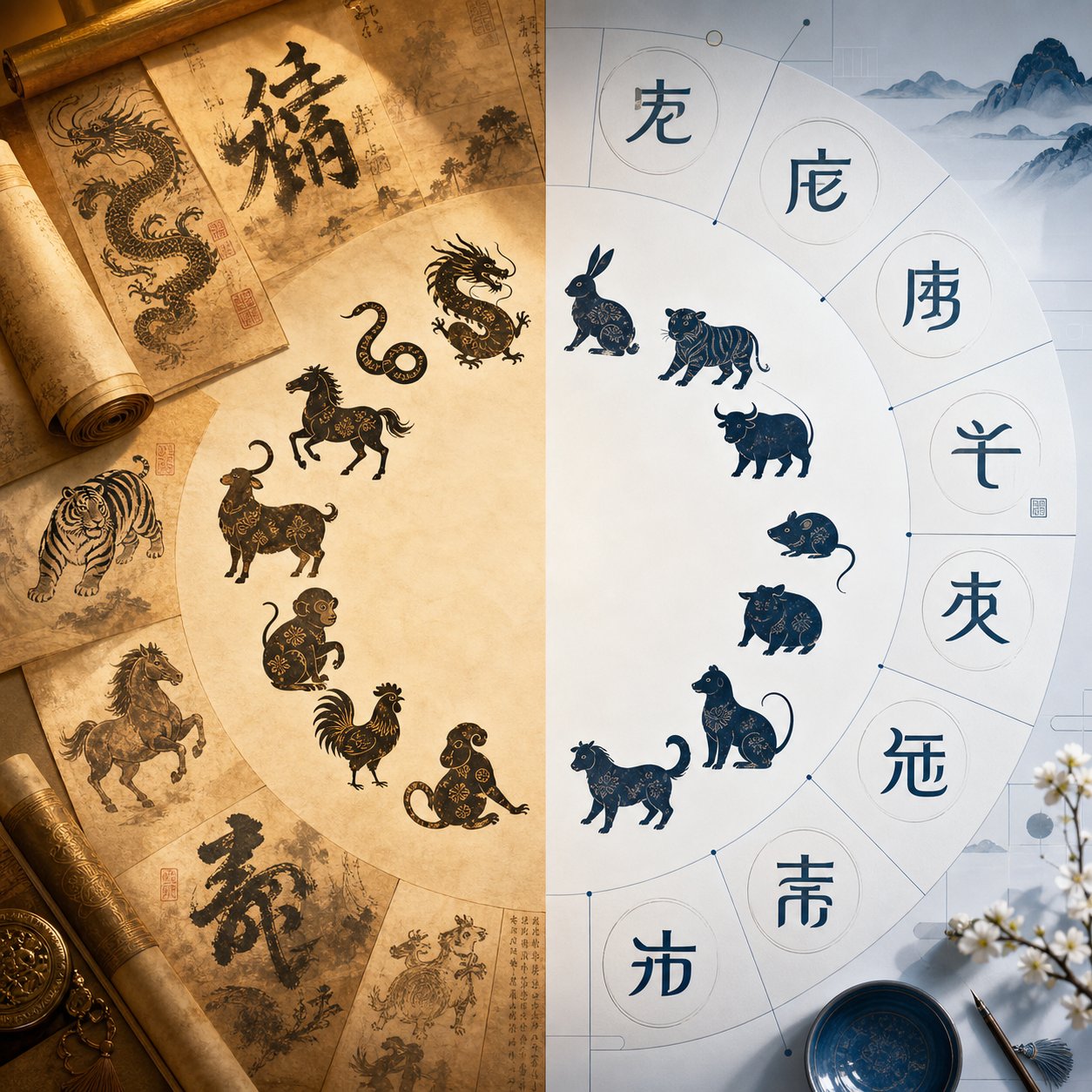
Traditional Chinese zodiac names derive from classical literary Chinese and the Earthly Branches system, where each animal is paired with a specific branch character carrying cosmological weight. Modern names reflect colloquial Mandarin, simplified character usage, and internationally recognized romanizations designed for cross-cultural readability.
This distinction matters whether you're reading a Bazi chart, choosing a culturally informed baby name, or simply trying to say the zodiac animals correctly in conversation. What follows is a complete side-by-side breakdown of all 12 animals, covering their Earthly Branch associations, traditional and simplified characters, pinyin, dialect variations, and English translations in one place.
How We Categorize Traditional and Modern Zodiac Name Forms
So how do you actually tell whether a Chinese zodiac name is "traditional" or "modern"? It's not as simple as checking whether the character is simplified or not. The classification involves multiple layers, from the literary register of the term to its connection with ancient timekeeping systems. Getting this framework right is what separates a surface-level understanding from genuine fluency with the naming conventions.
Criteria for Traditional Classification
A zodiac name qualifies as traditional when it meets a specific set of markers rooted in classical Chinese culture. Think of it as a checklist where the more boxes a name ticks, the more firmly it sits in the traditional camp.
- Character form: Uses traditional (unsimplified) characters, such as 龍 for dragon rather than 龙
- Literary register: Appears in classical texts from the Han Dynasty onward, often in formal or literary Chinese (wenyan)
- Earthly Branch connection: Paired with its corresponding Dizhi character (子, 丑, 寅, 卯, 辰, 巳, 午, 未, 申, 酉, 戌, 亥)
- Regional usage: Preserved in communities that maintain traditional script, such as Taiwan, Hong Kong, and overseas Chinese populations
- Cosmological context: Carries associations with the Chinese clock system, directional symbolism, or Yin-Yang classification
The twelve zodiac signs serve as visual representatives of the twelve Earthly Branches: 子 (rat), 丑 (ox), 寅 (tiger), 卯 (rabbit), 辰 (dragon), 巳 (snake), 午 (horse), 未 (goat), 申 (monkey), 酉 (rooster), 戌 (dog), and 亥 (pig). In classical usage, the branch character alone could reference the animal without ever naming the creature directly. That's a level of abstraction modern usage has largely abandoned.
Criteria for Modern Classification
Modern Chinese zodiac names in Mandarin prioritize accessibility. They're built for spoken communication, international recognition, and ease of learning. Here's what defines them:
- Character form: Uses simplified characters standardized after the 1950s script reforms in mainland China
- Colloquial register: Reflects everyday spoken Mandarin (baihua) rather than literary Chinese
- Phonetic appeal: Romanized through Hanyu Pinyin for cross-cultural readability
- Contemporary recognition: Widely understood across Chinese-speaking regions regardless of dialect background
- Standalone animal reference: Names the creature directly (鼠, 牛, 虎) without requiring the Earthly Branch prefix
You'll notice that modern forms strip away the cosmological scaffolding. When someone says "I'm a Dragon" in casual conversation, they say 龙 (long) without the branch character 辰 (chen). The chinese zodiac name becomes purely about the animal identity rather than its position in a timekeeping framework.
The Role of Earthly Branches in Formal Naming
The Earthly Branches aren't just labels. They're the backbone of the traditional system. Each branch originally represented a two-hour period in the Chinese clock, a compass direction, and a position in the sexagesimal cycle that combines with the Heavenly Stems to produce 60 unique year designations. The Five Elements (Wuxing) system layered onto this structure, meaning each zodiac animal could be further colored by Wood, Fire, Earth, Metal, or Water depending on the year. A "Fire Tiger" carries different naming weight than a "Water Tiger," and traditional naming practices accounted for these elemental combinations when selecting personal names.
Modern approaches, by contrast, prioritize phonetic appeal and individuality over auspicious alignment. Parents today are more likely to choose chinese names for zodiac signs based on how they sound or what personal qualities they evoke, rather than consulting a Bazi chart to ensure elemental harmony. The shift isn't absolute, but the trend is clear: from cosmological precision toward personal expression.
With these classification criteria established, the real differences become visible when you examine each animal pair side by side, starting with the first two signs in the cycle.
Rat and Ox Names in Classical and Contemporary Chinese
The Rat and the Ox open the twelve-animal cycle, and they also happen to illustrate two very different stories about how chinese zodiac animal names evolved. The Rat's naming history is tangled up with timekeeping and cunning symbolism. The Ox's story is one of quiet consistency, where the classical and modern forms stayed remarkably close across centuries. Together, they set the pattern for everything that follows in the zodiac sequence.
Rat - From Zi to Shu Across the Ages
If someone asks you to name an animal from the Chinese New Year zodiac, the Rat is where the cycle begins. Its Earthly Branch is 子 (zi), which in the classical system represents the hours between 11 PM and 1 AM, the deepest part of night when rats are most active. That connection isn't coincidental. Ancient Chinese astronomers assigned animals to time periods based on observed behavior, and the Rat's nocturnal habits locked it into the Zi position permanently.
In classical literary Chinese, the Rat could be referenced simply as 子 without ever naming the animal directly. Formal texts, Bazi charts, and traditional calendars still use this convention. When you see 子年 (zi nian), it means "Year of the Rat" in the most formal register available. The animal character 鼠 (shu) existed alongside it, but carried a more colloquial weight.
The modern form is straightforward: 鼠 (shu) in both traditional and simplified script, since this particular character wasn't altered during the 1950s reforms. That's an important detail. Unlike the Dragon or Rooster, the Rat's written form looks identical whether you're reading a Tang Dynasty poem or a contemporary horoscope app. The difference between traditional and modern usage here is purely about context, not character shape.
Where things get interesting is dialect variation. In Cantonese, the Rat is 鼠 (syu2), while colloquial Cantonese speakers often use 老鼠 (lou5 syu2), adding the familiar prefix 老. Hokkien speakers say "chhi" or "chhú" depending on the regional sub-dialect, a pronunciation that sounds nothing like Mandarin "shu" and preserves older phonetic layers of Chinese. The Rat occupies the first place in the Chinese zodiac, and its cultural associations with cunning and resourcefulness remain consistent across all these linguistic variants, even as the sounds diverge dramatically.
Ox - Chou-Niu in Classical and Contemporary Usage
The Ox holds the second position with the Earthly Branch 丑 (chou), corresponding to the hours between 1 AM and 3 AM, traditionally the time when oxen begin chewing cud before the day's labor. Imagine a farming society where cattle rhythms dictated the daily schedule. That's exactly the world that produced this pairing.
In classical texts, 丑 alone could signify the Ox in formal contexts, just as 子 could stand for the Rat. The animal character 牛 (niu) served as the colloquial counterpart. Like the Rat, the Ox character survived script simplification unchanged. 牛 looks the same in traditional and simplified Chinese, making this another case where the traditional-to-modern shift is about register and usage patterns rather than visual form.
Culturally, though, the classical and modern associations diverge more than you might expect. In traditional naming practices, the Ox carried deep associations with hardworking selflessness and devotion. Classical literature frequently used ox imagery to represent tireless service. The famous legend of the Shepherd and the Weaver features a cow that fully devotes itself to its master, embodying the Confucian ideal of loyal labor. Parents selecting names with ox-radical components (牜) were invoking that entire philosophical tradition.
Modern colloquial usage retains the "hardworking" association but has added layers. In contemporary Mandarin slang, 牛 (niu) also means "awesome" or "impressive," a semantic drift that would puzzle a classical scholar. The zodiac Ox today carries both its ancient dignity and this newer, informal energy.
In Cantonese, the Ox is 牛 (ngau4), and in Hokkien, it's "gu" — again, phonetically distant from Mandarin but carrying the same cultural weight. The Cantonese pronunciation preserves a nasal initial consonant that Mandarin lost centuries ago, making it a living fossil of older Chinese phonology.
| Animal | Earthly Branch | Traditional Character | Modern Character | Pinyin | Cantonese | Hokkien | English |
|---|---|---|---|---|---|---|---|
| Rat | 子 (zi) | 鼠 | 鼠 | shu | syu2 | chhi/chhu | Rat/Mouse |
| Ox | 丑 (chou) | 牛 | 牛 | niu | ngau4 | gu | Ox/Cow/Bull |
You'll notice something striking in this table: both the Rat and the Ox have identical traditional and modern characters. The real divergence between classical and contemporary usage lives in how these characters are deployed, whether paired with their Earthly Branch in formal writing or standing alone in casual speech. This pattern doesn't hold for every zodiac animal. The next pair in the cycle, the Tiger and Rabbit, introduces more visible differences in character form and far richer martial and literary symbolism in their naming traditions.
Tiger and Rabbit From Earthly Branches to Everyday Speech
The Tiger and Rabbit sit at positions three and four in the zodiac cycle, and they couldn't be more different in temperament. One is a martial protector steeped in military symbolism. The other is a quiet literary creature tied to dawn and springtime. Yet both reveal how chinese zodiac signs names carry cultural weight far beyond simple animal labels, especially when you trace their evolution from classical to contemporary forms.
Tiger - Yin-Hu and Its Martial Heritage
The Tiger's Earthly Branch is 寅 (yin), mapped to the hours between 3 AM and 5 AM, the period when tigers were believed to be most ferocious in their hunting. In the classical system, 寅 alone could reference the Tiger in formal astronomical and calendrical texts. The animal character 虎 (hu) served as the colloquial companion, and unlike the Rat or Ox, this character carries a phonetic dimension that shaped its cultural power for centuries.
Here's why: the Chinese word 虎 (hu, meaning tiger) sounds nearly identical to 护 (hu, meaning to protect). That phonetic overlap turned the Tiger into a defensive talisman across traditional Chinese culture, where its image represented bravery and its depiction acted as a protective charm. Elite soldiers exchanged tiger paintings as marks of respect for their comrades' courage. Military flags bore flying tigers. Children wore tiger-shaped shoes and jackets because parents believed the animal's fierce image would ward off evil spirits and illness.
The character 虎 itself remained unchanged through script simplification. It looks identical in traditional and simplified Chinese. So the traditional-to-modern shift here isn't about how the zodiac sign chinese name is written. It's about how the name is used. In classical naming practices, parents chose characters containing the tiger radical (虍) to invoke martial strength and protective energy for their children. A name like 虎威 (huwei, "tiger's might") or 彪 (biao, a tiger-striped pattern) carried explicit zodiac resonance rooted in the Yin branch's protective associations.
Modern parents born in Tiger years tend toward subtler approaches. Rather than embedding the tiger radical directly, they might select characters that evoke courage or vitality through phonetic suggestion or abstract meaning. The zodiac connection becomes inspirational rather than literal. The character 王 (wang, meaning king) historically appeared on depictions of tiger foreheads in Chinese art, and some modern parents incorporate this character into names for Tiger-year children as an indirect nod to the animal's regal associations without the overtly martial tone.
Rabbit - The Mao-Tu Evolution From Literary to Colloquial
The Rabbit occupies the fourth position with the Earthly Branch 卯 (mao), corresponding to 5 AM to 7 AM, the hours of early dawn when rabbits emerge to feed. This timing connects the Rabbit to freshness, new beginnings, and spring in classical cosmology. When you encounter chinese zodiac sign names in formal Bazi analysis, you'll see 卯 used independently to reference the Rabbit's energy without naming the creature at all.
The character story here is more textured than the Tiger's. The archaic form 兎 appears in older classical texts and some historical dictionaries, featuring a slightly different internal stroke structure from the standard modern character 兔 (tu). While both forms have coexisted for centuries and the difference is minor compared to, say, the Dragon's dramatic simplification, it's a detail that matters for calligraphers and scholars working with pre-modern sources. The standard form 兔 is used universally today in both traditional and simplified Chinese, making this another case where the character itself didn't change during the 1950s reforms.
Where the Rabbit's naming conventions diverge most sharply between traditional and modern practice is in personal name selection. Classical associations linked the Rabbit to literary refinement, gentleness, and the moon. The legendary Moon Rabbit (玉兔, yutu) grinding the elixir of immortality gave this zodiac animal a scholarly, almost ethereal quality. Traditional parents selecting chinese zodiac signs and names for Rabbit-year children often chose characters evoking elegance, literary talent, or lunar imagery.
Modern naming for Rabbit-year children leans toward softer phonetic combinations that sound pleasing without necessarily carrying zodiac symbolism. Characters chosen for their tonal beauty or contemporary associations with kindness and intelligence have largely replaced the classical moon-and-literature framework. The Rabbit's gentle image translates well into modern sensibilities, but the cosmological depth of the Mao branch connection fades in everyday usage.
| Animal | Earthly Branch | Traditional Character | Modern Character | Pinyin | Cantonese | Hokkien | English |
|---|---|---|---|---|---|---|---|
| Tiger | 寅 (yin) | 虎 | 虎 | hu | fu2 | ho | Tiger |
| Rabbit | 卯 (mao) | 兔 | 兔 | tu | tou3 | tho | Rabbit/Hare |
Like the Rat and Ox before them, the Tiger and Rabbit share identical traditional and modern character forms. The real evolution lives in cultural deployment: how these names inform personal naming philosophy, what symbolic layers get activated or ignored, and whether the Earthly Branch context travels with the animal name or gets left behind. The next pair in the cycle breaks this pattern entirely. The Dragon and Snake introduce the most visually dramatic character transformations in the entire zodiac set, where traditional and simplified forms look like they belong to different writing systems altogether.
Dragon and Snake Where Ancient Symbolism Meets Modern Simplification
The first four zodiac animals share a quiet secret: their characters look the same in traditional and simplified Chinese. The Dragon shatters that pattern completely. If you want to understand why the debate over traditional vs modern chinese zodiac names matters at a visual, visceral level, this is the animal that makes the case. And the Snake, sitting right beside it, offers a subtler but equally revealing story about how naming philosophy shifts across generations.
Dragon - Chen-Long and the Most Iconic Character Transformation
The Dragon's Earthly Branch is 辰 (chen), corresponding to the hours between 7 AM and 9 AM, when morning mist rises and ancient observers imagined dragons ascending through clouds. In classical cosmology, 辰 carried associations with celestial movement and cosmic timing. It's the only branch paired with a mythological creature rather than a real animal, which immediately sets the chinese zodiac dragon name apart from every other sign in the cycle.
The Dragon is the only legendary creature among the twelve zodiac animals. It symbolizes power, good fortune, and strength, and is historically linked with imperial authority. Chinese emperors considered themselves descendants of dragons, making this zodiac sign uniquely prestigious in naming practices.
Here's where things get dramatic. The traditional character 龍 contains 16 strokes, a dense, intricate form that visually evokes the coiling complexity of the creature itself. The simplified character 龙 uses just 5 strokes. That's an 11-stroke reduction, one of the most extreme simplifications in the entire Chinese writing system. When you place them side by side, they barely look related. A learner studying traditional characters in Taiwan and another studying simplified in mainland China are essentially memorizing two completely different symbols for the same mythological being.
This matters for anyone researching chinese zodiac dragon names for personal use. If you're selecting a name that incorporates the dragon radical, the traditional form 龍 carries a visual weight and calligraphic prestige that 龙 simply cannot replicate. Classical naming practices treated the full traditional character as inherently auspicious. Its complexity was the point. Each stroke contributed to the character's power, much like the dragon itself was believed to accumulate strength through its many scales and claws.
The 2025 chinese zodiac year name is the Year of the Snake, but the Dragon year that preceded it (2024) saw a well-documented surge in birth rates across Chinese-speaking communities. Parents specifically timed pregnancies to give children the dragon's auspicious associations. Many of those parents faced exactly this choice: use the traditional 龍 in their child's name for classical gravitas, or use the simplified 龙 for practical everyday legibility. In Taiwan and Hong Kong, the decision was already made by regional convention. In mainland China and Singapore, simplified was the default, but some parents deliberately registered names using the traditional form for its perceived cultural depth.
In Cantonese, the Dragon is 龍 (lung4), a pronunciation that English speakers might recognize from terms like "lung mei" (dragon vein) in feng shui. Hokkien speakers say "leng" or "liong" depending on sub-dialect. Both preserve the traditional character form since these communities predominantly use unsimplified script. The chinese zodiac 2025 year name (Snake) follows the Dragon in the cycle, and the contrast between these two neighbors couldn't be sharper in terms of cultural prestige and naming enthusiasm.
Snake - Si-She Between Scholarly Tradition and Modern Simplicity
The Snake occupies the sixth position with the Earthly Branch 巳 (si), mapped to 9 AM to 11 AM, the hours when snakes emerge to bask in warming sunlight. In classical texts, 巳 carried associations with wisdom, transformation, and hidden knowledge. The snake's ability to shed its skin made it a symbol of renewal in traditional Chinese thought, and its quiet, observant nature connected it to scholarly contemplation.
Unlike the Dragon's spectacular character transformation, the Snake's written form 蛇 (she) remained unchanged through simplification. The character looks identical in traditional and simplified Chinese. So the traditional-to-modern shift here mirrors what we saw with the Rat and Ox: it's about context and deployment rather than visual form. In formal Bazi analysis, 巳 alone references the Snake's energy. In casual conversation, people say 蛇 without the branch prefix.
What makes the Snake interesting in naming conventions is its cultural ambivalence. Traditional associations linked the Snake to wisdom and intuition, qualities that parents valued when selecting names for Snake-year children. Characters containing the insect/reptile radical (虫) or evoking sinuous elegance appeared in classical naming guides. The literary tradition treated the Snake as a creature of depth and mystery.
Modern attitudes are more complicated. Contemporary Chinese culture sometimes views the Snake with mild unease, associating it with cunning rather than wisdom. This shift means modern parents born in Snake years or naming Snake-year children often avoid direct zodiac references entirely. They might choose characters suggesting intelligence or grace without any serpentine connection. It's a clear example of how the generational naming philosophy has moved from auspiciousness-driven choices, where you leaned into your zodiac animal's classical virtues, toward individuality-driven choices, where the zodiac becomes background context rather than a naming blueprint.
In Cantonese, the Snake is 蛇 (se4), and in Hokkien, it's "tsua." A colloquial Mandarin alternative worth noting is 小龙 (xiao long), literally "little dragon." This euphemistic term softens the Snake's less favorable modern connotations by linking it to the Dragon's prestige. It's a naming workaround that exists in modern usage but has no classical precedent, making it a purely contemporary linguistic invention.
| Animal | Earthly Branch | Traditional Character | Modern Character | Pinyin | Cantonese | Hokkien | English |
|---|---|---|---|---|---|---|---|
| Dragon | 辰 (chen) | 龍 | 龙 | long | lung4 | leng/liong | Dragon |
| Snake | 巳 (si) | 蛇 | 蛇 | she | se4 | tsua | Snake/Serpent |
The Dragon and Snake together reveal the full spectrum of what happens when traditional naming meets modern reality. One animal underwent the most radical visual transformation in the zodiac set, turning a 16-stroke masterpiece into a 5-stroke shorthand. The other kept its character intact but watched its cultural associations shift beneath the surface. Both demonstrate that the evolution of chinese zodiac names isn't just about how characters look on paper. It's about what those characters mean to the people choosing them for their children, their businesses, and their identities. The next pair, Horse and Goat, introduces yet another dimension: how these naming conventions travel across national borders and what happens when Vietnamese, Korean, and Japanese adaptations preserve forms that Chinese itself has moved past.
Horse and Goat Across Dialects and East Asian Adaptations
The Dragon and Snake showed us what happens when character forms transform dramatically or cultural attitudes shift beneath a stable surface. The Horse and Goat introduce something different entirely: what happens when zodiac names cross national borders. These two animals sit at positions seven and eight in the cycle, and their naming stories stretch far beyond Chinese-speaking communities into Vietnamese, Korean, and Japanese traditions that sometimes preserve older forms mainland China has already moved past.
Horse - Wu-Ma and Solar Symbolism in Traditional Naming
The Horse's Earthly Branch is 午 (wu), mapped to the hours between 11 AM and 1 PM, the exact midpoint of the day when the sun reaches its zenith. This isn't arbitrary. In classical Chinese cosmology, the Horse represented peak yang energy, maximum solar power, and the height of vitality. The branch character 午 itself carries this noon association so strongly that the modern Chinese word for "noon" is still 中午 (zhongwu), literally "middle of wu." Every time a Mandarin speaker says "afternoon," they're unconsciously invoking the Horse's Earthly Branch.
In formal classical texts, 午 alone could reference the Horse without naming the animal. Bazi charts, traditional calendars, and cosmological diagrams used this convention extensively. The animal character 馬 (ma) served as the colloquial counterpart in traditional script, a character with 10 strokes that depicts the animal's mane and four legs in stylized form. The simplified version 马 reduces this to just 3 strokes, making the Horse one of the more visually transformed zodiac characters, though not as extreme as the Dragon's 16-to-5 reduction.
Here's what's interesting about the Horse in naming practices. Traditional parents selecting characters for Horse-year children drew on the solar symbolism embedded in the Wu branch. Characters containing the horse radical (马/馬) or evoking brightness, speed, and upward momentum were favored. A name like 骏 (jun, meaning "fine horse") or 驰 (chi, meaning "gallop") carried explicit zodiac resonance while also suggesting ambition and forward movement. The classical framework treated the Horse as inherently auspicious because of its solar peak associations.
Modern usage strips most of that cosmological context away. When someone says "I'm a Horse" in casual Mandarin, they say 马 (ma) without any reference to the Wu branch or noon symbolism. The character functions as a simple animal label. Modern parents might still appreciate the Horse's energetic associations, but they're less likely to consult the branch's solar connections when choosing a name. The shift from 馬 to 马 in mainland China also means the character's visual complexity, which once suggested the animal's power and movement through its elaborate stroke structure, has been compressed into something almost abstract.
In Cantonese, the Horse is 馬 (maa5), preserving the traditional character form. Hokkien speakers say "be" or "ma" depending on the sub-dialect. Both communities maintain the unsimplified character as their standard written form, keeping the classical visual identity alive in daily use.
Goat - Wei-Yang and the Cross-Cultural Translation Challenge
The Goat occupies the eighth position with the Earthly Branch 未 (wei), corresponding to 1 PM to 3 PM. Its naming story is arguably the most contested in the entire zodiac set, and the controversy has nothing to do with character simplification. It's about what the animal actually is.
The Chinese character 羊 (yang) refers broadly to the ovine family. It doesn't distinguish between goat, sheep, or ram the way English does. Lala Zuo, a Chinese language and culture professor at the U.S. Naval Academy, puts it directly: "I don't think there's a wrong translation. I think there are various ways of translation. It really depends on the context." The character 羊 is deliberately inclusive in a way that English simply cannot replicate with a single word.
This is where traditional Chinese actually avoids the ambiguity that plagues English translations. Classical texts could specify 山羊 (shanyang, mountain goat), 绵羊 (mianyang, sheep), or 公羊 (gongyang, ram) when precision was needed. But the zodiac character 羊 intentionally encompasses all of them. It's not vague by accident. It's broad by design. The traditional naming system treated 羊 as a category rather than a species, and the Earthly Branch 未 connected this category to gentleness, nourishment, and pastoral harmony.
Zuo notes that in ancient times, the character meant goat specifically, and that "goat is more commonly seen by people in China, both in the north and south." The character 羊 remained unchanged through script simplification. It looks identical in traditional and simplified Chinese, with 6 strokes depicting the animal's horns and body. So the traditional-to-modern shift here isn't visual at all. It's interpretive. What changed is how different cultures and languages chose to translate this single character into their own more specific animal vocabularies.
For personal naming, the Goat's classical associations centered on filial piety and gentleness. The image of a lamb kneeling to nurse from its mother became a Confucian symbol of gratitude toward parents. Traditional parents selecting names for Goat-year children often chose characters evoking warmth, kindness, and familial devotion. Modern naming retains some of this softness but tends toward aesthetic phonetic choices rather than explicit zodiac symbolism.
The real complexity emerges when you look at how other East Asian cultures handled these two zodiac animals. The chinese zodiac japanese names, Korean names, and Vietnamese names for the Horse and Goat reveal fascinating preservation patterns.
- Japanese names for chinese zodiac (Horse): Japanese uses 午 (uma) for the Earthly Branch and 馬 (uma) for the animal, preserving the traditional Chinese character form entirely. The reading "uma" derives from ancient Japanese, but the written characters are identical to classical Chinese.
- Japanese names for chinese zodiac (Goat): Japanese uses 未 (hitsuji) for the branch and 羊 (hitsuji) for the animal. The translation is unambiguously "sheep" in Japanese cultural understanding, not goat.
- Korean (Horse): Korean uses 오 (o) for the branch 午 and 말 (mal) for horse. The branch reading preserves the Sino-Korean pronunciation of the classical Chinese character.
- Korean (Goat/Sheep): Korean uses 미 (mi) for the branch 未 and 양 (yang) for the animal. Sang-Seok Yoon, a Korean language instructor at the University of Iowa, explains that "the most prototypical image of yang for Korean people is sheep" because Korea is small and sheep are the dominant cultural reference.
- Vietnamese (Horse): Vietnamese uses "Ngo" for the branch and "ngua" for horse, with Sino-Vietnamese readings that trace back to older Chinese pronunciations.
- Vietnamese (Goat): Vietnamese uses "mui" for this zodiac animal, and the translation is definitively goat. James Lap, who teaches Vietnamese at Columbia University, explains: "In Vietnam, there is no sheep or ram at all because the weather is so hot." Climate and geography resolved the ambiguity that Chinese leaves open.
What's remarkable about the chinese zodiac names in japanese and Korean is how they preserved the traditional Chinese character forms even as mainland China simplified them. Japanese still writes 馬 with all 10 strokes. Korean hanja (Chinese characters used in Korean) maintains 馬 and 羊 in their classical forms. These neighboring writing systems essentially froze the traditional zodiac characters in place while mainland Chinese moved forward with simplification. For researchers studying the evolution of these naming conventions, Japanese and Korean sources sometimes provide better access to classical Chinese character forms than modern mainland Chinese texts do.
| Animal | Earthly Branch | Traditional Character | Modern Character | Pinyin | Cantonese | Japanese | Korean | Vietnamese | English |
|---|---|---|---|---|---|---|---|---|---|
| Horse | 午 (wu) | 馬 | 马 | ma | maa5 | uma (馬) | mal (말) | ngua | Horse |
| Goat | 未 (wei) | 羊 | 羊 | yang | joeng4 | hitsuji (羊) | yang (양) | mui | Goat/Sheep/Ram |
The Horse and Goat together demonstrate that the traditional-to-modern naming evolution isn't just a Chinese domestic story. It's a regional phenomenon where different countries made different choices about which forms to keep and which to update. Japanese preserved the traditional characters wholesale. Vietnamese resolved the Goat's species ambiguity through climate-based logic. Korean maintained Sino-Korean readings that echo classical Chinese pronunciations lost in modern Mandarin. Each adaptation tells you something about how zodiac naming conventions travel, transform, and sometimes fossilize in unexpected places. The next pair, Monkey and Rooster, brings the focus back to Chinese-speaking communities themselves, where regional differences between Mainland China, Taiwan, Hong Kong, and Singapore create their own internal variation in how these names are written and used.
Monkey and Rooster Regional Differences in Naming Conventions
The Horse and Goat showed how zodiac names travel across national borders, with Japanese, Korean, and Vietnamese traditions each preserving or adapting classical Chinese forms in their own way. The Monkey and Rooster bring that lens back inward, revealing how Chinese-speaking communities themselves diverge in their naming conventions. Mainland China, Taiwan, Hong Kong, and Singapore all use Chinese characters for these zodiac animals, but the specific forms, pronunciations, and cultural associations vary more than most people realize.
Monkey - Shen-Hou From Classical Texts to Contemporary Culture
The Monkey holds the ninth position in the zodiac cycle with the Earthly Branch 申 (shen), corresponding to the hours between 3 PM and 5 PM. Ancient Chinese believed that during this time period, people are in their best spirits, and therefore the hours were symbolized by the most active and energetic creature they could observe: the monkey. That behavioral logic, matching animal temperament to time-of-day energy, is the same reasoning that placed the Rat at midnight and the Horse at noon.
In classical literary Chinese, 申 alone could reference the Monkey in formal contexts like Bazi charts and calendrical texts. The animal character 猴 (hou) served as the colloquial counterpart, and like the Rat, Tiger, and Rabbit before it, this character survived script simplification unchanged. 猴 looks identical in traditional and simplified Chinese, with 12 strokes depicting the dog radical (犭) combined with a phonetic component. The traditional-to-modern shift here is about cultural deployment, not visual form.
What makes the Monkey unique among chinese zodiac chinese names is how powerfully modern pop culture reshaped its associations. The classical literary tradition already gave the Monkey rich symbolic material. Based on the belief of animism, ancient Chinese considered monkeys to be vivacious and smart, and literary works portrayed them as cunning, active, and full of wisdom. But one fictional character amplified those associations beyond anything the classical system anticipated: Sun Wukong, the Monkey King from Journey to the West.
Sun Wukong's influence on contemporary naming around this zodiac sign is hard to overstate. The character embodies rebellion, supernatural power, and irreverent cleverness. Modern parents naming Monkey-year children sometimes draw on Wukong-adjacent qualities like boldness and resourcefulness rather than the classical Shen branch's more measured associations with alertness and mental agility. Characters like 悟 (wu, meaning "enlightenment," directly from Wukong's name) or 聪 (cong, meaning "clever") appear in modern Monkey-year naming guides. The zodiac signs names in chinese astrology for this animal now carry a pop-culture layer that didn't exist before the 16th century novel cemented the Monkey King in collective imagination.
People born in the Year of the Monkey are traditionally believed to have characteristics like ambitiousness and versatility. In Cantonese, the Monkey is 猴 (hau4), and in Hokkien, it's "kau." Both preserve the same character form, but the Cantonese pronunciation's tonal quality gives it a different phonetic texture that influences how the name feels in spoken use across Hong Kong versus mainland contexts.
Rooster - You-Ji and Regional Naming Variations
The Rooster sits at position ten with the Earthly Branch 酉 (you), mapped to the hours between 5 PM and 7 PM, the time when chickens return to roost as evening approaches. In classical cosmology, 酉 carried associations with the Metal element, autumn, and the direction west. The branch character itself originally depicted a wine vessel, connecting this time period to the evening ritual of drinking, though the zodiac animal association eventually dominated its cultural meaning.
Here's where the Rooster delivers one of the clearest demonstrations of regional character variation in the entire zodiac set. The traditional character is 雞, written with 18 strokes. The simplified form is 鸡, reduced to 7 strokes. That's an 11-stroke difference, matching the Dragon's dramatic transformation and making the Rooster one of the most visually altered chinese zodiac with chinese names between traditional and simplified systems.
But unlike the Dragon, where the choice between 龍 and 龙 is largely determined by which region you're in, the Rooster has an additional traditional variant: 鷄. This older form appears in some classical texts and historical dictionaries, adding a third layer to the character's evolution. So depending on your source, you might encounter 鷄, 雞, or 鸡 for the same animal. That's three distinct written forms for one zodiac sign, a complexity that catches language learners off guard.
The regional breakdown looks like this across Chinese-speaking communities:
| Region | Character Used | Stroke Count | Romanization | Pronunciation |
|---|---|---|---|---|
| Mainland China | 鸡 | 7 | Pinyin: ji | jī |
| Taiwan | 雞 | 18 | Zhuyin: ㄐㄧ | jī |
| Hong Kong | 雞 | 18 | Jyutping: gai1 | gai |
| Singapore | 鸡 | 7 | Pinyin: ji | jī |
Notice the split: Taiwan and Hong Kong maintain the traditional 雞, while Mainland China and Singapore use simplified 鸡. But the pronunciation diverges along a completely different axis. Taiwan and mainland China share the Mandarin pronunciation "ji," while Hong Kong uses the Cantonese "gai." Singapore adds another wrinkle. It officially uses simplified characters and Mandarin pinyin, but its large Hokkien-speaking population often says "ke" or "koe" in daily conversation, preserving a pronunciation that traces back to older Chinese phonological layers.
This means the zodiac signs names in chinese language for the Rooster fragment along two independent dimensions: script (traditional vs. simplified) and sound (Mandarin vs. Cantonese vs. Hokkien). You can't predict one from the other. A Hong Kong speaker uses traditional characters but Cantonese pronunciation. A Singaporean might use simplified characters but Hokkien pronunciation at home. The Rooster makes this layered reality impossible to ignore.
For personal naming, the Rooster's classical associations centered on punctuality, honesty, and the announcement of dawn (despite its evening branch placement, the rooster's crowing at sunrise dominated its symbolic identity). Traditional parents chose characters evoking reliability and vocal confidence. Modern naming tends toward phonetic aesthetics, though the Rooster's association with the Metal element still influences some parents who consult Five Elements compatibility when selecting names.
| Animal | Earthly Branch | Traditional Character | Modern Character | Pinyin | Cantonese | Hokkien | English |
|---|---|---|---|---|---|---|---|
| Monkey | 申 (shen) | 猴 | 猴 | hou | hau4 | kau | Monkey |
| Rooster | 酉 (you) | 雞 | 鸡 | ji | gai1 | ke/koe | Rooster/Chicken |
The Monkey and Rooster together reveal that regional variation within Chinese-speaking communities can be just as complex as cross-national differences. The Monkey's character stayed stable while its cultural meaning was transformed by a single literary creation. The Rooster's character fractured into multiple written forms while its core symbolism remained relatively consistent. Both patterns remind us that the evolution of zodiac naming isn't a single story moving in one direction. It's a web of parallel changes happening at different speeds in different places. The final pair in the cycle, Dog and Pig, completes this picture by showing how the last two animals bring the full traditional-to-modern arc to its conclusion.
Dog and Pig Completing the Traditional to Modern Naming Cycle
The Monkey and Rooster demonstrated how regional fragmentation and pop-culture influence reshape zodiac naming from within Chinese-speaking communities. The Dog and Pig, sitting at positions eleven and twelve, carry a different kind of weight. They close the cycle. Every pattern we've traced across the previous ten animals, character simplification, cultural attitude shifts, dialect divergence, and the tension between cosmological naming and personal expression, reaches its final expression in these two signs.
Dog - Xu-Gou and Loyalty Symbolism in Name Selection
The Dog's Earthly Branch is 戌 (xu), corresponding to the hours between 7 PM and 9 PM. In the classical system, this was the time when households relied on dogs to guard the home as darkness settled in. The pairing wasn't symbolic in an abstract sense. It was observational. Dogs became alert and protective during these evening hours, and ancient timekeepers encoded that behavioral reality into the branch assignment.
The animal character 狗 (gou) served as the colloquial name, while 犬 (quan) represented the more literary, formal alternative. This is a distinction worth pausing on. Unlike most zodiac animals that have one primary character with a branch prefix, the Dog has two animal characters operating at different registers. 犬 appears in classical texts, formal compounds, and literary Chinese. 狗 dominates everyday speech and casual writing. Both survived script simplification unchanged, so the chinese name for the zodiac dog looks identical in traditional and simplified systems. The traditional-to-modern shift here lives entirely in which character you choose and what context you're writing for.
In Cantonese, the Dog is 狗 (gau2), and in Hokkien, it's "kau." The Cantonese pronunciation happens to be a homophone for several less flattering words, which creates cultural sensitivity around using the character directly in personal names within Hong Kong communities. This phonetic accident doesn't exist in Mandarin, where 狗 (gou) carries no such baggage beyond the general informality of the word itself.
Traditional naming practices around the Dog drew heavily on loyalty symbolism. The dog radical 犭 (also written as 犬 in its full form) appears in dozens of Chinese characters, and classical naming guides recommended characters containing this radical for Dog-year children to reinforce the animal's core virtue. Consider these examples of how chinese zodiac dog names influenced traditional character selection:
- 献 (xian): meaning "to offer" or "to dedicate," contains the dog radical and evokes selfless devotion
- 狱 (yu): while meaning "prison" in modern usage, its classical etymology connects to the dog's role as guardian and arbiter, though modern parents obviously avoid this one
- 猛 (meng): meaning "fierce" or "bold," carries the dog radical and suggests protective courage
- 犹 (you): meaning "still" or "yet," contains the dog radical and appears in literary compounds suggesting steadfastness
Modern parents take a fundamentally different approach. Rather than embedding the dog radical into a child's name, contemporary naming for Dog-year children prioritizes phonetic beauty and aspirational meaning disconnected from the animal itself. Characters like 忠 (zhong, meaning "loyal") or 诚 (cheng, meaning "sincere") might capture the Dog's traditional virtues without any visual or structural reference to the zodiac animal. The loyalty concept transfers, but the radical connection breaks. That's the modern philosophy in miniature: keep the spirit, drop the literal encoding.
The Earthly Branches system places the Dog in the Metal triad alongside the Monkey and Rooster, forming what traditional nameology calls a "combination of three good friends." This grouping influenced classical naming practices because parents would sometimes select characters that harmonized not just with their child's own zodiac animal but with its triad partners. A Dog-year child might receive a name containing metal-element characters to reinforce the elemental alignment. Modern parents rarely consult these triad relationships when naming, treating the zodiac as individual identity rather than relational system.
Pig - Hai-Zhu Completing the Cycle From Classical to Modern
The Pig closes the twelve-animal cycle at position twelve with the Earthly Branch 亥 (hai), mapped to the hours between 9 PM and 11 PM. In classical cosmology, this was the deepest yin period before the cycle reset at midnight with the Rat's Zi hour. The Pig's placement at the end carried philosophical significance: it represented completion, abundance, and the gathering of resources before a new beginning. Think of it as the zodiac's exhale before the next inhale.
Here's where the character story gets visually interesting again. The traditional form is 豬, written with 15 strokes using the boar/pig radical 豕 combined with a phonetic component. The simplified form 猪 uses 11 strokes and swaps the radical to 犭 (the dog radical). Read that again. The simplified character for "pig" actually contains the dog radical rather than the pig radical. It's one of those simplification choices that prioritizes stroke reduction over semantic logic, and it catches learners off guard when they notice it. The traditional 豬 with its 豕 radical is etymologically coherent. The simplified 猪 is phonetically efficient but semantically odd.
This radical swap matters for naming. In traditional practice, characters containing the pig radical 豕 (like 豪, meaning "heroic" or "bold") carried zodiac resonance for Pig-year children. The character 豪 (hao) is particularly interesting because it combines the pig radical with a component suggesting height or greatness, creating a meaning that elevates the animal's associations from simple abundance to grand ambition. Traditional parents loved this character for Pig-year sons. It acknowledged the zodiac connection while projecting strength and aspiration.
Modern naming for Pig-year children faces a cultural challenge similar to the Snake's. Contemporary attitudes toward pigs in Chinese culture lean toward associations with laziness or overindulgence, a far cry from the classical view of the Pig as a symbol of wealth, fertility, and contentment. Chinese zodiac first names for Pig-year children today tend to avoid any direct zodiac reference. Parents choose characters suggesting prosperity (富, fu) or happiness (乐, le) that align with the Pig's positive classical associations without invoking the animal itself.
In Cantonese, the Pig is 豬 (zyu1), preserving the traditional character with its correct pig radical. Hokkien speakers say "ti" or "tu" depending on sub-dialect. The Cantonese form maintains full etymological transparency: you can see the pig radical 豕 sitting right there in the character, telling you exactly what creature you're dealing with. The simplified mainland form 猪 obscures that visual logic, trading semantic clarity for writing speed.
The traditional zodiac grouping system places the Pig in the Water triad alongside the Rat and Ox, forming another "triad of good friends." This means the cycle's final animal connects back to its first two members through elemental affinity. Classical naming practices sometimes exploited this circularity, selecting water-element characters for Pig-year children that would harmonize with Rat-year and Ox-year family members. It's an elegant system where the end feeds back into the beginning.
Here's how the Dog and Pig compare across all the dimensions we've been tracking:
| Animal | Earthly Branch | Traditional Character | Modern Character | Pinyin | Cantonese | Hokkien | English |
|---|---|---|---|---|---|---|---|
| Dog | 戌 (xu) | 狗 / 犬 | 狗 | gou | gau2 | kau | Dog |
| Pig | 亥 (hai) | 豬 | 猪 | zhu | zyu1 | ti/tu | Pig/Boar |
The Dog and Pig together encapsulate the full arc of what happens when dynastic-era naming conventions meet contemporary simplified usage. The Dog's character stayed visually stable but split into two register-dependent forms (犬 for literary, 狗 for colloquial), while its naming influence shifted from radical-embedding to abstract virtue-referencing. The Pig underwent a genuine radical transformation in simplification, losing its etymological pig radical in favor of a dog radical that makes no semantic sense but saves four strokes. Both animals show how modern parents have moved from zodiac-as-blueprint, where the animal's radicals and elemental associations directly shaped character selection, toward zodiac-as-inspiration, where the animal's qualities inform naming philosophy without dictating specific characters.
With all twelve animals now examined individually, the patterns across the complete cycle become visible. Some characters never changed. Others transformed beyond recognition. And the cultural philosophy driving name selection shifted beneath all of them, regardless of whether the ink on the page looked different or not.
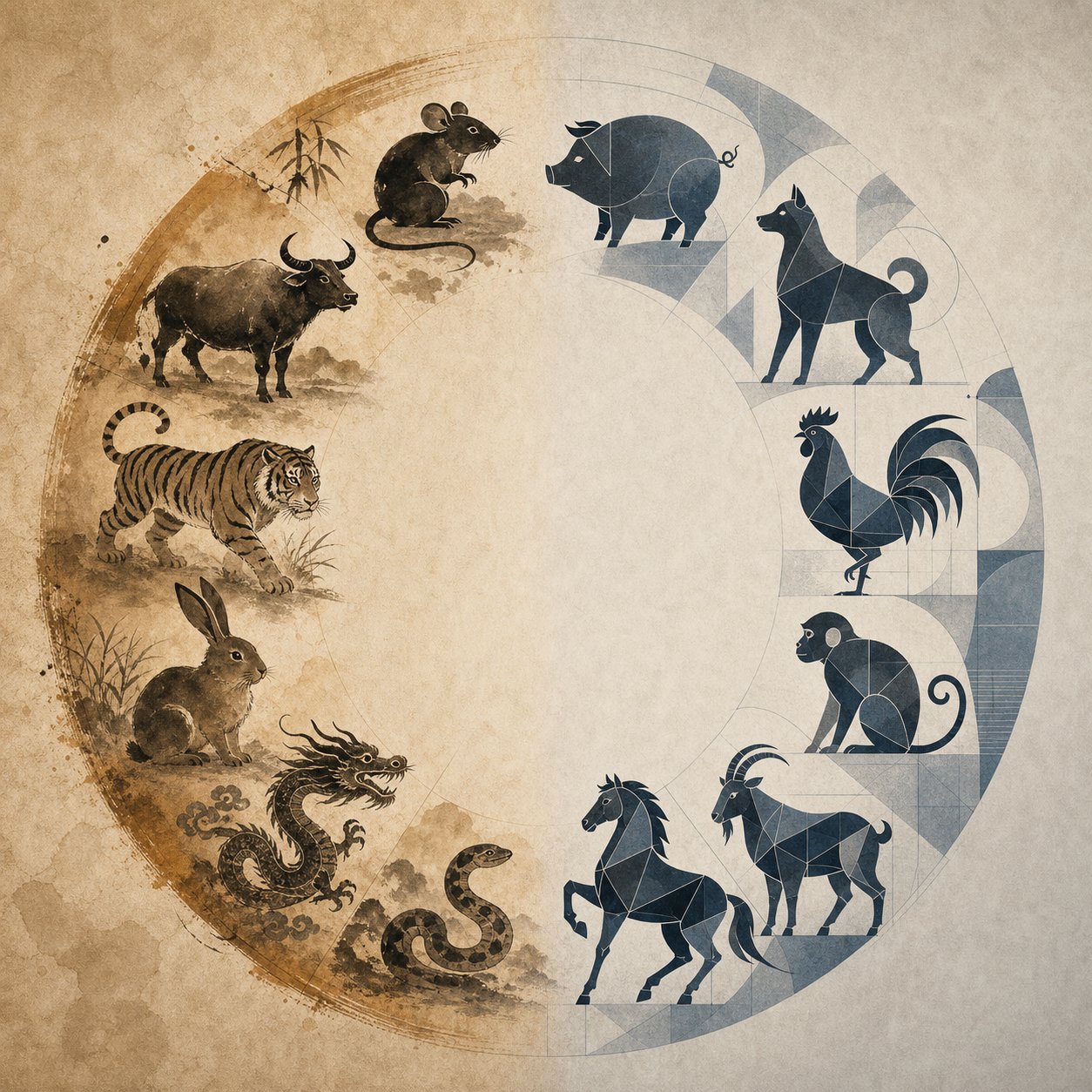
All 12 Zodiac Names Compared Side by Side
You've seen each pair examined in detail. Individual stories are revealing, but the real insights emerge when you line up all 12 chinese zodiac names animals in a single view. Patterns that were invisible at the pair level suddenly become obvious. Which characters survived simplification untouched? Which ones transformed so dramatically they look like different writing systems? And where does regional variation create the most confusion for learners and researchers trying to name all the signs of the chinese zodiac accurately?
Complete 12-Animal Reference Table
This table consolidates everything covered in the previous sections. If you need to name the 12 animals of the chinese zodiac with full traditional and modern forms, Earthly Branches, pinyin, and an honest assessment of how much each character changed, this is your single reference point.
| Number | Earthly Branch | Traditional Character | Modern Simplified Character | Pinyin | English Name | Degree of Change |
|---|---|---|---|---|---|---|
| 1 | 子 (zi) | 鼠 | 鼠 | shu | Rat | Minimal |
| 2 | 丑 (chou) | 牛 | 牛 | niu | Ox | Minimal |
| 3 | 寅 (yin) | 虎 | 虎 | hu | Tiger | Minimal |
| 4 | 卯 (mao) | 兔 | 兔 | tu | Rabbit | Minimal |
| 5 | 辰 (chen) | 龍 | 龙 | long | Dragon | Significant |
| 6 | 巳 (si) | 蛇 | 蛇 | she | Snake | Minimal |
| 7 | 午 (wu) | 馬 | 马 | ma | Horse | Moderate |
| 8 | 未 (wei) | 羊 | 羊 | yang | Goat/Sheep | Minimal |
| 9 | 申 (shen) | 猴 | 猴 | hou | Monkey | Minimal |
| 10 | 酉 (you) | 雞 | 鸡 | ji | Rooster | Significant |
| 11 | 戌 (xu) | 狗 | 狗 | gou | Dog | Minimal |
| 12 | 亥 (hai) | 豬 | 猪 | zhu | Pig | Moderate |
Look at the "Degree of Change" column. Out of all 12 chinese zodiac names, only two underwent significant visual transformation: the Dragon (16 strokes to 5) and the Rooster (18 strokes to 7). Two more experienced moderate changes: the Horse (10 strokes to 3) and the Pig (15 strokes to 11, with a radical swap from 豕 to 犭). The remaining eight animals kept their characters completely intact through simplification. That's a striking ratio. Two-thirds of the zodiac set looks identical in traditional and simplified Chinese.
Key Patterns in the Traditional to Modern Shift
Several patterns emerge when you step back from individual animals and look at the full cycle:
- Character stability is the norm, not the exception. Most people assume traditional and simplified zodiac characters look dramatically different. In reality, 8 out of 12 are visually identical. The perception of massive change is driven almost entirely by the Dragon and Rooster.
- The biggest transformations hit the most complex characters. 龍 (16 strokes), 雞 (18 strokes), 馬 (10 strokes), and 豬 (15 strokes) were the four most stroke-heavy zodiac characters. Simplification targeted complexity, not cultural significance.
- Regional variation creates more practical confusion than simplification does. The Goat's species ambiguity across languages, the Rooster's three-way character split (鷄/雞/鸡), and the Dog's dual-character system (犬 vs. 狗) generate more real-world naming errors than the traditional-to-simplified divide alone.
- Dialect pronunciation diverges far more than written forms. Cantonese "gai" versus Mandarin "ji" for Rooster, or Hokkien "chhi" versus Mandarin "shu" for Rat, represent phonetic gaps that no character comparison can capture. The Earthly Branch system provides a unifying framework precisely because it transcends these spoken-language differences.
- Cultural attitude shifts matter more than ink on paper. The Snake and Pig both kept their characters stable or nearly so, yet their naming influence changed dramatically because modern attitudes toward these animals shifted from classical admiration toward mild cultural discomfort.
The overarching story isn't really about characters at all. It's about philosophy. Traditional naming treated the zodiac as a cosmological system where your birth animal connected you to specific elements, time periods, directions, and virtues. Parents selected name characters that reinforced those connections through radicals, phonetic echoes, and elemental alignment. The Earthly Branch wasn't just a label. It was a prescription.
The deepest shift in Chinese zodiac naming isn't visual. It's philosophical. Traditional naming embedded the zodiac animal into a child's identity through radical selection, elemental alignment, and branch-based cosmology. Modern naming treats the zodiac as inspiration rather than instruction, prioritizing phonetic beauty and personal meaning over systematic auspiciousness.
Modern naming inverts that relationship. The zodiac becomes a starting point for reflection rather than a structural constraint. Parents might appreciate that their child is born in a Dragon year without feeling obligated to include the dragon radical in the name. They might acknowledge a Pig year's associations with abundance without consulting a Five Elements chart to ensure water-element harmony. The system hasn't disappeared. It's become optional. And that optionality is itself the most significant modern development in how these 12 names function in lived Chinese culture.
Understanding these patterns is one thing. Knowing which system to actually use for your specific purpose, whether that's language learning, baby naming, or academic research, requires a different kind of guidance entirely.
Choosing the Right Zodiac Naming System for Your Needs
Patterns and history are useful, but at some point you need to make a decision. Which system do you actually use? The answer depends entirely on what you're trying to accomplish. A language learner, a parent choosing chinese zodiac baby names, and an academic researcher each need different things from these naming conventions, and grabbing the wrong form for your context is exactly how mistakes happen.
Which System to Use for Language Learning
If you're studying Mandarin in mainland China or preparing for the HSK exam, simplified characters are your default. Learn 龙, 马, 鸡, and 猪 first. These are the forms you'll encounter in textbooks, apps, and everyday signage. But here's the thing: stopping there leaves you functionally illiterate when you encounter traditional characters in Taiwan, Hong Kong, or classical texts. The practical recommendation is to learn simplified as your active writing system and traditional as your passive recognition system.
The Earthly Branches (子丑寅卯辰巳午未申酉戌亥) are worth memorizing regardless of which character set you prioritize. They appear in formal writing, cultural contexts, and time expressions across all Chinese-speaking regions. Knowing that 午 means both "noon" and "Horse" gives you a mnemonic anchor that pure animal-character memorization can't provide. Language learners who understand both layers, the branch system and the colloquial animal names, develop a richer intuition for how Chinese encodes meaning.
Choosing Between Traditional and Modern for Baby Names
Parents exploring chinese zodiac baby names face a genuinely consequential choice. Traditional forms carry cultural gravitas and calligraphic beauty. A name incorporating 龍 (traditional dragon) signals classical education and deliberate cultural connection. The same name with 龙 (simplified) reads as contemporary and practical. Neither is wrong, but they communicate different things about the family's values and cultural positioning.
Consider these factors when deciding:
- Registration region: Mainland China requires simplified characters on official documents. Taiwan and Hong Kong require traditional. Your location may make the decision for you.
- Cultural weight: Traditional characters with zodiac radicals (like 豪 for Pig-year children or 骏 for Horse-year children) carry explicit cosmological resonance that simplified forms sometimes dilute.
- Practical legibility: A name your child will write thousands of times benefits from fewer strokes. 鸡 (7 strokes) is easier to live with daily than 雞 (18 strokes).
- Cross-regional readability: If your family spans mainland China and Taiwan, choosing characters that look identical in both systems (like 虎, 兔, or 羊) avoids the issue entirely.
What does my name mean in the chinese zodiac? That question drives many parents toward zodiac-inspired naming in the first place. The answer depends on whether you're drawing from the classical system, where elemental alignment and radical selection create layered meaning, or the modern approach, where the zodiac animal's personality traits loosely inspire character choices without structural encoding.
Finding Your Own Zodiac Name in Both Forms
Want to know what is my chinese zodiac name in both traditional and modern forms? The process is straightforward once you know the steps. Here's how to identify your zodiac animal and find its complete naming information:
- Determine your lunar birth year. If you were born between January 1 and February 20, check whether your birthday falls before or after Chinese New Year for that year. The zodiac year starts on Chinese New Year, not January 1. A zodiac calculator that accounts for the lunar calendar handles this automatically.
- Find your animal's position in the cycle. Divide your birth year by 12 and note the remainder. Remainder 0 = Monkey, 1 = Rooster, 2 = Dog, 3 = Pig, 4 = Rat, 5 = Ox, 6 = Tiger, 7 = Rabbit, 8 = Dragon, 9 = Snake, 10 = Horse, 11 = Goat.
- Identify your Earthly Branch. Match your animal to its branch: Rat = 子, Ox = 丑, Tiger = 寅, Rabbit = 卯, Dragon = 辰, Snake = 巳, Horse = 午, Goat = 未, Monkey = 申, Rooster = 酉, Dog = 戌, Pig = 亥.
- Learn both character forms. For most animals (Rat, Ox, Tiger, Rabbit, Snake, Goat, Monkey, Dog), the traditional and simplified characters are identical. For Dragon (龍/龙), Horse (馬/马), Rooster (雞/鸡), and Pig (豬/猪), practice recognizing both versions.
- Practice the correct pinyin pronunciation. Your zodiac name in Mandarin uses the animal character's pinyin: shu, niu, hu, tu, long, she, ma, yang, hou, ji, gou, or zhu. The phrase "I'm a [animal]" in Chinese is 我属 (wo shu) followed by your animal character.
Cultural researchers and anyone doing academic work with these names need the full Earthly Branch framework. The branch characters connect zodiac animals to the sexagesimal cycle, Five Elements theory, and traditional timekeeping in ways that the colloquial animal names alone cannot capture. If you're analyzing Bazi charts, reading classical almanacs, or studying the historical development of Chinese cosmology, the branch system isn't optional. It's the primary layer, and the animal names are secondary illustrations of it.
The core takeaway across all these use cases is simple: know both systems, then choose deliberately based on your context. Using traditional forms in a simplified-character environment looks affected. Using simplified forms in academic work on classical cosmology looks uninformed. The naming system itself isn't right or wrong in either direction. It's a tool, and like any tool, effectiveness depends on matching it to the job.
Frequently Asked Questions About Traditional and Modern Chinese Zodiac Names
1. What is the difference between traditional and modern Chinese zodiac names?
Traditional Chinese zodiac names use the Earthly Branches system (Dizhi) from classical literary Chinese, pairing each animal with a cosmological branch character like 子 for Rat or 辰 for Dragon. They employ traditional unsimplified characters such as 龍 and carry associations with timekeeping, elements, and directional symbolism. Modern names use simplified characters like 龙, colloquial Mandarin animal terms, and Hanyu Pinyin romanization. The key philosophical difference is that traditional naming embedded zodiac animals into a cosmological framework, while modern naming treats them as standalone animal identities prioritizing phonetic appeal and cross-cultural readability.
2. Which Chinese zodiac animal characters changed the most during simplification?
Only four out of twelve zodiac characters changed during China's script simplification reforms. The Dragon underwent the most dramatic transformation, dropping from 16 strokes (龍) to just 5 strokes (龙). The Rooster experienced a similar reduction from 18 strokes (雞) to 7 strokes (鸡). The Horse went from 10 strokes (馬) to 3 strokes (马), and the Pig changed from 15 strokes (豬) to 11 strokes (猪) while also swapping its pig radical for a dog radical. The remaining eight zodiac animals, including Rat, Ox, Tiger, Rabbit, Snake, Goat, Monkey, and Dog, kept their characters completely identical in both systems.
3. What are the 12 Earthly Branches for the Chinese zodiac animals?
The twelve Earthly Branches (Dizhi) paired with zodiac animals are: 子 (zi) for Rat, 丑 (chou) for Ox, 寅 (yin) for Tiger, 卯 (mao) for Rabbit, 辰 (chen) for Dragon, 巳 (si) for Snake, 午 (wu) for Horse, 未 (wei) for Goat, 申 (shen) for Monkey, 酉 (you) for Rooster, 戌 (xu) for Dog, and 亥 (hai) for Pig. Each branch corresponds to a two-hour period in the traditional Chinese clock, a compass direction, and a position in the sexagesimal cycle. In formal classical texts and Bazi charts, the branch character alone can reference the zodiac animal without naming the creature directly.
4. How do Chinese zodiac names differ across Chinese-speaking regions like Taiwan, Hong Kong, and mainland China?
Regional differences operate along two independent axes: script and pronunciation. Taiwan and Hong Kong use traditional characters (龍, 馬, 雞, 豬) while mainland China and Singapore use simplified forms (龙, 马, 鸡, 猪). Pronunciation diverges separately: Taiwan and mainland China share Mandarin readings, Hong Kong uses Cantonese (e.g., gai1 for Rooster instead of ji), and Singapore's Hokkien-speaking population preserves older pronunciations like 'ke' for Rooster. The Rooster demonstrates this most clearly with three possible written forms (鷄, 雞, 鸡) and multiple pronunciations depending on region and dialect.
5. How do Japanese and Korean zodiac names compare to Chinese traditional forms?
Japanese and Korean writing systems preserved traditional Chinese zodiac character forms even as mainland China simplified them. Japanese still writes 馬 (uma) with all 10 strokes and uses 龍 in formal contexts. Korean hanja maintains classical forms like 馬 and 羊 unchanged. These neighboring systems essentially froze the traditional characters in place, making them useful reference points for studying classical Chinese zodiac naming. Vietnamese adaptations resolved ambiguities differently, for example translating 羊 definitively as goat rather than sheep, based on the country's climate where sheep are absent.