Why Chinese Names Look Different Across Regions
Imagine you meet two people who share the exact same Chinese surname character. One spells it "Zhang" on their passport. The other writes "Cheung." Same character, completely different English spelling. If you've ever encountered this and wondered what's going on, you're not alone. The way Chinese names appear in English depends almost entirely on which region a person comes from and which romanization system that region uses.
Why the Same Chinese Name Gets Spelled Differently
Here's where the confusion around chinese traditional vs simplified gets interesting. Many people assume the difference between traditional Chinese vs simplified Chinese characters is what causes name spellings to change. It's a reasonable guess, but it misses the real story. Whether someone writes in simplified or traditional Chinese, the Mandarin pronunciation of a character stays the same. The character 王 sounds identical whether you're reading it in its traditional or simplified form (in this case, the character is actually the same in both scripts).
So is Mandarin simplified or traditional? The answer is neither. Mandarin is a spoken language. Simplified and traditional refer to writing systems. What actually changes a name's English spelling is the romanization system a region adopts to convert those sounds into Latin letters. Mainland China uses Hanyu Pinyin. Taiwan historically uses Wade-Giles. Hong Kong reflects Cantonese pronunciation entirely. Each system produces a different English result from the same underlying character.
Pinyin itself does not change between traditional and simplified characters. The spelling differences you see in Chinese names come from regional romanization systems, not from the script.
What This Guide Covers
This guide ranks the major romanization systems that shape how Chinese names appear in English, from the most globally recognized to regional variants. You'll see exactly how each system connects to either traditional or simplified character regions, why the same surname can look completely different across passports, and which system applies in which real-world situation. The differences between chinese simplified vs traditional naming conventions become much clearer once you know which romanization rules are at play.
The question, then, isn't really about the characters themselves. It's about the system standing between those characters and the English alphabet, and that system varies by geography, politics, and dialect.
How We Ranked These Romanization Systems
Geography and politics shape which romanization system a person's name follows, but not all systems carry equal weight in daily life. Some appear on millions of passports. Others survive mainly in library catalogs. To make sense of the chinese language traditional vs simplified naming landscape, you need a clear framework for comparing these systems against each other.
Evaluation Criteria for Romanization Systems
We evaluated each system using five practical criteria that reflect how names actually function in cross-cultural communication:
- Official government adoption - Is the system mandated by a national or regional government for official use?
- International recognition - Has it been certified by bodies like the ISO or the United Nations?
- Ease of pronunciation for English speakers - Can someone unfamiliar with Chinese reasonably approximate the correct sound?
- Prevalence in passports and legal documents - How likely are you to encounter this system on IDs, visa applications, or academic records?
- Connection to traditional or simplified Chinese character usage - Which script tradition does the system's home region use?
These criteria matter because the chinese difference between name spellings isn't academic. It shows up when you're filling out immigration forms, tracing family genealogy, citing authors in research papers, or simply trying to find the right person online. Understanding whether a name follows simplified chinese or traditional chinese conventions tells you which romanization rules likely apply.
How Region Determines Name Spelling
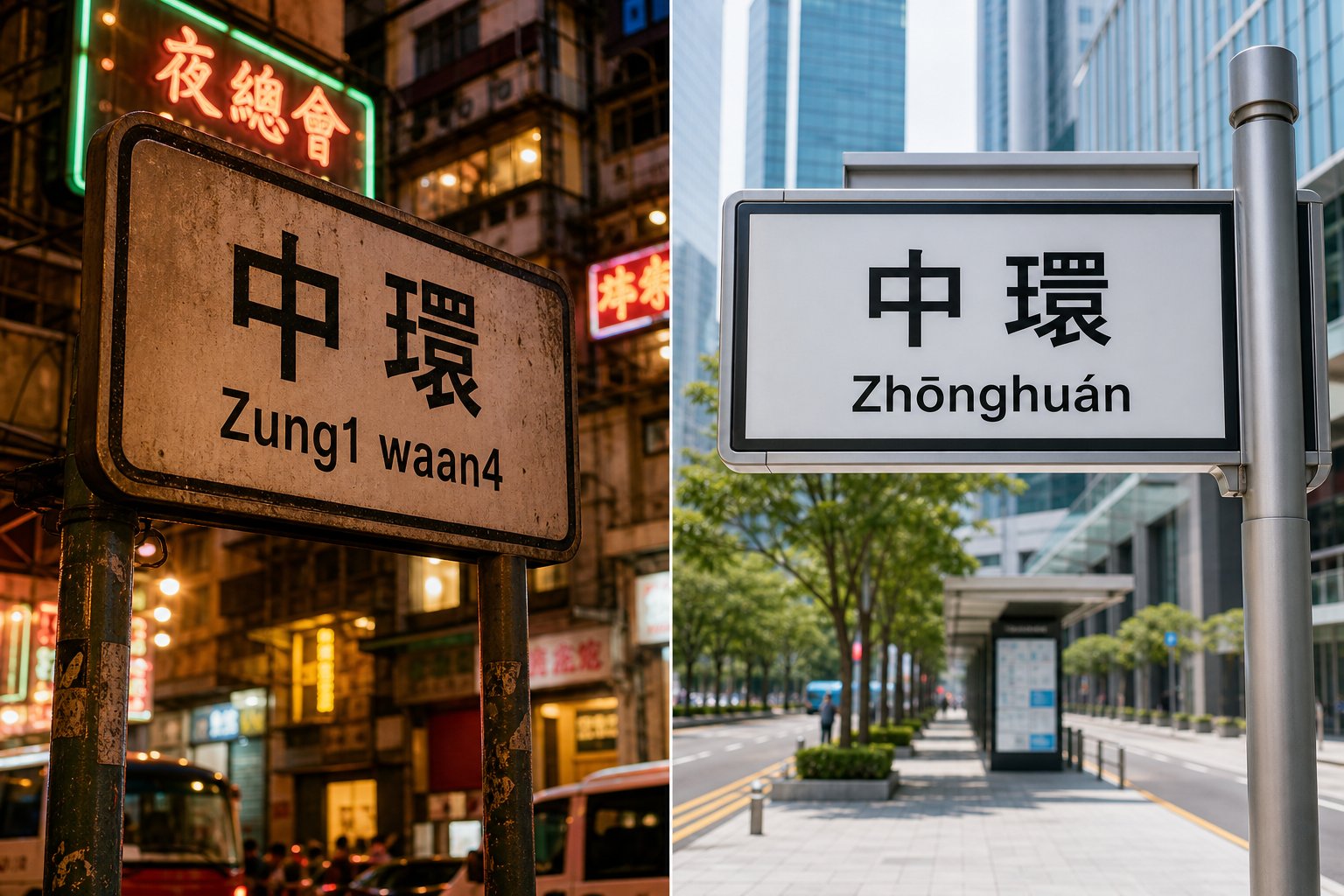
What is chinese script called in the Latin alphabet? That depends entirely on where you are. Each region adopted its own answer to this question at different points in history. Mainland China standardized Hanyu Pinyin and gained UN backing in 1986. Taiwan long relied on Wade-Giles before briefly experimenting with Tongyong Pinyin. Hong Kong never adopted a Mandarin-based system at all, instead romanizing names through Cantonese pronunciation.
The ranking that follows reflects practical relevance: how often you'll encounter each system, how broadly it's recognized, and how directly it connects to the traditional vs simplified chinese divide. A system used on hundreds of millions of passports naturally ranks higher than one preserved mainly in historical texts, regardless of its scholarly merit.
Hanyu Pinyin – The Global Standard for Simplified Chinese Names
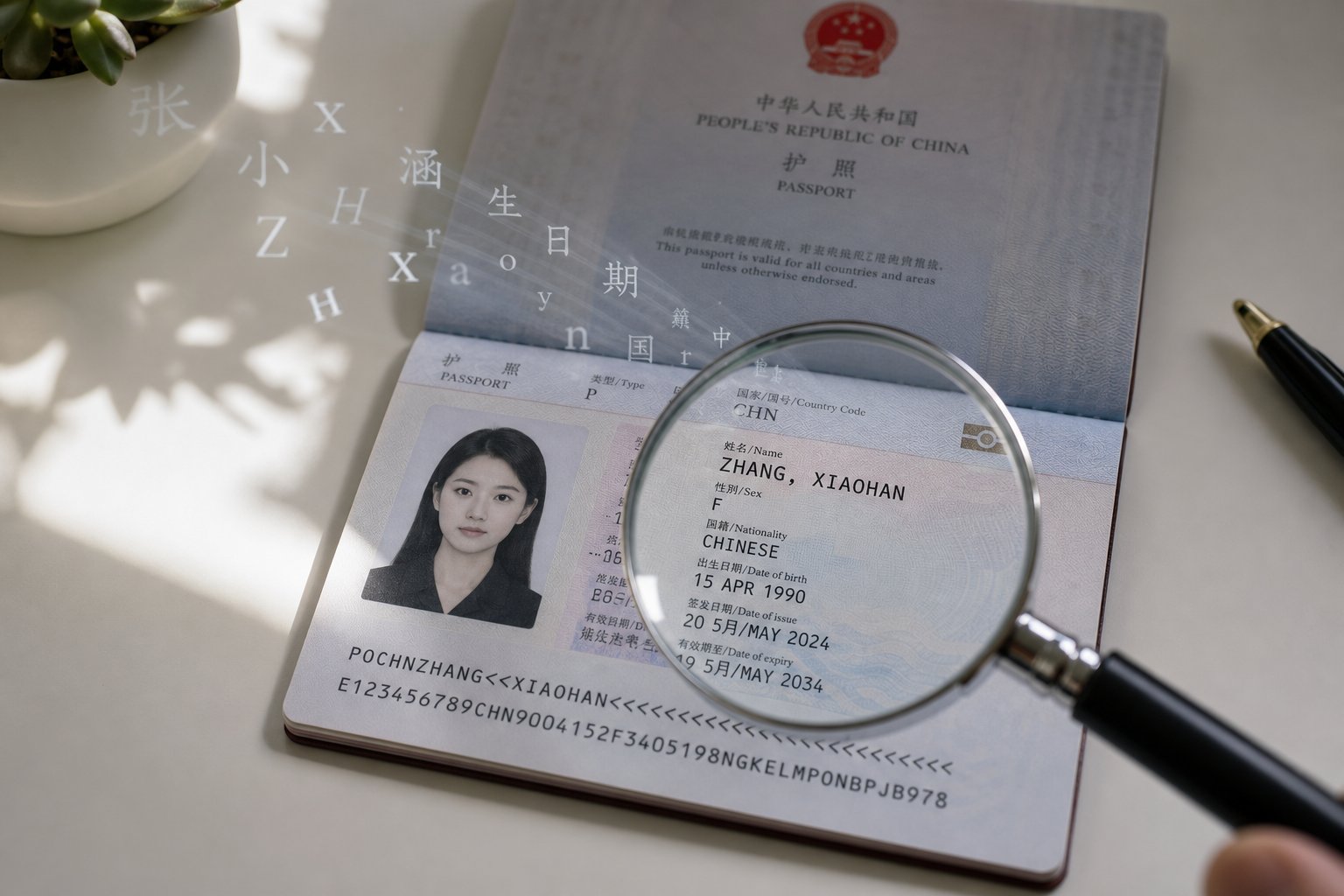
When most people say "pinyin," they're referring to one specific system: Hanyu Pinyin. Developed by the Chinese government in the 1950s and formally adopted in 1958, it was designed to boost literacy rates and standardize Mandarin pronunciation across Mainland China. It has since become the world's default method for romanizing simplified Chinese characters into Latin letters. If you've ever seen a Chinese name spelled with familiar-looking combinations like "Zhang," "Liu," or "Xu," you're looking at Hanyu Pinyin in action.
This system ranks first because its reach is unmatched. The International Organization for Standardization (ISO) and the United Nations both adopted Hanyu Pinyin in the 1980s, making it the internationally recognized standard for transcribing Mandarin sounds. Every passport issued in Mainland China uses it. Every street sign in Beijing follows it. For the simplified vs traditional chinese naming question, Hanyu Pinyin sits firmly on the simplified side of the divide.
How Hanyu Pinyin Works for Names
Hanyu Pinyin uses Roman letters to represent Mandarin syllables. Each Chinese character corresponds to one syllable, built from an initial consonant sound, a final vowel sound, and one of four tones. Tone marks sit above vowels as diacritical accents: a flat line for first tone (ā), a rising stroke for second (á), a dipping curve for third (ǎ), and a falling stroke for fourth (à).
In practice, though, names on passports and official documents almost never include tone marks. A china simplified passport will list a name like "ZHANG WEI" in plain capital letters with no tonal indicators. This means two entirely different characters with different tones can produce identical passport spellings. The character meaning "great" (伟, wěi) and the character meaning "danger" (危, wēi) both appear simply as "Wei" on a document.
For personal names, Mainland China follows a consistent format: surname first, given name second, with the given name written as one continuous unit. So a person named 李明华 becomes "Li Minghua" rather than "Li Ming Hua" or "Li Ming-hua."
Common Names in Hanyu Pinyin
You'll notice certain common chinese last names appearing constantly in Hanyu Pinyin. Here are some of the most frequent surnames and how they look in this system:
- Wang (王) - the most common Chinese surname, meaning "king"
- Li (李) - the second most common, where li means "plum" as in the plum tree
- Zhang (张) - the third most common, meaning "to stretch" or "to open"
- Liu (刘) - meaning "to kill" in its ancient form, though the association has long faded
- Chen (陈) - meaning "to display" or an ancient state name
- Yang (杨) - referring to the poplar tree
If you've ever wondered how to pronounce Zhang, it's not like the English word "zang." The "zh" in Hanyu Pinyin represents a retroflex sound, similar to the "j" in "judge" but with the tongue curled further back. This is one area where the system can trip up English speakers who read the letters at face value.
Pros and Cons of Hanyu Pinyin
Pros
- Recognized as the ISO 7098 international standard for Mandarin romanization
- Used on all Mainland Chinese passports and official documents
- Consistent, rule-based system with no regional variations in spelling
- Supported by every major digital input method for typing simplified chinese characters
- The system taught in virtually all modern Mandarin language courses worldwide
Cons
- Tone marks are almost always dropped in names, removing critical pronunciation information
- Several letter combinations mislead English speakers ("x," "q," "zh," "c" don't match English phonetics)
- Without tonal context, many common chinese names become ambiguous since dozens of characters can share one pinyin syllable
- Does not account for dialect pronunciations, only standard Mandarin
The strength of Hanyu Pinyin lies in its universality and consistency. You'll never see the same Mainland Chinese surname spelled two different ways within this system. But that consistency comes with a tradeoff: stripped of tone marks, names like "Li" could represent dozens of different characters and meanings. The surname Li (李) meaning plum is just one possibility among many homophones.
This standardization also means Hanyu Pinyin tells you nothing about whether a name originally used traditional or simplified characters. It only tells you the Mandarin pronunciation. A person from Taiwan who chooses to use Hanyu Pinyin on their passport will produce the same spelling as someone from Beijing, even though one writes in traditional characters and the other in simplified. The system is purely phonetic.
Still, in the real world, seeing a name in Hanyu Pinyin format is a strong signal that the person is connected to a simplified character region. And that regional association is exactly what breaks down when you cross into territories that chose entirely different romanization paths.
Wade-Giles – The Traditional Romanization Behind Taiwan's Names
If Hanyu Pinyin is the system of simplified character regions, Wade-Giles is its counterpart in the traditional Chinese world. Developed by British diplomat Sir Thomas Wade in 1859 and refined by scholar Herbert Giles in the 1890s, this system dominated English-language scholarship on China for nearly a century. It remains the reason why names from Taiwan and older academic texts look so different from the Hanyu Pinyin spellings most people recognize today. When you see "Chiang Kai-shek" instead of "Jiang Jieshi" or "Taipei" instead of "Taibei," you're encountering Wade-Giles conventions shaped by traditional chinese writing traditions.
Wade-Giles and Traditional Character Regions
Taiwan uses traditional chinese characters as its standard script, and for decades, Wade-Giles served as the default system for converting those characters into English spellings. Most Taiwanese people romanize their names using a simplified version of Wade-Giles that drops diacritics, tone marks, and apostrophes. This isn't a personal choice so much as institutional inertia. Government offices in Taiwan have used Wade-Giles reference materials for passport registration since the mid-20th century, and that practice shaped millions of names.
The connection between Wade-Giles and traditional characters chinese is geographic rather than technical. Just like Hanyu Pinyin, Wade-Giles romanizes Mandarin pronunciation. It doesn't encode whether the underlying character is traditional chinese or simplified. But because Taiwan, the primary region still using this system, writes exclusively in traditional characters, the association is strong. When you encounter a name in Wade-Giles format, you can reasonably assume the person comes from a traditional character region.
Here's what makes this confusing in practice: Taiwan officially switched to Hanyu Pinyin for signage in 2009, but personal names on passports still overwhelmingly follow Wade-Giles conventions. Romanization is not taught in Taiwan's public schools. Most Taiwanese learn pronunciation through Zhuyin (bopomofo), not any Latin-letter system, so the Wade-Giles spelling on their passport is often assigned by a government clerk rather than chosen deliberately.
Pros and Cons of Wade-Giles
Pros
- Deeply established in academic and historical texts published between 1890 and 1980
- Familiar in Western libraries, catalogs, and older reference works (the Library of Congress used it until its pinyin conversion project)
- Some spellings offer better pronunciation hints for English speakers ("ts" for the pinyin "c" sound, "hs" for the pinyin "x" sound)
- Remains the standard for most Taiwanese personal names on passports and legal documents
- Well-documented with clear conversion rules to and from Hanyu Pinyin
Cons
- Apostrophes that distinguish aspirated from unaspirated sounds are routinely dropped, creating confusion ("ch'ang" becomes "chang," colliding with a different sound)
- Less intuitive for modern readers who have grown up with Hanyu Pinyin as the global standard
- Hyphens and capitalization rules are inconsistently applied in Taiwanese usage
- Multiple characters can collapse into identical spellings when diacritics are removed
- No longer the international standard, making it harder to cross-reference with modern databases
The apostrophe problem deserves special attention. In proper Wade-Giles, the mark distinguishes two completely different sounds. "Ch'en" (with apostrophe) represents the surname 陈, while "Chen" (without) would technically represent a different initial sound. But in real-world Taiwanese usage, almost no one includes the apostrophe. The result? You can't always tell which sound a Wade-Giles spelling actually represents without additional context.
Pinyin vs Wade-Giles Name Examples
The gap between these two systems becomes vivid when you compare the same surname中文 character rendered in each. Here are common examples showing how chinese characters simplified vs traditional regions produce different English spellings for identical names:
| Character | Hanyu Pinyin | Wade-Giles | Notes |
|---|---|---|---|
| 张/張 | Zhang | Chang | "Zh" in pinyin becomes "Ch" in Wade-Giles |
| 陈/陳 | Chen | Ch'en | Apostrophe often dropped in practice |
| 周 | Zhou | Chou | Think "Chou En-lai" vs. "Zhou Enlai" |
| 邓/鄧 | Deng | Teng | "D" in pinyin maps to "T" in Wade-Giles |
| 许/許 | Xu | Hsü | "X" becomes "Hs" with umlaut |
| 赵/趙 | Zhao | Chao | Another "zh" to "ch" conversion |
| 谢/謝 | Xie | Hsieh | Common Taiwanese surname spelling |
| 蔡 | Cai | Ts'ai | As in former president Tsai Ing-wen |
Notice the pattern: pinyin's "zh" consistently becomes "ch" in Wade-Giles, pinyin's "d" becomes "t," and pinyin's "x" becomes "hs." These aren't random differences. They reflect a fundamental disagreement about which English letters best approximate Mandarin sounds. Wade-Giles chose letters that matched 19th-century British phonetic intuitions. Pinyin chose letters that fit a more systematic linguistic framework.
For anyone researching names across traditional chinese or simplified character regions, recognizing these patterns is essential. A "Chang" from Taiwan and a "Zhang" from Beijing may share the exact same surname character. The spelling difference tells you about geography and romanization history, not about pronunciation or meaning. Understanding this distinction is what separates confusion from clarity when working across the traditional and simplified divide.
Taiwan's romanization landscape, however, didn't stop evolving with Wade-Giles. The island's naming conventions grew even more complex when newer systems entered the picture, and when you factor in regions like Hong Kong that bypass Mandarin-based romanization entirely, the picture shifts again.
Jyutping and Cantonese Romanization – Hong Kong's Naming System
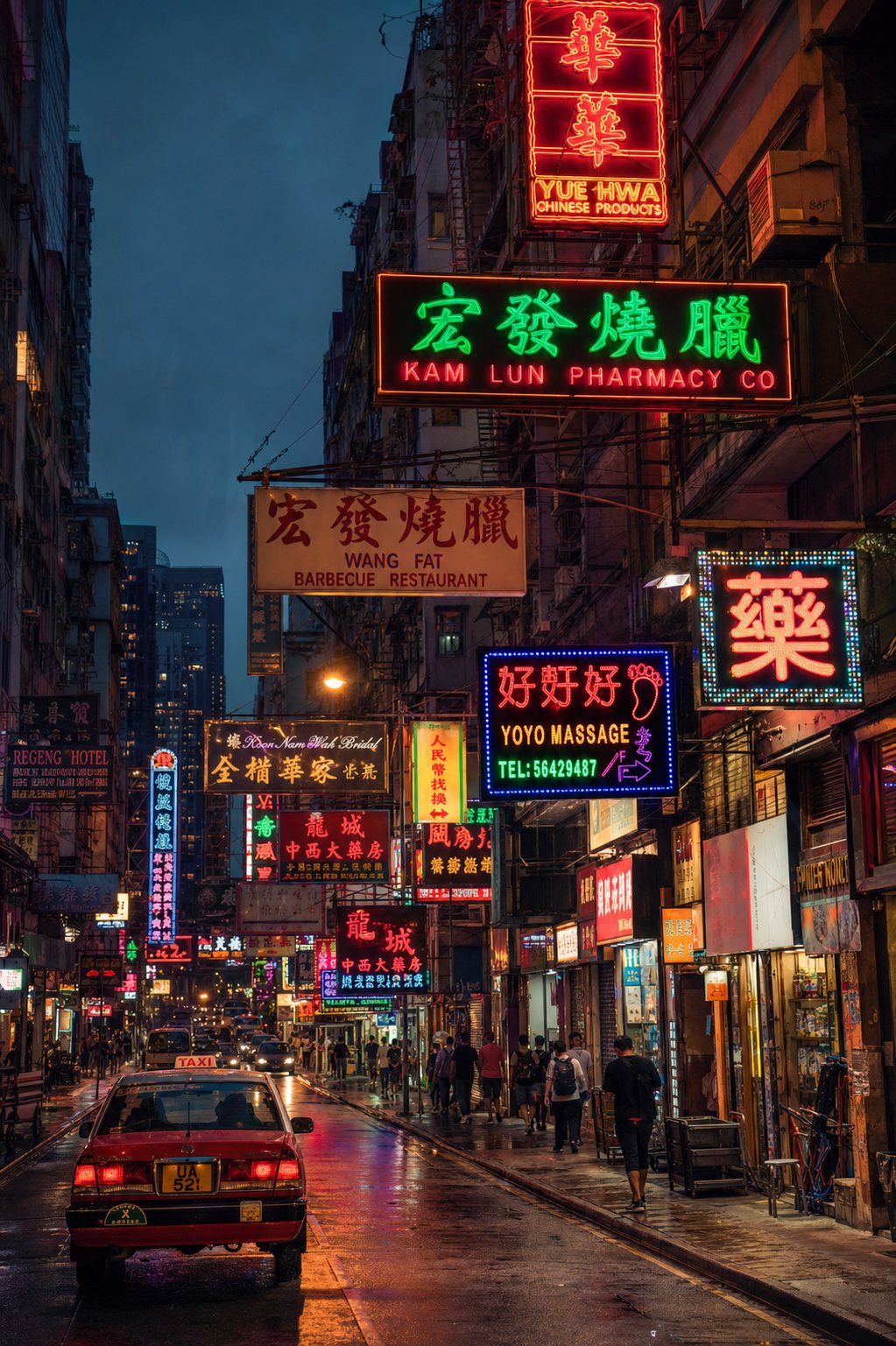
Hong Kong throws a curveball into the pinyin name traditional vs simplified discussion. Unlike Taiwan, which romanizes the same Mandarin pronunciation using a different letter system, Hong Kong romanizes a completely different pronunciation altogether. The city writes in traditional Chinese characters, but its residents speak Cantonese, not Mandarin. Their names reflect Cantonese sounds, which means the same character can produce an English spelling that looks nothing like either Hanyu Pinyin or Wade-Giles.
Why Hong Kong Names Sound Different
Consider the character 王. In Mandarin, it's pronounced "wang." In Cantonese, it's pronounced "wong." So a person from Beijing with this surname appears as "Wang" on their passport, while a person from Hong Kong with the identical character appears as "Wong." The wang last name origin traces back to the same ancient Chinese character meaning "king," but the English spelling diverges entirely based on which spoken language the romanization captures.
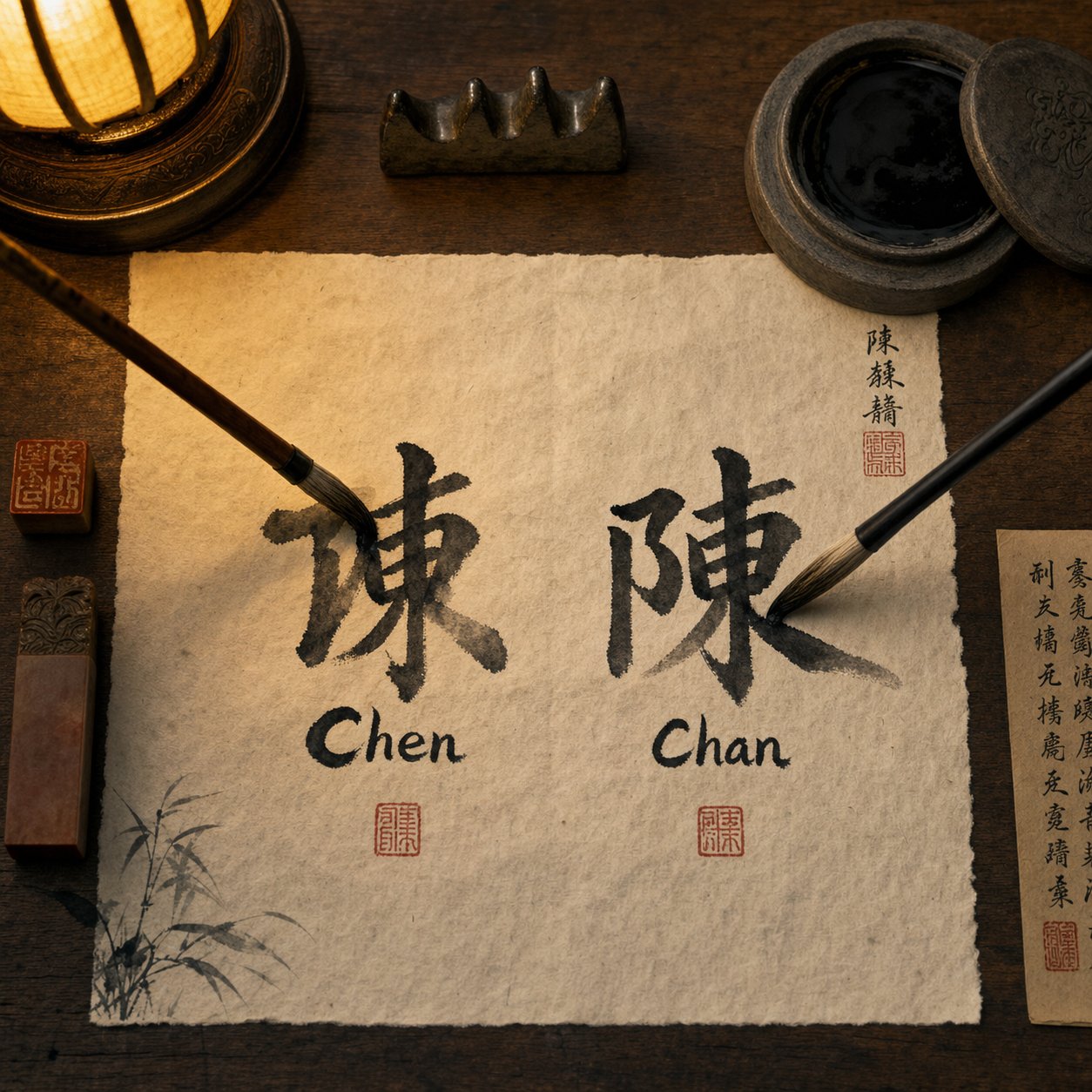
This pattern repeats across nearly every common surname among chinese family names. The character 陈 (陳 in traditional form) becomes "Chen" in Mandarin pinyin but "Chan" in Cantonese. The last name Chen and the last name Chan are the same character, the same family, the same meaning. Only the regional pronunciation differs. Similarly, the character 黄 becomes "Huang" in Mandarin but "Wong" in Cantonese. If you've ever researched the huang name origin and found it connected to the color yellow, that same character produces "Wong" on a Hong Kong ID card.
The Hong Kong Government Cantonese Romanisation system is based on a standard dating back to 1888, originally described by Roy T. Cowles. The government has never formally published its romanization rules. Instead, departments consult internal reference materials when assigning spellings to streets, places, and identity documents. Individuals registering names can choose their own spelling or accept the government default, which contributes to inconsistency even within the same family.
The system omits all tone markings and does not distinguish between aspirated and unaspirated consonant sounds. This means two characters with different tones and different meanings can receive identical English spellings. It's a practical simplification, but one that creates ambiguity for anyone trying to trace asian surnames names back to their original characters.
Pros and Cons of Cantonese Romanization
Pros
- Accurately represents how names are actually pronounced in Hong Kong's dominant spoken language
- Deeply rooted in Hong Kong cultural identity and over a century of consistent local usage
- Familiar to English speakers worldwide through the Hong Kong diaspora and popular culture
- Spellings like "Wong," "Chan," and "Lau" are immediately recognizable and easy to pronounce
Cons
- No single official published standard exists, leading to spelling variations across government departments
- Families with the same surname character may spell it differently depending on when they registered
- Tones are completely omitted, making reverse lookup to the correct character difficult
- Inconsistent treatment of aspirated sounds means different characters can collapse into one spelling
- Not compatible with Mandarin-based systems, making cross-referencing with Mainland records challenging
A more linguistically rigorous alternative exists. Jyutping, developed by the Linguistic Society of Hong Kong in 1993, captures Cantonese sounds with greater precision, including all six tones represented as numbers. It distinguishes vowel lengths and consonant types that the government system flattens. But jyutping remains primarily an academic and educational tool. It has not replaced the older conventions on passports or ID cards, and most Hong Kong residents are unfamiliar with it.
Famous Examples of Cantonese Name Spellings
The differences become concrete when you line up the same characters across systems. The li surname (李), meaning plum, appears as "Li" in both Mandarin pinyin and Wade-Giles but becomes "Lee" in Hong Kong's Cantonese romanization. Think Bruce Lee, whose family name is the same character as Mainland China's "Li" but spelled to match Cantonese pronunciation.
Here are more examples showing how wong in chinese and other common surnames shift between systems:
- Wong (黄/黃) - "Huang" in Mandarin pinyin, "Wong" in Cantonese
- Chan (陈/陳) - "Chen" in Mandarin pinyin, "Chan" in Cantonese
- Cheung (张/張) - "Zhang" in Mandarin pinyin, "Cheung" in Cantonese
- Lau (刘/劉) - "Liu" in Mandarin pinyin, "Lau" in Cantonese
- Ng (吴/吳) - "Wu" in Mandarin pinyin, "Ng" in Cantonese
- Leung (梁) - "Liang" in Mandarin pinyin, "Leung" in Cantonese
- Tsang (曾) - "Zeng" in Mandarin pinyin, "Tsang" in Cantonese
These aren't minor spelling tweaks. "Ng" and "Wu" look like entirely different names to someone unfamiliar with the systems. Yet they represent the same character, the same family lineage, and the same meaning. The gap exists because Cantonese and Mandarin diverged centuries ago, and their sound systems evolved along separate paths.
Macau follows a similar pattern but adds Portuguese-influenced spellings into the mix, creating yet another layer of variation. And Hong Kong's lack of a single enforced standard means that even within one city, you'll find the same character romanized multiple ways depending on the family, the generation, or the government clerk who processed the paperwork.
This regional fragmentation raises a broader question: what happens when a government tries to impose a new standard on a population already using something else? Taiwan's experience with Tongyong Pinyin offers a revealing case study in exactly that tension.
Tongyong Pinyin and Singapore – Regional Naming Variants
Taiwan's romanization story didn't end with Wade-Giles. In the early 2000s, the island attempted something ambitious: creating its own system that could handle not just Mandarin but also Taiwanese Hokkien and Hakka. The result was Tongyong Pinyin, and its brief, turbulent life as an official standard left a lasting mark on how Taiwanese names appear in English today.
Tongyong Pinyin and Taiwan's Naming Complexity
Developed by linguist Yu Bor-chuan, Tongyong Pinyin was designed as a modified version of Hanyu Pinyin with what its creators saw as improvements. Yu described the systems as differing by only about 15%, with changes like replacing the counter-intuitive "x" and "q" with spellings more natural for English speakers. The key selling point was versatility: Tongyong Pinyin could romanize Hakka and roughly 80% of Taiwanese Hokkien sounds, something Hanyu Pinyin simply cannot do.
The political context made this more than an academic exercise. Taiwan uses traditional characters and has long resisted adopting systems associated with Mainland China. The debate became entangled with identity politics. Tongyong Pinyin advocates were tagged as pro-independence, while Hanyu Pinyin supporters were labeled pro-unification. In 2002, Taiwan's government adopted Tongyong Pinyin as the official standard. Then in 2009, a new administration reversed course and mandated Hanyu Pinyin for road signs and public signage.
The practical fallout? Inconsistency everywhere. A person who registered their passport in 2004 might have a Tongyong spelling. Someone who registered in 2012 might follow Hanyu Pinyin. Others still carry Wade-Giles spellings from decades earlier. The same street in Taipei could appear as "Jhongsiao" (Tongyong), "Zhongxiao" (Hanyu Pinyin), or "Chunghsiao" (Wade-Giles) depending on which sign you read. For the chinese name first name order on Taiwanese documents, the romanization system applied depends entirely on timing and local government practice.
This oscillation means that converting traditional chinese to simplified chinese naming conventions is never straightforward in Taiwan's case. Two siblings might spell their surname differently on their passports if they registered years apart. An asian name from Taiwan could follow any of three or four systems, and there's no reliable way to guess which one without asking.
Singapore's Unique Naming Approach
Singapore presents the opposite puzzle. The city-state officially uses simplified and traditional chinese in different contexts, with simplified characters dominant in education and government since the 1970s. You might expect Singaporean names to follow Hanyu Pinyin, but they largely don't. Instead, most Singaporean Chinese names reflect older dialect romanizations from Hokkien, Teochew, Cantonese, or Hakka, the languages their ancestors spoke when they immigrated generations ago.
A Singaporean surnamed 陈 might spell it "Tan" (Hokkien), "Chan" (Cantonese), or "Chin" (Hakka) rather than the Mandarin pinyin "Chen." Chinese middle names and given names follow similar dialect patterns. The government does not enforce Hanyu Pinyin for personal names, so families preserve romanizations that reflect their linguistic heritage rather than modern Mandarin pronunciation. This creates a situation where simplified chinese vs traditional chinese script conventions tell you almost nothing about how a Singaporean name will be spelled in English.
Pros and Cons of Regional Variants
Pros
- Tongyong Pinyin was designed to represent multiple Taiwanese languages within a single framework
- Singapore's dialect-based names preserve cultural and linguistic heritage across generations
- Regional systems reflect how people actually speak rather than imposing a single Mandarin standard
- Both approaches acknowledge that language carries identity, not just information
Cons
- Tongyong Pinyin's 85% overlap with Hanyu Pinyin creates confusion rather than clarity for international readers
- Limited adoption means fewer resources, tools, and recognition outside the home region
- Taiwan's system-switching produced decades of inconsistent name spellings across official documents
- Singapore's lack of a single standard makes it nearly impossible to reverse-engineer the original character from a romanized name
Both Taiwan and Singapore illustrate a core tension in the simplified chinese vs traditional chinese naming world: standardization aids communication, but it can erase the linguistic diversity that names are meant to carry. And that tension leads directly to one of the most practical challenges anyone faces when working with romanized Chinese names: figuring out which actual character a spelling represents when multiple possibilities exist.
The Reverse Lookup Problem – From Pinyin Back to Characters
Every system we've covered so far moves in one direction: from a Chinese character to an English spelling. But what happens when you need to go the other way? You have a romanized name on a form, in a citation, or on a social media profile, and you need to identify the correct character behind it. This is the reverse lookup problem, and it's where the chinese name pronunciation gap becomes a genuine obstacle.
The Reverse Lookup Challenge
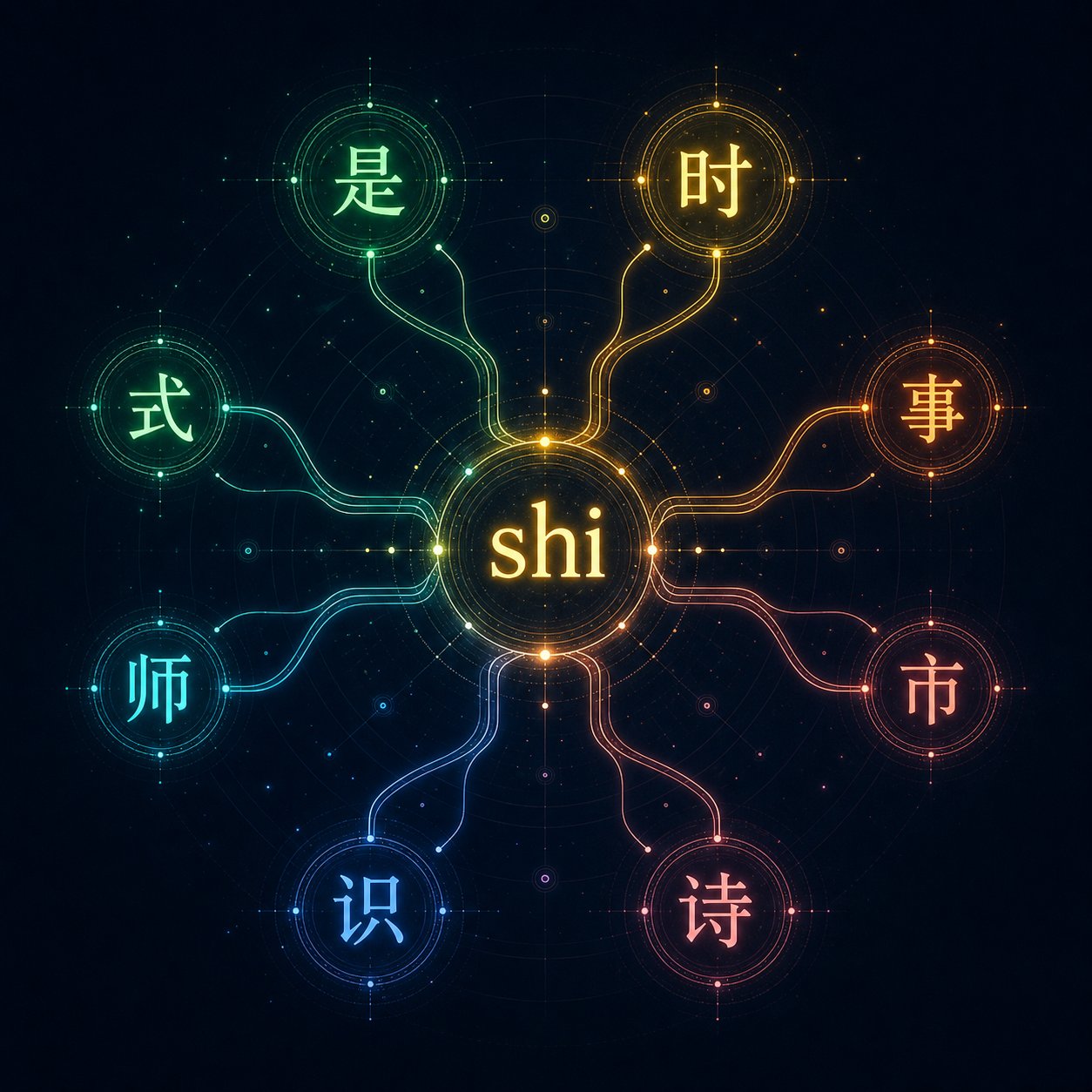
Mandarin has roughly 400 distinct syllables (around 1,300 if you count tonal variations). The writing system contains tens of thousands of characters. The math alone tells you that many characters must share the same sound, and therefore the same pinyin spelling. The surname "Li" could be 李 (plum), 黎 (dawn), 厉 (stern), or 栗 (chestnut). Each carries a different chinese name meaning, a different lineage, and a different history. Yet on a passport or a conference badge, they all appear as one identical word: Li.
This isn't a flaw in pinyin. It's a structural feature of how Chinese works. Understanding names in chinese and meanings requires knowing the character, not just the sound. A romanized spelling is a lossy compression. It captures pronunciation but discards the visual and semantic information that distinguishes one name from another. When someone asks for a chinese name definition, the romanization alone can't provide it.
When Simplified Merges Create Ambiguity
The simplification process made this problem worse in specific cases. When China reformed its writing system in the 1950s, multiple traditional characters were sometimes merged into a single simplified form. These aren't one-to-one mappings. They're many-to-one compressions that collapse distinct meanings into a shared written shape.
Character simplification merged multiple traditional characters into single simplified forms, meaning that converting a romanized name back to its correct character sometimes requires choosing between two or more unrelated possibilities.
Consider the surname "Hou." In traditional characters, 後 (meaning "behind") and 后 (meaning "empress") were separate characters representing separate family lines. After simplification, both are written 后. The romanization "Hou" now maps to a character that itself maps to two different traditional origins. Or take the character 谷, which in simplified Chinese represents both gǔ 穀 (grain) and gǔ 谷 (valley) — two distinct traditional characters with different mandarin name meanings that were consolidated into one form.
The surname 沈 presents another layer. In simplified Chinese, it can correspond to the traditional 沈 (the surname Shen) or 瀋 (as in Shenyang). Context determines which traditional form applies, but a romanized name standing alone offers no such context.
Practical Scenarios Where This Matters
This ambiguity isn't just a linguistic curiosity. It creates real friction in everyday situations:
- Genealogy research – Tracing chinese surnames and meanings across generations requires matching romanized records to the correct character. A family named "Ye" could be 叶 (leaf) or the traditional 葉, but the simplified form 叶 was also an entirely separate rare character before simplification.
- Visa and immigration forms – Applicants must provide characters alongside romanized names, but officials unfamiliar with Chinese may not verify the match. Errors propagate through legal systems.
- Academic citations – Citing an author as "Zhang" without characters makes it impossible to distinguish among dozens of possible surnames. Libraries that converted from Wade-Giles to pinyin catalogs faced exactly this disambiguation challenge.
- Finding people online – Searching for chinese names for english names databases or social platforms using only a romanized spelling returns hundreds of unrelated results. Without the character, you're guessing.
The reverse lookup problem highlights why romanization systems are tools of convenience, not complete representations. They work well for pronunciation. They fail at identification. And the gap between those two functions grows wider when simplified character merges remove distinctions that traditional characters preserved. For anyone working across both systems, a comparison table showing exactly how the same surnames appear in every romanization format becomes an essential reference.
Complete Comparison Table of the Most Common Chinese Surnames Across All Systems
All the patterns discussed so far become clearest when you line up the same chinese last name side by side across every major romanization system. The table below takes the most common chinese last names and shows exactly how each one appears depending on region and system. If you've been trying to match a name you've encountered to its correct character, this is your reference.
Common Surnames Across All Systems
The following table covers the most popular chinese last names, drawing from data on the ten most common chinese surnames in Mainland China. Each entry shows the traditional and simplified character forms alongside their romanized spellings in Hanyu Pinyin, Wade-Giles, and Cantonese.
| Traditional | Simplified | Hanyu Pinyin | Wade-Giles | Cantonese | Meaning / Origin |
|---|---|---|---|---|---|
| 王 | 王 | Wang | Wang | Wong | King or prince; used by descendants of royalty |
| 李 | 李 | Li | Li | Lee | Plum tree; one of the oldest surnames |
| 張 | 张 | Zhang | Chang | Cheung | To draw a bow; bestowed upon fletchers |
| 劉 | 刘 | Liu | Liu | Lau | Ancient weapon; linked to Han dynasty emperors |
| 陳 | 陈 | Chen | Ch'en | Chan | To display; State of Chen |
| 楊 | 杨 | Yang | Yang | Yeung | Poplar tree |
| 黃 | 黄 | Huang | Huang | Wong | Yellow; State of Huang |
| 趙 | 赵 | Zhao | Chao | Chiu | State of Zhao |
| 吳 | 吴 | Wu | Wu | Ng | State of Wu |
| 周 | 周 | Zhou | Chou | Chow | Zhou dynasty; to encircle |
| 林 | 林 | Lin | Lin | Lam | Forest; linked to Bi Gan's descendants |
| 許 | 许 | Xu | Hsü | Hui | To allow; State of Xu |
You'll notice that some chinese surnames remain identical across Pinyin and Wade-Giles (Wang, Li, Lin) while others diverge dramatically (Zhang vs. Chang vs. Cheung). The meaning of chinese last names stays constant regardless of spelling. A "Wong" in Hong Kong and a "Huang" in Beijing share the same character, the same lineage, and the same connection to the ancient State of Huang. Only the romanization path differs.
The Cantonese column reveals the widest gaps. "Ng" and "Wu" look like entirely unrelated names to an English reader, yet they represent the same character and the same family history. These chinese last name meanings don't change across borders. What changes is the phonetic lens applied to the character.
System-by-System Feature Comparison
Beyond individual surnames, it helps to compare the romanization systems themselves against the evaluation criteria covered earlier. The table below summarizes how each system performs across the factors that matter most when working with most common chinese surnames in real-world contexts.
| Feature | Hanyu Pinyin | Wade-Giles | Cantonese (HK Gov't) | Tongyong Pinyin |
|---|---|---|---|---|
| Official Region | Mainland China | Taiwan (historical) | Hong Kong, Macau | Taiwan (2002-2008) |
| Character Set Association | Simplified | Traditional | Traditional | Traditional |
| International Recognition | ISO 7098, UN standard | Legacy academic standard | Regional only | None |
| Passport Usage | All Mainland passports | Most Taiwan passports | All Hong Kong IDs | Some Taiwan passports (2002-2008 era) |
| Ease of Use for English Speakers | Moderate (some unintuitive letters) | Moderate (apostrophe system) | High (familiar spellings) | Moderate-High |
| Tone Marking | Diacritics (usually omitted) | Superscript numbers (usually omitted) | None | Diacritics (usually omitted) |
| Consistency | Very high | Moderate (diacritics often dropped) | Low (no enforced standard) | Low (limited adoption period) |
The pattern is clear: Hanyu Pinyin dominates in standardization and global reach, while the other systems persist because they serve specific regional populations. For anyone trying to identify or verify the most common chinese surnames across documents from different regions, knowing which column to check based on the document's origin saves significant guesswork. A name on a Mainland passport maps to the Hanyu Pinyin column. A name on a Hong Kong ID maps to Cantonese. A Taiwanese passport likely maps to Wade-Giles, though the era of issuance matters.
These tables consolidate the practical reality: the same dozen chinese last names account for a huge share of the population across all Chinese-speaking regions, but they can appear in three or four completely different English spellings depending on where the document was issued. Recognizing which system produced a given spelling is the first step toward using the correct one yourself.
Which Romanization System Should You Use
Knowing how chinese names work across regions is one thing. Knowing which system to apply in your specific situation is another. The comparison tables above give you the data, but real-world decisions depend on context: who you're communicating with, what documents you're handling, and what outcome you need.
Which System to Use Based on Your Situation
Here's a ranked set of recommendations based on the most common scenarios where the difference between simplified and traditional chinese naming conventions matters:
- Communicating with Mainland China or international organizations – Use Hanyu Pinyin. It's the ISO and UN standard, and it's what every Mainland passport, academic institution, and government body expects. If you're filling out forms, writing citations, or corresponding with anyone in a simplified character region, Hanyu Pinyin is the correct choice.
- Researching or corresponding with Taiwanese contacts – Expect Wade-Giles or Tongyong variants on their documents. Don't "correct" their spelling to Hanyu Pinyin. If you need to convert between systems for your own records, use a conversion table but preserve the original spelling in any communication directed at them.
- Working with Hong Kong or Macau names – Expect Cantonese romanization that bears no resemblance to Mandarin-based systems. A "Chan" is a "Chen" in pinyin, but never assume or substitute one for the other in official contexts.
- Genealogy or historical research – Be prepared to cross-reference multiple systems. Older records may use Wade-Giles, postal romanization, or dialect-based spellings. A simplified to traditional chinese converter can help identify character forms, but it won't resolve romanization differences.
- Academic writing – Follow your publisher's style guide. Most modern journals require Hanyu Pinyin, but historical figures are often left in their established Wade-Giles spellings ("Chiang Kai-shek" rather than "Jiang Jieshi").
Common Mistakes to Avoid
Even with the right system identified, people stumble over the same misconceptions repeatedly. Here are the errors that cause the most confusion when navigating the difference between chinese simplified and traditional name spellings:
- Assuming all Chinese names follow Hanyu Pinyin rules – They don't. If you see "Cheung" and try to pronounce it using pinyin logic, you'll get it wrong. That spelling follows Cantonese conventions, not Mandarin ones.
- Confusing romanization differences with pronunciation differences – "Zhang" and "Chang" represent the same sound. The letters differ because the systems use different conventions for mapping that sound to English. The person's actual name hasn't changed.
- Thinking simplified versus traditional chinese characters produce different pinyin – They don't. Pinyin encodes Mandarin pronunciation, which is identical regardless of script. The character 張 (traditional) and 张 (simplified) both produce "Zhang" in Hanyu Pinyin.
- "Correcting" someone's name spelling – A Taiwanese person who spells their name "Hsieh" is not misspelling the pinyin "Xie." They're using a different system entirely. Respect the spelling on their documents.
- Assuming one romanized spelling equals one character – Dozens of characters can share the same pinyin. Without the character itself, you cannot determine meaning, and you may not even be able to identify the correct surname.
The core issue behind all these mistakes is treating Hanyu Pinyin as universal when it's actually regional. Simplified chinese and traditional chinese regions developed their naming conventions independently, and those conventions persist on legal documents regardless of what international standards say.
Key Takeaways for Working with Chinese Names
How do chinese names work across the traditional and simplified divide? The answer comes down to three layers: the character (which carries meaning), the pronunciation (which depends on the spoken language), and the romanization system (which depends on geography and politics). Mixing up these layers is where confusion starts.
Pinyin represents sound, not script. The spelling differences you encounter across Chinese names are never caused by traditional versus simplified characters. They are caused by different regions choosing different systems to convert the same sounds into English letters.
Whether you're working with chinese traditional or simplified documents, the practical rule is simple: identify the region first, then apply the corresponding system. The character tells you the meaning. The region tells you the spelling. And the romanization system is just the bridge between them — one bridge among several, each built in a different era, by a different authority, for a different population.
Frequently Asked Questions About Pinyin Names in Traditional vs Simplified Chinese
1. Does pinyin change between traditional and simplified Chinese characters?
No. Pinyin represents Mandarin pronunciation, which remains identical regardless of whether a character is written in traditional or simplified form. The character 張 (traditional) and 张 (simplified) both produce the same pinyin spelling: Zhang. The spelling differences you see across Chinese names come from different romanization systems used by different regions, not from the script itself.
2. Why do Taiwanese names look different from Mainland Chinese names in English?
Taiwan historically uses the Wade-Giles romanization system, while Mainland China uses Hanyu Pinyin. These two systems assign different English letters to the same Mandarin sounds. For example, the surname 张 appears as 'Chang' in Wade-Giles (Taiwan) but 'Zhang' in Hanyu Pinyin (Mainland). Taiwan also briefly used Tongyong Pinyin from 2002 to 2008, adding further variation to Taiwanese name spellings depending on when a passport was issued.
3. Why is the same Chinese surname spelled 'Wong' in Hong Kong but 'Wang' in Mainland China?
Hong Kong romanizes names based on Cantonese pronunciation, not Mandarin. The character 王 is pronounced 'wong' in Cantonese and 'wang' in Mandarin. Since Hong Kong uses Cantonese as its primary spoken language, passports and ID cards reflect that pronunciation. This is why Hong Kong names often look completely different from both Hanyu Pinyin and Wade-Giles spellings, even though the underlying character is the same.
4. How can I find the correct Chinese character from a romanized name?
This is known as the reverse lookup problem. Multiple characters can share the same romanized spelling because Mandarin has far fewer distinct syllables than characters. The surname 'Li' alone could represent 李 (plum), 黎 (dawn), or 厉 (stern). To identify the correct character, you need additional context such as the person's region of origin, the romanization system used, or ideally the character itself provided alongside the romanized spelling.
5. Which romanization system should I use when writing a Chinese name in English?
Match the system to the region. Use Hanyu Pinyin for Mainland Chinese names and international contexts. Expect Wade-Giles or Tongyong variants for Taiwanese names and never 'correct' them to pinyin. Use Cantonese romanization for Hong Kong and Macau names. For academic writing, follow your publisher's style guide. The key rule is to identify the person's region first, then apply the corresponding system rather than defaulting to Hanyu Pinyin for everyone.