Why the Same Taiwanese Name Gets Spelled Five Different Ways
Imagine you are researching a Taiwanese public figure and find her surname spelled Tsai in one news article, Cai in an academic paper, and Tsay on a government document. Same person, same Chinese character, three different spellings. Welcome to the world of Taiwanese name romanization vs pinyin, where a single surname can fracture into multiple Latin-letter forms depending on which system was used and when.
This is not a typo problem. It is a system problem. Taiwan has cycled through at least five different romanization frameworks over the past century, and unlike mainland China, where Hanyu Pinyin became the sole standard, Taiwan never fully consolidated around one approach. The result: Taiwanese Chinese names appear in wildly different spellings across passports, academic journals, business cards, and international media.
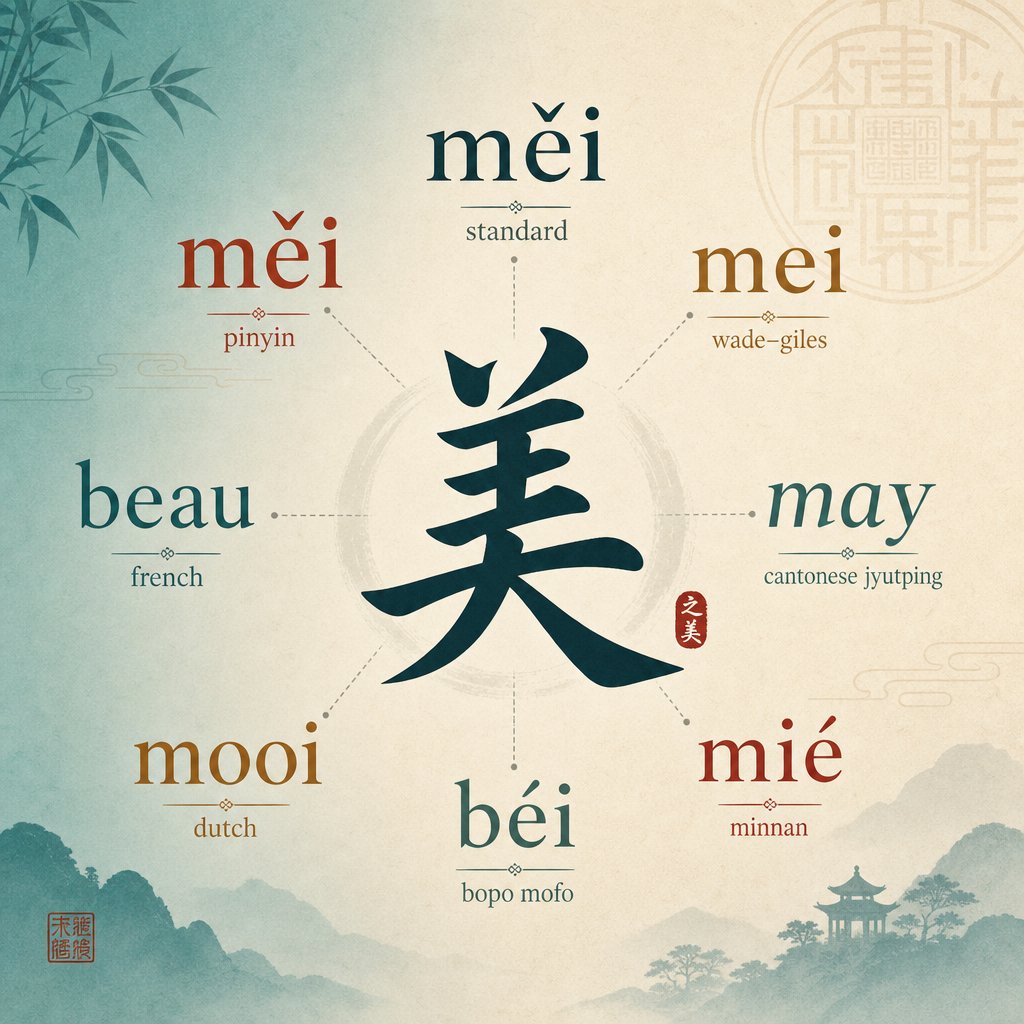
The character 蔡 appears as Tsai (Wade-Giles), Cai (Hanyu Pinyin), or Tsay (Tongyong Pinyin). All three are correct within their respective systems. None is a misspelling.
Why Taiwanese Names Look Nothing Like Mainland Pinyin
If you have studied Mandarin using Hanyu Pinyin, Taiwanese names can feel disorienting. A surname you would expect to see as "Xu" shows up as "Hsu." "Zhang" becomes "Chang." "Lin" stays "Lin" but "Li" somehow becomes "Lee." This happens because most people in Taiwan romanize their names using a simplified version of Wade-Giles or other legacy conventions rather than the pinyin system taught in Chinese language classrooms worldwide. Since romanization is not formally taught in Taiwan's schools, where students learn pronunciation through Bopomofo (Zhuyin) instead, many Taiwanese encounter the Latin-alphabet spelling of their own name only when applying for a passport.
Who This Guide Helps
This ranked guide breaks down each romanization system you will encounter when working with Taiwanese names. It is built for:
- Language learners trying to connect classroom pinyin to real Taiwanese names they see in the news
- Genealogy researchers tracing family names across documents that span decades and multiple systems
- Journalists who need to spell Taiwanese names consistently and correctly
- Business professionals addressing Taiwanese contacts without mangling their names
Each system gets evaluated on practical grounds: how often it appears on actual Taiwanese passports, how recognizable it is internationally, and how easily you can decode it. The goal is not to crown a linguistic winner but to give you the tools to navigate a landscape where the same name routinely wears five different spellings.
How We Evaluated Each Romanization System
Not all systems to romanize Chinese carry equal weight when you are trying to decode a Taiwanese name on a business card or a genealogy record. Some appear on millions of passports; others exist mainly in academic papers or on fading street signs. To rank each system fairly, we needed criteria grounded in real-world utility rather than theoretical elegance.
Evaluation Criteria for Each System
Every Chinese romanization method discussed in this guide is measured against five factors, listed here in order of importance:
- Prevalence on Taiwanese passports - How likely are you to encounter this system on an actual person's official documents? A system used by millions of passport holders matters more than one used by a handful of academics.
- International recognition - Can English-speaking institutions, databases, and search engines reliably process names spelled in this system?
- Ease of pronunciation for English speakers - Does the romanization of Chinese characters in this system produce spellings that English readers can approximate without special training?
- Internal consistency - Does the system follow predictable rules, or does it require memorizing exceptions?
- Availability of conversion tools - Can you easily convert a name from this system into another using free online tools or dictionaries?
What Prevalence Actually Means for Taiwanese Names
Prevalence deserves the top spot because it reflects what you will actually encounter. A system might be linguistically precise yet appear on almost no real documents. Conversely, a messy hybrid approach used by 23 million people on their passports demands your attention simply because of volume. These rankings reflect practical decoding power, not a judgment on which method best represents Mandarin phonology.
With these criteria in place, the differences between each system become much clearer, starting with the one responsible for the largest share of Taiwanese passport spellings in circulation.
Wade-Giles – The System Behind Most Taiwanese Passports
If you have ever looked at a Taiwanese passport or business card and wondered why the spelling looks nothing like the pinyin you learned in class, you were almost certainly looking at Wade-Giles romanization. Developed in the mid-19th century by British diplomat Thomas Francis Wade and later refined by sinologist Herbert Giles, this system dominated English-language transcription of Mandarin Chinese for over a century. In Taiwan, it became the de facto standard for personal names and remained so even as official romanization policies shifted multiple times underneath it.
How Wade-Giles Shaped Taiwanese Passport Names
Here is the key fact: the majority of people in Taiwan, both resident and overseas, still spell their legal names based on Wade-Giles conventions or a simplified version of them. When Taiwan's passport office assigns a romanized name, the default template draws from this system. Even after Taiwan officially adopted Hanyu Pinyin for street signs in 2009, personal names on passports largely stayed in their Wade-Giles forms.
Why the persistence? Two reasons. First, Taiwan used Wade-Giles for decades as its working standard, co-existing alongside a parade of official systems including Gwoyeu Romatzyh (1928), Mandarin Phonetic Symbols II (1986), and Tongyong Pinyin (2000). Second, once a name is on a passport, bank account, and university diploma, changing it creates a cascade of paperwork. Most people simply keep what they were given. The result is that Wade-Giles spellings are effectively frozen into millions of identity documents worldwide.
Key Phonetic Markers That Identify Wade-Giles Spellings
Recognizing a Wade-Giles name becomes straightforward once you know what to look for. The system has several distinctive features that set it apart from Hanyu Pinyin immediately.
The most important is the apostrophe (or a character resembling one) used to mark aspirated consonants. In formal Wade-Giles, you will see pairs like p vs p', t vs t', k vs k', and ch vs ch'. The version without the apostrophe represents an unaspirated sound (what Pinyin writes as b, d, g, zh/j), while the version with the apostrophe represents the aspirated counterpart (Pinyin's p, t, k, ch/q). In practice, though, most Taiwanese passport holders drop the apostrophe entirely. This means that four distinct Pinyin initials (j, q, zh, ch) all collapse into a single spelling: "ch." You will see "Chang" on a passport and have no immediate way to know whether the character is 張 (Zhang) or 章 (Zhang) or even 常 (Chang) without additional context.
Beyond the apostrophe issue, several letter combinations in Wade-Giles look unfamiliar to anyone trained in pinyin romanization. Here are the ones that cause the most confusion:
- hs → Pinyin x: The Wade-Giles "hs" represents the alveolo-palatal fricative that Pinyin writes as "x." So "Hsu" is Pinyin "Xu," and "hsi" is "xi."
- ts / tz → Pinyin z: The unaspirated dental affricate appears as "ts" or "tz" in Wade-Giles, but simply "z" in Pinyin. "Tsai" becomes "Zai" (though the surname 蔡 is actually "Cai" in Pinyin because it is aspirated: ts' → c).
- ts' / tz' → Pinyin c: The aspirated version uses the apostrophe. "Ts'ai" is Pinyin "Cai." In practice, the apostrophe vanishes, so both "z" and "c" sounds appear as "Ts" on passports.
- ch → Pinyin zh or j: Without the apostrophe distinction, "ch" maps to either "zh" (before a, e, i as in "zhi") or "j" (before i or u-umlaut). Context is your only guide.
- ch' → Pinyin ch or q: The aspirated counterpart similarly splits into two Pinyin initials depending on the following vowel.
- -ung → Pinyin -ong: Wade-Giles writes the back rounded vowel cluster as "-ung" where Pinyin uses "-ong." Think "kung fu" vs "gongfu."
The Library of Congress pinyin conversion guide offers a useful rule of thumb: if you see syllables beginning with "hs" or "ts," you are looking at Wade-Giles. If you see syllables beginning with b, d, g, q, x, or z, you are looking at Pinyin.
Common Surnames in Wade-Giles
Seeing these rules in action with real surnames makes the pattern click. Here are some of the most frequently encountered Taiwanese passport names and what they look like in each system:
| Chinese Character | Wade-Giles (Passport) | Hanyu Pinyin | Notes |
|---|---|---|---|
| 張 | Chang | Zhang | Apostrophe dropped from Ch'ang |
| 蔡 | Tsai | Cai | Apostrophe dropped from Ts'ai |
| 許 | Hsu | Xu | Classic hs → x conversion |
| 黃 | Huang | Huang | Identical in both systems |
| 陳 | Chen | Chen | Identical in both systems |
| 蔣 | Chiang | Jiang | ch + iang → j + iang |
| 謝 | Hsieh | Xie | Classic hs → x conversion |
| 曾 | Tseng | Zeng | ts → z conversion |
Notice that some surnames (Huang, Chen, Lin) look the same in both systems. These are the easy ones. The tricky names are those involving the hs, ts, and ch initials, where Wade-Giles and Pinyin diverge sharply. When you encounter a Taiwanese name starting with "Hs," "Ts," or "Ch" followed by an unexpected vowel pattern, you are almost certainly dealing with Wade-Giles romanization rather than a misspelling of Pinyin.
Understanding these conventions unlocks the vast majority of Taiwanese name spellings you will find in the wild. But Wade-Giles is not the only system at play. Taiwan's complicated relationship with Hanyu Pinyin, the global standard it partially adopted but never fully embraced for personal names, adds another layer to the puzzle.
Hanyu Pinyin – The Global Standard That Taiwan Partially Adopted
Hanyu Pinyin is the romanization system the rest of the world associates with Mandarin Chinese. Developed in mainland China during the 1950s and adopted by the International Organization for Standardization (ISO 7098) in 1982, it became the universal tool for teaching Mandarin, indexing library collections, and inputting Chinese characters on keyboards. If you have ever taken a Mandarin class anywhere outside Taiwan, you learned Hanyu Pinyin. So why does it play such an awkward supporting role when it comes to Taiwanese names?
Taiwan's Official Adoption and Its Limits
Taiwan's relationship with pinyin romanization is a story of policy on paper versus practice on the ground. In 2008, the central government under President Ma Ying-jeou officially adopted Hanyu Pinyin as the national standard for romanizing place names, street signs, and public infrastructure. The Ministry of Education's Guidelines for Transliteration of Chinese state plainly: "Hanyu Pinyin is the system that has been officially adopted for the romanization of Chinese, unless otherwise regulated."
Street signs began changing across the island. Taipei County replaced old Tongyong Pinyin signs with Hanyu Pinyin versions, swapping "Jhongshan Rd." for "Zhongshan Rd." and "Sinjhuang" for "Xinzhuang." The transition was slow and uneven, with many smaller roads retaining older spellings for years. But the direction was clear: Hanyu Pinyin would be the standard for public signage.
Here is the critical exception, though. The same MOE guidelines include this clause: "In romanizing personal names, the choice of the concerned party shall override the above-mentioned principles." In other words, individuals are free to spell their own names however they want. The government encourages Hanyu Pinyin for passports but does not require it. Most people keep whatever romanization they already have, which means the millions of Wade-Giles-based passport names discussed in the previous section remain untouched.
The result is a split personality. Walk down a street in Taipei and you will see Hanyu Pinyin on the green road signs overhead. Then meet the person who lives on that street, and their business card almost certainly uses a different system for their name.
Where You Actually See Hanyu Pinyin on Taiwanese Names
Despite its limited presence on passports, Hanyu Pinyin does appear on Taiwanese personal names in specific contexts. You will notice it most often in these situations:
- Academic publications - Taiwanese scholars publishing in international journals sometimes romanize their names in Hanyu Pinyin to align with global indexing systems and make their work easier to search in databases that default to this standard.
- Younger professionals with international careers - Some Taiwanese born after the 1990s, particularly those who studied abroad, choose Hanyu Pinyin when first applying for a passport because it matches what their foreign colleagues already know.
- Government documents and official communications - Ministries and agencies use Hanyu Pinyin for institutional names and titles in English-language materials.
- Language textbooks and educational materials - Any Mandarin Chinese Taiwan teaching resource aimed at foreign learners uses Hanyu Pinyin exclusively, even when produced in Taiwan.
Still, these cases represent a minority. A 2009 discussion among romanization experts in Taiwan estimated that the vast majority of existing passport holders retained non-Pinyin spellings, and that pattern has not fundamentally shifted. The inertia of existing documents, combined with the personal choice clause, means Hanyu Pinyin remains more common on street corners than on name cards.
Pros and Cons for International Recognition
For anyone deciding whether to use Hanyu Pinyin when working with Taiwanese names, the tradeoffs are concrete.
Pros
- Global standard - Hanyu Pinyin is recognized by the United Nations, ISO, and virtually every library and academic institution worldwide. A name in Pinyin is immediately parseable by anyone who has studied Mandarin.
- Consistent and predictable - Unlike Wade-Giles with its dropped apostrophes, Pinyin has a one-to-one mapping between sounds and spellings. No ambiguity about whether "Chang" means Zhang or Chang.
- Easy to learn - The system was designed for accessibility. Its rules are regular, with few exceptions, making it the fastest romanization method to pick up from scratch.
- Conversion tools everywhere - Dozens of free online dictionaries and converters support Hanyu Pinyin as their default input and output format.
Cons
- Rarely matches existing Taiwanese passport names - If you address a Taiwanese contact as "Xu" when their passport and email signature say "Hsu," you will look uninformed at best and disrespectful at worst.
- Can cause confusion with mainland Chinese names - A name spelled in Hanyu Pinyin gives no visual signal about whether the person is from Taiwan, China, Singapore, or Malaysia. For Taiwanese who value that distinction, this is a real drawback.
- Disconnected from established place name conventions - Everyone knows "Taipei" and "Kaohsiung." Almost nobody recognizes "Taibei" or "Gaoxiong." The kaohsiung pronunciation in Mandarin maps to "Gaoxiong" in Pinyin, but the internationally recognized English name derives from the Hokkien pronunciation of the original name. Forcing Pinyin onto well-known place names creates confusion rather than clarity.
- Political baggage - Some Taiwanese associate Hanyu Pinyin with the People's Republic of China and resist it on identity grounds, even when they acknowledge its practical advantages.
The Taipei vs. Taibei gap illustrates the core tension perfectly. "Taipei" uses the older Wade-Giles-influenced spelling that the world already knows. Switching official English materials to "Taibei" would be technically correct under Hanyu Pinyin but practically absurd for a city with decades of international brand recognition. Taiwan's government resolved this by grandfathering established place names while applying Hanyu Pinyin to newer or less internationally known locations. Personal names follow a similar logic: the spelling people already have takes precedence over systematic correctness.
This pragmatic compromise explains why Hanyu Pinyin occupies a strange middle ground in Taiwan. It is officially endorsed, widely understood, and rarely used for the one thing most people care about most: their own name. That gap between policy and practice did not appear overnight. It was partly created by a homegrown alternative that briefly tried to split the difference between local identity and international readability.
Tongyong Pinyin – Taiwan's Homegrown System
That homegrown alternative has a name: Tongyong Pinyin (通用拼音, sometimes informally written as "taiwan pinyin" or even misspelled as "pinyen" in casual online discussions). It was Taiwan's attempt to build a romanization system that looked familiar to the international community while preserving space for local languages. The experiment lasted barely a decade as official policy, but its fingerprints remain scattered across the island's signage and, occasionally, on personal names.
The Political History Behind Tongyong Pinyin
Tongyong Pinyin emerged from a politically charged question: should Taiwan adopt the same romanization system used by the People's Republic of China, or create its own? In 2002, the Democratic Progressive Party (DPP) government officially introduced Tongyong Pinyin as the national standard. The reasoning, as reported by the South China Morning Post, was that Tongyong was "more suitable to Taiwanese, Hakka and other dialects than pinyin, which was designed only for Putonghua."
The system was designed by linguist Yu Bor-chuan in the late 1990s. It shared roughly 85% of its spellings with Hanyu Pinyin but diverged on specific consonant clusters that its creators argued better represented sounds in Hokkien and Hakka when those languages needed romanization alongside Mandarin.
Adoption was uneven from the start. Tongyong was the official nationwide system, but individual counties and cities could opt out. Taipei City and Hsinchu, both governed by Kuomintang mayors, used Hanyu Pinyin instead. Taichung switched to Hanyu Pinyin as early as 2004. The result was a patchwork where neighboring districts used different systems on their street signs.
The experiment ended in 2008 when the KMT returned to power. The new government mandated Hanyu Pinyin for all government agencies starting January 1, 2009, arguing it was necessary to enhance Taiwan's international competitiveness. The DPP criticized the switch as "China-centric" and "not respectful of the island's other languages," but the policy stuck.
How Tongyong Differs From Hanyu Pinyin
If you are trying to identify whether a Taiwanese name or place name uses Tongyong Pinyin, you need to know where it diverges from Hanyu Pinyin. The two systems are identical for most syllables, which makes the differences subtle but important. The telltale signs cluster around a handful of consonant initials and one vowel combination.
Here is a comparison of the most common syllables found in names where the two systems differ:
| Hanyu Pinyin | Tongyong Pinyin | Example Character | Name Context |
|---|---|---|---|
| qi | ci | 齊 | Surname Qi/Ci |
| xi | si | 席 | Surname Xi/Si |
| zhi | jhih | 志 | Given name element |
| zhong | jhong | 中 | Zhongshan/Jhongshan Rd. |
| zhu | jhu | 朱 | Surname Zhu/Jhu |
| ci | cih | 慈 | Given name element |
| si | sih | 思 | Given name element |
| zi | zih | 子 | Given name element |
| ren | ren | 仁 | Identical in both |
| xin | sin | 新 | Xinzhuang/Sinjhuang |
The pattern becomes clear: Tongyong replaces Hanyu Pinyin's "zh" with "jh," swaps "x" for "s" (before i), and uses "c" where Hanyu Pinyin uses "q." It also appends "h" to bare syllables like zi, ci, and si to create zih, cih, and sih. These differences are small in number but highly visible on signs and documents.
Where Tongyong Pinyin Still Appears
Even though Tongyong lost its official status over fifteen years ago, you will still encounter it in the wild. Street signs in southern Taiwan, particularly in areas governed by DPP-aligned local officials during the transition period, were never fully replaced. Taichung's green metro line, which opened in 2021, uses a mixture of Hanyu Pinyin, Tongyong Pinyin, and Wade-Giles across its station names. Kaohsiung's former "Sizihwan" station name was pure Tongyong (Hanyu Pinyin would render it "Xizwan").
For personal names, Tongyong Pinyin appears occasionally on passports issued between 2002 and 2008, particularly for people who applied during that window and followed the system their local household registration office was using at the time. You might see a surname spelled "Jhu" instead of "Zhu" or a given name containing "Jhih" instead of "Zhi." These are not errors. They are artifacts of a six-year policy window.
The practical impact for anyone decoding Taiwanese names is straightforward: if you see "jh" at the start of a syllable or "si" where you would expect "xi," you are likely looking at Tongyong Pinyin rather than a typo. Recognizing this system helps you avoid misidentifying characters, but it also highlights a deeper reality about Taiwanese romanization. Official systems come and go, yet many names follow no system at all. They simply persist as inherited spellings that predate every policy change.
Conventional Frozen Spellings – The System Nobody Chose
Inherited spellings that predate every policy change are not edge cases. They are the norm. Walk through any Taiwanese office building and you will find business cards where the surname spelling does not cleanly match Wade-Giles, Hanyu Pinyin, or Tongyong Pinyin. The name "Lee" for 李 is the clearest example. Both Hanyu Pinyin and Tongyong Pinyin render it as "Li." Wade-Giles also produces "Li." Yet millions of Taiwanese spell it "Lee" on their passports, bank accounts, and email signatures. No official system generated that spelling. It simply became the convention, likely influenced by English-language familiarity and the global prevalence of the Korean surname Lee.
This phenomenon, sometimes called "frozen romanization" or conventional spelling, accounts for a significant share of the taiwan spelling patterns you will encounter in practice. Understanding it is essential because no conversion chart or decoder tool will help you here. These names exist outside the logic of any system.
Why Some Taiwanese Surnames Defy All Systems
How does a spelling become frozen? Several forces work together:
- Family inheritance - When a father's passport says "Lee," his children's passports say "Lee." The household registration office typically assigns the same romanization to family members unless someone specifically requests otherwise. Over two or three generations, a spelling becomes the family's identity in Latin taiwan letters, disconnected from whichever romanization system happens to be official that decade.
- English-language intuition - Some conventional spellings emerged because they "look right" to English speakers. "Lee" feels like a natural English name. "Wang" is immediately pronounceable. "Wu" is short and clean. These spellings stuck because they required no explanation at hotel check-in desks or on international flight manifests.
- Historical prestige - Certain spellings became fixed through famous bearers. "Chiang" (蔣) was cemented by Chiang Kai-shek. "Soong" (宋) was fixed by the Soong sisters. "Lee" gained additional weight from Lee Teng-hui, Taiwan's first democratically elected president. Once a spelling is associated with a prominent figure, it becomes the default for everyone sharing that surname.
- Postal romanization legacy - Taiwan's postal system used its own romanization conventions for decades, and some of those spellings migrated into personal names. This is why you see "Taipei" rather than "T'ai-pei" or "Taibei," and why certain surname forms echo postal conventions rather than any academic system.
The result is a layer of romanization that sits on top of every official system like sediment. Policies change; these spellings do not.
The Passport Office Rules for Choosing Your Romanization
Here is what the official policy actually says, stripped of bureaucratic language. Taiwan's Ministry of Foreign Affairs allows passport applicants to romanize their names using Hanyu Pinyin as the recommended default. But the operative word is "recommended." The 2016 passport rule revision expanded options further, allowing citizens to add alternate romanized names based on pronunciations in their mother tongues, including Hokkien and Hakka.
In practice, the process works like this:
- First-time applicants receive a suggested romanization from the household registration office, typically based on Hanyu Pinyin.
- Applicants can request a different spelling if they provide a reason: family consistency, prior usage on documents, or personal preference.
- Once a romanization is registered, changing it later requires documentation showing the previous spelling causes practical problems (mismatched records, confusion with another person, etc.).
- Parents can request that children's passports match the family's existing surname spelling regardless of which system it follows.
The personal choice clause in the MOE guidelines means that "official policy" and "what actually happens" are two different things. The government says Hanyu Pinyin. The population says whatever their family has always used. Neither side forces the issue, which is why Taiwan's romanization landscape remains a patchwork rather than a unified system.
Frozen Spellings You Will Encounter Repeatedly
To see how dramatic the gap between systems and reality can be, consider the most common Taiwanese surnames side by side. The table below draws on frequency data from Taiwan's college entrance exam records and cross-references each name against its theoretical spelling in three systems versus the spelling you will actually find on most passports and business cards.
| Chinese Character | Wade-Giles | Hanyu Pinyin | Tongyong Pinyin | Common Passport Spelling | % of Population |
|---|---|---|---|---|---|
| 陳 | Ch'en | Chen | Chen | Chen | 10.93% |
| 林 | Lin | Lin | Lin | Lin | 8.36% |
| 黃 | Huang | Huang | Huang | Huang | 6.06% |
| 張 | Chang | Zhang | Jhang | Chang | 5.39% |
| 李 | Li | Li | Li | Lee / Li | 5.20% |
| 王 | Wang | Wang | Wang | Wang | 4.20% |
| 吳 | Wu | Wu | Wu | Wu | 4.03% |
| 劉 | Liu | Liu | Liu | Liu | 3.18% |
| 蔡 | Ts'ai | Cai | Cai | Tsai | 2.86% |
| 楊 | Yang | Yang | Yang | Yang | 2.64% |
| 許 | Hsu | Xu | Syu | Hsu | 2.32% |
| 鄭 | Cheng | Zheng | Jheng | Cheng | 1.86% |
| 謝 | Hsieh | Xie | Sie | Hsieh | 1.77% |
| 邱 | Ch'iu | Qiu | Ciou | Chiu | 1.50% |
| 郭 | Kuo | Guo | Guo | Kuo | 1.48% |
| 曾 | Tseng | Zeng | Zeng | Tseng | 1.45% |
| 洪 | Hung | Hong | Hong | Hung | 1.40% |
| 廖 | Liao | Liao | Liao | Liao | 1.38% |
| 賴 | Lai | Lai | Lai | Lai | 1.32% |
| 周 | Chou | Zhou | Jhou | Chou | 1.24% |
A few patterns jump out immediately. For surnames where all systems agree (Lin, Wang, Wu, Liu, Yang, Liao, Lai), the passport spelling is predictable. The chaos concentrates around names where Wade-Giles and Pinyin diverge: Chang vs. Zhang, Tsai vs. Cai, Hsu vs. Xu, Hsieh vs. Xie, Chou vs. Zhou. In every one of these cases, the frozen passport spelling follows the Wade-Giles form, not Hanyu Pinyin. And then there is "Lee" for 李, which follows neither system and exists purely as a conventional English-influenced spelling.
Together, these twenty surnames cover over 68% of Taiwan's population. If you memorize just this table, you can correctly identify the chinese characters taiwan residents use for their surnames in the majority of cases you will encounter, regardless of which romanization system was theoretically in effect when their passport was issued.
Yet even this table has a blind spot. It assumes every Taiwanese name derives from Mandarin pronunciation. For a meaningful subset of the population, that assumption is wrong. Some names trace their romanization not to any Mandarin-based system but to entirely different languages spoken across the island.
Hokkien and Hakka Romanization – Beyond Mandarin
Those entirely different languages are Hokkien (also called Taiwanese or Southern Min) and Hakka, both spoken natively across the island for centuries before Mandarin became the dominant lingua franca. When you encounter a romanised Chinese name from Taiwan that refuses to map onto any Mandarin-based system, no matter how many Wade-Giles or Pinyin conversion charts you consult, there is a good chance the spelling reflects one of these languages instead.
When Mandarin Systems Cannot Decode a Taiwanese Name
Consider the surname 陳. In Mandarin, every system produces something close to "Chen." But in Hokkien, the same character is pronounced "Tan." If you see a Taiwanese person surnamed Tan, no amount of Pinyin knowledge will help you identify the underlying character, because the sound itself comes from a completely different language. The same applies to 王, which is "Wang" in Mandarin but "Ong" in Hokkien. Or 蕭, which is "Xiao" in Pinyin but appears as "Siew" or "Siau" in Hokkien-derived forms. Former Vice President Vincent Siew carries exactly this kind of Hokkien surname romanization on his official documents.
This is not a fringe phenomenon. Taiwan's Han population during the 17th century spoke primarily Hokkien and Hakka, and many families have maintained those pronunciations in their romanised names across generations. The historical figure Koxinga (國姓爺), who established the first Chinese governance in Taiwan in 1661, bears a name derived from the Hokkien pronunciation of his honorific title. Place names like Tamsui, Tamkang, and Takming all reflect Hokkien rather than Mandarin readings of their characters.
In 2019, Taiwan's Ministry of Foreign Affairs formally amended the Passport Act to allow romanized names transliterated from Hoklo, Hakka, and indigenous languages, not just Mandarin. This policy change acknowledged what had been happening informally for decades. Vice President Hsiao Bi-khim, for instance, uses a given name (Bi-khim) that is the Hokkien romanization of 美琴, not any Mandarin system.
Common Hokkien and Hakka Name Romanizations
The taiwan written language landscape includes two major romanization systems for these non-Mandarin languages. Pe̍h-ōe-jī (POJ), meaning "vernacular writing," was developed by Presbyterian missionaries in the 1860s and remains the oldest romanization system created in Taiwan. It uses diacritics and specific letter combinations (like "oe" for a rounded front vowel and superscript numbers or marks for seven tones) that look nothing like Mandarin romanization.
The newer Taiwanese Romanization System (Tai-lo), officially promoted by the Ministry of Education, modernizes POJ conventions while maintaining compatibility. For Hakka, the Taiwanese Hakka Romanization System was promulgated in 2003 and revised in 2008-2009, covering six major dialect groups including Sixian and Hailu.
Here are surnames and name elements you will encounter in Hokkien and Hakka forms:
| Chinese Character | Mandarin (Pinyin) | Hokkien Form | Hakka Form | Notes |
|---|---|---|---|---|
| 陳 | Chen | Tan | Chin / Tshin | Very common in Southeast Asian diaspora |
| 王 | Wang | Ong | Vong | Easily mistaken for a non-Chinese name |
| 黃 | Huang | Ng / Ooi | Vong | "Ng" baffles English speakers |
| 林 | Lin | Lim | Lim | Final -m instead of -n |
| 蕭 | Xiao | Siew / Siau | Siau | Vincent Siew's surname |
| 洪 | Hong | Ang | Fung | Hokkien drops the initial h- |
| 張 | Zhang | Teo / Teoh / Tiu | Chong | Unrecognizable from Mandarin form |
| 劉 | Liu | Lau | Liew / Lew | Common in Hong Kong and Malaysia too |
| 新光 (company) | Xinguang | Sin-kong | — | Shin Kong Group uses Hokkien |
The Shin Kong Group, one of Taiwan's major conglomerates, romanizes its name from Hokkien (Sin-kong) rather than Mandarin. This pattern extends across many Taiwanese businesses owned by Hoklo families, making taiwan lettering on corporate signage yet another layer of complexity beyond personal names.
How to Identify Non-Mandarin Taiwanese Names
When you encounter a Taiwanese name that does not decode through any Mandarin romanization system, check for these telltale markers of Hokkien or Hakka origin:
- Final -m where Mandarin has -n - Hokkien preserves the bilabial nasal coda that Mandarin lost centuries ago. "Lim" instead of "Lin," "Tam" instead of "Tan" (but note "Tan" itself is already Hokkien for Chen).
- Initial Ng- or standalone "Ng" - The velar nasal as a full syllable is characteristic of Southern Min. If you see "Ng" as a surname, it likely represents 黃 or 吳 in Hokkien.
- Final -k, -p, or -t on short syllables - Hokkien and Hakka retain entering tones (checked syllables) with stop consonant endings that Mandarin eliminated. Names ending in abrupt stops like "Kok," "Hap," or "Khit" signal non-Mandarin origin.
- "Oe" or "oa" vowel combinations - These diphthongs appear in Pe̍h-ōe-jī and have no equivalent in any Mandarin romanization system.
- "Kh," "Ph," or "Th" for aspirated stops - Where Mandarin systems use apostrophes (Wade-Giles) or separate letters (Pinyin's k, p, t), Hokkien romanization marks aspiration with an "h" suffix on the consonant.
- Surnames that look Southeast Asian - "Ong," "Tan," "Lim," "Goh," "Teo" are all Hokkien surnames common in Singapore and Malaysia. If a Taiwanese person shares one of these spellings, the name likely reflects family roots in Southern Min pronunciation rather than any Mandarin convention.
Recognizing these patterns matters because no Wade-Giles converter or Pinyin dictionary will produce the correct character for a Hokkien-romanized name. You need a different reference entirely, such as a Southern Min dictionary or the Ministry of Education's Taiwanese language resources. The gap between Mandarin-based systems and these local language romanizations represents the deepest layer of complexity in Taiwanese name spelling, one that even many Taiwanese themselves navigate by instinct rather than formal rules.
With all five approaches now on the table, from Wade-Giles through Hokkien and Hakka, the question becomes practical: how do they actually stack up against each other when you need to decode a name quickly?
Side-by-Side Comparison of Every System
Five approaches, each with different strengths, different histories, and different levels of real-world presence. When you are staring at an unfamiliar Taiwanese name and trying to figure out which character it represents, you need a fast way to determine which system you are dealing with and how reliable your decoding will be. This comparison matrix puts all five methods next to each other, ranked across the criteria established earlier in this guide.
Complete System Comparison Matrix
The table below evaluates each romanisation of Chinese names approach against the five practical criteria that matter most for anyone working with Taiwanese names. Scores reflect real-world utility, not linguistic elegance.
| Criteria | Wade-Giles | Hanyu Pinyin | Tongyong Pinyin | Conventional (Frozen) | Hokkien / Hakka |
|---|---|---|---|---|---|
| Passport Prevalence | Very High - basis for most existing passport names | Low - recommended but rarely chosen by existing holders | Low - limited to 2002-2008 applicants | High - many top surnames use frozen forms (Lee, Tsai, Hsu) | Low - growing after 2019 policy change but still a minority |
| International Recognition | Moderate - familiar in academic and historical contexts | Very High - UN, ISO, and global education standard | Low - virtually unknown outside Taiwan | High - English speakers recognize Lee, Wang, Chang intuitively | Moderate - recognized in Southeast Asian diaspora communities |
| Consistency | Low - apostrophes routinely dropped, creating ambiguity | Very High - one-to-one sound-to-spelling mapping | High - regular rules with few exceptions | Very Low - no rules, purely convention-based | Moderate - POJ and Tai-lo are systematic but unfamiliar to most |
| Learning Curve | Moderate - requires memorizing apostrophe pairs and hs/ts clusters | Low - designed for accessibility, fast to learn | Low - nearly identical to Hanyu Pinyin with a few swaps | N/A - must be memorized case by case | High - requires knowledge of Southern Min or Hakka phonology |
| Conversion Tool Availability | Good - many Wade Giles converter tools exist online | Excellent - default in every dictionary and input method | Limited - few dedicated tools, mostly cross-reference charts | Poor - no systematic conversion possible | Limited - specialized dictionaries required (MOE Taiwanese dictionary) |
The pattern is clear. Wade-Giles and conventional frozen spellings dominate what you will actually encounter on documents. Hanyu Pinyin dominates the tools and resources available to decode those documents. Tongyong Pinyin and Hokkien/Hakka romanization occupy niche positions that matter in specific contexts but rarely appear as the primary challenge.
For practical decoding, this means your workflow almost always involves two steps: recognizing a Wade-Giles or frozen spelling, then converting it mentally (or with a tool) into Hanyu Pinyin to look up the character. The decoder table below makes that first step faster.
Quick Decoder for Confusing Romanization Elements
When you spot an unfamiliar romanization element in a Taiwanese name, this reference tells you which system produced it and what it maps to in Hanyu Pinyin. Think of it as a cheat sheet for the most common points of confusion in taiwanese name romanization vs pinyin conversion.
| Romanization Element | System of Origin | Hanyu Pinyin Equivalent | Example Name |
|---|---|---|---|
| hs- | Wade-Giles | x- | Hsu → Xu, Hsieh → Xie |
| ts- (before vowel) | Wade-Giles | z- or c- | Tseng → Zeng, Tsai → Cai |
| ch- (before i or iu) | Wade-Giles | j- or q- | Chiang → Jiang, Chiu → Qiu |
| -ung | Wade-Giles | -ong | Hung → Hong, Tung → Dong |
| -ueh | Wade-Giles | -ue | Hsueh → Xue, Yueh → Yue |
| -ieh | Wade-Giles | -ie | Hsieh → Xie, Chieh → Jie |
| jh- | Tongyong Pinyin | zh- | Jhang → Zhang, Jhong → Zhong |
| si- (where x expected) | Tongyong Pinyin | xi- | Sian → Xian, Sin → Xin |
| ci- (where q expected) | Tongyong Pinyin | qi- | Cian → Qian, Cing → Qing |
| -ih (bare syllable) | Tongyong Pinyin | -i (zhi/chi/shi/ri) | Jhih → Zhi, Shih → Shi |
| Ng (standalone surname) | Hokkien | Huang (黃) or Wu (吳) | Ng → Huang or Wu |
| -m (final consonant) | Hokkien / Hakka | -n (in Mandarin equivalent) | Lim → Lin, Tam → (Tan/Chen) |
| -k, -p, -t (final stop) | Hokkien / Hakka | No equivalent in Mandarin | Kok, Hap, Khit |
| Lee (for 李) | Conventional frozen | Li | Lee Teng-hui → Li Denghui |
A quick scan of the first column is often enough to identify the system. Syllables starting with "hs" or "ts" point to Wade-Giles. A "jh" cluster signals Tongyong. Final "-m" or a standalone "Ng" means you have left Mandarin territory entirely and need a Southern Min reference. And if the spelling looks like a common English name (Lee, Young, King) but the person is Taiwanese, you are dealing with a frozen conventional form that requires context rather than conversion rules.
These two tables together give you a diagnostic framework. The comparison matrix tells you what to expect from each system in terms of reliability and coverage. The decoder table tells you what to do when a specific spelling element lands in front of you. Between them, you can handle the vast majority of Taiwanese romanized names without needing to memorize every rule of every system. What remains is knowing which approach to prioritize based on your specific situation, whether that is tracing a family tree, writing a news article, or addressing a new business contact correctly.
Final Recommendations for Every Use Case
Knowing the systems is one thing. Knowing what to do with that knowledge in your specific situation is another. Whether you are trying to romanize a name for a passport application, trace an ancestor through immigration records, or simply address a Taiwanese colleague without second-guessing yourself, the right approach depends on your goal. Here is targeted guidance for each common scenario.
Recommendations by Use Case
Genealogy researchers tracing family names: Start with the frozen conventional spellings table from the previous section. Most Taiwanese immigration records from the 20th century use Wade-Giles or conventional forms. If you are searching databases for a specific ancestor, try multiple romanizations of the same character. A person surnamed 許 might appear as Hsu, Xu, Shiu, or Hsu depending on the decade and the clerk who processed the paperwork. Cross-reference the University of Pittsburgh's Chinese Romanization Conversion table to generate all plausible variants of a surname before concluding a record does not exist.
Journalists writing about Taiwanese public figures: Use the spelling the person uses for themselves. Check their official website, government biography, or English-language publications. Do not "correct" a Taiwanese politician's name into Hanyu Pinyin unless your style guide explicitly requires it. If you write about President Tsai Ing-wen as "Cai Yingwen," readers familiar with Taiwan in Mandarin coverage will not recognize who you mean, and the subject herself would not recognize her own name. The hyphen in given names is standard Taiwanese convention, as explained by Taiwanese professionals who note that the two syllables together form the given name, not separately.
Business professionals addressing Taiwanese contacts: Mirror whatever spelling appears on their business card or email signature. If their card says "Hsieh," do not write "Xie" in your reply. If you need to look up the Chinese characters behind a contact's name for a bilingual document, use the decoder table to identify the likely system, then convert accordingly. When in doubt, ask. Most Taiwanese professionals are accustomed to explaining their name spelling and appreciate the effort.
Language learners building vocabulary: Learn Hanyu Pinyin as your primary system. It is the global standard, the one supported by every dictionary and input method, and the one that will serve you in classrooms, textbooks, and digital tools. But invest an afternoon learning the Wade-Giles conversion patterns (hs→x, ts→z/c, ch→zh/j, -ung→-ong). That small investment lets you read Taiwanese names fluently without constantly reaching for a converter. Think of it as learning to read both British and American spellings: the underlying language is the same, only the surface conventions differ.
Step-by-Step Process to Decode Any Taiwanese Name
You have just received an email from someone named "Hsiung Chih-Wei." How do you figure out which Chinese characters that represents? Here is a reliable process that works for any unfamiliar Taiwanese romanized name:
- Check for frozen conventional spellings first. Is the surname one of the top 20 (Lee, Tsai, Hsu, Chang, Chou, etc.)? If so, you already know the character from the frequency table. Skip the conversion entirely.
- Identify the romanization system. Look for diagnostic markers. Does the name contain "hs," "ts," or "-ung"? That is Wade-Giles. See "jh" or "ci" where you would expect "zh" or "qi"? Tongyong. Final "-m" or standalone "Ng"? Hokkien. No unusual markers and it looks like standard Pinyin? It probably is.
- Convert to Hanyu Pinyin. Use the decoder table or an online Wade Giles converter to translate the spelling into Pinyin. "Hsiung" becomes "Xiong." "Chih" becomes "Zhi." "Wei" stays "Wei."
- Look up the Pinyin in a Chinese dictionary. Search for "Xiong" as a surname. The most common result is 熊. Search "Zhiwei" as a given name combination and you will find candidates like 志偉, 智威, or 之維.
- Verify with context. If you have access to the person's Chinese-language materials, social media, or published work, confirm the characters. Multiple characters can share the same Pinyin reading, so context narrows the field.
- If nothing maps cleanly, consider non-Mandarin origin. When steps 1 through 4 produce no plausible match, the name may derive from Hokkien or Hakka pronunciation. Switch to a Southern Min dictionary or the MOE's Taiwanese language lookup tool.
This process handles the vast majority of tiwan names you will encounter in professional, academic, or personal contexts. The key insight is that most decoding failures happen at step 2: people try to read a Wade-Giles name as if it were Pinyin, get nonsense results, and give up. Correctly identifying the system first makes everything downstream work.
Which System to Learn First
If you can only invest time in one system, learn Hanyu Pinyin. It is the universal key that unlocks dictionaries, input methods, and language-learning resources. Every conversion tool uses it as the baseline.
If you can invest time in two, add Wade-Giles recognition. You do not need to produce Wade-Giles spellings from scratch. You just need to read them and mentally convert. The conversion patterns are finite and learnable in a single study session. Once you internalize that "Hsu" means "Xu" and "Tsai" means "Cai," you have cracked the code for the majority of Taiwanese passport names in circulation.
Understanding Wade-Giles conventions unlocks the majority of Taiwanese name spellings encountered in practice. Learn Pinyin for production, learn Wade-Giles patterns for recognition, and you will navigate Taiwanese names with confidence regardless of which system generated them.
The romanization landscape in Taiwan is unlikely to consolidate anytime soon. Personal names carry identity, family history, and individual choice in ways that resist top-down standardization. Rather than waiting for a single system to win, equip yourself to read all of them. The five spellings are not a problem to solve. They are a reality to navigate, and with the right framework, navigating them becomes second nature.
Frequently Asked Questions About Taiwanese Name Romanization
1. Why do Taiwanese names look different from mainland Chinese pinyin spellings?
Most Taiwanese passport holders romanize their names using Wade-Giles or conventional frozen spellings rather than Hanyu Pinyin. Taiwan never fully consolidated around one romanization system, and individuals are legally allowed to choose their own spelling. Since Taiwanese students learn pronunciation through Bopomofo (Zhuyin) rather than Latin-letter romanization in school, many encounter the romanized form of their name only when applying for a passport. The result is that surnames like 許 appear as Hsu (Wade-Giles) rather than Xu (Pinyin), and 蔡 appears as Tsai rather than Cai.
2. Does Taiwan use Hanyu Pinyin or a different romanization system?
Taiwan officially adopted Hanyu Pinyin in 2009 for street signs and public infrastructure, but personal names on passports follow a different pattern. The Ministry of Education recommends Hanyu Pinyin for new passport applications, yet includes a personal choice clause allowing citizens to use any spelling they prefer. In practice, the majority of Taiwanese retain Wade-Giles-based or conventional spellings on their passports because changing an established name creates paperwork complications across bank accounts, diplomas, and other legal documents.
3. How do I convert a Taiwanese name from Wade-Giles to pinyin?
Focus on a few key conversion patterns: 'hs' becomes 'x' (Hsu becomes Xu), 'ts' becomes 'z' or 'c' (Tseng becomes Zeng), 'ch' before i or iu becomes 'j' or 'q' (Chiang becomes Jiang), and '-ung' becomes '-ong' (Hung becomes Hong). Online Wade-Giles converters and the Library of Congress pinyin conversion guide can automate this process. However, some names like Lee for 李 are frozen conventional spellings that do not follow any system and must simply be memorized.
4. Can Taiwanese people choose how to romanize their name on a passport?
Yes. Taiwan's Ministry of Foreign Affairs allows passport applicants to select their preferred romanization. First-time applicants receive a suggested Hanyu Pinyin spelling, but they can request alternatives for reasons including family consistency, prior document usage, or personal preference. Since 2019, citizens can also romanize names based on Hokkien, Hakka, or indigenous language pronunciations. Once registered, changing a romanization later requires documentation showing the current spelling causes practical problems.
5. Why are some Taiwanese surnames spelled using Hokkien rather than Mandarin pronunciation?
Taiwan's Han population originally spoke primarily Hokkien (Southern Min) and Hakka before Mandarin became dominant. Many families maintained their ancestral pronunciation in romanized form across generations. For example, 陳 is Chen in Mandarin but Tan in Hokkien, and 王 is Wang in Mandarin but Ong in Hokkien. The 2019 amendment to Taiwan's Passport Act formally recognized this practice, allowing romanization from any mother tongue. Telltale signs of Hokkien-origin names include final -m (Lim instead of Lin), standalone Ng as a surname, and final stop consonants like -k or -p.