The Chinese Character for Wood at a Glance
When you search for the Chinese character for wood, the answer is refreshingly simple: it's 木. Four strokes, one syllable, and thousands of years of history packed into a single pictogram.
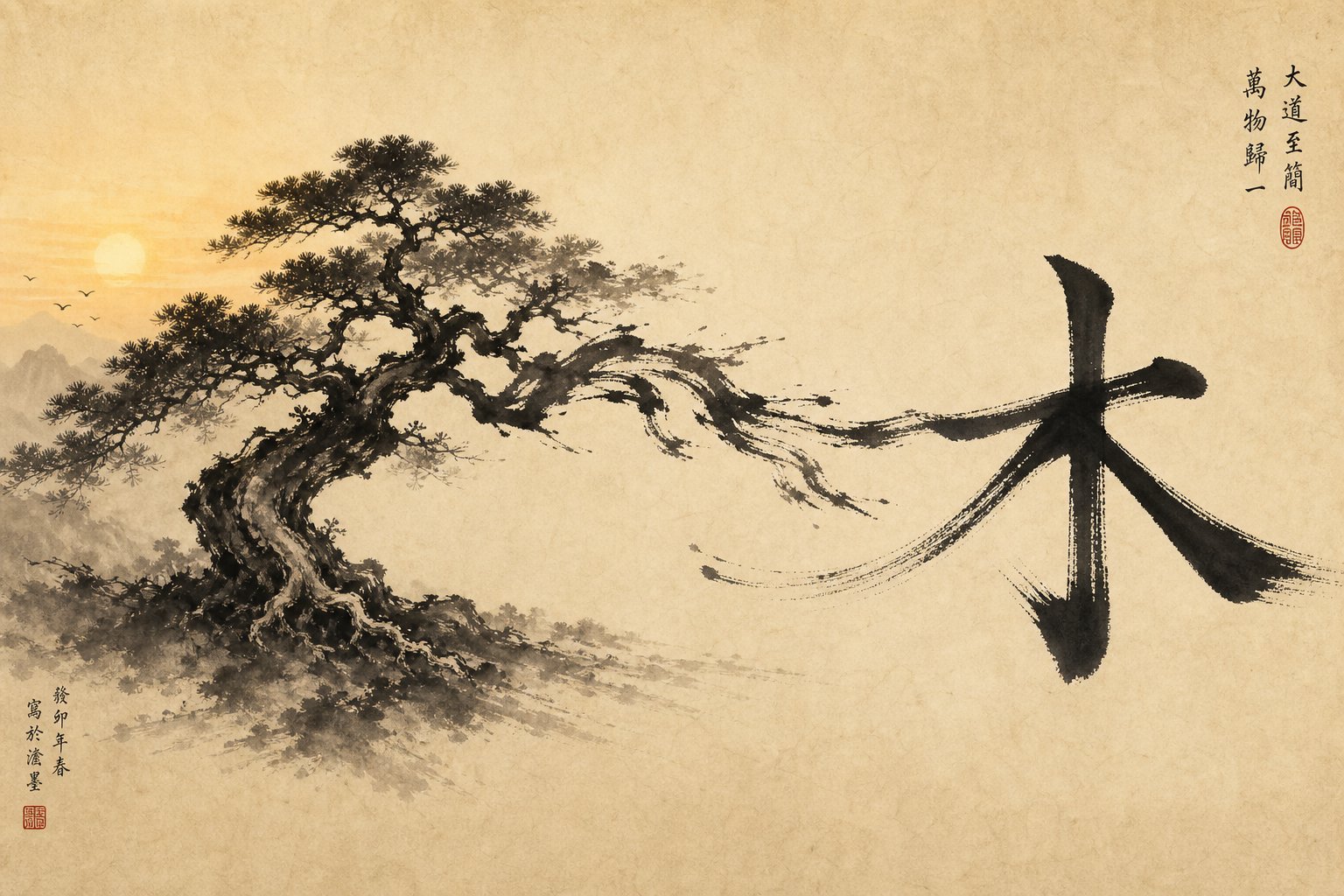
木 (mu) means wood, tree, or timber and is classified as a pictogram (象形字, xiangxingzi) — a character derived directly from a picture of the object it represents.
What Does 木 Mean in Chinese
The Chinese character wood — 木, pronounced mu in the fourth tone — is one of the oldest surviving pictograms in the language. It originally depicted a tree rooted in the ground, with branches reaching upward and roots spreading below. As a standalone word, it refers to wood as a material, timber, or trees in general. It appears in everyday vocabulary from 木头 (a piece of wood) to 木屋 (a wooden cabin), making it one of the most practical characters a learner can master early on.
What makes this character especially powerful is that it pulls triple duty. It works as a standalone word meaning wood or tree. It functions as Radical 75, a structural building block found inside hundreds of other characters. And it carries deep philosophical weight as the Wood element in China's Five Elements system. Few characters offer this much range.
Why This Character Matters for Learners
Think of 木 as a skeleton key. Once you recognize it, you start spotting it inside characters for table (桌), chair (椅), forest (林), school (校), and even machine (机). That pattern recognition accelerates reading speed and makes new vocabulary feel less random.
This article follows 木 from its ancient origins through pronunciation, radical function, vocabulary compounds, cultural philosophy, and idiomatic expressions. Whether you need a quick definition of the wood Chinese character or want to explore how a single tree sketch branched into over 200 related characters, each section goes one layer deeper.
How the Wood Character Evolved from Ancient Pictograph
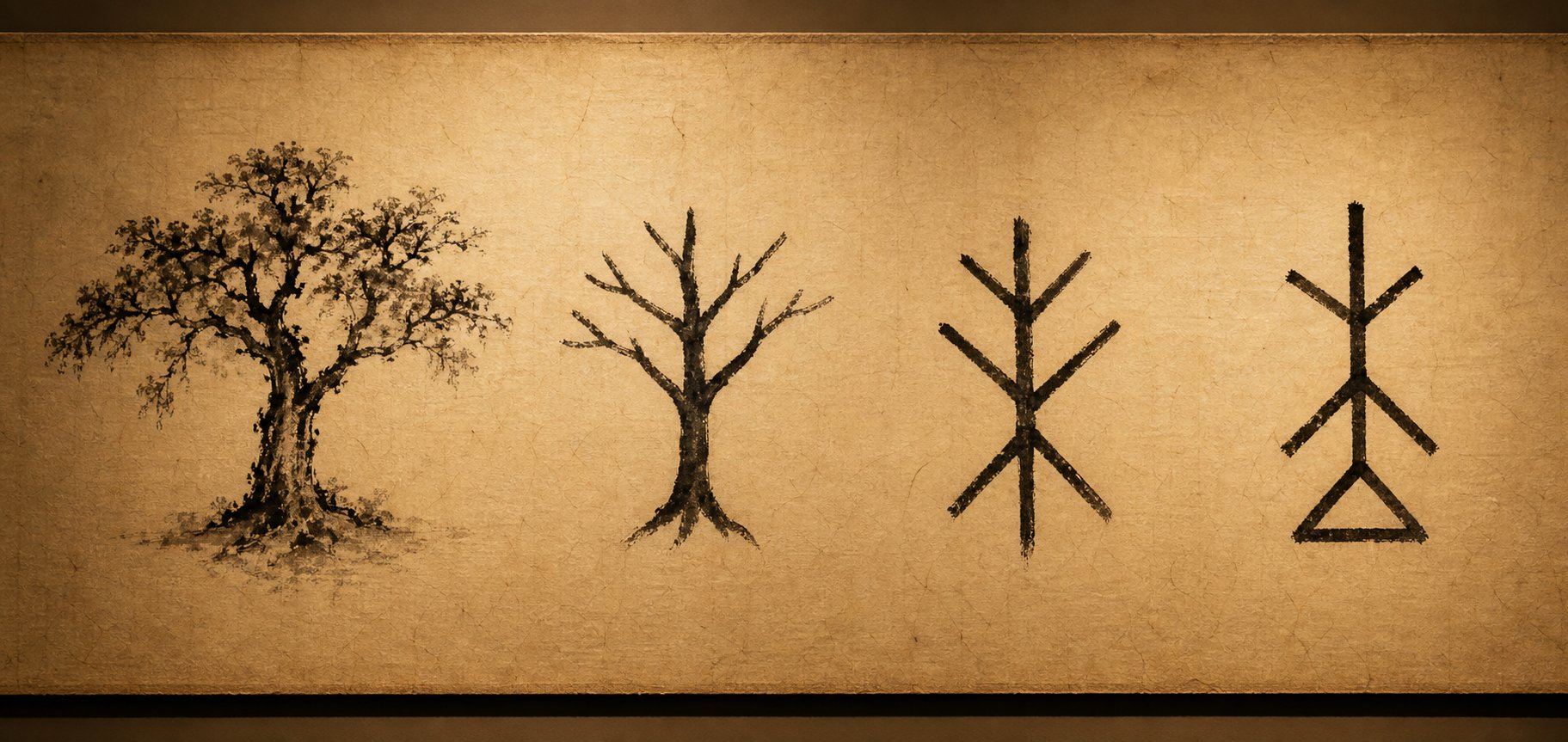
A character that looks the same in simplified and traditional Chinese is rare. 木 is one of those survivors — its form has remained remarkably stable across more than three thousand years of writing history. To understand why, you need to trace it back to its earliest appearance on oracle bones and watch how each era reshaped the image without ever losing the tree inside it.
Oracle Bone and Bronze Script Origins
The oldest known version of the ancient Chinese character for wood appears on oracle bone inscriptions (甲骨文, jiaguwen) from the Shang dynasty, roughly 1200-1050 BCE. Imagine a sketch that looks unmistakably like a tree: a central vertical line for the trunk, two curving strokes branching upward and outward at the top, and two more curving strokes reaching downward to represent roots digging into the earth. The overall shape resembles a stick figure of a tree drawn by someone who wanted you to recognize it instantly.
Bronze script (金文, jinwen), used during the late Shang and Zhou dynasties, kept the same basic structure but added slightly more weight and symmetry. The branches became rounder, the roots more evenly spaced. You'll notice the character still looked organic at this stage — curves dominated, and the strokes mimicked the natural growth patterns of an actual tree. Nothing about it felt geometric or abstract yet.
From Seal Script to Modern 木
Seal script (篆书, zhuanshu), standardized during the Qin dynasty around 221 BCE, began the shift toward regularity. The curving branches straightened into a single horizontal stroke crossing the trunk near the top. The roots, previously curling outward like real root tendrils, became two clean diagonal lines angling downward from the base of the trunk. The tree was still visible, but it had been tidied up — think of it as moving from a freehand sketch to a drafting-table version of the same image.
By the time clerical script (隶书, lishu) and regular script (楷书, kaishu) emerged during the Han dynasty and after, 木 had settled into the four-stroke form we write today: one horizontal line for branches, one vertical line for the trunk, and two falling diagonals for roots. The pictograph Chinese characters wood belongs to — the category called 象形字 (xiangxingzi) — rarely survives this intact across millennia. Most pictograms became so abstracted that their original image is unrecognizable without scholarly explanation. 木 is different. You can still see the tree.
A Pictograph That Survived Thousands of Years
Why did 木 resist change so effectively? Part of the answer is structural simplicity. Four strokes leave little room for further reduction. Another factor is frequency — because 木 appears as a radical inside hundreds of compound characters, its shape needed to stay recognizable at small sizes and in tight spaces. Simplification campaigns in the 1950s and 1960s left it untouched precisely because there was nothing to simplify. The traditional Chinese character for wood and the simplified version are identical.
This durability makes 木 a perfect entry point for understanding how Chinese writing works as a system. It demonstrates that pictograms are not arbitrary symbols — they carry visual logic inherited from real-world observation. And that visual logic extends outward: every time 木 appears inside a more complex character, it signals a connection to trees, wood, or plant-derived materials. Recognizing the tree inside the character is the first step toward reading that signal fluently.
Pronunciation and Stroke Order for 木
Seeing the tree inside 木 is one thing. Saying it correctly and writing it with confident strokes is where the character truly becomes yours. The good news? Both tasks are straightforward — this is a four-stroke, one-syllable character with a pronunciation that locks into memory once you hear the tone right.
Pronouncing Mu with the Correct Tone
The Chinese character for wood mu is pronounced mu in pinyin, marked with the fourth tone: mu (fourth tone). In pinyin notation, the tone mark sits above the vowel as a downward slash (like a tiny accent grave in reverse), giving you mu with that sharp falling pitch.
Sounds complex? Think of how you say "no" when you really mean it — firm, decisive, dropping from high to low in one quick motion. That falling energy is exactly what the fourth tone feels like. Start at the top of your vocal range and let your pitch drop sharply, almost like stamping a word into the ground. No rise, no dip in the middle, just a clean descent.
Chinese has four main tones plus a neutral tone, and getting them right matters because tone changes meaning entirely. For example, mu in the first tone (ma with a flat, high pitch) would be a completely different word. When you practice the mu wood Chinese character pronunciation, exaggerate the downward drop at first — it's easier to soften later than to add energy you never built.
Stroke Order and Writing Tips
木 is a chinese character with wood and four lines — exactly four strokes, written in this specific sequence:
- Horizontal stroke (横, heng) — Draw a short line from left to right across the upper portion. This represents the branches spreading outward.
- Vertical stroke (竖, shu) — Starting from the center of the horizontal line, pull straight down. This is the trunk of the tree.
- Left-falling stroke (撇, pie) — From the point where the horizontal and vertical strokes intersect, sweep diagonally down to the left. This is the first root.
- Right-falling stroke (捺, na) — From the same intersection point, press diagonally down to the right with a slight thickening at the end. This is the second root.
A common beginner mistake is writing the two diagonal strokes from the bottom of the vertical line. They actually originate from the crossing point — the junction where trunk meets branches. Keep the vertical stroke extending slightly below the diagonals so the character looks grounded, like a tree planted firmly in soil.
Memory Trick to Never Forget 木
Here's a visual mnemonic that makes the wood tree in Chinese character stick permanently: imagine you're looking at a real tree from a distance. The horizontal line is a pair of branches stretching left and right. The vertical line is the straight trunk. The two diagonal strokes are roots spreading into the earth beneath it. You're not memorizing an abstract symbol — you're drawing a tree every single time.
This visual logic is exactly what makes 木 a pictogram rather than an arbitrary sign. And once this tree-shape clicks in your mind, you'll start recognizing it tucked inside larger characters — sometimes on the left, sometimes on the bottom, always carrying that same woody, organic meaning forward into new words.
How 木 Works as a Radical to Build New Characters
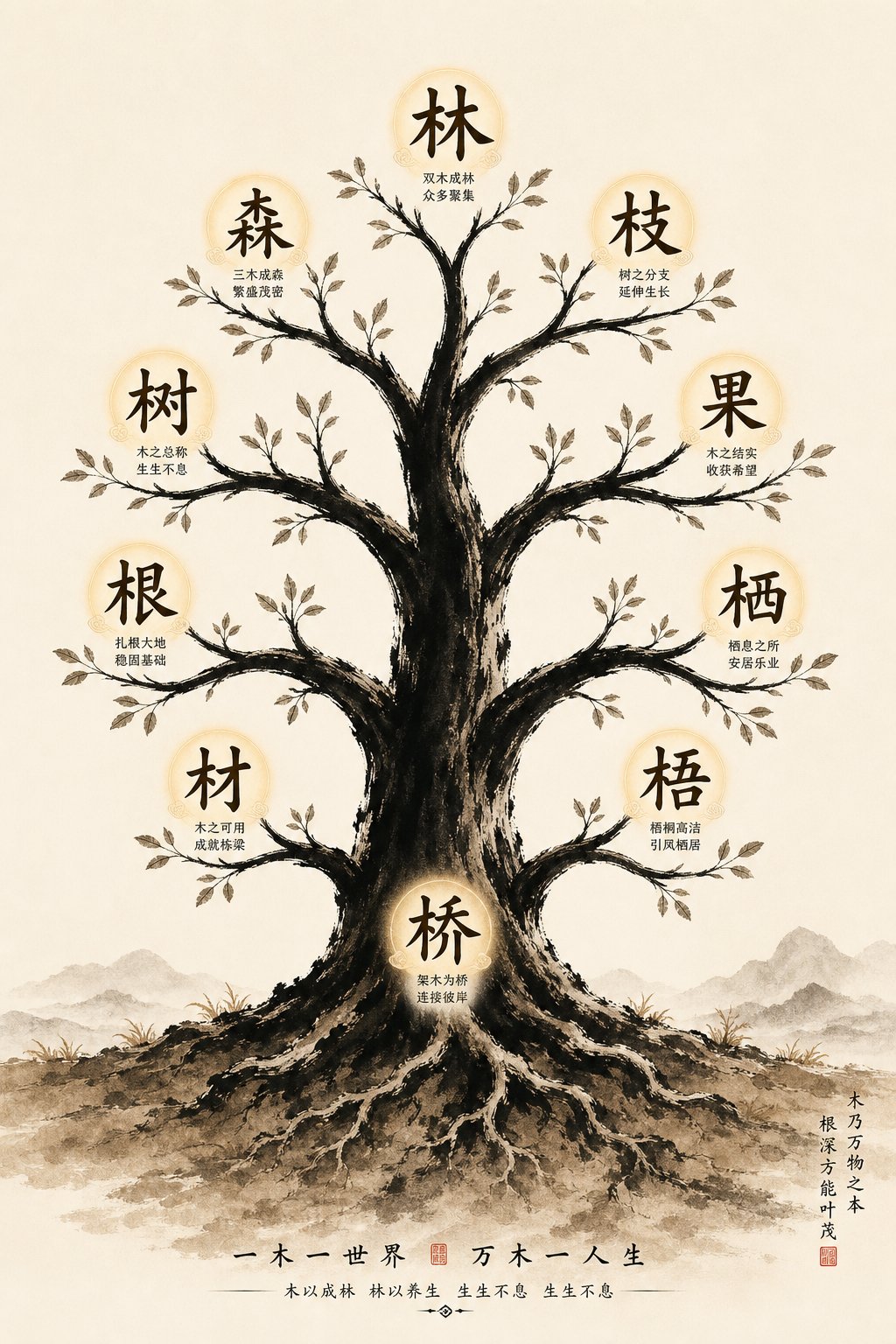
That tree shape you just learned to write? It doesn't stay solo for long. In Chinese, 木 is one of the most productive radicals (部首, bushou) in the entire writing system. It appears inside hundreds of compound characters, acting as a semantic signpost that tells you: this word has something to do with wood, trees, or materials that come from plants. Spot the radical, and you've already decoded part of the meaning before you even look up the pronunciation.
The wood radical — commonly called 木字旁 (mu zi pang) when it sits on the left side of a character — shows up in words ranging from tree species to furniture to abstract concepts. Its position shifts depending on the character's structure. You'll find it on the left side most often (as in 松, 桥, 椅), but it also appears at the bottom (as in 案, 梁, 果) or even across the top in certain formations. Regardless of placement, its job stays the same: signal a connection to wood or plant life.
What makes this radical so valuable for learners is the sheer number of characters it unlocks. Rather than memorizing each new character from scratch, you recognize the 木 component and immediately narrow down the meaning category. Below, you'll find Chinese characters with the wood radical organized by the real-world domains they describe.
Trees and Plants with the Wood Radical
The most intuitive group — characters that name actual trees, fruits, and plant species. Each one contains 木 because the thing it describes literally grows from wood:
- 松 (song) — pine tree; also means "loose" or "relaxed" in compounds like 放松 (relax)
- 柳 (liu) — willow tree; a classic symbol in Chinese poetry
- 桃 (tao) — peach; carries cultural weight as a symbol of longevity
- 梅 (mei) — plum blossom; one of the "Four Gentlemen" in Chinese art
- 桂 (gui) — osmanthus; associated with the Mid-Autumn Festival
- 柿 (shi) — persimmon; appears in 西红柿 (tomato)
- 李 (li) — plum; also one of the most common Chinese surnames
- 橡 (xiang) — oak; used in 橡皮 (eraser, literally "oak skin")
Notice how each character pairs the 木 radical with a phonetic component that hints at pronunciation. 松 combines 木 with 公 (gong) to approximate the "song" sound. 桃 pairs 木 with 兆 (zhao) to get close to "tao." This phonetic-semantic structure is the engine behind most Chinese characters with wood radical components.
Furniture and Wooden Objects
Before modern materials like plastic and metal took over, nearly every household object was carved, joined, or assembled from wood. The language remembers this history. Characters for furniture and everyday wooden items carry the 木 radical as a fossil record of what they were originally made from:
- 桌 (zhuo) — table or desk; 桌子 is one of the first nouns beginners learn
- 椅 (yi) — chair; always paired as 椅子 in spoken Chinese
- 柜 (gui) — cabinet or cupboard; 衣柜 means wardrobe
- 柱 (zhu) — pillar or column; the structural bones of traditional architecture
- 梁 (liang) — beam; a horizontal support in roofs and bridges
- 杯 (bei) — cup or glass; 杯子 covers everything from teacups to wine glasses
- 桶 (tong) — bucket or barrel; 垃圾桶 means trash can
- 梯 (ti) — ladder; 电梯 means elevator (literally "electric ladder")
Even though your coffee mug is probably ceramic and your chair might be steel, the characters still carry 木 inside them. The radical preserves the material origin — a reminder that these objects were wooden for most of Chinese history.
Building Materials and Structures
Scale up from furniture to architecture, and the wood radical keeps appearing. Traditional Chinese construction relied heavily on timber framing, and the vocabulary reflects that engineering heritage:
- 板 (ban) — board or plank; 黑板 means blackboard
- 桥 (qiao) — bridge; originally built from wooden beams and planks
- 栏 (lan) — railing or fence; 栏杆 is a handrail or balustrade
- 框 (kuang) — frame; used for door frames, picture frames, and text boxes
- 楼 (lou) — multi-story building; 楼 originally meant a wooden tower
- 村 (cun) — village; 农村 means countryside or rural area
- 材 (cai) — material; 材料 means raw materials or data
A character like 桥 is a perfect example of how the radical works. The left side (木) tells you the meaning category — something made from wood. The right side (乔) gives a phonetic clue pointing toward the "qiao" pronunciation. Together, they form a character that originally described wooden bridges spanning rivers and ravines.
Beyond the Obvious: Abstract Characters with 木
Here's where things get interesting. Some Chinese characters with the wood radical have drifted far from their literal timber origins. You might not guess these contain 木 unless you look closely:
- 机 (ji) — machine or opportunity; 飞机 (airplane), 手机 (phone), 机会 (chance)
- 校 (xiao/jiao) — school or to proofread; 学校 is one of the first words students learn
- 检 (jian) — to inspect or examine; 检查 means to check
- 概 (gai) — general or approximate; 大概 means "probably"
- 标 (biao) — mark or sign; 标准 means standard or criterion
Why does 机 (machine) have a wood radical? Because early machines — looms, printing presses, water wheels — were built from wood. The character preserved that origin even as technology moved to iron and silicon. Similarly, 校 (school) traces back to wooden structures where teaching happened. The radical is a linguistic time capsule.
Recognizing the chinese character with wood radical pattern gives you an immediate advantage when encountering unfamiliar characters. If you see 木 on the left, bottom, or embedded within a character you've never met before, you already know it connects to wood, plants, or something historically derived from them. That single insight cuts your guessing space dramatically and makes dictionary lookups faster — you can search by radical instead of flipping through thousands of entries blind.
The radical's productivity also reveals something about how Chinese builds meaning systematically. One pictogram of a tree, repeated and recombined across centuries, generated an entire ecosystem of vocabulary. And those characters don't just sit in isolation — they combine further into compound words, which is exactly where 木 shows its next layer of usefulness.
Common Words and Compounds Built from 木
Individual characters are the atoms of Chinese, but compound words are where real communication happens. 木 rarely appears alone in modern conversation — instead, it pairs with other characters to form specific, everyday vocabulary. These compounds show up in hardware stores, nature documentaries, real estate listings, and casual chat about weekend cabin trips. Knowing them transforms 木 from a study-card character into a word you actually use.
Essential 木 Vocabulary for Daily Use
Below are the most common compounds built from 木, along with example sentences that show how native speakers deploy them in context. You'll notice that 木 sometimes appears as the first character (specifying the material) and sometimes as the second (completing a broader concept).
- 木头 (mutou) — wood, log, or a piece of timber. This is the go-to word when referring to wood as a physical material. It also doubles as slang for someone who is emotionally dense or unresponsive ("wooden" in personality).
Example: 这块木头很适合做书架。(This piece of wood is perfect for making a bookshelf.) - 木材 (mucai) — timber, lumber. More formal than 木头, used in construction, industry, and trade contexts.
Example: 进口木材的价格今年涨了不少。(The price of imported lumber has risen quite a bit this year.) - 木工 (mugong) — carpentry or carpenter. Refers to both the craft and the person who practices it.
Example: 他退休后开始学木工。(He started learning carpentry after retiring.) - 木板 (muban) — wooden board or plank. The basic flat piece of wood used in shelving, flooring, and DIY projects.
Example: 墙上钉了几块木板当书架。(A few wooden boards were nailed to the wall as shelves.) - 木屋 (muwu) — wooden house, log cabin. Evokes rustic getaways and mountain retreats.
Example: 我们在山里租了一间木屋过周末。(We rented a cabin in the mountains for the weekend.) - 树木 (shumu) — trees collectively, as in a group or category. Used when talking about trees in general rather than one specific tree.
Example: 这个公园的树木种类非常丰富。(This park has a rich variety of trees.)
Notice the pattern: when 木 leads the compound (木头, 木材, 木工), the focus is on wood as a material or craft. When 木 follows another character (树木), it broadens the meaning into a collective or abstract category. This front-versus-back positioning is a reliable clue for guessing unfamiliar compounds.
木 vs 树 vs 林 vs 森 Explained
Here's a question that trips up nearly every learner: if 木 means tree, what's 树? And what about 林 and 森? These four characters form a logical progression — from a single tree concept to an entire forest — and understanding the differences clears up one of the most common points of confusion around the chinese character for woods and related terms.
Imagine starting with one tree, then placing two trees side by side, then packing three trees together. That visual logic is literally how these characters were constructed. The chinese character with two wood next to each other (林) means a grove or woods. The three woods chinese character (森) means a dense forest. It's one of the most elegant examples of how Chinese builds meaning through repetition and combination.
| Character | Pinyin | Meaning | Usage Context |
|---|---|---|---|
| 木 (mu) | mu, 4th tone | Wood (material); tree (abstract/classical) | Refers to wood as a substance or appears as a radical/building block. Rarely used alone in modern speech to mean a living tree. |
| 树 (shu) | shu, 4th tone | Tree (living, specific) | The standard modern word for a living tree. 那棵树 means "that tree." Used in 树叶 (leaf), 树枝 (branch), 种树 (plant a tree). |
| 林 (lin) | lin, 2nd tone | Grove, woods, a cluster of trees | Describes a small wooded area. Appears in 森林 (forest), 竹林 (bamboo grove), 树林 (woods). Also a common surname. |
| 森 (sen) | sen, 1st tone | Forest; dense, dark, imposing | Conveys thick, deep woodland. Used in 森林 (forest), 阴森 (gloomy/eerie). Carries a sense of density and depth. |
The key distinction: 木 is the concept and material, 树 is the living organism, and 林 and 森 describe increasing density of tree coverage. In modern Mandarin, you'd say 树 when pointing at a tree in a park, 木 when discussing the material your desk is made from, and 森林 when describing the Amazon rainforest.
There's also a visual elegance worth appreciating. The 2 chinese wood characters stacked side by side in 林 literally look like two trees standing together. Add a third 木 on top to form 森, and you can almost feel the canopy closing in overhead. This isn't coincidence — it's the pictographic logic of Chinese at work, building complex ideas by multiplying a simple image.
One more practical note: 森林 (senlin) combines both 森 and 林 into a single compound meaning "forest," which is the word you'll encounter most often in everyday Chinese. It appears in contexts from environmental news (森林火灾, forest fire) to children's stories (森林里的动物, animals in the forest). Recognizing that both characters trace back to 木 — one tree doubled, one tree tripled — makes the compound instantly memorable.
These vocabulary patterns reveal something deeper about how Chinese organizes meaning. The language doesn't just assign arbitrary sounds to concepts — it builds words visually and logically, layering simple elements into increasingly specific ideas. That same layering principle extends beyond vocabulary into philosophy, where 木 takes on symbolic weight far beyond its material definition.
The Wood Element in Chinese Philosophy and Culture
In vocabulary, 木 points to timber, trees, and furniture. In philosophy, it represents something far more expansive — an entire category of energy governing growth, renewal, and upward movement. The chinese character wood elements connection runs through traditional medicine, astrology, and even the names parents give their children. This is where a simple pictogram becomes a cosmological force.
Wood in the Five Elements System
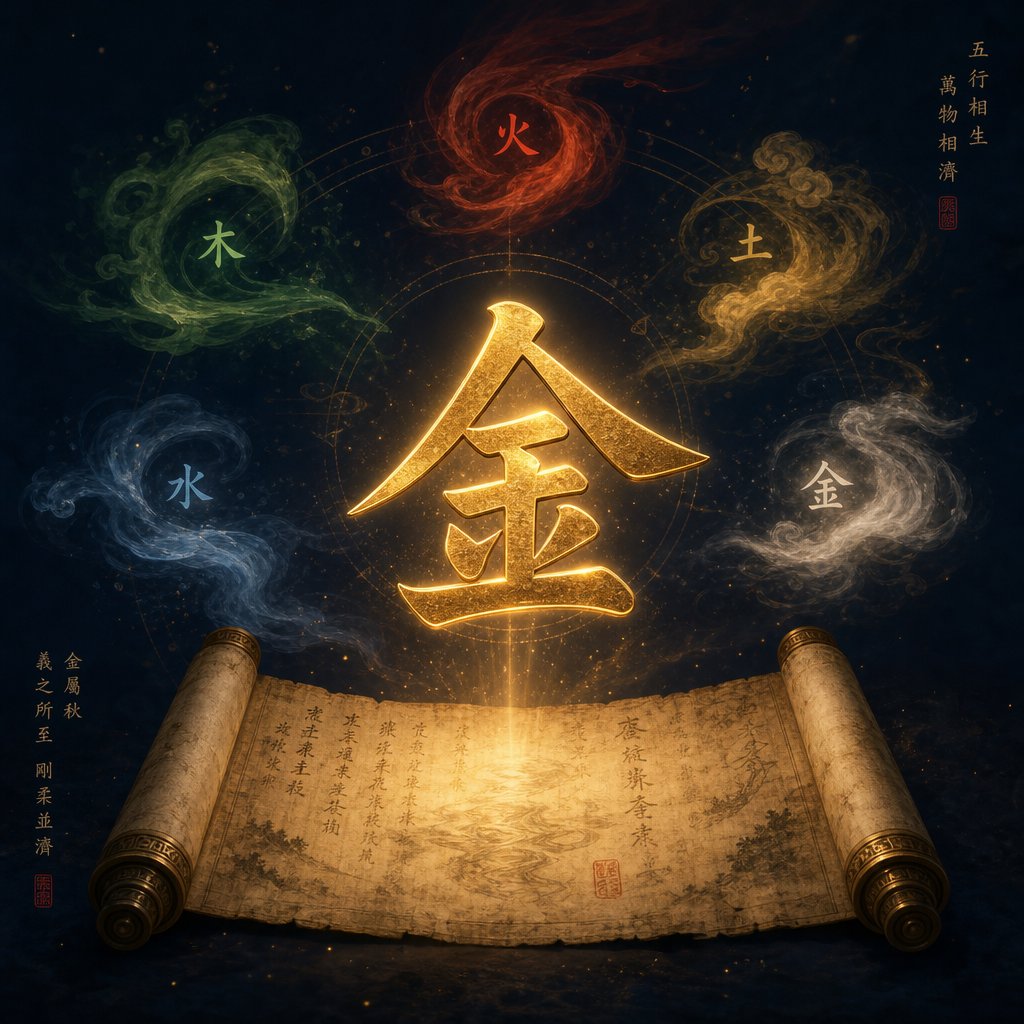
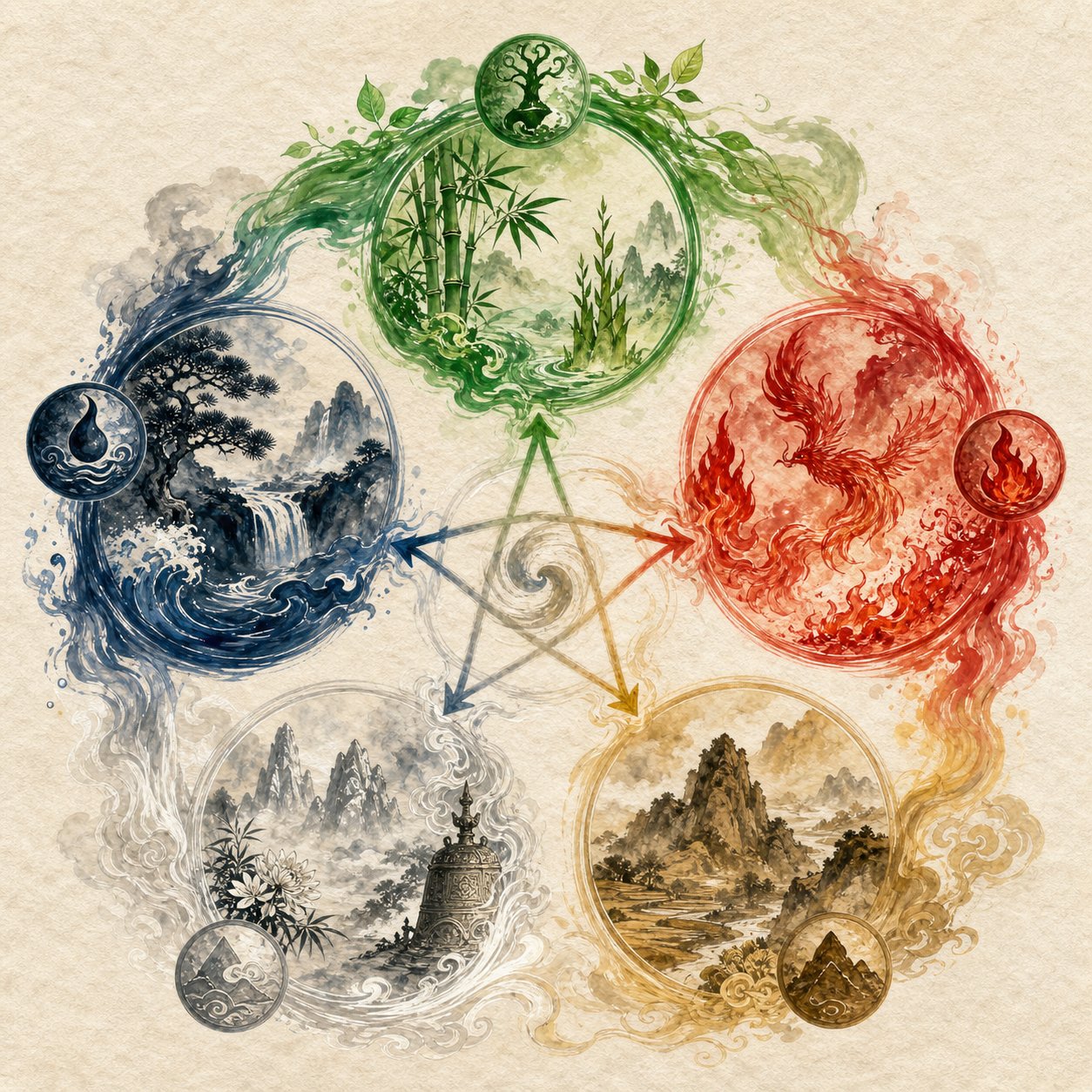
The Five Elements theory (五行, wuxing) is one of the oldest frameworks in Chinese thought. It maps the natural world into five interacting phases: Wood (木, mu), Fire (火, huo), Earth (土, tu), Metal (金, jin), and Water (水, shui). Each chinese character for wood fire earth metal water carries associations that extend into seasons, directions, body organs, colors, and emotions.
Wood's domain is spring — the season of sprouting, pushing upward, and expanding outward. Think of a seedling cracking through soil or a branch stretching toward sunlight. That rising, assertive energy defines the Wood element. In Traditional Chinese Medicine (TCM), Wood governs the liver and gallbladder, opens into the eyes, and manifests as tears among bodily fluids. When the Wood element is balanced, a person feels decisive, creative, and flexible. When it's excessive or stagnant, frustration, anger, and rigidity take over.
The table below maps all five elements to their core associations — a reference you'll see echoed across TCM clinics, feng shui consultations, and martial arts philosophy alike:
| Element | Chinese Character | Season | Direction | Color | Yin Organ | Yang Organ |
|---|---|---|---|---|---|---|
| Wood | 木 (mu) | Spring | East | Green | Liver | Gallbladder |
| Fire | 火 (huo) | Summer | South | Red | Heart | Small Intestine |
| Earth | 土 (tu) | Late Summer | Center | Yellow | Spleen | Stomach |
| Metal | 金 (jin) | Autumn | West | White | Lungs | Large Intestine |
| Water | 水 (shui) | Winter | North | Black | Kidneys | Urinary Bladder |
These elements don't exist in isolation — they interact through two cycles. In the generating cycle, each element feeds the next: Wood generates Fire (wood burns to create flame), Fire generates Earth (ash enriches soil), Earth generates Metal (minerals form underground), Metal generates Water (metal surfaces collect condensation), and Water generates Wood (rain nourishes trees). The chinese character wood fire relationship is the most intuitive — you can literally watch it happen at a campfire.
In the controlling cycle, each element restrains another: Wood controls Earth (roots break up soil and hold it in place), Earth controls Water (dams and banks contain rivers), Water controls Fire (extinguishes it), Fire controls Metal (melts it), and Metal controls Wood (axes cut trees). When TCM practitioners diagnose imbalances, they look at these relationships. A person with excessive Wood energy — high stress, irritability, tension headaches — might be "overacting" on Earth, disrupting digestion. Treatment aims to restore the cycle's natural rhythm.
Wood Element in the Chinese Zodiac
The Five Elements also rotate through the Chinese zodiac on a 60-year cycle. Each of the 12 zodiac animals pairs with each of the five elements once every 60 years, creating unique combinations like the Wood Dragon (木龙, mulong) or the Wood Pig (木猪, muzhu). The wood dragon in chinese characters — 木龙 — last appeared in 2024, and won't return until 2084. The wood pig chinese characters combination — 木猪 — last occurred in 1995 and cycles back in 2055.
What does a "Wood" animal mean in practice? The element modifies the animal's base personality. A Wood Dragon is considered more cooperative and less domineering than a Fire Dragon. A Wood Pig tends toward generosity and idealism, with strong creative instincts. Wood adds flexibility, growth orientation, and compassion to whatever animal it pairs with — qualities that mirror the element's association with spring and new beginnings.
Naming Traditions and Elemental Balance
Here's where the chinese character wood elements philosophy becomes deeply personal. In Chinese naming traditions, parents often consult a child's birth chart (八字, bazi — literally "eight characters") to determine which elements are strong or weak. If a child's chart lacks Wood energy, parents may choose a name containing 木-radical characters to restore balance. Names like 林 (lin, grove), 桂 (gui, osmanthus), 柏 (bai, cypress), or 楠 (nan, a type of hardwood) aren't just pleasant-sounding — they're prescriptive, intended to supplement a missing elemental force in the child's destiny.
This practice remains common across Chinese-speaking communities. A naming master might recommend characters with the wood radical for a child born in autumn (Metal's season) or winter (Water's season), reasoning that the child needs Wood's expansive, upward energy to counterbalance the contracting forces dominant at their birth time. The character 木 itself rarely appears in given names — it's considered too plain — but its radical offspring populate Chinese name registries by the millions.
This philosophical layer transforms how you read 木-containing characters. A word like 松 (pine) isn't just a tree species — it carries connotations of resilience and longevity. 梅 (plum blossom) signals perseverance through hardship, blooming in winter when other plants retreat. These cultural overtones, rooted in Five Elements thinking, give 木-radical characters an emotional depth that pure dictionary definitions miss. And that emotional depth surfaces most vividly in Chinese idioms — four-character expressions where 木 carries stories, warnings, and wisdom compressed into a handful of strokes.
Chinese Idioms and Expressions Featuring 木
Four-character idioms (成语, chengyu) are the poetry of everyday Chinese. They compress entire stories, moral lessons, and emotional states into tight packages that native speakers drop into conversation the way English speakers use phrases like "don't cry over spilled milk" or "hit the nail on the head." Because 木 carries such rich associations — rigidity, growth, material transformation, natural cycles — it appears in some of the most vivid and frequently used chengyu in the language.
Learning these idioms does more than expand your vocabulary. It shows you how Chinese speakers think metaphorically about wood: as something that can be carved, shaped, revived, or rendered motionless. Each expression below tells a miniature story, and knowing when to use them signals a level of fluency that textbook phrases alone can't achieve.
Four Essential Idioms Using 木
- 入木三分 (ru mu san fen) — Penetrating wood three-tenths of an inch
Literal meaning: To enter the wood to a depth of three-tenths.
Figurative meaning: Profoundly penetrating insight; incisive analysis or writing that cuts to the core of a matter.
Origin: This idiom traces back to the calligrapher Wang Xizhi of the Eastern Jin dynasty. His brushwork was said to be so powerful that when workers tried to scrape his characters off a wooden board, they found the ink had soaked three-tenths of an inch into the wood. The phrase evolved from praising calligraphy to praising any form of expression — writing, speech, criticism — that demonstrates exceptional depth and precision.
Usage context: You'd use this when complimenting someone's sharp observation or a piece of writing that captures a truth others miss. For example: 他对人性的分析入木三分 (His analysis of human nature is profoundly incisive). - 呆若木鸡 (dai ruo mu ji) — Dumb as a wooden chicken
Literal meaning: Stunned like a chicken made of wood.
Figurative meaning: Completely stunned or dumbfounded; frozen in shock, unable to react.
Origin: From the Daoist text Zhuangzi, where a trainer prepares a fighting rooster. The bird reaches peak readiness when it stands perfectly still, appearing wooden — so calm and centered that other roosters flee from its presence. Over time, the idiom shifted from describing supreme composure to describing someone frozen in shock or bewilderment.
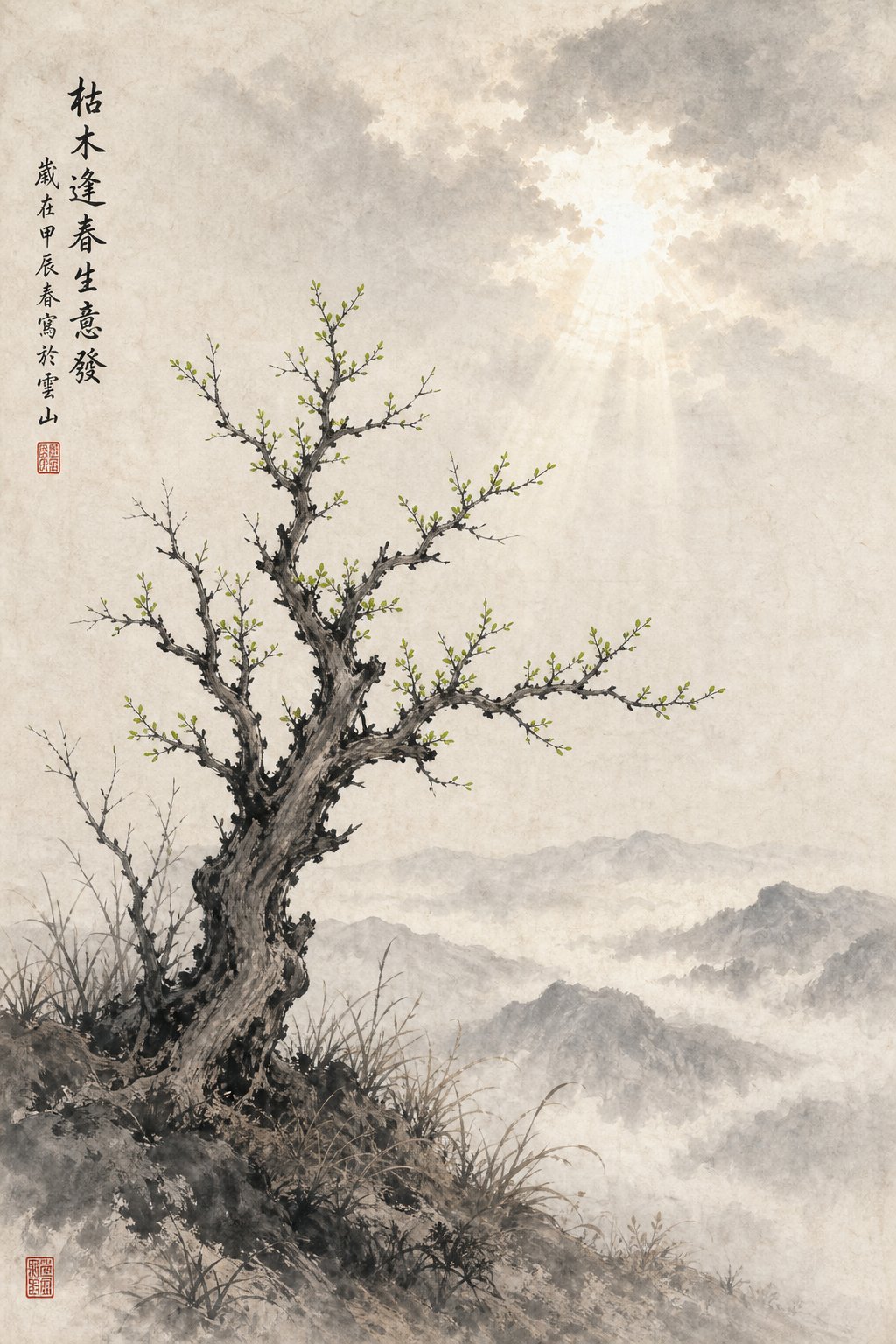
Usage context: Picture someone receiving unexpected news — a surprise layoff, a sudden proposal, a plot twist in a movie — and standing there motionless, mouth slightly open, brain buffering. That's 呆若木鸡. Example: 听到这个消息,她呆若木鸡地站在那里 (Hearing the news, she stood there completely dumbfounded). - 枯木逢春 (ku mu feng chun) — A dead tree meets spring
Literal meaning: A withered tree encounters springtime.
Figurative meaning: Revival after a period of hardship or decline; getting a second chance when all seemed lost.
Origin: The image is visceral — a tree that appeared dead through winter suddenly pushing out green buds when warm weather returns. It captures the moment when a failing business finds new investment, a struggling student finally breaks through, or a relationship recovers from near-collapse.
Usage context: This idiom carries hope and resilience. You'd use it when someone or something makes an unexpected comeback. Example: 这家老店经过改革,枯木逢春,生意又好起来了 (After restructuring, the old shop revived like a dead tree meeting spring — business picked up again). - 木已成舟 (mu yi cheng zhou) — The wood has already become a boat
Literal meaning: The timber has been built into a boat.
Figurative meaning: What's done is done; the situation is irreversible, so there's no point in regret or resistance.
Origin: Once raw lumber has been cut, shaped, and assembled into a vessel, you can't turn it back into a standing tree. The transformation is permanent. This idiom acknowledges irreversibility without bitterness — it's pragmatic rather than tragic.
Usage context: Chinese speakers reach for this phrase when someone is agonizing over a decision that's already been made. It's the equivalent of "no use crying over spilled milk," but with a more constructive undertone — the boat is built, so you might as well sail it. Example: 事情已经决定了,木已成舟,我们往前看吧 (The decision is made, what's done is done — let's look forward).
How to Use 木 Idioms in Context
You'll notice a pattern across these expressions. Wood serves as a metaphor for different states of being: rigid and unresponsive (呆若木鸡), deeply penetrable (入木三分), transformable into something new (木已成舟), or capable of renewal (枯木逢春). The material's physical properties — its hardness, its grain, its ability to be carved or to sprout — map directly onto human experiences.
A few practical tips for using these idioms naturally:
- Tone matters. 入木三分 is always a compliment. 呆若木鸡 can be humorous or sympathetic depending on delivery. 木已成舟 is consoling. 枯木逢春 is celebratory.
- Position in a sentence. Chengyu typically function as predicates or modifiers. They slot in where you'd place an adjective or a verb phrase: 他的文章入木三分 (His article is profoundly incisive) or 她呆若木鸡地看着我 (She stared at me, completely dumbfounded).
- Formality level. These idioms work in both written and spoken Chinese, though they carry a slightly literary flavor. Using them in conversation signals cultural literacy — like dropping a well-placed proverb in English.
Beyond these four, Chinese contains additional 木 idioms worth exploring as your level advances. 绳锯木断 (sheng ju mu duan — a rope saw cuts through wood) teaches that perseverance leads to success. 草木皆兵 (cao mu jie bing — every bush and tree looks like an enemy soldier) describes extreme paranoia. 缘木求鱼 (yuan mu qiu yu — climbing a tree to catch fish) mocks using the completely wrong method for a task. Each one builds on the same foundation: the physical reality of wood transformed into human wisdom.
These idiomatic expressions represent the deepest cultural layer of the wood Chinese character meaning — the point where a simple pictogram of a tree becomes a vehicle for storytelling, moral instruction, and emotional shorthand. Mastering even two or three of them gives you access to a register of Chinese that most textbooks never touch, and signals to native speakers that you understand the language beyond its surface mechanics.
Mastering 木 as Your Gateway to Chinese Characters
From oracle bone sketch to philosophical symbol to idiomatic metaphor, the chinese wood character 木 demonstrates what a single pictogram can do when an entire writing system builds outward from it. You've seen it function as a standalone word, a radical inside hundreds of compounds, a Five Elements force, and a storytelling device in classical idioms. That range isn't unique to 木 — it's how Chinese works. But few characters illustrate the principle as clearly or as accessibly as this one.
Your Learning Roadmap from 木 Outward
The most effective path through Chinese characters follows the same logic the writing system itself uses: start with a simple, high-frequency building block and expand outward in layers. Here's a concrete progression for turning your knowledge of wood in chinese characters into a broader reading ability:
- Step 1: Lock in the character itself. Write 木 from memory (four strokes, correct order), pronounce it with a clean fourth tone, and recall its core meanings — wood, tree, timber.
- Step 2: Learn its radical behavior. Recognize 木 when it appears on the left side (木字旁), at the bottom, or embedded within compound characters. Practice spotting it in words you already know: 桌, 椅, 校, 机.
- Step 3: Study 5-10 common compounds. Master everyday vocabulary like 木头, 木材, 树木, and 森林. Use them in sentences so they move from recognition to active production.
- Step 4: Explore the character family. Branch into 林 (two trees, grove) and 森 (three trees, forest). Notice how repetition of the same element builds meaning visually.
- Step 5: Connect to culture. Read about the Wood element in Five Elements theory. Learn one or two 木 idioms. This layer transforms passive vocabulary into cultural fluency.
One practical advantage worth repeating: the wood traditional chinese character and the simplified version are identical. Whether you're reading materials from mainland China, Taiwan, Hong Kong, or overseas Chinese communities, 木 looks the same everywhere. That universality makes it one of the safest starting points for any learner regardless of which script system they plan to focus on.
Why Radical-Based Learning Accelerates Progress
Research supports this approach. A study published in Frontiers in Psychology found that nonnative Chinese learners who received explicit instruction on semantic radicals significantly improved their ability to infer meanings of unfamiliar characters — and transferred that strategy to radicals they hadn't even been taught. The takeaway: learning how radicals work doesn't just help you with the specific characters you study. It gives you a transferable skill for decoding new characters you encounter in the wild.
木 is one of the most combinable radicals in modern Chinese, appearing in over 100 commonly used characters. Master its pattern, and you've built a template you can apply to other high-frequency radicals like 水 (water), 火 (fire), 金 (metal), and 土 (earth). Each one unlocks its own family of characters using the same logic: recognize the radical, infer the meaning category, then use context to narrow down the specific definition.
That's the real power of starting with 木. It's not just one character — it's a method disguised as a tree.
Frequently Asked Questions About the Wood Chinese Character
1. What is the Chinese character for wood and how is it pronounced?
The Chinese character for wood is 木, pronounced mu in the fourth tone (a sharp falling pitch). It is classified as a pictogram (象形字) because it visually represents a tree with branches on top and roots below. This character serves as a standalone word meaning wood, tree, or timber, and it remains identical in both simplified and traditional Chinese writing systems.
2. How many strokes does the Chinese wood character have and what is the correct stroke order?
The character 木 has exactly four strokes written in this sequence: first a horizontal stroke (representing branches), then a vertical stroke downward (the trunk), followed by a left-falling diagonal stroke, and finally a right-falling diagonal stroke (both representing roots). The two diagonal strokes originate from the intersection point where the horizontal and vertical lines cross, not from the bottom of the vertical stroke.
3. What is the difference between 木, 树, 林, and 森 in Chinese?
These four characters form a logical progression from one tree to a forest. 木 (mu) refers to wood as a material or abstract concept and functions as a radical. 树 (shu) is the modern word for a living, specific tree. 林 (lin) combines two 木 side by side to mean a grove or woods. 森 (sen) stacks three 木 together to convey a dense forest. In daily conversation, use 树 when pointing at a tree, 木 when discussing wood material, and 森林 when referring to a forest.
4. What does the wood element represent in Chinese philosophy?
In the Five Elements system (五行), Wood (木) represents growth, vitality, and upward movement. It is associated with spring, the east direction, the color green, and the liver in Traditional Chinese Medicine. Wood generates Fire in the productive cycle and controls Earth in the restraining cycle. This element also appears in the Chinese zodiac, creating combinations like Wood Dragon (木龙) or Wood Pig (木猪), and influences naming traditions where parents select 木-radical characters to balance a child's elemental birth chart.
5. How does the wood radical help in learning Chinese characters?
The wood radical (木) appears in over 100 commonly used characters, making it one of the most productive building blocks in Chinese. When you spot 木 on the left side, bottom, or embedded within an unfamiliar character, it signals a connection to wood, trees, or plant-derived materials. This pattern applies to tree names (松 pine, 柳 willow), furniture (桌 table, 椅 chair), structures (桥 bridge, 楼 building), and even abstract words like 机 (machine) whose original forms were wooden. Research shows that learners who understand radical functions can infer meanings of characters they have never studied before.